QUALIT MANAGEMENT SYSTEMS
SUBMITED BY:
18-MCE-83 18-MCE-84
18-MCE-88 18-MCE-15
SUBMITED TO:
DR. SYED AMJAD AHMAD
What is a QMS?
The short answer:
 Say what you do (documentation)
 Do what you say (implementation)
 Prove what you do (records)
 Review and improve (continuous improvement)
QMS Definitions
A Quality Management System is:
 System for managing the quality of an organization
 Includes everything in the organization that relates to quality:
◦ Products and services
◦ Processes
◦ Operations
◦ Customer Satisfaction
QMS Description
As required by ISO 9000:
 The Quality System is well documented, implemented, understood,
maintained and continually improved
 Emphasis is placed on problem prevention rather than inspection
 Quality planning is required
 The PROCESS APPROACH to management is encouraged
What makes it so special?
 Process Approach to management
 Integration of processes into a System/ Interrelation of all activities
 Continual Improvement at all levels
 Communication among all employees and management that leads
to full utilization of everyone’s talents.
DEFINITION
“A desired result is achieved more efficiently when activities and
related resources are managed as a process.”
 PROCESS – collection of interrelated activities that transform
inputs into outputs
DEFINITION
“Identifying, understanding, and managing interrelated processes as a
system contributes to the organization’s effectiveness and efficiency
in achieving its objective.”
 SYSTEM – a collection of interrelated processes with a common
set of objectives and outputs.
DEFINITIONS
 PROCESS CHAMPION – member of top management who
has interest in promoting the control and improvement of a
specific process.
 PROCESS OWNER – the head of one of the key functions
involved in the actual operation of the process and is
responsible for ensuring that the process is understood,
documented, implemented, controlled, and improved.
DEFINITIONS
 VERIFICATION – the confirmation that specified
requirements have been met
 VALIDATION – confirmation through the provision of
objective evidence that the requirements for a specific
intended use or application have been fulfilled.
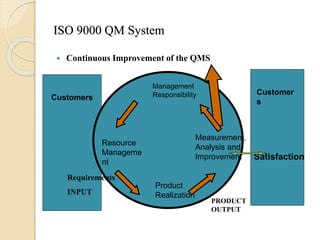
ISO 9000 QM System
 Continuous Improvement of the QMS
Customers
Resource
Manageme
nt
Measurement,
Analysis and
Improvement
Management
Responsibility
Product
Realization
PRODUCT
OUTPUT
Requirements
INPUT
Customer
s
Satisfaction
Quality Management Style
 Focus on the entire system
 Customer is main concern
 Communication at all levels
 Continuous Improvement
 Responsibility assigned
Why Implement a QMS?
 Ensure Customer Satisfaction
 Improve Quality System
 Enhance Control of Resources
 Improve Suppliers Performance
ISO 9000 Elements
• SCOPE covers why the standard is used
• APPLICATION states that the standard is generic and there can
be exclusions from section 7
• TERMS AND DEFINITIONS reference ISO 9000 and 9001
vocabulary
• General Requirements (Documentation requirements covered in
earlier training)
• Management Responsibility
• Resource Management
• Product Realization
• Measurement, Analysis and Improvement
General ( Documentation)
 Covered in “Creating and Documenting a Quality Management
System”
 Managers and supervisors most likely would write or participate in
writing documents:
◦ procedures
◦ forms
◦ work instructions
 Managers and supervisors provide oversight of record creation,
preservation, and retention
Management Responsibility
 Management Commitment
 Customer Focus
 Planning (Objectives & QMS)
 Responsibility, Authority and Communication (Management
Representative)
 Management Review
Resource Management
(Human, Infrastructure and Environment)
 Provision of Resources
 Human Resources
◦ General
◦ Competence, Awareness, and Training
 Infrastructure
 Work Environment
Product Realization
 Planning
 Customer-Related Processes
 Design and Development
 Purchasing
 Production and Service Provision
 Control of Monitoring and Measuring Devices
Measurement, Analysis and Improvement
 General
 Monitoring and Measurement
 Control of Nonconforming Product
 Analysis of Data
 Improvement
QUALITY MANAGEMENT PRINCIPLES
What are ISO 9000 Principles?
 Fundamental beliefs that form the foundation of the ISO
requirements
 Lead to quality excellence by following them
 Are based on practical application
 Can be applied at any level of the quality pyramid
◦ Quality Control (QC)
◦ Quality Management (QM)
◦ Total Quality Management (TQM)
ISO 9000 Principles
 Customer Focus
 Leadership
 Involvement of People
 Process Approach
 Systems Approach to Management
 Continual Improvement
 Factual Approach to Decision Making
 Mutually beneficial supplier relationship
ISO 9000 Principles
(1) Customer Focus
 QC -- understand and meet basic requirements; little or no
knowledge of customer perceptions
 QM – better understanding of overall requirements; customer
satisfaction tracked
 TQM – customer information collected systematically
throughout the company; knowledge of customer perception;
ability to offer preferred products
(2) Leadership
 QC – management provides resources sufficient for quality
control
 QM – management establishes policy, objectives and
environment to control processes that ensure quality
 TQM – managers provide personal examples that create
customer satisfaction; quality is a strategic issue
(3) Involvement of people
 QC – people must create and operate basic process; does
not draw on full talents
 QM – processes defined and personnel qualified; employees
contribute to improvement
 TQM – employees fully engaged & entirely involved; high
level of communication between leaders and employees
(4) Process Approach
 QC – inspection and testing are common; controlled
processes provide feedback
 QM – movement from control of only process outputs to
control of the process itself ; additional processes such as
management review, corrective actions, etc.
 TQM – optimizes resources, continually improves, uses
process measures
(5) System Approach to Management
 QC – inspection and control systems work together but not
integrated with the rest of the organization
 QM – moved to integrate the process for creating the product with
verification of the final product; focus on customer satisfaction
 TQM – fully understands the interaction among the processes;
continually improves
(6) Continual Improvement
 QC – focus on improvements to ensure that the customer does
not receive defective products
 QM – focus on improving the effectiveness and efficiency of
the QMS; mature corrective/preventive loop
 TQM – focus on efficiently meeting customer needs through
the QMS; leaders involved in improvement process
(7) Factual Approach to Decision Making
 QC – uses data to distinguish nonconformities; statistical data
ensure requirements are met; little use of data to measure
trends
 QM – facts and data used to make decisions regarding the
QMS; focus on improvement
 TQM – analysis used to improve market position; information
gathered from all members of the organization
(8)Mutually Beneficial Supplier Relationship
 QC – some validation of the suppliers product
 QM – processes to define and document, review and evaluate; well
developed and defined validation process
 TQM – focus changes with established strategic alliances or
partnerships; mutual commitment to customer satisfaction; focus on
continual improvement becomes common

Qualit management systems

  • 1.
    QUALIT MANAGEMENT SYSTEMS SUBMITEDBY: 18-MCE-83 18-MCE-84 18-MCE-88 18-MCE-15 SUBMITED TO: DR. SYED AMJAD AHMAD
  • 2.
    What is aQMS? The short answer:  Say what you do (documentation)  Do what you say (implementation)  Prove what you do (records)  Review and improve (continuous improvement)
  • 3.
    QMS Definitions A QualityManagement System is:  System for managing the quality of an organization  Includes everything in the organization that relates to quality: ◦ Products and services ◦ Processes ◦ Operations ◦ Customer Satisfaction
  • 4.
    QMS Description As requiredby ISO 9000:  The Quality System is well documented, implemented, understood, maintained and continually improved  Emphasis is placed on problem prevention rather than inspection  Quality planning is required  The PROCESS APPROACH to management is encouraged
  • 5.
    What makes itso special?  Process Approach to management  Integration of processes into a System/ Interrelation of all activities  Continual Improvement at all levels  Communication among all employees and management that leads to full utilization of everyone’s talents.
  • 6.
    DEFINITION “A desired resultis achieved more efficiently when activities and related resources are managed as a process.”  PROCESS – collection of interrelated activities that transform inputs into outputs
  • 7.
    DEFINITION “Identifying, understanding, andmanaging interrelated processes as a system contributes to the organization’s effectiveness and efficiency in achieving its objective.”  SYSTEM – a collection of interrelated processes with a common set of objectives and outputs.
  • 8.
    DEFINITIONS  PROCESS CHAMPION– member of top management who has interest in promoting the control and improvement of a specific process.  PROCESS OWNER – the head of one of the key functions involved in the actual operation of the process and is responsible for ensuring that the process is understood, documented, implemented, controlled, and improved.
  • 9.
    DEFINITIONS  VERIFICATION –the confirmation that specified requirements have been met  VALIDATION – confirmation through the provision of objective evidence that the requirements for a specific intended use or application have been fulfilled.
  • 10.
    ISO 9000 QMSystem  Continuous Improvement of the QMS Customers Resource Manageme nt Measurement, Analysis and Improvement Management Responsibility Product Realization PRODUCT OUTPUT Requirements INPUT Customer s Satisfaction
  • 11.
    Quality Management Style Focus on the entire system  Customer is main concern  Communication at all levels  Continuous Improvement  Responsibility assigned
  • 12.
    Why Implement aQMS?  Ensure Customer Satisfaction  Improve Quality System  Enhance Control of Resources  Improve Suppliers Performance
  • 13.
    ISO 9000 Elements •SCOPE covers why the standard is used • APPLICATION states that the standard is generic and there can be exclusions from section 7 • TERMS AND DEFINITIONS reference ISO 9000 and 9001 vocabulary • General Requirements (Documentation requirements covered in earlier training) • Management Responsibility
  • 14.
    • Resource Management •Product Realization • Measurement, Analysis and Improvement
  • 15.
    General ( Documentation) Covered in “Creating and Documenting a Quality Management System”  Managers and supervisors most likely would write or participate in writing documents: ◦ procedures ◦ forms ◦ work instructions  Managers and supervisors provide oversight of record creation, preservation, and retention
  • 16.
    Management Responsibility  ManagementCommitment  Customer Focus  Planning (Objectives & QMS)  Responsibility, Authority and Communication (Management Representative)  Management Review
  • 17.
    Resource Management (Human, Infrastructureand Environment)  Provision of Resources  Human Resources ◦ General ◦ Competence, Awareness, and Training  Infrastructure  Work Environment
  • 18.
    Product Realization  Planning Customer-Related Processes  Design and Development  Purchasing  Production and Service Provision  Control of Monitoring and Measuring Devices
  • 19.
    Measurement, Analysis andImprovement  General  Monitoring and Measurement  Control of Nonconforming Product  Analysis of Data  Improvement
  • 20.
  • 21.
    What are ISO9000 Principles?  Fundamental beliefs that form the foundation of the ISO requirements  Lead to quality excellence by following them  Are based on practical application  Can be applied at any level of the quality pyramid ◦ Quality Control (QC) ◦ Quality Management (QM) ◦ Total Quality Management (TQM)
  • 22.
    ISO 9000 Principles Customer Focus  Leadership  Involvement of People  Process Approach  Systems Approach to Management  Continual Improvement  Factual Approach to Decision Making  Mutually beneficial supplier relationship
  • 23.
    ISO 9000 Principles (1)Customer Focus  QC -- understand and meet basic requirements; little or no knowledge of customer perceptions  QM – better understanding of overall requirements; customer satisfaction tracked  TQM – customer information collected systematically throughout the company; knowledge of customer perception; ability to offer preferred products
  • 24.
    (2) Leadership  QC– management provides resources sufficient for quality control  QM – management establishes policy, objectives and environment to control processes that ensure quality  TQM – managers provide personal examples that create customer satisfaction; quality is a strategic issue
  • 25.
    (3) Involvement ofpeople  QC – people must create and operate basic process; does not draw on full talents  QM – processes defined and personnel qualified; employees contribute to improvement  TQM – employees fully engaged & entirely involved; high level of communication between leaders and employees
  • 26.
    (4) Process Approach QC – inspection and testing are common; controlled processes provide feedback  QM – movement from control of only process outputs to control of the process itself ; additional processes such as management review, corrective actions, etc.  TQM – optimizes resources, continually improves, uses process measures
  • 27.
    (5) System Approachto Management  QC – inspection and control systems work together but not integrated with the rest of the organization  QM – moved to integrate the process for creating the product with verification of the final product; focus on customer satisfaction  TQM – fully understands the interaction among the processes; continually improves
  • 28.
    (6) Continual Improvement QC – focus on improvements to ensure that the customer does not receive defective products  QM – focus on improving the effectiveness and efficiency of the QMS; mature corrective/preventive loop  TQM – focus on efficiently meeting customer needs through the QMS; leaders involved in improvement process
  • 29.
    (7) Factual Approachto Decision Making  QC – uses data to distinguish nonconformities; statistical data ensure requirements are met; little use of data to measure trends  QM – facts and data used to make decisions regarding the QMS; focus on improvement  TQM – analysis used to improve market position; information gathered from all members of the organization
  • 30.
    (8)Mutually Beneficial SupplierRelationship  QC – some validation of the suppliers product  QM – processes to define and document, review and evaluate; well developed and defined validation process  TQM – focus changes with established strategic alliances or partnerships; mutual commitment to customer satisfaction; focus on continual improvement becomes common