Insert image
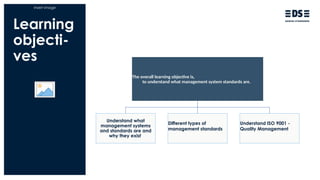
Learning
objecti-
ves
The overalllearning objective is,
to understand what management system standards are.
Understand what
management systems
and standards are and
why they exist
Different types of
management standards
Understand ISO 9001 -
Quality Management
3.
What is amanagement system?
A management system is the way in which an organization manages
the interrelated parts of its business in order to achieve its objectives.
These objectives can relate to a number of different topics, including
product or service quality, operational efficiency, environmental
performance, health and safety in the workplace and many more.
4.
A management systemis made up
by management standards
In order to structure the management
system, one or more different management
standards are used.
These can be standards for e.g.
• Quality management (ISO 9001)
• Environmental management (ISO 14001)
• OHS (occupational health and safety)
management (ISO 45001)
• Food safety (ISO 22000)
• Energy management (ISO 50001)
• Social responsibility (ISO 26000)
•
• These management standards follow the
same structure, making it easier to
implement new management standards.
• Management standards contain a
certain number of requirements that the
company must comply with if it wishes to
be certified.
• A certification is done through an
accredited organization (e.g. Bureau
Veritas, DNV or Lloyds) and must be
renewed every 3 years.
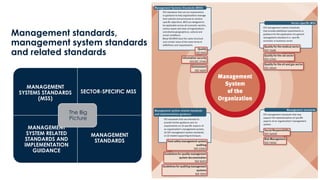
5.
Management standards,
management systemstandards
and related standards
MANAGEMENT
SYSTEMS STANDARDS
(MSS)
SECTOR-SPECIFIC MSS
MANAGEMENT
SYSTEM RELATED
STANDARDS AND
IMPLEMENTATION
GUIDANCE
MANAGEMENT
STANDARDS
The Big
Picture
6.
Benefits of applying
management
standards
Benefitsfor a company implementing a management system
More efficient use of resources
Improved financial performance
Improved risk management
Protection of people and the environment
• Increased ability to deliver consistent and improved products
and services, increasing value for customers and other
stakeholders.
• Bottom line
7.
Group exercise
In groupsof 5
1. Discuss what you think characterizes quality? What
do you think it is about? (you have 5 min. to discuss)
2. Identify 3-4 key quality related principles that you
think would be necessary for a quality management
system! (10 min.)
3. Present 3-4 key principles to the rest of the groups (3
min. Per group presentation)
What is a principle?
• A principle is a basic rule that guides or influences
thought or action.
• In other words, principles guide our decision-making.
We want to make decisions that support our
principles!
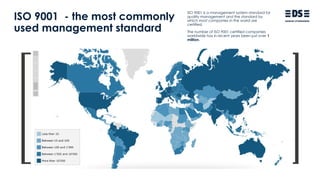
ISO 9001 -the most commonly
used management standard
Insert chart
ISO 9001 is a management system standard for
quality management and the standard by
which most companies in the world are
certified.
The number of ISO 9001 certified companies
worldwide has in recent years been just over 1
million.
10.
Why is ISO9001 so
common?
ISO 9001 sets out the
requirements for a quality
management system. It helps
businesses and organizations
to be more efficient and
improve customer satisfaction.
It is based on a number of
quality management
principles including continuous
improvement.
ISO 9001 specifies requilremsent
It helps ensure compliance
with customer requirements
and relevant legal and
regulatory requirements.
It sets the criteria for a quality
system and is the only
standard in the 9000 family
after which a company can
be certified.
It can be used by any
organization, large or small,
regardless of its scope.
Insert image
11.
Key QMS
principles
Principle 1Principle 3 Principle 5
Principle 2 Principle 4 Principle 6
Customer focus Engagement of
people
Improvement
Leadership Process approach Evidence-based
decision-making
The primary focus of quality management
is to meet customer requirements and to
strive to exceed customer expectations.
Leaders at all levels establish unity of
purpose and direction and create
conditions in which people are
engaged in achieving the
organization’s quality objectives.
Competent, empowered and
engaged people at all levels
throughout the organization are
essential to enhance its capability to
create and deliver value.
Consistent and predictable results
are achieved more effectively and
efficiently when activities are
understood and managed as
interrelated processes that function
as a coherent system.
Successful organizations have an
ongoing focus on improvement.
Decisions based on the analysis and
evaluation of data and information are
more likely to produce desired results.
Principle 7
Relationship
management
For sustained success, an
organization manages its
relationships with interested parties,
such as suppliers.
12.
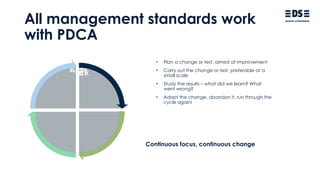
All management standardswork
with PDCA
• Plan a change or test, aimed at improvement
• Carry out the change or test, preferable at a
small scale
• Study the results – what did we learn? What
went wrong?
• Adopt the change, abandon it, run through the
cycle again!
Plan
Do
Check
Act
Continuous focus, continuous change
13.
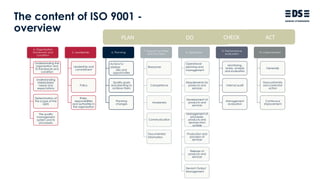
The content ofISO 9001 -
overview
4. Organisation
framework and
condition
Understanding the
organization and
its framework and
condition
Understanding
stakeholders'
needs and
expectations
Determination of
the scope of the
QMS
The quality
management
system and its
processess
5. Leadership
Leadership and
commitment
Policy
Roles,
responsibilities
and authorities in
the organization
6. Planning
Actions to
address
risks and
opportunities
Quality goals
and planning to
achieve them
Planning
changes
7. Support activities
and functions
Resources
Competence
Awareness
Communication
Documented
information
8. Operation
Operational
planning and
management
Requirements for
products and
services
Development of
products and
services
Management of
processes,
products and
services from
outside
Production and
provision of
services
Release of
products and
services
Deviant Output
Management
9. Performance
evaluation
Monitoring,
revies, analysis
and evaluation
Internal audit
Management
evaluation
10. Improvement
Generally
Nonconformity
and corrective
action
Continuous
improvement
PLAN DO CHECK ACT
14.
Insert image
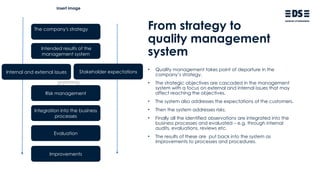
From strategyto
quality management
system
• Quality management takes point of departure in the
company’s strategy.
• The strategic objectives are cascaded in the management
system with a focus on external and internal issues that may
affect reaching the objectives.
• The system also addresses the expectations of the customers.
• Then the system addresses risks.
• Finally all the identified observations are integrated into the
business processes and evaluated – e.g. through internal
audits, evaluations, reviews etc.
• The results of these are put back into the system as
improvements to processes and procedures.
The company's strategy
Intended results of the
management system
Risk management
Integration into the business
processes
Evaluation
Improvements
Stakeholder expectations
Internal and external issues
15.
Exercise: Design yourown QMS
1. Think of an organization from your life
that could benefit from a QMS e.g. your
workplace, sports club or a cafe - just
think of any example!
2. In groups of 5 people select the best
example (5 min)
3. Define the objectives of your QMS (10
min) (see text to the right)
4. Identify your organization’s key processes
for meeting one of your organizations
objectives as well as your customers’
needs. (10 min)
5. Present what key process you came up
with (5 min each)
The objective may be in the form of critical
success factors. This helps an organization in
emphasizing the journey towards
accomplishing its mission. These
performance-based measures deliver a
gauge to determine compliance with its
objectives.
Some Critical Success Factors are:
• Financial Performance
• Product Quality
• Process Improvement
• Customer Satisfaction
• Market Share
• Employee Satisfaction
Editor's Notes
#3 The level of complexity of the system will depend on each organization’s specific context.
For some organizations, especially smaller ones, it may simply mean having strong leadership from the business owner, providing a clear definition of what is expected from each individual employee and how they contribute to the organization’s overall objectives, without the need for extensive documentation.
#5 Top left: Management system standards set requirements that enable organizations to achieve their goals in different areas. Management system standards are generic and can be used by all industries.
Top right: Management system standards have also been developed for specific sectors such as pharmaceuticals, oil and gas.
Bottom left: Several guides have been developed to help organizations prepare correct documentation and carry out audits.
Bottom right: Several management standards aim to support other standards – this can be risk management and social responsibility, for example. These cannot be certified.
#9 Applies to all organizations – often a requirement from the market – improve quality – helps organizations meet customer needs - public and private sector tender situations
#10 The potential benefits to an organization of implementing a quality management system are:
The ability to consistently provide products and services that meet customer and applicable statutory and regulatory requirements ;
Facilitating opportunities to enhance customer satisfaction ;
Addressing opportunities and risks associated with its context and objectives, and
The ability to gain the external recognition of conformity to specified quality management system requirements.
PLADS TIL INDIVIDUALITET:
It is not the intent of this International Standard to imply the need for uniformity in:
The structure of different quality management systems
Alignment of documentation to the clause structure of this International Standard
The use of specific terminology of the International Standard within the organization.
#12 PDCA er en 4-trins iterativ metode brugt af virksomheder til kontrol og løbende forbedringer. Den er udviklet af W. Edwards Deming som er faderen til moderne kvalitetskontrol.
#13 ISO 9001 visuelt fremstillet fra kapitel 4 – 10. Det er i disse kapitler at kravene beskrives, hvorimod at kapitel 0-3 er af informativ karakter.