QUALITY MANAGEMENT
SYSTEM
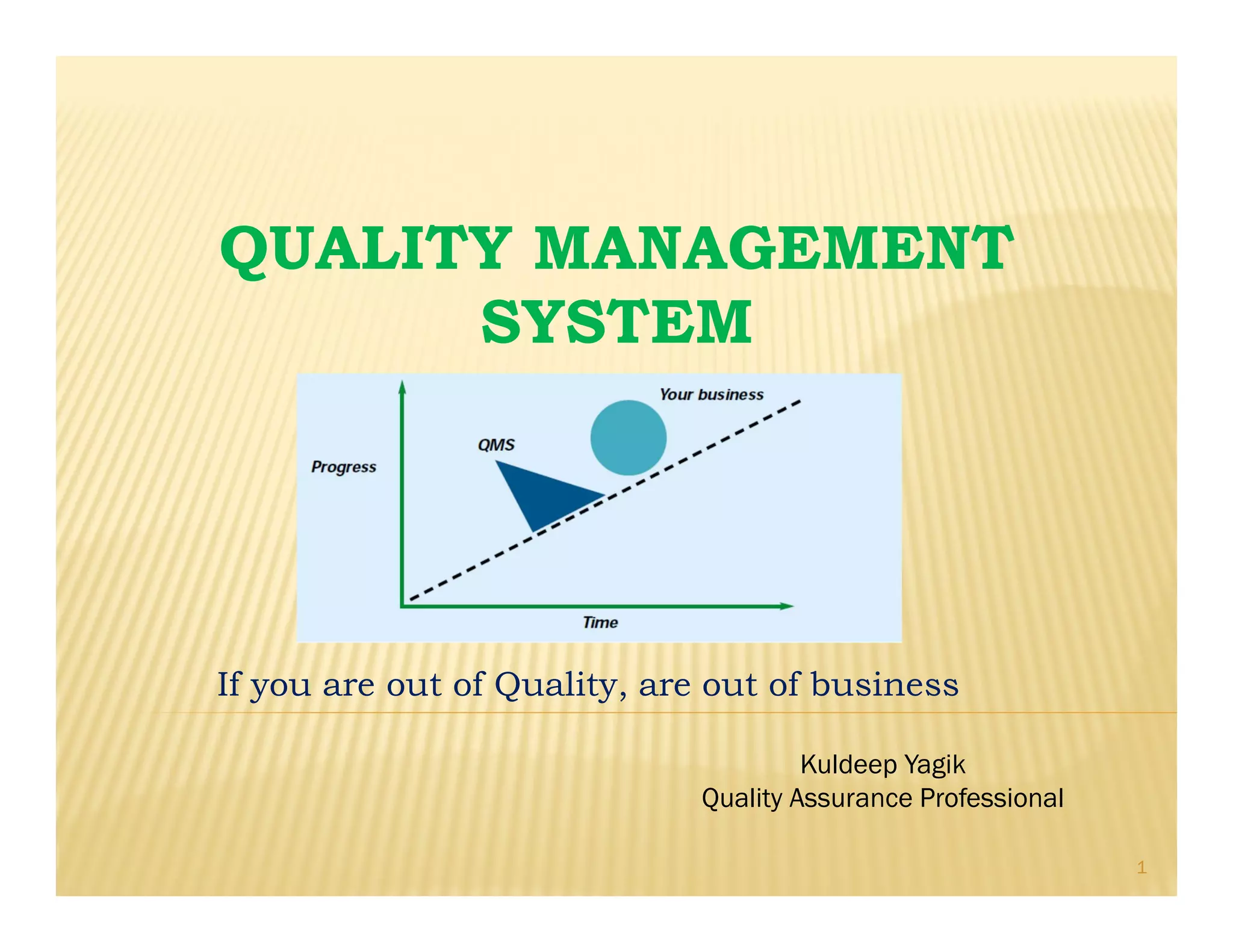
If you are out of Quality, are out of business
1
Kuldeep Yagik
Quality Assurance Professional
WHAT IS QUALITY?
According to the American Society for Quality, “quality” can be
defined in the following ways:
✔ Based on customer’s perceptions of a product/service’s
design and how well the design matches the original
specifications.
✔ The ability of a product/service to satisfy stated or implied
needs.
✔ Achieved by conforming to established requirements
within an organization.
2
WHY IS QUALITY IMPORTANT?
Ò Business success may simply be the extent to which your
organization can produce a higher-quality product or service
than your competitors are able to do at a competitive price.
Ò When quality is the key to a company’s success, quality
management systems allow organizations to keep up with and
meet current quality levels, meet the consumer’s requirement for
quality, retain employees through competitive compensation
programs, and keep up with the latest technology.
3
WHAT IS A QUALITY MANAGEMENT SYSTEM?
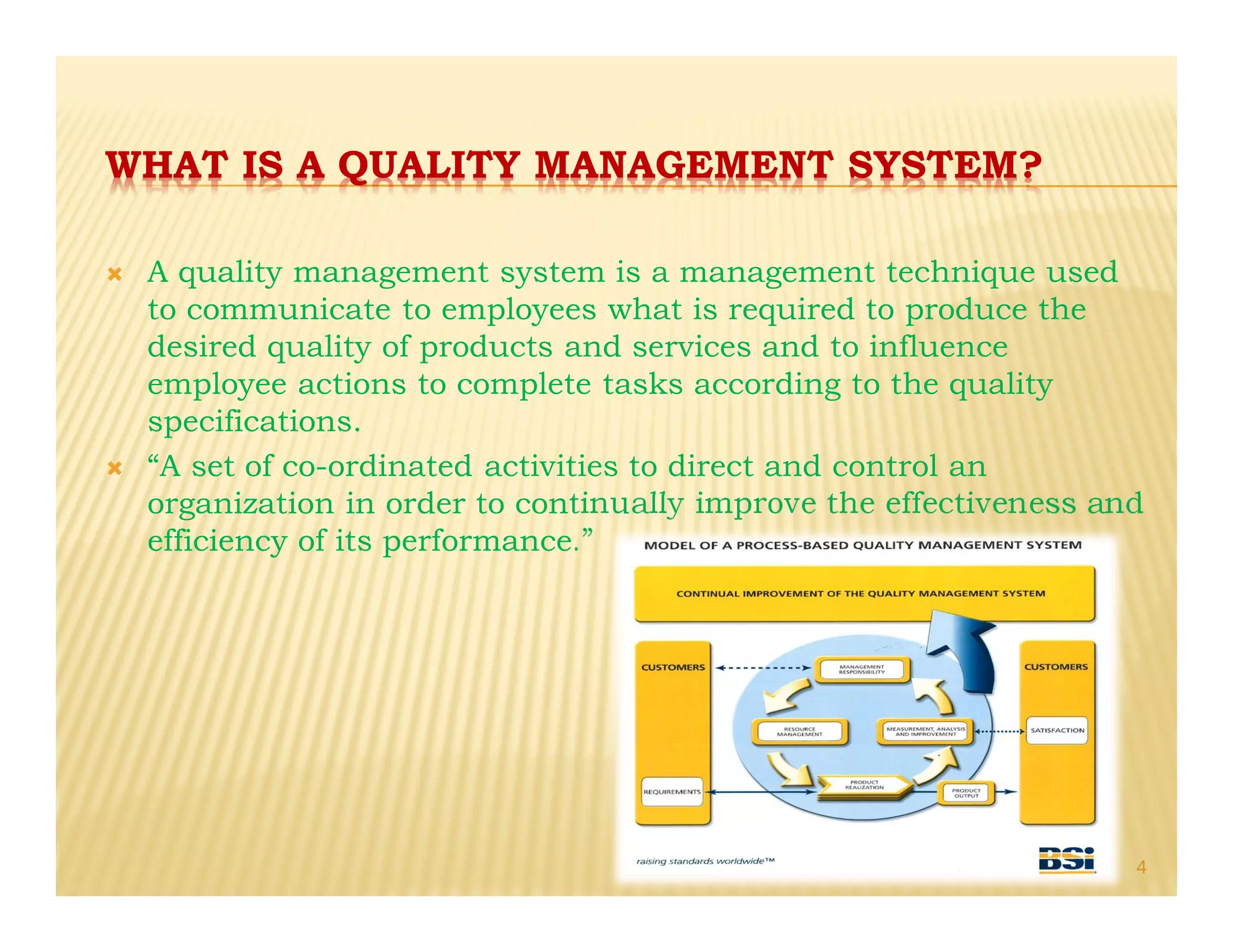
Ò A quality management system is a management technique used
to communicate to employees what is required to produce the
desired quality of products and services and to influence
employee actions to complete tasks according to the quality
specifications.
Ò “A set of co-ordinated activities to direct and control an
organization in order to continually improve the effectiveness and
efficiency of its performance.”
4
WHAT PURPOSE DOES A QUALITY
MANAGEMENT SYSTEM SERVE?
Management systems are needed in all areas of activity, whether
large or small businesses, manufacturing, service or public sector.
A good QMS will:
• Set direction and meet customers’ expectations
• Improve process control
• Reduce wastage
• Lower costs
• Increase market share/ values
• Facilitate training
• Involve staff
• Raise morale
5
HISTORY OF THE QUALITY MOVEMENT
Ò In 1911, Fredrick W. Taylor, suggested need of inspection
to assess quality in his publication ‘The principles of
Scientific Management’
Ò Quality Control & Statistical Theory: Quality Control
was introduced to detect & fix problems along the
production line to prevent production of faulty products.
Statistical theory played a important role in this area. In
1920s Dr. W Shewart developed the application of
statistical methods to the management of quality.
Quality In Japan
Ò As early as the 1950s, Japanese companies began to see
the benefits of emphasizing quality throughout their
organizations and enlisted the help of an American, W.
Edwards Deming, who is credited with giving Japanese
companies a massive head start in the quality movement.
Ò Deming believed that 85 percent of all quality problems
were the fault of management. In order to improve,
management had to take the lead and put in place the
necessary resources and systems.
Ò According to Deming, there were two different concepts of
process improvement that quality systems needed to
address: (1) common (systematic) causes of error, and (2)
special causes of error.
6
HISTORY OF THE QUALITY MOVEMENT
Ò Another influential individual in the development
of quality control was Joseph M. Juran, who, like
Deming, made a name for himself working in
Japanese organizations focusing on improving
quality. Juran also established the Juran
Institute in 1979; its goals and objectives were
centered on helping organizations improve the
quality of their products and services.
Ò Juran defined quality as “fitness for use,”
meaning that the users of products or services
should be able to rely on that product or service
100 percent of the time without any worry of
defects. If this was true, the product could be
classified as fit for use.
Ò Juran also developed a comprehensive approach
to quality as Quality by Design (QbD).
7
HISTORY OF THE QUALITY MOVEMENT
The Quality Revolution Comes to the United States
Ò In the 1980s, the Ford Motor Company was the first to
invite Deming to help the company transform itself into a
quality-oriented organization. As a result, Ford was able to
achieve higher quality standards than any other American
automotive manufacturer and substantial sales growth in
the late 1980s even when the rest of the U.S. automotive
market was declining. Ford attributes the ability of its
Taurus to overtake the Honda Accord in annual sales to
the high quality standards set by the company.
Ò Since the early 1980s and on into the twenty-first century,
quality issues have surfaced in every industry and almost
every organization in the United States.
Ò The quality movement started in manufacturing and then
moved to service industries.
8
HISTORY OF THE QUALITY MOVEMENT
Ò Total Quality: The term total quality was used ofr first time
in 1969 in Tokyo by Feigenbaum at first international
conference of Quality Control.
Ò Total Quality Management (TQM): In 1980s to 1990s, a
new phrase of Quality Control & Management coined in
Japan as Total Quality Management.
TQM is a management approach in which quality is
emphasized in every aspect of the business and organization.
Its goals are aimed at long-term development of quality
products and services.
Ò Standardized Systems : In 1987, International Organization
for Standardization take lead and launched ISO 9000 is a
series of quality management systems (QMS) standards based
on BS 5750 series of standard of BSI.
9
HISTORY OF THE QUALITY MOVEMENT
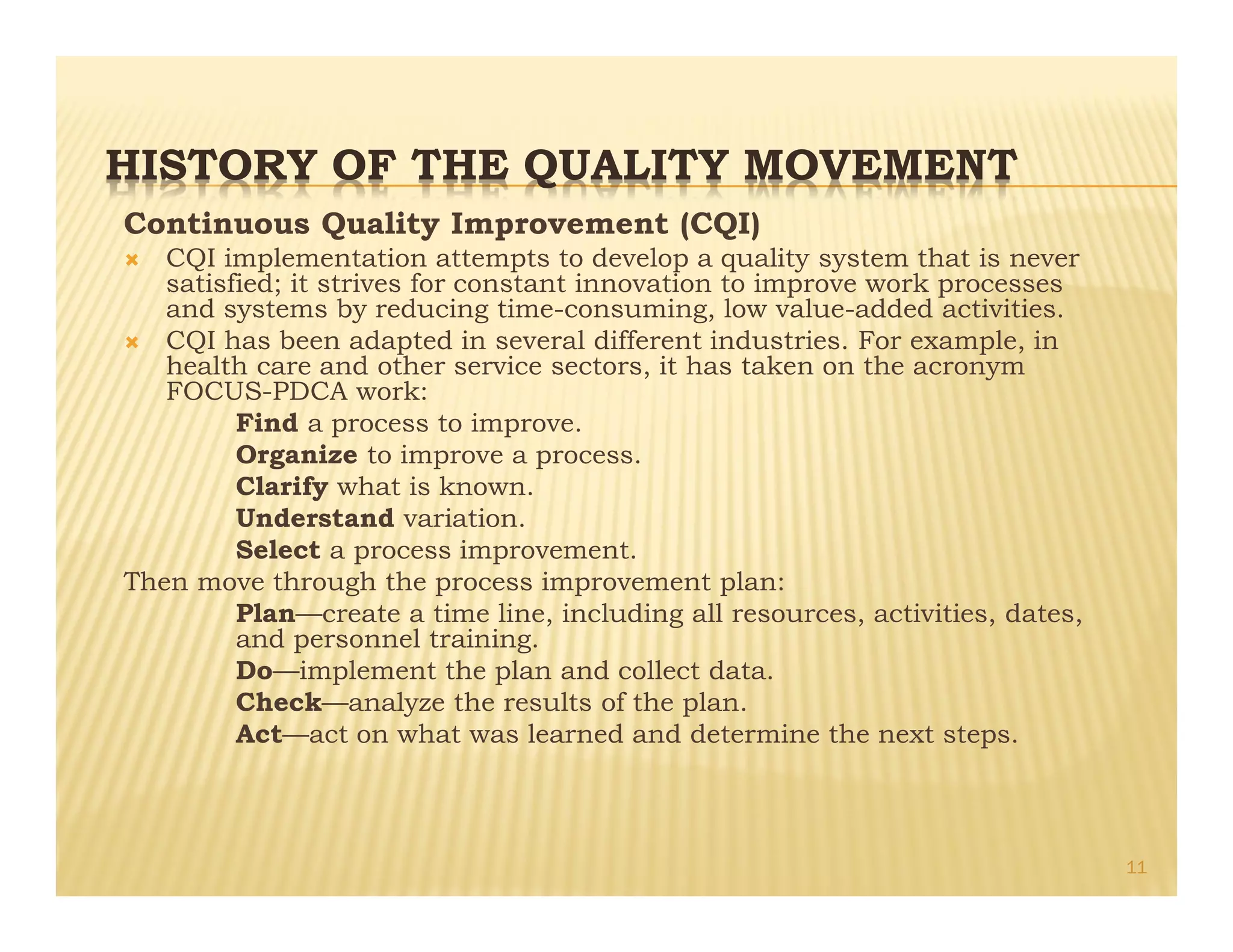
Continuous Quality Improvement (CQI)
It focus on the process of quality improvement. CQI allows
individuals involved in the day-to-day operations to change and
improve processes and work flows as they see fit.
10
HISTORY OF THE QUALITY MOVEMENT
Continuous Quality Improvement (CQI)
Ò CQI implementation attempts to develop a quality system that is never
satisfied; it strives for constant innovation to improve work processes
and systems by reducing time-consuming, low value-added activities.
Ò CQI has been adapted in several different industries. For example, in
health care and other service sectors, it has taken on the acronym
FOCUS-PDCA work:
Find a process to improve.
Organize to improve a process.
Clarify what is known.
Understand variation.
Select a process improvement.
Then move through the process improvement plan:
Plan—create a time line, including all resources, activities, dates,
and personnel training.
Do—implement the plan and collect data.
Check—analyze the results of the plan.
Act—act on what was learned and determine the next steps.
11
HISTORY OF THE QUALITY MOVEMENT
Six Sigma
Six sigma was developed at Motorola in the 1980s as a method
to measure and improve high-volume production processes.
The term six sigma refers to a statistical measure with no more
than 3.4 defects per million.
Six sigma is a statistically oriented approach to process
improvement that uses a variety of tools, including statistical
process control (SPC), total quality management (TQM), and
design of experiments (DOE). It can be coordinated with other
major initiatives and systems, such as new product
development, materials requirement planning (MRP), and just-in-
time (JIT) inventory control.
12
HISTORY OF THE QUALITY MOVEMENT
Six Sigma
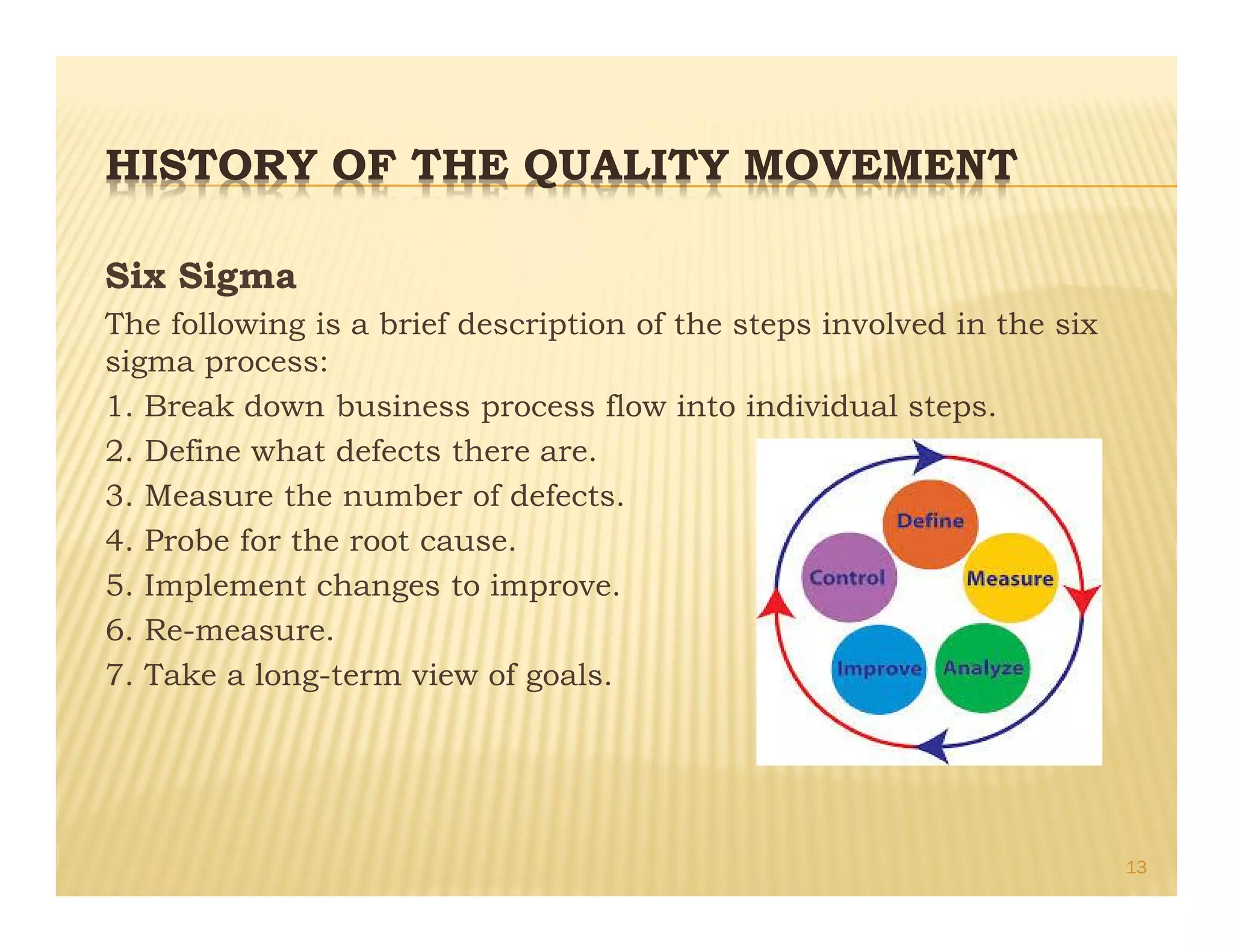
The following is a brief description of the steps involved in the six
sigma process:
1. Break down business process flow into individual steps.
2. Define what defects there are.
3. Measure the number of defects.
4. Probe for the root cause.
5. Implement changes to improve.
6. Re-measure.
7. Take a long-term view of goals.
13
QUALITY MANAGEMENT PRINCIPLES
The eight quality management principles are defined in ISO
9000:2005
Principle 1 – Customer focus
Principle 2 – Leadership
Principle 3 – Involvement of people
Principle 4 – Process approach
Principle 5 – System approach to management
Principle 6 – Continual improvement
Principle 7 – Factual approach to decision making
Principle 8 – Mutually beneficial supplier relationships
14
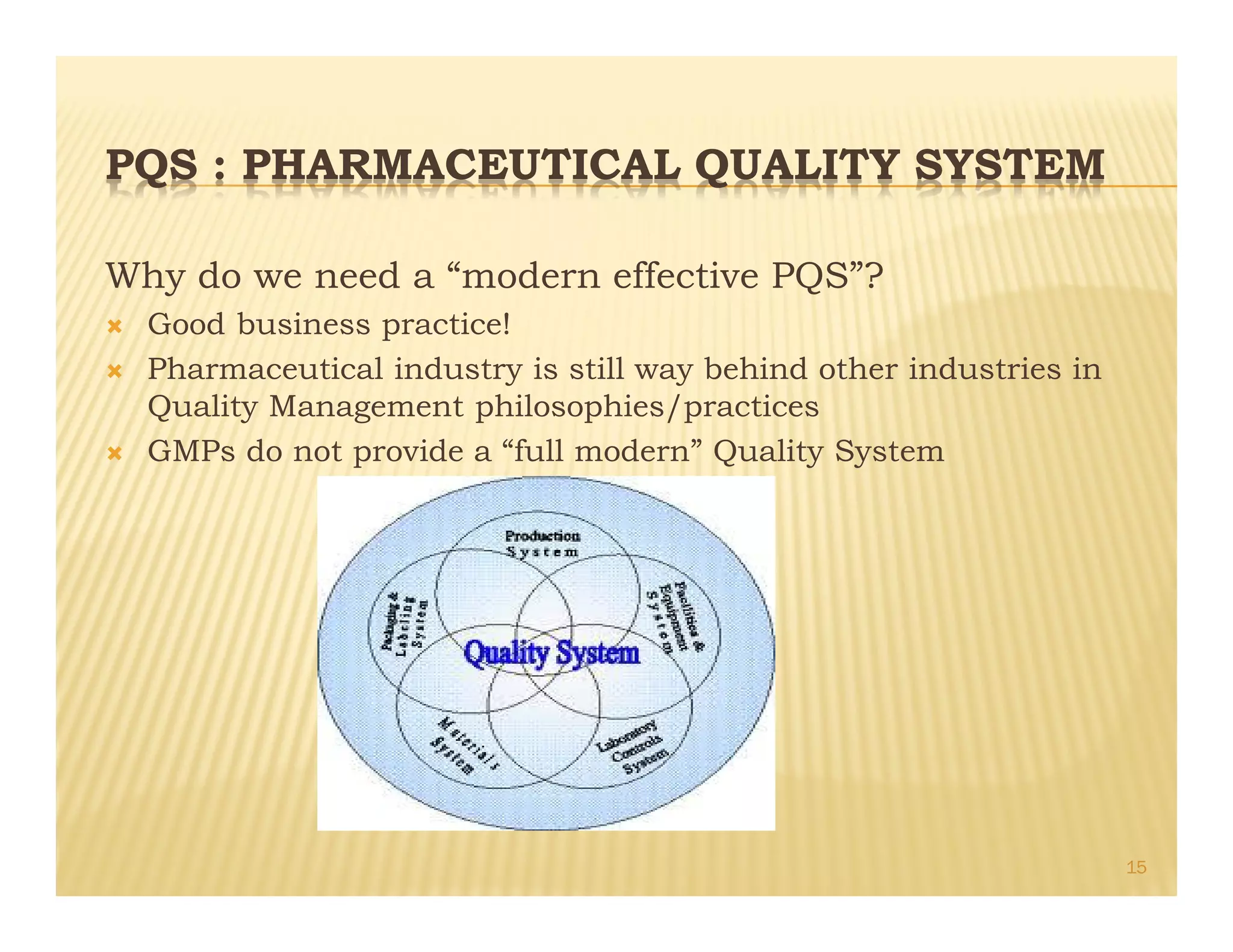
PQS : PHARMACEUTICAL QUALITY SYSTEM
Why do we need a “modern effective PQS”?
Ò Good business practice!
Ò Pharmaceutical industry is still way behind other industries in
Quality Management philosophies/practices
Ò GMPs do not provide a “full modern” Quality System
15
PQS : PHARMACEUTICAL QUALITY SYSTEM
Where are we Currently?
Ò Evolution of regional GMPs 1970s -
Ò Evolution of ISO 9000 approaches 1980s -
Ò FDA 21st Century initiative 2002 -
Ò ICH Quality Vision / Q8, Q9, Q10 2003 -
Ò FDA Quality Systems guide 2006 -
Ò ICH Q10 Pharmaceutical Quality System 2008
Ò Q10 Implementation journey…………………………….
16
PQS : PHARMACEUTICAL QUALITY SYSTEM
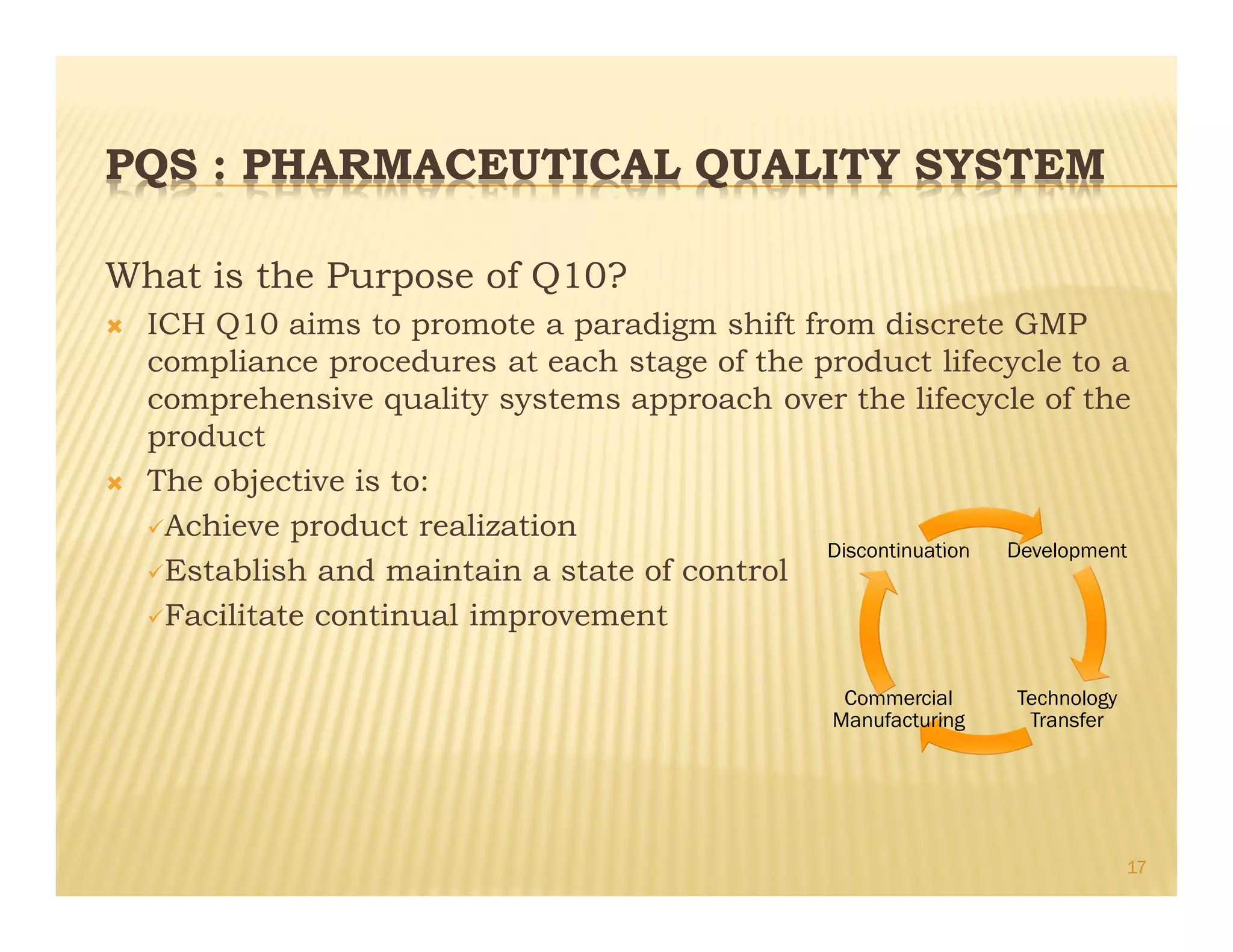
What is the Purpose of Q10?
Ò ICH Q10 aims to promote a paradigm shift from discrete GMP
compliance procedures at each stage of the product lifecycle to a
comprehensive quality systems approach over the lifecycle of the
product
Ò The objective is to:
üAchieve product realization
üEstablish and maintain a state of control
üFacilitate continual improvement
Development
Technology
Transfer
Commercial
Manufacturing
Discontinuation
17
PQS : PHARMACEUTICAL QUALITY SYSTEM
Q10 - Scope
Ò Applies to systems supporting the development and manufacture
of pharmaceutical drug substances (API) and drug products,
including biotechnology and biological products, throughout the
product lifecycle
Ò Both newly developed and existing products fall within the scope
Ò Apply in a manner appropriate and proportionate to the stage of
lifecycle
18
PQS : PHARMACEUTICAL QUALITY SYSTEM
Relationship of ICH Q10 to Regional GMP Requirements,
ISO Standards and ICH Q7
Ò Augment existing GMPs with specific PQS elements and
management responsibilities
Ò Encourage science and risk based approaches
Ò Be used together with existing GMPs
Ò Cover all stages of the product lifecycle as defined (beyond GMPs)
19
PQS : PHARMACEUTICAL QUALITY SYSTEM
Relationship of ICH Q10 to Regulatory Approaches
Ò Regulatory approaches for a specific product or manufacturing
facility should be commensurate with:
É The level of product and process understanding
É The results of quality risk management
É The effectiveness of the PQS
20
PQS : PHARMACEUTICAL QUALITY SYSTEM
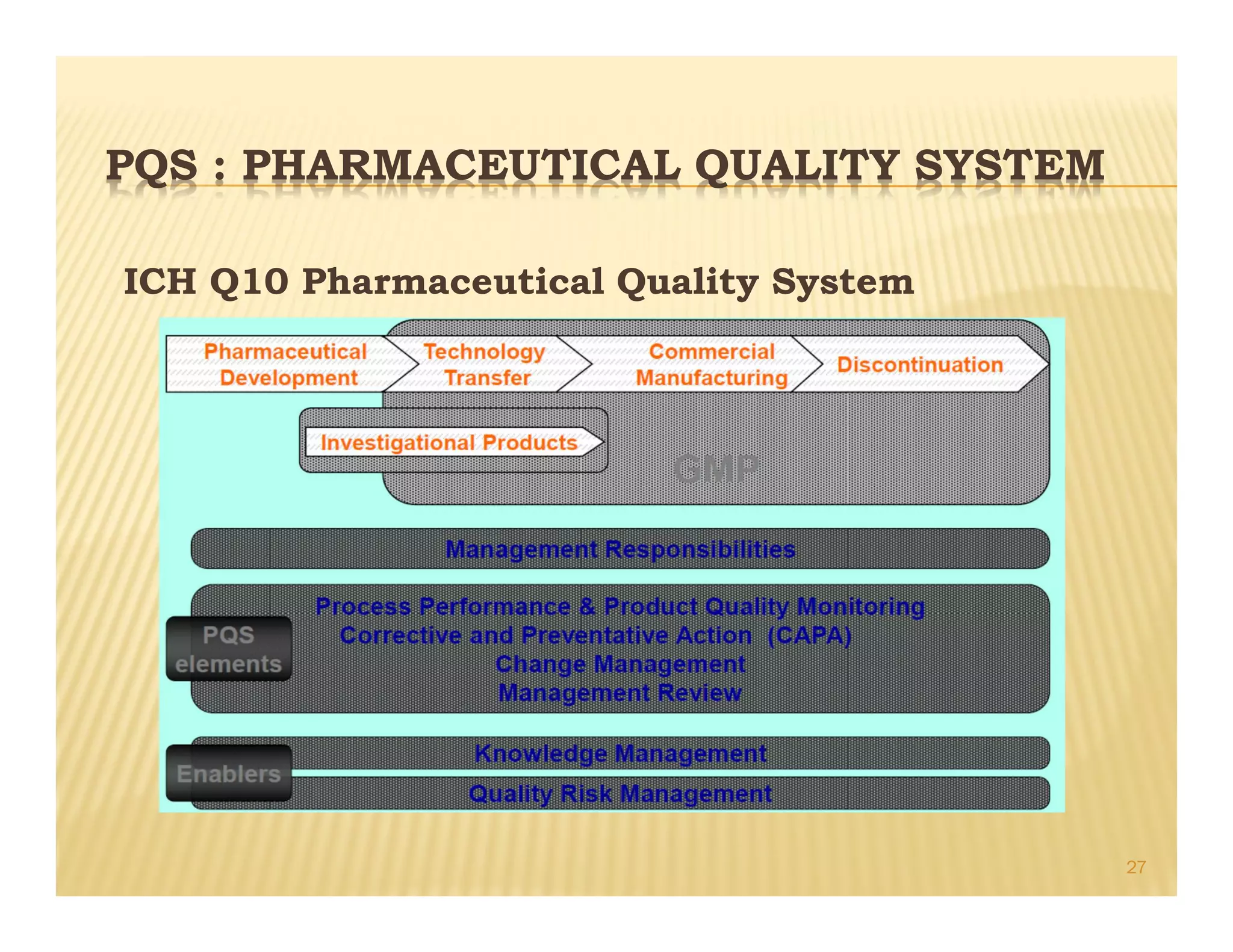
Q10 - Enablers
Ò The enablers provide the means for science and risk based
decisions related to product quality through the lifecycle
Ò Knowledge Management
É Manage knowledge from development through
commercialization to discontinuation
Ò Quality Risk Management (Q9)
É Proactive approach to managing risks to quality
21
PQS : PHARMACEUTICAL QUALITY SYSTEM
Design and Content considerations are:
Ò PQS should be well structured and clear / consider
complexity of organization
Ò The elements of ICH Q10 should be applied in a manner
that is proportionate to each of the product lifecycle stages
Ò Outsourced activities / purchased materials should be
within the scope of the PQS
Ò Management responsibilities should be identified
Ò The PQS should include process performance and product
quality monitoring, corrective and preventive action,
change management and management review
Ò Performance indicators should be identified and used to
monitor the effectiveness of the PQS
22
PQS : PHARMACEUTICAL QUALITY SYSTEM
Q10 - Quality Manual
Ò A Quality Manual (or equivalent) should be established and
should contain the description of the pharmaceutical quality
system; including:
Ò The quality policy
Ò The scope of the pharmaceutical quality system
Ò Identification of the processes within the PQS, as well as their
sequences, linkages and interdependencies
Ò Management responsibilities within the PQS
23
PQS : PHARMACEUTICAL QUALITY SYSTEM
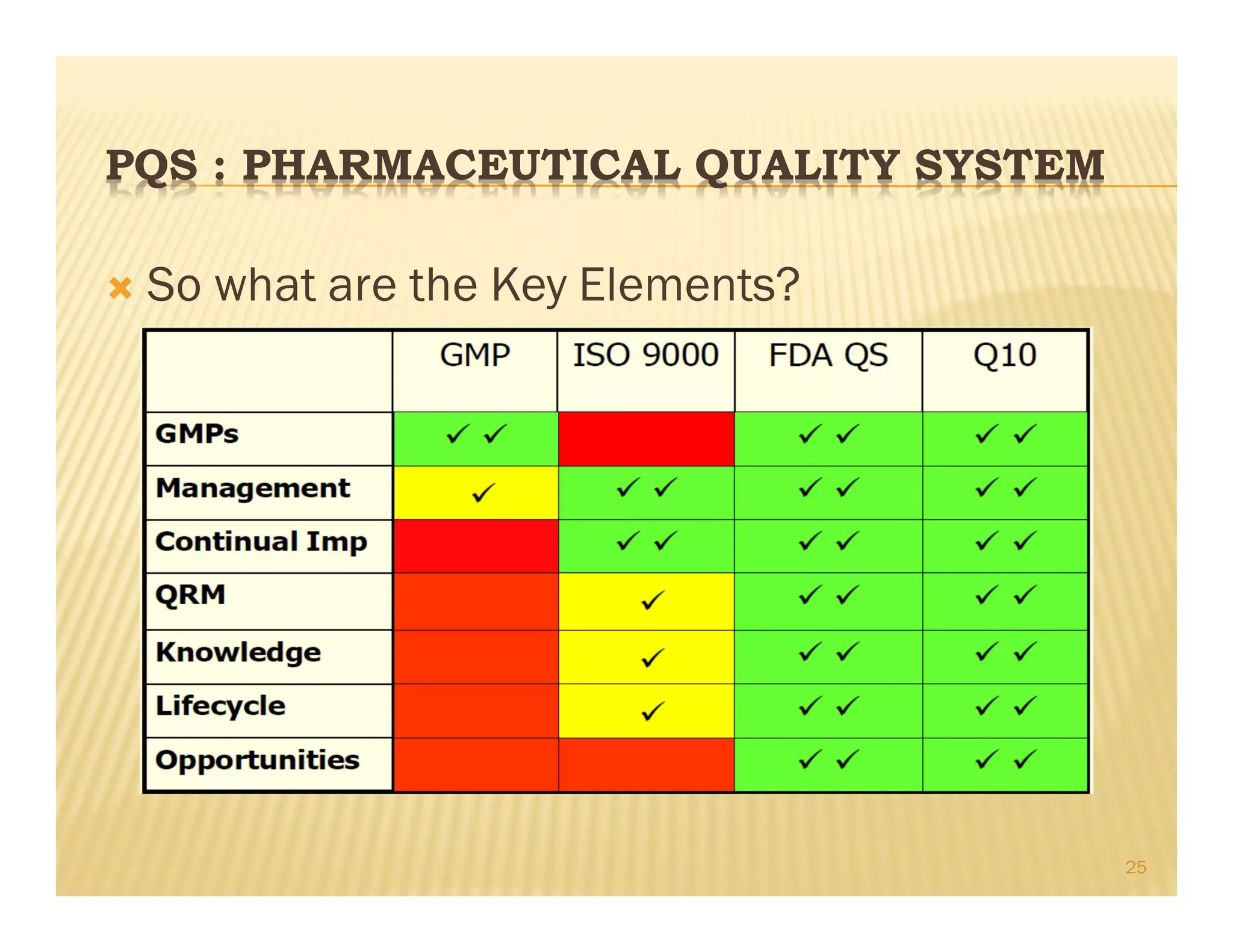
So What are the Key Elements?
Ò GMPs
Ò Management Responsibility
Ò Continual Improvement
É Products and Processes
É PQS itself
Ò Quality Risk Management
Ò Knowledge Management
Ò Lifecycle approach
Ò Opportunities for science-based and risk-based
regulatory approaches
24
PQS : PHARMACEUTICAL QUALITY SYSTEM
Ò So what are the Key Elements?
25
PQS : PHARMACEUTICAL QUALITY SYSTEM
Lifecycle Approach
Ò A Modern PQS needs to be holistic and cover the product lifecycle
É Design and Development
É Manufacturing
É Withdrawal
Ò Challenges and removes some traditional organizational silos
É Within Industry
É Within Regulatory Agencies
É With outsourcing partners
26
PQS : PHARMACEUTICAL QUALITY SYSTEM
ICH Q10 Pharmaceutical Quality System
27
PQS : PHARMACEUTICAL QUALITY SYSTEM
Management Responsibilities
Ò Essential component
Ò Not just about compliance
É Visible leadership to establish and
maintain a company wide culture and
commitment to Quality and improvement
É Monitor performance of the PQS and act
É Internal and Outsourced activities
Ò Quality cannot be owned by the Q Unit
É Management is accountable
É But independent assessments / audits are key
28
PQS : PHARMACEUTICAL QUALITY SYSTEM
Management Responsibilities
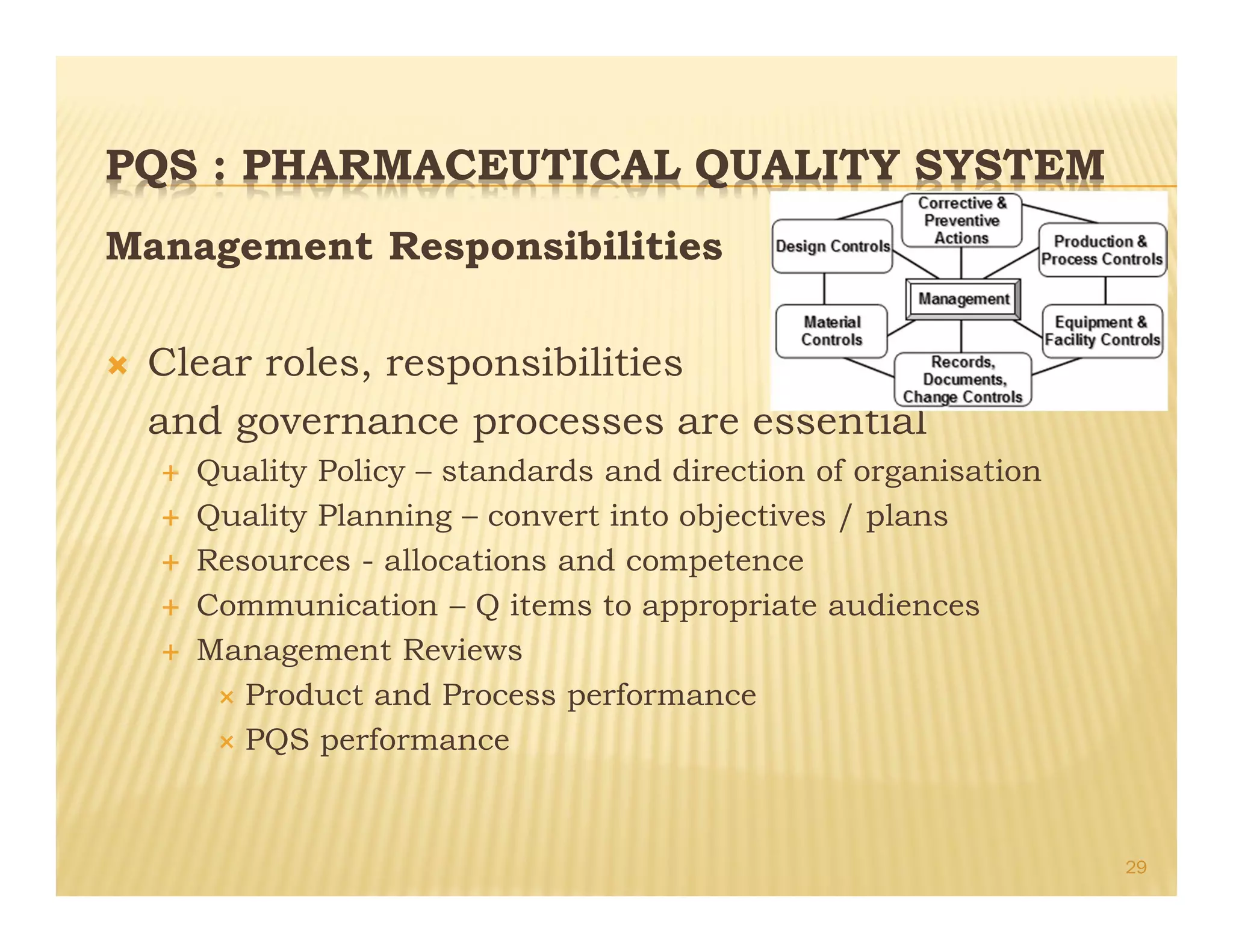
Ò Clear roles, responsibilities
and governance processes are essential
É Quality Policy – standards and direction of organisation
É Quality Planning – convert into objectives / plans
É Resources - allocations and competence
É Communication – Q items to appropriate audiences
É Management Reviews
Ð Product and Process performance
Ð PQS performance
29
PQS : PHARMACEUTICAL QUALITY SYSTEM
Management Responsibilities
Ò Management of Outsourced Activities and Purchased
Materials
É PQS must extend to the control and review of these activities
É Pharmaceutical firm (Management) is ultimately responsible
to assure processes are in place
Ò Processes must be in place to:
É Assess suitability of contractors / suppliers before use
É Ensure use of approved suppliers and a defined supply chain
É Define responsibilities and communication processes for
quality related activities
É Review performance and make improvements
30
PQS : PHARMACEUTICAL QUALITY SYSTEM
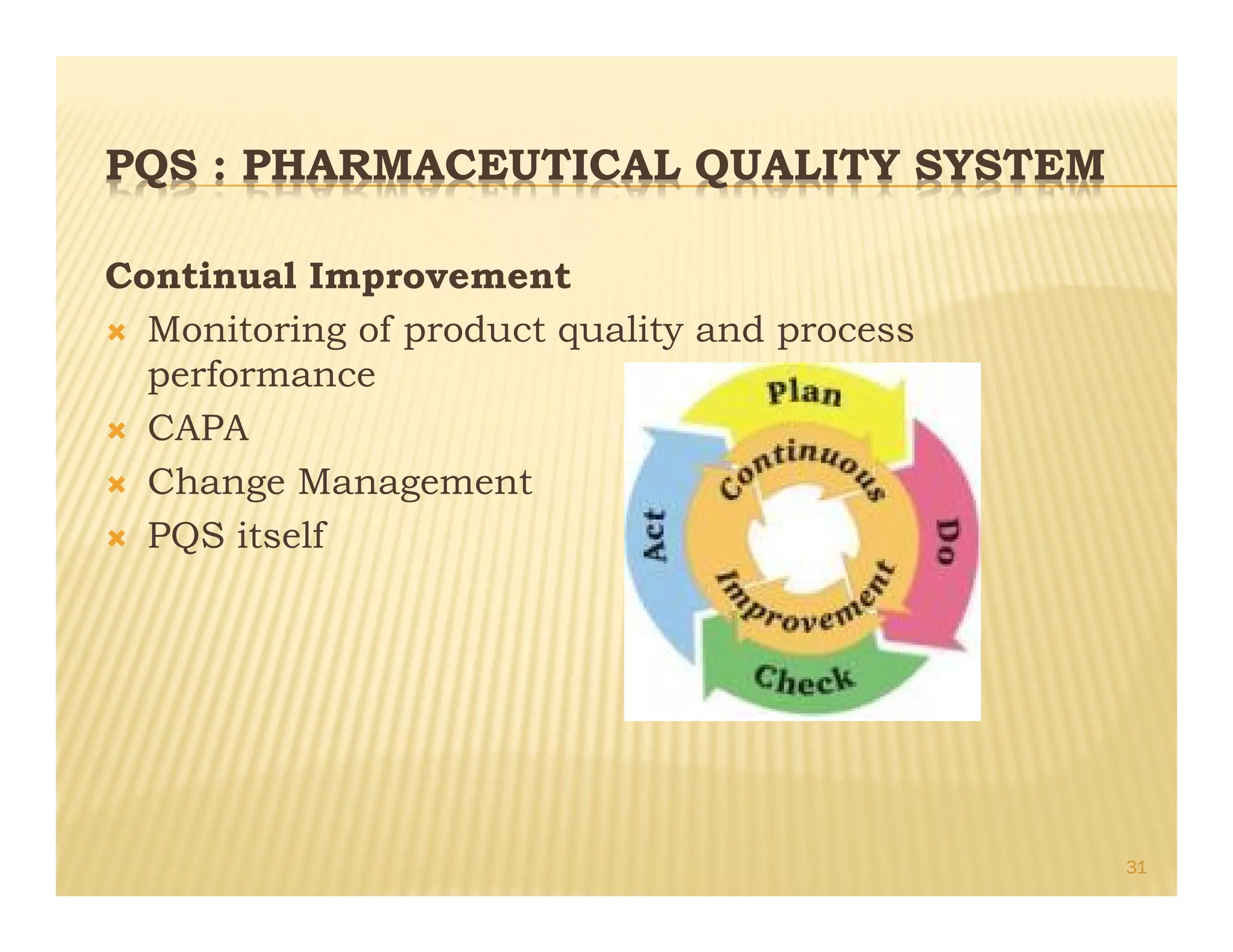
Continual Improvement
Ò Monitoring of product quality and process
performance
Ò CAPA
Ò Change Management
Ò PQS itself
31
PQS : PHARMACEUTICAL QUALITY SYSTEM
Product Quality and Process Performance
Monitoring System
Ò Use knowledge, QbD, Product and Process
understanding and QRM to set Control Strategy
É What and when to monitor / measure / test
É Based on critical product quality attributes and critical
process parameters to deliver them
Ò Confirm and maintain a state of control
É Feed-back and Feed-forward loops
Ò Reduce and control variation to appropriate levels
Ò Drive continual improvement
Ò Continual verification
32
PQS : PHARMACEUTICAL QUALITY SYSTEM
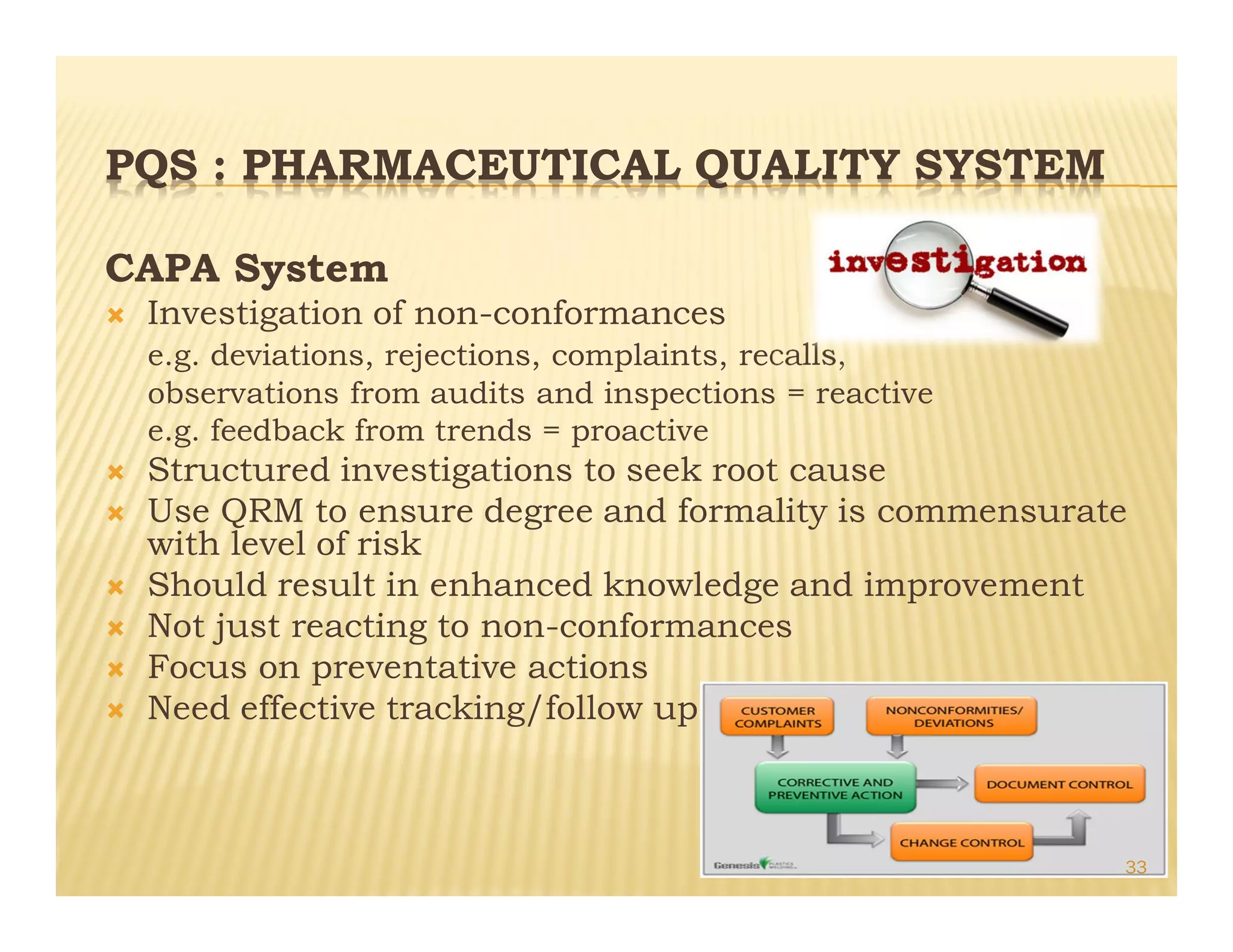
CAPA System
Ò Investigation of non-conformances
e.g. deviations, rejections, complaints, recalls,
observations from audits and inspections = reactive
e.g. feedback from trends = proactive
Ò Structured investigations to seek root cause
Ò Use QRM to ensure degree and formality is commensurate
with level of risk
Ò Should result in enhanced knowledge and improvement
Ò Not just reacting to non-conformances
Ò Focus on preventative actions
Ò Need effective tracking/follow up
33
PQS : PHARMACEUTICAL QUALITY SYSTEM
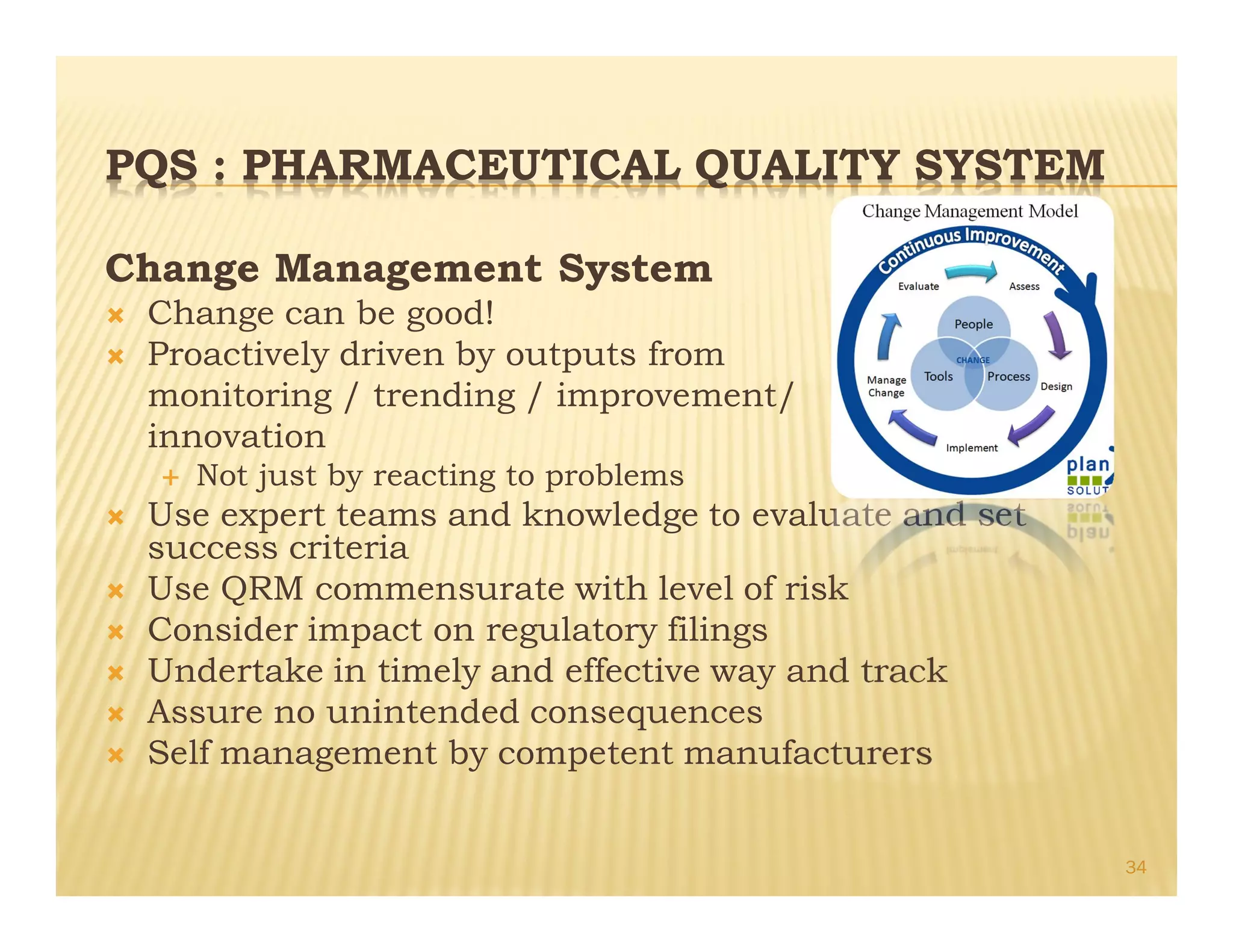
Change Management System
Ò Change can be good!
Ò Proactively driven by outputs from
monitoring / trending / improvement/
innovation
É Not just by reacting to problems
Ò Use expert teams and knowledge to evaluate and set
success criteria
Ò Use QRM commensurate with level of risk
Ò Consider impact on regulatory filings
Ò Undertake in timely and effective way and track
Ò Assure no unintended consequences
Ò Self management by competent manufacturers
34
PQS : PHARMACEUTICAL QUALITY SYSTEM
Ò PQS itself i.e. Continual improvement of the pharmaceutical
quality system
Ò Management Review of the PQS
É Measurement of achievement
É Assessment of performance indicators i.e. incidents,
deviation, CAPA, market complaint, OOS, Change
Management
É Self-assessment processes including risk assessments,
trending, and audits;
É Feedback on outsourced activities
É External assessments such as regulatory inspections and
findings and customer audits.
Ò Monitoring of Internal and External Factors Impacting the PQS
É Emerging regulations, guidance and quality issues that can
impact the Pharmaceutical Quality System;
É Innovations, Change in business environment,
35
PQS : PHARMACEUTICAL QUALITY SYSTEM
Ò PQS itself i.e. Continual improvement of the
pharmaceutical quality system
Ò Outcomes of Management Review and Monitoring
É Improvements to the pharmaceutical quality system and
related processes
É Allocation or reallocation of resources and/or personnel
training
É Revisions to quality policy and quality objectives
É Documentation and timely and effective communication
including escalation of appropriate issues to senior
management.
36
PQS : PHARMACEUTICAL QUALITY SYSTEM
Any more Questions ??
THANK YOU
Kuldeep Yagik
37

Quality Management System

  • 1.
    QUALITY MANAGEMENT SYSTEM If youare out of Quality, are out of business 1 Kuldeep Yagik Quality Assurance Professional
  • 2.
    WHAT IS QUALITY? Accordingto the American Society for Quality, “quality” can be defined in the following ways: ✔ Based on customer’s perceptions of a product/service’s design and how well the design matches the original specifications. ✔ The ability of a product/service to satisfy stated or implied needs. ✔ Achieved by conforming to established requirements within an organization. 2
  • 3.
    WHY IS QUALITYIMPORTANT? Ò Business success may simply be the extent to which your organization can produce a higher-quality product or service than your competitors are able to do at a competitive price. Ò When quality is the key to a company’s success, quality management systems allow organizations to keep up with and meet current quality levels, meet the consumer’s requirement for quality, retain employees through competitive compensation programs, and keep up with the latest technology. 3
  • 4.
    WHAT IS AQUALITY MANAGEMENT SYSTEM? Ò A quality management system is a management technique used to communicate to employees what is required to produce the desired quality of products and services and to influence employee actions to complete tasks according to the quality specifications. Ò “A set of co-ordinated activities to direct and control an organization in order to continually improve the effectiveness and efficiency of its performance.” 4
  • 5.
    WHAT PURPOSE DOESA QUALITY MANAGEMENT SYSTEM SERVE? Management systems are needed in all areas of activity, whether large or small businesses, manufacturing, service or public sector. A good QMS will: • Set direction and meet customers’ expectations • Improve process control • Reduce wastage • Lower costs • Increase market share/ values • Facilitate training • Involve staff • Raise morale 5
  • 6.
    HISTORY OF THEQUALITY MOVEMENT Ò In 1911, Fredrick W. Taylor, suggested need of inspection to assess quality in his publication ‘The principles of Scientific Management’ Ò Quality Control & Statistical Theory: Quality Control was introduced to detect & fix problems along the production line to prevent production of faulty products. Statistical theory played a important role in this area. In 1920s Dr. W Shewart developed the application of statistical methods to the management of quality. Quality In Japan Ò As early as the 1950s, Japanese companies began to see the benefits of emphasizing quality throughout their organizations and enlisted the help of an American, W. Edwards Deming, who is credited with giving Japanese companies a massive head start in the quality movement. Ò Deming believed that 85 percent of all quality problems were the fault of management. In order to improve, management had to take the lead and put in place the necessary resources and systems. Ò According to Deming, there were two different concepts of process improvement that quality systems needed to address: (1) common (systematic) causes of error, and (2) special causes of error. 6
  • 7.
    HISTORY OF THEQUALITY MOVEMENT Ò Another influential individual in the development of quality control was Joseph M. Juran, who, like Deming, made a name for himself working in Japanese organizations focusing on improving quality. Juran also established the Juran Institute in 1979; its goals and objectives were centered on helping organizations improve the quality of their products and services. Ò Juran defined quality as “fitness for use,” meaning that the users of products or services should be able to rely on that product or service 100 percent of the time without any worry of defects. If this was true, the product could be classified as fit for use. Ò Juran also developed a comprehensive approach to quality as Quality by Design (QbD). 7
  • 8.
    HISTORY OF THEQUALITY MOVEMENT The Quality Revolution Comes to the United States Ò In the 1980s, the Ford Motor Company was the first to invite Deming to help the company transform itself into a quality-oriented organization. As a result, Ford was able to achieve higher quality standards than any other American automotive manufacturer and substantial sales growth in the late 1980s even when the rest of the U.S. automotive market was declining. Ford attributes the ability of its Taurus to overtake the Honda Accord in annual sales to the high quality standards set by the company. Ò Since the early 1980s and on into the twenty-first century, quality issues have surfaced in every industry and almost every organization in the United States. Ò The quality movement started in manufacturing and then moved to service industries. 8
  • 9.
    HISTORY OF THEQUALITY MOVEMENT Ò Total Quality: The term total quality was used ofr first time in 1969 in Tokyo by Feigenbaum at first international conference of Quality Control. Ò Total Quality Management (TQM): In 1980s to 1990s, a new phrase of Quality Control & Management coined in Japan as Total Quality Management. TQM is a management approach in which quality is emphasized in every aspect of the business and organization. Its goals are aimed at long-term development of quality products and services. Ò Standardized Systems : In 1987, International Organization for Standardization take lead and launched ISO 9000 is a series of quality management systems (QMS) standards based on BS 5750 series of standard of BSI. 9
  • 10.
    HISTORY OF THEQUALITY MOVEMENT Continuous Quality Improvement (CQI) It focus on the process of quality improvement. CQI allows individuals involved in the day-to-day operations to change and improve processes and work flows as they see fit. 10
  • 11.
    HISTORY OF THEQUALITY MOVEMENT Continuous Quality Improvement (CQI) Ò CQI implementation attempts to develop a quality system that is never satisfied; it strives for constant innovation to improve work processes and systems by reducing time-consuming, low value-added activities. Ò CQI has been adapted in several different industries. For example, in health care and other service sectors, it has taken on the acronym FOCUS-PDCA work: Find a process to improve. Organize to improve a process. Clarify what is known. Understand variation. Select a process improvement. Then move through the process improvement plan: Plan—create a time line, including all resources, activities, dates, and personnel training. Do—implement the plan and collect data. Check—analyze the results of the plan. Act—act on what was learned and determine the next steps. 11
  • 12.
    HISTORY OF THEQUALITY MOVEMENT Six Sigma Six sigma was developed at Motorola in the 1980s as a method to measure and improve high-volume production processes. The term six sigma refers to a statistical measure with no more than 3.4 defects per million. Six sigma is a statistically oriented approach to process improvement that uses a variety of tools, including statistical process control (SPC), total quality management (TQM), and design of experiments (DOE). It can be coordinated with other major initiatives and systems, such as new product development, materials requirement planning (MRP), and just-in- time (JIT) inventory control. 12
  • 13.
    HISTORY OF THEQUALITY MOVEMENT Six Sigma The following is a brief description of the steps involved in the six sigma process: 1. Break down business process flow into individual steps. 2. Define what defects there are. 3. Measure the number of defects. 4. Probe for the root cause. 5. Implement changes to improve. 6. Re-measure. 7. Take a long-term view of goals. 13
  • 14.
    QUALITY MANAGEMENT PRINCIPLES Theeight quality management principles are defined in ISO 9000:2005 Principle 1 – Customer focus Principle 2 – Leadership Principle 3 – Involvement of people Principle 4 – Process approach Principle 5 – System approach to management Principle 6 – Continual improvement Principle 7 – Factual approach to decision making Principle 8 – Mutually beneficial supplier relationships 14
  • 15.
    PQS : PHARMACEUTICALQUALITY SYSTEM Why do we need a “modern effective PQS”? Ò Good business practice! Ò Pharmaceutical industry is still way behind other industries in Quality Management philosophies/practices Ò GMPs do not provide a “full modern” Quality System 15
  • 16.
    PQS : PHARMACEUTICALQUALITY SYSTEM Where are we Currently? Ò Evolution of regional GMPs 1970s - Ò Evolution of ISO 9000 approaches 1980s - Ò FDA 21st Century initiative 2002 - Ò ICH Quality Vision / Q8, Q9, Q10 2003 - Ò FDA Quality Systems guide 2006 - Ò ICH Q10 Pharmaceutical Quality System 2008 Ò Q10 Implementation journey……………………………. 16
  • 17.
    PQS : PHARMACEUTICALQUALITY SYSTEM What is the Purpose of Q10? Ò ICH Q10 aims to promote a paradigm shift from discrete GMP compliance procedures at each stage of the product lifecycle to a comprehensive quality systems approach over the lifecycle of the product Ò The objective is to: üAchieve product realization üEstablish and maintain a state of control üFacilitate continual improvement Development Technology Transfer Commercial Manufacturing Discontinuation 17
  • 18.
    PQS : PHARMACEUTICALQUALITY SYSTEM Q10 - Scope Ò Applies to systems supporting the development and manufacture of pharmaceutical drug substances (API) and drug products, including biotechnology and biological products, throughout the product lifecycle Ò Both newly developed and existing products fall within the scope Ò Apply in a manner appropriate and proportionate to the stage of lifecycle 18
  • 19.
    PQS : PHARMACEUTICALQUALITY SYSTEM Relationship of ICH Q10 to Regional GMP Requirements, ISO Standards and ICH Q7 Ò Augment existing GMPs with specific PQS elements and management responsibilities Ò Encourage science and risk based approaches Ò Be used together with existing GMPs Ò Cover all stages of the product lifecycle as defined (beyond GMPs) 19
  • 20.
    PQS : PHARMACEUTICALQUALITY SYSTEM Relationship of ICH Q10 to Regulatory Approaches Ò Regulatory approaches for a specific product or manufacturing facility should be commensurate with: É The level of product and process understanding É The results of quality risk management É The effectiveness of the PQS 20
  • 21.
    PQS : PHARMACEUTICALQUALITY SYSTEM Q10 - Enablers Ò The enablers provide the means for science and risk based decisions related to product quality through the lifecycle Ò Knowledge Management É Manage knowledge from development through commercialization to discontinuation Ò Quality Risk Management (Q9) É Proactive approach to managing risks to quality 21
  • 22.
    PQS : PHARMACEUTICALQUALITY SYSTEM Design and Content considerations are: Ò PQS should be well structured and clear / consider complexity of organization Ò The elements of ICH Q10 should be applied in a manner that is proportionate to each of the product lifecycle stages Ò Outsourced activities / purchased materials should be within the scope of the PQS Ò Management responsibilities should be identified Ò The PQS should include process performance and product quality monitoring, corrective and preventive action, change management and management review Ò Performance indicators should be identified and used to monitor the effectiveness of the PQS 22
  • 23.
    PQS : PHARMACEUTICALQUALITY SYSTEM Q10 - Quality Manual Ò A Quality Manual (or equivalent) should be established and should contain the description of the pharmaceutical quality system; including: Ò The quality policy Ò The scope of the pharmaceutical quality system Ò Identification of the processes within the PQS, as well as their sequences, linkages and interdependencies Ò Management responsibilities within the PQS 23
  • 24.
    PQS : PHARMACEUTICALQUALITY SYSTEM So What are the Key Elements? Ò GMPs Ò Management Responsibility Ò Continual Improvement É Products and Processes É PQS itself Ò Quality Risk Management Ò Knowledge Management Ò Lifecycle approach Ò Opportunities for science-based and risk-based regulatory approaches 24
  • 25.
    PQS : PHARMACEUTICALQUALITY SYSTEM Ò So what are the Key Elements? 25
  • 26.
    PQS : PHARMACEUTICALQUALITY SYSTEM Lifecycle Approach Ò A Modern PQS needs to be holistic and cover the product lifecycle É Design and Development É Manufacturing É Withdrawal Ò Challenges and removes some traditional organizational silos É Within Industry É Within Regulatory Agencies É With outsourcing partners 26
  • 27.
    PQS : PHARMACEUTICALQUALITY SYSTEM ICH Q10 Pharmaceutical Quality System 27
  • 28.
    PQS : PHARMACEUTICALQUALITY SYSTEM Management Responsibilities Ò Essential component Ò Not just about compliance É Visible leadership to establish and maintain a company wide culture and commitment to Quality and improvement É Monitor performance of the PQS and act É Internal and Outsourced activities Ò Quality cannot be owned by the Q Unit É Management is accountable É But independent assessments / audits are key 28
  • 29.
    PQS : PHARMACEUTICALQUALITY SYSTEM Management Responsibilities Ò Clear roles, responsibilities and governance processes are essential É Quality Policy – standards and direction of organisation É Quality Planning – convert into objectives / plans É Resources - allocations and competence É Communication – Q items to appropriate audiences É Management Reviews Ð Product and Process performance Ð PQS performance 29
  • 30.
    PQS : PHARMACEUTICALQUALITY SYSTEM Management Responsibilities Ò Management of Outsourced Activities and Purchased Materials É PQS must extend to the control and review of these activities É Pharmaceutical firm (Management) is ultimately responsible to assure processes are in place Ò Processes must be in place to: É Assess suitability of contractors / suppliers before use É Ensure use of approved suppliers and a defined supply chain É Define responsibilities and communication processes for quality related activities É Review performance and make improvements 30
  • 31.
    PQS : PHARMACEUTICALQUALITY SYSTEM Continual Improvement Ò Monitoring of product quality and process performance Ò CAPA Ò Change Management Ò PQS itself 31
  • 32.
    PQS : PHARMACEUTICALQUALITY SYSTEM Product Quality and Process Performance Monitoring System Ò Use knowledge, QbD, Product and Process understanding and QRM to set Control Strategy É What and when to monitor / measure / test É Based on critical product quality attributes and critical process parameters to deliver them Ò Confirm and maintain a state of control É Feed-back and Feed-forward loops Ò Reduce and control variation to appropriate levels Ò Drive continual improvement Ò Continual verification 32
  • 33.
    PQS : PHARMACEUTICALQUALITY SYSTEM CAPA System Ò Investigation of non-conformances e.g. deviations, rejections, complaints, recalls, observations from audits and inspections = reactive e.g. feedback from trends = proactive Ò Structured investigations to seek root cause Ò Use QRM to ensure degree and formality is commensurate with level of risk Ò Should result in enhanced knowledge and improvement Ò Not just reacting to non-conformances Ò Focus on preventative actions Ò Need effective tracking/follow up 33
  • 34.
    PQS : PHARMACEUTICALQUALITY SYSTEM Change Management System Ò Change can be good! Ò Proactively driven by outputs from monitoring / trending / improvement/ innovation É Not just by reacting to problems Ò Use expert teams and knowledge to evaluate and set success criteria Ò Use QRM commensurate with level of risk Ò Consider impact on regulatory filings Ò Undertake in timely and effective way and track Ò Assure no unintended consequences Ò Self management by competent manufacturers 34
  • 35.
    PQS : PHARMACEUTICALQUALITY SYSTEM Ò PQS itself i.e. Continual improvement of the pharmaceutical quality system Ò Management Review of the PQS É Measurement of achievement É Assessment of performance indicators i.e. incidents, deviation, CAPA, market complaint, OOS, Change Management É Self-assessment processes including risk assessments, trending, and audits; É Feedback on outsourced activities É External assessments such as regulatory inspections and findings and customer audits. Ò Monitoring of Internal and External Factors Impacting the PQS É Emerging regulations, guidance and quality issues that can impact the Pharmaceutical Quality System; É Innovations, Change in business environment, 35
  • 36.
    PQS : PHARMACEUTICALQUALITY SYSTEM Ò PQS itself i.e. Continual improvement of the pharmaceutical quality system Ò Outcomes of Management Review and Monitoring É Improvements to the pharmaceutical quality system and related processes É Allocation or reallocation of resources and/or personnel training É Revisions to quality policy and quality objectives É Documentation and timely and effective communication including escalation of appropriate issues to senior management. 36
  • 37.
    PQS : PHARMACEUTICALQUALITY SYSTEM Any more Questions ?? THANK YOU Kuldeep Yagik 37