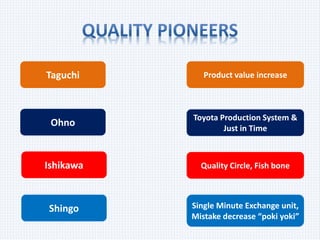
Taguchi
Single Minute Exchange unit,
Mistake decrease “poki yoki”
Quality Circle, Fish bone
Toyota Production System &
Just in Time
Product value increase
Ohno
Ishikawa
Shingo
Kano
Knowledge Share,
Employee psychology,
PDCA
Total Quality Management
Quality Control, Control
Chart, PDSA
Customer Needs
Understanding
Shewart
Juran
Deming
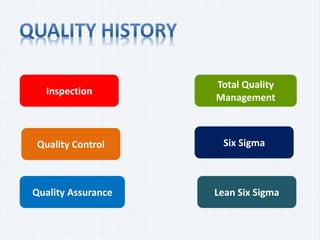
Inspection
Lean Six Sigma
Quality Control
Quality Assurance
Total Quality
Management
Six Sigma
Refers to the routine technical activities to ensure that
product quality is maintained or improved and
manufacturing errors are reduced or eliminated
The observation techniques and activities used to fulfill
requirements for quality.
Refers to the overall management system which includes
the organization, planning, data collection, quality control,
documentation, evaluation, and reporting activities
The planned and systematic activities implemented in a
quality system so that quality requirements for a product
or service will be fulfilled
Examination of a product design, product, service,
process or plant, and determination of their conformity
with specific requirements,
or on the basis of professional judgment-general
requirements
A holistic approach to long-term success that views
continuous improvement in all aspects of an
organization as a process and not as a short-term
goal. It aims to radically transform the organization
through progressive changes in the attitudes,
practices, structures, and systems.
The ISO story began in 1946 when delegates from 25 countries met at the
Institute of Civil Engineers in London and decided to create a new
international In February 1947 the new organization, began operations
They published over 19 500 International Standards covering almost all
aspects of technology and manufacturing.
They have members from 166 countries and 3 368 technical bodies to
take care of standard development.
BS 5750
ISO
9000:1987
ISO
9001:2000
ISO
9001:2008
Customer Focus
Involvement of People
System Approach to
Management
Factual approach to
decision making
Mutually beneficial supplier
relationships
Continual Improvement
Process Approach
Leadership
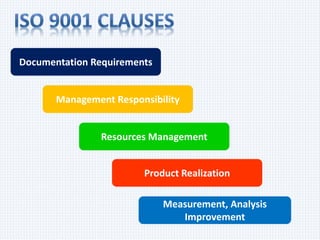
Documentation Requirements
Management Responsibility
Resources Management
Product Realization
Measurement, Analysis
Improvement
6.2 Human Resource
6.3 Infrastructure
6.4 Work
Environment

Quality Introduction

  • 2.
    Taguchi Single Minute Exchangeunit, Mistake decrease “poki yoki” Quality Circle, Fish bone Toyota Production System & Just in Time Product value increase Ohno Ishikawa Shingo
  • 3.
    Kano Knowledge Share, Employee psychology, PDCA TotalQuality Management Quality Control, Control Chart, PDSA Customer Needs Understanding Shewart Juran Deming
  • 4.
    Inspection Lean Six Sigma QualityControl Quality Assurance Total Quality Management Six Sigma
  • 5.
    Refers to theroutine technical activities to ensure that product quality is maintained or improved and manufacturing errors are reduced or eliminated The observation techniques and activities used to fulfill requirements for quality.
  • 6.
    Refers to theoverall management system which includes the organization, planning, data collection, quality control, documentation, evaluation, and reporting activities The planned and systematic activities implemented in a quality system so that quality requirements for a product or service will be fulfilled
  • 7.
    Examination of aproduct design, product, service, process or plant, and determination of their conformity with specific requirements, or on the basis of professional judgment-general requirements
  • 8.
    A holistic approachto long-term success that views continuous improvement in all aspects of an organization as a process and not as a short-term goal. It aims to radically transform the organization through progressive changes in the attitudes, practices, structures, and systems.
  • 9.
    The ISO storybegan in 1946 when delegates from 25 countries met at the Institute of Civil Engineers in London and decided to create a new international In February 1947 the new organization, began operations They published over 19 500 International Standards covering almost all aspects of technology and manufacturing. They have members from 166 countries and 3 368 technical bodies to take care of standard development.
  • 10.
  • 11.
    Customer Focus Involvement ofPeople System Approach to Management Factual approach to decision making Mutually beneficial supplier relationships Continual Improvement Process Approach Leadership
  • 12.
    Documentation Requirements Management Responsibility ResourcesManagement Product Realization Measurement, Analysis Improvement
  • 13.
    6.2 Human Resource 6.3Infrastructure 6.4 Work Environment