
Definition:
Total Quality Management
*Total Quality Management (TQ, QM or TQM) and Six Sigma (6) are
sweeping “culture change” efforts to position a company for greater
customer satisfaction, profitability and competitiveness.
*TQ may be defined as managing the entire organization so that it excels
on all dimensions of products and services that are important to the
customer.
*We often think of features when we think of the quality of a product or
service; TQ is about conformance quality, not features.
Total Quality Is…
*Meeting Our Customer’s Requirements
*Doing Things Right the First Time; Freedom from
Failure (Defects)
*Consistency (Reduction in Variation)
*Continuous Improvement
*Quality in Everything We Do
*A Quality Management System Is…
*A belief in the employee’s ability to solve problems
*A belief that people doing the work are best able to
Improve it
*A belief that everyone is responsible for quality
*Elements for Success
*Management Support
*Mission Statement
*Proper Planning
*Customer and Bottom Line Focus
*Measurement
*Empowerment
*Teamwork/Effective Meetings
*Continuous Process Improvement
*Dedicated Resources
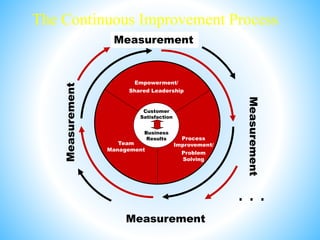
Measurement
Measurement
Measurement
Measurement
Empowerment/
Shared Leadership
Process
Improvement/
Problem
Solving
Team
Management
Customer
Satisfaction
Business
Results
The Continuous Improvement Process
. . .
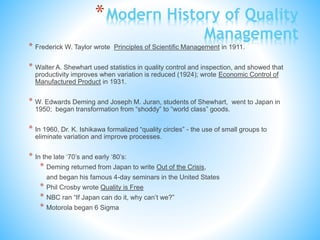
*Modern History of Quality
Management
* Frederick W. Taylor wrote Principles of Scientific Management in 1911.
* Walter A. Shewhart used statistics in quality control and inspection, and showed that
productivity improves when variation is reduced (1924); wrote Economic Control of
Manufactured Product in 1931.
* W. Edwards Deming and Joseph M. Juran, students of Shewhart, went to Japan in
1950; began transformation from “shoddy” to “world class” goods.
* In 1960, Dr. K. Ishikawa formalized “quality circles” - the use of small groups to
eliminate variation and improve processes.
* In the late ‘70’s and early ‘80’s:
* Deming returned from Japan to write Out of the Crisis,
and began his famous 4-day seminars in the United States
* Phil Crosby wrote Quality is Free
* NBC ran “If Japan can do it, why can’t we?”
* Motorola began 6 Sigma
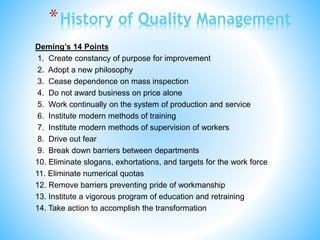
Deming’s 14 Points
1. Create constancy of purpose for improvement
2. Adopt a new philosophy
3. Cease dependence on mass inspection
4. Do not award business on price alone
5. Work continually on the system of production and service
6. Institute modern methods of training
7. Institute modern methods of supervision of workers
8. Drive out fear
9. Break down barriers between departments
10. Eliminate slogans, exhortations, and targets for the work force
11. Eliminate numerical quotas
12. Remove barriers preventing pride of workmanship
13. Institute a vigorous program of education and retraining
14. Take action to accomplish the transformation
*History of Quality Management
* History of Quality Management
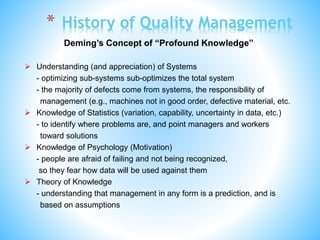
Deming’s Concept of “Profound Knowledge”
 Understanding (and appreciation) of Systems
- optimizing sub-systems sub-optimizes the total system
- the majority of defects come from systems, the responsibility of
management (e.g., machines not in good order, defective material, etc.
 Knowledge of Statistics (variation, capability, uncertainty in data, etc.)
- to identify where problems are, and point managers and workers
toward solutions
 Knowledge of Psychology (Motivation)
- people are afraid of failing and not being recognized,
so they fear how data will be used against them
 Theory of Knowledge
- understanding that management in any form is a prediction, and is
based on assumptions
According to Dr. Joseph M. Juran (1991):
“On the assembly line at the Ford Motor Company in 1923,
most of the workers producing Model T’s were immigrants
and could not speak English. Many were also illiterate.
Workers learned their trade by modeling the actions of other
workers. They were unable to plan, problem-solve, and make
decisions. As a result, the Taylor scientific school of
management flourished, and MBAs and industrial engineers
were invented to do this work. Today, however, the workforce
is educated. Workers know what is needed to improve their
jobs, and companies that do not tap into this significant
source of knowledge will truly be at a competitive
disadvantage.”
*History of Total Quality
According to Phil Crosby, Quality is . . .
An attitude:
- Zero Defects
- Continuous Improvement
A measurement:
- Price of Conformance, plus
- Price of Nonconformance (defects)
*History of Total Quality
*TQ: Transforming an Organization
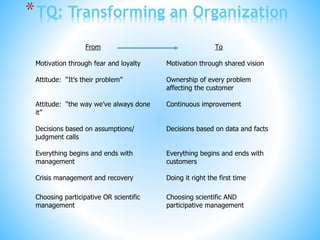
From
Motivation through fear and loyalty
To
Motivation through shared vision
Attitude: “It’s their problem” Ownership of every problem
affecting the customer
Attitude: “the way we’ve always done
it”
Continuous improvement
Decisions based on assumptions/
judgment calls
Decisions based on data and facts
Everything begins and ends with
management
Everything begins and ends with
customers
Crisis management and recovery Doing it right the first time
Choosing participative OR scientific
management
Choosing scientific AND
participative management
*What is Six Sigma?
• A goal of near perfection in meeting customer requirements
• A sweeping culture change effort to position a company for
greater customer satisfaction, profitability and competitiveness
• A comprehensive and flexible system for achieving,
sustaining and maximizing business success; uniquely driven
by close understanding of customer needs, disciplined use of
facts, data, and statistical analysis, and diligent attention to
managing, improving and reinventing business processes
(Source:The Six Sigma Way by Pande, Neuman and Cavanagh)
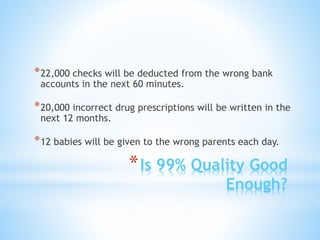
*Is 99% Quality Good
Enough?
*22,000 checks will be deducted from the wrong bank
accounts in the next 60 minutes.
*20,000 incorrect drug prescriptions will be written in the
next 12 months.
*12 babies will be given to the wrong parents each day.
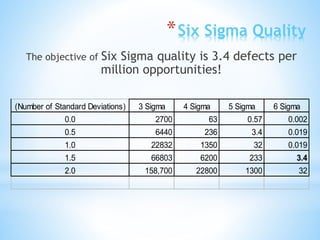
*Six Sigma Quality
The objective of Six Sigma quality is 3.4 defects per
million opportunities!
(Number of Standard Deviations) 3 Sigma 4 Sigma 5 Sigma 6 Sigma
0.0 2700 63 0.57 0.002
0.5 6440 236 3.4 0.019
1.0 22832 1350 32 0.019
1.5 66803 6200 233 3.4
2.0 158,700 22800 1300 32
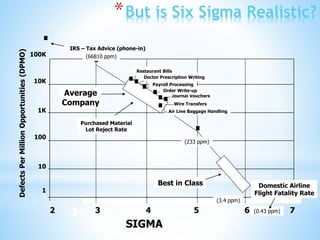
*But is Six Sigma Realistic?
·
1
11
21
31
41
3 4 5 6 7
10
1
100
1K
10K
100K
765432
(66810 ppm)
· IRS – Tax Advice (phone-in)
Best in Class
(3.4 ppm)
Domestic Airline
Flight Fatality Rate
(0.43 ppm)
·(233 ppm)
Average
Company
Purchased Material
Lot Reject Rate
Air Line Baggage Handling
Wire Transfers
Journal Vouchers
Order Write-up
Payroll Processing
Doctor Prescription Writing
Restaurant Bills
·······
DefectsPerMillionOpportunities(DPMO)
SIGMA
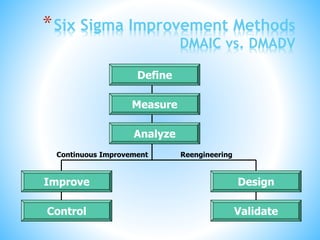
*Six Sigma Improvement Methods
DMAIC vs. DMADV
Define
Measure
Analyze
Design
Validate
Improve
Control
Continuous Improvement Reengineering
Six Sigma DMAIC Process
Measure
Control
Define
Analyze
Improve
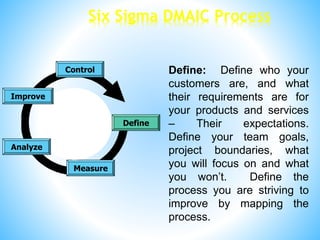
Define: Define who your
customers are, and what
their requirements are for
your products and services
– Their expectations.
Define your team goals,
project boundaries, what
you will focus on and what
you won’t. Define the
process you are striving to
improve by mapping the
process.
*Six Sigma DMAIC Process
Measure
Control
Define
Analyze
Improve
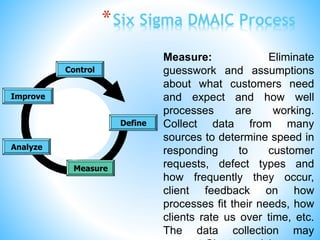
Measure: Eliminate
guesswork and assumptions
about what customers need
and expect and how well
processes are working.
Collect data from many
sources to determine speed in
responding to customer
requests, defect types and
how frequently they occur,
client feedback on how
processes fit their needs, how
clients rate us over time, etc.
The data collection may
Six Sigma DMAIC Process
Measure
Control
Define
Analyze
Improve
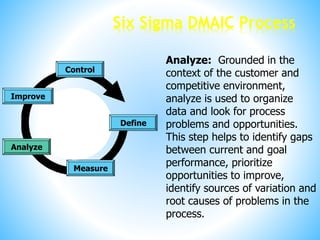
Analyze: Grounded in the
context of the customer and
competitive environment,
analyze is used to organize
data and look for process
problems and opportunities.
This step helps to identify gaps
between current and goal
performance, prioritize
opportunities to improve,
identify sources of variation and
root causes of problems in the
process.
*Six Sigma DMAIC ProcessMeasure
Control
Define
Analyze
Improve
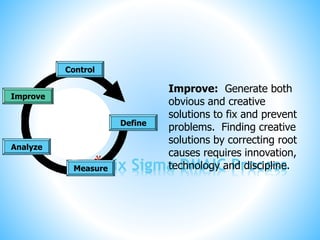
Improve: Generate both
obvious and creative
solutions to fix and prevent
problems. Finding creative
solutions by correcting root
causes requires innovation,
technology and discipline.
Six Sigma DMAIC Process
Measure
Control
Define
Analyze
Improve
Control: Insure that the
process improvements,
once implemented, will “hold
the gains” rather than revert
to the same problems again.
Various control tools such
as statistical process control
can be used. Other tools
such as procedure
documentation helps
institutionalize the
improvement.
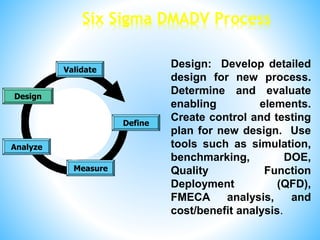
Six Sigma DMADV Process
Measure
Validate
Define
Analyze
Design
Design: Develop detailed
design for new process.
Determine and evaluate
enabling elements.
Create control and testing
plan for new design. Use
tools such as simulation,
benchmarking, DOE,
Quality Function
Deployment (QFD),
FMECA analysis, and
cost/benefit analysis.
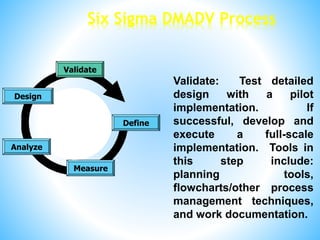
Six Sigma DMADV Process
Measure
Validate
Define
Analyze
Design
Validate: Test detailed
design with a pilot
implementation. If
successful, develop and
execute a full-scale
implementation. Tools in
this step include:
planning tools,
flowcharts/other process
management techniques,
and work documentation.
Total Quality Management & Six Sigma

Total Quality Management & Six Sigma

  • 1.
    Definition: Total Quality Management *TotalQuality Management (TQ, QM or TQM) and Six Sigma (6) are sweeping “culture change” efforts to position a company for greater customer satisfaction, profitability and competitiveness. *TQ may be defined as managing the entire organization so that it excels on all dimensions of products and services that are important to the customer. *We often think of features when we think of the quality of a product or service; TQ is about conformance quality, not features.
  • 2.
    Total Quality Is… *MeetingOur Customer’s Requirements *Doing Things Right the First Time; Freedom from Failure (Defects) *Consistency (Reduction in Variation) *Continuous Improvement *Quality in Everything We Do
  • 3.
    *A Quality ManagementSystem Is… *A belief in the employee’s ability to solve problems *A belief that people doing the work are best able to Improve it *A belief that everyone is responsible for quality
  • 4.
    *Elements for Success *ManagementSupport *Mission Statement *Proper Planning *Customer and Bottom Line Focus *Measurement *Empowerment *Teamwork/Effective Meetings *Continuous Process Improvement *Dedicated Resources
  • 5.
  • 6.
    *Modern History ofQuality Management * Frederick W. Taylor wrote Principles of Scientific Management in 1911. * Walter A. Shewhart used statistics in quality control and inspection, and showed that productivity improves when variation is reduced (1924); wrote Economic Control of Manufactured Product in 1931. * W. Edwards Deming and Joseph M. Juran, students of Shewhart, went to Japan in 1950; began transformation from “shoddy” to “world class” goods. * In 1960, Dr. K. Ishikawa formalized “quality circles” - the use of small groups to eliminate variation and improve processes. * In the late ‘70’s and early ‘80’s: * Deming returned from Japan to write Out of the Crisis, and began his famous 4-day seminars in the United States * Phil Crosby wrote Quality is Free * NBC ran “If Japan can do it, why can’t we?” * Motorola began 6 Sigma
  • 7.
    Deming’s 14 Points 1.Create constancy of purpose for improvement 2. Adopt a new philosophy 3. Cease dependence on mass inspection 4. Do not award business on price alone 5. Work continually on the system of production and service 6. Institute modern methods of training 7. Institute modern methods of supervision of workers 8. Drive out fear 9. Break down barriers between departments 10. Eliminate slogans, exhortations, and targets for the work force 11. Eliminate numerical quotas 12. Remove barriers preventing pride of workmanship 13. Institute a vigorous program of education and retraining 14. Take action to accomplish the transformation *History of Quality Management
  • 8.
    * History ofQuality Management Deming’s Concept of “Profound Knowledge”  Understanding (and appreciation) of Systems - optimizing sub-systems sub-optimizes the total system - the majority of defects come from systems, the responsibility of management (e.g., machines not in good order, defective material, etc.  Knowledge of Statistics (variation, capability, uncertainty in data, etc.) - to identify where problems are, and point managers and workers toward solutions  Knowledge of Psychology (Motivation) - people are afraid of failing and not being recognized, so they fear how data will be used against them  Theory of Knowledge - understanding that management in any form is a prediction, and is based on assumptions
  • 9.
    According to Dr.Joseph M. Juran (1991): “On the assembly line at the Ford Motor Company in 1923, most of the workers producing Model T’s were immigrants and could not speak English. Many were also illiterate. Workers learned their trade by modeling the actions of other workers. They were unable to plan, problem-solve, and make decisions. As a result, the Taylor scientific school of management flourished, and MBAs and industrial engineers were invented to do this work. Today, however, the workforce is educated. Workers know what is needed to improve their jobs, and companies that do not tap into this significant source of knowledge will truly be at a competitive disadvantage.” *History of Total Quality
  • 10.
    According to PhilCrosby, Quality is . . . An attitude: - Zero Defects - Continuous Improvement A measurement: - Price of Conformance, plus - Price of Nonconformance (defects) *History of Total Quality
  • 11.
    *TQ: Transforming anOrganization From Motivation through fear and loyalty To Motivation through shared vision Attitude: “It’s their problem” Ownership of every problem affecting the customer Attitude: “the way we’ve always done it” Continuous improvement Decisions based on assumptions/ judgment calls Decisions based on data and facts Everything begins and ends with management Everything begins and ends with customers Crisis management and recovery Doing it right the first time Choosing participative OR scientific management Choosing scientific AND participative management
  • 12.
    *What is SixSigma? • A goal of near perfection in meeting customer requirements • A sweeping culture change effort to position a company for greater customer satisfaction, profitability and competitiveness • A comprehensive and flexible system for achieving, sustaining and maximizing business success; uniquely driven by close understanding of customer needs, disciplined use of facts, data, and statistical analysis, and diligent attention to managing, improving and reinventing business processes (Source:The Six Sigma Way by Pande, Neuman and Cavanagh)
  • 13.
    *Is 99% QualityGood Enough? *22,000 checks will be deducted from the wrong bank accounts in the next 60 minutes. *20,000 incorrect drug prescriptions will be written in the next 12 months. *12 babies will be given to the wrong parents each day.
  • 14.
    *Six Sigma Quality Theobjective of Six Sigma quality is 3.4 defects per million opportunities! (Number of Standard Deviations) 3 Sigma 4 Sigma 5 Sigma 6 Sigma 0.0 2700 63 0.57 0.002 0.5 6440 236 3.4 0.019 1.0 22832 1350 32 0.019 1.5 66803 6200 233 3.4 2.0 158,700 22800 1300 32
  • 15.
    *But is SixSigma Realistic? · 1 11 21 31 41 3 4 5 6 7 10 1 100 1K 10K 100K 765432 (66810 ppm) · IRS – Tax Advice (phone-in) Best in Class (3.4 ppm) Domestic Airline Flight Fatality Rate (0.43 ppm) ·(233 ppm) Average Company Purchased Material Lot Reject Rate Air Line Baggage Handling Wire Transfers Journal Vouchers Order Write-up Payroll Processing Doctor Prescription Writing Restaurant Bills ······· DefectsPerMillionOpportunities(DPMO) SIGMA
  • 16.
    *Six Sigma ImprovementMethods DMAIC vs. DMADV Define Measure Analyze Design Validate Improve Control Continuous Improvement Reengineering
  • 17.
    Six Sigma DMAICProcess Measure Control Define Analyze Improve Define: Define who your customers are, and what their requirements are for your products and services – Their expectations. Define your team goals, project boundaries, what you will focus on and what you won’t. Define the process you are striving to improve by mapping the process.
  • 18.
    *Six Sigma DMAICProcess Measure Control Define Analyze Improve Measure: Eliminate guesswork and assumptions about what customers need and expect and how well processes are working. Collect data from many sources to determine speed in responding to customer requests, defect types and how frequently they occur, client feedback on how processes fit their needs, how clients rate us over time, etc. The data collection may
  • 19.
    Six Sigma DMAICProcess Measure Control Define Analyze Improve Analyze: Grounded in the context of the customer and competitive environment, analyze is used to organize data and look for process problems and opportunities. This step helps to identify gaps between current and goal performance, prioritize opportunities to improve, identify sources of variation and root causes of problems in the process.
  • 20.
    *Six Sigma DMAICProcessMeasure Control Define Analyze Improve Improve: Generate both obvious and creative solutions to fix and prevent problems. Finding creative solutions by correcting root causes requires innovation, technology and discipline.
  • 21.
    Six Sigma DMAICProcess Measure Control Define Analyze Improve Control: Insure that the process improvements, once implemented, will “hold the gains” rather than revert to the same problems again. Various control tools such as statistical process control can be used. Other tools such as procedure documentation helps institutionalize the improvement.
  • 22.
    Six Sigma DMADVProcess Measure Validate Define Analyze Design Design: Develop detailed design for new process. Determine and evaluate enabling elements. Create control and testing plan for new design. Use tools such as simulation, benchmarking, DOE, Quality Function Deployment (QFD), FMECA analysis, and cost/benefit analysis.
  • 23.
    Six Sigma DMADVProcess Measure Validate Define Analyze Design Validate: Test detailed design with a pilot implementation. If successful, develop and execute a full-scale implementation. Tools in this step include: planning tools, flowcharts/other process management techniques, and work documentation.