
Quality Assurance & e-Learning Future Plans in Malaysian Higher Education InstitutionsBy:Prof. Dr. Mohamed AminEmbi
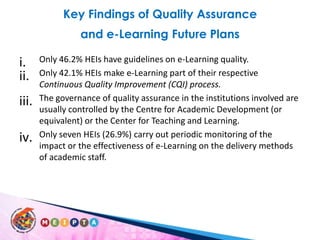
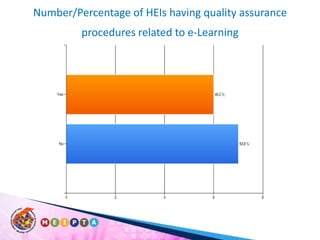
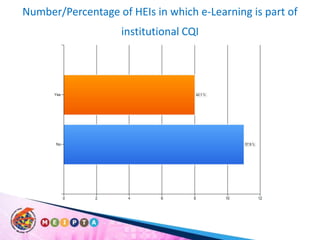
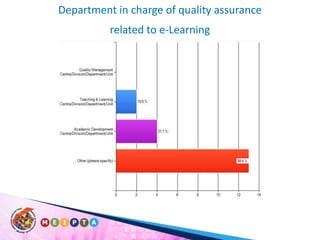
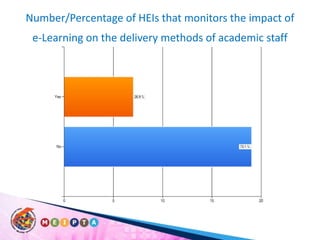
Key Findings of Quality Assurance and e-Learning Future PlansOnly 46.2% HEIs have guidelines on e-Learning quality. Only 42.1% HEIs make e-Learning part of their respective Continuous Quality Improvement (CQI) process.The governance of quality assurance in the institutions involved are usually controlled by the Centre for Academic Development (or equivalent) or the Center for Teaching and Learning. Only seven HEIs (26.9%) carry out periodic monitoring of the impact or the effectiveness of e-Learning on the delivery methods of academic staff.
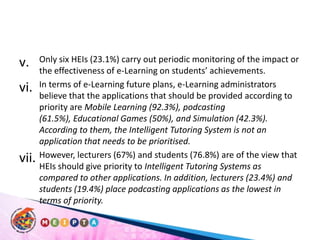
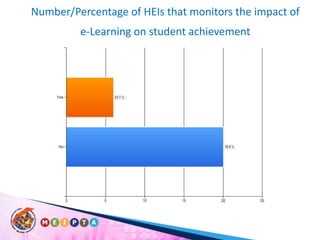
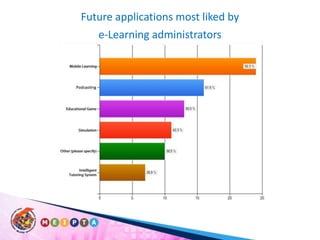
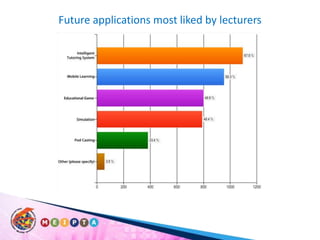
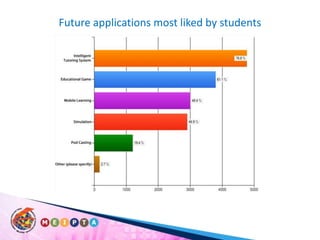
Only six HEIs (23.1%) carry out periodic monitoring of the impact or the effectiveness of e-Learning on students’ achievements. In terms of e-Learning future plans, e-Learning administrators believe that the applications that should be provided according to priority are Mobile Learning (92.3%), podcasting (61.5%), Educational Games (50%), and Simulation (42.3%). According to them, the Intelligent Tutoring System is not an application that needs to be prioritised. However, lecturers (67%) and students (76.8%) are of the view that HEIs should give priority to Intelligent Tutoring Systems as compared to other applications. In addition, lecturers (23.4%) and students (19.4%) place podcasting applications as the lowest in terms of priority.
Number/Percentage of HEIs having quality assurance procedures related to e-Learning
Number/Percentage of HEIs in which e-Learning is part of institutional CQI
Department in charge of quality assurance related to e-Learning
Number/Percentage of HEIs that monitors the impact of e-Learning on the delivery methods of academic staff
Number/Percentage of HEIs that monitors the impact of e-Learning on student achievement
Future applications most liked by e-Learning administrators
Future applications most liked by lecturers
Future applications most liked by students

Quality Assurance in e-Learning by Mohamed Amin Embi

  • 1.
    Quality Assurance &e-Learning Future Plans in Malaysian Higher Education InstitutionsBy:Prof. Dr. Mohamed AminEmbi
  • 2.
    Key Findings ofQuality Assurance and e-Learning Future PlansOnly 46.2% HEIs have guidelines on e-Learning quality. Only 42.1% HEIs make e-Learning part of their respective Continuous Quality Improvement (CQI) process.The governance of quality assurance in the institutions involved are usually controlled by the Centre for Academic Development (or equivalent) or the Center for Teaching and Learning. Only seven HEIs (26.9%) carry out periodic monitoring of the impact or the effectiveness of e-Learning on the delivery methods of academic staff.
  • 3.
    Only six HEIs(23.1%) carry out periodic monitoring of the impact or the effectiveness of e-Learning on students’ achievements. In terms of e-Learning future plans, e-Learning administrators believe that the applications that should be provided according to priority are Mobile Learning (92.3%), podcasting (61.5%), Educational Games (50%), and Simulation (42.3%). According to them, the Intelligent Tutoring System is not an application that needs to be prioritised. However, lecturers (67%) and students (76.8%) are of the view that HEIs should give priority to Intelligent Tutoring Systems as compared to other applications. In addition, lecturers (23.4%) and students (19.4%) place podcasting applications as the lowest in terms of priority.
  • 4.
    Number/Percentage of HEIshaving quality assurance procedures related to e-Learning
  • 5.
    Number/Percentage of HEIsin which e-Learning is part of institutional CQI
  • 6.
    Department in chargeof quality assurance related to e-Learning
  • 7.
    Number/Percentage of HEIsthat monitors the impact of e-Learning on the delivery methods of academic staff
  • 8.
    Number/Percentage of HEIsthat monitors the impact of e-Learning on student achievement
  • 9.
    Future applications mostliked by e-Learning administrators
  • 10.
    Future applications mostliked by lecturers
  • 11.
    Future applications mostliked by students