The innovative, creative, and engaging educator in AcademiaAlevElçiEastern Mediterranean UniversityNorthern CyprusPresented in JTEL 2010 summer SchoolOhrid Macedonia
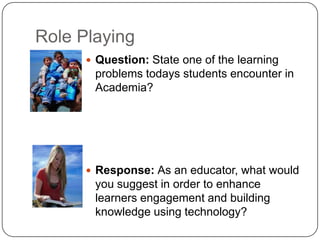
Role PlayingQuestion: State one of the learning problems todays students encounter in Academia?Response: As an educator, what would you suggest in order to enhance learners engagement and building knowledge using technology?
OutlineChallenges in Higher EducationLearning environmentsTechnology Enhanced Learning ToolsSocial networksFacebookNingWikisDigital StorytellingRole of studentsRole of educatorsResults & Discussion
Challenges in Higher EducationNeither students nor faculty are happy!Change in needs & expectations of students (Ellis, R., 1993;Fallows, S., & Bhanot, R., 2005). Change in learning environments (Grodecka, K., Pata, K., & Valjataga, T., 2008). Need to embrace 21st century learning skills (Solomon, G., & Schrum, L., 2007).
Complaints about todays studentsDo not read adequatelyDo not research adequatelyDo not meet deadlinesDo not studyHave no interest on the subjectsLast minute problem solversDo not bother with thingsTry to find an easy way to do thingsComplain...
Change in 21st Century Students’ LearningLearning stylesGamesLearning time and placeNetworksUse of  Technology ExperientialConstructivistCreativityPersonal Learning Environments
Learning EnvironmentsTraditional Classrooms are limiting!Wider range of contextAt homeLibraryCafeMobileOnlineAccessible 24/7 Social CommunitiesCollaborativeAny time, any where, any phase...
TEL ToolsSocial NetworksFacebookNingWikisWikispacesWetpaintDigital StorytellingAliceEmphasizeTeam buildingPeer-to-peer CollaborationTeacher student collaborationProjectsStorytellingGamesAnimations
FacebookUsed in IT Department since 2007 forming groups
CSIT474 Advanced Database Management for DBA in Oracle
CSIT422 Project Management in IT
Sharing content related
Links
Videos
Photos
Communication
Discussions
Peer to peer learningFacebookAdvantageMost students are already registeredFamiliar user interfaceInformal learningEntertainment & LearningDisadvantageFocusing on learning is difficult since other news distractNo privacy
Facebook groupshttp://www.facebook.com/editaccount.php?language#/group.php?gid=17894549712&ref=tshttp://www.facebook.com/editaccount.php?language#/group.php?gid=17790879328&ref=ts
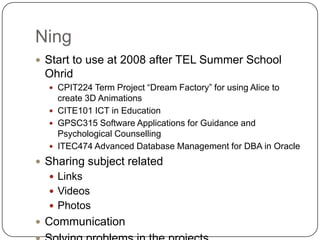
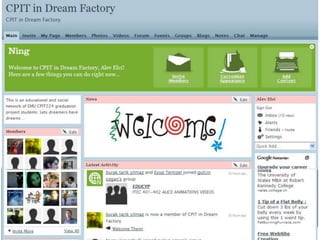
NingStart to use at 2008 after TEL Summer School Ohrid
CPIT224 Term Project “Dream Factory” for using Alice to create 3D Animations
CITE101 ICT in Education
GPSC315 Software Applications for Guidance and Psychological Counselling
ITEC474 Advanced Database Management for DBA in Oracle
Sharing subject related
Links
Videos
Photos

The innovative, creative, and engaging educator in Academia

  • 1.
    The innovative, creative,and engaging educator in AcademiaAlevElçiEastern Mediterranean UniversityNorthern CyprusPresented in JTEL 2010 summer SchoolOhrid Macedonia
  • 2.
    Role PlayingQuestion: Stateone of the learning problems todays students encounter in Academia?Response: As an educator, what would you suggest in order to enhance learners engagement and building knowledge using technology?
  • 3.
    OutlineChallenges in HigherEducationLearning environmentsTechnology Enhanced Learning ToolsSocial networksFacebookNingWikisDigital StorytellingRole of studentsRole of educatorsResults & Discussion
  • 4.
    Challenges in HigherEducationNeither students nor faculty are happy!Change in needs & expectations of students (Ellis, R., 1993;Fallows, S., & Bhanot, R., 2005). Change in learning environments (Grodecka, K., Pata, K., & Valjataga, T., 2008). Need to embrace 21st century learning skills (Solomon, G., & Schrum, L., 2007).
  • 5.
    Complaints about todaysstudentsDo not read adequatelyDo not research adequatelyDo not meet deadlinesDo not studyHave no interest on the subjectsLast minute problem solversDo not bother with thingsTry to find an easy way to do thingsComplain...
  • 6.
    Change in 21stCentury Students’ LearningLearning stylesGamesLearning time and placeNetworksUse of Technology ExperientialConstructivistCreativityPersonal Learning Environments
  • 7.
    Learning EnvironmentsTraditional Classroomsare limiting!Wider range of contextAt homeLibraryCafeMobileOnlineAccessible 24/7 Social CommunitiesCollaborativeAny time, any where, any phase...
  • 8.
    TEL ToolsSocial NetworksFacebookNingWikisWikispacesWetpaintDigitalStorytellingAliceEmphasizeTeam buildingPeer-to-peer CollaborationTeacher student collaborationProjectsStorytellingGamesAnimations
  • 9.
    FacebookUsed in ITDepartment since 2007 forming groups
  • 10.
    CSIT474 Advanced DatabaseManagement for DBA in Oracle
  • 11.
  • 12.
  • 13.
  • 14.
  • 15.
  • 16.
  • 17.
  • 18.
    Peer to peerlearningFacebookAdvantageMost students are already registeredFamiliar user interfaceInformal learningEntertainment & LearningDisadvantageFocusing on learning is difficult since other news distractNo privacy
  • 19.
  • 21.
    NingStart to useat 2008 after TEL Summer School Ohrid
  • 22.
    CPIT224 Term Project“Dream Factory” for using Alice to create 3D Animations
  • 23.
  • 24.
    GPSC315 Software Applicationsfor Guidance and Psychological Counselling
  • 25.
    ITEC474 Advanced DatabaseManagement for DBA in Oracle
  • 26.
  • 27.
  • 28.
  • 29.
  • 30.
  • 31.
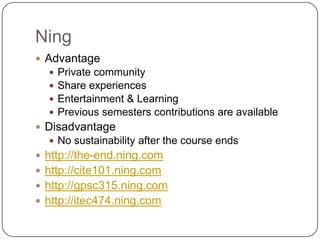
    Solving problems inthe projectsNingAdvantage
  • 32.
  • 33.
  • 34.
  • 35.
  • 36.
  • 37.
  • 38.
  • 39.
  • 40.
  • 41.
  • 42.
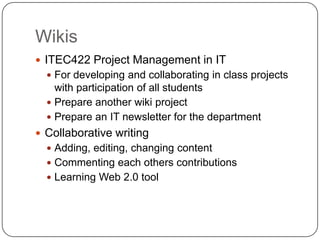
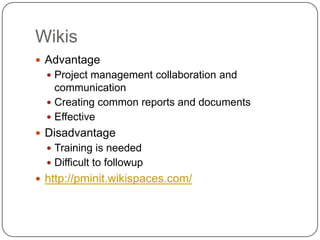
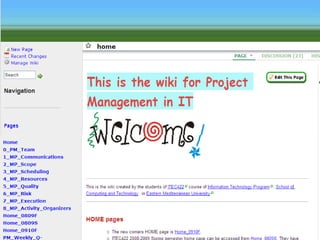
    WikisITEC422 Project Managementin ITFor developing and collaborating in class projects with participation of all studentsPrepare another wiki project Prepare an IT newsletter for the departmentCollaborative writingAdding, editing, changing contentCommenting each others contributionsLearning Web 2.0 tool
  • 43.
    WikisAdvantageProject management collaborationand communicationCreating common reports and documents EffectiveDisadvantageTraining is neededDifficult to followuphttp://pminit.wikispaces.com/
  • 45.
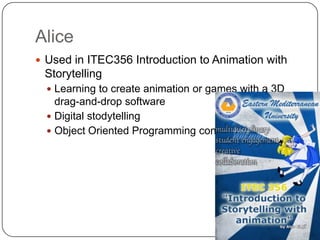
    AliceUsed in ITEC356Introduction to Animation with StorytellingLearning to create animation or games with a 3D drag-and-drop softwareDigital stodytelling Object Oriented Programming concepts
  • 46.
    AliceAdvantagesCan further useanimation and games for educational purposesWorking on a project with students from different disciplines DisadvantageIndividual work preferences of some students created problems in final group project
  • 48.
    StudentsThey don’t wantto be sole learnerThey want to participate in learning processThey want to choose their personal learning environmentsThey want to teach themselvesThey want to be active and engaged in what THEY want to learnThey need to be interested in the subjectThey need to be encouragedThey need to be motivatedThey usually prefer to work in communities
  • 49.
    What is therole of faculty member in facilitating new forms of learning?Not only Traditional Teacher... Knowledge transformer!Role modelCreating communities for faculty development in collaborative educational technologiesOrchestrating learnersConnecting learners Creating wider range of context (learning environments)
  • 50.
    Role of educatorsNotonly transfer knowledge!!!FacilitateGuideCollaborateCommunicateFriendParent24/7 connected
  • 51.
    Role of educatorsConsideringthat each student is differentAttract early adopter students Engaging studentsBe creative in their teachingInnovate new forms of teachingCreate various learning environmentsShare, care, dare...
  • 52.
    Result & DiscussionFacilitatingnew forms of learning may close the gap between teachers and students that exists in traditional teaching. Also formal and informal learning environments can be hand in hand. Collaboration can be emphasized more than competition.Entertaining while teaching can be a priority.Teachers needs to be professionally developed to integrate technology in the curriculum for including new forms of learning activities.Also the sustainability is needed for future competence development.
  • 53.
    ReferencesEllis, R. (1993).Quality assurance for university teaching: Issues and approaches. In H.Eggins (Series Ed.), & R. Ellis (Vol. Ed.), The Society for Research into Higher Education. Quality Assurance for University Teaching. Great Briton: Open University Press.
  • 54.
    Fallows, S., &Bhanot, R. (Eds.). (2005). Quality in ICT-based higher education: Some introductory questions. In J. Wisdom (Series Ed.), The staff and educational development series. Quality issues in ICT-based higher education. NY: RoutledgeFalmer.
  • 55.
    Frazel, F. (2010).Digital Storytelling. Washington DC: International Society for Techology in Education.
  • 56.
    Grodecka, K., Pata,K., & Valjataga, T. (2008). How to Use Social Software in Higher Education. A handbook from the iCamp project (2005-2008).
  • 57.
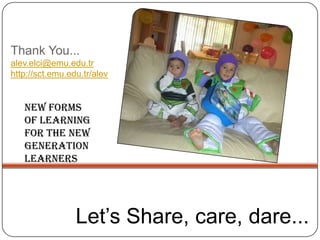
    Solomon, G., &Schrum, L. (2007). Web 2.0: new Tools, new schools. Washington DC: International Society for Techology in Education.Thank You...alev.elci@emu.edu.trhttp://sct.emu.edu.tr/alevNew forms of learning for the new generation learnersLet’s Share, care, dare...
  • 58.

Editor's Notes

  • #2 Today I will do king of STORY TELLING, and I expect you to JOIN me with your stories in learning in Universities. I was a student in TEL SS in 2008 and learned a lot TEL stuff. Used them in all my courses during these 2 years. Now it is time to share what I how done ? How I have done? Results...
  • #6 If so as educators our aim should be to arrange the teaching and learning: methods, materials, approaches, strategies, and teachers attitude according to 21st century STUDENTS. DON’T ACCUSE students