e-Content Development in Malaysian Higher Education InstitutionsBy:Prof. Dr. Mohamed Amin Embi
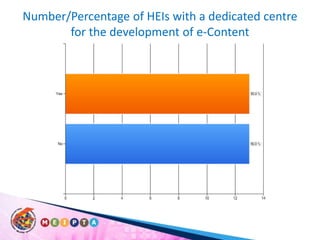
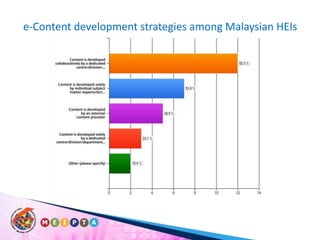
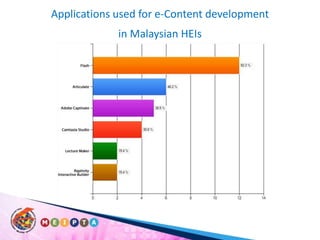
Key Findings of e-Content DevelopmentHalf (50%) of the HEIs surveyed have a dedicated centre/department/unit to manage e-Content development. Generally, the main strategy (92.3%) used by most Malaysian HEIs is for these dedicated units to collaborate with the lecturers who are subject matter experts. The main applications used for e-Content development are Flash (92.3%), followed by Articulate (46.3%), Adobe Captivate (38.3%), Camtasia Studio (30.8%), Lecture Maker (15.42%), and Interactive Raptivity Builder ( 15.4%).
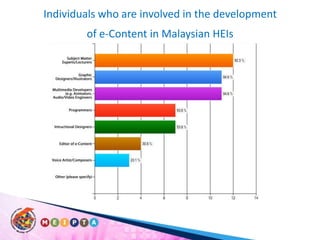
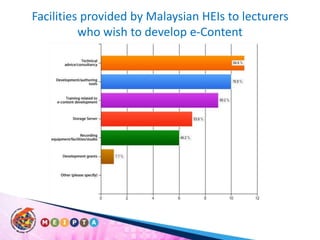
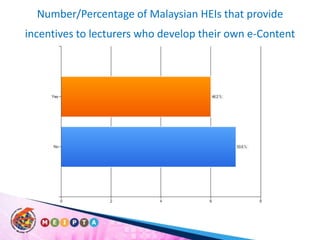
Those who were included in the development of e-Content were lecturers or the content experts (2.3%), graphic designers (84.6%), and also the multimedia developers (84.6%). Major support provided by Malaysian HEIs to lecturers who wish to develop e-Content include advice (84.6%), support in the form of equipment/authoring software (76.9%), and training related to the development of e-Content (69.2%). So far, only one (7.7%) Malaysian HEI provides e-Content development grants to academic staff. Out of the 13 HEIs who have dedicated centres to manage e-Content development, only six (46.2%) provide incentives for lecturers who develop their own e-Learning content.
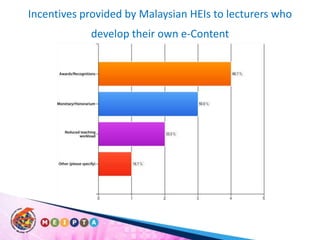
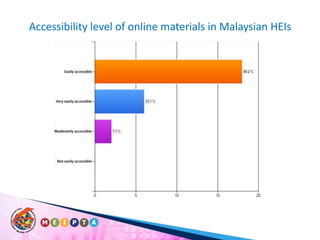
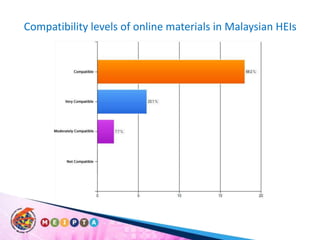
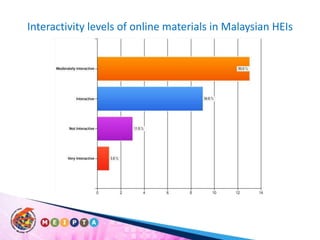
Out of the six, four HEIs provide incentives in the form of awards, three HEIs in the form of honorarium, and two HEIs in the form of reduced teaching load. In general, the materials available online can be accessed easily in most HEIs (69.2%), while in six HEIs (23.1%), it can be accessed very easily. In terms of compatibility, 69.2% are compatible; 23.1% are very compatible, while 7.7% are moderately compatible. In terms of interactivity of the materials available online, only 3.8% are very interactive, 34.6% are interactive, 50% are moderately interactive, and 11.5% are not interactive.
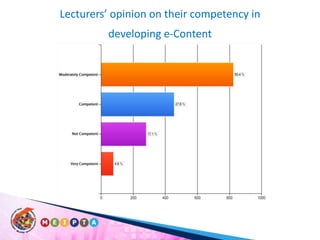
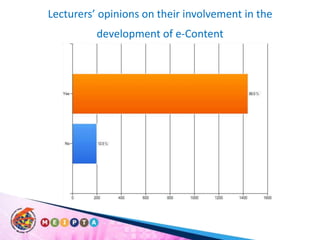
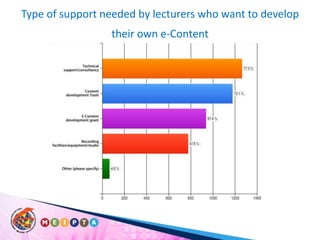
Only 17.1% of lecturers surveyed felt that they are not competent enough to develop e-Content. Half of them (50.4%) felt that they are moderately competent, 27.8% felt that they are competent, and 4.6% felt that they are very competent. Most of the lecturers surveyed (88%) believe that they should be involved in the development of e-Content. The main support needed by lecturers involved in e-Content development are technical support (77.3%), e-Content development software (72.1%), e-Content development grants (57.4%), and recording studio facility.
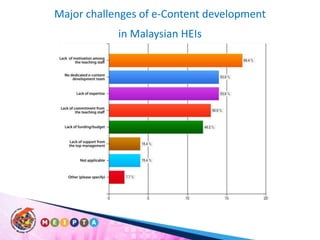
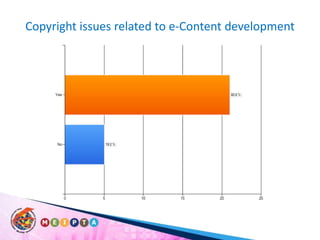
In terms of e-Content development, five major challenges faced by most HEIs are lack of motivation among the academic staff (65.4%), lack of specialists (53.80%), lack of a dedicated team to develop e-Content (53.8%), lack of commitment among academic staff (46.2%), and lack of funding/budget (46.2%). Support from top management (15.4%) is not the main challenge faced by HEIs on the development of e-Content. Copyright issue is also a problem faced by the majority (80.8%) of Malaysian HEIs in the development of e-Content.
Number/Percentage of HEIs with a dedicated centre for the development of e-Content
e-Content development strategies among Malaysian HEIs
Applications used for e-Content development in Malaysian HEIs
Individuals who are involved in the development of e-Content in Malaysian HEIs
Facilities provided by Malaysian HEIs to lecturers who wish to develop e-Content
Number/Percentage of Malaysian HEIs that provide incentives to lecturers who develop their own e-Content
Incentives provided by Malaysian HEIs to lecturers who develop their own e-Content
Accessibility level of online materials in Malaysian HEIs
Compatibility levels of online materials in Malaysian HEIs
Interactivity levels of online materials in Malaysian HEIs
Lecturers’ opinion on their competency in developing e-Content
Lecturers’ opinions on their involvement in the development of e-Content
Type of support needed by lecturers who want to develop their own e-Content
Major challenges of e-Content development in Malaysian HEIs
Copyright issues related to e-Content development

e-content development by Mohamed Amin Embi

  • 1.
    e-Content Development inMalaysian Higher Education InstitutionsBy:Prof. Dr. Mohamed Amin Embi
  • 2.
    Key Findings ofe-Content DevelopmentHalf (50%) of the HEIs surveyed have a dedicated centre/department/unit to manage e-Content development. Generally, the main strategy (92.3%) used by most Malaysian HEIs is for these dedicated units to collaborate with the lecturers who are subject matter experts. The main applications used for e-Content development are Flash (92.3%), followed by Articulate (46.3%), Adobe Captivate (38.3%), Camtasia Studio (30.8%), Lecture Maker (15.42%), and Interactive Raptivity Builder ( 15.4%).
  • 3.
    Those who wereincluded in the development of e-Content were lecturers or the content experts (2.3%), graphic designers (84.6%), and also the multimedia developers (84.6%). Major support provided by Malaysian HEIs to lecturers who wish to develop e-Content include advice (84.6%), support in the form of equipment/authoring software (76.9%), and training related to the development of e-Content (69.2%). So far, only one (7.7%) Malaysian HEI provides e-Content development grants to academic staff. Out of the 13 HEIs who have dedicated centres to manage e-Content development, only six (46.2%) provide incentives for lecturers who develop their own e-Learning content.
  • 4.
    Out of thesix, four HEIs provide incentives in the form of awards, three HEIs in the form of honorarium, and two HEIs in the form of reduced teaching load. In general, the materials available online can be accessed easily in most HEIs (69.2%), while in six HEIs (23.1%), it can be accessed very easily. In terms of compatibility, 69.2% are compatible; 23.1% are very compatible, while 7.7% are moderately compatible. In terms of interactivity of the materials available online, only 3.8% are very interactive, 34.6% are interactive, 50% are moderately interactive, and 11.5% are not interactive.
  • 5.
    Only 17.1% oflecturers surveyed felt that they are not competent enough to develop e-Content. Half of them (50.4%) felt that they are moderately competent, 27.8% felt that they are competent, and 4.6% felt that they are very competent. Most of the lecturers surveyed (88%) believe that they should be involved in the development of e-Content. The main support needed by lecturers involved in e-Content development are technical support (77.3%), e-Content development software (72.1%), e-Content development grants (57.4%), and recording studio facility.
  • 6.
    In terms ofe-Content development, five major challenges faced by most HEIs are lack of motivation among the academic staff (65.4%), lack of specialists (53.80%), lack of a dedicated team to develop e-Content (53.8%), lack of commitment among academic staff (46.2%), and lack of funding/budget (46.2%). Support from top management (15.4%) is not the main challenge faced by HEIs on the development of e-Content. Copyright issue is also a problem faced by the majority (80.8%) of Malaysian HEIs in the development of e-Content.
  • 7.
    Number/Percentage of HEIswith a dedicated centre for the development of e-Content
  • 8.
  • 9.
    Applications used fore-Content development in Malaysian HEIs
  • 10.
    Individuals who areinvolved in the development of e-Content in Malaysian HEIs
  • 11.
    Facilities provided byMalaysian HEIs to lecturers who wish to develop e-Content
  • 12.
    Number/Percentage of MalaysianHEIs that provide incentives to lecturers who develop their own e-Content
  • 13.
    Incentives provided byMalaysian HEIs to lecturers who develop their own e-Content
  • 14.
    Accessibility level ofonline materials in Malaysian HEIs
  • 15.
    Compatibility levels ofonline materials in Malaysian HEIs
  • 16.
    Interactivity levels ofonline materials in Malaysian HEIs
  • 17.
    Lecturers’ opinion ontheir competency in developing e-Content
  • 18.
    Lecturers’ opinions ontheir involvement in the development of e-Content
  • 19.
    Type of supportneeded by lecturers who want to develop their own e-Content
  • 20.
    Major challenges ofe-Content development in Malaysian HEIs
  • 21.
    Copyright issues relatedto e-Content development