

e-Learning Training in Malaysian Higher Education InstitutionsBy:Prof. Dr. Mohamed Amin Embi
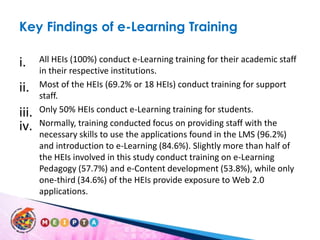
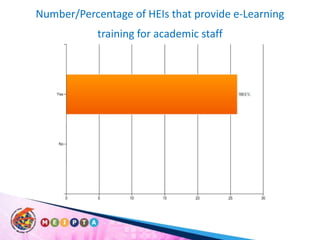
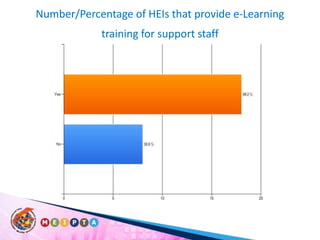
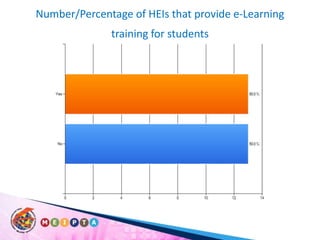
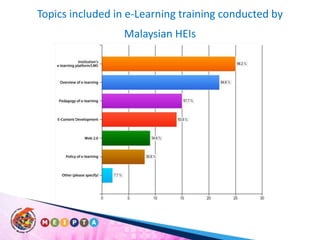
Key Findings of e-Learning Training All HEIs (100%) conduct e-Learning training for their academic staff in their respective institutions.Most of the HEIs (69.2% or 18 HEIs) conduct training for support staff. Only 50% HEIs conduct e-Learning training for students. Normally, training conducted focus on providing staff with the necessary skills to use the applications found in the LMS (96.2%) and introduction to e-Learning (84.6%). Slightly more than half of the HEIs involved in this study conduct training on e-Learning Pedagogy (57.7%) and e-Content development (53.8%), while only one-third (34.6%) of the HEIs provide exposure to Web 2.0 applications.
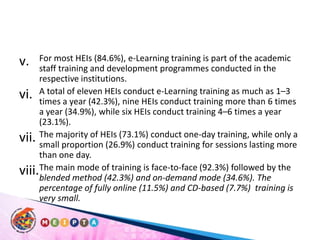
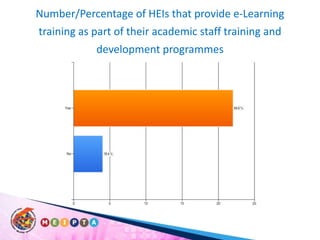
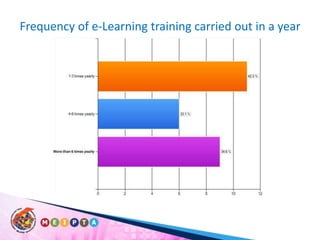
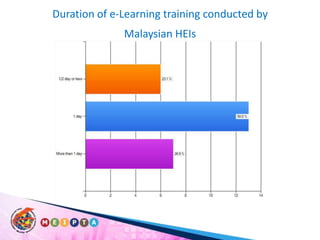
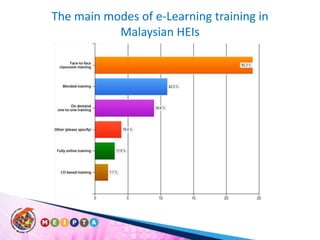
For most HEIs (84.6%), e-Learning training is part of the academic staff training and development programmes conducted in the respective institutions. A total of eleven HEIs conduct e-Learning training as much as 1–3 times a year (42.3%), nine HEIs conduct training more than 6 times a year (34.9%), while six HEIs conduct training 4–6 times a year (23.1%). The majority of HEIs (73.1%) conduct one-day training, while only a small proportion (26.9%) conduct training for sessions lasting more than one day. The main mode of training is face-to-face (92.3%) followed by the blended method (42.3%) and on-demand mode (34.6%). The percentage of fully online (11.5%) and CD-based (7.7%)  training is very small.
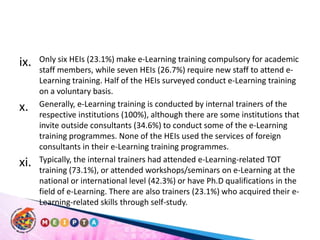
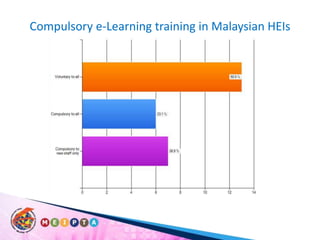
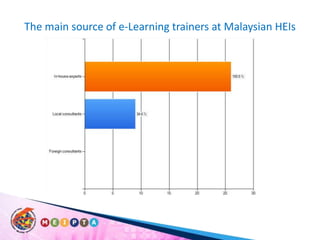
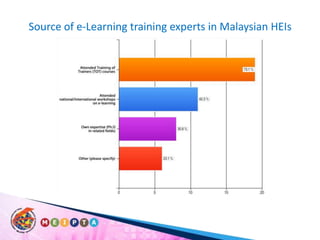
Only six HEIs (23.1%) make e-Learning training compulsory for academic staff members, while seven HEIs (26.7%) require new staff to attend e-Learning training. Half of the HEIs surveyed conduct e-Learning training on a voluntary basis. Generally, e-Learning training is conducted by internal trainers of the respective institutions (100%), although there are some institutions that invite outside consultants (34.6%) to conduct some of the e-Learning training programmes. None of the HEIs used the services of foreign consultants in their e-Learning training programmes. Typically, the internal trainers had attended e-Learning-related TOT training (73.1%), or attended workshops/seminars on e-Learning at the national or international level (42.3%) or have Ph.D qualifications in the field of e-Learning. There are also trainers (23.1%) who acquired their e-Learning-related skills through self-study.
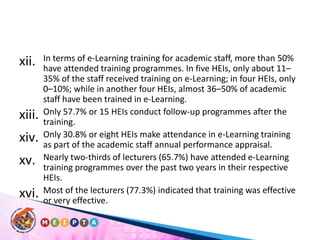
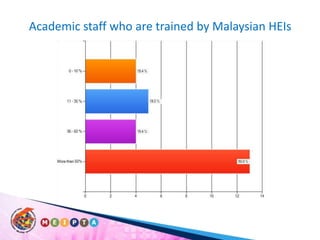
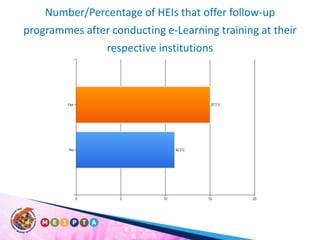
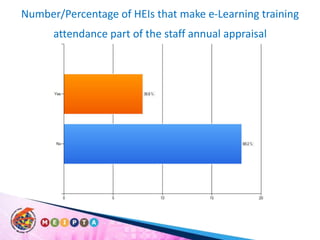
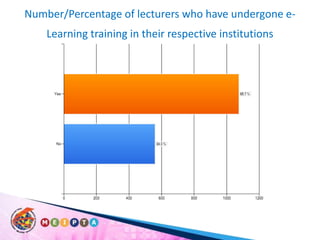
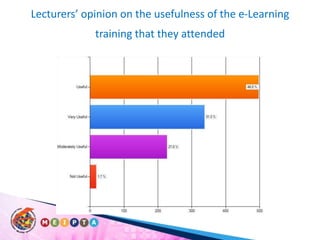
In terms of e-Learning training for academic staff, more than 50% have attended training programmes. In five HEIs, only about 11–35% of the staff received training on e-Learning; in four HEIs, only 0–10%; while in another four HEIs, almost 36–50% of academic staff have been trained in e-Learning. Only 57.7% or 15 HEIs conduct follow-up programmes after the training. Only 30.8% or eight HEIs make attendance in e-Learning training as part of the academic staff annual performance appraisal. Nearly two-thirds of lecturers (65.7%) have attended e-Learning training programmes over the past two years in their respective HEIs. Most of the lecturers (77.3%) indicated that training was effective or very effective.
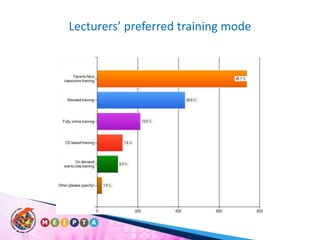
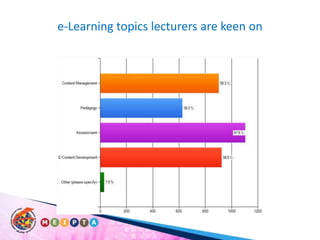
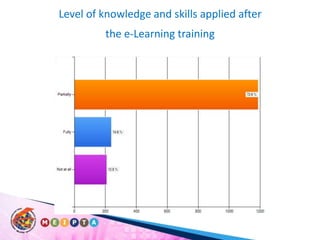
The main modes of training preferred by lecturers are face-to-face (45.1%), followed by the blended method (26.5%). Percentage of those interested in fully online (13%), CD-based (7.6%), and on demand (6.3%) training are very small. Training topics of interest to lecturers are online assessment (67.7%), e-Content development (56.5%), content management (55.3%), and e-Learning pedagogy (38.3%). In terms of applying the knowledge and skills learned during training, most of the lecturers (72.6%) indicated that they have successfully applied it in their teaching. A small proportion (14.6%) of lecturers believed that they managed to apply all that they have learned, while 12.8% indicated that they could not apply what they have learned during e-Learning training.
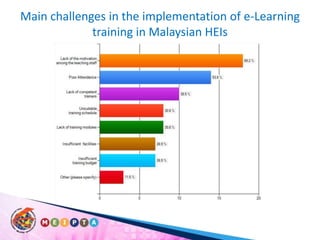
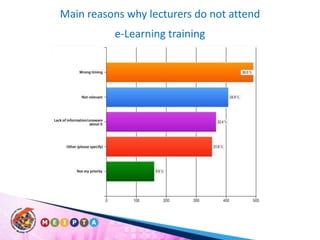
In terms of e-Learning training, the two key challenges faced by most HEIs are the lack of motivation among the teaching staff (69.2%) and the lack of attendance during training (53.8%). Other challenges include lack of expert training facilitators (38.5%), lack of training modules (30.8%), and unsuitable training schedule (30.8%). The data also shows that the lack of budget (26.9%) and lack of facilities (26.9%) are not major problems in the implementation of e-Learning training in Malaysian HEIs. Generally, most of the lecturers do not attend e-Learning training is because the training schedule usually clashes with their teaching activities during a semester.
Number/Percentage of HEIs that provide e-Learning training for academic staff
Number/Percentage of HEIs that provide e-Learning training for support staff
Number/Percentage of HEIs that provide e-Learning training for students
Topics included in e-Learning training conducted by Malaysian HEIs
Number/Percentage of HEIs that provide e-Learning training as part of their academic staff training and development programmes
Frequency of e-Learning training carried out in a year
Duration of e-Learning training conducted by Malaysian HEIs
The main modes of e-Learning training in Malaysian HEIs
Compulsory e-Learning training in Malaysian HEIs
The main source of e-Learning trainers at Malaysian HEIs
Source of e-Learning training experts in Malaysian HEIs
Academic staff who are trained by Malaysian HEIs
Number/Percentage of HEIs that offer follow-up programmes after conducting e-Learning training at their respective institutions
Number/Percentage of HEIs that make e-Learning training attendance part of the staff annual appraisal
Number/Percentage of lecturers who have undergone e-Learning training in their respective institutions
Lecturers’ opinion on the usefulness of the e-Learning training that they attended
Lecturers’ preferred training mode
e-Learning topics lecturers are keen on
Level of knowledge and skills applied after the e-Learning training
Main challenges in the implementation of e-Learning training in Malaysian HEIs
Main reasons why lecturers do not attend e-Learning training

e-learning training by Mohamed Amin Embi

  • 1.
    e-Learning Training inMalaysian Higher Education InstitutionsBy:Prof. Dr. Mohamed Amin Embi
  • 2.
    Key Findings ofe-Learning Training All HEIs (100%) conduct e-Learning training for their academic staff in their respective institutions.Most of the HEIs (69.2% or 18 HEIs) conduct training for support staff. Only 50% HEIs conduct e-Learning training for students. Normally, training conducted focus on providing staff with the necessary skills to use the applications found in the LMS (96.2%) and introduction to e-Learning (84.6%). Slightly more than half of the HEIs involved in this study conduct training on e-Learning Pedagogy (57.7%) and e-Content development (53.8%), while only one-third (34.6%) of the HEIs provide exposure to Web 2.0 applications.
  • 3.
    For most HEIs(84.6%), e-Learning training is part of the academic staff training and development programmes conducted in the respective institutions. A total of eleven HEIs conduct e-Learning training as much as 1–3 times a year (42.3%), nine HEIs conduct training more than 6 times a year (34.9%), while six HEIs conduct training 4–6 times a year (23.1%). The majority of HEIs (73.1%) conduct one-day training, while only a small proportion (26.9%) conduct training for sessions lasting more than one day. The main mode of training is face-to-face (92.3%) followed by the blended method (42.3%) and on-demand mode (34.6%). The percentage of fully online (11.5%) and CD-based (7.7%) training is very small.
  • 4.
    Only six HEIs(23.1%) make e-Learning training compulsory for academic staff members, while seven HEIs (26.7%) require new staff to attend e-Learning training. Half of the HEIs surveyed conduct e-Learning training on a voluntary basis. Generally, e-Learning training is conducted by internal trainers of the respective institutions (100%), although there are some institutions that invite outside consultants (34.6%) to conduct some of the e-Learning training programmes. None of the HEIs used the services of foreign consultants in their e-Learning training programmes. Typically, the internal trainers had attended e-Learning-related TOT training (73.1%), or attended workshops/seminars on e-Learning at the national or international level (42.3%) or have Ph.D qualifications in the field of e-Learning. There are also trainers (23.1%) who acquired their e-Learning-related skills through self-study.
  • 5.
    In terms ofe-Learning training for academic staff, more than 50% have attended training programmes. In five HEIs, only about 11–35% of the staff received training on e-Learning; in four HEIs, only 0–10%; while in another four HEIs, almost 36–50% of academic staff have been trained in e-Learning. Only 57.7% or 15 HEIs conduct follow-up programmes after the training. Only 30.8% or eight HEIs make attendance in e-Learning training as part of the academic staff annual performance appraisal. Nearly two-thirds of lecturers (65.7%) have attended e-Learning training programmes over the past two years in their respective HEIs. Most of the lecturers (77.3%) indicated that training was effective or very effective.
  • 6.
    The main modesof training preferred by lecturers are face-to-face (45.1%), followed by the blended method (26.5%). Percentage of those interested in fully online (13%), CD-based (7.6%), and on demand (6.3%) training are very small. Training topics of interest to lecturers are online assessment (67.7%), e-Content development (56.5%), content management (55.3%), and e-Learning pedagogy (38.3%). In terms of applying the knowledge and skills learned during training, most of the lecturers (72.6%) indicated that they have successfully applied it in their teaching. A small proportion (14.6%) of lecturers believed that they managed to apply all that they have learned, while 12.8% indicated that they could not apply what they have learned during e-Learning training.
  • 7.
    In terms ofe-Learning training, the two key challenges faced by most HEIs are the lack of motivation among the teaching staff (69.2%) and the lack of attendance during training (53.8%). Other challenges include lack of expert training facilitators (38.5%), lack of training modules (30.8%), and unsuitable training schedule (30.8%). The data also shows that the lack of budget (26.9%) and lack of facilities (26.9%) are not major problems in the implementation of e-Learning training in Malaysian HEIs. Generally, most of the lecturers do not attend e-Learning training is because the training schedule usually clashes with their teaching activities during a semester.
  • 8.
    Number/Percentage of HEIsthat provide e-Learning training for academic staff
  • 9.
    Number/Percentage of HEIsthat provide e-Learning training for support staff
  • 10.
    Number/Percentage of HEIsthat provide e-Learning training for students
  • 11.
    Topics included ine-Learning training conducted by Malaysian HEIs
  • 12.
    Number/Percentage of HEIsthat provide e-Learning training as part of their academic staff training and development programmes
  • 13.
    Frequency of e-Learningtraining carried out in a year
  • 14.
    Duration of e-Learningtraining conducted by Malaysian HEIs
  • 15.
    The main modesof e-Learning training in Malaysian HEIs
  • 16.
  • 17.
    The main sourceof e-Learning trainers at Malaysian HEIs
  • 18.
    Source of e-Learningtraining experts in Malaysian HEIs
  • 19.
    Academic staff whoare trained by Malaysian HEIs
  • 20.
    Number/Percentage of HEIsthat offer follow-up programmes after conducting e-Learning training at their respective institutions
  • 21.
    Number/Percentage of HEIsthat make e-Learning training attendance part of the staff annual appraisal
  • 22.
    Number/Percentage of lecturerswho have undergone e-Learning training in their respective institutions
  • 23.
    Lecturers’ opinion onthe usefulness of the e-Learning training that they attended
  • 24.
  • 25.
  • 26.
    Level of knowledgeand skills applied after the e-Learning training
  • 27.
    Main challenges inthe implementation of e-Learning training in Malaysian HEIs
  • 28.
    Main reasons whylecturers do not attend e-Learning training