Understanding Qualitative Research Methods: A
Comprehensive Overview
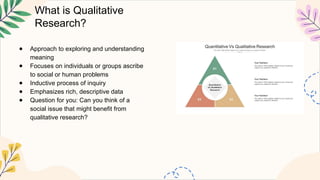
What is Qualitative
Research?
● Approach to exploring and understanding
meaning
● Focuses on individuals or groups ascribe
to social or human problems
● Inductive process of inquiry
● Emphasizes rich, descriptive data
● Question for you: Can you think of a
social issue that might benefit from
qualitative research?
Key Characteristics of Qualitative Research
● Natural setting
● Researcher as key instrument
● Multiple sources of data
● Inductive and deductive data analysis
● Participants' meanings
● Emergent design
● Reflexivity
● Holistic account
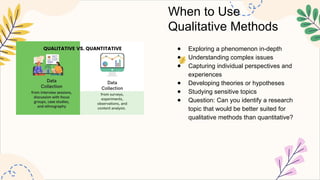
When to Use
Qualitative Methods
● Exploring a phenomenon in-depth
● Understanding complex issues
● Capturing individual perspectives and
experiences
● Developing theories or hypotheses
● Studying sensitive topics
● Question: Can you identify a research
topic that would be better suited for
qualitative methods than quantitative?
Types of Qualitative Research Designs
● 1. Phenomenology
● 2. Ethnography
● 3. Grounded Theory
● 4. Case Study
● 5. Narrative Research
● Each design has its unique approach and is suited for different
research questions
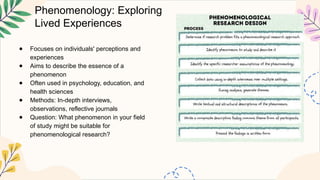
Phenomenology: Exploring
Lived Experiences
● Focuses on individuals' perceptions and
experiences
● Aims to describe the essence of a
phenomenon
● Often used in psychology, education, and
health sciences
● Methods: In-depth interviews,
observations, reflective journals
● Question: What phenomenon in your field
of study might be suitable for
phenomenological research?
Ethnography: Immersion in Cultural Context
● Studies shared patterns of behavior, beliefs, and language within
a cultural group
● Researcher becomes immersed in the community
● Extended period of fieldwork and observation
● Often used in anthropology, sociology, and cultural studies
● Methods: Participant observation, interviews, field notes
Grounded Theory: Building
Theory from Data
● Aims to develop a theory grounded in
systematically gathered and analyzed
data
● Iterative process of data collection and
analysis
● Used across various disciplines
● Methods: Interviews, observations,
document analysis
● Constant comparative analysis
● Question: How might grounded theory be
useful in your area of interest?
Case Study: In-Depth Analysis of a Case
● Intensive study of a specific case (individual, group, event, or
organization)
● Provides detailed, contextual analysis
● Can be single or multiple case design
● Often used in psychology, education, and business
● Methods: Interviews, observations, document analysis, surveys
Narrative Research:
Exploring Stories
Introduction to Qualitative
Research
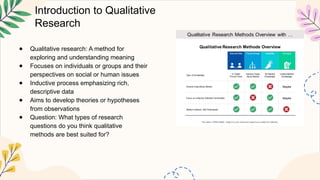
● Qualitative research: A method for
exploring and understanding meaning
● Focuses on individuals or groups and their
perspectives on social or human issues
● Inductive process emphasizing rich,
descriptive data
● Aims to develop theories or hypotheses
from observations
● Question: What types of research
questions do you think qualitative
methods are best suited for?
Key Characteristics of
Qualitative Research
● Natural setting: Research conducted in
real-world contexts
● Researcher as key instrument: Direct
involvement in data collection
● Multiple data sources: Interviews,
observations, documents, etc.
● Inductive and deductive data analysis
● Focus on participants' meanings and
perspectives
● Emergent design: Flexibility to adapt as
study progresses
● Reflexivity: Researcher's role and
potential biases acknowledged
● Holistic account: Complex picture of the
issue under study
● Question: How do these characteristics
When to Use Qualitative Methods
● Exploring complex phenomena in-depth
● Understanding subjective experiences and perspectives
● Developing new theories or hypotheses
● Studying sensitive or difficult-to-measure topics
● Capturing cultural or social nuances
● Investigating processes and changes over time
● Can you think of a research topic in your field that would benefit
from a qualitative approach?
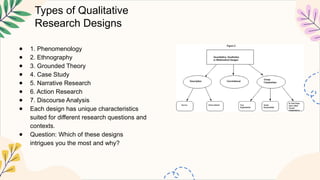
Types of Qualitative
Research Designs
● 1. Phenomenology
● 2. Ethnography
● 3. Grounded Theory
● 4. Case Study
● 5. Narrative Research
● 6. Action Research
● 7. Discourse Analysis
● Each design has unique characteristics
suited for different research questions and
contexts.
● Question: Which of these designs
intrigues you the most and why?
Phenomenology: Exploring Lived Experiences
● Focus: Individual perceptions and experiences of a phenomenon
● Aim: Describe the essence of a lived experience
● Common in: Psychology, education, health sciences
● Methods: In-depth interviews, observations, reflective journals
● Analysis: Identifying themes and patterns in participants'
accounts
● Example research question: "What is the lived experience of first-
generation college students?"
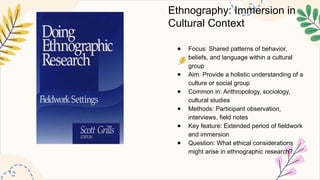
Ethnography: Immersion in
Cultural Context
● Focus: Shared patterns of behavior,
beliefs, and language within a cultural
group
● Aim: Provide a holistic understanding of a
culture or social group
● Common in: Anthropology, sociology,
cultural studies
● Methods: Participant observation,
interviews, field notes
● Key feature: Extended period of fieldwork
and immersion
● Question: What ethical considerations
might arise in ethnographic research?
Grounded Theory: Building Theory from Data
● Focus: Developing a theory grounded in systematically gathered
and analyzed data
● Aim: Generate or discover a theory through inductive reasoning
● Used across various disciplines
● Methods: Interviews, observations, document analysis
● Key feature: Constant comparative analysis
● How might grounded theory be useful in your area of study?
Case Study: In-Depth
Analysis of a Case
● Focus: Intensive study of a specific case
(individual, group, event, or organization)
● Aim: Provide detailed, contextual analysis
of a particular instance
● Types: Single case or multiple case
designs
● Common in: Psychology, education,
business, healthcare
● Methods: Interviews, observations,
document analysis, surveys
● Question: What advantages might a case
study approach offer over other research
designs?
Narrative Research: Exploring Stories
● Focus: Collecting and analyzing stories, life experiences, or
personal accounts
● Aim: Understand how individuals make sense of their lives
through storytelling
● Common in: Psychology, sociology, education, literature
● Methods: In-depth interviews, life histories, personal documents
● Analysis: Thematic analysis, structural analysis, or performative
analysis
● Can you think of a topic that would be well-suited for narrative
research?
Data Collection Methods in
Qualitative Research
● 1. Interviews (structured, semi-structured,
unstructured)
● 2. Focus groups
● 3. Participant observation
● 4. Document analysis
● 5. Audio-visual materials
● 6. Field notes and reflective journals
● Question: What are the potential
advantages and disadvantages of each
method?
Sampling in Qualitative Research
● Purposive sampling: Selecting participants based on specific
criteria
● Snowball sampling: Participants recruit other participants
● Theoretical sampling: Sampling guided by emerging theory
● Maximum variation sampling: Capturing diverse perspectives
● Convenience sampling: Selecting easily accessible participants
● Why is random sampling less common in qualitative research
compared to quantitative research?
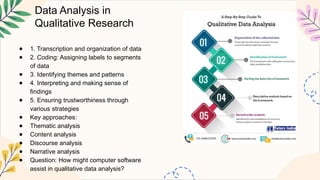
Data Analysis in
Qualitative Research
● 1. Transcription and organization of data
● 2. Coding: Assigning labels to segments
of data
● 3. Identifying themes and patterns
● 4. Interpreting and making sense of
findings
● 5. Ensuring trustworthiness through
various strategies
● Key approaches:
● Thematic analysis
● Content analysis
● Discourse analysis
● Narrative analysis
● Question: How might computer software
assist in qualitative data analysis?
Ensuring Quality in Qualitative Research
● Credibility: Accurate representation of participants' perspectives
● Transferability: Applicability of findings to other contexts
● Dependability: Consistency and traceability of the research
process
● Confirmability: Neutrality and objectivity of findings
● Strategies:
● Triangulation of data sources and methods
● Member checking
● Peer debriefing
● Audit trail
● Reflexivity
● How do these quality criteria differ from those used in quantitative
Ethical Considerations in
Qualitative Research
● Informed consent: Ensuring participants
understand the study and their rights
● Confidentiality and anonymity: Protecting
participants' identities
● Minimizing harm: Considering potential
risks to participants
● Reciprocity: Giving back to participants
and communities
● Power dynamics: Addressing imbalances
between researcher and participants
● Cultural sensitivity: Respecting diverse
cultural norms and values
● Question: What unique ethical challenges
might arise in qualitative research
compared to quantitative studies?
Writing and Presenting Qualitative Research
● Rich, thick description: Providing detailed accounts of findings
● Use of quotes: Supporting themes with participants' own words
● Reflexive writing: Acknowledging researcher's role and
perspective
● Addressing multiple viewpoints: Presenting diverse perspectives
● Visual representations: Using diagrams, charts, or models to
illustrate findings
● How might the writing style in qualitative research reports differ
from quantitative reports?
Mixed Methods:
Combining Qualitative and
Quantitative Approaches
● Definition: Integrating qualitative and
quantitative data in a single study
● Types of designs:
● 1. Convergent parallel
● 2. Explanatory sequential
● 3. Exploratory sequential
● Benefits: Provides a more comprehensive
understanding of research problems
● Challenges: Requires expertise in both
approaches and careful integration of
findings
● Question: Can you think of a research
question that would benefit from a mixed
methods approach?
Critiques and Limitations of Qualitative Research
● Subjectivity: Potential for researcher bias
● Generalizability: Limited ability to apply findings broadly
● Time-consuming: Often requires extensive data collection and
analysis
● Replicability: Difficulty in reproducing exact conditions of the
study
● Perceived lack of rigor: Misconceptions about the scientific
nature of qualitative research
● How would you address these criticisms when designing a
qualitative study?
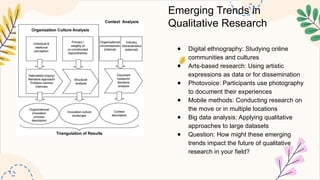
Emerging Trends in
Qualitative Research
● Digital ethnography: Studying online
communities and cultures
● Arts-based research: Using artistic
expressions as data or for dissemination
● Photovoice: Participants use photography
to document their experiences
● Mobile methods: Conducting research on
the move or in multiple locations
● Big data analysis: Applying qualitative
approaches to large datasets
● Question: How might these emerging
trends impact the future of qualitative
research in your field?
Conclusion: The Value of Qualitative Research
● Provides in-depth understanding of complex phenomena
● Captures the richness of human experiences and perspectives
● Allows for exploration of new areas and generation of
hypotheses
● Complements quantitative research by providing context and
meaning
● Essential for addressing certain research questions and social
issues
● Final question: How might qualitative research methods
contribute to your own research interests or career goals?

Qualitative research methods/ Qualitative research

  • 1.
    Understanding Qualitative ResearchMethods: A Comprehensive Overview
  • 2.
    What is Qualitative Research? ●Approach to exploring and understanding meaning ● Focuses on individuals or groups ascribe to social or human problems ● Inductive process of inquiry ● Emphasizes rich, descriptive data ● Question for you: Can you think of a social issue that might benefit from qualitative research?
  • 3.
    Key Characteristics ofQualitative Research ● Natural setting ● Researcher as key instrument ● Multiple sources of data ● Inductive and deductive data analysis ● Participants' meanings ● Emergent design ● Reflexivity ● Holistic account
  • 4.
    When to Use QualitativeMethods ● Exploring a phenomenon in-depth ● Understanding complex issues ● Capturing individual perspectives and experiences ● Developing theories or hypotheses ● Studying sensitive topics ● Question: Can you identify a research topic that would be better suited for qualitative methods than quantitative?
  • 5.
    Types of QualitativeResearch Designs ● 1. Phenomenology ● 2. Ethnography ● 3. Grounded Theory ● 4. Case Study ● 5. Narrative Research ● Each design has its unique approach and is suited for different research questions
  • 6.
    Phenomenology: Exploring Lived Experiences ●Focuses on individuals' perceptions and experiences ● Aims to describe the essence of a phenomenon ● Often used in psychology, education, and health sciences ● Methods: In-depth interviews, observations, reflective journals ● Question: What phenomenon in your field of study might be suitable for phenomenological research?
  • 7.
    Ethnography: Immersion inCultural Context ● Studies shared patterns of behavior, beliefs, and language within a cultural group ● Researcher becomes immersed in the community ● Extended period of fieldwork and observation ● Often used in anthropology, sociology, and cultural studies ● Methods: Participant observation, interviews, field notes
  • 8.
    Grounded Theory: Building Theoryfrom Data ● Aims to develop a theory grounded in systematically gathered and analyzed data ● Iterative process of data collection and analysis ● Used across various disciplines ● Methods: Interviews, observations, document analysis ● Constant comparative analysis ● Question: How might grounded theory be useful in your area of interest?
  • 9.
    Case Study: In-DepthAnalysis of a Case ● Intensive study of a specific case (individual, group, event, or organization) ● Provides detailed, contextual analysis ● Can be single or multiple case design ● Often used in psychology, education, and business ● Methods: Interviews, observations, document analysis, surveys
  • 10.
  • 11.
    Introduction to Qualitative Research ●Qualitative research: A method for exploring and understanding meaning ● Focuses on individuals or groups and their perspectives on social or human issues ● Inductive process emphasizing rich, descriptive data ● Aims to develop theories or hypotheses from observations ● Question: What types of research questions do you think qualitative methods are best suited for?
  • 12.
    Key Characteristics of QualitativeResearch ● Natural setting: Research conducted in real-world contexts ● Researcher as key instrument: Direct involvement in data collection ● Multiple data sources: Interviews, observations, documents, etc. ● Inductive and deductive data analysis ● Focus on participants' meanings and perspectives ● Emergent design: Flexibility to adapt as study progresses ● Reflexivity: Researcher's role and potential biases acknowledged ● Holistic account: Complex picture of the issue under study ● Question: How do these characteristics
  • 13.
    When to UseQualitative Methods ● Exploring complex phenomena in-depth ● Understanding subjective experiences and perspectives ● Developing new theories or hypotheses ● Studying sensitive or difficult-to-measure topics ● Capturing cultural or social nuances ● Investigating processes and changes over time ● Can you think of a research topic in your field that would benefit from a qualitative approach?
  • 14.
    Types of Qualitative ResearchDesigns ● 1. Phenomenology ● 2. Ethnography ● 3. Grounded Theory ● 4. Case Study ● 5. Narrative Research ● 6. Action Research ● 7. Discourse Analysis ● Each design has unique characteristics suited for different research questions and contexts. ● Question: Which of these designs intrigues you the most and why?
  • 15.
    Phenomenology: Exploring LivedExperiences ● Focus: Individual perceptions and experiences of a phenomenon ● Aim: Describe the essence of a lived experience ● Common in: Psychology, education, health sciences ● Methods: In-depth interviews, observations, reflective journals ● Analysis: Identifying themes and patterns in participants' accounts ● Example research question: "What is the lived experience of first- generation college students?"
  • 16.
    Ethnography: Immersion in CulturalContext ● Focus: Shared patterns of behavior, beliefs, and language within a cultural group ● Aim: Provide a holistic understanding of a culture or social group ● Common in: Anthropology, sociology, cultural studies ● Methods: Participant observation, interviews, field notes ● Key feature: Extended period of fieldwork and immersion ● Question: What ethical considerations might arise in ethnographic research?
  • 17.
    Grounded Theory: BuildingTheory from Data ● Focus: Developing a theory grounded in systematically gathered and analyzed data ● Aim: Generate or discover a theory through inductive reasoning ● Used across various disciplines ● Methods: Interviews, observations, document analysis ● Key feature: Constant comparative analysis ● How might grounded theory be useful in your area of study?
  • 18.
    Case Study: In-Depth Analysisof a Case ● Focus: Intensive study of a specific case (individual, group, event, or organization) ● Aim: Provide detailed, contextual analysis of a particular instance ● Types: Single case or multiple case designs ● Common in: Psychology, education, business, healthcare ● Methods: Interviews, observations, document analysis, surveys ● Question: What advantages might a case study approach offer over other research designs?
  • 19.
    Narrative Research: ExploringStories ● Focus: Collecting and analyzing stories, life experiences, or personal accounts ● Aim: Understand how individuals make sense of their lives through storytelling ● Common in: Psychology, sociology, education, literature ● Methods: In-depth interviews, life histories, personal documents ● Analysis: Thematic analysis, structural analysis, or performative analysis ● Can you think of a topic that would be well-suited for narrative research?
  • 20.
    Data Collection Methodsin Qualitative Research ● 1. Interviews (structured, semi-structured, unstructured) ● 2. Focus groups ● 3. Participant observation ● 4. Document analysis ● 5. Audio-visual materials ● 6. Field notes and reflective journals ● Question: What are the potential advantages and disadvantages of each method?
  • 21.
    Sampling in QualitativeResearch ● Purposive sampling: Selecting participants based on specific criteria ● Snowball sampling: Participants recruit other participants ● Theoretical sampling: Sampling guided by emerging theory ● Maximum variation sampling: Capturing diverse perspectives ● Convenience sampling: Selecting easily accessible participants ● Why is random sampling less common in qualitative research compared to quantitative research?
  • 22.
    Data Analysis in QualitativeResearch ● 1. Transcription and organization of data ● 2. Coding: Assigning labels to segments of data ● 3. Identifying themes and patterns ● 4. Interpreting and making sense of findings ● 5. Ensuring trustworthiness through various strategies ● Key approaches: ● Thematic analysis ● Content analysis ● Discourse analysis ● Narrative analysis ● Question: How might computer software assist in qualitative data analysis?
  • 23.
    Ensuring Quality inQualitative Research ● Credibility: Accurate representation of participants' perspectives ● Transferability: Applicability of findings to other contexts ● Dependability: Consistency and traceability of the research process ● Confirmability: Neutrality and objectivity of findings ● Strategies: ● Triangulation of data sources and methods ● Member checking ● Peer debriefing ● Audit trail ● Reflexivity ● How do these quality criteria differ from those used in quantitative
  • 24.
    Ethical Considerations in QualitativeResearch ● Informed consent: Ensuring participants understand the study and their rights ● Confidentiality and anonymity: Protecting participants' identities ● Minimizing harm: Considering potential risks to participants ● Reciprocity: Giving back to participants and communities ● Power dynamics: Addressing imbalances between researcher and participants ● Cultural sensitivity: Respecting diverse cultural norms and values ● Question: What unique ethical challenges might arise in qualitative research compared to quantitative studies?
  • 25.
    Writing and PresentingQualitative Research ● Rich, thick description: Providing detailed accounts of findings ● Use of quotes: Supporting themes with participants' own words ● Reflexive writing: Acknowledging researcher's role and perspective ● Addressing multiple viewpoints: Presenting diverse perspectives ● Visual representations: Using diagrams, charts, or models to illustrate findings ● How might the writing style in qualitative research reports differ from quantitative reports?
  • 26.
    Mixed Methods: Combining Qualitativeand Quantitative Approaches ● Definition: Integrating qualitative and quantitative data in a single study ● Types of designs: ● 1. Convergent parallel ● 2. Explanatory sequential ● 3. Exploratory sequential ● Benefits: Provides a more comprehensive understanding of research problems ● Challenges: Requires expertise in both approaches and careful integration of findings ● Question: Can you think of a research question that would benefit from a mixed methods approach?
  • 27.
    Critiques and Limitationsof Qualitative Research ● Subjectivity: Potential for researcher bias ● Generalizability: Limited ability to apply findings broadly ● Time-consuming: Often requires extensive data collection and analysis ● Replicability: Difficulty in reproducing exact conditions of the study ● Perceived lack of rigor: Misconceptions about the scientific nature of qualitative research ● How would you address these criticisms when designing a qualitative study?
  • 28.
    Emerging Trends in QualitativeResearch ● Digital ethnography: Studying online communities and cultures ● Arts-based research: Using artistic expressions as data or for dissemination ● Photovoice: Participants use photography to document their experiences ● Mobile methods: Conducting research on the move or in multiple locations ● Big data analysis: Applying qualitative approaches to large datasets ● Question: How might these emerging trends impact the future of qualitative research in your field?
  • 29.
    Conclusion: The Valueof Qualitative Research ● Provides in-depth understanding of complex phenomena ● Captures the richness of human experiences and perspectives ● Allows for exploration of new areas and generation of hypotheses ● Complements quantitative research by providing context and meaning ● Essential for addressing certain research questions and social issues ● Final question: How might qualitative research methods contribute to your own research interests or career goals?

Editor's Notes

  • #1 Created from: https://docs.google.com/presentation/d/1W6g_Ms8jgJ5KoyNYfPF6OEo5vHOss4-i2LqQd3P6M-k/edit#slide=id.p