QUALITATIVE
RESEARCH
CHAPTER 2:
Differentiate Qualitative from
Quantitative Approach in
Research.
PRIOR KNOWLEDGE
What is a Mixed Approach?
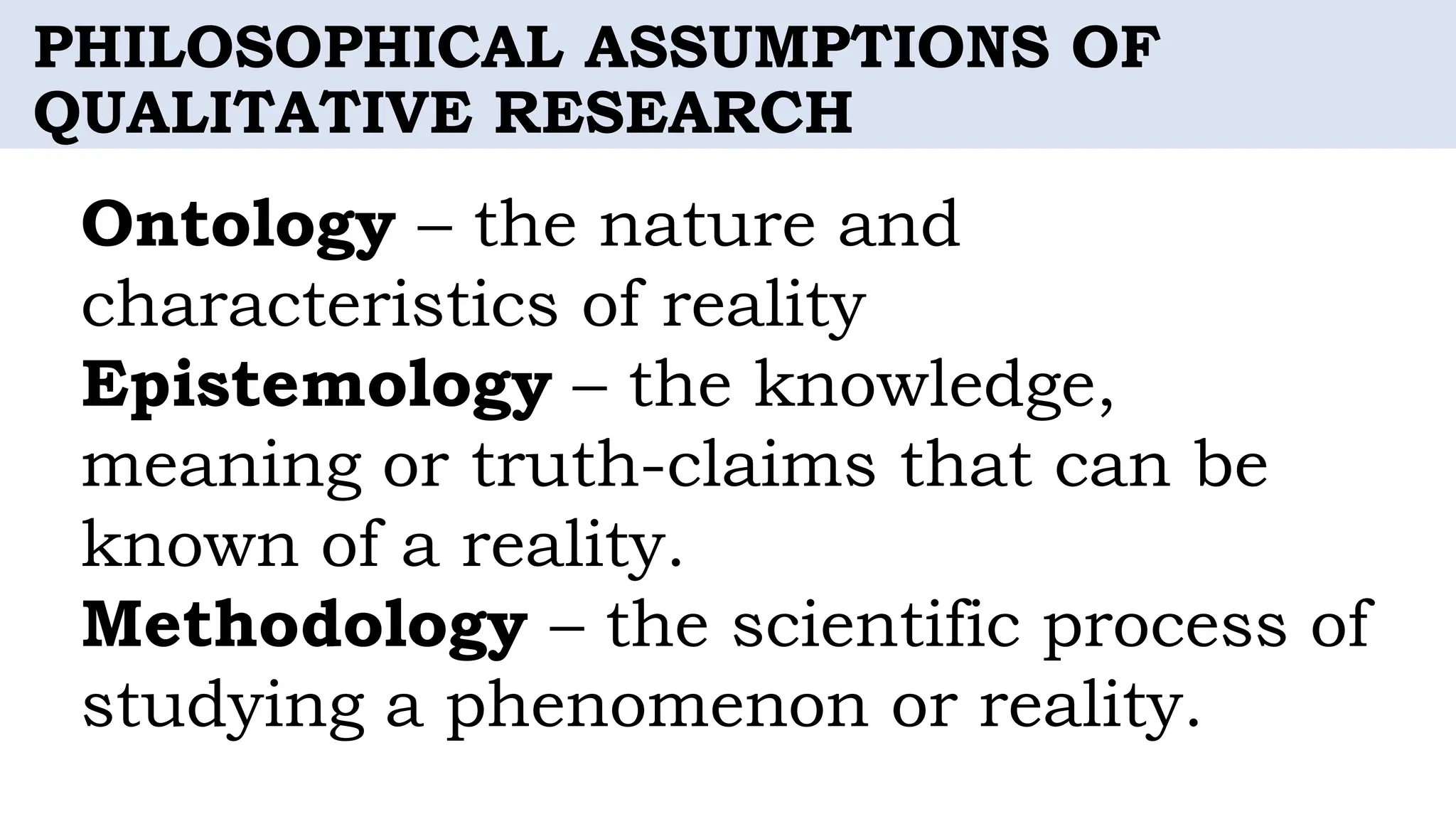
PHILOSOPHICAL ASSUMPTIONS OF
QUALITATIVE RESEARCH
Ontology – the nature and
characteristics of reality
Epistemology – the knowledge,
meaning or truth-claims that can be
known of a reality.
Methodology – the scientific process of
studying a phenomenon or reality.
PHILOSOPHICAL ASSUMPTIONS OF
QUALITATIVE RESEARCH
Framework of Understanding
Qualitative researcher must be aware of
assumptions of what constitute a reality
(ontology), from which findings themes, and
meanings (epistemology) could be known. He
or she must also know and justify the research
process or design (methodology) from a reality,
to possess the meaning and or knowledge-
claims of the research.
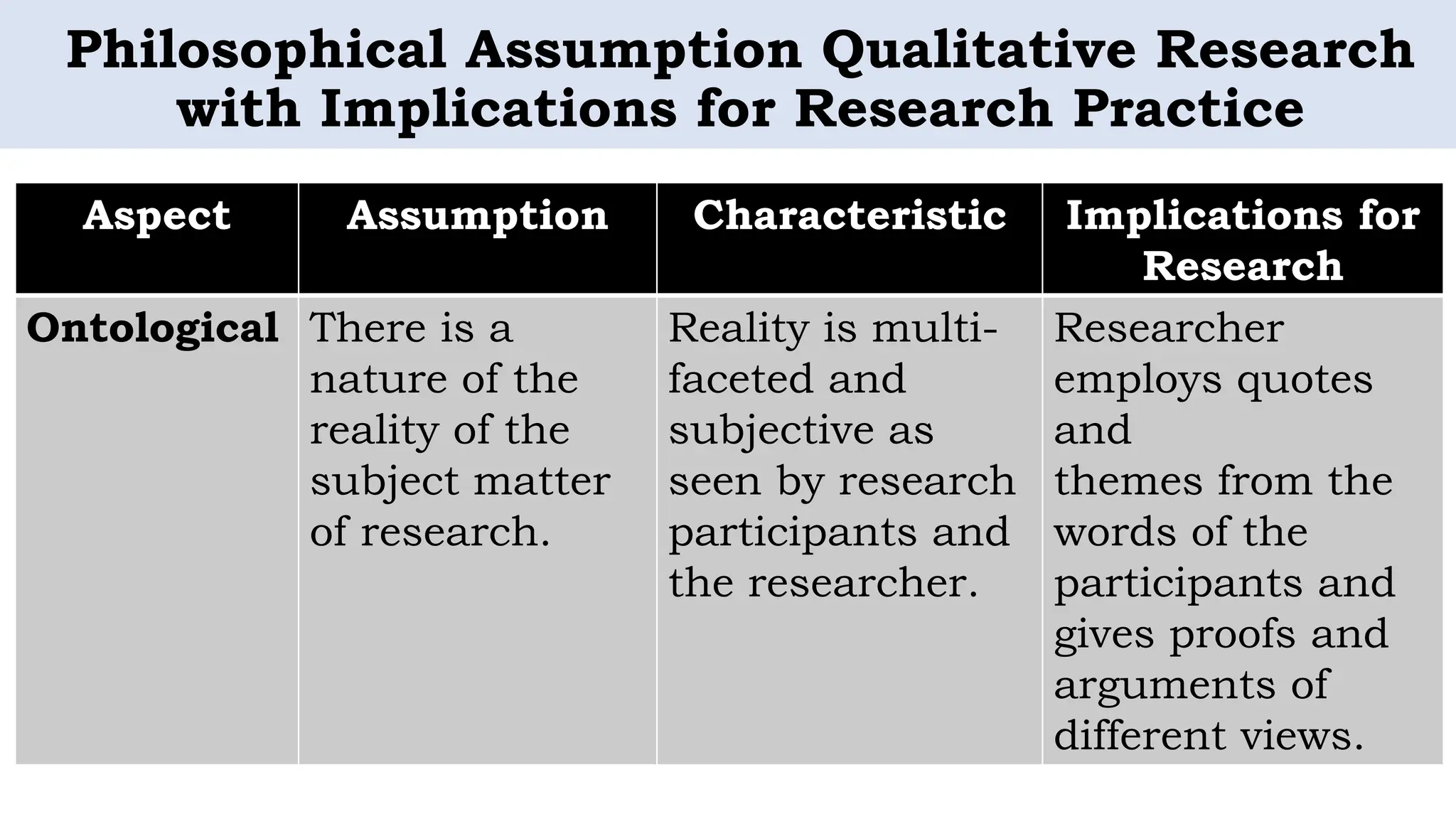
Philosophical Assumption Qualitative Research
with Implications for Research Practice
Aspect Assumption Characteristic Implications for
Research
Ontological There is a
nature of the
reality of the
subject matter
of research.
Reality is multi-
faceted and
subjective as
seen by research
participants and
the researcher.
Researcher
employs quotes
and
themes from the
words of the
participants and
gives proofs and
arguments of
different views.
Philosophical Assumption Qualitative Research
with Implications for Research Practice
Aspect Assumption Characteristic Implications for
Research
Epistemolo
gical
There is a
connection
between the
researchers and
the topic or
subject of
investigation.
Researcher tries
to reduce the
distance between
himself or herself
and that being
researched.
Researcher
spends time in
the field and with
research
participants and
becomes an
“insider” (part) of
their reality.
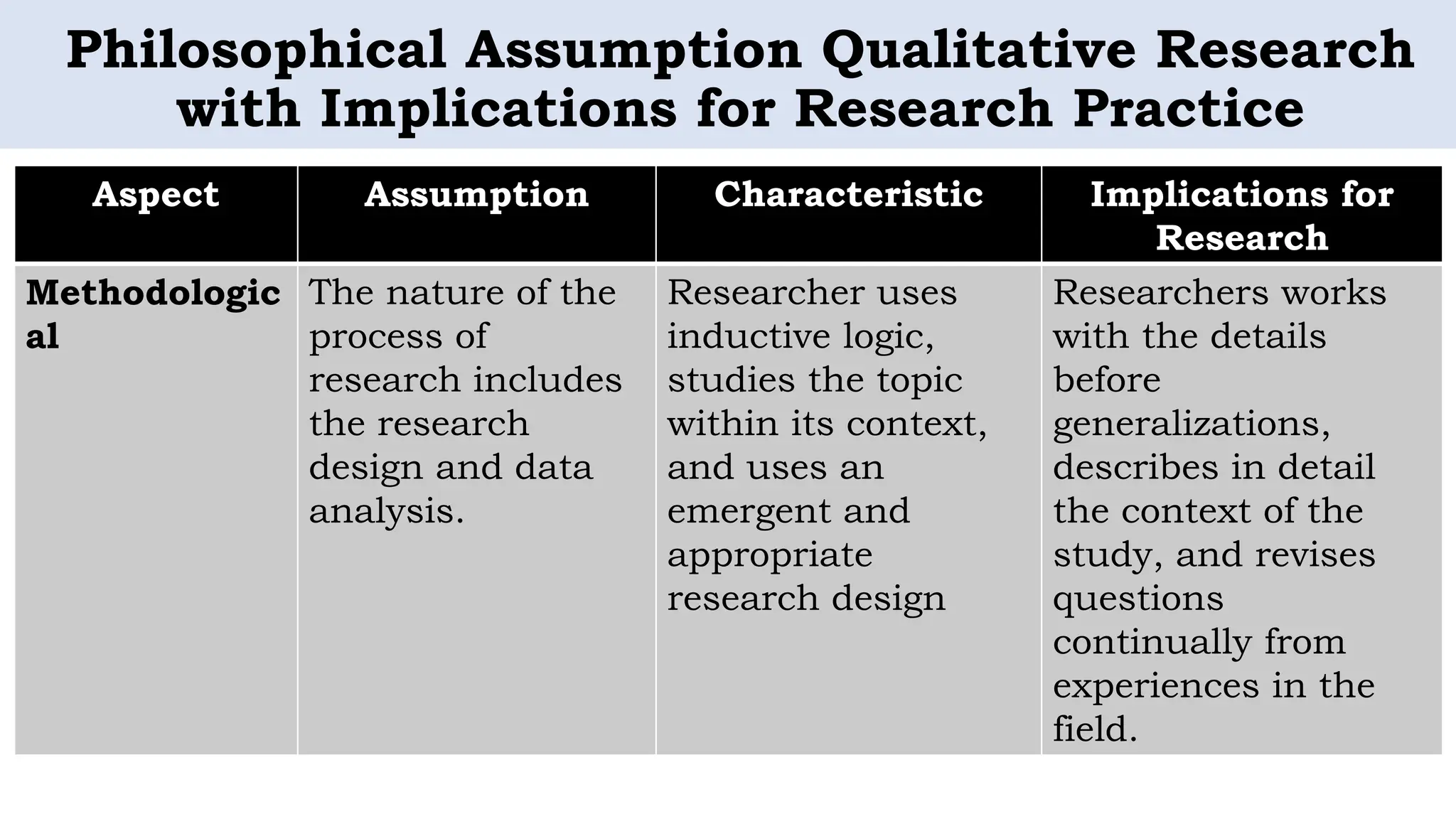
Philosophical Assumption Qualitative Research
with Implications for Research Practice
Aspect Assumption Characteristic Implications for
Research
Methodologic
al
The nature of the
process of
research includes
the research
design and data
analysis.
Researcher uses
inductive logic,
studies the topic
within its context,
and uses an
emergent and
appropriate
research design
Researchers works
with the details
before
generalizations,
describes in detail
the context of the
study, and revises
questions
continually from
experiences in the
field.
 - Focuses on the stories or narratives of individuals.
 - A common strategies for type of research is to select and
focus on examining one individual or group (family, indigenous
groups, business org.), where the researcher collects data by
documenting stories, reports individual narratives or
experiences, and chronologically arranges the story according
to the meaning given by the participants to the stages of the
story.
Example: Autobiographies and Biographies
TYPES OF QUALITATIVE
RESEARCH
1. NARRATIVE RESEARCH
 - A qualitative research that describes, examines and interpret
the shared and learned patterns of behavior, belief, knowledge,
values, and language of a culture-sharing group.
 - Ethnography emphasizes a detailed exploration of a group or
culture rather than testing hypothesis or guess about the
subject of a research.
 - Example: Filipino culture particularly in different provinces.
TYPES OF QUALITATIVE
RESEARCH
2. ETHNOGRAPHY
 - Textual analysis is a method used to describe and interpret
features or characteristic of a text, such as written, recorded,
visual message, images, photographs. The roots of textual
research go back to biblical scholarships, law, and literature.
 - Example: Bible, Quran and political-legal text.
 - In contemporary time: Social media
TYPES OF QUALITATIVE
RESEARCH
3. TEXTUAL
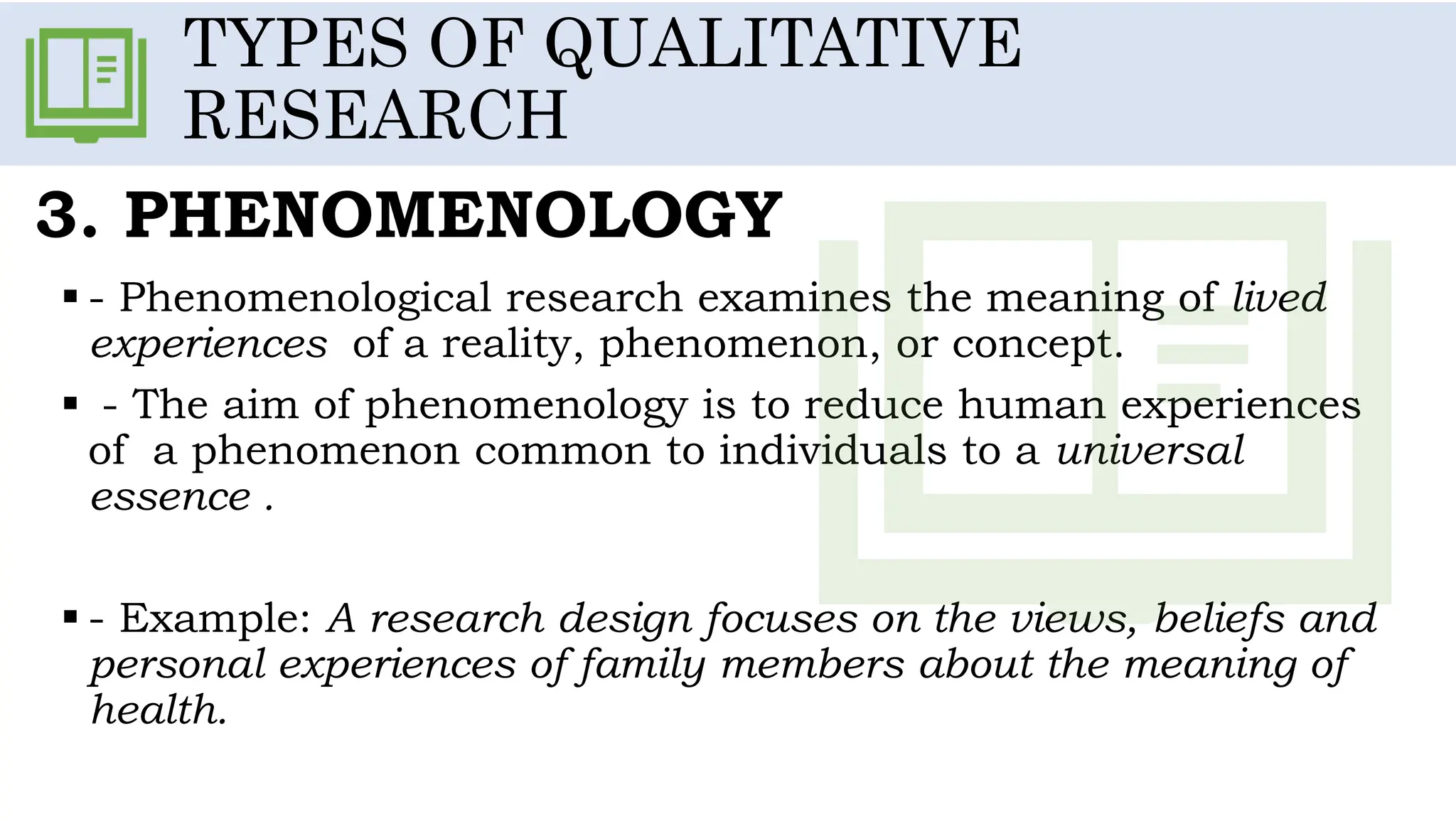
 - Phenomenological research examines the meaning of lived
experiences of a reality, phenomenon, or concept.
 - The aim of phenomenology is to reduce human experiences
of a phenomenon common to individuals to a universal
essence .
 - Example: A research design focuses on the views, beliefs and
personal experiences of family members about the meaning of
health.
TYPES OF QUALITATIVE
RESEARCH
3. PHENOMENOLOGY
 - Case study research provides detailed observations of a
phenomenon or group under study that enables the researcher to
examines the many and different aspect of the case under study.
 - A case study allows for an investigation of the different elements
and aspect of the said phenomenon including the everyday
language, symbols and practices that constitute a life-world or the
natural environment.
 - Example: Research about Philippines as an exporter of laborers
TYPES OF QUALITATIVE
RESEARCH
4. CASE STUDY
Social Science (anthropology, economics, history, political
science, psychology, social psychology and sociology)
Humanities (philosophy, law, literature, arts studies;
criminology, demography, education, and nursing)
Qualitative Research is a key and fundamental element in any
social science or humanities subjects because of its interpretive
and explorative approach in studying human behavior,
perceptions and action.
QUALITATIVE RESEARCHERS ACROSS THE
SOCIAL SCIENCES AND HUMANITIES AND ITS
USEFULNESS AND WEAKNESSES
1. It is a approach to scientific investigation because it allows
an investor to explore in-dept the human world thru their
very own words, experiences, language, beliefs, and
knowledge of a particular human community.
2. Qualitative Research can be applied to government,
industries by the media and the professions.
3. Qualitative Research teaches students to view social issue or
problem in methodical and logical ways.
QUALITATIVE RESEARCHERS ACROSS THE
SOCIAL SCIENCES AND HUMANITIES AND ITS
USEFULNESS AND WEAKNESSES
Usefulness and Strength of Qualitative Research
1. Findings from qualitative researchers are not generalize.
2. Qualitative research refers to subjective research methods as
opposed to an objective research method for quantitative
research.
3. Data collection tools in qualitative research are seen as time
consuming.
QUALITATIVE RESEARCHERS ACROSS THE
SOCIAL SCIENCES AND HUMANITIES AND ITS
USEFULNESS AND WEAKNESSES
Weaknesses of Qualitative Research
1. Write a 1500-word essay on the advantages
and disadvantages of INTERNET in qualitative
research.
ACTIVITY #1: DISADVANTAGE AND ADVANTAGE
OF INTERNET AND METHODOLOGY OF QUALI.
2. Find an example of a qualitative research.
Identify the type of qualitative research it belongs
to (e.g., ethnography, narrative, etc.) and present
the methodology used.

SHS G11_QUALITATIVE RESEARCH CHAPTER 2 LESSON 1.pptx

  • 1.
  • 2.
    Differentiate Qualitative from QuantitativeApproach in Research. PRIOR KNOWLEDGE What is a Mixed Approach?
  • 3.
    PHILOSOPHICAL ASSUMPTIONS OF QUALITATIVERESEARCH Ontology – the nature and characteristics of reality Epistemology – the knowledge, meaning or truth-claims that can be known of a reality. Methodology – the scientific process of studying a phenomenon or reality.
  • 4.
    PHILOSOPHICAL ASSUMPTIONS OF QUALITATIVERESEARCH Framework of Understanding Qualitative researcher must be aware of assumptions of what constitute a reality (ontology), from which findings themes, and meanings (epistemology) could be known. He or she must also know and justify the research process or design (methodology) from a reality, to possess the meaning and or knowledge- claims of the research.
  • 5.
    Philosophical Assumption QualitativeResearch with Implications for Research Practice Aspect Assumption Characteristic Implications for Research Ontological There is a nature of the reality of the subject matter of research. Reality is multi- faceted and subjective as seen by research participants and the researcher. Researcher employs quotes and themes from the words of the participants and gives proofs and arguments of different views.
  • 6.
    Philosophical Assumption QualitativeResearch with Implications for Research Practice Aspect Assumption Characteristic Implications for Research Epistemolo gical There is a connection between the researchers and the topic or subject of investigation. Researcher tries to reduce the distance between himself or herself and that being researched. Researcher spends time in the field and with research participants and becomes an “insider” (part) of their reality.
  • 7.
    Philosophical Assumption QualitativeResearch with Implications for Research Practice Aspect Assumption Characteristic Implications for Research Methodologic al The nature of the process of research includes the research design and data analysis. Researcher uses inductive logic, studies the topic within its context, and uses an emergent and appropriate research design Researchers works with the details before generalizations, describes in detail the context of the study, and revises questions continually from experiences in the field.
  • 8.
     - Focuseson the stories or narratives of individuals.  - A common strategies for type of research is to select and focus on examining one individual or group (family, indigenous groups, business org.), where the researcher collects data by documenting stories, reports individual narratives or experiences, and chronologically arranges the story according to the meaning given by the participants to the stages of the story. Example: Autobiographies and Biographies TYPES OF QUALITATIVE RESEARCH 1. NARRATIVE RESEARCH
  • 9.
     - Aqualitative research that describes, examines and interpret the shared and learned patterns of behavior, belief, knowledge, values, and language of a culture-sharing group.  - Ethnography emphasizes a detailed exploration of a group or culture rather than testing hypothesis or guess about the subject of a research.  - Example: Filipino culture particularly in different provinces. TYPES OF QUALITATIVE RESEARCH 2. ETHNOGRAPHY
  • 10.
     - Textualanalysis is a method used to describe and interpret features or characteristic of a text, such as written, recorded, visual message, images, photographs. The roots of textual research go back to biblical scholarships, law, and literature.  - Example: Bible, Quran and political-legal text.  - In contemporary time: Social media TYPES OF QUALITATIVE RESEARCH 3. TEXTUAL
  • 11.
     - Phenomenologicalresearch examines the meaning of lived experiences of a reality, phenomenon, or concept.  - The aim of phenomenology is to reduce human experiences of a phenomenon common to individuals to a universal essence .  - Example: A research design focuses on the views, beliefs and personal experiences of family members about the meaning of health. TYPES OF QUALITATIVE RESEARCH 3. PHENOMENOLOGY
  • 12.
     - Casestudy research provides detailed observations of a phenomenon or group under study that enables the researcher to examines the many and different aspect of the case under study.  - A case study allows for an investigation of the different elements and aspect of the said phenomenon including the everyday language, symbols and practices that constitute a life-world or the natural environment.  - Example: Research about Philippines as an exporter of laborers TYPES OF QUALITATIVE RESEARCH 4. CASE STUDY
  • 13.
    Social Science (anthropology,economics, history, political science, psychology, social psychology and sociology) Humanities (philosophy, law, literature, arts studies; criminology, demography, education, and nursing) Qualitative Research is a key and fundamental element in any social science or humanities subjects because of its interpretive and explorative approach in studying human behavior, perceptions and action. QUALITATIVE RESEARCHERS ACROSS THE SOCIAL SCIENCES AND HUMANITIES AND ITS USEFULNESS AND WEAKNESSES
  • 14.
    1. It isa approach to scientific investigation because it allows an investor to explore in-dept the human world thru their very own words, experiences, language, beliefs, and knowledge of a particular human community. 2. Qualitative Research can be applied to government, industries by the media and the professions. 3. Qualitative Research teaches students to view social issue or problem in methodical and logical ways. QUALITATIVE RESEARCHERS ACROSS THE SOCIAL SCIENCES AND HUMANITIES AND ITS USEFULNESS AND WEAKNESSES Usefulness and Strength of Qualitative Research
  • 15.
    1. Findings fromqualitative researchers are not generalize. 2. Qualitative research refers to subjective research methods as opposed to an objective research method for quantitative research. 3. Data collection tools in qualitative research are seen as time consuming. QUALITATIVE RESEARCHERS ACROSS THE SOCIAL SCIENCES AND HUMANITIES AND ITS USEFULNESS AND WEAKNESSES Weaknesses of Qualitative Research
  • 16.
    1. Write a1500-word essay on the advantages and disadvantages of INTERNET in qualitative research. ACTIVITY #1: DISADVANTAGE AND ADVANTAGE OF INTERNET AND METHODOLOGY OF QUALI. 2. Find an example of a qualitative research. Identify the type of qualitative research it belongs to (e.g., ethnography, narrative, etc.) and present the methodology used.

Editor's Notes

  • #9 When conducting research, it is easy to go to one source: Wikipedia. However, you need to include a variety of sources in your research. Consider the following sources: Who can I interview to get more information on the topic? Is the topic current and will it be relevant to my audience? What articles, blogs, and magazines may have something related to my topic? Is there a YouTube video on the topic? If so, what is it about? What images can I find related to the topic?
  • #10 When conducting research, it is easy to go to one source: Wikipedia. However, you need to include a variety of sources in your research. Consider the following sources: Who can I interview to get more information on the topic? Is the topic current and will it be relevant to my audience? What articles, blogs, and magazines may have something related to my topic? Is there a YouTube video on the topic? If so, what is it about? What images can I find related to the topic?
  • #11 When conducting research, it is easy to go to one source: Wikipedia. However, you need to include a variety of sources in your research. Consider the following sources: Who can I interview to get more information on the topic? Is the topic current and will it be relevant to my audience? What articles, blogs, and magazines may have something related to my topic? Is there a YouTube video on the topic? If so, what is it about? What images can I find related to the topic?
  • #12 When conducting research, it is easy to go to one source: Wikipedia. However, you need to include a variety of sources in your research. Consider the following sources: Who can I interview to get more information on the topic? Is the topic current and will it be relevant to my audience? What articles, blogs, and magazines may have something related to my topic? Is there a YouTube video on the topic? If so, what is it about? What images can I find related to the topic?
  • #13 When conducting research, it is easy to go to one source: Wikipedia. However, you need to include a variety of sources in your research. Consider the following sources: Who can I interview to get more information on the topic? Is the topic current and will it be relevant to my audience? What articles, blogs, and magazines may have something related to my topic? Is there a YouTube video on the topic? If so, what is it about? What images can I find related to the topic?
  • #14 When conducting research, it is easy to go to one source: Wikipedia. However, you need to include a variety of sources in your research. Consider the following sources: Who can I interview to get more information on the topic? Is the topic current and will it be relevant to my audience? What articles, blogs, and magazines may have something related to my topic? Is there a YouTube video on the topic? If so, what is it about? What images can I find related to the topic?
  • #15 When conducting research, it is easy to go to one source: Wikipedia. However, you need to include a variety of sources in your research. Consider the following sources: Who can I interview to get more information on the topic? Is the topic current and will it be relevant to my audience? What articles, blogs, and magazines may have something related to my topic? Is there a YouTube video on the topic? If so, what is it about? What images can I find related to the topic?
  • #16 When conducting research, it is easy to go to one source: Wikipedia. However, you need to include a variety of sources in your research. Consider the following sources: Who can I interview to get more information on the topic? Is the topic current and will it be relevant to my audience? What articles, blogs, and magazines may have something related to my topic? Is there a YouTube video on the topic? If so, what is it about? What images can I find related to the topic?
  • #17 When conducting research, it is easy to go to one source: Wikipedia. However, you need to include a variety of sources in your research. Consider the following sources: Who can I interview to get more information on the topic? Is the topic current and will it be relevant to my audience? What articles, blogs, and magazines may have something related to my topic? Is there a YouTube video on the topic? If so, what is it about? What images can I find related to the topic?