

Qualitative MethodsWhy would we use them?What are they like?How do we assure validity?
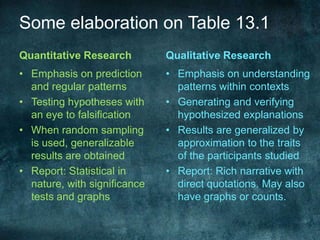
Some elaboration on Table 13.1Quantitative ResearchQualitative ResearchEmphasis on prediction and regular patternsTesting hypotheses with an eye to falsificationWhen random sampling is used, generalizable results are obtainedReport: Statistical in nature, with significance tests and graphsEmphasis on understanding patterns within contextsGenerating and verifying hypothesized explanationsResults are generalized by approximation to the traits of the participants studiedReport: Rich narrative with direct quotations. May also have graphs or counts.
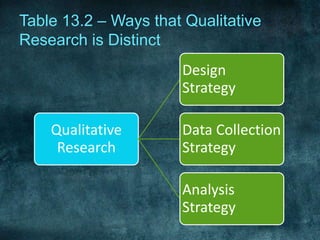
Table 13.2 – Ways that Qualitative Research is Distinct
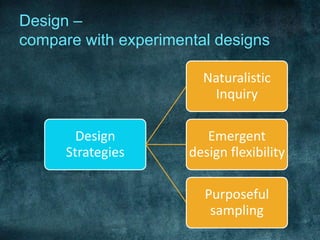
Design – compare with experimental designs
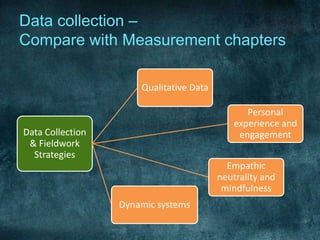
Data collection – Compare with Measurement chapters
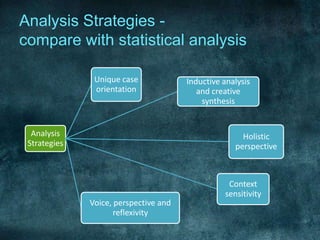
Analysis Strategies - compare with statistical analysis
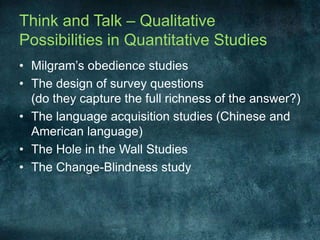
Think and Talk – Qualitative Possibilities in Quantitative StudiesMilgram’s obedience studiesThe design of survey questions(do they capture the full richness of the answer?)The language acquisition studies (Chinese and American language)The Hole in the Wall StudiesThe Change-Blindness study
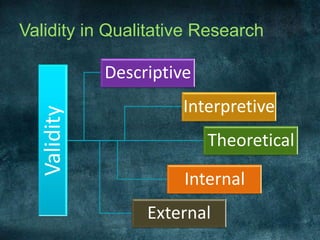
Validity in Qualitative Research
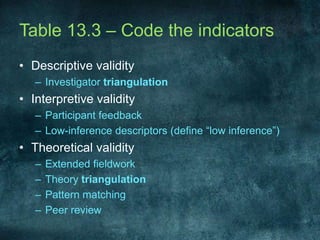
Table 13.3 – Code the indicatorsDescriptive validityInvestigator triangulationInterpretive validityParticipant feedbackLow-inference descriptors (define “low inference”)Theoretical validityExtended fieldworkTheory triangulationPattern matchingPeer review
Table 13.3 – Code the indicatorsInternal validity(compare with experimental designs)(Explain ideographic vsnomological causation)Researcher-as-detectiveMethods triangulationData triangulationExternal validity (compare with experimental designs)Naturalistic generalizationTheoretical generalization
ExamplesFIRSTPreviously viewed: Research on girls’ video games SECONDMixed methods: A Girl like meQualitative researchis used often in nursing and health careresearch, as well as in anthropology,      sociology, women’s studies, cultural                   studies, and political science.
Qualitative MethodsComing next:Particular qualitative approaches

Qualitative methods

  • 1.
    Qualitative MethodsWhy wouldwe use them?What are they like?How do we assure validity?
  • 2.
    Some elaboration onTable 13.1Quantitative ResearchQualitative ResearchEmphasis on prediction and regular patternsTesting hypotheses with an eye to falsificationWhen random sampling is used, generalizable results are obtainedReport: Statistical in nature, with significance tests and graphsEmphasis on understanding patterns within contextsGenerating and verifying hypothesized explanationsResults are generalized by approximation to the traits of the participants studiedReport: Rich narrative with direct quotations. May also have graphs or counts.
  • 3.
    Table 13.2 –Ways that Qualitative Research is Distinct
  • 4.
    Design – comparewith experimental designs
  • 5.
    Data collection –Compare with Measurement chapters
  • 6.
    Analysis Strategies -compare with statistical analysis
  • 7.
    Think and Talk– Qualitative Possibilities in Quantitative StudiesMilgram’s obedience studiesThe design of survey questions(do they capture the full richness of the answer?)The language acquisition studies (Chinese and American language)The Hole in the Wall StudiesThe Change-Blindness study
  • 8.
  • 9.
    Table 13.3 –Code the indicatorsDescriptive validityInvestigator triangulationInterpretive validityParticipant feedbackLow-inference descriptors (define “low inference”)Theoretical validityExtended fieldworkTheory triangulationPattern matchingPeer review
  • 10.
    Table 13.3 –Code the indicatorsInternal validity(compare with experimental designs)(Explain ideographic vsnomological causation)Researcher-as-detectiveMethods triangulationData triangulationExternal validity (compare with experimental designs)Naturalistic generalizationTheoretical generalization
  • 11.
    ExamplesFIRSTPreviously viewed: Researchon girls’ video games SECONDMixed methods: A Girl like meQualitative researchis used often in nursing and health careresearch, as well as in anthropology, sociology, women’s studies, cultural studies, and political science.
  • 12.

Editor's Notes

  • #12 To view this presentation, first, turn up your volume and second, launch the self-running slide show.