1
European Association
for Language Testing
and Assessment
www.ealta.eu.org
2
EALTA Mission Statement
The purpose of EALTA is to promote the
understanding of theoretical principles of
language testing and assessment, and the
improvement and sharing of testing and
assessment practices throughout Europe.
3
EALTA’s guidelines for good practice are
addressed primarily to three different
audiences:
Those involved in
• the training of teachers in testing and
assessment
• classroom testing and assessment
• the development of tests in national or
institutional testing units or centres
4
For all these groups, a number of general
principles apply:
Respect for the students/examinees
Responsibility
Fairness
Reliability
Validity
Collaboration among the parties involved
5
EALTA Guidelines for
Good Practice in
Language Testing and
Assessment
6
EALTA members involved in teacher
training related to testing and
assessment will clarify to themselves and
appropriate stakeholders (trainees,
practising teachers, curriculum
developers):
7
Examples
• How relevant is the training to the assessment
context of the trainees?
• How clearly are the principles of testing and
assessment (e.g. validity, reliability, fairness,
washback) related to the trainees´ context?
• What is the balance between theory and practice
in the training?
• How far are the trainees involved in developing,
trialling and evaluating assessment procedures?
8
EALTA members involved in
classroom testing and assessment
will clarify to themselves and
appropriate stakeholders (especially
pupils/ students and as far as
possible parents):
9
Examples
• What is the purpose of the assessment?
• How appropriate are the assessment procedures
to the learners?
• What efforts are made to ensure that the
assessment results are accurate and fair?
• What account is taken of students’ views on the
assessment procedures?
• What action(s) will be taken to improve learning?
• What kind of feedback do students get?
10
EALTA members involved in test
development will clarify to themselves and
appropriate stakeholders (teachers,
students, the general public), and provide
answers to the questions listed below.
11
Furthermore, test developers are
encouraged to engage in dialogue with
decision makers in their institutions and
ministries to ensure that decision makers
are aware of both good and bad practice, in
order to enhance the quality of
assessment systems and practices.
12
Examples
• Are there test specifications?
• Do test developers and item writers have
relevant experience of teaching at the
level the assessment is aimed at?
• What training do test developers and item
writers have?
• Are the tests piloted?
• Are markers trained for each test
administration?
13
Examples
• Is there routine double marking for subjectively
marked tests?
• What is the washback effect?
• What procedures are in place to ensure that the
test keeps pace with changes in the curriculum?
• Is test level specified in CEFR terms?
• What evidence is provided to support this claim?
14
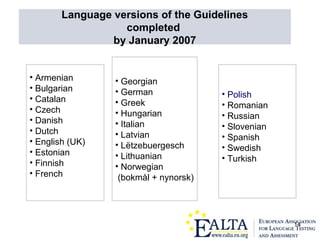
• Armenian
• Bulgarian
• Catalan
• Czech
• Danish
• Dutch
• English (UK)
• Estonian
• Finnish
• French
• Georgian
• German
• Greek
• Hungarian
• Italian
• Latvian
• Lëtzebuergesch
• Lithuanian
• Norwegian
(bokmål + nynorsk)
• Polish
• Romanian
• Russian
• Slovenian
• Spanish
• Swedish
• Turkish
Language versions of the Guidelines
completed
by January 2007
15
For the full EALTA Guidelines for Good
Practice in Language Testing and
Assessment document and its language
versions, see
www.ealta.eu.org

7.1 ealta guidelines

  • 1.
    1 European Association for LanguageTesting and Assessment www.ealta.eu.org
  • 2.
    2 EALTA Mission Statement Thepurpose of EALTA is to promote the understanding of theoretical principles of language testing and assessment, and the improvement and sharing of testing and assessment practices throughout Europe.
  • 3.
    3 EALTA’s guidelines forgood practice are addressed primarily to three different audiences: Those involved in • the training of teachers in testing and assessment • classroom testing and assessment • the development of tests in national or institutional testing units or centres
  • 4.
    4 For all thesegroups, a number of general principles apply: Respect for the students/examinees Responsibility Fairness Reliability Validity Collaboration among the parties involved
  • 5.
    5 EALTA Guidelines for GoodPractice in Language Testing and Assessment
  • 6.
    6 EALTA members involvedin teacher training related to testing and assessment will clarify to themselves and appropriate stakeholders (trainees, practising teachers, curriculum developers):
  • 7.
    7 Examples • How relevantis the training to the assessment context of the trainees? • How clearly are the principles of testing and assessment (e.g. validity, reliability, fairness, washback) related to the trainees´ context? • What is the balance between theory and practice in the training? • How far are the trainees involved in developing, trialling and evaluating assessment procedures?
  • 8.
    8 EALTA members involvedin classroom testing and assessment will clarify to themselves and appropriate stakeholders (especially pupils/ students and as far as possible parents):
  • 9.
    9 Examples • What isthe purpose of the assessment? • How appropriate are the assessment procedures to the learners? • What efforts are made to ensure that the assessment results are accurate and fair? • What account is taken of students’ views on the assessment procedures? • What action(s) will be taken to improve learning? • What kind of feedback do students get?
  • 10.
    10 EALTA members involvedin test development will clarify to themselves and appropriate stakeholders (teachers, students, the general public), and provide answers to the questions listed below.
  • 11.
    11 Furthermore, test developersare encouraged to engage in dialogue with decision makers in their institutions and ministries to ensure that decision makers are aware of both good and bad practice, in order to enhance the quality of assessment systems and practices.
  • 12.
    12 Examples • Are theretest specifications? • Do test developers and item writers have relevant experience of teaching at the level the assessment is aimed at? • What training do test developers and item writers have? • Are the tests piloted? • Are markers trained for each test administration?
  • 13.
    13 Examples • Is thereroutine double marking for subjectively marked tests? • What is the washback effect? • What procedures are in place to ensure that the test keeps pace with changes in the curriculum? • Is test level specified in CEFR terms? • What evidence is provided to support this claim?
  • 14.
    14 • Armenian • Bulgarian •Catalan • Czech • Danish • Dutch • English (UK) • Estonian • Finnish • French • Georgian • German • Greek • Hungarian • Italian • Latvian • Lëtzebuergesch • Lithuanian • Norwegian (bokmål + nynorsk) • Polish • Romanian • Russian • Slovenian • Spanish • Swedish • Turkish Language versions of the Guidelines completed by January 2007
  • 15.
    15 For the fullEALTA Guidelines for Good Practice in Language Testing and Assessment document and its language versions, see www.ealta.eu.org