Copyright DHP Research & Consultancy Ltd
2013
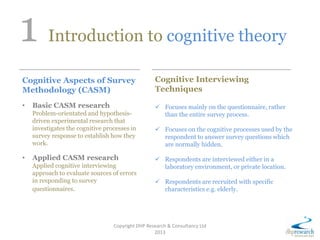
1 Introduction to cognitive theory
Cognitive Aspects of Survey
Methodology (CASM)
• Basic CASM research
Problem-orientated and hypothesis-
driven experimental research that
investigates the cognitive processes in
survey response to establish how they
work.
• Applied CASM research
Applied cognitive interviewing
approach to evaluate sources of errors
in responding to survey
questionnaires.
Cognitive Interviewing
Techniques
 Focuses mainly on the questionnaire, rather
than the entire survey process.
 Focuses on the cognitive processes used by the
respondent to answer survey questions which
are normally hidden.
 Respondents are interviewed either in a
laboratory environment, or private location.
 Respondents are recruited with specific
characteristics e.g. elderly.
Copyright DHP Research & Consultancy Ltd
2013
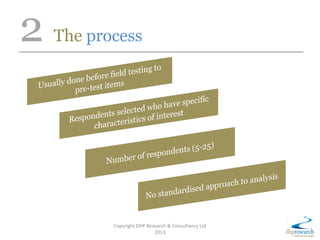
2 The process
 
Copyright DHP Research & Consultancy Ltd
2013
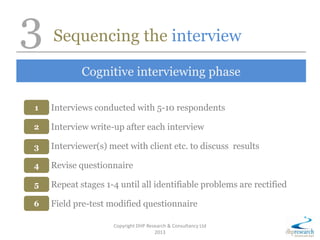
3 Sequencing the interview
Interviews conducted with 5-10 respondents
Interview write-up after each interview
Interviewer(s) meet with client etc. to discuss results
Revise questionnaire
Repeat stages 1-4 until all identifiable problems are rectified
Field pre-test modified questionnaire
Cognitive interviewing phase
Copyright DHP Research & Consultancy Ltd
2013
1
2
3
4
5
6
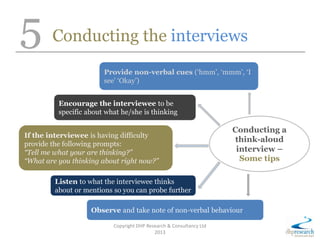
5 Conducting the interviews
Copyright DHP Research & Consultancy Ltd
2013
Conducting a
think-aloud
interview –
Some tips
Provide non-verbal cues (‘hmm’, ‘mmm’, ‘I
see’ ‘Okay’)
Encourage the interviewee to be
specific about what he/she is thinking
If the interviewee is having difficulty
provide the following prompts:
“Tell me what your are thinking?”
“What are you thinking about right now?”
Listen to what the interviewee thinks
about or mentions so you can probe further
Observe and take note of non-verbal behaviour
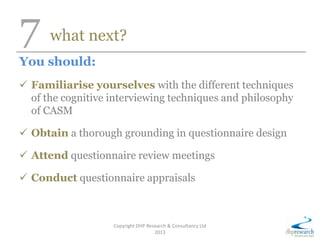
7 what next?
You should:
 Familiarise yourselves with the different techniques
of the cognitive interviewing techniques and philosophy
of CASM
 Obtain a thorough grounding in questionnaire design
 Attend questionnaire review meetings
 Conduct questionnaire appraisals
Copyright DHP Research & Consultancy Ltd
2013

A selection of slides from our cognitive interview training workshop

  • 1.
    Copyright DHP Research& Consultancy Ltd 2013
  • 2.
    1 Introduction tocognitive theory Cognitive Aspects of Survey Methodology (CASM) • Basic CASM research Problem-orientated and hypothesis- driven experimental research that investigates the cognitive processes in survey response to establish how they work. • Applied CASM research Applied cognitive interviewing approach to evaluate sources of errors in responding to survey questionnaires. Cognitive Interviewing Techniques  Focuses mainly on the questionnaire, rather than the entire survey process.  Focuses on the cognitive processes used by the respondent to answer survey questions which are normally hidden.  Respondents are interviewed either in a laboratory environment, or private location.  Respondents are recruited with specific characteristics e.g. elderly. Copyright DHP Research & Consultancy Ltd 2013
  • 3.
    2 The process   CopyrightDHP Research & Consultancy Ltd 2013
  • 4.
    3 Sequencing theinterview Interviews conducted with 5-10 respondents Interview write-up after each interview Interviewer(s) meet with client etc. to discuss results Revise questionnaire Repeat stages 1-4 until all identifiable problems are rectified Field pre-test modified questionnaire Cognitive interviewing phase Copyright DHP Research & Consultancy Ltd 2013 1 2 3 4 5 6
  • 5.
    5 Conducting theinterviews Copyright DHP Research & Consultancy Ltd 2013 Conducting a think-aloud interview – Some tips Provide non-verbal cues (‘hmm’, ‘mmm’, ‘I see’ ‘Okay’) Encourage the interviewee to be specific about what he/she is thinking If the interviewee is having difficulty provide the following prompts: “Tell me what your are thinking?” “What are you thinking about right now?” Listen to what the interviewee thinks about or mentions so you can probe further Observe and take note of non-verbal behaviour
  • 6.
    7 what next? Youshould:  Familiarise yourselves with the different techniques of the cognitive interviewing techniques and philosophy of CASM  Obtain a thorough grounding in questionnaire design  Attend questionnaire review meetings  Conduct questionnaire appraisals Copyright DHP Research & Consultancy Ltd 2013