QoS In WLAN

       BY
 WAQAS SHEHZAD
FAST NU PAKISTAN
Outline


 Introduction
 QoS Parameters.
 802.11 medium access control schemes
  (MAC).
 802.11e medium access control schemes
  (MAC).
 Conclusion.
 Reference.
Introduction

 What is 802.11?
 802.11 refers to a family of specifications
    developed by the IEEE for wireless LAN
    technology.
   802.11 Standards.
   1997 - 802.11 up to 2Mbps (900MHZ).
   1999 - 802.11b 2.4GHZ and up to 11Mbps.
   1999 – 802.11a 5GHZ and up to 54Mbps.
   200x – 802.11g 2.4GHZ and up to 54Mbps.
   200x – 802.11e for QoS.
Quality of Service (QoS)

   QoS is the capability to provide resource
    assurance in a network.
   QoS Parameters:
    Bandwidth.
    Delay.(how long it takes for a bit of data to travel
    across the network from one node or endpoint to
    another.)
    Packet loss rate.
    Jitter.
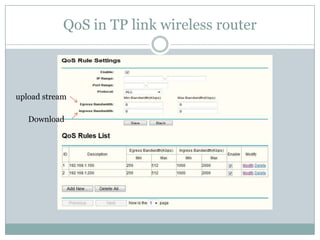
QoS in TP link wireless router


upload stream

   Download
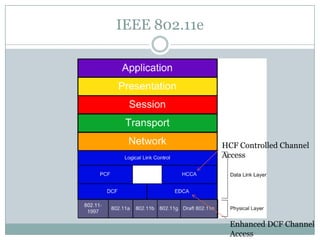
IEEE 802.11e


               HCF Controlled Channel
               Access


                 Enhanced DCF Channel
                 Access
802.11 medium access control schemes (MAC).


   There are two basic medium
     access control (MAC) modes:
    Distributed Coordination
     Function (DCF).
    Point Coordination Function
     (PCF).
Distributed Coordination Function (DCF)


 Contention-Based.
 Based on Carrier Sense Multiple Access with
  Collision Avoidance (CSMA/CA) algorithm.
 Designed for a best-effort service.
 Supports Asynchronous transmission.
Limitation of Distributed Coordination Function
                      (DCF)

 Does not provide any QoS guarantees.
 Does not support real-time application.
 Designed for equal priorities.
 Does not support the concept of differentiating
 frames with different user priorities.
Point Coordination Function (PCF)


 Contention free-based.
 Uses a centralized polling scheme.
 Differentiation Considered based on priority.
 Supports synchronous transmission.
.
Limitation of Point Coordination Function (PCF)


   poor QoS performance.
   Uses a simple round-robin
    algorithm, which can not handle the
    various QoS requirements.
   Transmission time of the polled
    stations is unknown.
Hybrid Coordination Function (HCF)


There are two methods of channel
  access:
 Enhanced DCF channel access (EDCA).
 HCF controlled channel access
  (HCCA).
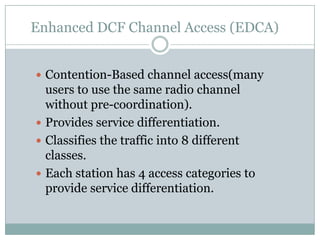
Enhanced DCF Channel Access (EDCA)


 Contention-Based channel access(many
  users to use the same radio channel
  without pre-coordination).
 Provides service differentiation.
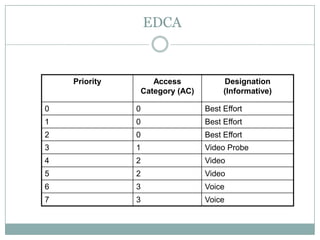
 Classifies the traffic into 8 different
  classes.
 Each station has 4 access categories to
  provide service differentiation.
EDCA


    Priority      Access            Designation
               Category (AC)        (Informative)

0              0               Best Effort
1              0               Best Effort
2              0               Best Effort
3              1               Video Probe
4              2               Video
5              2               Video
6              3               Voice
7              3               Voice
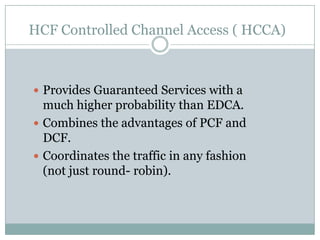
HCF Controlled Channel Access ( HCCA)


 Provides Guaranteed Services with a
  much higher probability than EDCA.
 Combines the advantages of PCF and
  DCF.
 Coordinates the traffic in any fashion
  (not just round- robin).
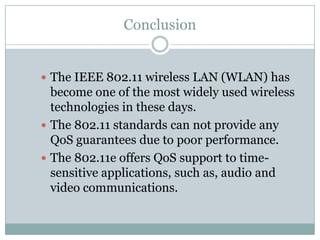
Conclusion


 The IEEE 802.11 wireless LAN (WLAN) has
  become one of the most widely used wireless
  technologies in these days.
 The 802.11 standards can not provide any
  QoS guarantees due to poor performance.
 The 802.11e offers QoS support to time-
  sensitive applications, such as, audio and
  video communications.

QoS in WLAN

  • 1.
    QoS In WLAN BY WAQAS SHEHZAD FAST NU PAKISTAN
  • 2.
    Outline  Introduction  QoSParameters.  802.11 medium access control schemes (MAC).  802.11e medium access control schemes (MAC).  Conclusion.  Reference.
  • 3.
    Introduction  What is802.11?  802.11 refers to a family of specifications developed by the IEEE for wireless LAN technology.  802.11 Standards.  1997 - 802.11 up to 2Mbps (900MHZ).  1999 - 802.11b 2.4GHZ and up to 11Mbps.  1999 – 802.11a 5GHZ and up to 54Mbps.  200x – 802.11g 2.4GHZ and up to 54Mbps.  200x – 802.11e for QoS.
  • 4.
    Quality of Service(QoS)  QoS is the capability to provide resource assurance in a network.  QoS Parameters: Bandwidth. Delay.(how long it takes for a bit of data to travel across the network from one node or endpoint to another.) Packet loss rate. Jitter.
  • 5.
    QoS in TPlink wireless router upload stream Download
  • 6.
    IEEE 802.11e HCF Controlled Channel Access Enhanced DCF Channel Access
  • 7.
    802.11 medium accesscontrol schemes (MAC). There are two basic medium access control (MAC) modes:  Distributed Coordination Function (DCF).  Point Coordination Function (PCF).
  • 8.
    Distributed Coordination Function(DCF)  Contention-Based.  Based on Carrier Sense Multiple Access with Collision Avoidance (CSMA/CA) algorithm.  Designed for a best-effort service.  Supports Asynchronous transmission.
  • 9.
    Limitation of DistributedCoordination Function (DCF)  Does not provide any QoS guarantees.  Does not support real-time application.  Designed for equal priorities.  Does not support the concept of differentiating frames with different user priorities.
  • 10.
    Point Coordination Function(PCF)  Contention free-based.  Uses a centralized polling scheme.  Differentiation Considered based on priority.  Supports synchronous transmission. .
  • 11.
    Limitation of PointCoordination Function (PCF)  poor QoS performance.  Uses a simple round-robin algorithm, which can not handle the various QoS requirements.  Transmission time of the polled stations is unknown.
  • 12.
    Hybrid Coordination Function(HCF) There are two methods of channel access:  Enhanced DCF channel access (EDCA).  HCF controlled channel access (HCCA).
  • 13.
    Enhanced DCF ChannelAccess (EDCA)  Contention-Based channel access(many users to use the same radio channel without pre-coordination).  Provides service differentiation.  Classifies the traffic into 8 different classes.  Each station has 4 access categories to provide service differentiation.
  • 14.
    EDCA Priority Access Designation Category (AC) (Informative) 0 0 Best Effort 1 0 Best Effort 2 0 Best Effort 3 1 Video Probe 4 2 Video 5 2 Video 6 3 Voice 7 3 Voice
  • 15.
    HCF Controlled ChannelAccess ( HCCA)  Provides Guaranteed Services with a much higher probability than EDCA.  Combines the advantages of PCF and DCF.  Coordinates the traffic in any fashion (not just round- robin).
  • 16.
    Conclusion  The IEEE802.11 wireless LAN (WLAN) has become one of the most widely used wireless technologies in these days.  The 802.11 standards can not provide any QoS guarantees due to poor performance.  The 802.11e offers QoS support to time- sensitive applications, such as, audio and video communications.