Amortized Analysis
    By Waqas Shehzad
    Fast NU Pakistan
Amortized Analysis
An amortized analysis is any
 strategy for analyzing a sequence of
 operations to show that the average
 cost per operation is small, even
 though a single operation within the
 sequence might be expensive.
Even though we’re taking averages,
 however, probability is not involved!
Operations on Data
Structures
 A data structure has a set of operations
  associated with it.
 Example: A stack with
   push(), pop() and MultiPop(k).
 Often some operations may be slow
  while others are fast.
 push() and pop() are fast.
 MultiPop(k) may be slow.
 Sometimes the time of a single
  operation can vary
Amortized Analysis
Aggregate Method: we determine an upper
 bound T(n) on the total sequence of n
 operations. The cost of each will then be
 T(n)/n.
Accounting Method: we overcharge some
 operations early and use them to as prepaid
 charge later.
Potential Method: we maintain credit as
 potential energy associated with the structure
 as a whole.
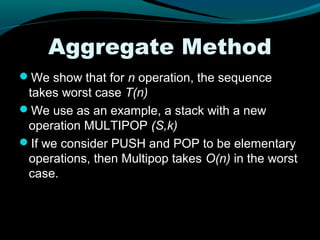
Aggregate Method
We show that for n operation, the sequence
 takes worst case T(n)
We use as an example, a stack with a new
 operation MULTIPOP (S,k)
If we consider PUSH and POP to be elementary
 operations, then Multipop takes O(n) in the worst
 case.
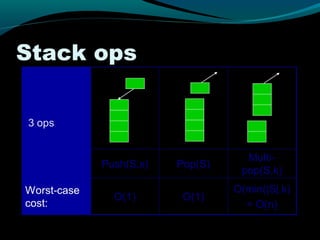
Stack ops
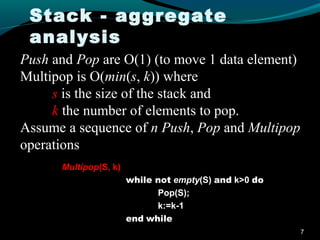
Stack - aggregate
 analysis
Push and Pop are O(1) (to move 1 data element)
Multipop is O(min(s, k)) where
     s is the size of the stack and
     k the number of elements to pop.
Assume a sequence of n Push, Pop and Multipop
operations
      Multipop(S, k)
                       while not empty(S) and k>0 do
                             Pop(S);
                             k:=k-1
                       end while
                                                       7
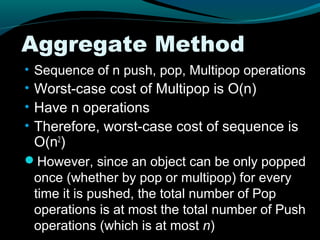
Aggregate Method
• Sequence of n push, pop, Multipop operations
• Worst-case cost of Multipop is O(n)
• Have n operations
• Therefore, worst-case cost of sequence is
 O(n2)
However, since an object can be only popped
 once (whether by pop or multipop) for every
 time it is pushed, the total number of Pop
 operations is at most the total number of Push
 operations (which is at most n)
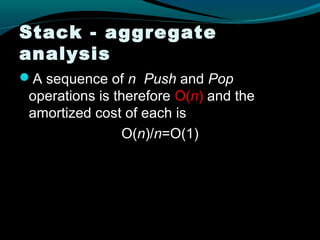
Stack - aggregate
analysis
A sequence of n Push and Pop
 operations is therefore O(n) and the
 amortized cost of each is
                 O(n)/n=O(1)
Accounting Method
We assign different charges to different
 operations, with some operations charged
 more or less than they actually cost.
The amount we charge an operation is its
 amortized cost.
When an operation’s amortized cost exceeds
 its actual cost, the difference is assigned to
 specific objects in the data structure as credit.
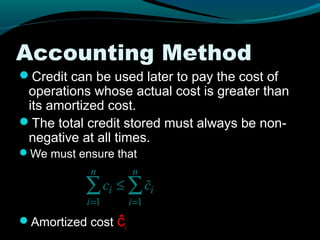
Accounting Method
Credit can be used later to pay the cost of
 operations whose actual cost is greater than
 its amortized cost.
The total credit stored must always be non-
 negative at all times.
We must ensure that
            n           n
           ∑ ci ≤ ∑ ci
                    ˆ
           i =1        i =1
Amortized cost   ĉi
Accounting Method: Stack
Thing about this: when we push a plate onto
 a stack, we use $1 to pay actual cost of the
 push and we leave $1 on the plate.
At any point, every plate on the stack has a
 dollar on top of it.
When we execute a pop operation, we
 charge it nothing and pay its cost with the
 dollar that is on top of it.
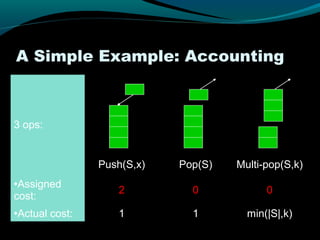
A Simple Example: Accounting


3 ops:


                Push(S,x)   Pop(S)   Multi-pop(S,k)
•Assigned
                   2          0            0
cost:
•Actual cost:      1          1        min(|S|,k)
Potential Method
Instead of representing prepaid work as credit
 stored with specific objects, the potential method
 represents the prepaid work as potential energy
 than can be released to pay for future
 operations.
Potential is associated with the data structure as
 a whole rather than with specific objects.
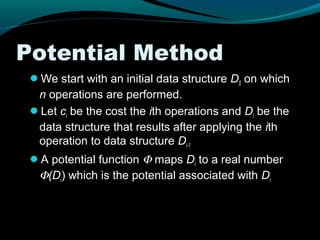
Potential Method
 We start with an initial data structure D0 on which
  n operations are performed.
 Let ci be the cost the ith operations and Di be the
  data structure that results after applying the ith
  operation to data structure Di-1
 A potential function Φ maps Di to a real number
  Φ(Di) which is the potential associated with Di
Applications of
      amortized analysis
Vectors/ tables
Disjoint sets
Priority queues
Heaps, Binomial heaps, Fibonacci heaps
Hashing

Amortized

  • 1.
    Amortized Analysis By Waqas Shehzad Fast NU Pakistan
  • 2.
    Amortized Analysis An amortizedanalysis is any strategy for analyzing a sequence of operations to show that the average cost per operation is small, even though a single operation within the sequence might be expensive. Even though we’re taking averages, however, probability is not involved!
  • 3.
    Operations on Data Structures A data structure has a set of operations associated with it. Example: A stack with push(), pop() and MultiPop(k). Often some operations may be slow while others are fast. push() and pop() are fast. MultiPop(k) may be slow. Sometimes the time of a single operation can vary
  • 4.
    Amortized Analysis Aggregate Method:we determine an upper bound T(n) on the total sequence of n operations. The cost of each will then be T(n)/n. Accounting Method: we overcharge some operations early and use them to as prepaid charge later. Potential Method: we maintain credit as potential energy associated with the structure as a whole.
  • 5.
    Aggregate Method We showthat for n operation, the sequence takes worst case T(n) We use as an example, a stack with a new operation MULTIPOP (S,k) If we consider PUSH and POP to be elementary operations, then Multipop takes O(n) in the worst case.
  • 6.
  • 7.
    Stack - aggregate analysis Push and Pop are O(1) (to move 1 data element) Multipop is O(min(s, k)) where s is the size of the stack and k the number of elements to pop. Assume a sequence of n Push, Pop and Multipop operations Multipop(S, k) while not empty(S) and k>0 do Pop(S); k:=k-1 end while 7
  • 8.
    Aggregate Method • Sequenceof n push, pop, Multipop operations • Worst-case cost of Multipop is O(n) • Have n operations • Therefore, worst-case cost of sequence is O(n2) However, since an object can be only popped once (whether by pop or multipop) for every time it is pushed, the total number of Pop operations is at most the total number of Push operations (which is at most n)
  • 9.
    Stack - aggregate analysis Asequence of n Push and Pop operations is therefore O(n) and the amortized cost of each is O(n)/n=O(1)
  • 10.
    Accounting Method We assigndifferent charges to different operations, with some operations charged more or less than they actually cost. The amount we charge an operation is its amortized cost. When an operation’s amortized cost exceeds its actual cost, the difference is assigned to specific objects in the data structure as credit.
  • 11.
    Accounting Method Credit canbe used later to pay the cost of operations whose actual cost is greater than its amortized cost. The total credit stored must always be non- negative at all times. We must ensure that n n ∑ ci ≤ ∑ ci ˆ i =1 i =1 Amortized cost ĉi
  • 12.
    Accounting Method: Stack Thingabout this: when we push a plate onto a stack, we use $1 to pay actual cost of the push and we leave $1 on the plate. At any point, every plate on the stack has a dollar on top of it. When we execute a pop operation, we charge it nothing and pay its cost with the dollar that is on top of it.
  • 13.
    A Simple Example:Accounting 3 ops: Push(S,x) Pop(S) Multi-pop(S,k) •Assigned 2 0 0 cost: •Actual cost: 1 1 min(|S|,k)
  • 14.
    Potential Method Instead ofrepresenting prepaid work as credit stored with specific objects, the potential method represents the prepaid work as potential energy than can be released to pay for future operations. Potential is associated with the data structure as a whole rather than with specific objects.
  • 15.
    Potential Method Westart with an initial data structure D0 on which n operations are performed. Let ci be the cost the ith operations and Di be the data structure that results after applying the ith operation to data structure Di-1 A potential function Φ maps Di to a real number Φ(Di) which is the potential associated with Di
  • 16.
    Applications of amortized analysis Vectors/ tables Disjoint sets Priority queues Heaps, Binomial heaps, Fibonacci heaps Hashing