Quality Function
Deployment
A Tool for Quality Optimization
QFD








QFD – Quality Function Deployment
QFD is aka HOUSE OF QUALITY
QFD – Customer Driven Quality Planning Tool
Developed by Japan - 1966, used by U S A
Incorporates Voice of Customers & Engineers
A Pre-cursor to SWOT Analysis
Comparison vis-à-vis our Competitors  External Assessment (Market)
 Internal Assessment (Technical)
QFD




QFD is a Customer Driven Quality
Planning Tool.
QFD provides a Graphical
Methodology for unearthing Customers
stated and unstated needs and
expectations and for driving these
Customer-based Requirements into
Products Design, Manufacturing and
Marketing Processes.
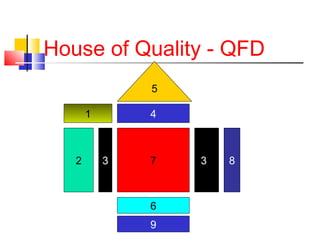
House of Quality - QFD
5
1

2

4

3

7

6
9

33

8
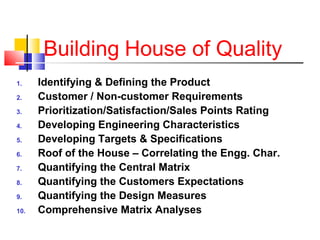
Building House of Quality
1.
2.
3.
4.
5.
6.
7.
8.
9.
10.

Identifying & Defining the Product
Customer / Non-customer Requirements
Prioritization/Satisfaction/Sales Points Rating
Developing Engineering Characteristics
Developing Targets & Specifications
Roof of the House – Correlating the Engg. Char.
Quantifying the Central Matrix
Quantifying the Customers Expectations
Quantifying the Design Measures
Comprehensive Matrix Analyses
Pros & Cons

Pros:
1.
Generates specific technical requirements
2.
Requirements are traceable
3.
Follows a repeatable, quantitative process
4.
Effectively translates Voice of the Customer
5.
Records rationale for each technical requirement
Cons:
1.
Time-consuming process for >10 requirements
2.
Data storage, manipulation and maintenance costs
3.
Very dependent on customer requirement gathering
4.
Inflexible to changing requirements; must recalculate
Pros & Cons

Pros:
1.
Generates specific technical requirements
2.
Requirements are traceable
3.
Follows a repeatable, quantitative process
4.
Effectively translates Voice of the Customer
5.
Records rationale for each technical requirement
Cons:
1.
Time-consuming process for >10 requirements
2.
Data storage, manipulation and maintenance costs
3.
Very dependent on customer requirement gathering
4.
Inflexible to changing requirements; must recalculate

Qfd

  • 1.
    Quality Function Deployment A Toolfor Quality Optimization
  • 2.
    QFD        QFD – QualityFunction Deployment QFD is aka HOUSE OF QUALITY QFD – Customer Driven Quality Planning Tool Developed by Japan - 1966, used by U S A Incorporates Voice of Customers & Engineers A Pre-cursor to SWOT Analysis Comparison vis-à-vis our Competitors  External Assessment (Market)  Internal Assessment (Technical)
  • 3.
    QFD   QFD is aCustomer Driven Quality Planning Tool. QFD provides a Graphical Methodology for unearthing Customers stated and unstated needs and expectations and for driving these Customer-based Requirements into Products Design, Manufacturing and Marketing Processes.
  • 4.
    House of Quality- QFD 5 1 2 4 3 7 6 9 33 8
  • 5.
    Building House ofQuality 1. 2. 3. 4. 5. 6. 7. 8. 9. 10. Identifying & Defining the Product Customer / Non-customer Requirements Prioritization/Satisfaction/Sales Points Rating Developing Engineering Characteristics Developing Targets & Specifications Roof of the House – Correlating the Engg. Char. Quantifying the Central Matrix Quantifying the Customers Expectations Quantifying the Design Measures Comprehensive Matrix Analyses
  • 6.
    Pros & Cons Pros: 1. Generatesspecific technical requirements 2. Requirements are traceable 3. Follows a repeatable, quantitative process 4. Effectively translates Voice of the Customer 5. Records rationale for each technical requirement Cons: 1. Time-consuming process for >10 requirements 2. Data storage, manipulation and maintenance costs 3. Very dependent on customer requirement gathering 4. Inflexible to changing requirements; must recalculate
  • 7.
    Pros & Cons Pros: 1. Generatesspecific technical requirements 2. Requirements are traceable 3. Follows a repeatable, quantitative process 4. Effectively translates Voice of the Customer 5. Records rationale for each technical requirement Cons: 1. Time-consuming process for >10 requirements 2. Data storage, manipulation and maintenance costs 3. Very dependent on customer requirement gathering 4. Inflexible to changing requirements; must recalculate