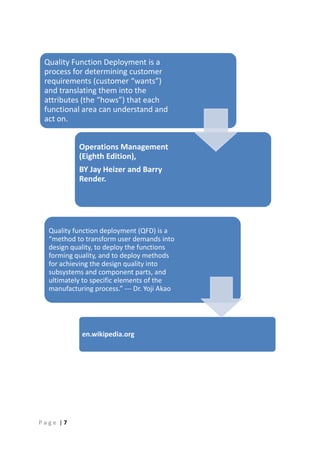
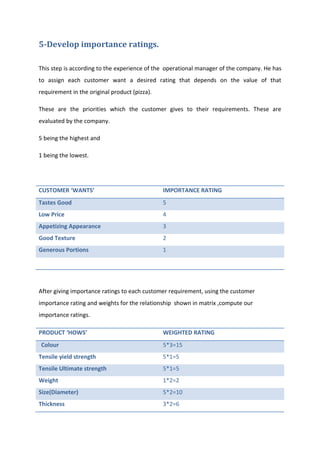
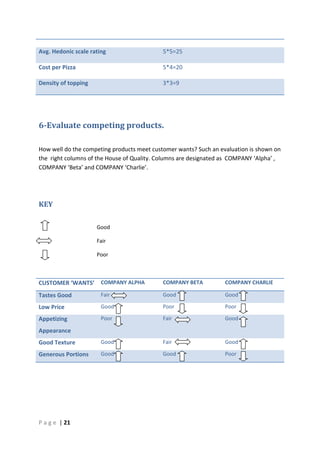
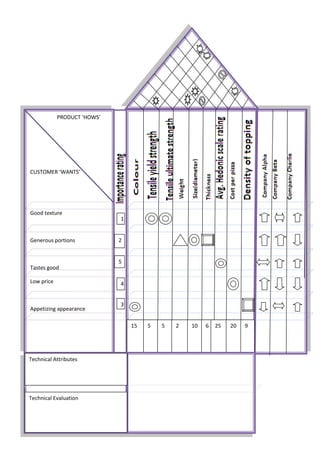
QUALITY FUNCTION DEPLOYMENTDEVELOPMENT OF HOUSE OF QUALITY OF ‘PIZZA’ Quality function deployment (QFD) is a “method to transform user demands into design quality, to deploy the functions forming quality, and to deploy methods for achieving the design quality into subsystems and component parts, and ultimately to specific elements of the manufacturing process.” --- Dr. Yoji Akao SUBMITTED BY:IBRAHIM AZHAR 08-ME-53INDUSTRIAL ENGINEERING –ISUMITTED TO:                           SIR. TURRAB HAIDERTITLESUB-TITLESPAGE NO.PREFACE---QUALITY FUNCTION DEPLOYMENTINTRDUCTIONDEFINITIONSOBJECTIVES OF QFDSTEPS IN QFDHISTORY OF QFDWHAT’S IN A NAMEUSE OF QFD----HOUSE OF QUALITYDEFINITIONSBASIC STRUCTURE OF DEVELOPING HOQSEVEN STEPS OF DEVELOPING HOQHOUSE OF QUALITY OF PIZZAPIZZAHISTORY OF PIZZATYPES OF PIZZAPIZZA IN PAKISTANINGREDIENTS IN PIZZA<br />                                                                                                            <br />                <br />                  <br />                 PREFACE<br />THIS REPORT ‘QUALITY FUNCTION DEPLOYMENT (DEVELOPMENT OF HOUSE OF QUALITY OF ‘PIZZA’)   ’ CONTAINS BASIC INFORMATION ABOUT THE CONCEPT, USAGE, FUNCTION, SIGNIFICANCE, IMPORTANCE AND APPLICATION OF QUALITY FUNCTION DEPLOYMENT AND ITS ONE MAIN TOOL i.e., HOUSE OF QUALITY. THE MAIN OBJECTIVE OF THIS REPORT IS THE DEVELOPMENT OF   :<br />HOUSE OF QUALITY OF ‘PIZZA’<br />FOR SUGGESTIONS, CRITICS AND COMMENTS, PLEASE CONTACT   :<br />Ibbi_08@yahoo.com<br />Ibbi_08@hotmail.com<br />                                                                  <br />                                                                  <br />                                                                   QUALTY FUNCTION DEPLOYMENT<br />INTRODUCTION<br />right0\"
Time was when a man could order a pair of shoes directly from the cobbler. By measuring the foot himself and personally handling all aspects of manufacturing, the cobbler could assure the customer would be satisfied,\"
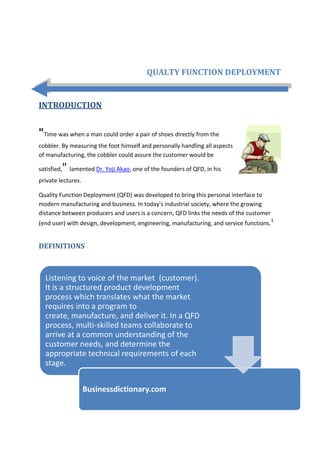
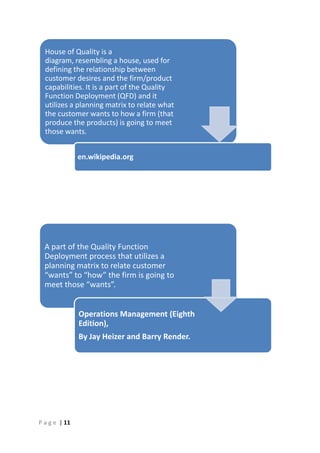
 lamented Dr. Yoji Akao, one of the founders of QFD, in his private lectures.<br />Quality Function Deployment (QFD) was developed to bring this personal interface to modern manufacturing and business. In today's industrial society, where the growing distance between producers and users is a concern, QFD links the needs of the customer (end user) with design, development, engineering, manufacturing, and service functions.1<br />DEFINITIONS <br /> <br />  <br />OBJECTIVES OF QFD<br />The main objectives of Quality Function Deployment are  :<br />Understanding Customer Requirements <br />Quality Systems Thinking + Psychology + Knowledge/Epistemology <br />Maximizing Positive Quality That Adds Value <br />Comprehensive Quality System for Customer Satisfaction <br />Strategy to Stay Ahead of The Game <br />As a quality system that implements elements of Systems Thinking with elements of Psychology and Epistemology (knowledge), QFD provides a system of comprehensive development process for:<br />Understanding 'true' customer needs from the customer's perspective <br />What 'value' means to the customer, from the customer's perspective <br />Understanding how customers or end users become interested, choose, and are satisfied <br />Analyzing how do we know the needs of the customer <br />Deciding what features to include <br />Determining what level of performance to deliver <br />Intelligently linking the needs of the customer with design, development, engineering, manufacturing, and service functions <br />Intelligently linking Design for Six Sigma (DFSS) with the front end Voice of Customer analysis and the entire design system <br />STEPS IN QFD<br />To develop a QFD it is necessary to have technical knowledge and an understanding of the techniques that assist in the development of each room, Some of the steps used in developing a QFD are listed below:<br />Capture the Voice of the Customer with market research <br />Importance ranking using Analytical Hierarchy Process (AHP) <br />How to deliver facilitation <br />How Much to Deliver <br />Relationship matrix to link wants and desires <br />Benchmarking <br />Organizational difficulty <br />Correlation matrix of specifications <br />Written requirements <br />These are only a few of the rooms that are developed in QFD level 1. Continuing through product development requires passing on the outputs into product details, process details and eventually the process controls needed to assure quality.2<br />                                                                                            HISTORY OF QFD<br />WHAT’S IN A NAME<br />“Quality Function Deployment” was originally created by two Japanese professors back in the 1960’s (Drs. Yoji Akao and Shigeru Mizuno). Thus, the process was originally given a Japanese name, which was later translated into English. The original Japanese name, “Hin-shitsu Ki-no Ten-kai”, was translated quite litterally into the name “Quality Function Deployment”. Although the name supposedly carries with it a more intuitive meaning in Japanese, it doesn’t seem to have the same readily apparent meaning in English.<br />Additionally, the term “QFD” is used by many people today to refer to a series of “House of Quality” matrices strung together to define customer requirements and translate them into specific product features to meet those needs. However, these prioritization matrices were only a small part of the system that Drs. Akao and Mizuno originally created. Thus, the application of the term “QFD” has changed over the course of the past 30+ years as well. Even though much was lost in translation from its Japanese name, “Quality Function Deployment” was a much more apropos name for the system of processes originally created by Akao and Mizumo than it is for the derivative tool that it has come to refer to today.<br />                                                                                                                               USE OF QFD<br />QFD is about communication and decision making, and its tools can truly be used in any industry. The House of Quality matrix, in particular, is an almost universal tool that can be used for prioritizing anything from a family budget to the complex engineering tasks of an automobile manufacturer.
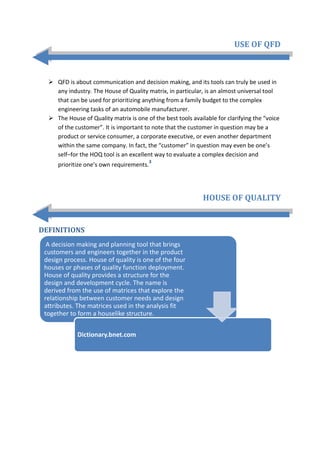
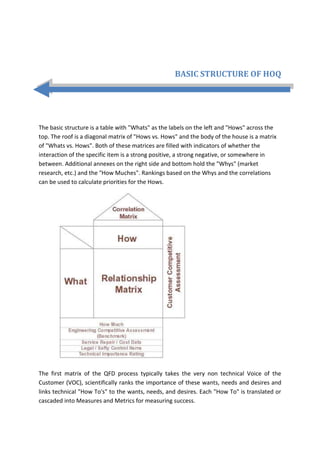
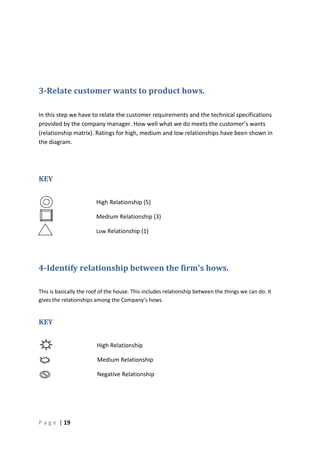
The House of Quality matrix is one of the best tools available for clarifying the “voice of the customer”. It is important to note that the customer in question may be a product or service consumer, a corporate executive, or even another department within the same company. In fact, the “customer” in question may even be one’s self–for the HOQ tool is an excellent way to evaluate a complex decision and prioritize one’s own requirements.3         <br />     HOUSE OF QUALITY<br />DEFINITIONS<br />                                                                                              <br />             BASIC STRUCTURE OF HOQ<br />The basic structure is a table with \"
Whats\"
 as the labels on the left and \"
Hows\"
 across the top. The roof is a diagonal matrix of \"
Hows vs. Hows\"
 and the body of the house is a matrix of \"
Whats vs. Hows\"
. Both of these matrices are filled with indicators of whether the interaction of the specific item is a strong positive, a strong negative, or somewhere in between. Additional annexes on the right side and bottom hold the \"
Whys\"
 (market research, etc.) and the \"
How Muches\"
. Rankings based on the Whys and the correlations can be used to calculate priorities for the Hows.<br />The first matrix of the QFD process typically takes the very non technical Voice of the Customer (VOC), scientifically ranks the importance of these wants, needs and desires and links technical \"
How To's\"
 to the wants, needs, and desires. Each \"
How To\"
 is translated or cascaded into Measures and Metrics for measuring success.<br />Each room’s function is similar to the rooms of the typical home. The kitchen, the living room, the bedroom, each have unique functions just like the \"
House of Quality\"
 QFD level 1. QFD level 1 also provides the opportunity to do benchmarking of current products against the measures and metrics. QFD level 1 also considers how each \"
technical how\"
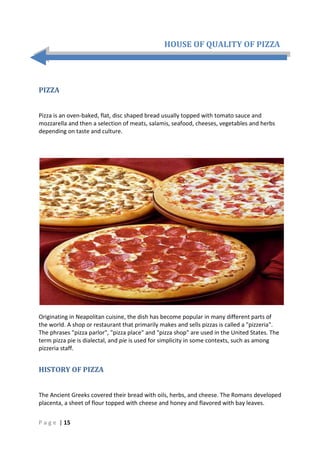
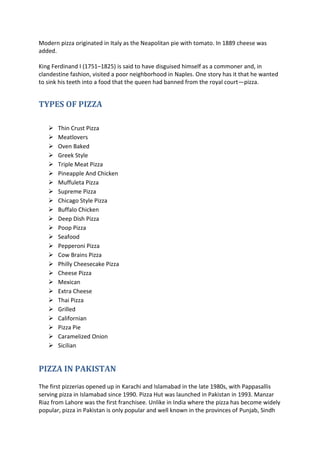
 might effect each other. This correlation section is often called the roof section because it is on top of the matrix and is angled like a roof.<br />When completed, requirements are written, benchmarking features are established to study further, and competing specifications are ranked to balance the delivery of a design based on the impact on the customer.<br />7 STEPS OF DEVELOPING HOQ<br />     HOUSE OF QUALITY OF PIZZA<br />PIZZA<br />Pizza is an oven-baked, flat, disc shaped bread usually topped with tomato sauce and mozzarella and then a selection of meats, salamis, seafood, cheeses, vegetables and herbs depending on taste and culture.<br />Originating in Neapolitan cuisine, the dish has become popular in many different parts of the world. A shop or restaurant that primarily makes and sells pizzas is called a \"
pizzeria\"
. The phrases \"
pizza parlor\"
, \"
pizza place\"
 and \"
pizza shop\"
 are used in the United States. The term pizza pie is dialectal, and pie is used for simplicity in some contexts, such as among pizzeria staff.<br />HISTORY OF PIZZA<br />The Ancient Greeks covered their bread with oils, herbs, and cheese. The Romans developed placenta, a sheet of flour topped with cheese and honey and flavored with bay leaves. Modern pizza originated in Italy as the Neapolitan pie with tomato. In 1889 cheese was added. <br />King Ferdinand I (1751–1825) is said to have disguised himself as a commoner and, in clandestine fashion, visited a poor neighborhood in Naples. One story has it that he wanted to sink his teeth into a food that the queen had banned from the royal court—pizza. <br />TYPES OF PIZZA<br />Thin Crust Pizza
Meatlovers
Oven Baked
Greek Style
Triple Meat Pizza
Pineapple And Chicken
Muffuleta Pizza
Supreme Pizza
Chicago Style Pizza
Buffalo Chicken
Deep Dish Pizza
Poop Pizza
Seafood
Pepperoni Pizza
Cow Brains Pizza
Philly Cheesecake Pizza
Cheese Pizza
Mexican
Extra Cheese
Thai Pizza
Grilled
Californian
Pizza Pie
Caramelized Onion
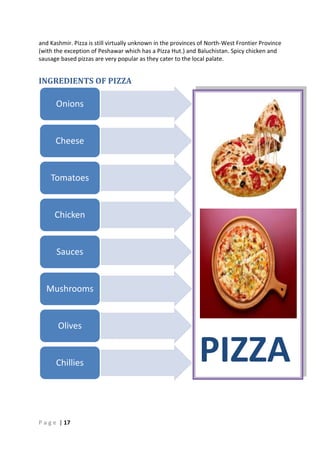
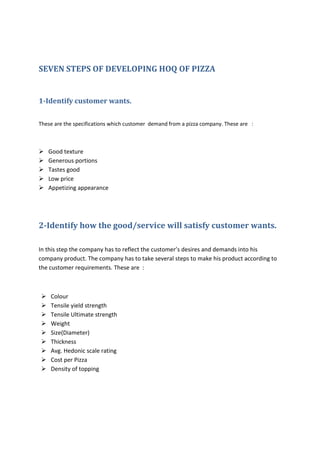
SicilianPIZZA IN PAKISTAN<br />The first pizzerias opened up in Karachi and Islamabad in the late 1980s, with Pappasallis serving pizza in Islamabad since 1990. Pizza Hut was launched in Pakistan in 1993. Manzar Riaz from Lahore was the first franchisee. Unlike in India where the pizza has become widely popular, pizza in Pakistan is only popular and well known in the provinces of Punjab, Sindh and Kashmir. Pizza is still virtually unknown in the provinces of North-West Frontier Province (with the exception of Peshawar which has a Pizza Hut.) and Baluchistan. Spicy chicken and sausage based pizzas are very popular as they cater to the local palate.<br />INGREDIENTS OF PIZZA<br />PIZZA <br />SEVEN STEPS OF DEVELOPING HOQ OF PIZZA<br />1-Identify customer wants.<br />These are the specifications which customer  demand from a pizza company. These are   :<br />Good texture
Generous portions
Tastes good

Quality Function Deployment for pizza

  • 1.
    QUALITY FUNCTION DEPLOYMENTDEVELOPMENTOF HOUSE OF QUALITY OF ‘PIZZA’ Quality function deployment (QFD) is a “method to transform user demands into design quality, to deploy the functions forming quality, and to deploy methods for achieving the design quality into subsystems and component parts, and ultimately to specific elements of the manufacturing process.” --- Dr. Yoji Akao SUBMITTED BY:IBRAHIM AZHAR 08-ME-53INDUSTRIAL ENGINEERING –ISUMITTED TO: SIR. TURRAB HAIDERTITLESUB-TITLESPAGE NO.PREFACE---QUALITY FUNCTION DEPLOYMENTINTRDUCTIONDEFINITIONSOBJECTIVES OF QFDSTEPS IN QFDHISTORY OF QFDWHAT’S IN A NAMEUSE OF QFD----HOUSE OF QUALITYDEFINITIONSBASIC STRUCTURE OF DEVELOPING HOQSEVEN STEPS OF DEVELOPING HOQHOUSE OF QUALITY OF PIZZAPIZZAHISTORY OF PIZZATYPES OF PIZZAPIZZA IN PAKISTANINGREDIENTS IN PIZZA<br /> <br /> <br /> <br /> PREFACE<br />THIS REPORT ‘QUALITY FUNCTION DEPLOYMENT (DEVELOPMENT OF HOUSE OF QUALITY OF ‘PIZZA’) ’ CONTAINS BASIC INFORMATION ABOUT THE CONCEPT, USAGE, FUNCTION, SIGNIFICANCE, IMPORTANCE AND APPLICATION OF QUALITY FUNCTION DEPLOYMENT AND ITS ONE MAIN TOOL i.e., HOUSE OF QUALITY. THE MAIN OBJECTIVE OF THIS REPORT IS THE DEVELOPMENT OF :<br />HOUSE OF QUALITY OF ‘PIZZA’<br />FOR SUGGESTIONS, CRITICS AND COMMENTS, PLEASE CONTACT :<br />Ibbi_08@yahoo.com<br />Ibbi_08@hotmail.com<br /> <br /> <br /> QUALTY FUNCTION DEPLOYMENT<br />INTRODUCTION<br />right0\" Time was when a man could order a pair of shoes directly from the cobbler. By measuring the foot himself and personally handling all aspects of manufacturing, the cobbler could assure the customer would be satisfied,\" lamented Dr. Yoji Akao, one of the founders of QFD, in his private lectures.<br />Quality Function Deployment (QFD) was developed to bring this personal interface to modern manufacturing and business. In today's industrial society, where the growing distance between producers and users is a concern, QFD links the needs of the customer (end user) with design, development, engineering, manufacturing, and service functions.1<br />DEFINITIONS <br /> <br /> <br />OBJECTIVES OF QFD<br />The main objectives of Quality Function Deployment are :<br />Understanding Customer Requirements <br />Quality Systems Thinking + Psychology + Knowledge/Epistemology <br />Maximizing Positive Quality That Adds Value <br />Comprehensive Quality System for Customer Satisfaction <br />Strategy to Stay Ahead of The Game <br />As a quality system that implements elements of Systems Thinking with elements of Psychology and Epistemology (knowledge), QFD provides a system of comprehensive development process for:<br />Understanding 'true' customer needs from the customer's perspective <br />What 'value' means to the customer, from the customer's perspective <br />Understanding how customers or end users become interested, choose, and are satisfied <br />Analyzing how do we know the needs of the customer <br />Deciding what features to include <br />Determining what level of performance to deliver <br />Intelligently linking the needs of the customer with design, development, engineering, manufacturing, and service functions <br />Intelligently linking Design for Six Sigma (DFSS) with the front end Voice of Customer analysis and the entire design system <br />STEPS IN QFD<br />To develop a QFD it is necessary to have technical knowledge and an understanding of the techniques that assist in the development of each room, Some of the steps used in developing a QFD are listed below:<br />Capture the Voice of the Customer with market research <br />Importance ranking using Analytical Hierarchy Process (AHP) <br />How to deliver facilitation <br />How Much to Deliver <br />Relationship matrix to link wants and desires <br />Benchmarking <br />Organizational difficulty <br />Correlation matrix of specifications <br />Written requirements <br />These are only a few of the rooms that are developed in QFD level 1. Continuing through product development requires passing on the outputs into product details, process details and eventually the process controls needed to assure quality.2<br /> HISTORY OF QFD<br />WHAT’S IN A NAME<br />“Quality Function Deployment” was originally created by two Japanese professors back in the 1960’s (Drs. Yoji Akao and Shigeru Mizuno). Thus, the process was originally given a Japanese name, which was later translated into English. The original Japanese name, “Hin-shitsu Ki-no Ten-kai”, was translated quite litterally into the name “Quality Function Deployment”. Although the name supposedly carries with it a more intuitive meaning in Japanese, it doesn’t seem to have the same readily apparent meaning in English.<br />Additionally, the term “QFD” is used by many people today to refer to a series of “House of Quality” matrices strung together to define customer requirements and translate them into specific product features to meet those needs. However, these prioritization matrices were only a small part of the system that Drs. Akao and Mizuno originally created. Thus, the application of the term “QFD” has changed over the course of the past 30+ years as well. Even though much was lost in translation from its Japanese name, “Quality Function Deployment” was a much more apropos name for the system of processes originally created by Akao and Mizumo than it is for the derivative tool that it has come to refer to today.<br /> USE OF QFD<br />QFD is about communication and decision making, and its tools can truly be used in any industry. The House of Quality matrix, in particular, is an almost universal tool that can be used for prioritizing anything from a family budget to the complex engineering tasks of an automobile manufacturer.
  • 2.
    The House ofQuality matrix is one of the best tools available for clarifying the “voice of the customer”. It is important to note that the customer in question may be a product or service consumer, a corporate executive, or even another department within the same company. In fact, the “customer” in question may even be one’s self–for the HOQ tool is an excellent way to evaluate a complex decision and prioritize one’s own requirements.3 <br /> HOUSE OF QUALITY<br />DEFINITIONS<br /> <br /> BASIC STRUCTURE OF HOQ<br />The basic structure is a table with \" Whats\" as the labels on the left and \" Hows\" across the top. The roof is a diagonal matrix of \" Hows vs. Hows\" and the body of the house is a matrix of \" Whats vs. Hows\" . Both of these matrices are filled with indicators of whether the interaction of the specific item is a strong positive, a strong negative, or somewhere in between. Additional annexes on the right side and bottom hold the \" Whys\" (market research, etc.) and the \" How Muches\" . Rankings based on the Whys and the correlations can be used to calculate priorities for the Hows.<br />The first matrix of the QFD process typically takes the very non technical Voice of the Customer (VOC), scientifically ranks the importance of these wants, needs and desires and links technical \" How To's\" to the wants, needs, and desires. Each \" How To\" is translated or cascaded into Measures and Metrics for measuring success.<br />Each room’s function is similar to the rooms of the typical home. The kitchen, the living room, the bedroom, each have unique functions just like the \" House of Quality\" QFD level 1. QFD level 1 also provides the opportunity to do benchmarking of current products against the measures and metrics. QFD level 1 also considers how each \" technical how\" might effect each other. This correlation section is often called the roof section because it is on top of the matrix and is angled like a roof.<br />When completed, requirements are written, benchmarking features are established to study further, and competing specifications are ranked to balance the delivery of a design based on the impact on the customer.<br />7 STEPS OF DEVELOPING HOQ<br /> HOUSE OF QUALITY OF PIZZA<br />PIZZA<br />Pizza is an oven-baked, flat, disc shaped bread usually topped with tomato sauce and mozzarella and then a selection of meats, salamis, seafood, cheeses, vegetables and herbs depending on taste and culture.<br />Originating in Neapolitan cuisine, the dish has become popular in many different parts of the world. A shop or restaurant that primarily makes and sells pizzas is called a \" pizzeria\" . The phrases \" pizza parlor\" , \" pizza place\" and \" pizza shop\" are used in the United States. The term pizza pie is dialectal, and pie is used for simplicity in some contexts, such as among pizzeria staff.<br />HISTORY OF PIZZA<br />The Ancient Greeks covered their bread with oils, herbs, and cheese. The Romans developed placenta, a sheet of flour topped with cheese and honey and flavored with bay leaves. Modern pizza originated in Italy as the Neapolitan pie with tomato. In 1889 cheese was added. <br />King Ferdinand I (1751–1825) is said to have disguised himself as a commoner and, in clandestine fashion, visited a poor neighborhood in Naples. One story has it that he wanted to sink his teeth into a food that the queen had banned from the royal court—pizza. <br />TYPES OF PIZZA<br />Thin Crust Pizza
  • 3.
  • 4.
  • 5.
  • 6.
  • 7.
  • 8.
  • 9.
  • 10.
  • 11.
  • 12.
  • 13.
  • 14.
  • 15.
  • 16.
  • 17.
  • 18.
  • 19.
  • 20.
  • 21.
  • 22.
  • 23.
  • 24.
  • 25.
  • 26.
    SicilianPIZZA IN PAKISTAN<br/>The first pizzerias opened up in Karachi and Islamabad in the late 1980s, with Pappasallis serving pizza in Islamabad since 1990. Pizza Hut was launched in Pakistan in 1993. Manzar Riaz from Lahore was the first franchisee. Unlike in India where the pizza has become widely popular, pizza in Pakistan is only popular and well known in the provinces of Punjab, Sindh and Kashmir. Pizza is still virtually unknown in the provinces of North-West Frontier Province (with the exception of Peshawar which has a Pizza Hut.) and Baluchistan. Spicy chicken and sausage based pizzas are very popular as they cater to the local palate.<br />INGREDIENTS OF PIZZA<br />PIZZA <br />SEVEN STEPS OF DEVELOPING HOQ OF PIZZA<br />1-Identify customer wants.<br />These are the specifications which customer demand from a pizza company. These are :<br />Good texture
  • 27.
  • 28.