1
Relevant Equations, Formulas, Tables and Figures
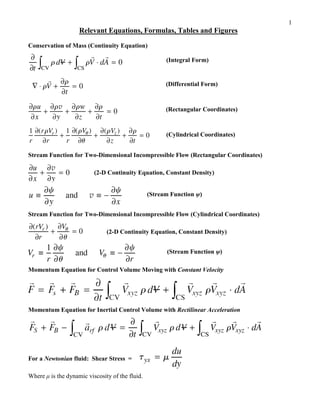
Conservation of Mass (Continuity Equation)
(Integral Form)
(Differential Form)
(Rectangular Coordinates)
(Cylindrical Coordinates)
Stream Function for Two-Dimensional Incompressible Flow (Rectangular Coordinates)
(2-D Continuity Equation, Constant Density)
(Stream Function ψ)
Stream Function for Two-Dimensional Incompressible Flow (Cylindrical Coordinates)
(2-D Continuity Equation, Constant Density)
(Stream Function ψ)
Momentum Equation for Control Volume Moving with Constant Velocity
Momentum Equation for Inertial Control Volume with Rectilinear Acceleration
For a Newtonian fluid: Shear Stress =
Where μ is the dynamic viscosity of the fluid.
2
For a Plane Submerged Surface:
where 𝐼𝐼𝑥𝑥
�𝑥𝑥
� =
𝑤𝑤𝑤𝑤𝑤𝑤𝑤𝑤ℎ×ℎ𝑒𝑒𝑒𝑒𝑒𝑒ℎ𝑡𝑡3
12
Pressure Variation in a Static Fluid
h
g
p
p
p atm
abs
gage ρ
=
−
=
where ρ = density of the fluid ; g = gravitational acceleration (9.81 m/s2
or 32.2 ft/s2
) ; h = height of
fluid column
Absolute pressure = atmospheric pressure + gauge pressure reading
Absolute pressure = atmospheric pressure – vacuum pressure reading
Specific Gravity = SG =
𝜌𝜌𝑠𝑠
𝜌𝜌𝑟𝑟𝑟𝑟𝑟𝑟
; where ρs = density of substance
and ρref = density of reference liquid which is water at 4°C (39°F) = 1000 kg/m3
(1.94 slug/ft3
)
Fluid Translation: Acceleration of a Fluid Particle in a Velocity Field, p
a

Fluid Deformation: Linear Deformation
Fluid Rotation:
𝝎𝝎
� =
𝟏𝟏
𝟐𝟐
𝛁𝛁 × 𝑽𝑽
� ; If 𝛁𝛁 × 𝑽𝑽
� = 𝟎𝟎 then flow is irrotational
The Bernoulli Equation is derived when the energy equation is applied to one-dimensional flows.
Assuming no friction losses and that no pump or turbine exists between sections 1 and 2 in the system,
1
2
1
1
2
2
2
2
2
2
z
g
V
p
z
g
V
p
+
+
=
+
+
γ
γ
, where
2
1, p
p = pressure at sections 1 and 2,
2
1,V
V = average velocity of the fluid at the sections,
2
1, z
z = the vertical distance from a datum to the sections (the potential energy),
γ = the specific weight of the fluid ( g
ρ ), and
g = the acceleration of gravity.
3
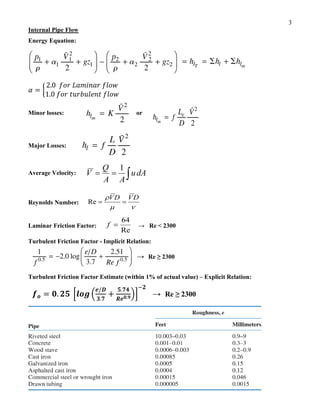
Internal Pipe Flow
Energy Equation:
𝛼𝛼 = �
2.0 𝑓𝑓𝑓𝑓𝑓𝑓 𝐿𝐿𝐿𝐿𝐿𝐿𝐿𝐿𝐿𝐿𝐿𝐿𝐿𝐿 𝑓𝑓𝑓𝑓𝑓𝑓𝑓𝑓
1.0 𝑓𝑓𝑓𝑓𝑓𝑓 𝑡𝑡𝑡𝑡𝑡𝑡𝑡𝑡𝑡𝑡𝑡𝑡𝑡𝑡𝑡𝑡𝑡𝑡 𝑓𝑓𝑓𝑓𝑓𝑓𝑓𝑓
Minor losses: or
Major Losses:
Average Velocity:
Reynolds Number:
ν
µ
ρ D
V
D
V
=
=
Re
Laminar Friction Factor:
Re
64
=
f → Re < 2300
Turbulent Friction Factor - Implicit Relation:
→ Re ≥ 2300
Turbulent Friction Factor Estimate (within 1% of actual value) – Explicit Relation:
𝒇𝒇𝒐𝒐 = 𝟎𝟎. 𝟐𝟐𝟐𝟐 �𝒍𝒍𝒍𝒍𝒍𝒍 �
𝒆𝒆/𝑫𝑫
𝟑𝟑.𝟕𝟕
+
𝟓𝟓.𝟕𝟕𝟕𝟕
𝑹𝑹𝑹𝑹𝟎𝟎.𝟗𝟗��
−𝟐𝟐
→ Re ≥ 2300
∫
=
= dA
u
A
A
Q
V
1
4
5
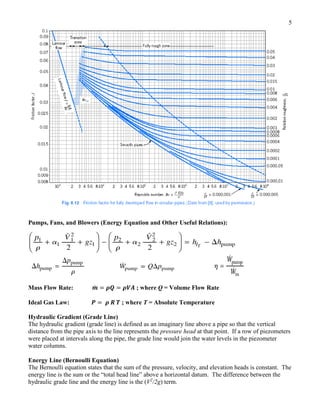
Pumps, Fans, and Blowers (Energy Equation and Other Useful Relations):
Mass Flow Rate: 𝒎𝒎
̇ = 𝝆𝝆𝝆𝝆 = 𝝆𝝆𝝆𝝆𝝆𝝆 ; where Q = Volume Flow Rate
Ideal Gas Law: 𝑷𝑷 = 𝝆𝝆 𝑹𝑹 𝑻𝑻 ; where T = Absolute Temperature
Hydraulic Gradient (Grade Line)
The hydraulic gradient (grade line) is defined as an imaginary line above a pipe so that the vertical
distance from the pipe axis to the line represents the pressure head at that point. If a row of piezometers
were placed at intervals along the pipe, the grade line would join the water levels in the piezometer
water columns.
Energy Line (Bernoulli Equation)
The Bernoulli equation states that the sum of the pressure, velocity, and elevation heads is constant. The
energy line is the sum or the “total head line” above a horizontal datum. The difference between the
hydraulic grade line and the energy line is the (V2
/2g) term.
6
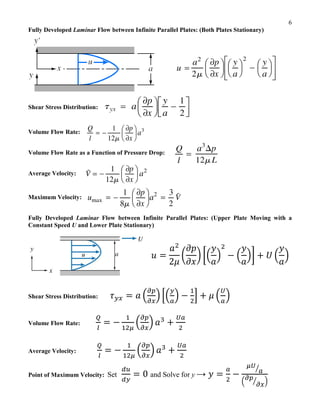
Fully Developed Laminar Flow between Infinite Parallel Plates: (Both Plates Stationary)
Shear Stress Distribution:
Volume Flow Rate:
Volume Flow Rate as a Function of Pressure Drop:
Average Velocity:
Maximum Velocity:
Fully Developed Laminar Flow between Infinite Parallel Plates: (Upper Plate Moving with a
Constant Speed U and Lower Plate Stationary)
𝑢𝑢 =
𝑎𝑎2
2𝜇𝜇
�
𝜕𝜕𝜕𝜕
𝜕𝜕𝜕𝜕
� ��
𝑦𝑦
𝑎𝑎
�
2
− �
𝑦𝑦
𝑎𝑎
�� + 𝑈𝑈 �
𝑦𝑦
𝑎𝑎
�
Shear Stress Distribution: 𝜏𝜏𝑦𝑦𝑦𝑦 = 𝑎𝑎 �
𝜕𝜕𝜕𝜕
𝜕𝜕𝜕𝜕
� ��
𝑦𝑦
𝑎𝑎
� −
1
2
� + 𝜇𝜇 �
𝑈𝑈
𝑎𝑎
�
Volume Flow Rate:
𝑄𝑄
𝑙𝑙
= −
1
12𝜇𝜇
�
𝜕𝜕𝜕𝜕
𝜕𝜕𝜕𝜕
� 𝑎𝑎3
+
𝑈𝑈𝑈𝑈
2
Average Velocity:
𝑄𝑄
𝑙𝑙
= −
1
12𝜇𝜇
�
𝜕𝜕𝜕𝜕
𝜕𝜕𝜕𝜕
� 𝑎𝑎3
+
𝑈𝑈𝑈𝑈
2
Point of Maximum Velocity: Set
𝑑𝑑𝑑𝑑
𝑑𝑑𝑑𝑑
= 0 and Solve for y → 𝑦𝑦 =
𝑎𝑎
2
−
𝜇𝜇𝑈𝑈
𝑎𝑎
�
�
𝜕𝜕𝑝𝑝
𝜕𝜕𝑥𝑥
� �
7
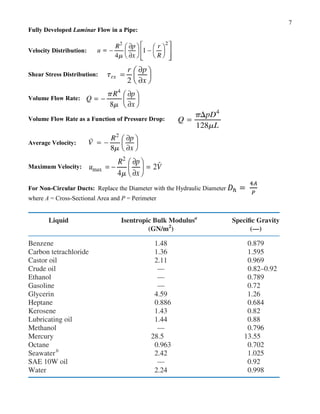
Fully Developed Laminar Flow in a Pipe:
Velocity Distribution:
Shear Stress Distribution:
Volume Flow Rate:
Volume Flow Rate as a Function of Pressure Drop:
Average Velocity:
Maximum Velocity:
For Non-Circular Ducts: Replace the Diameter with the Hydraulic Diameter 𝐷𝐷ℎ =
4𝐴𝐴
𝑃𝑃
where A = Cross-Sectional Area and P = Perimeter
8
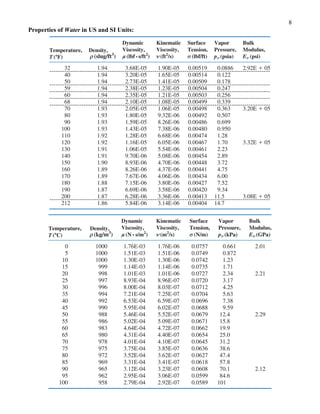
Properties of Water in US and SI Units:
9
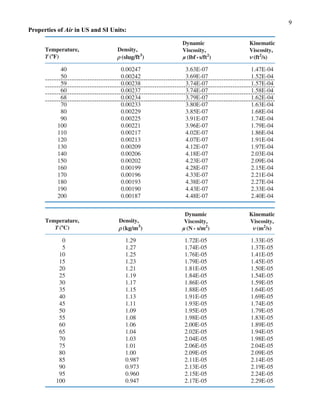
Properties of Air in US and SI Units:
10
DIMENSIONAL HOMOGENEITY AND DIMENSIONAL ANALYSIS
Equations that are in a form that do not depend on the fundamental units of measurement are called
dimensionally homogeneous equations. A special form of the dimensionally homogeneous equation is
one that involves only dimensionless groups of terms.
Buckingham’s Theorem: The number of independent dimensionless groups that may be employed to
describe a phenomenon known to involve n variables is equal to the number ( )
r
n − , where r is the
number of basic dimensions (i.e., M, L, T) needed to express the variables dimensionally.
SIMILTUDE
In order to use a model to simulate the conditions of the prototype, the model must be geometrically,
kinematically, and dynamically similar to the prototype system.
To obtain dynamic similarity between two flow pictures, all independent force ratios that can be written
must be the same in both the model and the prototype. Thus, dynamic similarity between two flow
pictures (when all possible forces are acting) is expressed in the five simultaneous equations below.
[ ] [ ]
[ ] [ ]
[ ] [ ]
[ ] [ ]m
p
m
p
m
T
L
p
T
L
m
p
m
v
p
v
m
E
L
p
E
L
m
p
m
p
m
G
L
p
G
L
m
p
m
p
m
V
L
p
V
L
m
p
m
p
L
p
p
L
We
We
LV
LV
F
F
F
F
Ca
Ca
E
V
E
V
F
F
F
F
Fr
Fr
Lg
V
Lg
V
F
F
F
F
VL
VL
F
F
F
F
p
V
p
V
F
F
F
F
=
=






=






=






=






=
=






=






=






=






=
=






=






=






=






=
=






=






=






=












=






=








=








σ
ρ
σ
ρ
ρ
ρ
µ
ρ
µ
ρ
ρ
ρ
2
2
2
2
2
2
2
2
Re
Re
where the subscripts p and m stand for prototype and model respectively, and
L
F = inertia force → 2
2
L
V
ρ
P
F = pressure force → 2
L
p
A
p ∆
∝
∆
V
F = viscous force → VL
L
L
V
A
dy
du
A µ
µ
µ
τ =
∝
= 2
G
F = gravity force → 3
L
g
mg ρ
∝
E
F = elastic force → 2
L
E
A
E v
v ∝
T
F = surface tension force → L
σ
Re = Reynolds number →
forces
viscous
forces
inertia
v
VD
VD
=
=
=
µ
ρ
Re
We = Weber number →
forces
tension
surface
forces
inertia
L
V
We =
=
σ
ρ 2
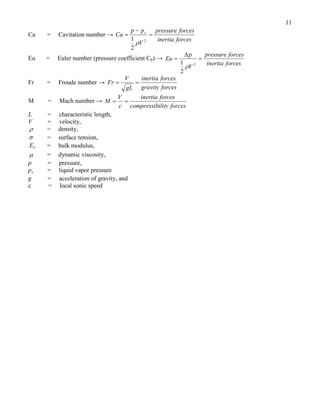
11
Ca = Cavitation number →
forces
inertia
forces
pressure
V
p
p
Ca v
=
−
=
2
2
1
ρ
Eu = Euler number (pressure coefficient Cp) →
forces
inertia
forces
pressure
V
p
Eu =
∆
=
2
2
1
ρ
Fr = Froude number →
forces
gravity
forces
inertia
gL
V
Fr =
=
M = Mach number →
forces
ility
compressib
forces
inertia
c
V
M =
=
L = characteristic length,
V = velocity,
ρ = density,
σ = surface tension,
V
E = bulk modulus,
µ = dynamic viscosity,
p = pressure,
pv = liquid vapor pressure
g = acceleration of gravity, and
c = local sonic speed

FluidMechanicsBooklet.pdf

  • 1.
    1 Relevant Equations, Formulas,Tables and Figures Conservation of Mass (Continuity Equation) (Integral Form) (Differential Form) (Rectangular Coordinates) (Cylindrical Coordinates) Stream Function for Two-Dimensional Incompressible Flow (Rectangular Coordinates) (2-D Continuity Equation, Constant Density) (Stream Function ψ) Stream Function for Two-Dimensional Incompressible Flow (Cylindrical Coordinates) (2-D Continuity Equation, Constant Density) (Stream Function ψ) Momentum Equation for Control Volume Moving with Constant Velocity Momentum Equation for Inertial Control Volume with Rectilinear Acceleration For a Newtonian fluid: Shear Stress = Where μ is the dynamic viscosity of the fluid.
  • 2.
    2 For a PlaneSubmerged Surface: where 𝐼𝐼𝑥𝑥 �𝑥𝑥 � = 𝑤𝑤𝑤𝑤𝑤𝑤𝑤𝑤ℎ×ℎ𝑒𝑒𝑒𝑒𝑒𝑒ℎ𝑡𝑡3 12 Pressure Variation in a Static Fluid h g p p p atm abs gage ρ = − = where ρ = density of the fluid ; g = gravitational acceleration (9.81 m/s2 or 32.2 ft/s2 ) ; h = height of fluid column Absolute pressure = atmospheric pressure + gauge pressure reading Absolute pressure = atmospheric pressure – vacuum pressure reading Specific Gravity = SG = 𝜌𝜌𝑠𝑠 𝜌𝜌𝑟𝑟𝑟𝑟𝑟𝑟 ; where ρs = density of substance and ρref = density of reference liquid which is water at 4°C (39°F) = 1000 kg/m3 (1.94 slug/ft3 ) Fluid Translation: Acceleration of a Fluid Particle in a Velocity Field, p a  Fluid Deformation: Linear Deformation Fluid Rotation: 𝝎𝝎 � = 𝟏𝟏 𝟐𝟐 𝛁𝛁 × 𝑽𝑽 � ; If 𝛁𝛁 × 𝑽𝑽 � = 𝟎𝟎 then flow is irrotational The Bernoulli Equation is derived when the energy equation is applied to one-dimensional flows. Assuming no friction losses and that no pump or turbine exists between sections 1 and 2 in the system, 1 2 1 1 2 2 2 2 2 2 z g V p z g V p + + = + + γ γ , where 2 1, p p = pressure at sections 1 and 2, 2 1,V V = average velocity of the fluid at the sections, 2 1, z z = the vertical distance from a datum to the sections (the potential energy), γ = the specific weight of the fluid ( g ρ ), and g = the acceleration of gravity.
  • 3.
    3 Internal Pipe Flow EnergyEquation: 𝛼𝛼 = � 2.0 𝑓𝑓𝑓𝑓𝑓𝑓 𝐿𝐿𝐿𝐿𝐿𝐿𝐿𝐿𝐿𝐿𝐿𝐿𝐿𝐿 𝑓𝑓𝑓𝑓𝑓𝑓𝑓𝑓 1.0 𝑓𝑓𝑓𝑓𝑓𝑓 𝑡𝑡𝑡𝑡𝑡𝑡𝑡𝑡𝑡𝑡𝑡𝑡𝑡𝑡𝑡𝑡𝑡𝑡 𝑓𝑓𝑓𝑓𝑓𝑓𝑓𝑓 Minor losses: or Major Losses: Average Velocity: Reynolds Number: ν µ ρ D V D V = = Re Laminar Friction Factor: Re 64 = f → Re < 2300 Turbulent Friction Factor - Implicit Relation: → Re ≥ 2300 Turbulent Friction Factor Estimate (within 1% of actual value) – Explicit Relation: 𝒇𝒇𝒐𝒐 = 𝟎𝟎. 𝟐𝟐𝟐𝟐 �𝒍𝒍𝒍𝒍𝒍𝒍 � 𝒆𝒆/𝑫𝑫 𝟑𝟑.𝟕𝟕 + 𝟓𝟓.𝟕𝟕𝟕𝟕 𝑹𝑹𝑹𝑹𝟎𝟎.𝟗𝟗�� −𝟐𝟐 → Re ≥ 2300 ∫ = = dA u A A Q V 1
  • 4.
  • 5.
    5 Pumps, Fans, andBlowers (Energy Equation and Other Useful Relations): Mass Flow Rate: 𝒎𝒎 ̇ = 𝝆𝝆𝝆𝝆 = 𝝆𝝆𝝆𝝆𝝆𝝆 ; where Q = Volume Flow Rate Ideal Gas Law: 𝑷𝑷 = 𝝆𝝆 𝑹𝑹 𝑻𝑻 ; where T = Absolute Temperature Hydraulic Gradient (Grade Line) The hydraulic gradient (grade line) is defined as an imaginary line above a pipe so that the vertical distance from the pipe axis to the line represents the pressure head at that point. If a row of piezometers were placed at intervals along the pipe, the grade line would join the water levels in the piezometer water columns. Energy Line (Bernoulli Equation) The Bernoulli equation states that the sum of the pressure, velocity, and elevation heads is constant. The energy line is the sum or the “total head line” above a horizontal datum. The difference between the hydraulic grade line and the energy line is the (V2 /2g) term.
  • 6.
    6 Fully Developed LaminarFlow between Infinite Parallel Plates: (Both Plates Stationary) Shear Stress Distribution: Volume Flow Rate: Volume Flow Rate as a Function of Pressure Drop: Average Velocity: Maximum Velocity: Fully Developed Laminar Flow between Infinite Parallel Plates: (Upper Plate Moving with a Constant Speed U and Lower Plate Stationary) 𝑢𝑢 = 𝑎𝑎2 2𝜇𝜇 � 𝜕𝜕𝜕𝜕 𝜕𝜕𝜕𝜕 � �� 𝑦𝑦 𝑎𝑎 � 2 − � 𝑦𝑦 𝑎𝑎 �� + 𝑈𝑈 � 𝑦𝑦 𝑎𝑎 � Shear Stress Distribution: 𝜏𝜏𝑦𝑦𝑦𝑦 = 𝑎𝑎 � 𝜕𝜕𝜕𝜕 𝜕𝜕𝜕𝜕 � �� 𝑦𝑦 𝑎𝑎 � − 1 2 � + 𝜇𝜇 � 𝑈𝑈 𝑎𝑎 � Volume Flow Rate: 𝑄𝑄 𝑙𝑙 = − 1 12𝜇𝜇 � 𝜕𝜕𝜕𝜕 𝜕𝜕𝜕𝜕 � 𝑎𝑎3 + 𝑈𝑈𝑈𝑈 2 Average Velocity: 𝑄𝑄 𝑙𝑙 = − 1 12𝜇𝜇 � 𝜕𝜕𝜕𝜕 𝜕𝜕𝜕𝜕 � 𝑎𝑎3 + 𝑈𝑈𝑈𝑈 2 Point of Maximum Velocity: Set 𝑑𝑑𝑑𝑑 𝑑𝑑𝑑𝑑 = 0 and Solve for y → 𝑦𝑦 = 𝑎𝑎 2 − 𝜇𝜇𝑈𝑈 𝑎𝑎 � � 𝜕𝜕𝑝𝑝 𝜕𝜕𝑥𝑥 � �
  • 7.
    7 Fully Developed LaminarFlow in a Pipe: Velocity Distribution: Shear Stress Distribution: Volume Flow Rate: Volume Flow Rate as a Function of Pressure Drop: Average Velocity: Maximum Velocity: For Non-Circular Ducts: Replace the Diameter with the Hydraulic Diameter 𝐷𝐷ℎ = 4𝐴𝐴 𝑃𝑃 where A = Cross-Sectional Area and P = Perimeter
  • 8.
    8 Properties of Waterin US and SI Units:
  • 9.
    9 Properties of Airin US and SI Units:
  • 10.
    10 DIMENSIONAL HOMOGENEITY ANDDIMENSIONAL ANALYSIS Equations that are in a form that do not depend on the fundamental units of measurement are called dimensionally homogeneous equations. A special form of the dimensionally homogeneous equation is one that involves only dimensionless groups of terms. Buckingham’s Theorem: The number of independent dimensionless groups that may be employed to describe a phenomenon known to involve n variables is equal to the number ( ) r n − , where r is the number of basic dimensions (i.e., M, L, T) needed to express the variables dimensionally. SIMILTUDE In order to use a model to simulate the conditions of the prototype, the model must be geometrically, kinematically, and dynamically similar to the prototype system. To obtain dynamic similarity between two flow pictures, all independent force ratios that can be written must be the same in both the model and the prototype. Thus, dynamic similarity between two flow pictures (when all possible forces are acting) is expressed in the five simultaneous equations below. [ ] [ ] [ ] [ ] [ ] [ ] [ ] [ ]m p m p m T L p T L m p m v p v m E L p E L m p m p m G L p G L m p m p m V L p V L m p m p L p p L We We LV LV F F F F Ca Ca E V E V F F F F Fr Fr Lg V Lg V F F F F VL VL F F F F p V p V F F F F = =       =       =       =       = =       =       =       =       = =       =       =       =       = =       =       =       =             =       =         =         σ ρ σ ρ ρ ρ µ ρ µ ρ ρ ρ 2 2 2 2 2 2 2 2 Re Re where the subscripts p and m stand for prototype and model respectively, and L F = inertia force → 2 2 L V ρ P F = pressure force → 2 L p A p ∆ ∝ ∆ V F = viscous force → VL L L V A dy du A µ µ µ τ = ∝ = 2 G F = gravity force → 3 L g mg ρ ∝ E F = elastic force → 2 L E A E v v ∝ T F = surface tension force → L σ Re = Reynolds number → forces viscous forces inertia v VD VD = = = µ ρ Re We = Weber number → forces tension surface forces inertia L V We = = σ ρ 2
  • 11.
    11 Ca = Cavitationnumber → forces inertia forces pressure V p p Ca v = − = 2 2 1 ρ Eu = Euler number (pressure coefficient Cp) → forces inertia forces pressure V p Eu = ∆ = 2 2 1 ρ Fr = Froude number → forces gravity forces inertia gL V Fr = = M = Mach number → forces ility compressib forces inertia c V M = = L = characteristic length, V = velocity, ρ = density, σ = surface tension, V E = bulk modulus, µ = dynamic viscosity, p = pressure, pv = liquid vapor pressure g = acceleration of gravity, and c = local sonic speed