COMBUSTION CHAMBERS AND PERFORMANCE
COMBUSTION CHAMBER:
Combustion in the normal, open cycle, gas turbine is a continuous process in
which fuel is burned in the air supplied by the compressor, an electric spark is
required only for initiating the combustion process, and thereafter the flames must
be self-sustaining. Combustion process occurs with the vaporized fuel and air
mixed on a molecular scale. The principle requirements for a combustion chamber
are:
 Low weight and small frontal area
 Low pressure loss
 Stable and efficient combustion over the operating flight altitudes and
speeds
 Reliability, serviceability and reasonable life
 Through mixing of hot and cold fluid streams to give a uniform
temperature distribution throughout the final mixture arriving at the
inlet to the turbine.
Combustion chambers must be designed to ensure stable combustion of the
fuel injected and optimum fuel utilization within the limited space available and
over a large range of air/fuel ratios. The combustion chamber design depends on
the application and requirements in each case.
CLASSIFICATION OF COMBUSTION CHAMBERS:
Combustion chambers have undergone continuous development over the
past 50 years, resulting in the evolution of a verity of basic combustion chamber.
They may be broadly classified into one of the three types, namely
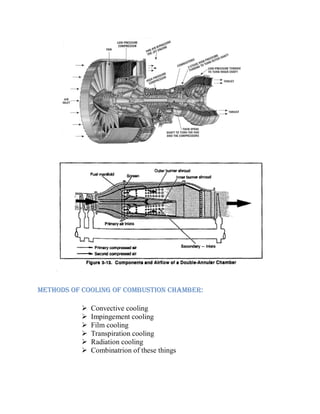
 Can combustion chambers
 Can-annular combustion chambers
 Annular combustion chambers
CAN COMBUSTION CHAMBERS:
A can combustion chamber consists of one or more cylinder burners, each
contained in a burner case. Can combustors look like cans and are mounted around
the engine. The air leaving the compressor is split into a number of separate
streams, each supplying in a separate chamber. Each chamber has its own fuel jet
called injectors from a common supplier. They can be easily removed for
maintenance and provide convenient plumbing for fuel. Because of its modular
design, the can system was used during the early development of the turbojet
engine. Can-type combustion chambers are particularly suitable for engines with
centrifugal-flow compressors as the airflow is already divided by the compressor
outlet diffusers. Each flame tube has its own secondary air duct. The separate
flame tubes are all interconnected. The entire combustion section consists of 8 to
12 cans that are arranged around the engine. Individual cans are also used
combustion chambers for small engines or auxiliary power units.
ADVANTAGES:
 The major advantage of can type combustion chambers was that
development could be carried out on a single can using only a fraction
of the overall air flow and fuel flow.
 low development cost
 favorable aerodynamic conditions in the flame tube
 favorable fuel distribution
 Good accessibility for servicing.
DISADVANTAGES:
 In aircraft application, these types of combustion chambers are
undesirable because of more weight, more volume and more frontal
area.
 Ignition problems may occur, particularly at high altitudes.
 A disadvantage of this design consists in the unfavorable
inflow/outflow ratios and the associated large size.
CAN-ANNULAR COMBUSTION CHAMBERS:
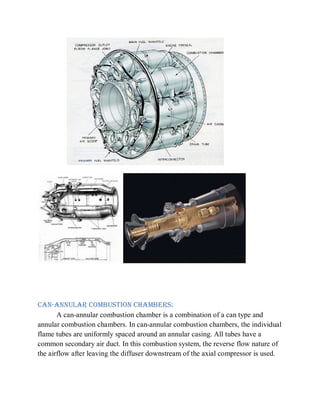
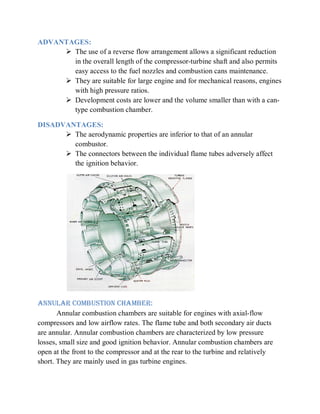
A can-annular combustion chamber is a combination of a can type and
annular combustion chambers. In can-annular combustion chambers, the individual
flame tubes are uniformly spaced around an annular casing. All tubes have a
common secondary air duct. In this combustion system, the reverse flow nature of
the airflow after leaving the diffuser downstream of the axial compressor is used.
ADVANTAGES:
 The use of a reverse flow arrangement allows a significant reduction
in the overall length of the compressor-turbine shaft and also permits
easy access to the fuel nozzles and combustion cans maintenance.
 They are suitable for large engine and for mechanical reasons, engines
with high pressure ratios.
 Development costs are lower and the volume smaller than with a can-
type combustion chamber.
DISADVANTAGES:
 The aerodynamic properties are inferior to that of an annular
combustor.
 The connectors between the individual flame tubes adversely affect
the ignition behavior.
ANNULAR COMBUSTION CHAMBER:
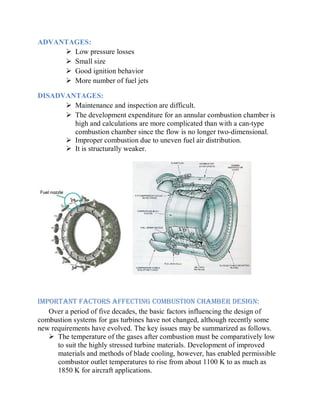
Annular combustion chambers are suitable for engines with axial-flow
compressors and low airflow rates. The flame tube and both secondary air ducts
are annular. Annular combustion chambers are characterized by low pressure
losses, small size and good ignition behavior. Annular combustion chambers are
open at the front to the compressor and at the rear to the turbine and relatively
short. They are mainly used in gas turbine engines.
ADVANTAGES:
 Low pressure losses
 Small size
 Good ignition behavior
 More number of fuel jets
DISADVANTAGES:
 Maintenance and inspection are difficult.
 The development expenditure for an annular combustion chamber is
high and calculations are more complicated than with a can-type
combustion chamber since the flow is no longer two-dimensional.
 Improper combustion due to uneven fuel air distribution.
 It is structurally weaker.
IMPORTANT FACTORS AFFECTING COMBUSTION CHAMBER DESIGN:
Over a period of five decades, the basic factors influencing the design of
combustion systems for gas turbines have not changed, although recently some
new requirements have evolved. The key issues may be summarized as follows.
 The temperature of the gases after combustion must be comparatively low
to suit the highly stressed turbine materials. Development of improved
materials and methods of blade cooling, however, has enabled permissible
combustor outlet temperatures to rise from about 1100 K to as much as
1850 K for aircraft applications.
At the end of the combustion space the temperature distribution must be of
known form if the turbine blades are not to suffer from local overheating. In
practice, the temperature can increase with radius over the turbine annulus,
because of the strong influence of temperature on allowable stress and the
decrease of blade centrifugal stress from root to tip.
 Combustion must be maintained in a stream of air moving with a high
velocity in the region of 30-60 m/s, and stable operation is required over a
wide range of air/fuel ratio from full load to idling conditions. The air/fuel
ratio might vary from about 60: 1 to 120: 1 for simple cycle gas turbines and
from 100: 1 to 200: I if a heat-exchanger is used. Considering that the
stoichiometric ratio is approximately 15: 1 it is clear that a high dilution is
required to maintain the temperature level dictated by turbine stresses.
 The formation of carbon deposits ('coking') must be avoided, particularly
the hard brittle variety. Small particles carried into the turbine in the high
velocity gas stream can erode the blades and block cooling air passages;
furthermore, aerodynamically excited vibration in the combustion chamber
might cause sizeable pieces of carbon to break free resulting in even worse
damage to the turbine.
 In aircraft gas turbines, combustion must also be stable over a wide range of
chamber pressure because of the substantial change in this parameter with
altitude and forward speed. Another important requirement is the capability
of relighting at high altitude in the event of an engine flame-out.
 Avoidance of smoke in the exhaust is of major importance for all types of
gas turbine; early jet engines had very smoky exhausts, and this became a
serious problem around airports when jet transport aircraft started to operate
in large numbers. Smoke trails in flight were a problem for military aircraft,
permitting them to be seen from a great distance. Stationary gas turbines are
now found in urban locations, sometimes close to residential areas.
 Although gas turbine combustion systems operate at extremely high
efficiencies, they produce pollutants such as oxides of nitrogen (NOx),
carbon monoxide (CO) and unburned hydrocarbons (UHC) and these must
be controlled to very low levels. Over the years, the performance of the gas
turbine has been improved mainly by increasing the compressor pressure
ratio and turbine inlet temperature (TIT). Unfortunately this results in
increased production of NOx ' Ever more stringent emissions legislation has
led to significant changes in combustor design to cope with the problem
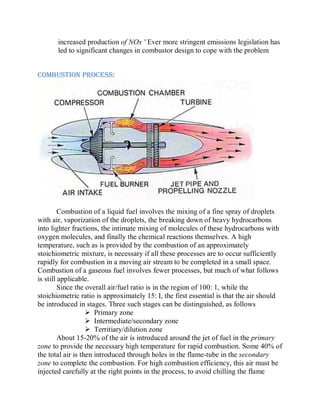
COMBUSTION PROCESS:
Combustion of a liquid fuel involves the mixing of a fine spray of droplets
with air, vaporization of the droplets, the breaking down of heavy hydrocarbons
into lighter fractions, the intimate mixing of molecules of these hydrocarbons with
oxygen molecules, and finally the chemical reactions themselves. A high
temperature, such as is provided by the combustion of an approximately
stoichiometric mixture, is necessary if all these processes are to occur sufficiently
rapidly for combustion in a moving air stream to be completed in a small space.
Combustion of a gaseous fuel involves fewer processes, but much of what follows
is still applicable.
Since the overall air/fuel ratio is in the region of 100: 1, while the
stoichiometric ratio is approximately 15: I, the first essential is that the air should
be introduced in stages. Three such stages can be distinguished, as follows
 Primary zone
 Intermediate/secondary zone
 Territiary/dilution zone
About 15-20% of the air is introduced around the jet of fuel in the primary
zone to provide the necessary high temperature for rapid combustion. Some 40% of
the total air is then introduced through holes in the flame-tube in the secondary
zone to complete the combustion. For high combustion efficiency, this air must be
injected carefully at the right points in the process, to avoid chilling the flame
locally and drastically reducing the reaction rate in that neighborhood. Finally, in
the tertiary/dilution zone, the remaining air is mixed with the products of
combustion to cool them down to the temperature required at inlet to the turbine.
Sufficient turbulence must be promoted so that the hot and cold streams are
thoroughly mixed to give the desired outlet temperature distribution, with no hot
streaks which would damage the turbine blades.
The zonal method of introducing the air cannot by itself give a self-piloting
flame in an air stream which is moving an order of magnitude faster than the flame
speed in a burning mixture. The second essential feature is therefore a recirculating
flow pattern which directs some of the burning mixture in the primary zone back
on to the incoming fuel and air. One way of achieving this is typical of British
practice. The fuel is injected in the same direction as the air stream, and the
primary air is introduced through twisted radial vanes, known as swirl vanes, so
that the resulting vortex motion will induce a region of low pressure along the axis
of the chamber. This vortex motion is sometimes enhanced by injecting the
secondary air through short tangential chutes in the flame-tube, instead of through
plain holes as in the figure. The net result is that the burning gases tend to flow
towards the region of low pressure, and some portion of them is swept round
towards the jet of fuel as indicated by the arrows.
Many other solutions to the problem of obtaining a stable flame are possible.
One American practice is to dispense with the swirl vanes and achieve the
recirculation by a careful positioning of holes in the flame-tube downstream of a
hemispherical baffle. It is difficult to avoid overheating the fuel injector, however,
and upstream injection is employed more for afterburners (or 'reheat') in the jet-
pipe of aircraft engines than in main combustion systems. Afterburners operate
only for short periods of thrust-boosting. A vaporizer system wherein the fuel is
injected at low pressure into walking -stick shaped tubes placed in the primary
zone. A rich mixture of fuel vapours and air issues from the vaporizer tubes in the
upstream direction to mix with the remaining primary air passing through holes in
a baffle around the fuel supply pipes. The fuel system is much simpler, and the
difficulty of arranging for an adequate distribution of fine droplets over the whole
operating range of fuel flow is overcome. The problem in this case is to avoid local
'cracking' of the fuel in the vaporizer tubes with the formation of deposits of low
thermal conductivity leading to overheating and burn-out. Vaporizer schemes are
particularly well suited for annular combustors where it is inherently more difficult
to obtain a satisfactory fuel-air distribution with sprays of droplets from high
pressure injectors, and they have been used in several successful aircraft engines.
The original walking-stick shaped tubes have been replaced in modem engines by
more compact and mechanically rugged T-shape vaporizers describe the history of
vaporizer development at Rolls Royce.
Having described the way in which the combustion process is accomplished,
it is now possible to see how incomplete combustion and pressure losses arise.
When not due simply to poor fuel injector design leading to fuel droplets being
carried along the flame-tube wall, incomplete combustion may be caused by local
chilling of the flame at points of secondary air entry. This can easily reduce the
reaction rate to the point where some of the products into which the fuel has
decomposed are left in their partially burnt state, and the temperature at the
downstream end of the chamber is normally below that at which the burning of
these products can be expected to take place. Since the lighter hydrocarbons into
which the fuel has decomposed have a higher ignition temperature than the original
fuel, it is clearly difficult to prevent some chilling from taking place, particularly if
space is limited and the secondary air cannot be introduced gradually enough. If
devices are used to increase large-scale turbulence and so distribute the secondary
air more uniformly throughout the burning gases, the combustion efficiency will be
improved but at the expense of increased pressure loss. A satisfactory compromise
must somehow be reached.
Combustion chamber pressure loss is due to two distinct causes:
(i) skin friction and turbulence and
(ii) The rise in temperature due to combustion.
The stagnation pressure drop associated with the latter, often called the
fundamental loss, arises because an increase in temperature implies a decrease in
density and consequently an increase in velocity and momentum of the stream. A
pressure force (¨p x A) must be present to impart the increase in momentum. One
of the standard idealized cases considered in gas dynamics is that of a heated gas
stream flowing without friction in a duct of constant cross-sectional area. The
stagnation pressure drop in this situation, for any given temperature rise, can be
predicted with the aid of the Rayleigh-line functions. When the velocity is low and
the fluid flow can be treated as incompressible (in the sense that although ȡ is a
function of T it is independent of p), a simple equation for the pressure drop can be
found as follows. .
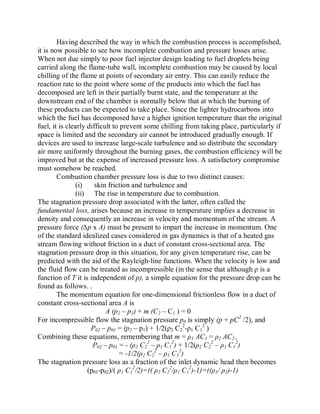
The momentum equation for one-dimensional frictionless flow in a duct of
constant cross-sectional area A is
A (p2 ± p1) + m (C2 ± C1 ) = 0
For incompressible flow the stagnation pressure p0 is simply (p + pC2
/2), and
P02 ± p01 = (p2 ± p1) + 1/2(ȡ2 C2
2
-ȡ1 C1
2
)
Combining these equations, remembering that m = ȡ1 AC1 = ȡ2 AC2 ,
P02 ± p01 = - (ȡ2 C2
2
± ȡ1 C1
2
) + 1/2(ȡ2 C2
2
± ȡ1 C1
2
)
= -1/2(ȡ2 C2
2
± ȡ1 C1
2
)
The stagnation pressure loss as a fraction of the inlet dynamic head then becomes
(p01-p02)/( ȡ1 C1
2
/2)=(( ȡ2 C2
2
/ȡ1 C1
2
)-1)=((ȡ1/ ȡ2)-1)
Finally, since ȡ Į 1/T for incompressible flow,
(p01-p02)/( ȡ1 C1
2
/2)=((T2/T1)-1)
This the same as the compressible flow value of (p01-p02)/(p01-p1) in the limiting
case of zero inlet Mach number. At this condition T2/T1 = T02/T01.
Although the assumptions of incompressible flow and constant cross-
sectional area are not quite true for a combustion chamber, the result is sufficiently
accurate to provide us with the order of magnitude of the fundamental loss. Thus,
since the outlet/inlet temperature ratio is in the region of 2-3, it is clear that the
fundamental loss is only about 1-2 inlet dynamic heads. The pressure loss due to
friction is found to be very much higher-of the order of 20 inlet dynamic heads.
When measured by pitot traverses at inlet and outlet with no combustion taking
place, it is known as the cold loss. That the friction loss is so high, is due to the
need for large-scale turbulence. Turbulence of this kind is created by the devices
used to stabilize the flame, e.g. the swirl vanes. In addition, there is the turbulence
induced by the jets of secondary and dilution air. The need for good mixing of the
secondary air with the burning gases to avoid chilling has been emphasized.
Similarly, good mixing of the dilution air to avoid hot streaks in the turbine is
essential. In general, the more effective the mixing the higher the pressure loss.
Here again a compromise must be reached: this time between uniformity of outlet
temperature distribution and low pressure loss.
Usually it is found that adequate mixing is obtained merely by injecting air
through circular or elongated holes in the flame-tube. Sufficient penetration of the
cold air jets into the hot stream is achieved as a result of the cold air having the
greater density. The pressure loss produced by such a mixing process is associated
with the change in momentum of the streams before and after mixing. In aircraft
gas turbines the duct between combustion chamber outlet and turbine inlet is very
short, and the compromise reached between good temperature distribution and low
pressure loss is normally such that the temperature non uniformity is up to 10 per
cent of the mean value. The length of duct is often greater in an industrial gas
turbine and the temperature distribution at the turbine inlet may be more unifonn,
although at the expense of increased pressure drop due to skin friction in the
ducting.
METHODS OF COOLING OF COMBUSTION CHAMBER:
 Convective cooling
 Impingement cooling
 Film cooling
 Transpiration cooling
 Radiation cooling
 Combinatrion of these things
CONVECTIVE COOLING:
This method is primarily used to maximise the heat transfer rate from a hot
wall to coolant side.
IMPINGEMENT COOLING:
The coolant may also imping on a hot surface to create a stagnation point
and enhance the heat transfer through the coolant through the wall.
FILM COOLING:
Minimising heat transfer to the wall from the gases by providing a cool layer
on the hot surface. The cool layer acts like a blanket that protects the surface from
hot gases.
TRANSPIRATION COOLING:
It can be viewed as ultimate cooling procedure as there are many number of
continuously distributed film holes on the surface.
RADIATION COOLING:
Radiation cooling accompanies all the surfaces above absolute zero
temperature.
COMBUSTION CHAMBER PERFORMANCE:
The main factors of importance in assessing combustion chamber
performance are
 pressure loss,
 combustion efficiency,
 outlet temperature distribution,
 stability limits and
 Combustion intensity.
Of these, we already know about outlet temperature distribution. Now,
pressure loss and combustion efficiency require further comment and stability
limits and combustion intensity have not yet received attention.
PRESSURE LOSS:
We have seen that the overall stagnation pressure loss can be regarded as the
Sum of the fundamental loss (a small component which is a function of T02/ TO1 )
and the frictional loss. Our knowledge of friction in ordinary turbulent pipe flow at
high Reynolds number would suggest that when the pressure loss is expressed non-
dimensionally in terms of the dynamic head it will not vary much over the range of
Reynolds number under which combustion systems operate. Experiments have
shown, in fact, that the overall pressure loss can often be expressed adequately by
an equation of the form
Pressure loss factor, PLF= (¨p0)/(m2
/2ȡ1Am
2
) =K1+K2((T02/T01)-1)«««(1)
Note that rather than ȡ1 C1
2
/2, a conventional dynamic head is used based on a
velocity calculated from the inlet density, air mass flow m, and maximum cross
sectional area Am of the chamber. This velocity-sometimes known as the reference
velocity-is more representative of conditions in the chamber, and the convention is
useful when comparing results from chambers of different shape. If K1 and K2 are
determined from a combustion chamber on a test rig from a cold run and a hot run,
then equation(1) enables the pressure loss to be estimated when the chamber is
operating as part of a gas turbine over a wide range of conditions of mass flow,
pressure ratio and fuel input.
To give an idea of relative orders of magnitude, typical values of PLF at
design operating conditions for tubular, tubo-annular and annular combustion
chambers are 35 25 and 18 respectively. There are two points which must be
remembered when considering pressure loss data. Firstly, the velocity of the air
leaving the last stage of an axial compressor is quite high-say 150 m/s-and some
form of diffusing section is introduced between the compressor and combustion
chamber to reduce the velocity to about 60 m/s. It is a matter of convention,
depending upon the layout of the gas turbine, as to how much of the stagnation
pressure loss in this diffuser is included in the PLF of the combustion system. In
other words, it depends on where the compressor is deemed to end and the
combustion chamber
(¨p0)/p01= ((¨p0)/ (m2
/2ȡ1Am
2
)) x ((m2
/2ȡ1Am
2
)/p01)
= PLF x (R/2) ((m (T01)1/2
)/Amp01)2
««««««« (2)
Where the difference between ȡ1 and ȡ01 has been ignored because the velocity is
low. By combining equations (1) and (2) it can be seen that (¨p0)/p01 can be
expressed as a function of non-dimensional mass flow at entry to the combustion
chamber and combustion temperature ratio: such a relation is useful when
predicting pressure losses at conditions other than design. Consider now the two
extreme cases of tubular and annular designs. If the values of (¨p0)/p01 are to be
similar, it follows from equation (2) and the values of PLF given above that the
chamber cross-sectional area per unit mass flow (Am/m) can be smaller for the
annular design. For aircraft engines, where space and weight are vital, the value of
Am/m is normally chosen to yield a value of (¨p0)/p01 between 4 and 7 per cent. For
industrial gas turbine chambers, Am/m is usually such that (¨p0)/p01is little more
than 2 per cent.
COMBUSTION EFFICIENCY:
A can system consists of one or more cylindrical burners, each contained in

Combustion chambers-and-performance

  • 1.
    COMBUSTION CHAMBERS ANDPERFORMANCE COMBUSTION CHAMBER: Combustion in the normal, open cycle, gas turbine is a continuous process in which fuel is burned in the air supplied by the compressor, an electric spark is required only for initiating the combustion process, and thereafter the flames must be self-sustaining. Combustion process occurs with the vaporized fuel and air mixed on a molecular scale. The principle requirements for a combustion chamber are: Low weight and small frontal area Low pressure loss Stable and efficient combustion over the operating flight altitudes and speeds Reliability, serviceability and reasonable life Through mixing of hot and cold fluid streams to give a uniform temperature distribution throughout the final mixture arriving at the inlet to the turbine. Combustion chambers must be designed to ensure stable combustion of the fuel injected and optimum fuel utilization within the limited space available and over a large range of air/fuel ratios. The combustion chamber design depends on the application and requirements in each case. CLASSIFICATION OF COMBUSTION CHAMBERS: Combustion chambers have undergone continuous development over the past 50 years, resulting in the evolution of a verity of basic combustion chamber. They may be broadly classified into one of the three types, namely Can combustion chambers Can-annular combustion chambers Annular combustion chambers
  • 2.
    CAN COMBUSTION CHAMBERS: Acan combustion chamber consists of one or more cylinder burners, each contained in a burner case. Can combustors look like cans and are mounted around the engine. The air leaving the compressor is split into a number of separate streams, each supplying in a separate chamber. Each chamber has its own fuel jet called injectors from a common supplier. They can be easily removed for maintenance and provide convenient plumbing for fuel. Because of its modular design, the can system was used during the early development of the turbojet engine. Can-type combustion chambers are particularly suitable for engines with centrifugal-flow compressors as the airflow is already divided by the compressor outlet diffusers. Each flame tube has its own secondary air duct. The separate flame tubes are all interconnected. The entire combustion section consists of 8 to 12 cans that are arranged around the engine. Individual cans are also used combustion chambers for small engines or auxiliary power units. ADVANTAGES: The major advantage of can type combustion chambers was that development could be carried out on a single can using only a fraction of the overall air flow and fuel flow. low development cost favorable aerodynamic conditions in the flame tube favorable fuel distribution Good accessibility for servicing. DISADVANTAGES: In aircraft application, these types of combustion chambers are undesirable because of more weight, more volume and more frontal area. Ignition problems may occur, particularly at high altitudes. A disadvantage of this design consists in the unfavorable inflow/outflow ratios and the associated large size.
  • 3.
    CAN-ANNULAR COMBUSTION CHAMBERS: Acan-annular combustion chamber is a combination of a can type and annular combustion chambers. In can-annular combustion chambers, the individual flame tubes are uniformly spaced around an annular casing. All tubes have a common secondary air duct. In this combustion system, the reverse flow nature of the airflow after leaving the diffuser downstream of the axial compressor is used.
  • 4.
    ADVANTAGES: The useof a reverse flow arrangement allows a significant reduction in the overall length of the compressor-turbine shaft and also permits easy access to the fuel nozzles and combustion cans maintenance. They are suitable for large engine and for mechanical reasons, engines with high pressure ratios. Development costs are lower and the volume smaller than with a can- type combustion chamber. DISADVANTAGES: The aerodynamic properties are inferior to that of an annular combustor. The connectors between the individual flame tubes adversely affect the ignition behavior. ANNULAR COMBUSTION CHAMBER: Annular combustion chambers are suitable for engines with axial-flow compressors and low airflow rates. The flame tube and both secondary air ducts are annular. Annular combustion chambers are characterized by low pressure losses, small size and good ignition behavior. Annular combustion chambers are open at the front to the compressor and at the rear to the turbine and relatively short. They are mainly used in gas turbine engines.
  • 5.
    ADVANTAGES: Low pressurelosses Small size Good ignition behavior More number of fuel jets DISADVANTAGES: Maintenance and inspection are difficult. The development expenditure for an annular combustion chamber is high and calculations are more complicated than with a can-type combustion chamber since the flow is no longer two-dimensional. Improper combustion due to uneven fuel air distribution. It is structurally weaker. IMPORTANT FACTORS AFFECTING COMBUSTION CHAMBER DESIGN: Over a period of five decades, the basic factors influencing the design of combustion systems for gas turbines have not changed, although recently some new requirements have evolved. The key issues may be summarized as follows. The temperature of the gases after combustion must be comparatively low to suit the highly stressed turbine materials. Development of improved materials and methods of blade cooling, however, has enabled permissible combustor outlet temperatures to rise from about 1100 K to as much as 1850 K for aircraft applications.
  • 6.
    At the endof the combustion space the temperature distribution must be of known form if the turbine blades are not to suffer from local overheating. In practice, the temperature can increase with radius over the turbine annulus, because of the strong influence of temperature on allowable stress and the decrease of blade centrifugal stress from root to tip. Combustion must be maintained in a stream of air moving with a high velocity in the region of 30-60 m/s, and stable operation is required over a wide range of air/fuel ratio from full load to idling conditions. The air/fuel ratio might vary from about 60: 1 to 120: 1 for simple cycle gas turbines and from 100: 1 to 200: I if a heat-exchanger is used. Considering that the stoichiometric ratio is approximately 15: 1 it is clear that a high dilution is required to maintain the temperature level dictated by turbine stresses. The formation of carbon deposits ('coking') must be avoided, particularly the hard brittle variety. Small particles carried into the turbine in the high velocity gas stream can erode the blades and block cooling air passages; furthermore, aerodynamically excited vibration in the combustion chamber might cause sizeable pieces of carbon to break free resulting in even worse damage to the turbine. In aircraft gas turbines, combustion must also be stable over a wide range of chamber pressure because of the substantial change in this parameter with altitude and forward speed. Another important requirement is the capability of relighting at high altitude in the event of an engine flame-out. Avoidance of smoke in the exhaust is of major importance for all types of gas turbine; early jet engines had very smoky exhausts, and this became a serious problem around airports when jet transport aircraft started to operate in large numbers. Smoke trails in flight were a problem for military aircraft, permitting them to be seen from a great distance. Stationary gas turbines are now found in urban locations, sometimes close to residential areas. Although gas turbine combustion systems operate at extremely high efficiencies, they produce pollutants such as oxides of nitrogen (NOx), carbon monoxide (CO) and unburned hydrocarbons (UHC) and these must be controlled to very low levels. Over the years, the performance of the gas turbine has been improved mainly by increasing the compressor pressure ratio and turbine inlet temperature (TIT). Unfortunately this results in
  • 7.
    increased production ofNOx ' Ever more stringent emissions legislation has led to significant changes in combustor design to cope with the problem COMBUSTION PROCESS: Combustion of a liquid fuel involves the mixing of a fine spray of droplets with air, vaporization of the droplets, the breaking down of heavy hydrocarbons into lighter fractions, the intimate mixing of molecules of these hydrocarbons with oxygen molecules, and finally the chemical reactions themselves. A high temperature, such as is provided by the combustion of an approximately stoichiometric mixture, is necessary if all these processes are to occur sufficiently rapidly for combustion in a moving air stream to be completed in a small space. Combustion of a gaseous fuel involves fewer processes, but much of what follows is still applicable. Since the overall air/fuel ratio is in the region of 100: 1, while the stoichiometric ratio is approximately 15: I, the first essential is that the air should be introduced in stages. Three such stages can be distinguished, as follows Primary zone Intermediate/secondary zone Territiary/dilution zone About 15-20% of the air is introduced around the jet of fuel in the primary zone to provide the necessary high temperature for rapid combustion. Some 40% of the total air is then introduced through holes in the flame-tube in the secondary zone to complete the combustion. For high combustion efficiency, this air must be injected carefully at the right points in the process, to avoid chilling the flame
  • 8.
    locally and drasticallyreducing the reaction rate in that neighborhood. Finally, in the tertiary/dilution zone, the remaining air is mixed with the products of combustion to cool them down to the temperature required at inlet to the turbine. Sufficient turbulence must be promoted so that the hot and cold streams are thoroughly mixed to give the desired outlet temperature distribution, with no hot streaks which would damage the turbine blades. The zonal method of introducing the air cannot by itself give a self-piloting flame in an air stream which is moving an order of magnitude faster than the flame speed in a burning mixture. The second essential feature is therefore a recirculating flow pattern which directs some of the burning mixture in the primary zone back on to the incoming fuel and air. One way of achieving this is typical of British practice. The fuel is injected in the same direction as the air stream, and the primary air is introduced through twisted radial vanes, known as swirl vanes, so that the resulting vortex motion will induce a region of low pressure along the axis of the chamber. This vortex motion is sometimes enhanced by injecting the secondary air through short tangential chutes in the flame-tube, instead of through plain holes as in the figure. The net result is that the burning gases tend to flow towards the region of low pressure, and some portion of them is swept round towards the jet of fuel as indicated by the arrows. Many other solutions to the problem of obtaining a stable flame are possible. One American practice is to dispense with the swirl vanes and achieve the recirculation by a careful positioning of holes in the flame-tube downstream of a hemispherical baffle. It is difficult to avoid overheating the fuel injector, however, and upstream injection is employed more for afterburners (or 'reheat') in the jet- pipe of aircraft engines than in main combustion systems. Afterburners operate only for short periods of thrust-boosting. A vaporizer system wherein the fuel is injected at low pressure into walking -stick shaped tubes placed in the primary zone. A rich mixture of fuel vapours and air issues from the vaporizer tubes in the upstream direction to mix with the remaining primary air passing through holes in a baffle around the fuel supply pipes. The fuel system is much simpler, and the difficulty of arranging for an adequate distribution of fine droplets over the whole operating range of fuel flow is overcome. The problem in this case is to avoid local 'cracking' of the fuel in the vaporizer tubes with the formation of deposits of low thermal conductivity leading to overheating and burn-out. Vaporizer schemes are particularly well suited for annular combustors where it is inherently more difficult to obtain a satisfactory fuel-air distribution with sprays of droplets from high pressure injectors, and they have been used in several successful aircraft engines. The original walking-stick shaped tubes have been replaced in modem engines by more compact and mechanically rugged T-shape vaporizers describe the history of vaporizer development at Rolls Royce.
  • 9.
    Having described theway in which the combustion process is accomplished, it is now possible to see how incomplete combustion and pressure losses arise. When not due simply to poor fuel injector design leading to fuel droplets being carried along the flame-tube wall, incomplete combustion may be caused by local chilling of the flame at points of secondary air entry. This can easily reduce the reaction rate to the point where some of the products into which the fuel has decomposed are left in their partially burnt state, and the temperature at the downstream end of the chamber is normally below that at which the burning of these products can be expected to take place. Since the lighter hydrocarbons into which the fuel has decomposed have a higher ignition temperature than the original fuel, it is clearly difficult to prevent some chilling from taking place, particularly if space is limited and the secondary air cannot be introduced gradually enough. If devices are used to increase large-scale turbulence and so distribute the secondary air more uniformly throughout the burning gases, the combustion efficiency will be improved but at the expense of increased pressure loss. A satisfactory compromise must somehow be reached. Combustion chamber pressure loss is due to two distinct causes: (i) skin friction and turbulence and (ii) The rise in temperature due to combustion. The stagnation pressure drop associated with the latter, often called the fundamental loss, arises because an increase in temperature implies a decrease in density and consequently an increase in velocity and momentum of the stream. A pressure force (¨p x A) must be present to impart the increase in momentum. One of the standard idealized cases considered in gas dynamics is that of a heated gas stream flowing without friction in a duct of constant cross-sectional area. The stagnation pressure drop in this situation, for any given temperature rise, can be predicted with the aid of the Rayleigh-line functions. When the velocity is low and the fluid flow can be treated as incompressible (in the sense that although ȡ is a function of T it is independent of p), a simple equation for the pressure drop can be found as follows. . The momentum equation for one-dimensional frictionless flow in a duct of constant cross-sectional area A is A (p2 ± p1) + m (C2 ± C1 ) = 0 For incompressible flow the stagnation pressure p0 is simply (p + pC2 /2), and P02 ± p01 = (p2 ± p1) + 1/2(ȡ2 C2 2 -ȡ1 C1 2 ) Combining these equations, remembering that m = ȡ1 AC1 = ȡ2 AC2 , P02 ± p01 = - (ȡ2 C2 2 ± ȡ1 C1 2 ) + 1/2(ȡ2 C2 2 ± ȡ1 C1 2 ) = -1/2(ȡ2 C2 2 ± ȡ1 C1 2 ) The stagnation pressure loss as a fraction of the inlet dynamic head then becomes (p01-p02)/( ȡ1 C1 2 /2)=(( ȡ2 C2 2 /ȡ1 C1 2 )-1)=((ȡ1/ ȡ2)-1)
  • 10.
    Finally, since ȡĮ 1/T for incompressible flow, (p01-p02)/( ȡ1 C1 2 /2)=((T2/T1)-1) This the same as the compressible flow value of (p01-p02)/(p01-p1) in the limiting case of zero inlet Mach number. At this condition T2/T1 = T02/T01. Although the assumptions of incompressible flow and constant cross- sectional area are not quite true for a combustion chamber, the result is sufficiently accurate to provide us with the order of magnitude of the fundamental loss. Thus, since the outlet/inlet temperature ratio is in the region of 2-3, it is clear that the fundamental loss is only about 1-2 inlet dynamic heads. The pressure loss due to friction is found to be very much higher-of the order of 20 inlet dynamic heads. When measured by pitot traverses at inlet and outlet with no combustion taking place, it is known as the cold loss. That the friction loss is so high, is due to the need for large-scale turbulence. Turbulence of this kind is created by the devices used to stabilize the flame, e.g. the swirl vanes. In addition, there is the turbulence induced by the jets of secondary and dilution air. The need for good mixing of the secondary air with the burning gases to avoid chilling has been emphasized. Similarly, good mixing of the dilution air to avoid hot streaks in the turbine is essential. In general, the more effective the mixing the higher the pressure loss. Here again a compromise must be reached: this time between uniformity of outlet temperature distribution and low pressure loss. Usually it is found that adequate mixing is obtained merely by injecting air through circular or elongated holes in the flame-tube. Sufficient penetration of the cold air jets into the hot stream is achieved as a result of the cold air having the greater density. The pressure loss produced by such a mixing process is associated with the change in momentum of the streams before and after mixing. In aircraft gas turbines the duct between combustion chamber outlet and turbine inlet is very short, and the compromise reached between good temperature distribution and low pressure loss is normally such that the temperature non uniformity is up to 10 per cent of the mean value. The length of duct is often greater in an industrial gas turbine and the temperature distribution at the turbine inlet may be more unifonn, although at the expense of increased pressure drop due to skin friction in the ducting.
  • 11.
    METHODS OF COOLINGOF COMBUSTION CHAMBER: Convective cooling Impingement cooling Film cooling Transpiration cooling Radiation cooling Combinatrion of these things
  • 12.
    CONVECTIVE COOLING: This methodis primarily used to maximise the heat transfer rate from a hot wall to coolant side. IMPINGEMENT COOLING: The coolant may also imping on a hot surface to create a stagnation point and enhance the heat transfer through the coolant through the wall. FILM COOLING: Minimising heat transfer to the wall from the gases by providing a cool layer on the hot surface. The cool layer acts like a blanket that protects the surface from hot gases. TRANSPIRATION COOLING: It can be viewed as ultimate cooling procedure as there are many number of continuously distributed film holes on the surface. RADIATION COOLING: Radiation cooling accompanies all the surfaces above absolute zero temperature. COMBUSTION CHAMBER PERFORMANCE: The main factors of importance in assessing combustion chamber performance are pressure loss, combustion efficiency, outlet temperature distribution, stability limits and Combustion intensity. Of these, we already know about outlet temperature distribution. Now, pressure loss and combustion efficiency require further comment and stability limits and combustion intensity have not yet received attention.
  • 13.
    PRESSURE LOSS: We haveseen that the overall stagnation pressure loss can be regarded as the Sum of the fundamental loss (a small component which is a function of T02/ TO1 ) and the frictional loss. Our knowledge of friction in ordinary turbulent pipe flow at high Reynolds number would suggest that when the pressure loss is expressed non- dimensionally in terms of the dynamic head it will not vary much over the range of Reynolds number under which combustion systems operate. Experiments have shown, in fact, that the overall pressure loss can often be expressed adequately by an equation of the form Pressure loss factor, PLF= (¨p0)/(m2 /2ȡ1Am 2 ) =K1+K2((T02/T01)-1)«««(1) Note that rather than ȡ1 C1 2 /2, a conventional dynamic head is used based on a velocity calculated from the inlet density, air mass flow m, and maximum cross sectional area Am of the chamber. This velocity-sometimes known as the reference velocity-is more representative of conditions in the chamber, and the convention is useful when comparing results from chambers of different shape. If K1 and K2 are determined from a combustion chamber on a test rig from a cold run and a hot run, then equation(1) enables the pressure loss to be estimated when the chamber is operating as part of a gas turbine over a wide range of conditions of mass flow, pressure ratio and fuel input. To give an idea of relative orders of magnitude, typical values of PLF at design operating conditions for tubular, tubo-annular and annular combustion chambers are 35 25 and 18 respectively. There are two points which must be remembered when considering pressure loss data. Firstly, the velocity of the air leaving the last stage of an axial compressor is quite high-say 150 m/s-and some form of diffusing section is introduced between the compressor and combustion chamber to reduce the velocity to about 60 m/s. It is a matter of convention, depending upon the layout of the gas turbine, as to how much of the stagnation pressure loss in this diffuser is included in the PLF of the combustion system. In other words, it depends on where the compressor is deemed to end and the combustion chamber (¨p0)/p01= ((¨p0)/ (m2 /2ȡ1Am 2 )) x ((m2 /2ȡ1Am 2 )/p01) = PLF x (R/2) ((m (T01)1/2 )/Amp01)2 ««««««« (2) Where the difference between ȡ1 and ȡ01 has been ignored because the velocity is low. By combining equations (1) and (2) it can be seen that (¨p0)/p01 can be expressed as a function of non-dimensional mass flow at entry to the combustion
  • 14.
    chamber and combustiontemperature ratio: such a relation is useful when predicting pressure losses at conditions other than design. Consider now the two extreme cases of tubular and annular designs. If the values of (¨p0)/p01 are to be similar, it follows from equation (2) and the values of PLF given above that the chamber cross-sectional area per unit mass flow (Am/m) can be smaller for the annular design. For aircraft engines, where space and weight are vital, the value of Am/m is normally chosen to yield a value of (¨p0)/p01 between 4 and 7 per cent. For industrial gas turbine chambers, Am/m is usually such that (¨p0)/p01is little more than 2 per cent. COMBUSTION EFFICIENCY: A can system consists of one or more cylindrical burners, each contained in