
Reservoir Fluid Properties Course (2nd Ed.)
1. Crude Oil Properties:
A.
B.
C.
D.

Formation volume factor for P=<Pb (Bo)
Isothermal compressibility coefficient (Co)
Formation volume factor for P>Pb (Bo)
Density
1. Crude Oil Properties:
A. Total formation volume factor (Bt)
B. Viscosity (μo)
a. Dead-Oil Viscosity
b. Saturated(bubble-point)-Oil Viscosity
c. Undersaturated-Oil Viscosity

C. Surface Tension (σ)

2. Water Properties
A.
B.
C.
D.

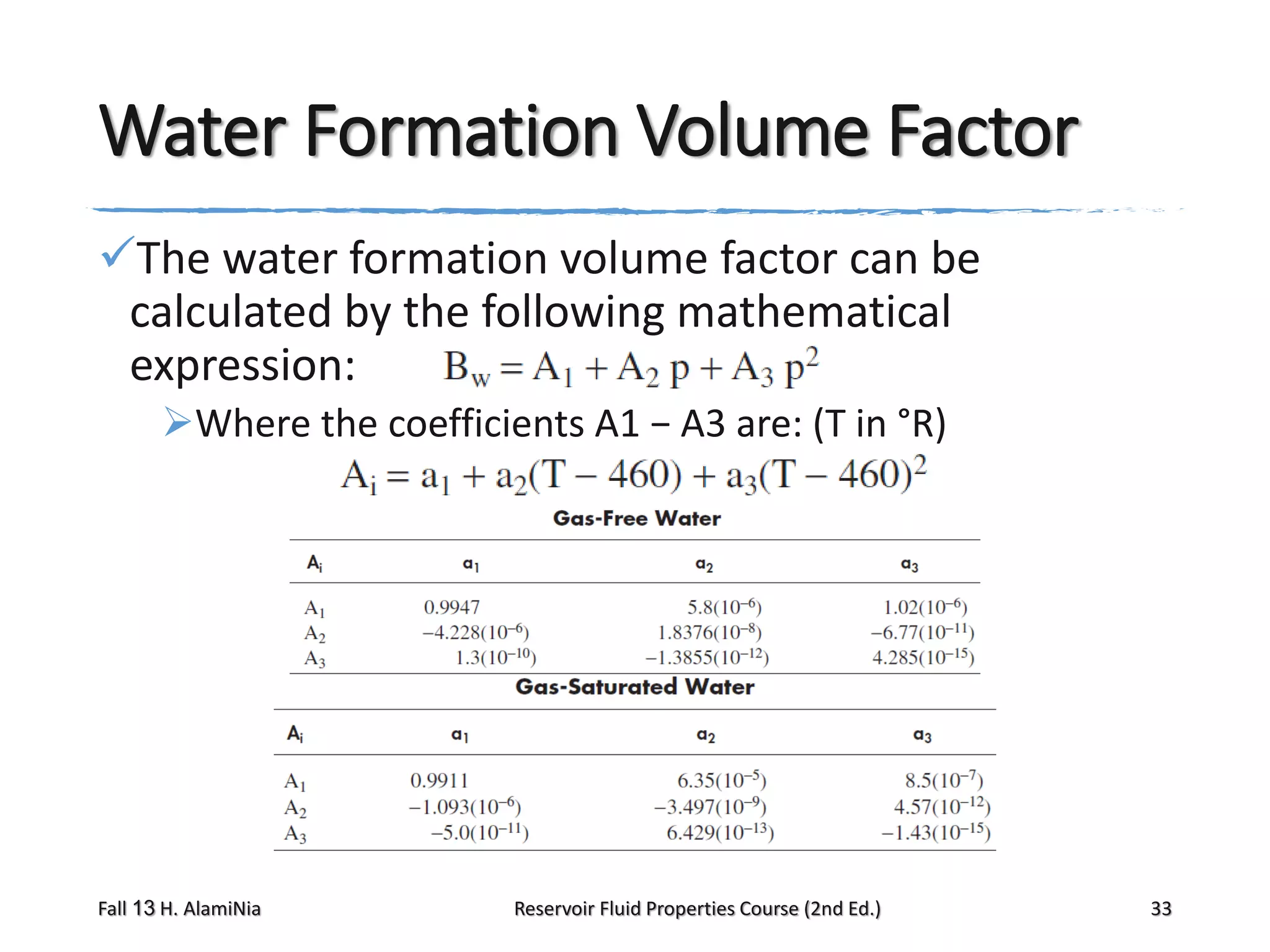
Water Formation Volume Factor (Bw)
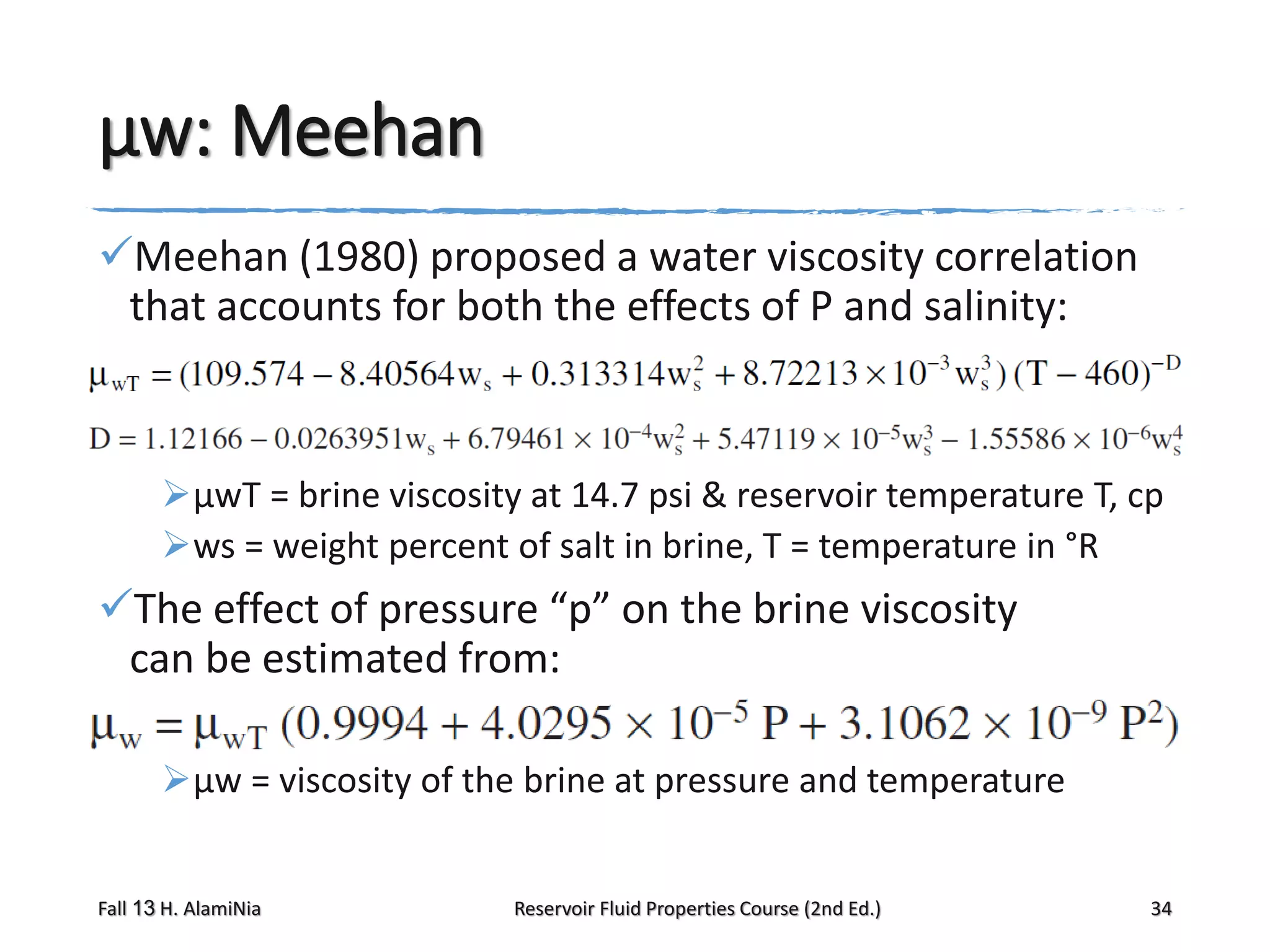
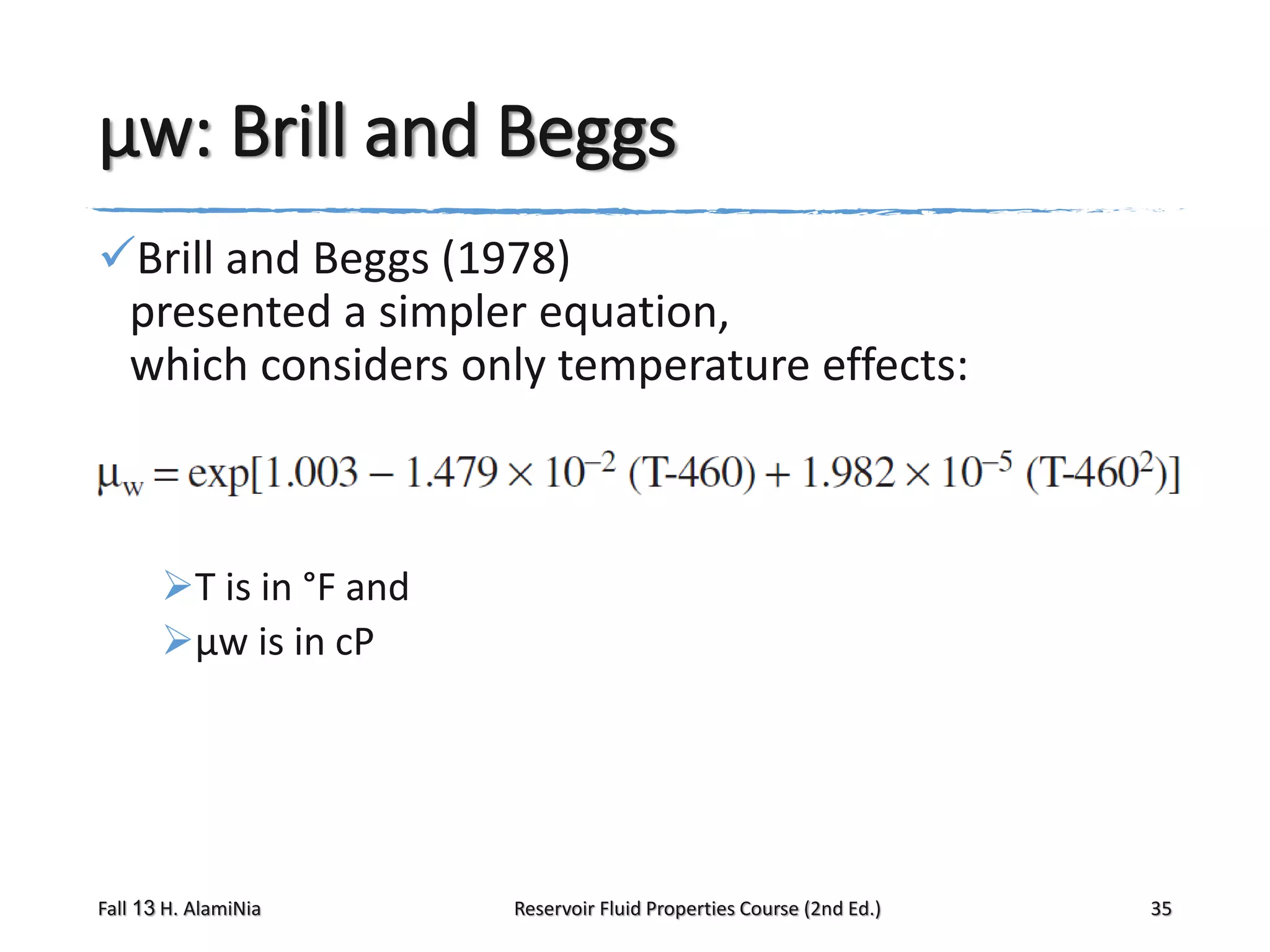
water viscosity (μw)
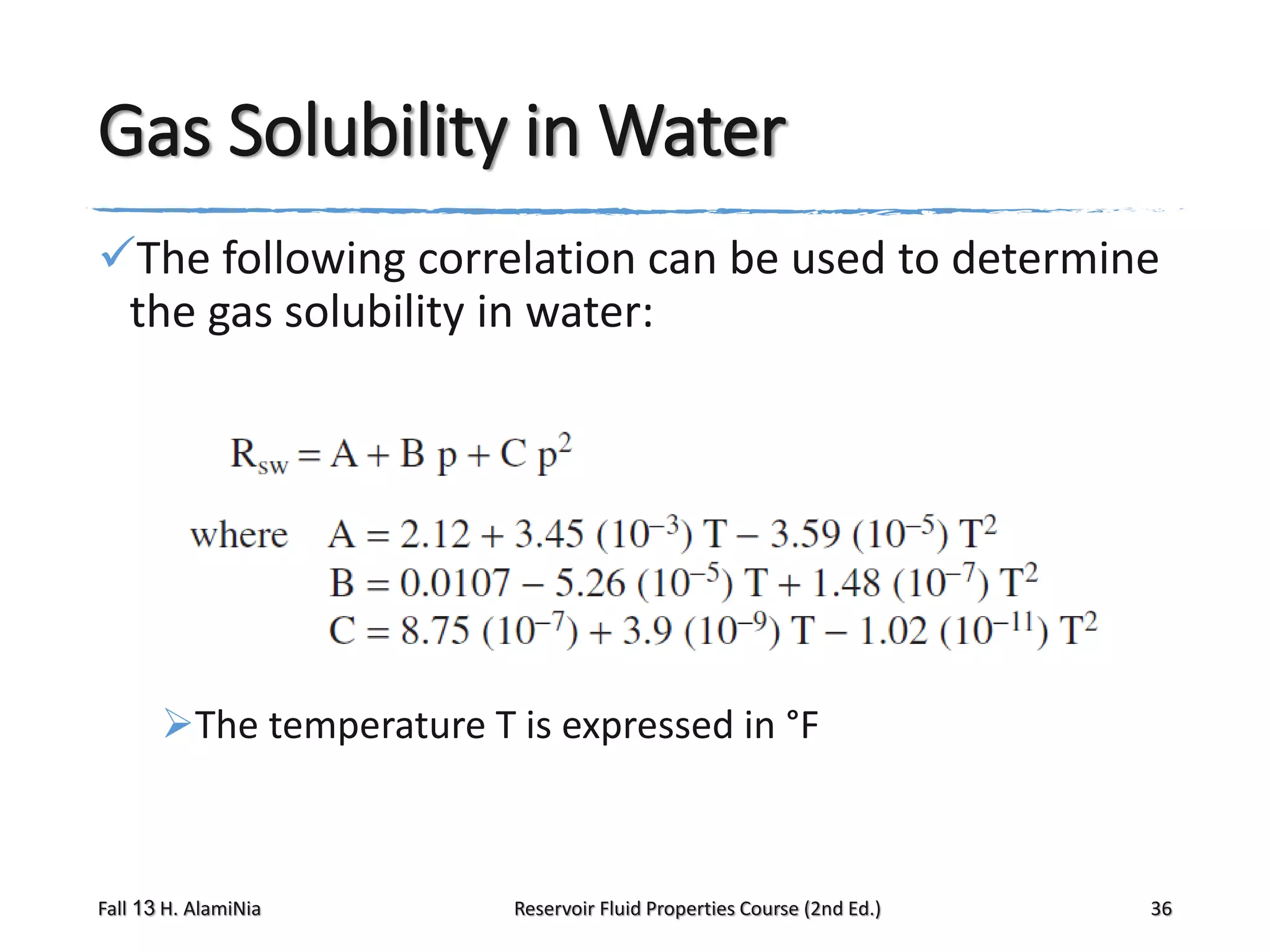
Gas Solubility in Water (Rsw)
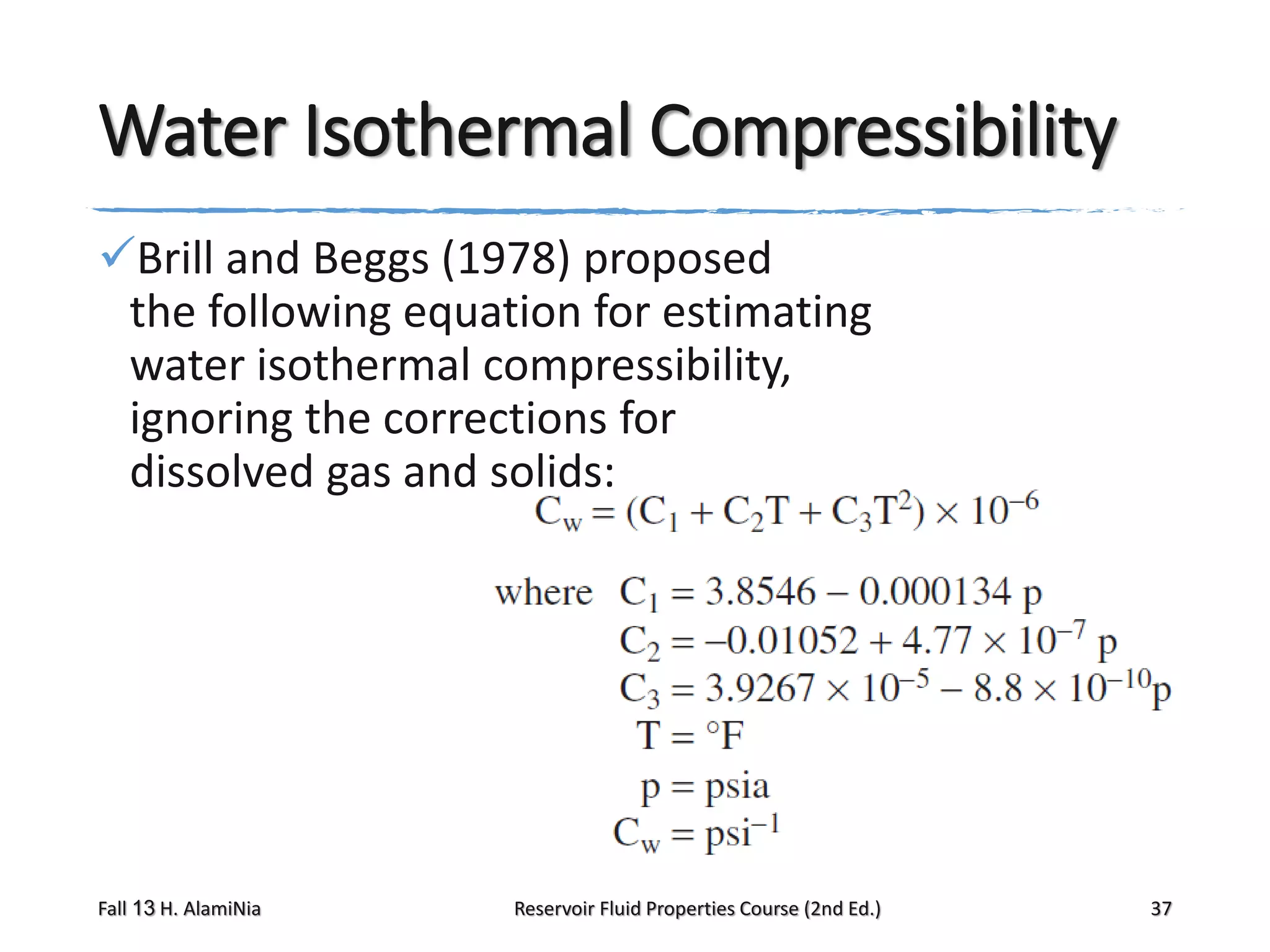
Water Isothermal Compressibility (Cw)
Total Formation Volume Factor
To describe the P-V relationship of hydrocarbon
systems below their bubble-point pressure,
it is convenient to express this relationship
in terms of the total formation volume factor
as a function of pressure.

the total formation volume factor (Bt)
defines the total volume of a system
regardless of the number of phases present.
is defined as the ratio of the total volume of the
hydrocarbon mixture (i.e., oil and gas, if present),
at the prevailing pressure and temperature
per unit volume of the stock-tank oil.
Fall 13 H. AlamiNia

Reservoir Fluid Properties Course (2nd Ed.)

5
Two-Phase Formation Volume Factor
expression
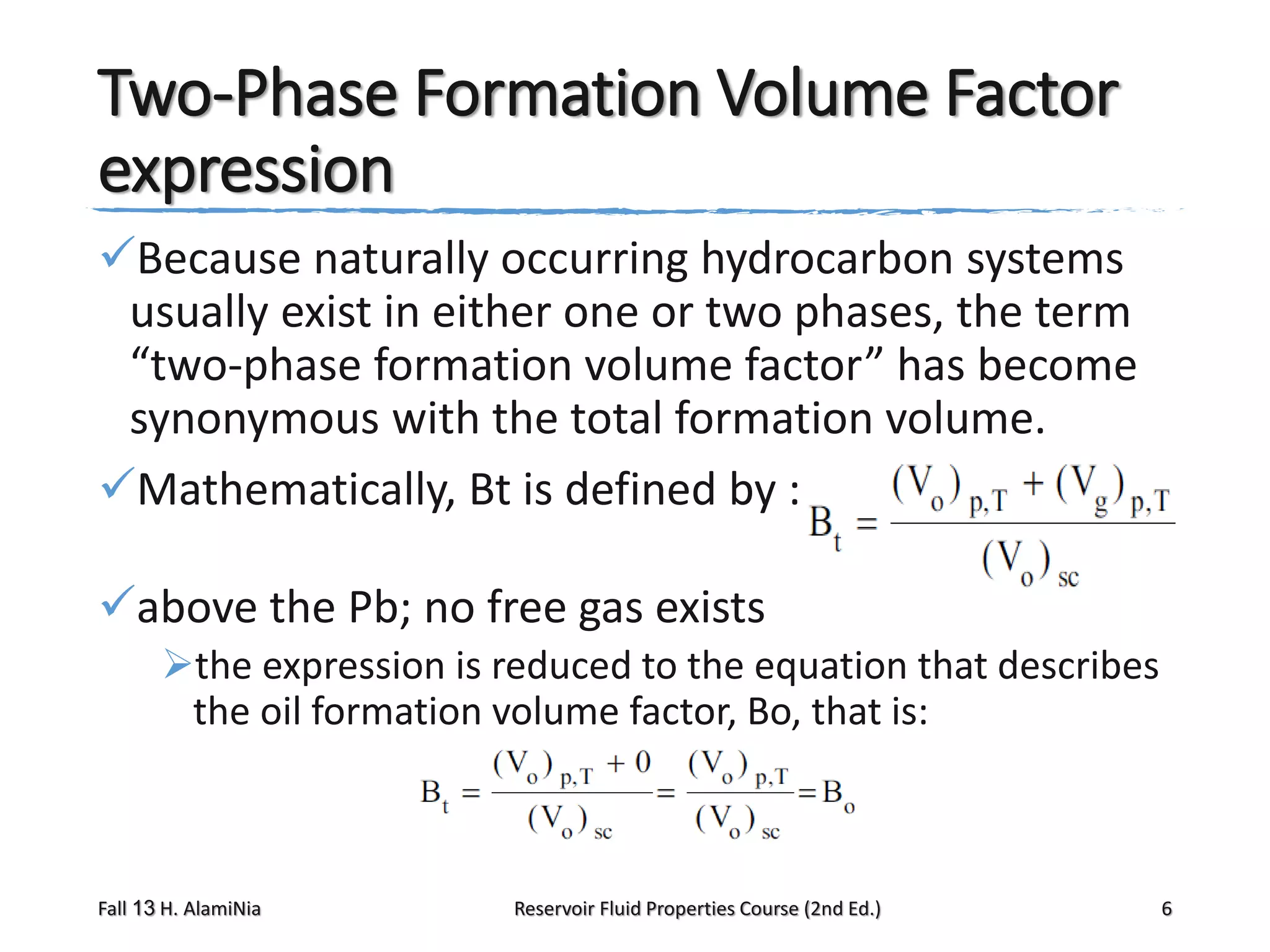
Because naturally occurring hydrocarbon systems
usually exist in either one or two phases, the term
“two-phase formation volume factor” has become
synonymous with the total formation volume.
Mathematically, Bt is defined by :
above the Pb; no free gas exists
the expression is reduced to the equation that describes
the oil formation volume factor, Bo, that is:

Fall 13 H. AlamiNia

Reservoir Fluid Properties Course (2nd Ed.)

6
Bt and Bo vs. Pressure
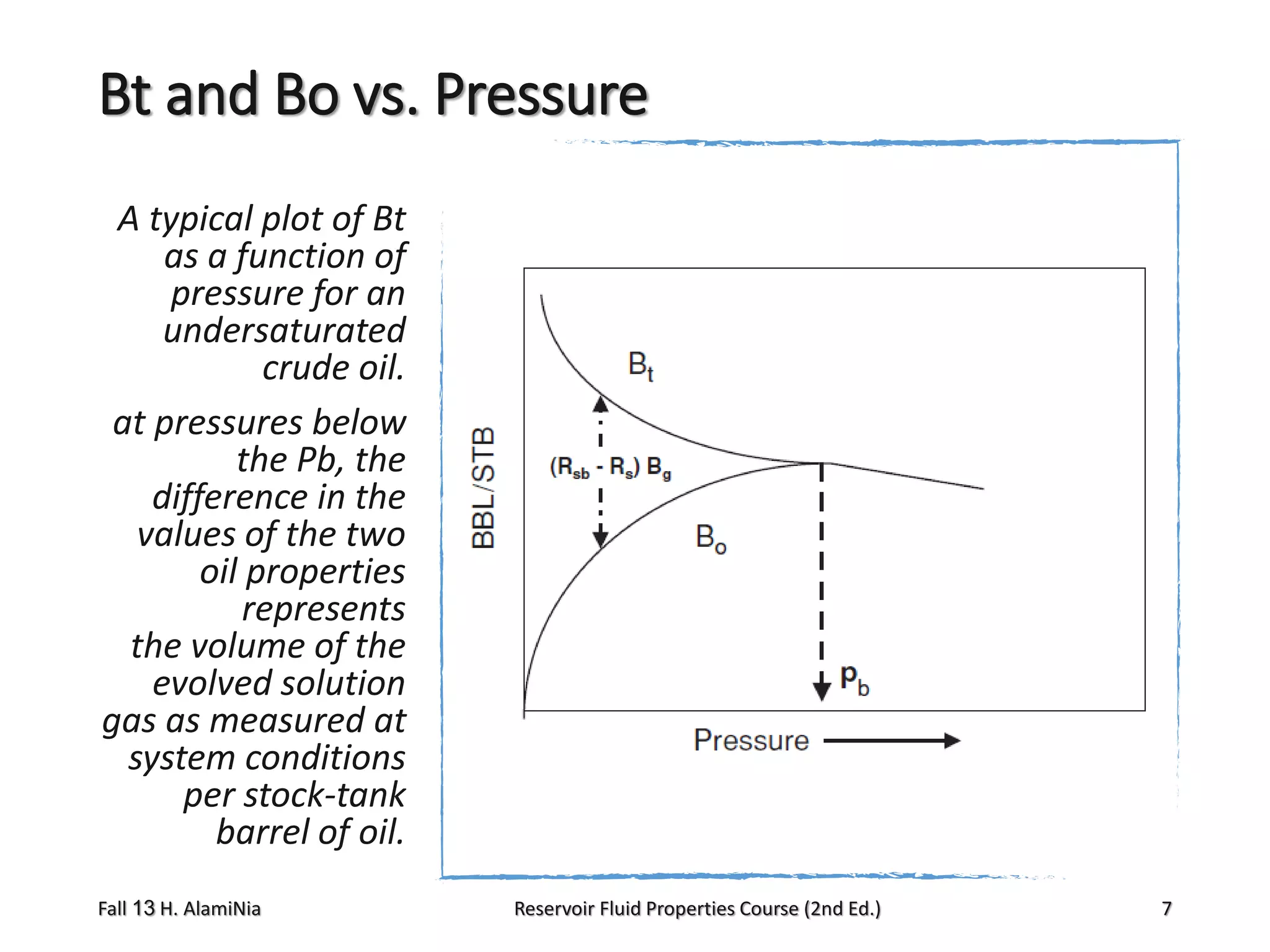
A typical plot of Bt
as a function of
pressure for an
undersaturated
crude oil.
at pressures below
the Pb, the
difference in the
values of the two
oil properties
represents
the volume of the
evolved solution
gas as measured at
system conditions
per stock-tank
barrel of oil.
Fall 13 H. AlamiNia

Reservoir Fluid Properties Course (2nd Ed.)

7
Volume of the Free Gas at P and T
Consider a crude oil sample placed in a PVT cell at its
bubble-point pressure, Pb, and reservoir temperature.
Assume that the volume of the oil sample is sufficient
to yield one stock-tank barrel of oil at standard conditions.
Let Rsb represent the gas solubility at Pb.

If the cell pressure is lowered to p,
a portion of the solution gas is evolved and
occupies a certain volume of the PVT cell.
Let Rs and Bo represent the corresponding
gas solubility and oil formation volume factor at p.

the term (Rsb – Rs) represents
the volume of the free gas
as measured in scf per stock-tank barrel of oil.
Fall 13 H. AlamiNia

Reservoir Fluid Properties Course (2nd Ed.)

8
Bt Calculation
The volume of
There are several
the free gas
correlations that
at the cell conditions is
can be used to estimate
the two phase formation
(Vg)p,T [bbl of gas/STB of volume factor
when the experimental
oil] and Bg [bbl/scf]
data are not available;
The volume of
the remaining oil
three of these methods
at the cell condition is
are:
from the definition
Fall 13 H. AlamiNia

Standing’s correlations
Glaso’s method
Marhoun’s correlation

Reservoir Fluid Properties Course (2nd Ed.)

9
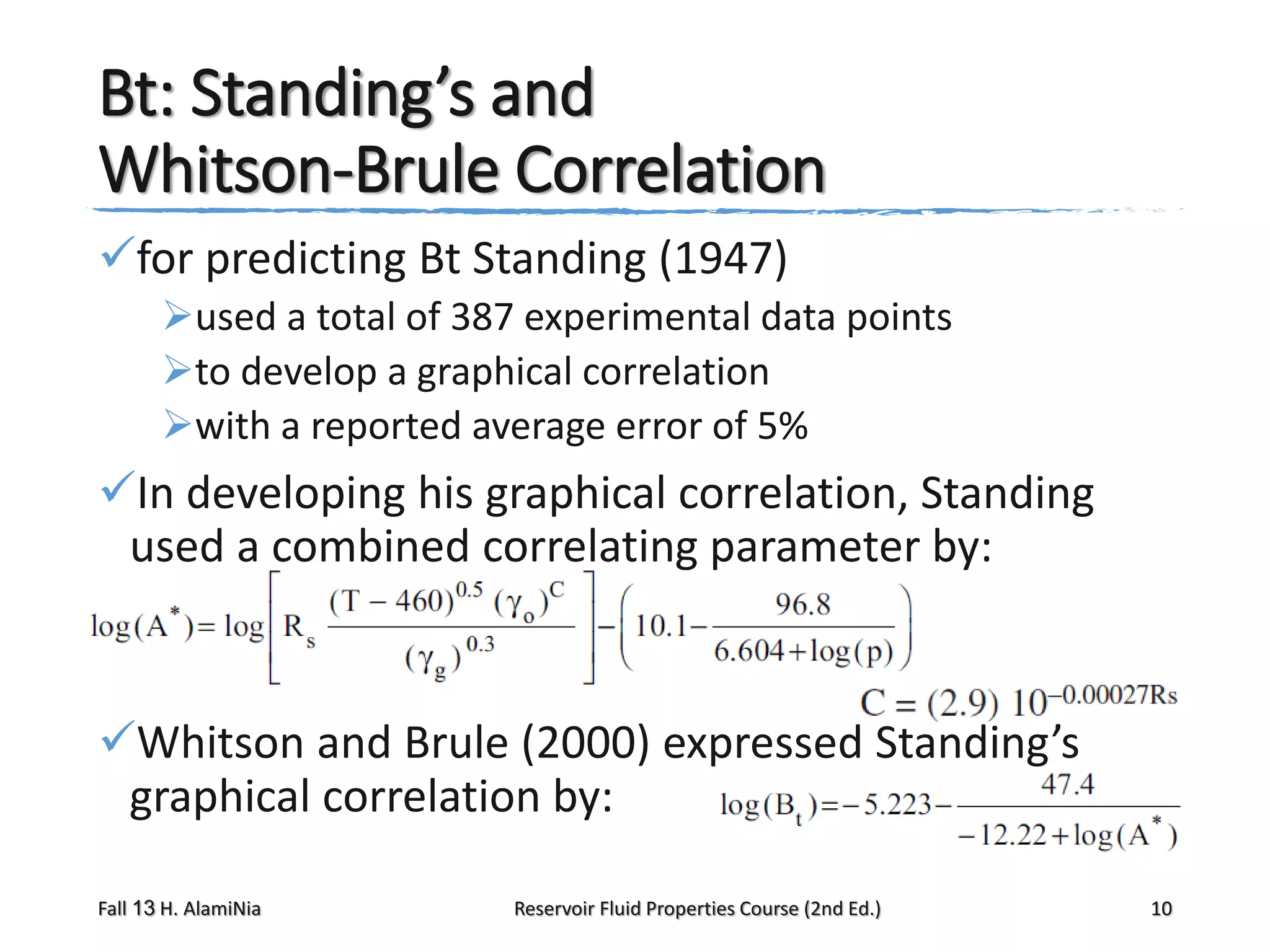
Bt: Standing’s and
Whitson-Brule Correlation
for predicting Bt Standing (1947)
used a total of 387 experimental data points
to develop a graphical correlation
with a reported average error of 5%

In developing his graphical correlation, Standing
used a combined correlating parameter by:

Whitson and Brule (2000) expressed Standing’s
graphical correlation by:
Fall 13 H. AlamiNia

Reservoir Fluid Properties Course (2nd Ed.)

10
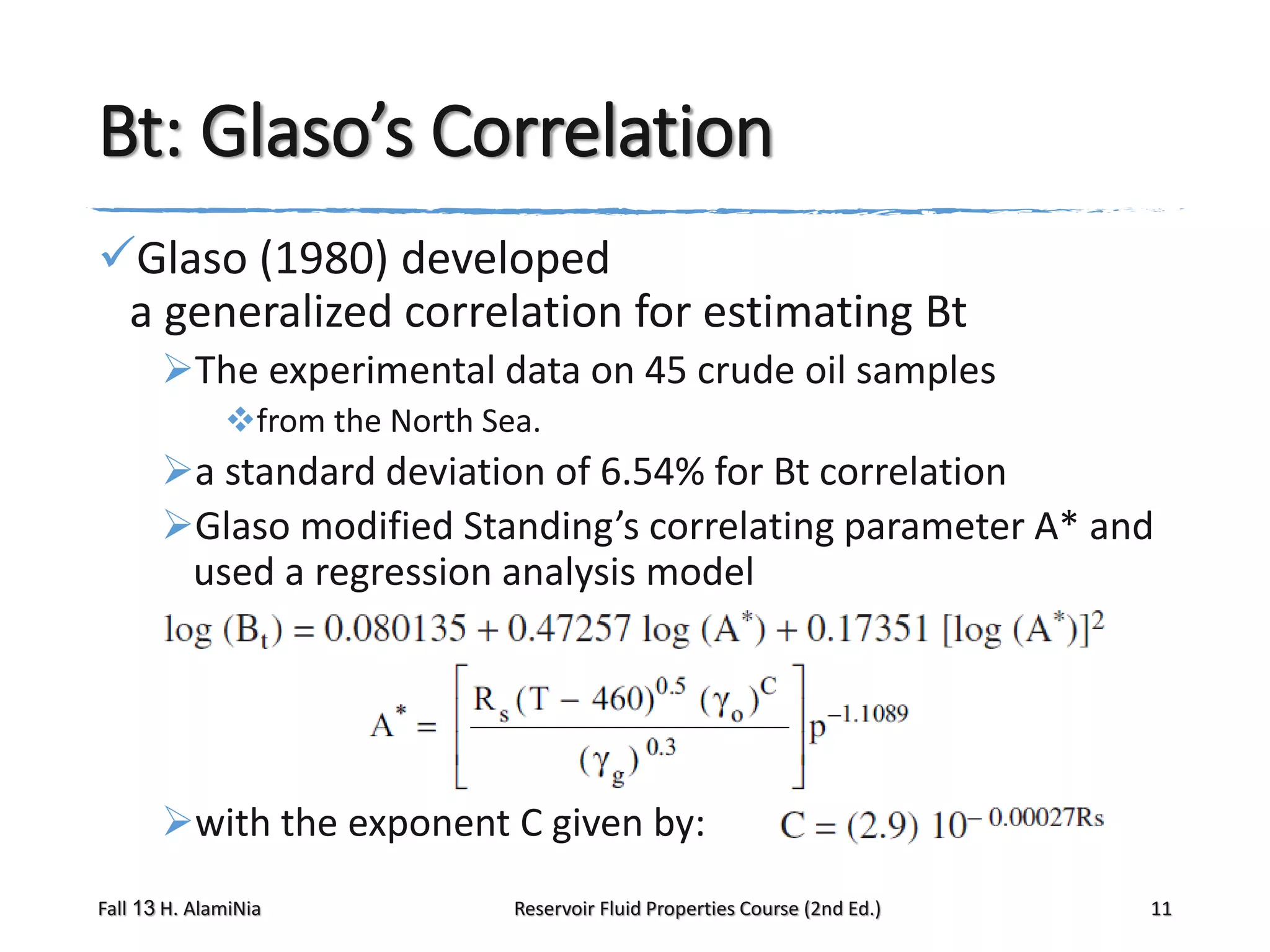
Bt: Glaso’s Correlation
Glaso (1980) developed
a generalized correlation for estimating Bt
The experimental data on 45 crude oil samples
from the North Sea.

a standard deviation of 6.54% for Bt correlation
Glaso modified Standing’s correlating parameter A* and
used a regression analysis model

with the exponent C given by:
Fall 13 H. AlamiNia

Reservoir Fluid Properties Course (2nd Ed.)

11
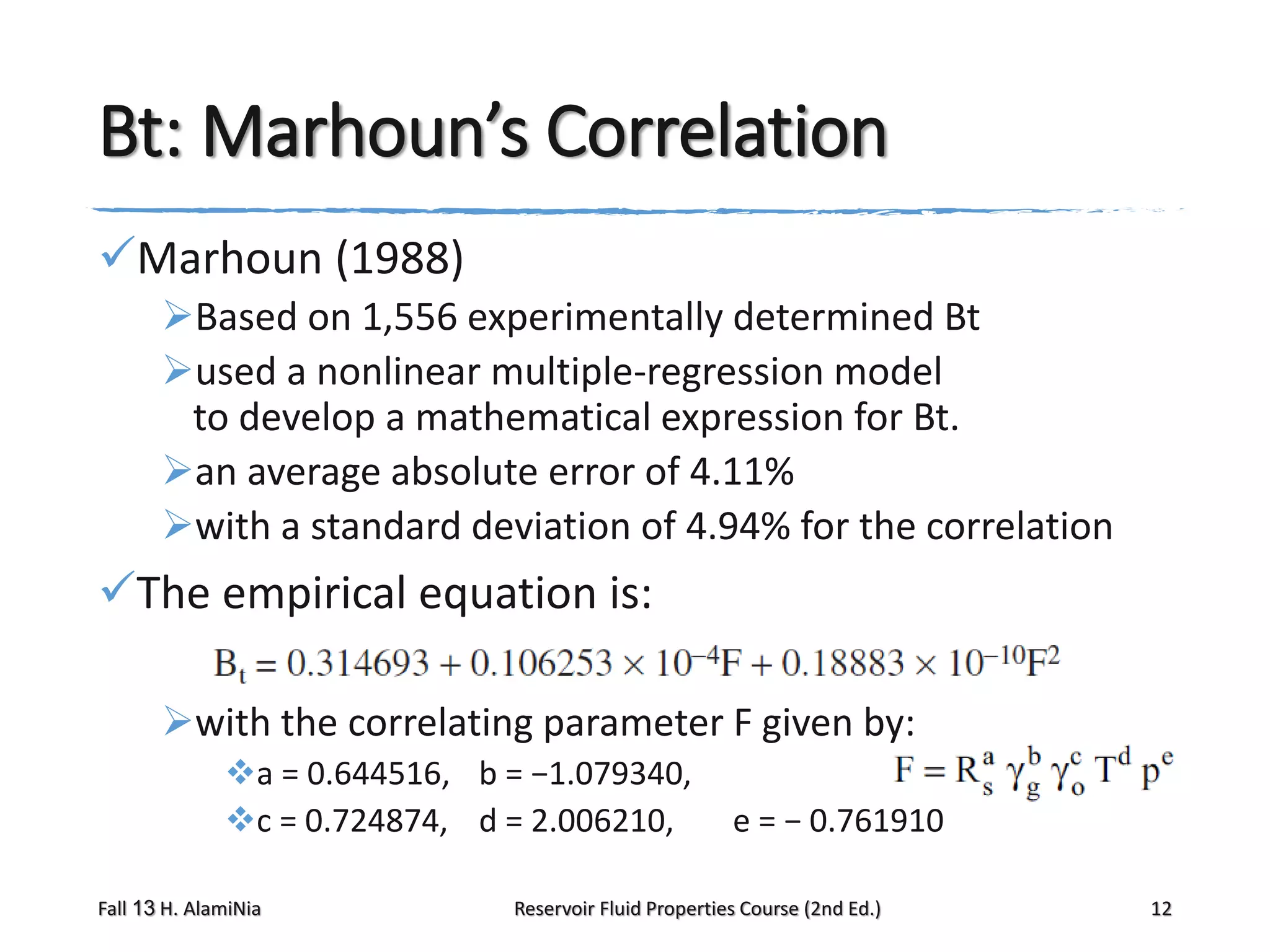
Bt: Marhoun’s Correlation
Marhoun (1988)
Based on 1,556 experimentally determined Bt
used a nonlinear multiple-regression model
to develop a mathematical expression for Bt.
an average absolute error of 4.11%
with a standard deviation of 4.94% for the correlation

The empirical equation is:
with the correlating parameter F given by:
a = 0.644516, b = −1.079340,
c = 0.724874, d = 2.006210,
Fall 13 H. AlamiNia

e = − 0.761910

Reservoir Fluid Properties Course (2nd Ed.)

12
Crude Oil Viscosity
Crude oil viscosity is an important physical property
that controls and influences
the flow of oil through porous media and pipes.

The oil viscosity
in general, is defined as
the internal resistance of the fluid to flow.
is a strong function of the T, P, oil gravity, γg, and Rs.
Whenever possible, should be determined
by laboratory measurements at reservoir T and P.
The viscosity is usually reported in standard PVT analyses.

Fall 13 H. AlamiNia

Reservoir Fluid Properties Course (2nd Ed.)

14
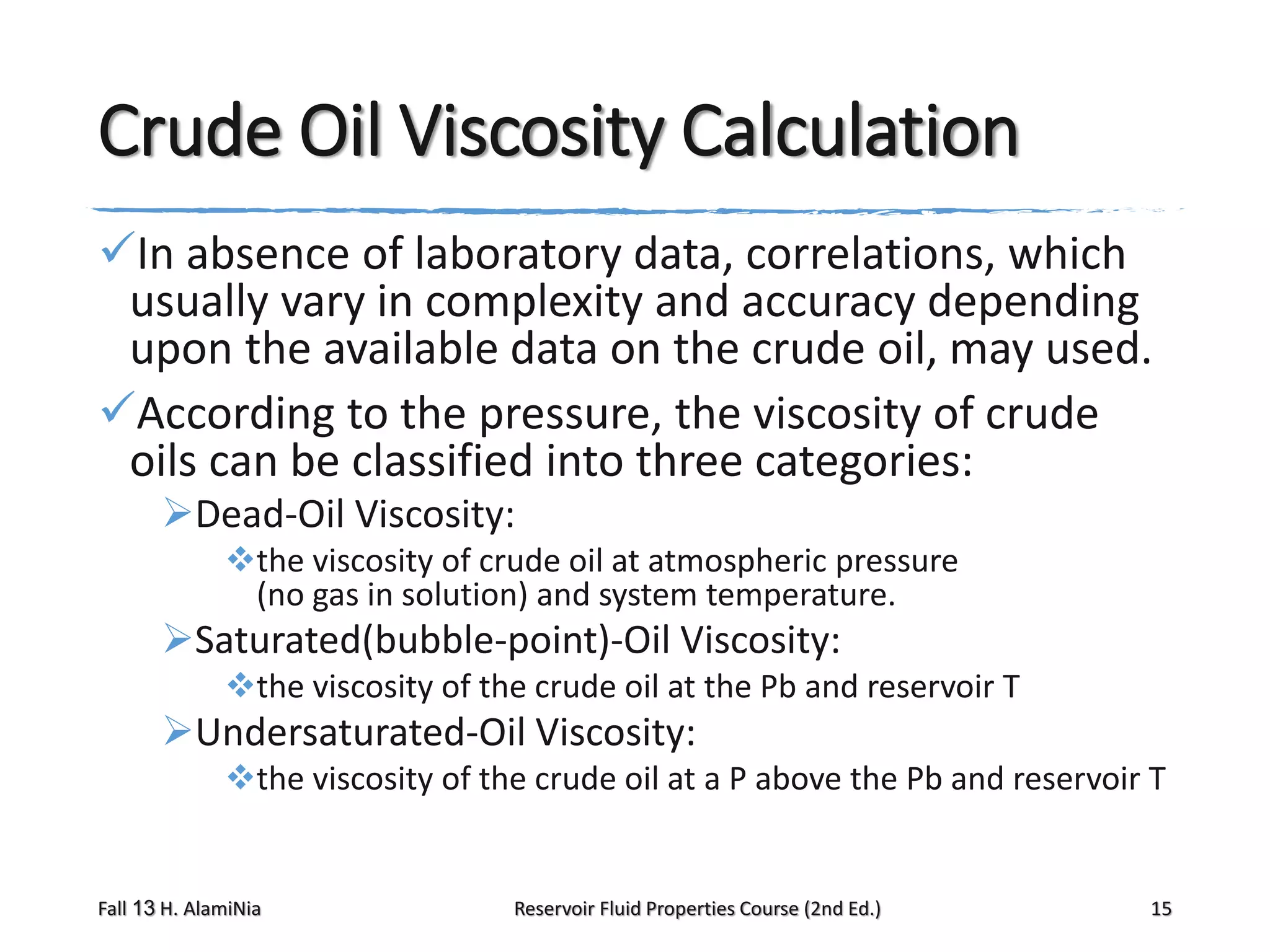
Crude Oil Viscosity Calculation
In absence of laboratory data, correlations, which
usually vary in complexity and accuracy depending
upon the available data on the crude oil, may used.
According to the pressure, the viscosity of crude
oils can be classified into three categories:
Dead-Oil Viscosity:
the viscosity of crude oil at atmospheric pressure
(no gas in solution) and system temperature.

Saturated(bubble-point)-Oil Viscosity:
the viscosity of the crude oil at the Pb and reservoir T

Undersaturated-Oil Viscosity:
the viscosity of the crude oil at a P above the Pb and reservoir T

Fall 13 H. AlamiNia

Reservoir Fluid Properties Course (2nd Ed.)

15
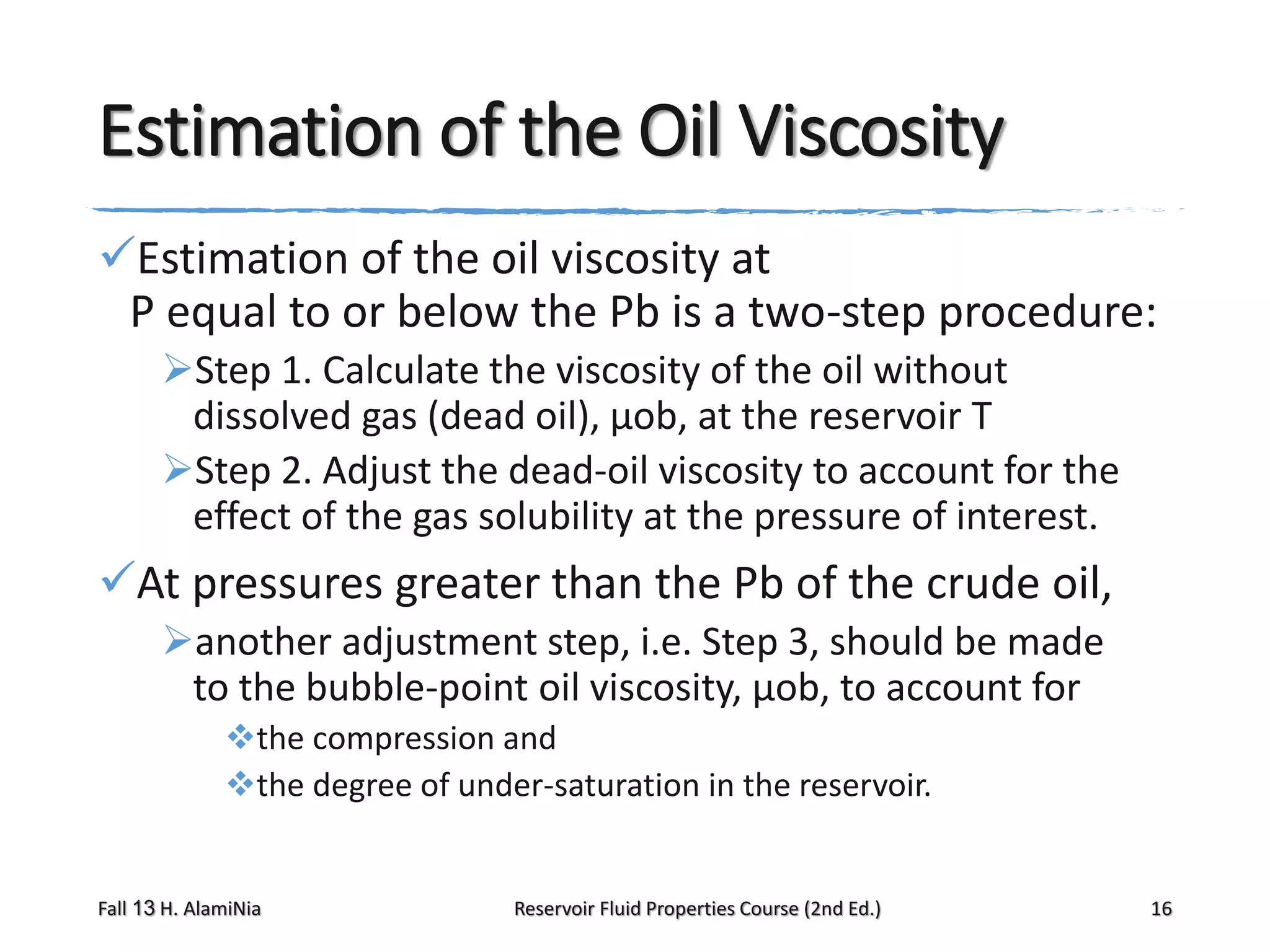
Estimation of the Oil Viscosity
Estimation of the oil viscosity at
P equal to or below the Pb is a two-step procedure:
Step 1. Calculate the viscosity of the oil without
dissolved gas (dead oil), μob, at the reservoir T
Step 2. Adjust the dead-oil viscosity to account for the
effect of the gas solubility at the pressure of interest.

At pressures greater than the Pb of the crude oil,
another adjustment step, i.e. Step 3, should be made
to the bubble-point oil viscosity, μob, to account for
the compression and
the degree of under-saturation in the reservoir.

Fall 13 H. AlamiNia

Reservoir Fluid Properties Course (2nd Ed.)

16
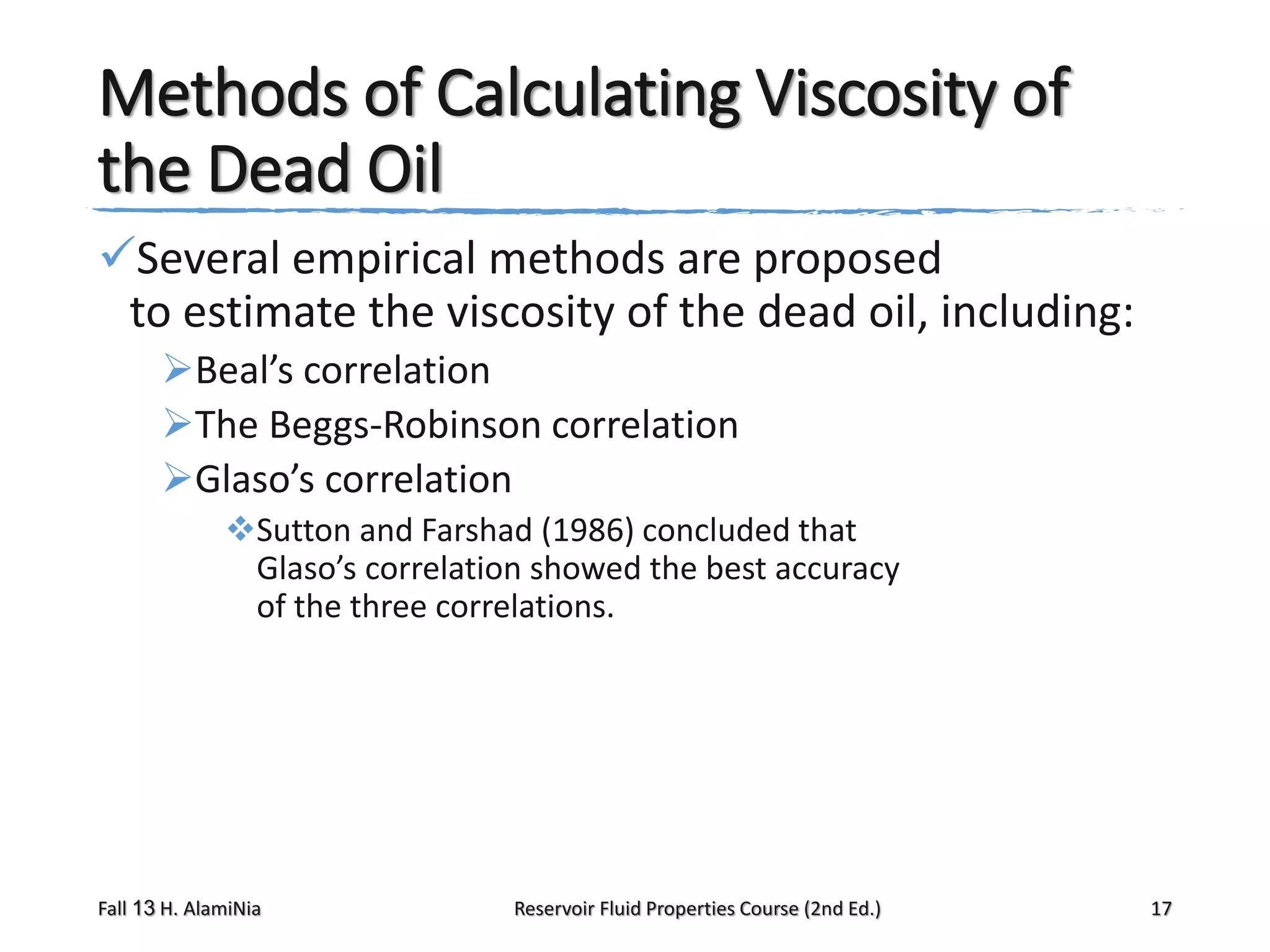
Methods of Calculating Viscosity of
the Dead Oil
Several empirical methods are proposed
to estimate the viscosity of the dead oil, including:
Beal’s correlation
The Beggs-Robinson correlation
Glaso’s correlation
Sutton and Farshad (1986) concluded that
Glaso’s correlation showed the best accuracy
of the three correlations.

Fall 13 H. AlamiNia

Reservoir Fluid Properties Course (2nd Ed.)

17
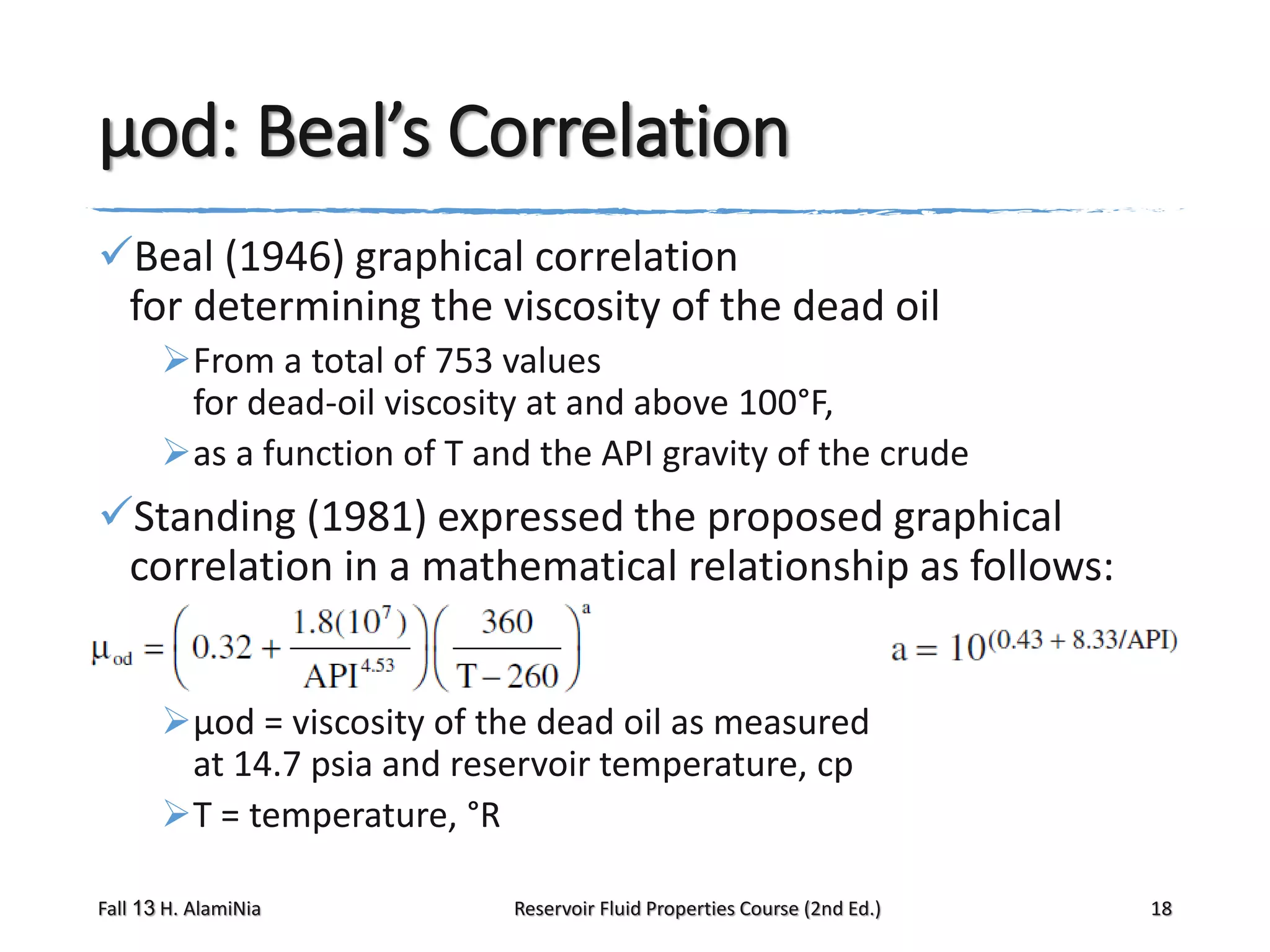
μod: Beal’s Correlation
Beal (1946) graphical correlation
for determining the viscosity of the dead oil
From a total of 753 values
for dead-oil viscosity at and above 100°F,
as a function of T and the API gravity of the crude

Standing (1981) expressed the proposed graphical
correlation in a mathematical relationship as follows:
μod = viscosity of the dead oil as measured
at 14.7 psia and reservoir temperature, cp
T = temperature, °R
Fall 13 H. AlamiNia

Reservoir Fluid Properties Course (2nd Ed.)

18
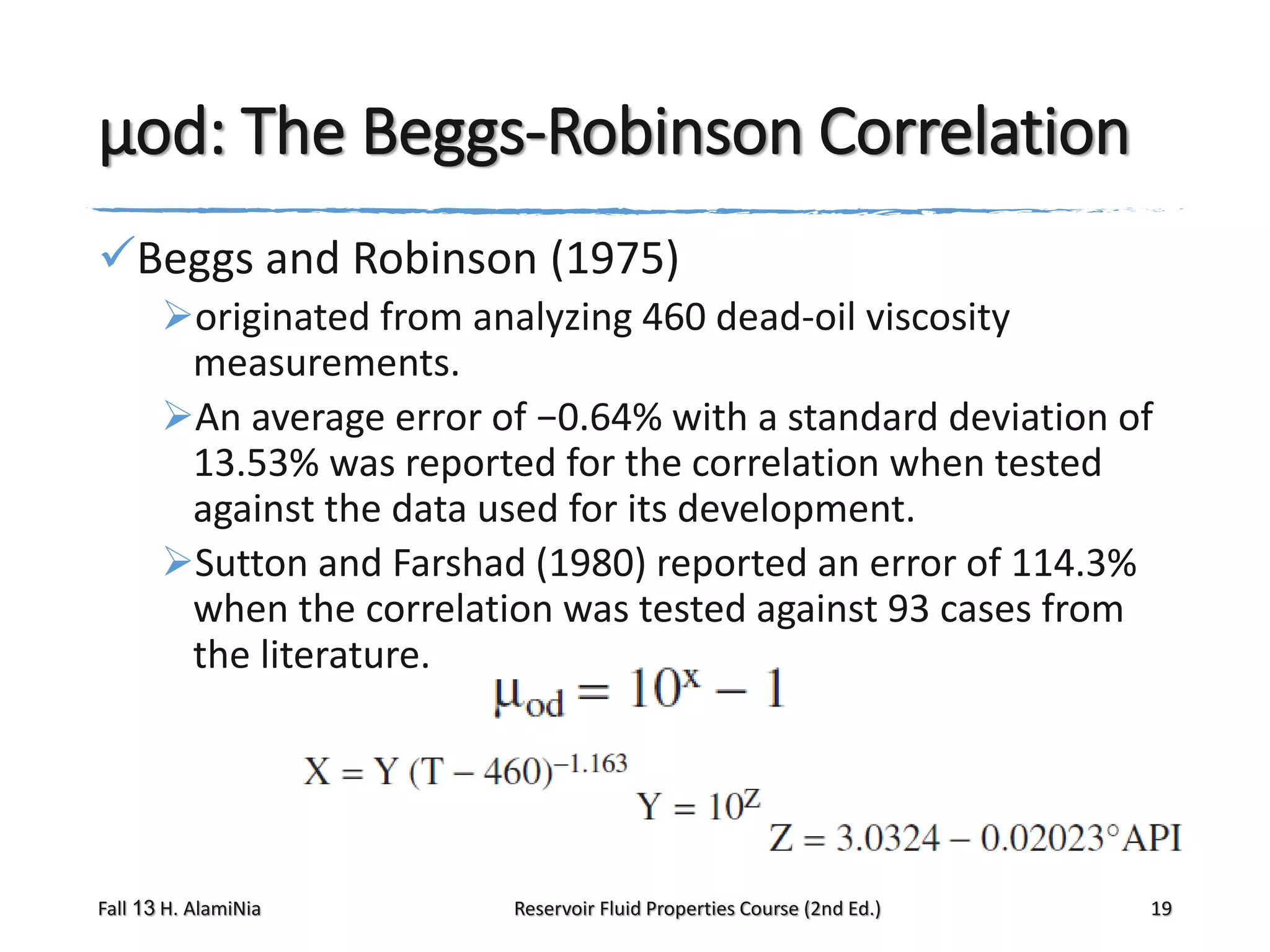
μod: The Beggs-Robinson Correlation
Beggs and Robinson (1975)
originated from analyzing 460 dead-oil viscosity
measurements.
An average error of −0.64% with a standard deviation of
13.53% was reported for the correlation when tested
against the data used for its development.
Sutton and Farshad (1980) reported an error of 114.3%
when the correlation was tested against 93 cases from
the literature.

Fall 13 H. AlamiNia

Reservoir Fluid Properties Course (2nd Ed.)

19
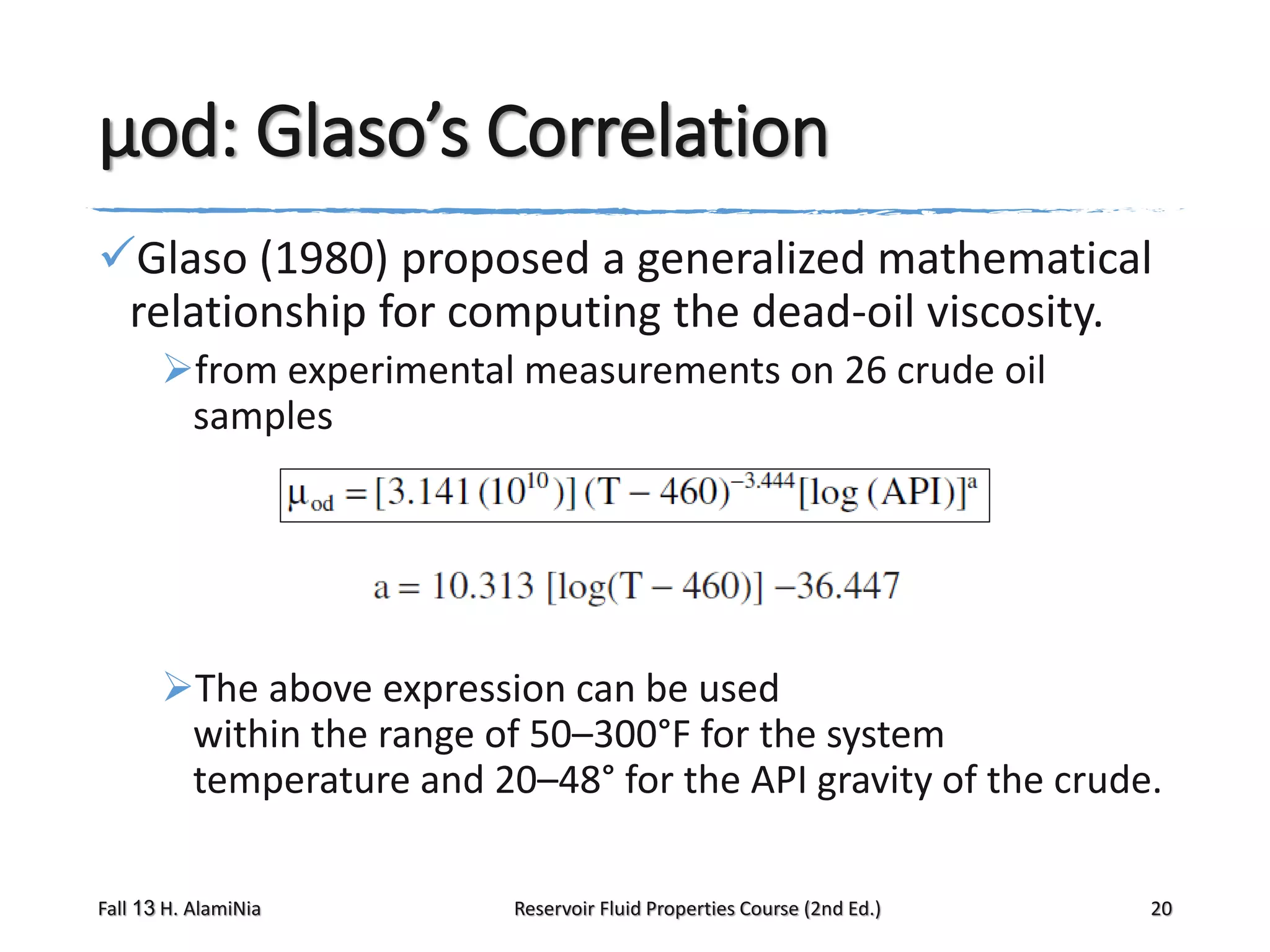
μod: Glaso’s Correlation
Glaso (1980) proposed a generalized mathematical
relationship for computing the dead-oil viscosity.
from experimental measurements on 26 crude oil
samples

The above expression can be used
within the range of 50–300°F for the system
temperature and 20–48° for the API gravity of the crude.
Fall 13 H. AlamiNia

Reservoir Fluid Properties Course (2nd Ed.)

20
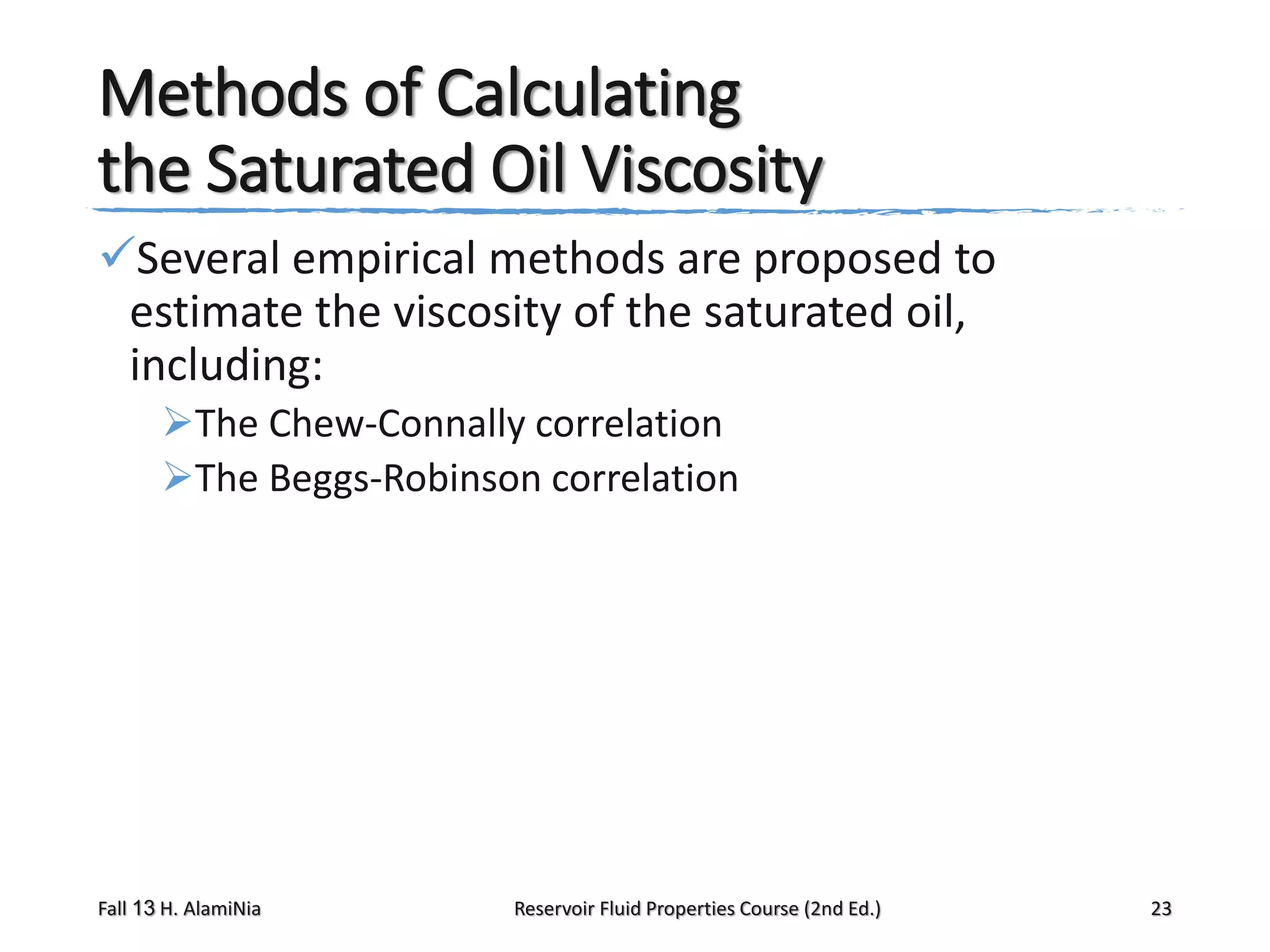
Methods of Calculating
the Saturated Oil Viscosity
Several empirical methods are proposed to
estimate the viscosity of the saturated oil,
including:
The Chew-Connally correlation
The Beggs-Robinson correlation

Fall 13 H. AlamiNia

Reservoir Fluid Properties Course (2nd Ed.)

23
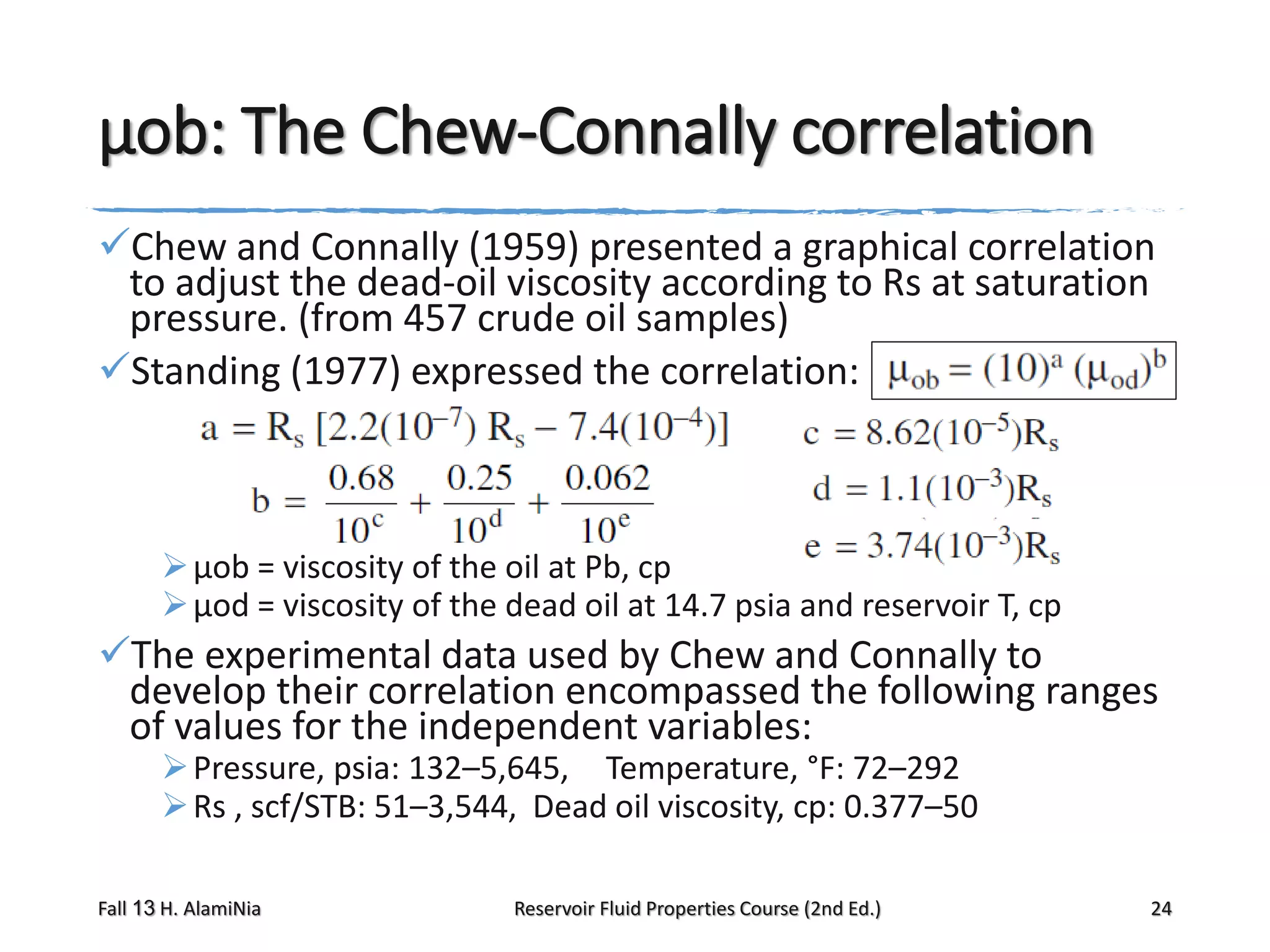
μob: The Chew-Connally correlation
Chew and Connally (1959) presented a graphical correlation
to adjust the dead-oil viscosity according to Rs at saturation
pressure. (from 457 crude oil samples)
Standing (1977) expressed the correlation:

 μob = viscosity of the oil at Pb, cp
 μod = viscosity of the dead oil at 14.7 psia and reservoir T, cp

The experimental data used by Chew and Connally to
develop their correlation encompassed the following ranges
of values for the independent variables:
 Pressure, psia: 132–5,645, Temperature, °F: 72–292
 Rs , scf/STB: 51–3,544, Dead oil viscosity, cp: 0.377–50

Fall 13 H. AlamiNia

Reservoir Fluid Properties Course (2nd Ed.)

24
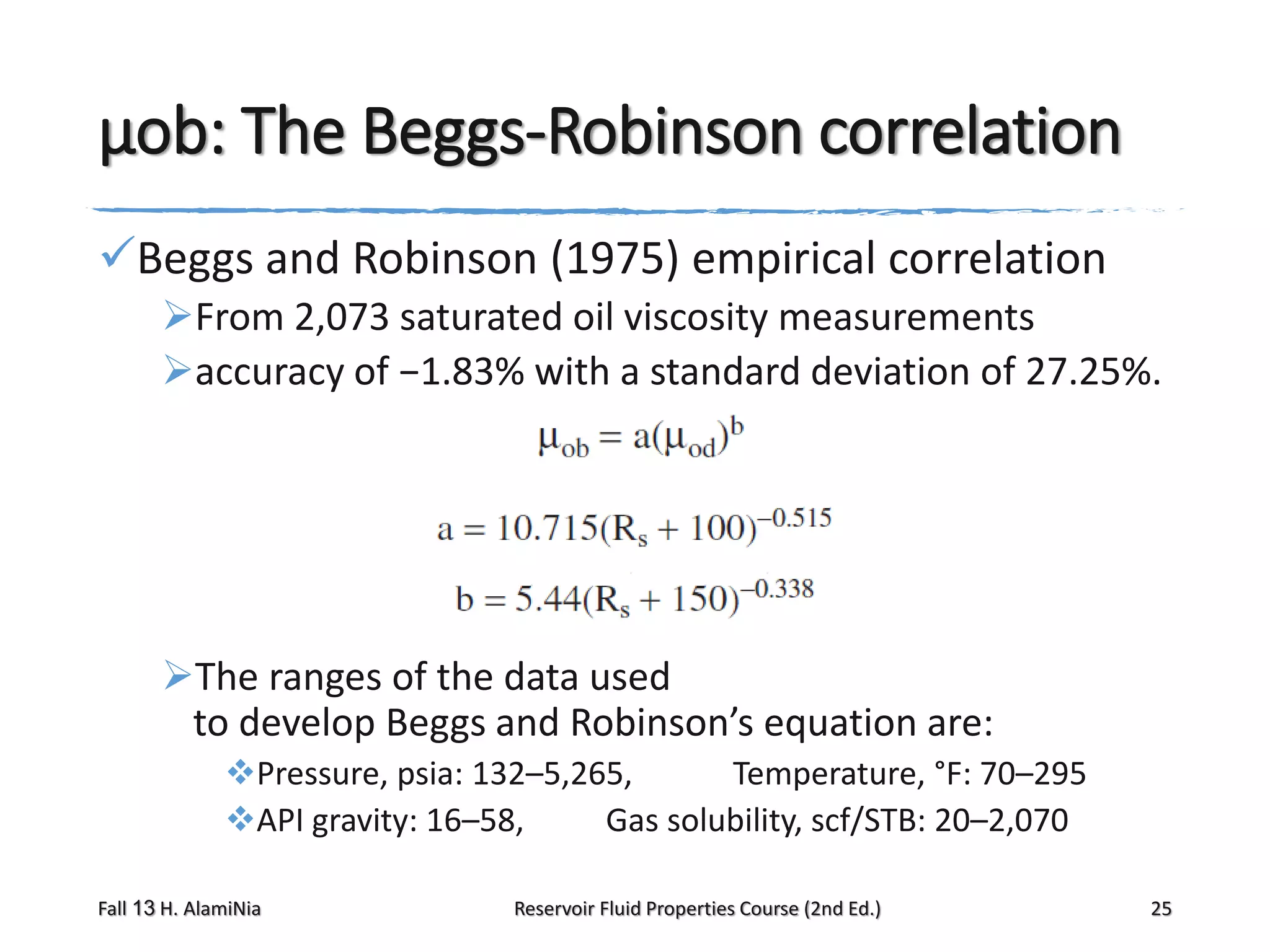
μob: The Beggs-Robinson correlation
Beggs and Robinson (1975) empirical correlation
From 2,073 saturated oil viscosity measurements
accuracy of −1.83% with a standard deviation of 27.25%.

The ranges of the data used
to develop Beggs and Robinson’s equation are:
Pressure, psia: 132–5,265,
Temperature, °F: 70–295
API gravity: 16–58,
Gas solubility, scf/STB: 20–2,070
Fall 13 H. AlamiNia

Reservoir Fluid Properties Course (2nd Ed.)

25
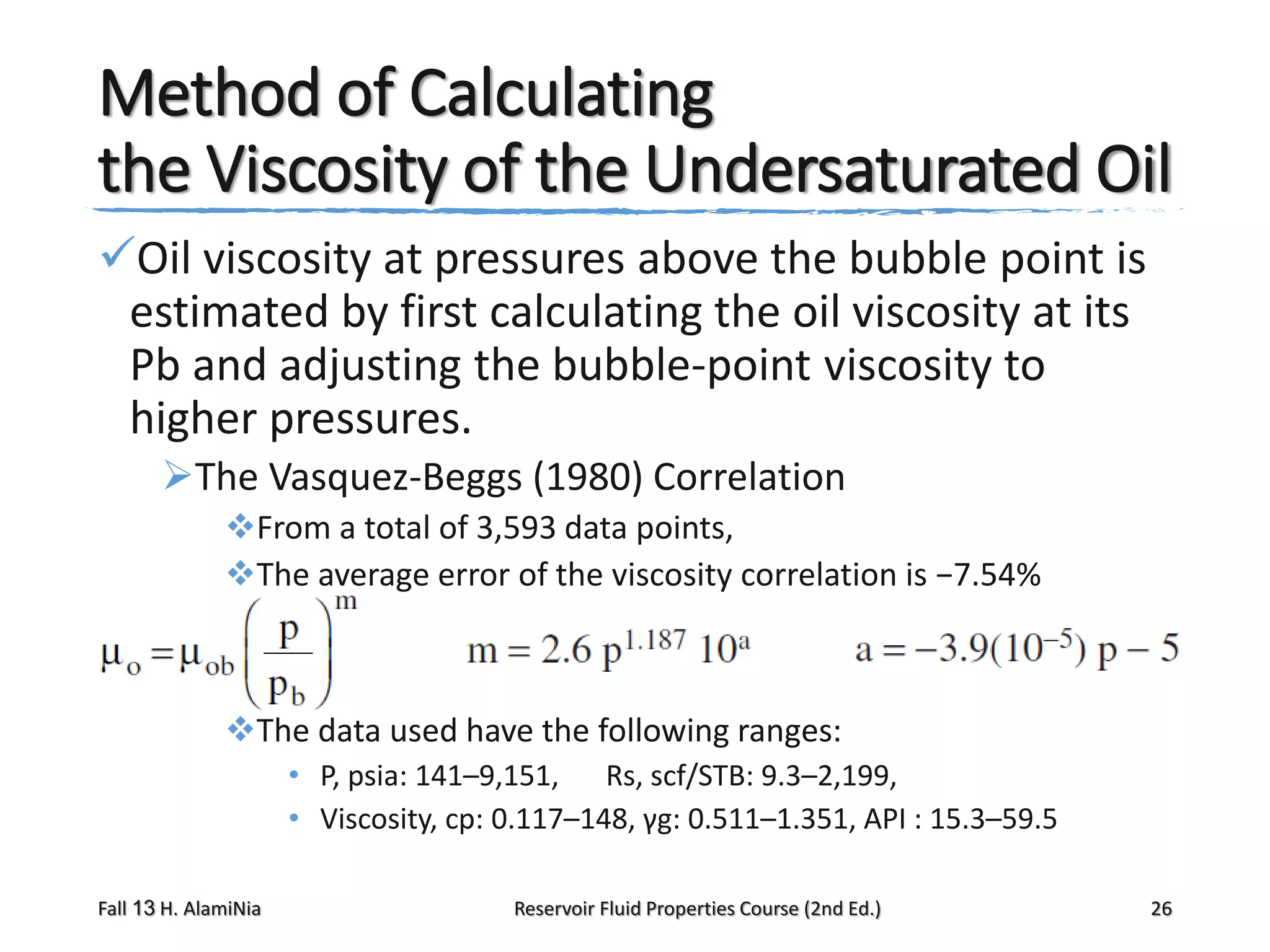
Method of Calculating
the Viscosity of the Undersaturated Oil
Oil viscosity at pressures above the bubble point is
estimated by first calculating the oil viscosity at its
Pb and adjusting the bubble-point viscosity to
higher pressures.
The Vasquez-Beggs (1980) Correlation
From a total of 3,593 data points,
The average error of the viscosity correlation is −7.54%

The data used have the following ranges:
• P, psia: 141–9,151, Rs, scf/STB: 9.3–2,199,
• Viscosity, cp: 0.117–148, γg: 0.511–1.351, API : 15.3–59.5
Fall 13 H. AlamiNia

Reservoir Fluid Properties Course (2nd Ed.)

26
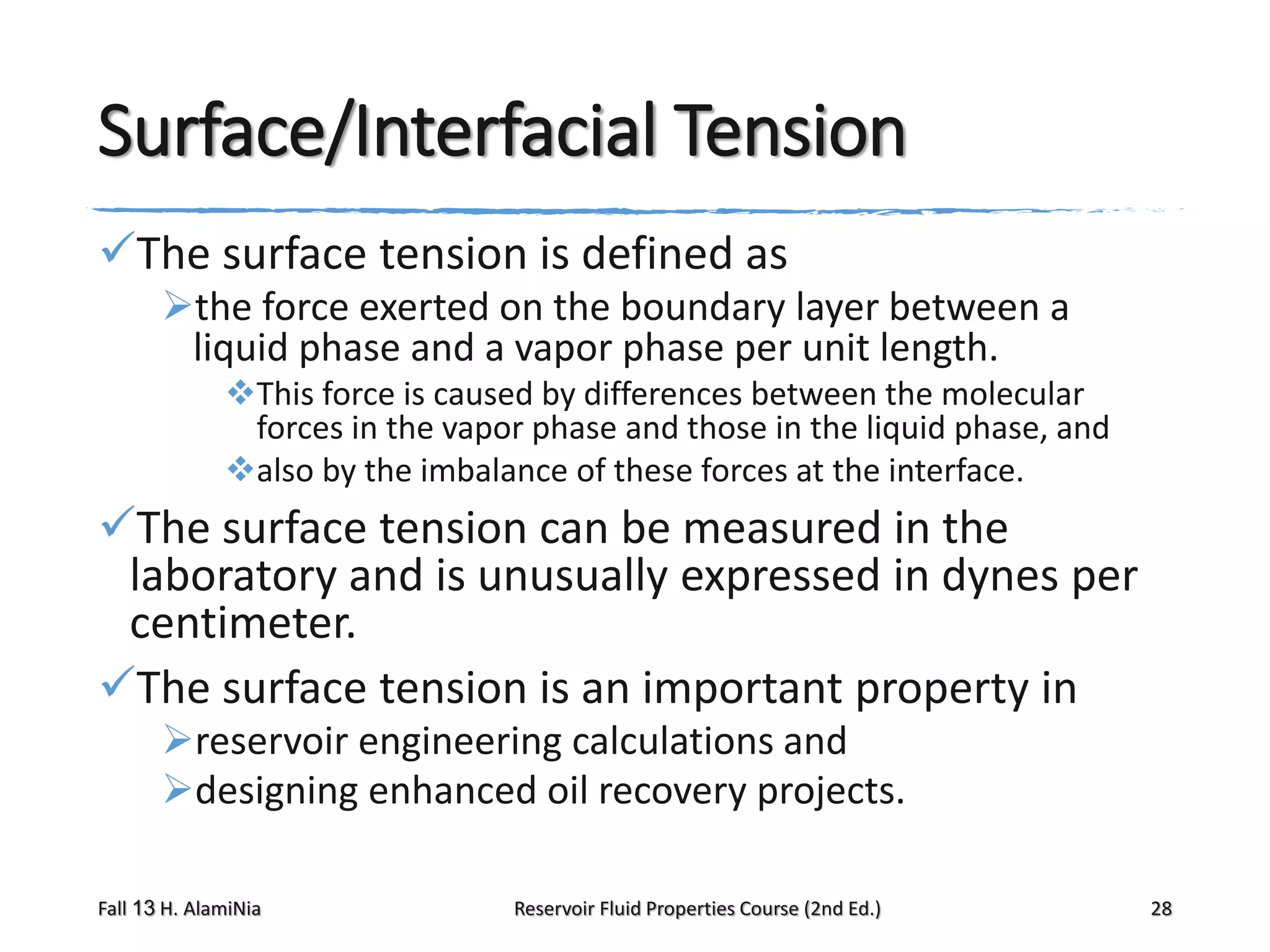
Surface/Interfacial Tension
The surface tension is defined as
the force exerted on the boundary layer between a
liquid phase and a vapor phase per unit length.
This force is caused by differences between the molecular
forces in the vapor phase and those in the liquid phase, and
also by the imbalance of these forces at the interface.

The surface tension can be measured in the
laboratory and is unusually expressed in dynes per
centimeter.
The surface tension is an important property in
reservoir engineering calculations and
designing enhanced oil recovery projects.
Fall 13 H. AlamiNia

Reservoir Fluid Properties Course (2nd Ed.)

28
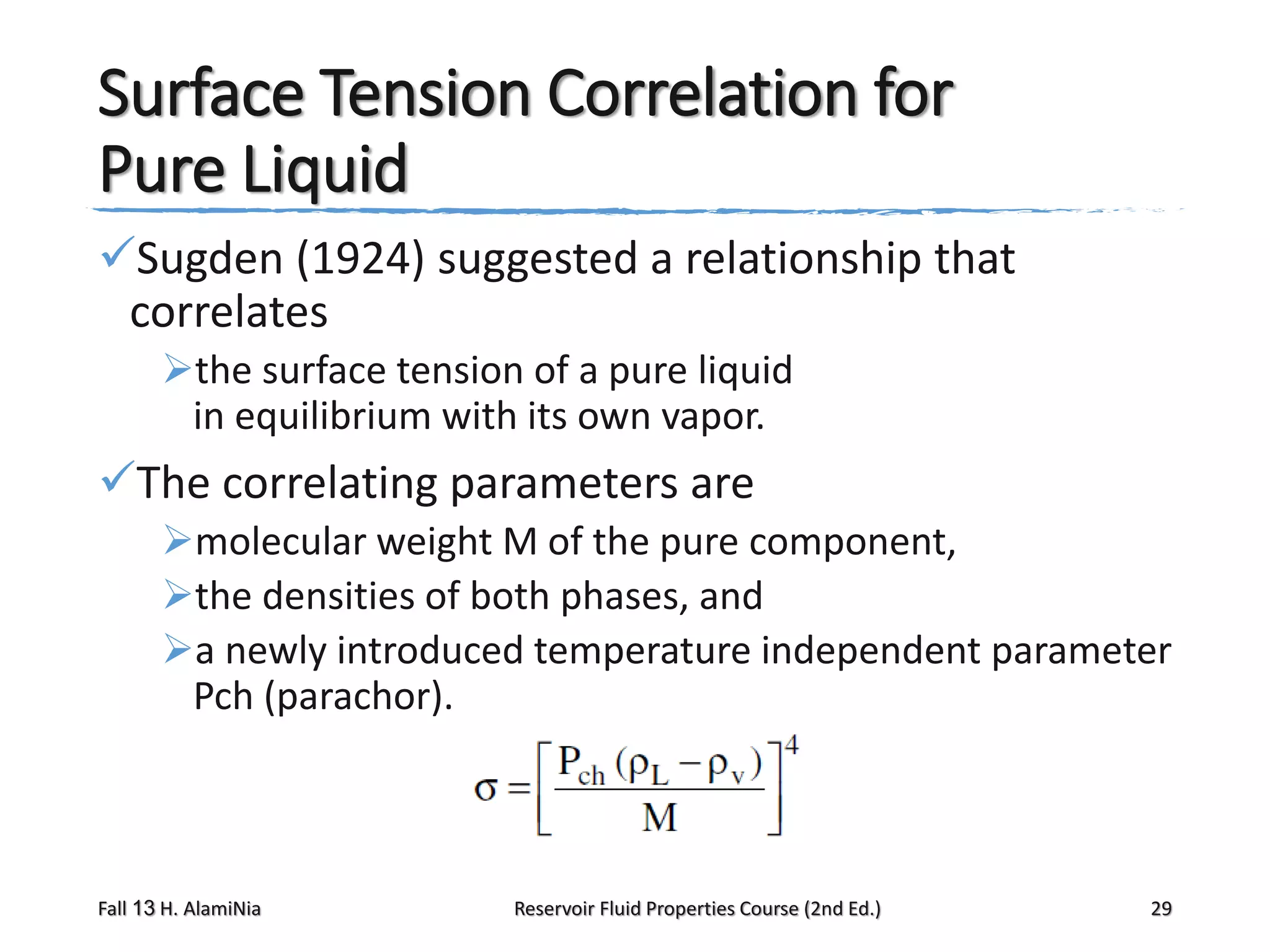
Surface Tension Correlation for
Pure Liquid
Sugden (1924) suggested a relationship that
correlates
the surface tension of a pure liquid
in equilibrium with its own vapor.

The correlating parameters are
molecular weight M of the pure component,
the densities of both phases, and
a newly introduced temperature independent parameter
Pch (parachor).

Fall 13 H. AlamiNia

Reservoir Fluid Properties Course (2nd Ed.)

29
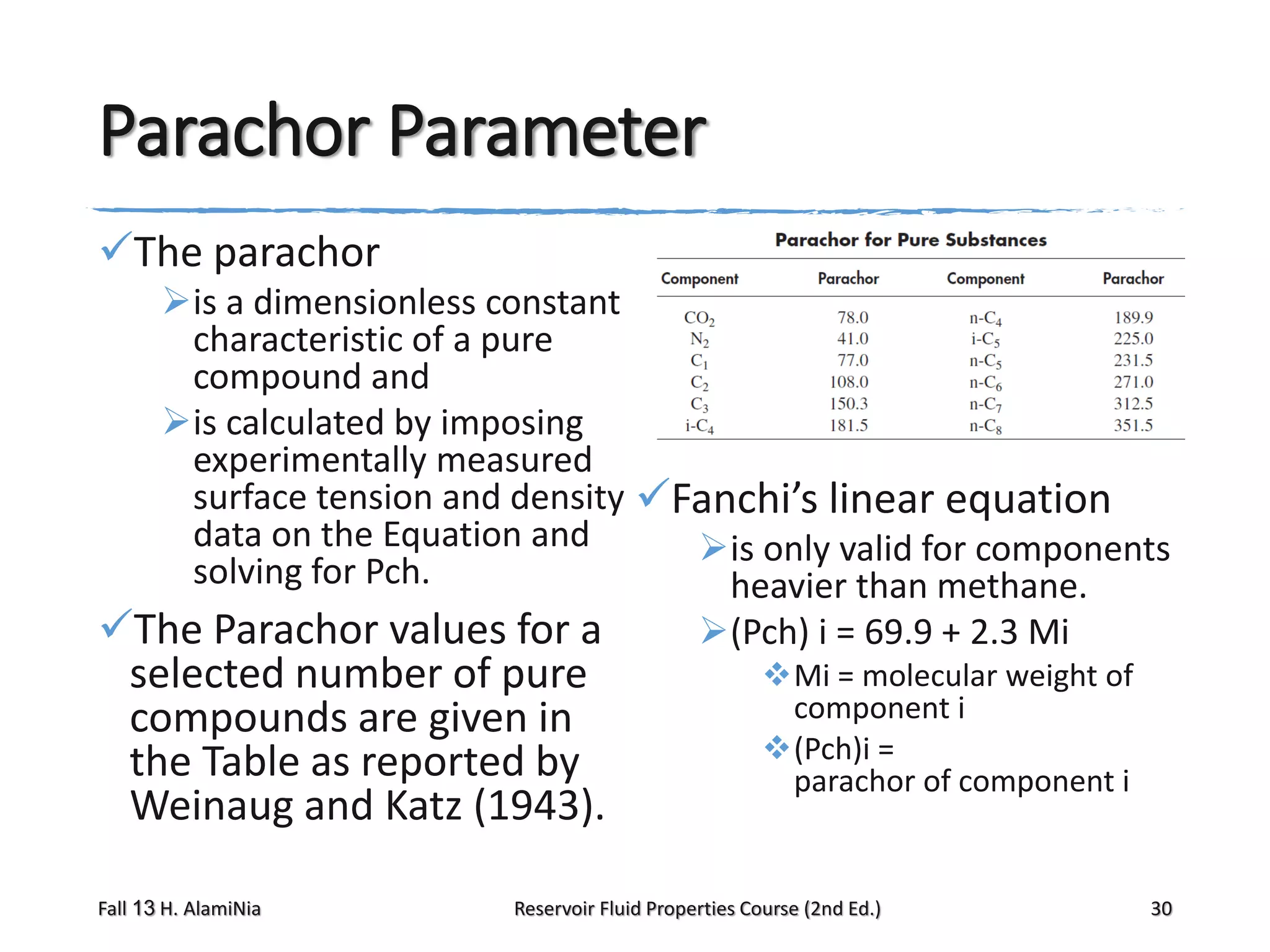
Parachor Parameter
The parachor
is a dimensionless constant
characteristic of a pure
compound and
is calculated by imposing
experimentally measured
surface tension and density Fanchi’s linear equation
data on the Equation and
is only valid for components
solving for Pch.
heavier than methane.
The Parachor values for a
(Pch) i = 69.9 + 2.3 Mi

selected number of pure
compounds are given in
the Table as reported by
Weinaug and Katz (1943).

Fall 13 H. AlamiNia

Mi = molecular weight of
component i
(Pch)i =
parachor of component i

Reservoir Fluid Properties Course (2nd Ed.)

30
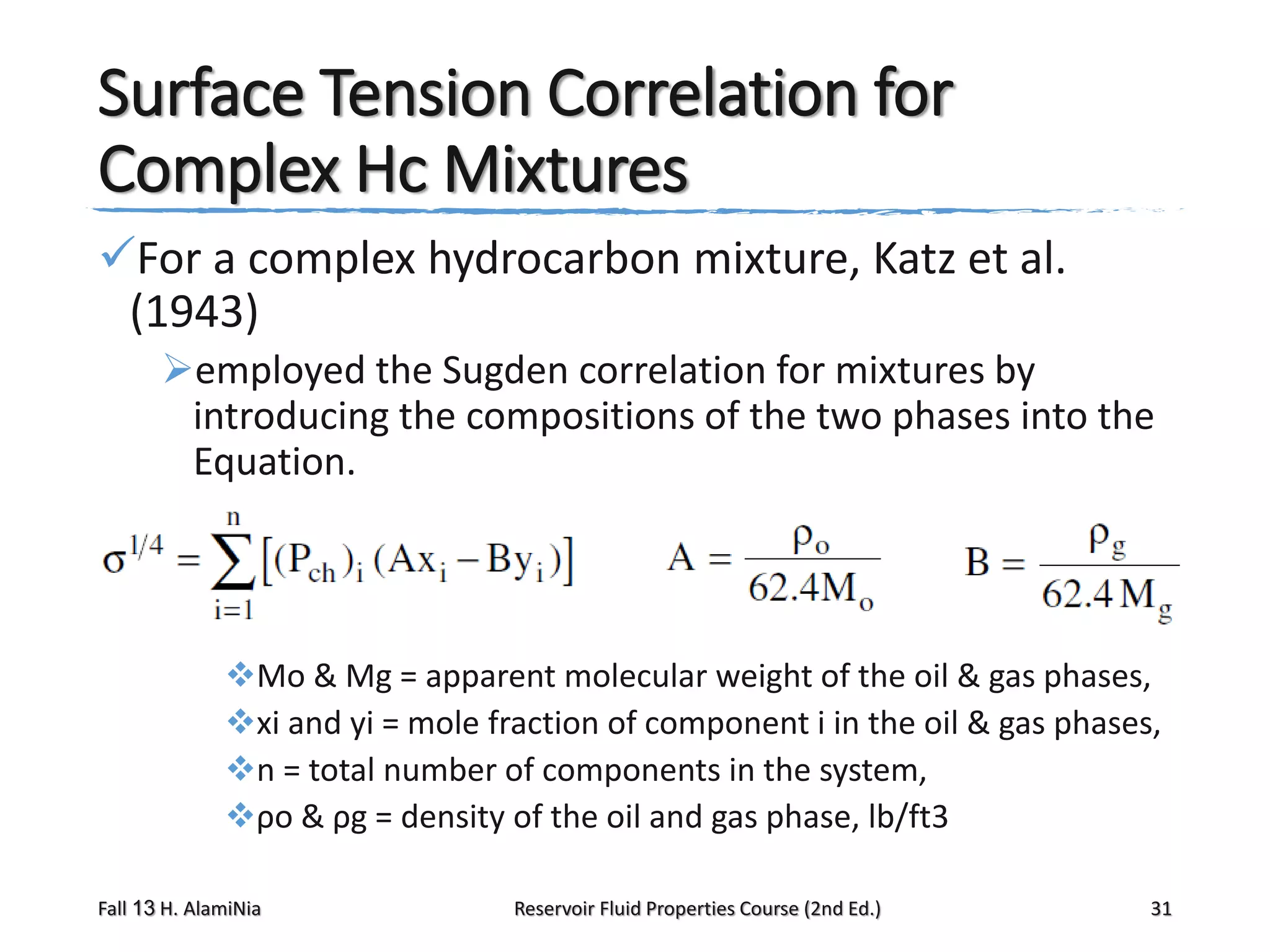
Surface Tension Correlation for
Complex Hc Mixtures
For a complex hydrocarbon mixture, Katz et al.
(1943)
employed the Sugden correlation for mixtures by
introducing the compositions of the two phases into the
Equation.

Mo & Mg = apparent molecular weight of the oil & gas phases,
xi and yi = mole fraction of component i in the oil & gas phases,
n = total number of components in the system,
ρo & ρg = density of the oil and gas phase, lb/ft3
Fall 13 H. AlamiNia

Reservoir Fluid Properties Course (2nd Ed.)

31
Water Formation Volume Factor
The water formation volume factor can be
calculated by the following mathematical
expression:
Where the coefficients A1 − A3 are: (T in °R)

Fall 13 H. AlamiNia

Reservoir Fluid Properties Course (2nd Ed.)

33
μw: Meehan
Meehan (1980) proposed a water viscosity correlation
that accounts for both the effects of P and salinity:

μwT = brine viscosity at 14.7 psi & reservoir temperature T, cp
ws = weight percent of salt in brine, T = temperature in °R

The effect of pressure “p” on the brine viscosity
can be estimated from:
μw = viscosity of the brine at pressure and temperature
Fall 13 H. AlamiNia

Reservoir Fluid Properties Course (2nd Ed.)

34
μw: Brill and Beggs
Brill and Beggs (1978)
presented a simpler equation,
which considers only temperature effects:

T is in °F and
μw is in cP

Fall 13 H. AlamiNia

Reservoir Fluid Properties Course (2nd Ed.)

35
Gas Solubility in Water
The following correlation can be used to determine
the gas solubility in water:

The temperature T is expressed in °F

Fall 13 H. AlamiNia

Reservoir Fluid Properties Course (2nd Ed.)

36
Water Isothermal Compressibility
Brill and Beggs (1978) proposed
the following equation for estimating
water isothermal compressibility,
ignoring the corrections for
dissolved gas and solids:

Fall 13 H. AlamiNia

Reservoir Fluid Properties Course (2nd Ed.)

37
1. Ahmed, T. (2010). Reservoir engineering
handbook (Gulf Professional Publishing).
Chapter 2
Q921 rfp lec8 v1
Q921 rfp lec8 v1

Q921 rfp lec8 v1

  • 1.
  • 2.
    1. Crude OilProperties: A. B. C. D. Formation volume factor for P=<Pb (Bo) Isothermal compressibility coefficient (Co) Formation volume factor for P>Pb (Bo) Density
  • 3.
    1. Crude OilProperties: A. Total formation volume factor (Bt) B. Viscosity (μo) a. Dead-Oil Viscosity b. Saturated(bubble-point)-Oil Viscosity c. Undersaturated-Oil Viscosity C. Surface Tension (σ) 2. Water Properties A. B. C. D. Water Formation Volume Factor (Bw) water viscosity (μw) Gas Solubility in Water (Rsw) Water Isothermal Compressibility (Cw)
  • 5.
    Total Formation VolumeFactor To describe the P-V relationship of hydrocarbon systems below their bubble-point pressure, it is convenient to express this relationship in terms of the total formation volume factor as a function of pressure. the total formation volume factor (Bt) defines the total volume of a system regardless of the number of phases present. is defined as the ratio of the total volume of the hydrocarbon mixture (i.e., oil and gas, if present), at the prevailing pressure and temperature per unit volume of the stock-tank oil. Fall 13 H. AlamiNia Reservoir Fluid Properties Course (2nd Ed.) 5
  • 6.
    Two-Phase Formation VolumeFactor expression Because naturally occurring hydrocarbon systems usually exist in either one or two phases, the term “two-phase formation volume factor” has become synonymous with the total formation volume. Mathematically, Bt is defined by : above the Pb; no free gas exists the expression is reduced to the equation that describes the oil formation volume factor, Bo, that is: Fall 13 H. AlamiNia Reservoir Fluid Properties Course (2nd Ed.) 6
  • 7.
    Bt and Bovs. Pressure A typical plot of Bt as a function of pressure for an undersaturated crude oil. at pressures below the Pb, the difference in the values of the two oil properties represents the volume of the evolved solution gas as measured at system conditions per stock-tank barrel of oil. Fall 13 H. AlamiNia Reservoir Fluid Properties Course (2nd Ed.) 7
  • 8.
    Volume of theFree Gas at P and T Consider a crude oil sample placed in a PVT cell at its bubble-point pressure, Pb, and reservoir temperature. Assume that the volume of the oil sample is sufficient to yield one stock-tank barrel of oil at standard conditions. Let Rsb represent the gas solubility at Pb. If the cell pressure is lowered to p, a portion of the solution gas is evolved and occupies a certain volume of the PVT cell. Let Rs and Bo represent the corresponding gas solubility and oil formation volume factor at p. the term (Rsb – Rs) represents the volume of the free gas as measured in scf per stock-tank barrel of oil. Fall 13 H. AlamiNia Reservoir Fluid Properties Course (2nd Ed.) 8
  • 9.
    Bt Calculation The volumeof There are several the free gas correlations that at the cell conditions is can be used to estimate the two phase formation (Vg)p,T [bbl of gas/STB of volume factor when the experimental oil] and Bg [bbl/scf] data are not available; The volume of the remaining oil three of these methods at the cell condition is are: from the definition Fall 13 H. AlamiNia Standing’s correlations Glaso’s method Marhoun’s correlation Reservoir Fluid Properties Course (2nd Ed.) 9
  • 10.
    Bt: Standing’s and Whitson-BruleCorrelation for predicting Bt Standing (1947) used a total of 387 experimental data points to develop a graphical correlation with a reported average error of 5% In developing his graphical correlation, Standing used a combined correlating parameter by: Whitson and Brule (2000) expressed Standing’s graphical correlation by: Fall 13 H. AlamiNia Reservoir Fluid Properties Course (2nd Ed.) 10
  • 11.
    Bt: Glaso’s Correlation Glaso(1980) developed a generalized correlation for estimating Bt The experimental data on 45 crude oil samples from the North Sea. a standard deviation of 6.54% for Bt correlation Glaso modified Standing’s correlating parameter A* and used a regression analysis model with the exponent C given by: Fall 13 H. AlamiNia Reservoir Fluid Properties Course (2nd Ed.) 11
  • 12.
    Bt: Marhoun’s Correlation Marhoun(1988) Based on 1,556 experimentally determined Bt used a nonlinear multiple-regression model to develop a mathematical expression for Bt. an average absolute error of 4.11% with a standard deviation of 4.94% for the correlation The empirical equation is: with the correlating parameter F given by: a = 0.644516, b = −1.079340, c = 0.724874, d = 2.006210, Fall 13 H. AlamiNia e = − 0.761910 Reservoir Fluid Properties Course (2nd Ed.) 12
  • 14.
    Crude Oil Viscosity Crudeoil viscosity is an important physical property that controls and influences the flow of oil through porous media and pipes. The oil viscosity in general, is defined as the internal resistance of the fluid to flow. is a strong function of the T, P, oil gravity, γg, and Rs. Whenever possible, should be determined by laboratory measurements at reservoir T and P. The viscosity is usually reported in standard PVT analyses. Fall 13 H. AlamiNia Reservoir Fluid Properties Course (2nd Ed.) 14
  • 15.
    Crude Oil ViscosityCalculation In absence of laboratory data, correlations, which usually vary in complexity and accuracy depending upon the available data on the crude oil, may used. According to the pressure, the viscosity of crude oils can be classified into three categories: Dead-Oil Viscosity: the viscosity of crude oil at atmospheric pressure (no gas in solution) and system temperature. Saturated(bubble-point)-Oil Viscosity: the viscosity of the crude oil at the Pb and reservoir T Undersaturated-Oil Viscosity: the viscosity of the crude oil at a P above the Pb and reservoir T Fall 13 H. AlamiNia Reservoir Fluid Properties Course (2nd Ed.) 15
  • 16.
    Estimation of theOil Viscosity Estimation of the oil viscosity at P equal to or below the Pb is a two-step procedure: Step 1. Calculate the viscosity of the oil without dissolved gas (dead oil), μob, at the reservoir T Step 2. Adjust the dead-oil viscosity to account for the effect of the gas solubility at the pressure of interest. At pressures greater than the Pb of the crude oil, another adjustment step, i.e. Step 3, should be made to the bubble-point oil viscosity, μob, to account for the compression and the degree of under-saturation in the reservoir. Fall 13 H. AlamiNia Reservoir Fluid Properties Course (2nd Ed.) 16
  • 17.
    Methods of CalculatingViscosity of the Dead Oil Several empirical methods are proposed to estimate the viscosity of the dead oil, including: Beal’s correlation The Beggs-Robinson correlation Glaso’s correlation Sutton and Farshad (1986) concluded that Glaso’s correlation showed the best accuracy of the three correlations. Fall 13 H. AlamiNia Reservoir Fluid Properties Course (2nd Ed.) 17
  • 18.
    μod: Beal’s Correlation Beal(1946) graphical correlation for determining the viscosity of the dead oil From a total of 753 values for dead-oil viscosity at and above 100°F, as a function of T and the API gravity of the crude Standing (1981) expressed the proposed graphical correlation in a mathematical relationship as follows: μod = viscosity of the dead oil as measured at 14.7 psia and reservoir temperature, cp T = temperature, °R Fall 13 H. AlamiNia Reservoir Fluid Properties Course (2nd Ed.) 18
  • 19.
    μod: The Beggs-RobinsonCorrelation Beggs and Robinson (1975) originated from analyzing 460 dead-oil viscosity measurements. An average error of −0.64% with a standard deviation of 13.53% was reported for the correlation when tested against the data used for its development. Sutton and Farshad (1980) reported an error of 114.3% when the correlation was tested against 93 cases from the literature. Fall 13 H. AlamiNia Reservoir Fluid Properties Course (2nd Ed.) 19
  • 20.
    μod: Glaso’s Correlation Glaso(1980) proposed a generalized mathematical relationship for computing the dead-oil viscosity. from experimental measurements on 26 crude oil samples The above expression can be used within the range of 50–300°F for the system temperature and 20–48° for the API gravity of the crude. Fall 13 H. AlamiNia Reservoir Fluid Properties Course (2nd Ed.) 20
  • 23.
    Methods of Calculating theSaturated Oil Viscosity Several empirical methods are proposed to estimate the viscosity of the saturated oil, including: The Chew-Connally correlation The Beggs-Robinson correlation Fall 13 H. AlamiNia Reservoir Fluid Properties Course (2nd Ed.) 23
  • 24.
    μob: The Chew-Connallycorrelation Chew and Connally (1959) presented a graphical correlation to adjust the dead-oil viscosity according to Rs at saturation pressure. (from 457 crude oil samples) Standing (1977) expressed the correlation:  μob = viscosity of the oil at Pb, cp  μod = viscosity of the dead oil at 14.7 psia and reservoir T, cp The experimental data used by Chew and Connally to develop their correlation encompassed the following ranges of values for the independent variables:  Pressure, psia: 132–5,645, Temperature, °F: 72–292  Rs , scf/STB: 51–3,544, Dead oil viscosity, cp: 0.377–50 Fall 13 H. AlamiNia Reservoir Fluid Properties Course (2nd Ed.) 24
  • 25.
    μob: The Beggs-Robinsoncorrelation Beggs and Robinson (1975) empirical correlation From 2,073 saturated oil viscosity measurements accuracy of −1.83% with a standard deviation of 27.25%. The ranges of the data used to develop Beggs and Robinson’s equation are: Pressure, psia: 132–5,265, Temperature, °F: 70–295 API gravity: 16–58, Gas solubility, scf/STB: 20–2,070 Fall 13 H. AlamiNia Reservoir Fluid Properties Course (2nd Ed.) 25
  • 26.
    Method of Calculating theViscosity of the Undersaturated Oil Oil viscosity at pressures above the bubble point is estimated by first calculating the oil viscosity at its Pb and adjusting the bubble-point viscosity to higher pressures. The Vasquez-Beggs (1980) Correlation From a total of 3,593 data points, The average error of the viscosity correlation is −7.54% The data used have the following ranges: • P, psia: 141–9,151, Rs, scf/STB: 9.3–2,199, • Viscosity, cp: 0.117–148, γg: 0.511–1.351, API : 15.3–59.5 Fall 13 H. AlamiNia Reservoir Fluid Properties Course (2nd Ed.) 26
  • 28.
    Surface/Interfacial Tension The surfacetension is defined as the force exerted on the boundary layer between a liquid phase and a vapor phase per unit length. This force is caused by differences between the molecular forces in the vapor phase and those in the liquid phase, and also by the imbalance of these forces at the interface. The surface tension can be measured in the laboratory and is unusually expressed in dynes per centimeter. The surface tension is an important property in reservoir engineering calculations and designing enhanced oil recovery projects. Fall 13 H. AlamiNia Reservoir Fluid Properties Course (2nd Ed.) 28
  • 29.
    Surface Tension Correlationfor Pure Liquid Sugden (1924) suggested a relationship that correlates the surface tension of a pure liquid in equilibrium with its own vapor. The correlating parameters are molecular weight M of the pure component, the densities of both phases, and a newly introduced temperature independent parameter Pch (parachor). Fall 13 H. AlamiNia Reservoir Fluid Properties Course (2nd Ed.) 29
  • 30.
    Parachor Parameter The parachor isa dimensionless constant characteristic of a pure compound and is calculated by imposing experimentally measured surface tension and density Fanchi’s linear equation data on the Equation and is only valid for components solving for Pch. heavier than methane. The Parachor values for a (Pch) i = 69.9 + 2.3 Mi selected number of pure compounds are given in the Table as reported by Weinaug and Katz (1943). Fall 13 H. AlamiNia Mi = molecular weight of component i (Pch)i = parachor of component i Reservoir Fluid Properties Course (2nd Ed.) 30
  • 31.
    Surface Tension Correlationfor Complex Hc Mixtures For a complex hydrocarbon mixture, Katz et al. (1943) employed the Sugden correlation for mixtures by introducing the compositions of the two phases into the Equation. Mo & Mg = apparent molecular weight of the oil & gas phases, xi and yi = mole fraction of component i in the oil & gas phases, n = total number of components in the system, ρo & ρg = density of the oil and gas phase, lb/ft3 Fall 13 H. AlamiNia Reservoir Fluid Properties Course (2nd Ed.) 31
  • 33.
    Water Formation VolumeFactor The water formation volume factor can be calculated by the following mathematical expression: Where the coefficients A1 − A3 are: (T in °R) Fall 13 H. AlamiNia Reservoir Fluid Properties Course (2nd Ed.) 33
  • 34.
    μw: Meehan Meehan (1980)proposed a water viscosity correlation that accounts for both the effects of P and salinity: μwT = brine viscosity at 14.7 psi & reservoir temperature T, cp ws = weight percent of salt in brine, T = temperature in °R The effect of pressure “p” on the brine viscosity can be estimated from: μw = viscosity of the brine at pressure and temperature Fall 13 H. AlamiNia Reservoir Fluid Properties Course (2nd Ed.) 34
  • 35.
    μw: Brill andBeggs Brill and Beggs (1978) presented a simpler equation, which considers only temperature effects: T is in °F and μw is in cP Fall 13 H. AlamiNia Reservoir Fluid Properties Course (2nd Ed.) 35
  • 36.
    Gas Solubility inWater The following correlation can be used to determine the gas solubility in water: The temperature T is expressed in °F Fall 13 H. AlamiNia Reservoir Fluid Properties Course (2nd Ed.) 36
  • 37.
    Water Isothermal Compressibility Brilland Beggs (1978) proposed the following equation for estimating water isothermal compressibility, ignoring the corrections for dissolved gas and solids: Fall 13 H. AlamiNia Reservoir Fluid Properties Course (2nd Ed.) 37
  • 38.
    1. Ahmed, T.(2010). Reservoir engineering handbook (Gulf Professional Publishing). Chapter 2