Reservoir Fluid Properties Course (2nd Ed.)
1. Crude Oil Properties:
A. Total formation volume factor (Bt)
B. Viscosity (μo)
a. Dead-Oil Viscosity
b. Saturated(bubble-point)-Oil Viscosity
c. Undersaturated-Oil Viscosity

C. Surface Tension (σ)

2. Water Properties
A.
B.
C.
D.

Water Formation Volume Factor (Bw)
water viscosity (μw)
Gas Solubility in Water (Rsw)
Water Isothermal Compressibility (Cw)
1. Laboratory Analysis
2. Laboratory Experiments
A. Constant-Composition Expansion
Laboratory Analysis of Reservoir Fluids
Accurate laboratory studies of PVT and
phase-equilibria behavior of reservoir fluids
are necessary
for characterizing these fluids and
evaluating their volumetric performance
at various pressure levels.

There are many laboratory analyses that
can be made on a reservoir fluid sample.
The amount of data desired determines
the number of tests performed in the laboratory.

Fall 13 H. AlamiNia

Reservoir Fluid Properties Course (2nd Ed.)

5
Types of Laboratory Tests
In general,
there are three types of laboratory tests
used to measure hydrocarbon reservoir samples:
1. Primary tests
(simple, routine field (on-site) tests)
The measurements of the specific gravity and
The gas-oil ratio of the produced hydrocarbon fluids.

2. Routine laboratory tests
3. Special laboratory PVT tests

Fall 13 H. AlamiNia

Reservoir Fluid Properties Course (2nd Ed.)

6
Routine Laboratory Tests
2. Routine laboratory tests
(laboratory tests that are routinely conducted
to characterize the reservoir hydrocarbon fluid)
Compositional analysis of the system
Constant-composition expansion
Differential liberation
Separator tests
Constant-volume depletion

Fall 13 H. AlamiNia

Reservoir Fluid Properties Course (2nd Ed.)

7
Special Laboratory Tests
3. Special laboratory PVT tests
(performed for very specific applications.
If a reservoir is to be depleted
under miscible gas injection or
a gas cycling scheme)
Slim-tube test
Swelling test

Fall 13 H. AlamiNia

Reservoir Fluid Properties Course (2nd Ed.)

8
Composition of the Reservoir Fluid
It is desirable to obtain a fluid sample
as early in the life of a field as possible
so that the sample will closely
approximate the original reservoir fluid.
Collection of a fluid sample early in the life of a field
reduces the chances of free gas existing
in the oil zone of the reservoir.
Most of the parameters measured
in a reservoir fluid study can be calculated
with some degree of accuracy from the composition.
It is the most complete description of reservoir fluid
that can be made.
Fall 13 H. AlamiNia

Reservoir Fluid Properties Course (2nd Ed.)

10
Heavy Components
In the past, reservoir fluid compositions were usually
measured to include separation of
the component methane through hexane,
with the heptanes and heavier components grouped
as a single component

reported with the average molecular weight and density.

With the development of more sophisticated
equations-of-state to calculate fluid properties,
it was learned that a more complete description
of the heavy components was necessary.
It is recommended that compositional analyses
of the reservoir fluid should include a separation
of components through C10 as a minimum.
The more sophisticated research laboratories now
use equations-of-state that require compositions
through C30 or higher.

Fall 13 H. AlamiNia

Reservoir Fluid Properties Course (2nd Ed.)

11
Hydrocarbon Analysis
of Reservoir Fluid Sample
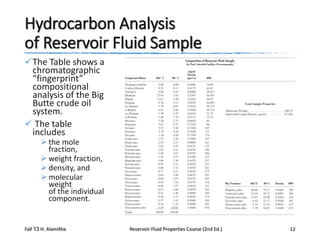
The Table shows a
chromatographic
“fingerprint”
compositional
analysis of the Big
Butte crude oil
system.
 The table
includes
 the mole
fraction,
 weight fraction,
 density, and
 molecular
weight
of the individual
component.

Fall 13 H. AlamiNia

Reservoir Fluid Properties Course (2nd Ed.)

12
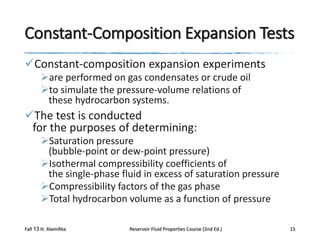
Constant-Composition Expansion Tests
Constant-composition expansion experiments
are performed on gas condensates or crude oil
to simulate the pressure-volume relations of
these hydrocarbon systems.

The test is conducted
for the purposes of determining:
Saturation pressure
(bubble-point or dew-point pressure)
Isothermal compressibility coefficients of
the single-phase fluid in excess of saturation pressure
Compressibility factors of the gas phase
Total hydrocarbon volume as a function of pressure
Fall 13 H. AlamiNia

Reservoir Fluid Properties Course (2nd Ed.)

15
Constant-composition expansion
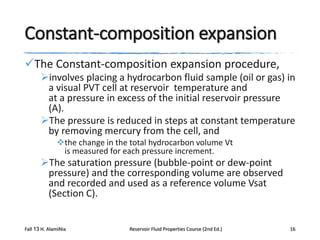
The Constant-composition expansion procedure,
involves placing a hydrocarbon fluid sample (oil or gas) in
a visual PVT cell at reservoir temperature and
at a pressure in excess of the initial reservoir pressure
(A).
The pressure is reduced in steps at constant temperature
by removing mercury from the cell, and
the change in the total hydrocarbon volume Vt
is measured for each pressure increment.

The saturation pressure (bubble-point or dew-point
pressure) and the corresponding volume are observed
and recorded and used as a reference volume Vsat
(Section C).
Fall 13 H. AlamiNia

Reservoir Fluid Properties Course (2nd Ed.)

16
Constant-composition expansion
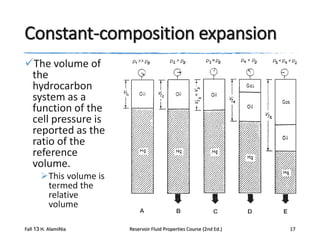
The volume of
the
hydrocarbon
system as a
function of the
cell pressure is
reported as the
ratio of the
reference
volume.
This volume is
termed the
relative
volume
Fall 13 H. AlamiNia

Reservoir Fluid Properties Course (2nd Ed.)

17
relative volume
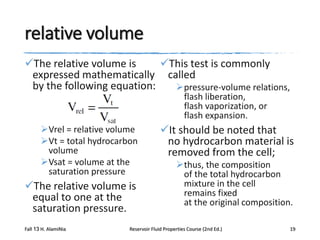
The relative volume is
This test is commonly
expressed mathematically called
by the following equation:
pressure-volume relations,
flash liberation,
flash vaporization, or
flash expansion.

Vrel = relative volume
Vt = total hydrocarbon
volume
Vsat = volume at the
saturation pressure

The relative volume is
equal to one at the
saturation pressure.
Fall 13 H. AlamiNia

It should be noted that
no hydrocarbon material is
removed from the cell;
thus, the composition
of the total hydrocarbon
mixture in the cell
remains fixed
at the original composition.

Reservoir Fluid Properties Course (2nd Ed.)

19
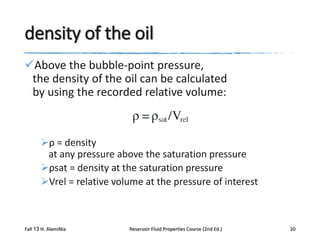
density of the oil
Above the bubble-point pressure,
the density of the oil can be calculated
by using the recorded relative volume:

ρ = density
at any pressure above the saturation pressure
ρsat = density at the saturation pressure
Vrel = relative volume at the pressure of interest

Fall 13 H. AlamiNia

Reservoir Fluid Properties Course (2nd Ed.)

20
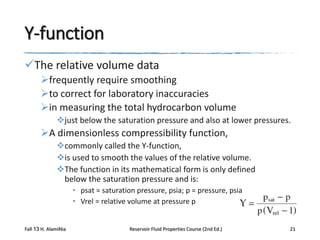
Y-function
The relative volume data
frequently require smoothing
to correct for laboratory inaccuracies
in measuring the total hydrocarbon volume
just below the saturation pressure and also at lower pressures.

A dimensionless compressibility function,
commonly called the Y-function,
is used to smooth the values of the relative volume.
The function in its mathematical form is only defined
below the saturation pressure and is:
• psat = saturation pressure, psia; p = pressure, psia
• Vrel = relative volume at pressure p

Fall 13 H. AlamiNia

Reservoir Fluid Properties Course (2nd Ed.)

21
the Y-function versus pressure
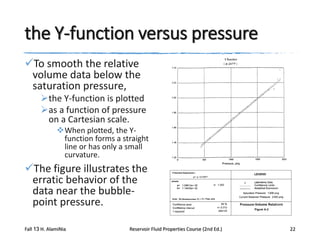
To smooth the relative
volume data below the
saturation pressure,
the Y-function is plotted
as a function of pressure
on a Cartesian scale.
When plotted, the Yfunction forms a straight
line or has only a small
curvature.

The figure illustrates the
erratic behavior of the
data near the bubblepoint pressure.
Fall 13 H. AlamiNia

Reservoir Fluid Properties Course (2nd Ed.)

22
procedure of smoothing and
correcting the relative volume data
The following steps summarize the simple
procedure of smoothing and correcting the relative
volume data:
Step 1. Calculate the Y-function
for all pressures below the saturation pressure
Step 2.
Plot the Y-function versus pressure on a Cartesian scale.
Step 3. Determine the coefficients of
the best straight fit of the data, or: Y = a + bp
where a and b are the intercept and slope of the lines,
respectively.

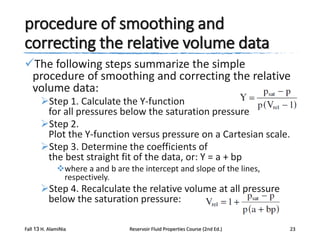
Step 4. Recalculate the relative volume at all pressure
below the saturation pressure:
Fall 13 H. AlamiNia

Reservoir Fluid Properties Course (2nd Ed.)

23
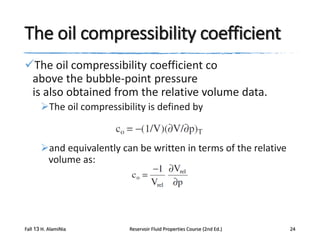
The oil compressibility coefficient
The oil compressibility coefficient co
above the bubble-point pressure
is also obtained from the relative volume data.
The oil compressibility is defined by

and equivalently can be written in terms of the relative
volume as:

Fall 13 H. AlamiNia

Reservoir Fluid Properties Course (2nd Ed.)

24
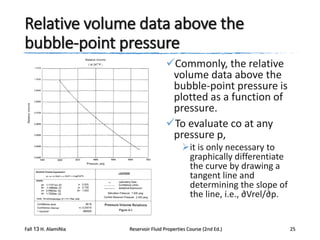
Relative volume data above the
bubble-point pressure
Commonly, the relative
volume data above the
bubble-point pressure is
plotted as a function of
pressure.
To evaluate co at any
pressure p,
it is only necessary to
graphically differentiate
the curve by drawing a
tangent line and
determining the slope of
the line, i.e., ∂Vrel/∂p.

Fall 13 H. AlamiNia

Reservoir Fluid Properties Course (2nd Ed.)

25
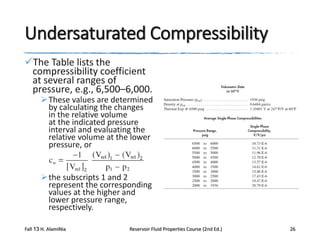
Undersaturated Compressibility
The Table lists the
compressibility coefficient
at several ranges of
pressure, e.g., 6,500–6,000.

 These values are determined
by calculating the changes
in the relative volume
at the indicated pressure
interval and evaluating the
relative volume at the lower
pressure, or

 the subscripts 1 and 2
represent the corresponding
values at the higher and
lower pressure range,
respectively.
Fall 13 H. AlamiNia

Reservoir Fluid Properties Course (2nd Ed.)

26
1. Ahmed, T. (2010). Reservoir engineering
handbook (Gulf Professional Publishing).
Chapter 3
Q921 rfp lec9 v1
Q921 rfp lec9 v1

Q921 rfp lec9 v1

  • 1.
  • 2.
    1. Crude OilProperties: A. Total formation volume factor (Bt) B. Viscosity (μo) a. Dead-Oil Viscosity b. Saturated(bubble-point)-Oil Viscosity c. Undersaturated-Oil Viscosity C. Surface Tension (σ) 2. Water Properties A. B. C. D. Water Formation Volume Factor (Bw) water viscosity (μw) Gas Solubility in Water (Rsw) Water Isothermal Compressibility (Cw)
  • 3.
    1. Laboratory Analysis 2.Laboratory Experiments A. Constant-Composition Expansion
  • 5.
    Laboratory Analysis ofReservoir Fluids Accurate laboratory studies of PVT and phase-equilibria behavior of reservoir fluids are necessary for characterizing these fluids and evaluating their volumetric performance at various pressure levels. There are many laboratory analyses that can be made on a reservoir fluid sample. The amount of data desired determines the number of tests performed in the laboratory. Fall 13 H. AlamiNia Reservoir Fluid Properties Course (2nd Ed.) 5
  • 6.
    Types of LaboratoryTests In general, there are three types of laboratory tests used to measure hydrocarbon reservoir samples: 1. Primary tests (simple, routine field (on-site) tests) The measurements of the specific gravity and The gas-oil ratio of the produced hydrocarbon fluids. 2. Routine laboratory tests 3. Special laboratory PVT tests Fall 13 H. AlamiNia Reservoir Fluid Properties Course (2nd Ed.) 6
  • 7.
    Routine Laboratory Tests 2.Routine laboratory tests (laboratory tests that are routinely conducted to characterize the reservoir hydrocarbon fluid) Compositional analysis of the system Constant-composition expansion Differential liberation Separator tests Constant-volume depletion Fall 13 H. AlamiNia Reservoir Fluid Properties Course (2nd Ed.) 7
  • 8.
    Special Laboratory Tests 3.Special laboratory PVT tests (performed for very specific applications. If a reservoir is to be depleted under miscible gas injection or a gas cycling scheme) Slim-tube test Swelling test Fall 13 H. AlamiNia Reservoir Fluid Properties Course (2nd Ed.) 8
  • 10.
    Composition of theReservoir Fluid It is desirable to obtain a fluid sample as early in the life of a field as possible so that the sample will closely approximate the original reservoir fluid. Collection of a fluid sample early in the life of a field reduces the chances of free gas existing in the oil zone of the reservoir. Most of the parameters measured in a reservoir fluid study can be calculated with some degree of accuracy from the composition. It is the most complete description of reservoir fluid that can be made. Fall 13 H. AlamiNia Reservoir Fluid Properties Course (2nd Ed.) 10
  • 11.
    Heavy Components In thepast, reservoir fluid compositions were usually measured to include separation of the component methane through hexane, with the heptanes and heavier components grouped as a single component reported with the average molecular weight and density. With the development of more sophisticated equations-of-state to calculate fluid properties, it was learned that a more complete description of the heavy components was necessary. It is recommended that compositional analyses of the reservoir fluid should include a separation of components through C10 as a minimum. The more sophisticated research laboratories now use equations-of-state that require compositions through C30 or higher. Fall 13 H. AlamiNia Reservoir Fluid Properties Course (2nd Ed.) 11
  • 12.
    Hydrocarbon Analysis of ReservoirFluid Sample The Table shows a chromatographic “fingerprint” compositional analysis of the Big Butte crude oil system.  The table includes  the mole fraction,  weight fraction,  density, and  molecular weight of the individual component. Fall 13 H. AlamiNia Reservoir Fluid Properties Course (2nd Ed.) 12
  • 15.
    Constant-Composition Expansion Tests Constant-compositionexpansion experiments are performed on gas condensates or crude oil to simulate the pressure-volume relations of these hydrocarbon systems. The test is conducted for the purposes of determining: Saturation pressure (bubble-point or dew-point pressure) Isothermal compressibility coefficients of the single-phase fluid in excess of saturation pressure Compressibility factors of the gas phase Total hydrocarbon volume as a function of pressure Fall 13 H. AlamiNia Reservoir Fluid Properties Course (2nd Ed.) 15
  • 16.
    Constant-composition expansion The Constant-compositionexpansion procedure, involves placing a hydrocarbon fluid sample (oil or gas) in a visual PVT cell at reservoir temperature and at a pressure in excess of the initial reservoir pressure (A). The pressure is reduced in steps at constant temperature by removing mercury from the cell, and the change in the total hydrocarbon volume Vt is measured for each pressure increment. The saturation pressure (bubble-point or dew-point pressure) and the corresponding volume are observed and recorded and used as a reference volume Vsat (Section C). Fall 13 H. AlamiNia Reservoir Fluid Properties Course (2nd Ed.) 16
  • 17.
    Constant-composition expansion The volumeof the hydrocarbon system as a function of the cell pressure is reported as the ratio of the reference volume. This volume is termed the relative volume Fall 13 H. AlamiNia Reservoir Fluid Properties Course (2nd Ed.) 17
  • 19.
    relative volume The relativevolume is This test is commonly expressed mathematically called by the following equation: pressure-volume relations, flash liberation, flash vaporization, or flash expansion. Vrel = relative volume Vt = total hydrocarbon volume Vsat = volume at the saturation pressure The relative volume is equal to one at the saturation pressure. Fall 13 H. AlamiNia It should be noted that no hydrocarbon material is removed from the cell; thus, the composition of the total hydrocarbon mixture in the cell remains fixed at the original composition. Reservoir Fluid Properties Course (2nd Ed.) 19
  • 20.
    density of theoil Above the bubble-point pressure, the density of the oil can be calculated by using the recorded relative volume: ρ = density at any pressure above the saturation pressure ρsat = density at the saturation pressure Vrel = relative volume at the pressure of interest Fall 13 H. AlamiNia Reservoir Fluid Properties Course (2nd Ed.) 20
  • 21.
    Y-function The relative volumedata frequently require smoothing to correct for laboratory inaccuracies in measuring the total hydrocarbon volume just below the saturation pressure and also at lower pressures. A dimensionless compressibility function, commonly called the Y-function, is used to smooth the values of the relative volume. The function in its mathematical form is only defined below the saturation pressure and is: • psat = saturation pressure, psia; p = pressure, psia • Vrel = relative volume at pressure p Fall 13 H. AlamiNia Reservoir Fluid Properties Course (2nd Ed.) 21
  • 22.
    the Y-function versuspressure To smooth the relative volume data below the saturation pressure, the Y-function is plotted as a function of pressure on a Cartesian scale. When plotted, the Yfunction forms a straight line or has only a small curvature. The figure illustrates the erratic behavior of the data near the bubblepoint pressure. Fall 13 H. AlamiNia Reservoir Fluid Properties Course (2nd Ed.) 22
  • 23.
    procedure of smoothingand correcting the relative volume data The following steps summarize the simple procedure of smoothing and correcting the relative volume data: Step 1. Calculate the Y-function for all pressures below the saturation pressure Step 2. Plot the Y-function versus pressure on a Cartesian scale. Step 3. Determine the coefficients of the best straight fit of the data, or: Y = a + bp where a and b are the intercept and slope of the lines, respectively. Step 4. Recalculate the relative volume at all pressure below the saturation pressure: Fall 13 H. AlamiNia Reservoir Fluid Properties Course (2nd Ed.) 23
  • 24.
    The oil compressibilitycoefficient The oil compressibility coefficient co above the bubble-point pressure is also obtained from the relative volume data. The oil compressibility is defined by and equivalently can be written in terms of the relative volume as: Fall 13 H. AlamiNia Reservoir Fluid Properties Course (2nd Ed.) 24
  • 25.
    Relative volume dataabove the bubble-point pressure Commonly, the relative volume data above the bubble-point pressure is plotted as a function of pressure. To evaluate co at any pressure p, it is only necessary to graphically differentiate the curve by drawing a tangent line and determining the slope of the line, i.e., ∂Vrel/∂p. Fall 13 H. AlamiNia Reservoir Fluid Properties Course (2nd Ed.) 25
  • 26.
    Undersaturated Compressibility The Tablelists the compressibility coefficient at several ranges of pressure, e.g., 6,500–6,000.  These values are determined by calculating the changes in the relative volume at the indicated pressure interval and evaluating the relative volume at the lower pressure, or  the subscripts 1 and 2 represent the corresponding values at the higher and lower pressure range, respectively. Fall 13 H. AlamiNia Reservoir Fluid Properties Course (2nd Ed.) 26
  • 27.
    1. Ahmed, T.(2010). Reservoir engineering handbook (Gulf Professional Publishing). Chapter 3