Reservoir Engineering 1 Course (1st Ed.)
1. Gas Properties:
A. Isothermal gas compressibility (Cg)
B. Gas formation volume factor (Bg)

2. Crude Oil Properties:
A.
B.
C.
D.
E.

Density
Solution gas
Bubble-point pressure
Oil formation volume factor (Bo)
Total formation volume factor (Bt)

2013 H. AlamiNia

Reservoir Engineering 1 Course: (Lec4) Oil & Water Properties and Experiments

2
1. Crude Oil Properties:
A. Viscosity
B. Surface Tension

2. Laboratory Analysis
3. Laboratory Experiments

2013 H. AlamiNia

Reservoir Engineering 1 Course: (Lec4) Oil & Water Properties and Experiments

3
Crude Oil Viscosity
Crude oil viscosity is an important physical property
that controls and influences the flow of oil through
porous media and pipes.
The viscosity, in general, is defined as the internal
resistance of the fluid to flow.
The oil viscosity is a strong function of the
temperature, pressure, oil gravity, gas gravity, and
gas solubility.
Whenever possible, oil viscosity should be determined
by laboratory measurements at reservoir temperature
and pressure.
The viscosity is usually reported in standard PVT analyses.
2013 H. AlamiNia

Reservoir Engineering 1 Course: (Lec4) Oil & Water Properties and Experiments

5
Crude Oil Viscosity Calculation
If such laboratory data are not available, engineers may
refer to published correlations, which usually vary in
complexity and accuracy depending upon the available
data on the crude oil. According to the pressure, the
viscosity of crude oils can be classified into three
categories:
Dead-Oil Viscosity: The dead-oil viscosity is defined as the
viscosity of crude oil at atmospheric pressure (no gas in
solution) and system temperature.
Saturated-Oil Viscosity: The saturated (bubble-point)-oil
viscosity is defined as the viscosity of the crude oil at the
bubble-point pressure and reservoir temperature.
Undersaturated-Oil Viscosity: The undersaturated-oil viscosity
is defined as the viscosity of the crude oil at a pressure above
the bubble-point and reservoir temperature.

2013 H. AlamiNia

Reservoir Engineering 1 Course: (Lec4) Oil & Water Properties and Experiments

6
Estimation of the Oil Viscosity
Estimation of the oil viscosity at pressures equal to
or below the bubble point pressure is a two-step
procedure:
Step 1. Calculate the viscosity of the oil without
dissolved gas (dead oil), μob, at the reservoir
temperature.
Step 2. Adjust the dead-oil viscosity to account for the
effect of the gas solubility at the pressure of interest.

At pressures greater than the bubble-point
pressure of the crude oil, another adjustment step,
i.e. Step 3, should be made to the bubble-point oil
viscosity, μob, to account for the compression and
the degree of under-saturation in the reservoir.
2013 H. AlamiNia

Reservoir Engineering 1 Course: (Lec4) Oil & Water Properties and Experiments

7
Methods of Calculating Viscosity of
the Dead Oil
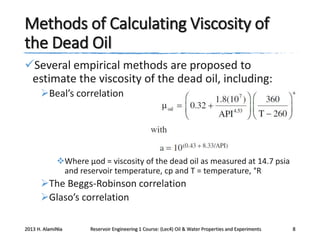
Several empirical methods are proposed to
estimate the viscosity of the dead oil, including:
Beal’s correlation

Where μod = viscosity of the dead oil as measured at 14.7 psia
and reservoir temperature, cp and T = temperature, °R

The Beggs-Robinson correlation
Glaso’s correlation
2013 H. AlamiNia

Reservoir Engineering 1 Course: (Lec4) Oil & Water Properties and Experiments

8
Methods of Calculating
the Saturated Oil Viscosity
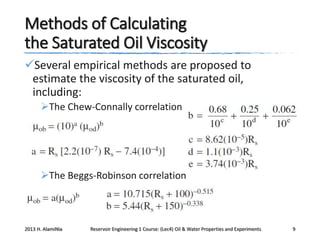
Several empirical methods are proposed to
estimate the viscosity of the saturated oil,
including:
The Chew-Connally correlation

The Beggs-Robinson correlation

2013 H. AlamiNia

Reservoir Engineering 1 Course: (Lec4) Oil & Water Properties and Experiments

9
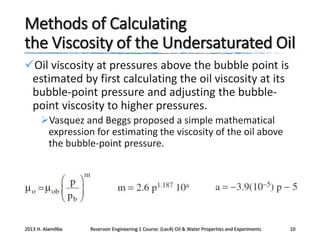
Methods of Calculating
the Viscosity of the Undersaturated Oil
Oil viscosity at pressures above the bubble point is
estimated by first calculating the oil viscosity at its
bubble-point pressure and adjusting the bubblepoint viscosity to higher pressures.
Vasquez and Beggs proposed a simple mathematical
expression for estimating the viscosity of the oil above
the bubble-point pressure.

2013 H. AlamiNia

Reservoir Engineering 1 Course: (Lec4) Oil & Water Properties and Experiments

10
Surface/Interfacial Tension
The surface tension is defined as the force exerted on
the boundary layer between a liquid phase and a vapor
phase per unit length.
This force is caused by differences between the molecular
forces in the vapor phase and those in the liquid phase, and
also by the imbalance of these forces at the interface.

The surface tension can be measured in the laboratory
and is unusually expressed in dynes per centimeter.
The surface tension is an important property in
reservoir engineering calculations and designing
enhanced oil recovery projects.
2013 H. AlamiNia

Reservoir Engineering 1 Course: (Lec4) Oil & Water Properties and Experiments

12
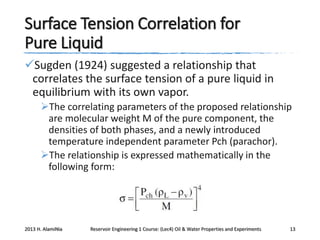
Surface Tension Correlation for
Pure Liquid
Sugden (1924) suggested a relationship that
correlates the surface tension of a pure liquid in
equilibrium with its own vapor.
The correlating parameters of the proposed relationship
are molecular weight M of the pure component, the
densities of both phases, and a newly introduced
temperature independent parameter Pch (parachor).
The relationship is expressed mathematically in the
following form:

2013 H. AlamiNia

Reservoir Engineering 1 Course: (Lec4) Oil & Water Properties and Experiments

13
Parachor Parameter
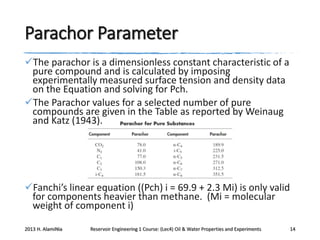
The parachor is a dimensionless constant characteristic of a
pure compound and is calculated by imposing
experimentally measured surface tension and density data
on the Equation and solving for Pch.
The Parachor values for a selected number of pure
compounds are given in the Table as reported by Weinaug
and Katz (1943).

Fanchi’s linear equation ((Pch) i = 69.9 + 2.3 Mi) is only valid
for components heavier than methane. (Mi = molecular
weight of component i)
2013 H. AlamiNia

Reservoir Engineering 1 Course: (Lec4) Oil & Water Properties and Experiments

14
Surface Tension Correlation for
Complex Hc Mixtures
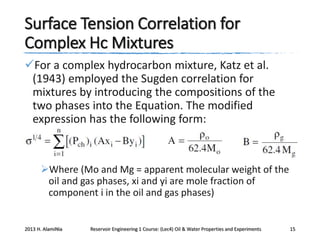
For a complex hydrocarbon mixture, Katz et al.
(1943) employed the Sugden correlation for
mixtures by introducing the compositions of the
two phases into the Equation. The modified
expression has the following form:

Where (Mo and Mg = apparent molecular weight of the
oil and gas phases, xi and yi are mole fraction of
component i in the oil and gas phases)

2013 H. AlamiNia

Reservoir Engineering 1 Course: (Lec4) Oil & Water Properties and Experiments

15
Water Formation Volume Factor
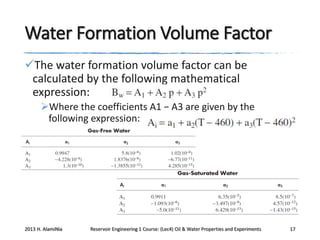
The water formation volume factor can be
calculated by the following mathematical
expression:
Where the coefficients A1 − A3 are given by the
following expression:

2013 H. AlamiNia

Reservoir Engineering 1 Course: (Lec4) Oil & Water Properties and Experiments

17
Water Viscosity
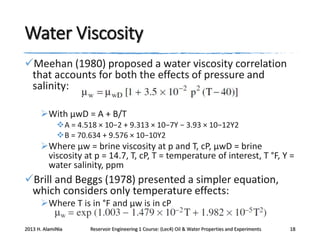
Meehan (1980) proposed a water viscosity correlation
that accounts for both the effects of pressure and
salinity:
With μwD = A + B/T
A = 4.518 × 10⁻² + 9.313 × 10⁻⁷Y − 3.93 × 10⁻¹²Y2
B = 70.634 + 9.576 × 10⁻¹⁰Y2

Where μw = brine viscosity at p and T, cP, μwD = brine
viscosity at p = 14.7, T, cP, T = temperature of interest, T °F, Y =
water salinity, ppm

Brill and Beggs (1978) presented a simpler equation,
which considers only temperature effects:
Where T is in °F and μw is in cP
2013 H. AlamiNia

Reservoir Engineering 1 Course: (Lec4) Oil & Water Properties and Experiments

18
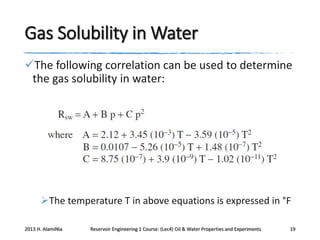
Gas Solubility in Water
The following correlation can be used to determine
the gas solubility in water:

The temperature T in above equations is expressed in °F
2013 H. AlamiNia

Reservoir Engineering 1 Course: (Lec4) Oil & Water Properties and Experiments

19
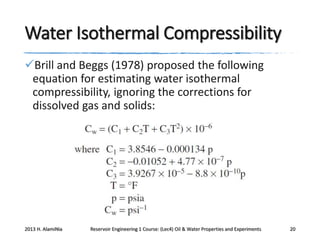
Water Isothermal Compressibility
Brill and Beggs (1978) proposed the following
equation for estimating water isothermal
compressibility, ignoring the corrections for
dissolved gas and solids:

2013 H. AlamiNia

Reservoir Engineering 1 Course: (Lec4) Oil & Water Properties and Experiments

20
Laboratory Analysis of Reservoir Fluids
Accurate laboratory studies of PVT and phaseequilibria behavior of reservoir fluids are necessary
for characterizing these fluids and evaluating their
volumetric performance at various pressure levels.
There are many laboratory analyses that can be
made on a reservoir fluid sample.
The amount of data desired determines the number of
tests performed in the laboratory.

2013 H. AlamiNia

Reservoir Engineering 1 Course: (Lec4) Oil & Water Properties and Experiments

23
Types of Laboratory Tests
In general, there are three types of laboratory tests
used to measure hydrocarbon reservoir samples:
1. Primary tests (simple, routine field (on-site) tests)
The measurements of the specific gravity and
The gas-oil ratio of the produced hydrocarbon fluids.

2. Routine laboratory tests
3. Special laboratory PVT tests

2013 H. AlamiNia

Reservoir Engineering 1 Course: (Lec4) Oil & Water Properties and Experiments

24
Routine Laboratory Tests
2. Routine laboratory tests (laboratory tests that
are routinely conducted to characterize the
reservoir hydrocarbon fluid)
Compositional analysis of the system
Constant-composition expansion
Differential liberation
Separator tests
Constant-volume depletion

2013 H. AlamiNia

Reservoir Engineering 1 Course: (Lec4) Oil & Water Properties and Experiments

25
Special Laboratory Tests
3. Special laboratory PVT tests (performed for very
specific applications. If a reservoir is to be depleted
under miscible gas injection or a gas cycling
scheme)
Slim-tube test
Swelling test

2013 H. AlamiNia

Reservoir Engineering 1 Course: (Lec4) Oil & Water Properties and Experiments

26
Composition of the Reservoir Fluid
It is desirable to obtain a fluid sample as early in
the life of a field as possible so that the sample will
closely approximate the original reservoir fluid.
Collection of a fluid sample early in the life of a field
reduces the chances of free gas existing in the oil zone of
the reservoir.
Most of the parameters measured in a reservoir fluid
study can be calculated with some degree of accuracy
from the composition.
It is the most complete description of reservoir fluid that
can be made.

2013 H. AlamiNia

Reservoir Engineering 1 Course: (Lec4) Oil & Water Properties and Experiments

28
Heavy Components
In the past, reservoir fluid compositions were usually
measured to include separation of the component
methane through hexane, with the heptanes and
heavier components grouped as a single component
reported with the average molecular weight and
density.
With the development of more sophisticated
equations-of-state to calculate fluid properties, it was
learned that a more complete description of the heavy
components was necessary.
It is recommended that compositional analyses of the
reservoir fluid should include a separation of components
through C10 as a minimum.
The more sophisticated research laboratories now use
equations-of-state that require compositions through C30 or
higher.

2013 H. AlamiNia

Reservoir Engineering 1 Course: (Lec4) Oil & Water Properties and Experiments

29
Constant-Composition Expansion Tests
Constant-composition expansion experiments are
performed on gas condensates or crude oil to
simulate the pressure-volume relations of these
hydrocarbon systems. The test is conducted for the
purposes of determining:
Saturation pressure (bubble-point or dew-point
pressure)
Isothermal compressibility coefficients of the singlephase fluid in excess of saturation pressure
Compressibility factors of the gas phase
Total hydrocarbon volume as a function of pressure
2013 H. AlamiNia

Reservoir Engineering 1 Course: (Lec4) Oil & Water Properties and Experiments

30
Differential Liberation (Vaporization)
Test
In the differential liberation process, the solution gas
that is liberated from an oil sample during a decline in
pressure is continuously removed from contact with the
oil, and before establishing equilibrium with the liquid
phase.
This type of liberation is characterized by a varying
composition of the total hydrocarbon system. The
experimental data obtained from the test include:
Amount of gas in solution as a function of pressure
The shrinkage in the oil volume as a function of pressure
Properties of the evolved gas including the composition of the
liberated gas, the gas compressibility factor, and the gas
specific gravity
Density of the remaining oil as a function of pressure

2013 H. AlamiNia

Reservoir Engineering 1 Course: (Lec4) Oil & Water Properties and Experiments

31
Separator Tests
Separator tests are conducted to determine the
changes in the volumetric behavior of the reservoir
fluid as the fluid passes through the separator (or
separators) and then into the stock tank.
The resulting volumetric behavior is influenced to a large
extent by the operating conditions, i.e., pressures and
temperatures, of the surface separation facilities.

2013 H. AlamiNia

Reservoir Engineering 1 Course: (Lec4) Oil & Water Properties and Experiments

32
Objectives of Separator Tests
The primary objective of conducting separator
tests, therefore, is to provide the essential
laboratory information necessary for determining
the optimum surface separation conditions, which
in turn will maximize the stock-tank oil production.
In addition, the results of the test, when
appropriately combined with the differential
liberation test data, provide a means of obtaining
the PVT parameters (Bo, Rs, and Bt) required for
petroleum engineering calculations. These
separator tests are performed only on the original
oil at the bubble point.
2013 H. AlamiNia

Reservoir Engineering 1 Course: (Lec4) Oil & Water Properties and Experiments

33
Extrapolation of Reservoir Fluid Data
In partially depleted reservoirs or in fields that
originally existed at the bubble-point pressure, it is
difficult to obtain a fluid sample, which usually
represents the original oil in the reservoir at the time of
discovery.
Also, in collecting fluid samples from oil wells, the
possibility exists of obtaining samples with a saturation
pressure that might be lower than or higher than the
actual saturation pressure of the reservoir.
In these cases, it is necessary to correct or adjust the
laboratory PVT measured data to reflect the actual
saturation pressure.
2013 H. AlamiNia

Reservoir Engineering 1 Course: (Lec4) Oil & Water Properties and Experiments

34
Laboratory Analysis of
Gas Condensate Systems
In the laboratory, a standard analysis of a gascondensate sample consists of:
Recombination and analysis of separator samples
Measuring the pressure-volume relationship, i.e.,
constant-composition expansion test
Constant-volume depletion test (CVD)

2013 H. AlamiNia

Reservoir Engineering 1 Course: (Lec4) Oil & Water Properties and Experiments

35
Constant-Volume Depletion
Experiment
Constant-volume depletion (CVD) experiments are
performed on
Gas condensates and
Volatile oils

To simulate reservoir depletion performance and
compositional variation.

2013 H. AlamiNia

Reservoir Engineering 1 Course: (Lec4) Oil & Water Properties and Experiments

36
1. Ahmed, T. (2006). Reservoir engineering
handbook (Gulf Professional Publishing). Ch2,3

2013 H. AlamiNia

Reservoir Engineering 1 Course: (Lec4) Oil & Water Properties and Experiments

37
2013 H. AlamiNia

Reservoir Engineering 1 Course: (Lec4) Oil & Water Properties and Experiments

38
Q913 re1 w1 lec 4

Q913 re1 w1 lec 4

  • 1.
    Reservoir Engineering 1Course (1st Ed.)
  • 2.
    1. Gas Properties: A.Isothermal gas compressibility (Cg) B. Gas formation volume factor (Bg) 2. Crude Oil Properties: A. B. C. D. E. Density Solution gas Bubble-point pressure Oil formation volume factor (Bo) Total formation volume factor (Bt) 2013 H. AlamiNia Reservoir Engineering 1 Course: (Lec4) Oil & Water Properties and Experiments 2
  • 3.
    1. Crude OilProperties: A. Viscosity B. Surface Tension 2. Laboratory Analysis 3. Laboratory Experiments 2013 H. AlamiNia Reservoir Engineering 1 Course: (Lec4) Oil & Water Properties and Experiments 3
  • 5.
    Crude Oil Viscosity Crudeoil viscosity is an important physical property that controls and influences the flow of oil through porous media and pipes. The viscosity, in general, is defined as the internal resistance of the fluid to flow. The oil viscosity is a strong function of the temperature, pressure, oil gravity, gas gravity, and gas solubility. Whenever possible, oil viscosity should be determined by laboratory measurements at reservoir temperature and pressure. The viscosity is usually reported in standard PVT analyses. 2013 H. AlamiNia Reservoir Engineering 1 Course: (Lec4) Oil & Water Properties and Experiments 5
  • 6.
    Crude Oil ViscosityCalculation If such laboratory data are not available, engineers may refer to published correlations, which usually vary in complexity and accuracy depending upon the available data on the crude oil. According to the pressure, the viscosity of crude oils can be classified into three categories: Dead-Oil Viscosity: The dead-oil viscosity is defined as the viscosity of crude oil at atmospheric pressure (no gas in solution) and system temperature. Saturated-Oil Viscosity: The saturated (bubble-point)-oil viscosity is defined as the viscosity of the crude oil at the bubble-point pressure and reservoir temperature. Undersaturated-Oil Viscosity: The undersaturated-oil viscosity is defined as the viscosity of the crude oil at a pressure above the bubble-point and reservoir temperature. 2013 H. AlamiNia Reservoir Engineering 1 Course: (Lec4) Oil & Water Properties and Experiments 6
  • 7.
    Estimation of theOil Viscosity Estimation of the oil viscosity at pressures equal to or below the bubble point pressure is a two-step procedure: Step 1. Calculate the viscosity of the oil without dissolved gas (dead oil), μob, at the reservoir temperature. Step 2. Adjust the dead-oil viscosity to account for the effect of the gas solubility at the pressure of interest. At pressures greater than the bubble-point pressure of the crude oil, another adjustment step, i.e. Step 3, should be made to the bubble-point oil viscosity, μob, to account for the compression and the degree of under-saturation in the reservoir. 2013 H. AlamiNia Reservoir Engineering 1 Course: (Lec4) Oil & Water Properties and Experiments 7
  • 8.
    Methods of CalculatingViscosity of the Dead Oil Several empirical methods are proposed to estimate the viscosity of the dead oil, including: Beal’s correlation Where μod = viscosity of the dead oil as measured at 14.7 psia and reservoir temperature, cp and T = temperature, °R The Beggs-Robinson correlation Glaso’s correlation 2013 H. AlamiNia Reservoir Engineering 1 Course: (Lec4) Oil & Water Properties and Experiments 8
  • 9.
    Methods of Calculating theSaturated Oil Viscosity Several empirical methods are proposed to estimate the viscosity of the saturated oil, including: The Chew-Connally correlation The Beggs-Robinson correlation 2013 H. AlamiNia Reservoir Engineering 1 Course: (Lec4) Oil & Water Properties and Experiments 9
  • 10.
    Methods of Calculating theViscosity of the Undersaturated Oil Oil viscosity at pressures above the bubble point is estimated by first calculating the oil viscosity at its bubble-point pressure and adjusting the bubblepoint viscosity to higher pressures. Vasquez and Beggs proposed a simple mathematical expression for estimating the viscosity of the oil above the bubble-point pressure. 2013 H. AlamiNia Reservoir Engineering 1 Course: (Lec4) Oil & Water Properties and Experiments 10
  • 12.
    Surface/Interfacial Tension The surfacetension is defined as the force exerted on the boundary layer between a liquid phase and a vapor phase per unit length. This force is caused by differences between the molecular forces in the vapor phase and those in the liquid phase, and also by the imbalance of these forces at the interface. The surface tension can be measured in the laboratory and is unusually expressed in dynes per centimeter. The surface tension is an important property in reservoir engineering calculations and designing enhanced oil recovery projects. 2013 H. AlamiNia Reservoir Engineering 1 Course: (Lec4) Oil & Water Properties and Experiments 12
  • 13.
    Surface Tension Correlationfor Pure Liquid Sugden (1924) suggested a relationship that correlates the surface tension of a pure liquid in equilibrium with its own vapor. The correlating parameters of the proposed relationship are molecular weight M of the pure component, the densities of both phases, and a newly introduced temperature independent parameter Pch (parachor). The relationship is expressed mathematically in the following form: 2013 H. AlamiNia Reservoir Engineering 1 Course: (Lec4) Oil & Water Properties and Experiments 13
  • 14.
    Parachor Parameter The parachoris a dimensionless constant characteristic of a pure compound and is calculated by imposing experimentally measured surface tension and density data on the Equation and solving for Pch. The Parachor values for a selected number of pure compounds are given in the Table as reported by Weinaug and Katz (1943). Fanchi’s linear equation ((Pch) i = 69.9 + 2.3 Mi) is only valid for components heavier than methane. (Mi = molecular weight of component i) 2013 H. AlamiNia Reservoir Engineering 1 Course: (Lec4) Oil & Water Properties and Experiments 14
  • 15.
    Surface Tension Correlationfor Complex Hc Mixtures For a complex hydrocarbon mixture, Katz et al. (1943) employed the Sugden correlation for mixtures by introducing the compositions of the two phases into the Equation. The modified expression has the following form: Where (Mo and Mg = apparent molecular weight of the oil and gas phases, xi and yi are mole fraction of component i in the oil and gas phases) 2013 H. AlamiNia Reservoir Engineering 1 Course: (Lec4) Oil & Water Properties and Experiments 15
  • 17.
    Water Formation VolumeFactor The water formation volume factor can be calculated by the following mathematical expression: Where the coefficients A1 − A3 are given by the following expression: 2013 H. AlamiNia Reservoir Engineering 1 Course: (Lec4) Oil & Water Properties and Experiments 17
  • 18.
    Water Viscosity Meehan (1980)proposed a water viscosity correlation that accounts for both the effects of pressure and salinity: With μwD = A + B/T A = 4.518 × 10⁻² + 9.313 × 10⁻⁷Y − 3.93 × 10⁻¹²Y2 B = 70.634 + 9.576 × 10⁻¹⁰Y2 Where μw = brine viscosity at p and T, cP, μwD = brine viscosity at p = 14.7, T, cP, T = temperature of interest, T °F, Y = water salinity, ppm Brill and Beggs (1978) presented a simpler equation, which considers only temperature effects: Where T is in °F and μw is in cP 2013 H. AlamiNia Reservoir Engineering 1 Course: (Lec4) Oil & Water Properties and Experiments 18
  • 19.
    Gas Solubility inWater The following correlation can be used to determine the gas solubility in water: The temperature T in above equations is expressed in °F 2013 H. AlamiNia Reservoir Engineering 1 Course: (Lec4) Oil & Water Properties and Experiments 19
  • 20.
    Water Isothermal Compressibility Brilland Beggs (1978) proposed the following equation for estimating water isothermal compressibility, ignoring the corrections for dissolved gas and solids: 2013 H. AlamiNia Reservoir Engineering 1 Course: (Lec4) Oil & Water Properties and Experiments 20
  • 23.
    Laboratory Analysis ofReservoir Fluids Accurate laboratory studies of PVT and phaseequilibria behavior of reservoir fluids are necessary for characterizing these fluids and evaluating their volumetric performance at various pressure levels. There are many laboratory analyses that can be made on a reservoir fluid sample. The amount of data desired determines the number of tests performed in the laboratory. 2013 H. AlamiNia Reservoir Engineering 1 Course: (Lec4) Oil & Water Properties and Experiments 23
  • 24.
    Types of LaboratoryTests In general, there are three types of laboratory tests used to measure hydrocarbon reservoir samples: 1. Primary tests (simple, routine field (on-site) tests) The measurements of the specific gravity and The gas-oil ratio of the produced hydrocarbon fluids. 2. Routine laboratory tests 3. Special laboratory PVT tests 2013 H. AlamiNia Reservoir Engineering 1 Course: (Lec4) Oil & Water Properties and Experiments 24
  • 25.
    Routine Laboratory Tests 2.Routine laboratory tests (laboratory tests that are routinely conducted to characterize the reservoir hydrocarbon fluid) Compositional analysis of the system Constant-composition expansion Differential liberation Separator tests Constant-volume depletion 2013 H. AlamiNia Reservoir Engineering 1 Course: (Lec4) Oil & Water Properties and Experiments 25
  • 26.
    Special Laboratory Tests 3.Special laboratory PVT tests (performed for very specific applications. If a reservoir is to be depleted under miscible gas injection or a gas cycling scheme) Slim-tube test Swelling test 2013 H. AlamiNia Reservoir Engineering 1 Course: (Lec4) Oil & Water Properties and Experiments 26
  • 28.
    Composition of theReservoir Fluid It is desirable to obtain a fluid sample as early in the life of a field as possible so that the sample will closely approximate the original reservoir fluid. Collection of a fluid sample early in the life of a field reduces the chances of free gas existing in the oil zone of the reservoir. Most of the parameters measured in a reservoir fluid study can be calculated with some degree of accuracy from the composition. It is the most complete description of reservoir fluid that can be made. 2013 H. AlamiNia Reservoir Engineering 1 Course: (Lec4) Oil & Water Properties and Experiments 28
  • 29.
    Heavy Components In thepast, reservoir fluid compositions were usually measured to include separation of the component methane through hexane, with the heptanes and heavier components grouped as a single component reported with the average molecular weight and density. With the development of more sophisticated equations-of-state to calculate fluid properties, it was learned that a more complete description of the heavy components was necessary. It is recommended that compositional analyses of the reservoir fluid should include a separation of components through C10 as a minimum. The more sophisticated research laboratories now use equations-of-state that require compositions through C30 or higher. 2013 H. AlamiNia Reservoir Engineering 1 Course: (Lec4) Oil & Water Properties and Experiments 29
  • 30.
    Constant-Composition Expansion Tests Constant-compositionexpansion experiments are performed on gas condensates or crude oil to simulate the pressure-volume relations of these hydrocarbon systems. The test is conducted for the purposes of determining: Saturation pressure (bubble-point or dew-point pressure) Isothermal compressibility coefficients of the singlephase fluid in excess of saturation pressure Compressibility factors of the gas phase Total hydrocarbon volume as a function of pressure 2013 H. AlamiNia Reservoir Engineering 1 Course: (Lec4) Oil & Water Properties and Experiments 30
  • 31.
    Differential Liberation (Vaporization) Test Inthe differential liberation process, the solution gas that is liberated from an oil sample during a decline in pressure is continuously removed from contact with the oil, and before establishing equilibrium with the liquid phase. This type of liberation is characterized by a varying composition of the total hydrocarbon system. The experimental data obtained from the test include: Amount of gas in solution as a function of pressure The shrinkage in the oil volume as a function of pressure Properties of the evolved gas including the composition of the liberated gas, the gas compressibility factor, and the gas specific gravity Density of the remaining oil as a function of pressure 2013 H. AlamiNia Reservoir Engineering 1 Course: (Lec4) Oil & Water Properties and Experiments 31
  • 32.
    Separator Tests Separator testsare conducted to determine the changes in the volumetric behavior of the reservoir fluid as the fluid passes through the separator (or separators) and then into the stock tank. The resulting volumetric behavior is influenced to a large extent by the operating conditions, i.e., pressures and temperatures, of the surface separation facilities. 2013 H. AlamiNia Reservoir Engineering 1 Course: (Lec4) Oil & Water Properties and Experiments 32
  • 33.
    Objectives of SeparatorTests The primary objective of conducting separator tests, therefore, is to provide the essential laboratory information necessary for determining the optimum surface separation conditions, which in turn will maximize the stock-tank oil production. In addition, the results of the test, when appropriately combined with the differential liberation test data, provide a means of obtaining the PVT parameters (Bo, Rs, and Bt) required for petroleum engineering calculations. These separator tests are performed only on the original oil at the bubble point. 2013 H. AlamiNia Reservoir Engineering 1 Course: (Lec4) Oil & Water Properties and Experiments 33
  • 34.
    Extrapolation of ReservoirFluid Data In partially depleted reservoirs or in fields that originally existed at the bubble-point pressure, it is difficult to obtain a fluid sample, which usually represents the original oil in the reservoir at the time of discovery. Also, in collecting fluid samples from oil wells, the possibility exists of obtaining samples with a saturation pressure that might be lower than or higher than the actual saturation pressure of the reservoir. In these cases, it is necessary to correct or adjust the laboratory PVT measured data to reflect the actual saturation pressure. 2013 H. AlamiNia Reservoir Engineering 1 Course: (Lec4) Oil & Water Properties and Experiments 34
  • 35.
    Laboratory Analysis of GasCondensate Systems In the laboratory, a standard analysis of a gascondensate sample consists of: Recombination and analysis of separator samples Measuring the pressure-volume relationship, i.e., constant-composition expansion test Constant-volume depletion test (CVD) 2013 H. AlamiNia Reservoir Engineering 1 Course: (Lec4) Oil & Water Properties and Experiments 35
  • 36.
    Constant-Volume Depletion Experiment Constant-volume depletion(CVD) experiments are performed on Gas condensates and Volatile oils To simulate reservoir depletion performance and compositional variation. 2013 H. AlamiNia Reservoir Engineering 1 Course: (Lec4) Oil & Water Properties and Experiments 36
  • 37.
    1. Ahmed, T.(2006). Reservoir engineering handbook (Gulf Professional Publishing). Ch2,3 2013 H. AlamiNia Reservoir Engineering 1 Course: (Lec4) Oil & Water Properties and Experiments 37
  • 38.
    2013 H. AlamiNia ReservoirEngineering 1 Course: (Lec4) Oil & Water Properties and Experiments 38