Drilling Engineering 1 Course (2nd Ed.)
1. Hoisting System:
A. The Block & Tackle
a. Hook Power
B. Load Applied to the Derrick
2. Drilling Fluid Circulation System
A. Mud Pumps
1. Drilling Fluid Circulation System
A. Mud Pumps (Duplex PDP & Triplex PDP)
B. Solids Control Equipment
a. Mud Cleaners
C. Treatment and Mixing Equipment
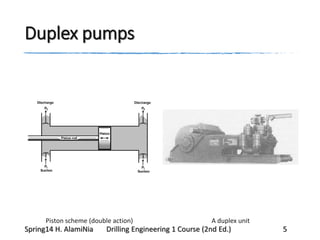
Duplex pumps
Piston scheme (double action) A duplex unit
Spring14 H. AlamiNia Drilling Engineering 1 Course (2nd Ed.) 5
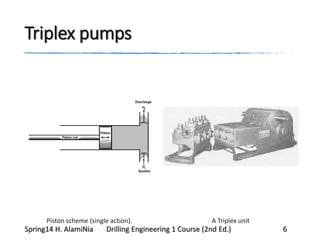
Triplex pumps
Piston scheme (single action). A Triplex unit
Spring14 H. AlamiNia Drilling Engineering 1 Course (2nd Ed.) 6
the pump factor
The duplex mud pump consists of
two double–action cylinders.
This means that drilling mud is pumped
with the forward and backward movement of the barrel.
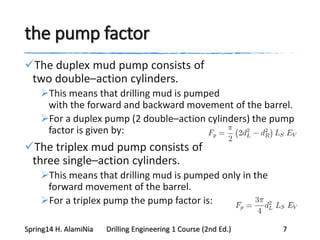
For a duplex pump (2 double–action cylinders) the pump
factor is given by:
The triplex mud pump consists of
three single–action cylinders.
This means that drilling mud is pumped only in the
forward movement of the barrel.
For a triplex pump the pump factor is:
Spring14 H. AlamiNia Drilling Engineering 1 Course (2nd Ed.) 7
Pump Flow Rate
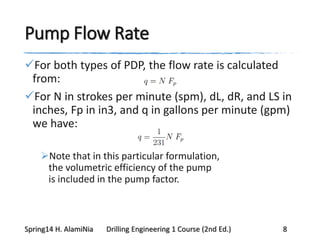
For both types of PDP, the flow rate is calculated
from:
For N in strokes per minute (spm), dL, dR, and LS in
inches, Fp in in3, and q in gallons per minute (gpm)
we have:
Note that in this particular formulation,
the volumetric efficiency of the pump
is included in the pump factor.
Spring14 H. AlamiNia Drilling Engineering 1 Course (2nd Ed.) 8
Pump Power
Pumps convert mechanical power into hydraulic
power. From the definition of power P=Fv
In its motion,
the piston exerts a force [F] on the fluid that is equal to
the pressure differential in the piston Δp times
the area A of the piston, and
the velocity v is equal to
the flow rate q divided by the area A, that is
For PH in hp, p in psi, and q in gpm we have:
Spring14 H. AlamiNia Drilling Engineering 1 Course (2nd Ed.) 9
pump factor & hydraulic power
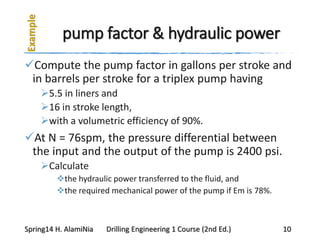
Compute the pump factor in gallons per stroke and
in barrels per stroke for a triplex pump having
5.5 in liners and
16 in stroke length,
with a volumetric efficiency of 90%.
At N = 76spm, the pressure differential between
the input and the output of the pump is 2400 psi.
Calculate
the hydraulic power transferred to the fluid, and
the required mechanical power of the pump if Em is 78%.
Spring14 H. AlamiNia Drilling Engineering 1 Course (2nd Ed.) 10
pump factor & hydraulic
power
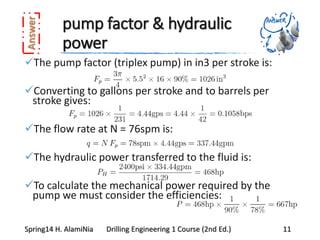
The pump factor (triplex pump) in in3 per stroke is:
Converting to gallons per stroke and to barrels per
stroke gives:
The flow rate at N = 76spm is:
The hydraulic power transferred to the fluid is:
To calculate the mechanical power required by the
pump we must consider the efficiencies:
Spring14 H. AlamiNia Drilling Engineering 1 Course (2nd Ed.) 11
Surge Dampeners
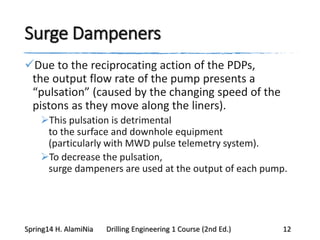
Due to the reciprocating action of the PDPs,
the output flow rate of the pump presents a
“pulsation” (caused by the changing speed of the
pistons as they move along the liners).
This pulsation is detrimental
to the surface and downhole equipment
(particularly with MWD pulse telemetry system).
To decrease the pulsation,
surge dampeners are used at the output of each pump.
Spring14 H. AlamiNia Drilling Engineering 1 Course (2nd Ed.) 12
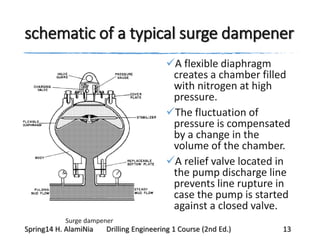
schematic of a typical surge dampener
A flexible diaphragm
creates a chamber filled
with nitrogen at high
pressure.
The fluctuation of
pressure is compensated
by a change in the
volume of the chamber.
A relief valve located in
the pump discharge line
prevents line rupture in
case the pump is started
against a closed valve.
Surge dampener
Spring14 H. AlamiNia Drilling Engineering 1 Course (2nd Ed.) 13
solids control equipment
The purpose of the solids control equipment is
to reduce to a minimum
the amount of inert solids and gases in the drilling fluid.
They are:
Shale shakers,
Degassers,
Desanders (hydrocyclones),
Desilters (hydrocyclones),
Centrifuges,
Mud cleaners.
Spring14 H. AlamiNia Drilling Engineering 1 Course (2nd Ed.) 15
inactive solids effects
Fine particles of inactive solids are continuously
added to the fluid during drilling.
These solids increase the density of the fluid and
also the friction pressure drop, but
do not contribute to the carrying capacity of the fluid.
The amount of inert solids must be kept as low as
possible.
Spring14 H. AlamiNia Drilling Engineering 1 Course (2nd Ed.) 16
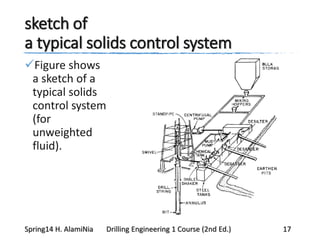
sketch of
a typical solids control system
Figure shows
a sketch of a
typical solids
control system
(for
unweighted
fluid).
Spring14 H. AlamiNia Drilling Engineering 1 Course (2nd Ed.) 17
shale shaker mechanism
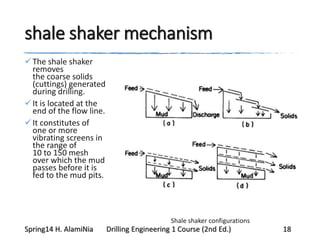
The shale shaker
removes
the coarse solids
(cuttings) generated
during drilling.
It is located at the
end of the flow line.
It constitutes of
one or more
vibrating screens in
the range of
10 to 150 mesh
over which the mud
passes before it is
fed to the mud pits.
Shale shaker configurations
Spring14 H. AlamiNia Drilling Engineering 1 Course (2nd Ed.) 18
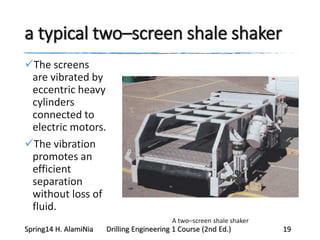
a typical two–screen shale shaker
The screens
are vibrated by
eccentric heavy
cylinders
connected to
electric motors.
The vibration
promotes an
efficient
separation
without loss of
fluid.
A two–screen shale shaker
Spring14 H. AlamiNia Drilling Engineering 1 Course (2nd Ed.) 19
Degassers
Gases that might enter the fluid
must also be removed.
Even when the fluid is overbalanced,
the gas contained in the rock cut by the bit
will enter the fluid and must be removed.
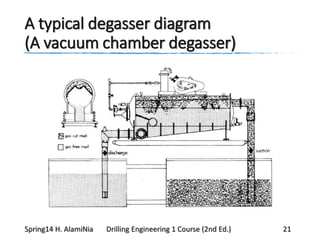
The degasser removes gas from the gas cut fluid
by creating a vacuum in a vacuum chamber.
The fluid flows down an inclined flat surface
as a thin layer.
The vacuum enlarges and coalesce the bubbles.
Degassed fluid is draw from chamber
by a fluid jet located at the discharge line.
Spring14 H. AlamiNia Drilling Engineering 1 Course (2nd Ed.) 20
A typical degasser diagram
(A vacuum chamber degasser)
Spring14 H. AlamiNia Drilling Engineering 1 Course (2nd Ed.) 21
Hydrocyclones
(Desanders and Desilters)
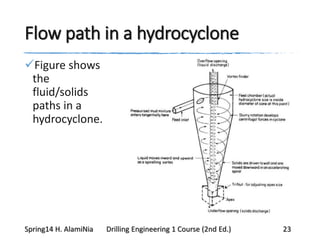
Hydrocyclones are simple devices with no internal moving parts.
The drilling fluid enters the device through a tangential opening in
the cylindrical section, impelled by a centrifugal pump.
The centrifugal force generated by the whirling motion pushes the
solid particles towards the internal wall of the inverted cone.
As the whirling flux moves downwards the rotating speed
increased and the diameters decreases.
The fluid free of solid particles is “squeezed” out of the flow and
swirls upwards in a vortex motion, leaving the hydrocyclone from
the upper exit.
The solids leave the hydrocyclone from the apex of the cone
(underflow).
For maximum efficiency, the discharge from the apex exit of
hydrocyclone should be in a spray in the shape of a hollow cone
rather than a rope shape.
Spring14 H. AlamiNia Drilling Engineering 1 Course (2nd Ed.) 22
Flow path in a hydrocyclone
Figure shows
the
fluid/solids
paths in a
hydrocyclone.
Spring14 H. AlamiNia Drilling Engineering 1 Course (2nd Ed.) 23
Hydrocyclone classifications
Hydrocyclones are classified
according to the size of the particles removed as
desanders (cut point in the 40–45μm size range) or
desilters (cut point in the 10–20μm size range).
At the cut point of a hydrocyclone
50% of the particles of that size is discarded.
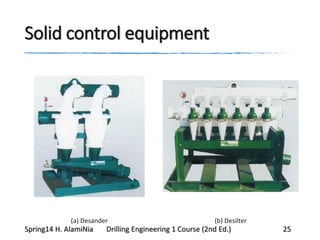
The desander
is a set of two or three 8in or 10in hydrocyclones, and are
positioned after the shale shaker and the degasser (if used).
The desilter
is a set of eight to twelve 4in or 5in hydrocyclones.
It removes particles that can not be removed by the desander.
Spring14 H. AlamiNia Drilling Engineering 1 Course (2nd Ed.) 24
Solid control equipment
(a) Desander (b) Desilter
Spring14 H. AlamiNia Drilling Engineering 1 Course (2nd Ed.) 25
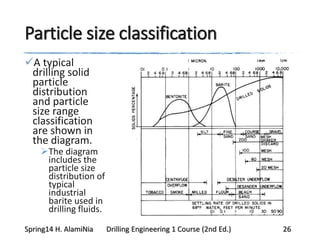
Particle size classification
A typical
drilling solid
particle
distribution
and particle
size range
classification
are shown in
the diagram.
The diagram
includes the
particle size
distribution of
typical
industrial
barite used in
drilling fluids.
Spring14 H. AlamiNia Drilling Engineering 1 Course (2nd Ed.) 26
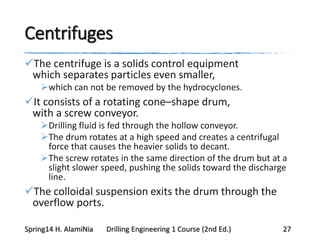
Centrifuges
The centrifuge is a solids control equipment
which separates particles even smaller,
which can not be removed by the hydrocyclones.
It consists of a rotating cone–shape drum,
with a screw conveyor.
Drilling fluid is fed through the hollow conveyor.
The drum rotates at a high speed and creates a centrifugal
force that causes the heavier solids to decant.
The screw rotates in the same direction of the drum but at a
slight slower speed, pushing the solids toward the discharge
line.
The colloidal suspension exits the drum through the
overflow ports.
Spring14 H. AlamiNia Drilling Engineering 1 Course (2nd Ed.) 27
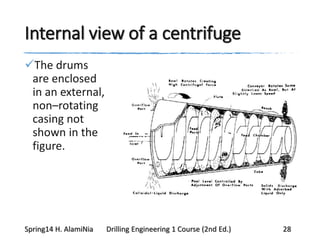
Internal view of a centrifuge
The drums
are enclosed
in an external,
non–rotating
casing not
shown in the
figure.
Spring14 H. AlamiNia Drilling Engineering 1 Course (2nd Ed.) 28
mud cleaner
Inert solids in weighted fluid
(drilling fluid with weight material like
barite, iron oxide, etc)
can not be treated with hydrocyclones alone
because the particle sizes of the weighting material are
within the operational range of desanders and desilters.
Weighting material are relatively expensive additives,
which must be saved.
A mud cleaner is a desilter unit in which
the underflow is further processed by a fine
vibrating screen, mounted directly under the cones.
Spring14 H. AlamiNia Drilling Engineering 1 Course (2nd Ed.) 31
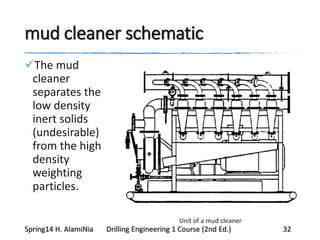
mud cleaner schematic
The mud
cleaner
separates the
low density
inert solids
(undesirable)
from the high
density
weighting
particles.
Unit of a mud cleaner
Spring14 H. AlamiNia Drilling Engineering 1 Course (2nd Ed.) 32
Hydrocyclones
Hydrocyclones discriminate light particles from
heavy particles.
Bentonite are lighter than formation solids
because they are of colloidal size
(although of the same density).
Barite particles are smaller than formation solids
because they are denser.
The desilter
removes the barite and
the formation solids particles in the underflow,
leaving only a clean mud
with bentonite particles
in a colloidal suspension in the overflow.
Spring14 H. AlamiNia Drilling Engineering 1 Course (2nd Ed.) 33
Hydrocyclones (Cont.)
The thick slurry in the underflow
goes to the fine screen,
which separate the large (low density) particles
(formation solids)
from the small (high density) barite particles,
thus conserving weighting agent and the liquid phase
but at the same time returning many fine solids to the
active system.
The thick barite rich slurry is treated with dilution
and mixed with the clean mud (colloidal bentonite).
The resulting mud is treated
to the right density and viscosity and
re–circulates in the hole.
Spring14 H. AlamiNia Drilling Engineering 1 Course (2nd Ed.) 34
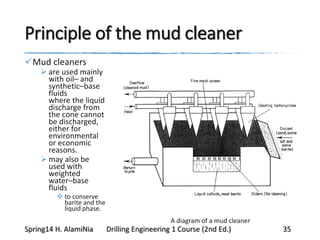
Principle of the mud cleaner
Mud cleaners
 are used mainly
with oil– and
synthetic–base
fluids
where the liquid
discharge from
the cone cannot
be discharged,
either for
environmental
or economic
reasons.
 may also be
used with
weighted
water–base
fluids
 to conserve
barite and the
liquid phase.
A diagram of a mud cleaner
Spring14 H. AlamiNia Drilling Engineering 1 Course (2nd Ed.) 35
Drilling fluid components
Drilling fluid is usually a suspension of clay
(sodium bentonite) in water.
Higher density fluids can be obtained
by adding finely granulated (fine sand to silt size)
barite (BaSO4).
Various chemicals or additives are also used
in different situations.
The drilling fluid continuous phase is usually water
(freshwater or brine) called water–base fluids.
When the continuous phase is oil
(emulsion of water in oil) it is called oil–base fluid.
Spring14 H. AlamiNia Drilling Engineering 1 Course (2nd Ed.) 37
Mixing Equipment
Water base fluids are normally made at the rig site
(oil base mud and synthetic fluids
are normally manufactured in a drilling fluid plant).
Special treatment and
mixing equipment exists for this purpose.
Tank agitators, mud guns, mixing hoppers, and
other equipment are used for these purposes.
Spring14 H. AlamiNia Drilling Engineering 1 Course (2nd Ed.) 38
drilling fluids physical properties
blenders
The basic drilling fluids physical properties are density,
viscosity, and filtrate.
Fresh water density is 8.37 pounds per gallon (ppg).
Bentonite adds viscosity to the fluids and also increases the
density to about 9 to 10 ppg.
Higher density (15 to 20 ppg) is obtained with barite, iron

oxide, or any other dense fine ground material.
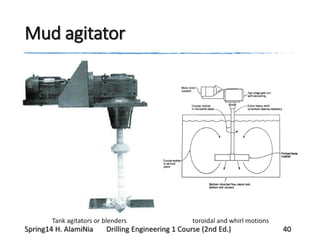
Tank agitators or blenders
are located in the mud tanks
to homogenize the fluid in the tank.
help to keep the various suspended material
homogeneously distributed in the tank
by forcing toroidal and whirl motions of the fluid in the tank.
Spring14 H. AlamiNia Drilling Engineering 1 Course (2nd Ed.) 39
Mud agitator
Tank agitators or blenders toroidal and whirl motions
Spring14 H. AlamiNia Drilling Engineering 1 Course (2nd Ed.) 40
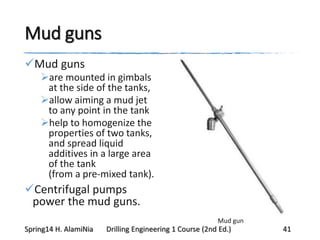
Mud guns
Mud guns
are mounted in gimbals
at the side of the tanks,
allow aiming a mud jet
to any point in the tank
help to homogenize the
properties of two tanks,
and spread liquid
additives in a large area
of the tank
(from a pre-mixed tank).
Centrifugal pumps
power the mud guns.
Mud gun
Spring14 H. AlamiNia Drilling Engineering 1 Course (2nd Ed.) 41
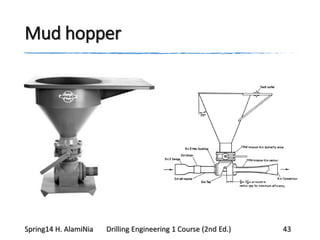
mixing hopper
The mixing hopper
allows adding powder substances and
additives in the mud system.
The hopper is connected to a Venturi pipe.
Mud is circulated by centrifugal pumps and
passes in the Venturi at high speed,
sucking the substance into the system.
Spring14 H. AlamiNia Drilling Engineering 1 Course (2nd Ed.) 42
Mud hopper
Spring14 H. AlamiNia Drilling Engineering 1 Course (2nd Ed.) 43
1. Jorge H.B. Sampaio Jr. “Drilling Engineering
Fundamentals.” Master of Petroleum
Engineering. Curtin University of Technology,
2007. Chapter 2
1. The Rotary System
A. Introduction
B. Kelly, Kelly Valves, and Kelly Saver Sub
C. Rotary Table and Components
2. Well Control System
3. Well Monitoring System
Q922+de1+l05 v1

Q922+de1+l05 v1

  • 1.
    Drilling Engineering 1Course (2nd Ed.)
  • 2.
    1. Hoisting System: A.The Block & Tackle a. Hook Power B. Load Applied to the Derrick 2. Drilling Fluid Circulation System A. Mud Pumps
  • 3.
    1. Drilling FluidCirculation System A. Mud Pumps (Duplex PDP & Triplex PDP) B. Solids Control Equipment a. Mud Cleaners C. Treatment and Mixing Equipment
  • 5.
    Duplex pumps Piston scheme(double action) A duplex unit Spring14 H. AlamiNia Drilling Engineering 1 Course (2nd Ed.) 5
  • 6.
    Triplex pumps Piston scheme(single action). A Triplex unit Spring14 H. AlamiNia Drilling Engineering 1 Course (2nd Ed.) 6
  • 7.
    the pump factor Theduplex mud pump consists of two double–action cylinders. This means that drilling mud is pumped with the forward and backward movement of the barrel. For a duplex pump (2 double–action cylinders) the pump factor is given by: The triplex mud pump consists of three single–action cylinders. This means that drilling mud is pumped only in the forward movement of the barrel. For a triplex pump the pump factor is: Spring14 H. AlamiNia Drilling Engineering 1 Course (2nd Ed.) 7
  • 8.
    Pump Flow Rate Forboth types of PDP, the flow rate is calculated from: For N in strokes per minute (spm), dL, dR, and LS in inches, Fp in in3, and q in gallons per minute (gpm) we have: Note that in this particular formulation, the volumetric efficiency of the pump is included in the pump factor. Spring14 H. AlamiNia Drilling Engineering 1 Course (2nd Ed.) 8
  • 9.
    Pump Power Pumps convertmechanical power into hydraulic power. From the definition of power P=Fv In its motion, the piston exerts a force [F] on the fluid that is equal to the pressure differential in the piston Δp times the area A of the piston, and the velocity v is equal to the flow rate q divided by the area A, that is For PH in hp, p in psi, and q in gpm we have: Spring14 H. AlamiNia Drilling Engineering 1 Course (2nd Ed.) 9
  • 10.
    pump factor &hydraulic power Compute the pump factor in gallons per stroke and in barrels per stroke for a triplex pump having 5.5 in liners and 16 in stroke length, with a volumetric efficiency of 90%. At N = 76spm, the pressure differential between the input and the output of the pump is 2400 psi. Calculate the hydraulic power transferred to the fluid, and the required mechanical power of the pump if Em is 78%. Spring14 H. AlamiNia Drilling Engineering 1 Course (2nd Ed.) 10
  • 11.
    pump factor &hydraulic power The pump factor (triplex pump) in in3 per stroke is: Converting to gallons per stroke and to barrels per stroke gives: The flow rate at N = 76spm is: The hydraulic power transferred to the fluid is: To calculate the mechanical power required by the pump we must consider the efficiencies: Spring14 H. AlamiNia Drilling Engineering 1 Course (2nd Ed.) 11
  • 12.
    Surge Dampeners Due tothe reciprocating action of the PDPs, the output flow rate of the pump presents a “pulsation” (caused by the changing speed of the pistons as they move along the liners). This pulsation is detrimental to the surface and downhole equipment (particularly with MWD pulse telemetry system). To decrease the pulsation, surge dampeners are used at the output of each pump. Spring14 H. AlamiNia Drilling Engineering 1 Course (2nd Ed.) 12
  • 13.
    schematic of atypical surge dampener A flexible diaphragm creates a chamber filled with nitrogen at high pressure. The fluctuation of pressure is compensated by a change in the volume of the chamber. A relief valve located in the pump discharge line prevents line rupture in case the pump is started against a closed valve. Surge dampener Spring14 H. AlamiNia Drilling Engineering 1 Course (2nd Ed.) 13
  • 15.
    solids control equipment Thepurpose of the solids control equipment is to reduce to a minimum the amount of inert solids and gases in the drilling fluid. They are: Shale shakers, Degassers, Desanders (hydrocyclones), Desilters (hydrocyclones), Centrifuges, Mud cleaners. Spring14 H. AlamiNia Drilling Engineering 1 Course (2nd Ed.) 15
  • 16.
    inactive solids effects Fineparticles of inactive solids are continuously added to the fluid during drilling. These solids increase the density of the fluid and also the friction pressure drop, but do not contribute to the carrying capacity of the fluid. The amount of inert solids must be kept as low as possible. Spring14 H. AlamiNia Drilling Engineering 1 Course (2nd Ed.) 16
  • 17.
    sketch of a typicalsolids control system Figure shows a sketch of a typical solids control system (for unweighted fluid). Spring14 H. AlamiNia Drilling Engineering 1 Course (2nd Ed.) 17
  • 18.
    shale shaker mechanism Theshale shaker removes the coarse solids (cuttings) generated during drilling. It is located at the end of the flow line. It constitutes of one or more vibrating screens in the range of 10 to 150 mesh over which the mud passes before it is fed to the mud pits. Shale shaker configurations Spring14 H. AlamiNia Drilling Engineering 1 Course (2nd Ed.) 18
  • 19.
    a typical two–screenshale shaker The screens are vibrated by eccentric heavy cylinders connected to electric motors. The vibration promotes an efficient separation without loss of fluid. A two–screen shale shaker Spring14 H. AlamiNia Drilling Engineering 1 Course (2nd Ed.) 19
  • 20.
    Degassers Gases that mightenter the fluid must also be removed. Even when the fluid is overbalanced, the gas contained in the rock cut by the bit will enter the fluid and must be removed. The degasser removes gas from the gas cut fluid by creating a vacuum in a vacuum chamber. The fluid flows down an inclined flat surface as a thin layer. The vacuum enlarges and coalesce the bubbles. Degassed fluid is draw from chamber by a fluid jet located at the discharge line. Spring14 H. AlamiNia Drilling Engineering 1 Course (2nd Ed.) 20
  • 21.
    A typical degasserdiagram (A vacuum chamber degasser) Spring14 H. AlamiNia Drilling Engineering 1 Course (2nd Ed.) 21
  • 22.
    Hydrocyclones (Desanders and Desilters) Hydrocyclonesare simple devices with no internal moving parts. The drilling fluid enters the device through a tangential opening in the cylindrical section, impelled by a centrifugal pump. The centrifugal force generated by the whirling motion pushes the solid particles towards the internal wall of the inverted cone. As the whirling flux moves downwards the rotating speed increased and the diameters decreases. The fluid free of solid particles is “squeezed” out of the flow and swirls upwards in a vortex motion, leaving the hydrocyclone from the upper exit. The solids leave the hydrocyclone from the apex of the cone (underflow). For maximum efficiency, the discharge from the apex exit of hydrocyclone should be in a spray in the shape of a hollow cone rather than a rope shape. Spring14 H. AlamiNia Drilling Engineering 1 Course (2nd Ed.) 22
  • 23.
    Flow path ina hydrocyclone Figure shows the fluid/solids paths in a hydrocyclone. Spring14 H. AlamiNia Drilling Engineering 1 Course (2nd Ed.) 23
  • 24.
    Hydrocyclone classifications Hydrocyclones areclassified according to the size of the particles removed as desanders (cut point in the 40–45μm size range) or desilters (cut point in the 10–20μm size range). At the cut point of a hydrocyclone 50% of the particles of that size is discarded. The desander is a set of two or three 8in or 10in hydrocyclones, and are positioned after the shale shaker and the degasser (if used). The desilter is a set of eight to twelve 4in or 5in hydrocyclones. It removes particles that can not be removed by the desander. Spring14 H. AlamiNia Drilling Engineering 1 Course (2nd Ed.) 24
  • 25.
    Solid control equipment (a)Desander (b) Desilter Spring14 H. AlamiNia Drilling Engineering 1 Course (2nd Ed.) 25
  • 26.
    Particle size classification Atypical drilling solid particle distribution and particle size range classification are shown in the diagram. The diagram includes the particle size distribution of typical industrial barite used in drilling fluids. Spring14 H. AlamiNia Drilling Engineering 1 Course (2nd Ed.) 26
  • 27.
    Centrifuges The centrifuge isa solids control equipment which separates particles even smaller, which can not be removed by the hydrocyclones. It consists of a rotating cone–shape drum, with a screw conveyor. Drilling fluid is fed through the hollow conveyor. The drum rotates at a high speed and creates a centrifugal force that causes the heavier solids to decant. The screw rotates in the same direction of the drum but at a slight slower speed, pushing the solids toward the discharge line. The colloidal suspension exits the drum through the overflow ports. Spring14 H. AlamiNia Drilling Engineering 1 Course (2nd Ed.) 27
  • 28.
    Internal view ofa centrifuge The drums are enclosed in an external, non–rotating casing not shown in the figure. Spring14 H. AlamiNia Drilling Engineering 1 Course (2nd Ed.) 28
  • 31.
    mud cleaner Inert solidsin weighted fluid (drilling fluid with weight material like barite, iron oxide, etc) can not be treated with hydrocyclones alone because the particle sizes of the weighting material are within the operational range of desanders and desilters. Weighting material are relatively expensive additives, which must be saved. A mud cleaner is a desilter unit in which the underflow is further processed by a fine vibrating screen, mounted directly under the cones. Spring14 H. AlamiNia Drilling Engineering 1 Course (2nd Ed.) 31
  • 32.
    mud cleaner schematic Themud cleaner separates the low density inert solids (undesirable) from the high density weighting particles. Unit of a mud cleaner Spring14 H. AlamiNia Drilling Engineering 1 Course (2nd Ed.) 32
  • 33.
    Hydrocyclones Hydrocyclones discriminate lightparticles from heavy particles. Bentonite are lighter than formation solids because they are of colloidal size (although of the same density). Barite particles are smaller than formation solids because they are denser. The desilter removes the barite and the formation solids particles in the underflow, leaving only a clean mud with bentonite particles in a colloidal suspension in the overflow. Spring14 H. AlamiNia Drilling Engineering 1 Course (2nd Ed.) 33
  • 34.
    Hydrocyclones (Cont.) The thickslurry in the underflow goes to the fine screen, which separate the large (low density) particles (formation solids) from the small (high density) barite particles, thus conserving weighting agent and the liquid phase but at the same time returning many fine solids to the active system. The thick barite rich slurry is treated with dilution and mixed with the clean mud (colloidal bentonite). The resulting mud is treated to the right density and viscosity and re–circulates in the hole. Spring14 H. AlamiNia Drilling Engineering 1 Course (2nd Ed.) 34
  • 35.
    Principle of themud cleaner Mud cleaners  are used mainly with oil– and synthetic–base fluids where the liquid discharge from the cone cannot be discharged, either for environmental or economic reasons.  may also be used with weighted water–base fluids  to conserve barite and the liquid phase. A diagram of a mud cleaner Spring14 H. AlamiNia Drilling Engineering 1 Course (2nd Ed.) 35
  • 37.
    Drilling fluid components Drillingfluid is usually a suspension of clay (sodium bentonite) in water. Higher density fluids can be obtained by adding finely granulated (fine sand to silt size) barite (BaSO4). Various chemicals or additives are also used in different situations. The drilling fluid continuous phase is usually water (freshwater or brine) called water–base fluids. When the continuous phase is oil (emulsion of water in oil) it is called oil–base fluid. Spring14 H. AlamiNia Drilling Engineering 1 Course (2nd Ed.) 37
  • 38.
    Mixing Equipment Water basefluids are normally made at the rig site (oil base mud and synthetic fluids are normally manufactured in a drilling fluid plant). Special treatment and mixing equipment exists for this purpose. Tank agitators, mud guns, mixing hoppers, and other equipment are used for these purposes. Spring14 H. AlamiNia Drilling Engineering 1 Course (2nd Ed.) 38
  • 39.
    drilling fluids physicalproperties blenders The basic drilling fluids physical properties are density, viscosity, and filtrate. Fresh water density is 8.37 pounds per gallon (ppg). Bentonite adds viscosity to the fluids and also increases the density to about 9 to 10 ppg. Higher density (15 to 20 ppg) is obtained with barite, iron oxide, or any other dense fine ground material. Tank agitators or blenders are located in the mud tanks to homogenize the fluid in the tank. help to keep the various suspended material homogeneously distributed in the tank by forcing toroidal and whirl motions of the fluid in the tank. Spring14 H. AlamiNia Drilling Engineering 1 Course (2nd Ed.) 39
  • 40.
    Mud agitator Tank agitatorsor blenders toroidal and whirl motions Spring14 H. AlamiNia Drilling Engineering 1 Course (2nd Ed.) 40
  • 41.
    Mud guns Mud guns aremounted in gimbals at the side of the tanks, allow aiming a mud jet to any point in the tank help to homogenize the properties of two tanks, and spread liquid additives in a large area of the tank (from a pre-mixed tank). Centrifugal pumps power the mud guns. Mud gun Spring14 H. AlamiNia Drilling Engineering 1 Course (2nd Ed.) 41
  • 42.
    mixing hopper The mixinghopper allows adding powder substances and additives in the mud system. The hopper is connected to a Venturi pipe. Mud is circulated by centrifugal pumps and passes in the Venturi at high speed, sucking the substance into the system. Spring14 H. AlamiNia Drilling Engineering 1 Course (2nd Ed.) 42
  • 43.
    Mud hopper Spring14 H.AlamiNia Drilling Engineering 1 Course (2nd Ed.) 43
  • 44.
    1. Jorge H.B.Sampaio Jr. “Drilling Engineering Fundamentals.” Master of Petroleum Engineering. Curtin University of Technology, 2007. Chapter 2
  • 45.
    1. The RotarySystem A. Introduction B. Kelly, Kelly Valves, and Kelly Saver Sub C. Rotary Table and Components 2. Well Control System 3. Well Monitoring System