Drilling Engineering 1 Course (2nd Ed.)
1. Introduction
2. Personnel at Rig Site
3. Rotary Drilling System
1. Power System
2. Hoisting System:
A. Introduction
B. The Block & Tackle
a.

Mechanical advantage and Efficiency
power supply
The power system of a rotary drilling rig has to
supply power to all the other systems.
the system must provide power for
pumps in general, rig light, air compressors, etc.

Since the largest power consumers on a rotary drilling
rig are
the hoisting, the circulation system, and the rotary system,
these components determine mainly the total power
requirements.

During typical drilling operations,
the hoisting and the rotary systems are not operated
at the same time. Therefore the same engines can be used to
perform both functions.
Spring14 H. AlamiNia

Drilling Engineering 1 Course (2nd Ed.)

5
power system
Drilling rig power systems are classified
as direct drive type (internal combustion engines supply
mechanical power to the rig )
and electric type.

In both cases,
the sources of energy are diesel fueled engines.

Most rigs use
1 to 3 engines to power the drawworks and rotary table.

The engines are usually rated between 400 and 800 hp.
As guideline, power requirements
for most onshore rigs are between 1,000 to 3,000 hp.
Offshore rigs in general use much more power.
Spring14 H. AlamiNia

Drilling Engineering 1 Course (2nd Ed.)

6
power system performance
The performance of a rig power system is
characterized by
the output horsepower,
torque,
and fuel consumption for various engine speeds.

These three parameters are related by the
efficiency of each system.

Spring14 H. AlamiNia

Drilling Engineering 1 Course (2nd Ed.)

7
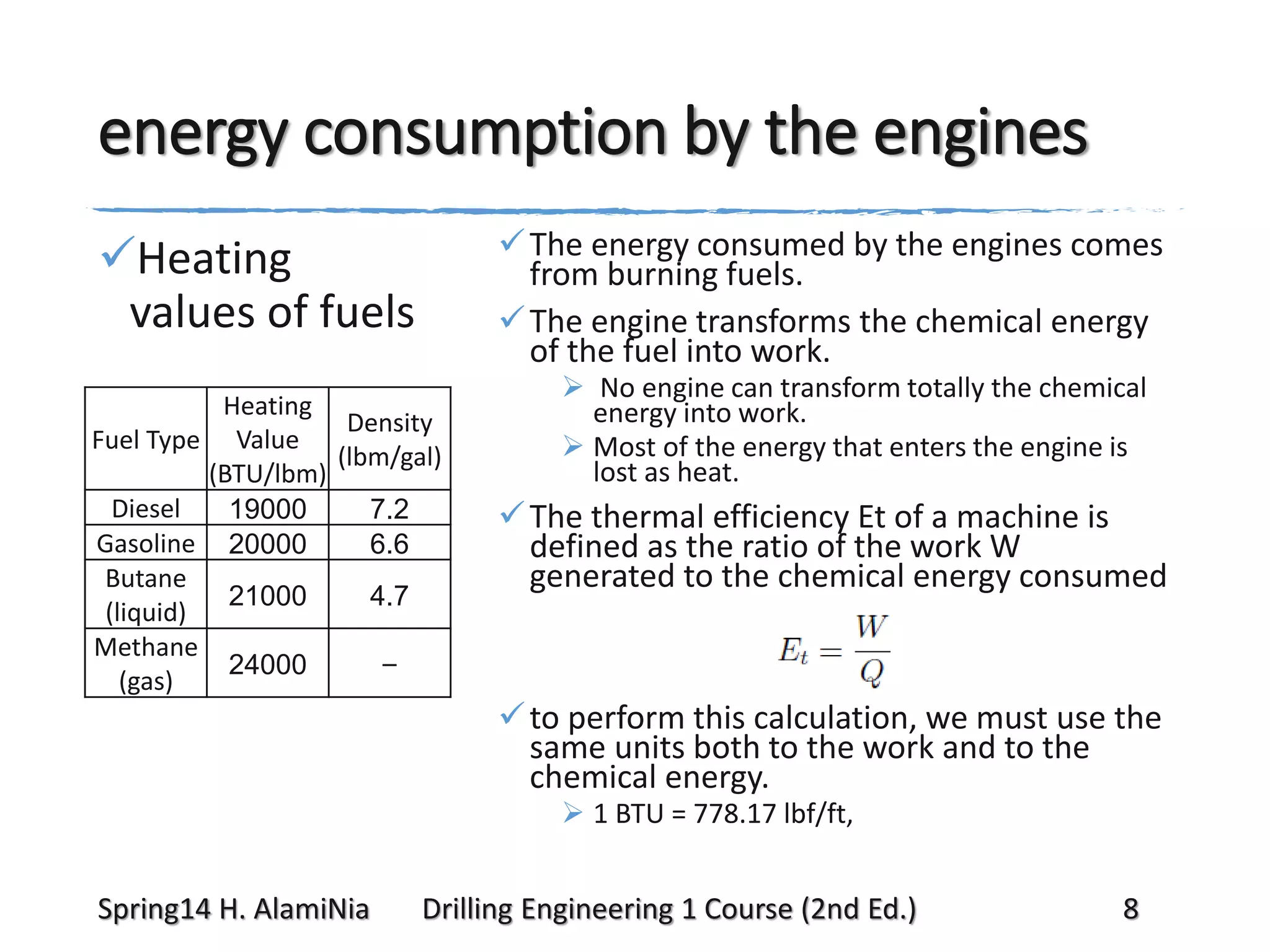
energy consumption by the engines
 The energy consumed by the engines comes
from burning fuels.
 The engine transforms the chemical energy
of the fuel into work.

Heating
values of fuels
Heating
Density
Fuel Type Value
(lbm/gal)
(BTU/lbm)
Diesel
19000
7.2
Gasoline 20000
6.6
Butane
21000
4.7
(liquid)
Methane
–
24000
(gas)

 No engine can transform totally the chemical
energy into work.
 Most of the energy that enters the engine is
lost as heat.

 The thermal efficiency Et of a machine is
defined as the ratio of the work W
generated to the chemical energy consumed

 to perform this calculation, we must use the
same units both to the work and to the
chemical energy.
 1 BTU = 778.17 lbf/ft,

Spring14 H. AlamiNia

Drilling Engineering 1 Course (2nd Ed.)

8
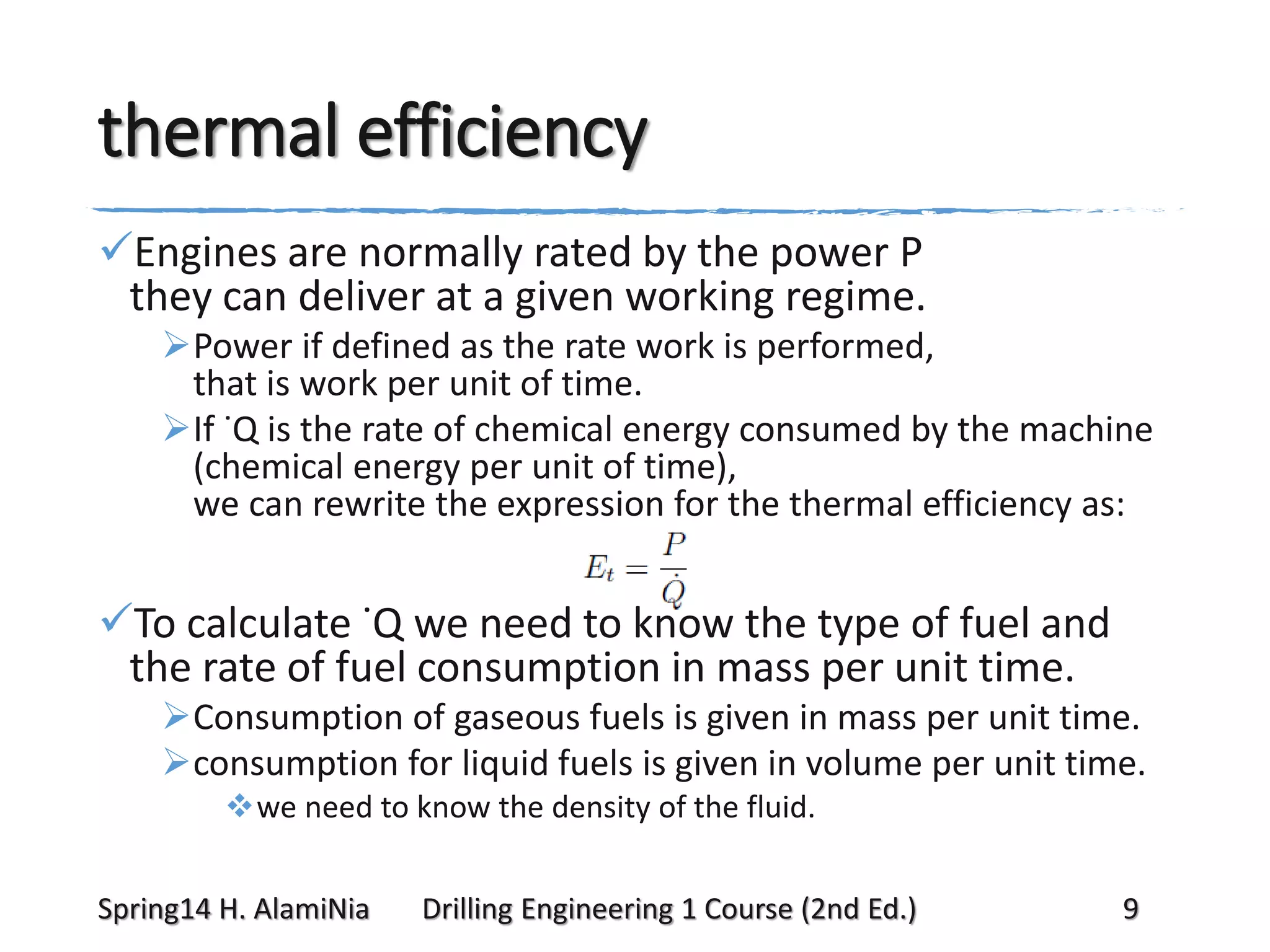
thermal efficiency
Engines are normally rated by the power P
they can deliver at a given working regime.
Power if defined as the rate work is performed,
that is work per unit of time.
If ˙Q is the rate of chemical energy consumed by the machine
(chemical energy per unit of time),
we can rewrite the expression for the thermal efficiency as:

To calculate ˙Q we need to know the type of fuel and
the rate of fuel consumption in mass per unit time.
Consumption of gaseous fuels is given in mass per unit time.
consumption for liquid fuels is given in volume per unit time.
we need to know the density of the fluid.
Spring14 H. AlamiNia

Drilling Engineering 1 Course (2nd Ed.)

9
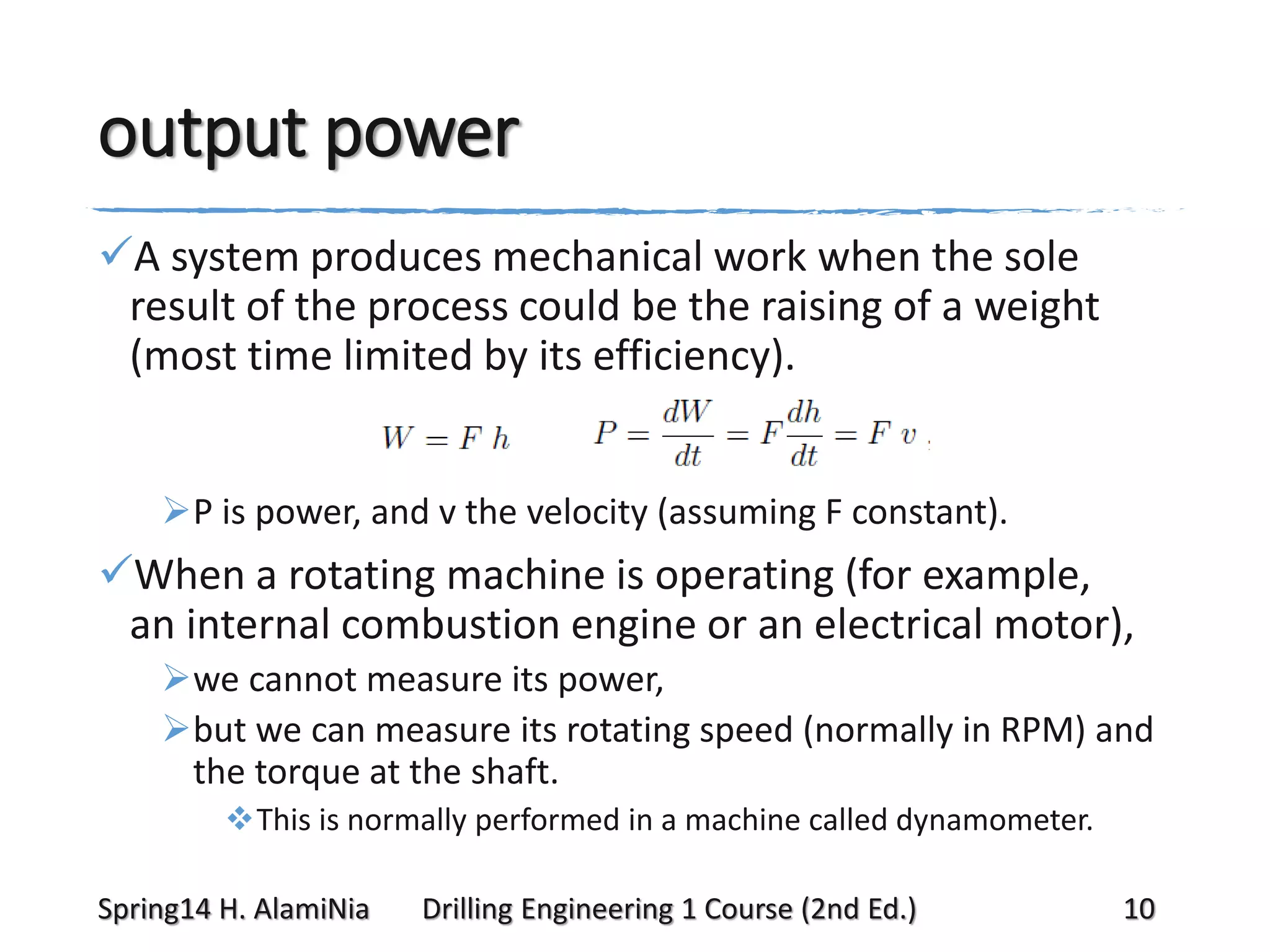
output power
A system produces mechanical work when the sole
result of the process could be the raising of a weight
(most time limited by its efficiency).
P is power, and v the velocity (assuming F constant).

When a rotating machine is operating (for example,
an internal combustion engine or an electrical motor),
we cannot measure its power,
but we can measure its rotating speed (normally in RPM) and
the torque at the shaft.
This is normally performed in a machine called dynamometer.
Spring14 H. AlamiNia

Drilling Engineering 1 Course (2nd Ed.)

10
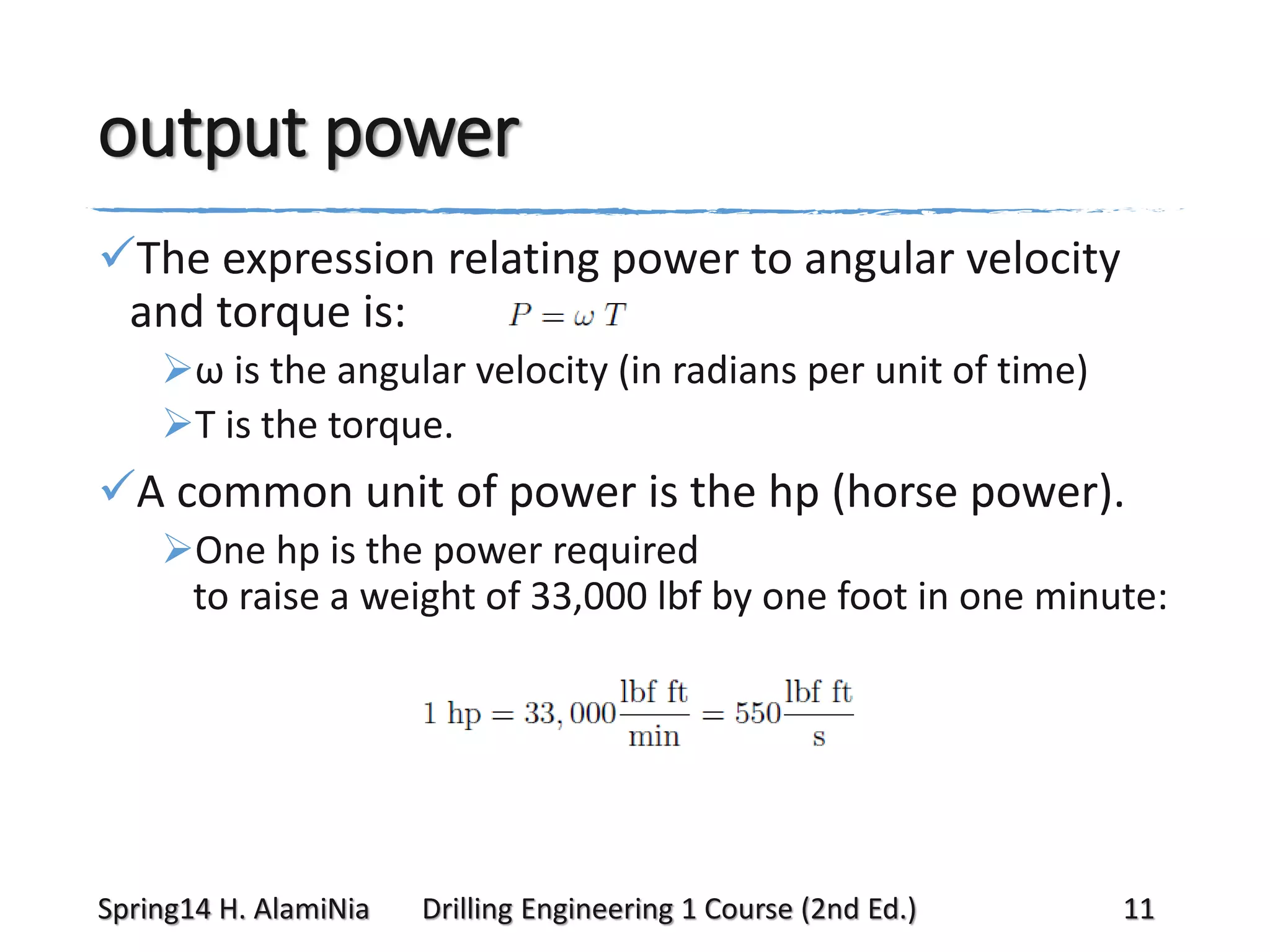
output power
The expression relating power to angular velocity
and torque is:
ω is the angular velocity (in radians per unit of time)
T is the torque.

A common unit of power is the hp (horse power).
One hp is the power required
to raise a weight of 33,000 lbf by one foot in one minute:

Spring14 H. AlamiNia

Drilling Engineering 1 Course (2nd Ed.)

11
output power
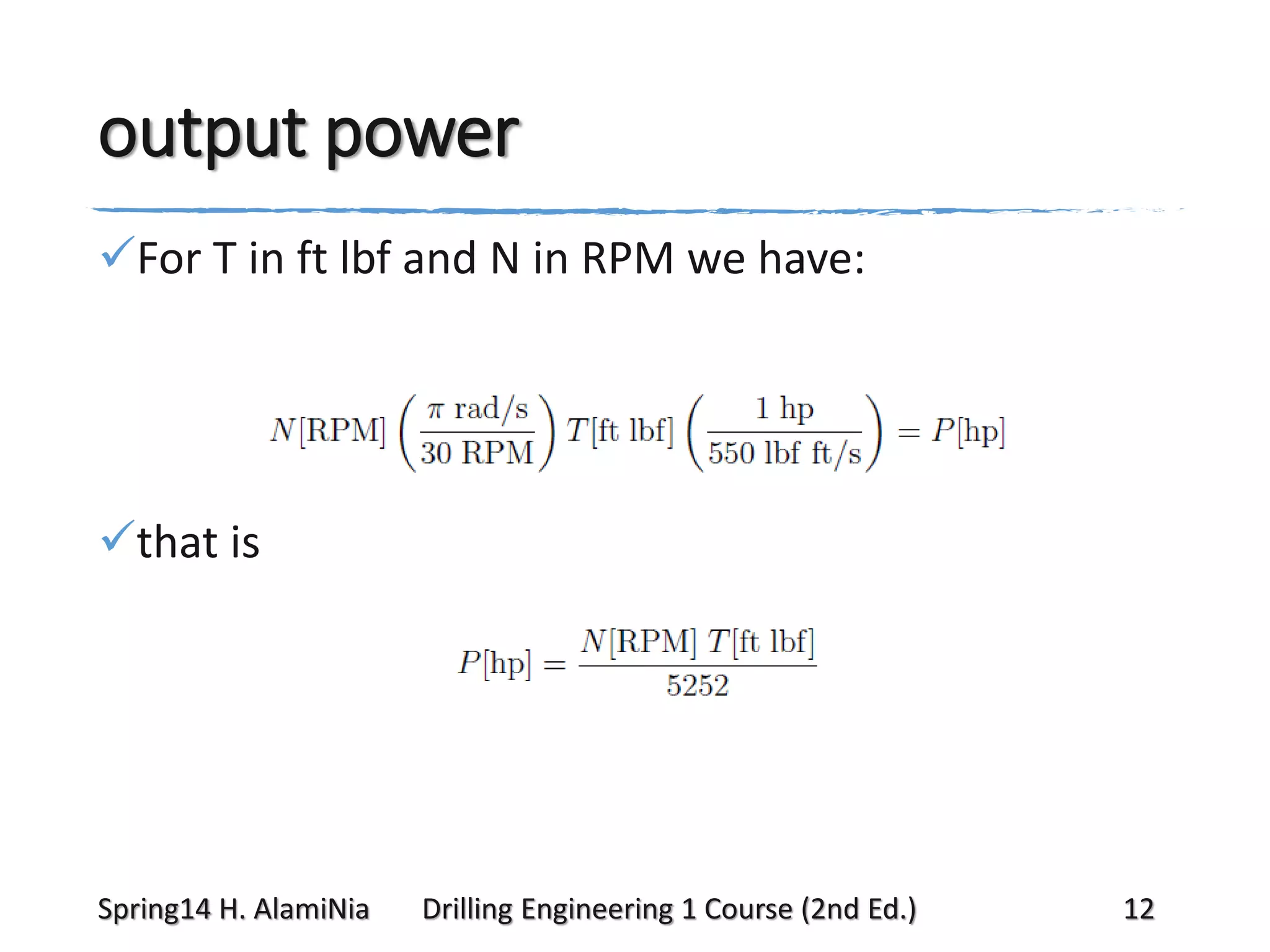
For T in ft lbf and N in RPM we have:

that is

Spring14 H. AlamiNia

Drilling Engineering 1 Course (2nd Ed.)

12
mechanical horsepower Correction
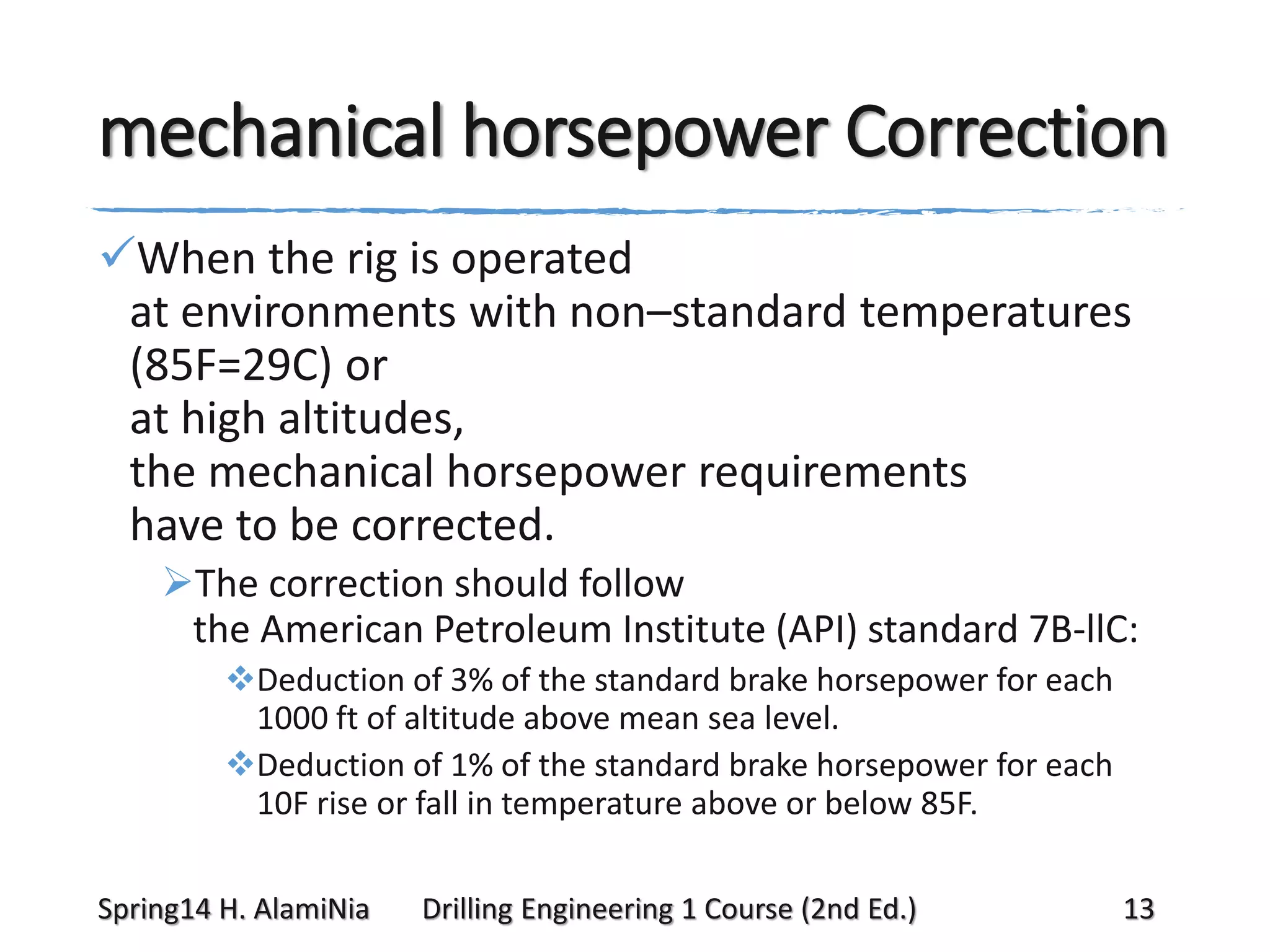
When the rig is operated
at environments with non–standard temperatures
(85F=29C) or
at high altitudes,
the mechanical horsepower requirements
have to be corrected.
The correction should follow
the American Petroleum Institute (API) standard 7B-llC:
Deduction of 3% of the standard brake horsepower for each
1000 ft of altitude above mean sea level.
Deduction of 1% of the standard brake horsepower for each
10F rise or fall in temperature above or below 85F.
Spring14 H. AlamiNia

Drilling Engineering 1 Course (2nd Ed.)

13
Calculation of the output power
and the overall efficiency
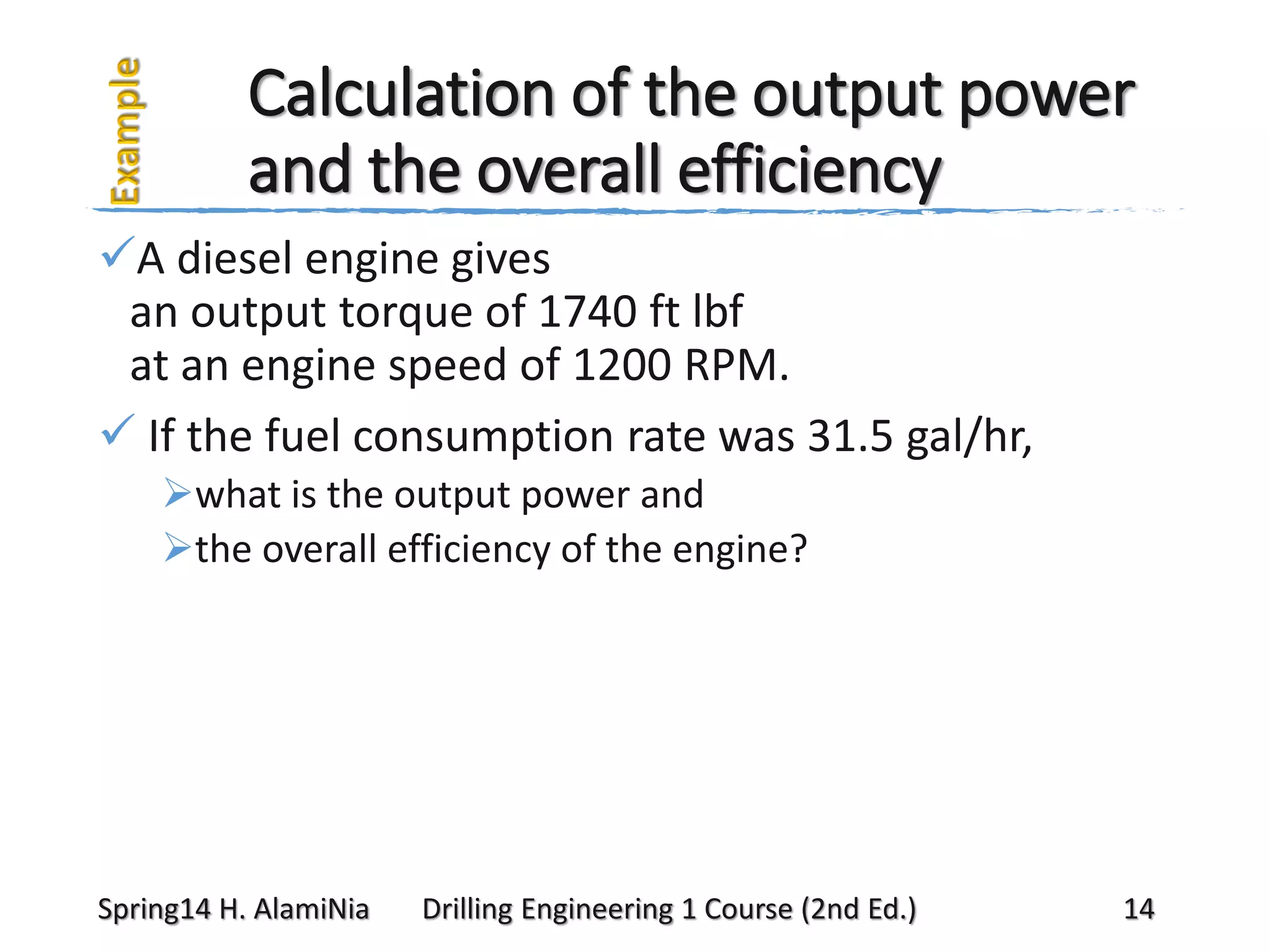
A diesel engine gives
an output torque of 1740 ft lbf
at an engine speed of 1200 RPM.
 If the fuel consumption rate was 31.5 gal/hr,
what is the output power and
the overall efficiency of the engine?

Spring14 H. AlamiNia

Drilling Engineering 1 Course (2nd Ed.)

14
the output power and
the overall efficiency
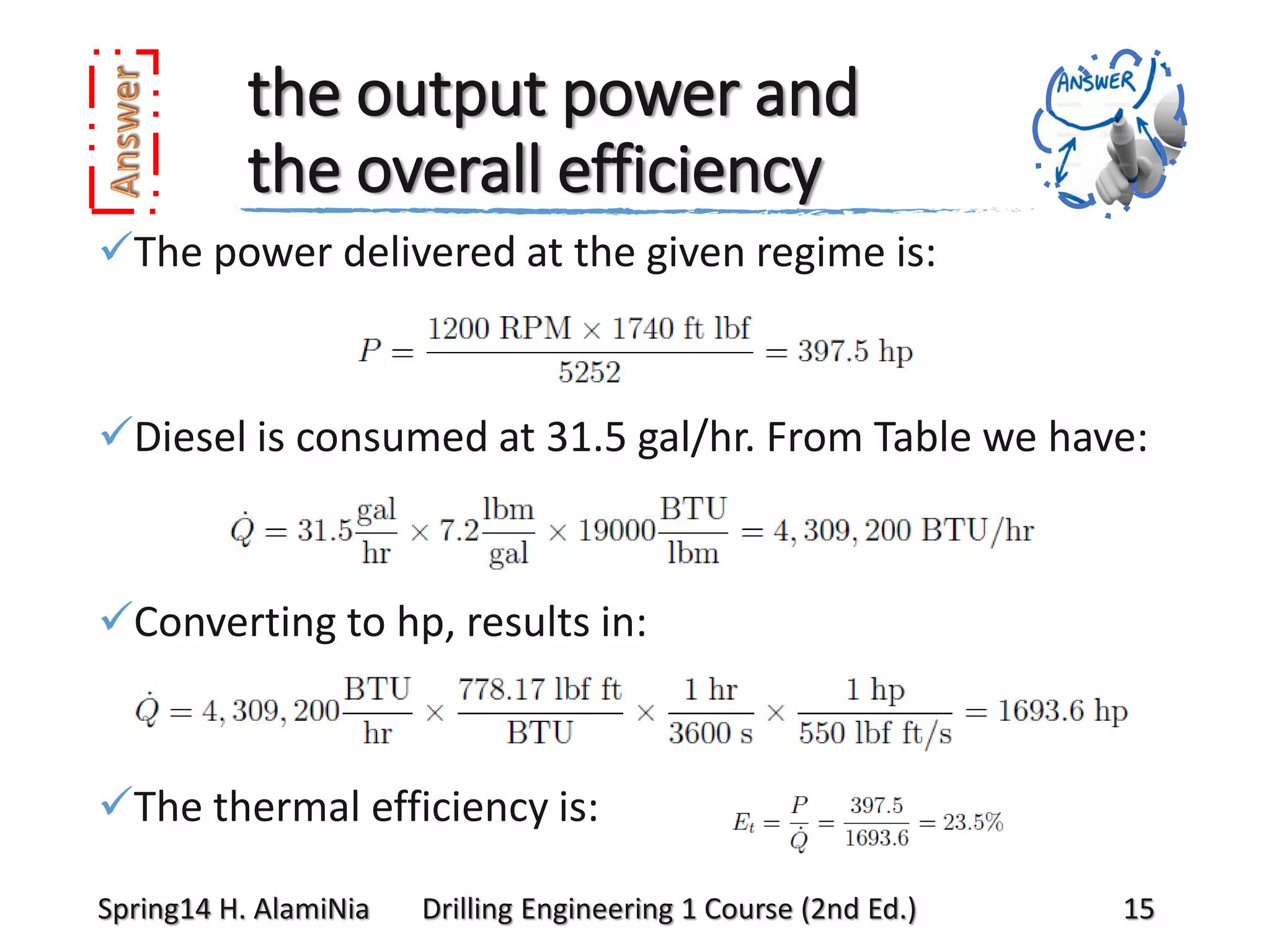
The power delivered at the given regime is:

Diesel is consumed at 31.5 gal/hr. From Table we have:

Converting to hp, results in:

The thermal efficiency is:
Spring14 H. AlamiNia

Drilling Engineering 1 Course (2nd Ed.)

15
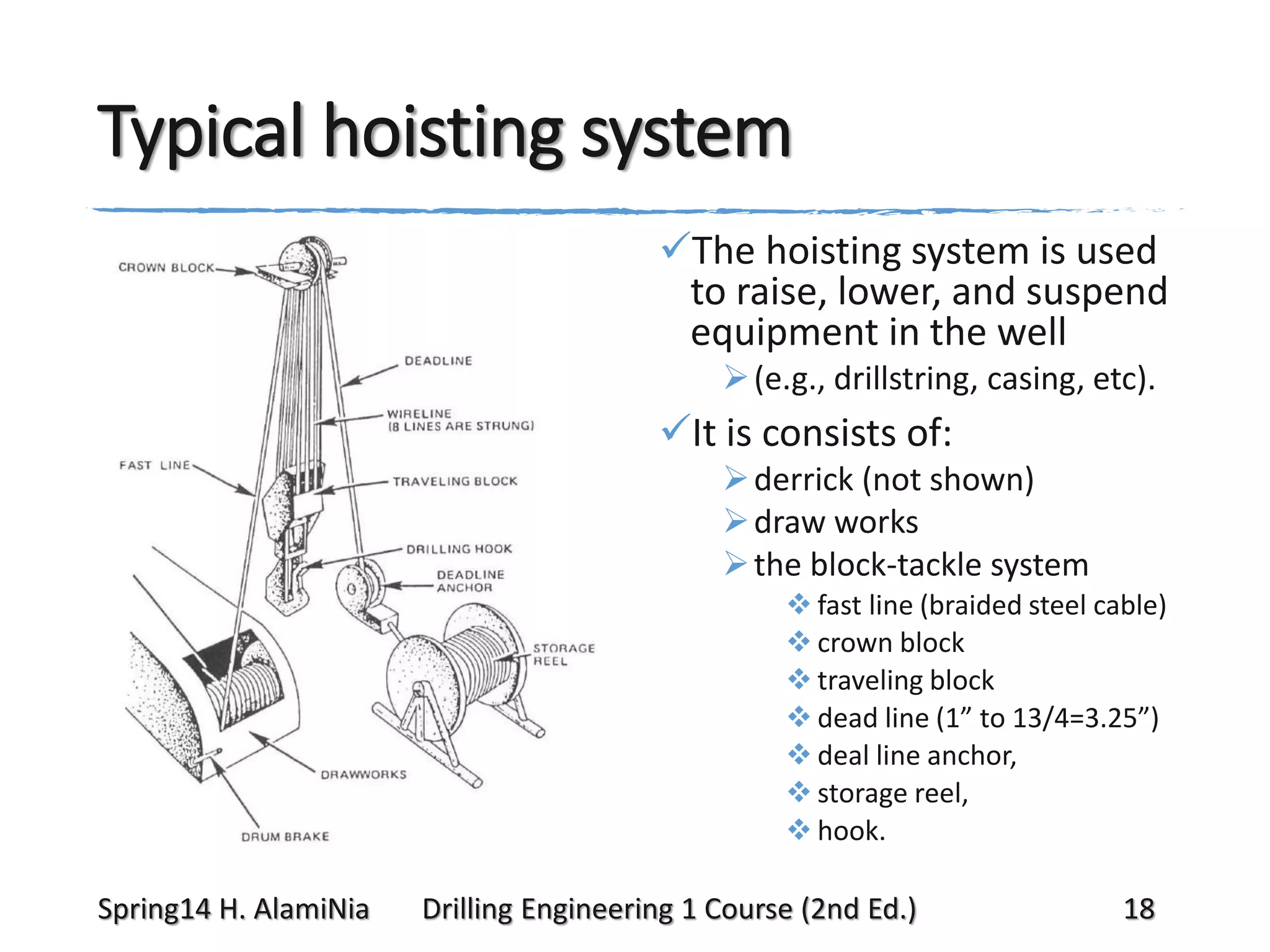
Typical hoisting system
The hoisting system is used
to raise, lower, and suspend
equipment in the well
 (e.g., drillstring, casing, etc).

It is consists of:
 derrick (not shown)
 draw works
 the block-tackle system
 fast line (braided steel cable)
 crown block
 traveling block
 dead line (1” to 13/4=3.25”)
 deal line anchor,
 storage reel,
 hook.

Spring14 H. AlamiNia

Drilling Engineering 1 Course (2nd Ed.)

18
The Derrick
The derrick or mast is a steel tower.
If the tower is jacked up, it is called mast.
If the tower is erected on the site, it is called derrick.

Derricks are rated by the API according
to their height (to handle 2, 3, or 4 joints) and
their ability to withstand wind and compressive loads.

The derrick stands above the derrick floor.
The derrick floor is the stage where several surface drilling
operations occur. At the derrick floor are located
the drawworks, the driller’s console, the driller’s house (or
“doghouse”), the rotary table, the drilling fluid manifold, and
several other tools to operate the drillstring.

The space below the derrick floor is the substructure.
Spring14 H. AlamiNia

Drilling Engineering 1 Course (2nd Ed.)

19
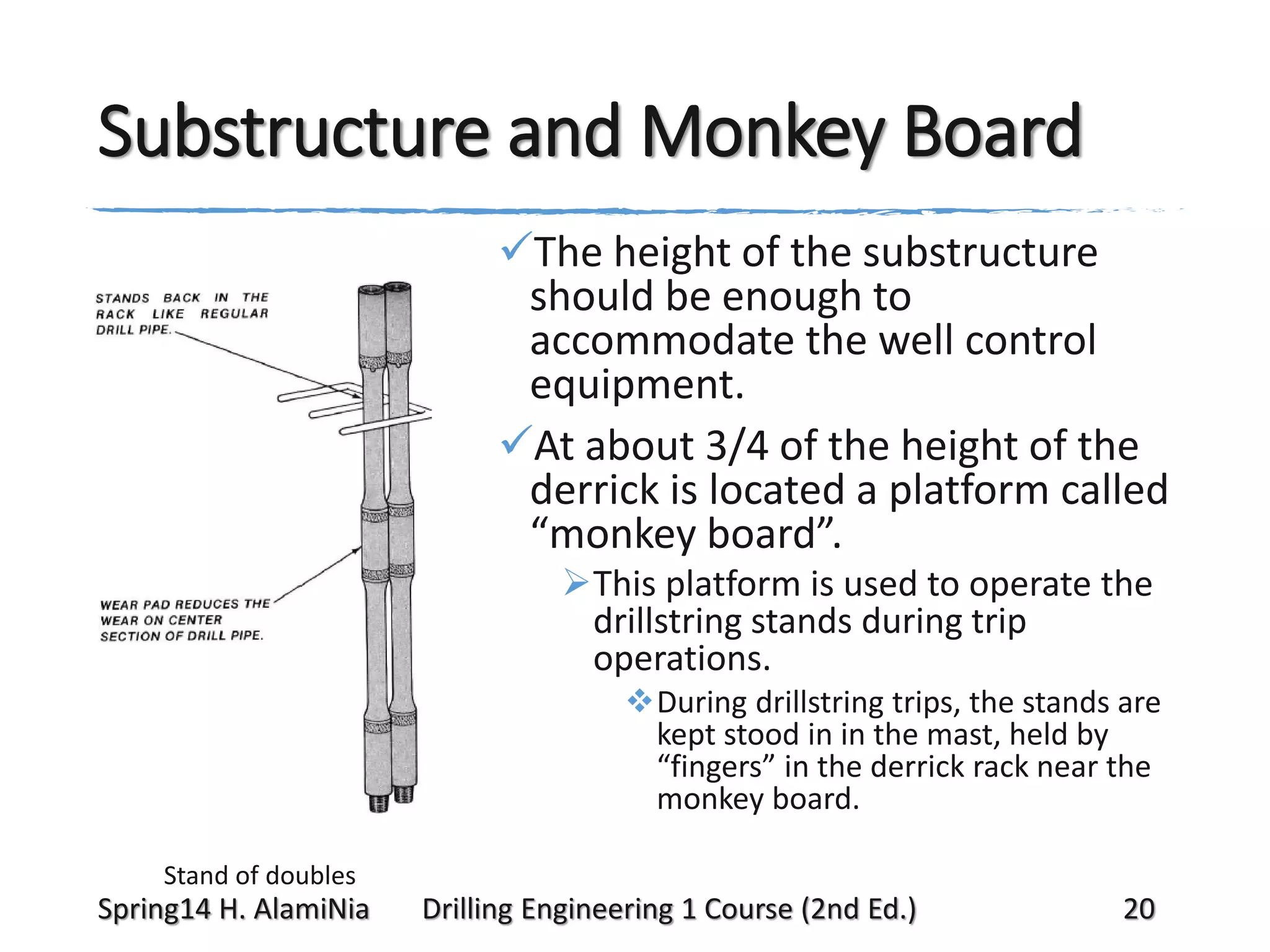
Substructure and Monkey Board
The height of the substructure
should be enough to
accommodate the well control
equipment.
At about 3/4 of the height of the
derrick is located a platform called
“monkey board”.
This platform is used to operate the
drillstring stands during trip
operations.
During drillstring trips, the stands are
kept stood in in the mast, held by
“fingers” in the derrick rack near the
monkey board.
Stand of doubles

Spring14 H. AlamiNia

Drilling Engineering 1 Course (2nd Ed.)

20
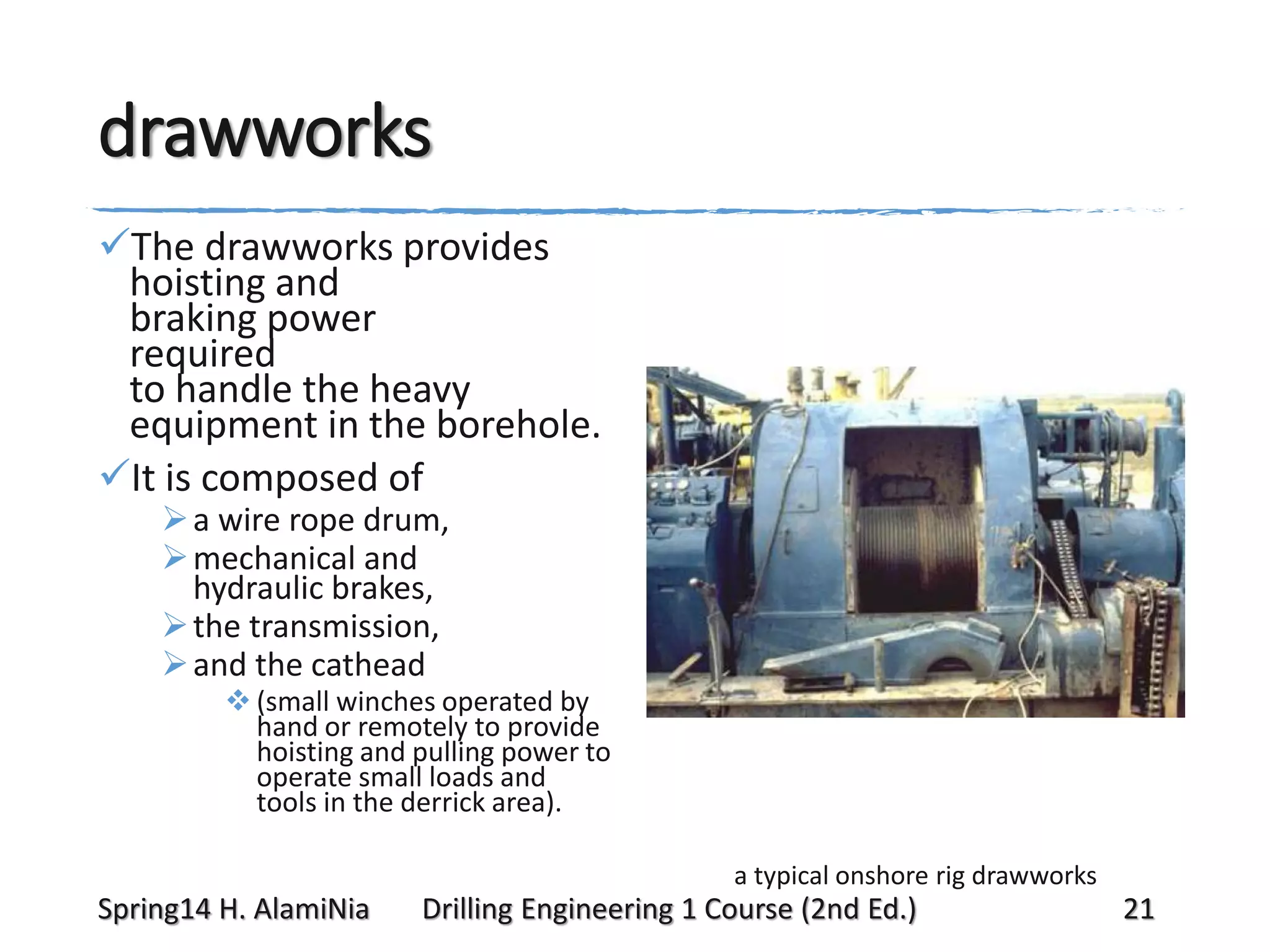
drawworks
The drawworks provides
hoisting and
braking power
required
to handle the heavy
equipment in the borehole.
It is composed of
 a wire rope drum,
 mechanical and
hydraulic brakes,
 the transmission,
 and the cathead

 (small winches operated by
hand or remotely to provide
hoisting and pulling power to
operate small loads and
tools in the derrick area).
a typical onshore rig drawworks

Spring14 H. AlamiNia

Drilling Engineering 1 Course (2nd Ed.)

21
Reeling in and out
The reeling–in of the drilling line
is powered by an electric motor or Diesel engine

the reeling–out
is powered by gravity
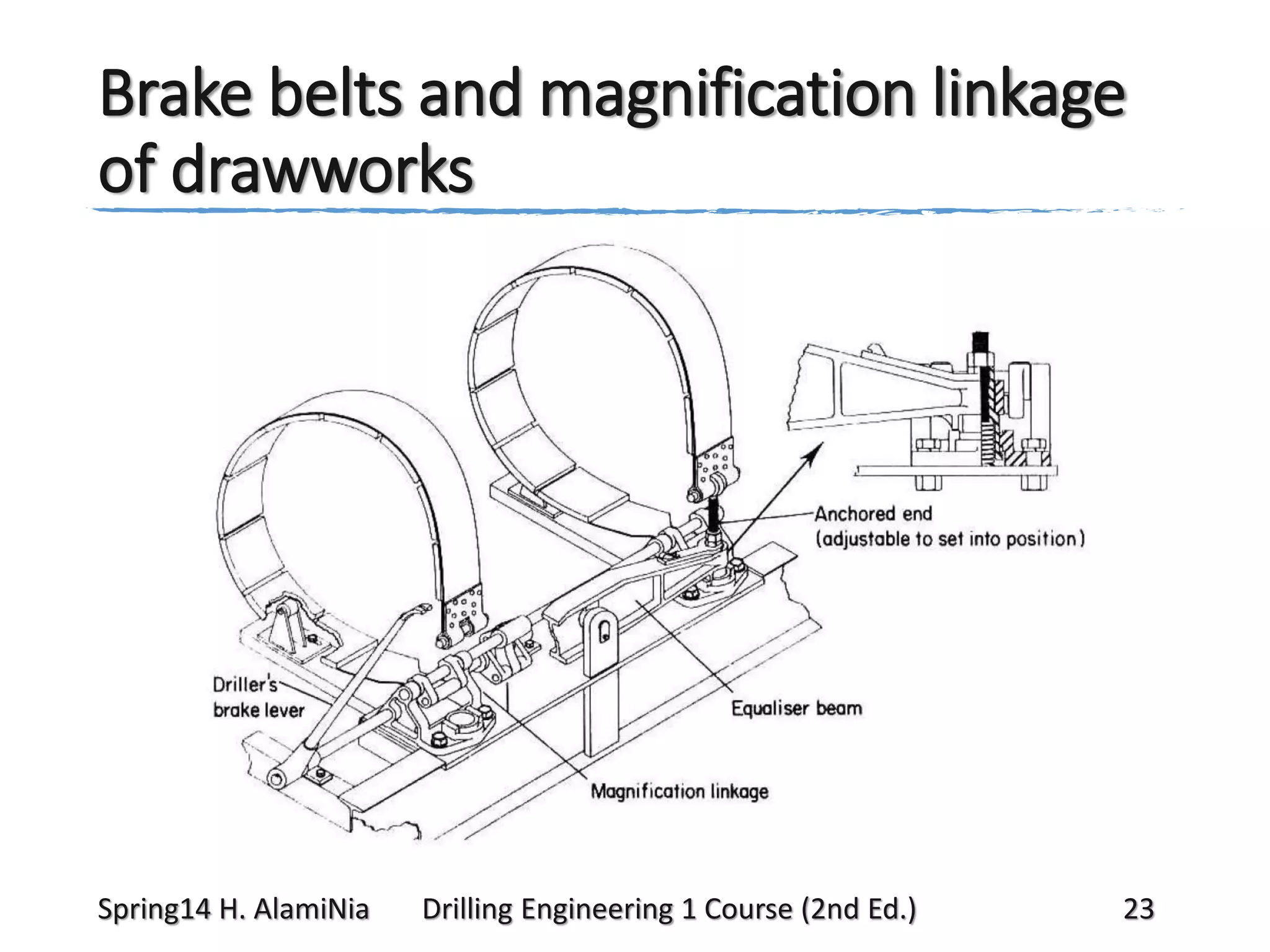
To control the reeling out,
mechanical brakes and
auxiliary hydraulic or magnetic brakes

are used, which dissipates the energy required to reduce
the speed and/or stop the downward movement of the
suspended equipment.

Spring14 H. AlamiNia

Drilling Engineering 1 Course (2nd Ed.)

22
Brake belts and magnification linkage
of drawworks

Spring14 H. AlamiNia

Drilling Engineering 1 Course (2nd Ed.)

23
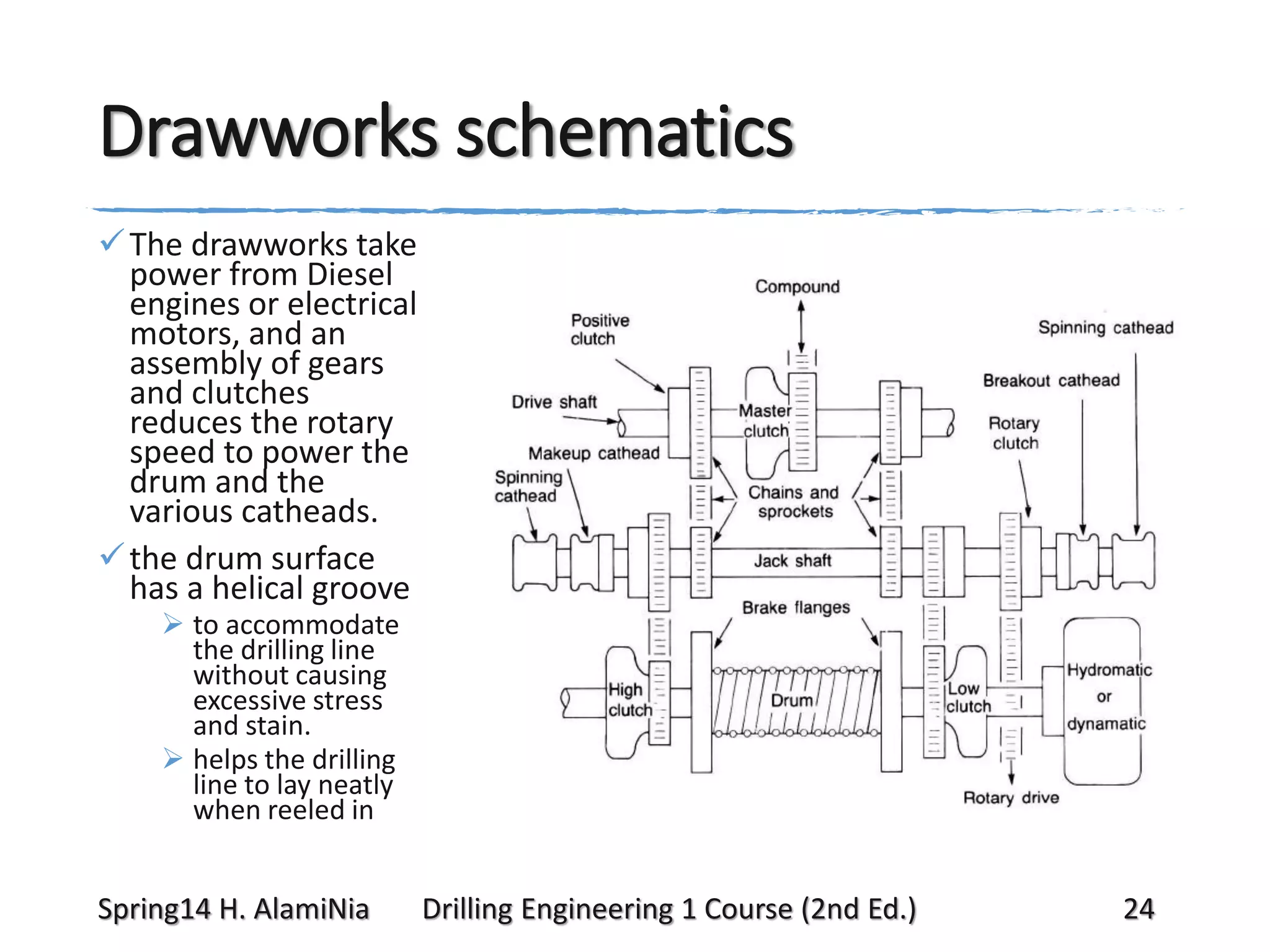
Drawworks schematics
 The drawworks take
power from Diesel
engines or electrical
motors, and an
assembly of gears
and clutches
reduces the rotary
speed to power the
drum and the
various catheads.
 the drum surface
has a helical groove
 to accommodate
the drilling line
without causing
excessive stress
and stain.
 helps the drilling
line to lay neatly
when reeled in

Spring14 H. AlamiNia

Drilling Engineering 1 Course (2nd Ed.)

24
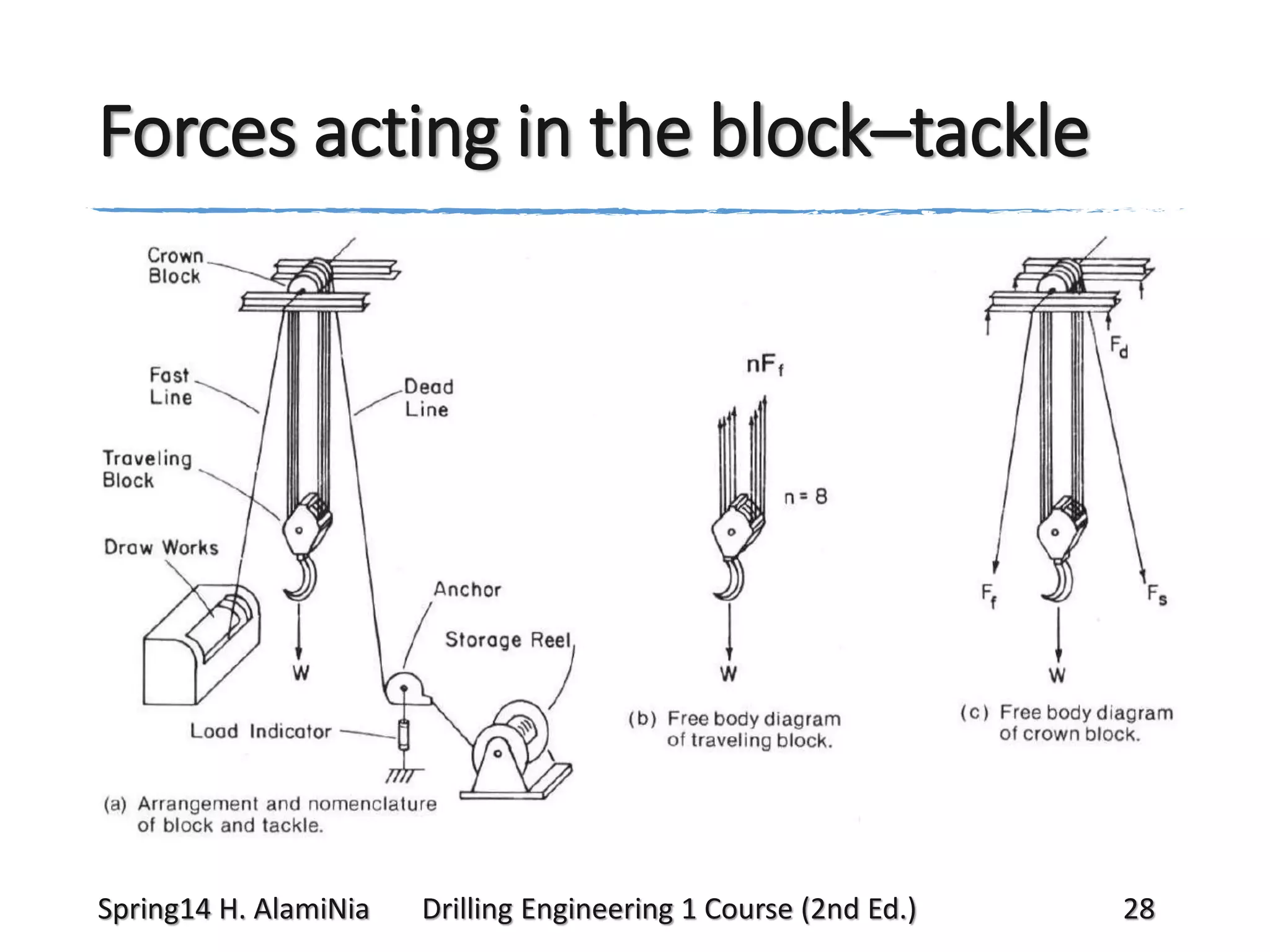
The Block & Tackle
Fast line

 The drilling line coming from the drawworks, called fast line, goes
over a pulley system mounted at the top of the derrick,
 called the crown block,

 and down to another pulley system
 called the traveling block.

block-tackle

 The assembly of crown block, traveling block and drilling line

The number of lines n of a tackle

 is twice the number of (active) pulleys in the traveling block.

The last line of the tackle

 is called dead line
 and is anchored to the derrick floor, close to one of its legs.

Below and connected to the traveling block is a hook to
which drilling equipment can be hung.
Spring14 H. AlamiNia

Drilling Engineering 1 Course (2nd Ed.)

26
block-tackle system calculations
The block-tackle system
provides a mechanical advantage to the drawworks, and
reduces the total load applied to the derrick.

We will be interested in calculating
the fast line force Ff (provided by the drawworks)
required to raise a weight W in the hook, and
the total load applied to the rig and
its distribution on the derrick floor.

Spring14 H. AlamiNia

Drilling Engineering 1 Course (2nd Ed.)

27
Forces acting in the block–tackle

Spring14 H. AlamiNia

Drilling Engineering 1 Course (2nd Ed.)

28
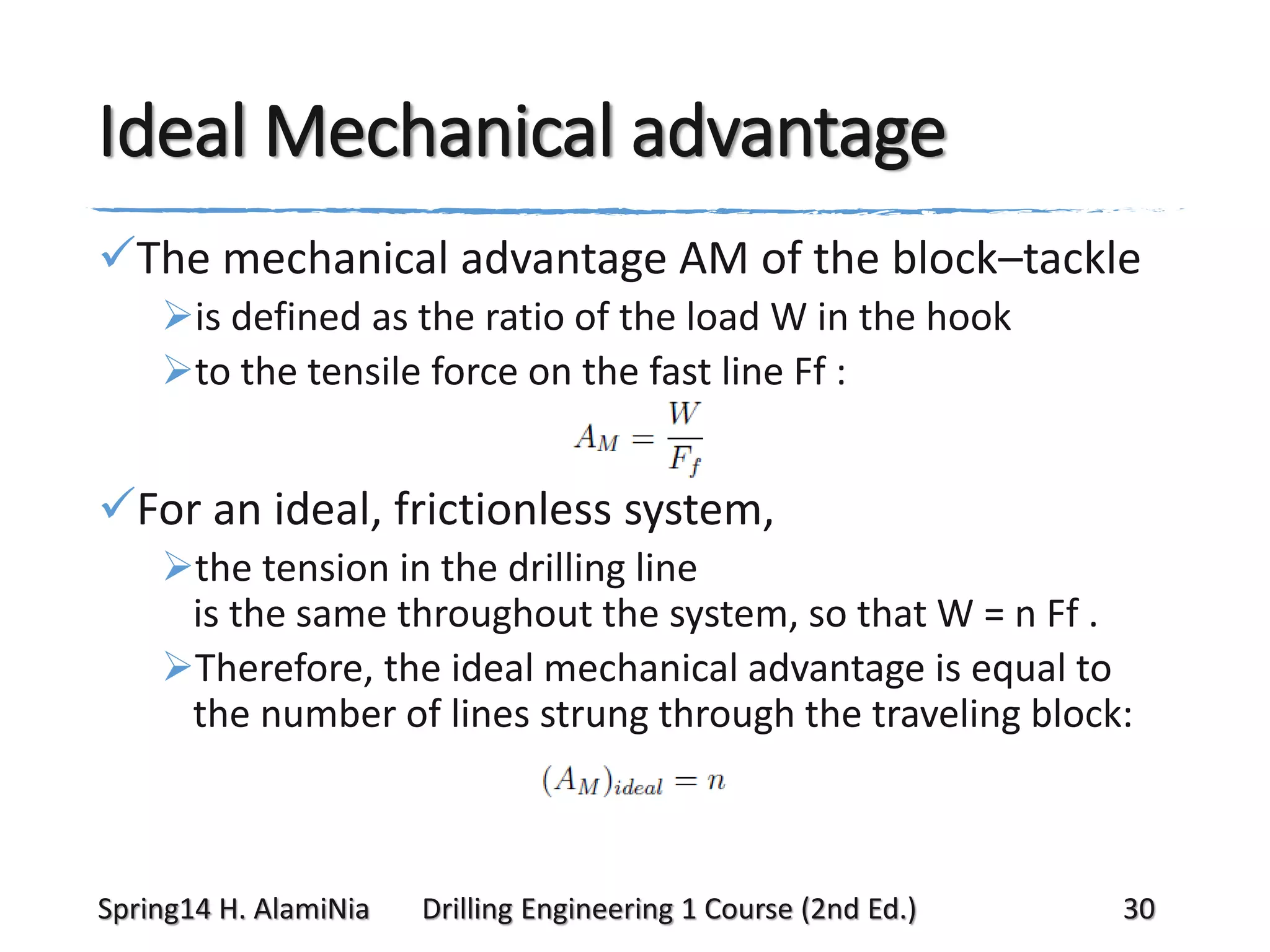
Ideal Mechanical advantage
The mechanical advantage AM of the block–tackle
is defined as the ratio of the load W in the hook
to the tensile force on the fast line Ff :

For an ideal, frictionless system,
the tension in the drilling line
is the same throughout the system, so that W = n Ff .
Therefore, the ideal mechanical advantage is equal to
the number of lines strung through the traveling block:

Spring14 H. AlamiNia

Drilling Engineering 1 Course (2nd Ed.)

30
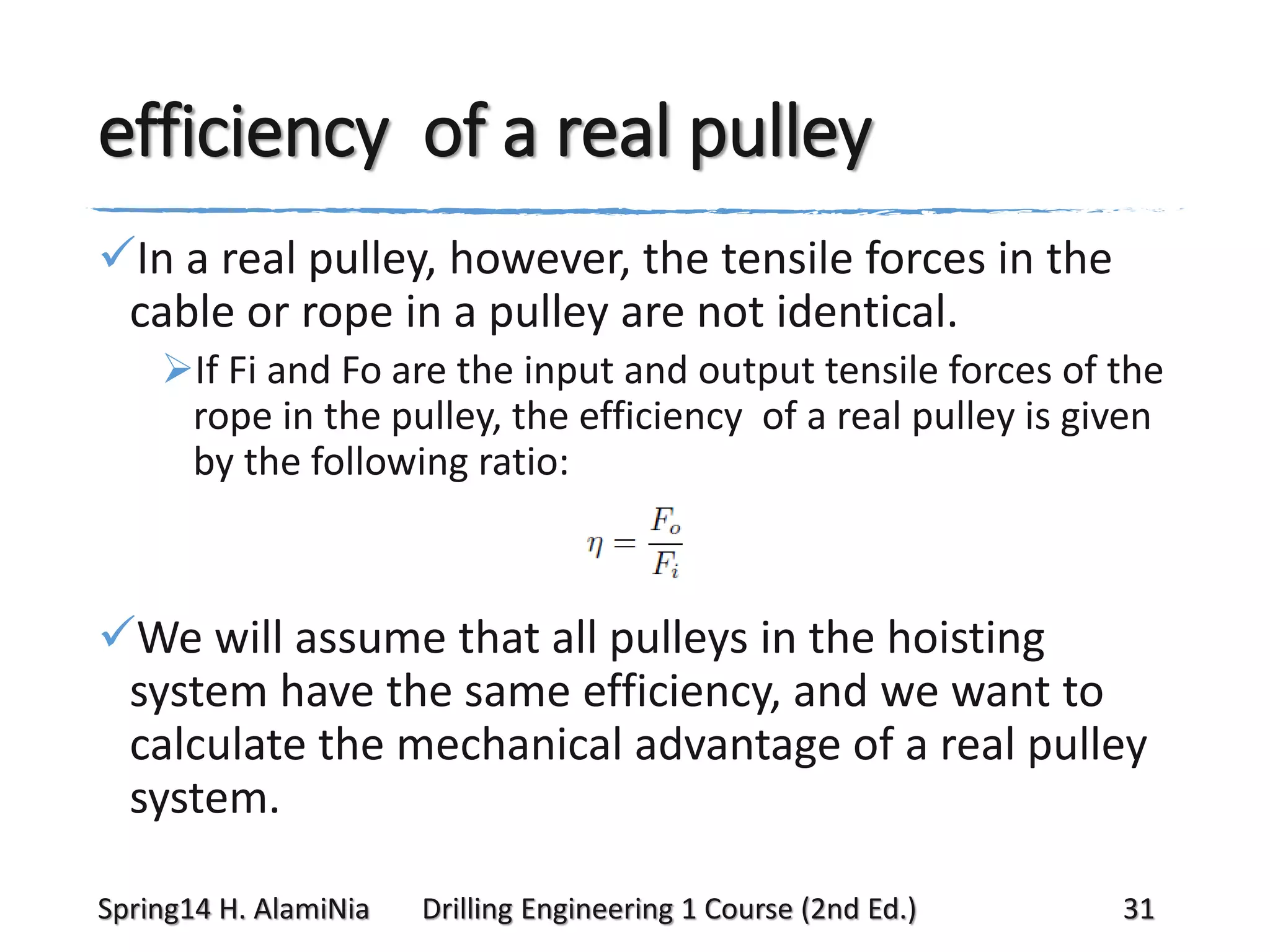
efficiency of a real pulley
In a real pulley, however, the tensile forces in the
cable or rope in a pulley are not identical.
If Fi and Fo are the input and output tensile forces of the
rope in the pulley, the efficiency of a real pulley is given
by the following ratio:

We will assume that all pulleys in the hoisting
system have the same efficiency, and we want to
calculate the mechanical advantage of a real pulley
system.
Spring14 H. AlamiNia

Drilling Engineering 1 Course (2nd Ed.)

31
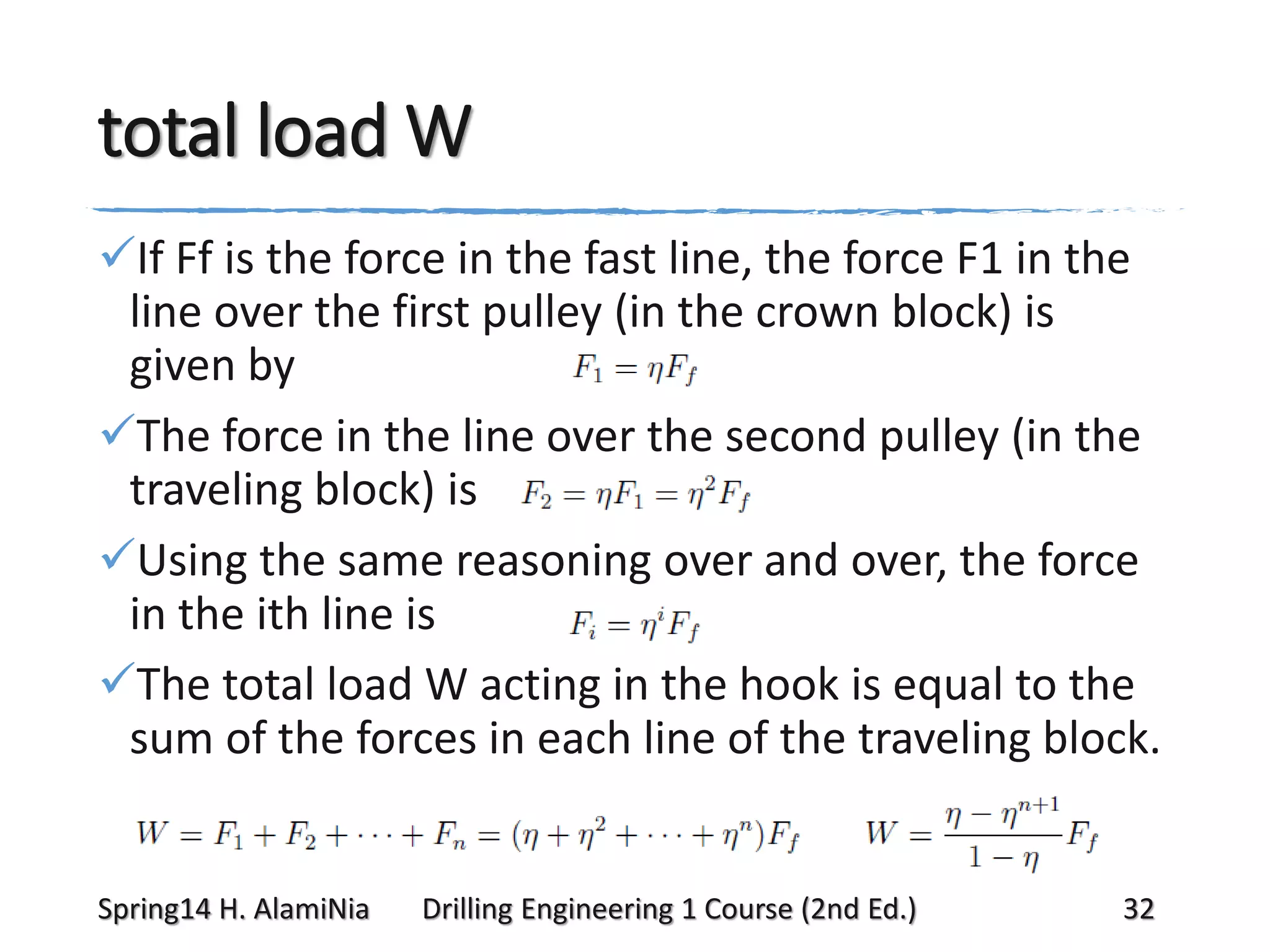
total load W
If Ff is the force in the fast line, the force F1 in the
line over the first pulley (in the crown block) is
given by
The force in the line over the second pulley (in the
traveling block) is
Using the same reasoning over and over, the force
in the ith line is
The total load W acting in the hook is equal to the
sum of the forces in each line of the traveling block.

Spring14 H. AlamiNia

Drilling Engineering 1 Course (2nd Ed.)

32
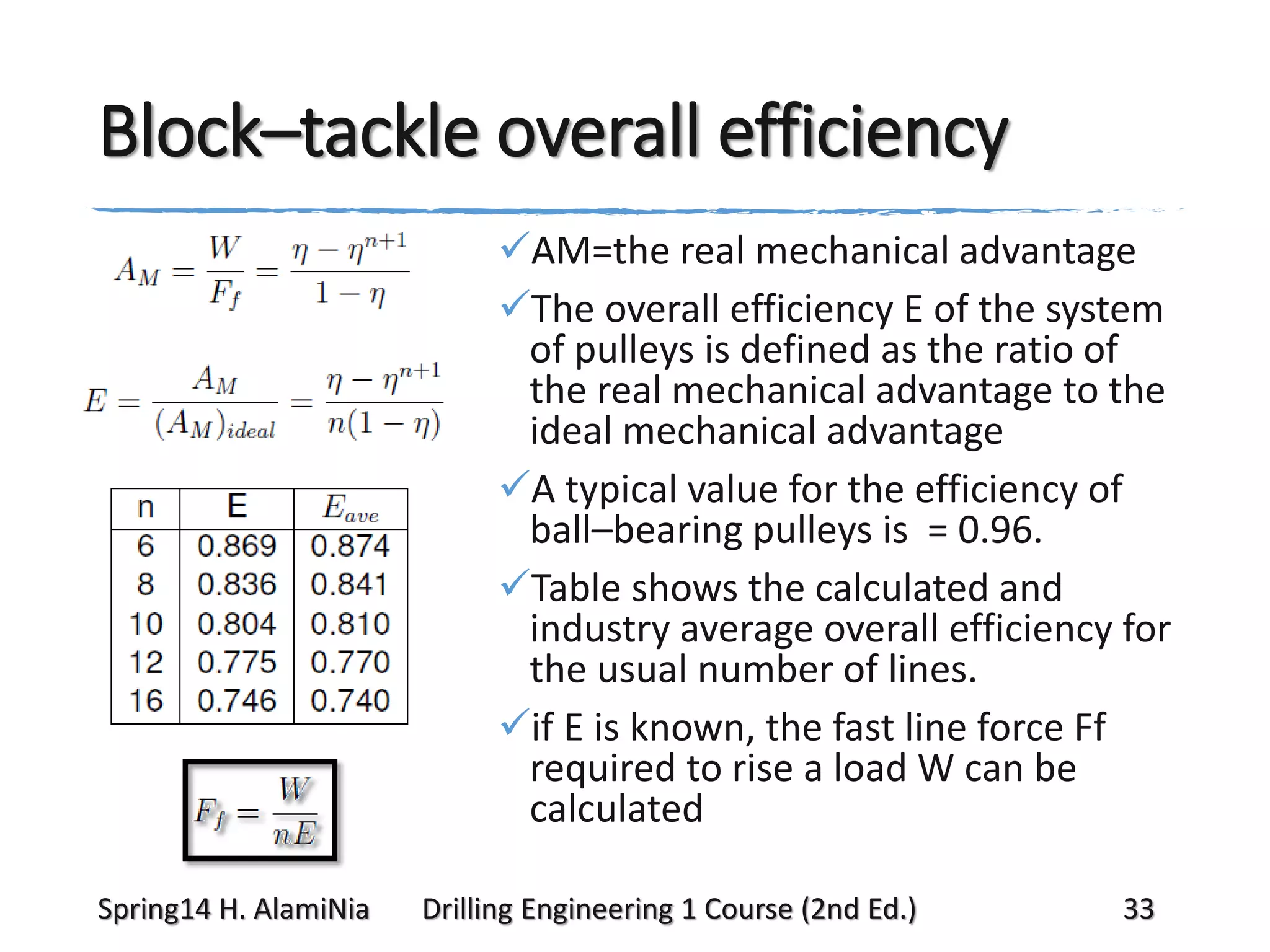
Block–tackle overall efficiency
AM=the real mechanical advantage
The overall efficiency E of the system
of pulleys is defined as the ratio of
the real mechanical advantage to the
ideal mechanical advantage
A typical value for the efficiency of
ball–bearing pulleys is = 0.96.
Table shows the calculated and
industry average overall efficiency for
the usual number of lines.
if E is known, the fast line force Ff
required to rise a load W can be
calculated
Spring14 H. AlamiNia

Drilling Engineering 1 Course (2nd Ed.)

33
1. Jorge H.B. Sampaio Jr. “Drilling Engineering
Fundamentals.” Master of Petroleum
Engineering. Curtin University of Technology,
2007. Chapter 2
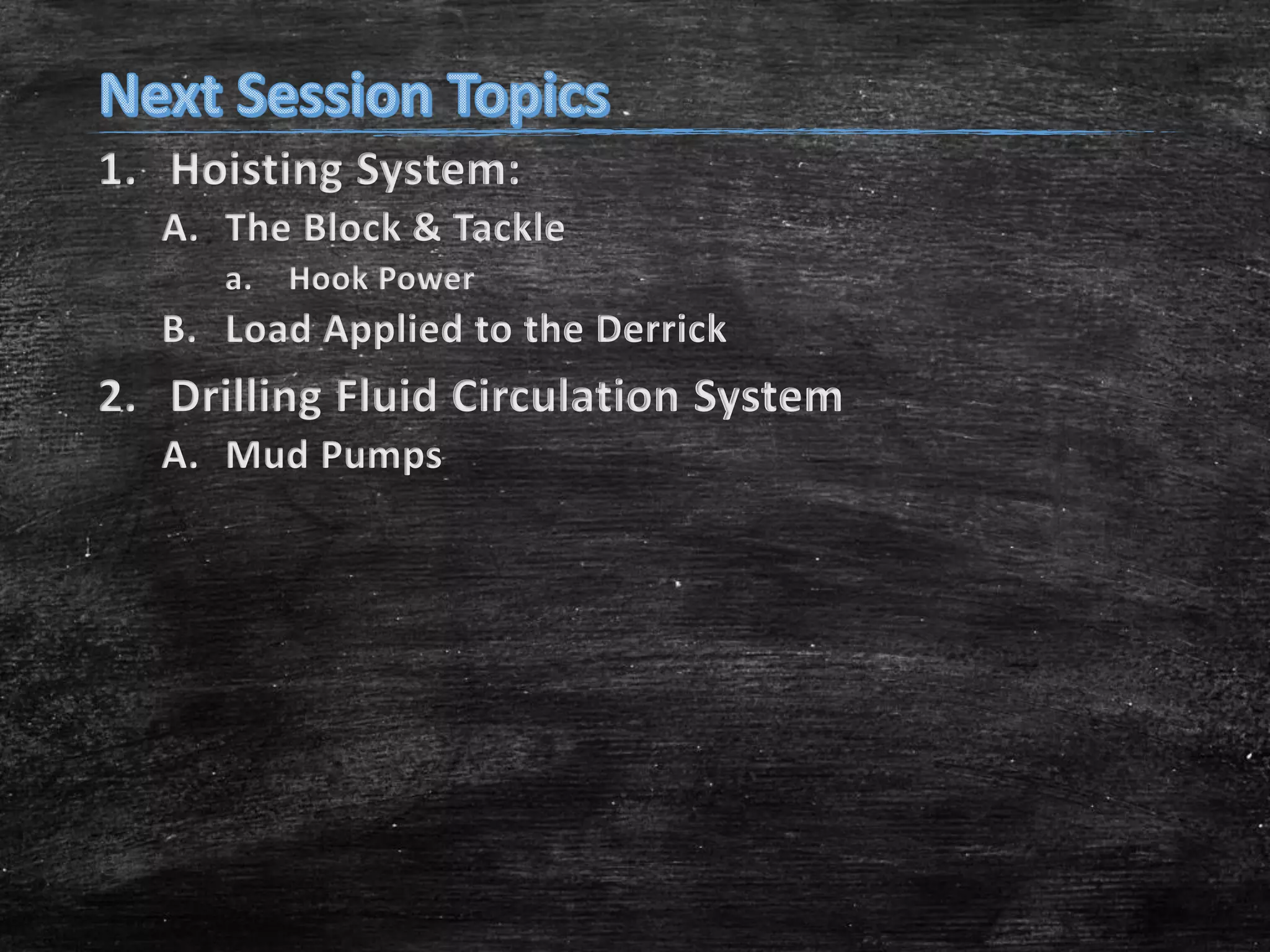
1. Hoisting System:
A. The Block & Tackle
a.

Hook Power

B. Load Applied to the Derrick

2. Drilling Fluid Circulation System
A. Mud Pumps
Q922+de1+l03 v1

Q922+de1+l03 v1

  • 1.
    Drilling Engineering 1Course (2nd Ed.)
  • 2.
    1. Introduction 2. Personnelat Rig Site 3. Rotary Drilling System
  • 3.
    1. Power System 2.Hoisting System: A. Introduction B. The Block & Tackle a. Mechanical advantage and Efficiency
  • 5.
    power supply The powersystem of a rotary drilling rig has to supply power to all the other systems. the system must provide power for pumps in general, rig light, air compressors, etc. Since the largest power consumers on a rotary drilling rig are the hoisting, the circulation system, and the rotary system, these components determine mainly the total power requirements. During typical drilling operations, the hoisting and the rotary systems are not operated at the same time. Therefore the same engines can be used to perform both functions. Spring14 H. AlamiNia Drilling Engineering 1 Course (2nd Ed.) 5
  • 6.
    power system Drilling rigpower systems are classified as direct drive type (internal combustion engines supply mechanical power to the rig ) and electric type. In both cases, the sources of energy are diesel fueled engines. Most rigs use 1 to 3 engines to power the drawworks and rotary table. The engines are usually rated between 400 and 800 hp. As guideline, power requirements for most onshore rigs are between 1,000 to 3,000 hp. Offshore rigs in general use much more power. Spring14 H. AlamiNia Drilling Engineering 1 Course (2nd Ed.) 6
  • 7.
    power system performance Theperformance of a rig power system is characterized by the output horsepower, torque, and fuel consumption for various engine speeds. These three parameters are related by the efficiency of each system. Spring14 H. AlamiNia Drilling Engineering 1 Course (2nd Ed.) 7
  • 8.
    energy consumption bythe engines  The energy consumed by the engines comes from burning fuels.  The engine transforms the chemical energy of the fuel into work. Heating values of fuels Heating Density Fuel Type Value (lbm/gal) (BTU/lbm) Diesel 19000 7.2 Gasoline 20000 6.6 Butane 21000 4.7 (liquid) Methane – 24000 (gas)  No engine can transform totally the chemical energy into work.  Most of the energy that enters the engine is lost as heat.  The thermal efficiency Et of a machine is defined as the ratio of the work W generated to the chemical energy consumed  to perform this calculation, we must use the same units both to the work and to the chemical energy.  1 BTU = 778.17 lbf/ft, Spring14 H. AlamiNia Drilling Engineering 1 Course (2nd Ed.) 8
  • 9.
    thermal efficiency Engines arenormally rated by the power P they can deliver at a given working regime. Power if defined as the rate work is performed, that is work per unit of time. If ˙Q is the rate of chemical energy consumed by the machine (chemical energy per unit of time), we can rewrite the expression for the thermal efficiency as: To calculate ˙Q we need to know the type of fuel and the rate of fuel consumption in mass per unit time. Consumption of gaseous fuels is given in mass per unit time. consumption for liquid fuels is given in volume per unit time. we need to know the density of the fluid. Spring14 H. AlamiNia Drilling Engineering 1 Course (2nd Ed.) 9
  • 10.
    output power A systemproduces mechanical work when the sole result of the process could be the raising of a weight (most time limited by its efficiency). P is power, and v the velocity (assuming F constant). When a rotating machine is operating (for example, an internal combustion engine or an electrical motor), we cannot measure its power, but we can measure its rotating speed (normally in RPM) and the torque at the shaft. This is normally performed in a machine called dynamometer. Spring14 H. AlamiNia Drilling Engineering 1 Course (2nd Ed.) 10
  • 11.
    output power The expressionrelating power to angular velocity and torque is: ω is the angular velocity (in radians per unit of time) T is the torque. A common unit of power is the hp (horse power). One hp is the power required to raise a weight of 33,000 lbf by one foot in one minute: Spring14 H. AlamiNia Drilling Engineering 1 Course (2nd Ed.) 11
  • 12.
    output power For Tin ft lbf and N in RPM we have: that is Spring14 H. AlamiNia Drilling Engineering 1 Course (2nd Ed.) 12
  • 13.
    mechanical horsepower Correction Whenthe rig is operated at environments with non–standard temperatures (85F=29C) or at high altitudes, the mechanical horsepower requirements have to be corrected. The correction should follow the American Petroleum Institute (API) standard 7B-llC: Deduction of 3% of the standard brake horsepower for each 1000 ft of altitude above mean sea level. Deduction of 1% of the standard brake horsepower for each 10F rise or fall in temperature above or below 85F. Spring14 H. AlamiNia Drilling Engineering 1 Course (2nd Ed.) 13
  • 14.
    Calculation of theoutput power and the overall efficiency A diesel engine gives an output torque of 1740 ft lbf at an engine speed of 1200 RPM.  If the fuel consumption rate was 31.5 gal/hr, what is the output power and the overall efficiency of the engine? Spring14 H. AlamiNia Drilling Engineering 1 Course (2nd Ed.) 14
  • 15.
    the output powerand the overall efficiency The power delivered at the given regime is: Diesel is consumed at 31.5 gal/hr. From Table we have: Converting to hp, results in: The thermal efficiency is: Spring14 H. AlamiNia Drilling Engineering 1 Course (2nd Ed.) 15
  • 18.
    Typical hoisting system Thehoisting system is used to raise, lower, and suspend equipment in the well  (e.g., drillstring, casing, etc). It is consists of:  derrick (not shown)  draw works  the block-tackle system  fast line (braided steel cable)  crown block  traveling block  dead line (1” to 13/4=3.25”)  deal line anchor,  storage reel,  hook. Spring14 H. AlamiNia Drilling Engineering 1 Course (2nd Ed.) 18
  • 19.
    The Derrick The derrickor mast is a steel tower. If the tower is jacked up, it is called mast. If the tower is erected on the site, it is called derrick. Derricks are rated by the API according to their height (to handle 2, 3, or 4 joints) and their ability to withstand wind and compressive loads. The derrick stands above the derrick floor. The derrick floor is the stage where several surface drilling operations occur. At the derrick floor are located the drawworks, the driller’s console, the driller’s house (or “doghouse”), the rotary table, the drilling fluid manifold, and several other tools to operate the drillstring. The space below the derrick floor is the substructure. Spring14 H. AlamiNia Drilling Engineering 1 Course (2nd Ed.) 19
  • 20.
    Substructure and MonkeyBoard The height of the substructure should be enough to accommodate the well control equipment. At about 3/4 of the height of the derrick is located a platform called “monkey board”. This platform is used to operate the drillstring stands during trip operations. During drillstring trips, the stands are kept stood in in the mast, held by “fingers” in the derrick rack near the monkey board. Stand of doubles Spring14 H. AlamiNia Drilling Engineering 1 Course (2nd Ed.) 20
  • 21.
    drawworks The drawworks provides hoistingand braking power required to handle the heavy equipment in the borehole. It is composed of  a wire rope drum,  mechanical and hydraulic brakes,  the transmission,  and the cathead  (small winches operated by hand or remotely to provide hoisting and pulling power to operate small loads and tools in the derrick area). a typical onshore rig drawworks Spring14 H. AlamiNia Drilling Engineering 1 Course (2nd Ed.) 21
  • 22.
    Reeling in andout The reeling–in of the drilling line is powered by an electric motor or Diesel engine the reeling–out is powered by gravity To control the reeling out, mechanical brakes and auxiliary hydraulic or magnetic brakes are used, which dissipates the energy required to reduce the speed and/or stop the downward movement of the suspended equipment. Spring14 H. AlamiNia Drilling Engineering 1 Course (2nd Ed.) 22
  • 23.
    Brake belts andmagnification linkage of drawworks Spring14 H. AlamiNia Drilling Engineering 1 Course (2nd Ed.) 23
  • 24.
    Drawworks schematics  Thedrawworks take power from Diesel engines or electrical motors, and an assembly of gears and clutches reduces the rotary speed to power the drum and the various catheads.  the drum surface has a helical groove  to accommodate the drilling line without causing excessive stress and stain.  helps the drilling line to lay neatly when reeled in Spring14 H. AlamiNia Drilling Engineering 1 Course (2nd Ed.) 24
  • 26.
    The Block &Tackle Fast line  The drilling line coming from the drawworks, called fast line, goes over a pulley system mounted at the top of the derrick,  called the crown block,  and down to another pulley system  called the traveling block. block-tackle  The assembly of crown block, traveling block and drilling line The number of lines n of a tackle  is twice the number of (active) pulleys in the traveling block. The last line of the tackle  is called dead line  and is anchored to the derrick floor, close to one of its legs. Below and connected to the traveling block is a hook to which drilling equipment can be hung. Spring14 H. AlamiNia Drilling Engineering 1 Course (2nd Ed.) 26
  • 27.
    block-tackle system calculations Theblock-tackle system provides a mechanical advantage to the drawworks, and reduces the total load applied to the derrick. We will be interested in calculating the fast line force Ff (provided by the drawworks) required to raise a weight W in the hook, and the total load applied to the rig and its distribution on the derrick floor. Spring14 H. AlamiNia Drilling Engineering 1 Course (2nd Ed.) 27
  • 28.
    Forces acting inthe block–tackle Spring14 H. AlamiNia Drilling Engineering 1 Course (2nd Ed.) 28
  • 30.
    Ideal Mechanical advantage Themechanical advantage AM of the block–tackle is defined as the ratio of the load W in the hook to the tensile force on the fast line Ff : For an ideal, frictionless system, the tension in the drilling line is the same throughout the system, so that W = n Ff . Therefore, the ideal mechanical advantage is equal to the number of lines strung through the traveling block: Spring14 H. AlamiNia Drilling Engineering 1 Course (2nd Ed.) 30
  • 31.
    efficiency of areal pulley In a real pulley, however, the tensile forces in the cable or rope in a pulley are not identical. If Fi and Fo are the input and output tensile forces of the rope in the pulley, the efficiency of a real pulley is given by the following ratio: We will assume that all pulleys in the hoisting system have the same efficiency, and we want to calculate the mechanical advantage of a real pulley system. Spring14 H. AlamiNia Drilling Engineering 1 Course (2nd Ed.) 31
  • 32.
    total load W IfFf is the force in the fast line, the force F1 in the line over the first pulley (in the crown block) is given by The force in the line over the second pulley (in the traveling block) is Using the same reasoning over and over, the force in the ith line is The total load W acting in the hook is equal to the sum of the forces in each line of the traveling block. Spring14 H. AlamiNia Drilling Engineering 1 Course (2nd Ed.) 32
  • 33.
    Block–tackle overall efficiency AM=thereal mechanical advantage The overall efficiency E of the system of pulleys is defined as the ratio of the real mechanical advantage to the ideal mechanical advantage A typical value for the efficiency of ball–bearing pulleys is = 0.96. Table shows the calculated and industry average overall efficiency for the usual number of lines. if E is known, the fast line force Ff required to rise a load W can be calculated Spring14 H. AlamiNia Drilling Engineering 1 Course (2nd Ed.) 33
  • 34.
    1. Jorge H.B.Sampaio Jr. “Drilling Engineering Fundamentals.” Master of Petroleum Engineering. Curtin University of Technology, 2007. Chapter 2
  • 35.
    1. Hoisting System: A.The Block & Tackle a. Hook Power B. Load Applied to the Derrick 2. Drilling Fluid Circulation System A. Mud Pumps