Petroleum engineering
Faculty of Engineering
Koya University
Drilling Engineering
Laboratory
Experiment No. 3: Mud Dilution
Date: Dec. 12th
2017
Supervised By: Prepared By:
Mr. Pishtiwan Jarjis Muhammad
Mr. Muhammad Group: B
Mud Dilution Experiment Jarjis Muhammad
II
Contents
Subject Page
Aim 1
Introduction to Experiment 2
Theory 3
Mud Balance Calibration 4
Procedure 5
Discussion 6
References 8
Mud Dilution Experiment Jarjis Muhammad
10
Aim of the experiment
-Decreasing mud weight (density of mud) by adding Water
(H2O) to the mud.
Mud Dilution Experiment Jarjis Muhammad
11
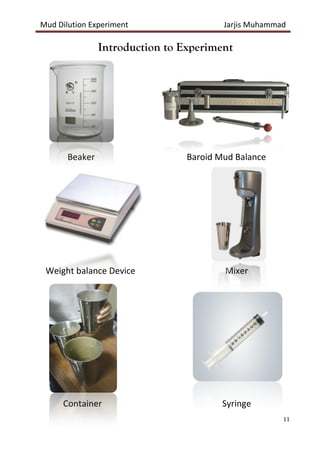
Introduction to Experiment
Beaker Baroid Mud Balance
Weight balance Device Mixer
Container Syringe
Mud Dilution Experiment Jarjis Muhammad
12
Theory
The mud weight is generally designed such that the borehole
pressure opposite permeable (and in particular hydrocarbon
bearing sands) is around 200-300 psi greater than the formation
pore pressure. This pressure differential is known as the
overbalance. If the mud weight is reduced the overbalance
becomes less and the risk of taking a kick becomes greater. It is
therefore essential that the mud weight is continuously
monitored to ensure that the mud that is being pumped into the
well is the correct density. If the mud weight does fall for some
reason then it must be increased to the programmed value
before it is pumped downhole. When the mud is being treated
to improve some property (e.g. viscosity) the first stage is to
dilute the mud with water (water-back) in order to lower the
percentage of solids. Water may also be added when drilling
deep wells, where evaporation may be significant. During these
operations mud weight must be monitored and adjusted
carefully.
Mud Dilution Experiment Jarjis Muhammad
13
Mud balance Calibration
1. Remove the lid from the cup, and completely fill the cup
with water.
2. Replace the lid and wipe dry.
3. Replace the balance arm on the base with knife-edge resting
on the fulcrum.
4. The level vial should be centered when the rider is set on
8.33. If not, add to or remove shot from the well in the end of
the bream.
Mud Dilution Experiment Jarjis Muhammad
14
Procedure:
1. First we weigh bentonite (22.455gm)
2. Then we prepare 400 cc of water.
3. Then we calibrate the Baroid mud balance by density of
water.
4. After that we mix the bentonite and water by mixtures
5. Next we measure density of mud by Baroid
6. Next we measure the additive water (222.22 cc).
7. Then we mix it with the prepared mud by mixture.
8. Finally we find the final density of mud.
Mud Dilution Experiment Jarjis Muhammad
15
Discussion:
1. Why we need to decrease the density of the drilling
mud?
Ans. we need to decrease the mud density because we
need to avoid several problems such as:
A. Mud circulation loss
B. Circulation low velocity
C. High viscous mud
D. Rate of Penetration (ROP) (decreases horsepower
required to circulate)
E. Avoid poor log quality ( rare cases)
F. Hole cleaning problems
2. Can we use other liquids instead of water?
Ans. Yes, we can use other liquids such as oil if we
have water sensitive formation. Or the main mud is
oil-based mud.
Mud Dilution Experiment Jarjis Muhammad
16
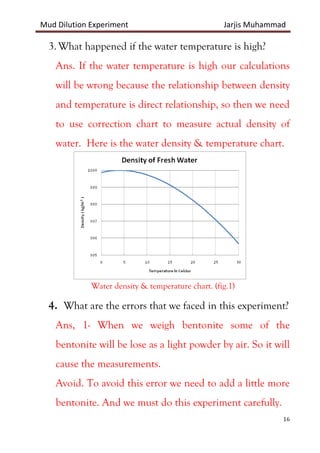
3. What happened if the water temperature is high?
Ans. If the water temperature is high our calculations
will be wrong because the relationship between density
and temperature is direct relationship, so then we need
to use correction chart to measure actual density of
water. Here is the water density & temperature chart.
Water density & temperature chart. (fig.1)
4. What are the errors that we faced in this experiment?
Ans, 1- When we weigh bentonite some of the
bentonite will be lose as a light powder by air. So it will
cause the measurements.
Avoid. To avoid this error we need to add a little more
bentonite. And we must do this experiment carefully.
Mud Dilution Experiment Jarjis Muhammad
17
2- Human errors.
Avoid. To avoid this error we must do this experiment
attentively, and do the experiment again if necessary.
3- If the quality of bentonite is bad then our
calculations will not be accurate.
Avoid. For avoid this error we need to get a good
quality of bentonite (API accepted quality).
5.
Mud Dilution Experiment Jarjis Muhammad
18
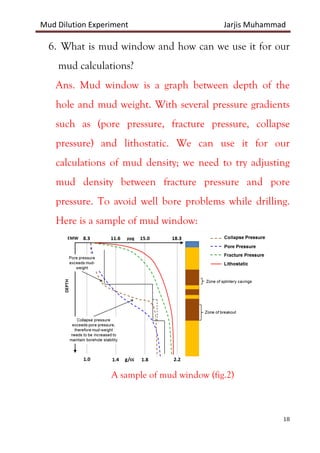
6. What is mud window and how can we use it for our
mud calculations?
Ans. Mud window is a graph between depth of the
hole and mud weight. With several pressure gradients
such as (pore pressure, fracture pressure, collapse
pressure) and lithostatic. We can use it for our
calculations of mud density; we need to try adjusting
mud density between fracture pressure and pore
pressure. To avoid well bore problems while drilling.
Here is a sample of mud window:
A sample of mud window (fig.2)
Mud Dilution Experiment Jarjis Muhammad
19
References:
1. Adam T. Bourgoyne Jr., Keith K. Millheim, Martin E.
Chenevert, and F. S. Young Jr.: “Applied Drilling
Engineering,” SPE Textbook Series, 1991.
2. Max R. Annis and Martin V. Smith: “Drilling Fluids
Technology,” Exxon Company, U.S.A., 1996.

Mud Dilution, Drilling Engineering Lab.

  • 1.
    Petroleum engineering Faculty ofEngineering Koya University Drilling Engineering Laboratory Experiment No. 3: Mud Dilution Date: Dec. 12th 2017 Supervised By: Prepared By: Mr. Pishtiwan Jarjis Muhammad Mr. Muhammad Group: B
  • 2.
    Mud Dilution ExperimentJarjis Muhammad II Contents Subject Page Aim 1 Introduction to Experiment 2 Theory 3 Mud Balance Calibration 4 Procedure 5 Discussion 6 References 8
  • 3.
    Mud Dilution ExperimentJarjis Muhammad 10 Aim of the experiment -Decreasing mud weight (density of mud) by adding Water (H2O) to the mud.
  • 4.
    Mud Dilution ExperimentJarjis Muhammad 11 Introduction to Experiment Beaker Baroid Mud Balance Weight balance Device Mixer Container Syringe
  • 5.
    Mud Dilution ExperimentJarjis Muhammad 12 Theory The mud weight is generally designed such that the borehole pressure opposite permeable (and in particular hydrocarbon bearing sands) is around 200-300 psi greater than the formation pore pressure. This pressure differential is known as the overbalance. If the mud weight is reduced the overbalance becomes less and the risk of taking a kick becomes greater. It is therefore essential that the mud weight is continuously monitored to ensure that the mud that is being pumped into the well is the correct density. If the mud weight does fall for some reason then it must be increased to the programmed value before it is pumped downhole. When the mud is being treated to improve some property (e.g. viscosity) the first stage is to dilute the mud with water (water-back) in order to lower the percentage of solids. Water may also be added when drilling deep wells, where evaporation may be significant. During these operations mud weight must be monitored and adjusted carefully.
  • 6.
    Mud Dilution ExperimentJarjis Muhammad 13 Mud balance Calibration 1. Remove the lid from the cup, and completely fill the cup with water. 2. Replace the lid and wipe dry. 3. Replace the balance arm on the base with knife-edge resting on the fulcrum. 4. The level vial should be centered when the rider is set on 8.33. If not, add to or remove shot from the well in the end of the bream.
  • 7.
    Mud Dilution ExperimentJarjis Muhammad 14 Procedure: 1. First we weigh bentonite (22.455gm) 2. Then we prepare 400 cc of water. 3. Then we calibrate the Baroid mud balance by density of water. 4. After that we mix the bentonite and water by mixtures 5. Next we measure density of mud by Baroid 6. Next we measure the additive water (222.22 cc). 7. Then we mix it with the prepared mud by mixture. 8. Finally we find the final density of mud.
  • 8.
    Mud Dilution ExperimentJarjis Muhammad 15 Discussion: 1. Why we need to decrease the density of the drilling mud? Ans. we need to decrease the mud density because we need to avoid several problems such as: A. Mud circulation loss B. Circulation low velocity C. High viscous mud D. Rate of Penetration (ROP) (decreases horsepower required to circulate) E. Avoid poor log quality ( rare cases) F. Hole cleaning problems 2. Can we use other liquids instead of water? Ans. Yes, we can use other liquids such as oil if we have water sensitive formation. Or the main mud is oil-based mud.
  • 9.
    Mud Dilution ExperimentJarjis Muhammad 16 3. What happened if the water temperature is high? Ans. If the water temperature is high our calculations will be wrong because the relationship between density and temperature is direct relationship, so then we need to use correction chart to measure actual density of water. Here is the water density & temperature chart. Water density & temperature chart. (fig.1) 4. What are the errors that we faced in this experiment? Ans, 1- When we weigh bentonite some of the bentonite will be lose as a light powder by air. So it will cause the measurements. Avoid. To avoid this error we need to add a little more bentonite. And we must do this experiment carefully.
  • 10.
    Mud Dilution ExperimentJarjis Muhammad 17 2- Human errors. Avoid. To avoid this error we must do this experiment attentively, and do the experiment again if necessary. 3- If the quality of bentonite is bad then our calculations will not be accurate. Avoid. For avoid this error we need to get a good quality of bentonite (API accepted quality). 5.
  • 11.
    Mud Dilution ExperimentJarjis Muhammad 18 6. What is mud window and how can we use it for our mud calculations? Ans. Mud window is a graph between depth of the hole and mud weight. With several pressure gradients such as (pore pressure, fracture pressure, collapse pressure) and lithostatic. We can use it for our calculations of mud density; we need to try adjusting mud density between fracture pressure and pore pressure. To avoid well bore problems while drilling. Here is a sample of mud window: A sample of mud window (fig.2)
  • 12.
    Mud Dilution ExperimentJarjis Muhammad 19 References: 1. Adam T. Bourgoyne Jr., Keith K. Millheim, Martin E. Chenevert, and F. S. Young Jr.: “Applied Drilling Engineering,” SPE Textbook Series, 1991. 2. Max R. Annis and Martin V. Smith: “Drilling Fluids Technology,” Exxon Company, U.S.A., 1996.