Reservoir Fluid Properties Course (1st Ed.)
1.
2.
3.
4.

About This Course
Resources
Training Outline (beta)
Petroleum Engineering & Its Importance

2013 H. AlamiNia

Reservoir Fluid Properties Course: Introduction

2
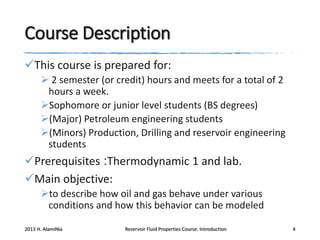
Course Description
This course is prepared for:
 2 semester (or credit) hours and meets for a total of 2
hours a week.
Sophomore or junior level students (BS degrees)
(Major) Petroleum engineering students
(Minors) Production, Drilling and reservoir engineering
students

Prerequisites :Thermodynamic 1 and lab.
Main objective:
to describe how oil and gas behave under various
conditions and how this behavior can be modeled
2013 H. AlamiNia

Reservoir Fluid Properties Course: Introduction

4
Lectures
Each session
Consists of different sections (about 4-5 sections)
Consists of about 50 slides
Is divided into 2 parts with short break time
Would be available online

2013 H. AlamiNia

Reservoir Fluid Properties Course: Introduction

5
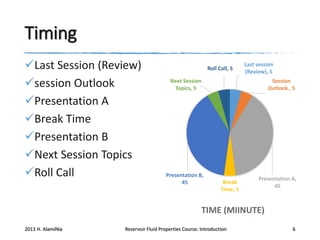
Timing
Last Session (Review)
session Outlook
Presentation A
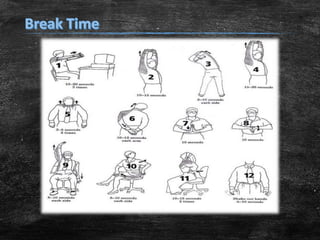
Break Time
Presentation B
Next Session Topics
Roll Call

Roll Call, 5

Last session
(Review), 5

Next Session
Topics, 5

Session
Outlook , 5

Presentation B,
45

Break
Time, 5

Presentation A,
45

TIME (MIINUTE)
2013 H. AlamiNia

Reservoir Fluid Properties Course: Introduction

6
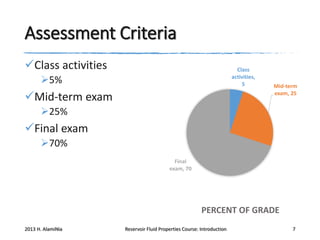
Assessment Criteria
Class activities

Class
activities,
5

5%

Mid-term exam

Mid-term
exam, 25

25%

Final exam
70%
Final
exam, 70

PERCENT OF GRADE
2013 H. AlamiNia

Reservoir Fluid Properties Course: Introduction

7
Syllabus
1390 edition
1378 edition

2013 H. AlamiNia

Reservoir Fluid Properties Course: Introduction

9
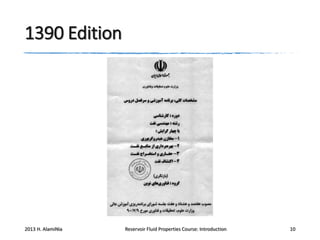
1390 Edition

2013 H. AlamiNia

Reservoir Fluid Properties Course: Introduction

10
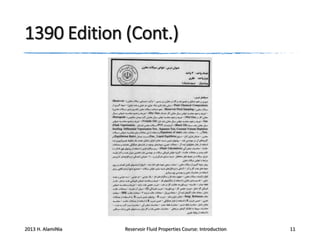
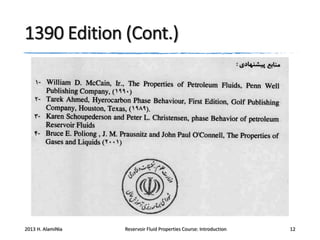
1390 Edition (Cont.)

2013 H. AlamiNia

Reservoir Fluid Properties Course: Introduction

11
1390 Edition (Cont.)

2013 H. AlamiNia

Reservoir Fluid Properties Course: Introduction

12
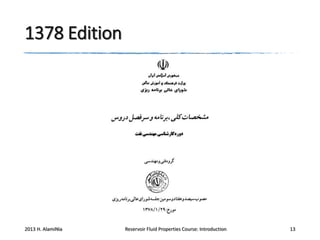
1378 Edition

2013 H. AlamiNia

Reservoir Fluid Properties Course: Introduction

13
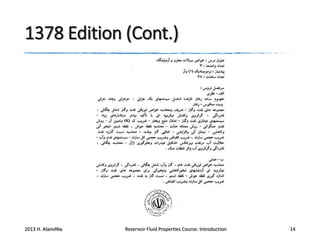
1378 Edition (Cont.)

2013 H. AlamiNia

Reservoir Fluid Properties Course: Introduction

14
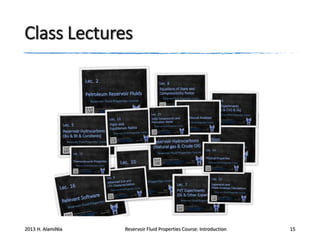
Class Lectures

2013 H. AlamiNia

Reservoir Fluid Properties Course: Introduction

15
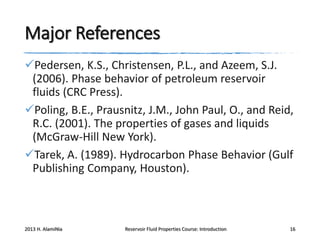
Major References
Pedersen, K.S., Christensen, P.L., and Azeem, S.J.
(2006). Phase behavior of petroleum reservoir
fluids (CRC Press).
Poling, B.E., Prausnitz, J.M., John Paul, O., and Reid,
R.C. (2001). The properties of gases and liquids
(McGraw-Hill New York).
Tarek, A. (1989). Hydrocarbon Phase Behavior (Gulf
Publishing Company, Houston).

2013 H. AlamiNia

Reservoir Fluid Properties Course: Introduction

16
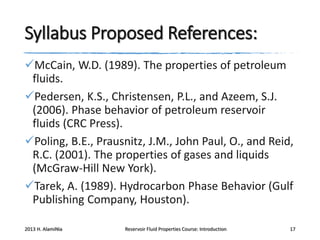
Syllabus Proposed References:
McCain, W.D. (1989). The properties of petroleum
fluids.
Pedersen, K.S., Christensen, P.L., and Azeem, S.J.
(2006). Phase behavior of petroleum reservoir
fluids (CRC Press).
Poling, B.E., Prausnitz, J.M., John Paul, O., and Reid,
R.C. (2001). The properties of gases and liquids
(McGraw-Hill New York).
Tarek, A. (1989). Hydrocarbon Phase Behavior (Gulf
Publishing Company, Houston).
2013 H. AlamiNia

Reservoir Fluid Properties Course: Introduction

17
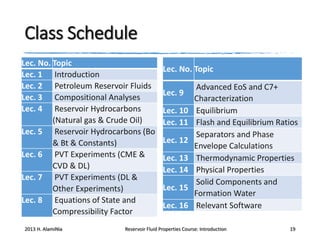
Class Schedule
Lec. No. Topic
Lec. 1 Introduction
Lec. 2 Petroleum Reservoir Fluids
Lec. 3 Compositional Analyses
Lec. 4 Reservoir Hydrocarbons
(Natural gas & Crude Oil)
Lec. 5 Reservoir Hydrocarbons (Bo
& Bt & Constants)
Lec. 6 PVT Experiments (CME &
CVD & DL)
Lec. 7 PVT Experiments (DL &
Other Experiments)
Lec. 8 Equations of State and
Compressibility Factor
2013 H. AlamiNia

Lec. No. Topic

Lec. 9
Lec. 10
Lec. 11
Lec. 12
Lec. 13
Lec. 14
Lec. 15
Lec. 16

Advanced EoS and C7+
Characterization
Equilibrium
Flash and Equilibrium Ratios
Separators and Phase
Envelope Calculations
Thermodynamic Properties
Physical Properties
Solid Components and
Formation Water
Relevant Software

Reservoir Fluid Properties Course: Introduction

19
Lec. 1: Introduction
About This Course
Resources
Training Outline (beta)
Petroleum Engineering & Its Importance

2013 H. AlamiNia

Reservoir Fluid Properties Course: Introduction

20
Lec. 2: Petroleum Reservoir Fluids
Reservoir Fluids
Phase Behavior of Hydrocarbons
Phase Envelopes
HC Classifications

2013 H. AlamiNia

Reservoir Fluid Properties Course: Introduction

21
Lec. 3: Compositional Analyses
Samples
Sample Analysis
Samples Quality Control
K-Factor as A QC

2013 H. AlamiNia

Reservoir Fluid Properties Course: Introduction

22
Lec. 4: Reservoir Hydrocarbons
(Natural gas & Crude Oil)
Reservoir Fluid Course
HC Alteration
Properties of Natural Gases
Properties of Crude Oils
density
Gas Solubility

2013 H. AlamiNia

Reservoir Fluid Properties Course: Introduction

23
Lec. 5: Reservoir Hydrocarbons
(Bo & Bt & Constants)
Formation Volume Factor
Oil
Total (two phase)

Property Constants

2013 H. AlamiNia

Reservoir Fluid Properties Course: Introduction

24
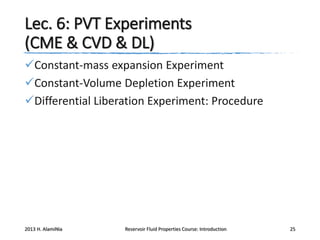
Lec. 6: PVT Experiments
(CME & CVD & DL)
Constant-mass expansion Experiment
Constant-Volume Depletion Experiment
Differential Liberation Experiment: Procedure

2013 H. AlamiNia

Reservoir Fluid Properties Course: Introduction

25
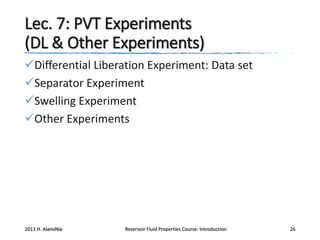
Lec. 7: PVT Experiments
(DL & Other Experiments)
Differential Liberation Experiment: Data set
Separator Experiment
Swelling Experiment
Other Experiments

2013 H. AlamiNia

Reservoir Fluid Properties Course: Introduction

26
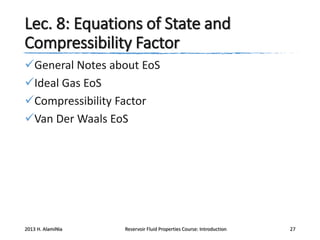
Lec. 8: Equations of State and
Compressibility Factor
General Notes about EoS
Ideal Gas EoS
Compressibility Factor
Van Der Waals EoS

2013 H. AlamiNia

Reservoir Fluid Properties Course: Introduction

27
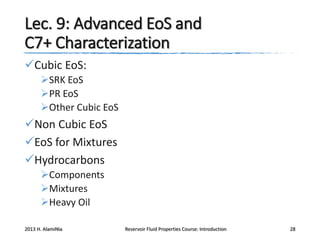
Lec. 9: Advanced EoS and
C7+ Characterization
Cubic EoS:
SRK EoS
PR EoS
Other Cubic EoS

Non Cubic EoS
EoS for Mixtures
Hydrocarbons
Components
Mixtures
Heavy Oil
2013 H. AlamiNia

Reservoir Fluid Properties Course: Introduction

28
Lec. 10: Equilibrium
Cubic EoS:
SRK EoS
PR EoS
Other Cubic EoS

Non Cubic EoS
EoS for Mixtures
Hydrocarbons
Components
Mixtures
Heavy Oil
2013 H. AlamiNia

Reservoir Fluid Properties Course: Introduction

29
Lec. 11: Flash and Equilibrium Ratios
PT-Flash Process
Equilibrium Ratios
PT-Flash Calculations
Mixture Saturation Points

2013 H. AlamiNia

Reservoir Fluid Properties Course: Introduction

30
Lec. 12: Separators and
Phase Envelope Calculations
Mixture Saturation Points Calculation
Surface Separation
Phase Envelope
Phase Identification

2013 H. AlamiNia

Reservoir Fluid Properties Course: Introduction

31
Lec. 13: Thermodynamic Properties
The Estimation of Physical Properties
EoS Applications
Thermodynamic Properties

2013 H. AlamiNia

Reservoir Fluid Properties Course: Introduction

32
Lec. 14: Physical Properties
Viscosity
Surface and Interfacial Tension
Applications of the Natural Gas PVT Properties
Applications of the Crude Oil PVT Properties

2013 H. AlamiNia

Reservoir Fluid Properties Course: Introduction

33
Lec. 15: Solid Components and
Formation Water
Asphaltene
Gas Hydrates
Hydrate Structures
Formation Water

2013 H. AlamiNia

Reservoir Fluid Properties Course: Introduction

34
Lec. 16: Relevant Software
PVT Simulation
CMG
IPM
PVTi

2013 H. AlamiNia

Reservoir Fluid Properties Course: Introduction

35
Petroleum Engineering
Definition
Petroleum Engineering, by definition, is finding crude oil
and natural gas in the ground and devising a way to bring
it out of the ground.

Petroleum Engineer Role
Petroleum Engineers supply society with crude oil and
natural gas for energy. This energy fuels our cars and
planes, heats our homes, powers our plants and
generates electricity.

2013 H. AlamiNia

Reservoir Fluid Properties Course: Introduction

38
What Is Petroleum?
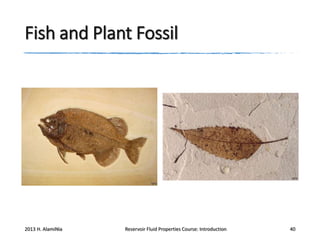
Crude oil, or petroleum, is an organic substance
derived from the remains of prehistoric plant and
animal matter.
It is a mixture of hydrocarbons, i.e. molecules
containing hydrogen and carbon, which exist
sometimes in liquid form (crude oil) and sometimes
as a vapor (natural gas).

2013 H. AlamiNia

Reservoir Fluid Properties Course: Introduction

39
Fish and Plant Fossil

2013 H. AlamiNia

Reservoir Fluid Properties Course: Introduction

40
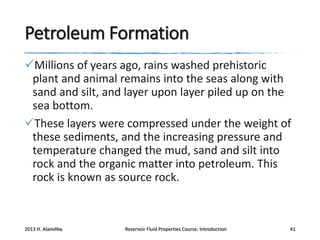
Petroleum Formation
Millions of years ago, rains washed prehistoric
plant and animal remains into the seas along with
sand and silt, and layer upon layer piled up on the
sea bottom.
These layers were compressed under the weight of
these sediments, and the increasing pressure and
temperature changed the mud, sand and silt into
rock and the organic matter into petroleum. This
rock is known as source rock.

2013 H. AlamiNia

Reservoir Fluid Properties Course: Introduction

41
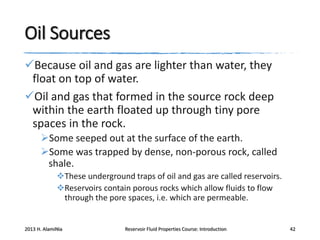
Oil Sources
Because oil and gas are lighter than water, they
float on top of water.
Oil and gas that formed in the source rock deep
within the earth floated up through tiny pore
spaces in the rock.
Some seeped out at the surface of the earth.
Some was trapped by dense, non-porous rock, called
shale.
These underground traps of oil and gas are called reservoirs.
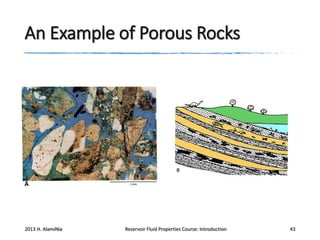
Reservoirs contain porous rocks which allow fluids to flow
through the pore spaces, i.e. which are permeable.

2013 H. AlamiNia

Reservoir Fluid Properties Course: Introduction

42
An Example of Porous Rocks

2013 H. AlamiNia

Reservoir Fluid Properties Course: Introduction

43
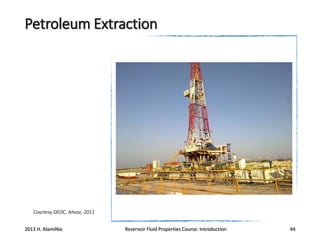
Petroleum Extraction

Courtesy OEOC, Ahvaz, 2011

2013 H. AlamiNia

Reservoir Fluid Properties Course: Introduction

44
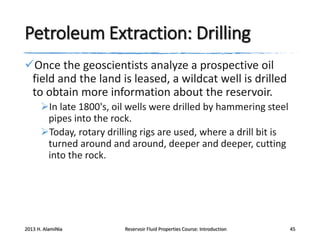
Petroleum Extraction: Drilling
Once the geoscientists analyze a prospective oil
field and the land is leased, a wildcat well is drilled
to obtain more information about the reservoir.
In late 1800's, oil wells were drilled by hammering steel
pipes into the rock.
Today, rotary drilling rigs are used, where a drill bit is
turned around and around, deeper and deeper, cutting
into the rock.

2013 H. AlamiNia

Reservoir Fluid Properties Course: Introduction

45
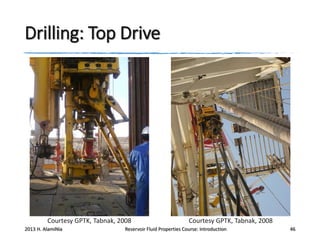
Drilling: Top Drive

Courtesy GPTK, Tabnak, 2008
2013 H. AlamiNia

Courtesy GPTK, Tabnak, 2008

Reservoir Fluid Properties Course: Introduction

46
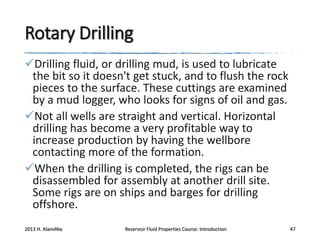
Rotary Drilling
Drilling fluid, or drilling mud, is used to lubricate
the bit so it doesn't get stuck, and to flush the rock
pieces to the surface. These cuttings are examined
by a mud logger, who looks for signs of oil and gas.
Not all wells are straight and vertical. Horizontal
drilling has become a very profitable way to
increase production by having the wellbore
contacting more of the formation.
When the drilling is completed, the rigs can be
disassembled for assembly at another drill site.
Some rigs are on ships and barges for drilling
offshore.
2013 H. AlamiNia

Reservoir Fluid Properties Course: Introduction

47
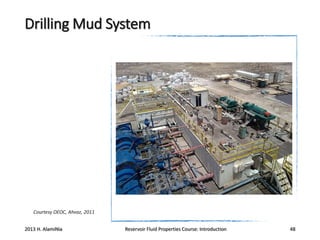
Drilling Mud System

Courtesy OEOC, Ahvaz, 2011

2013 H. AlamiNia

Reservoir Fluid Properties Course: Introduction

48
Well Completion
After drilling, steel pipe called casing is set in the
hole and is cemented into place.
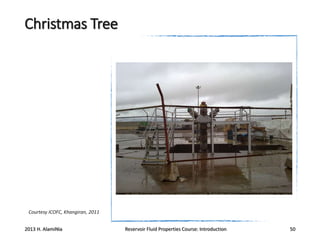
A heavy-duty system of valves called a Christmas
Tree is set into place at the wellhead to control the
flow of the oil, gas and water and prevent a
blowout.
Then the well casing is perforated at the right
depths to make holes for the oil and gas to flow into
the wellbore and up to the surface.

2013 H. AlamiNia

Reservoir Fluid Properties Course: Introduction

49
Christmas Tree

Courtesy ICOFC, Khangiran, 2011

2013 H. AlamiNia

Reservoir Fluid Properties Course: Introduction

50
Casing & Cementing

Courtesy OEOC, Ahvaz, 2011

2013 H. AlamiNia

Reservoir Fluid Properties Course: Introduction

51
Petroleum Extraction: Production
Because oil, gas and water underground are under
a lot of pressure at first, these fluids flow up a
wellbore all by themselves, much like a soft drink
that has been shaken up. When oil and gas are
produced this way, it is called primary recovery.
When the initial pressure is spent, sucker rod
pumps are used to pull the oil out of the reservoir
rock and up the well.
Sometimes gas is injected at the bottom of the
well, and as it expands, it lifts the oil up to the
surface. This is called gas lift.
2013 H. AlamiNia

Reservoir Fluid Properties Course: Introduction

52
Producing the Well
Opening up new channels in the rock for the oil
and gas to flow through is called stimulation.
Three stimulation treatments are commonly used:
Explosives to break up the rock,
Injection of acid to partially dissolve the rock, and
Hydraulic fracturing to split the rock and prop it open
with proppants.

2013 H. AlamiNia

Reservoir Fluid Properties Course: Introduction

53
Secondary Recovery
After primary recovery, only a portion of the oil and
gas has been produced, so secondary recovery, or
waterflooding is done.
Water and oil do not mix; oil is generally lighter than
water and floats on top of it in the reservoir.
During a waterflood, water is injected into the water
zone of some of the wells to push the oil and gas up the
other wells.

2013 H. AlamiNia

Reservoir Fluid Properties Course: Introduction

54
Consumption of Oil: Fuels
Fuel from produced oil and gas is used variously as
gasoline for cars, jet fuel, kerosene, propane gas for
cooking, heating oils for home furnaces, diesel fuels for
trucks and buses and trains, industrial fuels for boilers in
factories and ships, and solid coke for burning.
Many electricity generating plants are also run on oil or
natural gas.

2013 H. AlamiNia

Reservoir Fluid Properties Course: Introduction

55
Consumption of Oil: Plastics, Rubber,
Other Products and Fibers
Plastics, Rubber, Other Products
Many plastics and polymers are made from petroleum
feedstocks.
These are used to manufacture things like food wrap, toys,
containers, and automobile tires.

Other products include lubricating oils for machinery,
grease, wax for candles, asphalt for roads and roofs,
agricultural pesticides and fertilizers, and white oils and
petrolatum for medicinal purposes.

Fibers
Polyester and nylon are petrochemicals that are made
into thousands of consumer products like panty hose,
nylon thread, and polyester.
2013 H. AlamiNia

Reservoir Fluid Properties Course: Introduction

56
Careers in Oil Industry:
Engineers and Scientists
There are many careers in the oil industry. Nearly
every type of engineer can be found upstream or
downstream, including
Chemical, industrial, mechanical, civil, electrical,
bioengineers, and of course, petroleum engineers.

Natural and earth sciences are also prevalent in the
oil business.
Chemists, biologists, physicists, geologists, geophysicists,
and computer scientists work together on multidisciplinary teams with engineers to research and
optimize oil field and refinery operations.
2013 H. AlamiNia

Reservoir Fluid Properties Course: Introduction

57
Careers in Oil Industry:
Other Professional
There are also other professional and support
careers, as in any business.
These include business administration, accounting, law
and tax, advertising, sales and marketing, secretarial and
library functions, trucking, public and employee
relations, and a host of other positions to keep operation
smooth.

2013 H. AlamiNia

Reservoir Fluid Properties Course: Introduction

58
1. ONGC Videsh (2003). Petroleum Engineering &
Its Importance.

2013 H. AlamiNia

Reservoir Fluid Properties Course: Introduction

59
1.
2.
3.
4.

Reservoir Fluids
Phase Behavior of Hydrocarbons
Phase Envelopes
HC Classifications

2013 H. AlamiNia

Reservoir Fluid Properties Course: Introduction

60
Q913 rfp w1 lec 1

Q913 rfp w1 lec 1

  • 1.
  • 2.
    1. 2. 3. 4. About This Course Resources TrainingOutline (beta) Petroleum Engineering & Its Importance 2013 H. AlamiNia Reservoir Fluid Properties Course: Introduction 2
  • 4.
    Course Description This courseis prepared for:  2 semester (or credit) hours and meets for a total of 2 hours a week. Sophomore or junior level students (BS degrees) (Major) Petroleum engineering students (Minors) Production, Drilling and reservoir engineering students Prerequisites :Thermodynamic 1 and lab. Main objective: to describe how oil and gas behave under various conditions and how this behavior can be modeled 2013 H. AlamiNia Reservoir Fluid Properties Course: Introduction 4
  • 5.
    Lectures Each session Consists ofdifferent sections (about 4-5 sections) Consists of about 50 slides Is divided into 2 parts with short break time Would be available online 2013 H. AlamiNia Reservoir Fluid Properties Course: Introduction 5
  • 6.
    Timing Last Session (Review) sessionOutlook Presentation A Break Time Presentation B Next Session Topics Roll Call Roll Call, 5 Last session (Review), 5 Next Session Topics, 5 Session Outlook , 5 Presentation B, 45 Break Time, 5 Presentation A, 45 TIME (MIINUTE) 2013 H. AlamiNia Reservoir Fluid Properties Course: Introduction 6
  • 7.
    Assessment Criteria Class activities Class activities, 5 5% Mid-termexam Mid-term exam, 25 25% Final exam 70% Final exam, 70 PERCENT OF GRADE 2013 H. AlamiNia Reservoir Fluid Properties Course: Introduction 7
  • 9.
    Syllabus 1390 edition 1378 edition 2013H. AlamiNia Reservoir Fluid Properties Course: Introduction 9
  • 10.
    1390 Edition 2013 H.AlamiNia Reservoir Fluid Properties Course: Introduction 10
  • 11.
    1390 Edition (Cont.) 2013H. AlamiNia Reservoir Fluid Properties Course: Introduction 11
  • 12.
    1390 Edition (Cont.) 2013H. AlamiNia Reservoir Fluid Properties Course: Introduction 12
  • 13.
    1378 Edition 2013 H.AlamiNia Reservoir Fluid Properties Course: Introduction 13
  • 14.
    1378 Edition (Cont.) 2013H. AlamiNia Reservoir Fluid Properties Course: Introduction 14
  • 15.
    Class Lectures 2013 H.AlamiNia Reservoir Fluid Properties Course: Introduction 15
  • 16.
    Major References Pedersen, K.S.,Christensen, P.L., and Azeem, S.J. (2006). Phase behavior of petroleum reservoir fluids (CRC Press). Poling, B.E., Prausnitz, J.M., John Paul, O., and Reid, R.C. (2001). The properties of gases and liquids (McGraw-Hill New York). Tarek, A. (1989). Hydrocarbon Phase Behavior (Gulf Publishing Company, Houston). 2013 H. AlamiNia Reservoir Fluid Properties Course: Introduction 16
  • 17.
    Syllabus Proposed References: McCain,W.D. (1989). The properties of petroleum fluids. Pedersen, K.S., Christensen, P.L., and Azeem, S.J. (2006). Phase behavior of petroleum reservoir fluids (CRC Press). Poling, B.E., Prausnitz, J.M., John Paul, O., and Reid, R.C. (2001). The properties of gases and liquids (McGraw-Hill New York). Tarek, A. (1989). Hydrocarbon Phase Behavior (Gulf Publishing Company, Houston). 2013 H. AlamiNia Reservoir Fluid Properties Course: Introduction 17
  • 19.
    Class Schedule Lec. No.Topic Lec. 1 Introduction Lec. 2 Petroleum Reservoir Fluids Lec. 3 Compositional Analyses Lec. 4 Reservoir Hydrocarbons (Natural gas & Crude Oil) Lec. 5 Reservoir Hydrocarbons (Bo & Bt & Constants) Lec. 6 PVT Experiments (CME & CVD & DL) Lec. 7 PVT Experiments (DL & Other Experiments) Lec. 8 Equations of State and Compressibility Factor 2013 H. AlamiNia Lec. No. Topic Lec. 9 Lec. 10 Lec. 11 Lec. 12 Lec. 13 Lec. 14 Lec. 15 Lec. 16 Advanced EoS and C7+ Characterization Equilibrium Flash and Equilibrium Ratios Separators and Phase Envelope Calculations Thermodynamic Properties Physical Properties Solid Components and Formation Water Relevant Software Reservoir Fluid Properties Course: Introduction 19
  • 20.
    Lec. 1: Introduction AboutThis Course Resources Training Outline (beta) Petroleum Engineering & Its Importance 2013 H. AlamiNia Reservoir Fluid Properties Course: Introduction 20
  • 21.
    Lec. 2: PetroleumReservoir Fluids Reservoir Fluids Phase Behavior of Hydrocarbons Phase Envelopes HC Classifications 2013 H. AlamiNia Reservoir Fluid Properties Course: Introduction 21
  • 22.
    Lec. 3: CompositionalAnalyses Samples Sample Analysis Samples Quality Control K-Factor as A QC 2013 H. AlamiNia Reservoir Fluid Properties Course: Introduction 22
  • 23.
    Lec. 4: ReservoirHydrocarbons (Natural gas & Crude Oil) Reservoir Fluid Course HC Alteration Properties of Natural Gases Properties of Crude Oils density Gas Solubility 2013 H. AlamiNia Reservoir Fluid Properties Course: Introduction 23
  • 24.
    Lec. 5: ReservoirHydrocarbons (Bo & Bt & Constants) Formation Volume Factor Oil Total (two phase) Property Constants 2013 H. AlamiNia Reservoir Fluid Properties Course: Introduction 24
  • 25.
    Lec. 6: PVTExperiments (CME & CVD & DL) Constant-mass expansion Experiment Constant-Volume Depletion Experiment Differential Liberation Experiment: Procedure 2013 H. AlamiNia Reservoir Fluid Properties Course: Introduction 25
  • 26.
    Lec. 7: PVTExperiments (DL & Other Experiments) Differential Liberation Experiment: Data set Separator Experiment Swelling Experiment Other Experiments 2013 H. AlamiNia Reservoir Fluid Properties Course: Introduction 26
  • 27.
    Lec. 8: Equationsof State and Compressibility Factor General Notes about EoS Ideal Gas EoS Compressibility Factor Van Der Waals EoS 2013 H. AlamiNia Reservoir Fluid Properties Course: Introduction 27
  • 28.
    Lec. 9: AdvancedEoS and C7+ Characterization Cubic EoS: SRK EoS PR EoS Other Cubic EoS Non Cubic EoS EoS for Mixtures Hydrocarbons Components Mixtures Heavy Oil 2013 H. AlamiNia Reservoir Fluid Properties Course: Introduction 28
  • 29.
    Lec. 10: Equilibrium CubicEoS: SRK EoS PR EoS Other Cubic EoS Non Cubic EoS EoS for Mixtures Hydrocarbons Components Mixtures Heavy Oil 2013 H. AlamiNia Reservoir Fluid Properties Course: Introduction 29
  • 30.
    Lec. 11: Flashand Equilibrium Ratios PT-Flash Process Equilibrium Ratios PT-Flash Calculations Mixture Saturation Points 2013 H. AlamiNia Reservoir Fluid Properties Course: Introduction 30
  • 31.
    Lec. 12: Separatorsand Phase Envelope Calculations Mixture Saturation Points Calculation Surface Separation Phase Envelope Phase Identification 2013 H. AlamiNia Reservoir Fluid Properties Course: Introduction 31
  • 32.
    Lec. 13: ThermodynamicProperties The Estimation of Physical Properties EoS Applications Thermodynamic Properties 2013 H. AlamiNia Reservoir Fluid Properties Course: Introduction 32
  • 33.
    Lec. 14: PhysicalProperties Viscosity Surface and Interfacial Tension Applications of the Natural Gas PVT Properties Applications of the Crude Oil PVT Properties 2013 H. AlamiNia Reservoir Fluid Properties Course: Introduction 33
  • 34.
    Lec. 15: SolidComponents and Formation Water Asphaltene Gas Hydrates Hydrate Structures Formation Water 2013 H. AlamiNia Reservoir Fluid Properties Course: Introduction 34
  • 35.
    Lec. 16: RelevantSoftware PVT Simulation CMG IPM PVTi 2013 H. AlamiNia Reservoir Fluid Properties Course: Introduction 35
  • 38.
    Petroleum Engineering Definition Petroleum Engineering,by definition, is finding crude oil and natural gas in the ground and devising a way to bring it out of the ground. Petroleum Engineer Role Petroleum Engineers supply society with crude oil and natural gas for energy. This energy fuels our cars and planes, heats our homes, powers our plants and generates electricity. 2013 H. AlamiNia Reservoir Fluid Properties Course: Introduction 38
  • 39.
    What Is Petroleum? Crudeoil, or petroleum, is an organic substance derived from the remains of prehistoric plant and animal matter. It is a mixture of hydrocarbons, i.e. molecules containing hydrogen and carbon, which exist sometimes in liquid form (crude oil) and sometimes as a vapor (natural gas). 2013 H. AlamiNia Reservoir Fluid Properties Course: Introduction 39
  • 40.
    Fish and PlantFossil 2013 H. AlamiNia Reservoir Fluid Properties Course: Introduction 40
  • 41.
    Petroleum Formation Millions ofyears ago, rains washed prehistoric plant and animal remains into the seas along with sand and silt, and layer upon layer piled up on the sea bottom. These layers were compressed under the weight of these sediments, and the increasing pressure and temperature changed the mud, sand and silt into rock and the organic matter into petroleum. This rock is known as source rock. 2013 H. AlamiNia Reservoir Fluid Properties Course: Introduction 41
  • 42.
    Oil Sources Because oiland gas are lighter than water, they float on top of water. Oil and gas that formed in the source rock deep within the earth floated up through tiny pore spaces in the rock. Some seeped out at the surface of the earth. Some was trapped by dense, non-porous rock, called shale. These underground traps of oil and gas are called reservoirs. Reservoirs contain porous rocks which allow fluids to flow through the pore spaces, i.e. which are permeable. 2013 H. AlamiNia Reservoir Fluid Properties Course: Introduction 42
  • 43.
    An Example ofPorous Rocks 2013 H. AlamiNia Reservoir Fluid Properties Course: Introduction 43
  • 44.
    Petroleum Extraction Courtesy OEOC,Ahvaz, 2011 2013 H. AlamiNia Reservoir Fluid Properties Course: Introduction 44
  • 45.
    Petroleum Extraction: Drilling Oncethe geoscientists analyze a prospective oil field and the land is leased, a wildcat well is drilled to obtain more information about the reservoir. In late 1800's, oil wells were drilled by hammering steel pipes into the rock. Today, rotary drilling rigs are used, where a drill bit is turned around and around, deeper and deeper, cutting into the rock. 2013 H. AlamiNia Reservoir Fluid Properties Course: Introduction 45
  • 46.
    Drilling: Top Drive CourtesyGPTK, Tabnak, 2008 2013 H. AlamiNia Courtesy GPTK, Tabnak, 2008 Reservoir Fluid Properties Course: Introduction 46
  • 47.
    Rotary Drilling Drilling fluid,or drilling mud, is used to lubricate the bit so it doesn't get stuck, and to flush the rock pieces to the surface. These cuttings are examined by a mud logger, who looks for signs of oil and gas. Not all wells are straight and vertical. Horizontal drilling has become a very profitable way to increase production by having the wellbore contacting more of the formation. When the drilling is completed, the rigs can be disassembled for assembly at another drill site. Some rigs are on ships and barges for drilling offshore. 2013 H. AlamiNia Reservoir Fluid Properties Course: Introduction 47
  • 48.
    Drilling Mud System CourtesyOEOC, Ahvaz, 2011 2013 H. AlamiNia Reservoir Fluid Properties Course: Introduction 48
  • 49.
    Well Completion After drilling,steel pipe called casing is set in the hole and is cemented into place. A heavy-duty system of valves called a Christmas Tree is set into place at the wellhead to control the flow of the oil, gas and water and prevent a blowout. Then the well casing is perforated at the right depths to make holes for the oil and gas to flow into the wellbore and up to the surface. 2013 H. AlamiNia Reservoir Fluid Properties Course: Introduction 49
  • 50.
    Christmas Tree Courtesy ICOFC,Khangiran, 2011 2013 H. AlamiNia Reservoir Fluid Properties Course: Introduction 50
  • 51.
    Casing & Cementing CourtesyOEOC, Ahvaz, 2011 2013 H. AlamiNia Reservoir Fluid Properties Course: Introduction 51
  • 52.
    Petroleum Extraction: Production Becauseoil, gas and water underground are under a lot of pressure at first, these fluids flow up a wellbore all by themselves, much like a soft drink that has been shaken up. When oil and gas are produced this way, it is called primary recovery. When the initial pressure is spent, sucker rod pumps are used to pull the oil out of the reservoir rock and up the well. Sometimes gas is injected at the bottom of the well, and as it expands, it lifts the oil up to the surface. This is called gas lift. 2013 H. AlamiNia Reservoir Fluid Properties Course: Introduction 52
  • 53.
    Producing the Well Openingup new channels in the rock for the oil and gas to flow through is called stimulation. Three stimulation treatments are commonly used: Explosives to break up the rock, Injection of acid to partially dissolve the rock, and Hydraulic fracturing to split the rock and prop it open with proppants. 2013 H. AlamiNia Reservoir Fluid Properties Course: Introduction 53
  • 54.
    Secondary Recovery After primaryrecovery, only a portion of the oil and gas has been produced, so secondary recovery, or waterflooding is done. Water and oil do not mix; oil is generally lighter than water and floats on top of it in the reservoir. During a waterflood, water is injected into the water zone of some of the wells to push the oil and gas up the other wells. 2013 H. AlamiNia Reservoir Fluid Properties Course: Introduction 54
  • 55.
    Consumption of Oil:Fuels Fuel from produced oil and gas is used variously as gasoline for cars, jet fuel, kerosene, propane gas for cooking, heating oils for home furnaces, diesel fuels for trucks and buses and trains, industrial fuels for boilers in factories and ships, and solid coke for burning. Many electricity generating plants are also run on oil or natural gas. 2013 H. AlamiNia Reservoir Fluid Properties Course: Introduction 55
  • 56.
    Consumption of Oil:Plastics, Rubber, Other Products and Fibers Plastics, Rubber, Other Products Many plastics and polymers are made from petroleum feedstocks. These are used to manufacture things like food wrap, toys, containers, and automobile tires. Other products include lubricating oils for machinery, grease, wax for candles, asphalt for roads and roofs, agricultural pesticides and fertilizers, and white oils and petrolatum for medicinal purposes. Fibers Polyester and nylon are petrochemicals that are made into thousands of consumer products like panty hose, nylon thread, and polyester. 2013 H. AlamiNia Reservoir Fluid Properties Course: Introduction 56
  • 57.
    Careers in OilIndustry: Engineers and Scientists There are many careers in the oil industry. Nearly every type of engineer can be found upstream or downstream, including Chemical, industrial, mechanical, civil, electrical, bioengineers, and of course, petroleum engineers. Natural and earth sciences are also prevalent in the oil business. Chemists, biologists, physicists, geologists, geophysicists, and computer scientists work together on multidisciplinary teams with engineers to research and optimize oil field and refinery operations. 2013 H. AlamiNia Reservoir Fluid Properties Course: Introduction 57
  • 58.
    Careers in OilIndustry: Other Professional There are also other professional and support careers, as in any business. These include business administration, accounting, law and tax, advertising, sales and marketing, secretarial and library functions, trucking, public and employee relations, and a host of other positions to keep operation smooth. 2013 H. AlamiNia Reservoir Fluid Properties Course: Introduction 58
  • 59.
    1. ONGC Videsh(2003). Petroleum Engineering & Its Importance. 2013 H. AlamiNia Reservoir Fluid Properties Course: Introduction 59
  • 60.
    1. 2. 3. 4. Reservoir Fluids Phase Behaviorof Hydrocarbons Phase Envelopes HC Classifications 2013 H. AlamiNia Reservoir Fluid Properties Course: Introduction 60