Reservoir Fluid Properties Course (1st Ed.)
1. Petroleum Engineering & Its Importance
2. Petroleum Formation
3. Petroleum Extraction
A. Drilling
B. Production

4. Consumption of Oil

2013 H. AlamiNia

Reservoir Fluid Properties Course: Petroleum Reservoir Fluids

2
1.
2.
3.
4.

Reservoir Fluids
Phase Behavior of Hydrocarbons
Phase Envelopes
HC Classifications

2013 H. AlamiNia

Reservoir Fluid Properties Course: Petroleum Reservoir Fluids

3
Reservoir Fluid Constituents
Petroleum reservoir fluids are multicomponent
mixtures consisting primarily of hydrocarbons.
 Methane (CH4) is the simplest of all hydrocarbons, and
also the most common component in petroleum
reservoir fluids. Because methane contains one carbon
atom, it is often referred to as C1.
Hydrocarbons with seven and more carbon atoms are
called C7+ components, and the entity of all C7+
components is called the C7+ fraction.
Petroleum reservoir fluids may contain hydrocarbons as
heavy as C 200.

2013 H. AlamiNia

Reservoir Fluid Properties Course: Petroleum Reservoir Fluids

5
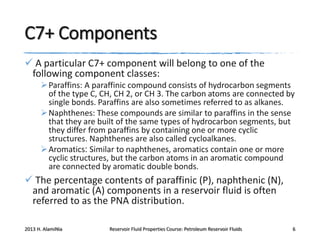
C7+ Components
 A particular C7+ component will belong to one of the
following component classes:
 Paraffins: A paraffinic compound consists of hydrocarbon segments
of the type C, CH, CH 2, or CH 3. The carbon atoms are connected by
single bonds. Paraffins are also sometimes referred to as alkanes.
 Naphthenes: These compounds are similar to paraffins in the sense
that they are built of the same types of hydrocarbon segments, but
they differ from paraffins by containing one or more cyclic
structures. Naphthenes are also called cycloalkanes.
 Aromatics: Similar to naphthenes, aromatics contain one or more
cyclic structures, but the carbon atoms in an aromatic compound
are connected by aromatic double bonds.

 The percentage contents of paraffinic (P), naphthenic (N),
and aromatic (A) components in a reservoir fluid is often
referred to as the PNA distribution.
2013 H. AlamiNia

Reservoir Fluid Properties Course: Petroleum Reservoir Fluids

6
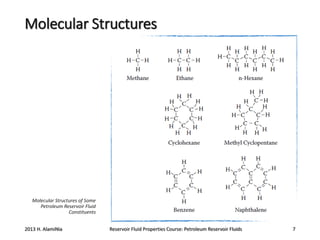
Molecular Structures

Molecular Structures of Some
Petroleum Reservoir Fluid
Constituents

2013 H. AlamiNia

Reservoir Fluid Properties Course: Petroleum Reservoir Fluids

7
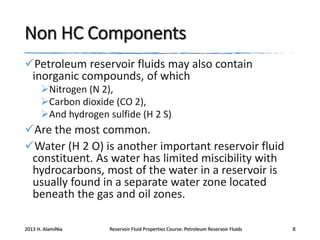
Non HC Components
Petroleum reservoir fluids may also contain
inorganic compounds, of which
Nitrogen (N 2),
Carbon dioxide (CO 2),
And hydrogen sulfide (H 2 S)

Are the most common.
Water (H 2 O) is another important reservoir fluid
constituent. As water has limited miscibility with
hydrocarbons, most of the water in a reservoir is
usually found in a separate water zone located
beneath the gas and oil zones.
2013 H. AlamiNia

Reservoir Fluid Properties Course: Petroleum Reservoir Fluids

8
Phase Behavior Definition
A "phase" is defined as any homogeneous part of a
system that is physically distinct and separated from
other parts of the system by definite boundaries.
For example, ice, liquid water, and water vapor
constitute three separate phases of the pure substance
H20.
Whether a substance exists in a solid, liquid, or gas
phase is determined by the temperature and pressure
acting on the substance.
It is known that ice (solid phase) can be changed to
water (liquid phase) by increasing its temperature and,
by further increasing temperature, water changes to
steam (vapor phase). This change in phases is termed
Phase Behavior.
2013 H. AlamiNia

Reservoir Fluid Properties Course: Petroleum Reservoir Fluids

10
Properties of
Reservoir Fluid Constituents
The pure component vapor pressures and the pure
component critical points are essential in
calculations of component and mixture properties.
 The pure component vapor pressures are
experimentally determined by measuring
corresponding values of temperature (T) and
pressure (P) at which the substance undergoes a
transition from liquid to gas.

2013 H. AlamiNia

Reservoir Fluid Properties Course: Petroleum Reservoir Fluids

11
Single-Component Systems
The simplest type of hydrocarbon system to
consider is that containing one component. The
word ''component'' refers to the number of
molecular or atomic species present in the
substance. A single-component system is composed
entirely of one kind of atom or molecule. We often
use the word "pure'' to describe a singlecomponent system.

2013 H. AlamiNia

Reservoir Fluid Properties Course: Petroleum Reservoir Fluids

12
Qualitative Understanding
The qualitative understanding of the relationship
between temperature T, pressure p, and volume V
of pure components can provide an excellent basis
for understanding the phase behavior of complex
petroleum mixtures.
The foregoing relationship is conveniently
introduced in terms of experimental measurements
conducted on a pure component as the component
is subjected to changes in pressure and volume at
constant temperature.
2013 H. AlamiNia

Reservoir Fluid Properties Course: Petroleum Reservoir Fluids

13
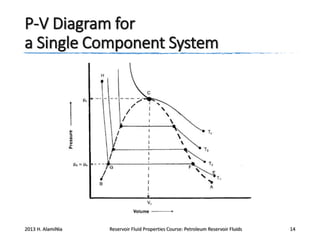
P-V Diagram for
a Single Component System

2013 H. AlamiNia

Reservoir Fluid Properties Course: Petroleum Reservoir Fluids

14
Isothermal Paths
Suppose a fixed quantity of a pure component is
placed in a cylinder fitted with a frictionless piston
at a fixed temperature T 1. Consider the initial p
exerted on the system to be low enough that the
entire system is in the vapor state (E).
Step 1. The pressure is increased isothermally (F).
On the diagram, where the liquid begins to condense.
The corresponding pressure is known as the dew-point
pressure Pd, and is defined as the pressure at which the
first droplet of liquid is formed.

2013 H. AlamiNia

Reservoir Fluid Properties Course: Petroleum Reservoir Fluids

15
Isothermal Paths (Cont.)
Step 2. The piston is moved further into the cylinder as more
liquid condenses. This condensation process is characterized
by a constant pressure and represented by the horizontal
line FG.
At point G, traces of gas remain and the corresponding
pressure is called the bubble-point pressure Pb, and defined
as the pressure at which the first sign of gas formation is
detected.
A characteristic of a single-component system is that at a
given temperature, the dew-point pressure and the bubblepoint pressure are equal.
Step 3. As the piston is forced slightly into the cylinder, a
sharp increase in the pressure (point H) is noted without an
appreciable decrease in the liquid volume. That behavior
evidently reflects the low compressibility of the liquid phase.
2013 H. AlamiNia

Reservoir Fluid Properties Course: Petroleum Reservoir Fluids

16
Isothermal Paths (Cont.)
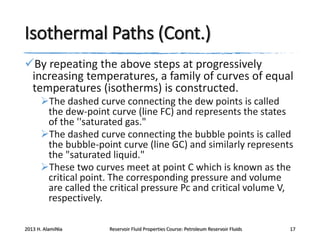
By repeating the above steps at progressively
increasing temperatures, a family of curves of equal
temperatures (isotherms) is constructed.
The dashed curve connecting the dew points is called
the dew-point curve (line FC) and represents the states
of the ''saturated gas."
The dashed curve connecting the bubble points is called
the bubble-point curve (line GC) and similarly represents
the "saturated liquid."
These two curves meet at point C which is known as the
critical point. The corresponding pressure and volume
are called the critical pressure Pc and critical volume V,
respectively.
2013 H. AlamiNia

Reservoir Fluid Properties Course: Petroleum Reservoir Fluids

17
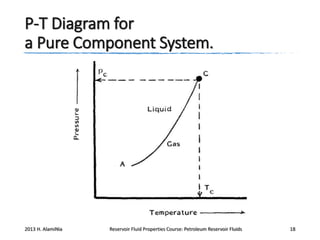
P-T Diagram for
a Pure Component System.

2013 H. AlamiNia

Reservoir Fluid Properties Course: Petroleum Reservoir Fluids

18
Binary Systems
(Two-Component Systems)
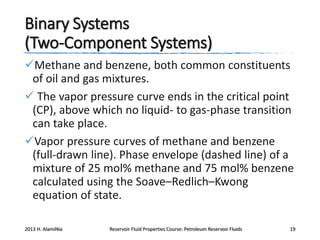
Methane and benzene, both common constituents
of oil and gas mixtures.
 The vapor pressure curve ends in the critical point
(CP), above which no liquid- to gas-phase transition
can take place.
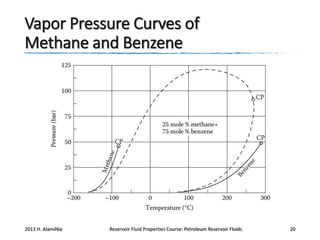
Vapor pressure curves of methane and benzene
(full-drawn line). Phase envelope (dashed line) of a
mixture of 25 mol% methane and 75 mol% benzene
calculated using the Soave–Redlich–Kwong
equation of state.
2013 H. AlamiNia

Reservoir Fluid Properties Course: Petroleum Reservoir Fluids

19
Vapor Pressure Curves of
Methane and Benzene

2013 H. AlamiNia

Reservoir Fluid Properties Course: Petroleum Reservoir Fluids

20
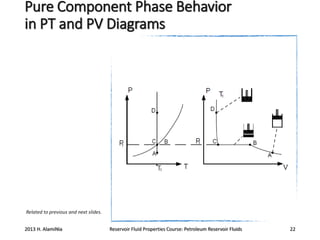
The Phase Behavior of
a Pure Component
At a given temperature, T 1, may be studied by placing
a fixed amount of this component in a cell kept at the
temperature T 1. The cell volume may be varied by
moving the piston up and down.
At position A, the cell content is in a gaseous state. If the
piston is moved downwards, the volume will decrease and the
pressure increase.
At position B a liquid phase starts to form.
 By moving the piston further downwards, the volume will
further decrease, but the pressure will remain constant until
all gas is converted into liquid. This happens at position C.
 A further decrease in the cell volume will result in a rapidly
increasing pressure.
2013 H. AlamiNia

Reservoir Fluid Properties Course: Petroleum Reservoir Fluids

21
Pure Component Phase Behavior
in PT and PV Diagrams

Related to previous and next slides.

2013 H. AlamiNia

Reservoir Fluid Properties Course: Petroleum Reservoir Fluids

22
The Phase Behavior of
a Pure Component (Cont.)
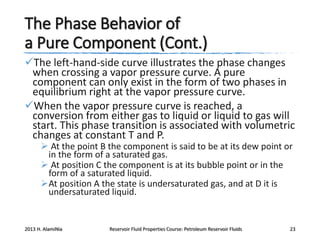
The left-hand-side curve illustrates the phase changes
when crossing a vapor pressure curve. A pure
component can only exist in the form of two phases in
equilibrium right at the vapor pressure curve.
When the vapor pressure curve is reached, a
conversion from either gas to liquid or liquid to gas will
start. This phase transition is associated with volumetric
changes at constant T and P.
 At the point B the component is said to be at its dew point or
in the form of a saturated gas.
 At position C the component is at its bubble point or in the
form of a saturated liquid.
At position A the state is undersaturated gas, and at D it is
undersaturated liquid.

2013 H. AlamiNia

Reservoir Fluid Properties Course: Petroleum Reservoir Fluids

23
2013 H. AlamiNia

Reservoir Fluid Properties Course: Petroleum Reservoir Fluids

25
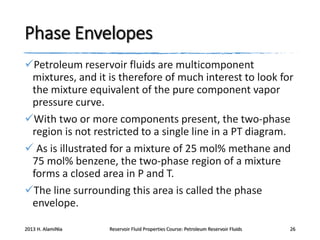
Phase Envelopes
Petroleum reservoir fluids are multicomponent
mixtures, and it is therefore of much interest to look for
the mixture equivalent of the pure component vapor
pressure curve.
With two or more components present, the two-phase
region is not restricted to a single line in a PT diagram.
 As is illustrated for a mixture of 25 mol% methane and
75 mol% benzene, the two-phase region of a mixture
forms a closed area in P and T.
The line surrounding this area is called the phase
envelope.
2013 H. AlamiNia

Reservoir Fluid Properties Course: Petroleum Reservoir Fluids

26
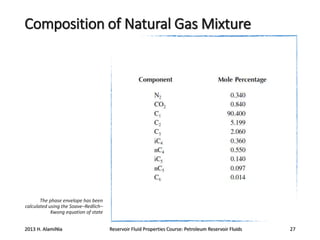
Composition of Natural Gas Mixture

The phase envelope has been
calculated using the Soave–Redlich–
Kwong equation of state

2013 H. AlamiNia

Reservoir Fluid Properties Course: Petroleum Reservoir Fluids

27
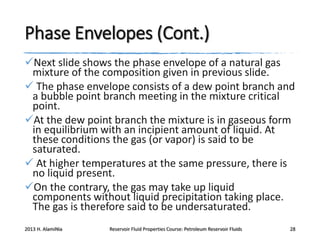
Phase Envelopes (Cont.)
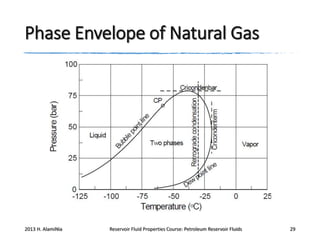
Next slide shows the phase envelope of a natural gas
mixture of the composition given in previous slide.
 The phase envelope consists of a dew point branch and
a bubble point branch meeting in the mixture critical
point.
At the dew point branch the mixture is in gaseous form
in equilibrium with an incipient amount of liquid. At
these conditions the gas (or vapor) is said to be
saturated.
 At higher temperatures at the same pressure, there is
no liquid present.
On the contrary, the gas may take up liquid
components without liquid precipitation taking place.
The gas is therefore said to be undersaturated.
2013 H. AlamiNia

Reservoir Fluid Properties Course: Petroleum Reservoir Fluids

28
Phase Envelope of Natural Gas

2013 H. AlamiNia

Reservoir Fluid Properties Course: Petroleum Reservoir Fluids

29
Phase Envelopes (Cont.)
At the bubble point branch the mixture is in liquid form
in equilibrium with an incipient amount of gas, and the
liquid is said to be saturated.
At lower temperatures, at the same pressure the liquid
(or oil) is undersaturated.
Right at the critical point, two identical phases are in
equilibrium, both having a composition equal to the
overall composition.
 At temperatures close to the critical one and pressures
above the critical pressure there is only one phase
present, but it can be difficult to tell whether it is a gas
or a liquid. This term super-critical fluid is often used
the super-critical region.
2013 H. AlamiNia

Reservoir Fluid Properties Course: Petroleum Reservoir Fluids

30
Phase Envelopes (Cont.)
 The highest pressure at which two phases can exist is
called the cricondenbar and the highest temperature
with two phases present is called the cricondentherm.
 The phenomenon called retrograde condensation is as
a dashed vertical line at T = -30°C. At this temperature,
the mixture is in gaseous form at pressures above the
upper dew point pressure, i.e., at pressures above
approximately 75 bar.
At lower pressure, the mixture will split into two
phases, a gas and a liquid. Liquid formation taking place
as the result of a falling pressure is called retrograde
condensation. If the pressure at a constant temperature
is decreased to below the lower dew point pressure of
approximately 15 bar, the liquid phase will disappear,
and all the mixture will be in gaseous form again.
2013 H. AlamiNia

Reservoir Fluid Properties Course: Petroleum Reservoir Fluids

31
2013 H. AlamiNia

Reservoir Fluid Properties Course: Petroleum Reservoir Fluids

32
Classification of Reservoirs
Reservoirs can be classified into essentially two
types.
Oil reservoirs: If the reservoir temperature T is less than
the critical temperature Tc of the reservoir fluid, the
reservoir is classified as an oil reservoir.
Gas reservoirs: If the reservoir temperature is greater
than the critical temperature of the hydrocarbon fluid,
the reservoir is considered a gas reservoir.

2013 H. AlamiNia

Reservoir Fluid Properties Course: Petroleum Reservoir Fluids

33
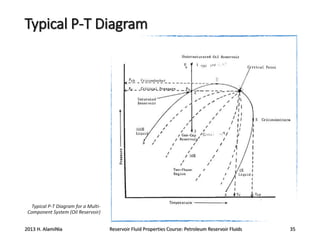
Oil Reservoirs
Depending upon initial reservoir pressure pi, oil
reservoirs can be sub classified into the following
categories:
Undersaturated Oil Reservoir: If the initial reservoir
pressure Pi, is greater than the bubble-point pressure Pb
of the reservoir fluid
Saturated Oil Reservoir: When the initial reservoir
pressure is equal to the bubble-point pressure of the
reservoir fluid
Gas-cap Reservoir: If the initial reservoir pressure is
below the bubble point pressure of the reservoir fluid.
The ratio of the gas-cap volume to reservoir oil volume is
given by the appropriate quality line.
2013 H. AlamiNia

Reservoir Fluid Properties Course: Petroleum Reservoir Fluids

34
Typical P-T Diagram

Typical P-T Diagram for a MultiComponent System (Oil Reservoir)

2013 H. AlamiNia

Reservoir Fluid Properties Course: Petroleum Reservoir Fluids

35
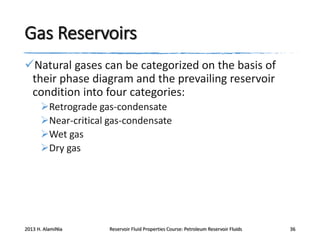
Gas Reservoirs
Natural gases can be categorized on the basis of
their phase diagram and the prevailing reservoir
condition into four categories:
Retrograde gas-condensate
Near-critical gas-condensate
Wet gas
Dry gas

2013 H. AlamiNia

Reservoir Fluid Properties Course: Petroleum Reservoir Fluids

36
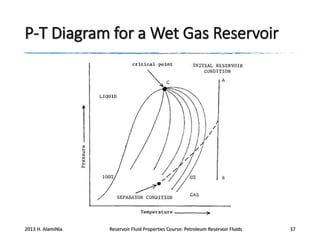
P-T Diagram for a Wet Gas Reservoir

2013 H. AlamiNia

Reservoir Fluid Properties Course: Petroleum Reservoir Fluids

37
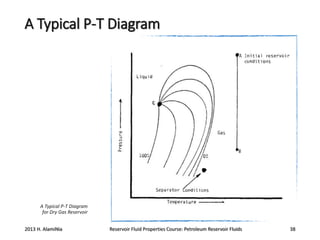
A Typical P-T Diagram

A Typical P-T Diagram
for Dry Gas Reservoir

2013 H. AlamiNia

Reservoir Fluid Properties Course: Petroleum Reservoir Fluids

38
Classification of
Petroleum Reservoir Fluids
Petroleum reservoir fluids may be divided into:
Natural gas mixtures
(Dry and wet gas)

Gas condensate mixtures
Near-critical mixtures or volatile oils
(Low-shrinkage, High-shrinkage (volatile) and Near-critical
crude oil)

(Ordinary) Black oils

2013 H. AlamiNia

Reservoir Fluid Properties Course: Petroleum Reservoir Fluids

39
Classification Base
The various fluid types are distinguished by the
location of the mixture-critical temperature relative
to the reservoir temperature. The above
classification is essentially based upon the
properties exhibited by the crude oil, including:
Physical properties
Composition
Gas-oil ratio
Appearance
Pressure-temperature phase diagram
2013 H. AlamiNia

Reservoir Fluid Properties Course: Petroleum Reservoir Fluids

40
Exercise
Determine mentioned properties for each type of
oil and gas reservoirs.

2013 H. AlamiNia

Reservoir Fluid Properties Course: Petroleum Reservoir Fluids

41
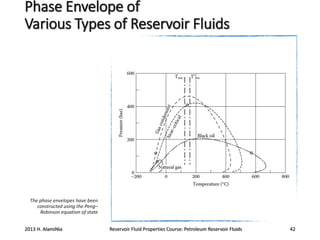
Phase Envelope of
Various Types of Reservoir Fluids

The phase envelopes have been
constructed using the Peng–
Robinson equation of state

2013 H. AlamiNia

Reservoir Fluid Properties Course: Petroleum Reservoir Fluids

42
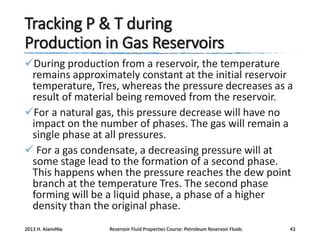
Tracking P & T during
Production in Gas Reservoirs
During production from a reservoir, the temperature
remains approximately constant at the initial reservoir
temperature, Tres, whereas the pressure decreases as a
result of material being removed from the reservoir.
For a natural gas, this pressure decrease will have no
impact on the number of phases. The gas will remain a
single phase at all pressures.
 For a gas condensate, a decreasing pressure will at
some stage lead to the formation of a second phase.
This happens when the pressure reaches the dew point
branch at the temperature Tres. The second phase
forming will be a liquid phase, a phase of a higher
density than the original phase.
2013 H. AlamiNia

Reservoir Fluid Properties Course: Petroleum Reservoir Fluids

43
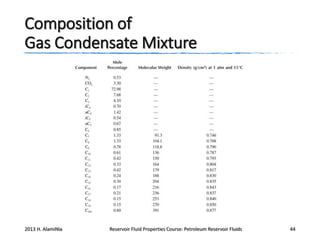
Composition of
Gas Condensate Mixture

2013 H. AlamiNia

Reservoir Fluid Properties Course: Petroleum Reservoir Fluids

44
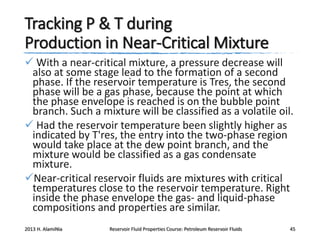
Tracking P & T during
Production in Near-Critical Mixture
 With a near-critical mixture, a pressure decrease will
also at some stage lead to the formation of a second
phase. If the reservoir temperature is Tres, the second
phase will be a gas phase, because the point at which
the phase envelope is reached is on the bubble point
branch. Such a mixture will be classified as a volatile oil.
 Had the reservoir temperature been slightly higher as
indicated by T'res, the entry into the two-phase region
would take place at the dew point branch, and the
mixture would be classified as a gas condensate
mixture.
Near-critical reservoir fluids are mixtures with critical
temperatures close to the reservoir temperature. Right
inside the phase envelope the gas- and liquid-phase
compositions and properties are similar.
2013 H. AlamiNia

Reservoir Fluid Properties Course: Petroleum Reservoir Fluids

45
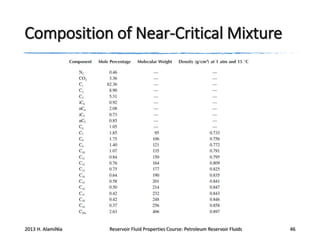
Composition of Near-Critical Mixture

2013 H. AlamiNia

Reservoir Fluid Properties Course: Petroleum Reservoir Fluids

46
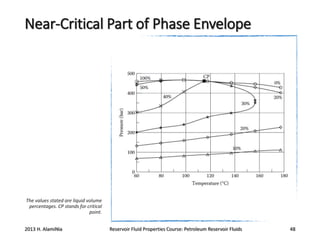
Close-Up of the Near-Critical Region
Next slide shows a close-up of the near-critical
region of a Chinese reservoir fluid (Yang et al.,
1997).
It illustrates the fact that the relative volumetric
amounts of gas and liquid change rapidly with
pressure and temperature in the vicinity of the CP.
For example, at a temperature of 100°C only a
marginal change in pressure is needed to change
the liquid-phase amount from 50 to 100 vol%.

2013 H. AlamiNia

Reservoir Fluid Properties Course: Petroleum Reservoir Fluids

47
Near-Critical Part of Phase Envelope

The values stated are liquid volume
percentages. CP stands for critical
point.

2013 H. AlamiNia

Reservoir Fluid Properties Course: Petroleum Reservoir Fluids

48
Tracking P & T during
Production in Oil Reservoirs
Finally with black oils, entry into the two-phase
region at the reservoir temperature will always take
place at the bubble point side and, accordingly, the
new phase forming is a gas.

2013 H. AlamiNia

Reservoir Fluid Properties Course: Petroleum Reservoir Fluids

49
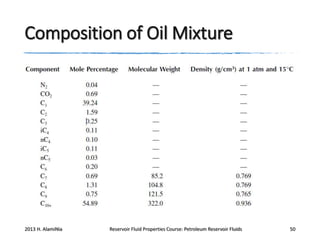
Composition of Oil Mixture

2013 H. AlamiNia

Reservoir Fluid Properties Course: Petroleum Reservoir Fluids

50
1.
2.
3.
4.

Samples
Sample Analysis
Samples Quality Control
K-Factor as A QC

2013 H. AlamiNia

Reservoir Fluid Properties Course: Petroleum Reservoir Fluids

51
1. Pedersen, K.S., Christensen, P.L., and Azeem,
S.J. (2006). Phase behavior of petroleum
reservoir fluids (CRC Press). Ch1.
2. Tarek, A. (1989). Hydrocarbon Phase Behavior
(Gulf Publishing Company, Houston). Ch1.

2013 H. AlamiNia

Reservoir Fluid Properties Course: Petroleum Reservoir Fluids

52
Q913 rfp w1 lec 2

Q913 rfp w1 lec 2

  • 1.
  • 2.
    1. Petroleum Engineering& Its Importance 2. Petroleum Formation 3. Petroleum Extraction A. Drilling B. Production 4. Consumption of Oil 2013 H. AlamiNia Reservoir Fluid Properties Course: Petroleum Reservoir Fluids 2
  • 3.
    1. 2. 3. 4. Reservoir Fluids Phase Behaviorof Hydrocarbons Phase Envelopes HC Classifications 2013 H. AlamiNia Reservoir Fluid Properties Course: Petroleum Reservoir Fluids 3
  • 5.
    Reservoir Fluid Constituents Petroleumreservoir fluids are multicomponent mixtures consisting primarily of hydrocarbons.  Methane (CH4) is the simplest of all hydrocarbons, and also the most common component in petroleum reservoir fluids. Because methane contains one carbon atom, it is often referred to as C1. Hydrocarbons with seven and more carbon atoms are called C7+ components, and the entity of all C7+ components is called the C7+ fraction. Petroleum reservoir fluids may contain hydrocarbons as heavy as C 200. 2013 H. AlamiNia Reservoir Fluid Properties Course: Petroleum Reservoir Fluids 5
  • 6.
    C7+ Components  Aparticular C7+ component will belong to one of the following component classes:  Paraffins: A paraffinic compound consists of hydrocarbon segments of the type C, CH, CH 2, or CH 3. The carbon atoms are connected by single bonds. Paraffins are also sometimes referred to as alkanes.  Naphthenes: These compounds are similar to paraffins in the sense that they are built of the same types of hydrocarbon segments, but they differ from paraffins by containing one or more cyclic structures. Naphthenes are also called cycloalkanes.  Aromatics: Similar to naphthenes, aromatics contain one or more cyclic structures, but the carbon atoms in an aromatic compound are connected by aromatic double bonds.  The percentage contents of paraffinic (P), naphthenic (N), and aromatic (A) components in a reservoir fluid is often referred to as the PNA distribution. 2013 H. AlamiNia Reservoir Fluid Properties Course: Petroleum Reservoir Fluids 6
  • 7.
    Molecular Structures Molecular Structuresof Some Petroleum Reservoir Fluid Constituents 2013 H. AlamiNia Reservoir Fluid Properties Course: Petroleum Reservoir Fluids 7
  • 8.
    Non HC Components Petroleumreservoir fluids may also contain inorganic compounds, of which Nitrogen (N 2), Carbon dioxide (CO 2), And hydrogen sulfide (H 2 S) Are the most common. Water (H 2 O) is another important reservoir fluid constituent. As water has limited miscibility with hydrocarbons, most of the water in a reservoir is usually found in a separate water zone located beneath the gas and oil zones. 2013 H. AlamiNia Reservoir Fluid Properties Course: Petroleum Reservoir Fluids 8
  • 10.
    Phase Behavior Definition A"phase" is defined as any homogeneous part of a system that is physically distinct and separated from other parts of the system by definite boundaries. For example, ice, liquid water, and water vapor constitute three separate phases of the pure substance H20. Whether a substance exists in a solid, liquid, or gas phase is determined by the temperature and pressure acting on the substance. It is known that ice (solid phase) can be changed to water (liquid phase) by increasing its temperature and, by further increasing temperature, water changes to steam (vapor phase). This change in phases is termed Phase Behavior. 2013 H. AlamiNia Reservoir Fluid Properties Course: Petroleum Reservoir Fluids 10
  • 11.
    Properties of Reservoir FluidConstituents The pure component vapor pressures and the pure component critical points are essential in calculations of component and mixture properties.  The pure component vapor pressures are experimentally determined by measuring corresponding values of temperature (T) and pressure (P) at which the substance undergoes a transition from liquid to gas. 2013 H. AlamiNia Reservoir Fluid Properties Course: Petroleum Reservoir Fluids 11
  • 12.
    Single-Component Systems The simplesttype of hydrocarbon system to consider is that containing one component. The word ''component'' refers to the number of molecular or atomic species present in the substance. A single-component system is composed entirely of one kind of atom or molecule. We often use the word "pure'' to describe a singlecomponent system. 2013 H. AlamiNia Reservoir Fluid Properties Course: Petroleum Reservoir Fluids 12
  • 13.
    Qualitative Understanding The qualitativeunderstanding of the relationship between temperature T, pressure p, and volume V of pure components can provide an excellent basis for understanding the phase behavior of complex petroleum mixtures. The foregoing relationship is conveniently introduced in terms of experimental measurements conducted on a pure component as the component is subjected to changes in pressure and volume at constant temperature. 2013 H. AlamiNia Reservoir Fluid Properties Course: Petroleum Reservoir Fluids 13
  • 14.
    P-V Diagram for aSingle Component System 2013 H. AlamiNia Reservoir Fluid Properties Course: Petroleum Reservoir Fluids 14
  • 15.
    Isothermal Paths Suppose afixed quantity of a pure component is placed in a cylinder fitted with a frictionless piston at a fixed temperature T 1. Consider the initial p exerted on the system to be low enough that the entire system is in the vapor state (E). Step 1. The pressure is increased isothermally (F). On the diagram, where the liquid begins to condense. The corresponding pressure is known as the dew-point pressure Pd, and is defined as the pressure at which the first droplet of liquid is formed. 2013 H. AlamiNia Reservoir Fluid Properties Course: Petroleum Reservoir Fluids 15
  • 16.
    Isothermal Paths (Cont.) Step2. The piston is moved further into the cylinder as more liquid condenses. This condensation process is characterized by a constant pressure and represented by the horizontal line FG. At point G, traces of gas remain and the corresponding pressure is called the bubble-point pressure Pb, and defined as the pressure at which the first sign of gas formation is detected. A characteristic of a single-component system is that at a given temperature, the dew-point pressure and the bubblepoint pressure are equal. Step 3. As the piston is forced slightly into the cylinder, a sharp increase in the pressure (point H) is noted without an appreciable decrease in the liquid volume. That behavior evidently reflects the low compressibility of the liquid phase. 2013 H. AlamiNia Reservoir Fluid Properties Course: Petroleum Reservoir Fluids 16
  • 17.
    Isothermal Paths (Cont.) Byrepeating the above steps at progressively increasing temperatures, a family of curves of equal temperatures (isotherms) is constructed. The dashed curve connecting the dew points is called the dew-point curve (line FC) and represents the states of the ''saturated gas." The dashed curve connecting the bubble points is called the bubble-point curve (line GC) and similarly represents the "saturated liquid." These two curves meet at point C which is known as the critical point. The corresponding pressure and volume are called the critical pressure Pc and critical volume V, respectively. 2013 H. AlamiNia Reservoir Fluid Properties Course: Petroleum Reservoir Fluids 17
  • 18.
    P-T Diagram for aPure Component System. 2013 H. AlamiNia Reservoir Fluid Properties Course: Petroleum Reservoir Fluids 18
  • 19.
    Binary Systems (Two-Component Systems) Methaneand benzene, both common constituents of oil and gas mixtures.  The vapor pressure curve ends in the critical point (CP), above which no liquid- to gas-phase transition can take place. Vapor pressure curves of methane and benzene (full-drawn line). Phase envelope (dashed line) of a mixture of 25 mol% methane and 75 mol% benzene calculated using the Soave–Redlich–Kwong equation of state. 2013 H. AlamiNia Reservoir Fluid Properties Course: Petroleum Reservoir Fluids 19
  • 20.
    Vapor Pressure Curvesof Methane and Benzene 2013 H. AlamiNia Reservoir Fluid Properties Course: Petroleum Reservoir Fluids 20
  • 21.
    The Phase Behaviorof a Pure Component At a given temperature, T 1, may be studied by placing a fixed amount of this component in a cell kept at the temperature T 1. The cell volume may be varied by moving the piston up and down. At position A, the cell content is in a gaseous state. If the piston is moved downwards, the volume will decrease and the pressure increase. At position B a liquid phase starts to form.  By moving the piston further downwards, the volume will further decrease, but the pressure will remain constant until all gas is converted into liquid. This happens at position C.  A further decrease in the cell volume will result in a rapidly increasing pressure. 2013 H. AlamiNia Reservoir Fluid Properties Course: Petroleum Reservoir Fluids 21
  • 22.
    Pure Component PhaseBehavior in PT and PV Diagrams Related to previous and next slides. 2013 H. AlamiNia Reservoir Fluid Properties Course: Petroleum Reservoir Fluids 22
  • 23.
    The Phase Behaviorof a Pure Component (Cont.) The left-hand-side curve illustrates the phase changes when crossing a vapor pressure curve. A pure component can only exist in the form of two phases in equilibrium right at the vapor pressure curve. When the vapor pressure curve is reached, a conversion from either gas to liquid or liquid to gas will start. This phase transition is associated with volumetric changes at constant T and P.  At the point B the component is said to be at its dew point or in the form of a saturated gas.  At position C the component is at its bubble point or in the form of a saturated liquid. At position A the state is undersaturated gas, and at D it is undersaturated liquid. 2013 H. AlamiNia Reservoir Fluid Properties Course: Petroleum Reservoir Fluids 23
  • 25.
    2013 H. AlamiNia ReservoirFluid Properties Course: Petroleum Reservoir Fluids 25
  • 26.
    Phase Envelopes Petroleum reservoirfluids are multicomponent mixtures, and it is therefore of much interest to look for the mixture equivalent of the pure component vapor pressure curve. With two or more components present, the two-phase region is not restricted to a single line in a PT diagram.  As is illustrated for a mixture of 25 mol% methane and 75 mol% benzene, the two-phase region of a mixture forms a closed area in P and T. The line surrounding this area is called the phase envelope. 2013 H. AlamiNia Reservoir Fluid Properties Course: Petroleum Reservoir Fluids 26
  • 27.
    Composition of NaturalGas Mixture The phase envelope has been calculated using the Soave–Redlich– Kwong equation of state 2013 H. AlamiNia Reservoir Fluid Properties Course: Petroleum Reservoir Fluids 27
  • 28.
    Phase Envelopes (Cont.) Nextslide shows the phase envelope of a natural gas mixture of the composition given in previous slide.  The phase envelope consists of a dew point branch and a bubble point branch meeting in the mixture critical point. At the dew point branch the mixture is in gaseous form in equilibrium with an incipient amount of liquid. At these conditions the gas (or vapor) is said to be saturated.  At higher temperatures at the same pressure, there is no liquid present. On the contrary, the gas may take up liquid components without liquid precipitation taking place. The gas is therefore said to be undersaturated. 2013 H. AlamiNia Reservoir Fluid Properties Course: Petroleum Reservoir Fluids 28
  • 29.
    Phase Envelope ofNatural Gas 2013 H. AlamiNia Reservoir Fluid Properties Course: Petroleum Reservoir Fluids 29
  • 30.
    Phase Envelopes (Cont.) Atthe bubble point branch the mixture is in liquid form in equilibrium with an incipient amount of gas, and the liquid is said to be saturated. At lower temperatures, at the same pressure the liquid (or oil) is undersaturated. Right at the critical point, two identical phases are in equilibrium, both having a composition equal to the overall composition.  At temperatures close to the critical one and pressures above the critical pressure there is only one phase present, but it can be difficult to tell whether it is a gas or a liquid. This term super-critical fluid is often used the super-critical region. 2013 H. AlamiNia Reservoir Fluid Properties Course: Petroleum Reservoir Fluids 30
  • 31.
    Phase Envelopes (Cont.) The highest pressure at which two phases can exist is called the cricondenbar and the highest temperature with two phases present is called the cricondentherm.  The phenomenon called retrograde condensation is as a dashed vertical line at T = -30°C. At this temperature, the mixture is in gaseous form at pressures above the upper dew point pressure, i.e., at pressures above approximately 75 bar. At lower pressure, the mixture will split into two phases, a gas and a liquid. Liquid formation taking place as the result of a falling pressure is called retrograde condensation. If the pressure at a constant temperature is decreased to below the lower dew point pressure of approximately 15 bar, the liquid phase will disappear, and all the mixture will be in gaseous form again. 2013 H. AlamiNia Reservoir Fluid Properties Course: Petroleum Reservoir Fluids 31
  • 32.
    2013 H. AlamiNia ReservoirFluid Properties Course: Petroleum Reservoir Fluids 32
  • 33.
    Classification of Reservoirs Reservoirscan be classified into essentially two types. Oil reservoirs: If the reservoir temperature T is less than the critical temperature Tc of the reservoir fluid, the reservoir is classified as an oil reservoir. Gas reservoirs: If the reservoir temperature is greater than the critical temperature of the hydrocarbon fluid, the reservoir is considered a gas reservoir. 2013 H. AlamiNia Reservoir Fluid Properties Course: Petroleum Reservoir Fluids 33
  • 34.
    Oil Reservoirs Depending uponinitial reservoir pressure pi, oil reservoirs can be sub classified into the following categories: Undersaturated Oil Reservoir: If the initial reservoir pressure Pi, is greater than the bubble-point pressure Pb of the reservoir fluid Saturated Oil Reservoir: When the initial reservoir pressure is equal to the bubble-point pressure of the reservoir fluid Gas-cap Reservoir: If the initial reservoir pressure is below the bubble point pressure of the reservoir fluid. The ratio of the gas-cap volume to reservoir oil volume is given by the appropriate quality line. 2013 H. AlamiNia Reservoir Fluid Properties Course: Petroleum Reservoir Fluids 34
  • 35.
    Typical P-T Diagram TypicalP-T Diagram for a MultiComponent System (Oil Reservoir) 2013 H. AlamiNia Reservoir Fluid Properties Course: Petroleum Reservoir Fluids 35
  • 36.
    Gas Reservoirs Natural gasescan be categorized on the basis of their phase diagram and the prevailing reservoir condition into four categories: Retrograde gas-condensate Near-critical gas-condensate Wet gas Dry gas 2013 H. AlamiNia Reservoir Fluid Properties Course: Petroleum Reservoir Fluids 36
  • 37.
    P-T Diagram fora Wet Gas Reservoir 2013 H. AlamiNia Reservoir Fluid Properties Course: Petroleum Reservoir Fluids 37
  • 38.
    A Typical P-TDiagram A Typical P-T Diagram for Dry Gas Reservoir 2013 H. AlamiNia Reservoir Fluid Properties Course: Petroleum Reservoir Fluids 38
  • 39.
    Classification of Petroleum ReservoirFluids Petroleum reservoir fluids may be divided into: Natural gas mixtures (Dry and wet gas) Gas condensate mixtures Near-critical mixtures or volatile oils (Low-shrinkage, High-shrinkage (volatile) and Near-critical crude oil) (Ordinary) Black oils 2013 H. AlamiNia Reservoir Fluid Properties Course: Petroleum Reservoir Fluids 39
  • 40.
    Classification Base The variousfluid types are distinguished by the location of the mixture-critical temperature relative to the reservoir temperature. The above classification is essentially based upon the properties exhibited by the crude oil, including: Physical properties Composition Gas-oil ratio Appearance Pressure-temperature phase diagram 2013 H. AlamiNia Reservoir Fluid Properties Course: Petroleum Reservoir Fluids 40
  • 41.
    Exercise Determine mentioned propertiesfor each type of oil and gas reservoirs. 2013 H. AlamiNia Reservoir Fluid Properties Course: Petroleum Reservoir Fluids 41
  • 42.
    Phase Envelope of VariousTypes of Reservoir Fluids The phase envelopes have been constructed using the Peng– Robinson equation of state 2013 H. AlamiNia Reservoir Fluid Properties Course: Petroleum Reservoir Fluids 42
  • 43.
    Tracking P &T during Production in Gas Reservoirs During production from a reservoir, the temperature remains approximately constant at the initial reservoir temperature, Tres, whereas the pressure decreases as a result of material being removed from the reservoir. For a natural gas, this pressure decrease will have no impact on the number of phases. The gas will remain a single phase at all pressures.  For a gas condensate, a decreasing pressure will at some stage lead to the formation of a second phase. This happens when the pressure reaches the dew point branch at the temperature Tres. The second phase forming will be a liquid phase, a phase of a higher density than the original phase. 2013 H. AlamiNia Reservoir Fluid Properties Course: Petroleum Reservoir Fluids 43
  • 44.
    Composition of Gas CondensateMixture 2013 H. AlamiNia Reservoir Fluid Properties Course: Petroleum Reservoir Fluids 44
  • 45.
    Tracking P &T during Production in Near-Critical Mixture  With a near-critical mixture, a pressure decrease will also at some stage lead to the formation of a second phase. If the reservoir temperature is Tres, the second phase will be a gas phase, because the point at which the phase envelope is reached is on the bubble point branch. Such a mixture will be classified as a volatile oil.  Had the reservoir temperature been slightly higher as indicated by T'res, the entry into the two-phase region would take place at the dew point branch, and the mixture would be classified as a gas condensate mixture. Near-critical reservoir fluids are mixtures with critical temperatures close to the reservoir temperature. Right inside the phase envelope the gas- and liquid-phase compositions and properties are similar. 2013 H. AlamiNia Reservoir Fluid Properties Course: Petroleum Reservoir Fluids 45
  • 46.
    Composition of Near-CriticalMixture 2013 H. AlamiNia Reservoir Fluid Properties Course: Petroleum Reservoir Fluids 46
  • 47.
    Close-Up of theNear-Critical Region Next slide shows a close-up of the near-critical region of a Chinese reservoir fluid (Yang et al., 1997). It illustrates the fact that the relative volumetric amounts of gas and liquid change rapidly with pressure and temperature in the vicinity of the CP. For example, at a temperature of 100°C only a marginal change in pressure is needed to change the liquid-phase amount from 50 to 100 vol%. 2013 H. AlamiNia Reservoir Fluid Properties Course: Petroleum Reservoir Fluids 47
  • 48.
    Near-Critical Part ofPhase Envelope The values stated are liquid volume percentages. CP stands for critical point. 2013 H. AlamiNia Reservoir Fluid Properties Course: Petroleum Reservoir Fluids 48
  • 49.
    Tracking P &T during Production in Oil Reservoirs Finally with black oils, entry into the two-phase region at the reservoir temperature will always take place at the bubble point side and, accordingly, the new phase forming is a gas. 2013 H. AlamiNia Reservoir Fluid Properties Course: Petroleum Reservoir Fluids 49
  • 50.
    Composition of OilMixture 2013 H. AlamiNia Reservoir Fluid Properties Course: Petroleum Reservoir Fluids 50
  • 51.
    1. 2. 3. 4. Samples Sample Analysis Samples QualityControl K-Factor as A QC 2013 H. AlamiNia Reservoir Fluid Properties Course: Petroleum Reservoir Fluids 51
  • 52.
    1. Pedersen, K.S.,Christensen, P.L., and Azeem, S.J. (2006). Phase behavior of petroleum reservoir fluids (CRC Press). Ch1. 2. Tarek, A. (1989). Hydrocarbon Phase Behavior (Gulf Publishing Company, Houston). Ch1. 2013 H. AlamiNia Reservoir Fluid Properties Course: Petroleum Reservoir Fluids 52