Module
4
Hydraulic Structures for
Flow Diversion and
Storage
Version 2 CE IIT, Kharagpur
Lesson
2
Design of the Main
Diversion Structure
of a Barrage
Version 2 CE IIT, Kharagpur
Instructional objectives
On completion of this lesson, the student shall learn:
1. The sub-surface consideration for the design of a barrage
2. Steps for computing seepage pressure and exit gradient for barrage
3. Procedure to determine the waterway of a barrage
4. Computation step for determining barrage cistern level
5. The different protection works for barrages
4.2.0 Introduction
The design of any hydraulic structure comprises of two steps:
• Hydraulic design, to fix the overall dimensions and profiles of the structure, and
• Structural design, where the various sections are analysed for stresses under
different loads and reinforcement or other structural details are worked out.
The dimensions fixed by hydraulic design through available empirical formulae are
further refined by testing a scale model of the structure in a hydraulic model testing
laboratory. The structural design uses the hydraulic forces expected from the given
hydraulic parameters (evolved through the hydraulic design) and produces a detailing
that will keep the structure safe against those forces and loadings. In this lesson, the
hydraulics of barrages and canal head regulator is presented. The structural design is
discussed in Lesson 4.2.
For barrages, there are two different sets of hydraulic conditions. The first is due to sub-
surface or seepage flow conditions that occurs due to a water level difference on the
upstream and down stream of a barrage and is the maximum when the gates of a
barrage are mostly closed as during the low flow period of the river. The other is due to
surface flow conditions which occur while the barrage gates are open during floods. In
this section we shall discuss each of these hydraulic conditions for the main diversion
structure of a barrage to evaluate the forces generated by them. The hydraulic
conditions of canal head regulators are also quite similar, with seepage flow dominating
during gate closed condition and free flow during gate open condition.
4.2.1 Hydraulic design for sub-surface flow
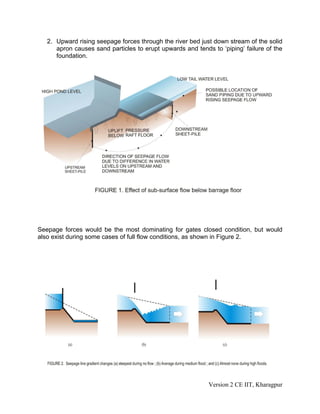
The sub-surface flow below a barrage causes two definite instability problems, as listed
below and illustrated in Figure 1.
1. Uplift forces due to the sub soil pressure that tends to lift up the barrage raft floor,
and
Version 2 CE IIT, Kharagpur
2. Upward rising seepage forces through the river bed just down stream of the solid
apron causes sand particles to erupt upwards and tends to ‘piping’ failure of the
foundation.
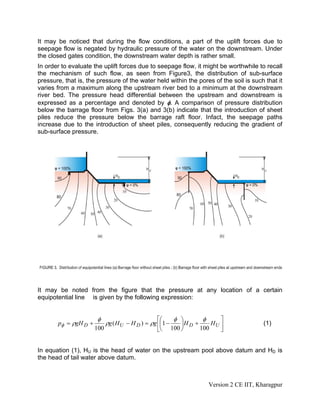
Seepage forces would be the most dominating for gates closed condition, but would
also exist during some cases of full flow conditions, as shown in Figure 2.
Version 2 CE IIT, Kharagpur
It may be noticed that during the flow conditions, a part of the uplift forces due to
seepage flow is negated by hydraulic pressure of the water on the downstream. Under
the closed gates condition, the downstream water depth is rather small.
In order to evaluate the uplift forces due to seepage flow, it might be worthwhile to recall
the mechanism of such flow, as seen from Figure3, the distribution of sub-surface
pressure, that is, the pressure of the water held within the pores of the soil is such that it
varies from a maximum along the upstream river bed to a minimum at the downstream
river bed. The pressure head differential between the upstream and downstream is
expressed as a percentage and denoted by φ. A comparison of pressure distribution
below the barrage floor from Figs. 3(a) and 3(b) indicate that the introduction of sheet
piles reduce the pressure below the barrage raft floor. Infact, the seepage paths
increase due to the introduction of sheet piles, consequently reducing the gradient of
sub-surface pressure.
It may be noted from the figure that the pressure at any location of a certain
equipotential line is given by the following expression:
⎥
⎦
⎤
⎢
⎣
⎡
+
⎟
⎠
⎞
⎜
⎝
⎛
−
=
−
+
= U
D
D
U
D H
H
g
H
H
g
gH
p
100
100
1
)
(
100
φ
φ
ρ
ρ
φ
ρ
φ (1)
In equation (1), HU is the head of water on the upstream pool above datum and HD is
the head of tail water above datum.
Version 2 CE IIT, Kharagpur
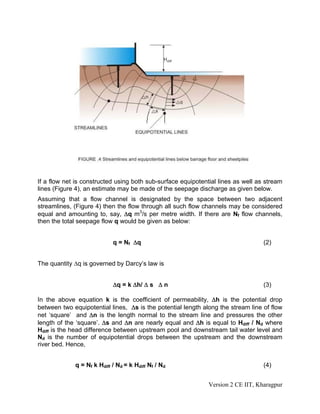
If a flow net is constructed using both sub-surface equipotential lines as well as stream
lines (Figure 4), an estimate may be made of the seepage discharge as given below.
Assuming that a flow channel is designated by the space between two adjacent
streamlines, (Figure 4) then the flow through all such flow channels may be considered
equal and amounting to, say, Δq m3
/s per metre width. If there are Nf flow channels,
then the total seepage flow q would be given as below:
q = Nf Δq (2)
The quantity Δq is governed by Darcy’s law is
Δq = k Δh/ Δ s Δ n (3)
In the above equation k is the coefficient of permeability, Δh is the potential drop
between two equipotential lines, Δs is the potential length along the stream line of flow
net ‘square’ and Δn is the length normal to the stream line and pressures the other
length of the ‘square’. Δs and Δn are nearly equal and Δh is equal to Hdiff / Nd where
Hdiff is the head difference between upstream pool and downstream tail water level and
Nd is the number of equipotential drops between the upstream and the downstream
river bed. Hence,
q = Nf k Hdiff / Nd = k Hdiff Nf / Nd (4)
Version 2 CE IIT, Kharagpur
The above equation enables the computation of the seepage quantity q.
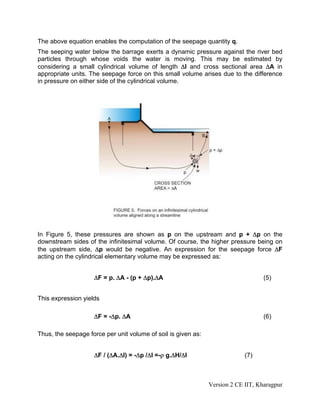
The seeping water below the barrage exerts a dynamic pressure against the river bed
particles through whose voids the water is moving. This may be estimated by
considering a small cylindrical volume of length Δl and cross sectional area ΔA in
appropriate units. The seepage force on this small volume arises due to the difference
in pressure on either side of the cylindrical volume.
In Figure 5, these pressures are shown as p on the upstream and p + Δp on the
downstream sides of the infinitesimal volume. Of course, the higher pressure being on
the upstream side, Δp would be negative. An expression for the seepage force ΔF
acting on the cylindrical elementary volume may be expressed as:
ΔF = p. ΔA - (p + Δp).ΔA (5)
This expression yields
ΔF = -Δp. ΔA (6)
Thus, the seepage force per unit volume of soil is given as:
ΔF / (ΔA.Δl) = -Δp /Δl =-ρ g.ΔH/Δl (7)
Version 2 CE IIT, Kharagpur
Where ΔH is the difference in head of water on either side of the small volume.
Obviously ΔH is negative, since pressure head drops in the direction of flow, and thus
the quantity on the right side of the equation would turn out to be positive.
At the exit end, where the stream line meets the river bed surface (B in Figure 5), the
seepage force is directed vertically upwards and against the weight of the volume of
solid held in the soil. If the seepage force is great enough, it would cause sand-boiling,
with the ejection of sand particles causing creation of pipe-like voids through the river
bed, on the other hand, the river bed particles at the entry point (A in Figure 5) do not
face such a problem, since both the seepage force and the particle weight are both
directed vertically downward.
In order to provide safety against piping-failure at the exit end, the submerged weight
(w) of the solid should be at least equal to the seepage force. This may be expressed
as:
w = (1-n)(ρs-ρ) g≥-ρg ΔH/Δl (8)
In the above, w is the submerged weight of the solids assuming a void ratio n. ρs and ρ
stand for the density of the solids and water, respectively. The equation then simplifies
to
-ΔH/Δl ≤(1-n) (G-1) (9)
Where G is the relative density of the soil.
The quantity ΔH/Δl represents the hydraulic gradient of the subsurface water at the exit
end of the streamline, and is also called the Exit Gradient. This should not exceed the
given value in order to prevent failure by piping. Assuming G and n to be nearly equal to
2.65 and 0.4 respectively for sandy bed, the limiting value of ⏐ΔH/Δl ⏐ turns out to be
approximately equal to 1.0. However, it is not enough to satisfy this limiting condition.
Even a slight increase in the value will upset the stability of the sub-soil at the exit end.
This requires the application of a generous factor of safety in the designs, which may be
considered as a precaution against uncertainties such as:
• Non- homogeneity of the foundation soil
• Difference in the packing and pore space
• Local intrusion of impervious material like clay beds or very porous material
• Faults and fissures in sub-soil formation, etc.
The factor of safety to be applied would take care of all these uncertainties besides
covering cases where due to retrogression of bed levels or flood scour, the upper part of
the piles at the downstream is exposed. According to the Bureau of Indian Standards
Code IS 6966 (part 1): 1989 “Hydraulic design of barrages and weirs- guidelines”, the
Version 2 CE IIT, Kharagpur
following factors of safety may be considered according to the variation of river bed
material:
Sub-soil material Factor of safety
Shingle 4 to 5
Coarse sand 5 to 6
Fine sand 6 to 7
4.2.2 Computation of seepage pressure and Exit gradient:
With the advent of numerical computational tools and computers with high precision
speeds, numerical solution of the Laplace equation representing sub-surface flow has
become quite common these days to evaluate the above parameters. However,
analytical solutions have been derived by a group of engineers and scientists in India
comprising of A.N. Khosla, N.K. Bose and M. Taylor and presented in simple analytical
forms and graphs. These can be used to arrive at a quick solution to a given problem.
They arrived at these equations after conducting several experiments and solving the
Laplace equation under simplified conditions using the Schwartz Christoffel
transformation theory. The results of their mathematical solutions have been published
under publication 12 of the Central Board of Irrigation and Power titled “Design of weirs
on permeable foundations”. Of course, the soil confined below a barrage conforms to a
complex shape and is not readily amenable to solution using analytical formulae but still
the following simple profiles have been found to be very useful for approximately
arriving at the subsurface pressures of a barrage or canal head regulator floor.
Version 2 CE IIT, Kharagpur
• A straight horizontal floor of negligible thickness with a sheet pile at either end
[Figure 6(a) or 6(b)].
• A straight horizontal floor of negligible thickness with an intermediate sheet pile
[Figure 6(c)].
• A straight horizontal floor depressed below the bed but with no sheet pile [Figure
6(d)].
The solution for these simple profiles has been obtained in terms of the pressure
head ratio (or percentage) at key points as shown in the figures.
Version 2 CE IIT, Kharagpur
These key points are the junction points of the sheet pile with floor incase of floors of
negligible thickness and at the corners of the base at the upstream and down stream
end incase of depressed floor. The analytical expressions of each of the above
cases are given as under:
• For sheet piles at either upstream end [Figure 6(a)] or the down stream end
[Figure 6(b)].
φE = (1/π) cos-1
[(λ-2)/ λ] (10)
φD = (1/π) cos-1
[(λ-1)/ λ] (11)
φC 1 = 100 - φE (12)
φD 1 = 100 - φD (13)
φE 1 = 100 (14)
where λ = (1/2)[ 1+√(1+α2
) ]
and α = (b/d)
• For sheet piles at the intermediate point [ Figure 6( c ) ]
φE = (1/π) cos-1
[(λ1-1)/ λ2] (15)
φD = (1/π) cos-1
[λ1/ λ2] (16)
φC = (1/π) cos-1
[(λ1+1)/ λ2] (17)
In the above equations, λ1 and λ2 are given as:
λ1= (1/2)[ √(1+α1
2
) - √(1+α2
2
)] (18)
λ2= (1/2)[ √(1+α1
2
) + √(1+α2
2
)] (19)
where α1 = (b1/d)
α2 = (b2/d)
• For the case of a depressed floor ,
φD' = φD - (2/3)[φE -φD] +(3/ α2
) (20)
φD' = 100 - φD
Version 2 CE IIT, Kharagpur
Where φD and φE are given as
φD = (1/π) cos-1
[(λ-1)/ λ] (21)
φE = (1/π) cos-1
[(λ-2)/ λ] (22)
The above expressions may also be determined from the graph shown in Figure 7.
Version 2 CE IIT, Kharagpur
The uplift pressures obtained by the analytical expressions or graphical methods need
to be corrected for the following more realistic conditions:
• Floor raft with sheet piles at either end actually has a floor thickness that can not
be considered as negligible compared to the sheet pile depths.
• A floor raft may have sheet piles both at the upstream as well as the downstream
ends, which might interfere one with the other.
• The floor of a modern barrage is not horizontal throughout.
Some formulas have, therefore, been suggested for incorporating the necessary
corrections which are expressed as follows:
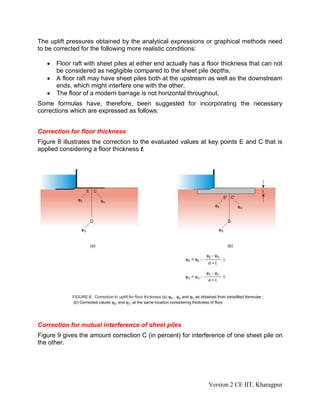
Correction for floor thickness
Figure 8 illustrates the correction to the evaluated values at key points E and C that is
applied considering a floor thickness t.
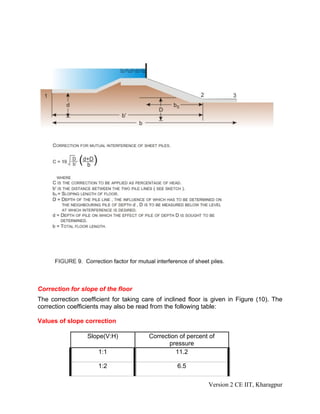
Correction for mutual interference of sheet piles
Figure 9 gives the amount correction C (in percent) for interference of one sheet pile on
the other.
Version 2 CE IIT, Kharagpur
Correction for slope of the floor
The correction coefficient for taking care of inclined floor is given in Figure (10). The
correction coefficients may also be read from the following table:
Values of slope correction
Slope(V:H) Correction of percent of
pressure
1:1 11.2
1:2 6.5
Version 2 CE IIT, Kharagpur
1:3 4.5
1:4 3.3
1:5 2.8
1:6 2.5
1:7 2.3
1:8 2.0
The corrections will have to be taken positive for down slopes and negative for up-
slopes taken in the direction of flow. The corrections are applicable to the key points of
the pile line fixed at the beginning or the end of the slope, for example the pile line 2 at
its end E for the floor and sheet-pile shown in Figure 9.
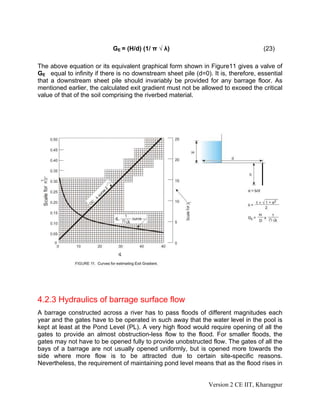
Corresponding to the downstream sheet pile [Figure 6 (b)], the exit gradient, denoted
as GE, is given below:
Version 2 CE IIT, Kharagpur
GE = (H/d) (1/ π √ λ) (23)
The above equation or its equivalent graphical form shown in Figure11 gives a valve of
GE equal to infinity if there is no downstream sheet pile (d=0). It is, therefore, essential
that a downstream sheet pile should invariably be provided for any barrage floor. As
mentioned earlier, the calculated exit gradient must not be allowed to exceed the critical
value of that of the soil comprising the riverbed material.
4.2.3 Hydraulics of barrage surface flow
A barrage constructed across a river has to pass floods of different magnitudes each
year and the gates have to be operated in such away that the water level in the pool is
kept at least at the Pond Level (PL). A very high flood would require opening of all the
gates to provide an almost obstruction-less flow to the flood. For smaller floods, the
gates may not have to be opened fully to provide unobstructed flow. The gates of all the
bays of a barrage are not usually opened uniformly, but is opened more towards the
side where more flow is to be attracted due to certain site-specific reasons.
Nevertheless, the requirement of maintaining pond level means that as the flood rises in
Version 2 CE IIT, Kharagpur
a river, more and more gate opening is provided till such time when the gates are fully
open.
The corresponding upstream stage-discharge curve shown in Figure 12(a) shows that
up to a river discharge of Q0, the water level behind the barrage is maintained at Pond
Level. At any higher discharge, the stage discharge curve is similar to that of the normal
river downstream [Figure 12(b)] but with an afflux.
Hence, at any discharge Q greater than Q0, the water level behind the barrage (Hu) is
higher than that downstream of the barrage (HD). In some rivers the construction of a
barrage causes the downstream riverbed to get degraded to progressively up to a
certain extent, a phenomenon that is called Retrogression, which has been found to be
more pronounced in alluvial rivers carrying more silt or having finer bed material and
having steep slope. IS 6966 (part 1): 1989 “Hydraulic design of barrages and weirs-
guidelines” recommends a retrogression of 1.25 to 2.25 m for alluvial rivers at lower
river stages depending upon the amount of silt in the river, type of bed material, and
slope. As a result of retrogression, low stages of the river are generally affected more
compared to the maximum flood levels. At the design flood, the reduction of stages due
to retrogression may be within 0.3 to 0.5m depending upon whether the river is shallow
or confined during floods. Figure 12(c) shows a typical retrogressed water stage versus
discharge and for the same discharge Q1, the corresponding water level (HD′ ) would be
much lower than the upstream water level (Hu).
The above discussion implies that for the same flood discharge, a non-retrogressed
river may exhibit submerged flow phenomenon [Figure 13(a)] compared to a free flow
condition [Figure 13(b)] expected for a retrogressed condition. As a consequence, there
Version 2 CE IIT, Kharagpur
would be a difference in scour depths in either case. Nevertheless, IS 6966 [part 1]:
1989 recommends that for non cohesive soils, the depth of scour may be calculated
from the Lacey’s formula which is as follows:
R=0.473(Q/f)1/3
when looseness factor is more than 1 (24)
or
R=1.35(q2
/f)1/3
when looseness factor is less than 1 (25)
Where
R=depth of scour below the highest flood level (in meters).
Q=high flood discharge in the river (in m3
/s)
f=silt factor which may be calculated knowing the average particle
size mr(in mm), of the soil from the following relationship
f=1.76√d50
(26)
q=intensity of flood discharge is in m3
/s per meter width
The extent of scour in a river with erodible bed material varies at different places along
a barrage. The likely extent of scour at various points are given in the following table:
Location Range Mean
Upstream cutoff (sheet pile) depth 1.0R*
Downstream cutoff (sheet pile) depth 1.25R*
Flexible apron upstream of impervious floor 1.25 to 1.75R 1.5R
Flexible apron downstream of impervious
floor
1.75 to 2.25R 2.0R
Noses of guide banks 2.00 to 2.50R 2.25R
Noses of divide wall 2.00 to 2.50R 2.25R
Transition from nose to straight 1.25 to 1.75R 1.50R
Straight reaches of guide banks 1.00 to 1.50R 1.25R
* A concentration factor of 20 percent is to be taken into account in fixing the depth of
sheet piles. These should be suitably extended into the banks on both sides up to at
least twice their depth from top of the floors.
Version 2 CE IIT, Kharagpur
It is quite common to find layers of clay below the riverbed of alluvial rivers in which
case, a judicious adjustment in the depths of upstream and downstream sheet-piles
shall have to be made to avoid build up of pressure under floor.
4.2.4 Fixing dimensions of barrage components
The hydraulic calculation for a barrage starts with determination of the waterway, as
discussed in Lesson 4.1. For shallow and meandering rivers, the minimum stable width
(P) can be calculated from Lacey’s modified formula
P=4.83 Q1/2
(27)
Where, the discharge Q is in m3
/s. For rivers with very wide sections, the width of the
barrage is limited to Lacey’s width multiplied by looseness factor and the balance width
is blocked by tie bunds with suitable training measures. Assuming the width of each bay
to be between 18m to 20m and pier width to be around 1.5 the total number of bays is
worked out. The total number of bays is distributed between spillway, under-sluice and
river-sluice bays. The crest levels of the different bays may be fixed up on the basis of
the formulations in Lesson 4.1.
With these tentative values, the adequacy of the water way for passing the design flood
within the permissible afflux needs to be checked up. Otherwise, the water way and
crest levels will need to be readjusted in such a way that the permissible values of afflux
are not exceeded.
The discharge through the bays of a barrage (spillway or under sluices) for an
uncontrolled condition (as during a flood discharge) is given as:
Q=CLH3/2
(28)
Where L is the clear water way (in meters) H is the total head (including velocity head)
over crest (in meters) and C is the coefficient of discharge, which for free flow conditions
[as shown in Figure 13 (b)] may be taken as 1.705 (for Broad-crested weirs/spillways) or
1.84 (for Sharp-crested weirs/ spillways). Roughly, a spillway or weir is considered to be
Broad Crested if a critical depth occurs over its crest. However, with the general
dimensions of a barrage spillway (with the crest width generally being kept at about 2m)
and the corresponding flow depths usually prevailing, it would mostly act like a Sharp-
Crested spillway. Under sluices and river sluices (without a crest) would behave as
broad-crested weir. Another point that may be kept in mind is that the total head H also
includes the velocity head Va
2
/2g, where Va is the velocity of approach and may be
found by dividing the total discharge by the flow Q cross section area A. The quantity A,
in turn, may be found out by multiplying the river width by the depth of flow, which has to
Version 2 CE IIT, Kharagpur
be taken not as the difference of the affluxed water level and the normal river bed, but
as the depth of scour measured from water surface as mention in section 4.2.3.
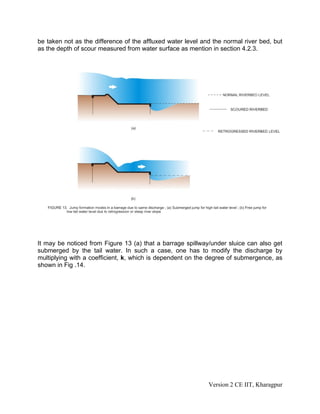
It may be noticed from Figure 13 (a) that a barrage spillway/under sluice can also get
submerged by the tail water. In such a case, one has to modify the discharge by
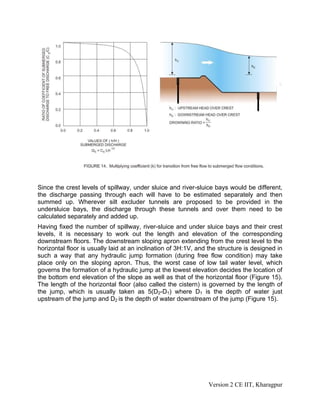
multiplying with a coefficient, k, which is dependent on the degree of submergence, as
shown in Fig .14.
Version 2 CE IIT, Kharagpur
Since the crest levels of spillway, under sluice and river-sluice bays would be different,
the discharge passing through each will have to be estimated separately and then
summed up. Wherever silt excluder tunnels are proposed to be provided in the
undersluice bays, the discharge through these tunnels and over them need to be
calculated separately and added up.
Having fixed the number of spillway, river-sluice and under sluice bays and their crest
levels, it is necessary to work out the length and elevation of the corresponding
downstream floors. The downstream sloping apron extending from the crest level to the
horizontal floor is usually laid at an inclination of 3H:1V, and the structure is designed in
such a way that any hydraulic jump formation (during free flow condition) may take
place only on the sloping apron. Thus, the worst case of low tail water level, which
governs the formation of a hydraulic jump at the lowest elevation decides the location of
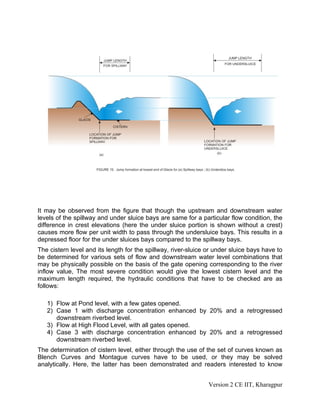
the bottom end elevation of the slope as well as that of the horizontal floor (Figure 15).
The length of the horizontal floor (also called the cistern) is governed by the length of
the jump, which is usually taken as 5(D2-D1) where D1 is the depth of water just
upstream of the jump and D2 is the depth of water downstream of the jump (Figure 15).
Version 2 CE IIT, Kharagpur
It may be observed from the figure that though the upstream and downstream water
levels of the spillway and under sluice bays are same for a particular flow condition, the
difference in crest elevations (here the under sluice portion is shown without a crest)
causes more flow per unit width to pass through the undersluice bays. This results in a
depressed floor for the under sluices bays compared to the spillway bays.
The cistern level and its length for the spillway, river-sluice or under sluice bays have to
be determined for various sets of flow and downstream water level combinations that
may be physically possible on the basis of the gate opening corresponding to the river
inflow value, The most severe condition would give the lowest cistern level and the
maximum length required, the hydraulic conditions that have to be checked are as
follows:
1) Flow at Pond level, with a few gates opened.
2) Case 1 with discharge concentration enhanced by 20% and a retrogressed
downstream riverbed level.
3) Flow at High Flood Level, with all gates opened.
4) Case 3 with discharge concentration enhanced by 20% and a retrogressed
downstream riverbed level.
The determination of cistern level, either through the use of the set of curves known as
Blench Curves and Montague curves have to be used, or they may be solved
analytically. Here, the latter has been demonstrated and readers interested to know
Version 2 CE IIT, Kharagpur
about graphical method, may go through any standard textbook on hydraulic structures
or irrigation engineering as the following:
Asawa, G L (1995) Irrigation Engineering, New Age Publishers
The various steps followed in the determination of the cistern level by analytical
methods are as follows:
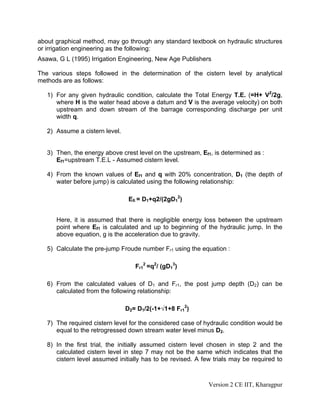
1) For any given hydraulic condition, calculate the Total Energy T.E. (=H+ V2
/2g,
where H is the water head above a datum and V is the average velocity) on both
upstream and down stream of the barrage corresponding discharge per unit
width q.
2) Assume a cistern level.
3) Then, the energy above crest level on the upstream, Ef1, is determined as :
Ef1=upstream T.E.L - Assumed cistern level.
4) From the known values of Ef1 and q with 20% concentration, D1 (the depth of
water before jump) is calculated using the following relationship:
Efi = D1+q2/(2gD1
2
)
Here, it is assumed that there is negligible energy loss between the upstream
point where Ef1 is calculated and up to beginning of the hydraulic jump. In the
above equation, g is the acceleration due to gravity.
5) Calculate the pre-jump Froude number Fr1 using the equation :
Fr1
2
=q2
/ (gD1
3
)
6) From the calculated values of D1 and Fr1, the post jump depth (D2) can be
calculated from the following relationship:
D2= D1/2(-1+√1+8 Fr1
2
)
7) The required cistern level for the considered case of hydraulic condition would be
equal to the retrogressed down stream water level minus D2.
8) In the first trial, the initially assumed cistern level chosen in step 2 and the
calculated cistern level in step 7 may not be the same which indicates that the
cistern level assumed initially has to be revised. A few trials may be required to
Version 2 CE IIT, Kharagpur
arrive at a final level of the cistern. The required length of the cistern is then
found out as 5(D2-D1).
The cistern is designed with the final dimension arrived at from the hydraulic
calculations mentioned above. However, the length of the horizontal floor can be
reduced with a corresponding saving in cost if the normal steady level of the
downstream water is obtained in a distance less than 5 times the jump height by
addition of some appurtenant structures. The most common is the addition of either one
or a combination of the following to the horizontal downstream floor:
1) A continuous end sill
2) Raised blocks
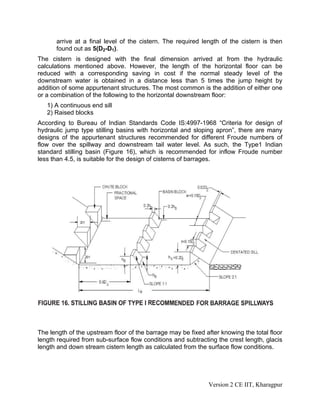
According to Bureau of Indian Standards Code IS:4997-1968 “Criteria for design of
hydraulic jump type stilling basins with horizontal and sloping apron”, there are many
designs of the appurtenant structures recommended for different Froude numbers of
flow over the spillway and downstream tail water level. As such, the Type1 Indian
standard stilling basin (Figure 16), which is recommended for inflow Froude number
less than 4.5, is suitable for the design of cisterns of barrages.
The length of the upstream floor of the barrage may be fixed after knowing the total floor
length required from sub-surface flow conditions and subtracting the crest length, glacis
length and down stream cistern length as calculated from the surface flow conditions.
Version 2 CE IIT, Kharagpur
4.2.5 Protection works
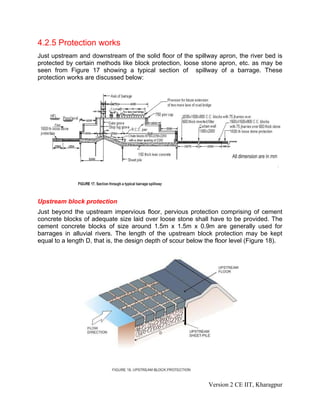
Just upstream and downstream of the solid floor of the spillway apron, the river bed is
protected by certain methods like block protection, loose stone apron, etc. as may be
seen from Figure 17 showing a typical section of spillway of a barrage. These
protection works are discussed below:
Upstream block protection
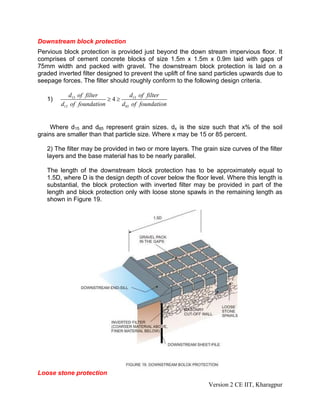
Just beyond the upstream impervious floor, pervious protection comprising of cement
concrete blocks of adequate size laid over loose stone shall have to be provided. The
cement concrete blocks of size around 1.5m x 1.5m x 0.9m are generally used for
barrages in alluvial rivers. The length of the upstream block protection may be kept
equal to a length D, that is, the design depth of scour below the floor level (Figure 18).
Version 2 CE IIT, Kharagpur
Downstream block protection
Pervious block protection is provided just beyond the down stream impervious floor. It
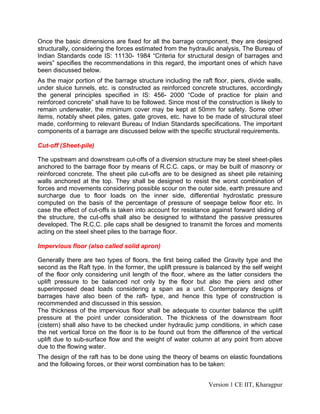
comprises of cement concrete blocks of size 1.5m x 1.5m x 0.9m laid with gaps of
75mm width and packed with gravel. The downstream block protection is laid on a
graded inverted filter designed to prevent the uplift of fine sand particles upwards due to
seepage forces. The filter should roughly conform to the following design criteria.
1) 15 15
15 85
4
d of filter d of filter
d of foundation d of foundation
≥ ≥
Where d15 and d85 represent grain sizes. dx is the size such that x% of the soil
grains are smaller than that particle size. Where x may be 15 or 85 percent.
2) The filter may be provided in two or more layers. The grain size curves of the filter
layers and the base material has to be nearly parallel.
The length of the downstream block protection has to be approximately equal to
1.5D, where D is the design depth of cover below the floor level. Where this length is
substantial, the block protection with inverted filter may be provided in part of the
length and block protection only with loose stone spawls in the remaining length as
shown in Figure 19.
Loose stone protection
Version 2 CE IIT, Kharagpur
Beyond the block protection on the upstream and down streams of a barrage located on
alluvial foundation, a layer of loose boulders or stones have to be laid, as shown in
Figure 20(a). The boulder size should be at least 0.3m and should not weigh less than
40kg. This layer of boulders are expected to fall below at an angle , or launch , when
the riverbed down stream starts getting scoured at the commencement of a heavy flood
[Figure 20(b)]. The length of river bed that has to be protected with loose stone blocks
shall be around 1.5D, where D is the depth of scour below average riverbed.
It may be mentioned that the loose stone protection shall have to be laid not only down
stream of the barrage floor, but all along the base of guide bunds, flank walls, abutment
walls, divide walls, under sluice tunnels, as may be observed from the typical layout of a
barrage given in Figure 21.
Version 2 CE IIT, Kharagpur
Once the basic dimensions are fixed for all the barrage component, they are designed
structurally, considering the forces estimated from the hydraulic analysis, The Bureau of
Indian Standards code IS: 11130- 1984 “Criteria for structural design of barrages and
weirs” specifies the recommendations in this regard, the important ones of which have
been discussed below.
As the major portion of the barrage structure including the raft floor, piers, divide walls,
under sluice tunnels, etc. is constructed as reinforced concrete structures, accordingly
the general principles specified in IS: 456- 2000 “Code of practice for plain and
reinforced concrete” shall have to be followed. Since most of the construction is likely to
remain underwater, the minimum cover may be kept at 50mm for safety. Some other
items, notably sheet piles, gates, gate groves, etc. have to be made of structural steel
made, conforming to relevant Bureau of Indian Standards specifications. The important
components of a barrage are discussed below with the specific structural requirements.
Cut-off (Sheet-pile)
The upstream and downstream cut-offs of a diversion structure may be steel sheet-piles
anchored to the barrage floor by means of R.C.C. caps, or may be built of masonry or
reinforced concrete. The sheet pile cut-offs are to be designed as sheet pile retaining
walls anchored at the top. They shall be designed to resist the worst combination of
forces and movements considering possible scour on the outer side, earth pressure and
surcharge due to floor loads on the inner side, differential hydrostatic pressure
computed on the basis of the percentage of pressure of seepage below floor etc. In
case the effect of cut-offs is taken into account for resistance against forward sliding of
the structure, the cut-offs shall also be designed to withstand the passive pressures
developed. The R.C.C. pile caps shall be designed to transmit the forces and moments
acting on the steel sheet piles to the barrage floor.
Impervious floor (also called solid apron)
Generally there are two types of floors, the first being called the Gravity type and the
second as the Raft type. In the former, the uplift pressure is balanced by the self weight
of the floor only considering unit length of the floor, where as the latter considers the
uplift pressure to be balanced not only by the floor but also the piers and other
superimposed dead loads considering a span as a unit. Contemporary designs of
barrages have also been of the raft- type, and hence this type of construction is
recommended and discussed in this session.
The thickness of the impervious floor shall be adequate to counter balance the uplift
pressure at the point under consideration. The thickness of the downstream floor
(cistern) shall also have to be checked under hydraulic jump conditions, in which case
the net vertical force on the floor is to be found out from the difference of the vertical
uplift due to sub-surface flow and the weight of water column at any point from above
due to the flowing water.
The design of the raft has to be done using the theory of beams on elastic foundations
and the following forces, or their worst combination has to be taken:
Version 1 CE IIT, Kharagpur
Beyond the block protection on the upstream and down streams of a barrage located on
alluvial foundation, a layer of loose boulders or stones have to be laid, as shown in
Figure 20(a). The boulder size should be at least 0.3m and should not weigh less than
40kg. This layer of boulders are expected to fall below at an angle , or launch , when
the riverbed down stream starts getting scoured at the commencement of a heavy flood
[Figure 20(b)]. The length of river bed that has to be protected with loose stone blocks
shall be around 1.5D, where D is the depth of scour below average riverbed.
It may be mentioned that the loose stone protection shall have to be laid not only down
stream of the barrage floor, but all along the base of guide bunds, flank walls, abutment
walls, divide walls, under sluice tunnels, as may be observed from the typical layout of a
barrage given in Figure 21.
4.2.6 Structural design of barrage components
Version 2 CE IIT, Kharagpur
• Buoyancy
• Wind forces
• Forces due to water current
• Differential hydrostatic pressure with the gate of one bay open and the adjacent
bay closed
• Seismic forces, if any
• Hydro dynamic forces due to seismic conditions
A pier shall have to be designed as a reinforced concrete column and IS:456-
2000 may be followed accordingly.
For the design of other components of a barrage project, like Divide walls,
Abutments, Flank walls, Return walls, etc., IS: 11130-1984 may be followed.
4.2.7 Construction of concrete barrages
Barrages are nowadays made of reinforced concrete and designed as raft type
structures which are light in weight compared to storage dams (designed as
gravity-type structures). The design of barrages is done by accepting some
calculated risks and hence it is important that the construction of such a
structure is done with great care and there is no room for construction failure to
occur. In this section, the important steps for a careful construction of barrage is
explained and further details may be had from Bureau of Indian Standards Code
IS:11150-1993 “Construction of concrete barrages – code of practice”.
Data required for construction activities
For planning and execution of construction activities, a number of data is
required, most of which would be available from the design reports. These
include:
• Index map of the site
• Contour plan of the area
• Cross-sections of the river
• Bore-hole log charts
• Permeability coefficients
• Rainfall data of the location
• Flood discharges, minimum and maximum water levels
• Location and accessibility of quarry areas for coarse and fine aggregates
• Working drawings of barrage and appurtenant structures
• Sequence of construction of various blocks comprising of number of bays and
abutments, etc.
• Requirements of inter-dependence of various items
• Necessary precautions to be taken
• Special features of construction, if any
Construction planning
Version 2 CE IIT, Kharagpur
The construction planning for any structure can be broadly classified under two
heads: a) Infrastructure planning, and b) Procurement planning and is applicable to
barrage construction also. It also includes the finalization of a programme of
works and, intermediate review of the programme vis-à-vis the actual work going
on in the field. These points are briefly explained below.
Infrastructure planning
This aspect of planning needs to ensure approach roads, power and water
supply, workshop, stores, aggregate processing plant, concrete batching and
mixing plants, camps and work sheds. It also requires the establishment of other
amenities, such as market, schools, medical facilities, and other social and
cultural needs of the field staff and workers. The planning should be carried out
to the extent possible before the work starts, so that the uncertainties and delays
in execution of work, and precise time estimates for the job planning could be
evaluated.
Procurement planning
This requires the storage of various construction related materials, like explosives
for blasting rocks, cement for construction, steel sheet piles, structural and
reinforcement steel, aggregates, etc. The construction equipment necessary to
execute the work have also to be procured along with adequate spare parts and
accessories.
Programme of works
This should be prepared at the start of the construction activities and consist
mainly of Bar Chart Programme for the project duration showing the quantities and
monthly progress required for various major items of the project. Another master
network plan based on PERT/CPM planning may have to be worked out for
monitoring the project work. Based on these programmes, the planning for
finance, manpower, equipment required for various activities in different seasons
of work have to be prepared.
Review of programme and resources
This should be carried out from time to time as the construction work progresses
and should compare items such as the budgeted programme of work and the
actual programme of work reviewed at intervals of three or six months. Also, the
actual performance of various machines have to be compared with the estimated
performance and recommend necessary corrective measures that should be
taken. Availability and procurement of essential materials like cement,
reinforcement steel, sheet piles, etc. have to be reviewed as well as that for
accessory and spare parts of plant and machinery in use and the availability of
skilled and unskilled manpower.
Sequence of construction
Version 2 CE IIT, Kharagpur
This important activity has to be planned perfectly, since mistakes at this stage
would be difficult to be rectified later. The major items under the sequence of
construction are as follows:
● Layout of the barrage axis as per the approved plan by constructing short
pillars called axis pillars at suitable locations along the line of the axis across
the river.
● Benchmark location has to be established the entire project area to help site
the various components like floor, crest, piers, etc. at proper elevation.
● Temporary access bridge has to be constructed for transporting men, material
and equipment from one bank of the river to the other.
● Layout of cofferdams have to be decided on the site conditions, nature of river
course, and programme of works for the season. Coffer dams are temporary
structures constructed in the riverbed to provide an enclosed area where the
actual construction might be executed. Details of the design of a cofferdam may
be had from Bureau of Indian Standards Code IS:10084-1982(Part1) “Criteria for
design of diversion works: Coffer dams”.
● Once the coffer dams are constructed, the water within the enclosure has to
be dewatered. The Bureau of Indian Standards Code IS:9759-1981 “Guidelines
for dewatering during construction” may be referred for details, but the main
points are noted below:
1. After completion of the excavation above the water table, dewatering of the
foundations have to be commenced by well points or open pumps and the
water table progressively lowered. Well point systems may be suitable for
sandy soils but in silty clay foundations strata open pumps and/or deep well
pump may be preferred. If an impermeable compact shingles-coffle layer is
sand witched between sandy layers in the depth to be excavated, then deep-
well pumps with strainer throughout its depth has to be used.
2. The preliminary requirements of dewatering pumps should be bored on the
inflow to the work area, calculated on the basis of permeability of the strata
and closeness of the water source.
3. During dewatering operation, care should be taken to ensure that there is no
removal of fines from the sub-strata that may weaken the foundation.
4. Any seepage of water from the foundation at local points or springs have to
be taken care of properly so that there is no piping of the foundation
material.
5. Excavation of the foundation to the barrage profile is to be made either
manually or by machines in reasonably dry conditions . During excavation,
Version 2 CE IIT, Kharagpur
water table should be maintained at a lower level at which the excavation is
being done. The excavated soil should be disposed- off either manually or by
machines, to suite the site requirements . In case machinery is employed, the
final excavation of the lowest layer should be done manually to the specified
depth.
6. Cutoff walls may be steel sheet -piles driven from riverbed in case of non-
bouldery strata of riverbed but in bouldery strata, either concrete or steel
sheet pile cut-offs have to be constructed, both by excavating a trench and then
back filling with sand. For a discussion of the details of steel sheet pile driving
or construction of cutoff walls in trenches the code IS:11150-1993 “Construction
of concrete barrages - code of practice” may be referred to.
7. Once the cut-off walls on the upstream and downstream sides of the barrage
are installed and partially covered with pile caps, the foundation surface of
the raft floor has to be properly leveled, dressed and consolidated. The
foundation should not contain loose pockets or materials and they should be
watered and compacted to the specified relative density. Clay pockets should be
treated as specified by the designer. It has to be ensured that proper drainage
arrangements in the foundation according to the designs including inverted
filter, wherever indicated, are provided and concreting work is taken up.
8. Instruments like piezometers, pressure cells, soil stress meters, tilt meters as
specified should be installed carefully such that the electric or mechanical
connections to a central control panel is least disturbed during construction.
9. The batching, mixing, placing and protection of concrete has to be done in
accordance with IS:456-1978 “Code of practice for plain and reinforced
concrete”.
10. Where mechanical parts like gate guidining rails, gate seals are to be
installed, block outs should be left out so that the parts may be embedded
later.
11. Dowel bars, or if necessary, metal sealing strips should be provided for the
joints between the pile caps and barrage floor.
12. The sequence of construction of barrage bays, silt excluder and piers have
to be done in lifts, starting from the downstream end of the barrage and with
continuous pour in suitable layers, or as specified by the designer.
13. Abutment and flared out walls may be constructed on pile foundations or on
well foundations.
Version 2 CE IIT, Kharagpur
14. Divide walls have to be constructed on well foundations and the wells have
to be sunk to the founding levels and the work of barrage bays on either
side of the divide wall should be taken up after construction of well caps.
15.The cement concrete blocks in the flexible apron on the upstream and
downstream of the solid aprons of the barrage floor may be cast in-situ with
alternate blocks cast at a time. These may be constructed with form work that
should be so designed that when it is stripped off, the required gap is formed
for filling the filler material to facilitate speedy construction, pre-cast blocks
may be used.
Care and diversion of river
Since a barrage would be covering almost the entire width of the river, and it
would take quite a few years to construct the whole structure, it would be
necessary to construct only portions of the barrage at each construction season,
when the flow in the river is relatively less. There may not possibly be any
construction in the flood season. During the construction season, the river has to
be diverted from the area enclosed for construction by suitable flow diversion
works.
The programme of construction of river diversion work should mainly be
determined by the availability of working period, likely time that would be
required for construction of coffer dams, associated diversion works and
construction capability.
The period available for construction of cofferdams is generally limited and
depends upon the post-monsoon pattern of the river course and quantum of
discharge and programme of work of various items of permanent nature.
Cofferdam construction for the portions nearer to the river banks where velocities
may not be high, may be of earthen type cofferdams and when the work
advances into the river portion, composite type cofferdams consisting of single
sheet piles backed with earthen embankments may be provided. Suitable
protection on the river side has to be provided to avoid dislodging of sheet piles
due to scour of soil backing. For details about the choice of coffer dam to be
adopted, one may refer to the Bureau of Indian Standards Code IS:10084-1982
(part1) “Guidelines for choice of type of diversion works: cofferdams”.
Version 2 CE IIT, Kharagpur

M4l02

  • 1.
    Module 4 Hydraulic Structures for FlowDiversion and Storage Version 2 CE IIT, Kharagpur
  • 2.
    Lesson 2 Design of theMain Diversion Structure of a Barrage Version 2 CE IIT, Kharagpur
  • 3.
    Instructional objectives On completionof this lesson, the student shall learn: 1. The sub-surface consideration for the design of a barrage 2. Steps for computing seepage pressure and exit gradient for barrage 3. Procedure to determine the waterway of a barrage 4. Computation step for determining barrage cistern level 5. The different protection works for barrages 4.2.0 Introduction The design of any hydraulic structure comprises of two steps: • Hydraulic design, to fix the overall dimensions and profiles of the structure, and • Structural design, where the various sections are analysed for stresses under different loads and reinforcement or other structural details are worked out. The dimensions fixed by hydraulic design through available empirical formulae are further refined by testing a scale model of the structure in a hydraulic model testing laboratory. The structural design uses the hydraulic forces expected from the given hydraulic parameters (evolved through the hydraulic design) and produces a detailing that will keep the structure safe against those forces and loadings. In this lesson, the hydraulics of barrages and canal head regulator is presented. The structural design is discussed in Lesson 4.2. For barrages, there are two different sets of hydraulic conditions. The first is due to sub- surface or seepage flow conditions that occurs due to a water level difference on the upstream and down stream of a barrage and is the maximum when the gates of a barrage are mostly closed as during the low flow period of the river. The other is due to surface flow conditions which occur while the barrage gates are open during floods. In this section we shall discuss each of these hydraulic conditions for the main diversion structure of a barrage to evaluate the forces generated by them. The hydraulic conditions of canal head regulators are also quite similar, with seepage flow dominating during gate closed condition and free flow during gate open condition. 4.2.1 Hydraulic design for sub-surface flow The sub-surface flow below a barrage causes two definite instability problems, as listed below and illustrated in Figure 1. 1. Uplift forces due to the sub soil pressure that tends to lift up the barrage raft floor, and Version 2 CE IIT, Kharagpur
  • 4.
    2. Upward risingseepage forces through the river bed just down stream of the solid apron causes sand particles to erupt upwards and tends to ‘piping’ failure of the foundation. Seepage forces would be the most dominating for gates closed condition, but would also exist during some cases of full flow conditions, as shown in Figure 2. Version 2 CE IIT, Kharagpur
  • 5.
    It may benoticed that during the flow conditions, a part of the uplift forces due to seepage flow is negated by hydraulic pressure of the water on the downstream. Under the closed gates condition, the downstream water depth is rather small. In order to evaluate the uplift forces due to seepage flow, it might be worthwhile to recall the mechanism of such flow, as seen from Figure3, the distribution of sub-surface pressure, that is, the pressure of the water held within the pores of the soil is such that it varies from a maximum along the upstream river bed to a minimum at the downstream river bed. The pressure head differential between the upstream and downstream is expressed as a percentage and denoted by φ. A comparison of pressure distribution below the barrage floor from Figs. 3(a) and 3(b) indicate that the introduction of sheet piles reduce the pressure below the barrage raft floor. Infact, the seepage paths increase due to the introduction of sheet piles, consequently reducing the gradient of sub-surface pressure. It may be noted from the figure that the pressure at any location of a certain equipotential line is given by the following expression: ⎥ ⎦ ⎤ ⎢ ⎣ ⎡ + ⎟ ⎠ ⎞ ⎜ ⎝ ⎛ − = − + = U D D U D H H g H H g gH p 100 100 1 ) ( 100 φ φ ρ ρ φ ρ φ (1) In equation (1), HU is the head of water on the upstream pool above datum and HD is the head of tail water above datum. Version 2 CE IIT, Kharagpur
  • 6.
    If a flownet is constructed using both sub-surface equipotential lines as well as stream lines (Figure 4), an estimate may be made of the seepage discharge as given below. Assuming that a flow channel is designated by the space between two adjacent streamlines, (Figure 4) then the flow through all such flow channels may be considered equal and amounting to, say, Δq m3 /s per metre width. If there are Nf flow channels, then the total seepage flow q would be given as below: q = Nf Δq (2) The quantity Δq is governed by Darcy’s law is Δq = k Δh/ Δ s Δ n (3) In the above equation k is the coefficient of permeability, Δh is the potential drop between two equipotential lines, Δs is the potential length along the stream line of flow net ‘square’ and Δn is the length normal to the stream line and pressures the other length of the ‘square’. Δs and Δn are nearly equal and Δh is equal to Hdiff / Nd where Hdiff is the head difference between upstream pool and downstream tail water level and Nd is the number of equipotential drops between the upstream and the downstream river bed. Hence, q = Nf k Hdiff / Nd = k Hdiff Nf / Nd (4) Version 2 CE IIT, Kharagpur
  • 7.
    The above equationenables the computation of the seepage quantity q. The seeping water below the barrage exerts a dynamic pressure against the river bed particles through whose voids the water is moving. This may be estimated by considering a small cylindrical volume of length Δl and cross sectional area ΔA in appropriate units. The seepage force on this small volume arises due to the difference in pressure on either side of the cylindrical volume. In Figure 5, these pressures are shown as p on the upstream and p + Δp on the downstream sides of the infinitesimal volume. Of course, the higher pressure being on the upstream side, Δp would be negative. An expression for the seepage force ΔF acting on the cylindrical elementary volume may be expressed as: ΔF = p. ΔA - (p + Δp).ΔA (5) This expression yields ΔF = -Δp. ΔA (6) Thus, the seepage force per unit volume of soil is given as: ΔF / (ΔA.Δl) = -Δp /Δl =-ρ g.ΔH/Δl (7) Version 2 CE IIT, Kharagpur
  • 8.
    Where ΔH isthe difference in head of water on either side of the small volume. Obviously ΔH is negative, since pressure head drops in the direction of flow, and thus the quantity on the right side of the equation would turn out to be positive. At the exit end, where the stream line meets the river bed surface (B in Figure 5), the seepage force is directed vertically upwards and against the weight of the volume of solid held in the soil. If the seepage force is great enough, it would cause sand-boiling, with the ejection of sand particles causing creation of pipe-like voids through the river bed, on the other hand, the river bed particles at the entry point (A in Figure 5) do not face such a problem, since both the seepage force and the particle weight are both directed vertically downward. In order to provide safety against piping-failure at the exit end, the submerged weight (w) of the solid should be at least equal to the seepage force. This may be expressed as: w = (1-n)(ρs-ρ) g≥-ρg ΔH/Δl (8) In the above, w is the submerged weight of the solids assuming a void ratio n. ρs and ρ stand for the density of the solids and water, respectively. The equation then simplifies to -ΔH/Δl ≤(1-n) (G-1) (9) Where G is the relative density of the soil. The quantity ΔH/Δl represents the hydraulic gradient of the subsurface water at the exit end of the streamline, and is also called the Exit Gradient. This should not exceed the given value in order to prevent failure by piping. Assuming G and n to be nearly equal to 2.65 and 0.4 respectively for sandy bed, the limiting value of ⏐ΔH/Δl ⏐ turns out to be approximately equal to 1.0. However, it is not enough to satisfy this limiting condition. Even a slight increase in the value will upset the stability of the sub-soil at the exit end. This requires the application of a generous factor of safety in the designs, which may be considered as a precaution against uncertainties such as: • Non- homogeneity of the foundation soil • Difference in the packing and pore space • Local intrusion of impervious material like clay beds or very porous material • Faults and fissures in sub-soil formation, etc. The factor of safety to be applied would take care of all these uncertainties besides covering cases where due to retrogression of bed levels or flood scour, the upper part of the piles at the downstream is exposed. According to the Bureau of Indian Standards Code IS 6966 (part 1): 1989 “Hydraulic design of barrages and weirs- guidelines”, the Version 2 CE IIT, Kharagpur
  • 9.
    following factors ofsafety may be considered according to the variation of river bed material: Sub-soil material Factor of safety Shingle 4 to 5 Coarse sand 5 to 6 Fine sand 6 to 7 4.2.2 Computation of seepage pressure and Exit gradient: With the advent of numerical computational tools and computers with high precision speeds, numerical solution of the Laplace equation representing sub-surface flow has become quite common these days to evaluate the above parameters. However, analytical solutions have been derived by a group of engineers and scientists in India comprising of A.N. Khosla, N.K. Bose and M. Taylor and presented in simple analytical forms and graphs. These can be used to arrive at a quick solution to a given problem. They arrived at these equations after conducting several experiments and solving the Laplace equation under simplified conditions using the Schwartz Christoffel transformation theory. The results of their mathematical solutions have been published under publication 12 of the Central Board of Irrigation and Power titled “Design of weirs on permeable foundations”. Of course, the soil confined below a barrage conforms to a complex shape and is not readily amenable to solution using analytical formulae but still the following simple profiles have been found to be very useful for approximately arriving at the subsurface pressures of a barrage or canal head regulator floor. Version 2 CE IIT, Kharagpur
  • 10.
    • A straighthorizontal floor of negligible thickness with a sheet pile at either end [Figure 6(a) or 6(b)]. • A straight horizontal floor of negligible thickness with an intermediate sheet pile [Figure 6(c)]. • A straight horizontal floor depressed below the bed but with no sheet pile [Figure 6(d)]. The solution for these simple profiles has been obtained in terms of the pressure head ratio (or percentage) at key points as shown in the figures. Version 2 CE IIT, Kharagpur
  • 11.
    These key pointsare the junction points of the sheet pile with floor incase of floors of negligible thickness and at the corners of the base at the upstream and down stream end incase of depressed floor. The analytical expressions of each of the above cases are given as under: • For sheet piles at either upstream end [Figure 6(a)] or the down stream end [Figure 6(b)]. φE = (1/π) cos-1 [(λ-2)/ λ] (10) φD = (1/π) cos-1 [(λ-1)/ λ] (11) φC 1 = 100 - φE (12) φD 1 = 100 - φD (13) φE 1 = 100 (14) where λ = (1/2)[ 1+√(1+α2 ) ] and α = (b/d) • For sheet piles at the intermediate point [ Figure 6( c ) ] φE = (1/π) cos-1 [(λ1-1)/ λ2] (15) φD = (1/π) cos-1 [λ1/ λ2] (16) φC = (1/π) cos-1 [(λ1+1)/ λ2] (17) In the above equations, λ1 and λ2 are given as: λ1= (1/2)[ √(1+α1 2 ) - √(1+α2 2 )] (18) λ2= (1/2)[ √(1+α1 2 ) + √(1+α2 2 )] (19) where α1 = (b1/d) α2 = (b2/d) • For the case of a depressed floor , φD' = φD - (2/3)[φE -φD] +(3/ α2 ) (20) φD' = 100 - φD Version 2 CE IIT, Kharagpur
  • 12.
    Where φD andφE are given as φD = (1/π) cos-1 [(λ-1)/ λ] (21) φE = (1/π) cos-1 [(λ-2)/ λ] (22) The above expressions may also be determined from the graph shown in Figure 7. Version 2 CE IIT, Kharagpur
  • 13.
    The uplift pressuresobtained by the analytical expressions or graphical methods need to be corrected for the following more realistic conditions: • Floor raft with sheet piles at either end actually has a floor thickness that can not be considered as negligible compared to the sheet pile depths. • A floor raft may have sheet piles both at the upstream as well as the downstream ends, which might interfere one with the other. • The floor of a modern barrage is not horizontal throughout. Some formulas have, therefore, been suggested for incorporating the necessary corrections which are expressed as follows: Correction for floor thickness Figure 8 illustrates the correction to the evaluated values at key points E and C that is applied considering a floor thickness t. Correction for mutual interference of sheet piles Figure 9 gives the amount correction C (in percent) for interference of one sheet pile on the other. Version 2 CE IIT, Kharagpur
  • 14.
    Correction for slopeof the floor The correction coefficient for taking care of inclined floor is given in Figure (10). The correction coefficients may also be read from the following table: Values of slope correction Slope(V:H) Correction of percent of pressure 1:1 11.2 1:2 6.5 Version 2 CE IIT, Kharagpur
  • 15.
    1:3 4.5 1:4 3.3 1:52.8 1:6 2.5 1:7 2.3 1:8 2.0 The corrections will have to be taken positive for down slopes and negative for up- slopes taken in the direction of flow. The corrections are applicable to the key points of the pile line fixed at the beginning or the end of the slope, for example the pile line 2 at its end E for the floor and sheet-pile shown in Figure 9. Corresponding to the downstream sheet pile [Figure 6 (b)], the exit gradient, denoted as GE, is given below: Version 2 CE IIT, Kharagpur
  • 16.
    GE = (H/d)(1/ π √ λ) (23) The above equation or its equivalent graphical form shown in Figure11 gives a valve of GE equal to infinity if there is no downstream sheet pile (d=0). It is, therefore, essential that a downstream sheet pile should invariably be provided for any barrage floor. As mentioned earlier, the calculated exit gradient must not be allowed to exceed the critical value of that of the soil comprising the riverbed material. 4.2.3 Hydraulics of barrage surface flow A barrage constructed across a river has to pass floods of different magnitudes each year and the gates have to be operated in such away that the water level in the pool is kept at least at the Pond Level (PL). A very high flood would require opening of all the gates to provide an almost obstruction-less flow to the flood. For smaller floods, the gates may not have to be opened fully to provide unobstructed flow. The gates of all the bays of a barrage are not usually opened uniformly, but is opened more towards the side where more flow is to be attracted due to certain site-specific reasons. Nevertheless, the requirement of maintaining pond level means that as the flood rises in Version 2 CE IIT, Kharagpur
  • 17.
    a river, moreand more gate opening is provided till such time when the gates are fully open. The corresponding upstream stage-discharge curve shown in Figure 12(a) shows that up to a river discharge of Q0, the water level behind the barrage is maintained at Pond Level. At any higher discharge, the stage discharge curve is similar to that of the normal river downstream [Figure 12(b)] but with an afflux. Hence, at any discharge Q greater than Q0, the water level behind the barrage (Hu) is higher than that downstream of the barrage (HD). In some rivers the construction of a barrage causes the downstream riverbed to get degraded to progressively up to a certain extent, a phenomenon that is called Retrogression, which has been found to be more pronounced in alluvial rivers carrying more silt or having finer bed material and having steep slope. IS 6966 (part 1): 1989 “Hydraulic design of barrages and weirs- guidelines” recommends a retrogression of 1.25 to 2.25 m for alluvial rivers at lower river stages depending upon the amount of silt in the river, type of bed material, and slope. As a result of retrogression, low stages of the river are generally affected more compared to the maximum flood levels. At the design flood, the reduction of stages due to retrogression may be within 0.3 to 0.5m depending upon whether the river is shallow or confined during floods. Figure 12(c) shows a typical retrogressed water stage versus discharge and for the same discharge Q1, the corresponding water level (HD′ ) would be much lower than the upstream water level (Hu). The above discussion implies that for the same flood discharge, a non-retrogressed river may exhibit submerged flow phenomenon [Figure 13(a)] compared to a free flow condition [Figure 13(b)] expected for a retrogressed condition. As a consequence, there Version 2 CE IIT, Kharagpur
  • 18.
    would be adifference in scour depths in either case. Nevertheless, IS 6966 [part 1]: 1989 recommends that for non cohesive soils, the depth of scour may be calculated from the Lacey’s formula which is as follows: R=0.473(Q/f)1/3 when looseness factor is more than 1 (24) or R=1.35(q2 /f)1/3 when looseness factor is less than 1 (25) Where R=depth of scour below the highest flood level (in meters). Q=high flood discharge in the river (in m3 /s) f=silt factor which may be calculated knowing the average particle size mr(in mm), of the soil from the following relationship f=1.76√d50 (26) q=intensity of flood discharge is in m3 /s per meter width The extent of scour in a river with erodible bed material varies at different places along a barrage. The likely extent of scour at various points are given in the following table: Location Range Mean Upstream cutoff (sheet pile) depth 1.0R* Downstream cutoff (sheet pile) depth 1.25R* Flexible apron upstream of impervious floor 1.25 to 1.75R 1.5R Flexible apron downstream of impervious floor 1.75 to 2.25R 2.0R Noses of guide banks 2.00 to 2.50R 2.25R Noses of divide wall 2.00 to 2.50R 2.25R Transition from nose to straight 1.25 to 1.75R 1.50R Straight reaches of guide banks 1.00 to 1.50R 1.25R * A concentration factor of 20 percent is to be taken into account in fixing the depth of sheet piles. These should be suitably extended into the banks on both sides up to at least twice their depth from top of the floors. Version 2 CE IIT, Kharagpur
  • 19.
    It is quitecommon to find layers of clay below the riverbed of alluvial rivers in which case, a judicious adjustment in the depths of upstream and downstream sheet-piles shall have to be made to avoid build up of pressure under floor. 4.2.4 Fixing dimensions of barrage components The hydraulic calculation for a barrage starts with determination of the waterway, as discussed in Lesson 4.1. For shallow and meandering rivers, the minimum stable width (P) can be calculated from Lacey’s modified formula P=4.83 Q1/2 (27) Where, the discharge Q is in m3 /s. For rivers with very wide sections, the width of the barrage is limited to Lacey’s width multiplied by looseness factor and the balance width is blocked by tie bunds with suitable training measures. Assuming the width of each bay to be between 18m to 20m and pier width to be around 1.5 the total number of bays is worked out. The total number of bays is distributed between spillway, under-sluice and river-sluice bays. The crest levels of the different bays may be fixed up on the basis of the formulations in Lesson 4.1. With these tentative values, the adequacy of the water way for passing the design flood within the permissible afflux needs to be checked up. Otherwise, the water way and crest levels will need to be readjusted in such a way that the permissible values of afflux are not exceeded. The discharge through the bays of a barrage (spillway or under sluices) for an uncontrolled condition (as during a flood discharge) is given as: Q=CLH3/2 (28) Where L is the clear water way (in meters) H is the total head (including velocity head) over crest (in meters) and C is the coefficient of discharge, which for free flow conditions [as shown in Figure 13 (b)] may be taken as 1.705 (for Broad-crested weirs/spillways) or 1.84 (for Sharp-crested weirs/ spillways). Roughly, a spillway or weir is considered to be Broad Crested if a critical depth occurs over its crest. However, with the general dimensions of a barrage spillway (with the crest width generally being kept at about 2m) and the corresponding flow depths usually prevailing, it would mostly act like a Sharp- Crested spillway. Under sluices and river sluices (without a crest) would behave as broad-crested weir. Another point that may be kept in mind is that the total head H also includes the velocity head Va 2 /2g, where Va is the velocity of approach and may be found by dividing the total discharge by the flow Q cross section area A. The quantity A, in turn, may be found out by multiplying the river width by the depth of flow, which has to Version 2 CE IIT, Kharagpur
  • 20.
    be taken notas the difference of the affluxed water level and the normal river bed, but as the depth of scour measured from water surface as mention in section 4.2.3. It may be noticed from Figure 13 (a) that a barrage spillway/under sluice can also get submerged by the tail water. In such a case, one has to modify the discharge by multiplying with a coefficient, k, which is dependent on the degree of submergence, as shown in Fig .14. Version 2 CE IIT, Kharagpur
  • 21.
    Since the crestlevels of spillway, under sluice and river-sluice bays would be different, the discharge passing through each will have to be estimated separately and then summed up. Wherever silt excluder tunnels are proposed to be provided in the undersluice bays, the discharge through these tunnels and over them need to be calculated separately and added up. Having fixed the number of spillway, river-sluice and under sluice bays and their crest levels, it is necessary to work out the length and elevation of the corresponding downstream floors. The downstream sloping apron extending from the crest level to the horizontal floor is usually laid at an inclination of 3H:1V, and the structure is designed in such a way that any hydraulic jump formation (during free flow condition) may take place only on the sloping apron. Thus, the worst case of low tail water level, which governs the formation of a hydraulic jump at the lowest elevation decides the location of the bottom end elevation of the slope as well as that of the horizontal floor (Figure 15). The length of the horizontal floor (also called the cistern) is governed by the length of the jump, which is usually taken as 5(D2-D1) where D1 is the depth of water just upstream of the jump and D2 is the depth of water downstream of the jump (Figure 15). Version 2 CE IIT, Kharagpur
  • 22.
    It may beobserved from the figure that though the upstream and downstream water levels of the spillway and under sluice bays are same for a particular flow condition, the difference in crest elevations (here the under sluice portion is shown without a crest) causes more flow per unit width to pass through the undersluice bays. This results in a depressed floor for the under sluices bays compared to the spillway bays. The cistern level and its length for the spillway, river-sluice or under sluice bays have to be determined for various sets of flow and downstream water level combinations that may be physically possible on the basis of the gate opening corresponding to the river inflow value, The most severe condition would give the lowest cistern level and the maximum length required, the hydraulic conditions that have to be checked are as follows: 1) Flow at Pond level, with a few gates opened. 2) Case 1 with discharge concentration enhanced by 20% and a retrogressed downstream riverbed level. 3) Flow at High Flood Level, with all gates opened. 4) Case 3 with discharge concentration enhanced by 20% and a retrogressed downstream riverbed level. The determination of cistern level, either through the use of the set of curves known as Blench Curves and Montague curves have to be used, or they may be solved analytically. Here, the latter has been demonstrated and readers interested to know Version 2 CE IIT, Kharagpur
  • 23.
    about graphical method,may go through any standard textbook on hydraulic structures or irrigation engineering as the following: Asawa, G L (1995) Irrigation Engineering, New Age Publishers The various steps followed in the determination of the cistern level by analytical methods are as follows: 1) For any given hydraulic condition, calculate the Total Energy T.E. (=H+ V2 /2g, where H is the water head above a datum and V is the average velocity) on both upstream and down stream of the barrage corresponding discharge per unit width q. 2) Assume a cistern level. 3) Then, the energy above crest level on the upstream, Ef1, is determined as : Ef1=upstream T.E.L - Assumed cistern level. 4) From the known values of Ef1 and q with 20% concentration, D1 (the depth of water before jump) is calculated using the following relationship: Efi = D1+q2/(2gD1 2 ) Here, it is assumed that there is negligible energy loss between the upstream point where Ef1 is calculated and up to beginning of the hydraulic jump. In the above equation, g is the acceleration due to gravity. 5) Calculate the pre-jump Froude number Fr1 using the equation : Fr1 2 =q2 / (gD1 3 ) 6) From the calculated values of D1 and Fr1, the post jump depth (D2) can be calculated from the following relationship: D2= D1/2(-1+√1+8 Fr1 2 ) 7) The required cistern level for the considered case of hydraulic condition would be equal to the retrogressed down stream water level minus D2. 8) In the first trial, the initially assumed cistern level chosen in step 2 and the calculated cistern level in step 7 may not be the same which indicates that the cistern level assumed initially has to be revised. A few trials may be required to Version 2 CE IIT, Kharagpur
  • 24.
    arrive at afinal level of the cistern. The required length of the cistern is then found out as 5(D2-D1). The cistern is designed with the final dimension arrived at from the hydraulic calculations mentioned above. However, the length of the horizontal floor can be reduced with a corresponding saving in cost if the normal steady level of the downstream water is obtained in a distance less than 5 times the jump height by addition of some appurtenant structures. The most common is the addition of either one or a combination of the following to the horizontal downstream floor: 1) A continuous end sill 2) Raised blocks According to Bureau of Indian Standards Code IS:4997-1968 “Criteria for design of hydraulic jump type stilling basins with horizontal and sloping apron”, there are many designs of the appurtenant structures recommended for different Froude numbers of flow over the spillway and downstream tail water level. As such, the Type1 Indian standard stilling basin (Figure 16), which is recommended for inflow Froude number less than 4.5, is suitable for the design of cisterns of barrages. The length of the upstream floor of the barrage may be fixed after knowing the total floor length required from sub-surface flow conditions and subtracting the crest length, glacis length and down stream cistern length as calculated from the surface flow conditions. Version 2 CE IIT, Kharagpur
  • 25.
    4.2.5 Protection works Justupstream and downstream of the solid floor of the spillway apron, the river bed is protected by certain methods like block protection, loose stone apron, etc. as may be seen from Figure 17 showing a typical section of spillway of a barrage. These protection works are discussed below: Upstream block protection Just beyond the upstream impervious floor, pervious protection comprising of cement concrete blocks of adequate size laid over loose stone shall have to be provided. The cement concrete blocks of size around 1.5m x 1.5m x 0.9m are generally used for barrages in alluvial rivers. The length of the upstream block protection may be kept equal to a length D, that is, the design depth of scour below the floor level (Figure 18). Version 2 CE IIT, Kharagpur
  • 26.
    Downstream block protection Perviousblock protection is provided just beyond the down stream impervious floor. It comprises of cement concrete blocks of size 1.5m x 1.5m x 0.9m laid with gaps of 75mm width and packed with gravel. The downstream block protection is laid on a graded inverted filter designed to prevent the uplift of fine sand particles upwards due to seepage forces. The filter should roughly conform to the following design criteria. 1) 15 15 15 85 4 d of filter d of filter d of foundation d of foundation ≥ ≥ Where d15 and d85 represent grain sizes. dx is the size such that x% of the soil grains are smaller than that particle size. Where x may be 15 or 85 percent. 2) The filter may be provided in two or more layers. The grain size curves of the filter layers and the base material has to be nearly parallel. The length of the downstream block protection has to be approximately equal to 1.5D, where D is the design depth of cover below the floor level. Where this length is substantial, the block protection with inverted filter may be provided in part of the length and block protection only with loose stone spawls in the remaining length as shown in Figure 19. Loose stone protection Version 2 CE IIT, Kharagpur
  • 27.
    Beyond the blockprotection on the upstream and down streams of a barrage located on alluvial foundation, a layer of loose boulders or stones have to be laid, as shown in Figure 20(a). The boulder size should be at least 0.3m and should not weigh less than 40kg. This layer of boulders are expected to fall below at an angle , or launch , when the riverbed down stream starts getting scoured at the commencement of a heavy flood [Figure 20(b)]. The length of river bed that has to be protected with loose stone blocks shall be around 1.5D, where D is the depth of scour below average riverbed. It may be mentioned that the loose stone protection shall have to be laid not only down stream of the barrage floor, but all along the base of guide bunds, flank walls, abutment walls, divide walls, under sluice tunnels, as may be observed from the typical layout of a barrage given in Figure 21. Version 2 CE IIT, Kharagpur
  • 28.
    Once the basicdimensions are fixed for all the barrage component, they are designed structurally, considering the forces estimated from the hydraulic analysis, The Bureau of Indian Standards code IS: 11130- 1984 “Criteria for structural design of barrages and weirs” specifies the recommendations in this regard, the important ones of which have been discussed below. As the major portion of the barrage structure including the raft floor, piers, divide walls, under sluice tunnels, etc. is constructed as reinforced concrete structures, accordingly the general principles specified in IS: 456- 2000 “Code of practice for plain and reinforced concrete” shall have to be followed. Since most of the construction is likely to remain underwater, the minimum cover may be kept at 50mm for safety. Some other items, notably sheet piles, gates, gate groves, etc. have to be made of structural steel made, conforming to relevant Bureau of Indian Standards specifications. The important components of a barrage are discussed below with the specific structural requirements. Cut-off (Sheet-pile) The upstream and downstream cut-offs of a diversion structure may be steel sheet-piles anchored to the barrage floor by means of R.C.C. caps, or may be built of masonry or reinforced concrete. The sheet pile cut-offs are to be designed as sheet pile retaining walls anchored at the top. They shall be designed to resist the worst combination of forces and movements considering possible scour on the outer side, earth pressure and surcharge due to floor loads on the inner side, differential hydrostatic pressure computed on the basis of the percentage of pressure of seepage below floor etc. In case the effect of cut-offs is taken into account for resistance against forward sliding of the structure, the cut-offs shall also be designed to withstand the passive pressures developed. The R.C.C. pile caps shall be designed to transmit the forces and moments acting on the steel sheet piles to the barrage floor. Impervious floor (also called solid apron) Generally there are two types of floors, the first being called the Gravity type and the second as the Raft type. In the former, the uplift pressure is balanced by the self weight of the floor only considering unit length of the floor, where as the latter considers the uplift pressure to be balanced not only by the floor but also the piers and other superimposed dead loads considering a span as a unit. Contemporary designs of barrages have also been of the raft- type, and hence this type of construction is recommended and discussed in this session. The thickness of the impervious floor shall be adequate to counter balance the uplift pressure at the point under consideration. The thickness of the downstream floor (cistern) shall also have to be checked under hydraulic jump conditions, in which case the net vertical force on the floor is to be found out from the difference of the vertical uplift due to sub-surface flow and the weight of water column at any point from above due to the flowing water. The design of the raft has to be done using the theory of beams on elastic foundations and the following forces, or their worst combination has to be taken: Version 1 CE IIT, Kharagpur
  • 29.
    Beyond the blockprotection on the upstream and down streams of a barrage located on alluvial foundation, a layer of loose boulders or stones have to be laid, as shown in Figure 20(a). The boulder size should be at least 0.3m and should not weigh less than 40kg. This layer of boulders are expected to fall below at an angle , or launch , when the riverbed down stream starts getting scoured at the commencement of a heavy flood [Figure 20(b)]. The length of river bed that has to be protected with loose stone blocks shall be around 1.5D, where D is the depth of scour below average riverbed. It may be mentioned that the loose stone protection shall have to be laid not only down stream of the barrage floor, but all along the base of guide bunds, flank walls, abutment walls, divide walls, under sluice tunnels, as may be observed from the typical layout of a barrage given in Figure 21. 4.2.6 Structural design of barrage components Version 2 CE IIT, Kharagpur
  • 30.
    • Buoyancy • Windforces • Forces due to water current • Differential hydrostatic pressure with the gate of one bay open and the adjacent bay closed • Seismic forces, if any • Hydro dynamic forces due to seismic conditions A pier shall have to be designed as a reinforced concrete column and IS:456- 2000 may be followed accordingly. For the design of other components of a barrage project, like Divide walls, Abutments, Flank walls, Return walls, etc., IS: 11130-1984 may be followed. 4.2.7 Construction of concrete barrages Barrages are nowadays made of reinforced concrete and designed as raft type structures which are light in weight compared to storage dams (designed as gravity-type structures). The design of barrages is done by accepting some calculated risks and hence it is important that the construction of such a structure is done with great care and there is no room for construction failure to occur. In this section, the important steps for a careful construction of barrage is explained and further details may be had from Bureau of Indian Standards Code IS:11150-1993 “Construction of concrete barrages – code of practice”. Data required for construction activities For planning and execution of construction activities, a number of data is required, most of which would be available from the design reports. These include: • Index map of the site • Contour plan of the area • Cross-sections of the river • Bore-hole log charts • Permeability coefficients • Rainfall data of the location • Flood discharges, minimum and maximum water levels • Location and accessibility of quarry areas for coarse and fine aggregates • Working drawings of barrage and appurtenant structures • Sequence of construction of various blocks comprising of number of bays and abutments, etc. • Requirements of inter-dependence of various items • Necessary precautions to be taken • Special features of construction, if any Construction planning Version 2 CE IIT, Kharagpur
  • 31.
    The construction planningfor any structure can be broadly classified under two heads: a) Infrastructure planning, and b) Procurement planning and is applicable to barrage construction also. It also includes the finalization of a programme of works and, intermediate review of the programme vis-à-vis the actual work going on in the field. These points are briefly explained below. Infrastructure planning This aspect of planning needs to ensure approach roads, power and water supply, workshop, stores, aggregate processing plant, concrete batching and mixing plants, camps and work sheds. It also requires the establishment of other amenities, such as market, schools, medical facilities, and other social and cultural needs of the field staff and workers. The planning should be carried out to the extent possible before the work starts, so that the uncertainties and delays in execution of work, and precise time estimates for the job planning could be evaluated. Procurement planning This requires the storage of various construction related materials, like explosives for blasting rocks, cement for construction, steel sheet piles, structural and reinforcement steel, aggregates, etc. The construction equipment necessary to execute the work have also to be procured along with adequate spare parts and accessories. Programme of works This should be prepared at the start of the construction activities and consist mainly of Bar Chart Programme for the project duration showing the quantities and monthly progress required for various major items of the project. Another master network plan based on PERT/CPM planning may have to be worked out for monitoring the project work. Based on these programmes, the planning for finance, manpower, equipment required for various activities in different seasons of work have to be prepared. Review of programme and resources This should be carried out from time to time as the construction work progresses and should compare items such as the budgeted programme of work and the actual programme of work reviewed at intervals of three or six months. Also, the actual performance of various machines have to be compared with the estimated performance and recommend necessary corrective measures that should be taken. Availability and procurement of essential materials like cement, reinforcement steel, sheet piles, etc. have to be reviewed as well as that for accessory and spare parts of plant and machinery in use and the availability of skilled and unskilled manpower. Sequence of construction Version 2 CE IIT, Kharagpur
  • 32.
    This important activityhas to be planned perfectly, since mistakes at this stage would be difficult to be rectified later. The major items under the sequence of construction are as follows: ● Layout of the barrage axis as per the approved plan by constructing short pillars called axis pillars at suitable locations along the line of the axis across the river. ● Benchmark location has to be established the entire project area to help site the various components like floor, crest, piers, etc. at proper elevation. ● Temporary access bridge has to be constructed for transporting men, material and equipment from one bank of the river to the other. ● Layout of cofferdams have to be decided on the site conditions, nature of river course, and programme of works for the season. Coffer dams are temporary structures constructed in the riverbed to provide an enclosed area where the actual construction might be executed. Details of the design of a cofferdam may be had from Bureau of Indian Standards Code IS:10084-1982(Part1) “Criteria for design of diversion works: Coffer dams”. ● Once the coffer dams are constructed, the water within the enclosure has to be dewatered. The Bureau of Indian Standards Code IS:9759-1981 “Guidelines for dewatering during construction” may be referred for details, but the main points are noted below: 1. After completion of the excavation above the water table, dewatering of the foundations have to be commenced by well points or open pumps and the water table progressively lowered. Well point systems may be suitable for sandy soils but in silty clay foundations strata open pumps and/or deep well pump may be preferred. If an impermeable compact shingles-coffle layer is sand witched between sandy layers in the depth to be excavated, then deep- well pumps with strainer throughout its depth has to be used. 2. The preliminary requirements of dewatering pumps should be bored on the inflow to the work area, calculated on the basis of permeability of the strata and closeness of the water source. 3. During dewatering operation, care should be taken to ensure that there is no removal of fines from the sub-strata that may weaken the foundation. 4. Any seepage of water from the foundation at local points or springs have to be taken care of properly so that there is no piping of the foundation material. 5. Excavation of the foundation to the barrage profile is to be made either manually or by machines in reasonably dry conditions . During excavation, Version 2 CE IIT, Kharagpur
  • 33.
    water table shouldbe maintained at a lower level at which the excavation is being done. The excavated soil should be disposed- off either manually or by machines, to suite the site requirements . In case machinery is employed, the final excavation of the lowest layer should be done manually to the specified depth. 6. Cutoff walls may be steel sheet -piles driven from riverbed in case of non- bouldery strata of riverbed but in bouldery strata, either concrete or steel sheet pile cut-offs have to be constructed, both by excavating a trench and then back filling with sand. For a discussion of the details of steel sheet pile driving or construction of cutoff walls in trenches the code IS:11150-1993 “Construction of concrete barrages - code of practice” may be referred to. 7. Once the cut-off walls on the upstream and downstream sides of the barrage are installed and partially covered with pile caps, the foundation surface of the raft floor has to be properly leveled, dressed and consolidated. The foundation should not contain loose pockets or materials and they should be watered and compacted to the specified relative density. Clay pockets should be treated as specified by the designer. It has to be ensured that proper drainage arrangements in the foundation according to the designs including inverted filter, wherever indicated, are provided and concreting work is taken up. 8. Instruments like piezometers, pressure cells, soil stress meters, tilt meters as specified should be installed carefully such that the electric or mechanical connections to a central control panel is least disturbed during construction. 9. The batching, mixing, placing and protection of concrete has to be done in accordance with IS:456-1978 “Code of practice for plain and reinforced concrete”. 10. Where mechanical parts like gate guidining rails, gate seals are to be installed, block outs should be left out so that the parts may be embedded later. 11. Dowel bars, or if necessary, metal sealing strips should be provided for the joints between the pile caps and barrage floor. 12. The sequence of construction of barrage bays, silt excluder and piers have to be done in lifts, starting from the downstream end of the barrage and with continuous pour in suitable layers, or as specified by the designer. 13. Abutment and flared out walls may be constructed on pile foundations or on well foundations. Version 2 CE IIT, Kharagpur
  • 34.
    14. Divide wallshave to be constructed on well foundations and the wells have to be sunk to the founding levels and the work of barrage bays on either side of the divide wall should be taken up after construction of well caps. 15.The cement concrete blocks in the flexible apron on the upstream and downstream of the solid aprons of the barrage floor may be cast in-situ with alternate blocks cast at a time. These may be constructed with form work that should be so designed that when it is stripped off, the required gap is formed for filling the filler material to facilitate speedy construction, pre-cast blocks may be used. Care and diversion of river Since a barrage would be covering almost the entire width of the river, and it would take quite a few years to construct the whole structure, it would be necessary to construct only portions of the barrage at each construction season, when the flow in the river is relatively less. There may not possibly be any construction in the flood season. During the construction season, the river has to be diverted from the area enclosed for construction by suitable flow diversion works. The programme of construction of river diversion work should mainly be determined by the availability of working period, likely time that would be required for construction of coffer dams, associated diversion works and construction capability. The period available for construction of cofferdams is generally limited and depends upon the post-monsoon pattern of the river course and quantum of discharge and programme of work of various items of permanent nature. Cofferdam construction for the portions nearer to the river banks where velocities may not be high, may be of earthen type cofferdams and when the work advances into the river portion, composite type cofferdams consisting of single sheet piles backed with earthen embankments may be provided. Suitable protection on the river side has to be provided to avoid dislodging of sheet piles due to scour of soil backing. For details about the choice of coffer dam to be adopted, one may refer to the Bureau of Indian Standards Code IS:10084-1982 (part1) “Guidelines for choice of type of diversion works: cofferdams”. Version 2 CE IIT, Kharagpur