DRILLING FLUIDS
The key to making the rotary drilling system work is the ability
to circulate a fluid continuously down through the drill pipe, out
through the bit nozzles and back to the surface.
The drilling fluid can be air, foam (a combination of air and
liquid or a liquid.
Liquid drilling fluids are commonly called drilling mud.
All drilling fluids, especially drilling mud, can have a wide
range of chemical and physical properties. These properties are
specifically designed for drilling conditions and the special
problems that must be handled in drilling a well.
Purpose of Drilling Fluids
1. Cooling and lubrication. As the bit drills into the rock
formation, the friction caused by the rotating bit against
the rock generate heat. The heat is dissipated by the
1
circulating drilling fluid. The fluid also lubricates the
bit.
2. Cuttings removal. An important function of the drilling
fluid is to carry rock cuttings removed by the bit to the
surface. The drilling flows through treating equipment
where the cuttings are removed and the clean fluid is
again pumped down through the drill pipe string.
3. Suspend cuttings. There are times when circulation has
to be stopped. The drilling fluid must have that gelling
characteristics that will prevent drill cuttings from
settling down at the bit. This may caused the drill pipe
to be stuck.
4. Pressure control. The drilling mud can be the first line
of defense against a blowout or loss of well control
caused by formation pressures.
The hydrostatic head produced by the mud in psi is =
0.052 x G x H
where G = density of mud in ppg
H = depth of the hole in feet.
This hydrostatic head will counter the formation
pressure in order to avoid a blowout while drilling.
2
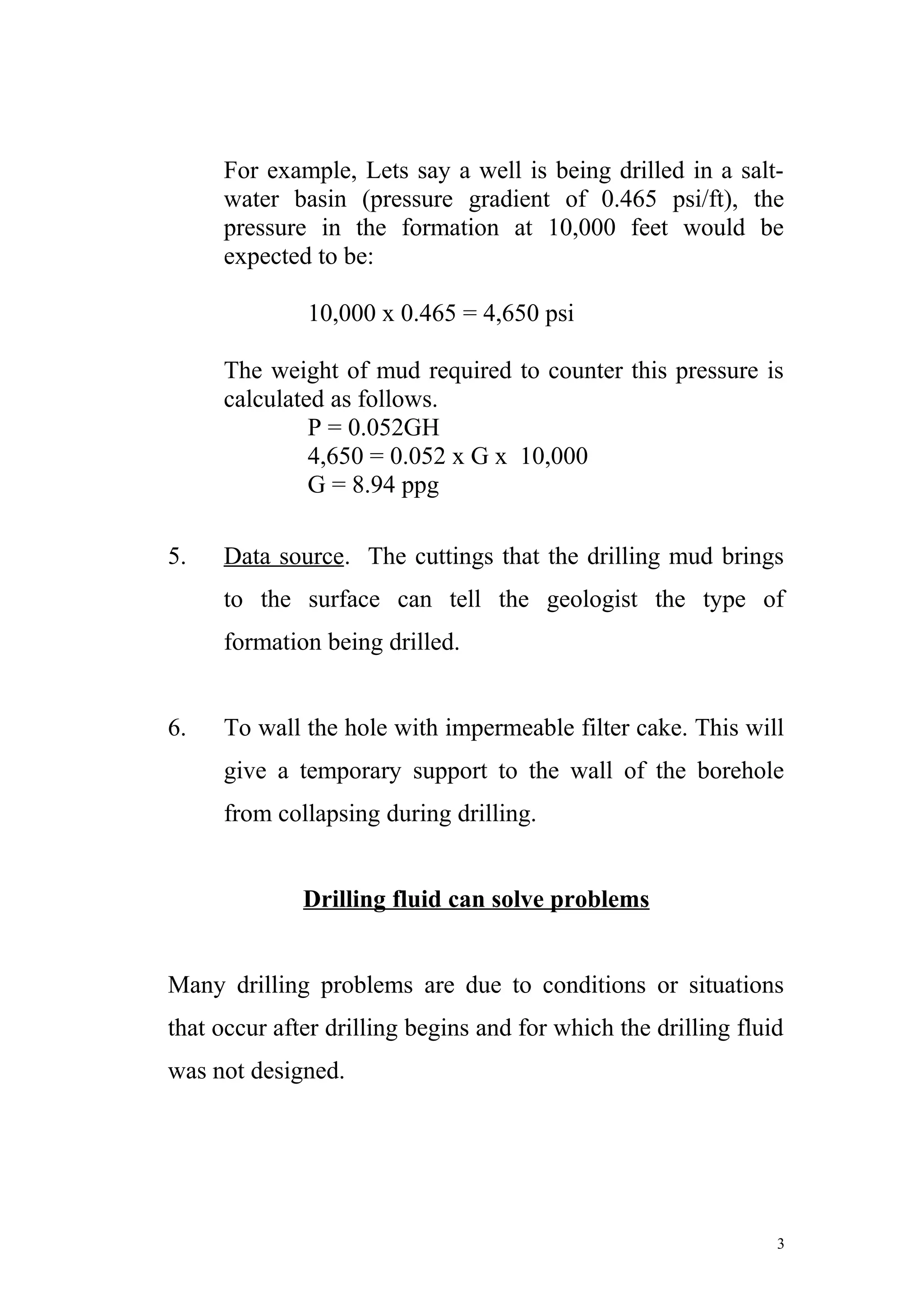
For example, Lets say a well is being drilled in a salt-
water basin (pressure gradient of 0.465 psi/ft), the
pressure in the formation at 10,000 feet would be
expected to be:
10,000 x 0.465 = 4,650 psi
The weight of mud required to counter this pressure is
calculated as follows.
P = 0.052GH
4,650 = 0.052 x G x 10,000
G = 8.94 ppg
5. Data source. The cuttings that the drilling mud brings
to the surface can tell the geologist the type of
formation being drilled.
6. To wall the hole with impermeable filter cake. This will
give a temporary support to the wall of the borehole
from collapsing during drilling.
Drilling fluid can solve problems
Many drilling problems are due to conditions or situations
that occur after drilling begins and for which the drilling fluid
was not designed.
3
Some of these problems can be solved by adding materials to
the drilling fluid to adjust its properties.
Other cases, it may be necessary to replace the drilling fluid
being used with another fluid system.
The most common changes is the mud weight or density.
Weighting material is added when high-pressure formations
are expected.
Some of the problems are:
1. Lost circulation
Lost circulation can occur in several types of formations,
including high permeable formations, fractured formations
and cavernous zones.
Lost circulation materials can be added to the mud to bridge
or deposit a mat where the drilling fluid being lost to the
formation. These materials include cane and wood fibres,
cellophane flakes and even padi husks were used in oil
drilling in Sumatra.
4
2. Stuck pipe
Stuck pipe can occur after drilling has been halted for a rig
breakdown, while running a directional survey or when
conducting other nondrilling operation.
The drill pipe may stick to the wall of the hole due to the
formation of filter cake or a layer of wet mud solids on the
wall of the hole in the formation.
3. Heaving or sloughing hole
This occurs when shales enter the well bore after the section
has been penetrated by the bit. To solve this problem,
drilling is suspended the hole is conditioned (by letting the
mud in circulation for a period of time)
Types of drilling fluids
1. Water-base mud
5
This fluid is the mud in which water is the continuous phase.
This is the most common drilling mud used in oil drilling.
2. Oil-based mud
This drilling mud is made up of oil as the continuous phase.
Diesel oil is widely used to provide the oil phase. This type
of mud is commonly used in swelling shale formation.
With water-based mud the shale will absorb the water and it
swells that may cause stuck pipe.
3. Air and foam
There are drilling conditions under which a liquid drilling
fluid is not eh most desirable circulating medium. Air or
foam is used in drilling some wells when these special
conditions exist.
Mud Properties
1. Mud density or mud weight
Mud weight is measured by means of a mud balance. The
weight of water is 8.33 ppg. The mud weight can be
increased by adding barite (barium sulphate). Barite has a
specific gravity of between 4.2 – 4.3.
6
Other materials can be used to increase mud weight such as
ilmenite (S.G of 4.58)
2. Mud viscosity
Mud viscosity is difficult to measure but in the field the
Marsh funnel and the Fann V-G meter is commonly used.
The Marsh Funnel is filled with mud, the operator then notes
the time, removes his finger from the discharge and measures
the time for one quart (946 cm3
) to flow out. Marsh funnels
are manufactured to precise dimensional standards and may
be calibrated with water which has a funnel viscosity of 26 ±
0.5 sec.
In using Fann V-G (Viscosity-gel) meter, readings are taken
at 600 rpm and 300 rpm.
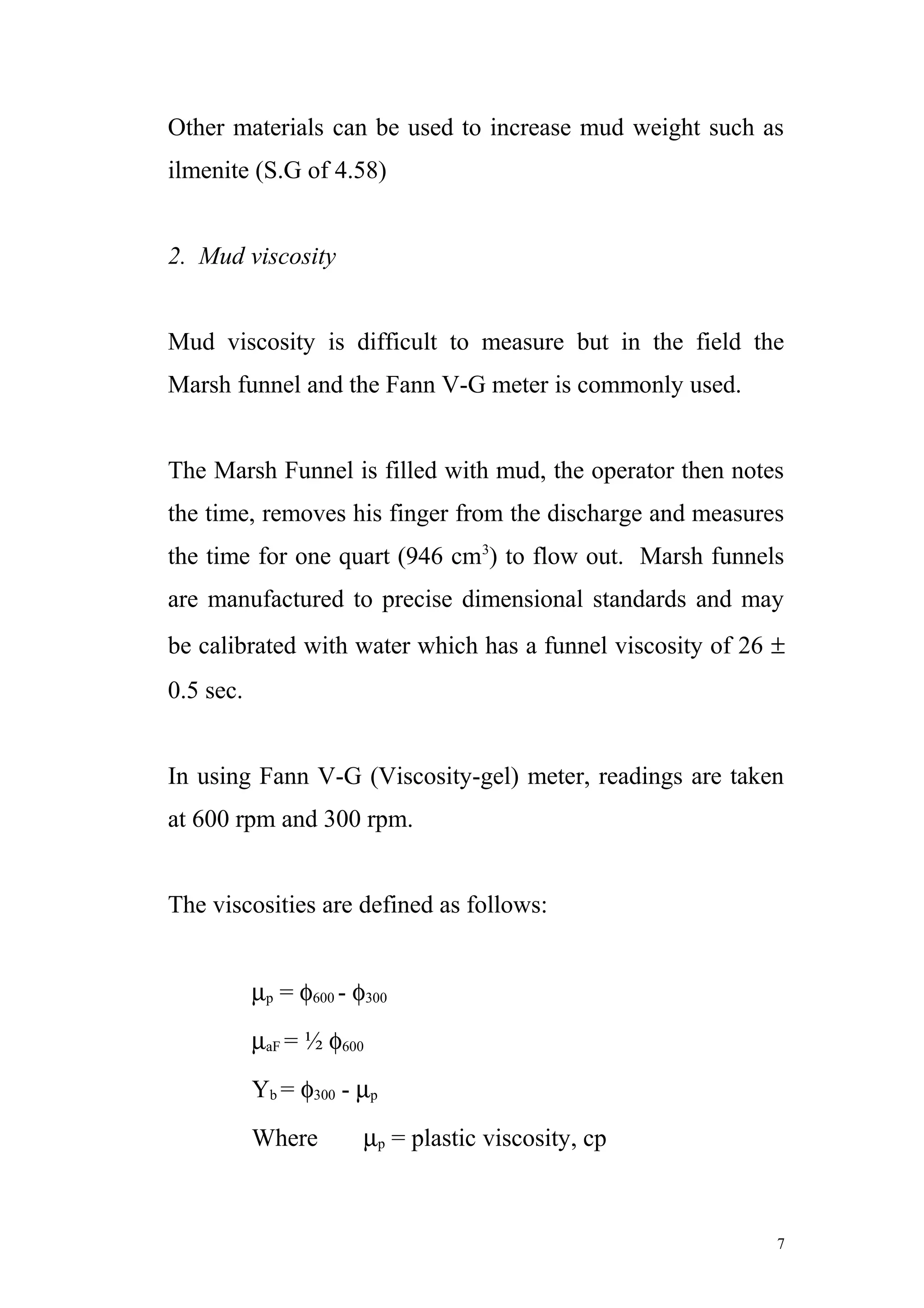
The viscosities are defined as follows:
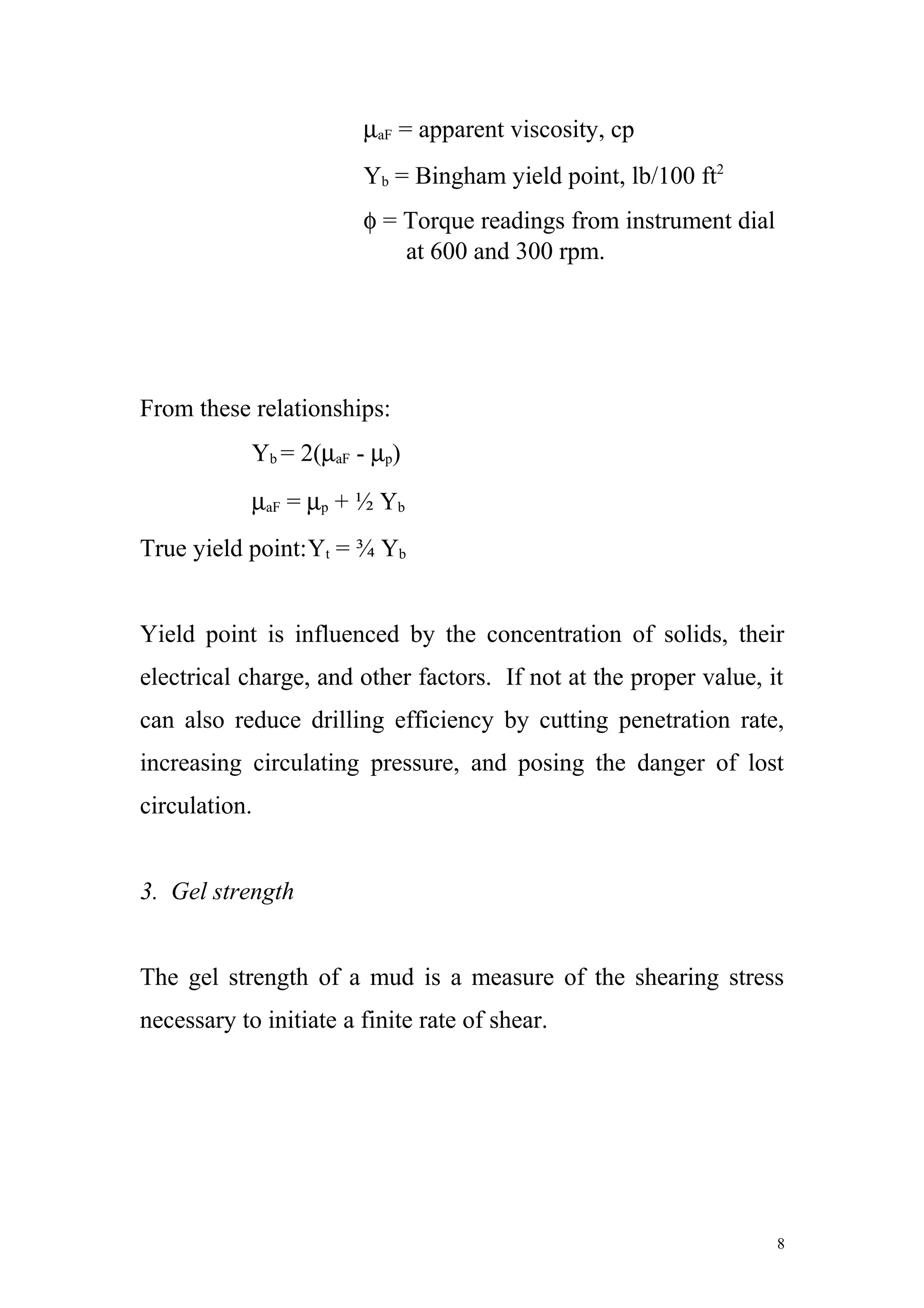
µp = φ600 - φ300
µaF = ½ φ600
Yb = φ300 - µp
Where µp = plastic viscosity, cp
7
µaF = apparent viscosity, cp
Yb = Bingham yield point, lb/100 ft2
φ = Torque readings from instrument dial
at 600 and 300 rpm.
From these relationships:
Yb = 2(µaF - µp)
µaF = µp + ½ Yb
True yield point:Yt = ¾ Yb
Yield point is influenced by the concentration of solids, their
electrical charge, and other factors. If not at the proper value, it
can also reduce drilling efficiency by cutting penetration rate,
increasing circulating pressure, and posing the danger of lost
circulation.
3. Gel strength
The gel strength of a mud is a measure of the shearing stress
necessary to initiate a finite rate of shear.
8
With proper gel strength can help suspend solids in the hole and
allow them to settle out on the surface, excessive gel strength
can cause a number drilling problems.
4. Filtration
The filtration, water loss or wall building test is conducted with
a filter press.
The rate at which filtrate will invade permeable zone and the
thickness of the filter cake that will be deposited on the wall of
the hole as filtration takes place are important keys to trouble-
free drilling
Drilling Fluid treating and monitoring equipment
In addition to the main mud pumps, several items of mud
treating equipment are found on most rigs. Much of this
equipment is aimed at solids removal, including shale shakers,
desanders, desilters and centrifuges.
Shale shakers remove larger particles from the mud stream as it
returns from the bottom of the hole. Shakers are equipped with
screens of various sizes, depending on the type of solids to be
removed.
9
Finer particles in the mud stream are removed with desanders,
desilters and centrifuges. Each of these items of solids-control
equipment is applicable only over a certain range of particle
sizes.
In addition to removing solids, mud handling equipment may
also include a mud degasser to remove entrained gas from the
mud stream. Degassing the drilling fluid is sometimes
necessary when small volumes of gas flow into the well bore
during drilling.
Additional equipment include mixers to agitate mud in the
tanks, smaller pumps to various duties and equipment for adding
chemicals and solid materials to the mud system.
Drilling hazards
The following are some of the most common hazards in drilling
and can be overcome by proper control of the mud properties.
10
1. Salt section hole enlargement
Salt section can be eroded by the drilling fluid and causes
hole enlargement. These enlargement will require larger
mud volume to fill the system and in case of casing the
hole, larger cement volume is required.
To avoid these problems a salt saturated mud system is
prepared prior to drilling the salt bed.
2. Heaving shale problems
Areas with shale sections containing bentonite or other
hydratable clays will continually absorb water, swell and
slough into the hole.
Such beds are referred to as heaving shales and constitute
a severe drilling hazard when encountered.
Pipe sticking, excessive solid buildup in the mud and hole
bridging are typical problems.
Various treatments of the mud are sometimes successful,
such as
• Changing mud system to high calcium content
by adding lime, gypsum etc which reduces the
11
tendency of the mud to hydrate water sensitive
clays.
• Increasing circulation rate for more rapid
removal of particles.
• Increasing mud density for greater wall support
• Decreasing water loss mud
• Changing to oil emulsion mud
• Changing to oil-based mud.
3. Blowouts
Blowout is the most spectacular, expensive and highly
feared hazard of drilling.
This occurs when encountered formation pressure exceed
the mud column pressure which allows the formation
fluids to blow out of the hole.
Mud density or the mud weight is the principal factor in
controlling this hazard.
In drilling a blow out preventer (BOP) stack is always
attached at the top of the conductor pipe. In case of a gas
kick (a sign that may lead to a blow out) the BOP stack
can close the annular space between the drilling pipe and
12
the conductor pipe or casing or shut the whole hole (with a
blind ram of the BOP).
4. Lost Circulation
Lost circulation means the loss of substantial amount of
drilling mud to an encountered formation.
Lost circulation materials are commonly circulated in the
mud system both as a cure and a continuous preventive.
These materials are the fibrous materials such as the hay,
sawdust or padi husk and lamellated (flat and platy)
materials such as mica, cellophane.
Drilling Mud Calculations
The most common mud engineering calculations are those
concerned with the changes of mud volume and density caused
by the addition of various solids or liquids to the system.
The first step is to compute the system volume, which is the sum
of the mud in the hole and surface pits.
13
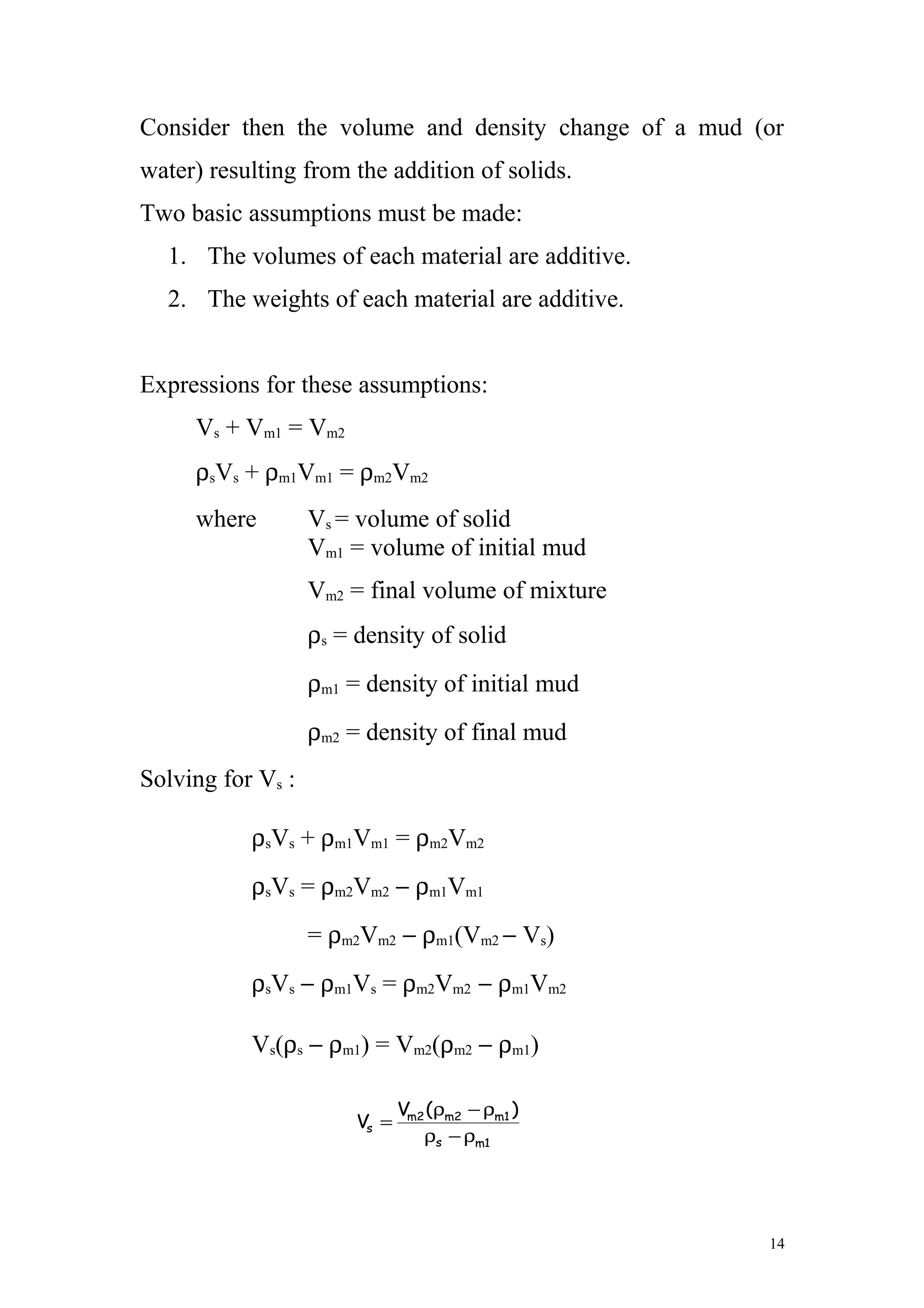
Consider then the volume and density change of a mud (or
water) resulting from the addition of solids.
Two basic assumptions must be made:
1. The volumes of each material are additive.
2. The weights of each material are additive.
Expressions for these assumptions:
Vs + Vm1 = Vm2
ρsVs + ρm1Vm1 = ρm2Vm2
where Vs = volume of solid
Vm1 = volume of initial mud
Vm2 = final volume of mixture
ρs = density of solid
ρm1 = density of initial mud
ρm2 = density of final mud
Solving for Vs :
ρsVs + ρm1Vm1 = ρm2Vm2
ρsVs = ρm2Vm2 − ρm1Vm1
= ρm2Vm2 − ρm1(Vm2 − Vs)
ρsVs − ρm1Vs = ρm2Vm2 − ρm1Vm2
Vs(ρs − ρm1) = Vm2(ρm2 − ρm1)
14
1ms
1m2m2m
s
)(V
V
ρ−ρ
ρ−ρ
=
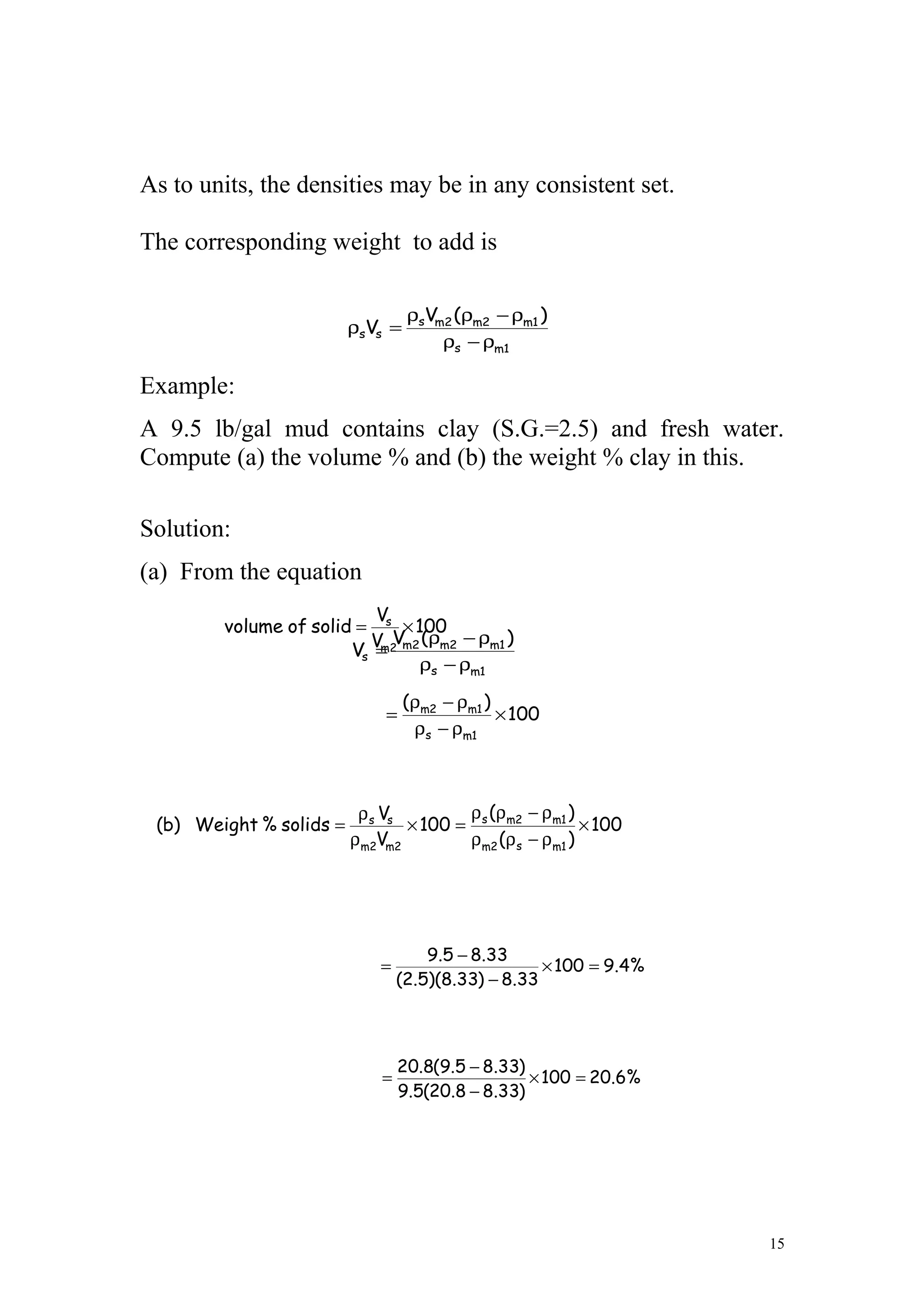
As to units, the densities may be in any consistent set.
The corresponding weight to add is
Example:
A 9.5 lb/gal mud contains clay (S.G.=2.5) and fresh water.
Compute (a) the volume % and (b) the weight % clay in this.
Solution:
(a) From the equation
15
1ms
1m2m2ms
ss
)(V
V
ρ−ρ
ρ−ρρ
=ρ
1ms
1m2m2m
s
)(V
V
ρ−ρ
ρ−ρ
=
100
V
V
solidofvolume
m2
s
×=
100
)(
1ms
1m2m
×
ρ−ρ
ρ−ρ
=
%4.9100
33.8)33.8)(5.2(
33.85.9
=×
−
−
=
100
)(
)(
100
V
V
solids%Weight)b(
1ms2m
1m2ms
2mm2
ss
×
ρ−ρρ
ρ−ρρ
=×
ρ
ρ
=
%6.20100
)33.88.20(5.9
)33.85.9(8.20
=×
−
−
=

drilling fluid-tripathi

  • 1.
    DRILLING FLUIDS The keyto making the rotary drilling system work is the ability to circulate a fluid continuously down through the drill pipe, out through the bit nozzles and back to the surface. The drilling fluid can be air, foam (a combination of air and liquid or a liquid. Liquid drilling fluids are commonly called drilling mud. All drilling fluids, especially drilling mud, can have a wide range of chemical and physical properties. These properties are specifically designed for drilling conditions and the special problems that must be handled in drilling a well. Purpose of Drilling Fluids 1. Cooling and lubrication. As the bit drills into the rock formation, the friction caused by the rotating bit against the rock generate heat. The heat is dissipated by the 1
  • 2.
    circulating drilling fluid.The fluid also lubricates the bit. 2. Cuttings removal. An important function of the drilling fluid is to carry rock cuttings removed by the bit to the surface. The drilling flows through treating equipment where the cuttings are removed and the clean fluid is again pumped down through the drill pipe string. 3. Suspend cuttings. There are times when circulation has to be stopped. The drilling fluid must have that gelling characteristics that will prevent drill cuttings from settling down at the bit. This may caused the drill pipe to be stuck. 4. Pressure control. The drilling mud can be the first line of defense against a blowout or loss of well control caused by formation pressures. The hydrostatic head produced by the mud in psi is = 0.052 x G x H where G = density of mud in ppg H = depth of the hole in feet. This hydrostatic head will counter the formation pressure in order to avoid a blowout while drilling. 2
  • 3.
    For example, Letssay a well is being drilled in a salt- water basin (pressure gradient of 0.465 psi/ft), the pressure in the formation at 10,000 feet would be expected to be: 10,000 x 0.465 = 4,650 psi The weight of mud required to counter this pressure is calculated as follows. P = 0.052GH 4,650 = 0.052 x G x 10,000 G = 8.94 ppg 5. Data source. The cuttings that the drilling mud brings to the surface can tell the geologist the type of formation being drilled. 6. To wall the hole with impermeable filter cake. This will give a temporary support to the wall of the borehole from collapsing during drilling. Drilling fluid can solve problems Many drilling problems are due to conditions or situations that occur after drilling begins and for which the drilling fluid was not designed. 3
  • 4.
    Some of theseproblems can be solved by adding materials to the drilling fluid to adjust its properties. Other cases, it may be necessary to replace the drilling fluid being used with another fluid system. The most common changes is the mud weight or density. Weighting material is added when high-pressure formations are expected. Some of the problems are: 1. Lost circulation Lost circulation can occur in several types of formations, including high permeable formations, fractured formations and cavernous zones. Lost circulation materials can be added to the mud to bridge or deposit a mat where the drilling fluid being lost to the formation. These materials include cane and wood fibres, cellophane flakes and even padi husks were used in oil drilling in Sumatra. 4
  • 5.
    2. Stuck pipe Stuckpipe can occur after drilling has been halted for a rig breakdown, while running a directional survey or when conducting other nondrilling operation. The drill pipe may stick to the wall of the hole due to the formation of filter cake or a layer of wet mud solids on the wall of the hole in the formation. 3. Heaving or sloughing hole This occurs when shales enter the well bore after the section has been penetrated by the bit. To solve this problem, drilling is suspended the hole is conditioned (by letting the mud in circulation for a period of time) Types of drilling fluids 1. Water-base mud 5
  • 6.
    This fluid isthe mud in which water is the continuous phase. This is the most common drilling mud used in oil drilling. 2. Oil-based mud This drilling mud is made up of oil as the continuous phase. Diesel oil is widely used to provide the oil phase. This type of mud is commonly used in swelling shale formation. With water-based mud the shale will absorb the water and it swells that may cause stuck pipe. 3. Air and foam There are drilling conditions under which a liquid drilling fluid is not eh most desirable circulating medium. Air or foam is used in drilling some wells when these special conditions exist. Mud Properties 1. Mud density or mud weight Mud weight is measured by means of a mud balance. The weight of water is 8.33 ppg. The mud weight can be increased by adding barite (barium sulphate). Barite has a specific gravity of between 4.2 – 4.3. 6
  • 7.
    Other materials canbe used to increase mud weight such as ilmenite (S.G of 4.58) 2. Mud viscosity Mud viscosity is difficult to measure but in the field the Marsh funnel and the Fann V-G meter is commonly used. The Marsh Funnel is filled with mud, the operator then notes the time, removes his finger from the discharge and measures the time for one quart (946 cm3 ) to flow out. Marsh funnels are manufactured to precise dimensional standards and may be calibrated with water which has a funnel viscosity of 26 ± 0.5 sec. In using Fann V-G (Viscosity-gel) meter, readings are taken at 600 rpm and 300 rpm. The viscosities are defined as follows: µp = φ600 - φ300 µaF = ½ φ600 Yb = φ300 - µp Where µp = plastic viscosity, cp 7
  • 8.
    µaF = apparentviscosity, cp Yb = Bingham yield point, lb/100 ft2 φ = Torque readings from instrument dial at 600 and 300 rpm. From these relationships: Yb = 2(µaF - µp) µaF = µp + ½ Yb True yield point:Yt = ¾ Yb Yield point is influenced by the concentration of solids, their electrical charge, and other factors. If not at the proper value, it can also reduce drilling efficiency by cutting penetration rate, increasing circulating pressure, and posing the danger of lost circulation. 3. Gel strength The gel strength of a mud is a measure of the shearing stress necessary to initiate a finite rate of shear. 8
  • 9.
    With proper gelstrength can help suspend solids in the hole and allow them to settle out on the surface, excessive gel strength can cause a number drilling problems. 4. Filtration The filtration, water loss or wall building test is conducted with a filter press. The rate at which filtrate will invade permeable zone and the thickness of the filter cake that will be deposited on the wall of the hole as filtration takes place are important keys to trouble- free drilling Drilling Fluid treating and monitoring equipment In addition to the main mud pumps, several items of mud treating equipment are found on most rigs. Much of this equipment is aimed at solids removal, including shale shakers, desanders, desilters and centrifuges. Shale shakers remove larger particles from the mud stream as it returns from the bottom of the hole. Shakers are equipped with screens of various sizes, depending on the type of solids to be removed. 9
  • 10.
    Finer particles inthe mud stream are removed with desanders, desilters and centrifuges. Each of these items of solids-control equipment is applicable only over a certain range of particle sizes. In addition to removing solids, mud handling equipment may also include a mud degasser to remove entrained gas from the mud stream. Degassing the drilling fluid is sometimes necessary when small volumes of gas flow into the well bore during drilling. Additional equipment include mixers to agitate mud in the tanks, smaller pumps to various duties and equipment for adding chemicals and solid materials to the mud system. Drilling hazards The following are some of the most common hazards in drilling and can be overcome by proper control of the mud properties. 10
  • 11.
    1. Salt sectionhole enlargement Salt section can be eroded by the drilling fluid and causes hole enlargement. These enlargement will require larger mud volume to fill the system and in case of casing the hole, larger cement volume is required. To avoid these problems a salt saturated mud system is prepared prior to drilling the salt bed. 2. Heaving shale problems Areas with shale sections containing bentonite or other hydratable clays will continually absorb water, swell and slough into the hole. Such beds are referred to as heaving shales and constitute a severe drilling hazard when encountered. Pipe sticking, excessive solid buildup in the mud and hole bridging are typical problems. Various treatments of the mud are sometimes successful, such as • Changing mud system to high calcium content by adding lime, gypsum etc which reduces the 11
  • 12.
    tendency of themud to hydrate water sensitive clays. • Increasing circulation rate for more rapid removal of particles. • Increasing mud density for greater wall support • Decreasing water loss mud • Changing to oil emulsion mud • Changing to oil-based mud. 3. Blowouts Blowout is the most spectacular, expensive and highly feared hazard of drilling. This occurs when encountered formation pressure exceed the mud column pressure which allows the formation fluids to blow out of the hole. Mud density or the mud weight is the principal factor in controlling this hazard. In drilling a blow out preventer (BOP) stack is always attached at the top of the conductor pipe. In case of a gas kick (a sign that may lead to a blow out) the BOP stack can close the annular space between the drilling pipe and 12
  • 13.
    the conductor pipeor casing or shut the whole hole (with a blind ram of the BOP). 4. Lost Circulation Lost circulation means the loss of substantial amount of drilling mud to an encountered formation. Lost circulation materials are commonly circulated in the mud system both as a cure and a continuous preventive. These materials are the fibrous materials such as the hay, sawdust or padi husk and lamellated (flat and platy) materials such as mica, cellophane. Drilling Mud Calculations The most common mud engineering calculations are those concerned with the changes of mud volume and density caused by the addition of various solids or liquids to the system. The first step is to compute the system volume, which is the sum of the mud in the hole and surface pits. 13
  • 14.
    Consider then thevolume and density change of a mud (or water) resulting from the addition of solids. Two basic assumptions must be made: 1. The volumes of each material are additive. 2. The weights of each material are additive. Expressions for these assumptions: Vs + Vm1 = Vm2 ρsVs + ρm1Vm1 = ρm2Vm2 where Vs = volume of solid Vm1 = volume of initial mud Vm2 = final volume of mixture ρs = density of solid ρm1 = density of initial mud ρm2 = density of final mud Solving for Vs : ρsVs + ρm1Vm1 = ρm2Vm2 ρsVs = ρm2Vm2 − ρm1Vm1 = ρm2Vm2 − ρm1(Vm2 − Vs) ρsVs − ρm1Vs = ρm2Vm2 − ρm1Vm2 Vs(ρs − ρm1) = Vm2(ρm2 − ρm1) 14 1ms 1m2m2m s )(V V ρ−ρ ρ−ρ =
  • 15.
    As to units,the densities may be in any consistent set. The corresponding weight to add is Example: A 9.5 lb/gal mud contains clay (S.G.=2.5) and fresh water. Compute (a) the volume % and (b) the weight % clay in this. Solution: (a) From the equation 15 1ms 1m2m2ms ss )(V V ρ−ρ ρ−ρρ =ρ 1ms 1m2m2m s )(V V ρ−ρ ρ−ρ = 100 V V solidofvolume m2 s ×= 100 )( 1ms 1m2m × ρ−ρ ρ−ρ = %4.9100 33.8)33.8)(5.2( 33.85.9 =× − − = 100 )( )( 100 V V solids%Weight)b( 1ms2m 1m2ms 2mm2 ss × ρ−ρρ ρ−ρρ =× ρ ρ = %6.20100 )33.88.20(5.9 )33.85.9(8.20 =× − − =