HC estimation methods
(just Geologist method)
other methods ?
Introduction
Volumetric estimationis concerned with quantifying how much oil and gas exists in an
accumulation.
The estimate will vary throughout the field lifetime as
 More informationbecomes available
 The technology for gathering and interpreting the data improves.
A volumetric estimateis therefore a current estimate, and should be expected to change over
time.
Two main methods of estimating volumetrics are used;
1. Deterministic
2. Probabilistic.
1. Deterministic methods average the data gathered at points in the reservoir, from
 well logs,
 cores,
 seismic,
to estimate the field-wide properties.
2. Probabilistic methods use predictive tools, statistics, analogue field data and input regarding
the geological model to predict trends in reservoir properties away from the sample points.
Commercial Application
The volumetrics of a field, along with the anticipated recovery factors, control the reserves in
the field; those hydrocarbons which will be produced in the future.
The value of an oil or gas company lies predominantly in its hydrocarbon reserves which are
used by shareholders and investors as one indication of the strength of the company,
both at present and in the future.
A reliable estimate of the reserves of a company is therefore important to the current value as
well as the longer term prospects of an oil or gas company.
1. Deterministic Method
Volumetric estimates are required at all stages of the field life cycle.
In manyinstances a first estimateof "how big" an accumulation could be is requested.
If only a "back of the envelope" estimateis needed or if the data available is very sparse a quick
look estimation can be made using field wide averages.
"back of the envelope" ::: done quickly to provide a rough estimate
Some terminologies
Thickness (h) : the isochore thickness of the total interval ("gross thickness") regardless of
lithology.
 An isochore map displays lines of equal thickness in a layer where the thicknesses are
measured vertically.
Isochore maps in geology are also referred to as True vertical Thickness (TVT) maps
Net sand : the height of the lithologic column with reservoir quality, i.e. the column that can
potentially store hydrocarbons.
NOS : the length of the net sand column that is oil bearing.
GRV : is the gross rock volume of the hydrocarbon-bearing interval and is the product of the
area (A) containing hydrocarbons and the interval thickness (h)
GRV =A . H
Units : ([ft3] or [acre.ft] or [m3])
Isopach vs isochore
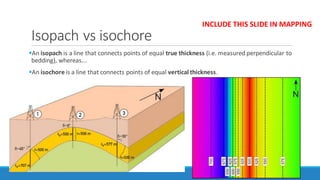
An isopach is a line that connects points of equal true thickness (i.e. measured perpendicular to
bedding), whereas...
An isochore is a line that connects points of equal vertical thickness.
INCLUDE THIS SLIDE IN MAPPING
STOIIP
GIIP
Sw
Bg
Bo
Formuale
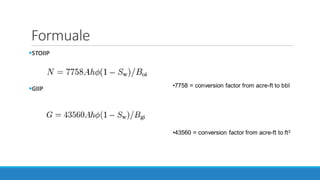
STOIIP
GIIP •7758 = conversion factor from acre-ft to bbl
•43560 = conversion factor from acre-ft to ft3
When and how to get
the data ?
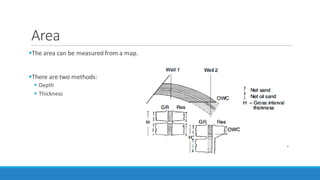
Area
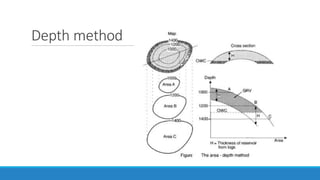
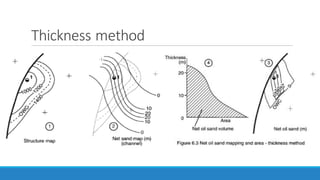
The area can be measured from a map.
There are two methods:
 Depth
 Thickness
Depth method
Thickness method
 h :: drilling ,coring, logging
 Sw or So : coring, logging
 Bg or Bo :: coring, fluid samples and testing.
ACCURACY
Dependent on quality of reservoir description.
Reserves estimates often high because this method does not consider problems of reservoir
heterogeneity.
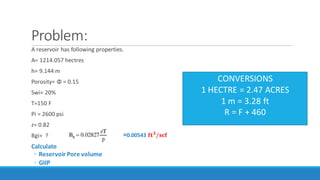
Problem:
A reservoir has following properties.
A= 1214.057 hectres
h= 9.144 m
Porosity= Φ = 0.15
Swi= 20%
T=150 F
Pi = 2600 psi
z= 0.82
Bgi= ?
Calculate
◦ Reservoir Pore volume
◦ GIIP
CONVERSIONS
1 HECTRE = 2.47 ACRES
1 m = 3.28 ft
R = F + 460
=0.00543 𝐟𝐭 𝟑/𝐬𝐜𝐟

Hydrocarbon estimation methods

  • 1.
    HC estimation methods (justGeologist method)
  • 2.
  • 3.
    Introduction Volumetric estimationis concernedwith quantifying how much oil and gas exists in an accumulation. The estimate will vary throughout the field lifetime as  More informationbecomes available  The technology for gathering and interpreting the data improves. A volumetric estimateis therefore a current estimate, and should be expected to change over time. Two main methods of estimating volumetrics are used; 1. Deterministic 2. Probabilistic.
  • 4.
    1. Deterministic methodsaverage the data gathered at points in the reservoir, from  well logs,  cores,  seismic, to estimate the field-wide properties. 2. Probabilistic methods use predictive tools, statistics, analogue field data and input regarding the geological model to predict trends in reservoir properties away from the sample points.
  • 5.
    Commercial Application The volumetricsof a field, along with the anticipated recovery factors, control the reserves in the field; those hydrocarbons which will be produced in the future. The value of an oil or gas company lies predominantly in its hydrocarbon reserves which are used by shareholders and investors as one indication of the strength of the company, both at present and in the future. A reliable estimate of the reserves of a company is therefore important to the current value as well as the longer term prospects of an oil or gas company.
  • 6.
    1. Deterministic Method Volumetricestimates are required at all stages of the field life cycle. In manyinstances a first estimateof "how big" an accumulation could be is requested. If only a "back of the envelope" estimateis needed or if the data available is very sparse a quick look estimation can be made using field wide averages. "back of the envelope" ::: done quickly to provide a rough estimate
  • 7.
  • 8.
    Thickness (h) :the isochore thickness of the total interval ("gross thickness") regardless of lithology.  An isochore map displays lines of equal thickness in a layer where the thicknesses are measured vertically. Isochore maps in geology are also referred to as True vertical Thickness (TVT) maps Net sand : the height of the lithologic column with reservoir quality, i.e. the column that can potentially store hydrocarbons. NOS : the length of the net sand column that is oil bearing. GRV : is the gross rock volume of the hydrocarbon-bearing interval and is the product of the area (A) containing hydrocarbons and the interval thickness (h) GRV =A . H Units : ([ft3] or [acre.ft] or [m3])
  • 9.
    Isopach vs isochore Anisopach is a line that connects points of equal true thickness (i.e. measured perpendicular to bedding), whereas... An isochore is a line that connects points of equal vertical thickness. INCLUDE THIS SLIDE IN MAPPING
  • 10.
  • 11.
    Formuale STOIIP GIIP •7758 =conversion factor from acre-ft to bbl •43560 = conversion factor from acre-ft to ft3
  • 12.
    When and howto get the data ?
  • 13.
    Area The area canbe measured from a map. There are two methods:  Depth  Thickness
  • 14.
  • 15.
  • 16.
     h ::drilling ,coring, logging  Sw or So : coring, logging  Bg or Bo :: coring, fluid samples and testing.
  • 17.
    ACCURACY Dependent on qualityof reservoir description. Reserves estimates often high because this method does not consider problems of reservoir heterogeneity.
  • 18.
    Problem: A reservoir hasfollowing properties. A= 1214.057 hectres h= 9.144 m Porosity= Φ = 0.15 Swi= 20% T=150 F Pi = 2600 psi z= 0.82 Bgi= ? Calculate ◦ Reservoir Pore volume ◦ GIIP CONVERSIONS 1 HECTRE = 2.47 ACRES 1 m = 3.28 ft R = F + 460 =0.00543 𝐟𝐭 𝟑/𝐬𝐜𝐟