Introduction: Photoregulation
and Phytochrome regulation
GURU GHASIDAS VISHWAVIDYALAYA
DEPARTMENT OF BIOTECHNOLOGY
PRESENTED BY,
RAHUL KUMAR GOSWAMI
M.Sc.3rd semester
Introduction
Light is a vital process for photosynthesis, but is
also
necessary to direct plant growth and
development.
Light acts as a signal to initiate and regulate
photoperiodism and photomorphogenesis.
there are two light sensing system involved in
these responses, the blue light sensitive system
(photoregulation) and red light sensitive system(
phytochrome regulation.
Photoregulation
Photoregulation is defines as regulation of plant by
light or blue light systems.
Many plant responses are regulated by blue light,
including phototropism, stomatal opening and
chlorophyll synthesis.
The last step of chlorophyll synthesis requires high
levels of blue light.
It was first documented by Darwin when he
discovered Blue light –induced phototropic
responses.
There are two types of blue light receptors in plants:-
1. Cryptochromes
2. Phototropins.
Cont.
The cryptochromes also present is animals
making them ubiquitous photoreceptors
throughout higher eukaryotes.
Phototropins are also found in different
organisms and regulate responses to
environmental stimuli,such as light oxygen.
Cryptochromes works together with
phytochromes to regulate photomorphogenic
responses, including the regulation of cell
elongation and photoperiodic flowering;
Prototropins mediated movement responses
including the phototropic curvature
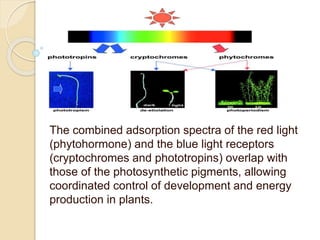
The combined adsorption spectra of the red light
(phytohormone) and the blue light receptors
(cryptochromes and phototropins) overlap with
those of the photosynthetic pigments, allowing
coordinated control of development and energy
production in plants.
70-80 kd proteins, photolyases like flavoproteins mainly nuclear
proteins
It has two recognizable domains an amino terminal region PHR
(showing sequence with photolyases) and a carboxyl terminal
region.
It found on dicot (Arabidopis, tomato) and monocot (rice, barley)
plants.
It has two domains
PHR
DAS (DQXVP-acidic-STATES)
Phototropins
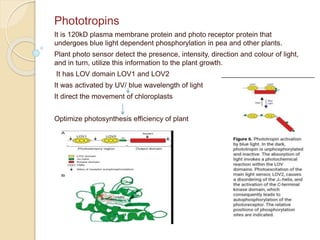
It is 120kD plasma membrane protein and photo receptor protein that
undergoes blue light dependent phosphorylation in pea and other plants.
Plant photo sensor detect the presence, intensity, direction and colour of light,
and in turn, utilize this information to the plant growth.
It has LOV domain LOV1 and LOV2
It was activated by UV/ blue wavelength of light
It direct the movement of chloroplasts
Optimize photosynthesis efficiency of plant
Phytochrome
Regulate the photoperiodism and flowering of
plants.
It is protein molecules have tetrapyrol ring
structure and small covalently bound molecules,
usually present on dimer form, its synthesize in
monomer form when two monomer added to
each other it form dimer and that dimer is acting
as photosensitive or chemosensitive molecules.
It is a type of photo pigments (chromophore) and
also photo sensitive in nature.
Size is 124 kDa polypeptides. Each polypeptide
has 3 domains.
Cont.
This pigments usually look like blue when light
hit on it its change his confirmation and its also
depend which wavelength of light its sense.
In night it is less active form but when morning or
day the light hits it it become more active or
hyper active form.
And when it activate its activated all major
biochemical process of plant.
PHOTOPERIODIS
M
It is light period or light + time period
Photoperiodism is a biological response to a
change in the proportion of light and dark in a
24-hour daily cycle.
Plant use it measure the seasons and to
cooridinate seasonal events such as flowering.
The light influence on living organisms is throuh
variations in day length called photoperiod.
In plants, photoperiod and temperature affect
flowering, fruit and seed production, bud and
seed dormancy, leaf fall and germination.
Flowering of plants
Photoperiod affects flowering, when shoot
meristems start producing flower buds instead of
leaves and lateral buds.
Effects on photoperiodism was first studied in
1920 by Garner and Allard.
They studies that tobacco plant
flowers only after exposure to a
series of short days.
Photoperiodism effect on
flowering
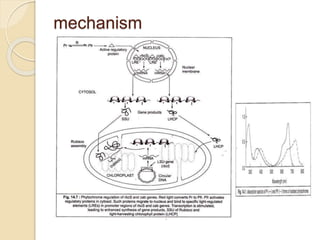
The phytochrome molecule is the photoreceptor for red
light responses. It exists in two forms :-
1. The Pr form-
Absorbs at peak of 666nm
When Pr absorb red light, it is converted to the
Pfr
form.
2.The Pfr form
Absorbs at a peak of 730 nm
It is active form that initiates biological
responses.
When Pfr absorb the far red light, it is converted
to
Pr form.
Regulation Mechanisms
In day condition–
mechanism
Types of phytochrome genes in dicot
There are five type of phytochrome gene
phyA – present only in angiosperm responsible
for early event in germination and seedling
detiolation.
phyB- increase stem extension rate.
phyC low abudance member of the five, control
seedling responses to light signals
phyD and PhyE both involve in cell elongation.
Photo morphogenetic responses
Type I Fast response:- includes those process in which
the quantum energy absorbed by the plant is transduced
to another form of energy like leaf movement in mimosa,
chloroplast movement in moungeotia, surface potential
changes, ion fluxes it occurring in time scale of second
and minutes.
Type II slow responses:- the rates and activation of
growth and development are switch on under the
influence of quality of light like seed germination,hook
opening, leaf expansion, stem elongation, flower initiation
and pigment biosynthesis.
It is relatively slow occuring on time scale of hours and
days.
Variation in Lag time, Escape time and light Quanta
for phytochrome responses:-
a) Very low fluence responses (VLFRs)
b) Low fluence responses ( LFRs)
c) High irradiation responses (HIRs)
MODE OF ACTIONS
1. Phytochrome and permeability:- a rapid photo
response is the phytochrome controlled dark
closure or folding of the leaflets and turgor in the
cells. Movement of K+ and other ions.
2. Phytochrome and Enzyme
3. Intracellular localization
4. Inhibition of internode extension
5. Phytochrome stimulates gene expression
6. Phytochrome inhibits gene expression
7. Crypto chrome: blue light responses
8. Phytochrome and flowering response in short
day plants
9. Phytochrome and flowering response in long day
plants.
Photoperiodism
Photo means light periodism time period.
Photoperiodism is a biological response to a
change in the proporation of light and dark in 24
hour daily cycle.
Plant use it to measure the seasons and to
coordinate seasonal events such as flowering.
In light influence on living organism is through
variations in day length called photoperiodism.
In plants, photoperiod and temperature affect
flowering, fruit and seed production, bud and
seed dormancy, leaf fall and germination.
Photoperiodic effect on flowering
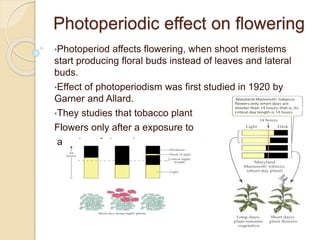
•Photoperiod affects flowering, when shoot meristems
start producing floral buds instead of leaves and lateral
buds.
•Effect of photoperiodism was first studied in 1920 by
Garner and Allard.
•They studies that tobacco plant
Flowers only after a exposure to
a series of short days.
Classification of plants based on photoperiod
requirement for flowering
Long day plant –
Which require more light on a day or long days
for flowering.
Eg- sunflower
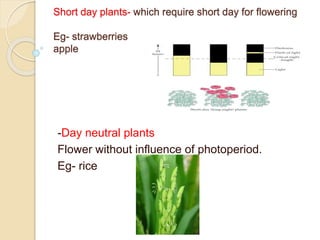
Short day plants- which require short day for flowering
Eg- strawberries
apple
-Day neutral plants
Flower without influence of photoperiod.
Eg- rice

Photoregulation

  • 1.
    Introduction: Photoregulation and Phytochromeregulation GURU GHASIDAS VISHWAVIDYALAYA DEPARTMENT OF BIOTECHNOLOGY PRESENTED BY, RAHUL KUMAR GOSWAMI M.Sc.3rd semester
  • 2.
    Introduction Light is avital process for photosynthesis, but is also necessary to direct plant growth and development. Light acts as a signal to initiate and regulate photoperiodism and photomorphogenesis. there are two light sensing system involved in these responses, the blue light sensitive system (photoregulation) and red light sensitive system( phytochrome regulation.
  • 3.
    Photoregulation Photoregulation is definesas regulation of plant by light or blue light systems. Many plant responses are regulated by blue light, including phototropism, stomatal opening and chlorophyll synthesis. The last step of chlorophyll synthesis requires high levels of blue light. It was first documented by Darwin when he discovered Blue light –induced phototropic responses. There are two types of blue light receptors in plants:- 1. Cryptochromes 2. Phototropins.
  • 4.
    Cont. The cryptochromes alsopresent is animals making them ubiquitous photoreceptors throughout higher eukaryotes. Phototropins are also found in different organisms and regulate responses to environmental stimuli,such as light oxygen. Cryptochromes works together with phytochromes to regulate photomorphogenic responses, including the regulation of cell elongation and photoperiodic flowering; Prototropins mediated movement responses including the phototropic curvature
  • 5.
    The combined adsorptionspectra of the red light (phytohormone) and the blue light receptors (cryptochromes and phototropins) overlap with those of the photosynthetic pigments, allowing coordinated control of development and energy production in plants.
  • 6.
    70-80 kd proteins,photolyases like flavoproteins mainly nuclear proteins It has two recognizable domains an amino terminal region PHR (showing sequence with photolyases) and a carboxyl terminal region. It found on dicot (Arabidopis, tomato) and monocot (rice, barley) plants. It has two domains PHR DAS (DQXVP-acidic-STATES)
  • 7.
    Phototropins It is 120kDplasma membrane protein and photo receptor protein that undergoes blue light dependent phosphorylation in pea and other plants. Plant photo sensor detect the presence, intensity, direction and colour of light, and in turn, utilize this information to the plant growth. It has LOV domain LOV1 and LOV2 It was activated by UV/ blue wavelength of light It direct the movement of chloroplasts Optimize photosynthesis efficiency of plant
  • 8.
    Phytochrome Regulate the photoperiodismand flowering of plants. It is protein molecules have tetrapyrol ring structure and small covalently bound molecules, usually present on dimer form, its synthesize in monomer form when two monomer added to each other it form dimer and that dimer is acting as photosensitive or chemosensitive molecules. It is a type of photo pigments (chromophore) and also photo sensitive in nature. Size is 124 kDa polypeptides. Each polypeptide has 3 domains.
  • 9.
    Cont. This pigments usuallylook like blue when light hit on it its change his confirmation and its also depend which wavelength of light its sense. In night it is less active form but when morning or day the light hits it it become more active or hyper active form. And when it activate its activated all major biochemical process of plant.
  • 10.
    PHOTOPERIODIS M It is lightperiod or light + time period Photoperiodism is a biological response to a change in the proportion of light and dark in a 24-hour daily cycle. Plant use it measure the seasons and to cooridinate seasonal events such as flowering. The light influence on living organisms is throuh variations in day length called photoperiod. In plants, photoperiod and temperature affect flowering, fruit and seed production, bud and seed dormancy, leaf fall and germination.
  • 11.
    Flowering of plants Photoperiodaffects flowering, when shoot meristems start producing flower buds instead of leaves and lateral buds. Effects on photoperiodism was first studied in 1920 by Garner and Allard. They studies that tobacco plant flowers only after exposure to a series of short days.
  • 12.
  • 13.
    The phytochrome moleculeis the photoreceptor for red light responses. It exists in two forms :- 1. The Pr form- Absorbs at peak of 666nm When Pr absorb red light, it is converted to the Pfr form. 2.The Pfr form Absorbs at a peak of 730 nm It is active form that initiates biological responses. When Pfr absorb the far red light, it is converted to Pr form.
  • 14.
  • 15.
  • 16.
    Types of phytochromegenes in dicot There are five type of phytochrome gene phyA – present only in angiosperm responsible for early event in germination and seedling detiolation. phyB- increase stem extension rate. phyC low abudance member of the five, control seedling responses to light signals phyD and PhyE both involve in cell elongation.
  • 17.
    Photo morphogenetic responses TypeI Fast response:- includes those process in which the quantum energy absorbed by the plant is transduced to another form of energy like leaf movement in mimosa, chloroplast movement in moungeotia, surface potential changes, ion fluxes it occurring in time scale of second and minutes. Type II slow responses:- the rates and activation of growth and development are switch on under the influence of quality of light like seed germination,hook opening, leaf expansion, stem elongation, flower initiation and pigment biosynthesis. It is relatively slow occuring on time scale of hours and days. Variation in Lag time, Escape time and light Quanta for phytochrome responses:- a) Very low fluence responses (VLFRs) b) Low fluence responses ( LFRs) c) High irradiation responses (HIRs)
  • 18.
    MODE OF ACTIONS 1.Phytochrome and permeability:- a rapid photo response is the phytochrome controlled dark closure or folding of the leaflets and turgor in the cells. Movement of K+ and other ions. 2. Phytochrome and Enzyme 3. Intracellular localization 4. Inhibition of internode extension 5. Phytochrome stimulates gene expression 6. Phytochrome inhibits gene expression 7. Crypto chrome: blue light responses 8. Phytochrome and flowering response in short day plants 9. Phytochrome and flowering response in long day plants.
  • 19.
    Photoperiodism Photo means lightperiodism time period. Photoperiodism is a biological response to a change in the proporation of light and dark in 24 hour daily cycle. Plant use it to measure the seasons and to coordinate seasonal events such as flowering. In light influence on living organism is through variations in day length called photoperiodism. In plants, photoperiod and temperature affect flowering, fruit and seed production, bud and seed dormancy, leaf fall and germination.
  • 20.
    Photoperiodic effect onflowering •Photoperiod affects flowering, when shoot meristems start producing floral buds instead of leaves and lateral buds. •Effect of photoperiodism was first studied in 1920 by Garner and Allard. •They studies that tobacco plant Flowers only after a exposure to a series of short days.
  • 21.
    Classification of plantsbased on photoperiod requirement for flowering Long day plant – Which require more light on a day or long days for flowering. Eg- sunflower
  • 22.
    Short day plants-which require short day for flowering Eg- strawberries apple -Day neutral plants Flower without influence of photoperiod. Eg- rice