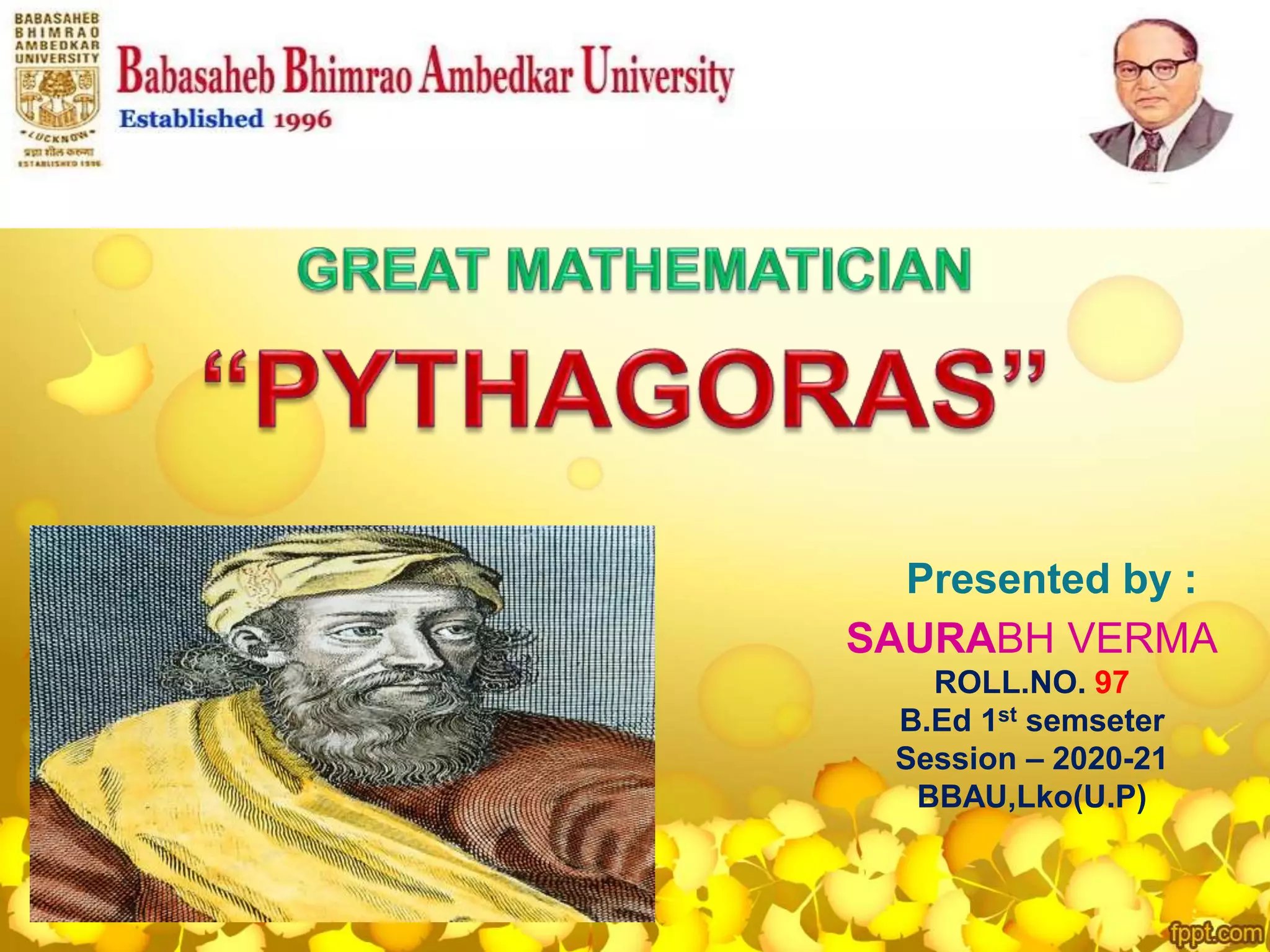
SAURABH VERMA
ROLL.NO. 97
B.Ed 1st semseter
Session – 2020-21
BBAU,Lko(U.P)
Presented by :
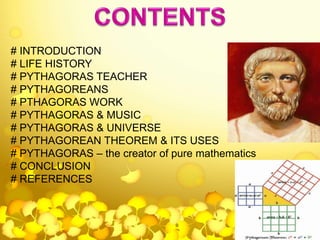
# INTRODUCTION
# LIFE HISTORY
# PYTHAGORAS TEACHER
# PYTHAGOREANS
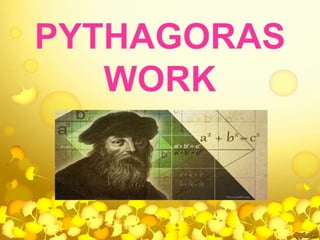
# PTHAGORAS WORK
# PYTHAGORAS & MUSIC
# PYTHAGORAS & UNIVERSE
# PYTHAGOREAN THEOREM & ITS USES
# PYTHAGORAS – the creator of pure mathematics
# CONCLUSION
# REFERENCES
Mathematics is a field that many people shy away from but there are some
who had a passion for numbers and making discoveries regarding
equations , measurement , and other numerical solution in history .
Some famous mathematician and scientists who contributed in the field of
science and mathematics are as follows – Albert Einstein , Pythagoras ,
Newton , Thales, Archimedes , Pascal , Aryabhata ,S. Ramanujan , Omar
Khayyam , John Neumann , Pierre de Fermat etc.
Pythagoras was the greatest mathematician of all time .
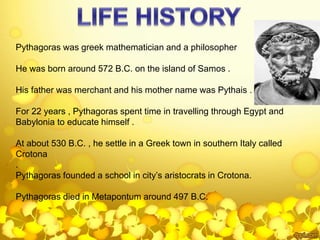
Pythagoras was greek mathematician and a philosopher
He was born around 572 B.C. on the island of Samos .
His father was merchant and his mother name was Pythais .
For 22 years , Pythagoras spent time in travelling through Egypt and
Babylonia to educate himself .
At about 530 B.C. , he settle in a Greek town in southern Italy called
Crotona
.
Pythagoras founded a school in city’s aristocrats in Crotona.
Pythagoras died in Metapontum around 497 B.C.
Among his teachers there were at least three philosophers who had great
influence on pythagoras .
The one was Pherekydes.
The other two philosopher were Thales and his pupil Anaximander , both
lived in Miletus.
Thales created phythagoras interest in mathematics and astronomy .
Anaximander was extremely interested in geometry and cosmology and
many of his ideas wold influence pythagoras’s own view .
Pythagoras followers were called “ Pythagoreans”.
Pythagoras school motto was “ ALL IS NUMBER” which means that all thing
in the universe obey the rules of number .
The pythagoreans tried to bring the realms of science , religion , and
philosophy all under the rules of number .
The school impose strict code of conduct on its members which included –
vegetarianism , secrecy and a curious taboo of eating of beans .
Mathematical results were considered to be the property of Pythagorean’s
school.
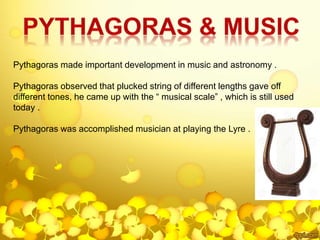
Pythagoras made important development in music and astronomy .
Pythagoras observed that plucked string of different lengths gave off
different tones, he came up with the “ musical scale” , which is still used
today .
Pythagoras was accomplished musician at playing the Lyre .
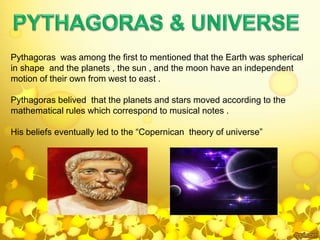
Pythagoras was among the first to mentioned that the Earth was spherical
in shape and the planets , the sun , and the moon have an independent
motion of their own from west to east .
Pythagoras belived that the planets and stars moved according to the
mathematical rules which correspond to musical notes .
His beliefs eventually led to the “Copernican theory of universe”
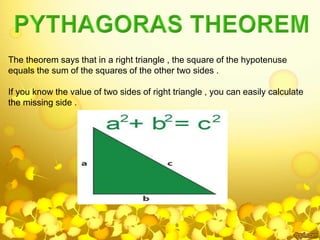
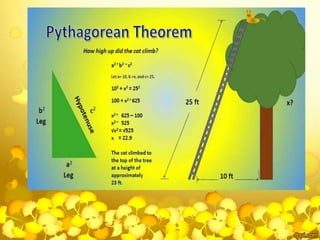
The theorem says that in a right triangle , the square of the hypotenuse
equals the sum of the squares of the other two sides .
If you know the value of two sides of right triangle , you can easily calculate
the missing side .
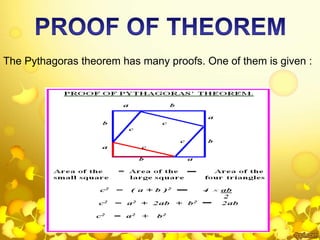
The Pythagoras theorem has many proofs. One of them is given :
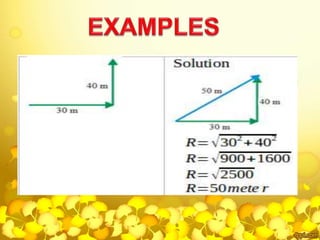
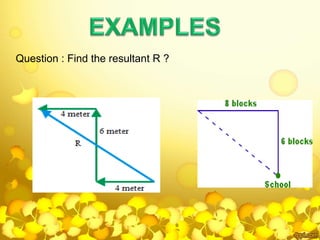
Question : Find the resultant R ?
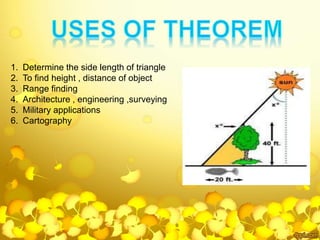
1. Determine the side length of triangle
2. To find height , distance of object
3. Range finding
4. Architecture , engineering ,surveying
5. Military applications
6. Cartography
PYTHAGOREAN NUMBERS
The three sides of right triangle are called Pythagorean numbers . Example - 3,4,5
.
POLYGONAL NUMBERS
Pythagoras made important discovery about number theory and geometry .
The Pythagoras represented whole numbers by using arrangements of dots or
pebbles .
The number 3,6,10,and so on were called triangular numbers because pebbles
could be arrange to form triangles.
The numbers 4.9.16.and so on were called square numbers because pebbles can
be arrange as square
PERFECT NUMBERS
The Pythagoras were interested in number for their mystical and numerological
properties .
A perfect number is one whose proper divisor sum to the number itself .
Example – the number 6 has the proper divisor 1,2,and 3 and 1+2+3 = 6
AMICABLE NUMBERS
Amicable numbers are two different numbers such that the sum of the proper
divisor of one number equals the other and vice – versa .
For example the two numbers 220 and 284
The divisor of 220 are 1,2,4,5,10,11,22,55, and 110 of which the sum is 284.
The divisor of 284 are 1,2,4,71,and 142 of which the sum is 220
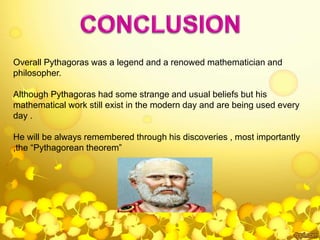
Overall Pythagoras was a legend and a renowed mathematician and
philosopher.
Although Pythagoras had some strange and usual beliefs but his
mathematical work still exist in the modern day and are being used every
day .
He will be always remembered through his discoveries , most importantly
,the “Pythagorean theorem”
Katz,V.J(2009).A history of mathematics – an introduction (3rd edition)
.Addision wesley.
Livio,M.(2010) .Is god a mathematician ?.New York :Simon and Schuster
Paperbacks.
Kline,M.(1972) . Mathematical thought from ancient to modern times.New
York : Oxford university press .
Pythagoras - the great mathematician

Pythagoras - the great mathematician

  • 1.
    SAURABH VERMA ROLL.NO. 97 B.Ed1st semseter Session – 2020-21 BBAU,Lko(U.P) Presented by :
  • 2.
    # INTRODUCTION # LIFEHISTORY # PYTHAGORAS TEACHER # PYTHAGOREANS # PTHAGORAS WORK # PYTHAGORAS & MUSIC # PYTHAGORAS & UNIVERSE # PYTHAGOREAN THEOREM & ITS USES # PYTHAGORAS – the creator of pure mathematics # CONCLUSION # REFERENCES
  • 3.
    Mathematics is afield that many people shy away from but there are some who had a passion for numbers and making discoveries regarding equations , measurement , and other numerical solution in history . Some famous mathematician and scientists who contributed in the field of science and mathematics are as follows – Albert Einstein , Pythagoras , Newton , Thales, Archimedes , Pascal , Aryabhata ,S. Ramanujan , Omar Khayyam , John Neumann , Pierre de Fermat etc. Pythagoras was the greatest mathematician of all time .
  • 4.
    Pythagoras was greekmathematician and a philosopher He was born around 572 B.C. on the island of Samos . His father was merchant and his mother name was Pythais . For 22 years , Pythagoras spent time in travelling through Egypt and Babylonia to educate himself . At about 530 B.C. , he settle in a Greek town in southern Italy called Crotona . Pythagoras founded a school in city’s aristocrats in Crotona. Pythagoras died in Metapontum around 497 B.C.
  • 5.
    Among his teachersthere were at least three philosophers who had great influence on pythagoras . The one was Pherekydes. The other two philosopher were Thales and his pupil Anaximander , both lived in Miletus. Thales created phythagoras interest in mathematics and astronomy . Anaximander was extremely interested in geometry and cosmology and many of his ideas wold influence pythagoras’s own view .
  • 6.
    Pythagoras followers werecalled “ Pythagoreans”. Pythagoras school motto was “ ALL IS NUMBER” which means that all thing in the universe obey the rules of number . The pythagoreans tried to bring the realms of science , religion , and philosophy all under the rules of number . The school impose strict code of conduct on its members which included – vegetarianism , secrecy and a curious taboo of eating of beans . Mathematical results were considered to be the property of Pythagorean’s school.
  • 8.
    Pythagoras made importantdevelopment in music and astronomy . Pythagoras observed that plucked string of different lengths gave off different tones, he came up with the “ musical scale” , which is still used today . Pythagoras was accomplished musician at playing the Lyre .
  • 9.
    Pythagoras was amongthe first to mentioned that the Earth was spherical in shape and the planets , the sun , and the moon have an independent motion of their own from west to east . Pythagoras belived that the planets and stars moved according to the mathematical rules which correspond to musical notes . His beliefs eventually led to the “Copernican theory of universe”
  • 10.
    The theorem saysthat in a right triangle , the square of the hypotenuse equals the sum of the squares of the other two sides . If you know the value of two sides of right triangle , you can easily calculate the missing side .
  • 11.
    The Pythagoras theoremhas many proofs. One of them is given :
  • 13.
    Question : Findthe resultant R ?
  • 14.
    1. Determine theside length of triangle 2. To find height , distance of object 3. Range finding 4. Architecture , engineering ,surveying 5. Military applications 6. Cartography
  • 16.
    PYTHAGOREAN NUMBERS The threesides of right triangle are called Pythagorean numbers . Example - 3,4,5 . POLYGONAL NUMBERS Pythagoras made important discovery about number theory and geometry . The Pythagoras represented whole numbers by using arrangements of dots or pebbles . The number 3,6,10,and so on were called triangular numbers because pebbles could be arrange to form triangles. The numbers 4.9.16.and so on were called square numbers because pebbles can be arrange as square
  • 17.
    PERFECT NUMBERS The Pythagoraswere interested in number for their mystical and numerological properties . A perfect number is one whose proper divisor sum to the number itself . Example – the number 6 has the proper divisor 1,2,and 3 and 1+2+3 = 6 AMICABLE NUMBERS Amicable numbers are two different numbers such that the sum of the proper divisor of one number equals the other and vice – versa . For example the two numbers 220 and 284 The divisor of 220 are 1,2,4,5,10,11,22,55, and 110 of which the sum is 284. The divisor of 284 are 1,2,4,71,and 142 of which the sum is 220
  • 18.
    Overall Pythagoras wasa legend and a renowed mathematician and philosopher. Although Pythagoras had some strange and usual beliefs but his mathematical work still exist in the modern day and are being used every day . He will be always remembered through his discoveries , most importantly ,the “Pythagorean theorem”
  • 19.
    Katz,V.J(2009).A history ofmathematics – an introduction (3rd edition) .Addision wesley. Livio,M.(2010) .Is god a mathematician ?.New York :Simon and Schuster Paperbacks. Kline,M.(1972) . Mathematical thought from ancient to modern times.New York : Oxford university press .