

The Pythagorean Theorem - 9.2 Objectives: Prove the Pythagorean Theorem Use Pythagorean to solve problems
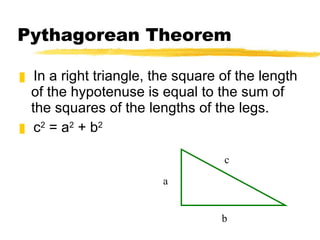
Pythagorean Theorem In a right triangle, the square of the length of the hypotenuse is equal to the sum of the squares of the lengths of the legs. c 2  = a 2  + b 2 a b c
Proving Pythagorean Look at page 535
Using Pythagorean A  Pythagorean triple  is a set of 3 positive integers a, b, and c that satisfy the equation c 2  = a 2  + b 2 3, 4, and 5 are an example.
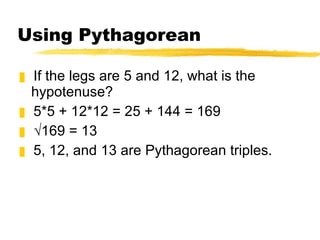
Using Pythagorean If the legs are 5 and 12, what is the hypotenuse? 5*5 + 12*12 = 25 + 144 = 169 √ 169 = 13 5, 12, and 13 are Pythagorean triples.
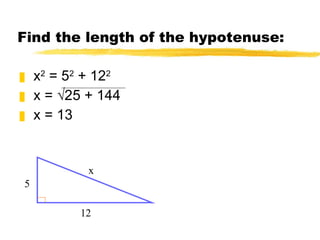
Find the length of the hypotenuse: x 2  = 5 2  + 12 2 x = √25 + 144 x = 13 x 5 12
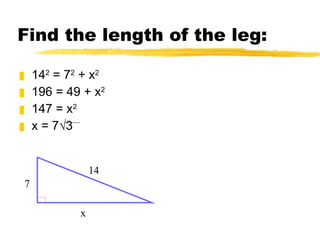
Find the length of the leg: 14 2  = 7 2  + x 2 196 = 49 + x 2 147 = x 2 x = 7√3 14 7 x
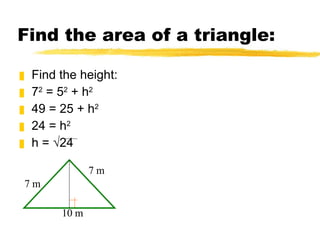
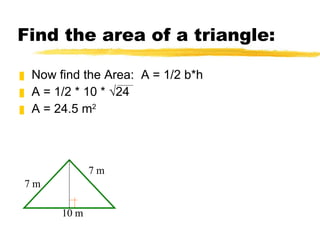
Find the area of a triangle: Find the height: 7 2  = 5 2  + h 2 49 = 25 + h 2 24 = h 2 h = √24 7 m 7 m 10 m
Find the area of a triangle: Now find the Area:  A = 1/2 b*h A = 1/2 * 10 * √24  A = 24.5 m 2 7 m 7 m 10 m
Now do Example 4, p. 537
Pythagorean video
Homework Do worksheets.

Geom 9point2