Copyright © 2005 New Age International (P) Ltd., Publishers
Published by New Age International (P) Ltd., Publishers

All rights reserved.
No part of this ebook may be reproduced in any form, by photostat, microfilm,
xerography, or any other means, or incorporated into any information retrieval
system, electronic or mechanical, without the written permission of the publisher.
All inquiries should be emailed to rights@newagepublishers.com


ISBN (10) : 81-224-2334-5
ISBN (13) : 978-81-224-2334-1


PUBLISHING FOR ONE WORLD
NEW AGE INTERNATIONAL (P) LIMITED, PUBLISHERS
4835/24, Ansari Road, Daryaganj, New Delhi - 110002
Visit us at www.newagepublishers.com
THIS PAGE IS
  BLANK
Preface


This book deals with a fascinating and important subject which has the
fundamentals of computer hardware, software and some of their applications.
This book is intended as an introductory graduate text in computer science
theory. I have taken care to present the material very clearly and interestingly.
     As an introductory subject to computer science, this book has been written
with major stress on worked examples. Chapter 0 covers the basics required
for this subject viz., sets, relations, functions, graphs, trees, languages, and
fundamental proof techniques.
     Chapter 1 deals with the different aspects of Deterministic Finite
Automata (DFA) and Non-Deterministic Finite Automata (NFA). A brief
introduction to pumping lemma and some theorems relating to Regular Sets
have also been given.
     Chapter 2 covers the concepts relating to context free grammar viz.,
derivation trees, parsing, ambiguity, and normal forms. Chapter 3 deals with
Pushdown Automata and their relation to Context-Free Grammar with some
introduction to decision algorithms.
     Chapter 4 deals with the Turing Machine model and the variations of
Turing Machines with introduction to Church-Turing Thesis and the concept
of undecidability. Chapter 5 explains the concepts viz., regular grammars,
unrestricted grammars and Chomsky hierarchy of languages.
     Chapter 6 deals with the different aspects of computability with an
introduction to formal systems, recursive functions, primitive recursive
functions, and recursion. Chapter 7 covers the various aspect of complexity
theory such as polynomial time algorithms, non-polynomial time algorithm
class P and NP problems.
     Chapter 8 covers propositions and predicates with lot of illustrative
examples.
    I wish to thank my teachers who helped me to get a good grasp of the
subject and for having motivated me to write this book.
    I want to place on record my sincere thanks to my family—Shri. Papu
Antony, my father; Mrs. Maria Daisy, my mother; Mrs. Assumpta Eugene, my
wife; and Ms. E. Catherine Praveena, my only daughter, for their great
patience and prayers while I was writing this book.
vi                              Preface

    My heartfelt thanks to my friends—Rajeevan Lal, Mohana Sundar,
Gayathri Suresh, Lakshmi Menon, Rajagopal Raman, Dr. A. Kannan and
Ilamadhi for their prayers and great encouragement.
    I wish to thank M/s. New Age International (P) Ltd., Publishers, for
publishing this book in a very short span of time.
    Suggestions are most welcome from the readers of this book.
     Happy Learning!

                                                   S.P. EUGENE XAVIER
Notations


Symbol     Meaning
∅          Empty set
|S|        Cardinality of set S.
∪          Set Union
∩          Set Intersection
a∈A        a belongs to the set A
A⊆B        A is a subset of B
—          Set Difference
Ac         Complement of A
2A         Powerset of A
A×B        Cartesian products of A and B
  n
Ui=1 Ai    Union of sets A1, A2, ..... An
L          Complement of L
LR         Language Reversal
L*         Kleene Star
L+         Kleene Plus
Σ*         All finite strings over the alphabet Σ
Σn         All strings over the alphabet Σ of length exactly n.
λ          Empty string
|x|        Length of string x.
∨          The OR function
∧          The AND function
xℜ y       x is related to y under relation ℜ
R+         Transitive closure of R
R1 o R 2   Composite of relations R1 and R2
f :x → y   Function from x to y.
f (x )     Image of x under f.
viii                                    Notations


Symbol                       Meaning

x                          Ceiling function of x (least integer not less than x)
x                          Floor function of x (greatest integer not exceeding x)
⇒                            Logical connective — If … … then … …
∨                            For every
∃                            There exists
≡                            Equivalence of predicate formulae
χA                           Characteristic function of set A
Z (x )                       Zero function
S (x )                       Successor function
pin ( x )                    Projector Function
(Q, Σ, δ, q 0 , F )          Finite automaton
(Q, Σ, ∆ , δ, λ, q 0 )       Moore-Mealey Machine
(V N , Σ, P , S )            Grammar
(Q, Σ, Γ , δ, q 0 , b, F )   Turing machine
O ( f ( n))                  Set of functions whose growth r is order f(n).
N                            Set of Natural numbers
Z                            Set of Integers
Q                            Set of Rational Numbers
R                            Set of Real Numbers
Contents


Preface                                                                    v
Notations                                                                 vii

Chapter 0   Introduction                                                   1

            0.1   Basics                                                   1
                  0.1.1    Sets                                            1
                  0.1.2    Relations and Functions                         8
                  0.1.3    Graphs and Trees                               15
                  0.1.4    Strings and Languages                          18
                  0.1.5    Boolean Logic                                  27
                  0.1.6    Fundamental Proof Techniques                   28
                  0.1.7    Introduction to Grammar                        37
                           Glossary                                       43
                           Review Questions                               44
                           Exercises                                      46
                           Short Questions and Answers                    51

Chapter 1   DFA and NFA                                                   58

            1.1   Deterministic Finite Automata (DFA)                     58
                  1.1.1    Automata—What is it?                           58
                  1.1.2    Types of Automaton                             58
                  1.1.3    Definition of Deterministic Finite Automaton   59
            1.2   Non-Deterministic Finite Automata (NFA)                 70
            1.3   Equivalence of NFA and DFA                              75
            1.4   Regular Expression                                      80
                  1.4.1    Regular Languages                              80
                  1.4.2    Regular Expressions                            81
                  1.4.3    Building Regular Expressions                   81
                  1.4.4    Languages Defined by Regular Expressions       82
                  1.4.5    Regular Expressions to NFA                     82
                  1.4.6    NFAs to Regular Expression                     83
            1.5   Two-way Finite Automata                                 88
            1.6   Finite Automata with Output                             89
x                                  Contents

                  1.6.1   Definition                                      89
                  1.6.2   Mealey Machine                                  89
                  1.6.3   Moore Machine                                   90
            1.7   Properties of Regular Sets (Languages)                 91
                  1.7.1   Closure                                         91
                  1.7.2   Union, Concatenation, Negation, Kleene Star,
                          Reverse                                         92
                  1.7.3   Intersection and Set Difference                 92
            1.8   Pumping Lemma                                          93
                  1.8.1   Principle of Pumping Lemma                      93
                  1.8.2   Applying the Pumping Lemma                      94
            1.9 Closure Properties of Regular Languages                  96
            1.10 Myhill-Nerode Theorem                                   97
                  1.10.1 Myhill-Nerode Relations                          97
                  1.10.2 Myhill-Nerode Theorem                            98
                         Glossary                                         99
                         Review Questions                                 99
                         Exercises                                       100
                         Short Questions and Answers                     108

Chapter 2   Context-Free Grammars                                        115

            2.1   Introduction                                           115
                  2.1.1   Definition of CFG                              115
                  2.1.2   Example of CFG                                 115
                  2.1.3   Right-Linear Grammar                           115
                  2.1.4   Right-Linear Grammars and NFAs                 116
                  2.1.5   Left-Linear Grammar                            116
                  2.1.6   Conversion of Left-linear Grammar into
                          Right-Linear Grammar                           117
            2.2   Derivation Trees                                       118
                  2.2.1   Definition of a Derivation Tree                118
                  2.2.2   Sentential Form                                119
                  2.2.3   Partial Derivation Tree                        119
                  2.2.4   Right Most/Left Most/Mixed Derivation          119
            2.3   Parsing and Ambiguity                                  127
                  2.3.1   Parsing                                        127
                  2.3.2   Exhaustive Search Parsing                      128
                  2.3.3   Topdown/Bottomup Parsing                       128
                  2.3.4   Ambiguity                                      129
                  2.3.5   Ambiguous Grammars/Ambiguous Languages         130
            2.4   Simplification of CFG                                  131
                  2.4.1   Simplification of CFG-Introduction             131
                  2.4.2   Abolishing Useless Productions                 132
            2.5   Normal Forms                                           142
Contents                                 xi

                  2.5.1   Chomsky Normal Form (CNF)                        142
                  2.5.2   Greibach Normal Form (GNF)                       148
                          Glossary                                         149
                          Review Questions                                 149
                          Exercises                                        150
                          Short-Questions and Answers                      153

Chapter 3   Pushdown Automata                                              159

            3.1   Definitions                                              159
                  3.1.1   Nondeterministic PDA (Definition)                159
                  3.1.2   Transition Functions for NPDA                    160
                  3.1.3   Drawing NPDAs                                    161
                  3.1.4   Execution of NPDA                                162
                  3.1.5   Accepting Strings with an NPDA                   162
                  3.1.6   An Example of NPDA Execution                     163
                  3.1.7   Accepting Strings with NPDA (Formal Version)     164
            3.2   Relationship between PDA and Context Free
                  Languages                                                166
                  3.2.1   Simplifying CFGs                                 166
                  3.2.2   Normal Forms of Context-Free Grammars            167
                  3.2.3   CFG to NPDA                                      167
                  3.2.4   NPDA to CFG                                      169
                  3.2.5   Deterministic Pushdown Automata                  170
            3.3   Properties of Context Free Languages                     170
                  3.3.1   Pumping Lemma for CFG                            170
                  3.3.2   Definitions                                      171
                  3.3.3   Proof of Pumping Lemma                           171
                  3.3.4   Usage of Pumping Lemma                           173
            3.4   Decision Algorithms                                      176
                          Glossary                                         179
                          Review Questions                                 180
                          Exercise                                         181
                          Short Questions and Answers                      182

Chapter 4   Turing Machines                                                186

            4.1   Turing Machine Model                                     186
                  4.1.1   What is a Turing Machine?                        186
                  4.1.2   Definition of Turing Machines                    186
                  4.1.3   Transition Function, Instantaneous Description
                          and Moves                                        187
                  4.1.4   Programming a Turing Machine                     188
                  4.1.5   Turing Machines as Acceptors                     188
                  4.1.6   How to Recognize a Language                      188
                  4.1.7   Turing Machines as Transducers                   189
xii                                Contents

            4.2   Complete Languages and Functions                        192
            4.3   Modification of Turing Machines                         195
                  4.3.1   N-Track Turing Machine                          195
                  4.3.2   Semi-infinite Tape/Offline/Multitape/
                          ND Turing Machines                              196
                  4.3.3   Multidimensional/Two-state Turing Machine       196
            4.4   Church-Turing’s Thesis                                  196
                  4.4.1   Counting                                        197
                  4.4.2   Recursive and Recursively Enumerable Language   197
                  4.4.3   Enumerating Strings in a Language               198
                  4.4.4   Non-recursively Enumerable Languages            199
            4.5   Undecidability                                          199
                  4.5.1   Halting Problem                                 199
                  4.5.2   Implications of Halting Problem                 201
                  4.5.3   Reduction to Halting Problem                    201
                  4.5.4   Post’s Correspondence Problem                   202
            4.6   Rice’s Theorem                                          203
                          Glossary                                        203
                          Review Questions                                204
                          Exercises                                       205
                          Short Questions and Answers                     206

Chapter 5   Chomsky Hierarchy                                             210

            5.1   Context Sensitive Grammars and Languages                210
            5.2   Linear Bounded Automata                                 211
            5.3   Relationship of other Grammars                          211
            5.4   The Chomsky Hierarchy                                   212
            5.5   Extending the Chomsky Hierarchy                         213
            5.6   Unrestricted Grammar                                    213
            5.7   Random-Access Machine                                   214
                          Glossary                                        214
                          Review Questions                                215
                          Exercises                                       215
                          Short Questions and Answers                     216

Chapter 6   Computability                                                 218

            6.1   Formal Systems                                          218
            6.2   Recursive Function Theory                               219
            6.3   Primitive Recursive Functions                           219
            6.4   Composition and Recursion                               222
            6.5   Ackermann’s Function                                    229
Contents                           xiii

                          Glossary                                   230
                          Review Questions                           231
                          Exercises                                  231
                          Short Questions and Answers                232

Chapter 7   Complexity Theory                                        235

            7.1   Introduction                                       235
            7.2   Polynomial-Time Algorithms                         236
            7.3   Non-deterministic Polynomial Time Algorithms       237
            7.4   Integer Bin Packing                                237
            7.5   Boolean Satisfiability                             238
            7.6   Additional NP Problems                             239
            7.7   NP-Complete Problems                               239
                          Glossary                                   240
                          Review Questions                           240
                          Exercises                                  241
                          Short Questions and Answers                242

Chapter 8   Propositions and Predicates                              245

            8.1   Propositions                                       245
                  8.1.1   Connectives                                246
                  8.1.2   Tautology, Contradiction and Contingency   255
                  8.1.3   Logical Identities                         258
            8.2   Logical Inference                                  265
            8.3   Predicates and Quantifiers                         276
            8.4   Quantifiers and Logical Operators                  281
            8.5   Normal Forms                                       289
                          Glossary                                   292
                          Review Questions                           293
                          Exercises                                  294
                          Short Questions and Answers                299
Answers to Exercises                                                 304
University Question Papers                                           320
Bibliography                                                         341
Index                                                                343
THIS PAGE IS
  BLANK
Chap ter 0

                                          Introduction


               0.1    BASICS
               0.1.1 Sets
               A “set” is a collection of objects. For example, the collection of four letters a,
               b, c and d is a set, which is written as
                                                L = { a, b, c, d }
               The objects comprising a set are called its “elements” or “members”.
                   A set having only one element is called a “singleton”. A set with no
               element at all is called the “empty set”, which is denoted by ∅.
                   It is essential to have a criterion for determining, for any given thing,
               whether it is or is not a member of the given set. This criterion is called the
               “Membership criterion” of the set.
                   There are two common ways to indicate the members of a set:
                        (i) List all the elements, e.g, {a, e, i, o, u}.
                       (ii) Provide some kind of an algorithm or a rule, such as a grammar.

                     Let us now take a look at the notation that is being used to denote sets.
                       (a) To indicate that x is a member of the set S, we write x ∈ S.
                       (b) If every element of set A is also an element of set B, we say that A
                           is a “subset” of B, and write A ⊆ B.
                       (c) If every element of set A is also an element of set B, but B also has
                           some elements not contained in A, we say that A is a “proper
                           subset” of B and write A ⊂ B.
                       (d) We denote the “empty set” as { } or ∅.

                     The set operations are as described below.

               (a)    Union
               The “union” of two sets is the set that has objects that are elements of at least
               one of the two given sets, and possibly both.


Introduction
2            Theory of Automata, Formal Languages and Computation


    That is, the union of sets A and B, written A ∪ B, is a set that contains
everything in A, or in B, or in both.
                            A ∪ B = {x : x ∈ A or x ∈ B }
Example: A = {1, 3, 9}              B = {3, 5}
Therefore,            A ∪ B = {1, 3, 5, 9}

(b)     Intersection
The “intersection” of sets A and B, written A ∩ B, is a set that contains exactly
those elements that are in both A and B.
                         A ∩ B = {x : x ∈ A      and   x ∈ B}
Example: Given A = {1, 3, 9}, B = {3, 5}, C = {a, b, c}
                                     A ∩ B = {3}
                                     A∩C={ }

(c)     Set Difference
The “set difference” of set A and set B, written as A–B, is the set that contains
everything that is in A but not in B.
                          A − B = {x : x ∈ A and x ∉ B }
Given A = {1, 3, 9}, B = {3, 5}
                                     A − B = {1, 9}

(d)     Complement
The “complement” of set A, written as A is the set containing everything that is
not in A.

Properties of set operations
Some of the properties of the set operations follow from their definitions. The
following laws hold for the three given sets A, B and C.

      Idempotency               :    A∪A= A
                                     A∩A= A
      Commutativity             :    A∪B = B ∪ A
                                     A∩B = B ∩ A
      Associativity             :    ( A ∪ B ) ∪ C = A ∪ (B ∪ C )
                                     ( A ∩ B ) ∩ C = A ∩ (B ∩ C )
Introduction                               3

   Distributivity           :    ( A ∪ B ) ∩ C = ( A ∩ C ) ∪ (B ∩ C )
                                 ( A ∩ B ) ∪ C = ( A ∪ C ) ∩ (B ∪ C )
   Absorption               :    (A ∪ B) ∩ A = A
                                 (A ∩ B) ∪ A = A
   DeMorgan’s Laws          :    A − (B ∪ C ) = ( A − B ) ∩ ( A − C )
                                 A − (B ∩ C ) = ( A − B ) ∪ ( A − C )

Ì Example 0.1.1: Show that A − ( B ∪ C ) = ( A − B ) ∩ ( A − C ).

Solution
      x ∈ A − ( B ∪ C ) ⇒ x ∈ A and x ∉ B ∪ C
                        ⇒ x ∈ A and x ∉ B and x ∉ C
                        ⇒ ( x ∈ A and x ∉ B ) and ( x ∈ A and x ∉ C )
                        ⇒ x ∈ A − B and x ∈ A − C
                        ⇒ x ∈ (A − B) ∩ (A − C)

Therefore             A − (B ∪ C ) ⊆ ( A − B ) ∩ ( A − C )                  (1)
Conversely,
   x ∈ ( A − B ) ∩ ( A − C ) ⇒ x ∈ A − B and x ∈ A − C
                             ⇒ (x ∈ A and x ∉ B ) and ( x ∈ A and x ∉ C )
                             ⇒ x ∈ A and ( x ∉ B and x ∉ C )
                             ⇒ x ∈ A and x ∉ B ∪ C
                             ⇒ x ∈ A − (B ∪ C )
    Therefore, ( A − B ) ∩ ( A − C ) ⊆ A − (B ∪ C ).
    Hence A − ( B ∪ C ) = ( A − B ) ∩ ( A − C ).

Ì Example 0.1.2: Given sets A and B are the subsets of a universal set U,
    prove that
      (a) A − B = A ∩ B ′
      (b) A − B = A, if and only if A ∩ B = ∅
      (c) A − B = ∅, if and only if A ⊆ B.

Solution
       (a) Let x ∈ A − B. Then
                       x ∈ A − B ⇒ x ∈ A and x ∉ B
                                 ⇒ x ∈ A and x ∈ B
                                 ⇒ x ∈ A ∩ B′
                                A − B ⊆ A ∩ B′                              (1)
4          Theory of Automata, Formal Languages and Computation

           Conversely, Let x ∈ A ∩ B ′. Then
                     x ∈ A ∩ B ′ ⇒ x ∈ A and x ∈ B
                                 ⇒ x ∈ A and x ∉ B                (2)
                                 ⇒ x∈A−B
           Hence from (1) and (2)
                                A − B = A ∩ B′
      (b) We have A ∩ B = ∅. Then
                     A = (A − B) ∪ (A ∩ B)
                   ⇒ A = A − B ∪ ∅ since A ∩ B = ∅
                   ⇒ A = A − B.
           Again we have A − B = A. Then
                         A = (A − B) ∪ (A ∩ B)
                   ⇒ A ∩ B = A − A Since A − B = A
                   ⇒ A ∩ B = ∅.

      (c) We have A ⊆ B . Then
                    A∩B      =   A
                    A−B      =   A − (A ∩ B)
                   ⇒A−B      =   A − A Since A ∩ B = A
                   ⇒A−B      =   ∅.
           If A − B = ∅, then
                           A ∩ B = A − (A − B)
                         ⇒ A ∩ B = A −∅
                         ⇒ A∩B = A
                         ⇒ A ⊆ B.

Ì Example 0.1.3: Given three sets A, B and C, prove that
                       A ∪ (B ∪ C ) = ( A ∪ B ) ∪ C .

Solution
      (i) Let us show that
                       A ∪ (B ∪ C ) ⊂ ( A ∪ B ) ∪ C
               x ∈ A ∪ (B ∪ C )
             ⇒ x ∈ A or x ∈ ( B ∪ C ), by definition of union
             ⇒ x ∈ A or (x ∈ B or x ∈ C )
             ⇒ ( x ∈ A or x ∈ B ) or x ∈ C
Introduction                           5

             ⇒ x ∈ ( A ∪ B ) or x ∈ C
             ⇒ x ∈ ( A ∪ B ) ∪ C.
            Therefore we have
                          A ∪ (B ∪ C ) ⊂ ( A ∪ B ) ∪ C                   (1)
      (ii) Let us now show that
                         ( A ∪ B ) ∪ C ⊂ A ∪ (B ∪ C ).
            Assume that y is any element of the set ( A ∪ B ) ∪ C
                           y∈ (A ∪ B) ∪ C
                         ⇒ y ∈ ( A ∪ B ) or y ∈ C
                         ⇒ ( y ∈ A or y ∈ B ) or y ∈ C
                         ⇒ y ∈ A or ( y ∈ B or y ∈ C )
                         ⇒ y ∈ A ∪ (B ∪ C )

            Therefore we have
                          ( A ∪ B ) ∪ C ⊂ A ∪ (B ∪ C )                   (2)
            From (1) and (2), we have
                          A ∪ (B ∪ C ) = ( A ∪ B ) ∪ C

Ì Example 0.1.4: Prove that the intersection of sets is associative i.e., if
    A, B and C are three sets, then
                          A ∩ (B ∩ C ) = ( A ∩ B ) ∩ C .

Solution
Let us prove that         A ∩ (B ∩ C ) ⊂ ( A ∩ B ) ∩ C
    Let x be an element such that
                          x ∈ A ∩ (B ∩ C )
                        ⇒ x ∈ A and x ∈ ( B ∩ C )
                        ⇒ x ∈ A and ( x ∈ B and x ∈ C )
                        ⇒ ( x ∈ A and x ∈ B ) and x ∈ C
                        ⇒ x ∈ ( A ∩ B ) and x ∈ C
                        ⇒ x ∈ (A ∩ B) ∩ C
Therefore                 A ∩ (B ∩ C ) ⊂ ( A ∩ B ) ∩ C                   (1)
    Let us prove that       ( A ∩ B ) ∩ C ⊂ A ∩ ( B ∩ C ).
Let us assume the element y ∈ ( A ∩ B ) ∩ C
                           ⇒ y ∈ ( A ∩ B ) and y ∈ C
6          Theory of Automata, Formal Languages and Computation

                     ⇒ ( y ∈ A and y ∈ B ) and y ∈ C
                     ⇒ y ∈ A and y ∈ B and y ∈ C
                     ⇒ y ∈ A and y ∈ ( B ∩ C )
                     ⇒ y ∈ A ∩ (B ∩ C )
Therefore we have       ( A ∩ B ) ∩ C ⊂ A ∩ (B ∩ C )                        (2)

    From (1) and (2), we have
                        A ∩ (B ∩ C ) = ( A ∩ B ) ∩ C

Ì Example 0.1.5: For any two sets A and B, prove the DeMorgan’s Laws
       (a) ( A ∪ B )′ = A′ ∩ B ′
       (b) ( A ∩ B )′ = A′ ∪ B ′

Solution
       (a) x ∈ ( A ∪ B )′ ⇔ x ∉ A ∪ B
                          ⇔ x ∉ A and x ∉ B
                          ⇔ x ∈ A′ and x ∈ B ′
                          ⇔ x ∈ A′ ∩ B ′
       (b) y ∈ ( A ∩ B )′ ⇔ y ∉ A ∩ B
                          ⇔ either y ∉ A or y ∉ B
                          ⇔ either y ∈ A′ or y ∈ B ′
                          ⇔ y ∈ A′ ∪ B ′
Hence we have ( A ∩ B )′ = A′ ∪ B ′ .

Ì Example 0.1.6: If the symmetric difference of the two sets A and B is
    refined as ( A − B ) ∪ (B − A ) and denoted by A ∆ B, prove that
       (a) A ∆ B = B ∆ A
       (b) ( A ∪ B ) − ( A ∩ B ) = A ∆ B.

Solution
       (a) A ∆ B = ( A − B ) ∪ (B − A )
                 = (B − A) ∪ ( A − B )
                 = B∆ A
       (b) ( A ∪ B ) − ( A ∩ B ) = ( A ∪ B ) ∩ ( A ∩ B )′
                                             (Q x − y = x ∩ y ′ )
                                 = ( A ∪ B ) ∩ ( A′ ∪ B ′ )
                                 = (( A ∪ B ) ∩ A′ ) ∪ (( A ∪ B ) ∩ B ′ )
                                 = ( A ∩ A′ ) ∪ (B ∩ A′ ) ∪ ( A ∩ B ′ )
                                              ∪ (B ∩ B′ )
Introduction                                    7

                                      = ( A ∩ B ′ ) ∪ (B ∩ A′ )
                                                   (Q ( A ∩ A′ ) = ( B ∩ B′ ) = ∅)
                                      = ( A − B ) ∪ (B − A)
                                      = A ∆ B.

Additional Terminology
(a) Disjoint Sets. If A and B have no common element, that is, A ∩ B = ∅,
then the sets A and B are said to be disjoint.
(b) Cardinality. The “Cardinality” of a set A, written |A|, is the number of
elements in set A.
(c) Powerset. The “powerset” of a set A, written 2A, is the set of all subsets of
A; i.e., a set containing ‘n’ elements has a powerset containing 2n elements.
(d) Cartesian Product. Let A and B be two sets. Then the set of all ordered
pairs (x, y) where x ∈ A and y ∈ B is called the “Cartesian Product” of the sets A
and B and is denoted by A × B , i.e.
                       A × B = {( x, y) : x ∈ A and y ∈ B }

Ì Example 0.1.7: Given A = {1, 2, 3} determine P(A) (powerset of A).

Solution
As the set A = {1, 2, 3} has 3 elements the powerset P(A) will have 23 = 8
elements.
             P ( A ) = {∅, {1}, {2}, {3}, {1, 2}, {2, 3}, {3, 1}, {1, 2, 3}}

Ì Example 0.1.8: Given               A = [{a, b}, {c}, {d, e, f }],     determine    the
    powerset P(A).

Solution
Since A has 3 elements, P(A) has 23 = 8 elements.
                    A, [{a, b}, {c}], [{a, b}, {d, e, f }], [{c}, {d, e, f }], 
          P ( A) =                                                             
                    [{a, b}], [{c}], [{d, e, f }], ∅                           

Ì Example 0.1.9: Prove that ( A × B ) ∪ ( A × C ) = A × ( B ∪ C )

Proof: ( A × B ) ∪ ( A × C ) =     {(x, y) : (x, y) ∈ A × B or (x, y) ∈ A × C }
                             =     {(x, y): x ∈ A, y ∈ B or x ∈ A, y ∈ C }
                             =     {(x, y): x ∈ A, and y ∈ B or y ∈ C }
                             =     {(x, y): x ∈ A, y ∈ B ∪ C }
                             =     A × (B ∪ C )                                      ¨
8            Theory of Automata, Formal Languages and Computation


Ì Example 0.1.10: Given A= {1,2}, B = {x, y, z} and C = {3, 4}, find
    A × B × C and n ( A × B × C ).

Solution
                                                                  3   (1, x, 3)
                                                  x
                                                                  4   (1, x, 4)
                                  1                               3   (1, y, 3)
                                                  y
                                                                  4   (1, y, 4)
                                                                  3   (1, z, 3)
                                                  z
                                                                  4   (1, z, 4)
                                                                  3   (2, x, 3)
                                                  x
                                                                  4   (2, x, 4)
                                                                  3   (2, y, 3)
                                                  y
                                  2                               4   (2, y, 4)
                                                                  3   (2, z, 3)
                                                  z
                                                                  4   (2, z, 4)

              n( A × B × C ) = n( A ) ⋅ n(B ) ⋅ n(C ) = (2) (3) (2) = 12.
                                                                        .

0.1.2 Relations and Functions
Definition of Relation: A relation on sets S and T is a set of ordered pairs (s, t),
where
       (a)   s ∈ S (s is a member of S )
       (b)   t ∈T
       (c)   S and T need not be different
       (d)   The set of all first elements in the “domain” of the relation, and
       (e)   The set of all second elements is the “range” of the relation.

Example:
                                   a                      w
                           b                                  x
                                   c
                                                          y
                           d
                                   e                      z

                               Set S                     Set T

                               Fig. 1 Sets S and T are disjoint

Suppose S is the set {a, b, c, d, e} and set T is {w, x, y, z}.
Introduction                                9

    Then a relation on S and T is
                         R = {( a, y), ( c, w), (c, z ), ( d, y)}
    The four ordered pairs in the relation is represented as shown in Fig. 2.

                           a                                       w
                    b                                                  x
                           c
                                                                   y
                    d
                           e                                           z

                  Fig. 2 Relation R = {(a, y), (c, w), (c, w), (c, z), (d, y)}


Equivalence Relation
A subset R of A × A is called an equivalence relation on A if R satisfies the
following conditions:
        (i) ( a, a ) ∈ R for all a ∈ A (R is reflexive)
       (ii) If ( a, b) ∈ R, then ( b, a ) ∈ R, then ( a, b) ∈ R (R is symmetric)
      (iii) If ( a, b) ∈ R and ( b, c) ∈ R, then ( a, c) ∈ R (R is transitive)

Partial Ordering Relations
A relation R on a set S is called a “Partial ordering” or a “Partial order”, if R is
reflexive, antisymmetric and transitive.
     A set S together with a partial ordering R is called a “Partially ordered set”
or “Poset”.

Example: The relation ≤ on the set R of real numbers is reflexive,
antisymmetric and transitive. Therefore ≤ is a “Partial ordering”.

Partition
A Partition P of S is a collection {Ai} of nonempty subsets of S with the
properties:
        (i) Each a ∈ S belongs to some Ai,
       (ii) If Ai ≠ A j , then Ai ∩ A j = ∅.
     Thus a partition P of S is a subdivision of S into disjoint nonempty sets.
     If R is an equivalence relation on a set S, for each ‘a’ in S, let [a] denote the
set of elements of S to which ‘a’ is related under R, i.e.
                                  [ a ] = {x : ( a, x ) ∈ R }
Here [a] is the Equivalence class” of ‘a’ in S.
10          Theory of Automata, Formal Languages and Computation

    The collection of all equivalence classes of elements of S under an
equivalence relation R is denoted by S R , i.e.,

                                    R = {[a ] : a ∈ S }.
                                S

It is known as “quotient” set of S by R.

Ì Example 0.1.11: Given a relation R is ‘circular’ if ( a, b) ∈ R and
     ( b, c) ∈ R ⇒ (c, a ) ∈ R. Show that a relation is reflexive and circular if and
     only if it is reflexive, symmetric, and transitive.

Solution
Let the relation R be reflexive and circular. We shall prove that R is reflexive,
symmetric and transitive.
           ( a, b) ∈ R , ( b, c) ∈ R ⇒ ( c, a ) ∈ R , since R is circular and
                          ( a, a ) ∈ R since R is reflexive.
We have ( c, a ) ∈ R, ( a, a ) ∈ R ⇒ ( a, c) ∈ R, since R is circular.
Thus shows (a, c) ∈ R and ( c, a ) ∈ R . Hence R is symmetric
            ( a, b) ∈ R, ( b, c) ∈ R ⇒ ( c, a ) ∈ R, since R is circular
                                     ⇒ ( a, c) ∈ R, since R is symmetric
                                     ⇒ R is transitive

It is given that R is reflexive.
      Conversely, if R is reflexive, symmetric, and transitive then we show that
R is reflexive and circular.
            ( a, b) ∈ R , ( b, c) ∈ R ⇒ ( a, c) ∈ R , since R is transitive
                                      ⇒ ( c,a ) ∈ R , since R issymmetric
                                      ⇒ R is circular
            ( a, c) ∈ R , ( c, a ) ∈ R ⇒ ( a, a ) ∈ R , since R is transitive
                                       ⇒ R is reflexive

Ì Example 0.1.12: Show that the relation “congruence modulo m” over
     the set of positive integers is an equivalence relation.

Solution
Assume that N = Set of all positive integers
         and m = given positive integer.
For x, y ∈ N , x ≡ y (mod m) if and only if x – y is divisible by m, i.e.
                               x − y = km, for k ∈ z.
Introduction                         11

Let x, y, z ∈ N . Then
       (a) As x – x = 0 m., x ≡ x (mod m), for all x ∈ N . Therefore this
           relation is reflexive
       (b) x ≡ y ( mod m) ⇒ x − y = km, for integer k
                            ⇒ y – x = (−k )m
                            ⇒ y ≡ x ( mod m)
           Therefore the relation is symmetric.
       (c) x ≡ y (mod m) and y ≡ z (mod m)
               ⇒ x − y = km and y − z = lm for integers k , l.
               ⇒ ( x − y) + ( y − z ) = ( k + l) m
               ⇒ ( x − z ) = ( k + l) m
               ⇒ x ≡ z (mod m) since k + l is also an integer
Therefore the relation is transitive.
    Since the relation is reflexive, symmetric and transitive, the relation
“congruence modulo m” is an equivalence relation.

Ì Example 0.1.13: Give examples of relations R on A = {1, 2, 3} with
       (a) R being both symmetric and antisymmetric
       (b) R being neither symmetric nor antisymmetric

Solution
A possible set of examples are:
       (a) R = {(11), (2,2)}
                  ,
       (b) R = {(12), (21), (2,3)}
                  ,      ,

Ì Example 0.1.14: Given the relation R in A as
                  R = {(1,1), (2,2), (2,3), (3,2), (4,2), (4,4)}
       (a) Is R (i) reflexive (ii) symmetric (iii) transitive?
       (b) Is R antisymmetric?
       (c) Determine R2.

Solution
       (a) (i) R is not reflexive because
                              /
                3 ∈ A but 3R 3, i.e. (3, 3) ∉ R
           (ii) R is not symmetric because
                            /
                4R2 but 2R 4, i.e.,( 4, 2) ∈ R but (2, 4) ∉ R
          (iii) R is not transitive because
                                      /
                4R2 and 2R3 but 4 R 3, i.e.,
                (4, 2) ∈ R, (2, 3) ∈ R but ( 4, 3) ∉ R
12         Theory of Automata, Formal Languages and Computation

       (b) R is not antisymmetric because 2R3 and 3R2 but 2 ≠ 3
       (c) For each pair ( a, b) ∈ R, determine all ( b, c) ∈ R. As (a, c) ∈ R 2 ,
            R 2 = {(1,1), (2,2), (2,3), (3,2), (3,3), (4,2), (4,3), (4,4)}.

Functions
Suppose every element of S occurs exactly once as the first element of an
ordered pair. In Fig shown, every element of S has exactly one arrow arising
from it. This kind of relation is called a “function”.

                          a                                     w
                  b                                                         x
                          c
                                                                    y
                  d
                          e                                                 z


                                     Fig. A Function

    A function is otherwise known as “Mapping”. A function is said to map an
element in its domain to an element in its range.
    Every element in S in the domain, i.e., every element of S is mapped to
some elemet in the range. No element in the domain maps to more than one
element in the range.

Functions as relations
A function f : A → B is a relation from A to B i.e., a subset of A × B, such that
each a ∈ A belongs to a unique ordered pair (a, b) in f.

Kinds of Functions
(a) One-to-One Function (Injection): A function f : A → B is said to be
one-to-one if different elements in the domain A have distinct images in the
range.
    A function f is one-to-one if f ( a ) = f (a′ ) implies a = a′.

                      a                                             w

                                                                        x
                      b
                                                                    y

                      c                                                 z


                          Fig. An Injection (one to one function)
Introduction                                13

(b) Onto function (Surjection): A function f : A → B is said to be an onto
function if each element of B is the image of some element of A.
      i.e., f : A → B is onto if the image of f is the entire codomain, i.e. if
 f ( A ) = B. i.e., f maps A onto B.

                           a                               w
                   b                                           x
                           c
                                                           y
                   d
                           e                                   z


                                  Fig. A Surjection

(c) One-to-one onto Function (Bijection): A function that is both one-to-one
and onto is called a “Bijection”. Such a function maps each and every element
of A to exactly one element of B, with no elements left over. Fig. below shows
bijection.

                       a                                   w
                   b                                           x

                           c                               y

                       d                                       z


                                   Fig. A Bijection

(d) Invertible function: A function f : A → B is invertible if its inverse
relation f –1 is a function from B to A.
     A function f : A → B is invertible if and only it is both one-to-one and
onto.

Ì Example 0.1.15: Find whether the function f ( x ) = x 2 from the set of
     integers to the set of integers is one-to-one.

Solution
The function f (x ) = x 2 is not one-to-one as, for example f (1) = f ( −1) = 1, but
1 ≠ −1.

Ì Example 0.1.16: Given f is a function f : A → B where A = {a, b, c, d}
     and B = {1, 2, 3} with f (a) = 3, f (b) = 2, f (c) =1, and f(d) = 3. Is the
     function f an onto function?
14          Theory of Automata, Formal Languages and Computation


                        a                                          1
                        b
                                                                   2
                        c

                        d                                          3


                    A                                          B


Solution
As all three elements of the codomain are images of elements in the domain,
we have f as an “onto function”.

Ì Example 0.1.17: Given f ( x ) = 2x + 3 and
                             g ( x ) = 3x + 2
Check if commutative law holds good for composition of functions.

Solution
                             ( f ⋅ g )(x ) =   f ( g (x ))
                                           =   f (3x + 2)
                                           =   2(3x + 2) + 3
                                           =   6x + 7
                             (g ⋅ f )(x ) =    g( f ( x ) )
                                           =   g (2x + 3)
                                           =   3(2x + 3) + 2
                                           =   6x + 11

Since ( f ⋅ g )(x ) ≠ ( g ⋅ f )( x ), commutative law does not hold for composition
of functions.

Ì Example 0.1.18: Check whether the mapping f : X → X where
                                                  1
     X = {x ∈ R , x ≠ 0} defined by f ( x ) =       is one to one and onto.
                                                  x

Solution
x = set of all non-zero real numbers. Let x1 , x 2 ∈ X .
                                                    1    1
Then                        f ( x1 ) = f ( x 2 ) ⇒    =
                                                   x1 x 2
                                                 ⇒ x1 = x 2

Hence f is one-to-one.
Introduction                              15

    For every non-zero real number x ∈ X there exists a non-zero real number
1
  ∈ X such that
x
                                   1    1
                                  f =      = x.
                                    x  1
                                         
                                         x
                                           1
   Hence every element x ∈ X is an image of . Therefore f is onto.
                                           x
Therefore f is one-to-one and onto.

0.1.3 Graphs and Trees
Graphs
A graph G consists of a finite set V of objects called “Vertices”, a finite set E of
objects called “Edges”, and a function γ that assigns to each edge a subset {v,
w}, where v and w are vertices (and may be the same).
Therefore we write                   G = (V , E , γ ).
Example: Given V = {1, 2, 3, 4} and E = {e1, e2, e3, e4, e5}
                       γ is defined by
                                γ ( e1 ) = γ (e5 ) = {1, 2}
                                γ ( e2 ) = {4, 3}
                                γ ( e3 ) = {1, 3}
                                γ ( e4 ) = {2, 4}

Then G = (V , E , γ ) is a graph shown below.

                            1                                 2


                                 4                       3

Degree of a vertex: It is defined as the number of edges having that vertex as
an end point.
Loop: A graph may have an edge from a vertex to itself, such an edge is called
a “loop”.
     Degree of a vertex is 2, for a loop since that vertex serves as both
endpoints of the loop.
Isolated vertex: A vertex with “zero” as degree is called an “Isolated vertex.”
16         Theory of Automata, Formal Languages and Computation


Adjacent vertices: A pair of vertices that determine an edge are “adjacent”
vertices.
     In the graph shown above, vertex ‘e’ is an “Isolated vertex”, ‘a’ and ‘b’ are
adjacent vertices, vertices ‘a’ and ‘d’ are not adjacent.
Path: A path in a graph G consists of a pair (V, E) of sequences.
Circuit: A circuit is a path that begins and ends at the same vertex.
Simple Path: A path is called “simple” if no vertex appears more than once in
the vertex sequence.
Connected Graph: A graph is called “connected” if there is a path from any
vertex to any other vertex in the graph, otherwise, the graph is “disconnected”.
Components: If the graph is disconnected, the various connected pieces are
called the “components” of the graph.


     The above two graphs are examples of connected graphs.


     The above two graphs are examples of disconnected graphs.
Introduction                               17

     (A “walk” is a sequence of edges, where the finish vertex of each edge is
the start vertex of the next edge).
Tree: A graph is said to be a “Tree” if it is connected and has no simple cycles.
     (A “path” is a cycle if it starts and ends in the same node. A “simple cycle”
is one that does not repeat any nodes except for the first and last).


                                   Fig. A Tree

Directed Graph: The graph is said to be a “directed graph” if it has arrows in
stead of lines.
Outdegree: The number of arrows pointing from a particular node is the
“outdegree” of that node.
Indegree: The number of arrows pointing to a particular node is the
“indegree”.
                          A                           B


     F                                                                    C


                          E                           D

                                Fig. Directed Graph

     Directed graphs (as shown in fig.) are an easy way of depicting binary
relations.
18         Theory of Automata, Formal Languages and Computation

0.1.4 Strings and Languages
The mathematical study of the “Theory of Computation” begins by
understanding the Mathematics of strings of symbols.
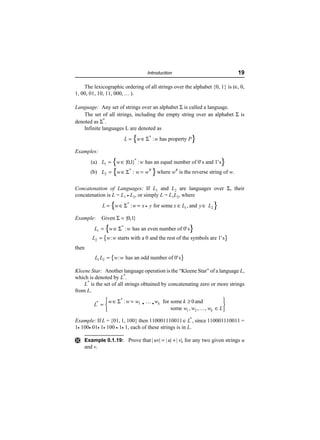
Alphabet: It is defined as a finite set of symbols.
     Example: Roman alphabet {a, b, ...... z}.
     “Binary Alphabet” {0, 1} is pertinent to the theory of computation.

String: A “string” over an alphabet is a finite sequence of symbols from that
alphabet, which is usually written next to one another and not separated by
commas.
        (i) If Σ a = {0, 1} then 001001 is a string over Σ a .
       (ii) If Σ b = {a, b, K , z ) then axyrpqstcd is a string over Σ b .

Length of String: The “length” of a string is its length as a sequence. The
length of a string w is written as |w|.
     Example: |10011| = 5

Empty String: The string of zero length is called the “empty string”. This is
denoted by ∈.
    The empty string plays the role of 0 in a number system.

Reverse String: If w = w1 w2 K wn where each wi ∈ Σ, the reverse of w is
wn wn −1 L w1 .

Substring: z is a substring of w if z appears consecutively within w.
    As an example, ‘deck’ is a substring of ‘abcdeckabcjkl’.

Concatenation: Assume a string x of length m and string y of length n, the
concatenation of x and y is written xy, which is the string obtained by
appending y to the end of x, as in x1 x 2 K x m y1 y2 K yn .
    To concatenate a string with itself many times we use the “superscript”
notation:
                                 6 74
                                  4k 8
                                 x x K x = xk

Suffix: If w = xv for some x, then v is a suffix of w.

Prefix: If w = vy for some y, then v is a prefix of w.

Lexicographic ordering: The Lexicographic ordering of strings is the same as
the dictionary ordering, except that shorter strings precede longer strings.
Introduction                                      19

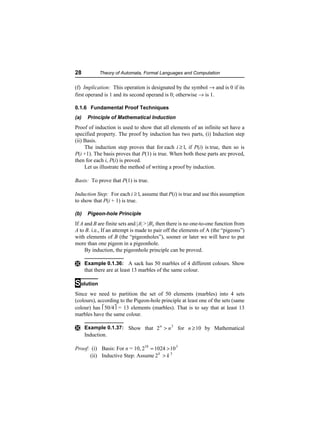
    The lexicographic ordering of all strings over the alphabet {0, 1} is (∈, 0,
1, 00, 01, 10, 11, 000, K ).

Language: Any set of strings over an alphabet Σ is called a language.
    The set of all strings, including the empty string over an alphabet Σ is
denoted as Σ*.
    Infinite languages L are denoted as

                               {
                       L = w ∈ Σ * : w has property P        }
Examples:

                  {
       (a) L1 = w ∈ {01}* : w has an equal number of 0' s and 1' s
                      ,                                                     }
       (b) L2   = {w ∈ Σ   *
                               : w= w   R
                                            } where w
                                                    R
                                                        is the reverse string of w.

Concatenation of Languages: If L1 and L2 are languages over Σ, their
concatenation is L = L1 • L2, or simply L = L1L2, where

                  {
             L = w ∈ Σ * : w = x • y for some x ∈ L1 , and y ∈ L2       }
Example: Given Σ = {0, 1}

              {
         L1 = w ∈ Σ * : w has an even number of 0' s        }
        L2 = {w : w starts with a 0 and the rest of the symbols are 1' s}
then
         L1 L2 = {w : w has an odd number of 0' s}

Kleene Star: Another language operation is the “Kleene Star” of a language L,
which is denoted by L*.
    L* is the set of all strings obtained by concatenating zero or more strings
from L.
              w ∈ Σ * : w = w1 • K • wk for some k ≥ 0 and           
        L* =                                                         
                                            some w1 , w2 , K , wk ∈ L

Example: If L = {01, 1, 100} then 110001110011 ∈ L* , since 110001110011 =
1• 100• 01• 1• 100 • 1• 1, each of these strings is in L.

Ì Example 0.1.19: Prove that | uv| = | u| + | v|, for any two given strings u
    and v.
20          Theory of Automata, Formal Languages and Computation


Solution
For all a ∈ Σ′ and w any string on Σ, we make a recursive definition as
                                  | a| = 1, | wa| = | w| + 1
     With this formal definition, we can prove
                                     | uv| = | u| + | v| .
    By this definition made, | uv| = | u| + | v| holds for all u of any length and v of
length 1, which is the basis.
    Let us assume v of length n + 1 and we write it as
                                           v = wa.
     Therefore we have, | v| = | w| + 1,
                                | uv| = | uwa| = | uw| + 1
     But by inductive hypothesis,
                                      | uw| = | u| + | w|
so that
                            | uv| = | u| + | w| +1 = | u| + | v|
     Hence for all u and all v of length upto n +1, we have
                                       | uv| = | u| + | v|
which is the inductive step.

Ì Example 0.1.20: Use induction on to show that | u n | = n | u| for all
     strings u and all n.

Solution
Basis: For n = 1, |u1| = |u| = l (assume)
                                   n| u| = 1| u| = | u| = 1
Inductive Hypothesis: Let us assume that it is true for n.
                                        | u n | = n| u|.
Inductive Step:             | u n +1 | = | u n • u1 | = | u n | + | u|
                                                      = n| u| + | u|
                                                      = ( n + 1)| u|

which is the required Inductive step to be proved.
Hence we have | u n | = n| u|.
Introduction                            21

Ì Example 0.1.21: The reverse of a string is defined by the recusive rules
                                        a R = a,
                                     (wa ) R = aw R

for all a ∈ Σ, w ∈ Σ * . Using this prove that

                                     ( uv ) R = v R u R

for all u, v ∈ Σ + .

Solution
Given that aR = a,
                                     ( wa ) R = aw R .

Now we have to prove ( uv ) R = v R u R .
Let us assume that u = wb and v = wa.
                       LHS = (uv ) R = ( wbwa ) R =       bw R ⋅ aw R
                                                  =       ( bw R )( aw R )
                                                  =       ( bw) R ( aw) R
                                                  =       v R ⋅ u R = RHS

Hence proved.

Ì Example 0.1.22: Given Σ = {a, b} obtain Σ*.

        (a) Give an example of a finite language in Σ.
                             {             }
        (b) Given L = a n b n : n ≥ 0 , check if the strings aabb, aaaabbbb,
              abb are in the language L.

Solution
                                        Σ = {a, b}
Therefore we have Σ * = {λ , a, b, aa, ab, ba, bb, aaa, }

        (a) {a, aa, aab} is an example of a finite language in Σ.
               (i) aa bb → a string in L. (n = 2)
              (ii) aaaa bbbb → a string in L. (n = 4)
             (iii) abb → not a string in L (since there is no n satisfying this).
22            Theory of Automata, Formal Languages and Computation


Ì Example 0.1.23: Given L =              {a    b :n ≥ 0
                                              n n
                                                          }
                  2       R
     obtain (a) L (b) L .

Solution
              {
Given L = a n b n : n ≥ 0     }
                      {
        (a) L2 = a n b n a m b m : n ≥ 0, m ≥ 0     }
            where n and m are unrelated.
            For example, the string aabbaaabbb is in L2.
        (b) Reverse of L is given by

                                        {
                                   LR = b n a n : n ≥ 0  }
Ì Example 0.1.24: Let L = {ab, aa, baa}. Which of the following strings
     are in L*.
        (a)   abaabaaabaa
        (b)   aaaabaaaa
        (c)   baaaaabaaaab
        (d)   baaaaabaa

Solution
Please note that L* is the “star-closure” of a language L, given by
                                  L* = L0 ∪ L1 ∪ L2 KK

and L+ is the “positive closure” defined by
                                    L+ = L1 ∪ L2 KK

        (a) ab aa baa ab aa → This string is in L*
        (b) aa aa baa aa → This string is in L*
        (c) baa aa ab aa aa b or baa aa ab aa a ab
                           ↑                      ↑
                     ( undefined )         ( undefined )
                                      This string is not in L*.
        (d) baa aa ab aa → This string is in L*.

Ì Example 0.1.25: Given L =              {a   n n +1
                                               b       : n≥0 .}
                          *
     It is true that L = L for the given language L?
Introduction                      23

Solution
We know L* = L0 ∪ L1 ∪ L2 KK
    and L+ = L1 ∪ L2 ∪ L3 KK
                           {                  }
    Now for given L = a n b n +1 : n ≥ 0 , we have

                                 L0 = a 0 b 0+1 = b
                                 L1 = a 1 b1 +1 = ab 2
                                 L2 = a 2 b 2+1 = a 2 b 3 .
                                 KKK
                                 KKK

Therefore, we have             L* = L0 ∪ L1 ∪ L2 KK
                                  = b ∪ ab 2 ∪ a 2 b 3 KK
Hence it is true that L = L*.

Ì Example 0.1.26: Given u = a 2 ba 3 b 2 and u = bab 2 , obtain

         (a)   uv              (e)   ||u||         (i)   ||v2||
         (b)   vu              (f)   ||v||         (j)   ||u2||
         (c)   v2              (g)   ||uv||
         (d)   u2              (h)   ||vu||

Solution
       (a) uv = ( a 2 ba 3 b 2 )(bab 2 ) = a 2 ba 3 b 3 ab 2
       (b) vu = ( bab 2 )( a 2 ba 3 b 2 ) = bab 2 a 2 ba 3 b 2
       (c) v 2 = vv = ( bab 2 )(bab 2 ) = bab 3 ab 2
       (d) u 2 = uu = ( a 2 ba 3 b)( bab 2 ) = a 2 ba 3 b 2 ab 2
       (e) ||u|| = 8 (as there are 8 letters in the word u)
        (f) ||v|| = 4
       (g) ||uv|| = 12
       (h) ||vu|| = 12
        (i) ||v2|| = 8
        (j) ||u2|| = 11

Ì Example 0.1.27: For any word u and v, prove that
       (a) ||uv|| = ||u|| + ||v||
       (b) ||uv|| = ||vu||.

Proof: (a) Let us assume ||u|| = m and ||v|| = n. Therefore uv will have ‘m’
           letters of u followed by ‘n’ letters of v.
24          Theory of Automata, Formal Languages and Computation

             Therefore we have
                             || uv|| = m + n =|| u|| + || v||.

        (b) Now,      || uv|| = | u|| + || v|| (from (a))
                    ⇒         = || v|| + || u||
                    ⇒ || uv|| = || vu||.

                                                                             ¨

Ì Example 0.1.28: Given A = {a, b, c}, find L* where
     (i) L = {b2} (ii) L = {a, b} (iii) L = {a,b, c3}

Solution
         (i) For L = {b2}, L* has all words bn, where n is even (including the
             empty word λ).
        (ii) For L = {a, b}, L* has words in a and b.
       (iii) For L = {a, b, c 3 }
L* has all words from A = {a, b, c} with the length of each maximal subword
composed entirely of C’s is divisible by 3.

Ì Example 0.1.29: For the language L = {ab, c} over the set A = {a, b, c}.
     Find (a) L3 (b) L–2 (c) L0.

Solution
        (a) For L = {ab, c}, we have
          L3 = All 3 - word sequences from L
                {
             = ababab, ababc, abcab, abc 2 ,cabab,cabc,c 2 ab,c 3        }
        (b) L–2 is “Not defined” as negative power of a language is not
            defined.
        (c) L0 = {λ}, where λ is empty word.

Ì Example 0.1.30: Given L1 = {a, ab, a2} and L2 = {b2, aba} are the
     languages over A = {a, b}, determine {a} L1L2 (b) L2L2.

Solution:
        (a) To find L1L2, we concatenate words in L1 with words in L2 so that

                         {                                           }
                 L1 L2 = ab 2 , a 2 ba, ab 3 , ababa, a 2 b 2 , a 3 ba
Introduction                           25

       (b) To find L2L2, we concatenate words in L2 with words in L2 so that

                               {
                    L2 L2 = b 4 , b 2 aba, abab 2 , aba 2 ba                       }
Ì Example 0.1.31: Find (i) uvu (ii) λu, uλ, uλv given u = a2b and v =
    b3ab.

Solution
       (i) uvu = ( a b)( b ab)( a b)
                    2      3     2

               = a 2 b 4 aba 2 b
       (ii) We know that λ is an empty word. Therefore we have
                            λu = uλ = u = a 2 b
                           uλv = uv = ( a 2 b)( b 3 ab)
                                    = a 2 b 4 ab

Ì Example 0.1.32: Given A = {a, b, c} check if L1, L2, L3 and L4 are all
    languages over the alphabet A., where
                          L1   =       {a, aa, ab, ac, abc, cab}
                          L2   =       {aba, aabaa}
                          L3   =       { }
                          L4   =       {a i cb i ≥ 1}

Solution
All the languages L1, L2, L3 and L4 are defined over the alphabet A.

Ì Example 0.1.33:

       (a) Given L1 =     {a b i > j ≥ 1} and
                               i       j


                   L2   = {a b 1 ≤ i < j} find L ∪ L .
                               i           j
                                                                   1       2

       (b) Given L3     = {a b c i, j ≥ 1 and
                               i       i
                                         }      j


                   L4   = {a b c i, j ≥ 1 find L ∩ L .
                               i
                                         } j        j
                                                                       3       4


Solution
       (a) L1 ∪ L2 =   {a bi       j
                                                        } {
                                               i > j ≥1 ∪ a ib j 1 ≤ i < j             }
                     = {a bi       j
                                               i ≠ j, i, j ≥ 1}
26             Theory of Automata, Formal Languages and Computation


       (b) L3 ∩ L4 =          {a b c
                                   i   i   j
                                                      } {
                                               i, j ≥ 1 ∩ a i b j c j i, j ≥ 1        }
                            = {a b c
                                   i   i i
                                                  }
                                               i ≠1

Ì Example 0.1.34: Given L1 is English language and L2 is French
     language, what do you mean by (a) L1 ∪ L2 and L1 ∩ L2 .

Solution
       (a) L1 ∪ L2 = Set of all sentences someone who speaks both English
           and French can recognize.
       (b) L1 ∩ L2 = Language that contains all the sentences that are in both
           L1 and L2.

Ì Example 0.1.35: Given A = {a, b, c}, B = {b, c, d} and

          L1 =   {a b
                    i   j
                            i ≥ 1, j ≥ 1 , }            L2 =   {b c i ≥ j ≥ 1}
                                                                  i   j


          L3   = {a b
                    i   j
                                                 }
                            c i d j i ≥ 1, j ≥ 1 ,      L4   = {( ad ) a d i ≥ 2, j ≥ 1
                                                                          i   j   j
                                                                                       }
     Determine whether each of the following statements is true or false.
        (a)    L1 is a language over A.
        (b)    L1 is a language over B.
        (c)    L2 is a language over A ∪ B.
        (d)    L2 is a language over A ∩ B.
        (e)    L3 is a language over A ∪ B.
         (f)   L3 is a language over A ∩ B.
        (g)    L4 is a language over A ⊕ B.
        (h)    L1 is a language over A – B.
         (i)   L1 is a language over B – A.
         (j)   L1 ∪ L2 is a language over A.
        (k)    L1 ∪ L2 is a language over A ∪ B.
         (l)   L1 ∪ L2 is a language over A ∩ B.
       (m)     L1 ∩ L2 is a language over B.
        (n)    L1 ∩ L2 is a language over A ∪ B.
        (o)    L1 ∩ L2 is a language over A ∩ B.

Solution
From the given sets A and B, we have
                                       A ∪ B = {a, b, c, d}
                                       A ∩ B = {b, c}
                                       A − B = {a}
                                       B − A = {d}.
Introduction                               27

Hence we conclude the following
    (a) True (b) False (c) True (d) True (e) True (f) False
    (g) True (h) False (i) False (j) True (k) True (l) False
    (m) True (n) True (o) True.

0.1.5 Boolean Logic
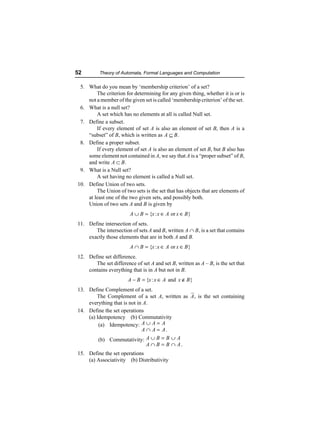
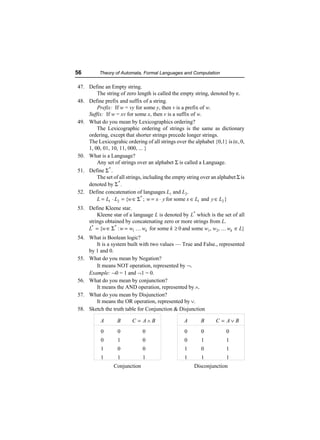
“Boolean logic” is a system built with two values TRUE and FALSE.
“Boolean values” are represented by values 0 and 1. There are many Boolean
operations.

(a) Negation: It means the NOT operation, represents by ¬.
Example: ¬ 0 = 1 and ¬ 1 = 0.

(b) Conjunction: It means the AND operation, represented by ∧.

(c) Disjunction: It means the OR operation, represented by ∨
    The truth tables of the above Boolean operations are shown as below:

   A       B         C = A∧ B                       A   B        C = A∨ B
   0       0            0                           0   0           0
   0       1            0                           0   1           1
   1       0            0                           1   0           1
   1       1            1                           1   1           1
               AND                                          OR

(d) Exclusive-OR operation: 1 if either but not both of its operands are 1.
Exclusive-OR is denoted by ⊕.

                        A        B        C = A⊕B
                         0        0             0
                         0        1             1
                         1        0             1
                         1        1             0
                                Exclusive-OR

(e) Equality: The equality operation, written with the symbol ↔, is 1 if both
its operands have the same value.
28           Theory of Automata, Formal Languages and Computation


(f) Implication: This operation is designated by the symbol → and is 0 if its
first operand is 1 and its second operand is 0; otherwise → is 1.

0.1.6 Fundamental Proof Techniques
(a)    Principle of Mathematical Induction
Proof of induction is used to show that all elements of an infinite set have a
specified property. The proof by induction has two parts, (i) Induction step
(ii) Basis.
     The induction step proves that for each i ≥ 1, if P(i) is true, then so is
P(i +1). The basis proves that P(1) is true. When both these parts are proved,
then for each i, P(i) is proved.
     Let us illustrate the method of writing a proof by induction.

Basis: To prove that P(1) is true.

Induction Step: For each i ≥ 1, assume that P(i) is true and use this assumption
to show that P(i + 1) is true.

(b)    Pigeon-hole Principle
If A and B are finite sets and |A| > |B|, then there is no one-to-one function from
A to B. i.e., If an attempt is made to pair off the elements of A (the “pigeons”)
with elements of B (the “pigeonholes”), sooner or later we will have to put
more than one pigeon in a pigeonhole.
     By induction, the pigeonhole principle can be proved.

Ì Example 0.1.36: A sack has 50 marbles of 4 different colours. Show
      that there are at least 13 marbles of the same colour.

Solution
Since we need to partition the set of 50 elements (marbles) into 4 sets
(colours), according to the Pigeon-hole principle at least one of the sets (same
colour) has 50/4 = 13 elements (marbles). That is to say that at least 13
marbles have the same colour.

Ì Example 0.1.37: Show that 2 n > n 3 for n ≥ 10 by Mathematical
      Induction.

Proof: (i) Basis: For n = 10, 210 = 1024 > 10 3
      (ii) Inductive Step: Assume 2 k > k 3
Introduction                                            29

Now,
                                                                  3
                                                     1
                               2 k +1 = 2 ⋅ 2 k > 1 +  ⋅ 2 k
                                                   10 
                                                                 3
                                                           1
                                                    ≥ 1 +     ⋅2
                                                                     k
                                                           k 
                                                                 3
                                                       1
                                                    ≥ 1 +  ⋅ k 3
                                                       k
                                                          ( k + 1) 3
                                                    ≥ k3
                                                              k3
                                           2 k +1   ≥ ( k + 1) 3 .

Hence 2 n > n 3 for n ≥ 10.                                                                         ¨

Ì Example 0.1.38: Prove that for every integer n ≥ 0, the number
    4 2 n+1 + 3 n + 2 is a multiple of 13.

Proof: We use induction on n, starting with n = 0.
                         P (0) = 4 2 (0) +1 + 3 (0) + 2 = 4 + 3 2 = 13(1)                           (1)

Assume             P ( k ) = 4 2 k +1 + 3 k + 2 = 13t, for some integer t.                          (2)

We need to prove that
                  P ( k + 1): 4 2 (k +1) +1 + 3 (k +1) + 2 is a multiple of 13.

Now,
         4 2 (k +1) +1 + 3 (k +1) + 2 = 4 (2 k +1) + 2 + 3 (k + 2) +1
                                      = 4 2 ( 4 2 k +1 ) + 4 2 (3 k + 2 − 3 k + 2 ) + 3 ⋅ 3 k + 2

                          = 4 2 ( 4 2k +1 + 3 k + 2 ) + 3 k + 2 (−4 2 + 3)
                          = 16(13t ) + 3 k + 2 ( −13) [from (2)]
                          = 13[16t − 3 k + 2 ]                                                      (3)

From (3) it follows that P(k+1) is a multiple of 13. Hence we have,
4 2 n+1 + 3 n + 2 is a multiple of 13.                          ¨

Ì Example 0.1.39: Show that for any integer n ≥ 0, (11) n+ 2 + (12) 2 n+1 is
    divisible by 133.

Proof: Basis: When n = 0, 112 + 121 = 133 is divisible by 133.
30          Theory of Automata, Formal Languages and Computation

Inductive Hypothesis: When n = k.
                                 11k + 2 + 12 2k +1 = 133 p

Inductive Step: When n = k + 1
                  11k + 3 + 12 2k + 3 = 11 • 11k + 2 + 12 2 k + 3
                                      = 11(133 p − 12 2 k +1 ) + 12 2k + 3
                                      = 133(11 p) − 12 2k +1 (11 − 12 2 )
                                      = 133(11 p + 12 2 k +1 )
Hence it is true for n ≥ 0.                                                   ¨

Ì Example 0.1.40: It is known that for any positive integer n ≥ 2,
                               1     1       1
                                  +      +L    − A >0
                              n +1 n + 2    2n
where A is a constant. How large can A be?

Solution
Let the value of A be x.
                           1 1                                 7
                     n = 2, + − x > 0               Assume x < 
                           3 4                                12 
Inductive Hypothesis:
                                     1    1         1
                     For n = k ,       +      +L +    − x >0
                                   k +1 k + 2      2k
Inductive Step:
                                      1    1          1
                   For n = k+1,         +     +L+           −x
                                    k +2 k +3     2( k + 1)

          1      1       1      1      1      1
        =     +      +L+  +         +      −      −x
          k +1 k + 2    2 k  2 k + 1 2k + 2 k + 1
                                                                      1 
                                            Adding and substracting      
                                                                    k + 1
                                                                              (1)
        =0

                   1         1        1
But                k + 1 + k + 2 + L 2k  = x + p ( p - positive)
                                        
Introduction                                31

From (1), we have
    1         1         1                       1        1        1
    k + 2 + k + 3 + L 2k + 2 − x  = (x + p) + 2k + 1 + 2k + 2 − k + 1 − x
                                 
                                            1         1
                                    = p+         −
                                          2k + 1 2 k + 2
                                                 1
                                    = p+
                                          (2k + 1)(2k + 2)

    Hence the value of x is increasing for increase in n.
                                                    7
                         ⇒ Maximum value of A <       .
                                                   12

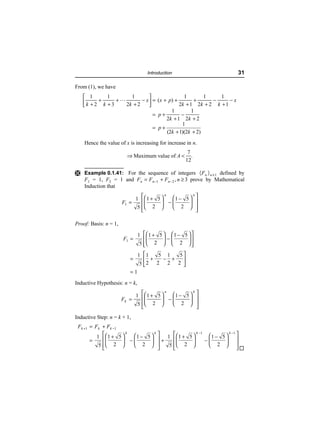
Ì Example 0.1.41: For the sequence of integers 〈 Fn 〉 n ≥ 1 defined by
    F1 = 1, F2 = 1 and Fn = Fn−1 + Fn− 2 , n ≥ 3 prove by Mathematical
    Induction that

                            1 1 + 5    1 − 5  
                                        n         n

                       F1 =          −        
                             5  2       2  
                                                   

Proof: Basis: n = 1,

                               1 1 + 5  1 − 5  
                       F1 =             −     
                                5  2   2  
                                                   
                               1 1   5 1  5
                          =        +  − +  
                                5 2 2 2 2 
                          =1
Inductive Hypothesis: n = k,

                              1 1 + 5    1 − 5  
                                          n         k

                       Fk =            −        
                               5  2       2  
                                                     
Inductive Step: n = k + 1,
 Fk +1 = Fk + Fk −1
          1 1 + 5    1 − 5   1 1 + 5        1 − 5  
                      k         k              k −1          k −1

       =           −        +              −       
           5  2       2       5  2           2  
                                                               ¨
32          Theory of Automata, Formal Languages and Computation


Ì Example 0.1.42: Show that any positive integer, n ≥ 2 is either a prime
     or a product of primes.

Proof: Basis: n =2 is a prime.
Inductive Hypothesis: For n = k, k is either a prime or a product of primes.
Inductive Step: For n = k + 1, if k + 1 is prime the given statement is true else,
                                k + 1 = pq, p, q < k
                          ⇒ k + 1 is a product of primes.
                                                                                    ¨

Ì Example 0.1.43: Prove by Mathematical Induction, for n ≥ 1,
                               n
                                         n( n + 1)( n + 2)
                              ∑k2 =              6
                              k =1


                                         n( n + 1)(2n + 1)
Proof: Let P ( n) = 12 + 2 2 + L n 2 =
                                                 6
Basis: For n = 1, P(1) = 12 = 1 (on calculating LHS)
                                 1(1 + 1)(2 + 1) (1)(2)(3)
                  RHS = P (1) =                 =          =1
                                        6            6
Therefore P(1) is true.

Inductive Hypothesis:
                                              k ( k + 1)(2k + 1)
               P ( K ) = 12 + 2 2 + L k 2 =                      is true.
                                                       6

Inductive Step: We claim that
                                                ( k + 1)( k + 2)(2k + 3)
       P ( K + 1) = 12 + 2 2 + L+( k + 1) 2 =                            is true.
                                                            6
Now,
          11 + 2 2 +L+k 2 + ( k + 1) 2 = (11 + 2 2 + L + k 2 ) + ( k + 1) 2
                                         k (k + 1) (2k + 1)
                                       =                    + (k + 1) 2
                                                  6
                                                       (Q P (k ) is true )
                                         k (k + 1) (2k + 1) + 6( k + 1) 2
                                       =
                                                        6
                                         ( k + 1)[2k 2 + 7k + 6]
                                       =
                                                     6
Introduction                         33

                                   ( k + 1) ( k + 2) (2k + 3)
                               =
                                                6
                      ⇒ P(k+1) is true.
Thus we have, if P(k) is true, P(k+1) is also true. By principle of Mathematical
Induction, we have
                                         n( n + 1)(2n + 1)
                        ∑ k =1 k 2 =
                           n
                                                           , n ≥1
                                                 6                           ¨

Ì Example 0.1.44: Prove that 2 n > n, for all n ∈ N , by using Mathematical
    Induction.

Proof: Let P ( n) = 2 n − n > 0.
Basis: For n = 1, P(1) = 21 – 1 = 2 – 1 = 1 > 0.
Therefore P(1) is true.

Inductive Hypothesis: Let us assume that P(k) is true. Here we have k as a
positive integer.
                                      ⇒ 2 k − k is positive integer
                                      ⇒ 2k − k = m                          (1)
Inductive Step: To prove that P(k + 1) is also positive. Let us consider
2 k +1 − ( k + 1).
      We have
                  2 k +1 − (k + 1) =    2(2) k − k − 1
                                   =    2( k + m) − k − 1
                                   =    k + 2m − 1
                                   =    positive (Q m is positive)

              ⇒ If P(k) is true, P(k + 1) is also true.
Hence by Mathematical Induction, P(n) is true, i.e.,
                          2 n − n > 0 ⇒ 2 n > n, ∀ n ∈ N                     ¨

Ì Example 0.1.45: A wheel of fortune has the numbers from 1 to 36
    painted on it in at random. Prove that irrespective of how the numbers are
    situated, three consecutive numbers total 55 or more.

Solution
Let n1 be any number on the wheel.
34           Theory of Automata, Formal Languages and Computation

      Counting clockwise from n1, label the other numbers n2 , n3 , KK , n36 .
      For the result to be false, we should have
                                 n1 + n2 + n3 < 55,
                                 n2 + n3 + n4 < 55,
                                 LLL
                                 LLL
                                 n34 + n35 + n36 < 55,
                                 n35 + n36 + n1 < 55,
                                 n36 + n1 + n2 < 55.

    In all the inequalities above, the terms n1, n2, n3, ...... appear exactly three
times.
    Therefore adding the 36 inequalities we get

                      3∑ j =1 n j = 3∑ j =1 j < 36(35) = 1980.
                          36              36


                               ∑ j =1 j = (36)(37) = 666.
                                  36
But

But this gives the contradiction that
                               1998 = 3 (666) < 1980.

Ì Example 0.1.46: Prove by induction,
                                                    n( n + 1)(2n + 1)
                 1.3 + 2.4 + 3.5 + L n ( n + 2) =
                                                            6

Proof:
                                          (1)(2)(9)
Basis:                            1.3 =             =3
                                              6
This result is true for n = 1.

Inductive Hypothesis: Assume that the result is true for n = k ( ≥ 1).
i.e.,
                                              k (k + 1)(2k + 7)
              1.3 + 2.4 + 35 + L k ( k + 2) =
                           .
                                                      6

Inductive Step: For n = k + 1,
                     [1.3 + 2.4 + L k ( k + 2)] + ( k + 1)( k + 3)
                       k ( k + 1)(2k + 7) 
                    =                      + ( k + 1)( k + 3)
                                6         
Introduction               35

                            ( k + 1)
                          =          [ k (2k + 7) + 6(k + 3)]
                                6
                            ( k + 1)(2k 2 + 13k + 18)
                          =
                                           6
                            ( k + 1)( k + 2)(2k + 9)
                          =
                                          6
Hence the result follows for all n ∈ Z + , by the principle of Mathematical
induction.                                                              ¨

Ì Example 0.1.47: Prove by induction
                                                     1         n
                                   ∑ i=1 i(i + 1) = n + 1
                                            n


                                      1       n
Proof: Assume S ( n): ∑ i=1
                           n
                                           =     .
                                  i( i + 1) n + 1
For n = 1,
                                                     1         1    1
                                   ∑ i=1 i(i + 1) = 1(2) = 1 + 1
                                            1
                      S (1) =
                               ⇒ S (1) is true.
                                                    1       k
                      S ( k ): ∑ i =1
                                        k
Assume                                                   =      is true.
                                                i( i + 1) k + 1

Now consider S (k + 1).
                   k +1       1                          1           1
                ∑ i=1 i(i + 1) = ∑ i=1 i(i + 1) + (k + 1) (k + 2)
                                                 k


                                         k             1
                                    =          +
                                      (k + 1) (k + 1) ( k + 2)
                                      [k ( k + 2) + 1]
                                    =
                                      (k + 1) ( k + 2)
                                      k +1
                                    =
                                      k +2
Therefore, S(k) ⇒ S(k + 1). Hence the result follows by Mathematical
Induction.

Ì Example 0.1.48: Prove by induction for n ∈ z + ,

                                     n > 4 ⇒ n2 < 2n

Proof: For n = 5, 25 = 32 > 25 = 52.
36          Theory of Automata, Formal Languages and Computation

Assume the result for n = k ( ≥ 5):
                                        2k > k2.
For k > 3, we have
                           k ( k − 2) > 1
                         ⇒ k 2 > 2k + 1
                         ⇒ 2k > k 2
                         ⇒ 2k + 2k > k 2 + k 2
                         ⇒ 2 k +1 > k 2 + k 2 > k 2 (2k + 1)
                         ⇒ 2 k +1 > (k + 1) 2
Hence the result is true for n ≥ 5 by the principle of Mathematical Induction.
                                                                            ¨

Ì Example 0.1.49: Given S (n) as the statement
                                                      2
                                              1 
                                         n +  2  
                                               
                                         
                                ∑ i=1 i = 2
                                  n
                                                      .

Prove that the truth of S(k) implies the truth of S(k + 1) by Mathematical
induction.

Proof: Assume S(k). For S(k + 1), we have
                                             2
                                                 
                       k +1
                     ∑ i=1         k +  1   2 + (k + 1)
                              i =      
                                         2    
                                               
                                               1          
                               =  k 2 + k +   + 2k + 2 2
                                               4          
                                                          1
                               =  ( k + 1) 2 + (k + 1) +    2
                                                          4 
                                              1 
                                                   2
                               =  ( k + 1) +    2
                                              2 
                                                    
Therefore S (k ) ⇒ s( k + 1).                                              ¨

Ì Example 0.1.50: Show that if we select 151 distinct computer
     engineering courses numbered between 1 and 300 inclusive, at least two
     are consecutively numbered (using Pigeonhole Principle).
Introduction                                37

Solution
Let the selected course numbers be
                                k1 , k 2 , KK k151                             (1)
    The 302 numbers consisting of (1) together with
                           k1 + 1, k 2 + 1, KK k151 + 1                        (2)
range in value between 1 and 301. By Pigeonhole principle, at least two of
those values coincide. The numbers (1) are all distinct and so the numbers (2)
are also distinct.
     It must be then that one of (1) and one of (2) are equal. Therefore we have
                                   ki = k j +1
and course ki follows course kj.

Ì Example 0.1.51: Suppose there are 50 marbles of four different colours
    in a sack, if exactly 8 marbles are red, show that there are at least 14 of the
    same colour.

Solution
If we know that 8 of the marbles are red, then no other marbles could be red,
and we need to partition the rest (50 – 8) = 42 marbles into the rest (4 – 1) = 3
colours.
    According to the Pigeon-hole principle, there are at least 42/3 = 14
marbles, which must have the same colour.

0.1.7 Introduction to Grammar
Grammar is a mechanism to describe the languages.
   A grammar (G) is defined as a quadruple
                                G = (V, T, S, P)
where
V       =     Finite set of objects called VARIABLES
T       =     Finite set of objects called TERMINAL SYMBOLS
S ∈V    =     Start variables
P       =     Finite set of Productions.
A production rule P is of the form
                                     x→ y
Given a string w, of the form w = uxv, we can use the production rule x → y and
obtain a new string z = uyv.
38          Theory of Automata, Formal Languages and Computation

    The set of all strings obtained by using Production rules is the “Language”
generated by the Grammar.
     If the grammar G = (V, T, S, P) then
                          L(G ) = {w ∈ T * : S ⇒ w}
                                               *


     If W ∈ L(G ), then the sequence
                      S ⇒ w1 ⇒ w2 ⇒ w3 KK ⇒ wn ⇒ w
is a “derivation” of the sentence w.
    The string S , w1 , w2 , KK wn , which contain variables as well as
terminals, are called “SENTENTIAL FORMS” of the derivation.

Ì Example 0.1.52: Given a Grammar G = ({S }, {a, b}, S , P )
     with P defined as
                                    S → aSb,
                                    S→λ

     (i) Obtain a sentence in language generated by G and the sentential form
     (ii) Obtain the language L(G).

Solution
                                  S ⇒ aSb
                                    ⇒ aaSbb
                                    ⇒ aabb
Therefore we have S ⇒ aabb .
                    *


         (i) Sentence in the language generated by G = aabb.
             Sentential form = aaSbb.
        (ii) The rule S → aSb is recursive.
     All sentential forms will have the forms
                                  wi = a i S b i
     Applying the production rule S → aSb, we get
                             a i S b i ⇒ a i +1 S b i+1
This is true for all i.
     In order to get a sentence we apply S → λ.
Therefore we get
                            S ⇒ a n S bn ⇒ a n bn
                              *
Introduction                             39

Therefore                             {
                             L(G ) = a n b n ; n ≥ 0 .}
Ì Example 0.1.53: Obtain a Grammar which generates the language

                                  {
                              L = a n b n+1 : n ≥ 0}
Solution
            {           }
With L = a n b n : n ≥ 0 , the grammar

                             G = ({S }, {a, b}, S , P )
with production rules S → aSb, S → λ.
                    {              }
    Therefore L = a n b n+1 : n ≥ 0 is obtained by generating an extra b.
    This is done with a production rule
                                     S → Ab.
Hence the grammar G is given by
            G = ({S , A}{a, b}, S , P ) with production rules given by
                                    S → Ab,
                                    A → aAb
                                    A→ λ

Ì Example 0.1.54: Obtain the language L produced by G with production
    rules
                                    S → SS ,
                                    S→λ
                                    S → aSb
                                    S → bSa

Solution
It is known from the given production rules that G has equal number of a’s and
b’s.
      If w starts with an ‘a’ and ends with a ‘b’, then w ∈ L has the form
                                    w = a w1 b
where w1 ∈ L.
   If w starts with a ‘b’ and ends with an ‘a’ then w ∈ L has the form
                                    w = b w1 a
where w1 ∈ L..
40         Theory of Automata, Formal Languages and Computation

    As a string in L can begin and end with the same symbol, the string shoud
be of the form
                                    w = w1 w2
where w1 and w2 are in L, produced by S → SS.
   This generates the language
                            L = {w : na ( w) = nb ( w)}
where na(w) and nb(w) denotes the number of a’s and number of b’s in the
string w, respectively.

Ì Example 0.1.55: Given G1 = ({A, S }, {a, b}, S , P1 ) with P1 defined by
     the production rules
                                   S → aAb | λ
                                   A → aAb | λ

                   {               }
show that L(G1 ) = a n b n : n ≥ 0 .
     Also show that G1 is equivalent to G where G = ({S }, {a, b}, S , P ) where P
is given by
                                     S → aSb
                                     S → λ.

Solution
Given P1 as
                                     S → aAb
                                     S→λ
                                     S → aAb
                                     A → λ.

              S → λ produces a string with zero length. (n = 0)
                 S ⇒ aAb                 S ⇒ aAb
                   ⇒ aλb                   ⇒ aaAbb
                   ⇒ ab                    ⇒ aabb
                                           ⇒ a 2 b2 and so on

Therefore L(G1) = {an bn : n ≥ 0}.
Given G = ({S }, {a, b}, S , P ) where P is S → aSb, S → λ.
   The rule S → aSb is recursive.
   All sentential forms will have the forms
                                   wi = a i S b i
Introduction                        41

    Applying the production rule S → aSb, we get
                             a i S b i ⇒ a i +1 S b i+1

This is true for all i.
    In order to get a sentence we apply S → λ.
Therefore we get
                            S ⇒ a n S bn ⇒ a n bn
                              *


Hence                                 {
                            L(G ) = a n b n : n ≥ 0   }
Hence G1 is equivalent to G as both the grammars are given by
{             }
 a n bn : n ≥ 0 .

Ì Example 0.1.56: Given a grammar G defined by the production rules
                                      S → AB
                                      A → Aa
                                      B → Bb
                                      A→ a
                                      B → b.

Show that the word            w = a 2 b 4 ∈ L(G ),

where L is a language determined by G.

Solution
                                 S ⇒ AB
                                   ⇒ AaB
                                   ⇒ aaB
                                   ⇒ aaBb
                                   ⇒ aaBbb
                                   ⇒ aaBbbb
                                   ⇒ aabbbb
                                   ⇒ a 2 b4

Hence the word w = a 2 b 4 ∈ L(G ).

Ì Example 0.1.57: Find grammars for Σ = {a, b} that generate the sets of
        (a) all strings with exactly one ‘a’
        (b) all strings with at least one ‘a’
        (c) all strings with no more than three a’s.
42         Theory of Automata, Formal Languages and Computation


Solution
       (a) Given Σ = {a, b}
           We are able to write the grammar G which produces all strings
           with exactly one ‘a’ whose production rules are
                                     A → aSb
                                     S → Sb
                                     S →∈
       (b) For all strings with at least one ‘a’: Production rules of Grammar
           C are
                                     A → aSb
                                     S → bSa
                                     S →∈
       (c) For all strings with no more than three a’s
                         L=   {a b
                                 n m
                                          n ≤ 3, m ≥ 0}
            with production rules
                                    A → aSb
                                    S → aBb
                                    B → aCb
                                    C → bC
                                    C → b |∈.

Ì Example 0.1.58: Give a simple description of the language generated
     by the grammar with productions
                    ( a ) S → aA ,              ( b ) S → Aa ,
                          A → bS ,                    A→ B
                          S→λ                         B → Aa.

Soution
       (a) For the given production rules
                                 S → aA
                                 A → bS
                                 S→λ
            we have the language L given by

                            L=   {a   n
                                          bn n ≥1 }
       (b) For the given production rules
                                     S → Aa
Introduction                              43

                                   A→ B
                                   B → Aa

There is no language L produced as there is no proper termination.


                                 GLOSSARY

Set: Collection of objects
Singleton: Set having only one element.
Empty set: Set with no element
Complement: Set containing everything not contained in the base set.
Cardinality: Number of elements in a set.
Powerset: Set having ‘n’ elements have a powerset having 2n elements.
Relation: A relation on two sets is a set of ordered pair.
Poset: Partially ordered set.
Mapping: A function is otherwise called Mapping.
Injection (one-to-one function): Function is one-to-one if different elements
       in domain of one set have distinct images in the range.
Surjection (onto function): A function is onto function if each element of a
       set is the image of some element of the other set.
Bijection (one-to-one onto function): Function that is both one-to-one and
       onto
Invertible function: Function is invertible if and only if it is both one-to-one
       and onto.
Degree of vertex: Number of edges having that vertex as an end point.
Loop: Graph having an edge from a vertex to itself.
Isolated vertex: Vertex with zero as degree.
Directed graph: Graph having arrows instead of lines.
Outdegree: Number of arrows pointing from a particular node.
Indegree: Number of arrows pointing to a particular node.
Alphabet: Finite set of symbols.
String: Finite sequence of symbols from an alphabet.
Lexicographic ordering: Dictionary ordering, except that shorter strings
       precede longer strings.
Language: Any set of strings over an alphabet.
Kleene star: Set of all strings obtained by concatenating zero or more strings
       from a language.
Boolean logic: System built with two values True and False.
Negation: Means NOT operation
Conjunction: Means AND operation
Disjunction: Means OR operation.
44         Theory of Automata, Formal Languages and Computation

Exclusive-OR: 1 if either but not both of its operands are 1.
Mathematical Induction: Has two parts (a) Induction step (b) Basis.
Pigen-hole principle: If an attempt is made to pair off the elements of A (“the
      pigeons”) with elements of B (the “pigeon holes”), sooner or later we
      will have to put more than one pigeon in a pigeon hole.


                           REVIEW QUESTIONS

  1. Define the following terms:
     (a) Set (b) Union (c) Intersection
  2. Define the following terms:
     (a) set difference (b) Complement
     Explain with examples.
  3. What have you understood by the following:
     (a) Idempotency
     (b) Commutativity
     (c) Associativity in respect of sets.
  4. Define the following w.r.t. sets:
     (a) Distributivity (b) Absorption (c) DeMorgan’s laws
  5. Stand prove DeMorgan’s Laws.
  6. Define the following terms w.r.t. sets:
     (a) Disjoint sets
     (b) Cardinality
     (c) Powerset
     (d) Cartesian product.
  7. Define a relation. Explain with an example.
  8. What is an equivalence relation? Give an example.
  9. Explain the terms:
     (a) Partial ordered set/Poset (b) Partition of a relation
 10. What do you mean by equivalence class?
 11. Define function as a relation.
 12. What are the kinds of functions?
 13. Explain the following with an example for each:
     (a) one-to-one function
     (b) onto function
     (c) one-to-one onto function
     (d) invertible function.
 14. Differentiate between Injection, Surjection and bijection with
     examples.
 15. Define a graph with an example.
Introduction                          45

16. Define the following terms:
    (a) Degree of a vertex
    (b) Loop
    (c) Isolated vertex
    (d) Adjacent vertices.
17. Define the following terms w.r.t a graph
    (a) path (b) circuit (c) simple path
18. Define the following terms w.r.t. of graph
    (a) Connected graph
    (b) Components of a graph
    (c) Walk of a graph
    (d) Directed graph.
19. Define the following terms w.r.t. a graph
    (a) out degree (b) in degree
20. How will you define the following:
    (a) string (b) alphabet in languages.
21. How do you define the length of a string?
22. Define the following in respect of languages.
    (a) Empty string
    (b) Reverse string
    (c) Substring
    (d) Concatenation
22. What do you mean by lexicographic ordering of strings?
23. What do you mean by prefix and suffix of a string?
24. Define a language with an example.
25. Define concatenation of strings with an example.
26. Define “kleene star”, with an example.
27. What are the kinds of fundamental proof techniques?
28. Explain the following with an example (in Boolean logic)
    (a) Negation
    (b) Conjunction
    (c) Disjunction
    (d) Exclusive-OR
    (e) Equality
    (f) Implication
29. State and explain the principle of Mathematical Induction with an
    example.
30. State and explain Pigeon-hole principle with an example.
31. What do you mean by Grammar?
32. What are the types of Grammars?
46        Theory of Automata, Formal Languages and Computation

                                EXERCISES

 1. Determine whether each of the following pairs of sets is equal
    (a) φ, {φ}
    (b) {{2}, {2, {2}}}
    (c) {1, 3, 3, 5, 5, 5}, {5, 3, 1}
 2. For each of the following sets, determine whether 5 is an element of that
    set.
    (a) {x ∈ R | x is an integer greather than 1}
    (b) {x ∈ R | x is the square of an integer }
    (c) {5, {5}}
 3. Determine whether each of the following statements is True or False.
    (a) x ∈ {x} (b) φ ⊆ {x} (c) φ ∈ {x}
 4. If A, B and C are sets such that A ⊆ B and B ⊆ C , show that A ⊆ C .
 5. Find the Cardinality of each of the following sets.
    (a) {1} (b) {{1}} (c) {1, {1}} (d) {1, {1}, {1, {1}}}
 6. Determine the powerset of the following sets.
    (a) {a} (b) {a, b} (c) {φ, {φ}}
 7. Determine the number of elements in each of the following sets.
    (a) P ( P (φ ) ) (b) P({φ, a, {a}, {{a}}})
 8. Given A = {a, b, c, d} and B = {y, z}, find {a} A × B (b) B × A.
 9. Find out the cartesian product A × B × C, where A is the set of all airlines
    and B and C are both the set of all cities in Australia.
10. If A is a set, show that φ × A = A × φ = A.
11. Determine how many elements will A × B have if A has in elements and
    B has n elements.
12. Show that the ordered pair (a, b) can be defined in terms of sets as
    {{a}, {a, b}}, (Hint: First show that {{a}, {a, b} = {c}, {c, d}} if and only
    if a = c and b = d).
13. Let A = {1, 2, 3, 4, 5} and B = {0, 3, 6}. Find (a) A ∪ B (b) A ∩ B
    (c) A − B (d) B − A.
14. Show that A = A, for a given set A.
15. Show that (a) A ∪ B = B ∪ A (b) A ∩ B = B ∩ A.
16. Show that if A and B are sets, A − B = A ∩ B .
17. Show that if A and B are sets, then ( A ∩ B ) ∪ ( A ∩ B ) = A.
18. What can you say about the sets A and B if the following are true?
    (a) A ∪ B = A
    (b) A ∩ B = A
    (c) A − B = A
    (d) A ∩ B = B ∩ A
Introduction                                47

     (e) A − B = B − A.
                                                             n        n
19. Let Ai = {1, 2, 3, KK i} for i = 1, 2, 3, KK . Find (a) U Ai , (b) I Ai
                                                            i =1     i =1
20. Using Membership table show that
                   A ∩ ( B ∪ C ) = ( A ∩ B ) ∪ ( A ∩ C ).
21. Using Venn diagram show that
                    A ∪ (B ∩ C ) = ( A ∪ B ) ∩ ( A ∪ C )
22. Using set builder notation and logical equivalences show that
                             A∩B = A ∪B
23. State and prove De Morgan’s laws.
24. Prove by (a) Venn Diagram (b) Membership table:
    (i) Commutative law (ii) Distoibutive law.
25. Given A = {∈, a}, B = {ab}, find A2, B3 and AB.
26. Given A = {∈, a}, B = {ab} determine A*, B* and B+
27. Given A and B are subsets of Σ * and ∈∉ A, show that the equation
    X = AX ∪ B has a unique solution X = A* B .
28. Define Σ + in terms of Σ * .
29. Given L1 = {ab, bc, ca}, L2 = {aa, ac, cb} determine
    (a) L1 ∪ L2 (b) L1 ∩ L2 (c) L1 ⋅ L2 (d) L1 L2 .
30. What do you mean by the Kleene closure of set A?
31. What do you mean by ∈-free closure of set A?
32. Given A = {a, aa}, B = {a}, C = {aa} show that
                          A ( B ∩ C ) ⊂ AB ∩ AC .
33. A survey was conducted among 1000 people. Of these 595 are
    democrats. 595 wear glasses and 550 like icecream. 395 of them are
    democrats who wear glasses, 350 of them are democrats who like
    icecream and 400 of them wear glasses and like icecreams; 250 of them
    are democrats who wear glasses and like icecream.
    (a) How many of them are not Democrats, who do not wear glasses,
           and do not like icecreams?
    (b) How many of them are Democrats, who do not wear glasses and do
           not like icecreams?
34. It is known that at the “Catherine Assumption University”, 60 percent of
    them play bridge, 70 percent jog, 20 percent play tennis and bridge, 30
    percent play Tennis and jog, and 40 percent play bridge and jog. If
    someone claimed that 20 percent of the Professors jog and play bridge
    and Tennis, would you believe in this claim? Why?
48         Theory of Automata, Formal Languages and Computation

35. Prove:
    (a) A ∪ ( A ∩ B ) = A
    (b) A ∩ ( A ∪ B ) = A
    (c) A − B = A ∩ B
    (d) A ∪ ( A ∩ B ) = A ∪ B
     (e) A ∩ ( A ∪ B ) = A ∩ B.
36. Check if the following are functions defined in R to R:
                  1
    (a) f ( x ) =
                  x
    (b) f ( x ) = x
     (c)   f (x ) = ± x 2 + 1
37. Determine the domain and range of the following functions.
    (a) The function that assigns to each positive integer the largest perfect
        square not exceeding this integer
    (b) The function that assigns to each bit string twice the number of
        zeros in that string.
38. Which of the following functions are onto from the set {a, b, c, d}.
    (a) f ( a ) = b, f ( b) = a, f (c) = c, f ( d ) = d
    (b) f ( a ) = d, f ( b) = b, f ( c) = c, f ( d ) = d
39. Determine which of the following functions from Z to Z is one-to-one
    (a) f ( n) = n − 1
    (b) f ( n) = n 2 + 1
     (c)   f ( n) = n 3
    (d) f ( n) =  n 2
40. Determine which of the following functions is a bijection from R to R.
    (a) f ( x ) = 3x + 1
    (b) f ( x ) = 2x 2 + 1
     (c)   f ( x ) = 3x 3
    (d) f ( x ) = ( x 2 + 1) ( x 2 + 4)
42. If g is a function from A to B and f is a function from B to C.
    (a) Show that if both f and g one onto functions, then f B g is also onto.
    (b) Show that if both f and g are one-to-one functions, then f B g is also
    one-to-one.
43. If f and f B g are one-to-one, does it follow that g is one-to-one? Justify
    your answer.
44. Find f B g and g of where f ( x ) = 2x 2 + 1 and g ( x ) = x + 5 are functions
    from R to R.
Introduction                                49

45. Show that the mapping f : X → X when X = {x ∈ R , x ≠ 0} defined
                1
    by f ( x ) = is one-to-one and onto.
                x
46. State which of the following are injections, surjections or bijections
    from R to R, where R is the set of all real numbers.
    (a) f ( x ) = −2x
    (b) f ( x ) = x 2 − 1
47. Given X = {1, 2, 3, 4} and a function f : X → X given by
    f = {(12), (2,3), (3, 4), (41)}. Find the composite function f 4.
           ,                    ,
48. Given f : R → R and g : R → R, where R is the set of real numbers,
    where f ( x ) = x 2 − 2 and g (x ) = x + 4. Determine f o g and g o f . State
    whether these functions are injective, surjective and bijective.
49. Given R is the relation on the set N of all natural numbers given by the
    expression x + 3y = 12.
    (a) Express R as a set of ordered pairs
    (b) Determine the domain and range of R.
50. Given R as the relation from A = {2, 3, 4, 5} to B = {3, 6, 7, 10}, which is
    defined by the expression “x divides y”.
    (a) Express R as a set of ordered pairs.
    (b) Determine the domain and range.
51. For each of the following relations on the set {1, 2, 3, 4}, determine
    whether it is reflexive, or symmetric or antisymmetric or it is transitive.
    (a) {(2,2), (2,3), (2,4), (3,2), (3,3), (3,4)}
    (b) {(1,1), (1,2), (2,1), (2,2), (3,3), (4,4)}
    (c) {(2,4), (4,2)}
    (d) {(1,2), (2,3), (3,4)}
52. How many relations are there on a set with ‘n’ elements that are
    (a) symmetric
    (b) antisymmetric
    (c) asymmetric
    (d) irreflexive
    (e) reflexive & symmetric
    (f) neither reflexive nor irreflexive
53. Show that the relation R on a set A is symmetric if and only if R = R–1
    where R–1 is the inverse relation.
54. Assume that the relation R is irreflexive. Is R2 necessarily irreflexive?
    Give reasons.
55. Given R is a reflexive relation on a set A, show that Rn is reflexive for all
    positive integers n.
50         Theory of Automata, Formal Languages and Computation


56. Given R is a relation R = {(a, b) a divides b} on the set of positive
    integers. Determine
    (a) R–1 (b) R
57. Determine whether the relation R on the set of all integers is reflexive,
    symmetric, antisymmetric, and/or transitive, where ( x, y) ∈ R if and
    only if
    (a) xy ≥ 1 (b) x ≡ y (mod b) (c) x = y 2
58. Determine the language of grammar G given by V = {S, A, a, b},
    T = {a, b} and production P = {S → aA, S → b, A → aa}.
59. Determine the grammar that generates the set
    {0 n1n n = 0, 1, 2, KK }.
60. Determine at least two grammars that generate the set {0 m1n     m and n
    are nonnegative integers}.
61. Determine the grammar that generates the set
    {0 n1n 2 n n = 0, 1, 2, KK }
62. Determine the grammar for each of the following languages.
    (a) set of all bit strings containing an even number of 0s and no 1s.
    (b) set of all strings containing more 0s than 1s.
    (c) set of all strings containing an equal number of 0s and 1s.
    (d) set of all strings containing an unequal number of 0s and 1s.
63. Determine the grammars for the following languages on Σ = {a}.
    (a) L = {w : | w | mod 3 = 0}
    (b) L = {w : | w | mod 3 ≥ | w | mod 2}
64. Assuming Σ = {a, b} with na(w) and nb(w) as the number of a’s and b’s
    respectively in string w, find grammars for
    (a) L = {w : na ( w) = 2nb (w)}
    (b) L = {w : na ( w) > nb ( w)}
65. Are the two grammars with respective productions
                               S → aSb | ab | λ
     and
                                S → aAb | ab
                                A → aAb | λ

     equivalent?
                                             *
66. Are there languages for which L* = L ?
67. Prove that ( L1 L2 ) R = LR L1 for all languages L1 and L2.
                              2
                                 R


68. Show that any 2 n × 2 n chessboard with one square removed can be tiled
Introduction                                51

     using L-shaped pieces, where these pieces cover three squares at a time
     as shown in fig. (n-positive integer).


69. Using Mathematical Induction prove that 3 + 3.5 + 3.52 + L + 3.5n = 3
    (5n + 1 – 1)/4, where n is a nonnegative integer.
70. Using Mathematical induction prove that n! < nn, where n > 1.
71. Show that 12 – 22 + 32 – L + (–1)n –1n2 = (–1)n–1n(n+1)/2 where n > 0.
72. Determine which amounts of postage can be formed using 5-cent and
    6-cent postage stamps. Prove your solution using mathematical
    induction.
73. Show that n lines separate the plane into ( n 2 + n + 2) / 2 regions if no two
    of these lines are parallel and no three pass through a common point.
74. A computer network has 6 computers. Each computer is directly
    connected to at least one of the other computers. Show that there are at
    least 2 computers in the network that are directly connected to the same
    number of other computers (using Pigeonhole principle).
75. Show that in a group of 5 people where any two people are either
    friends/enemies, there are not necessarily three mutual friends or three
    mutual enemies, using Pigeon-hole principle.
76. Use induction to prove that any integer composed of 3n identical digits is
    divisible by 3n.


                 SHORT QUESTIONS AND ANSWERS

 1. Define a set.
       A set is a collection of objects.
 2. Define “elements” of a set.
       The objects comprising a set are called its elements or members.
 3. Define a singleton.
       A set having only one element is called a Singleton.
 4. Define an empty set.
       A set with no element at all is called the empty set.
52        Theory of Automata, Formal Languages and Computation

 5. What do you mean by ‘membership criterion’ of a set?
        The criterion for determining for any given thing, whether it is or is
    not a member of the given set is called ‘membership criterion’ of the set.
 6. What is a null set?
        A set which has no elements at all is called Null set.
 7. Define a subset.
        If every element of set A is also an element of set B, then A is a
    “subset” of B, which is written as A ⊆ B .
 8. Define a proper subset.
        If every element of set A is also an element of set B, but B also has
    some element not contained in A, we say that A is a “proper subset” of B,
    and write A ⊂ B .
 9. What is a Null set?
        A set having no element is called a Null set.
10. Define Union of two sets.
        The Union of two sets is the set that has objects that are elements of
    at least one of the two given sets, and possibly both.
    Union of two sets A and B is given by
                        A ∪ B = {x : x ∈ A or x ∈ B }
11. Define intersection of sets.
       The intersection of sets A and B, written A ∩ B , is a set that contains
    exactly those elements that are in both A and B.
                        A ∩ B = {x : x ∈ A or x ∈ B }
12. Define set difference.
       The set difference of set A and set B, written as A – B, is the set that
    contains everything that is in A but not in B.
                       A − B = {x : x ∈ A and x ∉ B}
13. Define Complement of a set.
        The Complement of a set A, written as A, is the set containing
    everything that is not in A.
14. Define the set operations
    (a) Idempotency (b) Commutativity
         (a) Idempotency: A ∪ A = A
                             A ∩ A = A.
         (b) Commutativity: A ∪ B = B ∪ A
                               A ∩ B = B ∩ A.
15. Define the set operations
    (a) Associativity (b) Distributivity
Introduction                               53

         (a) Associativity: ( A ∪ B ) ∪ C = A ∪ (B ∪ C )
                             ( A ∩ B ) ∩ C = A ∩ (B ∩ C )
         (b) Distributivity: ( A ∪ B ) ∩ C = ( A ∩ C ) ∪ ( B ∩ C )
                             ( A ∩ B ) ∪ C = ( A ∪ C ) ∩ (B ∪ C )
16. Define the set operation viz., Absorption.
       (A ∪ B) ∩ A = A
       (A ∩ B) ∪ A = A
17. State DeMorgan’s Laws.
        A − (B ∪ C ) = ( A − B ) ∩ ( A − C )
        A − (B ∩ C ) = ( A − B ) ∪ ( A − C )
18. What are disjoint sets?
        If A and B have no common elements i.e., A ∩ B = φ, then the sets A
    and B are said to be disjoint.
19. Define cardinality of a set.
        The Cardinality of a set A, written |A|, is the number of elements in
    set A.
20. Define powerset.
        The set of all subsets of A, written 2A, is called The power set of set
    A.
21. If a set has ‘n’ elements, how many elements does the powerset have?
        The Powerset has 2n elements.
22. Define Cartesian Product.
        The set of all ordered pairs (x, y) where x ∈ A and y ∈ B is called
    Cartesian product of the sets A and B, denoted by A × B , i.e.,
                     A × B = {(x, y): x ∈ A and y ∈ B }
23. Define a relation.
         A relation on sets S and T is a set of ordered pairs (s, t), whose
     (a) s ∈ S (s is a member of S)
     (b) t ∈ T
     (c) S and T need not be different
     (d) The set of all first elements is the “domain” of the relation, and
     (e) The set of all the second elements is the “range” of the relation.
24. What is an equivalence relation?
         A subset R of A × A is called an equivalence relation on A if R
    satisfies the following conditions:
      (i) ( a, a ) ∈ R for all a ∈ A (R is reflexive)
     (ii) If ( a, b) ∈ R, then (b, a ) ∈ R, then ( a, b) ∈ R
                                                                (R is symmetric)
    (iii) If ( a, b) ∈ R and ( b, c) ∈ R, then (a, c) ∈ R (R is transitive)
54        Theory of Automata, Formal Languages and Computation

25. What do you mean by a partial ordering relation?
         A relation R on a set S is called a “partial ordering” or a “partial
    order” if R is reflexive, antisymmetric and transitive.
26. What do you mean by a Poset?
         A set S together with a partial ordering R is called a “Partially
    ordered set” or “Poset”.
27. What do you mean by Partition?
         A Partition P of S is a collection {Ai} of nonempty subsets of S with
    the properties:
      (i) Each a ∈ S belongs to some Ai,
     (ii) If Ai ≠ A j , then Ai ∩ A j = ∅.
28. What is a function?
         Suppose every element of S occurs exactly once as the first element
    of an ordered pair. In fig. shown, every element of S has exactly one
    arrow arising from it. This kind of relation is called a “function”.
                 domain                           co-domain

                      a                                 x


                  b                                         y


                      c                                 z


          A function maps an element in its domain to an element in its
      co-domain.
29.   What do you mean by injection?
          A one-to-one function is called an Injection. A function f : A → B is
      said to be one-to-one if different elements in the domain A has distinct
      images in the range.
      A function of is one-to-one if f ( a ) = f ( a′ ) implies a = a′ .
30.   Define Surjection.
          An onto function is called a Surjection.
      A function f : A → B is said to be an onto function if each element of B
      is the image of some element of A.
31.   What do you mean by bijection?
          A one-to-one onto function is called a bijection. A function that
      maps each and every element of A to exactly one element of B, with no
      elements left over is a one-to-one onto function.
32.   What is an invertible function?
          A function f : A → B is invertible if its inverse relation f –1 is a
      function from B to A.
Introduction                                55

      A function f : A → B is invertible if and only if it is both one-to-one and
      onto.
33.   Define a Graph.
          A graph a consists of a finite set V of object called “Vertices”, a
      finite set E of objects called “Edges” and a function γ that assigns to
      each edge a subset {v, w}, where v and w are vertices. Here we have
      G = (V , E , γ ).
34.   Define degree of a vertex.
          Degree of a vertex is defined as the number of edges having that
      vertex as an end point.
35.   What is an isolated vertex?
          A vertex with zero as degree is called an Isolated vertex.
36.   What is a circuit?
          A circuit is a path that begins and ends at the same vertex.
37.   What is a connected graph?
          A graph is called “connected” if there is a path from any vertex to
      any other vertex in the graph.
38.   When is a graph said to be a tree?
          A graph is said to be a tree if it is connected and has no simple cycles.
39.   When is a path called a cycle?
          A path is a cycle if it starts and ends in the same node.
40.   What is a directed graph?
          A graph is said to be directed if it has arrows in stead of lines.
41.   Define outdegree of a node.
          The number of arrows pointing from a particular node is the
      outdegree of that node.
42.   Define Indegree of a node.
          The number of arrows pointing to a particle node is the indegree.
43.   Define Alphabet with an example.
          Alphabet is defined as a finite set of symbols
      Example: Roman Alphabet {a, b, .......... z}
44.   Define a string.
          A string over an alphabet is a finite sequence of symbols from that
      alphabet, which is usually written next to one another and not separated
      by commas.
45.   Give examples for strings.
       (a) If Σ a = {0,1} then 001001 is a string over Σ a
     (b) If Σ b = {a, b, KK z} then axyrpqstcd is a string over Σ b .
46. Define length of a string.
        The length of a string is its length as a sequence. The length of a
    string w is written as | w |.
    Example: | 10011 | = 5.
56        Theory of Automata, Formal Languages and Computation

47. Define an Empty string.
        The string of zero length is called the empty string, denoted by ∈.
48. Define prefix and suffix of a string.
        Prefix: If w = vy for some y, then v is a prefix of w.
    Suffix: If w = xv for some x, then v is a suffix of w.
49. What do you mean by Lexicographics ordering?
        The Lexicographic ordering of strings is the same as dictionary
    ordering, except that shorter strings precede longer strings.
    The Lexicograhic ordering of all strings over the alphabet {0,1} is (∈, 0,
    1, 00, 01, 10, 11, 000, ... }
50. What is a Language?
        Any set of strings over an alphabet Σ is called a Language.
51. Define Σ * .
        The set of all strings, including the empty string over an alphabet Σ is
    denoted by Σ * .
52. Define concatenation of languages L1 and L2.
        L = L1 ⋅ L2 = {w ∈ Σ * ; w = x ⋅ y for some x ∈ L1 and y ∈ L2 }
53. Define Kleene star.
        Kleene star of a language L is denoted by L* which is the set of all
    strings obtained by concatenating zero or more strings from L.
    L* = {w ∈ Σ * : w = w1 K wk for some k ≥ 0 and some w1, w2, K wk ∈ L}
54. What is Boolean logic?
       It is a system built with two values — True and False., represented
    by 1 and 0.
55. What do you mean by Negation?
       It means NOT operation, represented by ¬.
    Example: ¬0 = 1 and ¬1 = 0.
56. What do you mean by conjunction?
       It means the AND operation, represented by ∧.
57. What do you mean by Disjunction?
       It means the OR operation, represented by ∨.
58. Sketch the truth table for Conjunction & Disjunction

           A       B      C = A∧ B                 A       B      C = A∨ B
           0       0           0                   0       0           0
           0       1           0                   0       1           1
           1       0           0                   1       0           1
           1       1           1                   1       1           1
                 Conjunction                           Disconjunction
Introduction                               57

      59. Sketch the Ex-OR truth table.

                         A      B      C = A⊕B
                         0      0            0
                         0      1            1
                         1      0            1
                         1      1            0
                              Conjunction
60. What is the principle of Mathematical Induction?
         There are two parts to the method of proof by induction (used to
    show that all elements of an infinite set have a specified property):
    (i) Induction step (ii) Basis.
         The Induction step proves that for each i ≥ 1, if P(i) is true, then so is
    P ( i + 1).
    The basis proves that P(1) is true.
    When both these parts are proved, then for each i, P(i) is proved.
61. State Pigeon-hole Principle.
         If an attempt is made to pair off the elements of A (the “pigeons”)
    with elements of B (the “pigeonholes”), sooner or later we will have to
    put more than one pigeon in a pigeonhole.
62. Define a Grammar of a Language.
         A Grammar (G) is defined as a quadruple
                                G = (V , T , S , P )
     where
         V     =   finite set of objects called Variables
         T     =   finite set of objects called Terminal symbols.
     S ∈V      =   start symbol
         P     =   finite set of productions.
Chap ter 1

                        DFA and NFA


1.1 DETERMINISTIC FINITE AUTOMATA (DFA)
1.1.1 Automata—What is it?
An automaton is an abstract model of a digital computer. An automaton has a
mechanism to read input, which is a string over a given alphabet. This input is
actually written on an “input file”, which can be read by the automaton but
cannot change it.
                      Input File


                     Control Unit                       Storage


                       Output

                                    Fig. Automaton

     Input file is divided into cells, each of which can hold one symbol. The
automaton has a temporary “storage” device, which has unlimited number of
cells, the contents of which can be altered by the automaton. Automaton has a
control unit, which is said to be in one of a finite number of “internal states”.
The automaton can change state in a defined way.

1.1.2 Types of Automaton
       (a) Deterministic Automata
       (b) Non-deterministic Automata
     A deterministic automata is one in which each move (transition from one
state to another) is unequally determined by the current configuration.
     If the internal state, input and contents of the storage are known, it is
possible to predict the future behaviour of the automaton. This is said to be
deterministic automata otherwise it is nondeterminist automata.
DFA and NFA                                   59

   An automaton whose output response is “yes” or “No” is called an
“Acceptor”.

1.1.3 Definition of Deterministic Finite Automaton
A Deterministic Finite Automator (DFA) is a 5-tuple
                                  M = (Q, Σ, δ, q 0 , F )
where
Q                  =     Finite state of “internal states”
Σ                  =     Finite set of symbols called “Input alphabet”
δ :Q × Σ → Q       =     Transition Function
q0 ∈Q              =     Initial state
F⊆Q                =     Set of Final states
     The input mechanism can move only from left to right and reads exactly
one symbol on each step.
     The transition from one internal state to another are governed by the
transition function δ.
     If δ ( q 0 , a ) = q1 , then if the DFA is in state q0 and the current input symbol
is a, the DFA will go into state q1.

Ì Example 1.1.1: Design a DFA, M which accepts the language
    L( M ) = {w ∈ ( a, b)* : w does not contain three consecutive b’s).
     Let                          M = (Q, Σ, δ, q 0 , F )
where
           Q = {q0, q1, q2, q3}
           Σ = {a, b}
           q0 is the initial state
           F = {q0, q1, q2,} are initial states
           and δ is defined as follows:

                  Initial state          Symbol             Final state
                        q                  σ                 δ ( q, σ )
                       q0                   a                   q0
                       q0                   b                   q1
                       q1                   a                   q0
                       q1                   b                   q2
                       q2                   a                   q0
                       q2                   b                   q3
                       q3                   a                   q3
                       q3                   b                   q3
60          Theory of Automata, Formal Languages and Computation


Solution
M does not accept specified language, as long as three consecutive b’s have not
been read.
    It should be noted that
        (i) M is in state qi (where i = 0,1, or 2) immediately after reading a run
            of i consecutive b’s that either began the input string or was
            preceded by an ‘a’.
       (ii) If an ‘a’ is read and M is in state, q0, q1, or M returns to its initial
            state q0.
q0, q1 and q2 are “Final states” (as given in the problem). Therefore any input
string not containing three consecutive b’s will be accepted.
     In case we get three consecutive b’s then the q3 state is reached (which is
not final state), hence M will remain in this state, irrespective of any other
symbol in the rest of the string. This state q3 is said to be “dead state” or M is
said to be “trapped” at q3.
     The DFA schematic is shown below based on the discussion above.
            a                                    a                         b
                                 a
                q0                   q1               q2                  q3
                        b                    b                  b              a

                           Fig. Finite Automaton with four states


Ì Example 1.1.2: Determine the DFA schematic for M = (Q, Σ, δ, q, F )
     where Q = {q1, q2, q3}, Σ = {0,1}, q1 is the start state, F = {q2} and δ is
     given by the table below.

                 Initial state            Symbol            Final state
                       q                    σ                δ ( q, σ )

                      q1                     0                      q1
                      q1                     1                      q2
                      q2                     0                      q3
                      q2                     1                      q2
                      q3                     0                      q2
                      q3                     1                      q2

     Also determine a Language L recognized by the DFA.
DFA and NFA                                    61

Solution
                          0                                1
                                       1                            0
                          q1                          q2                q3

                                                                 0,1

                         Fig. Finite Automaton having three states.

From the given table for δ, the DFA is drawn, where q2 is the only final state.
    (It is to be noted that a DFA can “accept” a string and it can “recognize” a language.
Catch here is that “accept” is used for strings and “recognize” for that of a language).
    It could be seen that the DFA accepts strings that has at least one 1 and an
even number of 0s following the last 1.
    Hence the language L is given by

                  L = {w | w contains at least one 1 and
                            an even number of 0s follow the last 1}

where L = L(M) and M recognized the RHS of the equation above.

Ì Example 1.1.3: Sketch the DFA given
                          M = ({q1 , q 2 }, {01}, δ, q1 , {q 2 })
                                              ,
    and δ is given by
                          δ ( q1 , 0) = q1 and δ ( q 2 , 0) = q1
                           δ ( q1 , 1) = q 2       δ ( q 2 , 1) = q 2
    Determine a Language L(M), that the DFA recognizes.

Solution
From the given data, it is easy to predict the schematic of DFA as follows.
        Internal states = q1, q2.
        Symbols = 0, 1.
        Transition function = δ (as defined above in the given problem)
        q1 = Initial state
        q2 = Final state.
                                  0                                 1
                                               1

                                  q1                           q2

                                               0

                                Fig. State diagram of DFA
62           Theory of Automata, Formal Languages and Computation

     If a string ends in a 0, it is “rejected” and “accepted” only if the string ends
in a 1. Therefore the language
                               L(M) = {w | w ends in a 1}.

Ì Example 1.1.4: Design a DFA, the language recognized by the
     Automaton being
                                         L = {a n b : n ≥ 0}

Solution
                                a                                                 a,b
                                         b                        a,b
                             q0                      q1                      q2


For the given language L = {a n b : n ≥ 0}, the strings could be b, ab, a2b, a3b, K .
     Therefore the DFA accepts all strings consisting of an arbitrary number of
a’s, followed by a single b. All other input strings are rejected.

Ì Example 1.1.5: Obtain the state table diagram and state transistion
     diagram (DFA Schematic) of the finite state Automaton M = (Q, Σ, δ,
     q 0 , F ), where Q = {q 0 , q1 , q 2 , q 3 }, Σ = {a, b}, q 0 is the initial state, F is the
     final state with the transistion defined by
                    δ (q 0 , a ) = q 2       δ ( q 3 , a ) = q1     δ ( q 2 , b) = q 3
                    δ ( q1 , a ) = q 3       δ (q 0 , b) = q1       δ ( q 3 , b) = q 2
                    δ (q 2 , a ) = q 0       δ ( q1 , b ) = q 0

Solution
The State Table diagram is as shown below

                                    δ                a                  b

                                  q0                q2                  q1
                                  q1                q3                  q0
                                  q2                q0                  q3
                                  q3                q1                  q2

With the given definitions, the State Transition diagram/DFA Schematic is
shown on next page.
DFA and NFA                                                63
                                                     b

                                    q0                             q1

                                                     b

                          a                   a                a               a

                                                     b

                                    q2                             q3

                                                     b


Ì Example 1.1.6: Obtain the DFA that accepts/recognizes the language
           L(M) = {w | w ∈ {a, b, c}* and w contains the pattern abac}
     (Note: This is an application of DFA’s involving searching a text for a specified
pattern)

Solution
Let us begin by “hard coding” the pattern into the machines states as shown in
fig. (a) below.
   Input
                      a                       b                        a                 c
           q0                  q1                        q2                     q3              q4


                                                  Fig. (a)

    As the pattern ‘abac’ has length four, there are four states required
in addition to one intial state q0, to remember the pattern. q4 is the only
accepting state required and this state q4 can be reached only after reading
‘abac’.
    The complete DFA is as shown below in Fig. (b).
                                    b,c
           b,c                a                                            b                 a,b,c

           q0     a           q1          b           q2           a           q3    c        q4

                  c
                                                           a

                                                  Fig. (b)


Ì Example 1.1.7: Given Σ = {a, b}, construct a DFA that shall recognize
    the language L = {b m ab n : m, n > 0}.
64           Theory of Automata, Formal Languages and Computation


Solution
The given language L = {b m ab n : m, n > 0} has all words with exactly one ‘a’
which is neither the first nor last letter of the word i.e., there is one or more b’s
before or after ‘a’.
                                                         a,b
                                                q4

                               a                     a                   a
                                            b
                           b                    a                            b
                  q0                   q1                       q2               q3

DFA is drawn above for the automaton M,
where     M = (Q, Σ, δ, q 0 , F ) with
          Q = {q 0 , q1 , q 2 , q 3 , q 4 }
          Σ = {a, b}; q0 = Initial state,
          F = {q3} = Final state.
and       δ is defined as per the language L. (q4 is “dead” state)

Ì Example 1.1.8: Given Σ = {a, b}, construct a DFA which recognize the
      language L = {a m b n : m, n > 0}.

Solution
The given language L = {a m b n : m, n > 0} has all words which begin with one or
more a’s followed by one or more b’s.
    The finite automaton M (Q, Σ, δ, q 0 , F ) is with
               Q = {q0, q1, q2, q3}
               Σ = {a, b}
              q0 = Initial state
        F = {q2} = Final state
and       δ as defined by language L.
      The DFA is as shown below.
                                                               a,b
                                                 q3

                               b                                         a
                                                         a

                   q0              a             q1                  b           q2
                                                                                      b
Here q3 is a “dead” state.
DFA and NFA                                  65

Ì Example 1.1.9: Construct a DFA which recognizes the set of all strings
    on Σ = {a, b} starting with the prefix ‘ab’.

Solution
Only two states (q1, q2) are required to recognize ab, in addition to the input
state. One additional state called the “trap” state is also required.

                                                                             a,b
                q0               a            q1            b           q2


                                b                 a


                                              q3
                                                      a,b

                                       Fig. (a) DFA

    Hence the DFA that recognizes the set of all strings on Σ = {a, b} starting
with the prefix ‘ab’ is drawn above, where the automaton M is
                         M ({q 0 , q1 , q 2 , q 3 }, {01}, δ, {q 2 })
                                                       ,
with the state table diagram for δ as shown below.

                                δ             a                 b

                                q0           q1             q3
                                q1           q3             q2
                                q2           q2             q2
                                q3           q3             q3

                                 Fig. (b) State table diagram


Ì Example 1.1.10: Determine the DFA that will accept those words from
    Σ = {a, b} where the number of b’s is divisible by three. Sketch the state
    table diagram of the finite Automaton M also.

Solution
The Finite Automaton M is M (Q, Σ, δ, q 0 , F ) with
        Q = {q 0 , q1 , q 2 }
66          Theory of Automata, Formal Languages and Computation

          Σ = {a, b}
         q 0 = Initial state
          F = Final state
We choose three states q0, q1, q2. The states count the number of b’s modulo 3,
with q0 as the input as well as accepting state where q1 and q2 are not accepting
states. Run arrows from q0 to q1, q1 to q2 and q2 to q0 with label ‘b’.
     If any a is encountered, it does not alter the state. The suitable DFA is as
shown in the figure (a).

                                                          a
                                               q0


                                       b                  b


                               q1                             q2
                                                b                  a
                              a

                                           Fig. (a) DFA

     The state table diagram is shown in Fig. (b).

                                  δ             a             b

                                  q0            q0            q1
                                  q1            q1            q2
                                  q2            q2            q0

                                   Fig. (b) State table diagram


Ì Example 1.1.11: Construct an FA accepting all strings in {0,1}* having
     even number of 0’s.

Solution                                                                    1
                                                                                0

The Finite Automaton M is given by                                     q0            q1

        M ({q 0 , q1 , q 2 }, {01}, δ, q 0 , {q 2 }).
                                ,                                                1
The Finite Automaton is as shown.                                                    0
                                                                                q2
DFA and NFA                                       67

Ì Example 1.1.12: Construct a finite automaton accpting all strings over
     {0, 1}
        (a) having odd number of 0’s
        (b) having even number of 0’s and even number of 1’s.

Solution
(a) M ({q 0 , q1 , q 2 }, {01}, δ, q 0 , {q1 }). (See Fig. (a))
                             ,
(b) M ({q 0 , q1 , q 2 , q 3 }, {01}, δ, q 0 , {q 0 }). (See Fig. (b))
                                  ,

                                                                              1

                                                                q0                      q1

                         0                                                      1
                 1
            q0                        q1
                                           1            0            0              0        0
            1                0
                                                                              1
                                      0
                        q2                                      q3                      q2


                         1                                                      1

                     Fig. (a)                                            Fig. (b)


Ì Example 1.1.13: Determine an FA, M accepting L,
     where L = {w ∈ {01}* : Every 0 in w has a 1 immediately to its right}.
                      ,

Solution
                                                                          0,1

                                 q0    0           q1           0        q3

                                               1            0

                                                   q2
                                                            1


The finite automaton is given by
                          M ({q 0 , q1 , q 2 , q 3 }, {01}, δ, q 0 , {q 2 }).
                                                        ,
68          Theory of Automata, Formal Languages and Computation


Ì Example 1.1.14: Determine the languages produced by the FA shown
     in Figs. (a) and (b).
                                                                 a
                 q1     a                           q0                     q1   a

                 b                                                b        b

                  (a)                                            (b)


Solution
        (a) For Σ = {a, b}, language generated = {a,b}*
            (∈ will be accepted when initial state equal final state).
        (b) For Σ = {a, b}, language generated = {a, b}+
            {∈ is not accepted).

Ì Example 1.1.15: Determine the FA if Σ = {a, b} for

        (a) Language generated L A = ( ab)* = {( ab) n | n ≥ 0}
            (∈-not accepted)
        (b) Language generated LB = {( ab) n | n ≥ 1}
            (∈-not accepted)

Solution
(a) Given L A = {( ab) n | n ≥ 0}.
    The FA is shown below in Fig. (a).
                                                        a
                                        q0                        q1

                                                         b
                                        b                            a
                                                     q2
                                               b             a

                                             Fig. (a)

     The FA is given by
                            M ({q 0 , q1 , q 2 }, {a, b}, δ, q 0 , q 0 )
where q2 is a “dead state”.
DFA and NFA                                         69

(b) Given LB = {(ab) n | n ≥ 1} (∈-not accepted) i.e., initial state ≠ final state).
The FA for this language LB is shown in Fig. (b).
                                               a
                              q0                                q1               b


                                                                         a            q2
                                  b                             a
                                               q3
                                       b                             b
                                               a

                                                    Fig.(b)

    The FA is given by
                         M ({q 0 , q1 , q 2 , q 3 }, {a, b}, δ, q 0 , q 2 )
where q3 is a “dead state”.

Ì Example 1.1.16: Determine the FA with the
       (a)   Set of strings beginning with an ‘a’.
       (b)   Set of strings beginning with ‘a’ and ending with ‘b’.
       (c)   Set of strings having ‘aaa’ as a subword.
       (d)   Set of integers
       (e)   Set of signed integers.

Solution
(a) Set of strings beginning with an ‘a’.
                                                       a
                                      q0                             q1          a

                                                                             b
                                      b
                                                       q2
                                                            a
                                                   b

    [It is not necessary always to have a dead state]
(b) Set of strings beginning with ‘a’ and ending with ‘b’.
                                      a                         a    b
                    q0                                 q1                            q2
                                                                                           b
                                                                     a
                          b
                                      q3
                              b            a
70             Theory of Automata, Formal Languages and Computation

(c) Set of strings having ‘aaa’ as a subword.


                                 a                         a               a
                     q0                        q1                    q2              q3   a
          b
                                     b
                                                                                      b
                                               b

(d) Set of integers.


        q0                      q1                 Alphabet Σ = {0,1, K , 9}
                  1-9                    0-9


(e) Set of signed Integers.


                            q0                        q2                  q1
                                         +,–                   1-9             0-9


1.2    NON-DETERMINISTIC FINITE AUTOMATA (NFA)
Definition
A Nondeterministic Finite Automata (NFA) is defined by a 5-tuple
                                          M = (Q, Σ, δ, q 0 , F )
where        Q, Σ, δ, q 0 , F        are defined as follows:
                  Q = Finite set of internal states
                  Σ = Finite set of symbols called “Input alphabet”
                  δ = Q × ( Σ ∪ {λ }) → 2 Q
                  q 0 ∈ Qis the Initial states
                  F ⊆ Qis a set of Final states
NFA differs from DFA in that, the range of δ in NFA is in the powerset 2Q.
   A string is accepted by an NFA if there is some sequence of possible
moves that will put the machine in the final state at the end of the string.

Ì Example 1.2.1: Obtain an NFA for a language consisting of all strings
      over {0,1} containing a 1 in the third position from the end.

Solution
          q1, q2, q3 are initial states
DFA and NFA                            71

          q4 is the final state.

                              1                  0,1                0,1
                        q1                  q2             q3             q4

Please note that this is an NFA as δ ( q 2 ,0) = q 3 and δ ( q 2 ,1) = q 3 .

Ì Example 1.2.2: Determine an NFA accepting the language

         (a) L1 = {x | x ∈ {a, b, c}* and x contains the pattern abac}
        (b) L2 = {a * ∪ b* }

Solution
              a,b,c                a,b,c
(a)
             q0       abac        q1

                                  q1        a
                       λ

(b)          q0

                       λ          q2        b


Ì Example 1.2.3: Determine an NFA accepting all strings over {0,1}
      which end in 1 but does not contain the substring 00.

Solution
The conditions to be satisfied are:
        (a) String should end in a 1
        (b) String should not contain 00.
                                                           q1
                                                 1
                                       q0              0        1

                                                 1         q2

      The NFA is shown in figure.

Ì Example 1.2.4: Obtain an NFA which should accept a language LA,
      given by L A = {x ∈ {a, b}* :| x| ≥ 3 and third symbol of x from the right is
      {‘a’}.
72          Theory of Automata, Formal Languages and Computation


Solution
The conditions are
       (a) the last two symbols can be ‘a’ or ‘b’.
       (b) third symbol from the right is ‘a’
       (c) symbol in any position but for the last three position can be ‘a’ or
           ‘b’.
     The NFA is shown in fig. below.
                       a,b

                  q0                       q1                    q2                   q3
                              a                       a,b                 a,b

Ì Example 1.2.5: Sketch the NFA state diagram for
                       M = ({q 0 , q1 , q 2 , q 3 }, {01}, δ, q 0 , {q 3 })
                                                       ,
     with the state table as given below.

                                   δ              0                1

                                   q0           q0, q1          q0, q2
                                   q1            q3                ∅
                                   q2            ∅                 q3
                                   q3            q3                q3


Solution
The NFA states are q0, q1, q2 and q3.
                   δ (q 0 ,0) = {q 0 , q1 }           δ ( q 0 ,1) = {q 0 , q 2 }
                   δ (q1 ,0) = {q 3 }                 δ ( q 2 ,1) = {q 3 }
                   δ (q 3 ,0) = {q 3 }                δ ( q 3 ,1) = {q 3 } .

The NFA is as shown below.

                                                q1

                        0,1            0
                                                                                0,1
                              q0                                   q3

                                       1
                                                q2
DFA and NFA                                              73

Ì Example 1.2.6: Given L is the language accepted by NFA in Fig.
    Determine an NFA that accepts L ∪ {a 5 }.

                    q0          a          q1        a           q2         a           q3

                         a
                                                 a
                                q4                               q5

                                                 a

Solution
The language accepted by the given NFA is
                                 L = {a 3 } ∪ {a n : n is odd}.

    Now to make an NFA accepting the language:
                             L = {a 3 } ∪ {a n : n is odd} ∪ {a 5 }.

This is accomplished by adding two states after state q3 viz., q6 and q7 as shown
in fig.


    The NFA is given by
         M = ({q 0 , q1 , q 2 , q 3 , q 4 , q 5 , q 6 , q 7 }, {a}, δ, q 0 , {q 3 , q 5 , q 7 })

Ì Example 1.2.7: Find an NFA with four states for
                                L = {a n : n ≥ 0} ∪ {b n a : n ≥ 1}

Solution
NFA for the language:
                                L = {a n : n ≥ 0} ∪ {b n a : n ≥ 1}

    For such a language two cases are to be considered.

Case (i): a n , n ≥ 0
   q0 goes to a state q3 where all a’s are absorbed. Hence an is accepted.
74          Theory of Automata, Formal Languages and Computation


Case (ii): b n a : n ≥ 1
     q0 goes to a state q1 where all b’s are accepted and when an ‘a’ is
encountered it goes to final state q2. An additional state q4 is added as a
rejection state for the cases when ‘b’ is encountered after a’s of case (i) or when
‘a’ or ‘b’ is encountered after bna of case (ii).
     The NFA is given by
                M = ({q 0 , q1 , q 2 , q 3 , q 4 }, {a, b}, δ, q 0 , {q 2 , q 3 })
which is shown in the fig. below.


                                  π


Ì Example 1.2.8: Design an NFA with no more than five states for the set

                           {abab n : n ≥ 0} ∪ {aba n : n ≥ 0}.

Solution
NFA for the language
                         L = {abab n : n ≥ 0} ∪ {aba n : n ≥ 0}
is
              M = ({q 0 , q1 , q 2 , q 3 , q 4 }, {a, b}, δ, q 0 , {q 2 , q 3 , q 4 }).
Here the NFA is such that it accepts all strings of the type aban and ababn
where n ≥ 0.
                                                                                          b

                  q0        a          q1         b          q2         a          q3

                                                               a

                                                             q4


                                                              a

     q2 is for the case when string is ab, i.e. abn with n = 0.
     q3 is for the case when string is ababn with n ≥ 0.
     q4 is for the case when string is aban with n ≥ 0
This NFA is shown in the fig. above.
DFA and NFA                             75

Ì Example 1.2.9: Determine an NFA with three states that accepts the
      language {ab, abc}*.

Solution:
NFA for the language
                                   L = {ab, abc}*

should be such that it accepts “ab” or “abc” in the first step and then this is
looped with initial state so that any combination of “ab” and “abc” can be
accepted.
    Hence we have the NFA as
                    M = ({q 0 , q1 , q 2 }, {a, b, c}, δ, q 0 , {q1 })
which is shown below:
                                                     a

                                                         b
                             q0      a         q1                q2
                                                         a

Ì Example 1.2.10: Determine an NFA that accepts the language

                                   L(aa * ( a + b)).

Solution:
                                                a

                                    a                  a,b
                           q0                 q1                  q2

NFA is given by
                     M = ({q 0 , q1 , q 2 }, {a, b}, δ, q 0 , {q 2 })

1.3    EQUIVALENCE OF NFA AND DFA
Definition
Two finite accepters M1 and M2 are equivalent iff
                                  L( M 1 ) = L( M 2 )
i.e., if both accept the same language.
      Both DFA and NFA recognize the same class of languages. It is important
to note that every NFA has an equivalent DFA.
      Let us illustrate the conversion of NDA to DFA through an example.
76           Theory of Automata, Formal Languages and Computation


Ì Example 1.3.1: Determine a deterministic Finite State Automaton
      from the given Nondeterministic FSA.
                             M = ({q 0 , q1 }, {a, b}, δ, q 0 , {q1 })
      with the state table diagram for δ given below.

                                  δ               a               b

                                  q0         {q0, q1}           {q1}
                                  q1             ∅            {q0, q1}


Solution
                          ′
Let M ′ = (Q′ , Σ, δ′ , q 0 , F ′ ) be a determine. Finite state automaton (DFA),
where
          Q′ = {[ q 0 ], [ q1 ], [ q 0 , q1 ], [∅]},
          q ′ = [q0]
            0
and       F ′ = {[q1 ], [ q 0 , q1 ]}
Please remember that [ ] denotes a single state. Let us now proceed to
determine δ′ to be defined for the DFA.

                                  δ′              a               b

                                 [q0]         [q0, q1]          [q1]
                                 [q1]            ∅            [q0, q1]
                               [q0,q1]        [q0,q1]          [q0,q1]
                                  ∅              ∅                ∅

It is to be noted that
                                  δ′ ([ q 0 , q1 ], a ) = [q 0 , q1 ]

since                    δ′ ([ q 0 , q1 ], a ) = δ ( q 0 , a ) ∪ δ (q1 , a )
                                             = {q 0 , q1 } ∪ ∅
                                             = {q1 , q1 }

and                               δ′ ([q 0 , q1 ], b) = [q 0 , q1 ]

since                     δ ([q 0 , q1 ], b) = δ ( q 0 , b) ∪ δ ( q1 , b)
                                             = {q1 } ∪ {q 0 , q1 }
                                             = {q 0 , q1 }
DFA and NFA                                           77

Here any subset containing q1 is the final state in DFA. This is shown as below.

                                          a

                        b                                b                              a
                [q0]                  [q1]                                [q0,q1]

                                      a
                                                                                    b
                                          ∅
                              b
                                               a

Ì Example 1.3.2: Given the NDA as shown in Fig. (a), with δ as shown in
    Fig. (b).

                                  a                          b
                        q0                         q1                       q2
                                      a                           b

                                              Fig. (a)


                                                   a                  b
                             q0               {q0, q1}                ∅
                             q1                    ∅             {q1, q2}
                             q2                    ∅                  ∅

                                              Fig. (b)


    Determine the equivalent DFA for the above given NDA.

Solution
Conversion of NDA to DFA is done through subset construction as shown in
the State table diagram below.

                                                   a                  b
                          [q0]                [q0, q1]             ∅
                        [q0, q1]              [q0, q1]           [q1, q2]
                        [q1 , q2]               ∅                [q1, q2]
                             ∅                     ∅                  ∅
78         Theory of Automata, Formal Languages and Computation

    The corresponding DFA is shown below. Please note that here any subset
containing q2 is the final state.


                                  ∅


Ì Example 1.3.3: Given the NDA as shown in fig. below, determine the
     equivalent DFA.


Solution
The given NDA has q2 and q4 as final states. It accepts strings ending in 00 or
11. The state table is shown below.

                                       0          1

                          q0       {q0, q1}    {q0, q3}
                          q1          {q2}        ∅
                          q2           ∅          ∅
                          q3           ∅        {q4}
                          q4           ∅          ∅

The conversion of NDA to DFA is done through the subset construction.
DFA and NFA                                           79

    δ′ is given by the following state table.
                                                     0                             1
                    → [q 0 ]                    [q0, q1]                     [q0, q3]
                    [q0 , q1]                [ q 0 , q1 , q 2 ]              [q0, q3]
                    [q0 , q3]                   [q0 , q1]                  [q 0 , q 3 , q 4 ]
                 [ q 0 , q1 , q 2 ]          [ q 0 , q1 , q 2 ]              [q0 , q3]
                 [q 0 , q 3 , q 4 ]             [q0 , q1]                  [q 0 , q 3 , q 4 ]

Any state containing q2 or q4 will be a final state.
   The DFA is shown below.

                           0          [q0]               1
                                              1
                [q0,q1]                                                [q0,q3]


                0                              0                                          1

                                                                  1
              [q0,q1,q2]                                                             [q0,q3,q4]
                                                             0


Ì Example 1.3.4: Determine a NFA accepting {ab, ba} and use it to find
    a DFA accepting it.

Solution
The state table is as shown below.
                                                    a                      b
                                   q0               q1                     q2
                                   q1               ∅                      q3
                                   q2               q3                     ∅
                                   q3               ∅                      ∅

The NFA is shown below.
                                                                           b

                               a                                                 a
                    q0                   q1                           q2                      q3


                                         b
q0 is the input state, q3 is the final state.
80         Theory of Automata, Formal Languages and Computation

    The state table corresponding to the DFA is derived by using subset
construction. State table for DFA is as shown below.

                                        a               b
                         [q0]          [q1]         [q2]
                         [q1]          ∅            [q3]
                         [q2]          [q3]            ∅
                         [q3]          ∅               ∅
                          ∅            ∅               ∅


                                         b                      a

                    a
          [q0]              [q1]                 [q2]                 [q3]

                                                            b
                            a                      b
                                                                a,b
                                       ∅

                                   b         a

     The DFA is as shown above.

1.4 REGULAR EXPRESSION
1.4.1 Regular Languages
The regular languages are those languages that can be constructed from the
“big three” set operations viz., (a) Union (b) Concatenation (c) Kleene star.
    A regular language is defined as follows.
Definition: Let Σ be an alphabet. The class of “regular languages” over Σ is
defined inductively as follows:
       (a) ∅ is a regular language
       (b) For each σ ∈ Σ, {σ} is a regular language
       (c) For any natural number n ≥ 2 if L1 , L2 , KK Ln are regular
            languages, then so is L1 ∪ L2 ∪ K K ∪ Ln.
       (d) For any natural number n ≥ 2, if L1 , L2 , KK Ln are regular
            languages, then so is L1 o L2 o K K o Ln .
       (e) If L is a regular language, then so is L*.
        (f) Nothing else is a regular language unless its construction follows
            from rules (a) to (e).
DFA and NFA                               81

Examples:
        (i) ∅ is a regular language (by rule (a))
       (ii) L = {a, ab} is a language over Σ = {a, b} because, both {a} and {b}
            are regular languages by rule (b). By rule (d) it follows that
            {a} o {b} = {ab} is a regular language. Using rule (c), we see that
            {a} ∪ {ab} = L is a regular language.
      (iii) The language over the alphabet {0,1} where strings contain an
            even number of 0’s can be constructed by
                                 (1*((01*)(01*))*)
            or simply 1*(01* 01*)*.

1.4.2 Regular Expressions
Regular expressions were designed to represent regular languages with a
mathematical tool, a tool built from a set of primitives and operations.
    This representation involves a combination of strings of symbols from
some alphabet Σ, parantheses and the operators +, ⋅ , and *.
    A regular expression is obtained from the symbol {a, b, c}, empty string ∈,
and empty-set ∅ perform the operations +, ⋅ and * (union, concatenation and
Kleene star).
Examples
                  0 + 1 represents the set {0, 1}
                      1 represents the set {1}
                      0 represents the set {0}
           (0 + 1) 1 represents the set {01, 11}
    ( a + b) ⋅ ( b + c) represents the set {ab, bb, ac, bc}
             (0 + 1)* = ∈ + (0 + 1) + (0 + 1) (0 + 1) + LL = Σ *
             (0 + 1) + = (0 + 1) (0 + 1) * = Σ + = Σ * − {ε}

1.4.3 Building Regular Expressions
Assume that Σ = {a, b, c}

Zero or more: a* means “zero or more a’s”,
    To say “zero or more ab’s,” i.e., {λ , ab, abab, KK } you need to say
(ab)*.
One or more: Since a* means “zero or more a’s”, you can use aa* (or
equivalently a*a) to mean “one or more a’s”. Similarly to describe ‘one or
more ab’s”, that is {ab, abab, ababab, KK}, you can use ab (ab)*.
Zero or one: It can be described as an optional ‘a’ with (a + λ).
82         Theory of Automata, Formal Languages and Computation

Any string at all: To describe any string at all (with Σ = {a, b, c} you can use
(a + b + c)*.
Any nonempty string: This is written any character from Σ = {a, b, c} followed
by any string at all: (a + b + c) ( a + b + c) *
Any string not containing ..........: To describe any string at all that does not
contain an ‘a’ (with Σ = {a, b, c}), you can use (b + c)*.
Any string containing exactly one ........: To describe any string that contains
exactly one ‘a’ put “any string not containing an a”, on either side of the ‘a’
like: ( b + c) * a (b + c)* .

1.4.4 Languages defined by Regular Expressions
There is a very simple correspondence between regular expressions and the
languages they denote:

              Regular expression            L (Regular Expression)
                x, for each x ∈ Σ                      {x}
                       λ                               {λ}
                       ∅                               { }
                      ( r1 )                          L(r1 )
                       r1∗                          ( L( r1 )) *
                      r1 r2                       L( r1 ) L( r2 )
                     r1 + r2                     L(r1 ) ∪ L(r2 )

1.4.5 Regular Expressions to NFA
        (i) For any x in Σ, the regular expression denotes the language {x}.
            The NFA (with a single start state and a single final state) as
            shown below, represents exactly that language.

                                        x

                                    NFA for x

       (ii) The regular expression λ denotes the language {λ}that is the
            language containing only the empty string.

                                        λ

                                    NFA for λ
DFA and NFA                                  83

      (iii) The regular expression ∅ denotes the language ∅; no strings
            belong to this language, not even the empty string.


                                     NFA for ∅


      (iv) For juxtaposition, strings in L( r1 ) followed by strings in L( r2 ), we

                          M(r1)                          M(r2)
              λ                          λ                         λ


                                   NFA for r1r2

          chain the NFAs together as shown.
      (v) The “+” denotes “or” in a regular expression, we would use an
          NFA with a choice of paths.

                                       M(r1)

                          λ                                λ


                                       M(r2)
                          λ                                λ


                                   NFA for r1 + r2

      (vi) The star (*) denotes zero or more applications of the regular
           expression, hence a loop has to be set up in the NFA.
                                                     λ

                          λ            M(r1)              λ


                                                     λ

1.4.6 NFAs to Regular Expression
The basic approach to convert NFA, to Regular Expressions is as follows:
       (i) If an NFA has more than one final state, convert it to an NFA with
           only one final state. Make the original final states nonfinal, and
           add a λ-transition from each to the new (single) final state.
84         Theory of Automata, Formal Languages and Computation

       (ii) Consider the NFA to be a generalised transition graph, which is
            just like an NFA except that the edges may be labeled with
            arbitrary regular expressions. Since the labels on the edges of an
            NFA may be either λ or members of each of these can be
            considered to be a regular expression.
      (iii) Removes states one by one from the NFA, relabeling edge as you
            go, until only the initial and the final state remain.
      (iv) Read the final regular expression from the two state automaton
            that results.
     The regular expression derived in the final step accepts the same language
as the original NFA.

Ì Example 1.4.1: Represent the following sets by regular expression
       (a) {∧, ab}
       (b) {1, 11, 111, KK }
       (c) {ab, a, b, bb}

Solution
       (a) The set {∧, ab} is represented by the regular expression ∧ + ab
       (b) The set {1, 11, 111, KK } is got by concatenating 1 and any element
           of {1}*. Therefore 1(1)* represent the given set.
       (c) The set {ab, a, b, bb} represents the regular expression
           ab + a + b + bb.

Ì Example 1.4.2: Obtain the regular expressions for the following sets:
       (a) The set of all strings over {a, b} beginning and ending with ‘a’.
       (b) {b 2 , b 5 , b 8 , KK }
       (c) {a 2 n+1 | n > 0}

Solution
       (a) The regular expression for ‘the set of all strings over {a, b}
           beginning and ending with ‘a’ is given by:
                                   a (a + b)*a
       (b) The regular expression for {b 2 , b 5 , b 8 , KK } is given by:

                                   bb (bbb)*
       (c) The regular expression for {a 2n +1 | n > 0} is given by:

                                     a (aa)*
DFA and NFA                                     85

Ì Example 1.4.3: Obtain the regular expressions for the languages given
    by
         (a)   L1 = {a 2 n b 2 m + 1 | n ≥ 0, m ≥ 0}
         (b)   L2 = {a, bb, aa, abb, ba, bbb, KK }
         (c)   L3 = {w ∈ {01}* | w has no pair of consecutive zeros}
                               ,
         (d)   L4 = {strings of 0’s and 1’s ending in 00}

Solution
         (a) L1 = {a 2 n b 2 m + 1 | n ≥ 0, m ≥ 0} denotes the regular expression

                                      (aa)*(bb)*b
         (b) The      regular      expression    for              the       language
             L2 = {a, bb, aa, abb, ba, bbb, KK }
                                  (a + b)* (a + bb)
         (c) The regular expression for the language L3 = {w ∈ {01}* | w has no
                                                                 ,
             pair of consecutive zeros} is given by
                            (1*011* ) * (0 + λ ) + 1* (0 + λ )

         (d) The regular expression for the language L4 = {strings of 0’s and
             1’s beginning with 0 and ending with 1} is given by
                                      0 (0 + 1)*1

Ì Example 1.4.4: Describe the set represented by the regular expression
    (aa + b)* (bb + a)*

Solution
The given regular expression is
                                 (aa + b)* ( bb + a )* .
The English language description is as follows: “The set of all the strings of the
form uv where a’s are in pairs in u and b’s are in pairs in v”.

Ì Example 1.4.5: Give Regular expressions for the following on
    Σ = {a, b, c}
         (a) all strings containing exactly one a
         (b) all strings containing no more than three a’s
         (c) all strings which contain at least one occurrence of each symbol in
             Σ.
86         Theory of Automata, Formal Languages and Computation

     (d) all strings which contain no runs of a’s of length greater than two.
     (e) all strings in which all runs of a’s have lengths that are multiples of
         three.

Solution
     (a) R.E = (b + c)* a (b + c)* [for all strings containing exact one a]
     (b) All strings containing no more than three a’s: We can describe the
         string containing zero, one, two or three a’s (and nothing else) as
                             ( λ + a ) ( λ + a ) (λ + a )
           Now we want to allow arbitrary strings not containing a’s at the
           places marked by X’s:
                        X (λ + a ) X (λ + a ) X (λ + a ) X
           Therefore we put (b + c)* for each X.
           (b + c)* (λ + a ) ( b + c)* (λ + a ) (b + c)* (λ + a ) (b + c)*

     (c) All strings which contain at least one occurrence of each symbol
         in Σ:
         Here we cannot assume the symbols are in any particular order.
         We have no way of saying “in any order’, so we have to list the
         possible orders:
                      abc + acb + bac + bca + cab + cba
           Let us put X in every place where we want to allow an arbitrary
           string:
               XaXbXcX + XaXcXbX + XbXaXcX + XbXcXaX
                        + XcXaXbX + XcXbXaX
           Finally, we replace all X’s with (a + b + c)* to get the final regular
           expression:
           ( a + b + c)* a ( a + b + c)* b( a + b + c)* c(a + b + c)*      +
           ( a + b + c)* a ( a + b + c)* c( a + b + c)* b( a + b + c)*     +
           ( a + b + c)* b( a + b + c) * a ( a + b + c)* c( a + b + c)*    +
           ( a + b + c)* b( a + b + c) * c( a + b + c) * a ( a + b + c)*   +
           ( a + b + c)* c(a + b + c)* a ( a + b + c)* b( a + b + c)*      +
           ( a + b + c)* c(a + b + c)* b( a + b + c) * a ( a + b + c)*
     (d) All strings which contain no runs of a’s of length greater than
         two: An expression containing no a, one a, or one aa:
                          (b + c)* (λ + a + aa )(b + c)*
DFA and NFA                                       87

             But if we want to repeat this, we have to ensure to have least one
             non-a between repetitions:
           ( b + c) * ( λ + a + aa )( b + c) * (( b + c)(b + c)* (λ + a + aa )(b + c)* )*

        (e) All strings in which all runs of a’s have lengths that are multiples
            of three:
                                   (aaa + b + c)*

Ì Example 1.4.6: Find regular expressions over Σ = {a, b} for the
   language defined as follows:
        (a) L1 = {a m b m : m > 0}
        (b) L2 = {b m ab n : m > 0, n > 0}
        (c) L3 = {a m b m , m > 0, n > 0}

Solution
        (a) Given L1 = {a m b m : m > 0},
            L1 has those words beginning with one or more a’s followed by
            one or more b’s.
            Therefore the regular expression is
                                aa * bb* (or ) a * ab* b
        (b) Given L2 = {b m ab n : m > 0, n > 0}. This language has those words
            w whose letters are all b except for one ‘a’ that is not the first or
            last letter of w.
            Therefore the regular expression is
                                       bb*abb*
        (c) Given L3 = {a m b m , m > 0}.
            There is no regular expression for this beginning as L3 is not
            regular.

Ì Example 1.4.7: Determine all strings in L(( a + b)* b( a + ab)* ) of
   length less than four.

Solution
                b, ab, bb, ba, aab, abb, bab, bbb, baa, bba, aba

Ì Example 1.4.8: Find the regular expressions for the languages defined
   by
88         Theory of Automata, Formal Languages and Computation


        (i) L1 = {a n b m : n ≥ 1, m ≥ 1, nm ≥ 3}
       (ii) L2 = {ab n w : n ≥ 3, w ∈ {a, b}+ }
      (iii) L3 = {vwv : v, w ∈ {a, b}* , | v| = 2}
      (iv) L4 = {w : | w| mod 3 = 0}

Solution:
        (i) Regular Expression for L1 = {a n b m : n ≥ 1, m ≥ 1, nm ≥ 3} is given
            by
                          aa (a*) b(b*) + a(a*) bb (b*)
       (ii) Regular Expression for L2 = {ab n w : n ≥ 3, w ∈ {a, b}+ } is given
            by
                            abbb (b*) (a + b) (a + b)*
      (iii) Regular Expression for L3 = {vwv : v, w ∈ {a, b}* , | v| = 2} is given
            by
                     (a + b) (a + b) (a + b)* (a + b) (a + b)
      (iv) The regular expression for L4 = {w : | w| mod 3 = 0} is given by
                 (aaa + bbb + ccc + aab + aba + abb + bab
                      + bba + cab + cba + cbb + caa)*

1.5   TWO-WAY FINITE AUTOMATA
Two-way finite automata are machines that can read input string in either
direction. This type of machines have a “read head”, which can move left or
right over the input string.
    Like the finite automata, the two-way finite automata also have a finite set
Q of states and they can be either deterministic (2DFA) or nondeterministic
(2NFA).
    They accept only regular sets like the ordinary finite automata. Let us
assume that the symbols of the input string are occupying cells of a finite tape,
one symbol per cell as shown in fig. The left and right endmarkers |— and —|
enclose the input string. The endmarkers are not included in the input alphabet
Σ.

                              |— a1 a2 a3 …… an —|
                      Q
DFA and NFA                                  89

Definition
A 2DFA is an octuple
                           M = (Q, Σ, |—, —|, δ, s, t, r )
where, Q is a finite set of states
       Σ is a finite set of input alphabet.
       |— is the left endmarker, |— ∉ Σ,
       —| is the right endmarker, —| ∉ Σ,
       δ :Q × ( Σ ∪ {|—, —|}) → (Q × {L, R }) is the transition function.
         s ∈ Q is the start state,
         t ∈ Q is the accept state, and
         r ∈ Q is the reject state, r ≠ t
such that for all the states q,
                        δ ( q, t ) = ( u, R ) for some u ∈ Q,
                        δ ( q,—| ) = ( v, L) for some v ∈ Q
and for all symbols b ∈ Σ ∪ {|—}
                     δ ( t, b) = ( t, R ),    δ ( r, b) = ( r, R )
                     δ ( t,—| ) = ( t, L),    δ ( r,—| ) = (r, L).

δ takes a state and a symbol as arguments and returns a new state and a
direction to move the head i.e., if δ ( p, b) = (q, d ), then whenever the machine
is in state p and scanning a tape cell containing symbol b, it moves its head one
cell in the direction d and enters the state q.

1.6   FINITE AUTOMATA WITH OUTPUT
1.6.1 Definition
A finite-state machine M = (Q, Σ, O, δ, λ , q 0 ) consists of a finite set Q of
states, a finite input alphabet Σ, a finite output alphabet O, a transition function
δ that assigns to each state and input pair a new state, an output function λ that
assigns to each state and input pair an output, and an initial state q0.
     Let M = (Q, Σ, O, δ, λ, q 0 ) be a finite state machine. A state table is used to
denote the values of the transition function δ and the output function λ for all
pairs of states and input.

1.6.2 Mealey Machine
Usually the finite automata have binary output, i.e., they accept the string or do
not accept the string. This is basically decided on the basis of whether the final
state is reached by the initial state. Removing this restriction, we are trying to
consider a model where the outputs can be chosen from some other alphabet.
90          Theory of Automata, Formal Languages and Computation

    The values of the output function F(t) in the most general case is a
function of the present state q(t) and present input x(t).
                                  F ( t ) = λ (q ( t ), x ( t ))
where λ is called the output function.
    This model is called the “Mealey machine”.
    A “Mealey machine” is a six-tuple (Q, Σ, O, δ, λ , q 0 ) where all the symbols
except λ have the same meaning as discussed in the sections above.
    λ is the output function mapping Σ × Q into O.

1.6.3 Moore Machine
If the output function F(t) depends only on the present state and is independent
of the present input q(t), then we have the output function f(t) given by
                                       F ( t ) = λ ( q (t ))
   A Moore machine is a six-tuple (Q, Σ, O, δ, λ , q 0 ) with the usual
meanings for symbols.

Ì Example 1.6.1: Given state table as shown below that describes a
     finite-state machine with states Q = {q 0 , q1 , q 2 , q 3 }, input alphabet
     Σ = {01} and output alphabet O = {0, 1}, sketch the state diagram.
            ,

                                          δ                          λ

                                       Input                       Output
                    State
                                  0             1              0            1
                     q0           q1            q0             1            0
                     q1           q3            q0             1            1
                     q2           q1            q2             0            1
                     q3           q2            q1             0            0


Solution
The given state table corresponds to finite-state machine with output. The
corresponding state diagram is shown below.
                                 1,0                 0,1
                            q0                                 q1

                                  1,1     0,0
                                                                     1,0
                                                     0,1
                            q2                                 q3
                                              0,0
DFA and NFA                                         91

Ì Example 1.6.2: Give examples for Moore and Mealy Models of finite
      automata with outputs.

Solution
State Table shown in Fig. (a) represents a Moore Machine and that of Fig. (b)
shows a Mealey Machine.

                          Current           Next State δ
                           State                                         Output
                                                    Input                  λ
                                            0               1
           Input →          q0             q3               q1             0
                            q1             q1               q2             1
                            q2             q2               q3             0
                            q3             q3               q0             0

                                         Fig. (a)


                                                      Next State
                                         Input 0                       Input 1
                                 State          Output           State         Output
       Input →       q1             q3               0            q2              0
                     q2             q1               1            q4              0
                     q3             q2               1            q1              1
                     q4             q4               1            q3              0

                                         Fig. (b)

1.7    PROPERTIES OF REGULAR SETS (LANGUAGES)
A regular set (language) is a set accepted by a finite automaton.

1.7.1 Closure
A set is closed under an operation if, whenever the operation is applied to
members of the set, the result is also a member of the set.
    For example, the set of integers is closed under addition, because x + y is
an integer whenever x and y are integers. However, integers are not closed
under division: if x and y are integers, x/y may or may not be an integer.
92         Theory of Automata, Formal Languages and Computation

     There are several operations defined on languages:
       L1 ∪ L2 : strings in either L1 or L2.
       L1 ∩ L2 : strings in both L1 and L2.
          L1 L2 : strings composed of one string from L, followed by one
                  string from L2.
           –L2 : All strings (over the same alphabet) not in L1.
             L* : Zero or more strings from L1 concatenated together
              1
       L1 − L2 : strings in L1 that are not in L2.
              R
            L1 : strings in L1, reversed.

    We shall show that the set of regular languages is closed under each of
these operations.

1.7.2 Union, Concatenation, Negation, Kleene Star, Reverse
The general approach is as follows:
        (i) Build automata (DFA or NFA) for each of the languages involved.
       (ii) Show how to combine the automata in order to form a new
            automaton which recognizes the desired language.
      (iii) Since the language is represented by NFA/DFA, we shall
            conclude that the language is regular.

Union of L1 and L2
       (a) Create a new start state
       (b) Make a λ-transition from the new start state to each of the original
           start states.

Concatenation of L1 and L2

       (a) Put a λ-transition from each final state of L1 to the initial state of L2.
       (b) Make the original final states of L1 nonfinal.

1.7.3 Intersection and Set Difference
Just as with the other operations, it can be proved that regular languages are
closed under intersection and set difference by starting with automata for the
initial languages, and constructing a new automaton that represents the
operation applied to the initial languages.
     In this construction, a completely new machine is formed, whose states are
labelled with an ordered pair of state names: the first element of each pair is a
state from L1 and the second element of each pair is a state from L2.
       (a) Begin by creating a start state whose label is (start state of L1, start
           state of L2).
DFA and NFA                                       93

        (b) Repeat the following until no new arcs can be added:
              (1) Find a state (A, B) that lacks a transition for some x in Σ.
              (2) Add a transition on x from state (A, B) to state (δ ( A, x ),
                  δ ( B, x )). (If this state does not already exist, create it).

Negation of L1
        (a) Start with a complete DFA, not with an NFA
        (b) Make every final state nonfinal and every nonfinal state final.

Kleene star of L1
        (a) Make a new start state; connect it to the original start state with a
            λ-transition.
        (b) Make a new final state; connect the original final state (which
            becomes nonfinal) to it with λ-transitions.
        (c) Connect the new start state and new final state with a pair of
            λ-transitions.

Reverse of L1
        (a) Start with an automaton with just one final state.
        (b) Make the initial state final and final state initial.
        (c) Reverse the direction of every arc.
     The same construction is used for both intersection and set difference. The
distinction is in how the final states are selected.

Intersection
Make a state (A, B) as final if both
         (i) A is a final state in L1 and
        (ii) B is a final state in L2

Set Difference
Mark a state (A, B) as final if A is a final state in L1, but B is not a final state in L2.

1.8    PUMPING LEMMA
1.8.1 Principle of Pumping Lemma
      • If an infinite language is regular, it can be defined by a DFA.
      • The DFA has some finite number of states (say).
      • Since the language is infinite, some strings of the language should have
        length > n.
94         Theory of Automata, Formal Languages and Computation


     • For a string of length > n accepted by the DFA, the walk through the
       DFA must contain a cycle.
     • Repeating the cycle an arbitrary number of times should yield another
       string accepted by the DFA.
     The “pumping lemma” for regular languages is another way of showing
that a given infinnite language is not regular. The proof is always done by
“contradiction”. The technique that is followed is as outlined below:
        (i) Assume that the language L is regular.
       (ii) By Pigeon-hole principle, any sufficiently long string in L should
            repeat some state in the DFA, and therefore, the walk contains a
            “cycle”.
      (iii) Show that repeating the cycle some number of times (“pumping”
            the cycle) yields a string that is not in L.
      (iv) Conclude that L is not regular.

1.8.2 Applying the Pumping Lemma
Definition of Pumping Lemma
If L is an infinite regular language, then there exists some positive integer ‘m’
such that any string w ∈ L, whose length is ‘m’ or greater can be decomposed
into three parts, xyz where
        (i) | xy | is less than or equal to m.
       (ii) | y | > 0,
      (iii) wi = xy i z is also in L for all i = 0, 1, 2, 3, ……

     To use this lemma, we need to show:
        (i) For any choice of m,
       (ii) For some w ∈ L that we get to choose (and we will choose one of
            length at least ‘m’).
      (iii) For any way of decomposing w into xyz, so long as |xy| is not
            greater than m and y is not λ,
      (iv) We can choose an i such that xyiz is not in L.

Ì Example 1.8.1: Prove that L = {a n b n : n ≥ 0} is not regular.

Solution
        (i) We don’t know m, but let us assume that there is one.
       (ii) Choose a string w = anbn, where n > m, so that any prefix of length
            ‘m’ consists only of a’s.
DFA and NFA                                        95

      (iii) We don’t know the decomposition of w into xyz, but since | xy| ≤ m,
            xy must consist entirely of a’s. Moreover, y cannot be empty.
      (iv) Choose i = 0. This has the effect of dropping | y | a’s out of the
            string, without affectng the number of b’s. The resultant string has
            fewer a’s than b’s, hence does not belong to L.
    Therefore L is not regular.

Ì Example 1.8.2: Prove that L = {a n b k : n > k and n ≥ 0} is not regular.

Solution
        (i) We do not know ‘m’, but assume there is one.
       (ii) Choose a string w = a n b k , where n > m, so that any prefix of
            length ‘m’ consists entirely of a’s, and k = n – 1, so that there is just
            one more a than b.
      (iii) We do not know the decomposition of w into xyz, but since
            | xy| ≤ m, xy must consist entirely of a’s. Moreover, y cannot be
            empty.
      (iv) Choose i = 0. This has the effect of dropping | y | a’s out of the
            string, without affecting the number of b’s. The resultant string
            fewer a’s than before, so it has either fewer a’s than b’s, or the
            same number of each. Either way, the string does not belong to L,
            so L is not regular.

Ì Example 1.8.3: Show that L = {a n : n is a prime number} is not
    regular.

Solution
        (i) We don’t know m, but assume there is one.
       (ii) Chose a string w = an where n is a prime number and
            | xyz| = n > m + 1. (This can always be done because there is no
            largest prime number). Any prefix of w consists entirely of a’s.
      (iii) We do not know the decomposition of w into xyz but since | xy| ≤ m,
            it follows that | z | > 1. As usual, | y | > 0.
      (iv) Since | z| > 1, | xy| > 1. Choose i = | xz|. Then | xy i z| = | xz| + | y| | xz|
                                    .
                                                                      = (1 + | y| ) | xz|.
            Since (1 + | y |) and | xz | are each greater than 1, the product must
            be a composite number.
            Therefore | xy i z| is a composite number.
Hence L is not regular.
96           Theory of Automata, Formal Languages and Computation

1.9    CLOSURE PROPERTIES OF REGULAR LANGUAGES

THEOREM 1: If L1 and L2 are regular over Σ, then L1 ∪ L2 is regular i.e.,
      union of two regular sets is also regular. [Regular sets are closed w.r.t.
      union].
Proof: As L1 and L2 are given to be regular; there exists finite automata
M 1 = (Q, Σ, δ 1 , q1 , F1 ) and M 2 = (Q2 , Σ, δ 2 , q 2 , F2 ) such that L1 = T(M1) and
L2 = T (M2).
                         [T ( M ) = {x ∈ Σ * : δ (q 0 , x ) ∈ F }
                        is a language L(M) accepted by M]
      Let us assume that Q1 ∩ Q2 = ∅.
      Let us define NFA with ∈-transitions as follows:
                                M 3 = (Q, Σ, δ, q 0 , F )
where
          (i) Q = Q1 ∪ Q2 ∪ {q 0 } where q0 is a new state not in Q1 ∪ Q2
         (ii) F = F1 ∪ F2
        (iii) δ is defined by δ ( q 0 , ∈) = {q1 , q 2 }                  (a)
                                       δ (q, a ) if q ∈ Q1
                          δ ( q, a ) =  1
                                        δ 2 (q, a ) if q ∈ Q2                       (b)
     It is obvious that δ (q 0 , ∈) = {q1 , q 2 } induces ∈-transitions either to the
initial state q1 of M1 or initial state q2 of M2.
     From (b), the transitions of M are the same as transitions M1 or M2
depending on whether q1 or q2 reached by ∈-transitions from q0.
     Since F = F1 ∪ F2 , any string accepted by M1 or M2 accepted by M.
     Therefore L1 ∪ L2 = T ( M ) and so is regular.                                ¨

THEOREM 2: If L is regular and L ⊆ Σ * , then Σ * − L is also a regular set.

Proof: Let L = T(M) where M = (Q, Σ, δ, q 0 , F ) is an FA.
     Though L ⊆ Σ * , δ (q, a) need not be defined as for all ‘a’ in Σ.
     δ (q, a) is defined for some ‘a’ in Σ eventhough ‘a’ does not find a place in
the strings accepted by M.
     Let us now modify Σ, Q and δ as defined below.
         (i) If a ∈ Σ 1 − Σ, then the symbol ‘a’ will not appear in any string of
             T(M). Therefore we delete ‘a’ from Σ 1 and all transitions defined
             by the symbol ‘a’. T(M) is not affected by this).
        (ii) If Σ − Σ 1 ≠ ∅, we add a dead state d to Q. We define δ ( d, a ) = d
             for all ‘a’ in Σ and δ (d, a ) = d for all q in Q and ‘a’ in Σ − Σ 1 .
      Once again T(M) is not affected by this.
DFA and NFA                                  97

   Let us consider M got after applying (i) and (ii) to Σ, Q and δ. We write the
modified M as
                                   (Q, Σ, δ, q 0 , F ).
    Let us now define a new automaton M ′ by
                              M ′ = (Q, Σ, δ, q 0 , Q − F ).
    We can see that w ∈ T ( M ′ ) iff δ (q 0 , w) ∈ Q − F and w ∉ T ( M ).
    Therefore Σ * − L = T ( M ′ ) and therefore regular.                          ¨

THEOREM 3: If L1 and L2 are regular, so is L1 ∩ L2 [Regular sets are closed
    w.r.t. Intersection]
Proof: It is important to note that
                               L1 ∩ L2 = ( L1 ∪ Lc ) c
                                            c
                                                 2

If L1 and L2 are regular, then L1 , Lc are regular by theorem 1.
                                c
                                     2
    Therefore ( L1 ∪ Lc ) c is regular by theorem 2.
                 c
                      2
    Hence L1 ∩ L2 is regular.                                                     ¨

1.10 MYHILL-NERODE THEOREM
1.10.1 Myhill-Nerode Relations
Isomorphism
Two DFAs given by M = (Q M , Σ, δ m , sm , Fm ) and N = (Q N , Σ, δ n , sn , Fn ) are
said to be “isomorphic” if there is a one-to-one and onto mapping
f : Q M → Q N such that
        (i) f ( s M ) = s N ,
       (ii) f (δ M ( p, a )) = δ N ( f ( p), a ) for all P ∈ Q M , a ∈ Σ,
      (iii) p ∈ F M if f ( p) ∈ F N .
    Isomorphic automata accept same set.

Myhill-Nerode Relations
Let R ⊆ Σ * be a regular set, and let M = (Q, Σ, δ, s, F ) be a DFA for R with no
inaccessible states.
    The automaton M induces an equivalence relation ≡ M on Σ * defined by
                                   def
                                       $         $
                           x ≡ M y ⇔ δ (s, x ) = δ ( s, y)

      It is easy to show that the relation ≡ M is an equivalence relation, meaning
it is reflexive, symmetric and transitive.
98          Theory of Automata, Formal Languages and Computation

     A few properties satisfied by ≡ M are as follows:

(a) It is a right congruence: for any x, y ∈ Σ * and a ∈ Σ,

                               x ≡ M y ⇒ xa ≡ M ya
Proof: Assume x ≡ M y.
   Therefore we have
                $                 $
                δ ( s, xa ) = δ (δ ( s, x ), a )
                                 $ ( s, y), a ) (by assumption)
                            = δ (δ
                              $
                            = δ (s, ya )                                            ¨

(b) It refines R : for any x, y ∈ Σ * ,
                           x ≡ M y ⇒ (x ∈ R ⇔ y ∈ R ).
                 $        $
Proof: Since δ ( s, x ) = δ ( s, y), which is either an accept state or a reject state,
so either both x and y are accepted or both are rejected.                           ¨
(c) It is of “Finite index”: i.e., it has only finitely many equivalence class.
    This is because there is exactly one equivalence class
                                           $
                                {x ∈ Σ * | δ ( s, x ) = q}

     corresponding to each state q of M.
Hence the equivalence relation ≡ on Σ * is a “Myhill-Herode relation” for R if it
satisfies properties (a), (b) and (c). i.e., if it is a right congruence of finite index
refining R.

1.10.2 Myhill-Nerode Theorem
Let R ⊆ Σ * . The following statements are equivalent.
         (i) R is regular
        (ii) There exists a Myhill-Nerode relation for R
       (iii) The relation ≡ R is of finite index.
(The proof is beyond the scope of this book).

Ì Example 1.10.1: Using Myhill-Nerode Theorem verify whether
     L = {a n b n : n ≥ 0} is regular or not.

Solution
This is done by determining the ≡ R -classes. If k ≠ m, then a k ≡ L a m , since
                                                                 /
DFA and NFA                                  99

a k b k ∈ L but a m b k ∉ L. Hence there are infinitely many ≡ L -classes, at least
one for each a k , k ≥ 0.
    Hence by Myhill-Nerode Theorem L is not regular. (The application of
Myhill-Nerode theorem has been illustrated above).


                                  GLOSSARY

Automaton: Abstract model of a digital computer.
Acceptor: Automaton whose output response is “Yes” or “No”
DFA: Deterministic Finite Automata.
NFA: Non-deterministic Finite Automata.
Regular Language: Language that can be constructed from the set
      operations—Union, Concatenation and Kleene star.
Regular expression: Mathematical tool built from a set of primitives and
      operations.
Two-way Finite Automata: Machines that can read input string in either
      direction.
Moore machine: Output function depends only on present state and
      independent of present input.
Mealey machine: Value of the output function is a function of the present
      state and present input in a Mealey Machine.
Pumping lemma: A way to show that an infinite language is not regular.


                            REVIEW QUESTIONS

  1.   Define the term ‘Automata’ with an example.
  2.   What are the types of Automaton?
  3.   Explain Deterministic automata with an example.
  4.   Explain Non-deterministic automaton with an example.
  5.   Distinguish between DFA and NFA.
  6.   Explain the terms:
       (a) State Table diagram
       (b) State Transition diagram.
  7.   Define Non-deterministic Finite automata.
  8.   Comment on the equivalence of NFA and DFA.
  9.   What are regular expressions?
 10.   Define a regular language.
 11.   Give examples for regular expressions.
100      Theory of Automata, Formal Languages and Computation

12. Comment on the correspondence between regular expressions and the
    languages they denote.
13. How will you convert an NFA to a regular expression?
14. What do you mean by two way finite automata?
15. What do you mean by finite automata with output.
16. What do you mean by a Mealy machine?
17. What do you mean by a Moore machine?
18. Give examples for Moore and mealy models of finite automata with
    outputs.
19. State the properties of regular sets.
20. State the principle of pumping lemma.
21. Define Pumping lemma.
22. Explain the closure properties of Regular languages.
23. What is Isomorphism?
24. State the Myhill-Nerode relations.


                             EXERCISES

 1. For Σ = {a, b} construct DFA that accepts the following set of strings
    (a) all strings with exactly one ‘a’
    (b) all strings with at least one ‘a’
    (c) all strings with no more than three a’s
    (d) all strings with at least one ‘a’ and exactly two b’s.
    (e) L = { w : | w | mod 3 = 0 }
    (f) L = { w : | w | mod 5 ≠ 0 }
 2. Determine a DFA that accepts all strings on {0,1} except those
    containing the substring 001.
 3. Obtain the NFA for a language defined by
                          L = {a n b m n, m ≥ 1}.

    and its associated state table diagram.
 4. Construct an NFA for the state table given below.

                  δ                 0                  1
                  q0            {q0, q1}             {q3}
                  q1              {q0}              {q1, q3}
                  q2                ∅               {q0, q2}
                  q3           {q1, q2, q3}          {q1}
DFA and NFA                             101

5. Obtain the language recognised by the NDA shown below.

                                                    0
                                           q1                 q3       0
                                  1

                         q0                             1
                                                                   0,1

                         0         0                1
                                           q2                 q4

6. Convert the NDA to DFA given M = ({q 0 , q1 , q 2 }, {a, b}, δ, q 0 , {q1 })
   with state table as given below

                                                a            b
                              q0           {q1, q2}          ∅
                              q1                ∅           {q2}
                              q2                ∅           {q2}

7. Determine the DFA that accepts the language
                                   L( aa * + aba * + b* )

8. Determine the DFA that accepts the language
                              L ( ab ( a + ab* ( a + aa )).

9. Determine the regular expression for the languages accepted by the
   following automata:

                     b                          a                  b
    (a)                       a                     a                      a


                         b                      b

                         a                      a
    (b)

                                       b
                a
                                            a
                     b
                                            b
    (c)

                                       b
102         Theory of Automata, Formal Languages and Computation

10. Construct the state diagram for the finite-state machine with the state
    table shown below.

                                     g                        h

                                    Input                    Input

                State         0              1           0              1
                 s0           s1             s0          1              0
                 s1           s3             s0          1              1
                 s2           s1             s2          0              1
                 s3           s2             s1          0              0

11. Construct the state table for the finite-state machine with the state
    diagram shown below.

                                             s1    1,1        s2


                      Start   s0
                                         1,0 0,0     0,0          1,0


                               1,0           s3               s4
                                                    0,0

12. In a given coding algorithm, when three consecutive 1’s appear in a
    message, the receiver of the message knows that there has been a
    transmission error. Construct a finite state machine that gives a 1 as its
    output but if and only if the last three bits received are all 1’s.
13. Obtain the state tables for the finite-state machines with the following
    state diagrams.

                               0,0

             Start    s0                    s1     1,1
                              1,1
      (a)                            1,1
                                             0,0

                                   0,0
                      s2                    s3
                              0,0                  1,0
DFA and NFA                            103

                                           s1       1,0
                            0,0
             Start   s0
     (b)                                    0,0
                                1,1

                                           s2
                          1,0                       0,1

14. For the finite-state machine shown in problem (13), determine the
    output for each of the following input strings
    (a) 0111
    (b) 11011011
    (c) 01010101010
15. Construct a finite-state machine that delays an input string two bits,
    giving 00 as the first two bits of output.
16. Construct a finite state machine that determines whether the input string
    has a 1 in the last position and a 0 in the third to the last position read so
    far.
17. Construct the state table for the Moore machine with the state diagram
    shown below. Each input string to a Moore machine M produces an
    output string. The output corresponding to an input string
    a1 , a 2 , KK , a k is the string g ( s0 ) g (s1 ) KK g ( sk ) where
    s1 = f ( si − a , a i ) for i = 1, 2, KK k .
                                                                  0
                                           0              s1 1


                           Start      s0            1         0

                                                1
                                                          s2 0


                                                          1

18. Determine the output generated by the Moore machine shown in
    problem (17), with each of the input strings shown below.
         (a) 0101 (b) 111111 (c) 11101110111
19. Construct a Moore machine that determines whether an input string
    contains an even or odd number of 1s. The machine should give 1 as
    output if an even number of 1s are in the string and 0 as output if an odd
    number of 1s are in the string.
20. Obtain the languages recognized by each of the following Finite-state
    automata shown below.
104         Theory of Automata, Formal Languages and Computation

                                      1                 0,1
      (a)     Start         s0                  s1

                                                                       0
                                                                                              0,1

      (b)     Start         s0            0                    1       s2        0,1   s3
                                                 s1

                                                 1

                                 0                                     0

              Start                       1
      (c)                   s0                   s1                    s2              s3
                                                               1

                                                                        0,1             0,1

21. Obtain the NDA with state table shown below.

                                                                   f

                                                               Input

                      State                       0                         1
                       s0                      s0, s1                       s3
                       s1                        s0                     s1, s3
                       s2                                               s0, s2
                       s3                     s0, s1, s2                    s1

22. Determine the state table for the NDA with state diagram as shown
    below.

                                                           0                       0
                                                s1                     s3


                 Start               s0                    1               0,1

                      0
                                                s2                     s4
                                                               1

23. Determine a DFA that recognizes the same language as the NDA shown
    in problem 2.2 (Determine the language first).
24. Determine the language recognized by the NDA shown below.
DFA and NFA                                 105

           Start          0,1                     1
                   s0                  s1                 s2
     (a)
                                          0

                                       0

     (b)                                                        1
                   s0         0        s1         1       s2

                                   0
                                  0                   1

                                                               0,1        0
     (c)   Start   s0     1            s1         0   s2             s3


                                      0

25. Determine the languages recognized by the given DFA.


     (a)


                                              1

                                                  0            0,1
           Start   s0     1            s1             s2
     (b)

                    0
26. Determine a DFA that recognizes each of the following
     (a) {1n | n = 1, 2, 3,KK}
    (b) {1, 00}
    (c) {0}
27. Show that there is no finite-state automaton that recognizes the set of bit
    strings containing an equal number of 0s and 1s.
28. What are the strings in the regular sets specified by the regular
    expressions given below.
    (a) 10*
    (b) (10)*
    (c) 0 ∪ 01
    (d) 0(0 ∪ 1)*
    (e) (0 * 1)*.
29. Construct a NDA that recognizes the regular set 1* ∪ 01.
106       Theory of Automata, Formal Languages and Computation

30. Determine a regular grammar that generates the regular set recognized
    by the finite state automaton shown in Fig.
                                                                     0
                                                        s1
                                        0
                       Start   s0                   1            0

                                        1
                                                        s2
                                                                 1

31. Prove that the set {o n 1n | n = 0, 1, 2, KK } made up of all strings
    consisting of a block of 0s followed by a block of an equal number of 1 s,
    is not regular.
32. Express each of the following sets using a regular expression.
    (a) the set of strings of one or more 0s followed by a 1.
    (b) the set of strings of two or more symbols followed by three or more
    0s.
33. Show that if A is a regular set, then set AR, the set of all reversals of
    strings in A, is also regular.
34. Find an NDA which recognizes the set 0*1*.
35. Show that the set {02n 1n} is not regular using pumping lemma.
36. Show that the set of palindromes over {0,1} is not regular using
    pumping lemma.
37. Convert the NFA to DFA of the NFA shown below.

                                            1

                                    b                    a
                                                ε

                          a
                                2                            3
                                            a,b

38. Convert the regular expression ( ab ∪ a ) * to an NFA.
39. Convert the regular expression ( a ∪ b)* aba to an NFA.
40. Using pumping lemma show that the following languages are not
    regular.
    (a) L1 = {0 n1n 2 n | n ≥ 0}
                   n                n
      (b) L2 = {a 2 | n ≥ 0} (a 2 means a string of 2n a’s).
41. Give regular expressions for each of the following subsets of {a, b}*.
    (a) {x | x contains an even number of a’s }
DFA and NFA                                    107

    (b) {x | x contains an odd number of b’s}
    (c) {x | x contains an even number of a’s or an odd number of b’s}
    (d) {x | x contains an even number of a’s and an odd number of b’s}
42. Give the DFA accepting the sets of strings matching the following
    regular expressions:
    (a) (000* + 111*)*
    (b) (01 + 10) (01 + 10) (01 + 10)
    (c) (0 + 1 (01*0)*1)*
43. Show that the following sets are not regular.
    (a) {a n b m | n = 2m}
     (b) {x ∈ {a, b, c}* | x is a palindrome}
    (c) {x ∈ {a, b, c}* | the length of x is a square}
44. Consider the NFA shown below.
                                 a
                                                 a
                                                                     b
                                     q0                  q1

                                                 b

    (a) Construct an equivalent DFA.
    (b) Give an equivalent regular expression.
45. Convert the NDA to equivalent DFA for each of the following:
                         a,b
     (a)                     a                       a                   b
                    s0                      s1                  s2            s3


             a,b                                                                   a,b
     (b)
                             a                       a                   b
                   s0                      s1                  s2            s3


46. Give the regular expressions for each of the following subsets of {a, b}*.
    (a) {x | x does not contain the substring a}
    (b) {x | x does not contain the substring ab}
    (c) {x | x does not contain the substring aba}
47. Match each NFA with an equivalent regular expression.
                         0


     (a)      q0                     q1                   q2
                         0                       0                   1

                                                 1
108         Theory of Automata, Formal Languages and Computation

                         0                  1
      (b)
                q0                 q1              q2    0
                         0                  1

                         0                  1
      (c)
                q0                 q1              q2    0
                         1                  1

                         0                  1
      (d)
                q0                 q1              q2    1
                         0                  0

                         0

                q0                 q1       1      q2
      (e)                1
                                                         0

                                            1
      (i) ∈ + 0 (01 1 + 00) (01)
                     *       *          *


      (ii) ∈ + 0 (10*1 + 10)* 10*
      (iii) ∈ + 0 (10*1 + 00)* 0
      (iv) ∈ + 0 (01*1 + 00)* 0
    (v) ∈ + 0 (10*1 + 10)* 1
48. Define an NFA with four states equivalent to the regular expression
                                 (01 + 011 + 0111) * .

    Convert this automaton to an equivalent deterministic one.
49. Obtain the DFA equivalent to the following regular expressions:
    (a) (00 + 11)* (01 + 10) (00 + 11)*
    (b) (000)* 1 + (00)*1
    (c) (0 (01)* (1 + 00) + 1 (10)* (0 + 11))*


                  SHORT QUESTIONS AND ANSWERS

 1. What is an automaton?
       An Automaton is an abstract model of a digital computer. It has a
    mechanism to read input, which is a string over a given alphabet. This
    input is actually written on an “input” file, which can be read by the
    automaton but cannot change it.
 2. What are the types of Automaton?
        (a) Deterministic Automata
DFA and NFA                                  109

        (b) Non-deterministic Automata
3. What do you mean by deterministic automata?
       If the internal state, input and contents of storage are known, it is
   possible to predict the future behaviour of the automaton. This is said to
   be deterministic automaton.
4. What do you mean by non-deterministic automata?
       If the internal state, input and contents of storage are known, if it is
   not possible to predict the future behaviours of the automaton, it is said
   to be non-determine automaton.
5. Give the formal definition of Deterministic Finite Automaton (DFA).
       A Deterministic Finite Automaton (DFA) is a t-tuple
                            M = (Q, Σ, δ, q 0 , F )
      where
      Q = Finite state of “internal states”
      Σ = Finite state of symbols called ‘Input Alphabet’.
      δ :Q × Σ → Q = Transition function
      q 0 ∈ Q = Initial state
      F ⊆ Q = Set of Final states.
6. Define the transition function δ in DFA.
      If δ ( q 0 , a ) = q1 , then if the DFA is in state q0 and the current input
   symbol is a, the DFA will go into state q1.
7. Give the formal definition of Non-deterministic Finite Automata
   (NFA).
      A non-deterministic Finite Automata (NFA) is defined by a 5-tuple
                            M = (Q, Σ, δ, q 0 , F )
        where Q, Σ, δ, q 0 , F are defined as follows:
        Q = Finite set of internal states
        Σ = Finite set of symbols called ‘Input alphabet’
        δ = Q × ( Σ ∪ {λ}) → 2 Q
      q 0 ∈ Q is the ‘Initial state’
      F ⊆ Q is a set of Final states.
8. What is the difference between NFA and DFA in terms of the transition
   function δ?
      NFA differs from DFA is that, the range of δ in NFA is in the
   powerset 2Q.
9. When is a string accepted by an NFA?
      A string is accepted by an NFA if there is some sequence of possible
   moves that will put the machine in the final state at the end of the string.
110       Theory of Automata, Formal Languages and Computation

10. When are two finite acceptors M1 and M2 said to be equivalent?
      Two finite acceptors M1 and M2 are said to be equivalent if
                              L( M 1 ) = L( M 2 )
           i.e., if both accept the same language.
11. Is it possible to convert every NFA into an equivalent DFA?
         Yes, it is possible to convert every NFA into an equivalent DFA and
    vice-versa.
12. What are regular languages?
         Regular languages are those languages that can be constructed from
    the three set operations (a) Union (b) Concatenation and (c) Kleene star.
13. Give the formal definition of a regular language.
         Let Σ be an alphabet. The class of ‘regular languages’ over Σ is
    defined inductively as follows:
         (a) ∅ is a regular language
         (b) For each σ ∈ Σ, {σ} is a regular language
         (c) For any natural number n ≥ 2 if L1 , L2 , KK Ln are regular
              languages, then so is L1 ∪ L2 KK ∪ Ln .
         (d) For any natural number n ≥ 2 if L1 , L2 , KK Ln are regular
              languages, then so is L1 o L2 o KK o Ln .
         (e) If L is a regular language, then so is L*.
          (f) Nothing else is a regular language unless its construction
              follows from rules (a) to (e).
14. Give an example of a regular language.
       The language over the alphabet {0, 1} whose strings contain an even
    number of 0’s can be constructed by
                               1*((01*)(01*))*)
           or simply 1*(01*01*)*.
15. What is the motivation behind writing regular expressions?
        Regular expresions were designed to represent regular languages
    with a mathematical tool, a tool built from a set of primitives and
    operations.
16. How are regular expressions formed?
        A regular expression is obtained from the symbols {a, b, c}, empty
    string ∈, and empty set ∅ performing the operations +, ⋅ and * (union
    concatenation and Kleene star).
17. What do the following regular expressions represent?
    (a) (0 + 1) 1 (b) ( a + b) ⋅ ( b + c) (c) (0 + 1)* (d) 0 (e) (0 + 1)+
           (a) (0 + 1) 1 represents the set {01, 11}
           (b) (a + b) ⋅ ( b + c) represents the set {ab, bb, ac, bc}
DFA and NFA                               111

            (c) (0 + 1)* represents the following:
              (0 + 1) * = ∈ + (0 + 1) + (0 + 1) (0 + 1) + LL = Σ *

           (d) 0 represents the set { 0 }
           (e) (0 + 1) + = (0 + 1) (0 + 1)* = Σ + = Σ * − {∈}
18. What are the languages defined by the following regular expressions?
    (a) ∅ (b) r1 r2 (c) r1 + r2
         (a) For ∅, the language is { }
         (b) For r1 r2 , the language is L(r1 )L( r2 ).
         (c) For r1 + r2 , the language is L( r1 ) ∪ L( r2 ).
19. Sketch the NFA for (a) x ∈ Σ (b) λ (c) ∅.
                                          x
            (a) NFA for x:
                                         λ
           (b) NFA for λ:

             (c) NFA for ∅:
20.   What do you mean by two-way finite automata?
          Two way-finite automata are machines that can read input string in
      either direction.
21.   What is the kind of arrangement you have for the “read head” in a
      two-way automata machine?
          These types of machines have a ‘read head’, which can move left or
      right over the input string.
22.   State a common characteristic between Finite automata and two-way
      finite automata?
          Both Finite automata and two-way finite automata have the same
      finite set Q of states. They accept only regular sets.
23.   What are the types of two-way finite automata?
             (a) 2DFA (Deteministic)
             (b) 2NFA (Non-deterministic)
24.   Give the formal definition of a 2DFA (two-way DFA).
          A 2DFA is an octuple
                           M = (Q, Σ, |–, –|, δ, s, t, r )
          where, Q is a fine set of states,
          Σ is a finite set of input,
         |– is the left end marker, |– ∉ Σ ,
          –| is the right end marker, –| ∉ Σ ,
         δ :Q × ( Σ ∪ {|–, –|} → (Q × {L, R }) is the transition function
112       Theory of Automata, Formal Languages and Computation

        s ∈ Q is the start state,
        t ∈ Q is the accept state, and
        r ∈ Q is the reject state, r ≠ t.
25. What is a Mealey Machine?
        Usually the finite automata have binary output i.e., they accept the
    string or do not accept the string. This is basically decided on the basis
    of whether the final state is reached by the initial state. Removing this
    restrictin, we are trying to consider a model where the outputs can be
    chosen from some other alphabet. The value of the output function F(t)
    in the most general case is a function of the present state q(t) and present
    input x(t).
                             F ( t ) = λ ( q ( t ), x ( t ))
        where λ is called the output function. This model is called the
    “Mealey Machine”.
26. What is a Moore Machine?
        If the output function F (t) depends only on the present state and is
    independent of the present input q (t), then we have the output function
    F(t) given by
                                F ( t ) = λ ( q (t ))
        A Moore machine is a six-tuple (Q, Σ,0, δ, λ , q 0 ) with the usual
    meanings for symbols.
27. What is a regular set?
        A set which is accepted by a finite automaton is called a regular set.
28. What is closure property of a regular set?
        A set is closed under an operation if, whenever the operation is
    applied to members of the set, the result is also a member of the set.
29. State the meanings of the following operations made on languages:
    (a) L1 ∪ L2 (b) L1 ∩ L2 (c) – L2 (d) L1 – L2 (e) L* (f) L1 .
                                                              1
                                                                       R


           (a)   L1 ∪ L2 : Strings in either L1 or L2.
           (b)   L1 ∩ L2 : Strings in both L1 and L2.
           (c)   – L2: All strings (over the same alphabet) not in L1.
           (d)   L1 – L2: Strings in L1 that are not in L2.
           (e)   L* : Zero or more strings from L1 concatenated together.
                  1
                R
           (f) L1 : Strings in L1, reversed.
30. What is meant by Pumping Lemma?
       The Pumping Lemma for regular languages is another way of
    showing that a given infinite language is not regular.
31. What is the method of proof used by Pumping Lemma?
       The proof is always done by contradiction.
DFA and NFA                             113

32. State the principle of Pumping Lemma.
        If an infinite language is regular,k it can be defined by a DFA. The
    DFA has some finite number of states (say n). Since the language is
    infinite, some strings of the language should have length >n. For a string
    of length >n accepted by DFA, the walk through of the DFA must
    contain a cycle. Repeating the cycle an arbitrary number of times should
    yield aother string accepted by the DFA.
33. How will you show that a given infinite language is not regular using a
    Pumping Lemma?
            (i) Assume that the language L is regular
           (ii) By Pigeon-hole principle, any sufficiently long string in L
                should repeat some state in the DFA, and therefore, the walk
                contains a “cycle”.
          (iii) Show that repeating the cycle some number of times
                (“pumping” the cycle) yields a string that is not in L.
          (iv) Conclude that L is not regular.
33. Give the formal definition of a Pumping Lemma.
        If L is an infinite regular language, then there exists some positive
    integer ‘m’ such that any string w ∈ L, whose length is ‘m’ or greater can
    be decomposed into three parts, xyz where
            (i) | xy | is less than or equal to m
           (ii) | y | > 0,
          (iii) wi = xy i z is also in L for all i = 0, 1, 2, 3, KK
34. Is the language L = {a n b n : n ≥ 0} regular or not.
        The language L is not regular.
35. Are the following languages regular or not.
    (a) L = {a n b k : n > k and n ≥ 0}
     (b) L = {a n : n is a prime number}.

          (a) Not regular
          (b) Not regular.
36. State the closure property of Regular Languages.
          (a) If L1 and L2 are regular over Σ, then L1 ∪ L2 is regular, i.e.,
              union of two regular sets is also regular. Regular sets are
              closed w.r.t. union.
          (b) If L1 and L2 are regular, so is L1 ∩ L2 , i.e., regular sets are
              closed w.r.t. intersection.
37. State the Myhill-Nerode Theorem.
        Let R ⊆ Σ * . The following statements are equivalent
            (i) R is regular
114       Theory of Automata, Formal Languages and Computation

          (ii) there exists a Myhill-Nerode relation for R.
         (iii) the relation ≡ R is of finite index.
38. What is an acceptor?
       Automaton whose output response is ‘Yes’ or ‘No’ is called an
    acceptor.
39. What is a regular expression?
       It is a mathematical tool built from a set of primitive and operations.
40. What are the properties of regular sets?
           (a)    Closure
           (b)    Union
           (c)    Concatenation
           (d)    Negation
           (e)    Kleene star
            (f)   Intersection
           (g)    Set difference
Chap ter 2

            Context-Free Grammars


2.1    INTRODUCTION
2.1.1 Definition of CFG
A context-free grammar is a 4-tuple (V, T, S, P) where
         (i) V is a finite set called the variables
        (ii) T is a finite set, disjoint from V, called the terminals
       (iii) P is a finite set of rules, with each rule being a variable and a string
             of variables and terminals, and
       (iv) S ∈V is the start variable.
    If u, v and w are strings of variables and terminals, and A → w is a rule of
the grammar, we say that uAv yields uwv, written uAv ⇒ uwv.

2.1.2 Example of CFG
Given a grammar G = ({S}, {a, b}, R, S).
   The set of rules R is
                                     S → aSb
                                     S → SS
                                     S →∈
This grammar generates strings such as
                           abab, aaabbb, and aababb
   If we assume that a is left paranthesis ‘(’ and b is right paranthesis ‘)’, then
L(G) is the language of all strings of properly nested parantheses.

2.1.3 Right-Linear Grammar
In general productions have the form:
                             (V ∪ T ) + → (V ∪ T )* .

      In right-linear grammar, all productions have one of the two forms:
                                     V → T *V
116         Theory of Automata, Formal Languages and Computation


or                                     V → T*
i.e., the left hand side should have a single variable and the right hand side
consists of any number of terminals (members of T) optionally followed by a
single variable.

2.1.4 Right-Linear Grammars and NFAs
There is a simple connection between right-linear grammars and NFAs, as
shown in the following illustration.
                                         x
                A → xB             A             B
                                         x               y           z
                A → xyzB           A                                     B
                                         λ
                A→B                A             B
                                         x
                A→x                A

     As an example of the correspondence between an NFA and a right linear
grammar, the following automaton and grammar both recognize the set of set
of strings consisting of an even number of 0’s and an even number of 1’s.
                                                             1
          S→λ
                                             S                           A
          S → 0B
          S → 0A                                             1

          A → 0C                   0                 0           0           0
          A → 1S
                                                             1
          B → 0S
          B → 1C                             B                           C

                                                             1

2.1.5 Left-Linear Grammar
In a left-linear grammar, all productions have one of the two forms:
                                    V → VT *
or                                     V → T*
i.e., the left hand side must consist of a single varibale, and the right-hand side
consists of an optional single variable followed by one number of terminals.
Context-free Grammars                  117

2.1.6 Conversion of Left-linear Grammar into
      Right-Linear Grammar

                  Step                                Method
(a) Construct a right-linear       Replace each production A → x of L
    grammar for the different      with a production A → x R and
    languages LR.                  replace each production A → Bx
                                   with a production A → x R B
(b) Construct an NFA for LR from Refer to section 2.1.4 for deriving an
    the right-linear grammar. This NFA from a right-linear grammar.
    NFA should have just one
    final state.
(c) Reverse the NFA for LR to         (i) Construct an NFA to
    obtain an NFA for L.                  recognize the language L.
                                     (ii) Ensure the NFA has only a
                                          single final state
                                    (iii) Reverse the direction of arcs
                                    (iv) Make the initial state final and
                                          final state initial
(d) Construct a right-linear       This is the technique described in
    grammar for L from the         the previous section.
    NFA for L.

Ì Example 2.1.1: Give some example of context-free languages.

Solution
      (a) The grammar G = ({S}, {a, b}, S, P) with productions
                     S → aSa,        S → bSb,    S→λ
           is context free.
                S ⇒ aSa ⇒ aaSaa ⇒ aabSbaa ⇒ aabbaa
          Thus we have L( a ) = {ww R : w ∈ {a, b}* }.
          This language is context free.
      (b) The grammar G, with production rules given by
                                   S → abB ,
                                   A → aaBb,
                                   B → bbAa,
                                   A→ λ

           is context free.
118          Theory of Automata, Formal Languages and Computation

              The language is
                       L(G ) = {ab ( bbaa ) n bba ( ba ) n : n ≥ 0}

Ì Example 2.1.2: Construct right-and left-linear grammars for the
      language L = {a n b m : n ≥ 2, m ≥ 3}.

Solution
Right-Linear Grammar:
                                       S → aS
                                       S → aaA
                                       A → bA
                                       A → bbb
Left-Linear Grammar:
                                      S → Abbb
                                      S → Sb
                                      A → Aa
                                      A → aa

2.2    DERIVATION TREES
A ‘derivation tree’ is an ordered tree which the the nodes are labeled with the
left sides of productions and in which the children of a node represent its
corresponding right sides.

2.2.1 Definition of a Derivation Tree
Let G = (V, T, S, P) be a CFG. An ordered tree is a derivation tree for G iff it
has the following properties:
          (i) The root of the derivation tree is S.
         (ii) Each and every leaf in the tree has a label from T ∪ {λ}.
        (iii) Each and every interior vertex (a vertex which is no a leaf) has a
              label from V.
        (iv) If a vertex has label A ∈V , and its children are labeled (from left to
              right) a1 , a 2 , KK a n , then P must contain a production of the
              form
                               A → a1 , a 2 , K K a n
        (v) A leaf labeled λ has no siblings, that is, a vertex with a child
            labeled λ can have no other children.
Context-free Grammars                       119

2.2.2 Sentential Form
For a given CFG with productions S → aA, A → aB , B → bB , B → a. The
derivation tree is as shown below.
                                   S
                           a
                                       A
                               a
                                             B
                                       b
                                                 B


                                                 a

                     S ⇒ aA ⇒ aaB ⇒ aabB ⇒ aaba
    The resultant of the derivation tree is the word w = aaba.
    This is said to be in “Sentential Form”.

2.2.3 Partial Derivation Tree
In the definition of derivation tree given, if every leaf has a label from
V ∪ T ∪ {λ} it is said to be “partial derivation tree”.

2.2.4 Right Most/Left Most/Mixed Derivation
Consider the grammar G with production
                               1. S → aSS 
                               2. S → b 
                                          
Now, we have
                                   1
                               S ⇒ aSS
                                   1
                                   ⇒ aaSSS
                                   2
                                   ⇒ aabSS            (Left Most Derivation)
                                   1
                                   ⇒ aabaSSS
                                   2
                                   ⇒ aababSS
                                   2
                                   ⇒ aababbS
                                   2
                                   ⇒ aababbb
The sequence followed is “left most derivation”, following “1121222”, giv-
ing “aababbb”.
120        Theory of Automata, Formal Languages and Computation

                                 1
                              S ⇒ aSS
                                 2
                                ⇒ aSb
                                 1
                                ⇒ aaSSb                (Mixed Derivation)
                                 2
                                ⇒ aabSb
                                 1
                                ⇒ aabaSSb
                                 2
                                ⇒ aabaSbb
                                 2
                                ⇒ aababbb
    The sequence 1212122 represents a “Mixed Derivation”, giving
“aababbb”.
                                 1
                              S ⇒ aSS
                                 2
                                ⇒ aSb
                                 1
                                ⇒ aaSSb
                                 1
                                ⇒ aaSaSSb         (Right Most Derivation)
                                 2
                                ⇒ aaSaSbb
                                 2
                                ⇒ aaSabbb
                                 2
                                ⇒ aababbb
    The sequence 1211222 represents a “Right Most Derivation”, giving
“aababbb”.

Ì Example 2.2.1: A grammar G which is context-free has the
    productions
                                S → aAB
                                A → Bba
                                B → bB
                                B → c.

    (The word w = acbabc is derived as follows)
         S ⇒ aAB → a ( Bba ) B ⇒ acbaB ⇒ acba ( bB ) ⇒ acbabc.
Obtain the derivation tree.
Context-free Grammars                           121

Solution
              S                             S                           S

         a           B                 a             B           a           B
              A                              A                          A

                                       B             a           B           a
                                             b                          b

                                                                 c
         (a) S → aAB                   (b) A → Bba                   (c) B → c

              S                                          S

         a                                       a
              A                   B                      A              B

         B          a    b              B        B           a   b           c
              b                                          b

         c
             (d) B → bB                                  (e) B → c

Ì Example 2.2.2: A CFG given by productions is
                                            S → a,
                                            S → aAS ,
                                      and   A → bS
Obtain the derivation tree of the word w = abaabaa.

Solution
    w = abaabaa is derived from S as
                  S ⇒ aAS ⇒ a ( bS )S ⇒ abaS ⇒ aba ( aAS )
                                             ⇒ abaa (bs) S
                                             ⇒ abaabaS
                                             ⇒ abaabaa

The derivation tree is sketched below.
                                   S
                             a
                                   A                     S
                             b
                                   S             a       A   S

                                   a             b           a
                                                         S

                                                         a
122        Theory of Automata, Formal Languages and Computation


Ì Example 2.2.3: Given a CFG given by G = (N, T, P, S)
                                  (1) S → aSb
   with N = {S}, T = {a, b}, P =             .
                                  (2) S → ab 
   Obtain the derivation tree and the language generated L(G).

Solution
                   S ⇒ ab                    i.e. , ab ∈ L(G )
                   S ⇒ aSb
                     ⇒ aabb                  i.e. , a 2 b 2 ∈ L(G )
                   S ⇒ aSb
                     ⇒ aaSbb
                     ⇒ aaabbb                i.e. , a 3 b 3 ∈ L(G ),
                     ⇒ a 3 b3                and so on
   Derivation tree is as follows.
                                     S

                                 a               b
                                         S

                                a                b
                                         S

                                 a               b

   Language generated L(G ) = {a n b n | n ≥ 1}.

Ì Example 2.2.4: Given a CFG G = (N, T, P, S)
                                        (1) S → aSa 
                                                    
   with N = {S}, T = {a, b, c} and P =  (2) S → bSb.
                                       
                                        (3) S → c  
   Obtain the derivation tree and language generated L(G).

Solution
                                                                       S

      (i) S ⇒ c, c ∈ L(G )
                                                                       C
                                                                           S
                                                                       a       a
      (ii) S ⇒ aSa ⇒ aca ∈ L(G )                                           S

                                                                           c
Context-free Grammars                                  123


         (iii) S ⇒ bSb ⇒ bcb ∈ L(G )


                                                                            S

                                                                    a                a
                                                                            S
     (iv) S ⇒ aSa
              ⇒ abSba                                               b                b
              ⇒ abcba ∈ L(G )                                               S
            and so on.
Hence the language generated L(G) is given by                               c

                                  L(G ) = {wcw R | w ∈ {a, b}* }

where wR = reversal of w
i.e.,                            if      w = a1 a 2 KK a n−1 a n
                              then       w R = a n a n−1 KK a 2 a1 .

Ì Example 2.2.5: Given G = (N, T, P, S) with
        N = {E}, S = E, T = {id, +, *, c}

          P : 1. E → E + E
   and        2. E → E * E.
              3. E → ( E )
               4. E → id
Obtain the derivation tree.

Solution
                         E                                                      E

                    E             E                                     E                E
                          +                                                     *
            E            E                                      (               )
                    *             id                                    E                id

            id           id                                    E                E
                                                                        +

                                                               id               id
                 ⇒ id * id + id                                     ⇒ (id + id) * id
124        Theory of Automata, Formal Languages and Computation


Ì Example 2.2.6: Obtain the language generated L(G) for a CFG given
                                        1. S → SS 
   G(N, T, P, S) with N = {S}, T{a}, P:           
                                        2. S → a 

Solution
                                                 S
                            S⇒a

                                                 a
                                                 S

                            S ⇒ SS         S
                              ⇒ aS               S
                              ⇒ aa         a
                                                 a

              S ⇒ SS ⇒ aS ⇒ aSS ⇒ aaS ⇒ aaa and so on....
   Therefore the language generated is
                             L(G ) = {a n | n ≥ 1}

Ì Example 2.2.7: Obtain the language generated by each of the following
   production rules.

      (a) A → a              (b) S → aS              (c) A → a
          A → aB                 S →∈                    A → aB
          A→∈                                            A→∈
      (d) A → aS             (e) S → aS              (f) S → ab
          S → bS                 S → bS                  S → bs
          S →∈                   S→a                     S→a
                                                         S→b

Solution
        (a) The language generated is a “type-3 language” or “regular set”.
       (b) S ⇒∈
           S ⇒ aS ⇒ a
           S ⇒ as ⇒ aaS ⇒ aa
           and so on.
           Hence the language generated is
                             L(G ) = {a n | n ≥ 0}
Context-free Grammars                       125

      (c) A ⇒∈
           A⇒a             L(G ) = {ww R | w ∈ {a, b}+ }
           A ⇒ aB
      (d) S → aS
           S → bS          L(G ) = {a, b}*
           S →∈             Language generated of any string of a,b
      (e) S → aS
           S → bS          L(G ) = {a, b}* a
           S →a
       (f) S → ab
           S → bS          L(G ) = {a, b}+ .
           S →a
           S→b

Ì Example 2.2.8: Given a CFG G = (N, T, P, S)
                                        1. S → aS 
                                        2. S → aA 
   with N = {S, A}, T = {a, b} and P = 
                                          3. A → bA 
                                                   
                                         4. A → b 
   Obtain the derivation tree and L(G).

Solution
              S ⇒ aA ⇒ ab
              S ⇒ aS ⇒ aaA ⇒ aab
              S ⇒ aS ⇒ aaS ⇒ aaaA ⇒ aaabA ⇒ aaabb
                                       and so on ...
   The derivation tree has been shown here in fig.


   The language generated is
                L(G ) = {a n b m n ≥ 1, m ≥ 1}
126        Theory of Automata, Formal Languages and Computation


Ì Example 2.2.9: Given a CFG with
       1. S → aA 
                  
   P =  2. A → bS . Obtain the derivation tree and L(G).
        3. A → b 
                  

Solution
                                                                    S

                                                                a       A
   S ⇒ aA ⇒ ab

                                                                        b

                                                       S

                                                 a              A

   S ⇒ aA ⇒ abS ⇒ abaA ⇒ abab K K                      b            S

                                                                a       A

                                                                    b
   The derivation trees suggest ab, abab, ....
   Therefore the language generated
                           L(G ) = {( ab) n | n ≥ 1}

Ì Example 2.2.10: Obtain the production rules for CFG given the
   language generated as
      (a) L(G ) = {w | w ∈ {a, b}* ,    a ( w)   =    b ( w)}
      (b) L(G ) = {w | w ∈ {a, b} ,
                                  *
                                        a ( w)   =2    b ( w)}
      (c) L(G ) = {w | w ∈ {a, b} ,
                                  *
                                        a ( w)   =3    b ( w)}


Solution
      (a) S → SaSbS
          S →∈
          S → SbSaS
      (b) S → SaSaSbS
          S → SaSbSaS
          S → SbSaSaS
          S →∈
Context-free Grammars                        127

       (c) S → SaSaSaSbS
           S → SaSaSbSaS
           S → SaSbSaSaS
           S → SbSaSaSaS
           S →∈

Ì Example 2.2.11: Given a grammar G with production rules
                                  S → aB
                                  S → bA
                                  A → aS
                                  A → bAA
                                  A→ a
                                  B → bS
                                  B → aBB
                                  B→b
     Obtain the (i) leftmost derivation, and (ii) rightmost derivation for the
string “aaabbabbba”.

Solution
(i) Leftmost derivation:
      S ⇒ aB ⇒ aaBB ⇒ aaaBBB ⇒ aaabBB ⇒ aaabbB
        ⇒ aaabbabB ⇒ aaabbabbB ⇒ aaabbabbbS ⇒ aaabbabbba
        ⇒ aaabbabb

(ii) Rightmost derivation:
       S ⇒ aB ⇒ aaBB ⇒ aaBbS ⇒ aaBbbA ⇒ aaaBBbba
         ⇒ aaabBbba ⇒ aaabbSbba ⇒ aaabbaBbba ⇒ aaabbabbba

2.3   PARSING AND AMBIGUITY
2.3.1 Parsing
A grammar can be used in two ways:
       (a) Using the grammar to generate strings of the language.
       (b) Using the grammar to recognize the strings.
     “Parsing” a string is finding a derivation (or a derivation tree) for that
string.
     Parsing a string is like recognizing a string. The only realistic way to
recognize a string of a context-free grammar is to parse it.
128         Theory of Automata, Formal Languages and Computation

2.3.2 Exhaustive Search Parsing
The basic idea of the “Exhaustive Search Parsing” is to parse a string w,
generate all strings in L and check if w is among them.
     Problem arises when L is an infinite language. Therefore a systematic
approach is needed to achieve this, as it is required to know that no strings are
overlooked. And also it is necessary so as to stop after a finite number of steps.
     The idea of exhaustive search parsing for a string is to generate all strings
of length no greater than | w |, and see if w is among them.
     The restrictions that are placed on the grammar will allow us to generate
any string w ∈ L in at most 2 | w | – 1 derivation steps.
     Exhaustive search parsing is inefficient. It requires time exponential in | w.
                                                                                  |
     There are ways to further restrict context free grammar so that strings may
be parsed in linear or non-linear time (which methods are beyond the scope of
this book).
     There is no known linear or non-linear algorithm for parsing strings of a
general context free grammar.

2.3.3 Topdown/Bottomup Parsing
Sequence of rules are applied in a leftmost derivation in Topdown parsing.
(Refer to section 2.2.4.)
    Sequence of rules are applied in a rightmost derivation in Bottomup
parsing.
    This is illustrated below.
    Consider the grammar G with production
                                   1. S → aSS
                                   2. S → b.
    The parse trees are as follows.
                                    S

                              a             S
                                    S
                                                    b
                              a
                                    S           S

                              b         a               S
                                                S
                                                b
                                        b

                               Fig. Topdown parsing.

    aababbb → Left parse of the string with the sequence 1121222.
    This is known as “Topdown Parsing.”
Context-free Grammars                          129

    “Right Parse” is the reversal of sequence of rules applied in a rightmost
derivation.
                               S

                                    S
                                                  S
                                        S                     S       S
                                                      S

                       a       a        b     a       b       b       b

                                    Fig. Bottom-up parsing.

    aababbb → Right parse of the string with the sequence 2221121.
    This is known as “Bottom-up Parsing.”

2.3.4 Ambiguity
The grammar given by
                 G = ({S }, {a, b}, S , S → aSb | bSa | SS | λ )
generates strings having an equal number of a’s and b’s.
    The string “abab” can be generated from this grammar in two distinct
ways, as shown in the following derivation trees:
                  S                                               S
             a             b
                  S                                   S                   S

            b              a                   a              b a             b
                  S                                   S                   S


                   λ                                  λ                   λ

    Similarly, “abab” has two distinct leftmost derivations:
                 S ⇒ aSb ⇒ abSab ⇒ abab
                 S ⇒ SS ⇒ aSbS ⇒ abS ⇒ abaSb ⇒ abab.

    Also, “abab” has two distinct rightmost derivations:
                  S ⇒ aSb ⇒ abSab ⇒ abab
                  S ⇒ SS ⇒ SaSb ⇒ Sab ⇒ aSbab ⇒ abab

     Each of the above derivation trees can be turned into a unique rightmost
derivation, or into a unique leftmost derivation. Each leftmost or rightmost
derivation can be turned into a unique derivation tree. These representations
are largely interchangeable.
130        Theory of Automata, Formal Languages and Computation

2.3.5 Ambiguous Grammars/Ambiguous Languages
Since derivation trees, leftmost derivations, and rightmost derivations are
equivalent rotations, the following definitions are equivalent:

Definition: Let G = ( N , T , P , S ) be a CFG.
    A string w ∈ L(G ) is said to be “ambiguously derivable “if there are two or
more different derivation trees for that string in G.

Definition: A CFG given by G = (N, T, P, S) is said to be “ambiguous” if there
exists at least one string in L(G) which is ambiguously derivable. Otherwise it
is unambiguous.
     Ambiguity is a property of a grammar, and it is usually, but not always
possible to find an equivalent unambiguous grammar.
     An “inherantly ambiguous language” is a language for which no
unambiguous grammar exists.

Ì Example 2.3.1: Prove that the grammar
                                S → aB | ab,
                                A → aAB | a,
                                B → ABb | b

    is ambiguous.

Solution
It is easy to see that “ab” has two different derivations as shown below.
      Given the grammar G with production
                                 1. S → aB
                                 2. S → ab
                                 3. A → aAB
                                 4. A → a
                                 5. B → ABb
                                 6. B → b
Using (2), S ⇒ ab     
                      
Using (1), S ⇒ aB ⇒ ab
and then (6).         
                      

Ì Example 2.3.2: Show that the grammar S → S | S , S → a is ambiguous.

Solution
In order to show that G is ambiguous, we need to find a w ∈ L(G ), which is
ambiguous.
Context-free Grammars                           131

Assume                              w = abababa.
      The two derivation trees for w = abababa is shown below in Fig. (a) and (b).
              S                                               S
         S          S
               b                                     S        b       S
               S          S
         a                                      S         S S             S
                      b
                                                     b                b
                      S         S
               a
                          b                     a         a       a       a
                      a         a

                   (a)                                     (b)

      Therefore, the grammar G is ambiguous.

Ì Example 2.3.3: Show that the grammar G with production
                                S → a | aAb | abSb
                                A → aAAb | bS
      is ambiguous.

Solution
                          S ⇒ abSb         (Q S → abSb)
                            ⇒ abab         (Q S → a )

Similarly,
                           S ⇒ aAb          (Q S → aAb)
                             ⇒ abSb        (Q A → bS )
                             ⇒ abab
      Since ‘abab’ has two different derivations, the grammar G is ambiguous.

2.4    SIMPLIFICATION OF CFG
2.4.1 Simplification of CFG-Introduction
In a Context Free Grammar (CFG), it may not be necessary to use all the
symbols in V ∪ T , or all the production rules in P while deriving sentences.
    Let us try to eliminate symbols and productions in G which are not useful
in deriving sentences.
    Let G = (V , T , S , P ) be a context-free grammar. Suppose that P contains a
production of the form
                                    A → x1 B x 2 .
132        Theory of Automata, Formal Languages and Computation

    Assume that A and B are different variables and that
                              B → y1 | y2 | LL | yn .
is the set of all productions in P which have B as the left side.
          $               $                           $
     Let G = (V , T , S , P ) be the grammar in which P is constructed by deleting
                                     A → x1 B x 2
from P, and adding to it
                        A → x1 y1 x 2 | x1 y2 x 2 | L | x1 yn x 2 .
       $
Then L(G ) = L(G ).

Substitution Rule
A production A → x1 Bx 2 can be eliminated from a grammar if we put in its
place the set of productions in which B is replaced by all strings it derives in
one step. In this result, it is necessary that A and B are different variables.
    An illustration is given in examples 2.4.1 and 2.4.2.

2.4.2 Abolishing Useless Productions
In the grammar G with P,
                                   S → aSb | λ | A
                                   A → aA.
the production S → A does not play any role because A cannot be transformed
into a terminal string. ‘A’ can occur in a string derived from S, this can never
lead to a sentential form. Hence this production rule can be removed, which
does not affect the language.
Definition: Let G = (V , T , S , P ) be a CFG.
    A variable A ∈V is said to be “useful” iff there is at least one w ∈ L(G )
such that
                                        *        *
                                    S ⇒ xAy ⇒ w
with x, y in (V ∪ T ) * , i.e., a variable is useful iff it occurs in at least one
derivation.
Illustration: Consider the grammar G with P
                                      S→A
                                      A → aA | λ
                                      B → bA.

    Here the variable B is said to be “useless”, hence the production B → bA is
also “useless”. There is no way to achieve S ⇒ xBy.
                                                      *
Context-free Grammars                           133

THEOREM: Let G = (V, T, S, P) be a CFG. There exists an equivalent
              $   $ $        $
    grammar G = (V , T , S , P ) that does not contain any useless variables or
    productions.

Procedure: The first Part-A is to find G1 using the algorithm.
Step 1: Set V1 to ∅
Step 2: Repeat the following step until no more variables are added to V1.
    For every A ∈V for which P has a production of the form.
           A → x1 x 2 KK x n , with all x i . in V1 ∪ T , add A to V1.
Step 3: Take P1 as all the productions in P whose symbols are all in (V1 ∪ T ).

   Thus the grammar G1 can be generated from G by the above algorithm.
Here G1 = (V1 , T2 , S , P1 ) such that V1 contains only variables A for which
                                     *
                                  A ⇒ w ∈T *
                                                                 *
    The next step is to check whether every A for which A ⇒ w = ab K is
added to V1 before the procedure terminates.
    Step below describes the second Part B.
    “Dependency graph” is drawn to find all the variables that cannot be
reached from the start symbol S. These variables are removed from the
variable set and also all the productions involving the variables.
    The resultant obtained is G.$

(a) Empty Production Removal
The productions of context-free grammars can be coerced into a variety of
forms without affecting the expressive power of the grammars.
     If the empty string does not belong to a language, then there is a way to
eliminate the productions of the form A → λ from the grammar.
     If the empty string belongs to a language, then we can eliminate λ from all
productions save for the single production S → λ. In this case we can also
eliminate any ocurrences of S from the right-hand side of productions.
     Let us illustrate this through the Example 2.4.4. Any production of a CFG
of the form
                                     A→ λ
is called a λ-production. Any variable A for which the derivation
                                 *
                               A ⇒ λ is possible.
is called “NULLABLE”.
134         Theory of Automata, Formal Languages and Computation


    Let G be any CFG with λ not in L(G). Then there exists an equivalent
         $
grammar G having no λ-productions.

Procedure to find CFG without λ-Productions
Step (i): For all productions A → λ, put A into VN.
Step (ii): Repeat the following steps until no further variables are added to VN.
    For all productions
                              B → A1 A2 KK An .
where A1 , A2 , A3 , KK , An are in VN, put B into VN.
             $
   To find P, let us consider all productions in P of the form
                            A → x1 x 2 KK x m , m ≥ 1
for each x i ∈V ∪ T .
                                                $
     For each such production of P, we put into P that production as well as
all those generated by replacing nullable variables with λ in all possible
combinations.
                                                                      $
        (If all xi are nullable, the production A → λ is not put into P).
    Let us illustrate this procedure through an example as shown in example
2.4.5.

(b) Unit Productions Removal
Any production of a CFG of the form
                                      A→ B
where A, B ∈V is called a “Unit-production”. Having variable one on either
side of a production is sometimes undesirable.
    “Substitution Rule” is made use of in removing the unit-productions.
    Given G = (V, T, S, P), a CFG with no λ-productions, there exists a CFG
 $     $ $       $
G = (V , T , S , P ) that does not have any unit-productions and that is equivalent
to G.
    Let us illustrate the procedure to remove unit-production through example
2.4.6.

Procedure to remove the unit productions:
Find all variables B, for each A such that
                                         *
                                      A⇒B
    This is done by sketching a “depending graph” with an edge (C, D)
Context-free Grammars                              135

                                                                      *
whenever the grammar has unit-production C → D, then A ⇒ B holds
whenever there is a walk between A and B.
                        $                                          $
    The new grammar G, equivalent to G is obtained by letting into P all
non-unit productions of P.
                                      *
                                                     $
    Then for all A and B satisfying A ⇒ B, we add to P
                             A → y1 | y2 | KK | yn
                                                       $
where B → y1 | y2 | KK | yn is the set of all rules in P with B on the left.

(c) Left Recursion Removal
A variable A is left-recursive if it occurs in a production of the form
                                    A → Ax
for any x ∈ (V ∪ T ) * .
     A grammar is left-recursive if it contains at least one left-recursive
variable.
     Every content-free language can be represented by a grammar that is not
left-recursive.

Ì Example 2.4.1: Given a grammar G = ({A, B }, {a, b, c}, A, P ) with
    productions
                               A → a | aaA | abBc
                               B → abbA | b.
                             $                      $
obtain an equivalent grammar G such that both G and G would accept the string
“aaabbc”.

Solution
Given G as
                               A → a | aaA | abBc                              (1)
                                 B → abbA | b.                                 (2)
                                                  $
    Making use of (2) in (1), we have the grammar G with productions
                          A → a | aaA | ababbAc | abbc
                          B → abbA | b.
$
G is equivalent to G.
     Thus the string “aaabbc” is derived as
                  A ⇒ aaA ⇒ aaabBc ⇒ aaabbc            (with G )
136         Theory of Automata, Formal Languages and Computation

and
                                              $
                       A ⇒ aaA ⇒ aaabbc (with G )
            $
since G and G are equivalent.

Ì Example 2.4.2: Given a CFG as
                     G = ({S , A, B , C , E}, {a, b, c}, P , S )
with production P given by
                                    S → AB
                                    A→ a
                                    B→b
                                    B→C
                                    E→ c/ λ
                                                   $
    Obtain L(G) and obtain an equivalent grammar L(G) by eliminating
useless terminals and productions.

Solution
L(G) is obtained as follows:
                             S ⇒ AB ⇒ aB ⇒ ab.
      Therefore, L(G) = {ab}.
Here                    $
                        G = ({S , A, B}, {a, b}, P ′ , S ).

where P′ has the production rules
                                     S → AB
                                     A→ a
                                     B→b

    We have eliminated C as it does not derive terminal string. E and C do not
appear in any sentential form.
    E → λ is a null production and hence eliminated. B → C simply replaces
B by C.

Ì Example 2.4.3: Given G = (V, T, S, P) with P given by
                                  S → aS | A | C
                                  A→a
                                  B → aa
                                  C → aCb

Eliminate the useless symbols and productions from G.
Context-free Grammars                          137

Solution
Here V = {S, A, B, C}. Let us determine the set of variables that can lead to a
terminal string.
    Since A → a and B → aa, implies A and B belong to this set. Also S
belongs to this set, since S ⇒ A ⇒ a.
    But C does not belong to this set because C does not produce terminals
since C → aCb.
    Thus C is removed and its corresponding productions are also removed.
                                   S → aS | A
                                   A→ a
                                   B → aa

Here V1 = {S, A, B}.
    To eliminate the variables that cannot be reached from the start variable, a
“dependency graph” is drawn and decided.
    The dependency graph for V1 = {S, A, B} is drawn as below.


                        S               A                B

    A variable is useful only if there is a path from the vertex labeled S to the
vertex labeled with that variable.
    From the above fig. it is obvious B is useless. Hence we have
           $     $ $        $         $            $
           G = (V , T , S , P ) with V = {S , A}, T = {a} and P given by
                                   S → aS | A
                                   A → a.

Ì Example 2.4.4: Given a CFG with P given by
                                  S → aS1 b
                                  S1 → aS 1 b | λ

obtain a new set of P for a grammar same as the given CFG.

Solution
The given grammar
                                  S → aS1 b
                                  S1 → aS 1 b | λ

generates the λ-free language given by
138        Theory of Automata, Formal Languages and Computation


                                {a n b n : n ≥ 1}

The λ-production in P viz.,
                                   S1 → λ
is removed after adding new productions by substituting λ for S1 where it
occurs on the right. Hence we get
                                S → aS 1 b | ab
                                S 1 → aS 1 b | ab

which is the new set of P that produces the same language given by
{a n b n : n ≥ 1}.

Ì Example 2.4.5: Determine a CFG without λ-production equivalent to
    the grammar given by P as
          S → ABaC ,      A → BC , B → b | λ, C → D | λ , D → d

Solution
Refer to the procedure outlined in section 2.4.2 to find CFG without
λ-productions.
Step 1: The “Nullable variables” are A, B and C.
Step 2:
                S → ABaC | BaC | ABa | AaC | Aa | Ba | ac | a
                A → B | C | BC
                B→b
                C→D
                D→ d
    The above set of rules represent P ′ for the new CFG after elimination of
λ-productions.

Ì Example 2.4.6: Eliminate unit productions from the grammar G given
    by productions (P).
                                  S → AB
                                  A→ a
                                  B → C |b
                                  C→D
                                  D→ E
                                  E → a.
Context-free Grammars                    139

Solution
                                                         $
A → a, B → b, E → a are nonunit production. Therefore P will contain these
productions.
             *
                                                                       $
    Since B ⇒ E , and E → a is a non-unit production, include B → a in P.
            *
                                                  $
    Since C ⇒ E , D ⇒ E , include C → a, D → a in P.
                                                                     $
    Hence we have the equivalent grammar without unit productions as G
defined by
                       $                                    $
                       G = ({S , A, B , C , D, E }, {a, b}, P , S )
     $
with P given by
                                       S → AB
                                       A→ a
                                       B→b
                                       B→a
                                       C→a
                                       D→ a

Ì Example 2.4.7: Given a CFG with P given by
                                       S → AB
                                       A→ a
                                       B→C
                                       C→D
                                       D → b.

      Eliminate the unit productions to obtain an equivalent grammar.

Solution
In the grammar defined by P, we have
                                        B→C
                                        C→D

as unit-productions.
      We can replace
                                        B→C
                                        C→D
and                                     D→ b
by                                       B → b,
140        Theory of Automata, Formal Languages and Computation

        $
we have P for an equivalent grammar given by
                                    S → AB
                                    A→ a
                                    B→b

Ì Example 2.4.8: Eliminate the unit-production from the CFG with P
    given by
                               S → Aa | B
                               B → A | bb
                               A → a | bc | B .

Solution
From the given P we shall draw the dependency graph as follows.


                      S               A              B


    From this we see that
                                      *
                                    S ⇒A
                                      *
                                    S ⇒B
                                      *
                                    B⇒A
                                      *
                                    A⇒B

    Therefore these rules are added to the original non-unit productions
                       S → Aa
                       A → a | bc      (from given P )
                       B → bb

the following new rules
                               S → a | bc | bb
                               A → bb
                               B → a | bc

in order to obtain
                             S → a | bc | bb | Aa
                             A → a | bb | bc
                             B → a | bb | bc
         $
which is P for the new grammar generated equivalent to the given grammar.
Context-free Grammars                         141

Ì Example 2.4.9: Given a CFG with P given by
                                 S → AB | a
                                 A→ b
    Eliminate the useless symbols to obtain an equivalent grammar.

Solution
Given                            S → AB | a
                                 A→ b

B is a non-generating symbol. a and b generate themselves. S generates a and A
generates b.
     When B is eliminated, S → AB is eliminated. Therefore we have
                                   S →a
                                   A→ b

S and a are only reachable from S. Therefore we eliminate A and b, therefore
we have
                                    S→a
           $
as the new P for equivalent grammar.

Ì Example 2.4.10: Given the CFG with P given by
                                S → AB
                                A → aAA | λ
                                B → bBB | λ.
                                          $
    Eliminate the λ-productions to obtain P for an equivalent CFG.

Solution
A and B are “Nullable Symbols” as they have λ-productions. S is also
“Nullable”, because it has the production S → AB , which has only “Nullable
symbols”, A and B.
   For S → AB, we have three ways viz.,
                               S → AB | A | B
    For A → aAA, we have four ways viz.,
                             A → aAA | aA | aA | a
    For B → bBB , we have three ways viz.,
                              B → bBB | bB | b
142         Theory of Automata, Formal Languages and Computation

                                          $
    Therefore, the new set of productions P for the grammar equivalent to the
given CFG is
                               S → AB | A | B
                               S → aAA | aA | a
                               B → bBB | bB | b.

2.5    NORMAL FORMS
Two kinds of normal forms viz., Chomsky Normal Form and Greibach
Normal Form (GNF) are considered here.

2.5.1 Chomsky Normal Form (CNF)
Any context-free language L without any λ-production is generated by a
grammar is which productions are of the form A → BC or A → a, where
A, B ∈V N , and a ∈VT .

Procedure to find Equivalent Grammar in CNF

         (i) Eliminate the unit productions, and λ-productions if any,
        (ii) Eliminate the terminals on the right hand side of length two or
             more.
       (iii) Restrict the number of variables on the right hand side of
             productions to two.

Proof:
For Step (i): Apply the following theorem:
          “Every context free language can be generated by a grammar with no
      useless symbols and no unit productions”.
    At the end of this step the RHS of any production has a single terminal or
two or more symbols. Let us assume the equivalent resulting grammar as
G = (V N , VT , P , S ).

For Step (ii): Consider any production of the form
                         A → y1 y2 KK ym ,         m ≥ 2.
    If y1 is a terminal, say ‘a’, then introduce a new variable Ba and a
production
                                   Ba → a
Repeat this for every terminal on RHS.
      Let P ′ be the set of productions in P together with the new productions
Context-free Grammars                           143

               ′
                                                                ′
B a → a. Let V N be the set of variables in V N together with B a s introduced for
every terminal on RHS.
    The resulting grammar G1 = (V N , VT , P ′, S ) is equivalent to G and every
                                       ′
production in P ′ has either a single terminal or two or more variables.

For step (iii): Consider A → B1 B 2 KK B m
where Bi’s are variables and m ≥ 3.
   If m = 2, then A → B1 , B 2 is in proper form.
   The production A → B1 B 2 KK B m is replaced by new productions
                                  A → B1 D1 ,
                                 D1 → B 2 D2 ,
                                 LL L L
                                 LL L L
                               Dm− 2 → B m−1 B m

where Di′S are new variables.
   The grammar thus obtained is G2, which is in CNF.

Ì Example 2.5.1: Obtain a grammar in Chomsky Normal Form (CNF)
    equivalent to the grammar G with productions P given
                               S → aAbB
                               A → aA | a
                               B → bB | b.

Solution
        (i) There are no unit productions in the given set of P.
       (ii) Amongst the given productions, we have
                                     A → a,
                                     B→b

            which are in proper form.
            For S → aAbB , we have
                                 S → B a AB b B,
                                 Ba → a
                                 B b → b.

            For A → aA, we have
                                   A → Ba A
            For B → bB, we have
                                   B → B b B.
144         Theory of Automata, Formal Languages and Computation

             Therefore, we have G1 given by
                    G1 = ({S , A, B , B a , B b }, {a, b}, P ′ , S )
             where P′ has the productions
                                  S→      B a AB b B
                                  A→      Ba A
                                  B→      Bb B
                                 Ba →     a
                                 Bb →     b
                                  A→      a
                                  B→      b

       (iii) In P ′ above, we have only
                                   S → B a AB b B
             not in proper form.
             Hence we assume new variables D1 and D2 and the productions
                                    S → B a D1
                                   D1 → AD2
                                   D2 → B b B

    Therefore the grammar in Chomsky Normal Form (CNF) is G2 with the
productions given by
                                    S → B a D1 ,
                                   D1 → AD2 ,
                                   D2 → B b B ,
                                    A → B a A,
                                    B → B b B,
                                   B a → a,
                                   B b → b,
                                    A → a,
and                                 B → b.

Ì Example 2.5.2: Obtain a grammar in Chomsky Normal Form (CNF)
      equivalent to the grammar G with productions P given by
                                     S → ABa
                                     A → aab
                                     B → AC
Context-free Grammars                  145

Solution
       (i) The given set P does not have any unit productions or
           λ-productions.
      (ii) None of the given rules is in proper form.
           For S → ABa, we have
                                  S → ABB a
           and                      Ba → a
           For A → aab, we have
                                 A → Ba Ba Bb
           and                     B b → b.
           For B → Ac, we have
                                  B → AB c
           and                     Bc → c
           Therefore G1 has a set of productions P ′ given by
                               S → ABB a
                               A → Ba Ba Bb
                               B → AB c
                             Ba → a
                             Bb → b
                             Bc → c
     (iii) In P ′ above, we have
                               S → ABB a
                               A → Ba Ba Bb
           not in proper form.
   Hence we assume new variables D1 and D2 and the productions
                                  S→    AD1 ,
                                 D1 →   BB a ,
                                  A→    B a D2 ,
                                 D2 →   Ba Bb .

    Thus the grammar in Chomsky Normal Form (CNF) is G2 given by the
productions given by
                                  S→    AD1 ,
                                 D1 →   BB a ,
                                  A→    B a D2 ,
                                 D2 →   Ba Bb ,
146        Theory of Automata, Formal Languages and Computation

                                    B → AB c ,
                                  B a → a,
                                  B b → b,
and                               B c → c.

Ì Example 2.5.3: Reduce the given CFG with P given by
                 S → abSb | a | aAb and           A → bS | aAAb
to Chomsky Normal Form (CNF).

Solution
       (i) There are neither λ-productions nor unit product in the given set of
           P.
      (ii) Among the given productions, we have
                                      S→a
           in proper form.
           For S → abSb, we have
                 S → B a B b SB b , B a → a, and B b → b.
           For S → aAb, we have
                                  S → B a AB b .
           For A → bS , we have
                                    A → Bb S.
           For A → aAAb, we have
                                 A → B a AAB b .
           Therefore, we have G1 given by
                     G1 = ({S , A, B a , B b }, {a, b}, P ′ , S )
           which has P ′ given by
                               S → B a B b SB b
                               S → B a AB b
                               A → B a AAB b
                               A → BbS
                             Ba → a
                             Bb → b
           and                S → a.
      (iii) In P ′ above, we have
                                 S → B a B b SB b
                                 S → B a AB b
Context-free Grammars                       147

           and               A → B a AAB b
           not in proper form.
           Hence we assume new variables D1, D2, D3, D4 and D5 with
           productions given as below:
           For S → B a B b SB b , we have
                 S → B a D1 , D1 → B b D2 , D2 → SB b
           For S → B a AB b , we have
                                  S → B a D3
                                 D3 → AB b

           For A → B a AAB b , we have
                                  A → B a D4
                                 D4 → AD5
                                 D5 → AB b

           Therefore, the grammar in Chomsky Normal Form (CNF) is G2
           with production given by
                                  S → B a D1
                                 D1 → B b D2
                                 D2 → SB b
                                  S → B a D3
                                 D3 → AB b
                                  A → B a D4
                                 D4 → AD5
                                 D 5 → AB b
                                  A → Bb S
                                 Ba → a
                                 Bb → b
           and                    S → a.

Ì Example 2.5.4: Obtain the grammar G given by P as S → a | b | cSS .

Solution
       (i) There are no λ-productions and no unit productions in given P.
      (ii) Among the given productions,
                                   S→a
           and                     S→b
           are in proper form.
148       Theory of Automata, Formal Languages and Computation

           For S → cSS , we have
                                    S → B c SS .
                                     B c → c.
           Therefore we have G1 given by
                           G1 = ({S * }, {a, b, c}, P′ , S )
           which has P ′ given by
                                     S→     B c SS
                                    Bc →    c
                                     S→     a
                                     S→     b
      (iii) In P ′ above, we have
                                    S → B c SS
           not in proper form.
           Hence we have new variable D1 and new productions,
                                     S → B c D1
                                    D1 → SS

           Therefore the grammar in Chomsky Normal Form (CNF) is G2
           with productions given by
                                     S → B c D1
                                    D1 → SS
                                    Bc → c
                                     S→ a
            and                      S → b.

2.5.2 Greibach Normal Form
In Chomsky’s Normal Form (CNF), restrictions are put on the length of right
sides of a production, whereas in Greibach Normal Form (GNF), restriction
are put on the positions in which terminals and variables can appear.
    GNF is useful in simplifying some proofs and making constructions such
as Push Down Automaton (PDA) accepting a CFG.
Definition: A context-free grammar is said to be in Greibach Normal Form
(GNF) if all productions have the form
                                      A → ax,
where a ∈ T and x ∈V * .
Context-free Grammars                      149

     For a grammar in GNF, the RHS of every production has a single terminal
followed by a string of variables.
     The procedure of getting a grammar in GNF is beyond the scope of this
book.


                                 GLOSSARY

CFG: Context-Free Grammar.
Left-Linear Grammar: All productions are either of the form
                                  V → VT *
or                                V → T*
Right-Linear Grammar: All productions are either of the form
                                  V → T *V
or                                V → T*
Parsing: Finding a derivation of the string.
Topdown Parsing: Sequence of rules applied in the leftmost derivation
Bottomup Parsing: Sequence of rules applied in a rightmost derivation.
Ambiguous Grammar: A CFG is said to be “ambiguous” if there exists at
       least one string in the language of the CFG which is ambiguously
       derivable. Otherwise it is unambiguous.
Useless Production: A production rule not affecting the language
Unit Production: Any production of a CFG of the form A → B where
       A, B ∈V is called a Unit-Production.
Chomsky Normal Form: A CFG without any λ-productions is generated by
       a grammar in which productions are of the form A → BC or A → a,
       where A, B ∈ VN and a ∈VT .


                            REVIEW QUESTIONS

     1.   Define the term: Context-Free Grammar (CFG).
     2.   Give an example of a CFG.
     3.   What do you mean by a right linear grammar?
     4.   Show the relationship existing between right-linear grammars and
          NFAs. Give an example.
     5.   What is a left-linear grammar?
     6.   Compare right-linear grammar with left-linear grammar.
     7.   Give some examples of Context-free languages.
     8.   What are derivation Trees?
150       Theory of Automata, Formal Languages and Computation

 9.   Define ‘derivation tree’.
10.   When is an ordered tree said to be a derivation tree?
11.   What do you mean by sentential form?
12.   What is a partial derivation tree?
13.   Explain (a) Rightmost (b) Leftmost and (c) Mixed derivation.
14.   What do you mean by the terms
      (a) Parsing
      (b) Ambiguity.
15.   What do you mean by exhaustive search parsing?
16.   Distinguish between top-down and bottom-up parsing.
17.   Define the terms:
      (a) Ambiguous Grammar (b) Ambiguous Language.
18.   What do you mean by inherantly ambiguous language?
19.   Explain the method of simplifying a CFG.
20.   State the substitution rule.
21.   How will you abolish useless production in CFG?
22.   What do you mean by empty production removal? Explain with an
      example.
23.   State the procedure to find CFG without λ-productions.
24.   What do you mean by unit production removal?
25.   What do you mean by left recursion removal?
26.   What are the kinds of Normal Forms?
27.   What do you mean by Chomsky Normal Form (CNF)?
28.   State the procedure to find equivalent grammar in CNF.
29.   What do you mean by Greibach Normal Form (GNF).
30.   When is a CFG said to be in GNF?


                               EXERCISES

 1. Generate the Context-Free Grammars that give the following languages.
    (a) {w | w contains at least three 1s}
    (b) {w | w starts and ends with the same symbol}
    (c) {w | the length of w is odd}
    (d) {w | w = wR, that is, w is a palindrome}
 2. Determine the CFG that generates the following languages.
    (a) The set of strings over the alphabet {a, b} with twice as many a’s as
    b’s.
    (b) The complement of the language {an bn | n ≥ 0}
 3. Determine a derivation tree of a * b + a * b given that a * b + a * b is in
    L(G ) where G is given by the productions S → S + S | S * S | a | b.
Context-free Grammars                          151

 4. Given grammar G with productions
              S → aB | bA, A → a | aS | bAA, B → b | bs | aBB .
    For the string aaabbabbba, find a rightmost derivation, leftmost
    derivation and parse tree.
 5. Obtain the derivation tree for the string a2b2c in the grammar
    G = ( N , T , P , S ) where N = ( x 0 , x1 ), T = (a, b, c), S = x 0 ,
    P = {x 0 → ax 0 | bx1 , x1 → bx1 | c}.
 6. Obtain a CFG that generates the language L = {a i b j c k | i, j, k ≥ 0 and
    either i = j or j = k}. Is the grammar you have generated ambiguous?
 7. Let GA and GB be context-free grammars, generating the languages
    L(GA) and L(GB), respectively. Show that there is a context-free
    grammar generating each of the following sets.
           (a) L(G A ) ∪ L(GB ) (b) L(G A ) L(GB ) (c) L(G A )* .

 8. Given V = {S, A, B, a, b} and T = {a, b}. Determine whether G = (V, T, S,
    P) is a type 0 grammar but not a type 1 grammar, a type 1 grammar but
    not a type 2 grammar, or a type 2 grammar but not a type 3 grammar if P,
    the set of productions is
    (a) S → aAB , A → Bb, B → λ; (b) S → ABa, AB → a;
    (c) S → bA, A → B , B → a;            (d) S → bA, A → b, S → λ;
    (e) S → aA, A → bB , B → b, B → λ .
 9. Given G is a grammar with V = {a, b, c, S }, T = {a, b, c}, starting symbol
    S, and productions S → abS , S → bcS , S → bbS , S → a and S → cb.
    Construct derivation trees for:
    (a) bcbba
    (b) bbbcbba
    (c) bcabbbbbcb.
10. For a grammar G with productions
                             S → aAS | a
                             A → SbA | SS | ba.
                   *
    Show that S ⇒ aabbaa and construct a derivation tree for aabbaa.
11. Obtain a CFG for generating all integers.
12. Given the grammar G:
                               S → aAD
                               A → aB | bAB
                               B→b
                               D→ d

     Reduce the grammar G to Chomsky Normal Form.
152       Theory of Automata, Formal Languages and Computation

13. Obtain a grammar in Chomsky Normal Form equivalent to
    S → aAbB , A → aA | a, B → bB | b.
14. Convert the following NFA to DFA.
                                                   q3
                                       aba                    a

                                  q0                  λ              q4

                                         λ                    λ
                                                   q5

15. Prove that for every NFA there is an equivalent NFA that has only one
    final state.
16. Given M = ({q 0 , q1 }, {01}, ∆ , q 0 , {q1 }) is an NFA with
                              ,
         ∆ = {( q 0 ,0, q 0 ), ( q 0 ,0, q1 ), (q 0 ,1, q1 ), ( q1 ,1, q 0 ), ( q1 ,1, q1 )}
    Draw the state transition diagram for M. Convert to a DFA using subset
    construction.
17. Show that the grammar with productions S → aSb | SS | λ, is ambiguous.
18. Show that the grammar
                                    S → aSbS | bSaS | λ
         is ambiguous.
19. Give the derivation tree for ((( a + b) * c)) + a + b, using the grammar
                                        G = (V , T , E , P )
                                        V = {E , T , F , I }
                                       E→T
                                       T→F
                                       F→I
                                       E → E +T
                                       T → T *F
                                       F → ( E ),
                                       I → a | b| c

20. Eliminate useless productions from
                                       S → a | aA | B | C
                                       A → aB | λ
                                       B → Aa
                                       C → cCD,
                                       D → ddd

21. Show that the two grammars
                       S → abAaA | abAbb | ba,
                        A → aaa
Context-free Grammars                     153

                      and      S → abAB | ba,
                               A → aaa,
                               B → aA | bb
    are equivalent.
22. Eliminate all the λ-productions from
                                       S → AaB | aaB ,
                                       A→ λ
                                       B → bbA | λ .

23. Say whether the following grammars are in CNF:
    (a) S → AS | a;      (b) S → AS | AAS ,
        A → SA | b            A → SA | aa.
24. Convert the grammar S → aSb | ab into Chomsky Normal Form.
25. Convert the grammar with productions
                                       S → abAB ,
                                       A → bAB | λ,
                                       B → BAa | A | λ
          into Chomsky Normal Form.
26. Give a grammar with no ∈- or unit productions generating the set
    L(G ) − {∈}, where G is the grammar
                                       S → aSbb | T ,
                                       T → bTaa | S | ∈.

27. Give grammars in Chomsky Normal Form for the following CFGs.
    (a) {a, b}*-(palindromes)
    (b) {a k b m c n | k , m, n ≥ 1, 2k ≥ n}
     (c) {a n b k a n | k , n ≥ 1}
     (d) {a n b 2n c k | k , n ≥ 1}.


                   SHORT-QUESTIONS AND ANSWERS

 1. Define a Context-Free Grammar (CFG).
       A context-free grammar is a 4-tuple (V, T, S, P) where
          (i) V is a finite set called the variables
         (ii) T is a finite set, disjoint from V, called the terminals.
        (iii) P is a finite set of rules, with each rule being a variable and a
              string of variables and terminals, and
        (iv) S ∈V is the start variable.
154      Theory of Automata, Formal Languages and Computation

        If u, v and w are strings of variables and terminals and A → w is a
    rule of the grammar, we say that uAv yields uwv, written uAv ⇒ uwv.
 2. Give an example of CFG.
        Given a grammar of G = ({S }, {a, b}, R , S ). The set of rules R is
                                  S → aSB
                                  S → SS
                                  S →∈

      This grammar generates strings such as abab, aaabbb and aababb.
 3. What is a left linear grammar?
      A grammar is which all productions are either of the form
                                  V → VT *
        or                         V → T*
      is called a left linear grammar.
 4. What is right linear grammar?
      A grammar is which all productions are either of the form
                                  V → T *V
        or                         V → T*
       is called a right linear grammar.
 5. What do you mean by Parsing?
       Finding a derivation of the string is called Parsing.
 6. What are derivation trees?
       A derivation tree is an ordered tree in which the nodes are labeled
    with the left sides of productions and in which the children of a node
    represent its corresponding right sides.
 7. What do you mean by sentential form?
       The resultant of the derivation tree is a word something like
    w = aaba for a CFG with productions S → aA, A → aB , B → bB,
    B → a. This word is said to be in sentential form.
 8. Sketch the derivation tree for the CFG given by S → aA, A → aB ,
    B → bB , B → a.
                                  S
                          a
                                      A
                              a
                                             B
                                      b
                                                 B


                                                 a
Context-free Grammars                            155

 9. What is a partial derivation tree?
        In the definition of derivation tree given, if every leaf has a label
    from V ∪ T ∪ {λ} then it is said to be a partial derivation tree.
10. What do you mean by Topdown Parsing?
        The sequence of rules being applied in the leftmost derivation is
    referred to as Topdown Parsing.
11. What is meant by bottomup Parsing?
        Sequence of rules applied in a rightmost derivation is referred to as
    bottom-up parsing.
12. What is an ambiguous grammar?
        A CFG is said to be ambiguous if there exists at least one string in the
    language of the CFG which is ambiguously derivable. Otherwise it is
    unambiguous.
13. What is meant by a useless production?
        A production which does not affect a language is called a useless
    production.
14. What is an Unit Production?
        Any production of a CFG of the form A → B where A, B ∈V is
    called a Unit Production.
15. What do you mean by exhaustive search parsing?
        To parse a string w, that generates all strings in L and check if w is
    among them is called exhaustive search parsing.
16. Give the formal definition of an ambiguous CFG.
        Let G = ( N , T , P, S ) be a CFG. A string w ∈ L(G ) is said to be
    “ambiguously derivable” if there are two or more different derivation
    trees for that string in G.
17. What is an inherantly ambiguous language?
        A language for which no unambiguous grammar exists, is called an
    inherantly ambiguous language.
18. Give examples for ambiguous grammars.
           (a) A CFG which has the production rules
                       S → SbS , S → a is ambiguous.
           (b) A CFG which has the production rules
              S → a | aAb | abSb, A → aAAb | bS is ambiguous.
19. What do you mean by substitution rule?
        A production A → x1 Bx 2 can be eliminated from a grammar if we
    put in its place the set of productions in which B is replaced by all strings
    it derives in one step. In this result, it is essential that A and B are
    different variables.
156        Theory of Automata, Formal Languages and Computation

20. Give the formal definition of a useful production.
         Let G = (V, T, S, P) be a CFG. A variable A ∈V is said to be ‘useful’
    iff there is at least one w ∈ L(G ) such that.
                                     *        *
                                  S ⇒ xAy ⇒ w
       with x, y in (V ∪ T ) * , i.e., a variable is useful if it occurs in at least
    one derivation.
21. Give an example of a grammar with useless production.
       In the grammar G with production rules P given by
                                 S → aSb | λ | A
                                 A → aA
        The production S → A does not play any role because ‘A’ cannot be
    transformed into a terminal string. ‘A’ can occur in a string derived from
    S, this can never lead to a sentential form.
22. Determine whether the grammar G with P
                                 S→A
                                 A → aA | λ
                                 B → bA
      has a useless production?
         Here the variable B is “useless”, therefore B → bA is also useless.
                                          *
    There is no way to achieve S ⇒ xBy. Therefore B → bA is a useless
    production.
23. What is a λ-production?
       Any production of a CFG of the form
                                     A→ λ
      is called a λ-production.
24. When is a variable said to be “nullable”?
      Any variable A for which the derivation
                                          *
                                         A⇒λ
       is possible is called “Nullable”.
25. Write a procedure to find CFG without λ-productions
          (i) For all production A → λ, put A into VN.
         (ii) Repeat the following steps until no further variables are added
              to VN.
       For all productions
                              B → A1 A2 KK An
         where A1, A2, A3, KK An are in VN, put B into V N .
Context-free Grammars                        157

26. What is meant by a Unit Production?
      Any production of a CFG of the form
                                    A→ B
        where A, B ∈V is called a ‘Unit Production’.
27. State the procedure to remove the unit productions.
           (i) Find all variables B, for each A such that
                                         *
                                    A⇒B
               This is done by sketching a “dependency graph” with an edge
               (C, D) whenever the grammar has unit production C → D,
                       *
                then A ⇒ B holds whenever there is a walk between A and B.
                                     $
           (ii) The new grammar G, equivalent to G is obtained by letting
                     $ all non-unit productions of P.
                into P
                                                   *
                                                                 $
          (iii) Then for all A and B satisfying A ⇒ B, we add to P
                           A → y1 | y2 | KK | yn
                                                                       $
            where B → y1 | y2 | KK | yn is the set of all rules in P with B
            on the left.
28. What do you mean by left recursion?
      A variable A is left-recursive if it occurs in a production of the form
                                   A → Ax
              for any x ∈ (V ∪ T ) * .
                 A grammar is left-recursive if it contains at least one
      left-recursive variable.
29.   Can every CF language be represented by a grammar that is not
      left-recursive?
          YES.
30.   What are the kinds of Normal Forms?
          There are two kinds of Normal Forms viz.,
             (a) Chomsky Normal Form (CNF)
             (b) Greibach Normal Form (GNF)
31.   What do you mean by Chomsky Normal Form?
          A CFG without any λ-production is generated by a grammar in
      which productions are of the form A → BC or A → a, where A, B ∈V N
      and a ∈VT .
32.   Differentiate between Chomsky’s Normal Form (CNF) and Greibach
      Normal Form (GNF).
158      Theory of Automata, Formal Languages and Computation

        In CNF, restrictions are put on the length of right sides of
    production, whereas in Greibach Normal Form (GNF), restrictions are
    put on the positions in which terminals and variables can appear.
33. What is meant by Greibach Normal Form?
        A CFG is said to be in Greibach Normal Form if all productions have
    the form
                                 A → ax
          where a ∈ T and x ∈V * .
Chap ter 3

                Pushdown Automata


3.1   DEFINITIONS
Let us consider a finite automata which accepts the language
                           L1 ( M ) = {a m b n | m, n ≥ 1}.

   We see that M moves from q0 to q1, on the occurence of a’s. On seeing ‘b’,
M moves from q1 to q2 and continues to be in the state q2 on getting more b’s.
   Assume that the input string is given by
                                       a m bn ,
then the resulting state is final state and so M accepts a m b n .
    Consider the language L2 ( M ) = {a n b n | n ≥ 1} where the number of b’s
and a’s are equal. The FA constructed for L1 differs from that of L2.
    For the language L1 ( M ) = {a m b n | m, n ≥ 1} there is not necessity to
remember the number of a’s. The following have to be remembered.
        (a) Whether the first symbol is ‘b’ (to reject the string)
        (b) Whether ‘a’ follows ‘b’ (to reject the string)
        (c) Whether ‘a’ follows ‘a’ and ‘b’ follows ‘b’ (to accept the string).
    We know that FA has only a finite number of states, M cannot remember
the number of a’s in anbn where ‘n’ is larger than the number of states of M.
    The FA does not accept the sets of the form {a n b n | n ≥ 1}. This is taken
care by a “PUSHDOWN AUTOMATA”.
    Let us illustrate a Pushdown Automata (PDA) model.

3.1.1 Nondeterministic PDA (Definition)
An NPDA is defined by the 7-tuple
                            M = (Q, Σ, Γ , δ, q 0 , Z, F )
where         Q = Finite set of internal states of the control unit
              Σ = Input alphabet
              Γ = Finite set of symbols called “Stack alphabet”
160         Theory of Automata, Formal Languages and Computation


             δ : Q × ( Σ ∪ {λ}) × Γ → finite subsets of Q × Γ * is the
                 transition function
            q0 = Initial state of the control unit ∈ Q
             Z = Stack start symbol
         F ⊆ Q = Set of Final states.
    The arguments of δ are the current state of the control unit, the current
input symbol, and the current symbol on the top of the stack.
    The result is a set of pairs (q, x)
where         q = next state of the control unit
              x = string that is put on top of the stack in place of the single
                  symbol there before.
     The ‘stack’ is an additional component available as part of PDA. The
‘stack’ increases its memory. With respect to {a n b n | n ≥ 1}, we can store a’s in
the stack. When the symbol ‘b’ is encountered, an ‘a’ from the stack can be
removed. If the stack becomes empty on the completion of processing a given
string, then the PDA accepts the string.
                               Input File
                                   a


                              Finite State            Z
                                Control


                                               Pushdown Store

                      Fig. Model of Pushdown Automaton (PDA)

3.1.2 Transition Functions for NPDA
The transition function for an NPDA has the form
                δ :Q × ( Σ ∪ {λ}) × Γ → Finite subsets of Q × Γ
δ is now a function of three arguments.
     The first two arguments are the same as before:
         (i) the state
        (ii) either λ, or a symbol from the input alphabet.
    The third argument is the symbol on top of the stack. Just as the input
symbol is “consumed” when the function is applied, the stack symbol is also
“consumed” (removed from the stack).
Pushdown Automata                                      161

    Note that while the second argument may be λ, rather than a member of
the input alphabet (so that no input symbol is consumed), there is no such
option for the third argument.
    δ always consumes a symbol from the stack, no move is possible if the
stack is empty.
    There may also be a λ-transition, where the second argument may be λ,
which means that a move that does not consume an input symbol is possible.
No move is possible if the stack is empty.

Example: Consider the set of transition rules of an NPDA given by
                          δ ( q1 , a, b) = {( q 2 , cd ), ( q 3 , λ )}
    If at any time the control unit is in state q1, the input symbol read is ‘a’,
and the symbol on the top of stack is ‘b’, then one of the following two cases
can occur:
        (a) The control unit tends to go into the state q2 and the string ‘cd’
            replaces ‘b’ on top of the stack.
        (b) The control unit goes into state q3 with the symbol b removed from
            the top of the stack.
    In the deterministic case, when the function δ is applied, the automaton
moves to a new state q ∈ Q and pushes a new string of symbols x ∈Γ * onto the
stack. As we are dealing with nondeterministic pushdown automaton, the
result of applying δ is a finite set of (q, x) pairs.

3.1.3 Drawing NPDAs
NPDAs are not usually drawn. However, with a few minor extensions, we can
draw an NPDA similar to the way we draw an NFA.
      Instead of labeling an are with an element of Σ, we can label arcs with
a | x, y where a ∈ Σ, x ∈ Γ and y ∈Γ * .
      Let us consider the NPDA given by
     (Q = {q 0 , q1 , q 2 , q 3 }, Σ = {a, b}, Γ = {0, 1}, δ, q 0 , Z = 0, F = {q 3 })
where      δ ( q 0 , a,0) = {(q1 ,10), (q 3 , λ )}
           δ ( q 0 , λ ,0) = {( q 3 , λ )}
           δ ( q1 , a,1) = {( q1 ,11)}
           δ ( q1 , b,1) = {(q 2 , λ )}
           δ ( q1 , b,1) = {(q 2 , λ )}
           δ ( q 2 , λ ,0) = {( q 3 , λ )}
162         Theory of Automata, Formal Languages and Computation

    This NPDA is drawn as follows.
                                        a/0,10                    a/1,11
                          q0                           q1

                  λ/0,λ         a/0,λ                     b/1,λ

                                                                  b/1,λ
                          q3                           q2
                                        λ/0,λ
Please note that the top of the stack is considered to be the left, so that, for
example, if we get an ‘a’ from the starting position, the stack changes from ‘0’
to ‘10.’.

3.1.4 Execution of NPDA
Assume that someone is in the middle of stepping through a string with a DFA,
and we need to take over and finish the job. There are two things that are
required to be known:
        (a) the state of the DFA is in, and
        (b) what the remaining input is.
     But if the automaton is an NPDA we need to know one more viz., contents
of the stack.

Instantaneous Description of a PDA
The Instantaneous description of a PDA is a triplet (q, w, u),
where         q = current state of the automaton
              w = unread part of the input string
              u = stack contents (written as a string, with the leftmost
                  symbol at the top of the stack).
Let the symbol “|–” denote a move of the NPDA, and suppose that
δ ( q1 , a, x ) = {( q 2 , y), K }, then the following is possible:
                           ( q1 , aW , xz ) |– ( q 2 , W, yz )
where W indicates the rest of the string following ‘a’ and Z indicates the rest of
the stack contents underneath the x.
     This notation tells that in moving from state q1 to state q2, an ‘a’ is
consumed from the input string aW, and the x at the top (left) of the stack xZ is
replaced with y, leaving yZ on the stack.

3.1.5 Accepting Strings with an NPDA
Assume that you have the NPDA given by
                           M = (Q, Σ, Γ , δ, q 0 , z, F ).
Pushdown Automata                         163

     To recognize string w, begin with the instantaneous assumption
                                        ( q 0 , w, z )
where          q0 = start state
               w = entire string to be processed, and
                z = start stack symbol.
     Starting with this instantaneous description, make zero or more moves,
just as is done with an NFA.
     There are two kinds of moves that can be made:
        (a) λ-Transitions: If you are in state q1, x is the top (leftmost) symbol
            in the stack, and
                           δ (q1 , λ , x ) = {( q 2 , w2 ), KK }
            then you can replace the symbol x with the string w2 and move to q2.
        (b) Nonempty transitions: If you are in the state q1, ‘a’ is the next
            unconsumed input symbol, x is the top (leftmost) symbol in the
            stack, and
                            δ ( q1 , a, x ) = {( q 2 , w2 ), KK }
            then you can remove the ‘a’ from the input string, replace the
            symbol x with the string w2, and move to state q2.
    If you are in the final state when you reach the end of the string (and may
be make some λ-transition after reaching the end), then the string is accepted
by the NPDA. It does not matter what is on the stack.

3.1.6 An Example of NPDA Execution
Let us consider the NPDA given by
                      δ ( q 0 , a, 0) = {( q1 ,10), ( q 3 , λ )}
                      δ ( q 0 , λ, 0) = {(q 3 , λ )}
                      δ ( q1 , a, 1) = {(q1 ,11)}
                      δ ( q1 , b, 1) = {( q 2 , λ )}
                      δ ( q 2 , b, 1) = {(q 2 , λ )}
                      δ ( q1 , λ, 0) = {( q 3 , λ )}
    It is possible for us to recognize the string “aaabbb” using the following
sequence of “Moves”:
                        ( q 0 , aaabbb, 0) |– ( q1 , aabbb, 10)
                                           |– ( q1 , abbb, 110)
                                           |– ( q1 , bbb, 1110)
                                           |– ( q 2 , bb, 110)
                                           |– ( q 2 , b, 10)
                                           |– ( q 2 , λ, 0)
164          Theory of Automata, Formal Languages and Computation

3.1.7 Accepting Strings with NPDA (Formal Version)
The notation “|–” is used to indicate a single move of an NPDA.
    “|– * ” is used to indicate a sequence of zero or more moves.
    “|– + ” is used to indicate a sequence of one or more moves.

    If M = (Q, Σ, Γ , δ, q 0 , Ζ , F ) is an NPDA, then the language accepted by
M, L(M), is given by
                                                  *
             L( M ) = {w ∈ Σ * : ( q 0 , w, z ) |– ( p, λ , u), p ∈ F , u ∈ Γ * } .

Ì Example 3.1.1: Construct a Push Down Automata (PDA) accepting
    {a n b m a n | m, n ≥ 1} by empty store.

Solution
The PDA which will accept
                                    {a n b m a n | m, n ≥ 1}

is given below
                    PDA = ({q 0 , q1 }, {a, b}, {a, z 0 }, δ, q 0 , z 0 , φ )
where δ is given by
       (1)    δ ( q 0 , a, z 0 ) = {( q 0 , a z 0 )}
       (2)    δ ( q 0 , a, a ) = {( q 0 , aa )}
       (3)    δ ( q 0 , b, a ) = {( q1 , a )}
       (4)    δ ( q1 , b, a ) = {( q1 , a )}
       (5)    δ ( q1 , a, a ) = {( q1 , λ )}
       (6)    δ ( q1 , λ, z 0 ) = {( q1 , λ )}
Therefore we can see that we start storing a’s till b occurs ((1) and (2)). When
the current input symbol is b, the state changes, but no change in PDS occurs
((3)). Once all the b’s in the input string acts over ((4)), the remaining a’s are
erased ((5)).
     Using (6), z0 is erased.
     Therefore we have
             ( q 0 , a n b m a n , z 0 ) |—— ( q1 , λ , z 0 ) |—— ( q1 , λ , λ )
                                           *


    Therefore we see that a n b m a n ∈ N (PDA).

Ì Example 3.1.2: Construct a PDA accepting {a n b 2 n | n ≥ 1} by empty
    store.
Pushdown Automata                                     165

Solution
The PDA that will accept {a n b 2 n | n ≥ 1} is given by
                PDA = ({q0, q1, q2}, {a, b}, {a, z0}, δ, q0, z0, φ)
where δ is given by
            δ ( q 0 , a, z 0 ) = {( q1 , a z 0 )}
            δ ( q1 , a, a ) = {( q1 , a a )}
            δ ( q1 , b, a ) = {( q 2 , a )}
            δ ( q 2 , b, a ) = {( q1 , λ )}
            δ ( q1 , λ, z 0 ) = {( q1 , λ )}

Ì Example 3.1.3: Obtain the PDA accepting {a m b m c n | m, n ≥ 1} by
     empty store.

Solution
The PDA which will accept {a m b m c n | m, n ≥ 1} by empty store is given below.
                PDA = ({q 0 , q1 }, ( a, b, c}, {z 0 , z1 }, δ, q 0 , z 0 , φ )
where δ is given by
            δ ( q 0 , a, z 0 ) = {( q 0 , z, z 0 )}
            δ ( q 0 , a, z1 ) = {( q 0 , z1 z1 )}
            δ ( q 0 , b, z1 ) = {( q1 , λ )}
            δ ( q1 , b, z1 ) = {( q1 , λ )}
            δ ( q1 , c, z 0 ) = {( q1 , z 0 )}
            δ ( q1 , λ, z 0 ) = {( q1 , λ )}
When an ‘a’ is read z1 is added. When a ‘b’ is read then z1 is removed.

Ì Example 3.1.4: Construct a PDA accepting {a n b m a n | m, n ≥ 1} by
     final state.

Solution
THEOREM: If A = (Q, Σ, Γ , δ, q 0 , z 0 , F ) is a PDA accepting L by null store,
     we can find a PDA
                             B = (Q ′, Σ, Γ ′, δ B , q 0 , z 0 , F ′ )
                                                       ′ ′
which accept L by final state, i.e.,
                                     L = N(A) = T(B).
   Using the above theorem, we have
                               ′                              ′        ′ ′
           B = ({q 0 , q1 , q 0 , q f }, {a, b}, {a, z 0 , z 0 }, δ, q 0 , z 0 , {q f })
where δ is given by
            δ ( q ′ , λ, z 0 ) = {( q 0 , z 0 z 0 )}
                  0        ′                    ′
166        Theory of Automata, Formal Languages and Computation

                          ′                                    ′
           δ ( q 0 , λ, z 0 ) = {( q f , λ )} = δ (q 0 , λ , z 0 )
                          ′                                   ′
           δ ( q1 , λ, z 0 ) = {( q f , λ )} = δ ( q1 , λ, z 0 )
           δ ( q 0 , a, z 0 ) = {( q 0 , a z 0 )}
           δ ( q 0 , a, a ) = {( q 0 , aa )}
           δ ( q 0 , b, a ) = {( q1 , a )}
           δ ( q1 , b, a ) = {( q1 , a )}
           δ ( q1 , a, a ) = {( q f , λ )}
           δ ( q1 , λ, z 0 ) = {( q1 , λ )}

Ì Example 3.1.5: Given L = {a m b n | n < m}.
Derive (i) a context-free grammar that accepts L
       (ii) a PDA accepting L by empty store
      (iii) a PDA accepting L by final state.

Solution
        (i) Given L = {a m b n | n < m}
            CFG is given by G = ({S }, {a, b}, P , S ), where productions P are
                                          S → aSb
                                                       
                                          S → aS 
                                          S→a         
       (ii) The PDA that will accept L(G) by empty store is given by
                        A = ({q}, {a, b}, {S , a, b}, δ, q, S , φ ),
            where δ is defined by the rule:
            δ ( q, λ , S ) = {( q, aSb), ( q, aS ), (q, a )}
            δ ( q, a, a ) = δ ( q, b, b) = {( q, λ )}
      (iii) B = (Q ′, Σ, Γ ′, δ B , q 0 , z 0 , F ′ ), where
                                       ′ ′
            Q ′ = {q 0 , q 0 , q f }, Γ ′ = {S , a, b, z 0 }, F = {q f }.
                            ′                            ′
            δB is given by
                    ′         ′                    ′
            δ B ( q 0 , λ , z 0 ) = {( q1 , z 0 z 0 )}
            δ B ( q, λ, S ) = {(q, aSb), ( q, aS ), ( q, a )}
            δ B ( q, a, a ) = {( q, λ )} = δ B ( q, b, b)
            δ B ( q1 , λ , z ′ ) = {( q f , λ )}
                              0
            where
            δ B ( q, a, S ) = δ ( q, a, S ) = φ and
            δ B ( q, b, S ) = δ (q, b, S ) = φ.

3.2   RELATIONSHIP BETWEEN PDA AND CONTEXT FREE
      LANGUAGES
3.2.1 Simplifying CFGs
The productions of context-free grammars can be coerced into a variety of
forms without affecting the expressive power of the grammar.
Pushdown Automata                            167

(a)   Empty Production Removal
If the empty string does not belong to a language, then there is no way to
eliminate production of the form A → λ from the grammar.
     If the empty string belongs to a language, then we can eliminate λ from all
productions same for the single productions S → λ. In this case we can
eliminate any occurrences of S from the right-hand-side of productions.

(b)   Unit Production Removal
We can eliminate productions of the form A → B from a CFG.

(c)   Left Recursion Removal
A variable A is left-recursive if it occurs in a production of the form
                                    A → Ax
for any x ∈ (V ∪ T )* . A grammar is left-recursive if it contains at least one
left-recursive variable.
     Every CFL can be represented by a grammar that is not left-recursive.

3.2.2 Normal Forms of Context-Free Grammars
(a)   Chomsky Normal Form
A grammar is in Chomsky Normal form if all productions are of the form
                                    A → BC
or                                   A→ a
where A, B and C are variables and ‘a’ is a terminal. Any context-free grammar
that does not contain λ can be put into Chomsky Normal Form.

(b)   Greibach Normal Form (GNF)
A grammar is in Greibach Normal Form if all productions are of the form
                                    A → ax
where ‘a’ is a terminal and x ∈V * .
    Grammars in Greibach Normal Form are much longer than the CFG from
which they were derived. GNF is useful for proving the equivalence of NPDA
and CFG.
    Thus GNF is useful in converting a CFG to NPDA.

3.2.3 CFG to NPDA
For any context-free grammar in GNF, it is easy to build an equivalent
nondeterministic pushdown automaton (NPDA).
168        Theory of Automata, Formal Languages and Computation

    Any string of a context-free language has a leftmost derivation. We set up
the NPDA so that the stack contents “corresponds” to this sentential form:
every move of the NPDA represents one derivation step.
    The sentential form is
           (The characters already read) + (symbols on the stack)
                                         – (Final z (initial stack symbol)
     In the NPDA, we will construct, the states that are not of much
importance. All the real work is done on the stack. We will use only the
following three states, irrespective of the complexity of the grammar.
       (i) start state q0 just gets things initialized. We use the transition from
           q0 to q1 to put the grammar’s start symbol on the stack.
                           δ ( q 0 , λ, Z ) → {(q1 , Sz )}
       (ii) State q1 does the bulk of the work. We represent every derivation
            step as a move from q1 to q1.
      (iii) We use the transition from q1 to qf to accept the string
                           δ (q1 , λ , z ) → {(q f , z )}
Example Consider the grammar G = ({S , A, B }, {a, b}, S , P ), where
          P = {S → a, S → aAB , A → aA, A → a, B → bB , B → b}
     These productions can be turned into transition functions by rearranging
the components.
                              S               a AB


                          δ (q1,a,S)           {(q1, AB)}


    Thus we obtain the following table:

         (Start)                          δ ( q 0 , λ, z ) → {( q1 , Sz )}
         S→a                              δ ( q1 , a, S ) → {( q1 , λ )}
         S → aAB                          δ ( q1 , a, S ) → {( q1 , AB )}
         A → aA                           δ ( q1 , a, A ) → {( q1 , A )}
         A→ a                             δ ( q1 , a, A ) → {( q1 , λ )}
         B → bB                           δ ( q1 , b, B ) → {( q1 , B )}
         B→b                              δ ( q1 , b, B ) → {( q1 , λ )}
         (finish)                         δ ( q1 , λ, z ) → {( q f , z )}
Pushdown Automata                             169

    For example, the derivation
                      S ⇒ aAB ⇒ aaB ⇒ aabB ⇒ aabb
maps into the sequence of moves
                         ( q 0 , aabb, z ) |–   ( q1 , aabb, Sz )
                                           |–   ( q1 , abb, ABz )
                                           |–   ( q1 , bb, Bz )
                                           |–   ( q1 , b, Bz )
                                           |–   ( q1 , λ , z )
                                           |–   (q 2 , λ, λ )

3.2.4 NPDA to CFG
(a) We have shown that for any CFG, an equivalent NPDA can be obtained.
We shall show also that, for any NPDA, we can produce an equivalent CFG.
This will establish the equivalence of CFGs and NFDAs.
    We shall assert without proof that any NPDA can be transformed into an
equivalent NPDA which has the following form:
        (i) The NPDA has only one final state, which it enters if and only if
            the stack is empty.
       (ii) All transitions have the form
                         δ ( q, a, A) = {c1 , c2 , c3 , KK }
            where each ci has one of the two forms
                                        (q j , λ )
             or                        (q j , BC )
(b) When we write a grammar, we can use any variable names we choose. As
in programming languages, we like to use “meaningful” variable names.
     When we translate an NPDA into a CFG, we will use variable names that
encode information about both the state of the NPDA and the stack content
variable names will have the form
                                      [ q i Aq j ],
where q i and q j are states and A is a variable.
    The “meaning” of the variable [qi Aqj] is that the NPDA can go from state
qi with Ax on the stack to state qj with x on the stack.
    Each transition of the form δ ( q i , a, A ) = ( q j , λ ) results in a single
grammar rule.
    Each transition of the form
                              δ (q i , a, A ) = {q j , BC )
170           Theory of Automata, Formal Languages and Computation

results is a multitude of grammar rules, one for each pair of states qx and qy in
the NPDA.

3.2.5 Deterministic Pushdown Automata
A Non-deterministic finite acceptor differs from a deterministic finite acceptor
in two ways:
        (i) The transition function δ is single-valued for a DFA, but
            multi-valued for an NFA.
       (ii) An NFA may have λ-transitions.
    A non-deterministic pushdown automaton differs from a pushdown
automaton in the following ways:
        (i) The transition function δ is at most single-valued for a DPDA,
            multi-valued for an NPDA.
            Formally: | δ ( q1 , a, b)| = 0 or 1, for every q ∈ Q, a ∈ Σ ∪ {λ }, and
            b ∈Γ .
       (ii) Both NPDA and DPDA may have λ-transitions; but a DPDA may
            have a λ-transition only if no other transition is possible.
            Formally: If | δ ( q, λ , b)| ≠ ∅ , then δ ( q, c, b) = ∅ for every c ∈ Σ.
    A deterministic CFL is a language that can be recognized by a DPDA. The
deterministic context-free languages are a proper subset of the context-free
languages.

3.3   PROPERTIES OF CONTEXT FREE LANGUAGES
3.3.1 Pumping Lemma for CFG
A “Pumping Lemma” is a theorem used to show that, if certain strings belong
to a language, then certain other strings must also belong to the language.
     Let us discuss a Pumping Lemma for CFL.
     We will show that , if L is a context-free language, then strings of L that are
at least ‘m’ symbols long can be “pumped” to produce additional strings in L.
The value of ‘m’ depends on the particular language.
     Let L be an infinite context-free language. Then there is some positive
integer ‘m’ such that, if S is a string of L of Length at least ‘m’, then
        (i)   S = uvwxy (for some u, v, w, x, y)
       (ii)   | vwx| ≤ m
      (iii)   | vx| ≥ 1
      (iv)    uv i wx i y ∈ L.
for all non-negative values of i.
Pushdown Automata                              171

    It should be understood that
        (i) If S is sufficiently long string, then there are two substrings, v and
            x, somewhere in S. There is stuff (u) before v, stuff (w) between v
            and x, and stuff (y), after x.
       (ii) The stuff between v and x won’t be too long, because | vwx | can’t
            be larger than m.
      (iii) Substrings v and x won’t both be empty, though either one could
            be.
      (iv) If we duplicate substring v, some number (i) of times, and
            duplicate x the same number of times, the resultant string will also
            be in L.

3.3.2 Definitions
A variable is useful if it occurs in the derivation of some string. This requires
that
       (a) the variable occurs in some sentential form (you can get to the
           variable if you start from S), and
       (b) a string of terminals can be derived from the sentential form (the
           variable is not a “dead end”).
   A variable is “recursive” if it can generate a string containing itself. For
example, variable A is recursive if
                                      *
                                    S ⇒ uAy
for some values of u and y.
     A recursive variable A can be either
        (i) “Directly Recursive”, i.e., there is a production
                                   A → x1 Ax 2
            for some strings x1 , x 2 ∈ (T ∪ V ) * , or
       (ii) “Indirectly Recursive”, i.e., there are variables xi and productions
                                A→ X1 K
                                X 1 →K X 2 K
                                X 2 →K X 3 K
                                X N →K A K

3.3.3 Proof of Pumping Lemma
(a) Suppose we have a CFL given by L. Then there is some context-free
Grammar G that generates L. Suppose
172         Theory of Automata, Formal Languages and Computation

         (i) L is infinite, hence there is no proper upper bound on the length of
             strings belonging to L.
        (ii) L does not contain λ.
       (iii) G has no productions or λ-productions.
     There are only a finite number of variables in a grammar and the
productions for each variable have finite lengths. The only way that a grammar
can generate arbitrarily long strings is if one or more variables is both useful
and recursive.
     Suppose no variable is recursive.
     Since the start symbol is nonrecursive, it must be defined only in terms of
terminals and other variables. Then since those variabls are non recursive, they
have to be defined in terms of terminals and still other variables and so on.
After a while we run out of “other variables” while the generated string is still
finite. Therefore there is an upperbond on the length of the string which can be
generated from the start symbol. This contradicts our statement that the
language is finite.
     Hence, our assumption that no variable is recursive must be incorrect.

(b) Let us consider a string X belonging to L.
    If X is sufficiently long, then the derivation of X must have involved
recursive use of some variable A.
    Since A was used in the derivation, the derivation should have started as
                                         *
                                      S ⇒ uAy
for some values of u and y. Since A was used recursively the derivation must
have continued as
                                  *              *
                               S ⇒ uAy ⇒ uvAxy
    Finally the derivation must have eliminated all variables to reach a string
X in the language.
                           *      *                  *
                         S ⇒ uAy ⇒ uvAxy ⇒ uvwxy = x
      This shows that derivation steps
                                         *
                                      A ⇒ vAx
                                             *
and                                   A⇒w
are possible. Hence the derivation
                                         *
                                      A ⇒ vwx
must also be possible.
Pushdown Automata                                  173

    It should be noted here that the above does not imply that a was used
                                    *
recursively only once. The * of ⇒ could cover many uses of A, as well as other
recursive variables.
     There has to be some “last” recursive step. Consider the longest strings
that can be derived for v, w and x without the use of recursion. Then there is a
number ‘m’ such that | vwx | < m.
     Since the grammar does not contain any λ-productions or unit
productions, every derivation step either introduces a terminal or increases the
                                             *
length of the sentential form. Since A ⇒ vAx, it follows that | vx| > 0.
                                                                *              *
    Finally, since uvAxy occurs in the derivation, and A ⇒ vAx and A ⇒ w are
both possible, it follows that uv i wx i y also belongs to L.
    This completes the proof of all parts of Lemma.

3.3.4 Usage of Pumping Lemma
The Pumping Lemma can be used to show that certain languages are not
context free.
    Let us show that the language
                                 L = {a i b i c i | i > 0}
is not context-free.

Proof: Suppose L is a context-free language.
    If string X ∈ L, where | X | > m, it follows that X = uvwxy, where | vwx| ≤ m.
     Choose a value i that is greater than m. Then, wherever vwx occurs in the
string a i b i c i , it cannot contain more than two distinct letters it can be all a’s,
all b’s, all c’s, or it can be a’s and b’s, or it can be b’s and c’s.
     Therefore the string vx cannot contain more than two distinct letters; but
by the “Pumping Lemma” it cannot be empty, either, so it must contain at least
one letter.
     Now we are ready to “pump”.
     Since uvwxy is in L, uv 2 wx 2 y must also be in L. Since v and x can’t both be
empty,
                               | uv 2 wx 2 y| > | uvwxy|,

so we have added letters.
    Both since vx does not contain all three distinct letters, we cannot have
added the same number of each letter.
    Therefore, uv2wx2y cannot be in L.
    Thus we have arrived at a “contradiction”.
174        Theory of Automata, Formal Languages and Computation

    Hence our original assumption, that L is context free should be false.
    Hence the language L is not context-free.                              ¨

Ì Example 3.3.1: Check whether the language given by
                           L = {a m b m c n : m ≤ n ≤ 2m}

is a CFL or not.

Solution
Let s = anbnc2n, n being obtained from Pumping Lemma.
    Then s = uvwxy, where 1 ≤ | vx | ≤ n.
    Therefore, vx cannot have all the three symbols a, b, c.
    If you assume that vx has only a’s and b’s then we can shoose i such that
uviwxiy has more than 2n occurrence of a or b and exactly 2n occurences of c.
    Hence uv i wx i y ∉ L, which is a contradiction. Hence L is not a CFL.

Ì Example 3.3.2: “If L is regular and L ⊆ Σ * , then Σ * − L is also a regular
    set”—Prove this theorem.

Proof: Let L = T(M) where M = (Q, Σ, δ, q 0 , F ) is a Finite Automata.
   We modify Σ, Q and δ as follows:
       (a) If a ∈ Σ 1 − Σ, then the symbol ‘a’ will not appear in any string of
           T(M).
           Therefore we can delete ‘a’ from Σ 1 and all transitions defined by
           ‘a’.
           Here T(M) is not affected.
       (b) If Σ − Σ 1 ≠ ∅, we can add a dead state d to Q. Let us define
           δ ( d, a ) = d, for all ‘a’ in Σ and δ ( q, a ) = d, for all q in Q and a in
           Σ − Σ1 .
           Hence also T(M) is not affected.
      Let us consider M obtained by applying (a) and (b) to Σ, Q and δ.
      The new M is now written as (Q, Σ, δ, q 0 , F ). Let us define a new
automaton ‘M’ such that M ′ = (Q, Σ, δ, Q, F ), where M ′ differs from M only in
its final states.
      There w ∈ T ( M ′ ) iff δ ( q 0 , w) ∈ Q − F and w ∉ T ( M ).
      Therefore, Σ * − L = T ( M ′ ) is regular.                             ¨

Ì Example 3.3.3: Prove that the language L given by
                           L = {a n b n | n ≥ 0, n ≠ 1000}
is context-free.
Pushdown Automata                                 175

Proof: Let us assume that
                                  L A = {a 1000 b1000 }.

Then, since L1 is finite, it is regular.
   It is obvious that
                              L = {a n b n | n ≥ 0} ∩ L1 .

    According to the theorem: “If L1 is a CFL and L2 is a regular language,
L1 ∩ L2 is context-free”, we have the following.
    By closure of regular languages under complementation and closure of
context free languages under regular intersection, the language L given by
                            L = {a n b n | n ≥ 0, n ≠ 1000}

is context-free.                                                                    ¨

Ì Example 3.3.4: Check whether the language given by

                   L = {w ∈ {a, b, c}* | na ( w) = nb (w) = nc ( w)}

is not context-free.

Proof: If L is assumed to be context-free, then
                        L ∩ L( a * b* c* ) = {a n b n c n | n ≥ 0}.

which is also context-free.
   But it is a fact that the latter is not context-free.
   Therefore we conclude that
                   L = {w ∈ {a, b, c}* | na (w) = nb ( w) = nc ( w)}

is not context-free.                                                                ¨

Ì Example 3.3.5: Determine                 whether      the     language   given    by
            n2
    L = {a | n ≥ 1} is context-free or not.

Solution
Let us assume that
                                                2
                                        s= an .
                    s = uvwxy, where 1 ≤ | vx | ≤ n. which is true
since,                 | vwx| ≤ n       ( by Pumping Lemma)
176            Theory of Automata, Formal Languages and Computation

      Let | vx| = m, m ≤ n.
      By Pumping Lemma, uv 2 wx 2 y is in L.

Since                                         | uv 2 wx 2 y| > n 2 ,
                                              | uv 2 wx 2 y| = k 2 .

where k ≥ n + 1.
   But | uv 2 wx 2 y| = n 2 + m < n 2 + 2n + 1.
      Therefore, | uv 2 wx 2 y| lies between n 2 and (n + 1)2.
      Hence, uv 2 wx 2 y ∉ L, which is a contradiction.
                           2
      Therefore, {a n : n ≥ 1} is not context-free.

3.4     DECISION ALGORITHMS

THEOREM: Given L is a regular set, i.e., a language accepted by a finite
      automaton. There exists a constant ‘n’ such that if ‘s’ in any string in L and
      | s| ≥ n, then s = uvw such that | uv| ≤ n, | v | ≥ 1 and for all i ≥ 0, uv i w ∈ L.

Proof: Let us assume that L = T(M) where M = (Q, Σ, δ, q 0 , F ) and ‘n’ be the
number of states in Q.
Let                        w = a1 a 2 KK a m ∈ L            where m ≥ c
and                             δ ( q 0 , q1 , q 2 , KK a i ) = q i .
Since m ≥ n, the number of states, the sequences q 0 , q1 , KK q m will have
some repeated states.
    Hence there are two integers j and k, 0 ≤ j < k < n such that qi = qk.
    Let us assume that k is least in the chosen pair (j, k).
    For this we have
         (a) qi = qk
         (b) if 0 < 1< k, then q i ≠ q j for all 0 ≤ i < 1, therefore q 0 , q1 , KK q k −1
             are distinct states in Q and k ≤ n.
   Let u = a1 a 2 KK a j ; v = a j +1 KK , a k                             and w = a k +1, KK , a n .
Therefore s = uvw (as shown in Fig.).
                                                           aj+1, .... ak

                      q0                            qi = qk                       qm
                               a1a2 .... aj                    ak+1, .... am

      Since δ (q i , v ) = q k = q j , δ (q j , v i ) = q j .
      Therefore δ ( q 0 , uv i w) = q m ∈ F .
Pushdown Automata                             177

     This illustrates that uv i w ∈ L, for all i ≥ 0.
     Since uv = a1 a 2 KK a k and
                                    k ≤ n, | uv | ≤ n.
Hence, | v| ≥ 1.                                                                 ¨

THEOREM: The set of strings that is accepted by a finite automaton which has
     ‘n’ state is
        (a) nonempty if and only if M accepts some string of length less than
            n.
        (b) infinite, if an only if M accepts some string of length k where
            n ≤ k < 2n.
    Thus there is a DECISION ALGORITHM, to find out whether M accepts
zero, a finite number, or an infinite number of strings.

Algorithm (i): Let us give an algorithm to decide if T ( M ) = ∅.
     Let us consider the strings of length less than n. Test if any of these strings
is in T(M). If so, T ( M ) = ∅. Otherwise, T(M) is empty.

Algorithm (ii): Let us give an algorithm to decide if T(M) is infinite.
    Let us consider the strings of length k, where n ≤ k ≤ 2n − 1. Test if any
such string is found in T(M). If so, T(M) is infinite, otherwise T(M) is finite.

Ì Example 3.4.1: Prove that there exists an algorithm to find if two finite
     automata M1 and M2 accept the same language.

Proof: Let us assume that
                                   L1 = T ( M 1 ) and
                                   L2 = T ( M 2 ).

Let us define L = ( L1 − L2 ) ∪ ( L2 − L1 ).
     The language L is regular.
     Let us assume that M is a finite automaton such that L = T(M).
     Now, if L = ∅, iff L1 = L2 .
    Since there is an algorithm (decision algorithm) to test if L is a empty, we
have an algorithm to check if L1 = L2.                                        ¨

Ì Example 3.4.2: Check whether the language defined by

                   L = {a p = p is a prime number} is regular or not.
178         Theory of Automata, Formal Languages and Computation


Solution
Let us assume that L = T ( M ), where the automaton M has n states.
    If p is a prime number greater than n, consider
                                        z = a p ∈ L.
    By using pumping lemma, s = uvw and uv i w ∈ L for i ≥ 1.
Also                                   uv P +1 w ∈ L.
    But | uv P +1 w | = | uvw | +| v P | = p + pm where m = | v |.

    This is a contradiction as we see that p + pm cannot be prime.
    Therefore the language L is not prime.

Ì Example 3.4.3: Construct a deterministic Pushdown Automata to
    accept L( ) , the language of nested, balanced parantheses.

Solution
The idea is to store all left parantheses on the stack and then pop them off as
each one matches a right parantheses.
    Let us define
                          M = ({q 0 , q1 }, {( , )}, δ, q 0 , {q1 })
where δ is given in the table below.

                      Table: Transition Table for DPDA.

  Transition     Current        Input        Stack         New         Input   Stack
   Number         state        symbol         Top          state        op      op
       1             q0            (            >            q0         +      push (
       2             q0            (            (            q0         +      push (
       3             q0            )            (            q0         +       pop
       4             q0            >            >            q1         0        0
       5             q0            >            (            q2         0        0
       6             q0            )            >            q2         0        0

     Transitions (1) and (2) are used to push opening parantheses on the stack;
transition (3) is used to to match a closing paranthesis with an open one on the
stack; (4) accepts the input, and (5) and (6) send the machine into a rejecting
state, which halts the machine.
Pushdown Automata                                   179

    Consider M on input (( ) ( )):

               ( q 0 , [1, (( ) ( ))], [1, λ ] |– ( q 0 , [2, (( ) ( ))], [1, ( ])
                                               M

                                               |– ( q 0 , [3, (( ) ( ))], [1, (( ])
                                               M

                                               |– ( q 0 , [ 4, (( ) ( ))], [1, ( ])
                                               M

                                               |– ( q 0 , [5, (( ) ( ))], [1, ( ])
                                               M

                                               |– ( q 0 , [6, (( ) ( ))], [1, (])
                                               M

                                               |– ( q 0 , [ 7, (( ) ( ))], [1, λ ])
                                               M

                                               |– ( q1 , [7, (( ) ( ))], [1, λ ])
                                               M


Therefore,
                                                   *
                 ( q 0 [1, ( ( ) ( ) ], [1, λ ]) |– ( q1 , [ 7, ( ( ) ( )], [1, λ ])
                                                   M


and since q1 is an accepting state, all input has been read, and the stack is
empty, we have ( ( ) ( ) ) ∈ L( M ).
    Let us consider M on the input string ( ) ). We get the following
computations.
                      ( q 0 , [1, ( )], [1, λ ] |– ( q 0 , [2, ( ))], [1, ( ])
                                               M
                                               |– ( q 0 , [3, ( ))], [1, λ ])
                                               M
                                               |– ( q 2 , [3, ( ))], [1, λ ])
                                               M

    No further transitions of M can be applied, q2 is not an accepting state, and
so ( )) ∉ L( ) .


                                        GLOSSARY

NDPDA: Non-deterministic Pushdown automata
PDA: Pushdown automata
Transition Function of NPDA: Are of the form
                                 δ = Q × ( Σ ∪ {λ }) × Γ
These are finite subsets of Q × Γ ∗ .
180         Theory of Automata, Formal Languages and Computation

Stack: One additional component available as part of PDA.
More of NPDA: |– denotes a move of NPDA.
PDA: Has (q, w, u),
where         q = current state of automaton
              w = unreal part of input string
              u = stack contents.
Simplifying CFG: Done either through (i) Empty Production removal (ii)
       Unit production removal (iii) Left recursion removal.
DPDA: Deterministic PDA, which has a transition function as single-valued
       for DFA and has λ-transitions.
Pumping Lemma: Theorem used to show that if certain strings belong to a
       language, then certain other strings must also belong to the language.
Decision Algorithm: To find out if M accepts zero, a finite number, or an
       infinite number of strings.


                           REVIEW QUESTIONS

  1.    Define a Pushdown automata.
  2.    Define a Nondeterministic Pushdown automata.
  3.    State the general form of transition function for an NPDA.
  4.    Give the instantaneous description of a PDA.
  5.    Explain how the strings are accepted with an NPDA.
  6.    What are the kinds of moves that can be made while accepting strings
        with an NPDA?
  7.    Explain the terms (a) λ-transitions (b) Non-empty transitions
  8.    Give an example of NPDA execution.
  9.    State the relationship between PDA and context free languages.
 10.    Explain: (a) Empty Production removal (b) Unit Production removal.
 11.    What are the Normal forms of CFGs?
 12.    How will you convert a CFG to NPDA?
 13.    How will you convert a NPDA to CFG?
 14.    What do you mean by deterministic pushdown automata?
 15.    State the properties of Context free languages.
 16.    State the pumping lemma for CFG.
 17.    Give the proof for pumping lemma.
 18.    State the usuage of pumping lemma.
 19.    What are decision algorithms?
 20.    State the usefulness of decision algorithms.
Pushdown Automata                                181

                                   EXERCISES

 1. Construct a Pushdown automata (PDA) accepting the language
                        L = {0 i1i | i ≥ 0} ∪ {0 j 12 j | j ≥ 0}.

 2. For Σ = {0, 1}, design DPDAs to accept the following languages:
    (a) 0*
    (b) {0 i1i 0 j 1 j | i, j ≥ 0}
     (c) {0 2i1i | i ≥ 1}
     (d) {0 m1n | m ≠ n}
 3. Define the concepts of string and language acceptance for PDAs.
 4. For Σ = {01}, design PDA to accept the following languages:
               ,
    (a) {xx | x ∈ {0, 1}* }
     (b) {x | x ∈ {0, 1}* and x = x R }
     (c) {0 m1n | n ≤ m ≤ 2n}
     (d) {0 m1n | 3n ≤ m ≤ 7n}
 5. Construct a PDA accepting {a n b 3 n | n ≥ 1} by empty store.
 6. Obtain the PDA accepting {a m b n c n | m, n ≥ 1} by empty store.
 7. Obtain the PDA accepting {a m b n c n | m, n ≥ 1} by final state.
 8. Given L = {a n b m | m < n}. Derive
    (a) a CFG that accepts L
    (b) a PDA accepting L by empty store
    (c) a PDA accepting L by final state.
 9. Construct a PDA accepting L = {wcw T : w ∈ {a, b}* } by final state.
10. Construct a PDA accepting L = {wcw T : w ∈ {a, b}* } by empty store.
11. If the PDA A = {Q, Σ, Γ , δ, q 0 , Z 0 , F ) accepts L by final state, prove that
    there exists another PDA B accepting L by empty store, i.e., T(A) = T(B)
    = L.
12. Find PDA accepting the following sets by final state
    (a) {x ∈ {a, b}* : na ( x ) > nb ( x )}
     (b) x ∈ {a, b}* : na (x ) < x b ( x )}
13. Design a PDA recognizing the set L of all non-palindromes over {a, b}.
14. Construct a PDA equivalent to the CFG.
                   S → 0BB , B → 0S , B → 1S , B → 0
15. Construct a CFG accepting L = {a m b n | n < m} and construct a PDA
    accepting L by empty store.
182        Theory of Automata, Formal Languages and Computation

16. Construct a PDA accepting L by empty store where
                          L = {a j b n a n | n ≥ 1, j ≥ 0}

17. Construct a PDA accepting {a j b n c n : n ≥ 1, j ≥ 1} by final state.
18. Constuct a CFG generating {a n b n | n ≥ 1} ∪ {a m b 2 m | m ≥ 1}. Using this
    CFG, construct a PDA accepting the given set by empty store.
19. Using Pumping lemma show that the language L = {a i b i c i | i ≥ 0} is not
    context free.
20. Using Pumping lemma show that the language
                        L = {a m b n c p | 0 ≤ m ≤ n ≤ p}

    is not a CFL.
21. Using Pumping Lemma prove that the language L = {ww | w ∈ {0, 1}* is
    not a CFL.
22. Consider the set of all strings over {a, b} with no more than twice as
    many a’s as b’s:
                        {x ∈ {a, b}* | # a (x ) ≤ 2# b( x )}
    (a) Give a CFG for this set, and prove that it is correct.
    (b) Give a PDA for this set. Show sample runs on the input strings
        aabbaa, aaabbb and aaabaa.
23. Consider the set
                          a * b* c* — {a n b n c n | n ≥ 0}

      the set of all strings of a’s followed by b’s followed by c’s such that the
      number of a’s, b’s and c’s are not all equal.
      (a) Give a CFG for the set, and prove that your grammar is correct.
      (b) Give an equivalent PDA.
                                   2
24. Show that {a, b}* — {a n b n | n ≥ 0} is not context free.


                  SHORT QUESTIONS AND ANSWERS

 1. What is PDA and NDPDA?
       PDA means Push Down Automata and NDPDA means
    non-deterministic Push Down Automata.
 2. Define an NDPDA.
       An NDPDA is defined by the 7-tuple
                           M = (Q, Σ, Γ , δ, q 0 , Z, F )
Pushdown Automata                             183

     where Q = Finite set of internal states of the control unit
                Σ = input alphabet
               Γ = Finite set of symbols called ‘stack alphabet’.
δ :Q × ( Σ ∪ {λ }) × Γ → Finite subsets of Q × Γ * is the transition function.
               q0 = Initial state of the control unit ∈ Q
                Z = Stack start symbol
              F ⊆ Q →Set of Final states.
   3. What is the data structure used in a Push Down Automaton?
           Stack is the data structure used in a PDA.
   4. What is the general form of a transition function of an NPDA?
           δ :Q × ( Σ ∪ {λ }) × Γ → Finite subsets of Q × Γ * . where δ has now
       three arguments:
              (a) the state
              (b) either λ, or a symbol from the input alphabet.
              (c) symbol on the top of the stack.
   5. State the requirements for execution of an NPDA.
          (a) The state of the DFA is in
          (b) What the remaining input is.
  6. Given an instantaneous description of a PDA.
        The instantaneous description of a PDA is a triplet (q, w, u), where
             q = current state of the automaton
            w = unreal part of the input string
             u = stack contents (written as a string, with the leftmost
                  symbol at the top of the stack).
  7. What are the types of moves that are made while accepting strings with
     an NPDA?
           (a) λ-transition.
           (b) Non-empty transition.
  8. What do you mean by a λ-transition in PDA?
        If you are in a state q1, x is the top (leftmost) symbol in the stack, and
                          δ (q1 ; λ , x ) = {( q 2 , w2 ), K }
         then you can replace the symbol x with the string w2 and move to q2.
  9. What are non-empty transitions in an NPDA?
         If you are in the state q1, ‘a’ is the next unconsumed input symbol, x
     is the top (leftmost) symbol in the stack, and
                          δ ( q1 , a, x ) = {(q 2 , w2 ), K }
            then you can remove the ‘a’ from the input string, replace the
            symbol x with the string w2, and move to the state q2.
184       Theory of Automata, Formal Languages and Computation

                                *     +
10. State the meanings of |–, |– and |– while accepting strings with NPDA.
       |– is used to indicate a single move of an NPDA
          *
         |– is used to indicate a sequence of zero or more moves
          +
         |– is used to indicate a sequence removal in a PDA.
11. What is meant by Empty Production removal in a PDA?
        If the empty string does not belong to a language, the there is no way
    to eliminate production of the from A → λ from the grammar. If the
    empty string belongs to a language, then we can eliminate λ from all
    productions for the single production S → λ. In this case we can
    eliminate any occurrences of S from the right hand side of productions.
12. What is meant by unit production removal in PDA?
        Eliminating productions of the form A → B from a CFG is called a
    unit production removal in PDA.
13. What is meant by left recursion removal in PDA?
        A variable A is left recursive if it occurs in a production of the form
                                    A → Ax
        for any x ∈ (V ∪ T )* . A grammar is left-recursive if it contains at
    least one left-recursive variable. Every CFL can be represented by a
    grammar that is not left-recursive.
14. What are the Normal Forms of CFGs?
             (a) Chomsky Normal Form.
            (b) Greibach Normal Form.
15.   How is an NPDA built from a CFL?
          Any string of a CFL has a leftmost derivation. NPDA is set up so that
      the stack contents corresponds to this sentential form, every move of the
      NPDA represents one derivation step.
16.   How is the sentential form obtained while converting a CFG into an
      NPDA?
          The sentential form is obtained as
      [The characters already read] + [symbols on the stack] – [Final z (initial
      stack symbol)]
17.   What are the two ways in which deterministic pushdown finite acceptor
      differs from a non-deterministic finite acceptor?
             (a) The transition function δ is single-valued for a DFA, but
                 multi-valued for an NFA.
            (b) An NFA may have λ-transitions.
18.   What are the ways in which a non-deterministic pushdown automaton
      differs from a Pushdown automata
Pushdown Automata                               185

          (a) The transition function δ is at most single-valued for a DPDA,
               multi-valued for an NPDA.
               Formally: | δ ( q, a, b)| = 0 or l,
               for every q ∈ Q, a ∈ Σ ∪ {λ }, and b ∈Γ .
          (b) Both NPDA and DPDA may have λ-transitions, but a DPDA
               may have a λ-transition only if no other transition is possible.
               Formally: If δ ( q, λ, b) ≠ ∅, then δ (q, c, b) = ∅ for every c ∈ Σ.
19. State the Pumping Lemma for Context Free Grammars.
        Let L be an infinite context-free language. Then there is some
    positive integer ‘m’ such that, if S is a string of L of length at least ‘m’,
    then
           (i) S = uvwxy (for some u, v, w, x, y)
          (ii) | vwx| ≤ m
         (iii) | vx| ≥ 1
         (iv) uv i wiy ∈ L, for all non-negative values of i.
20. State one usage of a Pumping Lemma.
        The Pumping Lemma can be used to show that certain languages are
    not context free.
21. What is a decision algorithm?
        The set of strings that is accepted by a finite automaton M which has
    ‘n’ state is
           (a) non empty, if and only if M accepts some string of length less
                than n.
           (b) infinite, if and only if M accepts some string of length k where
                n ≤ k ≤ 2n.
22. State the use of decision algorithm:
        It is used to find out whether a finite automaton M accepts zero, a
    finite number, or an infinite number of strings.
23. What are the ways to simplify a CFG to an NPDA?
           (a) Empty Production Removal
           (b) Unit Production Removal
           (c) Left Recursion Removal.
24. How is a ‘move’ of an NPDA denoted?
               |– denotes a move of NPDA.
Chap ter 4

                    Turing Machines


4.1   TURING MACHINE MODEL
4.1.1 What is a Turing Machine?
A Turing Machine is like a Pushdown Automaton. Both have a finite-state
machine as a central component, both have additional storage.
    A Pushdown Automaton uses a “stack” for storage whereas a Turing
Machine usea a “tape”, which is actually infinite in both the directions. The
tape consists of a series of “squares”, each of which can hold a single symbol.
The “tape-head”, or “read-write head”, can read a symbol from the tape, write
a symbol to the tape and move one square in either direction.
    There are two kinds of Turing Machine available.
        (a) Deterministic Turing Machine.
        (b) Non-deterministic Turing Machine.
    We will discuss about Deterministic Machines only. A Turing Machine
does not read “input”, unlike the other automata. Instead, there are usually
symbols on the tape before the Turing Machine begins, the Turing Machine
might read some. all, or none of these symbols. The initial tape may, if desired,
be thought of as “input”.
    “Acceptors” produce only a binary (accept/reject) output. “Transducers”
can produce more complicated results. So far all our previous discussions were
only with acceptors. A Turing Machine also accepts or rejects its input. The
results left on the tape when the Turing Machine finshes can be regarded as the
“output” of the computation. Therefore a Turing Machine is a “Transducer”.

4.1.2 Definition of Turing Machines
A Turing Machine M is a 7-tuple
                              (Q, Σ, Γ , δ, q 0 , # , F )
where    Q is a set of states
         Σ is a finite set of symbols, “input alphabet”.
         Γ is a finite set of symbols, “tape alphabet”.
         δ is the partial transition function
Turing Machines                           187

        # ∈ T is a symbol called ‘blank’
        q 0 ∈ Q is the initial state
        F ⊆ Q is a set of final states
   As the Turing machine will have to be able to find its input, and to know
when it has processed all of that input, we require:
       (a) The tape is initially “blank” (every symbol is #) except possibly
           for a finite, contiguous sequence of symbols.
       (b) If there are initially nonblank symbols on the tape, the tape head is
           initially positioned on one of them.
     This emphasises the fact that the “input” viz., the non-blank symbols on
the tape does not contain #.

4.1.3 Transition Function, Instantaneous Description
      and Moves
The “Transition Function” for Turing Machine is given by
                          δ :Q × Γ → Q × Γ × {L, R }
When the machine is in a given state (Q) and reads a given symbol (Γ ) from the
tape, it replaces the symbol on the tape with some other symbol (Γ ), goes to
some other state (Q), and moves the tape head one square left (L) or right (R).
    An “Instantaneous Description” or “Configuration” of a Turing machine
requires.
       (a) the state the Turing machine is in
       (b) the contents of the tape
       (c) the position of the tape head on the tape.
    This is written as a string of the form
                          x i KK x j q m x k KK x l
where the x’s are the symbols on the tape, qm is the current state, and the tape
head is on the square containing xk (the symbol immediately following qm).
     The “Move” of a Turing machine can therefore be expressed as a pair of
instantaneous descriptions, separated by a symbol “|–”.
     For example, if
                              δ ( q 5 , b) = ( q 8 , c, R )
then a possible move can be
                      abbabq 5 babb |–           abbabcq 8 abb
188        Theory of Automata, Formal Languages and Computation

4.1.4 Programming a Turing Machine
As we have the “productions” as the control theme of a grammar, the
“transitions” are the central theme of a Turing machine. These transitions are
given as a table or list of S-tuples, where each tuple has the form
      (current state, symbol read, symbol written, direction, next state)
Creating such a list is called “programming” a Turing machine.
     A Turing machine is often defined to start with the read head positioned
over the first (leftmost) input symbol. This is not really necessary, because if
the Turing machine starts anywhere on the nonblank portion of the tape, it is
simple to get to the first input symbol.
     For the input alphabet Σ = {a, b}, the following program fragment does the
trick, then goes to state q1.
                                   ( q 0 , a, a, L, q 0 )
                                   ( q 0 , b, b, L, q 0 )
                                   ( q 0 , # , # , R , q1 )

4.1.5 Turing Machines as Acceptors
A Turing machine halts when it no longer has available moves. If it halts in a
final state, it accepts its input, otherwise it rejects its input.
     A Turing machine T = (Q, Σ, Γ , δ, q 0 , # , F ) accepts a language L(M),
where
                                   *
      L( M ) = ( w ∈ Σ + : q 0 w |– x i q f x j for some q f ∈ F , x i , x j ∈ Γ * ),

with the assumption that the Turing machine starts with its tape head
positioned on the leftmost symbol.
    A Turing Machine accepts its input if it halts in a final state. There are two
ways this could fail to happen:
       (a) The Turing machine could halt in a nonfinal state or
       (b) The Turing machine could never stop i.e., it enters an “infinite
           loop”.

4.1.6 How to Recognize a Language
This machine will match strings of the form
                                       {a n b n : n ≥ 0}

q1 is the only “final state”.
q4 (which has no available moves at all) serves as an “error state”.
Turing Machines                                189

       Current      Symbol        Symbol       Direction       Next
        state        read         written                      state
     Find the left end of the input
          q0            a             a               L          q0
          q0            b             b               L          q0
          q0            #             #               R          q1
     If leftmost symbol is “a”, erase it, if “b” fail
          q1            a             #               R          q2
          q1            b             #               R          q4
     Find the right end of the input
          q2            a             a               R          q2
          q2            b             b               R          q2
          q2            #             #               L          q3
     Erase the “b” at the left end of the input
          q3            b             #               L          q0

    The basic operation of this machine is a loop:
    q0: move all the way to the left
    q1: erase on ‘a’
    q2: move all the way to the right
    q3: Erase a ‘b’
    Repeat

    If the string is not of the form {a n b n : n ≥ 0}, it will finally either

       (a) See an ‘a’ in nonfinal state q3, and halt, or
       (b) see a ‘b’ in final state q1, move to nonfinal state q4, and halt.

4.1.7 Turing Machines as Transducers
To use a Turing machine as a transducer, treat the entire nonblank portion of
the initial tape as input, and treat the entire nonblank portion of the tape when
the machine halts as output.
     A Turing machine defines a function y = f (x) for strings x, y ∈ Σ * if
                                           *
                                     q 0 x |– q f y

where qf is the final state.
190         Theory of Automata, Formal Languages and Computation

     A function index is “Turing computable” if there exists a Turing machine
that can perform the above task.

Ì Example 4.1.1: Design a Turing machine that accepts the set of all even
    palindromes over {0,1}.

Solution
There are various steps involved in processing even length palindromes. The
TM scans the first symbol of input tape (0 or 1), erases it and changes state (q1,
or q2). TM scans the remaining part without changing the tape symbol until it
encounters b. The read/write head moves to the left. If the rightmost symbol
tallies with the leftmost symbol (which can be erased but remembered), the
rightmost symbol is erased. Otherwise TM halts. The read/write head moves to
the left until b is encountered. The above steps are repeated after changing the
states suitably. The transition table is as shown below.

             Present                      Input Symbol
              State
                                0               1                b
              → q0            bRq1            bRq2             bRq7
                q1            0Rq1            1Rq1             bLq3
                q2            0Rq1            1Rq2             bLq4
                q3            bLq5
                q4                             bLq6
                q5            0Lq5             1Lq5            bRq0
                q6            0Lq6             1Lq6            bRq0
                q7


Ì Example 4.1.2: Given Σ = {01}, design a Turing machine that accepts
                             ,
    the language denoted by the regular expression 00*.

Solution
Let us start at the left end of the input, we read each symbol and check that it is
a 0. If it is, then we continue by moving right. If a blank is reached without
seeing anything else other than 0, we terminate and accept the string.
     If the input contains a 1 anywhere, the string is not in L(00*), and so we
halt in a nonfinal state. In order to keep track of computation, two internal
states Q = {q 0 , q1 } and the final state F = {q1 } are enough.
Turing Machines                               191

    Transition function is taken as
                               δ(q0, 0) = (q0, 0, R)
                              δ(q0, o) = (q1, o,R).
       The head will move to the right, as long as 0 appears under the read-write
head. If any time a 1 is read, the machine will halt in the nonfinal state q0, since
δ ( q 0 ,1) is undefined.

Ì Example 4.1.3: Design a Turing machine that accepts
                                L = {a n b n | n ≥ 0}.

Solution
Assume that q1 is the “final state”.
   q4 (which has no available moves at all) serves as an “error state”.

        Current       Symbol          Symbol         Direction       Next
         state         read           written                        state
     Find the left end of the input
           q0             a               a              L            q0
           q0             b               b              L            q0
           q0             #               #              R            q1
     If leftmost symbol is “a”, erase it, if “b”, fail
           q1             a               #              R            q2
           q1             b               #              R            q4
     Find the right end of the input
           q2             a               a              R            q2
           q2             b               b              R            q2
           q2             #               #              L            q3
     Erase the “b” at the left end of the input
           q3             b               #              L            q0

    The basic operation of this machine is a loop:
    q0: Move all the way to the left
    q1: Erase an ‘a’.
192            Theory of Automata, Formal Languages and Computation

      q2: Move all the way to the right
      q3: Erase a “b”.
      Repeat

      If the string is not of the form {a n b n | n ≥ 0} it will finally either

         (a) see an ‘a’ in nonfinal state q3, and halt, or
         (b) see a ‘b’ in final state q1, move to nonfinal state q4, and halt.

Ì Example 4.1.4: What does the Turing Machine described by the
      5-tuples ( q 0 ,0, q 0 ,0, R ), ( q 0 ,1, q1 ,0, R ), ( q 0 , B, q 2 , B , R ), (q1 ,0, q1 ,0, R ),
      ( q1 ,1, q 0 ,1, R ) and ( q1 , B, q 2 , B , R ) do when given a bit string as input?

Solution
If the tape contains at least one 1, the machine changes every other 1 to a 0
starting at the first 1, and halts when it reches the first blank symbol. If the tape
is blank initially the machine halts without changing the tape. If the nonblank
portion of the tape contains all 0s, the machine moves successively through
these 0s and halts.

Ì Example 4.1.5: Let T be the Turing machine defined by the five tuples:
      ( q 0 , 0, q1 , 1, R ), (q 0 , 1, q1 , 0, R ), ( q 0 , B, q1 , 0, R ), (q1 , 0, q 2 , 1, L),
      ( q1 , 1, q1 , 0, R ), ( q1 , B , q 2 , 0, L). For each of the following initial tapes,
      determine the final tape when T halts, assuming that T begins in initial
      position.
                   ...    B      B     0     0      1     1     B     B      ...    ...   ...
         (a)

                   ...    B     B      B     B      B     B     B      B     ...    ...   ...
         (b)


Solution
         (a) The nonblank portion of the tape contains the string 1111 when
             the machine halts.
         (b) The nonblank portion of the tape contains the string 00 when the
             machine halts.

4.2    COMPLETE LANGUAGES AND FUNCTIONS
A Turing machine has an output function, the contents of the input tape after
processing, a given input string can be viewed as the result of computation.
Therefore a Turing machine is seen as a computer of functions, from integers
to integers.
Turing Machines                                  193

   Let us now look at the procedure to compute functions f ( n1 , n2 , KK nk )
where n1 , n2 , KK , nk are non-negative integers.
        (a) Represent the integers n1 , n2 , KK , nk in unary i.e., n1 is written
            as 0 n1 etc. The input (n1 , n2 , K , nk ) is represented by
            0 n110 n2 KK10 nk where the 1’s are used to separate the unary
            representation of n1 , n2 , KK , nk .
        (b) After several moves, if the Turing Machine halts (either in a
            final state or in any other state) and has 0m in the input tape, then
            F (n1 , n2 , KK , nk ) = m.

Ì Example 4.2.1: Design a Turing machine to add two given integers.

Solution
Assume that m and n are positive integers. Let us represent the input as 0mB0n.
    If the separating B is removed and 0’s come together we have the required
output, m + n is unary.
         (i) The separating B is replaced by a 0.
        (ii) The rightmost 0 is erased i.e., replaced by B.
    Let us define M = ({q 0 , q1 , q 2 , q 3 , q 4 }, {0}, {0, B }, δ, q 0 , {q 4 }). δ is
defined by Table shown below.

                                                 Tape Symbol

                      State                  0                  B
                       q0              ( q 0 ,0, R )        ( q1 ,0, R )
                       q1               ( q1 ,0, R )       ( q 2 , B , L)
                       q2              ( q 3 , B , L)           —
                       q3               ( q 3 ,0, L)       (q 4 , B, R )

     M starts from ID q 0 0 m B0 n , moves right until seeking the blank B. M
changes state to q1. On reaching the right end, it reverts, replaces the rightmost
0 by B. It moves left until it reaches the beginning of the input string. It halts at
the final state q4.

Ì Example 4.2.2: Design a Turing Machine that copies strings of 1’s.

Solution
Follow the following steps:
194        Theory of Automata, Formal Languages and Computation

       (a) Replace every 1 by an x.
       (b) Find the rightmost x and replace it with 1.
       (c) Travel to the right end of the current nonblank region and create a
           1 there.
       (d) Repeat steps (b) and (c) until there are no more x’s.
    The Transition function is given by
                               δ (q 0 ,1) =   ( q 0 , x, R ),
                             δ ( q 0 ,¨) =    ( q1 , ¨, L),
                             δ ( q1 , x ) =   ( q 2 ,1, R ),
                               δ (q 2 ,1) =   ( q 2 ,1, R ),
                            δ (q 2 , ¨ ) =    ( q1 ,1, L),
                               δ ( q1 ,1) =   ( q1 ,1, L),
                            δ ( q1 , ¨) =     ( q 3 , ¨, R ).

where q3 is the only final state.

Ì Example 4.2.3: Design a Turing Machine that multiplies two positive
    integers in unary notation.

Solution
0 0 1 1 1 0 1 1 1                                0 1 1 ......... 1 0 1 1 1 0 1 1 1

       y        y                                                    y        y

Assume that the initial and final tape contents are to be as indicated in figure
above. Multiplication is visualized as a repeated copying of the multiplicand y
for each 1 in the multiplies x, whereby the string y is added the appropriate
number of times to the partially computed product. The steps involved in the
process are:
        (i) Repeat the following steps until x contains no more 1’s—find a 1
            in x and replace it with another symbol a. Replace the leftmost 0
            by 0y.
       (ii) Replace all a’s with 1’s.

Ì Example 4.2.4: Design a Turing Machine that recognizes the set of bit
    strings which have a 1 as their second bit i.e., the regular set
    (0 ∨ 1)1(0 ∨ 1)* .

Solution
We would like to have a Turing machine, which, starting at the leftmost
nonblank tape cell, moves right, and determines whether the second symbol is
Turing Machines                                 195

a 1. If the second symbol is 1, the machine should more into a final state. If the
second symbol is not a 1, the machine should not halt or it should halt in a
non-final state.
     To construct such a machine, we include the five-tuples (q0, 0, q1, 0, R) and
(q0, 1, q1, 1, R) to read in the first symbol and put the Turing machine in state
q1.
     Next, we include the five-tuples (q1, 0, q2, 0, R) and (q1, 1, q3, 1, R) to read
in the second symbol and either move to state q2 if this symbol is a 0, or to state
q3 if this symbol is a 1.
     We do not want to recognize strings that have a 0 as their second bit, so q2
should not be a final state. We want q3 to be a final state. Therefore we can
include the 5-tuple (q2, 0, q2, 0, R). As we do not want to recognize the empty
string nor a string with one bit, we also include the 5-tuples (q0, B, q2, 0, R) and
(q1, B, q2, 0, R).
     The Turing machine T consisting of seven 5-tuples given above will
terminate in the final state q3 if and only if the bit string has at least two bits and
the second bit of the input string is a 1. If the bit string contains fewer than two
bits or if the second bit is not a 1, the machine will terminate in the non final
state q2.

4.3    MODIFICATION OF TURING MACHINES
Two automata are said to be equivalent if they accept the same language. Two
transducers are said to be equivalent if they compute the same function.
     A class of automata e.g., Standard Turing machines is equivalent to
another class of automata e.g., nondeterministic Turing machines, if for each
transducer in one class, an equivalent transducer can be found in another class.
     At each move of a Turing machine, the tape head may move either left or
right. We can augment this with a “Stay option”, i.e., we will add “don’t move”
to the set {L, R}.
          “Turing machines with a stay option are equivalent to Standard
      Turing Machines.”

4.3.1 N-Track Turing Machine
An N-track Turing Machine is one in which each square of the tape holds an
ordered n-tuple of symbols from the tape alphabet. This can be thought of as a
Turing machine with multiple tape heads, all of which move in lock-step
mode.
         “N-Track Turing machines are equivalent to standard Turing
      machines”.
196         Theory of Automata, Formal Languages and Computation

4.3.2 Semi-infinite tape/Offline/Multitape/ND Turing Machines
        (a) A Turing machine may have a “semi-infinite tape”, the nonblank
            input is at the extreme left end of the tape.
            Turing machines with semi-infinite tape are equivalent to
            Standard Turing machines.
        (b) An “Offline Turing Machine” has two tapes. One tape is read-only
            and contains the input, the other is read-write and is initially blank.
            Offline Turing machines are equivalent to Standard Turing
            machines”.
        (c) A “Multi-tape Turing Machine” has a finite number of tapes, each
            with its own independently controlled tape head.
            “Multi-tape Turing Machines are equivalent to Standard Turing
            Machines”.
        (d) A “Nondeterministic Turing Machine” is one in which the DFA
            controlling the tape is replaced with an NFA.
          “Nondeterministic Turing machines are equivalent to Standard
      Turing Machines.”

4.3.3 Multidimensional/Two-state Turing Machine
A “Multidimensional Turing Machine” has a Multidimensional “tape”, for
example, a two-dimensional Turing Machine would read and write on an
infinite plane divided into squares, like a checkerboard. Possible directions
that the tape head could move might be labelled {N , E, S , W}. A
three-dimensional turing machine machine might have possible directions
{N , E , S , W, V , D} and so on.
         “Multidimensional Turing Machines are equivalent to Standard
    Turing Machines”.
    A “Binary Turing Machine” is one whose tape alphabet consists of
exactly two symbols.
         Binary Turing machines are equivalent to Standard Turing Machines.
    A “Two-state Turing Machine” is one that has only two states. Two-state
Turing machines are equivalent to Standard Turing Machines.

4.4    CHURCH–TURING’S THESIS
Alan Turing defined Turing machines in an attempt to formalize the notion of
an “effective producer” which is usually called as ‘algorithm’ these days.
    Simultaneously mathematicians were working independently on the same
problem.
         Emil Post                → Production Systems
         Alonzo Church            → Lambda Calculus
Turing Machines                             197

        Noam Chomsky               → Unrestricted Grammars
        Stephen Kleene             → Recursive function Theory
        Raymond Smullyn            → Formal Systems.
     All of the above formalisms were proved equivalent to one another. This
led to
       (a) Turing’s Thesis (Weak Form): A Turing machine can compute
           anything that can be computed by a general-purpose digital
           computer.
       (b) Turing’s Thesis (Strong Form): A Turing machine can compute
           anything that can be computed.
     The strong form of Turing’s Thesis cannot be proved it states a
relationship between mathematical concepts and the “real world”.

4.4.1 Counting
Two sets can be put into a one-to-one corresponding if and only if they have
exactly the same number of elements.
Example:
                     {red,    yellow,       green,    blue}
                     b        b        b       b
                   {apple, banana, cucumber, plum}

One-to-one correspondence with a subset of natural numbers can be done as:
                       {red, yellow, green, blue}
                         ↓      ↓      ↓      ↓
                        {1,    2,      3,    4}

4.4.2 Recursive and Recursively Enumerable Language
There are three possible outcomes of executing a Turing machine over a given
input.
    The Turing machine may
        (i) Halt and accept the input
       (ii) Halt and reject the input, or
      (iii) Never halt.
     A language is “recursive” if there exists a Turing machine that accepts
every string of language and rejects every string over the same alphabet that is
not in the language.
     If a language L is recursive, then its complement L should also be
recursive.
198         Theory of Automata, Formal Languages and Computation

     A language is “recursively enumerable” if there exists a Turing machine
that accepts every string of the language, and does not accept strings that are
not in the language. Strings which are not in the language may be rejected or
may cause the Turing machine to go into an infinite loop.


                               Recursively
                                             Enumerable

                             Recursive            Languages
                               Languages


    Every Recursive language is also recursively enumerable. But it is not
clear if every recursively enumerable language is also recursive.
    Turing Machines are not “recursive”. The terminology is borrowed from
recursive function theory.

4.4.3 Enumerating Strings in a Language
To enumerate a set is to place the elements of the set in a one-to-one
correspondence with the natural numbers. The set of all strings over an
alphabet is denumerable. Let us assume that a string is a number is an | Σ| -ary
number system. The strings in a language from a subset of the set of all strings
over Σ. But is it possible to enumerate the strings in a language?
     If a language is recursive, then there exists a Turing machine for it that is
guaranteed to halt. We can generate the strings of Σ * in a shortest first order to
guarantee that every finite string will be generated, test the string with the
Turing machine, and if the Turing machine accepts the string, assign that string
the next available natural number. We can also enumerate the recursively
enumerable languages. We have a Turing machine that will halt and accept any
string that belongs to the language; the trick is to avoid getting hung up on
strings that cause the Turing machine to go into an infinite loop. This is done
using “Time sharing”. Let us illustrate this now.
    w : = ∅; N: = 0;
    for i = 1 to χ0 do {
          :
        add the next string in Σ to set W;
                                *

        initialize a Turing machine for this new string;
        for each string in set W do {
          let the Turing machine for it make one more;
          if the Turing machine halts {
            accept or reject the string as appropriate;
            if the string is accepted {
              N: = N + 1;
Turing Machines                               199

                let this be string N of the language;
              }
            remove the string from set W;
      }

4.4.4 Non-recursively Enumerable Languages
A Language is a subset of Σ * . A language is “any” subset of Σ * . We have
shown that Turing machines are enumerable. Since recursively enumerable
laguages are those whose strings are accepted by a Turing machine, the set of
recursively enumerable languages is also enumerable. The power set of an
infinite set is not enumerable i.e., it has more than χ 0 subsets. Each of these
subsets represent a language. Hence there should be languages that are not
computable by a Turing machine.
     According to Turing Thesis, a Turing machine can compute any effective
procedure. Therefore there are languages that cannot be defined by any
effective procedure. It is possible to find a non-recursively enumerable
language X by a process called “diagonalisation”.

4.5       UNDECIDABILITY
4.5.1 Halting Problem
The input to a Turing machine is a string. Turing machines themselves can be
written as strings. Since these strings can be used as input to other Turing
machines.
    A “Universal Turing machine” is one whose input consists of a
description M of some arbitrary Turing machine, and some input w to which
machine M is to be applied, we write this combined input as M + w. This
produces the same output that would be produced by M. This is written as
                 Universal Turing Machine (M + w) = M (w).
     As a Turing machine can be represented as a string, it is fully possible to
supply a Turing machine as input to itself, for example M (M). This is not even
a particularly bizarre thing to do for example, suppose you have written a C
prettyprinter in C, then used the Prettyprinter on itself. Another common usage
is Bootstrapping—where some convenient languages used to write a minimal
compiler for some new language L, then used this minimal compiler for L to
write a new, improved compiler for language L. Each time a new feature is
added to language L, you can recompile and use this new feature in the next
version of the compiler. Turing machines sometimes halt, and sometimes they
enter an infinite loop. A Turing machine might halt for one input string, but go
into an infinite loop when given some other string.
     The halting problem asks: “It is possible to tell, in general, whether a given
machine will halt for some given input?” If it is possible, then there is an
200        Theory of Automata, Formal Languages and Computation

effective procedure to look at a Turing machine and its input and determine
whether the machine will halt with that input. If there is an effective procedure,
then we can build a Turing machine to implement it.
     Suppose we have a Turing machine “WillHalt” which, given an input
string M + w, will halt and accept the string if Turing machine M halts on input
w and will halt and reject the string if Turing machine M does not halt on input
w. When viewed as a Boolean function, “WillHalt (M, w)” halts and returns
“TRUE” in the first case, and (halts and) returns “FALSE” in the second.

THEOREM: Turing Machine “WillHalt (M, w)” does not exist.
Proof: This theorem is proved by contradiction.
    Suppose we could build a machine “WillHalt”.
    Then we can certainly build a second machine,
    “LoopIfHalts”, that will go into an infinite loop if and only if “WillHalt”
accepts its input:
    Function LoopIfHalts (M, w):
      if WillHalt (M, w) then
        while true do { }
      else
        return false;
     We will also define a machine “LoopIfHaltOnItSelf” that, for any given
input M, representing a Turing machine, will determine what will happen if M
is applied to itself, and loops if M will halt in this case.
    Function LoopIfHaltsOnItself (M):
        return LoopIfHalts (M, M):
    Finally, we ask what happens if we try:
    Function Impossible:
        return LoopIfHaltsOnItself (LoopIfHaltsOnItself):
     This machine, when applied to itself, goes into an infinite loop if and only
if it halts when applied to itself. This is impossible. Hence the theorem is
proved.

                           Start


                                   Will this
                                   program
                                     halt?

                                                     Halt
                                   Yes
Turing Machines                               201

4.5.2 Implications of Halting Problem
(a)   Programming
The Theorem of “Halting Problem” does not say that we can never determine
whether or not a given program halts on a given input.
     Most of the times, for practical reasons, we could eliminate infinite loops
from programs. Sometimes a “meta-program” is used to check another
program for potential infinite loops, and get this meta-program to work most of
the time.
     The theorem says that we cannot ever write such a meta-program and have
it work all of the time. This result is also used to demonstrate that certain other
programs are also impossible.
     The basic outline is as follows:
        (i) If we could solve a problem X, we could solve the Halting problem
       (ii) We cannot solve the Halting Problem
      (iii) Therefore, we cannot solve problem X.

(b)   Artificial Intelligence (AI)
It has been tried to use the Halting Problem as an argument against the
possibility of intelligent computers. The argument is as follows:
        (i) There are things computer cannot do
       (ii) We can do those things
      (iii) Therefore, we must be superior to computers.
    The first premise given above is definitely TRUE. The second premise is
generally supported by displaying a program which solves some subset of the
Halting Problem, then describing a nice trick which is not incorporated into the
program, that solves a slightly larger subset. There may well be valid
arguments against the possibility of AI. This is not one of them.

4.5.3 Reduction to Halting Problem
In order to reduce a problem P to the Halting problem, look at the following
steps:
        (i) Assume that you have an effective procedure—either a Turing
            machine or any kind of algorithm to solve problem P.
       (ii) Show how to use the program for P to solve the Halting problem.
      (iii) Conclude that problem P cannot be solved.

State Entry Problem
This problem otherwise called “dead code problem” is to determine whether
Turing machine M, when given input w, ever enters state q. The only way a
202             Theory of Automata, Formal Languages and Computation

Turing machine M halts is if it enters a state q for which some transition
function δ ( q i , a i ) is undefined. Add a new final state z to the Turing machine,
and add all these missing transitions to lead to state z. Now use the assumed
state-entry procedure to test if state z, is ever entered when M is given input w.
This will let us know if the original machine M halts. We conclude that it
should not be possible to build the assumed state-entry procedure.
     Some unsolvable Problems are as follows:
          (i)   Does a given Turing machine M halts on all input?
         (ii)   Does Turing machine M halt for any input?
        (iii)   Is the language L(M) finite?
        (iv)    Does L(M) contain a string of length k, for some given k?
         (v)    Do two Turing machines M1 and M2 accept the same language?
    It is very obvious that if there is no algorithm that decides, for an arbitrary
given Turing machine M and input string w, whether or not M accepts w. These
problems for which no algorithms exist are called “UNDECIDABLE” or
“UNSOLVABLE”.

4.5.4 Post’s Correspondence Problem
Let Σ be a finite alphabet, and let A and B be two lists of nonempty strings over
Σ, with | A| = | B |, i.e.,
                              A = ( w1 , w2 , w3 , KK wk )
and                           B = ( x1 , x 2 , x 3 , KK x k )
Post’s Correspondence Problem is the following.
      Does there exist a sequence of integers i1 , i2 , KK im such that m ≥ 1 and
                     wi1 wi 2 wi 3 KK wim = x i1 x i 2 x i 3 KK x im ?

Example: Suppose A = (a, abaaa, ab) and B = (aaa, ab, b). Then the required
sequence of integers is 2, 1, 1, 3 giving
                            abaaa a a ab = abaaa aaa b.
    This example has a solution. It will turn out that Post’s correspondence
problem is insolvable in general.

Ì Example 4.5.1: Prove that if L1 is not recursive, and there is a reduction
      from L1 to L2, then L2 is also not recursive.

Solution
Assume that L2 is recursive, as decided by Turing machine M2 and let T be the
Turing machine that computes the reduction τ.
Turing Machines                                203

    Then the Turing machine TM2 would decide L1. But L1 is undeciable—a
contradiction.

4.6    RICE’S THEOREM
A Turing machine (TM) is a way to describe a language and the decision
problem can be interpreted as belonging to the general class of problems:
          “Given a Turing machine, does L(TM) have the property P”?
In this case P is the property of containing the null string.

THEOREM: “If P is a property of languages that is satisfied by some but not
      all recursively enumerable languages, then the decision problem.
          D: Given a TM, does L(TM) have property P is unsolvable.”

Proof: Assume that P is a nontrivial language property. Starting with Turing
machine TM, an arbitrary instance of Accepts (∧). (Which is the other
unsolvable problem), we need to find an instance TM′ of D so that the answer
for TM and TM′ are the same.
     The machine TM′ is constructed so that the first things it does it to move its
tape head past the input string and execute TM on input ∧. What TM′ does with
its original input after that depends on the outcome of Accepts (∧).
     We would like TM′ to proceed with its original input as if its goal were to
accept some original input as if its goal were to accept some language LA so
that it halts if and only if the original input is in LA. Also we would want TM′ to
proceed as if it were accepted as a different language L.
     In order to get everything right, we want LA to be a language satisfying P
and LB to be a language not satisfying P and LB to be a language not satisfying
P. This ensures that if TM′ is a yes-instance of D if and only if TM is a
yes-instance of Accepts (∧).
     The problem that exists here is that if TM does not accept ∧, then it will go
into infinite loop. Then TM′ could not accept anything. Therefore LB is an
empty language. Therefore if TM crashed on input ∧, then TM′ also crashes. If
∅ happens to be a language not satisfying the property P, then we have exactly
what we want.
     The choice of the language LA is arbitrary subject to the condition LA must
satisfy P; then we have such a language LA, since P is nontrival.
     Therefore it is proved that if P is any nontrivial property not satisfied by the
empty language, then D is unsolvable, which proves the Rice’s Theorem. ¨


                                   GLOSSARY

Turing machine: Finite-state machine with storage.
204        Theory of Automata, Formal Languages and Computation

Types of TM: Deterministic TM, non-deterministic TM
Transition function of TM: δ :Q × Γ → Q × Γ × {L, R }
Configuration of TM: Requires
        (i) state of TM
       (ii) contents of the tape
      (iii) position of the tape head on the tape.
Move of a TM: Pair of instantaneous descriptions, separated by |–.
Programming a TM: Creating current state, symbol read, symbol written,
       direction, next state.
Transducer: TM is used as a Tranducer by treating the entire nonblank
       portion of the initial tape as input, and treating the entire nonblank
       portion of the tape when the machine halts as output.
N-Track Turing machine: One in whch each square of the tape holds an
       ordered n-tuple of symbols from the tape alphabet.
Semi-infinite tape TM: TM having an semi-infinite tape, with the non-blank
       input at the extreme left of the tape.
Offline TM: TM having two tapes, one tape is read-only and has the input,
       the other is read-write and is initially blank.
Multi-tape TM: TM having finite number of tapes, each having its own
       independently controlled tape head.
Standard TM: Multi-tape TMs are called so.
Binary TM: One whose tape alphabet consists of exactly two symbols.
Turing Thesis (Weak form): TM can compute anything that can be.
       computed by a general-purpose digital computer.
Turing Thesis (Strong Form): TM can compute anything that can be
       computed.
Recursively enumerable (R.E.): Language is R.E. if there exists a TM that
       accepts every string of the language and does not accept strings that are
       not in the language.


                           REVIEW QUESTIONS

  1.   What is a Turing machine?
  2.   What are the types of Turing machines?
  3.   Give the definition of a Turing machine.
  4.   Define the term ‘Transition function’ of a TM.
  5.   Define the term ‘Instantaneous description’ of a TM.
  6.   Define the term ‘move’ in a TM.
  7.   What are the requirements of the ‘configuration’ of a TM?
  8.   How will you program a Turing machine?
  9.   Explain “Turing machine as acceptors”.
Turing Machines                              205

10.   How will you recognize a language in a TM?
11.   How are Turing machines used as Transducers?
12.   Explain what do you mean by an N-Track Turing machine?
13.   Explain the following terms
      (a) Semi-infinite tape
      (b) Offline Turing machine
      (c) Multitape Turing machine
      (d) Nondeterministic “Multidimensional Turing Machine”
14.   What do you mean by “Multidimensional Turing Machine”?
15.   What do you mean by a binary TM?
16.   State the Church-Turing Thesis.
17.   State the weak form and strong form of Turing’s Thesis.
18.   What do you mean by Recursively enumerable languages?
19.   How will you enumerate strings in language?
20.   What are non-recursively enumerable languages?
21.   What do you mean by Undecidability?
22.   What do you mean by the Halting problem?
23.   What is an Universal Turing machine?
24.   State the implications of Halting problem.
25.   What do you mean by Post’s Correspondence problem?


                                EXERCISES

 1. Design a Turing machine which recognizes the language consisting of
    all strings of 0s whose length is a power of 2. i.e., it decides the language
            n
    L = {0 2 | n ≥ 0}.
 2. Design a Turing machine              which    recognizes     the   language
    L = {w # w | w ∈ {01}* }.
                       ,
 3. Design a Turing machine which recognizes the language
    L = {a i b j c k | i × j = k and i, j, k ≥ 1}.
 4. Design a deterministic Turing machine (DTM) to accept the language
    L = {a i b i c i | i ≥ 0}.
 5. Define a DTMs to accept the following languages. Specify the 5-tuple in
    each. (Use multi-tape machine if necessary).
    (a) {xx | x ∈ {01}* }
                    ,
    (b) {x | x ∈ {01}* and x = x R }
                   ,
 6. Design DTMs to compute the following functions. (Input number can
    be in unary, i.e., n is encoded as 1n).
    (a) Successor function: f : N → N where f ( n) = n + 1.
206       Theory of Automata, Formal Languages and Computation

      (b) f : N × N → N such that f ( a, b) =  a / b
      (c) f : N → N such that f (n) = log 2 n.
 7. Define Nondeterministic Turing machines to accept the following
    languages.
    (a) {xx | x ∈ {01}* }
                    ,
      (b) {x | x ∈ {01}* and x = x R }
                     ,
 8. Define a multiheaded Turing machine, a model in which each tape can
    have k tape heads. Prove that a Deterministic Turing Machine (DTM)
    with one work tape can simulate a two-headed Turing machine.
 9. Design a Turing machine which computes the function
    f ( n1 , n2 ) = min(n1 , n2 ) for all non-negative integers n1 and n2.
10. Design a Turing machine which computes the function f ( n) = 3 if n ≥ 5
    and f ( n) = 0 if n =0, 1, 2, 3 or 4.
11. Construct a Turing machine which computes the function f (n) = n mod
    5.
12. Design a Turing machine which recognizes the set {0 n1n2 n | n ≥ 0}.
13. Design a TM that recognizes the set of all bit strings that contain an even
    number of 1s.
14. Construct a TM that recognizes the set of all bit strings which end with a
    0.
15. Design a Turing machine with tape symbols 0, 1 and B that given a bit
    string as input, replaces all but the leftmost 1 on the tape with 0s and
    does not change any of the other symbols on the tape.
16. Design a TM with tape symbols 0, 1 and B that replaces the first 0 with a
    1 and does not change any of the other symbols on the tape.
17. Design a TM that recognizes the set
                                {0 2n1n | n ≥ 0}.

18. Show that the recursiveness problem of Type-0 grammars is unsolvable.
19. Show that the problem of determining whether or not a TM over {0,1}
    will print ever the symbol 1, with a given tape configuration is
    unsolvable.
20. Show that there exists a TM for which the halting problem is
    unsolvable.


                 SHORT QUESTIONS AND ANSWERS

 1. What is a Turing machine?
      A finite-state machine with storage is called a Turing machine.
 2. What is the analogy between a Turing machine and a Push Down
Turing Machines                              207

    Automaton?
       Both have a finite-state machine as a central component, both have
    additional storage.
 3. What are the types of Turing machines?
          (a) Deterministic Turing machine.
          (b) Non-deterministic Turing machine.
 4. Define a Turing machine.
       A Turing machine is a 7-Tuple
                             (Q, Σ, Γ , δ, q 0 , # , F )
       where    Q is a set of states
                Σ is a finite set of symbols, “Input alphabet”
                Γ is a finite set of symbols, “Tape alphabet”
                δ is the partial transition function
                # ∈ T is a symbol called ‘blank’
                q 0 ∈ Q is the initial state
                F ⊆ Q is a set of final states
 5. Define the Transition Function for Turing Machine (TM)
            δ :Q × Γ → Q × Γ × {L, R } is the transition function.
      When a machine is in a given state (Q) and reads a given symbol (Γ )
      from the tape, it replaces the symbol on the tape with some other symbol
      (Γ ), goes to some other state (Q), and moves the tape head one square
      left (L) or right (R).
 6.   State the requirements of an instantaneous description or configuration
      of a TM.
           TM requires:
              (a) the state the TM is in
              (b) the contents of the tape
              (c) the position of the tape head on the tape.
 7.   How is move of a Turing machine expressed?
           It is expressed as a pair of instantaneous descriptions, separated by a
      symbol |–.
 8.   What do you understand by “programming” a Turing machine?
           Creating a list:
           (current state, symbol read, symbol written, direction, next state) is
      called ‘Programming’ a Turing machine.
 9.   What are the reasons for a TM not accepting its input?
      (a) The TM could halt in a nonfinal state.
      (b) The TM could never stop i.e., it enters an “infinite loop”.
10.   How is a Turing machine used as a Transducer?
208        Theory of Automata, Formal Languages and Computation

        To use a Turing machine as a Transducer, treat the entire nonblank
    portion of the initial tape as input, and treat the entire nonblank portion
    of the tape when the machine halts as output.
11. When is a function f said to be “Turing computable”?
        A Turing machine defines a function y = f (x ) for strings x, y ∈ Σ * if
                                        *
                                   q 0 x |– q f y

      where q f is the final state.
      A function f is ‘Turing Computable” if there exists a Turing machine
      that can perform the above task.
12.   When are two automata said to be equivalent?
          Two automata are said to be equivalent if they accept the same
      language.
13.   When are two transducers said to be equivalent?
          Two transducers are said to be equivalent if they compute the same
      function.
14.   What do you mean by standard Turing machines?
          At each move of a Turing machine, the tape head may move either
      left or right. We can augment this with a ‘stay’ option, i.e. we will add
      “don’t move” to the set {L, R}.
          Turing machines with a stay option are equivalent to Standard
      Turing Machines.
15.   What is an N-Track Turing machine?
          A TM in which each square of the tape holds an ordered n-tuple of
      symbols from the tape alphabet is said to be an N-Track Turing
      Machine.
16.   What is a semi-infinite tape Turing Machine?
          A Turing machine having a semi-infinite tape, with the non-blank
      input at the extreme left of the tape is called so.
17.   What is an offline Turing machine?
          A Turing machine having two tapes, one tape being read-only and
      has the input, the other being read-write that is initially blank is called an
      offline Turing machine.
18.   What is a multi-tape Turing machine?
          A Turing machine with finite number of tapes, each having its own
      independently controlled tape head is called a multi-tape TM.
19.   What are standard Turing Machines?
          Multi-tape Turing machines are called standard Turing Machines.
20.   What is a binary Turing Machine?
          A Turing machine whose tape alphabet having exactly two symbols
      is a binary Turing Machine.
Turing Machines                             209

21. What is the ‘weak form’ of Turing Thesis?
        “A Turing machine can compute anything that can be computed by a
    general-purpose digital computer.” This is the weak form of Turing
    Thesis.
22. What is the ‘strong form’ of Turing Thesis?
        “A Turing Machine can compute anything that can be computed”.
    This is the strong form of Turing Thesis.
23. When is a language said to be recursively enumerable?
        A language is recursively enumerable if there exists a Turing
    machine that accepts every string of the language, and does not accept
    strings that are not in the language.
24. What is the Post’s correspondence problem?
        Let Σ be a finite alphabet, and let A and B be the lists of nonempty
    strings over Σ, with | A| =| B|, i.e.,
                           A = (w1 , w2 , KK wk )
      and                  B = ( x1 , x 2 , KK x k ).
        Post’s correspondence problem is the following:
        “Does there exist a sequence of integers i1 , i2 , K im such that m ≥ 1
     and
               wi1 wi 2 wi 3 KK wim = x i1 x i 2 x i 3 KK x im ?”
Chap ter 5

                 Chomsky Hierarchy


5.1    CONTEXT SENSITIVE GRAMMARS AND LANGUAGES
A context-sensitive Language is a language generated by a context sensitive
grammar.

Definition 1: A context-sensitive grammar is one whose productions are all
of the form
                                    xAy → xvy
where A ∈ v and x, v, y ∈ (V ∪ T ) .*

    “Context-sensitive” implies the fact that the actual string modification is
given by A → v, while the x and y provide the context in which the rule may be
applied.

Definition 2: A context-sensitive grammar is one whose productions are all
of the form
                                        x→ y
where x, y ∈ (V ∪ T ) + , and | x| ≤| y|.
     This type of grammar is called “Non-contracting” as the derivation steps
never decrease the length of the sentential form.
     This definition given above is mostly used. The two kinds of grammar are
almost equivalent generating the same languages with only the exception: One kind
of grammar permits languages to contain the empty string, while the other doesn’t.
     A language L is context-sensitive if there exists a context sensitive
grammar G such that either L = L(G ) or L = L(G ) ∪ {λ }.

Ì Example 5.1.1: Show that the language L = {a n b n c n | n ≥ 1} is a
      context-sensitive language.

Solution
Let us prove this by showing a context-sensitive grammar for the language.
Chomsky Hierarchy                               211

      A kind of grammar is
                                  S→     abc | aAbc,
                                 Ab →    bA,
                                 Ac →    Bbcc,
                                 bB →    Bb,
                                 aB →    aa | aa A

      Let us see how this works by looking at the derivation of a 3 b 3 c 3 .
                      S ⇒ aAbc ⇒ abAc ⇒ abBbcc
                        ⇒ aBbbcc ⇒ aaAbbcc ⇒ aabAbcc
                        ⇒ aabbAcc ⇒ aabbBbccc
                        ⇒ aabBbbccc ⇒ aaBbbbccc
                        ⇒ aaabbbccc.
    This uses the variables A and B. Since the language is not context-free, it is
said to be context-sensitive language.

5.2    LINEAR BOUNDED AUTOMATA
A Turing machine has an infinite supply of blank tape. A linear-bounded
automaton is a Turing machine whose tape is only αn squares long, where ‘n’ is
the length of the input string and α is a constant associated with the particular
linear-bounded automaton.

THEOREM (I): For every context-sensitive language L there exists a
      linear-bounded automaton M such that L = L(M), i.e., M accept exactly the
      strings of L.

THEOREM (II): For         every language L accepted by a linear-bounded
      automaton that produces exactly L or L − {λ }, depending on the definition
      of context sensitive grammar.

5.3    RELATIONSHIP OF OTHER GRAMMARS

THEOREM (I): Every context-free language is context-sensitive.

Proof: The productions of a context-free language have the form A → v. The
productions of a context-sensitive language have the form xAy → xvy, where x
and y are permitted to be λ.
    Hence the result.                                                    ¨

THEOREM (II): There exists a context-sensitive language that is not
      context-free.
212         Theory of Automata, Formal Languages and Computation


Proof: The language {a n b n c n | n ≥ 0} is not context-free (which could be
proved using a pumping lemma).
    It can be shown that it is context-sensitive by providing an approprite
grammar.
    The productions of one such grammar is given here.
                    S → aABC S → aBC         A → aABC
                    A → aBC CB → BC          aB → ab
                    bB → bb  bC → bc         cC → cc

                                                                          ¨

THEOREM (III): Every context-sensitive language is recursive.

Proof: A context-sensitive grammar is noncontracting. Moreover, for any
integer n there are only a finite number of sentential forms of length n.
Therefore, for any string w we could set a bound on the number of derivation
steps required to generate w, hence a bound on the number of possible
derivations. The string w is in the language if and only if one of these
derivations produces w.

5.4    THE CHOMSKY HIERARCHY
The Chomsky Hierarchy, as originally defined by Noam Chomsky, comprises
four types of languages and their associated grammars and machines.

      Language           Grammar               Machine          Example
Regular lan-     Regular grammar            Deterministic          a*
guage            —Right-linear grammar            or
                 —Left-linear grammar       Nondeter-
                                            ministic
                                            finite-state
                                            acceptor
Context-free     Context-free grammar       Nondeter-              anbn
language                                    ministic
                                            pushdown
                                            automaton
Context-sensi- Context sensitive            Linear-              anbncn
tive language grammar                       bounded
                                            automaton
Recursively      Unrestricted grammar       Turing          Any
enumerable                                  machine         computable
language                                                    function
Chomsky Hierarchy                           213

5.5    EXTENDING THE CHOMSKY HIERARCHY
So far we have discussed about other types of languages besides those in the
“classical Chomsky hierarchy. For example, we noted that deterministic
pushdown automaton were less powerful than nondeterministic pushdown
automata. The table below shows a table of some of the language classes we
have covered that fit readily into the hierarchy.

                Language                                  Machine
Regular language                         Deterministic or Non-deterministic
                                         finite-state acceptor
Deterministic context-free language      Deterministic Pushdown Automaton
Context-free language                    Non-deterministic pushdown Autom-
                                         aton
Context-Sensitive language               Linear-bounded Automaton
Recursive language                       Turing machine that halts
Recursively enumerable language          Turing machine

    It should be noted that not all language classes fit into a hierarchy. When
linear languages are considered, they fit neatly between the regular languages
and the context-free languages. However there are languages that are linear but
not deterministic context-free, and there are languages that are deterministic
context-free but not linear.

5.6    UNRESTRICTED GRAMMAR
The grammars in the Chomsky hierarchy allows productions of the form
                                     α→β
where α and β are arbitrary strings of grammar symbols, with α ≠ λ.
    These types of grammars as called “Unrestricted grammars”. The 4-tuple
notation G = (V , T , P , S ) is used for unrestricted grammars also.
                                                      *
                        L(G ) = {w | w is in T * and S ⇒ w}
*
⇒ denotes the reflexive and transitive closure of the relation ⇒.

THEOREM (I): If L is L(G) for unrestricted grammar G = (V , T , P , S ) , then L
      is an r.e. language.

THEOREM (II): If L is an r.e. language, then L = L(G ) for some unrestricted
      grammar G.
214          Theory of Automata, Formal Languages and Computation

5.7   RANDOM-ACCESS MACHINE
A randon access machine is defined as follows:
Data Types: The only data type supported is the Natural Numbers 0, 1, 2, 3,
......... But the numbers may be very large.
Variables: An orbitrary number of variables are allowed. Each variable is
capable of holding a single natural number. All variables are initialized to 0.
Tests: The only test allowed is <variable> = 0.
Statements: There are the following types of statements in the language:
       (a)   if <test> then <statement> else <statement>;
       (b)   while <test> do <statements>;
       (c)   <variable> : = <variable> +1; (increment)
       (d)   <variable>: = <variable> –1; (decrement)
     It is to be noted that decrementing a variable whose value is already zero
has no effect.
     Statements to be executed in sequence (<statement>; <statement>;
<statement>; ...... are allowed and parantheses are used to group a sequence of
statement into a single statement. This language is very equivalent in power to
a Turing machine. This can be proved by using the language to implement a
Turing machine, and then using a Turing machine to enulate the language.
     This language is so powerful to compute anything that can be computed in
any programming language.


                                GLOSSARY

Context sensitive language: Language generated by a context-sensitive
      grammar.
Context-sensitive grammar: It is one whose productions are of the form
                                 xAy → xVy
       where A ∈V and x, v, y ∈ (V ∪ T )* .
Linear Bounded automata (LBA): It is a TM whose tape is only αn squares
      long, where ‘n’ is the length of input string and α is a constant
      associated with the LBA.
Chomsky hierarchy: Has 4 types of languages viz.,
       (a)   Regular language
       (b)   Context-free language
       (c)   Context-sensitive language
       (d)   Recursively enumerable language.
Chomsky Hierarchy                        215

Unrestricted grammar: Production of the form α → β where α, β are
      arbitrary strings of grammar symbols, with α ≠ λ forms unrestricted
      grammar.


                          REVIEW QUESTIONS

  1.   What do you mean by a context-sensitive grammar?
  2.   What do you mean by a context-sensitive language?
  3.   What do you mean Linear bounded automata?
  4.   Prove: “Every context-free language is context-sensitive”.
  5.   Prove: “There exists a context-sensitive language that is not
       context-free”.
  6.   Prove: “Every context-sensitive language is recursive”.
  7.   Given an example for
       (a) Regular language (b) Context-free language.
  8.   Give an example for
       (a) Context-sensitive language (b) Recursively enumerable language.
  9.   What do you mean by Chomsky hierarchy of languages?
 10.   What are the machines corresponding to each of the following?
       (a) Recursively enumerable language
       (b) Context sensitive language
       (c) Context-free language
       (d) Regular language.
 11.   What do you mean by unrestricted grammar?
 12.   What do you mean by a random access machine?


                               EXERCISES

  1. Check whether the language given by
                             L = {a n b n | n ≥ 1}

     is a context-sensitive language or not.
  2. Check whether the language
                              L = {1n0 n | n ≥ 1}

     is a context-sensitive language or not.
  3. Explain the Chomsky hierarchy of languages with an example.
  4. Explain the concept of unrestricted grammar with examples.
  5. Show that every context-free language is context sensitive.
216       Theory of Automata, Formal Languages and Computation

 6. Prove that exists a context-sensitive language that is not context-free.
 7. Show that every context sensitive language is recursive.


                 SHORT QUESTIONS AND ANSWERS

 1. What is a context-sensitive language?
       A language generated by a context-sensitive grammar is called a
    context-sensitive language.
 2. Define a context sensitive grammar.
       A context-sensitive grammar is one whose productions are all of the
    form
                                     xAy → xVy
         where A ∈ v and x, v, y ∈ (V ∪ T )* .
 3. Give an alternative definition of context-sensitive grammar.
       A context-sensitive grammar is one whose productions are all of the
    form
                                       x→ y
                                 +
         where x, y ∈ (V ∪ T )       and | x| ≤ | y|.
 4. What is meant by “non-contracting” grammar?
        Grammar is which the derivation steps never decrease the length of
    the sentential form is called a ‘non-contracting’ grammar.
 5. When is a language said to be context sensitive?
        A language L is context-sensitive if there exists a content-sensitive
    grammar G, such that either L = L(G ) or L = L(G ) ∪ {λ }
 6. Give an example for a context-sensitive language.
        L = {a n b n c n | n ≥ 1} is an example of a context-sensitive language.
 7. What is a linear bounded automata?
       A linear bounded automaton is a Turing machine whose tape is only
    αn squares long, where ‘n’ is the length of the input string and α is a
    constant.
 8. Say True or False: “Every context-free language is context-sensitive.”
       TRUE.
 9. Say True or False: “There exists a context-sensitive language that is not
    context-free.”
       TRUE.
10. Say True or False: “Every context-sensitive language need not be
    recursive”.
       FALSE, every context-sensitive language is recursive.
Chomsky Hierarchy                         217

11. Give an example of a regular language
       a*.
12. Give an example of a context-free language?
       a nbn.
13. Give an example of a context-sensitive language
       a n bn cn .
14. Give an example of a recursively enumerable language.
       Any computable function is an example.
15. What are kinds of regular grammars?
        (a) Right-linear grammar.
        (b) Left-linear grammar.
16. Give an example of a machine which applies context-free language.
       Nondeterministic Pushdown Automaton
17. Give an example of a machine which applies context-sensitive
    language.
       Linear Bounded Automaton
18. Give an example of a machine which applies recursively enumerable
    language.
       Turing machine.
19. What is the grammar corresponding to a recursively enumerable
    language.
       Unrestricted grammar.
20. What are the languages the Chomsky Hierarchy describes?
        (a) Regular language
        (b) Context-free language
        (c) Context-sensitive language
        (d) Recursively enumerable language.
21. What are Unrestricted grammars?
       The grammars in the Chomsky hierarchy allows productions of the
    form
                                 α→β
      where α and β are arbitrary strings of grammar symbols, with α ≠ λ .
      These grammars are called ‘Unrestricted grammars”.
22. Mention the types of statements in the language of a random access
    machine.
       (a) if <test> then <statement> else <statement>;
       (b) while <test> do <statement>;
       (c) <variable>: = <variable> + 1; (increment)
       (d) <variable>: = <variable> – 1; (decrement)
Chap ter 6

                         Computability


6.1    FORMAL SYSTEMS
The necessary properties of a satisfactory formal system are as follows:

(a) Completeness: It should be possible either to prove or disprove any
proposition that can be expressed in the system.

(b) Consistency: It should not be possible to both prove and disprove a
proposition in the system.
    Consistency becomes crucial if it becomes possible to prove and disprove
some proposition in the system, which means the same can be done for every
proposition in the system.
    In the late 1800’s there were a lot of mathematicians who were working on
a method of putting together all of mathematics, starting from the axions of set
theory.
    In fact, sets can have other sets as members. In 1901 Bertrand Russel
discovered the Russel’s Paradox:

Russel’s Paradox
“Consider the set of all sets that do not have themselves as a member. Is this set
a member of itself?”
    This problem was tried to be resolved by the way of defining “type”. This
theory of types though not accepted fully have paved way for new
philosophies of mathematics.
    Godel was able to express proofs as numbers like considering a computer
program to be a very large binary number. Godel proved the following result:
          “If it is possible to prove, within a formal system, that the system is
      consistent, then the formal system is not, in fact, consistent.”
      Equivalently, we can say,
           “If a formal system is consistent, then it is impossible to prove (within
      the system) that it is consistent.”
Computability                               219

     This particular result shows that any attempt to prove mathematics
consistent is foredoomed to failure. It is still possible to prove a system
consistent by logical arguments outside that system, provided the outer system
is known to be consistent.

6.2   RECURSIVE FUNCTION THEORY
It is seen that a sufficiently powerful formal system cannot be both consistent
and complete as proved by Godel. Simple arithmetic on integers is an example
of a system that is “sufficiently powerful”. It is always preferred to give up
completeness rather than consistency, because in a consistent system any
proposition can be proven.
      Ideally, we wanted to have an algorithmic theorem proving procedure to
distinguish between the provable propositions and unprovable ones. Alan
Turing invented Turing machines in an attempt to solve this problem. With the
halting problem, Alan Turing had shown that it is not possible to distinguish
between soluable and insolvable problems. Similar results were arrived at by
other scientists. Church invented “Recursive Function Theory”.

6.3   PRIMITIVE RECURSIVE FUNCTIONS
This section describes the basic ideas behind recursive function theory.
     The Recursive functions are described over the natural numbers I = {0, 1,
2, 3, ......}. Recursive functions are looked at as “Pure Symbol Systems”.
Numbers are not used in the system, rather, we use the system to construct both
numbers and arithmetical functions on numbers. Its a different numbering
system, in the same way as Roman numerals are different. The correspondence
is as given below.
                      z (x ) = 0, s( z (x )) = 1, s( s( z (x ))) = 2, .....
     In order to translate to decimal, just count the number of s’s surrounding
the central z(x).

(a) Zero Function: z ( x ) = z ( y), for all x, y ∈ I . This is our “zero”; it is written
as a function so we don’t have to introduce constants into the system.

(b) Successor Function s(x): This function informally means x + 1. Formally,
it does not return a value. It just lies there, the result of s(x) is s(x).

(c) Projector Function:
                                           p1 ( x ) = x
                                        p1 ( x, y) = x
                                        p2 ( x, y) = y
220         Theory of Automata, Formal Languages and Computation

These projector functions are a way of extracting one of the parameters and
discarding the rest. We define only P1 and P2 as only functions of no more
than two arguments are only discused.

Definition: A total function f over N is primitive recursive if (i) it is any one of
the three initial functions [zero function, successor function and Projector
Function] or (ii) it can be got by applying composition and recursion finite
number of times to the set of initial functions. This is dealt with in the
subsequent sections.

Ì Example 6.3.1: How are the following functions defined.
       (a) Zero function Z(x)
       (b) Successor function S(x)
       (c) Projection function Pi n ( x ).

Solution
       (a) Zero function Z(x) = 0
       (b) Successor function S(x) = x + 1
       (c) Projection function Pi n ( x1 , x 2 , KK x n ) = x i

Ì Example 6.3.2: How are the following functions defined?
       (a) nil (x)
       (b) cons a(x)
       (c) cons b(x)

Solution
       (a) nil (x) = λ
       (b) cons a(x) = ax
       (c) cons b(x) = bx

Ì Example 6.3.3: Find out the values of
       (a) Z(80)
       (b) P24 (2, 3, 7, 6)
       (c) P34 (2, 3, 6, 7)
       (d) S ( 78)
    With Z as the zero function, S as the successor function and U as the
projection function.
Computability                         221

Solution
      (a) Z(80) = 0 since zero function Z ( x ) = 0.
      (b) We know that Pi n ( x1 , x 2 , KK , x n ) = x i .
          Therefore we have
                                    P24 (2, 3, 7, 6) = 3

      (c) P34 (2, 3, 6, 7) = 6
      (d) S ( x ) = x + 1.
          Therefore S(78) = 78 + 1 = 79.

Ì Example 6.3.4: Obtain the values of
      (a) nil (ababab)
      (b) cons a(baba)
      (c) cons b(ababab)
   with the usual definitions of functions over Σ.

Solution
      (a) nil (ababab) = λ
      (b) cons a(baba) = ababa
      (c) cons b(ababab) = bababab.

Ì Example 6.3.5: Check whether the following functions are Total
   functions or not. If a function is not total, specify the arguments for which
   the function is defined.
      (a)   f   (x ) =   x 4over N
      (b)   f   (x ) =   x 2 − 9 over N
      (c)   f   (x ) =   x + 4 over N
      (d)   f   (x ) =   x 2 over N
      (e) f ( x ) = 5x 3 + 2x 2 + 6 over N .

Solution
      (a) f ( x ) = x 4over N .
          The function is defined for all natural numbers divisible by 4.
      (b) f ( x ) = x 2 − 9 over N .
          The function is defined for all x ≥ 3.
      (c) f ( x ) = x + 4 over N .
          The function is defined for all natural numbers.
222          Theory of Automata, Formal Languages and Computation


        (d) f ( x ) = x 2 over N .
            The function is defined for all natural numbers.
        (e) f ( x ) = 5x 3 + 2x 2 + 6.
            The function is defined for all natural numbers.

6.4    COMPOSITION AND RECURSION
If g1, g2, g3 and h are previously defined functions, these functions can be
combined to form new functions. These functions can be combined only in
precisely defined ways.

(a) Composition: f (x, y) = h( g1 ( x, y), g 2 ( x, y)). This allows us to use
functions as arguments to functions.

(b) Primitive Recursion: This is a structured “recursive routine” with the
form:
                            f ( x,0) = g1 ( x )
                       f ( x, s( y)) = h(g 2 ( x, y), g 3 ( f ( x, y)))

          “A primitive recursive function is a function formed from the
      functions z, s, p1 and p2 by using only composition and primitive
      recursion”.
     The recursion should be guaranteed to terminate. In order to ensure this,
the function should carry along an extra parameter that is “decremented” every
time the function is called [s(x) replaced by x], and halts the recursion when it
reaches “zero” (z(x)), i.e.,
                      f (KK , z ( x )) = KK
                      f (KK , s( x )) = KK f (KK , x ), KK
    The recursive function should appear only once in the definitions (RHS of
the definition). This in fact, avoids various forms of “fancy” recursion.

Examples: The following examples show how these can be used to define
more complicated functions.

(a) Addition of two numbers: According to the form, it is:
                    add (x, z ( x )) = g1 ( x )
                    add (x, s( y)) = h( g 2 ( x, y), g 3 (add ( x, y)))

      By choosing g1 = p1 , g 2 = p1 , g 3 = s and h = p2 , we get
                    add (x, z ( x )) = p1 ( x )
                    add (x, s( y)) = p2 ( p1 ( x, y), s( add ( x, y)))
Computability                             223

which simplifies to
                            add ( x, z (x )) = x
                            add ( x, s( y)) = s( add ( x, y)).

    As an example, add (3, 2) works as follows:
                           add ( s( s( s( z ( x )))), s( s( z ( x ))))
                           s(add ( s( s( s( z ( x )))), s( z ( x ))))
                           s( s( add ( s(s( s( z ( x )))), z ( x )))))
                           s( s( s( s( s( z ( x)))))).

(b) Multiplication of Two Numbers: The new feature is the use of a previously
defined function, add, in the definition of a new function. We skip the step of
playing around with the pi functions to pick out the right parts, and go to the
simplified form.
                   multiply ( x, s( z (x ))) = x
                   multiply ( x, s( y)) = add( x, multiply (x, y))

(c) Predecessor of a Number: The important catch here is that it will not be
able to drop below zero, so effectively 0 – 1 = 0. In order to show this, we write
a dot above the minus sign and call it “monus”. The function is easy to define:
                                   pred ( z ( x )) = z ( x )
                                   pred ( s( x )) = x
(d) Subtraction:
                                 subtract (x, z ( x )) = x
                                 subtract (x, s(y)) = pred (subtract (x, y)).

Ì Example 6.4.1: Given
                                  g1 = ( x, y) = x + y,
                                  g 2 = ( x, y) = 3xy
                                  g 3 = ( x, y) = 12x

and h( x, y, z ) = x + y + z are functions over N. Obtain the composition of h
with g1, g2, g3.

Solution
               h( f 1 ( x, y); f 2 (x, y); f 3 ( x, y)) = h( x + y, 3xy, 12x )
                                                        = x + y + 3xy + 12x.

    Therefore the composition of h with g1, g2 and g3 is given by a function
                             f ( x, y) = x + y + 3xy + 12x.
224          Theory of Automata, Formal Languages and Computation


Ì Example: Given f 1 = x1 x 2 , f 2 = λ , f 3 = 5x1 x 2 all defined over Σ
                        2 2

    with the pair (x1, y1) and g(x1, x2, x3) = 5x2x3; again defined over Σ. Obtain
    the composition of g with f1, f2 and f3.

Solution
                           g ( f 1 , f 2 , f 3 ) = g ( x12 x 2 , λ ,5x1 x 2 )
                                                             2

                                                 = 5λ (5x1 x 2 )
                                                 = 25x1 x 2 .

    Therefore the composition of g with f1, f2 and f3 is given by
                                     h( x1 , x 2 ) = 25x1 x 2 .

Ì Example 6.4.2: Prove that the function f add ( x, y) = x + y is primitive
    recursive.

Solution
A function f of (n + 1) variables is defined by recursion if there exists a
function g of ‘n’ variables, and a function h of (n + 2) variables and f is defined
as follows:
                       f ( x1 , x 2 , KK x n ,0) = g ( x1 , x 2 , KK x n )                   (1)
      f ( x1 , x 2 , KK x n , y + 1) = g ( x1 , x 2 , KK x n , y, f ( x1 , x 2 , KK x n , y)) (2)
 f add ( x, y) is a function of two variables. In order that f add (x, y) is defined by
recursion, we require a function ‘g’ of a single variable and a function ‘h’ of
three variables.
                                    f add ( x,0) = x + 0 = x                                 (3)
    Comparing f add (x, 0) with the left hand side of (1), we have
                                                      ′
                                       g ( x ) = x = p1 ( x )                                (4)
(Note that p is the projector function).
    Also we have
              f add (x, y + 1) = x + ( y + 1) = ( x + y) + 1 = f add ( x, y) + 1             (5)
Comparing this with L.H.S. of equation (2), we have
                       h(x, y, f (x, y)) = f add ( x, y) + 1
                                         = s( f add ( x, y))
                                         = s( p3 (x, y, f add (x, y)))
                                                 3


    Let us assume h( x, y, z ) = s( p3 (x, y, z )).
                                     3
Computability                                     225

    From (4) we have
                                              ′
                                         g = p1 ( x ).
                                                                   3
     Therefore we have h that is got from the initial functions p3 and s by
composition and f add is got by recusion using g and h.
     Hence we see here that f add is got by applying composition and recursion
                                               1   3
finite number of times to initial functions p1 , p3 and s.
     Therefore f add (x, y) = x + y is “primitive recursive”.

Ì Example 6.4.3: Show that the function                           f ( x ) = x 2 is primitive
    recursive.

Solution
Given f (x) = x2.
           f ( x + 1) = (x + 1) 2 = x 2 + 2x + 1
                                                                 ′
                                  = f ( x ) + s(s( z ( x )))) ⋅ p1 ( x ) + s( z ( x)).
Thus we have f (x) shown to be obtained by recursion and addition of primitive
recursive functions.

Ì Example 6.4.4: Prove that the function given by the signum function
                                            0, x = 0
                                  sgn(x ) = 
                                            1, x > 0
    is primitive recursive.

Solution
Given that the signum function
                                            0, x = 0
                                  sgn(x ) = 
                                            1, x > 0
Now,
                             sgn(0) = z (0)
                          sgn( x + 1) = s( z ( p2 ( x, sgn( x ))))
                                                2


Therefore the given signum function is primitive recursive.

Ì Example 6.4.5: Prove that the function
                                   f ( x, y) = max ( x, y)
    is primitive recursive.
226         Theory of Automata, Formal Languages and Computation


Solution
Given
                                f ( x ) = Max ( x, y)
                                                    •
                                       = y + ( x — y)
        •
where — represents “Monus” given by
                               pred ( z (x )) = z ( x ) 
                               pred (s( x )) = x 
                                                          .
                                                        
Therefore the given function f (x, y) is primitive recursive.

Ì Example 6.4.6: Prove that the function R(x, y) = Remainder (x/y) is
    primitive recursive.

Solution
When y = 0, R(x, y) = R(x, 0) = 0. When y is increased in its value by 1, the
remainder R(x, y) also increases by 1.
   When y = x, we have R(x, y) = 0.
Therefore we have
                                                             •
                R ( x, y + 1) = s( R ( x, y)) * sgn (x — s(R ( x, y))).
                                      •
where s is the successor function,— represents the monus function (defined in
the usual way) and sgn (x) represents the signum function.
    Therefore we have the remainder function defined by
                     R (x,0) = 0
                                                         •
                R (x, y + 1) = s(r ( x, y)) * sgn (x — s(R (x, y))).

Hence the function R ( x, y) = Remainder (x / y) is primitive recursive, as it
obtained by applying composition and recursion to known primitive functions.

Ì Example 6.4.7: Show that the characteristic function χ {0} ( x ) defined by
                                            0, x ≠ 0
                               χ {0} (x ) = 
                                            1, x = 0
    is primitive recursive.

Solution
Given the characteristic function
Computability                      227

                                              0, x ≠ 0
                                 χ {0} (x ) = 
                                              1, x = 0

i.e.
                               χ {0} (0) = 1
                           χ {0} ( x + 1) = χ {0} sgn( pR (x ))

where predecessor function pR ( x ) is given by
                                             x − 1, x ≠ 0
                                 pR ( x ) = 
                                             0,     x=0

Since we are able to represent the function as a combination of the primitive
functions, it is proved to be primitive recursive.

Ì Example 6.4.8: Show that the function pR(x), the predecessor function
       given by
                                             x − 1, x ≠ 0
                                 pR ( x ) = 
                                             0,     x=0

       is primitive recursive.

Solution
Given the predecessor function
                                             x − 1, x ≠ 0
                                 pR ( x ) = 
                                             0,     x=0

       We have
                                 pR (0) = 0
                             pR ( y + 1) = p12 ( y, pR ( y))

(Note: pR represents predecessor function and p12 represents projector
function).
    Thus the given predecessor function pR (x ) is defined by recursion using
an initial function (projector function).
Hence we have the function to be primitive recursive.

Ì Example 6.4.9: Prove that the function
                                      g ( x, y) = x y

       is primitive recursive.
228           Theory of Automata, Formal Languages and Computation


Solution
Given g ( x, y) = x y .
      We have g ( x, y)| y = 0 = g ( x,0) = x 0 = 1.

and
                   g ( x, y + 1) = x ⋅ g ( x, y)
                                 = p13 (x, y, g ( x, y) * p3 ( x, y, g (x, y))
                                                           3


Thus we have been able to represent the given function as a combination of
initial function. Therefore the given function is primitive recursive.

Ì Example 6.4.10: Show that the function given by
                                               x, x ≥ 0
                                  Abs ( x ) = 
                                               − x, x < 0
      is primitive recursive.

Solution
Given the absolute value function as
                                               x, x ≥ 0
                                  Abs ( x ) = 
                                               − x, x < 0
We are able to write
                                                  •            •
                           Abs ( x − y) = ( x — y) + ( y — x )

Hence the function is primitive recursive as we have been able to represent the
Absolute function as a combination of initial function/or function (monus)
defined in terms of initial function.

Ì Example 6.4.11: Prove that the characteristic function of a finite subset
      of N is primitive recursive.

Solution
Let us initially prove that the characteristic function
                                                0, x ≠ 0
                                   χ {0} (x ) = 
                                                1, x = 0
is primitive recursive.
Computability                           229

i.e.
                               χ {0} (0) = 1
                           χ {0} ( x + 1) = χ {0} sgn( pR ( x ))

where predecessor function pR ( x ) is given by
                                           x − 1, x ≠ 0
                               pR ( x ) =              .
                                           0,     x=0

Hence χ {0} ( x ) is primitive recursive.
   Now, we have
                  χ {α1, α 2 , Kα n} = χ {α1} + χ {α 2} + LL + χ {α n} .
Since we have proved that χ {α1} is primitive recursive and also the fact that the
sum of primitive functions is also primitive recursive, it is proved that the
characteristic function of a finite subset of N is primitive recursive. Hence
proved.

6.5     ACKERMANN’S FUNCTION
Ackermann’s function is an example of a function that is mu-recursive but not
primitive recursive. Mu-recursive functions are said to have the power of a
Turing machine. It is defined as follows:
                           A (0, y) = y + 1
                           A ( x,0) = A ( x − 11)
                                               ,
                           A (x, y) = A ( x − 1, A ( x, y − 1))
It is otherwise defined as
                                 A (0, y) = y + 1
                             A( x + 10) = A ( x, 1)
                                      ,
                         A( x + 1, y + 1) = A ( x, A ( x + 1, y))

A(x, y) can be computed for every (x, y). Hence A (x,y) is a total function. But
Ackermann’s function is not primitive recursive but recursive.

Ì Example 6.5.1: Calculate A(1, 1) and A(1, 2) where A(x, y) represents
       Ackermann’s function.

Solution
We have Ackermann’s function given by
                                    A (0, y) = y + 1                          (1)
                                 A( x + 10) = A ( x, 1)
                                         ,                                    (2)
                         A( x + 1, y + 1) = A ( x, A ( x + 1, y))             (3)
230          Theory of Automata, Formal Languages and Computation

Therefore, to calculate A(1, 1), we have
                      A (1, 1) = A (0 + 1, 0 + 1)
                               = A (0, A (10))
                                           ,        ( using (3))
                               = A (0, A (01))
                                            ,       ( using (2))
                               = A (0, 2)           ( using (1))
                      A (1,1) = 3                   ( using (1))
                      A (2,2) = A (1 + 1, 1 + 1)
                              = A (1, A (21)
                                          ,      ( using (3))
                     A (21) = A(1 + 1, 0 + 1)
                         ,
                            = A(1, A (2, 0)          ( using (3))
Now,                        = A(1, A (11))
                                       ,             ( using (2))
                            = A(1, A (11))
                                       ,
                            = A(1, 3)
                            = A(0 + 1, 2 + 1)
                            = A(0, A(1, 2))          (using (3))
                            = A(0, 4)
                     A(2,1) = 5.
Therefore,                   A (2, 2) = A (1, A (2, 1))
                                      = A (1, 5)
                     A(1, 5) = A (0 + 1, 4 + 1)
                             = A (0, A (1, 4))      (Using (3))
Now,                         = 1 + A (1, 4)        (Using (1))
                             = 1 + A (0 + 1, 3 + 1)
                             = 1 + A (0, A (1, 3))
                             = 1 + 1 + A (1, 3)
                             = 1 + 1 + 1 + A (1, 2)
                             = 1 +1 +1 + 4
                     A(1, 5) = 7.

Therefore A(2, 2) = 7.


                                  GLOSSARY

Formal system: Should be complete and consistent.
Completeness: Should be possible either to prove or disprove any
      proposition that can be expressed in the system.
Consistency: Should not be possible to both prove and disprove a proposition
      in the system.
Russel’s Paradox: Consider the set of all sets that do not have themselves as
      a member. Is this set a member of itself?
Computability                       231

Primitive Recursive function: Total function is primitive recursive if (a) it is
        any one of three initial functions (zero function, successor function and
        Projector function) or (b) it can be got by applying composition and
        recursion finite number of times to the set of initial functions.
Initial functions: Zero function, successor function and projector function.
Composition of functions: Allows us to use functions as arguments to
        functions.
                             f ( x, y) = h( g1 (x, y), g 2 ( x, y))
Ackermann’s function:
                              A (0, y) = y + 1
                              A ( x,0) = A ( x − 11)
                                                  ,
                              A (x, y) = A ( x − 1, A ( x, y − 1))


                                 REVIEW QUESTIONS

  1.   What are formal systems?
  2.   Define (a) Completeness (b) Consistency in Formal Systems.
  3.   State the Russel’s Paradox.
  4.   What are recursive functions?
  5.   Give examples for recursive functions.
  6.   What is a primitive recursive function?
  7.   Give examples for primitive recursive function.
  8.   Explain composition of functions.
  9.   What do you mean by primitive recursion?
 10.   What is Ackermann’s function?


                                        EXERCISES

  1. Obtain the values of
     (a) Z(90)
           5
     (b) p2 (2, 3, 7, 8, 6)
              7
       (c)   p3 (1, 2, 3, 4, 5, 6, 7)
     (d) S(82).
  2. Obtain the values of
     (a) nil (abababab)
     (b) cons a(ababab)
     (c) cons b(abababa)
232         Theory of Automata, Formal Languages and Computation

 3. Determine whether the following functions are total functions or not. If
    a function is not total, specify the arguments for which the function is
    defined.
                  x
    (a) f ( x ) = over N
                  9
    (b) f ( x ) = x 2 − 25 over N
      (c)     f ( x ) = 3x 2 + 2x + 5 over N
      (d) f ( x ) = x + 8 over N .
 4.   Given g1 ( x, y) = x + 2 y, g 2 ( x, y) = 2xy and g 3 (x, y) = 6x and
      h( x, y, z ) = 2x + y + z are functions over N. Obtain the composition of h
      with g1, g2 and g3.
 5.   Given f 1 = 2x12 x 2 , f 2 = λ, f 3 = 2x1 x 2 all defined over Σ. With the pair
                             2

      ( x1 , y1 ) and g ( x1 , x 2 , x 3 ) = 15x 2 x 3 again defined over Σ. Obtain the
      composition of g with f1, f2 and f3.
 6.   Show that the function f mult ( x, y) = xy is primitive recursive.
 7.   Show that the function f(x, y) = Min (x, y) is primitive recursive.
 8.   Show that the function Q (x, y) = Quotient ( x/ y) is primitive recursive.
                                               2x − 1, x ≠ 0
 9.   Show that the function p( x ) =                          is primitive recursive.
                                                0,        x=0
                                                    2
10. Check whether the function g ( x, y) = x y is primitive recursive or not.
11. Show that the function f (x ) = x/2 is partial recursive function over N.
12. Prove that the function
                               4x     if x is perfect square
                     f (x ) = 
                               4x + 1 otherwise
    is primitive recursive.
13. Compute A(2, 4) and A(3, 3) when A(x, y) is Ackermann’s function.


                  SHORT QUESTIONS AND ANSWERS

 1. What are the properties of a formal system?
         (a) Completeness
         (b) Consistency
 2. Define the term ‘completeness’ of a formal system.
        It could be either to prove or disprove any proposition that can be
    expressed in the system.
 3. Define the term ‘consistency’ of a formal system.
        It should not be possible to both prove and disprove a proposition in
    the system.
Computability                           233

 4. What is Russel’s Paradox?
       “Consider the set of all sets that do not have themselves as a
    member. Is this set a member of itself?”
 5. What is Godel’s proof of numbers about.
       “If it is possible to prove within a formal system that the system is
    consistent, then the formal system is not, in fact consistent.”
 6. What are the different primitive recursive functions?
        (a) Zero function
        (b) Successor function
        (c) Projector function
 7. What is a zero function?
                          z (x ) = z ( y), for all x, y ∈ I
        This is our “zero”, it is written as a function so we don’t have to
    introduce constants into the system.
 8. What is a successor function?
        This function informally means x + 1. Formally, it does not return a
    value.
 9. What is a Projector function?
                                      p1 ( x ) = x
                                   p1 ( x, y) = x
                                   p2 ( x, y) = y

        These functions are a way of extracting one of the parameters and
    discarding the rest.
10. What is a primitive recursive function?
        A Total function f over N is primitive recursive if (a) it is any one of
    the three initial functions [zero function, successor function and
    projector function] or (b) it can be got by applying composition and
    recursion finite number of times so the set of initial functions.
11. What do you mean by composition of functions?
        Use of function as arguments to functions represent composition of
    functions.
                        f ( x, y) = h( g1 (x, y), g 2 ( x, y))
12. What is primitive recursion?
      This is a structured “recursive routine” with the form
                         f ( x,0) = g1 ( x )
                    f ( x, s( y)) = h(g 2 ( x, y), g 3 ( f ( x, y)))

        A primitive recursive function is formed from the functions z, s, p1
     and p2 by using only composition and primitive recursion.
234      Theory of Automata, Formal Languages and Computation

13. Give examples for primitive recursive functions
         (a) f add (x, y) = x + y
         (b) f (x ) = x 2
                        0, x = 0
         (c) sgn( x ) = 
                        1, x > 0
14. Are the following functions primitive recursive?
    (a) R ( x, y) = Remainder (x/y).
    (b) f ( x, y) = Max ( x, y)
        (a) YES
        (b) YES
15. Are the following functions primitive recursive?
                    x − 1, x ≠ 0
    (a) pR ( x ) = 
                    0,     x=0
                     0, x ≠ 0
    (b) χ {0} (x ) = 
                     1, x = 0
        (a) YES
        (b) YES
16. Give an example of a function that is mu-recursive but not primitive
    recursive.
       Ackermann’s function.
17. Define the Ackermann’s function.
                            A (0, y) = y + 1
                        A( x + 10) = A ( x,1)
                                 ,
                    A( x + 1, y + 1) = A ( x, A ( x + 1, y))

18. Is Ackermann’s function recursive/primitive recursive?
        It is recursive not primitive recursive.
19. What is a formal system?
        A system which is complete and consistent is a formal system.
20. What are the initial functions?
         (a) Zero function.
         (b) Successor function.
         (c) Projector function.
Chap ter 7

                   Complexity Theory


7.1   INTRODUCTION
There are two kinds of measures with Complexity Theory: (a) time and
(b) space.
(i) Time Complexity: It is a measure of how long a computation takes to
execute. As far as Turing machine is concerned, this could be measured as the
number of moves which are required to perform a computation. In the case of a
digital computer, this could be measured as the number of machine cycles
which are required for the computation.
(ii) Space Complexity: It is a measure of how much storage is required for a
computation. In the case of a Turing machine, the obvious measure is the
number of tape squares used, for a digital computer, the number of bytes used.
     It is to be noted that both these measures functions of a single input
parameter, viz., “size of the input”, which is defined in terms of squares or
bytes. For any given input size, different inputs require different amounts of
space and time. Thus it will be easier to discuss about the “average case” or for
the “worst case”. It is usually interesting to look at the worst-case complexity
because
       (a) It may be difficult to define an “average case”
       (b) Usually easier to compute worst-case complexity.

Order Statistic
In Complexity theory, equations are subjected to extreme simplifications.
     If an algorithm takes exactly 50n 3 + 5n 2 − 5n + 56 machine cycles, where
‘n’ is the size of the input, then we shall simplify this to O(n3). This is called the
“order statistic”.
     It is customary to (a) drop all terms except the highest-ordered one
(b) drop the co-efficient of the highest-ordered term.
     For very large values of n, the effect of the highest-order term completely
swamps the contribution of lower-ordered term. Tweaking the code can
improve the coefficients, but the order statisfic is a function of the algorithm
itself.
236           Theory of Automata, Formal Languages and Computation


Ì Example 7.1.1: Given P ( n) = a 0 + a1 n + a 2 n 2 + L + a m n m .          Show
      that
                                        P ( n) = O ( n m ).

Solution
Let b0 =| a 0 |, b1 =| a1 |, KK bm =| a m |.
Then for n ≥ 1,
                                                b0   b             
   P ( n) ≤ b0 + b1 n + b2 n 2 + LL + bm n m =  m + m1−1 + LL + bm  n m
                                               n   n               
          ≤ ( b0 + b1 + LL + bm ) n m = Mn m

where                          M = | a 0 |+| a1 |+ LL + | a m |.
Therefore                               P ( n) = O ( n m ).

Ì Example 7.1.2: Find the order of the following polynomials:

         (a) f 1 ( n) = 5n 3 + 3n + 1
        (b) f 2 (n) = n 5 − 400n 2

Solution
         (a) ( f 1 ( n)) = O ( n 3 ).
        (b) f 2 (n) = O ( n 5 ).

7.2    POLYNOMIAL-TIME ALGORITHMS
A polynomial-time algorithm is an algorithm whose execution time is either
given by a polynomial on the size of the input, or can be bounded by such a
polynomial. Problems which can be solved by a polynomial-time algorithm
are called “tractable” problems. As an example, most algorithms on arrays can
use the array size, n, as the input size. In order to find the largest element in any
array requires a single pass through the array, so the algorithm which does this
is of O(n), or it is a “linear time” algorithm.
     Sorting algorithms take O(n log n) or O(n2) time. Bubble sort takes linear
time in the least case, but O(n2) time in the average and worst cases. Heapsort
takes O(n log n) time in all cases. Quicksort takes O(n log n) time on average,
but O(n2) time in the worst case.
     As far as O(n log n) is concerned, it must be noted that the base of the
logarithms is irrelevant, as the difference is a constant factor, which is ignored.
     All programming tasks we know have polynomial solutions. It is not due
to the reason that all practical problems have polynomial-time solutions.
Complexity Theory                              237

Rather, it is because the day-to-day problems are one for which there is no
known practical solution.

7.3    NON-DETERMINISTIC POLYNOMIAL TIME ALGORITHMS
A nondeterministic computation is viewed as:
         (i) when a choice point is reached, an infallible oracle can be
             consulted to determine the right option.
        (ii) When a choice point is reached, all choices are made and
             computation can proceed simultaneously.
    A Non-deterministic Polynomial Time Algorithm is one that can be
executed in polynomial time on a nondeterministic machine. The machine can
either consult an oracle in constant time, or it can spawn an arbitrarily large
number of parallel processes, which is obviously a nice machine to have.
      Summary to common time complexities:

        Complexity             Verbal Description              Feasilality
          O(1)              constant time              feasible
          O (log n)         log time                   feasible
          O ( n)            linear time                feasible
          O (n log n)       log linear time            feasible
          O (n 2 )          quadratic time             sometimes feasible
          O (n 3 )          cubic time                 less often feasible
          O (2 n )          exponential time           rarely feasible

7.4    INTEGER BIN PACKING
Assume we are given a set of n integers. Our task is to arrange these integers
into two piles or bins, so that the sum of the integers in one pile is equal to the
sum of the integers in the other pile.
     For example, given the integers
            {19, 23, 32, 42, 50, 62, 77, 88, 89, 105, 114, 123, 176}
     These numbers sum to 1000. Can they be divided into two bins, bin A and
bin B, such that the sum of the integers in each bin is 500?
     There is an obvious nondeterministic algorithm: For each number, put it in
the correct bin. This requires linear time.
     There is also a fairly easy deterministic algorithm. There are 13 numbers
(n = 13), so form the 13-bit binary number 0000000000000.
238          Theory of Automata, Formal Languages and Computation

    For i ranging from 1 to 13: if bit i is zero, put integer i into bin A; if bit i is
one, put integer i into bin B. Test the resultant arrangement.
    If we don’t have a solution yet, add 1 to the binary number and try again. If
we reach 1111111111111, we will stop and conclude that there is no solution.
    This is fairly simply algorithm; the only problem is that it takes O(2n)
time, that is, “exponential time”. In the above example, we may need to try as
many as 213 arrangements. This is fine for all small values of n (such as 13), but
becomes unreasonable for large values of n.
    We could find many shortcuts for problems such as this, but the best we
can do is improve the coefficients. The time complexity remains O(2n).
Problems that require exponential time are referred to as “Intractable”
problems.
    There are many variants to this problem.
      • We can have multiple bins.
      • We can have a single bin, and the object is to pack as much as possible
        into it.
      • We can pack objects with multiple dimensions (volume and weight, for
        example).

7.5    BOOLEAN SATISFIABILITY
Assume we have n Boolean variables, viz., A, B, C, .... and an expression in the
propositional Calculus i.e., we can use and, or and not to form the expression.
Is there an assignment of truth values to the variables, (for example, A = true,
B = true, C = false), that will make the expression true?
     Here is a nondeterministic algorithm to solve the problem: For each
Boolean variable, assign if the proper truth value. This is a linear algorithm.
We can find a deterministic algorithm for this problem in much the same way
as we did for the integer bin problem. Effectively, the idea is to set up a
systematic procedure to try every possible assignment of truth values to
variables. The algorithm terminates when a satisfactory solution is found, or
when all 2n possible assignments have been tried. Again, the deterministic
solution requires exponential time.

Ì Example 7.5.1: Check whether the boolean formula
                               ∅ = ( x ∧ y) ∨ ( x ∧ z )
      is satisfiable or not.

Solution
A Boolean formula is satisfiable if some assignment of 0s and 1s to the
variables makes the formula evaluate to 1.
    When x = 0, y = 1 and z = 0, we have
Complexity Theory                           239

                                ∅ = (1 ∧ 1) ∨ (0 ∧ 1)
                                  = 1∨ 1
                                ∅=1
Therefore the Boolean formula is satisfiable.

Ì Example 7.5.2: Check whether the formula
                       ( x ∨ y) ∧ ( x ∨ y ) ∧ (x ∨ y) ∧ ( x ∨ y )
      is satisfiable or not?

Solution
(Hint: Proceed in the same way as the previous problem).

7.6    ADDITIONAL NP PROBLEMS
The following problems have a polynomial-time solution, but an
exponential-time solution on a deterministic machine. There are literally
hundreds of additional examples.

(a) The Travelling Salesman Problem (TSP): A salesman starting in Texas,
wants to visit every capital city in the United States, returning to Texas as his
last stop. In what order should he visit the capital cities so as to minimize the
total distance travelled?

(b) The Hamiltonian Circuit Problem: Every capital city has direct air flights
to at least some capital cities. Our intrepid salesman wants to visit all the
capitals, and return to his starting point, taking only direct air flights. Can he
find a path that lets him do this?

(c) Linear Programming: We have on hand X amount of butter, Y amount of
flour, Z eggs etc. We have cookie recipies that use varying amounts of these
ingredients. Different kinds of cookies bring different prices. What mix of
cookies should we make in order to maximize profits?

7.7    NP-COMPLETE PROBLEMS
All the known NP problems have a remarkable characteristic: They are all
reducible to one another. What this means is that, given any two NP problems
X and Y,
         (a) There exists a polynomial-time algorith to restate a problem of
             type X as a problem of type Y, and
         (b) There exists a polynomial-time algorithm to translate a solution to
             a type Y problem back into a solution for the type X problem.
240        Theory of Automata, Formal Languages and Computation

    This is what the “complete” refers to when we talk about NP-complete
problems. What this means is that, if anyone ever discovers a polynomial-time
algorithm for any of these problems, then there is an easily-derived
polynomial-time algorithm for all of them. This leads to the question.
                               Does P = NP?
     No one has ever found a deterministic polynomial-time algorithm for any
of these problems (or the hundreds of others like them). However, no one has
ever succeeded in proving that no deterministic polynomial time algorithm
exists, either. The status for some years now is this: most computer scientists
don’t think a polynomial-time algorithm can exist, but no one knows for sure.


                                GLOSSARY

Measures of complexity: Time and space
Time complexity: Measure of how long a computation takes to execute.
Space complexity: Measure of how much storage is required for a
      computation.
Kinds of complexity analysis: (a) average case (b) worst case (c) best case
Polynomial time algorithm: An algorithm whose execution time is either
      given by a polynomial on the size of the input, or can be bounded by
      such a polynomial.
Heapsort complexity: O(n log n) at all times.
Quicksort complexity: O(n log n) time an average, O ( n 2 ) time in the worst
      case.
Nondeterministic Polynomial time algorithm: One that can be executed in
      polynomial time on a non-deterministic machine.
NP problem: How a polynomial-time solution, but an exponential time
      solution on a deterministic machine.
TSP: Travelling salesman problem.


                           REVIEW QUESTIONS

  1.   What is meant by complexity theory?
  2.   What do you mean by Time complexity?
  3.   What do you mean by space complexity?
  4.   Define order-statistic in complexity theory?
  5.   Define O-notation (Big O).
  6.   What do you mean by Polynomial Time algorithms?
  7.   What do you mean by non-polynomial time algorithms?
Complexity Theory                           241

 8. State some of the common time complexities.
 9. Discuss the feasibility of the following complexicities
    (a) O(1)        (b) O(log n)         (c) O(n)      (d) O(n log n)
                                                                  2
     (e) O(n2)        (f) O(n3)              (g) O(2n)   (h) O (2 n )
10. What are heuristic algorithms?
11. Explain the following intractable problems
    (a) Integer Bin packing
    (b) TSP
12. What do you mean by Boolean satisfiablity?
13. What are P-class problems?
14. What are NP-class problems?
15. When are problems said to be NP-complete?
16. Give examples for
    (a) class-P
    (b) class-NP Problems.


                                  EXERCISES

 1. Prove the following
    (a) n 2 + 100 log n is O (n 2 )
     (b) n! is O ( n n )
     (c) 3 n is O ( n!)
 2. Given f ( n) = 5n 2 + n and g ( n) = O ( n 2 ). Is      the       statement
    f ( n) − g ( n) = O ( n) valid?
 3. Determine the order of the following polynomials
    (a) f a ( n) = 100 n 2 + 3n − 1
     (b) f b (n) = 5n 5 − 4n 4 − 200n 2 .
 4. Discuss the feasibility of algorithms with following time complexities.
    (a) O (log n) (b) O (n log n) (c) O ( n 2 )
 5. Discuss the feasibility of algorithms with following time complexities.
    (a) O(n3) (b) O (2 n ) (c) O ( n!)
 6. Explain Boolean satisfiability with an example.
 7. Verify whether the following formula
                               ( x ∧ y ) ∨ ( x ∧ y)
     is Boolean satisfiable or not.
242        Theory of Automata, Formal Languages and Computation

                   SHORT QUESTIONS AND ANSWERS

 1. What are the measures of Complexity Theory?
       (a) Time (b) Space
 2. What is meant by time complexity?
       It is a measure of how long a computation takes to execute.
 3. What is meant by space complexity?
       It is a measure of how much storage is required for a computation.
 4. How do you measure space complexity in a Turing machine?
       It is the number of tape squares used.
 5. How do you measure space complexity in a digital computer?
       It is the number of bytes used in a digital computer which is a
    measure of space complexity.
 6. What are the different cases of complexities?
        (a) averge case
        (b) best case
        (c) worst case.
 7. What is order statistic?
       In complexity theory, equations are subjected to extreme
    simplifications.
       If an algorithm takes exactly 50n 3 + 5n 2 − 5n + 56 machine cycles,
    where ‘n’ is the size of the input, then we shall simplify this to O ( n 3 ).
    This is called “order statistic”.
 8. Determine the order of the polynomials
    (a) f 1 ( n) = 10n 3 + 6n + 1
      (b) f 2 (n) = n 5 − 2n 2
            (a) f 1 ( n) = O ( n 3 )
            (b) f 2 ( n) = O ( n 5 )
 9. What is a Polynomial time algorithm?
        An algorithm whose execution time is either given by a polynomial
    on the size of the input or can be by bounded by such polynomial is a
    polynomial time algorithm.
10. What are tractable problems?
        Problems which can be solved by a polynomial time algorithm are
    called tractable problems.
11. What do you mean by saying that an algorithm is an O(n) algorithm?
        It means it is a linear time algorithm.
12. What are the time complexities of sorting algorithms?
        O ( n log n) or O ( n 2 ).
Complexity Theory                             243

13. Mention the time complexities of a bubble sort in (a) best case
    (b) average case and (c) worst case?
         (a) Best case: O(n)
         (b) Average case: O ( n 2 )
         (c) Worst case: O(n2).
14. Mention the time complexities of Quicksort algorithm in (a) best case
    (b) average case and (c) worst case.
         (a) Best case: O ( n log n)
         (b) Average case: O ( n log n)
         (c) Worst case: O ( n 2 )
15. Discuss the feasibility of the following complexities:
    (a) O (2 n ) (b) O ( n 3 ) (c) O ( n 2 ).
         (a) O (2 n ) → rarely feasible
         (b) O ( n 3 ) → less often feasible
         (c) O ( n 2 ) → sometimes feasible
16. Discuss the feasibility of the following complexities.
    (a) O ( n log n) (b) O ( n) (c) O(1)
         (a) O ( n log n) → feasible
         (b) O ( n) → feasible
         (c) O(1) → feasible
17. What is a non-deterministic Polynomial Time algorithm?
        It is the one that can be executed in polynomial time on a
    non-deterministic machine.
18. What are the view points of a non-deterministic computation?
           (a) When a choice point is reached, an infallible oracle can be
                consulted to determine the right option.
           (b) When a choice point is reached, all choices are made and
                computation can proceed simultaneously.
19. Name some of the intractable problems.
         (a) Integer Bin packing
         (b) Knapsack problem
         (c) Travelling Salesman Problem
20. What is ‘integer bin packing’ problem?
        Assume we are given a set of n integers. Our task is to arrange these
    integers into two piles or bins, so that the sum of the integers in one pile
    is equal to the sum of the integers in the other pile.
21. What is Boolean satisfiability?
        A Boolean formula is satisfiable if some assignment of 0s and 1s to
    the variables makes the formula evaluate to 1.
244       Theory of Automata, Formal Languages and Computation

22. Name some of the NP problems.
         (a) Travelling salesman problem
         (b) Hamiltonian Circuit problem.
23. What is the TSP problem?
        “A salesman starting in a certain city, wants the visit every capital
    city in a country, returning to the city where he started. In what order
    should be visit the capital cities so as to minimize the total distance
    travelled?” This is the TSP.
24. Mention a remarkable characteristic of all NP Problems.
        All NP problems are reducible to one another.
25. Is P = NP?
        No one has proved or disproved that P = NP.
Chap ter 8

      Propositions and Predicates


8.1   PROPOSITIONS
Mathematics is the study of the properties of mathematical structures. A
mathematical structure is defined by a set of “axioms”. An “axiom” is a true
statement about the properties of the structure.
     “Logic” is the discipline that deals with the methods of reasoning. It gives
a set of rules and techniques to determine whether a given argument is valid or
not. True assertions which can be inferred from the truth of axioms are called
“theorems”. A “proof” of a theorem is an argument that establishes that the
theorem is true for a specified mathematical structure.
     A “proposition” or “statement” is any declarative sentence which is true
(T) or false (F). We refer to T or F as the truth value of the statement.
Propositional calculus is the calculus of propositions.
     Some illustrations below explain the concept well.
       (a) The sentence “3 + 3 = 6” is a statement, since it can be either true
           or false. Since it happens to be a true statement, its truth value is T.
       (b) The sentence “2 = 0” is also a statement, but its truth value is F.
       (c) “It will rain tomorrow” is a proposition. For its truth value, we
           shall have wait for tomorrow.
       (d) “Solve the following equation for y” is not a statement, since it
           cannot be assigned any truth value whatsoever. It is an imperative,
           or command, rather than a declarative statement.
       (e) The Liar’s Paradox: “This statement is false” gets us into a bind:
           If it were true, then since it is declaring itself to be false, it must be
           false. On the other hand, if it were false, then its declaring itself
           false is a lie, so it is true! In other words, if it is true, then it is false,
           and if it is false, then it is true, and we go around in circles. We get
           out of this bind by refusing to accord it the privileges of
           statementhood. In other words it is not a statement. An equivalent
           pseudo statement is “I am lying”, so we call this liar’s paradox.
    Such sentences are called “self-referential” sentences, since they refer to
themselves.
246        Theory of Automata, Formal Languages and Computation

    We use the letters p, q, r, s, ...... for propositions. Thus for example, we
might decide that P should stand for the proposition “The earth is round”. Then
we shall write
                             p: “the earth is round”
to express this. We read this
                    p is the statement “the earth is round”.

8.1.1 Connectives
In order to make use of some keywords like and, ‘or’, ‘not’, etc. which are
called “sentential connectives”, it is required to have some ground rules before
making use of them. Let us now discuss about the different forms of
connectives.

(a) Negation (NOT): The negation of p is the statement ~p, which is read as
“not P”. Its truth value is defined by the following truth table.

                                p               ~p
                                T               F
                                F               T

where p is the statement, T and F represent ‘True’ and ‘False’ respectively.

Illustration
       (i) Given p = "3 + 3 = 6", we have
                                ~ p ="3 + 3 ≠ 6".
            Note that ~p is false in this case, since p is true.
       (ii) If p = “2 = 0”, then we have
                                    ~ p :"1 ≠ 0".
            ~ p is true in this case, since p is false.
      (iii) If p = “I loved either Nirmala or Padmaja”.
            then we have
                ~ p : “I loved neither Nirmala nor Padmaja”.
           Here p is a hypothetical statement (but which was true!)
      (iv) If p = “All the doctors in this town are crooks”, then we have
              ~ p = “Not all the doctors in this town are crooks”
                                      or
        ~ p = “At least one of the doctors in this town is not a crook”.
Propositions and Predicates                      247

It is very important to be careful while negating a statement involving the
words “All” or “Some”. The use of these “quantifiers” is the subject of
“Predicate calculus”. ~p is also written as ¬ p.

(b) Conjunction (AND): The conjunction of p and q is the statement p ∧ q,
which is read as “p and q”, whose truth value is defined by the following truth
table.

                            p           q         p∧ q
                            T           T           T
                            T           F           F
                            F           T           F
                            F           F           F

    If p and q columns are listed, all four possibile combinations of truth
values for p and q, and in the p ∧ q column we find the associated truth value
for p ∧ q.

Illustration
        (i) If p = “I am clever”
            and q = “You are strong”.
            Therefore we have
                   p ∧ q = “I am clever and you are strong”.
       (ii) If p = “The galaxy will at last wind up in a black hole”
            and q = “3 + 3 = 6”, then we have
                   p ∧ q: “This galaxy will at last wind up in
                          a black hole and 3 + 3 = 6”.
               and p ∧ (~ q ) : “This galaxy will at last windup in
                                 a black hole and 3 + 3 ≠ 6.”
      (iii) If p = “This chapter is boring”.
            and q = “Logic is a boring subject”.
     Let us see how the statement “This chapter is definitely not boring even
though logic is a boring subject” is expressed in logical form.
     The first clause is the negation of p, so is ~p. The second clause is simply
stating the (false) claim that logic is a boring subject, and thus amounts to q.
     The phrase “even though” is a colourful way of saying that both clauses
are ture, and so the whole statement is just (~ p) ∧ q.
248         Theory of Automata, Formal Languages and Computation

(c) Disjunction (OR): The disjunction of p and q is the statement p ∨ q, which
is read as “p or q”, whose truth value is defined by the following truth table.

                             p            q          p∨ q
                             T            T            T
                             T            F            T
                             F            T            T
                             F            F            F

     Note that the only way for the whole statement to be false is for both p and
q to be false. Hence we say that p ∨ q means “p and q are not both false”.

Illustration
        (i) If p : I am clever
            and q : You are strong
                   then p ∨ q = I am clever or you are strong.
            Mathematicians have settled on “Inclusive or”: p ∨ q means p is
            true or q is true or both are ture.
       (ii) If p : The butler did it.
            and q : The cook did it.
            then we have
                    p ∨ q: either the butler or the cook did it.
      (iii) If p : The butler did it
               q : The cook did it
               r : The lawyer did it, then we have
               ( p ∨ q ) ∧ (~ r ): Either the butler or the cook did it,
                                   but not the lawyer.

(d) Implication (Conditional/ if ........ then): The conditional p ⇒ q, read as “if
p, then q” or “p implies q”, is defined by the following truth table.

                             p            q          p⇒q
                             T            T            T
                             T            F            F
                             F            T            T
                             F            F            T
Propositions and Predicates                        249

     The arrow ⇒ is the “conditional” operator, and in p ⇒ q the statement p is
called the “antecedent” or “hypothesis”, and q is called the “consequent”, or
“conclusion”.

Illustration
(i) If p and q are both true, then p ⇒ q is true. For example, “if 2 + 2 = 4, then
the sun rises in the East”
         Here: p : “2 + 2 = 4” and q : “the sun rises in the east”.
(ii) If p is true and q is false, then p ⇒ q is false. For example:
       “When it rains, I carry an umbrella”. Here p : It is raining; q : I carry an
    umbrella.
    If it is raining then I carry an umbrella. Now there are lot of days when it
rains (p is true) and I forget to bring my umbrella (q is false). On any of those
days the statement p ⇒ q is clearly false.

(e) Biconditional (If and only if........): The Biconditional p ⇔ q, which is
read as “p if and only if p” or “p is equivalent to q” is defined by the following
truth table.

                            p           q         p⇔q
                            T           T           T
                            T           F           F
                            F           T           F
                            F           F           T

    From the truth table, we see that for p ⇔ q to be true, both p and q must
have the same truth values; otherwise it is false.
    The statement p ⇔ q is defined to be the statement ( p ⇒ q ) ∧ ( q ⇒ p).
For this reason, the double headed arrow ⇔ is called the “biconditional”.
    Each of the following is equivalent to the biconditional p ⇔ q
        (i) p if and only if q
       (ii) p is necessary and sufficient for q.
      (iii) p is equivalent to q.

Illustration
(i) The statement “2 + 2 = 6 if and only if Gregory is Alexander the Great”, is
true since the given statement has the form p ⇔ q, where
                     p : "2 + 2 = 6" and
                     q : "Gregory is Alexander the Great"
250          Theory of Automata, Formal Languages and Computation

Since both statements are false, the biconditional p ⇔ q is true.
(ii) Consider the statement:
       “I teach mathematics if and only if I am paid a large amount of
    money”.
Some of the equivalent ways of phrasing this sentence are:
        “My teaching Mathematics is necessary and sufficient for me to be
    paid a large amount of money”.
        “For me to teach Mathematics it is necessary and sufficient that I be
    paid a large sum of money”.

Ì Example 8.1.1: Express the following statements in symbolic form,
    with
                               p : Jalaney is good.
                               q : Padmaja is good.
       (a)   Jalaney is good and Padmaja is not good.
       (b)   Jalaney and Padmaja are both good.
       (c)   Neither Jalaney nor Padmaja are good.
       (d)   It is not true that Jalaney and Padmaja are both good.

Solution
       (a)   p ∧ ¬q
       (b)   p∧ q
       (c)   ¬ p∧ ¬ q
       (d)   ¬ ( p ∧ q)

Ì Example 8.1.2: Express the following statements in symbolic form.
       (a) Jack and Jill went behind the hill
       (b) If either Naveena takes Maths or Nirmala takes Physics, then Anju
           will take English.
       (c) If there is a ticket available, I will travel by this train
       (d) There is either a fault with Raju or Mohan.

Solution
       (a) p : Jack went behind the hill
           q : Jill went behind the hill.
           Then we have the given statement in symbolic form as
                                      p∧ q
Propositions and Predicates                      251

     (b) p : Naveena takes Maths
         q : Nirmala takes physics
         r : Anju takes English
         Then the given statement is written as
                                ( p ∧ q) ⇒ r

     (c) p : Ticket is available
         q : I will travel by this train.
                                    p⇒q

         is the given statement in symbolic form.
     (d) p : There is a fault with Raju.
         q : There is a fault with Mohan.
                                    p∨ q

           is the given statement is symbolic form.

Ì Example 8.1.3: Given
           p : Triangle PQR is isosceles
           q : Triangle PQR is equilateral
           r : Triangle PQR is equiangular.
   Translate each of the following into a statement in English.
     (a)   q⇔ p
     (b)   ¬ p⇔¬q
     (c)   q⇔r
     (d)   p ∧ 7q
     (e)   r ⇒ p.

Solution
     (a) q ⇔ p
         Triangle PQR is equilateral if and only if it is isoscles
     (b) ¬ p ⇔ ¬ q
         Triangle PQR is not isosciles if and only if it is not equilateral.
     (c) q ⇔ r
         Triangle PQR is equilateral if and only if it is equiangular
     (d) p ∧ ¬ q
         Triangle PQR is isosceles and it is not equilateral.
     (e) r ⇒ p
         If Triangle PQR is equiangular then it is isosceles.
252         Theory of Automata, Formal Languages and Computation


Ì Example 8.1.4: Given
          p : It is cold;
          q : 12 + 5 = 200
      and r : It rains.
   Express the following in symbolic form.
      (a)   It is cold only if 12 + 5 = 200.
      (b)   A necessary condition for it to be cold is that 12 + 5 = 200.
      (c)   A sufficient condition for it to be cold is that 12 + 5 = 200.
      (d)   It rains and 12 + 5 is not 200.
      (e)   It never rains when 12 + 5 = 200.

Solution
      (a)   p⇔q
      (b)   p⇔q
      (c)   q⇔ p
      (d)   r∧ ¬ p
      (e)   q ⇒¬r

Ì Example 8.1.5: Let
            p : prices are high,
            q : wages are increasing.
   Express the following in verbal form.
   (a) p ∧ q (b) ¬ p ∧ ¬ q           (c) ¬ ( p ∧ q )
   (d) p ∨ ¬ q (e) ¬ ( ¬ p ∨ ¬ q ).

Solution
      (a)   p ∧ q: Prices are high and wages are increasing
      (b)   ¬ p ∧ ¬ q: Prices are not high and wages are not increasing
      (c)   ¬ ( p ∧ q ): It is not that prices are high and wages are increasing
      (d)   p ∨ ¬ q: Prices are high or the wages are not increasing
      (e)   ¬ ( ¬ p ∨ ¬ q ): It is not that prices are not high or wages are not
            increasing.

Ì Example 8.1.6: Determine the truth of the following:
      (a)   5 < 6 and 6 is a positive integer.
      (b)   5 > 6 or 6 is a positive integer
      (c)   If 5 > 6, then 100 is a prime number
      (d)   If 10 > 6, then 100 is a prime number.
Propositions and Predicates                      253

Solution
(a) T ; (b) T;            (c) T; (d) F.

Ì Example 8.1.7: If p, q, r are three statements, with truth values ‘True’,
     ‘True’, ‘False’ respectively, find the truth values of the following:
     (a) p ∨ q          (b) p ∧ r       (c) ( p ∨ q ) ∧ r      (d) p ∧ ( ¬ r )
     (e) ( p ∧ ¬ q ) ∧ ( ¬ r ) (f) p ⇒ r (g) p ⇒ ( q ⇔ ( r ⇒ s)).

Solution
Given            p : T;           q : T; r : F

(a) p ∨ q
             p                    q           p∨ q
                                                             True
            T                     T               T

(b) p ∧ r
         p                    r           p∧ r
                                                          False
         T                T                   T

(c) ( p ∨ q ) ∧ r
            p                 q               r           p∨ q      ( p ∨ q) ∧ r
                                                                                   False
         T                    T               F             T              F

(d) p ∧ (¬ r )
            p                 r               ¬r          p ∧ (¬ r )
                                                                           True
         T                    F               T              T

(e) ( p ∧ ¬ q ) ∧ ( ¬ r )
        p          ¬q             p∧ ¬ q           ¬r       ( p ∧ ¬ q ) ∧ (¬ r )
                                                                                   False
        T           F                 F               T                F

(f) p ⇒ r
         p                r           p⇒r
                                                   False
         T              F                 F
254               Theory of Automata, Formal Languages and Computation

(g) p ⇒ ( q ⇔ ( r ⇒ s))

          p       q       r   s        r⇒s      q ⇔ (r ( ⇔) s) p ⇒ ( q ⇒ ( r ⇒ s))
                                                                                           True
          T       T       F   F         T             T                      T

Ì Example 8.1.8: Construct the truth table for
                                        (¬ p ∨ q ) ∧ (¬ q ∨ p).

Solution
  p           q       ¬p      ¬q       ¬ p∨ q        ¬q∨ p        [( ¬ p ∨ q ) ∧ ( ¬ q ∨ p)
  T           T       F       F             T         T                       T
  T           F       F       T             F         T                       F
  F           T       T       F             T         F                       F
  F           F       T       T             T         T                       T

Ì Example 8.1.9: Determine the Truth Table for ¬ (¬ p ∧ ¬ q ).

      p               q           ¬p            ¬q    ¬ p∧ ¬ q            ¬ (¬ p ∧ ¬ q )
      T               T            F            F             F                   T
      T               F            F            T             F                   T
      F               T            T            F             F                   T
      F               F            T            T             T                   F

Ì Example 8.1.9: Using truth tables, show that if P ⇔ Q is true, then
      P ⇒ Q and Q ⇒ P are both true. Conversely, show that if P ⇒ Q and
      Q ⇒ P are both true, then P ⇔ Q is true.

Solution
                      P           Q         P ⇔Q      P ⇒Q         Q⇒P
                      T           T             T         T           T           —¬
                      T           F             F         F           T
                      F           T             F         T           F
                      F           F             T         T           T           —-
Propositions and Predicates                    255

     From ¬ and -, it is obvious that if P ⇔ Q is true, then P ⇒ Q and Q ⇒ P
is true.
     From the above truth table, from ¬ & -, it is seen that if P ⇒ Q and
Q ⇒ P are true also P ⇔ Q is true.

8.1.2 Tautology, Contradiction and Contingency
(a) Tautology: A Tautology is a propositional form whose truth value is true
for all possible values of its propositional variables.
    Example: p ∨ ¬ p.

(b) Contradiction: A contradiction or absurdity is a propositional form which
is always false.
    Example: p ∧ ¬ p.

(c) Contingency: A propositional form which is neither a tautology nor a
contradiction is called a contingency.

Ì Example 8.1.10: Show that P ⇒ Q has the same truth value as ¬ P ∨ Q
    for all truth values of P and Q, i.e., show that (P ⇒ Q ) ⇔ (¬ P ∨ Q ) is a
    tautology.

Solution
    P          Q       ¬P       P ⇒Q       ¬P ∨Q      (P ⇒ Q ) ⇔ (¬ P ∨ Q )
    T          T        F          F         T                  T
    T          F        F          F         F                  T
    F          T        T          T         T                  T
    F          F        T          T         T                  T

From the truth table it is clear that P ⇒ Q has the same truth value as ¬ P ∨ Q.
    Also it is seen that ( P ⇒ Q ) ⇔ ( ¬ P ∨ Q ) has all truth values to be
“True”. Therefore it is a “Tautology”.

Ì Example 8.1.11: Establish whether the following propositions are
    tautologies, contingencies or contradictions.
        (a)   P∨¬P
        (b)   P∧¬P
        (c)   P ⇒ ¬ (¬ P )
        (d)   ¬ ( P ∧ Q ) ⇔ (¬ P ∨ ¬ Q )
256           Theory of Automata, Formal Languages and Computation


Solution
(a) P ∨ ¬ P .
          P           ¬P           P∨¬P
          T              F              T
          F              T              T

     All truth values are True.
     Therefore, it is a “Tautology”.
(b) P ∧ ¬ P
          P           ¬P           P∧¬P
          T              F              F
          F              T              F

     All truth values are False.
     Therefore, it is a “contradiction”.
(c) P ⇒ ¬ (¬ P )
          P          ¬P          ¬ (¬ P )   P ⇒ ¬ (¬ P )
          T          F              T            T
          F          T              F            T

     All truth values are “True”.
     Therefore, it is a “Tautology”.
(d) ¬ ( P ∧ Q ) ⇔ ( ¬ P ∨ ¬ Q )

 P    Q       P ∧Q   ¬ (P ∧ Q ) ¬ P ¬ Q ¬ P ∨ ¬ Q ¬ (P ∧ Q ) ⇔
                                                           (¬ P ∨ ¬ Q )

 T    T        T             F          F   F        F          T
 T    F        F             T          F   T        T          T
 F    T        F             T          T   F        T          T
 F    F        F             T          T   T        T          T

     All truth values are “True”.
     Therefore, it is a “Tautology”.

Ì Example 8.1.12: Establish whether the following propositions are
     tautologies, contingencies or contradictions.
Propositions and Predicates                       257

      (a)   ¬ ( P ∨ Q ) ⇔ (¬ P ∧ ¬ Q )
      (b)   (P ⇒ Q ) ⇔ (¬ Q ⇒ ¬ P )
      (c)   (P ⇒ Q ) ⇔ (¬ Q ⇒ ¬ P )
      (d)   [ P ∧ (Q ∨ R )] ⇒ [(P ∧ Q ) ∨ ( P ∧ R )].

Solution
      (a) ¬ ( P ∨ Q ) ⇔ (¬ P ∧ ¬ Q )
          Tautology
      (b) ( P ⇒ Q ) ⇔ ( ¬ Q ⇒ ¬ P )
          Tautology
      (c) ( P ⇒ Q ) ∧ (Q ⇒ P )

                    P        Q      P ⇒Q      Q⇒P          ( P ⇒ Q ) ∧ (Q ⇒ P )
                    T        T         T         T                  T
                    T        F         F         T                  F
                    F        T         T         F                  F
                    F        F         T         T                  T

          Some values are True, some are False.
          Therefore, it is a “Contingency”.
      (d) [ P ∧ (Q ∨ R )] ⇒ [(P ∧ Q ) ∨ ( P ∧ R )].
          It can be shown to be a “tautology”.

Ì Example 8.1.13: Let P be the proposition “It is snowing”.
   Let Q be the proposition “I will go to town”.
   Let R be the proposition “I have time”.
      (a)    Using logical connectives, write a proposition which symbolizes
             each of the following:
              (i)   If it is not snowing and I have time, then I will go to town.
             (ii)   I will go to town only if I have time.
            (iii)   It isn’t snowing.
            (iv)    It is snowing, and I will not go to town.
      (b) Write a sentence in English corresponding to each of the
          following propositions:
              (i)   Q ⇔ (R ∧ ¬ P )
             (ii)   R ∧Q
            (iii)   (Q ⇒ R ) ∧ (R ⇒ Q )
            (iv)    ¬ ( R ∧ Q ).
258        Theory of Automata, Formal Languages and Computation


Solution
       (a) (i) ( ¬ P ∧ R ) ⇒ Q
            (ii) R ⇒ Q
           (iii) ¬ P
           (iv) P ∧ ¬ Q
       (b) (i) Q ⇔ ( R ∧ ¬ P ).
                 I will go to town, if and only if I have time and it is not
            snowing.
            (ii) R ∧ Q.
                 I have time and I will go to town.
           (iii) (Q ⇒ R ) ∧ (R ⇒ Q ).
                 I will go to town if I have time and if I have time, I will go to
                 town.
           (iv) ¬ ( R ∨ Q ).
                 It is not that I have time or I will go to town.

Ì Example 8.1.14: How many rows are needed for the truth table of the
    formula ( p ∧ ¬ q ) ⇔ (( ¬ r ∧ s) ⇒ t )?

Solution
Given p, q, r, s, t as propositions.
∴ Number of rows needed in Truth Table = 25 = 32.

Ì Example 8.1.15: If p1 , p2 , KK pn are primitive propositions and
    ∅( p1 , p2 , KK pn ) is a formula which contains at least one occurrence of
    each pi (1 ≤ i ≤ n), how many rows are needed to construct the truth table
    for ∅?

Solution
Given p1 , p2 , KK pn as propositions. Therefore number of rows needed in
Truth Table = 2n (for n elements).

8.1.3 Logical Identities
If two propositional forms are logically equivalent one can be substituted for
the other in any proposition in which they occur. Table below shows a list of
important equivalences, which are called “identities.” The symbols P, Q , and
R represent arbitrary propositional forms. The symbol “1” is used to represent
either a “tautology” or a true proposition. Similarly, “0” represents a false
proposition or a contradiction.
Propositions and Predicates                          259

                           Table. Logical Identities
 1.      P ⇔ (P ∨ P )                               Idempotence of ∨
 2.      P ⇔ (P ∧ P )                               Idempotence of ∧
 3.      (P ∨ Q ) ⇔ (Q ∨ P )                        Commutativity of ∨
 4.      (P ∧ Q ) ⇔ (Q ∧ P )                        Commutativity of ∧
 5.      [( P ∨ Q ) ∨ R ] ⇔ [P ∨ (Q ∨ R )]          Associativity of ∨
 6.      [( P ∧ Q ) ∧ R ] ⇔ [P ∧ (Q ∧ R )]          Associativity of ∧
 7.      ¬ (P ∨ Q ) ⇔ (¬ P ∧ ¬ Q )                 DeMorgan’s Laws
                                      
 8.      ¬ (P ∧ Q ) ⇔ (¬ P ∨ ¬ Q ) 
 9.      [ P ∧ (Q ∧ R )] ⇔ [( P ∧ Q ) ∨ (P ∧ R )]   Distributivity of ∧ over ∨
10.      [ P ∨ (Q ∧ R )] ⇔ [( P ∨ Q ) ∧ (P ∨ R )]   Distributivity of ∨ over ∧
11.      (P ∨ 1) ⇔ 1
12.      (P ∧ 1) ⇔ P
13.      (P ∨ 0) ⇔ P
14.      (P ∧ 0) ⇔ 0
15.      (P ∨ ¬ P ) ⇔ 1
16.      (P ∧ ¬ P ) ⇔ 0
17.      P ⇔ ¬ (¬ P )                               Double Negation
18.      (P ⇒ Q ) ⇔ ( ¬ P ∨ Q )                     Implication
19.      (P ⇔ Q ) ⇔ [( P ⇒ Q ) ∧ (Q ⇒ P )]          Equivalence
20.      [( P ∧ Q ) ⇒ R ] ⇔ [P ⇒ (Q ⇒ R )]          Exportation
21.      [( P ⇒ Q ) ∧ ( P ⇒ ¬ Q )] ⇔ ¬ P            Absurdity
22.      (P ⇒ Q ) ⇔ ( ¬ Q ⇒ ¬ P )                   Contrapositive

      All the above identities can be proved by constructing truth tables.
      The following table gives a list of tautologies which are implications.

                          Table. Logical Implications
1.     P ⇒ (P ∨ Q )                                       Addition
2.     (P ∧ Q ) ⇒ P                                       Simplification
3.     (P ∧ ( P ⇒ Q )] ⇒ Q                                Modus Ponens
4.     [( P ⇒ Q ) ∧ ¬ Q ] ⇒ ¬ P                           Modus Tollens
5.     [ ¬ P ∧ ( P ∨ Q )] ⇒ Q                             Disjunctive Syllogism
6.     [( P ⇒ Q ) ∧ (Q ⇒ R )] ⇒ ( P ⇒ R )                 Hypothetical Syllogism
7.     (P ⇒ Q ) ⇒ [(Q ⇒ R ) ⇒ ( P ⇒ R )]
8.     [( P ⇒ Q ) ∧ ( R ⇒ S ) ⇒ [(P ∧ R ) ⇒ (Q ∧ S )]
9.     [( P ⇔ Q ) ∧ (Q ⇔ R )] ⇒ ( P ⇔ R )
260         Theory of Automata, Formal Languages and Computation


Ì Example 8.1.15: State the converse and contrapositive of the following
    statements:
      (a)   If it rains, I am not going.
      (b)   I will stay only if you go.
      (c)   If you get 8 pounds, you can bake the cake.
      (d)   I can’t complete the task if I don’t get more help.

Solution
      (a) Converse: If I don’t go, then it rains.
          Contrapositive: If I go, then it does not rain.
      (b) Converse: If you go then I will stay
          Contrapositive: If you go I will not stay
      (c) Converse: If you can bake the cake you get 8 pounds.
          Contrapositive: If you cannot bake the cake you don’t get 8
          pounds.
      (d) Converse: I don’t get more help if I can’t complete the task.
          Contrapositive: I can complete the the task if I get more help.

Ì Example 8.1.16: For each of the following expressions, use identities
    to find equivalent expressions which use only ∧ and ¬ and are as simple as
    possible.
      (a) P ∨ Q ∨ ¬ R
      (b) P ∨ [( ¬ Q ∧ R ) ⇒ P ]
      (c) P ⇒ (Q ⇒ P )

Solution
      (a) P ∨ Q ∨ ¬ R ⇔ ¬ ( ¬ P ∧ ¬ Q ) ∨ ¬ R
                        ⇔ ¬ (( ¬ P ∧ ¬ Q ) ∧ R )
                        ⇔ ¬ (¬ P ∧ ¬ Q ∧ R )
      (b) P ∨ [( ¬ Q ∧ R ) ⇒] ⇔ ¬ (¬ P ∧ ¬ [(¬ Q ∧ R ) ⇒ P ])
                              ⇔ ¬ (¬ P ∧ ¬ ( ¬ (¬ Q ∧ R ) ∨ P )]
                              ⇔ ¬ (¬ P ∧ (( ¬ Q ∧ R ) ∧ ¬ P )]
      (c) P ⇒ (Q ⇒ P ) ⇔ P ⇒ (¬ Q ∨ P )
                          ⇔ ¬ P ∨ (¬ Q ∨ P )
                          ⇔ (¬ P ∨ P ) ∨ ¬ Q
                          ⇔ 1∨ ¬ Q
                          ⇔1

Ì Example 8.1.17: For each of the following expressions, use identities
    to find equivalent expressions which use only ∨ and ¬ and are as simple as
    possible.
Propositions and Predicates                     261

       (a) ( P ∧ Q ) ∧ ¬ P
       (b) [P ⇒ (Q ∨ ¬ R )] ∧ ¬ P ∧ Q.

Solution
       (a) ( P ∧ Q ) ∧ ¬ P ⇔ ¬ [ ¬ ( P ∧ Q ) ∨ P ]
                           ⇔ ¬ [¬ P ∨ ¬ Q ∨ P ]
       (b) [P ⇒ (Q ∨ ¬ R )] ∧ ¬ P ∧ Q
              ⇔ [ ¬ P ∨ (Q ∨ ¬ R )] ∧ ( ¬ P ∧ Q )
              ⇔ ¬ P ∨ (Q ∨ ¬ R ) ∧ ¬ P ∧ Q
              ⇔ (¬ P ∧ ¬ P ∧ Q ) ∨ (Q ∧ (¬ P ∧ Q )) ∨ ( ¬ R ∧ (¬ P ∧ Q ))
              ⇔ (¬ P ∧ Q ) ∨ (Q ∧ ¬ P ) ∨ ( ¬ P ∧ Q ∧ ¬ R ) ∨
                                                  [(Q ∧ ¬ P )(1 ∧ ¬ R )]
              ⇔ ¬ ( P ∨ ¬ Q ).

Ì Example 8.1.18: Establish the following tautologies by simplifying the
    left side to the form of the right side:
       (a) [( P ∧ Q ) ⇒ P ) ⇔ 1]
       (b) ¬ ( ¬ ( P ∨ Q ) ⇒ ¬ P ) ⇔ 0
       (c) [( P ⇒ ¬ P ) ∧ (¬ P ⇒ P )] ⇔ 0

Solution
       (a) [( P ∧ Q ) ⇒ P ] ⇔ ¬ (P ∧ Q ) ∨ P
                            ⇔ ¬ P ∨ ¬Q ∨ P
                            ⇔ (P ∨ ¬ P ) ∨ ¬ Q
                            ⇔ 1∨ ¬ Q
                            ⇔1
       (b) ¬ ( ¬ ( P ∨ Q ) ⇒ ¬ P
                           ⇔ ¬ [(P ∨ Q ) ∨ ¬ P ]
                           ⇔ ¬ [P ∨ ¬ P ) ∨ Q ]
                           ⇔ ¬ [1 ∨ Q ]
                           ⇔ ¬ [1]
                           ⇔0
       (c) [( P ⇒ ¬ P ) ∧ (¬ P ⇒ P )]
                                ⇔ [( ¬ P ∨ ¬ P ) ∧ ( P ∨ P )]
                                ⇔ ¬P∧P
                                ⇔0

Ì Example 8.1.19: Using the truth table of ⇒, relate the following
    assertion to the logical operator ⇒: “If you start with a false assumption,
    you can prove anything you like”.
262          Theory of Automata, Formal Languages and Computation


Solution
         P            Q         P ⇒Q
         T            T            T
         T            F             F
         F            T            T
         F            F            T

    Suppose P is false.
    Then P ⇒ Q is true for any proposition Q. If we know P ⇒ Q as true, and
accept P as true, then we can infer the truth of Q.
    Q may or may not be true (as seen in truth table).

Ì Example 8.1.20: The Sheffer stroke, or nand operator, is defined by the
    following truth table:

         P            Q           P |Q
         0            0             1
         0            1             1
         1            0             1
         1            1             0

Nand is an acronym for not and, P | Q is logically equivalent to ¬ ( P ∧ Q ).
Show that        (a) P | P ⇔ ¬ P
                 (b) ( P | P )| (Q | Q ) ⇔ P ∨ Q
                 (c) ( P | Q )| (P | Q ) ⇔ P ∧ Q.

Solution
          P               Q             P ∧Q        ¬ (P ∧ Q )
          T               T              T              F
          T               F              F              T
          F               T              F              T
          F               F              F              T

    P | Q ⇔ ¬ ( P ∧ Q ).       (NAND).
Propositions and Predicates            263

(a) P | P ⇔ ¬ P (To prove)
    We know P | Q ⇔ ¬ ( P ∧ Q )
              P | P ⇔ ¬ (P ∧ P )
                    ⇔ ¬ P.
Hence proved.
(b) (P | P )| (Q | Q ) ⇔ P ∨ Q (To prove)
    We have from (a), P | P ⇔ ¬ P
                         Q |Q ⇔ ¬ Q
                         ( P | P )| (Q | Q )
                                ⇔ ¬ P|¬Q
                                ⇔ ¬ (¬ P ∧ ¬ Q )
                                ⇔ P ∨ Q.
Hence proved.
(c) (P | Q )| ( P | Q ) ⇔ P ∧ Q (To prove)
    P | Q = ¬ (P ∧ Q )
                        ( P | Q )| ( P | Q )
                       ⇔ [ ¬ ( P ∧ Q )]|[ ¬ ( P ∧ Q )]
                       ⇔ ¬ [[ ¬ ( P ∧ Q ) ∧ [ ¬ (P ∧ Q ))]
                       ⇔ ¬ [( P ∨ Q ) ∧ ( P ∨ Q )
                       ⇔ ¬ (P ∨ Q )
                       ⇔ P ∧ Q.
Hence proved.

Ì Example 8.1.21: Establish the following implications:
       (a) ¬ P ⇒ ( P ⇒ Q )
       (b) ¬ ( P ⇒ Q ) ⇒ P
       (c) ¬ Q ∧ ( P ⇒ Q ) ⇒ ¬ P

Solution
(a) ¬ P ⇒ (P ⇒ Q )

        P          Q        ¬P       P ⇒Q       ¬ P ⇒ (P ⇒ Q )
        T          T         F          T               T
        T          F         F          F               T
        F          T         T          T               T
        F          F         T          T               T

∴ It is a Tautology.
Hence proved.
264           Theory of Automata, Formal Languages and Computation

(b) ¬ ( P ⇒ Q ) ⇒ P

          P        Q       P ⇒Q     ¬ (P ⇒ Q )      ¬ (P ⇒ Q ) ⇒ P
          T        T         T            F                 T
          T        F         F           T                  T
          F        T         T            F                 T
          F        F         T            F                 T

∴ It is a tautology.
Hence proved.
(c) ¬ Q ∧ ( P ⇒ Q ) ⇒ ¬ P

 P    Q       ¬Q P ⇒Q        ¬P      ¬ Q ∧ (P ⇒ Q ) ¬ Q ∧ ( P ⇒ Q ) ⇒ ¬ P
 T    T       F        T      F               F                     T
 T    F       T        F      F               F                     T
 F    T       F        T      T               F                     T
 F    F       T        T      T               T                     T

∴ It is a tautology.
Hence proved.

Ì Example 8.1.22: Show that
       (( P ∨ Q ) ∧ ¬ ( ¬ P ∧ ( ¬ Q ∨ ¬ R ))) ∨ ( ¬ P ∧ ¬ Q ) ∨ ( ¬ P ∧ ¬ R )
     is a tautology.

Solution
       (( P ∨ Q ) ∧ ¬ ( P ∧ (¬ Q ∨ ¬ R ))) ∨ ( ¬ P ∧ ¬ Q ) ∨ ( ¬ P ∧ ¬ R )
      ⇔ (( P ∨ Q ) ∧ ¬ ( ¬ P ∧ ¬ (Q ∧ R )) ∨ ¬ ( P ∨ Q ) ∨ (¬ (P ∨ R ))
      ⇔ (( P ∨ Q ) ∧ (P ∨ (Q ∧ R )) ∨ ¬ (P ∨ Q ) ∨ ¬ (P ∨ R )
      ⇔ [( P ∨ Q ) ∧ ((P ∨ Q ) ∨ ¬ [(P ∨ Q ) ∧ (P ∨ R )]
      ⇔ [( P ∨ Q ) ∧ (P ∨ R )] ∨ ¬ (P ∨ (Q ∧ R ))
      ⇔ [P ∨ (Q ∧ R )] ∨ ¬ [ P ∨ (Q ∧ R )]
      ⇔T
Hence the given formula is a tautology.

Ì Example 8.1.23: Show that ( P → Q ) ∧ ( R → Q ) and ( P ∨ R ) → Q are
     equivalent formulae.
Propositions and Predicates                         265

Solution
                 (P → Q ) ∧ (R → Q ) ⇔    (¬ P ∨ Q ) ∧ (¬ R ∨ Q )
                                     ⇔    (¬ P ∧ ¬ R ) ∨ Q
                                     ⇔    ¬ (P ∨ R ) ∨ Q
                                     ⇔    (P ∨ R ) → Q

Hence proved.

Ì Example 8.1.24: Prove that
                ¬ ( P ∧ Q ) → ( ¬ P ∨ ( ¬ P ∨ Q )) ⇒ ( ¬ P ∨ Q ).
                   ¬ (P ∨ Q ) → ( ¬ P ∨ ( ¬ P ∨ Q ))
                              ⇒ ( P ∧ Q ) ∨ [¬ P ∨ (¬ P ∨ Q )]
                              ⇒ (P ∧ Q ) ∨ (¬ P ∨ Q )
                              ⇒ (P ∧ Q ) ∨ ¬ P ∨ Q
                              ⇒ ((P ∧ Q ) ∨ ¬ P ) ∨ Q
                              ⇒ ((P ∨ ¬ P ) ∧ (Q ∨ ¬ P ) ∨ Q
                              ⇒ (T ∧ (Q ∨ ¬ P )) ∨ Q
                              ⇒ (Q ∨ ¬ P ) ∨ Q
                              ⇒Q∨¬P
                              ⇒ ¬P ∨Q
Hence proved.

Ì Example 8.1.25: Show that S ∨ R is tautologically implied by
      ( P ∨ Q ) ∧ (P → R ) ∧ (Q → S ).

Solution
Assume that ( P ∨ Q ) ∧ ( P → R ) ∧ (Q → S ) has the truth value T.
     ( P ∨ Q ), ( P → R ) and (Q → S ) all have truth value T. As the truth value of
P ∨ Q is T, either P has Truth value T or Q have truth value T.
     Suppose P has the value T. As P → R has truth value T, R should have
truth value T. On the other hand suppose Q has the truth value T. As Q → S has
truth value T, S should have truth value T. Thus either R has truth value T or S
has truth value T, i.e., R ∨ S has truth value T.
     Therefore ( P ∨ Q ) ∧ ( P → R ) ∧ (Q → S ) is tautologically implied by
S ∨ R.

8.2    LOGICAL INFERENCE
Rule P     : A premise may be introduced at any point in the derivation.
Rule T     : A formula S may be introduced in a derivation if S is tautologically
             implied by any one or more of the preceding formula in the
             derivation.
266        Theory of Automata, Formal Languages and Computation

Rule CP : If we can derive S from R and a set of premises, then we an derive
          R → S from the set of premises alone. (Deduction Theorem).

Rules of Inference
Implications:
I1     P ∧Q ⇒P 
                (Simplification)
I2     P ∧Q ⇒Q 
I3     P ⇒P ∨Q 
                (addition)
I4     Q ⇒P ∨Q 
I5     ¬P ⇒P→Q
I6     Q⇒P→Q
I7     ¬ (P → Q ) ⇒ P
I8     ¬ (P → Q ) = ¬ Q
I9     P, Q ⇒ P ∧ Q
I10    ¬ P , P ∨ Q ⇒ Q (disjunctive syllogism)
I11    P, P → Q ⇒ Q (Modus Ponens)
I12    ¬ Q, P → Q ⇒ ¬ P (Modus Tollens)
I13    P → Q, Q → R ⇒ P → R (Hypothetical Syllogism)
I14    P ∨ Q, P → R , Q → R ⇒ R (dilemma)
Equivalences
E1     ¬ ¬ P ⇔ P (double Negation)
E2     P ∧Q ⇔Q∧ P 
                    (Commutative laws)
E3     P ∨Q ⇔Q∨ P 
E4     (P ∧ Q ) ∧ R ⇔ P ∧ (Q ∧ R ) 
                                       (Associative laws)
E5     (P ∨ Q ) ∨ R ⇔ P ∨ (Q ∨ R ) 
E6     P ∨ (Q ∧ R ) ⇔ ( P ∨ Q ) ∧ ( P ∨ R ) 
                                             (Distributive law)
E7     P ∧ (Q ∧ R ) ⇔ ( P ∧ Q ) ∨ ( P ∧ R ) 
E8     ¬ (P ∧ Q ) ⇔ ¬ P ∨ ¬ Q 
                               (De Morgan' s laws)
E9     ¬ (P ∨ Q ) ⇔ ¬ P ∧ ¬ Q 
E10    P∨P ⇔P
E11    P∧P ⇔P
E12    R ∨ (P ∧ ¬ P ) ⇔ R
E13    R ∧ (P ∨ ¬ P ) ⇔ R
E14    R ∨ (P ∨ ¬ P ) ⇔ T
Propositions and Predicates                     267

E15      R ∧ (P ∧ ¬ P ) ⇔ F
E16      P →Q ⇔ ¬P ∨Q
E17      ¬ (P → Q ) ⇔ P ∧ ¬ Q
E18      P → Q ⇔ ¬Q → ¬ P
E19      P → (Q → R ) ⇔ ( P ∧ Q ) → R
E20      ¬ (P ⇔ Q ) ⇔ P ⇔ ¬ Q
E21      P ⇔ Q ⇔ ( P → Q ) ∧ (Q → P )
E22      (P ⇔ Q ) ⇔ (P ∧ Q ) ∨ ( ¬ P ∧ ¬ Q )

Ì Example 8.2.1: Show that R ∨ S follows logically from the premises
      C ∨ D, (C ∨ D ) → ¬ H , ¬ H → ( A ∧ ¬ B ) and ( A ∧ ¬ B ) → (R ∨ S ).

Solution
1.       C ∨D→ ¬H                           P
2.       ¬ H → (A ∧ ¬ B)                    P
3.       C ∨ D → (A ∧ ¬ B)                  Using Hyp. Syll in (1), (2)
4.       ( A ∧ ¬ B ) → (R ∨ S )             P
5.       (C ∨ D ) → ( R ∨ S )               Using Hyp. Syll. in (3), (4)
6.       C∨D                                P
7.       R∨S                                Modus Ponens

Ì Example 8.2.2: Show that S ∨ R is tautologically implied by
                        ( P ∨ Q ) ∧ ( P → R ) ∧ (Q → S ).

Solution
1.       P ∨Q             P
2.       ¬P→Q             (Q P → P ⇔ (¬ P ∨ Q ))
3.       Q→ S             P
4.       ¬P→ S            (2), (3), Hyp. Syll.
5.       ¬S → P           (From (4), using ( P → Q ⇔ ¬ Q → ¬ P ))
6.       P→R              P
7.       ¬S → R           (5), (6) & Hyp. Syll.
8.       S∨R

Ì Example 8.2.3: Show that R ∧ ( P ∨ Q ) is a valid conclusion from the
      premises P ∨ Q, Q → R, P → M and ¬ M.
268         Theory of Automata, Formal Languages and Computation


Solution
1.      P→ M                                  P
2.      ¬M                                    P
3.      ¬P                                    (1), (2), Modus Tollens
4.      P ∨Q                                  P
5.      Q                                     Simplification of (4)
6.      Q→ R                                  P
7.      R                                     Modus Ponens
8.      R ∧ (P ∨ Q )                          (Q P , Q ⇒ P ∧ Q )

Hence proved.

Ì Example 8.2.4: Demonstrate that S is a valid inference from the
     premises P → ¬ Q, Q ∨ R , ¬ S → P and ¬ R.

Solution:
1.      Q∨R                   P
2.      ¬R                    P
3.      Q                     (1), (2), Disj. Syll.
4.      P → ¬Q                P
5.      ¬P                    (3), (4), Contrapositive, Modus Tollens
6.      ¬S → P                P
7.      S                     (5), (6), Modus Tollens

Ì Example 8.2.5: Show that ¬ Q, P → Q ⇒ ¬ P .

Solution
1.      P→Q               P
2.      ¬Q → ¬ P          T, (1) and contra positive [ P → Q ⇔ ¬ Q → ¬ P ]
3.      ¬Q                P
4.      ¬P                T, (2), (3) and Modus Ponens. [ P → Q, P ⇒ Q ]

Ì Example 8.2.5: Show that R ∨ S is a valid conclusion from the premises
     C ∨ D, C ∨ D → ¬ H , ¬ H → ( A ∧ ¬ B ) and ( A ∧ ¬ B ) → (R ∨ S ).
Propositions and Predicates                        269

Solution
1.       C∨D                                 P
2.       C ∨D→ ¬H                            P
3.       ¬H                                  (1), (2), Modus Ponens
4.       ¬ H → (A ∧ ¬ B)                     P
5.       A∧ ¬B                               (3), (4), Modus Ponens
6.       ( A ∧ ¬ B ) → (R ∨ S )              P
7.       R∨S                                 (5), (6), Modus Ponens

Ì Example 8.2.6: State whether the following argument is valid or not. If
     valid, give proof. If not valid, give counter example.
             If a baby is hungry the baby cries.
             If the baby is not mad, then he does not cry.
             If a baby is mad, then he has a red face.
             Therefore, if a baby is hungry, then he has a red face.

Solution
     H : Baby is hungry
     C : Baby cries
     M : Baby is mad
     R : Baby has a red face.
Given:        H→C
             ¬ M → ¬C
              M→R
             ∴H → R
Verification:
1.       H→C               Premise
2.       ¬ M → ¬C          Premise
3.       C→ M              (2), Contrapositive
4.       H→ M              (1), (3), Hyp. Syll.
5.       M→R               Premise
6.       H→R               (4), (5), Hyp. Syll.

Ì Example 8.2.7: State whether the following argument is valied or not.
         “If Nixon is not re-elected, then Tulsa will lose its air base. Nixon will
     be re-elected if and only if Tulsa votes for him. If Tulsa keeps its air base,
     Nixon will be re-elected. Therefore, Nixon will be re-elected”.
270            Theory of Automata, Formal Languages and Computation


Solution
      R : Nixon is re-elected
      L : Tulsa will lost its air base
      V : Tulsa votes for Nixon
Given:
      (1) ¬ R → L       
                        
      (2) R ↔ V          Premises
      (3) ¬ L → R       
                        
          ∴R

(1) and (3) are equivalent.
                            (¬ L → R ) ∧ ( R ↔ V ) ⇒ R

  L        R      V    (¬ L → R )        ( R ↔ V ) (¬ L → R ) ∧    (¬ L → R ) ∧
                                                     (R ↔ V )     (R ↔ V ) ⇒ R
  T        T      T         T               T           T               T
  T        T      F         T               F           F               T
  T        F      T         F               F           F               T
  T        F      F         F               F           F               T
  F        T      T         T               T           T               T
  F        T      F         T               F           F               T
  F        F      T         T               F           F               T
  F        F      F         T               F           T               F

Therefore the given implication is “not a Tautology.” Therefore the argument
is not valid.

Ì Example 8.2.8: For each of the following sets of premises, list the
      relevant conclusions which can be drawn and the rules of inference used in
      each case.
         (a) I am either fat or thin, I’m certanly not thin.
         (b) If I run I got out of breath. I’m not out of breath.
         (c) If the butler did it, then his hands are dirty. The butler’s hands are
             dirty.
         (d) Blue skies make me happy and gray skies make me sad. The sky is
             either blue or gray.
Propositions and Predicates                      271

Solution
       (a) F : I am fat
           T :I am thin              (1) F ∨ T   P
           F ∨T                      (2) ¬ T     P
              ¬T                     (3) F       (1), (2), Dis. syll.
             ∴F                                  ( 7Q, P ∨ Q ⇒ P )

                             Conclusion: I am Fat

       (b) R : I run
           B : I get out of breath      (1) R → B       P
             R→B                        (2) ¬ B         P
                  ¬B                    (3) ¬ R         (1), (2), Mol - Tolens
             ∴¬ R                                       ( ¬ Q, P → Q ⇒ ¬ P )

                           Conclusion: I didn’t run
       (c) B : Butler did it
           H: Hands are dirty.
                                 B→H
                                    H
                           Conclusion: Hypothesis

       (d) B : Blue skies
           H : Make me happy
           G : Gray skies
           S : Makes me sad
1.     B→H                                   P
2.     B ∨G                                  P
3.     B                                     (2), Simplification
4.     H                                     (1), (3), Modus Ponens
5.     G→ S                                  P
6.     B ∨G                                  P
7.     G                                     (6), Simplification
Conclusion: I am either happy or sad.

Ì Example 8.2.9: For each of the following set of premises, list the
     relevant conclusions which can be drawn and the rules of inference used in
     each case.
272         Theory of Automata, Formal Languages and Computation

      (a) If my program runs, then I am happy. If I am happy, the sun
          shines. It’s 11.00 p.m. and very dark.
      (b) All trignometric functions are periodic functions and all periodic
          functions are continuous functions.

Solution
         P : My program runs
        H : I am happy               P→H 
                                            
         S : Sun shines              H → S  Hypotheses
         τ: It' s 11 pm.             C ∧ ¬ S
                                            
       ¬ S : It is very dark

       1.      P→H                         P
       2.      H→S                         P
       3.      P→S                         (1), (2)
       4.      τ∧¬S                        P
       5.      ¬S ∧C
       6.      ¬S                          Simplification
       7.      ¬P                          (3), (6), Modus Tollens
       8.      ¬H                          (1), (7), Modus Tollens
       9.      ¬P∧¬H                       Conjunction
            Conclusion: I am not happy and my program does not run.
      (b) T : Trignometric functions
          P : Periodic functions
          C : Continuous functions
                                  T→P
                                  P→C
                                 ∴T → C
            Conclusion: All Trignometric functions are continuous functions.

Ì Example 8.2.10: Construct a proof for each of the following
   arguments, giving all necessary additional assertions. Specify the rules of
   inference used at each step. (The word “or” denotes the “logical or” rather
   than the “exclusive or”.
      (a) It is not the case that IBM or Xerox will take over the copier
          market. If RCA returns to the computer market, then IBM will
          take over the copier market. Hence, RCA will not return to the
          computer market.
Propositions and Predicates                 273

         (b) (My program runs successfully) or (the system bombs and I blow
             my stack). Furthermore, (the system does not bomb) or (I don’t
             blow my stack and my program runs successfully). Therefore, my
             program runs successfully.

Solution
         (a) IBM: IBM will take over the copier market
             Xerox: Xerox will take over the copier market
             RCA: RCA returns to the computer market
                (1) ¬ (IBM ∨ Xerox)
                (2) RCA → IBM
                     ∴ ¬ RCA

Proof:
1.    ¬ (IBM ∨ xerox)                       P
2.    RCA → IBM                             P
3.    ¬ IBM ∧ ¬ xerox                       (1), De Morgan’s Law
4.    ¬ IBM                                 (3), Simplification
5.    ¬ RCA                                 (2), (4), Modus Tollens
         (b) S: My program runs successfully
             B: System bombs
             BS: I blow my stack
                         ¬ B ∨ ( ¬ BS ∧ S )
                         S ∨ ( B ∧ BS )
                             ∴S          (To prove)

Proof:
1.    S ∨ ( B ∧ BS )                         P
2.    ¬ B ∨ (¬ BS ∧ S )                      P
3.    ( S ∨ B ) ∧ ( S ∨ BS )                 Distributivity of (1)
4.    ( ¬ B ∨ ¬ BS ) ∧ ( ¬ B ∨ S )           Distributivity of (2)
5.    S∨B                                    (3), Simplification
6.    ¬B∨S                                   (4), Simplification
7.    S ∨¬B                                  (6)
8.    (S ∨ B ) ∧ (S ∨ ¬ B )                  (5), (7), Conj.
9.    S ∨ (B ∧ ¬ B )
10.   S ∨0
11.   S
Hence proved.
274         Theory of Automata, Formal Languages and Computation


Ì Example 8.2.11: Determine which of the following arguments are
     valid-contruct proofs for the valid arguments.
       (a) A ∧ B         (b) A ∨ B
           A ⇒C              A ⇒C
           ∴C ∧ B           ∴C ∨ B

                          (d) A ⇒ (B ∨ C )
       (c) A ⇒ B              D ⇒ ¬C
           A ⇒C               B ⇒¬A
                              A
           ∴C ⇒ B             D
                             ∴B ∧ ¬ B

Solution
(a) Given
        A∧ B
        A ⇒C
        ∴C ∧ B

1.    A∧ B                          P
2.    A→ C
3.    A                             (1), Simplification
4.    C                             (2), (3), Modus Ponens
Therefore the given argument is INVALID.
(b) Given
        A∨ B
        A ⇒C
        ∴C ∨ B

1.    A∨ B                          P
2.    A ⇒C                          P
3.    ¬B→ A                         (2), Implication
4.    ¬B→C                          (2), (3), Hyp. Syll.
5.    B ∨C                          (4), Implication
Hence the argument is VALID.
(c) Given
        A⇒B
        A ⇒C
        ∴C ⇒ B
Propositions and Predicates                      275

 A    B      C   A→ B     A→C        (A → B) ∧        C→B     (A → B) ∧
                                      (A → C)                 (A → C)
                                                              ⇒C → B

 T    T      T    T         T            T             T             T
 T    T      F    T          F            F            T             T
 T    F      T    F         T             F            T             T
 T    F      F    F          F            F            T             T
 F    T      T    T         T            T             F             F
 F    T      F    T         T            T             T             T
 F    F      T    T         T            T             F             F
 F    F      F    T         T            T             T             T

⇒ Not a Tautology
⇒ Argument is INVALID.
(d) Given:
       A → (B ∨ C )
       D → ¬C
       B→¬A
       A
       D
       ∴B ∧ ¬ B

1.    A → (B ∨ C )                         P
2.    A                                    P
3.    B ∨C                                 (1), (2), Modus Ponens
4.    D → ¬C                               P
5.    D                                    P
6.    ¬C                                   (4), (5), Modus Ponens
7.    B→¬A
8.    ¬ (¬ A ) → ¬ B                       (7), Implication
9.    A→ ¬B                                (8), Simplification
10.   ¬B                                   (2), (9), Modus Ponens
11.   B                                    (3), Simplification
12.   B∧¬B                                 (10), (11), Conjunction
⇒ Argument is VALID.
276           Theory of Automata, Formal Languages and Computation


Ì Example 8.2.12: Determine whether the following argument is valid or
      not. Give the proof if it is valid.
          “If today is Tuesday, then I have a test in Computer Science or a test in
      Economics. If my Economics Professor is sick, then I will not have a test
      in Economics. Today is Tuesday and my Economic Professor is sick.
      Therefore, I have a test in Computer Science”.

Solution
T: Today is Tuesday
CS: I have a test in Computer Science
E: I have a test in Economics
EP: Economics Professor is sick.
            (1) T → (CS ∨ E )
            (2)   EP → ¬ E
            (3)     T∧E
                    ∴ CS

1.     T → (CS ∨ E )                           P
2.      EP → ¬ E                               P
3.     T∧E                                     P
4.      T                                      (3), Simplification
5.     CS ∨ E                                  (1), (4), Modus Ponens
6.      E                                      (3), Simplification
7.      ¬E                                     (2), (6)
8.      CS                                     (5), (7), Disj. Syll.

∴The Argument is VALID.

8.3    PREDICATES AND QUANTIFIERS
Assertions which are formed using variables in a “template” that expresses the
property of an object or a relationship between objects are called “Predicates”.
Example:
         (i) “He is dark and ugly” is written as
             “x is dark and ugly”.
        (ii) “Naveena lives in Maryland and
             Menon Lakshmi lives in Texas” is written as
             “x lives in Maryland and
             y lives in Texas”.
Propositions and Predicates                      277

     Predicates are used in Control Statements in high level languages.
     Predicates may be either “constants” or “variables”. Values of the
individual variables are drawn from a set of values called “Universe of
discourse”.
     In order to change a predicate into a proposition, each individual variable
of the predicate should be “bound”. There are two ways of doing it.
(i) The first way to bind an individual variable is by assigning a value to it.
             Example: P = “a + b = 6”.
             which is denoted by P(x, y).
             If a = 2, and b = 3, then
             P(2, 3) is false.
(ii) The second way to bind an individual variable is by “quantification” of the
variable.
     It can be done either by “universal” or “extential”.
         “For all values of x, the assertion P(x) is true.”
       “For all x, P(x)” is written as “∨ x P ( x )”, where ∨ is a “Universal
    Quantifier”.
         “There exists a value of x for which the assertion P(x) is true”. This
    statement is written as “ℑx P (x )” where ℑ is called “External Quantifier”.
    The proposition ∨ x P ( x ) is equivalent to the conjunction
                           P (1) ∧ P (2) ∧ P (3) ∧ P ( 4)
for the universal consisting of integers 1, 2, 3, and 4.
     The proposition ℑx P ( x ) is equivalent to the disjunction
                           P (1) ∨ P (2) ∨ P (3) ∨ P (4)
    The proposition ℑ! xP ( x ) is equivalent to the proposition
             [ P (1) ∧ ¬ P (2) ∧ ¬ P (3)] ∨ [ P (2) ∧ ¬ P (1) ∧ ¬ P (3)]
                                         ∨ [P (3) ∧ ¬ P (1) ∧ ¬ P (2)]
    Note that the sequence ∨ x ∨ y can always be replaced by ∨ y ∨ x , and the
sequence ℑx ℑ y can always be replaced by ℑ y ℑx , though the order in which
individual variables are bound cannot always be changed without affecting the
meaning of an assertion.

Ì Example 8.3.1: Let S(x, y, z) denote the predicate “x + y = z”. P(x, y, z)
    denote “x ⋅ y = z” and L(x, y) denote “x < y”. Let the universe of discourse
    be the natural numbers N. Using the above predicates, express the
    following assertions. The phrase “there is an x” does not imply that x has a
    unique value.
278          Theory of Automata, Formal Languages and Computation

       (a)   For every x and y, there is a z such that x + y = z.
       (b)   No x is less than 0.
       (c)   For all x, x + 0 = x.
       (d)   For all x, x – y = y for all y.
       (e)   There is an x such that x ⋅ y = y for all y.

Solution:
         S ( x, y, z ): x + y = z
         P ( x, y, z ): x − y = z
           L( x, y) : x < y

Universe of Discourse : N.
       (a)   ∨ x ∨ y ℑ z ( x + y = z ) i.e. ∨ x ∨ y ℑ z ≤ ( x, y, z )
       (b)   ∨ x (¬ L( x, 0)) or ¬ ℑx [ L( x, 0)]
       (c)   ∨ x S ( x,0, x )
       (d)   ∨ x ∨ y P (x, y, x )
       (e)   ℑx ∨ y P (x, y, y)

Ì Example 8.3.2: Show that ℑx ℑ y P ( x, y) and ℑ y ℑ x P ( x, y) are
    equivalent by expanding the expressions into infinite disjunctions.

Proof: To prove: ℑx ℑ y P ( x, y) = ℑ y ℑx P (x, y).
       ℑx ℑ y P ( x, y) = [ ℑ y P (0, y)] ∨ [ ℑ y P (1, y)]∨ [ ℑ y P (2, y)] KK
                        = [ P (0, 0) ∨ P (0, 1) ∨ P (0, 2) KK ]
                         ∨[P (10) ∨ P (1, 1) ∨ P (12) KK ]
                                 ,                    ,
                         ∨[P (2,0) ∨ P (2, 1) ∨ P (2,2) KK ]
                         ∨ KK
                        = [ P (0, 0) ∨ P (1, 0) ∨ P (2, 0) ∨KK ]
                         ∨[P (0, 1) ∨ P (1, 1) ∨ P (2, 1) ∨KK ]
                         ∨[P (0, 2) ∨ P (1, 2) ∨ P (2, 2) ∨KK ]
                         ∨ KK
                        = [ ℑx P ( x,0)] ∨ [ ℑx P (x, 1)] ∨ [ ℑx P (x, 2)] ∨KK
                        = ℑ y ℑx P ( x, y).

Hence Proved.                                                                     ¨

Ì Example 8.3.3: Determine which of the following propositions are true
    if the universe is the set of integers I and ⋅ denotes the operation of
    multiplication.
       (a) ∨ x ℑ y [ x ⋅ y = 0]
       (b) ∨ x ℑ! y[x ⋅ y = 1]
Propositions and Predicates                   279

       (c) ℑ y ∨ x [ x ⋅ y = 1]
       (d) ℑ y ∨ x [ x ⋅ y = x ]

Solution
        (a) ∨ y ℑ y [x ⋅ y = 0]
            y = 0 makes it TRUE.
       (b) ∨ x ℑ! y [x ⋅ y = 1] False
        (c) ℑ y ∨ x [ x ⋅ y = 1]
                      1⋅ y = 1
                      2⋅ y = 1
                1
            y = ∉ I.
                2
            False.
       (d) ℑ y ∨ x [ x ⋅ y = x ]
                      1 ⋅1 = 1
                      2 ⋅1 = 2
                         y = 1 makes it true.

Ì Example 8.3.4: Let the universe be the integers. For each of the
    following assertions, find a predicate P which makes the implication false.
    (a) ∨ x ℑ! y P (x, y) ⇒ ℑ! y ∨ x P ( x, y)
    (b) ℑ! y ∨ x P ( x, y) ⇒ ∨ x ℑ! y P ( x, y)

Solution
(a) ∨ x ℑ! y P (x, y) ⇒ ℑ! y ∨ x P ( x, y)
                                      x+y=0
LHS:                                x + ( −1) = 0
                                            x=1
                                    x + ( −2) = 0
                                            x=2
RHS:                                ℑ! y, x = 1,
                                     1+ y = 0
                                          y = −1
                               ℑ! y, x = 2, 2 + y = 0
                                                y = −2

                               P ( x, y) is ( x + y) = 0.
280           Theory of Automata, Formal Languages and Computation

(b) ℑ! y ∨ x P ( x, y) ⇒ ∨ x ℑ! y P ( x, y)
                                           xy = 0
LHS: (i) y = 0               RHS: x (0) = 0
         y=0                      x = 1, 2, 3, K

(ii) y = 0
     y=0

                                    P ( x, y) is xy = 0.


Ì Example 8.3.5: Specify the universe of discourse for which the
    following propositions are true. Try to choose the universe to be as large a
    subset of integers as possible.
        (a)   ∨ x [ x > 10]
        (b)   ∨ [ x = 3]
        (c)   ∨ x ℑ y [ x + y = 436]
        (d)   ℑ y ∨ x [ x + y < 0].

Solution
        (a)   Universe of discourse: “All Integers greater than 10”.
        (b)   Universe of discourse: “The Universe has 3 only”.
        (c)   Universe of discourse: I
        (d)   Universe of discourse: I

Ì Example 8.3.6: Let the universe of discourse consists of the integers 0
    and 1. Find finite disjunctions and conjunctions of propositions which do
    not use quantifiers and which are equivalent to the following:
        (a)   ∨ x P (0, x )
        (b)   ∨ x ∨ y P (x, y)
        (c)   ∨ x ℑ y P (x, y)
        (d)   ℑx ∨ y P ( x, y)
        (e)   ℑ y ℑx P ( x, y)

Solution
                    U = 0, 1.
        (a)   ∨ x P (0, x ) = P (0,0) ∧ (01).
                                          ,
        (b)   ∨ x ∨ y P (x, y) = P (0, 0) ∧ P (0, 1) ∧ P (1, 0) ∧ P (1, 1)
        (c)   ∨ x ℑ y P (x, y) = [ P (0, 0) ∨ P (0, 1)] ∧ [P (1, 0) ∨ P (1, 1)]
        (d)   ℑx ∨ y P ( x, y) = [ P (0, 0) ∧ P (1, 0)] ∨ [ P (0, 1) ∧ P (1, 1)]
        (e)   ℑ y ℑx P ( x, y) = P (0, 0) ∨ P (0, 1) ∨ P (1, 0) ∨ P (1, 1).
Propositions and Predicates                     281

Ì Example 8.3.7: Consider the universe of integers I.
        (a) Find a predictate P(x) which is false regardless of whether the
            variable x is bound by ∨ or ℑ.
        (b) Find a predicate P(x) which is true regardless of whether the
            variable x is bound by ∨ or ℑ.
        (c) Is it possible for a predicate P(x) to be true regardless of whether
            the variable is bound by ∨, ℑ, or ℑ!?

Solution
        (a) P ( x ): x = x + 1
        (b) P ( x ) = x ≠ x + 1
        (c) Yes.
            P ( x ): x ≠ x + 1 is true regardless of whether the variable is bound
            by ∨, ℑ, or ℑ!

Ì Example 8.3.8: Consider the universe of integers and let P (x, y, z)
      denote x – y = z. Transcribe the following assertions into logical notation.
        (a)  For every x and y, there is some z such that x − y = z
        (b)  For every x and y, there is some z such that x − z = y
        (c)  There is an x such that for all y, y − x = y.
        (d)  When 0 is subtracted from any integer, the result is the original
             integer.
         (e) 3 subtracted from 5 gives 2.

Solution
                    P ( x, y, z ): x − y = z.
        (a)   ∨ x ∨ y ℑ z P ( x, y, z )
        (b)   ∨ x ∨ y ℑ z P ( x, y, z )
        (c)   ℑx ∨ y P ( y, x, y)
        (d)   P ( x,0, x )
        (e)   P (5, 3, 2)

8.4    QUANTIFIERS AND LOGICAL OPERATORS
The transcription of mathematical statements involves predicates, quantifiers
and logical operators.
    Assume that “Universe of discourse” is I and let
        E (x), x –even
        O (x), x–odd
        P (x), x–prime
        N (x), x non-negative.
282         Theory of Automata, Formal Languages and Computation

        (i) Every integer is even or odd.
                                   ∨ x [ E (x ) ∨ O ( x )]
       (ii) The only even prime is two
                             ∨ x [ E ( x ) ∧ P ( x ) ⇒ x = 2]
      (iii) Not all primes are odd.
                   ¬ ∨ x [ P ( x ) ⇒ O (x )], ℑx [ P ( x ) ∧ ¬ O ( x )].
      (iv) If an integer is not odd, then its even.
                                ∨ x [ ¬ O (x ) ⇒ E ( x )]
     The quantifiers may go anywhere in the transcription of mathematical
statements.
     Let P ( x, y, z ) denote “xy = z” for the universe of integers. Informal
statements of propositions frequently omit the universal quantification of
individual variables.
        (i) “If x = 0, then xy = x for all vlaues of y”
                            ∨ x [ x = 0 ⇒ ∨ y P ( x, y, x )]
       (ii) “If xy = x for every y, then x = 0”.
                            ∨ x [∨ y P ( x, y, x ) ⇒ x = 0]
    Propagation of negations through quantifier sequences is useful in
constructing proofs and counterexamples.
    As an example, consider there exists a z such that x + z = y, for every pair of
integers x and y. This is stated as:
                                ∨ x ∨ y ℑ z [ x + z = y]
     This is true for universe of integers I, but not true for the natural numbers
N. We establish the falsity for the universe N by showing that its negation is
true.
     The negation has the form
                               ¬ ∨ x ∨ y ℑ z [ x + z = y]
which is difficult to interpret.
   The equivalent form
               ℑx ℑ y ∨ y ¬ [ x + z = y], or ℑx ℑ y ∨ z [ x + z ≠ y]
is more tractable and can easily be shown to be true for the nonnegative
integers by choosing x > y.
Propositions and Predicates                           283

Logical Relations
        1.    ∨ x P (x ) ⇒ P ( c), where c is an arbitrary element of universe.
        2.    P ( c) ⇒ ℑx P ( x ), where c is an arbitrary element of universe.
        3.    ∨ x ¬ P ( x ) ⇔ ¬ ℑx P (x )
        4.    ∨ x P (x ) ⇔ ¬ P ( x )
        5.    ℑx ¬ P ( x ) ⇔ ¬ ∨ x P ( x )
        6.    [∨ x P ( x ) ∧ Q ] ⇔ ∨ x [ P ( x ) ∧ Q ]
        7.    [∨ x P ( x ) ∨ Q ] ⇔ ∨ x [ P ( x ) ∨ Q ]
        8.    [∨ x P ( x ) ∧ ∨ x Q ( x )] ⇔ ∨ x [ P ( x ) ∧ Q (x )]
        9.    [∨ x P ( x ) ∨ ∨ x Q ( x )] ⇔ ∨ x [ P ( x ) ∨ Q (x )]
       10.    [ ℑx P (x ) ∧ Q ] ⇔ ℑx [ P ( x ) ∧ Q ]
       11.    [ ℑx P (x ) ∨ Q ] ⇔ ℑx [ P ( x ) ∨ Q ]
       12.    ℑx [P ( x ) ∧ Q ( x )] ⇔ [ ℑx P ( x ) ∧ ℑx Q ( x )]
       13.    [ ℑx P (x ) ∨ ℑx Q ( x )] ⇔ [ℑx P ( x ) ∨ Q ( x )]

Ì Example 8.4.1: Let P(x, y, z) denote xy = z; E(x, y) denote x = y; and
    G(x, y) denote x > y.
    Let the universe of discourse be the integers. Transcribe the following into
logical notation.
       (a)    If y = 1, then xy = x for any x.
       (b)    If xy ≠ 0, then x ≠ 0 and y ≠ 0
       (c)    If xy = 0, then x = 0 or y = 0.
       (d)    3x = 6 if and only if x = 2.
       (e)    There is no solution to x2 = y unless y ≥ 0.
        (f)   x < z is a necessary condition for x < y and y < z.
       (g)    x ≤ y and y ≤ x is a sufficient condition for y = x.
       (h)    If x < y and z < 0, then xz < yz.
        (i)   It cannot happen that x = y and x < y.
        (j)   If x < y then for some z such that z < 0, xz > yz.
       (k)    There is an x such that for every y and z, xy = xz.

Solution
       (a) If y = 1, then xy = x for any x.
                           ∨ y [E ( y, 1) ⇒ ∨ x [ P ( x, y, x )]]
       (b) If xy ≠ 0, then x ≠ 0 and y ≠ 0.
                  ∨ x ∨ y [ ¬ P ( x, y,0) ⇒ ¬ E (0, y) ∧ ¬ E ( x, 0)]
       (c) If xy = 0, then x = 0, and y = 0.
                      ∨ x ∨ y [ P (x, y,0) ⇒ E (0, y) ∧ E ( x, 0)]
284         Theory of Automata, Formal Languages and Computation

      (d) 3x = 6 if and only if x = 2
                               ∨ x [ P (3, x,6) ⇔ E ( x,2)]
      (e) There is no solution to x2 = y unless y ≥ 0.
                     ∨ x [ ¬ ( x, x, y) ⇔ ¬ [G ( y,0) ∨ E ( y,0)]]
      (f) x < z is a necessary condition for x < y and y < z.
               ∨ x ∨ y ∨ z [[¬ G (x, y) ∧ ¬ G ( y, z )] ⇒ ¬ G ( x, z )]
      (g) x ≤ y and y ≤ x is a sufficient condition for y = x.
                  ∨ x ∨ y [[ ¬ G ( x, y) ∧ ¬ G ( y, x )] ⇒ E ( y, x )]
      (h) If x < y and z > 0, then xz > yz.
            ∨ x ∨ y ∨ z [(G ( y, x ) ∧ G (0, z ) ⇒ ∨ u ∨ v [[ P ( x, z, u) ∧ P ( y, z, v )]]
                                                 ⇒ G ( u, v )

       (i) It cannot happen that x = y and x < y.
                            ¬ ∨ x ∨ y [ E ( x, y) ∧ G ( y, x )]
       (j) If x < y then for some z such that z < 0, xz > yz.
             ∨ x ∨ y [(G ( y, x ) ∧ ℑ y G (0, z )] ⇒ ∨ u ∨ v [[ P ( x, z, u) ∧ P ( y, z, v )]]
                                                   ⇒ G ( u, v ).

      (k) Do it yourself.

Ì Example 8.4.2: Let the universe of discourse be the set of arithmetic
   assertions with predicates defined as follows:
   P (x) denotes “x is provable”.
   T (x) denotes “x is true”.
   S (x) denotes “x is satisfiable”.
   D (x, y, z) denotes “z is the disjunction x ∨ y”
   Translate the following assertions into English statements.
      (a)   ∨ x [ P ( x ) ⇒ T ( x )]
      (b)   ∨ x [T ( x ) ∨ ¬ S (x )]
      (c)   ℑx [T ( x ) ∧ ¬ P ( x )]
      (d)   ∨ x ∨ y ∨ z {[ D ( x, y, z ) ∧ P ( z )] ⇒ [ P ( x ) ∨ P ( y)]}
      (e)   ∨ x {T ( x ) ⇒ ∨ y ∨ z [ D ( x, y, z ) ⇒ T ( z )]}

Solution
      (a) ∨ x [ P ( x ) ⇒ T ( x )]
          If x is provable, then x is true.
Propositions and Predicates                       285

      (b) Vx [T ( x ) ∨ ¬ S (x )]
          If x is true or it is unsatisfiable.
      (c) ℑx [T ( x ) ∧ ¬ P ( x )]
          There is some x, for which x is true and it not provable.
      (d) ∨ x ∨ y ∨ z {[ D ( x, y, z ) ∧ P ( z )] ⇒ [ P ( x ) ∨ P ( y)]}
          If the assertion z = x ∨ y and the assertion p(z) is provable, then
          either x is provable or y is provable.
      (e) ∨ x {T ( x ) ⇒ ∨ y ∨ z [ D ( x, y, z ) ⇒ T ( z )]}
          If every arithmetic assertion is true, then the assertion z = x ∨ y is
          true.

Ì Example 8.4.3: Write the following using logical notation. Choose
   predicates so that each assertion requires at least one quantifier.
      (a) There is one and only one even prime
      (b) No odd numbers are even.
      (c) Every train is fasten than some cars.
      (d) Some cars are slower than all trains but at least one train is faster
          than every car.
      (e) If it trains tomorrow, then somebody will get wet.

Solution
      (a) P (x): x is prime
          E (x): x is even
          ℑ! x[ P (x ) ∧ E ( x )]
      (b) P (x): x is odd
          E (x): x is even
          ¬ ℑx [0(x ) ∧ E ( x )]
      (c) T (x): x is a train
          C (y): y is a car
          F (x, y): x is faster than y.
                       ∨ x [T ( x ) ⇒ ℑ y (C ( y) ∧ F ( x, y))]
      (d) ∨ x ℑ y [C ( y) ∧ ¬ F (x, y)] ∧ ℑx ℑ y [T ( x ) ∧ F ( x, y)]
      (e) R: It rains tomorrow.
          W(x): x will get wet.
                                  R ⇒ ℑx [w( x )].

Ì Example 8.4.4: Find an assertion which is logically equivalent to
   ∨ x P (x ) but uses only the quantifier ℑ and the logical operator ¬ .
   Similarly, express ℑx P (x ) in terms of ∨ and ¬. Similarly, express ℑx P ( x )
   in terms of ∨ and ¬.
286        Theory of Automata, Formal Languages and Computation


Solution
       (i) ∨ x P (x ) ⇔ ¬ ( ¬ ∨ x P (x ))
                      ⇔ ¬ ( ℑx ¬ P ( x ))
                      ⇔ ¬ ℑx ¬ P ( x ).
      (ii) ℑx P ( x ) ⇔ ¬ (¬ ℑx P (x ))
                      ⇔ ¬ (∨ x ¬ P ( x ))
                      ⇔ ¬ ∨ x ¬ P (x ).

Ì Example 8.4.5: Find an assertion which is logically equivalent to
    ℑ! xP (x ) but which uses only the quantifiers ∨ and ℑ together with the
    predicate for equality and logical operators.

Solution
                  ℑ! xP ( x ) ⇔ ℑx [ P ( x ) ∧ ∨ y [ P ( y) ⇒ y = x ]

Ì Example 8.4.6: Find whether the assertion
                  ∨ x [ P ( x ) ⇒ Q ( x )] ⇒ [∨ x P ( x ) ⇒ ∨ x Q ( x )]
    is true or not.

Solution:
    P(x)          Q(x)            ∨ x P (x ) ⇒ Q ( x )           ∨ x P (x ) ⇒ ∨ x Q (x )
      T               T                    T                               T
      T               T                    T                               T
      T               F                     F                              F
      T               F                     F                              F
      F               T                    T                               T
      F               T                    T                               T
      F               F                    T                               T
      F               F                    T                               T

The assertion is “TRUE”.

Ì Example 8.4.7: For a universe containing only the elements 0 and 1,
    expand ℑx [ P ( x ) ∧ Q (x )] and [ ℑx P ( x ) ∧ ℑx Q ( x )] into propositions
    involving P (0), P (1), K etc., and without quantifiers. Rearrange the
    terms of the expansion to show that
Propositions and Predicates                                 287

                    ℑx [P ( x ) ∧ Q ( x )] ⇒ [ℑx P (x ) ∧ ℑx Q (x )]

Solution
     ℑx [ P ( x ) ∧ Q ( x )] ⇔ [(P (0) ∧ P (0)] ∨ [(P (1) ∧ Q (1)]
                             ⇔ [[P (0) ∧ Q (0)] ∨ P (1)] ∧ [( P (0) ∧ Q (0)) ∨ Q (1)]
                             ⇔ [[P (0) ∨ P (1)] ∧ [Q (0) ∨ P (1)] ∧ [[ P (0) ∨ Q (1)]
                              ∧[Q (0) ∨ Q (1)]]
                             ⇔ [[P (0) ∨ P (1)] ∧ [Q (0) ∨ Q (1)]]
                             ⇔ ℑ x P ( x ) ∧ ℑx Q ( x )   (for this universe).

Hence proved.

Ì Example 8.4.8: For each of the following sets of premises, list the
   relevant conclusions which can be drawn and the rules of inference used in
   each case.
      (a) All cows are mammals. Some mammals chew their cud.
      (b) All even integers are divisible by 2. The integer 4 is even but 3 is
          not.
      (c) What’s good for the auto industry is good for the country. What’s
          good for the country is good for you. What’s good for the auto
          industry is for you to buy an expensive car.

Solution
      (a) C(x): is x is a cow.
          M(x): x is a mammal.
          D(x): x chew their cud
          ∨ x [C ( x ) → M (x )]
          ℑx M ( x ) → D ( x ).
      (b) E(x): x is an even Integer.
          D(x): x is divisible by 2.
          E ( x ) → D (x ).
      (c) A ( x ): x is good for the auto industry
          C(x): x is good for the country
          Y(x): x is good for you.
          b = “You buying an expensive car” (constant)
                                 Vx [ A ( x ) → C ( x )]                                (1)
                                 Vx [C ( x ) → Y ( x )]                                 (2)
                                         A(b)                                           (3)
By US,                              A( b) → C (b)                                       (4)
                                    C ( b) → Y (b)                                      (5)
288          Theory of Automata, Formal Languages and Computation

(3), (4), Modus Ponens,                   C(b)                                     (6)
(5), (6), Modus Ponens,                   Y(b)                                     (7)
By conjunction,                       C ( b) ∧ Y ( b)
Conclusion: It is good for the country and for you to buy an expensive car.

Ì Example 8.4.9: Determine the validity of the argument: “It is not the
      case that some trigonometric functions are not periodic. Some periodic
      functions are continuous. Therefore, it is not true that all trigonometric
      functions are not continuous”.
      Construct proof, if it is valid.

Solution
T(x): x is a Trigonometric function.
P(x): x is a periodic function
C(x): x is a continuous function.
     ¬[ ℑ x T ( x ) →    ¬P ( x )]                        ∨ ¬T ( x ) →    P (x )
     ℑx P ( x ) → C ( x )                                 ℑx P ( x ) → C ( x )
∴¬ (∨ x T (x ) →         ¬C (x )                        ∴ ( ℑx ¬T ( x ) → C (x ))

1.      ∨ ¬ T (x ) → P (x )                 P
2.      ¬ T (a ) → P (a )                   US, (1)
3.      ℑx P ( x ) → C ( x )
4.      P (a ) → C ( a )                    (3), ES
5.      ¬ T (a ) → C (a )                   (2), (4), Implication
6.      ℑx ¬ T ( x ) → C ( x )              (5), EG
                                 ⇒ Assertion is VALID.

Ì Example 8.4.10: Show that (∨ x )(∨ y ) P ( x, y) → ( ¬ x )(∨ y ) P ( x, y) is
      logically valid.

Solution
1.         (∨ x ) (∨ y ) P ( x, y)          P
2.          (∨ y ) P ( a, y)                US, (1)
3.         P (a, y)                         UG, (2)
4.         (ℑx ) P ( a, y)                  EG, (3)
5.         (ℑx ) ∨ y P ( a, y)              UG, (4)
Propositions and Predicates                            289

Ì Example 8.4.11: Prove that (∨ y )( ℑ y )P ( x, y) → ( ℑ x )( ℑ y ) P (x, y) is
      logically valid.

Solution
1.       (∨ x ) ( ℑ y ) P ( x, y)                 P
2.          ( ℑ y ) P ( a, y)                     US, (1)
3.       P ( a, y)                                ES, (2)
4.          ( ℑ y ) P ( a, y)                     (3), EG
5.       ( ℑx ) ( ℑ y ) P ( x, y)                 (4), EG

Ì Example 8.4.12: Show                  that ¬ P ( a, b) follows          logically    from
      (∨ x )(∨ y )( P ( x, y) → W (x, y)) and ¬ W ( a, b).

Solution
1.      (∨ x ) (∨ y ) ( P ( x, y) → W ( x, y))              P
2.      (∨ x ) ( P (x, b) → W ( x, b))                      (1), US
3.      P (a, b) → W ( a, b)                                (2), US
4.      ¬ P ( a, b) ∨ W ( a, b)                             P →Q ⇔¬P ∨Q
5.      ¬ W ( a, b)                                         P
6.      ¬ P ( a, b)                                         T , (5), ¬ P , P ∨ Q ⇒ Q

8.5    NORMAL FORMS
Let us show how to find the formula given the Truth Table.

        P         Q        R        f (P, Q, R)
        T         T        T            T             
                                                      
        T         T        F            F             
        T         F        T            T             
                                                      
        T         F        F            T                      4 Truth values are
                                                                    “True”
        F         T        T            F             
        F         T        F            F             
                                                      
        F         F        T            T             
        F         F        F            F             
290        Theory of Automata, Formal Languages and Computation

        f (P , Q, R ) = ( P ∧ Q ∧ R ) ∨ ( P ∧ ¬ Q ∧ R ) ∨ ( P ∧ ¬ Q ∧ 7r )
                                     ∨ (¬ P ∧ ¬ Q ∧ R )
    Formula obtained here is a “disjunction” of terms, each of which is a
“conjunction” of “statement variables” and their “negations”.
    A product of statement variables and their negations is called “elementary
production”. A sum of variables and their negations is called “elementary
sum”.

Disjunctive Normal Form
A formula which is equivalent to a given formula and which has a sum of
elementary products is called “disjunctive Normal Form” of the formula.

Conjunctive Normal Form
A formula which is equivalent to a given formula and that has a product of
elementary sums is called “conjunctive Normal form” of the formula.

Procedure to find disjunctive Normal form
       (i) If the connective → and ↔ appear in the given formula, obtain an
           equivalent formula in which → and ↔ does not appear.
                       α → β is replaced by ( ¬ α ∨ β )
            and α → β is replaced either by
                            (α ∧ β ) ∨ ( ¬ α ∧ ¬ β)
                                       or
                            ( ¬ α ∨ β) ∧ ( ¬ β ∧ α )
       (ii) Using DeMorgan’s laws, an equivalent formula can be obtained in
            which the negation is applied to statement variables only, if the
            negation applied to a formula or part of the formula which is not a
            statement variable.
      (iii) Applying the distributive law until a sum of elementary products
            is obtained.
            This is the “Disjunctive Normal Form”, after applying the
            Idempotent law and suitable re-ordering.
            In the Normal Form, the elementary products which are
            equivalent to “F” (False), if any, can be ommitted.

Ì Example 8.5.1: Obtain a disjunctive normal form of
                       P ∨ ( ¬ P → (Q ∨ (Q → ¬ R ))).
Propositions and Predicates                  291

Solution
               P ∨ (¬ P →   (Q ∨ (Q → ¬ R )))
                        ⇔   P ∨ (¬ P → (Q ∨ ( ¬Q ∨ R )))
                        ⇔   P ∨ (¬ P → [(Q ∨ ¬Q ) ∨ (Q ∨ R )]
                        ⇔   P ∨ (¬ P → [T ∨ (Q ∨ R )]
                        ⇔   P ∨ (¬ P → (Q ∨ R ))
                        ⇔   P ∨ [ ¬ (¬ P ) ∨ (Q ∨ R )]
                        ⇔   P ∨ [ P ∨ (Q ∨ R )]
                        ⇔   (P ∨ P ) ∨ [ P ∨ (Q ∨ R )]
                        ⇔   P ∨ (Q ∨ R )
                        ⇔   P ∨ P ∨Q∨ R
                        ⇔   P ∨ Q ∨ R.       (Answer)

Ì Example 8.5.2: Obtain the disjunctive Normal form of
                            P ∨ (¬ P ∧ ¬ Q ∨ R )

Solution
                 P ∨ (¬ P ∧ ¬ Q ∨ R )
                     ⇔ (P ∨ ¬ P ) ∧ (P ∨ ¬ Q ) ∨ (P ∨ R )
                     ⇔ P ∧ (P ∨ ¬ Q ) ∨ (P ∨ R )
                     ⇔ ¬ Q ∨ (P ∨ R )
                     ⇔ P ∨ ¬Q ∨ R        (Answer).

Ì Example 8.5.3: Obtain the disjunctive normal form of
                        (¬ P ∨ ¬ Q ) → ( ¬ P ∧ R )
   Solution:
           ( ¬ P ∨ ¬ Q ) → (¬ P ∧ R )
                         ⇔ [[ ¬ ( ¬ P ∨ ¬ Q )] ∨ ( ¬ P ∧ R )]
                         ⇔ [( P ∧ Q ) ∨ ( ¬ P ∧ R )]    (Answer).

Ì Example 8.5.4: Obtain the disjunctive normal form of
                       ( P ∧ ¬ (Q ∧ R )) ∨ ( P → Q )

Solution
           (P ∧ ¬ (Q ∧ R )) ∨ ( P → Q )
               ⇔ (P ∧ ¬ (Q ∧ R )) ∨ ( ¬ P ∨ Q )
               ⇔ (P ∧ ( ¬ Q ∨ R )) ∨ ( ¬ P ∨ Q )
               ⇔ (P ∧ ¬ Q ) ∨ ( P ∧ R ) ∨ ( ¬ P ∨ Q )
               ⇔ (P ∧ ¬ Q ∨ ¬ P ) ∨ ( P ∧ ¬ Q ∨ Q ) ∨ (P ∧ R )
292        Theory of Automata, Formal Languages and Computation

                    ⇔ (T ∧ ¬ Q ) ∨ ( P ∧ T ) ∨ (P ∧ R )
                    ⇔ 7Q ∨ P ∨ ( P ∧ R )
                    ⇔ (P ∧ R ) ∨ P ∨ ¬ Q        (Answer)

Ì Example 8.5.5: Obtain a Disjunctive Normal Form of
                     P → (( P → Q ) ∧ ¬ ( ¬ Q ∨ ¬ P ))

Solution
               P → (( P → Q ) ∧ ¬ ( ¬ Q ∨ ¬ P ))
                 ⇔ P → [( ¬ P ∨ Q ) ∧ (Q ∧ P )]
                 ⇔ ¬ P ∨ [(¬ P ∨ Q ) ∧ (Q ∧ P )]
                 ⇔ [¬ P ∨ (¬ P ∨ Q )] ∧ [ ¬ P ∨ (Q ∧ P )]
                 ⇔ [¬ P ∨ (¬ P ∨ Q )] ∧ [( ¬ P ∨ Q ) ∧ (F )]
                 ⇔ [( ¬ P ∨ ¬ P ) ∨ ( ¬ P ∨ Q )] ∧ [( ¬ P ∨ Q )]
                 ⇔ [¬ P ∨ (¬ P ∨ Q )] ∧ ( ¬ P ∨ Q )
                 ⇔ [( ¬ P ∨ ¬ P ) ∨ ( ¬ P ∨ Q )] ∧ ( ¬ P ∨ Q )
                 ⇔ [¬ P ∨ Q ] ∧ [ ¬ P ∨ Q ]
                 ⇔ ¬P ∨Q          (Answer)

Ì Example 8.5.6: Obtain the Conjungtive Normal Form of
                           ¬ (P ∨ Q ) ↔ (P ∧ Q )

Solution
      ¬ (P ∨ Q ) ↔ (P ∧ Q )
             ⇔ [¬ (P ∨ Q ) ∧ ( P ∧ Q )] ∨ [ ¬ ( ¬ (P ∨ Q )) ∧ ¬ (P ∧ Q )]
             ⇔ [( ¬ P ∧ ¬ Q ) ∧ ( P ∧ Q )] ∨ [( P ∨ Q ) ∧ ( ¬ P ∨ ¬ Q )]
             ⇔ [( P ∧ ¬ P ∧ Q ∧ ¬ Q ) ∨ ( P ∨ Q ) ∧ ( ¬ P ∨ ¬ Q )]
             ⇔ (P ∨ Q ) ∧ (¬ P ∨ ¬ Q )         (Answer)


                                GLOSSARY

Logic: Discipline which deals with methods of reasoning.
Proposition (statement): Any declarative sentence which is true (T) or false
       (F).
Truth Value: T or F are the truth values of a statement.
Liar’s Paradox: This statement is false.
Connectives: AND, NOT, OR, ......
Negation: ~ P or ¬ P (NOT P)
Conjunction: AND ( p ∧ q )
Disjunction: OR ( p ∨ q )
Propositions and Predicates                   293

Implication: Conditional p ⇒ q
Biconditional: If and only if p ⇔ q
Tautology: Propositional form whose truth value is true for all possible
      values of its propositional variables.
Contradiction: Propositional form that is always false.
Contingency: Propositional form which is neither a tautology nor a
      contradiction.
Modus Ponens: ( P ∧ (P ⇒ Q )) ⇒ Q
Modus Tollens: [( P ⇒ Q ) ∧ ¬ Q ] ⇒ ¬ P
Disjunctive Syllogism: [ ¬ P ∧ ( P ∧ Q )] ⇒ Q
Hypothetical Syllogism: [( P ⇒ Q ) ∧ (Q ⇒ R )] ⇒ (P ⇒ R )
Predicates: Assertions formed using variables in a “template” that expresses
      the property of an object or a relationship between objects are
      predicates.


                          REVIEW QUESTIONS

  1.   What do you mean by a proposition?
  2.   Give examples for proposition.
  3.   State the liar’s paradox.
  4.   What are connectives? Give examples.
  5.   Explain the following:
       (a) Negation       (b) Conjunction (c) Disjunction
       (d) Implication (e) Biconditional.
  6.   Give the Truth Tables for:
       (a) Negation       (b) Conjunction (c) Disjunction
       (d) Implication (e) Biconditional.
  7.   Explain the terms:
       (a) Tautology (b) Contradiction (c) Contingency
  8.   What are logical Identities? Give a few of them.
  9.   Explain the following:
       (a) Modus Ponens
       (b) Modus Tollens
       (c) Disjunctive Syllogism
       (d) Hypothetical Syllogism
 10.   What are Predicates and Quantifiers?
 11.   Explain the following:
       (a) Disjunctive Normal Form
       (b) Conjunctive Normal Form
 12.   State the procedure to find Disjunctive Normal Form.
294      Theory of Automata, Formal Languages and Computation

                             EXERCISES

 1. Which of the following sentences are propositions? What are the truth
    values of those that are propositions?
    (a) x + y = y + x for every pair of real numbers x and y
    (b) Answer this question
    (c) y + 2 = 17
    (d) 7 + 5 = 10
    (e) 3 + 2 = 5
    (f) Bombay is the capital of India.
    (g) ISPEX is in love with ‘L’JALAJABATVMU
 2. Write the negation of each of the following propositions?
    (a) Summer in Kodaikanal is hot and sunny.
    (b) 7 + 8 = 15
    (c) There is no air pollution in Karuppur
    (d) Today is friday.
 3. Let p and q be the propositions
    p: I drive over 85 km per hour
    q: I get a speeding ticket.
    (a) I do not driver over 85 kmph
    (b) I will get a speeding ticket if I drive over 85 kmph.
    (c) Driving over 85 kmph is sufficient for getting a speeding ticket.
    (d) Whenever I get a speeding ticket, I am driving over 85 kmph.
 4. Obtain a truth table for each of the following propositional forms:
    (a) ( ¬ p) ∧ q
    (b) ¬ ( p ∧ q )
    (c) ( ¬ p) ∨ (¬ q )
    (d) ( p ∧ q ) ∨ r
    (e) ( p ∧ (¬ p)) ⇒ p
 5. Determine whether each of the following implications is true or false.
    (a) If 2 + 2 = 6, then 3 + 3 = 8
    (b) If elephants can fly, then 2 + 2 = 6
    (c) If 2 + 2 = 6, then elephants can fly.
 6. For each of the following sentences state if the sentence means if the
    “or” is an “inclusive or” (disjunction) or an “exclusive or” which of
    these meanings of “or” do you think is intended
    (a) Dinner for two includes two items from menu list I or three items
          from menu list II.
    (b) To take Applied Physics, you should have taken a course in
          Mathematics or a course in physics.
Propositions and Predicates                     295

 7. Write down each of the following statements in the form “if p, then q” in
    English.
    (a) Your guarantee is good, only if you bought your PC less than 1
         year ago.
    (b) If you drive more than 800 kilometres, you have to buy diesel.
 8. State the converse and contrapositive of each of the following
    implications.
    (a) A positive integer is a prime only if it has no divisors other than 1
         and itself.
    (b) I go to class whenever there is a test.
 9. Construct a truth table for each of the following compound propositions.
    (a) ( p ∨ q ) ∨ r
    (b) ( p ∧ q ) ∧ r
    (c) ( p ∧ q ) ∨ ¬ r
10. Construct a Truth table for each of the following compound
    propositions.
    (a) ( p → q ) ∨ ( ¬ p → r )
    (b) ( p → q ) ∧ ( ¬ p → r )
    (c) ¬ p → ( q → r )
11. Show that ¬ ( p ∨ q ) and ¬ p ∧ ¬ q are logically equivalent by
    constructing Truth Table.
12. Show that the propositions p → q and ¬ p ∨ q are logically equivalent.
13. Show that the propositions p ∨ (q ∧ r ) and ( p ∨ q ) ∧ ( p ∨ r ) are
    logically equivalent.
14. Show that ¬ ( p ∨ ( ¬ p ∧ q )) and ¬ p ∧ ¬ q are logically equivalent.
15. Show that p ≡ ¬ (¬ p).
16. Rewrite the statement: “It is not true that I am not happy” in simpler
    form.
17. Show that ¬ ( p ∧ q ) ≡ (¬ p) ∨ (¬ q ) (De Morgan’s Laws)
18. Given p: The president is a Democrat
          q: The president is a Republican
    Express (a) ¬ ( p ∧ q ) (b) (¬ p) ∨ ( ¬ q ).
19. Show that the statement p ∨ ( ¬ p) is a tautology.
20. Show that ( p ∨ q ) ∨ [(¬ p) ∧ (¬ q )] is a tautology.
21. Show that the statement ( p ∨ q ) ∧ [(¬ p) ∧ (¬ q )] is a contradiction.
22. Simplify the statement ¬ ([ p ∧ ( ¬ q )] ∧ r ).
23. Consider: “You will get an A if either you are clever and the sun shines,
    or you are clever and it rains”. Rephrase the conditions more simply.
24. Show that p → q ≡ ( ¬ p) ∨ q using Truth Table construction.
25. Verify the “Switcheroo Law” using Truth Table. p → q ≡ ( ¬ p) ∨ q.
296        Theory of Automata, Formal Languages and Computation

26. Using the Switcheroo law p → q ≡ ( 7 p) ∨ q transform the following
    statement into a disjunction: “If 0 = 1, then I am the queen of Texas.”
27. Check whether the followings statements are equivalent or not.
    (a) If it is Tuesday, this must be Mexico.
    (b) That this is Mexico is a necessary condition
    (c) Its being Tuesday is sufficient for this to be Mexico.
28. Verify whether commutative law holds good for the “conditional” i.e.,
    p → q is the same as q → p or not?
29. Prove the valid argument:
                            ( p ∨ r ) → (s ∧ t )
                            p
                            ∴t

30. Prove the valid argument:
                               a → ( b ∧ c)
                               ¬b
                               ∴¬a

31. Prove the valid argument:
                                 p→ a
                                 p→ b
                                 p
                                 ∴a∧b

32. Check the validity of the argument:
                            s→ r
                            ( p ∨ q) → ¬ r
                            ¬ s → (¬ q → r )
                            p
                            ∴q

33. Prove and comment on the argument:
                             p ∧ ( ¬ p)
                            ∴p

34. Show that the argument
                                 p→ q
                                 q
                                 ∴p
      is not valid.
Propositions and Predicates                    297

35. Check whether the following argument is valid. If it is, then give a
    proof, if it is not, then give a counterexample.
    “Heat dissipation accompanies every irreversible chemical reaction.
    Therefore, if a chemical reaction is reversible, it dissipates no heat”.
36. Check whether the following is valid.
    If it is, then give a proof; it it is not, then give a counterexample.
    “It the moon is made of red chease, then elephants can fly and circles are
    round. The moon is indeed made of red cheese. Therefore elephants can
    fly”.
37. Prove the valid argument
                                 ( p ∧ q ) → ( r ∨ s)
                                 p∧ q
                                 ∴r∨ s

38. Check the validity of the following arguments:
      (a) ¬ ( r ∨ s)                          (b)   p∧ q
          ( p ∧ q ) → ( r ∨ s)                      p→ r
          ∴ ¬ ( p ∧ q)                              ∴r

      (c) p → ( q ∨ r )
          p
          ¬r
          q
39. Let P(x) denote “x spends more than six hours every weak is class”,
    where the universe of discourse for x is the set of students. Express each
    of the following quantifications in English.
    (a) ℑx P ( x )
    (b) ∨ x P (x )
    (c) ℑx ¬ P ( x )
    (d) ∨ x ¬ P ( x )
40. Given P (x): x can speak Hindi
    Q (x): x knows computer language “Small Talk” express each of the
    following sentences in terms of P(x), Q(x), quantifiers and logical
    connectives. Universe of discourse is the set of all students at your
    school.
     (a) There is a student at your school who can speak Hindi and who
          knows small talk.
     (b) There is a student at your school who can speak Hindi but who
          does not know small talk.
41. Use quantifiers to express the associative law for multiplication of real
    numbers.
298        Theory of Automata, Formal Languages and Computation

42. Prove that the statements
                    ¬ ℑx ∨ y P ( x, y) and ∨ x ℑ y ¬ P (x, y)
            have the same truth table.
43.   State the truth values of the following:
      (a) ℑ! xP (x ) → ℑx P (x )
      (b) ∨ x P (x ) → ℑ! x P (x )
      (c) ℑ! ¬ P ( x ) → ¬ ∨ x P ( x )
44.   Show that ∨ x P ( x ) ∨ ∨ x Q ( x ) and ∨ x ( P (x ) ∨ Q ( x )) are not logically
      equivalent.
45.   Show that ∨ x P ( x ) ∨ ℑx Q (x ) and ∨ x ℑ y ( P ( x ) ∨ Q ( y)) are equivalent.
46.   Obtain the principal disjunctive normal form and principal conjunctive
      normal form of
                                      P ↔ Q.
47. Obtain the PDNF of the following
    (a) ¬ P ∨ Q
    (b) ( P ∧ Q ) ∨ (¬ P ∧ Q ) ∨ (Q ∧ R ).
48. Obtain the disjunctive normal form of
                         P ∨ ( ¬ P → (Q ∨ (¬ Q → R )))
49. Derive the disjunctive normal form of
                         P → (( P → Q ) ∧ ( ¬ Q → R )))
50. Obtain the conjunctive normal form of
                             ( ¬ P → R ) ∧ (Q ↔ R )
51. State whether the following argument is valid or not. Give proof if it is
    valid. Otherwise give counter example.
    Babies are illogical.
    Nobody is despised, who can manage crocodiles.
    Illogical people are despised.
    Therefore babies cannot manage crocodiles.
52. If the colonel was out of the room when the murder was committed, then
    he could not have been right about the weapon used. Either the butler is
    lying or he knows who the murderer was. If Lady Sharon was not the
    murderer, then either colonel was in the room at the time or the butler is
    lying. Either the butler knows who the murdered was or the colonel was
    out of the room of the time of the murder. The policeman deduced that if
    the colonel was right about the weapon, they Lady Sharon was the
    murderer. Was he right?
Propositions and Predicates                      299

                 SHORT QUESTIONS AND ANSWERS

 1. Define a mathematical structure.
        It is defined as a set of axioms.
 2. What is an axiom?
        An oxiom is a true statement about the properties of the structure.
 3. What is logic?
        Logic is the discipline that deals with the method of reasoning. It
    gives a set of rules and techniques to determine whether a given
    argument is valid or not.
 4. What are Theorems?
        True assertions which can be inferred from the truth of axioms are
    called ‘Theorems’.
 5. What is meant by ‘proof’ of a Theorem?
        Proof of a theorem is an argument that establishes that the theorem is
    true for a specified mathematical structure.
 6. What is a proposition or a statement?
        Any declarative sentence which is true (T) or false (F) is called a
    proposition or a statement.
 7. What do you mean by truth value of a statement?
        We refer to T (True) or F (False) as the truth value of the statement.
 8. Give examples for statements (propositions).
         (a) 3 + 3 = 6
         (b) It will rain tomorrow.
 9. What is Liar’s paradox?
         (a) “This statement is false”.
         (b) “I am lying”.
    Statement (b) is a pseudostatement equivalent to (a).
    Such a self-referential sentence is a Liar’s Paradox.
10. Give examples of sentential connectives
        And, or, not.
11. Draw the truth table of Negation.

                            P                ~P
                            T                 F
                            F                 T
300      Theory of Automata, Formal Languages and Computation

12. Draw the truth table of conjunction (AND).

                        p           q        p∧ q
                        T           T          T
                        T           F          F
                        F           T          F
                        F           F          F

13. Obtain the Negation of the statements:
        (a) Not all the doctors in this town are crooks.
        (b) I loved neither Padmaja nor Naveena.
        (a) All the doctors in this town are crooks.
        (b) I loved either Padmaja or Naveena.
14. Obtain the conjunction of the statements.
    (a) p: I am rich.
         q: You are old.
    (b) p: 8 + 8 = 17
         q: Sun rises in the east.
        (a) p ∧ q : “I am rich and you are old”.
        (b) p ∧ q : 8 + 8 = 17 and Sun rises in the East.
15. Sketch the truth table of disjunction (OR).

                        p           q        p∧ q
                        T           T          T
                        T           F          F
                        F           T          T
                        F           F          F

16. Obtain the disjunction of the statements
    p: Ravi did it
    q: Ram did it.
              p ∨ q: Either Ravi or Ram did it.
17. What is meant by implication? Sketch the Truth Table.
        p ⇒ q read as “if p, then q” is an implication.
Propositions and Predicates                     301

        The Truth Table is as follows.

                         p            q        p⇒q
                         T            T             T
                         T            F             F
                         F            T             T
                         F            F             T

18. What is the Truth Table of Biconditional?
      Biconditional means “q if and only if p”. or “p is equivalent to q”.

                         p            q        p⇔q
                         T            T             T
                         T            F             F
                         F            T             F
                         F            F             T

19. What do you mean by Tautology?
        A Tautology is a propositional form whose truth value is true for all
    possible values of its propositional variables.
        Example: P ∨ ¬ P .
20. What do you mean by contradiction?
        A contradiction or absurdity is a propositional form which is always
    false.
        Example: P ∧ ¬ P .
21. What do you mean by contingency?
        A propositional form which is neither a tautology nor a contradiction
    is called a contingency.
22. What are the representations for tautology and contradiction?
        Tautology → 1
        Contradiction → 0.
23. What is Modus Ponens?
                             [ P ∧ ( P ⇒ Q )] ⇒ Q
24. What is Modus Tollens?
                         [(P ⇒ Q ) ∧ ¬Q ] ⇒ ¬ P.
302      Theory of Automata, Formal Languages and Computation

25. What is disjunctive syllogism?
                          [ ¬ P ∧ ( P ∨ Q )] ⇒ Q
26. What is Hypothetical Syllogism?
                    [( P ⇒ Q ) ∧ (Q ⇒ R )] ⇒ ( P ⇒ R )
27. What do you mean by contrapositive identity?
                         ( P ⇒ Q ) ⇔ ( 7Q ⇒ 7P ).
28. Explain the logical identity: Exportation.
                    [( P ∧ Q ) ⇒ R ] ⇔ [P ⇒ (Q ⇒ R )]
29. Explain the logical identify: Absurdity
                     [( P ⇒ Q ) ∧ ( P ⇒ ¬ Q )] ⇔ ¬ P
30. Explain the logical identity: Equivalence
                    (P ⇔ Q ) ⇔ [( P ⇒ Q ) ∧ (Q ⇒ P )]
31. Explain the logical identify: Implication
                         (P ⇒ Q ) ⇔ (¬ P ∨ Q )
32. State the following rules of inference
    (a) Hypothetical Syllogism
    (b) Disjunctive Syllogism
        (a) P → Q, Q → R ⇒ P → R
        (b) ¬ P , P ∨ Q ⇒ Q
33. State the following rules of inference
    (a) Modus Ponens
    (b) Modus Tollens
        (a) P , P → Q ⇒ Q
        (b) ¬ Q, P → Q ⇒ ¬ P .
34. What is double negation?
                               ¬¬P ⇔P
35. State De Morgan’s laws in terms of Equivalences.
                         ¬ (P ∧ Q ) ⇔ ¬ P ∨ ¬ Q
                         ¬ (P ∨ Q ) ⇔ ¬ P ∧ ¬ Q
36. State Distributive Laws in terms of equivalences.
                    P ∨ (Q ∧ R ) ⇔ ( P ∨ Q ) ∧ ( P ∨ R )
                    P ∧ (Q ∧ R ) ⇔ ( P ∧ Q ) ∨ ( P ∧ R )
Propositions and Predicates                    303

37. State Associative Laws in terms of equivalences.
                       (P ∧ Q ) ∧ R ⇔ P ∧ (Q ∨ R )
                       (P ∨ Q ) ∨ R ⇔ P ∨ (Q ∨ R )

38. State Commutative laws in terms of equivalences.
                             P ∧ Q ⇔Q ∧ P
                             P ∨Q ⇔Q∧ P

39. What are Predicates?
       Assertions formed using variables in a “template” that expresses the
    property of an object or a relationship between objects are called
    Predicates.
Answers to Exercises


CHAPTER 0
 1.   (a) No (b) No (c) Yes
 2.   (a) Yes (b) No (c) Yes
 3.   (a) True (b) True (c) False
 4.   Suppose that x ∈ A. Since A ⊆ B , this implies that x ∈ B . Since B ⊆ C ,
      we have x ∈ C . Since x ∈ A implies that x ∈ C , it follows that A ⊆ C .
 5.   (a) 1 (b) 1 (c) 2 (d) 3
 6.   (a) {φ, {a}}
      (b) {φ, {a}, {b}, {a, b}}
      (c) {φ, {φ}, {{φ}}, {φ, {φ}}}
 7.   (a) 2 (b) 16
 8.   (a) {(a, y), ( b, y), ( c, y), ( d, y), ( a, z ), ( b, z ), (c, z ), (d, z )}
      (b) {( y, a ), ( y, b), ( y, c)( y, d ), ( z, a ), ( z, b), ( z, c), ( z, d )}
 9.   The set of triples (a, b, c) where a is an airline and b and c are cities.
10.   φ × Α = {( x, y)| x ∈ φ and y ∈ A}
               = φ = {( x, y | x ∈ A and y ∈ φ}
               = A ×φ
11.   mn
13.   (a) {0, 1, 2, 3, 4, 5, 6}
      (b) {3}
      (c) {1, 2, 4, 5}
      (d) {0,6}
18.   (a) B ⊆ A
      (b) A ⊆ B
      (c) A ∩ B = φ
      (d) Nothing, since this is always true
      (e) A = B
19.   (a) {1, 2, 3, KK n}
      (b) {1}
Answers to Exercises                      305

25. A 2 = {∈, a, a 2 }
    B 3 = {ababab}
    AB = {ab, aab}
26.   A* = {∈, a, a 2 , KK } = {a n | n ≥ 0}
      B * = {( ab) n | n ≥ 0}
      B + = {( ab) n | n ≥ 1}
28. Σ + = Σ * − {∈}
29. (a) L1 ∪ L2 = {ab, bc, aa, ac, cb}
    (b) L1 ∩ L2 = {aa}
    (c) L1 − L2 = {xy | x ∈ L1 ∧ y ∈ L2 }
    (d) L1 L2 = {abaa, abac, abcb, bcaa, bcac, bccb, caaa, caac, cacb}
30. A* = Ui ≥ 0 A i = A 0 ∪ A1 ∪ A 2 KK
31. A + =   Ui ≥ 1 A i = A1 ∪ A 2 ∪ A 3 KK
32. A = {a, aa}, B = {a} and C = {aa}, to prove that
                             A (B ∩ C ) ⊂ AB ∩ AC .
    AB = {aa, aaa}, AC = {aaa, aaaa}
    AB ∩ AC = {aaa}, B ∩ C = φ, A (B ∩ C ) = φ
    ⇒ A ( B ∩ C ) ⊂ AB ∩ AC .
33. (a) 155 (b) 100
35. (a) We know, A ∩ B ⊂ A.
         If A ⊂ B, then A ∩ B = A.
         ∴ A ∪ ( A ∩ B ) = A.
    (b) A ∩ ( A ∪ B ) = ( A ∩ A ) ∪ ( A ∩ B )
                       = A ∪ (A ∩ B)
                       = A ( by ( a ))
    (c) x ∈ ( A − B ) ⇔ x ∈ A ∧ x ∉ B
                      ⇔ x ∈ A∧ x ∈B
                      ⇔ x ∈ (A ∩ B )
           ∨ x [ x ∈ ( A − B )] = ∨ x [ x ∈ ( A ∩ B )]
                    ∴ A − B = A ∩ B.
      (d) A ∪ ( A ∧ B ) = ( A ∪ A ) ∩ ( A ∪ B )
                        = U ∩ (A ∪ B)
                        = A ∪ B.
    (e) A ∩ ( A ∪ B ) = ( A ∩ A ) ∪ ( A ∩ B )
                      = φ ∪ (A ∩ B)
                      = A ∩ B.
36. (a) No (b) No (c) No.
306        Theory of Automata, Formal Languages and Computation

38. (a) only
40. Only (a) and (d) are onto functions.
41. (a) Yes (b) No (c) Yes (d) No.
46. (a) Bijection
    (b) None
47. {(1,1), (2, 2), (3, 3), (4,4)}
48. f o g = x + 8x + 14
               2

    g o f = x2 +2
49. (a) R = {(3, 3), (6, 2), (9, 1)}
    (b) Domain = {3, 6, 9}
        Range = {3, 2, 1}
50. (a) R = {(3, 2), (5, 2), (5, 4), (7, 2), (7, 4), (7, 6), (9, 2), (9, 4), (9, 6),
                 (9, 8)}
    (b) Domain = {3, 5, 7, 9}
        Range = {2, 4, 6, 8}
51. (a) Transistive
    (b) Reflexive, symmetric, transitive
    (c) Symmetric
    (d) Antisymmetric.
52. (a) 2 n (n+1) 2
      (b) 2 n 3 n (n−1) 2
      (c) 3 n (n−1) 2
      (d) 2 n (n−1)
      (e) 2 n (n−1) 2
              2
      (f) 2 n − 2 ⋅ 2 n (n−1)
53.   R is reflexive if and only if ( a, a ) ∈ R for all a ∈ A if and only if
      ( a, a ) ∈ R −1 if and only if R −1 is reflexive.
54.   No, Example R = {(13), (31)}
                              ,      ,
56.   (a) {(a, b)| b divides a}
      (b) {(a, b)| a does not divide b}
57.   (a) Symmetric, transitive
      (b) Reflexive, symmetric, transitive
      (c) Antisymmetric
58.   L(G) = {b, aaa}
59.   G = (V, T, S, P) where V = {0, 1, S} T = {0, 1}, S is the start symbol and
      productions are
                                     S → 0S1
                                     S → λ.
Answers to Exercises                 307

60. G1: V = {S , 0, 1}, T = {0, 1}.
    Production P: S → 0S , S → S1, S → λ
    G2 : V = {S , A, 0, 1}, T = {0, 1}
    Productions P: S → 0S , S → 1A, S → 1, A → 1A, A → 1, S → λ .
61. G = (V , T , S , P )
    V = {0, 1, 2, S, A, B}
    T = {0, 1, 2}
    S = Starting state
    Productions P: S → 0SAB , S → λ , BA → AB,
                        0 A → 01, 1A → 11, 1B → 12, 2B → 22.
62. (a) S → 00S , S → λ
    (b) S → AS , S → ABS , S → A, AB → BA, BA → AB, A → 0, B → 1
    (c) S → ABS , S → λ , AB → BA, BA → AB , A → 0, B → 1
    (d) S → ABS , S → T , B → U , T → AT , T → A,
         U → BU , U → B, AB → BA, BA → AB, A → 0, B → 1.
                       n
69. Let P(n) be ∑ 3 ⋅ 5 j = 3(5 n+1 − 1) / 4.
                     j =0
                                                   n
     Basis: P(0) is true time since ∑ 3 ⋅ 5 j = 3 = 3(51 − 1) / 4.
                                               j =0
                                      n
     Induction: Assume that ∑ 3 ⋅ 5 j = 3(5 n+1 − 1) / 4.
                                     j =0
                n +1               n          
     Then
                ∑3⋅5 j          =  ∑ 3 ⋅ 5 j  + 3 ⋅ 5 n +1
                                   j =0       
                j =0

                                = 3 (5 − 1) 4 + 3 ⋅ 5 n +1
                                       n +1

                                = 3 (5 n+1 + 45 n+1 − 1) 4
                                               .
                                = 3 (5 n+ 2 − 1) 4.
72. Postages are 5 cents, 6 cents, 10 cents, 11 cents, 12 cents, 15 cents, 16
    cents, 17 cents, 18 cents and all postages of 20 cents or more.

CHAPTER 1
                       b
 1. (a)
                            a
                q0                        q1
                                                   b

     (b)                    a
                q0                        q1       a

                b                              b
308         Theory of Automata, Formal Languages and Computation


      (c)                             b                               b                            b                           b
                        q0                                 q1                        q2                             q3
                                       a                               a                           a
      (d) (i)                                                              a                           a
                             q0                                 q1                        q2                             q3
                                              a                            b                           b                       a

            (ii)                                                           a                           a
                             q0                                 q1                          q2                           q3        a
                                               b                               a                           b
            (iii)                                                              a                           a
                                 q0                              q1                         q2                            q3       a
                                                  b                            b                           a
      (e)                                                                               a
                                 a,b                             a,b                        a,b
                   q0                                 q1                        q2                             q3


                                                                           b

 2.                                                                                 0                          0,1
                        1
                                          0
                                                                 0
                   λ                                  0                        00                          001
                                                                                               1
                                          1
 3.                    a                                   b
            q0                                q1                               q2
                             a                                   b

                                          a                                    b
            q0                    {q0, q1}                                     ∅
            q1                            ∅                           {q1, q2}
            q2                            ∅                                    ∅

 4.                    0                      0
             q0                                                  q1        1
                                           0
        1                                                   1             0,1
                        0                         1

             q2                                                  q3
                                          0
             1
Answers to Exercises                          309

5. L = {0 n ,0 n010 n11 n ≥ 0}
                  ,
6. M = ({[∅], [ q 0 ], [ q1 ], [ q 2 ], [ q 0 , q1 ], [q 0 , q 2 ], [ q1 , q 2 ]
      1

         [q 0 , q1 , q 2 ]}, {a, b}, δ ′, [ q 0 ], {[q1 ], [ q 0 , q1 ],
         [q1 , q 2 ], [ q 0 , q1 , q 2 ]}
     which is the DFA of the form M ′ = (Q ′, Σ, δ ′, q 0 , F ′ ) with δ′ given by
                                                        ′
     the table below.

                                                          a                 b
                               [∅]                       [∅]             [∅]
                              [q0]                     [q1, q2]          [∅]
                              [q1]                       [∅]             [q2]
                              [q2]                       [∅]             [q2]
                             [q0, q1]                  [q1, q2]          [q2]
                             [q0, q2]                  [q1, q2]          [q2]
                             [q1, q2]                    [∅]             [q2]
                        [q0, q1, q2]                   [q1, q2]          [q2]

7.


                                                    a
8.
                                                               a
                        a                 b
              q0                    q1             q2                  q3

                                a                  a              b     a
                b
                        q4                          q5            b    q3
                                                                            a,b
                                                   a
                        b
                                                    q4             b


9. (a) b* aa * ab* a
310        Theory of Automata, Formal Languages and Computation


      (b) ( aabb) * + b( bab)* ( ba )* b + ( ab)*
      (c) a * ba *
10.                                        s1
                           0,1                              1,0
                 1,0

         Start                       1,1                          s3
                     s0                         0,0

                                                        0,0
                                           s2


                                           1,1
11.
         State                       g                             h

                                Input                             Input
           s0             s1               s3               1             0
           s1             s1               s2               1             1
           s2             s3               s4               0             0
           s3             s1               s0               0             0
           s4             s3               s4               0             0

12.    Start
                               1,0
                                                      1,0
                 s0                        s1                     s2

                               0,0                                     1,1
         0,0

                                           0,0

14. (a) 1100
    (b) 00110110
    (c) 11111111111
15.
Answers to Exercises                                            311

16.                                                                     1,0

                                                                                    1,1
                                        s1                              s3                        s5
                          0,0                         0,0
         Start                                           0,0                  1,0
                  s0                                                0,0                            1,1
                                                                                            0,0
                          1,0           s2                              s4                        s6
                                                      0,0                           0,0

                                                                        1,0                       1,0
17.
                                                  f
                                             Input
          State                     0                       1                           g
            s0                      s1                      s2                          1
            s1                      s1                      s0                          1
            s2                      s1                      s2                          0

18. (a) 11111 (b) 1000000 (c) 100011001100
                                                            0
19.
                                                 1                        1
                                                      s1
                                    0                                               0
                  1                                                            s3
         Start    s0                                            1
                                                      1
                                                                        0
                                    1
                                                      s2
                                                      0             0

20. (a) La = {1 | n = 0, 1, 2, KK }
                      n


      (b) Lb = {1, 01}
      (c) Lc = {0 n ,0 n 10x | n = 0, 1, 2, K and x is any string}
21.                                               1
                           0                 s1                     1
                  0
                                    0        1 0,1
         Start    s0                                                    s3

                                             0
                                1                               0
                                             s2
                                                  1
312       Theory of Automata, Formal Languages and Computation

22.
               State                                          f

                                                           Input

                                             0                                1
                s0                      s0, s2                                s1
                s1                       s3
                s2                                                            s4
                s3                           s3
                s4                           s3                               s3

23. L = {0 n ,0 n010 n11| n ≥ 0}
                   ,
                                                                  0

                                                                  1
                                            {s0,s2}                                {s1,s4}

                                                                                             1
                                0                     0                       0
       Start                        0,1                                             0,1
                        {s0}                                  {s3}                               {s3,s4}
                                                  φ
                                                                              0,1
                                1                         0

                                             {s1}                                   {s4}
                                                                  1

24. (a) L = {0, 01, 11}
    (b) L = {λ,0} ∪ {0 m1n | m ≥ 1, n ≥ 1}
    (c) L = {10 n | n ≥ 0} ∪ {10 n10 m | n, m ≥ 0}
25. (a) {0, 10, 11} {0, 1}*
    (b) (0 m1n | m ≥ 0 and n ≥ 1}
26. (a)                                                                              1

                Start                   1                             1
                           s0                         s1                       s2

                                                          0
                                    0                                     0

                                                      s3


                                                      0
Answers to Exercises                               313

                Start                 1
      (b)                   s0                   s1

                                0                    0,1

                                      1                    0,1
                            s2                   s4

                                 0          0,1
                                      s3

      (c)       Start       s0       0           s1

                                 1             0,1

                                      s2
                                           0,1

28. (a)     A 1 followed by any number of 0s
    (b)     Any number of copies of 10, including null string
    (c)     The string 0 or the string 01
    (d)     Any string beginning with 0.
    (e)     Any string not ending with 0.
29.     Start      s0       0        s1    1          s2


                        1

30. G = (V, T, S, P)
    G = {S , A, B ,01}
                    ,
    T = {0, 1}
    S → 0 A, S → 1B , S → λ, A → 0 A, A → 1B,
    A → 1, B → 0 A, B → 1B , B → 1.
32. (a) 00*1
    (b) (0 ∪ 1) (0 ∪ 1) (0 ∪ 1)* 0000*
34.                        0                                          1

        Start      s0                s1    0          s2   0     s3   s4       1   s5
                                                 0
                                                      0
                                                 0                         1
314          Theory of Automata, Formal Languages and Computation


35. Assume L = {0 2 n1n } is regular. Assume S is the set of states of a finite-
      state machine recognizing the set. Let Z = 0 2n1n where 3n ≥ | s|. Then by
    pumping lemma, Z = 0 2 n1n = uvw, l( v ) ≥ 1, and uv i w ∈ {0 2n1n | n ≥ 0}. It
    is obvious that V cannot contain both 0 and 1, since V2 could then
    contain 10. Therefore V is all 0s or all 1s, and so uv2w contains too many
    0s or too many 1s, so it is not in L. This is a contradiction which shows L
    is not regular.
36. Assume that the set of palindromes over {0, 1} is regular. Assume S is
    the set of states of a finite-state machine that recognizes the set. Let Z =
    0n10n, when n > | S |.
    Apply the pumping lemma to get uv i w ∈ L for all positive integers i
    where l( v ) ≥ 1, and l( uv ) ≤| s| and z = 0 n10 n = uvw. Then v must be a
    string of 0s (since | n| >| s| ), so uv2w is not a palindrome. Therefore the set
    is not regular.
37.                    a                        b
               φ                  {1}                   {2}                  {1,2}
       a,b

                                 b                                 a,b                a
                                                   b
                                                                        a
                                           a
              {3}                {1,3}                 {2,3}                {1,2,3}
                           a
                                                                        b
                                               b
38. (ab ∪ a)*
                                                                    ε


                                                               ε

                                     ε
                       ε

                                     ε


                                             ε
Answers to Exercises                        315

39. (a ∪ b)* aba
                                                                     ε

                                                                 a
                                     ε
               ε                                                                 ε
                                         ε
                                                                 b


       ε                                 ε                                   ε


                             a                       ε                   b       ε   a


CHAPTER 2
 3.                          S

                    S         +               S

           S                 S S                         S
                    *                            *

      a                 b    a                               b
               x0
 5.   a
                        x0
               b                 x0
                        a
                                             x1
                                 b
                                                     x1
                                             c
 7. Let SA and SB be the start symbols of GA and GB respectively. Let S be a
    new start symbol.
    (a) Add S and productions S → S A and S → S B
    (b) Add S and production S → S A S B
    (c) Add S and production S → λ and S → S A S .
 8. (a) Type 2, not type 3
    (b) Type 0, not type 1
    (c) Type 2
    (d) Type 3
    (e) Type 2, not type 3
316        Theory of Automata, Formal Languages and Computation

10.               S

            a              S
                  A
                                     a
            S             A
                  b
       a              a          a

14.
                                                   {q1,q4}
                                                                   b
                                         a
                                                                       {q2}
                                                      a
                          {s0}
                           q                                                      a
                                                               b

                                                                       b                  {q3}
                                         b           φ
                                                                                      a
                                             a,b             a,b
                                                                           {q4}


23. (a) Yes
    (b) No.

CHAPTER 3
12. Defining A = ({q, q f }, {a, b}, {z 0 , a, b}, δ, q, z 0 , {q 3 }} δ is given by
    δ ( q, a, z 0 ) = {( q, az 0 )}      δ ( q, b, z 0 ) = {(q, bz 0 )}
    δ ( q, a, a ) = {( q, aa )}           δ ( q, b, b) = {( q, bb)}
    δ ( q, a, b) = {(q, ∈)} = δ ( q, b, a )
    δ ( q, ∈, a ) = {( q f , ∈)}
    A accepts the given set by final state.
14. M = ({q}, {01}, {S , B ,01}, δ, q, S , ∅} δ is defined as
                     ,             ,
    δ (q, ∈, S ) = {( q, 0BB )}
    δ ( q, ∈, B ) = {( q, 0S ), ( q,1s), (q,0)}
      δ (q,0,0) = {( q, ∈)}
        δ ( q,11) = {( q, ∈)}
               ,
15. G = ({S }, {a, b}, P , S )
    P : S → aSb, S → aS , S → a
    A:({q}, {a, b}, {S , a, b}, δ, q, S , ∅)
    where δ ( q, ∈, S ) = {(q, aSb), ( q, aS ), ( q, a )}
    δ ( q, a, a ) = δ ( q, b, b) = {( q, ∈)}
Answers to Exercises                                               317

CHAPTER 4
 1. M = (Q, Σ, Π, δ, q1 , q accept , q reject ).
    Σ = {0}
    Γ = {0, x, £}
    q1 — start state
    qaccept — accept state
    qreject — reject state
    δ is described by the state diagram shown below.
                                                  →
                                                  →
                                      →
                                                                                         →

                                                         →
                 →
                                                                   →                 →
                 →
                                                                                      →


                                                   →


 9.    ( s0 ,0, s0 ,0, R )               ( s0 ,*, s5 , B , R )              ( s3 , *, s3 , *, L)
       ( s3 ,0, s3 ,0, L)                ( s3 ,1, s3 ,1, L)                 ( s3 , B, s0 , B, R )
       ( s5 ,1, s5 , B , R )             ( s5 ,0, s5 , B, R )               ( s5 , B, s6 , B, L)
       ( s6 , B , s6 , B, L)             ( s6 ,0, s7 ,1, L)                 ( s7 , 0 , s2 , 1, L)
       ( s0 ,1, s1 ,0, R )               ( s1 ,1, s1 ,1, R )                ( s2 , B, s4 , B, L)
       ( s4 ,0, s4 ,1, L)                ( s4 ,*, s8 , B , L)               ( s8 , 0 , s8 , B,L)
       ( s8 ,1, s8 , B , L)
      where B = Blank cell, L = Left and R = Right
13.   ( s0 ,0, s0 ,0, R ), ( s0 ,1, s1 ,1, R ), ( s1 ,0, s1 ,0, R ), ( s1 ,1, s0 ,1, R ), ( s0 , B, s2 , B , R ).
14.   ( s0 ,0, s1 ,0, R ), ( s0 ,1, s0 ,0, R ), ( s1 ,0, s1 ,0, R ), ( s1 ,1, s0 ,0, R ), ( s1 , B , s2 , B , R )
15.   ( s0 ,0, s0 ,0, R ), ( s0 ,1, s,1, R ), (s1 ,0, s1 ,0, R ), ( s1 ,1, s1 ,0, R )
16.   ( s0 ,0, s1 ,1, R ), ( s0 ,1, s0 ,1, R )
20.   Since the universal Turing machine that simulates every Turing
      machine, the present problem is equivalent to the Halting problem of
      Turing machines, therefore, it is unsolvable.

CHAPTER 6
 1. (a) 0
318       Theory of Automata, Formal Languages and Computation

    (b) 3
    (c) 3
    (d) 83
 2. (a) λ
    (b) aababab
    (c) babababa
 3. (a) Function is defined for all natural numbers divisible by 9.
    (b) Function is defined for all x ≥ 5
    (c) Function is defined for all N.
    (d) Function is defined for all N.
13. A (2, 4) = 11; A (3, 3) = 37.

CHAPTER 8
 1. (a) Yes, T
    (b) No
    (c) No
    (d) Yes, F
    (e) Yes, T
    (f) Yes, F
    (g) Yes, T
 2. (a) Summer in Kodaikanal is not hot or it is not Sunny
    (b) There is air pollution in Karuppur.
    (c) 7 + 8 ≠ 15
    (d) Today is not friday.
 3. (a) ¬ p
    (b) p → q
    (c) p → q
    (d) q → p
 5. (a) True
    (b) True
    (c) True
 7. (a) If your guarantee is good, then you must have bought your PC less
         than 1 year ago.
    (b) If you drive more than 800 kilometers, then you have to buy diesel.
 8. (a) Converse: A positive integer is a prime if it has no divisors other
         than 1 and itself.
         Contrapositive: If a positive integer has a divisor other than 1 and
         itself, then it is not prime.
    (b) Converse: If I goto class there will be a test.
         Contrapositive: If I do not go to class, then there will not be a test.
Answers to Exercises                          319

16. I am happy.
18. (a) The President is not both a Democrat and a republican.
    (b) Either the President is not a Democrat, or he is not a Republican, or
         he is neither.
19.
             p             ¬p          p ∨ ( ¬ p)
             T              F              T
             F              T              T

      Since there are only T’s in the p ∨ (¬ p) column, we conclude that
      p ∨ ( ¬ p) is a tautology.
21.   Hint: Show that all the entries in the last column are all F’s.
22.   ( ¬ p) ∨ q ∨ ( ¬ r )
23.   You will get an A if you are clever and either the sun shines or it rains.
26.   Either 0 ≠ 1, or I am the Queen of Texas.
27.   Yes
28.   No (verify using Truth Table construction).
36.   Valid.
38.   (a) Valid
      (b) Valid
      (c) Valid
39.   (a) There is a student who spends more than 6 hours every weekday in
            class.
      (b) Every student spends more than 6 hours every weekday in class.
      (c) There is student who does not spend more than 6 hours every
            weekday in class.
      (d) No student spends more than 6 hours every weekday in class.
40.   (a) ℑx ( P (x ) ∧ Q ( x ))
      (b) ℑx ( P (x ) ∧ ¬ Q (x ))
41.   ∨ x ∨ y ∨ z ((x ⋅ y) ⋅ z = x ⋅ ( y ⋅ z ))
43.   (a) True
      (b) False, unless the Universe of discourse has just one element
      (c) True
46.   PDNF :( P ∧ Q ) ∨ (¬ P ∧ ¬ Q )
      PCNF :(P ∨ ¬ Q ) ∨ ( ¬ P ∨ Q )
47.   (a) ( P ∧ Q ) ∨ ( ¬ P ∧ Q ) ∨ ( ¬ P ∧ ¬ Q )
      (b) ( P ∧ Q ∧ R ) ∨ (P ∧ Q ∧ ¬ R ) ∨ ( ¬ P ∧ Q ∧ R ) ∨ ( ¬ P ∧ Q ∧ ¬ R )
48.   P ∨Q∨ R
49.   ( P ∧ Q ) ∨ (¬ P ∧ Q ) ∨ ( ¬ P ∧ ¬ Q )
University Question Papers


                      THEORY OF COMPUTING

                               GROUP I

                    (ANSWER ALL QUESTIONS)

1. The positive closure operator denotes
      (a) Proper suffix                (b) Proper prefix
      (c) One or more occurrance       (d) the length of string is zero
 2.   Type 3 Grammars are known as
      (a) Regular Grammar              (b) Context Sensitive Grammar
      (c) Context Free Grammar         (d) Unrestricted Grammar
 3.   If a grammar produces more than one parse free for a sentence, the
      grammar is known as
      (a) Left Linear Grammar          (b) Ambiguous Grammar
      (c) Context Free Grammar         (d) Regular Grammar
(4)   Which is the data structure used to implement the Push Down
      Automata?
      (a) Linked List                  (b) Queue
      (c) Stack                        (d) Array
 5.   The graphical representation of derivation is known as
      (a) Derivation Tree              (b) Derivation structure
      (c) Linear Graph                 (d) Cellular Automata
 6.   An unrestricted language can be accepted by
      (a) Finite Automata              (b) Turing Machine
      (c) Push Down Automata           (d) Cellular Automata
 7.   The grammar with the productions
      S → aA and A → ε (ε-epsilon) belongs to
      (a) Regular Grammar only         (b) Context-Free Grammar only
      (c) Regular Grammar and context-free grammar
      (d) Context sensitive grammar.
University Question Papers                     321

  8. The functions which are computable by a Turing Machine are known as
     (a) Partial Recursive Functions (b) Enumerable Functions
     (c) Partial Functions              (d) Finite-Automata
 10. In a digraph, if all the vertices have the same outer degree, then it is
     known as
     (a) Connected Graph                (b) Euler Graph
     (c) Hamiitonion Graph              (d) Regular Graph


                                  GROUP II

 11. Which Automation is used for accepting Regular Expressions? Write
     the definition for it.
 12. Define “prefix” and “suffix” of a string.
 13. When an NFA becomes a DFA?
 14. What is CNF? and What is GNF? Define.
 15. Write the definition of Context-Free Grammar.
 16. Define “Unit Production” and “Null Production”.
 17. Write the definition of “Turing machine”.
 18. What is meant by Recursively Enumerable language?
 19. What is meant by Partial Recursive Function?
 20. When a “digraph” becomes a “regular graph”?


                      SEMESTER EXAMINATIONS
                          (NOV./DEC. 1999)

        M.Sc. — COMPUTER TECHNOLOGY — I SEMESTER

                       THEORY OF COMPUTING

Time : 3 hours                                              Max. Marks: 60

Instructions
  1. Answer ALL questions from Part A and FIVE questions from Part B.
  2. All questions must be answered in same answer book.


                                  PART A

  1. Define regular expression.
322       Theory of Automata, Formal Languages and Computation

 2.   Show that the CFG with the following productions is ambiguous.
                        S → a | Sa | bSS | SSb | SbS |
 3.   When NFA becomes DFA?
 4.   List the properties of Finite State Machine.
 5.   Define tree automata.
 6.   What is priority rewriting?
 7.   Define Kleene closure.
 8.   What is star free sets?
 9.   State the two methods used by PDA to accept a language.
10.   Define Rabin tree automation.


                                  PART B

11. Construct DFA accepting each of the following languages.
    (a) W ∈ {a, b}* each a in W is immediately proceded and immediately
        followed by “ab”.
    (b) W ∈ {a, b}* :W has “abab” as a substring.
12. Construct and explain special automata for the given string “abbaab”.
13. Design a Push Down Automata to accept the strings of the grammar.
                           G : E → r E r | e E e | e.
    Explain the sequence of moves.
14. Find star heights of the following regular expressions.
    (a) ( a ( ab* c)* )*              (b) ( c ( a * b) * )*
    (c) ( a * ∪ b* ∪ ab)*              (d) ( abb* a )*
15. Write markov algorithm to find the following.
    (a) Reverse of the given string “abcd”
    (b) Whether a given decimal number is divisible by 3.
16. Construct NFA accepting the following languages over alphabet {0, 1}
    (a) The set of all strings with 3 consecutive 0’s (zeroes).
    (b) The set of all strings such that every block of five consecutive sym-
        bols contains atleast 2 zeroes.
    (c) The set of all strings ending in oo.

                                    END
University Question Papers                     323

                       THEORY OF COMPUTATION

Time: 3 hours                                                      Marks : 60

Instructions:
Answer any Six questions each carry 10 marks.
 1. (a) State and prove the principle of mathematical induction using two
          examples other than Q no. lb.
     (b) Prove using mathematical induction ‘For every n > 1 the number of
          subsets of {1, 2, ....n} is 2n.
 2. (a) Prove that the language accepted by any Finite Automation is
          regular.
     (b) Construct a minimal DFA for the regular expression
          (( ab)* b / ab*) *
 3. (a) Write short notes on Pumping lemma.
     (b) State and Prove the properties of Context Free languages.
 4. (a) Distinguish between deterministic Pushdown Automata and
          Non-deterministic Pushdown Automata.
     (b) Let G be the Context free grammar with productions
                              S → aS / ASbS / c
             Let G1 be the Context free grammar with productions
                S1 → T / U   T → aTbT / c U → aS 1 / aTbU
     (i)  Show that G is ambiguous.
     (ii) Show that G and G1 generate the same language.
     (iii)Show that G1 is unambiguous.
  5. (a)  Construct a Turing machine to accept a palindrome over | a ⋅ b |.
          Draw the transition diagram and trace the moves for the any string.
     (b) Does every Turing machine computes a partial function? Explain.
  6. State the Rice’s theorem and post correspondence problem and give the
     proof of Rice’s theorem.
  7. (a) Show that a language L ⊆ Σ * is recursively enumerable (i.e. can be
          accepted by some TM) if and only if L can be enumerated by some
          TM.
     (b) Distinguish halting problem and Unsolvability.
324       Theory of Automata, Formal Languages and Computation

                        THEORY OF COMPUTING

                                  GROUP I

                      (ANSWER ALL QUESTIONS)


 1. Let a and b be two regular expressions then ( a ∗ ∪ b* )* is equivalent to
      (a) a ∪ b                          (b) ( a ∪ b) *
      (c) ( b ∪ a ) *                    (d) ( b* ∪ a * )*
 2.   Every context free Grammar can be transferred into an equivalent
      (a) Greibach Normal Form (GNF)
      (b) Chomsky Normal Form (CNF)
      (c) Either (A) or (B)
      (d) None of the above
 3.   Finite state machine — recognizes palindromes
      (a) can                            (b) may
      (c) Can’t                          (d) may not
 4.   Pushdown machine represents
      (a) Type 3 regular grammar         (b) Type 2 context free grammar
      (c) Type 1 context sensitive grammar
      (d) Type 0 phrase structural grammar
 5.   The Turing machine is computable if final state contains
      (a) transition function            (b) no tansition function
      (c) halt state                     (d) both B and C
 6.   Match the following
      1. BNF                             (a) S → aAa, A → SbA
      2. CNF                             (b) S → aAA, A → bBB
      3. GNF                             (c) S → AA, A → a
      (A) 1-a, 2-b, 3-c,                (B) 1-b, 2-c, 3-a
      (C) 1-a, 2-c, 3-b                 (D) 1-c, 2-b, 3-a.
 7.   Which is the data structure used to implement the PDA?
      (a) Linked list                    (b) queue
      (c) stack                          (d) Array
 8.   A connected graph as a strongly regular colouring if and only if it is a
      (a) digraph                        (b) cayley graph
      (c) regular graph                  (d) cellular Automata.
 9.   Which is the following is a model of massive parallelism.
      (a) Finite Automata                (b) Linear Bounded Automata
      (c) Turing machine                 (d) Cellular Automata
University Question Papers                    325

10. The free abelian group of ranked with the standard set of free generator
    is the lattice of integer co-ordinate prints of euclidean space Rd denoted
    as 2d is is
    (a) triangular tessellation          (b) Torus
    (c) Torus tessellation               (d) 2D-euclidean grid


                       THEORY OF COMPUTING

                                   GROUP II

11. Draw the NFA that recognize the following set 01*/00*1.
12. Construct a Turing machine that recognizes the set of all bit strings that
    end with a ‘0’.
13. Derive the string aaabbbccc from S → ABSc, S → Abc, BA → AB ,
    Bb → bb, Ab → ab, Aa → aa.
14. Is the Grammar ‘S → AB, B → ab, A → aa, A → a, B → b’ ambiguous?
    Prove.
15. Define Pushdown Automata.
16. What is a unit production & ε- (epsilon) production?
17. State the church’s Hypothesis.
18. State the Halting problem.
19. State some practical application for linear cellular automata.
20. Draw 3 examples for cayley graph.


                       THEORY OF COMPUTING

                                   GROUP I

                      (ANSWER ALL QUESTIONS)

 1. The grammar with the productions
            S → aA / bB , B → b, A → ε (ε-epsilon) belongs to
    (a) Regular grammar only          (b) Context free grammar only
    (c) Regular and Context free only
    (d) Context sensitive only
 2. State the regular expression recognized by the transition diagram
                               0            1

                   Start           1              0
                             A             B            10

                                                  1
                                           0
326        Theory of Automata, Formal Languages and Computation

     (i) 10 (ii) 0*1* (iii) {0, 1}*{10} (iv) (101)*
     (A) (i) only                     (B) (i) & (ii) only
     (C) (i) & (iii) only             (D) (ii) & (iii) only
  3. The context free grammar defined by ab* is
     (a) S → Sb / a                    (b) S → XY , X → ax, Y → by
     (c) C → SS / baa / abb, S → ε (d) S → aS , S → bS .
  4. Find the useless symbol in the given CFG
S → AB / CA, B → BC / AB , A → a; C → aB / b
     (a) A     (b) B      (c) C     (d) all of the above.
  5. The grammar that does not have an equivalent deterministic automata
     for a non-deterministic one is
     (a) Finite state automata         (b) Turing machine
     (c) Pushdown automata             (d) None of the above
  6. A CFG is ambiguous if
     (a) The grammar contains useless Non-Terminals.
     (b) It produces more than one parse tree for some sentence.
     (c) Some productions has two Non-Terminals side by side.
     (d) The grammar contains only terminals on the right side.
  7. Which of the following is a model of massive parallelism
     (a) Cellular automata             (b) Turing machine
     (c) Linear bounded automata (d) Finite automata
  8. When a connected graph has a strongly regular coloring
     (a) If the graph is a digraph
     (b) If the graph is a Cayley graph
     (c) If the graph is a Euler graph.
     (d) If the graph is a Hamiltonian graph.

  9. Match the following
     (a) BNF                              (i) S → AA, A → BB , B → a
     (b) CNF                             (ii) S → aAA, A → bBB, B → b
     (c) GNF                            (iii) S → aAa, A → SA, A → b
     (a) a - i, b - iii, c - ii          (b) a - ii, b - iii, c - i
     (c) a - i, b - ii, c - iii          (d) a - iii, b - i, c - ii.
 10. If ‘a’ and ‘x’ as configuration with finite support and ‘x’ be an arbitrary
     configuration then the convolution a*x is given by.
University Question Papers                 327

                           THEORY OF COMPUTING

                                   GROUP II

 11. Describe in English the sets accepted by the finite automata along with
     the regular expression for the following transition diagram.
                        0             1             1

            Start            1                0          1
                       A             B             C          D

                                          0
                                              0

 12. List the application of finte automata.
 13. Show that the following context Free Grammar generates the language
     of all strings over {0, 1} with twice as many 1’s as 0’s.
                          S → SS / 0TT / T 0T / TT 0
                          T → 1S / S1S / S1 / 1.
 14. Is the following grammar ambiguous. Justify
                    S → AB , A → aA / ε B → ab / bB / ε.
 15. Give the new set of productions after removng the unit productions for
     the following CFG.
                    S → AA, A → B / BB , B → abB / b / bb.
 16.   Construct two different NFA for the RE a*.
 17.   Is unsolvability a halting problem. Justify.
 18.   When a ‘digraph’ becomes regular?
 19.   Define cellular automata.
 20.   What is meant by Recursively Enumerable language?


  B.E. — COMPUTER SCIENCE & ENGINEERING — IV SEMESTER

                           THEORY OF COMPUTING

Time: 3 Hours                                                Max. Marks: 60


                                   GROUP III

 21. Construct and explain pushdown Automata for the following grammar.
                                 S → aAA
                                 A → aS / bS / a
328         Theory of Automata, Formal Languages and Computation

 22. Construct NFA for the following regular expressions. Show the
     sequence of moves made by the each in processing the input string
     “ababbab”.
     (a) (ab)* (ac)*
     (b) (a / b)* abb (a / b)*
     (c) (a* / b*)
 23. Construct GNF for the BNF grammar S → AB , A → B , B → aB | Bb | ε.
 24. Construct Turing Machine for identifying the language consisting of 0’s
     and 1’s in which all the string consisting of even number of 0’s and odd
     number of 1’s.
 25. The roles played by Linear Cellular Automatadiscuss. Explain Global
     maps and dynamical systems.


                          THEORY OF COMPUTING

Time: 3 Hours                                                      Max. Marks: 60


                                    GROUP III

 21. Let M = ({q1 , q 2 , q 3 }, {01}, δ, {q1 }, {q 3 }) is a NDFA where δ is given by
                                      ,
     δ ( q1 ,0) = {q 2 , q 3 } δ ( q1 ,1) = {q1}
     δ ( q 2 ,0) = {q1 , q 2 } δ ( q 2 ,1) = {φ}
     δ( q 3 ,0) = {q 2 }       δ ( q 3 ,1) = {q1 , q 2 }
     (a) Construct an equivalent DFA and draw the transition diagram.
     (b) Check whether the string ‘011010’ is accepted by DFA and NFA.
 22. Consider the grammar with the following productions
                         S → iC t S / iCtSeS / a, C → b
     (a) Generate a sentence ‘ibtibtaea’ using leftmost derivation and con-
         struct a derivation tree for it.
     (b) Derive an equivalent chomsky norma form productions.
 23. (a) Construct a PDA for the given grammar
         S → AaA / CA / BaB
         A → aaBa / CDA / aa / DC
         B → bB / bAB / bbaS
         C → Ca / bC / D
         D → bD / ε.
     (b) Using the above show the sequence of PDA for the string
         ‘aabbaaaaaaa’.
 24. (a) State the problems in Turing Machine.
University Question Papers                    329

     (b) Construct a Turing Machine that will accept the following langua-
         ges in {a, b}
                        L = {a n b m , n ≥ 1, n ≠ m}.

25. (a) Explain the basic properties of linear cellular Automata.
    (b) Draw any 3 common types of Cayley graph.


                      THEORY OF COMPUTING

                                 TEST II

Class: BE—CSE                                            Time 90 mts.
Sem: IV                                                  Marks : 30

                               GROUP I

 1. The CFG defined by ab* is
                                              S → XY
     (a) S → Sb | a                    (b)    X → ax
                                              Y → by
     (c) C → SS | baa | abb            (d)    S → aS
         S →ε                                 S → Bs
 2. Consider the Left Recursive (LR) grammar
    S → Aa | b
    A → Ac | bd
    Which of the following grammar is equivalent to the given grammar.
    When LR is removed
         S → Aa | b
    (a) A → bdA′                  (b) S → bA′
         A → cA′ | ε                    A → C | da

    (c) S → Aa | b                (d) S → Aa | b
         A → CA′                        A → A′ C | bd | ε
 3. Match the following
    1. BNF                        (a) S → aAa, A → SbA
    2. CNF                        (b) S → aAA, A → bBB
    3. GNF                        (c) S → AA, A → a
    (a) 1- a, 2 - b, 3 - c        (b) 1 - a, 2 - c, 3 - b
    (c) 1 - b, 2 - c, 3 - a       (d) 1 - c, 2 - b, 3 - a
 4. In PDA, the δ is defined by
    (a) δ ( q, a, z ) = ( p1, γ1) (b) δ ( q, z ) = ( p1, γ1)
    (c) δ ( q, a ) = ( p1, γ1)    (d) both a & b.
330      Theory of Automata, Formal Languages and Computation

 5. The Turing machine is computable if final state contains__________
    (a) transition function       (b) halt state
    (c) no transition function    (d) both b & c.


                               GROUP II

 6. Check whether the following grammar is ambiguous or Unambiguous
                               S → S ( S )| ε
 7. Rewrite the given grammar after removing unit production
    S → AB
    A→ B
    B → aB | Bb | ε
 8. Define PDA
 9. Find the moves for the following configuration of TM
                  Q0
                   ↓
          0        1       1

          Q1
          ↓
          0        1       1

10. Define Turing Machine.


                               GROUP III

Answer Any 2 Questions
11. Construct GNF for the BNF given in problem no. 7.
12. (a) Construct PDA from the following grammar
        S → aAA | bBB | aB | a
        A → aA | a
        B → bB | b
    (b) Show the sequence of moves of PDA of problem given in 12(a).
13. Construct TM for identifying the language consisting of 0’s and 1’s in
    which all the string consists of even no. of 0’s and 1’s.
University Question Papers                      331

                       THEORY OF COMPUTING

                                 GROUP I

 1. The regular expression for the set of strings that consists of alternating
    0’s and 1’s.
    (a) (01) * + (10) * + 0(10)* + 1(01)* (b) (01) * (10)* 1(01) * 0(10) *
     (c) (ε + 1)(01)* (ε + 0)             (d) both a & c.
 2. Consider the following 2 DFA’s (Refer fig.)
 3. The CFG is defined by the following productions
    S → A1B
    A → 0A / ε
    B → 0B / 1B / ε
    Which of the following substring is encountered during the derivation
    process for the sentence 00101
    (a) 0A1B (b) 0 ∈1B (c) 0101B (d) All of the above
 4. Match the following
    1. BNF                              (a) A → xXyz
    2. GNF                              (b) A → xy
    3. CNF                              (c) A → XxYyZz
    (a) 1 - a, 2 - b, 3 - c             (b) 1 - b, 2 - c, 3 - a
    (c) 1 - c, 2 - A, 3 - b             (d) 1 - a, 2 - b, 3 - c
 5. The equivalent PDA for the given CFG is S → 0S1 / A (Refer fig.)
 6. The pumping lemma for regular language
    (a) xy′ z for any i ≥ 0             (b) x′ yz for any i ≥ 0
    (c) xyz′ for any i ≥ 1              (d) x′ y′ z′ for any i ≥ 1
 7. The transition function of Turing machine can be defined as
    (a) δ ( q, x ) = ( p, y, D )        (b) δ ( q, ∈) = ( p, y, D )
    (c) δ ( q, xy) = ( p, y, D )        (d) No transistion function.
 8. The Turing machine is said to be acceptance by halting, if
    (a) δ ( q, x ) is undefined         (b) δ ( q, x ) is defined
    (c) δ ( q, x ) is ∈                 (d) δ ( q, x ) = ( p, y)
 9. ....................... model does not exchange information during
    computation
    (a) uniform arrays                  (b) mosaic automata
    (c) tessellation structure          (d) all of the above
10. The transition function of cellular space is denoted by
    (a) δ:Q × Q d → Q                   (b) δ:Q × Q → Q d
     (c) δ:→ Q d                       (d)   δ:Q d → Q
332        Theory of Automata, Formal Languages and Computation

            B.E. — COMPUTER SCIENCE & ENGINEERING
                     THEORY OF COMPUTING

                               SEMESTER IV

Time: 3 Hours                                             Maximum Marks : 60


                                  GROUP II

 11. Find a regular expression for the language of the set of all strings of 0’s
     & 1’s whose number of 0’s is divisible by 5 and whose number of 1’s is
     even.
 12. Compute ∈-NFA for the following, regular expression
                           1(1 + 10)* + 10(0 + 01) *

 13. Prove that {0 n102 n / n ≥ 0} is not a regular language.
 14. Find whether the given grammar is ambiguous (or) Unambiguous
                               S → T |U
                               T → aTbT | c
                               U → aA | aTbU

 15. Rewrite the given grammar after removing unit production:
                                  S → ABA
                                  A → aA | ∈
                                  B → bB | ∈

 16. Design a CFG generating the following language
                             {a i b j c k / j ≠ i + k }

 17.   Define Turing Machine.
 18.   Why accepting state is called as Halting State in TM?
 19.   Differentiate Cellular and Linear Cellular automata.
 20.   Write the local rules of Cellular automata.


                                  GROUP III

 21. (a) Construct finite automata to recognize the language of all strings of
         0’s and 1’s of length at least 1, if they were interrupted as binary
         representation of integers, would represent integers evenly divisi-
         ble by 3. Leading 0’s are permissible.
University Question Papers                  333

     (b) Find an equivalent FA and Regular expression from the given NFA
         (Refer fig.)
 22. (a) Design a PDA to recognize the language of all odd-length palin-
         dromes over {a, b}
     (b) Construct CFG for the language generated in Question No. 22(a).
 23. Construct GNF from the given grammar
                                  S → aAa | bBb |
                                  A → c| a
                                  B → c| b
                                  C → CDE |
                                  D → A | B | ab

 24. (a) Construct a Turing Machine that creates a copy of its input string
         (Ex: abcd) to the right of the input but with a blank separating the
          copy from the original.
     (b) Design a Turing machine for computing the LCM of two numbers.
 25. Write short notes on
     (a) Cellular Automata
     (b) Linear Cellular Automata


                          THEORY OF COMPUTING

Time: 3 hours                                               Max. Marks: 40


                                     GROUP I

  1. Find the start height of the following and draw the NFA for the given
     regular expressions.
     (a) ( a ( a / a * aa ) / aaa )*
      (b) ((( a / a * aa )aa )* / aaaaaa * ) *
  2. Consider the two regular expressions
     r1:0* / 1* r2:01* / 10* / 1*0 / (0*1)*
     (a) Find a string corresponding to r1 but not to r2.
     (b) Find a string corresponding to r2 but not to r1.
     (c) Find a string corresponding to both r1 and r2.
     (d) Find a string in {0, 1}* corresponding to neither r1 nor r2.
  3. Define and Construct a language for Context sensitive grammar.
     ‘We do not define ε-transitions for a Turing machine’. True or False.
     Justify.
334        Theory of Automata, Formal Languages and Computation

  4. State and distinguish halting problem and Unsolvability.

                                GROUP II

  5. State the Kleene’s theorem (not the corollary) and give the proof with
     neat sketch wherever necessary.
  6. State the rules for a Context Free Grammar to be in Chomsky Normal
     form. Find a CFG G’ in CNF generating L(G)—{ε}, where G has a
     productions of
           S → AaA / CA / BaB     A → aaBa / CDA / aa / DC
           B → bB / bAB / bb / As C → Ca / bC / D
           D → bD / ε

  7. Consider the CFG with productions
     S → S1 $ S1 → S1 + T / T T → T * F / F              F → (S 1 ) / a
     (a) Write the CFG obtained from this one by eliminating left recursion.
          (2)
     (b) State the rules for DPDA and give a transition table for a DPDA
          that acts as a top down parser for this language.
  8. Define Universal TM.
     Show that a language L ⊆ Σ * is recursively enumerable (i.e., can be
     accepted by some TM) if and only if L can be enumerated by some TM.
  9. State and prove Rice’s Theorem.


                        THEORY OF COMPUTING

Time : 90 Mts.                                             Max Marks: 30

                                   TEST II

                                GROUP I

  1.   The CFG defined by ab* is
                                             S → XY
       (a) S → Sb | a                  (b)   X → ax
                                             Y → by
     (c) C → SS | baa | abb           (d) S → aS | bS
          S →∈
  2. The transition function of PDA is defined as
     (a) δ ( q, a, z ) = ( p, γ )
     (b) δ ( q, z ) = ( p, γ )
University Question Papers                        335

    (c) δ ( q, a ) = ( p, γ )
    (d) δ ( q, a, z ) = ( p, γ )
 3. Say True or False
    A language L is Context free Language, if there is a Pushdown automata
    accepting.
 4. A CFG is Unambiguous if,
    (a) it contains uselss Nonterminals
    (b) it produces more than one parse tree for some sentence
    (c) it produces more than one derivation for some sentence
    (d) Both b & c
 5. S → aAa, A → SA, A → b. The given grammar is in ............ normal
    form.
    (a) BNF (b) CNF (c) GNF (d) both a & b


                                   GROUP II

 6. Define PDA.
 7. Show that the CFG with following production is Unambiguous.
                                  S → S ( S )| ∈
 8. Let L be the language generated by the CFG with productions
                    S → S + S | S − S | S * S | S / S | (S )| a
    How many derivation trees (Parse trees) are there fore the string a | a | a |
    a|a|a?
 9. Write Instantaneous descriptions for the PDA generated in the Qn. No.
    11 for accepting the sentence aabb.
10. Rewrite the grammar after removing Left recursion.
                                  S → Aa | b
                                  A → Ac | bd


                                  GROUP III

Answer any 2 Questions
11. Convert the following grammar to GNF.
                                S → ASB | ∈
                                A → aAS | a
                                B → SbS | A | bb
336       Theory of Automata, Formal Languages and Computation

12. (a) Construct PDA from the given grammar.
                              S → S1$
                              S1 → S + T | S1 − T | T
                              T → T * F |T / F | F
                              F → ( S )| a
      (b) Show the moves of the PDA for accepting the sentence
                                   a + a * a/ a$
13. Design a Context Free grammar for Boolean expressions and Construct
    PDA for the same.


                           THEORY OF COMPUTING

                                   GROUP II

11. Describes in English the sets accepted by the finite automata along with
    the regular expression for the following transition diagram.
                        0              1                1

            Start             1                0            1
                       A              B             C           D

                                           0
                                               0

12. List the application of finite automata.
13. Show that the following context Free Grammar generates the language
    of all strings over {0, 1} with twice as many 1’s as 0’s.
                            S → SS / 0TT / T 0T / TT 0
                            T → 1S / S1S / S1 / 1.

14. Is the following grammar ambiguous. Justify
                     S → AB , A → aA/ ∈, B → ab / bB / ∈.
15. Give the new set of productions after removing the unit productions for
    the following CFG.
                    S → AA, A → B / BB, B → abB / b / bb.
16.   Construct two different NFA for the RE a*.
17.   Is unsolvability a halting problem. Justify.
18.   When a ‘digraph’ becomes regular?
19.   Define cellular automata.
20.   What is meant by Recursively Enumerable language?
University Question Papers                         337

   B.E.—COMPUTER SCIENCE & ENGINEERING—IV SEMESTER

                         THEORY OF COMPUTING

Time : 3 Hours                                                   Max. Marks: 60


                                   GROUP III

 21. Let M = ({q1 , q 2 , q 3 }, {01}, δ, {q1 }, {q 3 }) is a NDFA where δ is given
                                       ,
     by
     δ ( q1 ,0) = {q 2 , q 3 } δ ( q1 ,1) = {q1 }
     δ ( q 2 ,0) = {q1 , q 2 } δ(q 2 ,1) = {φ}
     δ ( q 3 ,0) = {q 2 }      δ ( q 3 ,1) = {q1 , q 2 }
     (a) Construct an equivalent DFA and draw the transition diagram.
     (b) Check whether the string ‘011010’ is accepted by DFA and NFA.
 22. Consider the grammar with the following productions
                         S → iCtS / iCtSeS / a, C → b
     (a) Generate a sentence ‘ibtibtaea’ using leftmost derivation and con-
         struct a derivation tree for it.
     (b) Derive an equivalent chomsky normal form productions.
 23. (a) Construct a PDA for the given grammar
                          S → AaA / CA / BaB
                          A → aaBa / CDA / aa / DC
                          B → bB / bAB / bbaS
                          C → Ca / bC / D
                          D → bD / ∈.

     (b) Using the above show the sequence of PDA for the string
         ‘aabbaaaaaaa’.
 24. (a) State the problems in Turing Machine.
     (b) Construct a Turing Machine that will accept the following languages
         in {a, b}
                            L = {a n b m , n ≥ 1, n ≠ m}.

 25. (a) Explain the basic properties of linear cellular Automata.
     (b) Draw any 3 common types of Cayley graph.
338        Theory of Automata, Formal Languages and Computation

  COMPUTER SCIENCE AND ENGINEERING — FIFTH SEMESTER

                      THEORY OF COMPUTATIONS

Time: 3 Hours                                                            Max. Marks: 50

*Answer All Questions

                                       PART A

  1. (a) Explain the Chomsky’s hierarchy of language.
     (b) Explain the need for Theory of Computing.
  2. (a) Prove by mathematical induction: Every integer, greater than 17, is
         a nonnegative integer combination of 4 and 7. In other words, for
         every n > 17, there exists integers in and jn both ≥ 0, so that
                                  n = in * 4 + jn * 7.
     (b) For every n ≥ 0, n( n 2 + 5) is divisible by 6.
  3. (a) Prove that for every NDFA, there exists a DFA.
     (b) Find the deterministic acceptor equivalent to
         M = ({q0, q1, q2}, (a, b), δ, δ 0 , δ 2 ) is given below:

                   State                    a                       b

                     q0                  q0, q1                     q2
                     q1                     q0                      q1
                     q2                                        q0, q1

  4. (a) Find the language generated by the following grammars:
          (i) S → 0 A |1S | 0 |1, A → 1A |1S |1
         (ii) S → 0S1| 0 A1, A → 1A0 | 0.
     (b) Construct a grammar to generate
                          {( ab) n | n ≥ 1) ∪ {( ba ) n | n ≥ 1}.

  5. List any 12 idetities for regular expressions.
  6. Draw the transition system corresponding to ( ab + c* ) * b.
University Question Papers                                339

 7. Transition table of a Turing machine is given below:

 Present               Tape Symbols                              Initial State→
  State          b               0                   1            finite state
  → q1         1Lq2          0Rq1
   q2          bRq3          0Lq2                1Lq2
   q3                        bRq4                bRq5
   q4          0Rq5          0Rq4                1Rq4
   q5          0Lq2

    Draw the computation sequence of the input string 00.
 8. Explain how a Turing-machine can be used as a language acceptor.
 9. Prove that not all languages are recursively enumerable.
10. (a) What is Rice’s Theorem?
    (b) List six unsolvable problems.
11. (i) Construct a minimal finite automaton for the given FA.
                                                         0

                                                         4
                                                 0
                                         2           1
                                 0                       5   0

                         1                           1
                                                         6   1
                             1               0
                                     3
                                             1           7

                                                         1

     (ii) Below are a number of language over {0, 1}. In each case, decide
          whether or not the language is regular, and prove that your answer
          is correct.
          (a) The set of all strings x beginning with a non null string of the
               form WW.
          (b) Set of all strings x containing some non null substring of the
               form WW.
          (c) Set of all strings x containing some non null substring of the
               form WWW.
          (d) Set of all length strings over {0,1} with middle symbol 0.
340      Theory of Automata, Formal Languages and Computation

         (e) Set of non palindromes.
          (f) Set of strings in which the number of 0’s and the number of
              1’s are both divisible by 5.
12. What is a non deterministic turing machine? Explain how is it used for
    computing.
13. (a) (i) Construct a turing machine that can accept the strings over
              {0, 1} containing even number of 1’s.
         (ii) Construct a turing macine that can accept the set of all even
              palindromens over {0, 1}.
                                   (OR)
     (b) M is a turing machine represented by the transition system as in
         the figure given. Obtain the computation sequence of M for
         processing the i/p string 0011.
                           (y,y,R)            (y,y,L)             (b,b,R)

                (0,x,R)             (1,y,L)             (x,x,R)          (b,b,R)
           q1               q2                  q3                  q5             q


            (1,x,R)                       (0,0,L)
                            q4


                          (0,0,L)
Bibliography


 1. Richard Johnsonbaugh, Discrete Mathematics, Fifth Edition, Pearson
    Education Asia Publishers, 2001.
 2. Kolman, Bushy, Ross, Discrete Mathematical Structures, Fourth
    Edition, Pearson Education, 2001.
 3. Dexter C. Kozen, Automata and Computability, Springer, 1997.
 4. Seymour Lipschutz., Discrete Structures, Schaum’s Outline series,
    TMH, 1986.
 5. Michael Sipser, Introduction to Theory of Computation, Thomson,
    Brooks/Kole, 2001.
 6. Peter Linz., An Introduction to Formal Languages and Automata,
    Second Edition, Narosa Publishers, 1997.
 7. Raymond Greenlaw, H-James Hoover, Fundamentals of the Theory of
    Computation, Principles and Practice, Morgan Kaufmann Publishers, 1998.
 8. John E. Hoperoft, Rajeev Motwani, Jeffrey D. Ullman, Introduction to
    Automata Theory, Languages and Computation, Pearson Education, 2001.
 9. Leon. S. Levy, Discrete Structures of Computer Science, Wiley Eastern
    Limited, 1994.
10. K.L.P. Mishra, N. Chandrasekaran, Theory of Computer Science,
    Second Edition, EEE, Prentice Hall of India, 1998.
11. Kenneth Ht. Rosen, Discrete Mathematics and Its Applications, Tata
    McGraw-Hill, Edition 2001.
12. B.S. Vatssa, Discrete Mathematics, Wishwa Prakashan, 1993.
13. Bernard M. Moret. The Theory of Computation, Pearson Education
    Asia, 1998.
14. Harry R. Lewis, Christos H. Papadimitrion, Elements of the Theory of
    Computation, Pearson Education Asia, Second Edn., 1998.
15. Ralph P. Grimaldi, Discrete and Combinatorial Mathematics, Pearson
    Education, Asia, 2002.
16. John C. Martin, Introduction to Languages and the Theory of
    Computation, Second Edition, McGraw Hill International Edition, 1997.
17. John. E. Hopcroft, Jeffrey D. Ullman, Introduction to Automata Theory,
    Languages and Computation, Narosa Publishers, 1979.
THIS PAGE IS
  BLANK
Index


Absorption 3, 44, 53                       Context-free grammar (CFG) 115,
Absurdity 255, 259, 302                      148-149, 153, 167
Acceptor 59, 99, 114, 170, 186, 188        Contingency 255, 257, 293, 301
Ackermann’s function 229, 231, 234         Contradiction 94, 173, 203, 255-256, 293,
Alphabet 18, 43, 55                          301
Ambiguity 127, 129-130                     Contrapositive 259-260, 302
Ambiguous grammar 130, 149, 155            Cycle 17, 55, 94
Associativity 2, 44, 52-53, 259
Automaton 58, 97, 99, 108                  Decision algorithm 176, 180, 185
Axiom 245, 299                             Degree of vertex 15, 43, 55
                                           DeMorgan’s law 3, 6, 44, 53, 259, 290
Biconditional 249, 293, 301                Derivation tree 118, 125, 154
Bijection 13, 43, 54                       Deterministic automata 58, 109
Binary turing machine 196, 208             Directed graph 17, 43, 55
Blank 187, 207                             Disjoint set 7, 44, 53
Boolean logic 27, 43, 56                   Disjunction 27, 43, 56, 248, 290, 292,
Boolean satisfiability 238, 243               300
Bottomup parsing 128-129, 149, 155         Disjunctive syllogism 259, 293, 302
Bubble sort 236, 243                       Distributivity 3, 44, 52, 259, 273

Cardinality 7, 43-44, 46, 53, vii          Empty production removal 133, 184
Cartesian product 7, 53, vii               Empty set 1, 43, vii
Chomsky normal form (CNF) 142, 149,        Empty string 18, 56, vii
   157, 167, 184                           Equivalence 259, 266, 302
Circuit 16, 55                             Equivalence relation 9-11, 44, 53, 97-98
Closure 91, 96, 112, 175                   Exhaustive search parsing 128, 155
Commutativity 2, 44, 52, 259               Exportation 259, 302
Complement 2, 43, 52, vii
Complexity theory 235, 240, 242            Finite acceptor 110, 170
Composition of functions 222, 231, 233     Formal system 197, 218, 230, 232, 234
Concatenation 18, 56, 80-81, 92, 99           completeness 218, 230, 232
Conjunction 27, 43, 56, 247, 290, 292,        consistency 218, 230, 232
   300                                     Function 12, 43, 54
Connected graph 16, 55
Context sensitive grammar 210, 214, 216    Godel’s proof of numbers 218, 233
Context sensitive language 210-211, 214,   Grammar 37-38, 57, 117, viii
   216-217                                 Graph 15, 55
Automata languages and computation

Automata languages and computation

  • 3.
    Copyright © 2005New Age International (P) Ltd., Publishers Published by New Age International (P) Ltd., Publishers All rights reserved. No part of this ebook may be reproduced in any form, by photostat, microfilm, xerography, or any other means, or incorporated into any information retrieval system, electronic or mechanical, without the written permission of the publisher. All inquiries should be emailed to rights@newagepublishers.com ISBN (10) : 81-224-2334-5 ISBN (13) : 978-81-224-2334-1 PUBLISHING FOR ONE WORLD NEW AGE INTERNATIONAL (P) LIMITED, PUBLISHERS 4835/24, Ansari Road, Daryaganj, New Delhi - 110002 Visit us at www.newagepublishers.com
  • 5.
  • 6.
    Preface This book dealswith a fascinating and important subject which has the fundamentals of computer hardware, software and some of their applications. This book is intended as an introductory graduate text in computer science theory. I have taken care to present the material very clearly and interestingly. As an introductory subject to computer science, this book has been written with major stress on worked examples. Chapter 0 covers the basics required for this subject viz., sets, relations, functions, graphs, trees, languages, and fundamental proof techniques. Chapter 1 deals with the different aspects of Deterministic Finite Automata (DFA) and Non-Deterministic Finite Automata (NFA). A brief introduction to pumping lemma and some theorems relating to Regular Sets have also been given. Chapter 2 covers the concepts relating to context free grammar viz., derivation trees, parsing, ambiguity, and normal forms. Chapter 3 deals with Pushdown Automata and their relation to Context-Free Grammar with some introduction to decision algorithms. Chapter 4 deals with the Turing Machine model and the variations of Turing Machines with introduction to Church-Turing Thesis and the concept of undecidability. Chapter 5 explains the concepts viz., regular grammars, unrestricted grammars and Chomsky hierarchy of languages. Chapter 6 deals with the different aspects of computability with an introduction to formal systems, recursive functions, primitive recursive functions, and recursion. Chapter 7 covers the various aspect of complexity theory such as polynomial time algorithms, non-polynomial time algorithm class P and NP problems. Chapter 8 covers propositions and predicates with lot of illustrative examples. I wish to thank my teachers who helped me to get a good grasp of the subject and for having motivated me to write this book. I want to place on record my sincere thanks to my family—Shri. Papu Antony, my father; Mrs. Maria Daisy, my mother; Mrs. Assumpta Eugene, my wife; and Ms. E. Catherine Praveena, my only daughter, for their great patience and prayers while I was writing this book.
  • 7.
    vi Preface My heartfelt thanks to my friends—Rajeevan Lal, Mohana Sundar, Gayathri Suresh, Lakshmi Menon, Rajagopal Raman, Dr. A. Kannan and Ilamadhi for their prayers and great encouragement. I wish to thank M/s. New Age International (P) Ltd., Publishers, for publishing this book in a very short span of time. Suggestions are most welcome from the readers of this book. Happy Learning! S.P. EUGENE XAVIER
  • 8.
    Notations Symbol Meaning ∅ Empty set |S| Cardinality of set S. ∪ Set Union ∩ Set Intersection a∈A a belongs to the set A A⊆B A is a subset of B — Set Difference Ac Complement of A 2A Powerset of A A×B Cartesian products of A and B n Ui=1 Ai Union of sets A1, A2, ..... An L Complement of L LR Language Reversal L* Kleene Star L+ Kleene Plus Σ* All finite strings over the alphabet Σ Σn All strings over the alphabet Σ of length exactly n. λ Empty string |x| Length of string x. ∨ The OR function ∧ The AND function xℜ y x is related to y under relation ℜ R+ Transitive closure of R R1 o R 2 Composite of relations R1 and R2 f :x → y Function from x to y. f (x ) Image of x under f.
  • 9.
    viii Notations Symbol Meaning x Ceiling function of x (least integer not less than x) x Floor function of x (greatest integer not exceeding x) ⇒ Logical connective — If … … then … … ∨ For every ∃ There exists ≡ Equivalence of predicate formulae χA Characteristic function of set A Z (x ) Zero function S (x ) Successor function pin ( x ) Projector Function (Q, Σ, δ, q 0 , F ) Finite automaton (Q, Σ, ∆ , δ, λ, q 0 ) Moore-Mealey Machine (V N , Σ, P , S ) Grammar (Q, Σ, Γ , δ, q 0 , b, F ) Turing machine O ( f ( n)) Set of functions whose growth r is order f(n). N Set of Natural numbers Z Set of Integers Q Set of Rational Numbers R Set of Real Numbers
  • 10.
    Contents Preface v Notations vii Chapter 0 Introduction 1 0.1 Basics 1 0.1.1 Sets 1 0.1.2 Relations and Functions 8 0.1.3 Graphs and Trees 15 0.1.4 Strings and Languages 18 0.1.5 Boolean Logic 27 0.1.6 Fundamental Proof Techniques 28 0.1.7 Introduction to Grammar 37 Glossary 43 Review Questions 44 Exercises 46 Short Questions and Answers 51 Chapter 1 DFA and NFA 58 1.1 Deterministic Finite Automata (DFA) 58 1.1.1 Automata—What is it? 58 1.1.2 Types of Automaton 58 1.1.3 Definition of Deterministic Finite Automaton 59 1.2 Non-Deterministic Finite Automata (NFA) 70 1.3 Equivalence of NFA and DFA 75 1.4 Regular Expression 80 1.4.1 Regular Languages 80 1.4.2 Regular Expressions 81 1.4.3 Building Regular Expressions 81 1.4.4 Languages Defined by Regular Expressions 82 1.4.5 Regular Expressions to NFA 82 1.4.6 NFAs to Regular Expression 83 1.5 Two-way Finite Automata 88 1.6 Finite Automata with Output 89
  • 11.
    x Contents 1.6.1 Definition 89 1.6.2 Mealey Machine 89 1.6.3 Moore Machine 90 1.7 Properties of Regular Sets (Languages) 91 1.7.1 Closure 91 1.7.2 Union, Concatenation, Negation, Kleene Star, Reverse 92 1.7.3 Intersection and Set Difference 92 1.8 Pumping Lemma 93 1.8.1 Principle of Pumping Lemma 93 1.8.2 Applying the Pumping Lemma 94 1.9 Closure Properties of Regular Languages 96 1.10 Myhill-Nerode Theorem 97 1.10.1 Myhill-Nerode Relations 97 1.10.2 Myhill-Nerode Theorem 98 Glossary 99 Review Questions 99 Exercises 100 Short Questions and Answers 108 Chapter 2 Context-Free Grammars 115 2.1 Introduction 115 2.1.1 Definition of CFG 115 2.1.2 Example of CFG 115 2.1.3 Right-Linear Grammar 115 2.1.4 Right-Linear Grammars and NFAs 116 2.1.5 Left-Linear Grammar 116 2.1.6 Conversion of Left-linear Grammar into Right-Linear Grammar 117 2.2 Derivation Trees 118 2.2.1 Definition of a Derivation Tree 118 2.2.2 Sentential Form 119 2.2.3 Partial Derivation Tree 119 2.2.4 Right Most/Left Most/Mixed Derivation 119 2.3 Parsing and Ambiguity 127 2.3.1 Parsing 127 2.3.2 Exhaustive Search Parsing 128 2.3.3 Topdown/Bottomup Parsing 128 2.3.4 Ambiguity 129 2.3.5 Ambiguous Grammars/Ambiguous Languages 130 2.4 Simplification of CFG 131 2.4.1 Simplification of CFG-Introduction 131 2.4.2 Abolishing Useless Productions 132 2.5 Normal Forms 142
  • 12.
    Contents xi 2.5.1 Chomsky Normal Form (CNF) 142 2.5.2 Greibach Normal Form (GNF) 148 Glossary 149 Review Questions 149 Exercises 150 Short-Questions and Answers 153 Chapter 3 Pushdown Automata 159 3.1 Definitions 159 3.1.1 Nondeterministic PDA (Definition) 159 3.1.2 Transition Functions for NPDA 160 3.1.3 Drawing NPDAs 161 3.1.4 Execution of NPDA 162 3.1.5 Accepting Strings with an NPDA 162 3.1.6 An Example of NPDA Execution 163 3.1.7 Accepting Strings with NPDA (Formal Version) 164 3.2 Relationship between PDA and Context Free Languages 166 3.2.1 Simplifying CFGs 166 3.2.2 Normal Forms of Context-Free Grammars 167 3.2.3 CFG to NPDA 167 3.2.4 NPDA to CFG 169 3.2.5 Deterministic Pushdown Automata 170 3.3 Properties of Context Free Languages 170 3.3.1 Pumping Lemma for CFG 170 3.3.2 Definitions 171 3.3.3 Proof of Pumping Lemma 171 3.3.4 Usage of Pumping Lemma 173 3.4 Decision Algorithms 176 Glossary 179 Review Questions 180 Exercise 181 Short Questions and Answers 182 Chapter 4 Turing Machines 186 4.1 Turing Machine Model 186 4.1.1 What is a Turing Machine? 186 4.1.2 Definition of Turing Machines 186 4.1.3 Transition Function, Instantaneous Description and Moves 187 4.1.4 Programming a Turing Machine 188 4.1.5 Turing Machines as Acceptors 188 4.1.6 How to Recognize a Language 188 4.1.7 Turing Machines as Transducers 189
  • 13.
    xii Contents 4.2 Complete Languages and Functions 192 4.3 Modification of Turing Machines 195 4.3.1 N-Track Turing Machine 195 4.3.2 Semi-infinite Tape/Offline/Multitape/ ND Turing Machines 196 4.3.3 Multidimensional/Two-state Turing Machine 196 4.4 Church-Turing’s Thesis 196 4.4.1 Counting 197 4.4.2 Recursive and Recursively Enumerable Language 197 4.4.3 Enumerating Strings in a Language 198 4.4.4 Non-recursively Enumerable Languages 199 4.5 Undecidability 199 4.5.1 Halting Problem 199 4.5.2 Implications of Halting Problem 201 4.5.3 Reduction to Halting Problem 201 4.5.4 Post’s Correspondence Problem 202 4.6 Rice’s Theorem 203 Glossary 203 Review Questions 204 Exercises 205 Short Questions and Answers 206 Chapter 5 Chomsky Hierarchy 210 5.1 Context Sensitive Grammars and Languages 210 5.2 Linear Bounded Automata 211 5.3 Relationship of other Grammars 211 5.4 The Chomsky Hierarchy 212 5.5 Extending the Chomsky Hierarchy 213 5.6 Unrestricted Grammar 213 5.7 Random-Access Machine 214 Glossary 214 Review Questions 215 Exercises 215 Short Questions and Answers 216 Chapter 6 Computability 218 6.1 Formal Systems 218 6.2 Recursive Function Theory 219 6.3 Primitive Recursive Functions 219 6.4 Composition and Recursion 222 6.5 Ackermann’s Function 229
  • 14.
    Contents xiii Glossary 230 Review Questions 231 Exercises 231 Short Questions and Answers 232 Chapter 7 Complexity Theory 235 7.1 Introduction 235 7.2 Polynomial-Time Algorithms 236 7.3 Non-deterministic Polynomial Time Algorithms 237 7.4 Integer Bin Packing 237 7.5 Boolean Satisfiability 238 7.6 Additional NP Problems 239 7.7 NP-Complete Problems 239 Glossary 240 Review Questions 240 Exercises 241 Short Questions and Answers 242 Chapter 8 Propositions and Predicates 245 8.1 Propositions 245 8.1.1 Connectives 246 8.1.2 Tautology, Contradiction and Contingency 255 8.1.3 Logical Identities 258 8.2 Logical Inference 265 8.3 Predicates and Quantifiers 276 8.4 Quantifiers and Logical Operators 281 8.5 Normal Forms 289 Glossary 292 Review Questions 293 Exercises 294 Short Questions and Answers 299 Answers to Exercises 304 University Question Papers 320 Bibliography 341 Index 343
  • 15.
  • 16.
    Chap ter 0 Introduction 0.1 BASICS 0.1.1 Sets A “set” is a collection of objects. For example, the collection of four letters a, b, c and d is a set, which is written as L = { a, b, c, d } The objects comprising a set are called its “elements” or “members”. A set having only one element is called a “singleton”. A set with no element at all is called the “empty set”, which is denoted by ∅. It is essential to have a criterion for determining, for any given thing, whether it is or is not a member of the given set. This criterion is called the “Membership criterion” of the set. There are two common ways to indicate the members of a set: (i) List all the elements, e.g, {a, e, i, o, u}. (ii) Provide some kind of an algorithm or a rule, such as a grammar. Let us now take a look at the notation that is being used to denote sets. (a) To indicate that x is a member of the set S, we write x ∈ S. (b) If every element of set A is also an element of set B, we say that A is a “subset” of B, and write A ⊆ B. (c) If every element of set A is also an element of set B, but B also has some elements not contained in A, we say that A is a “proper subset” of B and write A ⊂ B. (d) We denote the “empty set” as { } or ∅. The set operations are as described below. (a) Union The “union” of two sets is the set that has objects that are elements of at least one of the two given sets, and possibly both. Introduction
  • 17.
    2 Theory of Automata, Formal Languages and Computation That is, the union of sets A and B, written A ∪ B, is a set that contains everything in A, or in B, or in both. A ∪ B = {x : x ∈ A or x ∈ B } Example: A = {1, 3, 9} B = {3, 5} Therefore, A ∪ B = {1, 3, 5, 9} (b) Intersection The “intersection” of sets A and B, written A ∩ B, is a set that contains exactly those elements that are in both A and B. A ∩ B = {x : x ∈ A and x ∈ B} Example: Given A = {1, 3, 9}, B = {3, 5}, C = {a, b, c} A ∩ B = {3} A∩C={ } (c) Set Difference The “set difference” of set A and set B, written as A–B, is the set that contains everything that is in A but not in B. A − B = {x : x ∈ A and x ∉ B } Given A = {1, 3, 9}, B = {3, 5} A − B = {1, 9} (d) Complement The “complement” of set A, written as A is the set containing everything that is not in A. Properties of set operations Some of the properties of the set operations follow from their definitions. The following laws hold for the three given sets A, B and C. Idempotency : A∪A= A A∩A= A Commutativity : A∪B = B ∪ A A∩B = B ∩ A Associativity : ( A ∪ B ) ∪ C = A ∪ (B ∪ C ) ( A ∩ B ) ∩ C = A ∩ (B ∩ C )
  • 18.
    Introduction 3 Distributivity : ( A ∪ B ) ∩ C = ( A ∩ C ) ∪ (B ∩ C ) ( A ∩ B ) ∪ C = ( A ∪ C ) ∩ (B ∪ C ) Absorption : (A ∪ B) ∩ A = A (A ∩ B) ∪ A = A DeMorgan’s Laws : A − (B ∪ C ) = ( A − B ) ∩ ( A − C ) A − (B ∩ C ) = ( A − B ) ∪ ( A − C ) Ì Example 0.1.1: Show that A − ( B ∪ C ) = ( A − B ) ∩ ( A − C ). Solution x ∈ A − ( B ∪ C ) ⇒ x ∈ A and x ∉ B ∪ C ⇒ x ∈ A and x ∉ B and x ∉ C ⇒ ( x ∈ A and x ∉ B ) and ( x ∈ A and x ∉ C ) ⇒ x ∈ A − B and x ∈ A − C ⇒ x ∈ (A − B) ∩ (A − C) Therefore A − (B ∪ C ) ⊆ ( A − B ) ∩ ( A − C ) (1) Conversely, x ∈ ( A − B ) ∩ ( A − C ) ⇒ x ∈ A − B and x ∈ A − C ⇒ (x ∈ A and x ∉ B ) and ( x ∈ A and x ∉ C ) ⇒ x ∈ A and ( x ∉ B and x ∉ C ) ⇒ x ∈ A and x ∉ B ∪ C ⇒ x ∈ A − (B ∪ C ) Therefore, ( A − B ) ∩ ( A − C ) ⊆ A − (B ∪ C ). Hence A − ( B ∪ C ) = ( A − B ) ∩ ( A − C ). Ì Example 0.1.2: Given sets A and B are the subsets of a universal set U, prove that (a) A − B = A ∩ B ′ (b) A − B = A, if and only if A ∩ B = ∅ (c) A − B = ∅, if and only if A ⊆ B. Solution (a) Let x ∈ A − B. Then x ∈ A − B ⇒ x ∈ A and x ∉ B ⇒ x ∈ A and x ∈ B ⇒ x ∈ A ∩ B′ A − B ⊆ A ∩ B′ (1)
  • 19.
    4 Theory of Automata, Formal Languages and Computation Conversely, Let x ∈ A ∩ B ′. Then x ∈ A ∩ B ′ ⇒ x ∈ A and x ∈ B ⇒ x ∈ A and x ∉ B (2) ⇒ x∈A−B Hence from (1) and (2) A − B = A ∩ B′ (b) We have A ∩ B = ∅. Then A = (A − B) ∪ (A ∩ B) ⇒ A = A − B ∪ ∅ since A ∩ B = ∅ ⇒ A = A − B. Again we have A − B = A. Then A = (A − B) ∪ (A ∩ B) ⇒ A ∩ B = A − A Since A − B = A ⇒ A ∩ B = ∅. (c) We have A ⊆ B . Then A∩B = A A−B = A − (A ∩ B) ⇒A−B = A − A Since A ∩ B = A ⇒A−B = ∅. If A − B = ∅, then A ∩ B = A − (A − B) ⇒ A ∩ B = A −∅ ⇒ A∩B = A ⇒ A ⊆ B. Ì Example 0.1.3: Given three sets A, B and C, prove that A ∪ (B ∪ C ) = ( A ∪ B ) ∪ C . Solution (i) Let us show that A ∪ (B ∪ C ) ⊂ ( A ∪ B ) ∪ C x ∈ A ∪ (B ∪ C ) ⇒ x ∈ A or x ∈ ( B ∪ C ), by definition of union ⇒ x ∈ A or (x ∈ B or x ∈ C ) ⇒ ( x ∈ A or x ∈ B ) or x ∈ C
  • 20.
    Introduction 5 ⇒ x ∈ ( A ∪ B ) or x ∈ C ⇒ x ∈ ( A ∪ B ) ∪ C. Therefore we have A ∪ (B ∪ C ) ⊂ ( A ∪ B ) ∪ C (1) (ii) Let us now show that ( A ∪ B ) ∪ C ⊂ A ∪ (B ∪ C ). Assume that y is any element of the set ( A ∪ B ) ∪ C y∈ (A ∪ B) ∪ C ⇒ y ∈ ( A ∪ B ) or y ∈ C ⇒ ( y ∈ A or y ∈ B ) or y ∈ C ⇒ y ∈ A or ( y ∈ B or y ∈ C ) ⇒ y ∈ A ∪ (B ∪ C ) Therefore we have ( A ∪ B ) ∪ C ⊂ A ∪ (B ∪ C ) (2) From (1) and (2), we have A ∪ (B ∪ C ) = ( A ∪ B ) ∪ C Ì Example 0.1.4: Prove that the intersection of sets is associative i.e., if A, B and C are three sets, then A ∩ (B ∩ C ) = ( A ∩ B ) ∩ C . Solution Let us prove that A ∩ (B ∩ C ) ⊂ ( A ∩ B ) ∩ C Let x be an element such that x ∈ A ∩ (B ∩ C ) ⇒ x ∈ A and x ∈ ( B ∩ C ) ⇒ x ∈ A and ( x ∈ B and x ∈ C ) ⇒ ( x ∈ A and x ∈ B ) and x ∈ C ⇒ x ∈ ( A ∩ B ) and x ∈ C ⇒ x ∈ (A ∩ B) ∩ C Therefore A ∩ (B ∩ C ) ⊂ ( A ∩ B ) ∩ C (1) Let us prove that ( A ∩ B ) ∩ C ⊂ A ∩ ( B ∩ C ). Let us assume the element y ∈ ( A ∩ B ) ∩ C ⇒ y ∈ ( A ∩ B ) and y ∈ C
  • 21.
    6 Theory of Automata, Formal Languages and Computation ⇒ ( y ∈ A and y ∈ B ) and y ∈ C ⇒ y ∈ A and y ∈ B and y ∈ C ⇒ y ∈ A and y ∈ ( B ∩ C ) ⇒ y ∈ A ∩ (B ∩ C ) Therefore we have ( A ∩ B ) ∩ C ⊂ A ∩ (B ∩ C ) (2) From (1) and (2), we have A ∩ (B ∩ C ) = ( A ∩ B ) ∩ C Ì Example 0.1.5: For any two sets A and B, prove the DeMorgan’s Laws (a) ( A ∪ B )′ = A′ ∩ B ′ (b) ( A ∩ B )′ = A′ ∪ B ′ Solution (a) x ∈ ( A ∪ B )′ ⇔ x ∉ A ∪ B ⇔ x ∉ A and x ∉ B ⇔ x ∈ A′ and x ∈ B ′ ⇔ x ∈ A′ ∩ B ′ (b) y ∈ ( A ∩ B )′ ⇔ y ∉ A ∩ B ⇔ either y ∉ A or y ∉ B ⇔ either y ∈ A′ or y ∈ B ′ ⇔ y ∈ A′ ∪ B ′ Hence we have ( A ∩ B )′ = A′ ∪ B ′ . Ì Example 0.1.6: If the symmetric difference of the two sets A and B is refined as ( A − B ) ∪ (B − A ) and denoted by A ∆ B, prove that (a) A ∆ B = B ∆ A (b) ( A ∪ B ) − ( A ∩ B ) = A ∆ B. Solution (a) A ∆ B = ( A − B ) ∪ (B − A ) = (B − A) ∪ ( A − B ) = B∆ A (b) ( A ∪ B ) − ( A ∩ B ) = ( A ∪ B ) ∩ ( A ∩ B )′ (Q x − y = x ∩ y ′ ) = ( A ∪ B ) ∩ ( A′ ∪ B ′ ) = (( A ∪ B ) ∩ A′ ) ∪ (( A ∪ B ) ∩ B ′ ) = ( A ∩ A′ ) ∪ (B ∩ A′ ) ∪ ( A ∩ B ′ ) ∪ (B ∩ B′ )
  • 22.
    Introduction 7 = ( A ∩ B ′ ) ∪ (B ∩ A′ ) (Q ( A ∩ A′ ) = ( B ∩ B′ ) = ∅) = ( A − B ) ∪ (B − A) = A ∆ B. Additional Terminology (a) Disjoint Sets. If A and B have no common element, that is, A ∩ B = ∅, then the sets A and B are said to be disjoint. (b) Cardinality. The “Cardinality” of a set A, written |A|, is the number of elements in set A. (c) Powerset. The “powerset” of a set A, written 2A, is the set of all subsets of A; i.e., a set containing ‘n’ elements has a powerset containing 2n elements. (d) Cartesian Product. Let A and B be two sets. Then the set of all ordered pairs (x, y) where x ∈ A and y ∈ B is called the “Cartesian Product” of the sets A and B and is denoted by A × B , i.e. A × B = {( x, y) : x ∈ A and y ∈ B } Ì Example 0.1.7: Given A = {1, 2, 3} determine P(A) (powerset of A). Solution As the set A = {1, 2, 3} has 3 elements the powerset P(A) will have 23 = 8 elements. P ( A ) = {∅, {1}, {2}, {3}, {1, 2}, {2, 3}, {3, 1}, {1, 2, 3}} Ì Example 0.1.8: Given A = [{a, b}, {c}, {d, e, f }], determine the powerset P(A). Solution Since A has 3 elements, P(A) has 23 = 8 elements.  A, [{a, b}, {c}], [{a, b}, {d, e, f }], [{c}, {d, e, f }],  P ( A) =    [{a, b}], [{c}], [{d, e, f }], ∅  Ì Example 0.1.9: Prove that ( A × B ) ∪ ( A × C ) = A × ( B ∪ C ) Proof: ( A × B ) ∪ ( A × C ) = {(x, y) : (x, y) ∈ A × B or (x, y) ∈ A × C } = {(x, y): x ∈ A, y ∈ B or x ∈ A, y ∈ C } = {(x, y): x ∈ A, and y ∈ B or y ∈ C } = {(x, y): x ∈ A, y ∈ B ∪ C } = A × (B ∪ C ) ¨
  • 23.
    8 Theory of Automata, Formal Languages and Computation Ì Example 0.1.10: Given A= {1,2}, B = {x, y, z} and C = {3, 4}, find A × B × C and n ( A × B × C ). Solution 3 (1, x, 3) x 4 (1, x, 4) 1 3 (1, y, 3) y 4 (1, y, 4) 3 (1, z, 3) z 4 (1, z, 4) 3 (2, x, 3) x 4 (2, x, 4) 3 (2, y, 3) y 2 4 (2, y, 4) 3 (2, z, 3) z 4 (2, z, 4) n( A × B × C ) = n( A ) ⋅ n(B ) ⋅ n(C ) = (2) (3) (2) = 12. . 0.1.2 Relations and Functions Definition of Relation: A relation on sets S and T is a set of ordered pairs (s, t), where (a) s ∈ S (s is a member of S ) (b) t ∈T (c) S and T need not be different (d) The set of all first elements in the “domain” of the relation, and (e) The set of all second elements is the “range” of the relation. Example: a w b x c y d e z Set S Set T Fig. 1 Sets S and T are disjoint Suppose S is the set {a, b, c, d, e} and set T is {w, x, y, z}.
  • 24.
    Introduction 9 Then a relation on S and T is R = {( a, y), ( c, w), (c, z ), ( d, y)} The four ordered pairs in the relation is represented as shown in Fig. 2. a w b x c y d e z Fig. 2 Relation R = {(a, y), (c, w), (c, w), (c, z), (d, y)} Equivalence Relation A subset R of A × A is called an equivalence relation on A if R satisfies the following conditions: (i) ( a, a ) ∈ R for all a ∈ A (R is reflexive) (ii) If ( a, b) ∈ R, then ( b, a ) ∈ R, then ( a, b) ∈ R (R is symmetric) (iii) If ( a, b) ∈ R and ( b, c) ∈ R, then ( a, c) ∈ R (R is transitive) Partial Ordering Relations A relation R on a set S is called a “Partial ordering” or a “Partial order”, if R is reflexive, antisymmetric and transitive. A set S together with a partial ordering R is called a “Partially ordered set” or “Poset”. Example: The relation ≤ on the set R of real numbers is reflexive, antisymmetric and transitive. Therefore ≤ is a “Partial ordering”. Partition A Partition P of S is a collection {Ai} of nonempty subsets of S with the properties: (i) Each a ∈ S belongs to some Ai, (ii) If Ai ≠ A j , then Ai ∩ A j = ∅. Thus a partition P of S is a subdivision of S into disjoint nonempty sets. If R is an equivalence relation on a set S, for each ‘a’ in S, let [a] denote the set of elements of S to which ‘a’ is related under R, i.e. [ a ] = {x : ( a, x ) ∈ R } Here [a] is the Equivalence class” of ‘a’ in S.
  • 25.
    10 Theory of Automata, Formal Languages and Computation The collection of all equivalence classes of elements of S under an equivalence relation R is denoted by S R , i.e., R = {[a ] : a ∈ S }. S It is known as “quotient” set of S by R. Ì Example 0.1.11: Given a relation R is ‘circular’ if ( a, b) ∈ R and ( b, c) ∈ R ⇒ (c, a ) ∈ R. Show that a relation is reflexive and circular if and only if it is reflexive, symmetric, and transitive. Solution Let the relation R be reflexive and circular. We shall prove that R is reflexive, symmetric and transitive. ( a, b) ∈ R , ( b, c) ∈ R ⇒ ( c, a ) ∈ R , since R is circular and ( a, a ) ∈ R since R is reflexive. We have ( c, a ) ∈ R, ( a, a ) ∈ R ⇒ ( a, c) ∈ R, since R is circular. Thus shows (a, c) ∈ R and ( c, a ) ∈ R . Hence R is symmetric ( a, b) ∈ R, ( b, c) ∈ R ⇒ ( c, a ) ∈ R, since R is circular ⇒ ( a, c) ∈ R, since R is symmetric ⇒ R is transitive It is given that R is reflexive. Conversely, if R is reflexive, symmetric, and transitive then we show that R is reflexive and circular. ( a, b) ∈ R , ( b, c) ∈ R ⇒ ( a, c) ∈ R , since R is transitive ⇒ ( c,a ) ∈ R , since R issymmetric ⇒ R is circular ( a, c) ∈ R , ( c, a ) ∈ R ⇒ ( a, a ) ∈ R , since R is transitive ⇒ R is reflexive Ì Example 0.1.12: Show that the relation “congruence modulo m” over the set of positive integers is an equivalence relation. Solution Assume that N = Set of all positive integers and m = given positive integer. For x, y ∈ N , x ≡ y (mod m) if and only if x – y is divisible by m, i.e. x − y = km, for k ∈ z.
  • 26.
    Introduction 11 Let x, y, z ∈ N . Then (a) As x – x = 0 m., x ≡ x (mod m), for all x ∈ N . Therefore this relation is reflexive (b) x ≡ y ( mod m) ⇒ x − y = km, for integer k ⇒ y – x = (−k )m ⇒ y ≡ x ( mod m) Therefore the relation is symmetric. (c) x ≡ y (mod m) and y ≡ z (mod m) ⇒ x − y = km and y − z = lm for integers k , l. ⇒ ( x − y) + ( y − z ) = ( k + l) m ⇒ ( x − z ) = ( k + l) m ⇒ x ≡ z (mod m) since k + l is also an integer Therefore the relation is transitive. Since the relation is reflexive, symmetric and transitive, the relation “congruence modulo m” is an equivalence relation. Ì Example 0.1.13: Give examples of relations R on A = {1, 2, 3} with (a) R being both symmetric and antisymmetric (b) R being neither symmetric nor antisymmetric Solution A possible set of examples are: (a) R = {(11), (2,2)} , (b) R = {(12), (21), (2,3)} , , Ì Example 0.1.14: Given the relation R in A as R = {(1,1), (2,2), (2,3), (3,2), (4,2), (4,4)} (a) Is R (i) reflexive (ii) symmetric (iii) transitive? (b) Is R antisymmetric? (c) Determine R2. Solution (a) (i) R is not reflexive because / 3 ∈ A but 3R 3, i.e. (3, 3) ∉ R (ii) R is not symmetric because / 4R2 but 2R 4, i.e.,( 4, 2) ∈ R but (2, 4) ∉ R (iii) R is not transitive because / 4R2 and 2R3 but 4 R 3, i.e., (4, 2) ∈ R, (2, 3) ∈ R but ( 4, 3) ∉ R
  • 27.
    12 Theory of Automata, Formal Languages and Computation (b) R is not antisymmetric because 2R3 and 3R2 but 2 ≠ 3 (c) For each pair ( a, b) ∈ R, determine all ( b, c) ∈ R. As (a, c) ∈ R 2 , R 2 = {(1,1), (2,2), (2,3), (3,2), (3,3), (4,2), (4,3), (4,4)}. Functions Suppose every element of S occurs exactly once as the first element of an ordered pair. In Fig shown, every element of S has exactly one arrow arising from it. This kind of relation is called a “function”. a w b x c y d e z Fig. A Function A function is otherwise known as “Mapping”. A function is said to map an element in its domain to an element in its range. Every element in S in the domain, i.e., every element of S is mapped to some elemet in the range. No element in the domain maps to more than one element in the range. Functions as relations A function f : A → B is a relation from A to B i.e., a subset of A × B, such that each a ∈ A belongs to a unique ordered pair (a, b) in f. Kinds of Functions (a) One-to-One Function (Injection): A function f : A → B is said to be one-to-one if different elements in the domain A have distinct images in the range. A function f is one-to-one if f ( a ) = f (a′ ) implies a = a′. a w x b y c z Fig. An Injection (one to one function)
  • 28.
    Introduction 13 (b) Onto function (Surjection): A function f : A → B is said to be an onto function if each element of B is the image of some element of A. i.e., f : A → B is onto if the image of f is the entire codomain, i.e. if f ( A ) = B. i.e., f maps A onto B. a w b x c y d e z Fig. A Surjection (c) One-to-one onto Function (Bijection): A function that is both one-to-one and onto is called a “Bijection”. Such a function maps each and every element of A to exactly one element of B, with no elements left over. Fig. below shows bijection. a w b x c y d z Fig. A Bijection (d) Invertible function: A function f : A → B is invertible if its inverse relation f –1 is a function from B to A. A function f : A → B is invertible if and only it is both one-to-one and onto. Ì Example 0.1.15: Find whether the function f ( x ) = x 2 from the set of integers to the set of integers is one-to-one. Solution The function f (x ) = x 2 is not one-to-one as, for example f (1) = f ( −1) = 1, but 1 ≠ −1. Ì Example 0.1.16: Given f is a function f : A → B where A = {a, b, c, d} and B = {1, 2, 3} with f (a) = 3, f (b) = 2, f (c) =1, and f(d) = 3. Is the function f an onto function?
  • 29.
    14 Theory of Automata, Formal Languages and Computation a 1 b 2 c d 3 A B Solution As all three elements of the codomain are images of elements in the domain, we have f as an “onto function”. Ì Example 0.1.17: Given f ( x ) = 2x + 3 and g ( x ) = 3x + 2 Check if commutative law holds good for composition of functions. Solution ( f ⋅ g )(x ) = f ( g (x )) = f (3x + 2) = 2(3x + 2) + 3 = 6x + 7 (g ⋅ f )(x ) = g( f ( x ) ) = g (2x + 3) = 3(2x + 3) + 2 = 6x + 11 Since ( f ⋅ g )(x ) ≠ ( g ⋅ f )( x ), commutative law does not hold for composition of functions. Ì Example 0.1.18: Check whether the mapping f : X → X where 1 X = {x ∈ R , x ≠ 0} defined by f ( x ) = is one to one and onto. x Solution x = set of all non-zero real numbers. Let x1 , x 2 ∈ X . 1 1 Then f ( x1 ) = f ( x 2 ) ⇒ = x1 x 2 ⇒ x1 = x 2 Hence f is one-to-one.
  • 30.
    Introduction 15 For every non-zero real number x ∈ X there exists a non-zero real number 1 ∈ X such that x 1 1 f = = x.  x  1    x 1 Hence every element x ∈ X is an image of . Therefore f is onto. x Therefore f is one-to-one and onto. 0.1.3 Graphs and Trees Graphs A graph G consists of a finite set V of objects called “Vertices”, a finite set E of objects called “Edges”, and a function γ that assigns to each edge a subset {v, w}, where v and w are vertices (and may be the same). Therefore we write G = (V , E , γ ). Example: Given V = {1, 2, 3, 4} and E = {e1, e2, e3, e4, e5} γ is defined by γ ( e1 ) = γ (e5 ) = {1, 2} γ ( e2 ) = {4, 3} γ ( e3 ) = {1, 3} γ ( e4 ) = {2, 4} Then G = (V , E , γ ) is a graph shown below. 1 2 4 3 Degree of a vertex: It is defined as the number of edges having that vertex as an end point. Loop: A graph may have an edge from a vertex to itself, such an edge is called a “loop”. Degree of a vertex is 2, for a loop since that vertex serves as both endpoints of the loop. Isolated vertex: A vertex with “zero” as degree is called an “Isolated vertex.”
  • 31.
    16 Theory of Automata, Formal Languages and Computation Adjacent vertices: A pair of vertices that determine an edge are “adjacent” vertices. In the graph shown above, vertex ‘e’ is an “Isolated vertex”, ‘a’ and ‘b’ are adjacent vertices, vertices ‘a’ and ‘d’ are not adjacent. Path: A path in a graph G consists of a pair (V, E) of sequences. Circuit: A circuit is a path that begins and ends at the same vertex. Simple Path: A path is called “simple” if no vertex appears more than once in the vertex sequence. Connected Graph: A graph is called “connected” if there is a path from any vertex to any other vertex in the graph, otherwise, the graph is “disconnected”. Components: If the graph is disconnected, the various connected pieces are called the “components” of the graph. The above two graphs are examples of connected graphs. The above two graphs are examples of disconnected graphs.
  • 32.
    Introduction 17 (A “walk” is a sequence of edges, where the finish vertex of each edge is the start vertex of the next edge). Tree: A graph is said to be a “Tree” if it is connected and has no simple cycles. (A “path” is a cycle if it starts and ends in the same node. A “simple cycle” is one that does not repeat any nodes except for the first and last). Fig. A Tree Directed Graph: The graph is said to be a “directed graph” if it has arrows in stead of lines. Outdegree: The number of arrows pointing from a particular node is the “outdegree” of that node. Indegree: The number of arrows pointing to a particular node is the “indegree”. A B F C E D Fig. Directed Graph Directed graphs (as shown in fig.) are an easy way of depicting binary relations.
  • 33.
    18 Theory of Automata, Formal Languages and Computation 0.1.4 Strings and Languages The mathematical study of the “Theory of Computation” begins by understanding the Mathematics of strings of symbols. Alphabet: It is defined as a finite set of symbols. Example: Roman alphabet {a, b, ...... z}. “Binary Alphabet” {0, 1} is pertinent to the theory of computation. String: A “string” over an alphabet is a finite sequence of symbols from that alphabet, which is usually written next to one another and not separated by commas. (i) If Σ a = {0, 1} then 001001 is a string over Σ a . (ii) If Σ b = {a, b, K , z ) then axyrpqstcd is a string over Σ b . Length of String: The “length” of a string is its length as a sequence. The length of a string w is written as |w|. Example: |10011| = 5 Empty String: The string of zero length is called the “empty string”. This is denoted by ∈. The empty string plays the role of 0 in a number system. Reverse String: If w = w1 w2 K wn where each wi ∈ Σ, the reverse of w is wn wn −1 L w1 . Substring: z is a substring of w if z appears consecutively within w. As an example, ‘deck’ is a substring of ‘abcdeckabcjkl’. Concatenation: Assume a string x of length m and string y of length n, the concatenation of x and y is written xy, which is the string obtained by appending y to the end of x, as in x1 x 2 K x m y1 y2 K yn . To concatenate a string with itself many times we use the “superscript” notation: 6 74 4k 8 x x K x = xk Suffix: If w = xv for some x, then v is a suffix of w. Prefix: If w = vy for some y, then v is a prefix of w. Lexicographic ordering: The Lexicographic ordering of strings is the same as the dictionary ordering, except that shorter strings precede longer strings.
  • 34.
    Introduction 19 The lexicographic ordering of all strings over the alphabet {0, 1} is (∈, 0, 1, 00, 01, 10, 11, 000, K ). Language: Any set of strings over an alphabet Σ is called a language. The set of all strings, including the empty string over an alphabet Σ is denoted as Σ*. Infinite languages L are denoted as { L = w ∈ Σ * : w has property P } Examples: { (a) L1 = w ∈ {01}* : w has an equal number of 0' s and 1' s , } (b) L2 = {w ∈ Σ * : w= w R } where w R is the reverse string of w. Concatenation of Languages: If L1 and L2 are languages over Σ, their concatenation is L = L1 • L2, or simply L = L1L2, where { L = w ∈ Σ * : w = x • y for some x ∈ L1 , and y ∈ L2 } Example: Given Σ = {0, 1} { L1 = w ∈ Σ * : w has an even number of 0' s } L2 = {w : w starts with a 0 and the rest of the symbols are 1' s} then L1 L2 = {w : w has an odd number of 0' s} Kleene Star: Another language operation is the “Kleene Star” of a language L, which is denoted by L*. L* is the set of all strings obtained by concatenating zero or more strings from L.  w ∈ Σ * : w = w1 • K • wk for some k ≥ 0 and  L* =    some w1 , w2 , K , wk ∈ L Example: If L = {01, 1, 100} then 110001110011 ∈ L* , since 110001110011 = 1• 100• 01• 1• 100 • 1• 1, each of these strings is in L. Ì Example 0.1.19: Prove that | uv| = | u| + | v|, for any two given strings u and v.
  • 35.
    20 Theory of Automata, Formal Languages and Computation Solution For all a ∈ Σ′ and w any string on Σ, we make a recursive definition as | a| = 1, | wa| = | w| + 1 With this formal definition, we can prove | uv| = | u| + | v| . By this definition made, | uv| = | u| + | v| holds for all u of any length and v of length 1, which is the basis. Let us assume v of length n + 1 and we write it as v = wa. Therefore we have, | v| = | w| + 1, | uv| = | uwa| = | uw| + 1 But by inductive hypothesis, | uw| = | u| + | w| so that | uv| = | u| + | w| +1 = | u| + | v| Hence for all u and all v of length upto n +1, we have | uv| = | u| + | v| which is the inductive step. Ì Example 0.1.20: Use induction on to show that | u n | = n | u| for all strings u and all n. Solution Basis: For n = 1, |u1| = |u| = l (assume) n| u| = 1| u| = | u| = 1 Inductive Hypothesis: Let us assume that it is true for n. | u n | = n| u|. Inductive Step: | u n +1 | = | u n • u1 | = | u n | + | u| = n| u| + | u| = ( n + 1)| u| which is the required Inductive step to be proved. Hence we have | u n | = n| u|.
  • 36.
    Introduction 21 Ì Example 0.1.21: The reverse of a string is defined by the recusive rules a R = a, (wa ) R = aw R for all a ∈ Σ, w ∈ Σ * . Using this prove that ( uv ) R = v R u R for all u, v ∈ Σ + . Solution Given that aR = a, ( wa ) R = aw R . Now we have to prove ( uv ) R = v R u R . Let us assume that u = wb and v = wa. LHS = (uv ) R = ( wbwa ) R = bw R ⋅ aw R = ( bw R )( aw R ) = ( bw) R ( aw) R = v R ⋅ u R = RHS Hence proved. Ì Example 0.1.22: Given Σ = {a, b} obtain Σ*. (a) Give an example of a finite language in Σ. { } (b) Given L = a n b n : n ≥ 0 , check if the strings aabb, aaaabbbb, abb are in the language L. Solution Σ = {a, b} Therefore we have Σ * = {λ , a, b, aa, ab, ba, bb, aaa, } (a) {a, aa, aab} is an example of a finite language in Σ. (i) aa bb → a string in L. (n = 2) (ii) aaaa bbbb → a string in L. (n = 4) (iii) abb → not a string in L (since there is no n satisfying this).
  • 37.
    22 Theory of Automata, Formal Languages and Computation Ì Example 0.1.23: Given L = {a b :n ≥ 0 n n } 2 R obtain (a) L (b) L . Solution { Given L = a n b n : n ≥ 0 } { (a) L2 = a n b n a m b m : n ≥ 0, m ≥ 0 } where n and m are unrelated. For example, the string aabbaaabbb is in L2. (b) Reverse of L is given by { LR = b n a n : n ≥ 0 } Ì Example 0.1.24: Let L = {ab, aa, baa}. Which of the following strings are in L*. (a) abaabaaabaa (b) aaaabaaaa (c) baaaaabaaaab (d) baaaaabaa Solution Please note that L* is the “star-closure” of a language L, given by L* = L0 ∪ L1 ∪ L2 KK and L+ is the “positive closure” defined by L+ = L1 ∪ L2 KK (a) ab aa baa ab aa → This string is in L* (b) aa aa baa aa → This string is in L* (c) baa aa ab aa aa b or baa aa ab aa a ab ↑ ↑ ( undefined ) ( undefined ) This string is not in L*. (d) baa aa ab aa → This string is in L*. Ì Example 0.1.25: Given L = {a n n +1 b : n≥0 .} * It is true that L = L for the given language L?
  • 38.
    Introduction 23 Solution We know L* = L0 ∪ L1 ∪ L2 KK and L+ = L1 ∪ L2 ∪ L3 KK { } Now for given L = a n b n +1 : n ≥ 0 , we have L0 = a 0 b 0+1 = b L1 = a 1 b1 +1 = ab 2 L2 = a 2 b 2+1 = a 2 b 3 . KKK KKK Therefore, we have L* = L0 ∪ L1 ∪ L2 KK = b ∪ ab 2 ∪ a 2 b 3 KK Hence it is true that L = L*. Ì Example 0.1.26: Given u = a 2 ba 3 b 2 and u = bab 2 , obtain (a) uv (e) ||u|| (i) ||v2|| (b) vu (f) ||v|| (j) ||u2|| (c) v2 (g) ||uv|| (d) u2 (h) ||vu|| Solution (a) uv = ( a 2 ba 3 b 2 )(bab 2 ) = a 2 ba 3 b 3 ab 2 (b) vu = ( bab 2 )( a 2 ba 3 b 2 ) = bab 2 a 2 ba 3 b 2 (c) v 2 = vv = ( bab 2 )(bab 2 ) = bab 3 ab 2 (d) u 2 = uu = ( a 2 ba 3 b)( bab 2 ) = a 2 ba 3 b 2 ab 2 (e) ||u|| = 8 (as there are 8 letters in the word u) (f) ||v|| = 4 (g) ||uv|| = 12 (h) ||vu|| = 12 (i) ||v2|| = 8 (j) ||u2|| = 11 Ì Example 0.1.27: For any word u and v, prove that (a) ||uv|| = ||u|| + ||v|| (b) ||uv|| = ||vu||. Proof: (a) Let us assume ||u|| = m and ||v|| = n. Therefore uv will have ‘m’ letters of u followed by ‘n’ letters of v.
  • 39.
    24 Theory of Automata, Formal Languages and Computation Therefore we have || uv|| = m + n =|| u|| + || v||. (b) Now, || uv|| = | u|| + || v|| (from (a)) ⇒ = || v|| + || u|| ⇒ || uv|| = || vu||. ¨ Ì Example 0.1.28: Given A = {a, b, c}, find L* where (i) L = {b2} (ii) L = {a, b} (iii) L = {a,b, c3} Solution (i) For L = {b2}, L* has all words bn, where n is even (including the empty word λ). (ii) For L = {a, b}, L* has words in a and b. (iii) For L = {a, b, c 3 } L* has all words from A = {a, b, c} with the length of each maximal subword composed entirely of C’s is divisible by 3. Ì Example 0.1.29: For the language L = {ab, c} over the set A = {a, b, c}. Find (a) L3 (b) L–2 (c) L0. Solution (a) For L = {ab, c}, we have L3 = All 3 - word sequences from L { = ababab, ababc, abcab, abc 2 ,cabab,cabc,c 2 ab,c 3 } (b) L–2 is “Not defined” as negative power of a language is not defined. (c) L0 = {λ}, where λ is empty word. Ì Example 0.1.30: Given L1 = {a, ab, a2} and L2 = {b2, aba} are the languages over A = {a, b}, determine {a} L1L2 (b) L2L2. Solution: (a) To find L1L2, we concatenate words in L1 with words in L2 so that { } L1 L2 = ab 2 , a 2 ba, ab 3 , ababa, a 2 b 2 , a 3 ba
  • 40.
    Introduction 25 (b) To find L2L2, we concatenate words in L2 with words in L2 so that { L2 L2 = b 4 , b 2 aba, abab 2 , aba 2 ba } Ì Example 0.1.31: Find (i) uvu (ii) λu, uλ, uλv given u = a2b and v = b3ab. Solution (i) uvu = ( a b)( b ab)( a b) 2 3 2 = a 2 b 4 aba 2 b (ii) We know that λ is an empty word. Therefore we have λu = uλ = u = a 2 b uλv = uv = ( a 2 b)( b 3 ab) = a 2 b 4 ab Ì Example 0.1.32: Given A = {a, b, c} check if L1, L2, L3 and L4 are all languages over the alphabet A., where L1 = {a, aa, ab, ac, abc, cab} L2 = {aba, aabaa} L3 = { } L4 = {a i cb i ≥ 1} Solution All the languages L1, L2, L3 and L4 are defined over the alphabet A. Ì Example 0.1.33: (a) Given L1 = {a b i > j ≥ 1} and i j L2 = {a b 1 ≤ i < j} find L ∪ L . i j 1 2 (b) Given L3 = {a b c i, j ≥ 1 and i i } j L4 = {a b c i, j ≥ 1 find L ∩ L . i } j j 3 4 Solution (a) L1 ∪ L2 = {a bi j } { i > j ≥1 ∪ a ib j 1 ≤ i < j } = {a bi j i ≠ j, i, j ≥ 1}
  • 41.
    26 Theory of Automata, Formal Languages and Computation (b) L3 ∩ L4 = {a b c i i j } { i, j ≥ 1 ∩ a i b j c j i, j ≥ 1 } = {a b c i i i } i ≠1 Ì Example 0.1.34: Given L1 is English language and L2 is French language, what do you mean by (a) L1 ∪ L2 and L1 ∩ L2 . Solution (a) L1 ∪ L2 = Set of all sentences someone who speaks both English and French can recognize. (b) L1 ∩ L2 = Language that contains all the sentences that are in both L1 and L2. Ì Example 0.1.35: Given A = {a, b, c}, B = {b, c, d} and L1 = {a b i j i ≥ 1, j ≥ 1 , } L2 = {b c i ≥ j ≥ 1} i j L3 = {a b i j } c i d j i ≥ 1, j ≥ 1 , L4 = {( ad ) a d i ≥ 2, j ≥ 1 i j j } Determine whether each of the following statements is true or false. (a) L1 is a language over A. (b) L1 is a language over B. (c) L2 is a language over A ∪ B. (d) L2 is a language over A ∩ B. (e) L3 is a language over A ∪ B. (f) L3 is a language over A ∩ B. (g) L4 is a language over A ⊕ B. (h) L1 is a language over A – B. (i) L1 is a language over B – A. (j) L1 ∪ L2 is a language over A. (k) L1 ∪ L2 is a language over A ∪ B. (l) L1 ∪ L2 is a language over A ∩ B. (m) L1 ∩ L2 is a language over B. (n) L1 ∩ L2 is a language over A ∪ B. (o) L1 ∩ L2 is a language over A ∩ B. Solution From the given sets A and B, we have A ∪ B = {a, b, c, d} A ∩ B = {b, c} A − B = {a} B − A = {d}.
  • 42.
    Introduction 27 Hence we conclude the following (a) True (b) False (c) True (d) True (e) True (f) False (g) True (h) False (i) False (j) True (k) True (l) False (m) True (n) True (o) True. 0.1.5 Boolean Logic “Boolean logic” is a system built with two values TRUE and FALSE. “Boolean values” are represented by values 0 and 1. There are many Boolean operations. (a) Negation: It means the NOT operation, represents by ¬. Example: ¬ 0 = 1 and ¬ 1 = 0. (b) Conjunction: It means the AND operation, represented by ∧. (c) Disjunction: It means the OR operation, represented by ∨ The truth tables of the above Boolean operations are shown as below: A B C = A∧ B A B C = A∨ B 0 0 0 0 0 0 0 1 0 0 1 1 1 0 0 1 0 1 1 1 1 1 1 1 AND OR (d) Exclusive-OR operation: 1 if either but not both of its operands are 1. Exclusive-OR is denoted by ⊕. A B C = A⊕B 0 0 0 0 1 1 1 0 1 1 1 0 Exclusive-OR (e) Equality: The equality operation, written with the symbol ↔, is 1 if both its operands have the same value.
  • 43.
    28 Theory of Automata, Formal Languages and Computation (f) Implication: This operation is designated by the symbol → and is 0 if its first operand is 1 and its second operand is 0; otherwise → is 1. 0.1.6 Fundamental Proof Techniques (a) Principle of Mathematical Induction Proof of induction is used to show that all elements of an infinite set have a specified property. The proof by induction has two parts, (i) Induction step (ii) Basis. The induction step proves that for each i ≥ 1, if P(i) is true, then so is P(i +1). The basis proves that P(1) is true. When both these parts are proved, then for each i, P(i) is proved. Let us illustrate the method of writing a proof by induction. Basis: To prove that P(1) is true. Induction Step: For each i ≥ 1, assume that P(i) is true and use this assumption to show that P(i + 1) is true. (b) Pigeon-hole Principle If A and B are finite sets and |A| > |B|, then there is no one-to-one function from A to B. i.e., If an attempt is made to pair off the elements of A (the “pigeons”) with elements of B (the “pigeonholes”), sooner or later we will have to put more than one pigeon in a pigeonhole. By induction, the pigeonhole principle can be proved. Ì Example 0.1.36: A sack has 50 marbles of 4 different colours. Show that there are at least 13 marbles of the same colour. Solution Since we need to partition the set of 50 elements (marbles) into 4 sets (colours), according to the Pigeon-hole principle at least one of the sets (same colour) has 50/4 = 13 elements (marbles). That is to say that at least 13 marbles have the same colour. Ì Example 0.1.37: Show that 2 n > n 3 for n ≥ 10 by Mathematical Induction. Proof: (i) Basis: For n = 10, 210 = 1024 > 10 3 (ii) Inductive Step: Assume 2 k > k 3
  • 44.
    Introduction 29 Now, 3  1 2 k +1 = 2 ⋅ 2 k > 1 +  ⋅ 2 k  10  3  1 ≥ 1 +  ⋅2 k  k  3  1 ≥ 1 +  ⋅ k 3  k ( k + 1) 3 ≥ k3 k3 2 k +1 ≥ ( k + 1) 3 . Hence 2 n > n 3 for n ≥ 10. ¨ Ì Example 0.1.38: Prove that for every integer n ≥ 0, the number 4 2 n+1 + 3 n + 2 is a multiple of 13. Proof: We use induction on n, starting with n = 0. P (0) = 4 2 (0) +1 + 3 (0) + 2 = 4 + 3 2 = 13(1) (1) Assume P ( k ) = 4 2 k +1 + 3 k + 2 = 13t, for some integer t. (2) We need to prove that P ( k + 1): 4 2 (k +1) +1 + 3 (k +1) + 2 is a multiple of 13. Now, 4 2 (k +1) +1 + 3 (k +1) + 2 = 4 (2 k +1) + 2 + 3 (k + 2) +1 = 4 2 ( 4 2 k +1 ) + 4 2 (3 k + 2 − 3 k + 2 ) + 3 ⋅ 3 k + 2 = 4 2 ( 4 2k +1 + 3 k + 2 ) + 3 k + 2 (−4 2 + 3) = 16(13t ) + 3 k + 2 ( −13) [from (2)] = 13[16t − 3 k + 2 ] (3) From (3) it follows that P(k+1) is a multiple of 13. Hence we have, 4 2 n+1 + 3 n + 2 is a multiple of 13. ¨ Ì Example 0.1.39: Show that for any integer n ≥ 0, (11) n+ 2 + (12) 2 n+1 is divisible by 133. Proof: Basis: When n = 0, 112 + 121 = 133 is divisible by 133.
  • 45.
    30 Theory of Automata, Formal Languages and Computation Inductive Hypothesis: When n = k. 11k + 2 + 12 2k +1 = 133 p Inductive Step: When n = k + 1 11k + 3 + 12 2k + 3 = 11 • 11k + 2 + 12 2 k + 3 = 11(133 p − 12 2 k +1 ) + 12 2k + 3 = 133(11 p) − 12 2k +1 (11 − 12 2 ) = 133(11 p + 12 2 k +1 ) Hence it is true for n ≥ 0. ¨ Ì Example 0.1.40: It is known that for any positive integer n ≥ 2, 1 1 1 + +L − A >0 n +1 n + 2 2n where A is a constant. How large can A be? Solution Let the value of A be x. 1 1  7 n = 2, + − x > 0  Assume x <  3 4  12  Inductive Hypothesis: 1 1 1 For n = k , + +L + − x >0 k +1 k + 2 2k Inductive Step: 1 1 1 For n = k+1, + +L+ −x k +2 k +3 2( k + 1)  1 1 1 1 1 1 = + +L+  + + − −x  k +1 k + 2 2 k  2 k + 1 2k + 2 k + 1  1   Adding and substracting   k + 1 (1) =0  1 1 1 But  k + 1 + k + 2 + L 2k  = x + p ( p - positive)  
  • 46.
    Introduction 31 From (1), we have  1 1 1  1 1 1  k + 2 + k + 3 + L 2k + 2 − x  = (x + p) + 2k + 1 + 2k + 2 − k + 1 − x   1 1 = p+ − 2k + 1 2 k + 2 1 = p+ (2k + 1)(2k + 2) Hence the value of x is increasing for increase in n. 7 ⇒ Maximum value of A < . 12 Ì Example 0.1.41: For the sequence of integers 〈 Fn 〉 n ≥ 1 defined by F1 = 1, F2 = 1 and Fn = Fn−1 + Fn− 2 , n ≥ 3 prove by Mathematical Induction that 1 1 + 5  1 − 5   n n F1 =   −   5  2   2     Proof: Basis: n = 1, 1 1 + 5  1 − 5   F1 =   −  5  2   2     1 1 5 1 5 =  + − +  5 2 2 2 2  =1 Inductive Hypothesis: n = k, 1 1 + 5  1 − 5   n k Fk =   −   5  2   2     Inductive Step: n = k + 1, Fk +1 = Fk + Fk −1 1 1 + 5  1 − 5   1 1 + 5  1 − 5   k k k −1 k −1 =   −  +   −   5  2   2   5  2   2      ¨
  • 47.
    32 Theory of Automata, Formal Languages and Computation Ì Example 0.1.42: Show that any positive integer, n ≥ 2 is either a prime or a product of primes. Proof: Basis: n =2 is a prime. Inductive Hypothesis: For n = k, k is either a prime or a product of primes. Inductive Step: For n = k + 1, if k + 1 is prime the given statement is true else, k + 1 = pq, p, q < k ⇒ k + 1 is a product of primes. ¨ Ì Example 0.1.43: Prove by Mathematical Induction, for n ≥ 1, n n( n + 1)( n + 2) ∑k2 = 6 k =1 n( n + 1)(2n + 1) Proof: Let P ( n) = 12 + 2 2 + L n 2 = 6 Basis: For n = 1, P(1) = 12 = 1 (on calculating LHS) 1(1 + 1)(2 + 1) (1)(2)(3) RHS = P (1) = = =1 6 6 Therefore P(1) is true. Inductive Hypothesis: k ( k + 1)(2k + 1) P ( K ) = 12 + 2 2 + L k 2 = is true. 6 Inductive Step: We claim that ( k + 1)( k + 2)(2k + 3) P ( K + 1) = 12 + 2 2 + L+( k + 1) 2 = is true. 6 Now, 11 + 2 2 +L+k 2 + ( k + 1) 2 = (11 + 2 2 + L + k 2 ) + ( k + 1) 2 k (k + 1) (2k + 1) = + (k + 1) 2 6 (Q P (k ) is true ) k (k + 1) (2k + 1) + 6( k + 1) 2 = 6 ( k + 1)[2k 2 + 7k + 6] = 6
  • 48.
    Introduction 33 ( k + 1) ( k + 2) (2k + 3) = 6 ⇒ P(k+1) is true. Thus we have, if P(k) is true, P(k+1) is also true. By principle of Mathematical Induction, we have n( n + 1)(2n + 1) ∑ k =1 k 2 = n , n ≥1 6 ¨ Ì Example 0.1.44: Prove that 2 n > n, for all n ∈ N , by using Mathematical Induction. Proof: Let P ( n) = 2 n − n > 0. Basis: For n = 1, P(1) = 21 – 1 = 2 – 1 = 1 > 0. Therefore P(1) is true. Inductive Hypothesis: Let us assume that P(k) is true. Here we have k as a positive integer. ⇒ 2 k − k is positive integer ⇒ 2k − k = m (1) Inductive Step: To prove that P(k + 1) is also positive. Let us consider 2 k +1 − ( k + 1). We have 2 k +1 − (k + 1) = 2(2) k − k − 1 = 2( k + m) − k − 1 = k + 2m − 1 = positive (Q m is positive) ⇒ If P(k) is true, P(k + 1) is also true. Hence by Mathematical Induction, P(n) is true, i.e., 2 n − n > 0 ⇒ 2 n > n, ∀ n ∈ N ¨ Ì Example 0.1.45: A wheel of fortune has the numbers from 1 to 36 painted on it in at random. Prove that irrespective of how the numbers are situated, three consecutive numbers total 55 or more. Solution Let n1 be any number on the wheel.
  • 49.
    34 Theory of Automata, Formal Languages and Computation Counting clockwise from n1, label the other numbers n2 , n3 , KK , n36 . For the result to be false, we should have n1 + n2 + n3 < 55, n2 + n3 + n4 < 55, LLL LLL n34 + n35 + n36 < 55, n35 + n36 + n1 < 55, n36 + n1 + n2 < 55. In all the inequalities above, the terms n1, n2, n3, ...... appear exactly three times. Therefore adding the 36 inequalities we get 3∑ j =1 n j = 3∑ j =1 j < 36(35) = 1980. 36 36 ∑ j =1 j = (36)(37) = 666. 36 But But this gives the contradiction that 1998 = 3 (666) < 1980. Ì Example 0.1.46: Prove by induction, n( n + 1)(2n + 1) 1.3 + 2.4 + 3.5 + L n ( n + 2) = 6 Proof: (1)(2)(9) Basis: 1.3 = =3 6 This result is true for n = 1. Inductive Hypothesis: Assume that the result is true for n = k ( ≥ 1). i.e., k (k + 1)(2k + 7) 1.3 + 2.4 + 35 + L k ( k + 2) = . 6 Inductive Step: For n = k + 1, [1.3 + 2.4 + L k ( k + 2)] + ( k + 1)( k + 3)  k ( k + 1)(2k + 7)  =  + ( k + 1)( k + 3)  6 
  • 50.
    Introduction 35 ( k + 1) = [ k (2k + 7) + 6(k + 3)] 6 ( k + 1)(2k 2 + 13k + 18) = 6 ( k + 1)( k + 2)(2k + 9) = 6 Hence the result follows for all n ∈ Z + , by the principle of Mathematical induction. ¨ Ì Example 0.1.47: Prove by induction 1 n ∑ i=1 i(i + 1) = n + 1 n 1 n Proof: Assume S ( n): ∑ i=1 n = . i( i + 1) n + 1 For n = 1, 1 1 1 ∑ i=1 i(i + 1) = 1(2) = 1 + 1 1 S (1) = ⇒ S (1) is true. 1 k S ( k ): ∑ i =1 k Assume = is true. i( i + 1) k + 1 Now consider S (k + 1). k +1 1 1 1 ∑ i=1 i(i + 1) = ∑ i=1 i(i + 1) + (k + 1) (k + 2) k k 1 = + (k + 1) (k + 1) ( k + 2) [k ( k + 2) + 1] = (k + 1) ( k + 2) k +1 = k +2 Therefore, S(k) ⇒ S(k + 1). Hence the result follows by Mathematical Induction. Ì Example 0.1.48: Prove by induction for n ∈ z + , n > 4 ⇒ n2 < 2n Proof: For n = 5, 25 = 32 > 25 = 52.
  • 51.
    36 Theory of Automata, Formal Languages and Computation Assume the result for n = k ( ≥ 5): 2k > k2. For k > 3, we have k ( k − 2) > 1 ⇒ k 2 > 2k + 1 ⇒ 2k > k 2 ⇒ 2k + 2k > k 2 + k 2 ⇒ 2 k +1 > k 2 + k 2 > k 2 (2k + 1) ⇒ 2 k +1 > (k + 1) 2 Hence the result is true for n ≥ 5 by the principle of Mathematical Induction. ¨ Ì Example 0.1.49: Given S (n) as the statement 2   1  n +  2      ∑ i=1 i = 2 n . Prove that the truth of S(k) implies the truth of S(k + 1) by Mathematical induction. Proof: Assume S(k). For S(k + 1), we have  2  k +1 ∑ i=1  k +  1   2 + (k + 1) i =     2       1  =  k 2 + k +   + 2k + 2 2   4    1 =  ( k + 1) 2 + (k + 1) +    2   4    1  2 =  ( k + 1) +    2   2    Therefore S (k ) ⇒ s( k + 1). ¨ Ì Example 0.1.50: Show that if we select 151 distinct computer engineering courses numbered between 1 and 300 inclusive, at least two are consecutively numbered (using Pigeonhole Principle).
  • 52.
    Introduction 37 Solution Let the selected course numbers be k1 , k 2 , KK k151 (1) The 302 numbers consisting of (1) together with k1 + 1, k 2 + 1, KK k151 + 1 (2) range in value between 1 and 301. By Pigeonhole principle, at least two of those values coincide. The numbers (1) are all distinct and so the numbers (2) are also distinct. It must be then that one of (1) and one of (2) are equal. Therefore we have ki = k j +1 and course ki follows course kj. Ì Example 0.1.51: Suppose there are 50 marbles of four different colours in a sack, if exactly 8 marbles are red, show that there are at least 14 of the same colour. Solution If we know that 8 of the marbles are red, then no other marbles could be red, and we need to partition the rest (50 – 8) = 42 marbles into the rest (4 – 1) = 3 colours. According to the Pigeon-hole principle, there are at least 42/3 = 14 marbles, which must have the same colour. 0.1.7 Introduction to Grammar Grammar is a mechanism to describe the languages. A grammar (G) is defined as a quadruple G = (V, T, S, P) where V = Finite set of objects called VARIABLES T = Finite set of objects called TERMINAL SYMBOLS S ∈V = Start variables P = Finite set of Productions. A production rule P is of the form x→ y Given a string w, of the form w = uxv, we can use the production rule x → y and obtain a new string z = uyv.
  • 53.
    38 Theory of Automata, Formal Languages and Computation The set of all strings obtained by using Production rules is the “Language” generated by the Grammar. If the grammar G = (V, T, S, P) then L(G ) = {w ∈ T * : S ⇒ w} * If W ∈ L(G ), then the sequence S ⇒ w1 ⇒ w2 ⇒ w3 KK ⇒ wn ⇒ w is a “derivation” of the sentence w. The string S , w1 , w2 , KK wn , which contain variables as well as terminals, are called “SENTENTIAL FORMS” of the derivation. Ì Example 0.1.52: Given a Grammar G = ({S }, {a, b}, S , P ) with P defined as S → aSb, S→λ (i) Obtain a sentence in language generated by G and the sentential form (ii) Obtain the language L(G). Solution S ⇒ aSb ⇒ aaSbb ⇒ aabb Therefore we have S ⇒ aabb . * (i) Sentence in the language generated by G = aabb. Sentential form = aaSbb. (ii) The rule S → aSb is recursive. All sentential forms will have the forms wi = a i S b i Applying the production rule S → aSb, we get a i S b i ⇒ a i +1 S b i+1 This is true for all i. In order to get a sentence we apply S → λ. Therefore we get S ⇒ a n S bn ⇒ a n bn *
  • 54.
    Introduction 39 Therefore { L(G ) = a n b n ; n ≥ 0 .} Ì Example 0.1.53: Obtain a Grammar which generates the language { L = a n b n+1 : n ≥ 0} Solution { } With L = a n b n : n ≥ 0 , the grammar G = ({S }, {a, b}, S , P ) with production rules S → aSb, S → λ. { } Therefore L = a n b n+1 : n ≥ 0 is obtained by generating an extra b. This is done with a production rule S → Ab. Hence the grammar G is given by G = ({S , A}{a, b}, S , P ) with production rules given by S → Ab, A → aAb A→ λ Ì Example 0.1.54: Obtain the language L produced by G with production rules S → SS , S→λ S → aSb S → bSa Solution It is known from the given production rules that G has equal number of a’s and b’s. If w starts with an ‘a’ and ends with a ‘b’, then w ∈ L has the form w = a w1 b where w1 ∈ L. If w starts with a ‘b’ and ends with an ‘a’ then w ∈ L has the form w = b w1 a where w1 ∈ L..
  • 55.
    40 Theory of Automata, Formal Languages and Computation As a string in L can begin and end with the same symbol, the string shoud be of the form w = w1 w2 where w1 and w2 are in L, produced by S → SS. This generates the language L = {w : na ( w) = nb ( w)} where na(w) and nb(w) denotes the number of a’s and number of b’s in the string w, respectively. Ì Example 0.1.55: Given G1 = ({A, S }, {a, b}, S , P1 ) with P1 defined by the production rules S → aAb | λ A → aAb | λ { } show that L(G1 ) = a n b n : n ≥ 0 . Also show that G1 is equivalent to G where G = ({S }, {a, b}, S , P ) where P is given by S → aSb S → λ. Solution Given P1 as S → aAb S→λ S → aAb A → λ. S → λ produces a string with zero length. (n = 0) S ⇒ aAb S ⇒ aAb ⇒ aλb ⇒ aaAbb ⇒ ab ⇒ aabb ⇒ a 2 b2 and so on Therefore L(G1) = {an bn : n ≥ 0}. Given G = ({S }, {a, b}, S , P ) where P is S → aSb, S → λ. The rule S → aSb is recursive. All sentential forms will have the forms wi = a i S b i
  • 56.
    Introduction 41 Applying the production rule S → aSb, we get a i S b i ⇒ a i +1 S b i+1 This is true for all i. In order to get a sentence we apply S → λ. Therefore we get S ⇒ a n S bn ⇒ a n bn * Hence { L(G ) = a n b n : n ≥ 0 } Hence G1 is equivalent to G as both the grammars are given by { } a n bn : n ≥ 0 . Ì Example 0.1.56: Given a grammar G defined by the production rules S → AB A → Aa B → Bb A→ a B → b. Show that the word w = a 2 b 4 ∈ L(G ), where L is a language determined by G. Solution S ⇒ AB ⇒ AaB ⇒ aaB ⇒ aaBb ⇒ aaBbb ⇒ aaBbbb ⇒ aabbbb ⇒ a 2 b4 Hence the word w = a 2 b 4 ∈ L(G ). Ì Example 0.1.57: Find grammars for Σ = {a, b} that generate the sets of (a) all strings with exactly one ‘a’ (b) all strings with at least one ‘a’ (c) all strings with no more than three a’s.
  • 57.
    42 Theory of Automata, Formal Languages and Computation Solution (a) Given Σ = {a, b} We are able to write the grammar G which produces all strings with exactly one ‘a’ whose production rules are A → aSb S → Sb S →∈ (b) For all strings with at least one ‘a’: Production rules of Grammar C are A → aSb S → bSa S →∈ (c) For all strings with no more than three a’s L= {a b n m n ≤ 3, m ≥ 0} with production rules A → aSb S → aBb B → aCb C → bC C → b |∈. Ì Example 0.1.58: Give a simple description of the language generated by the grammar with productions ( a ) S → aA , ( b ) S → Aa , A → bS , A→ B S→λ B → Aa. Soution (a) For the given production rules S → aA A → bS S→λ we have the language L given by L= {a n bn n ≥1 } (b) For the given production rules S → Aa
  • 58.
    Introduction 43 A→ B B → Aa There is no language L produced as there is no proper termination. GLOSSARY Set: Collection of objects Singleton: Set having only one element. Empty set: Set with no element Complement: Set containing everything not contained in the base set. Cardinality: Number of elements in a set. Powerset: Set having ‘n’ elements have a powerset having 2n elements. Relation: A relation on two sets is a set of ordered pair. Poset: Partially ordered set. Mapping: A function is otherwise called Mapping. Injection (one-to-one function): Function is one-to-one if different elements in domain of one set have distinct images in the range. Surjection (onto function): A function is onto function if each element of a set is the image of some element of the other set. Bijection (one-to-one onto function): Function that is both one-to-one and onto Invertible function: Function is invertible if and only if it is both one-to-one and onto. Degree of vertex: Number of edges having that vertex as an end point. Loop: Graph having an edge from a vertex to itself. Isolated vertex: Vertex with zero as degree. Directed graph: Graph having arrows instead of lines. Outdegree: Number of arrows pointing from a particular node. Indegree: Number of arrows pointing to a particular node. Alphabet: Finite set of symbols. String: Finite sequence of symbols from an alphabet. Lexicographic ordering: Dictionary ordering, except that shorter strings precede longer strings. Language: Any set of strings over an alphabet. Kleene star: Set of all strings obtained by concatenating zero or more strings from a language. Boolean logic: System built with two values True and False. Negation: Means NOT operation Conjunction: Means AND operation Disjunction: Means OR operation.
  • 59.
    44 Theory of Automata, Formal Languages and Computation Exclusive-OR: 1 if either but not both of its operands are 1. Mathematical Induction: Has two parts (a) Induction step (b) Basis. Pigen-hole principle: If an attempt is made to pair off the elements of A (“the pigeons”) with elements of B (the “pigeon holes”), sooner or later we will have to put more than one pigeon in a pigeon hole. REVIEW QUESTIONS 1. Define the following terms: (a) Set (b) Union (c) Intersection 2. Define the following terms: (a) set difference (b) Complement Explain with examples. 3. What have you understood by the following: (a) Idempotency (b) Commutativity (c) Associativity in respect of sets. 4. Define the following w.r.t. sets: (a) Distributivity (b) Absorption (c) DeMorgan’s laws 5. Stand prove DeMorgan’s Laws. 6. Define the following terms w.r.t. sets: (a) Disjoint sets (b) Cardinality (c) Powerset (d) Cartesian product. 7. Define a relation. Explain with an example. 8. What is an equivalence relation? Give an example. 9. Explain the terms: (a) Partial ordered set/Poset (b) Partition of a relation 10. What do you mean by equivalence class? 11. Define function as a relation. 12. What are the kinds of functions? 13. Explain the following with an example for each: (a) one-to-one function (b) onto function (c) one-to-one onto function (d) invertible function. 14. Differentiate between Injection, Surjection and bijection with examples. 15. Define a graph with an example.
  • 60.
    Introduction 45 16. Define the following terms: (a) Degree of a vertex (b) Loop (c) Isolated vertex (d) Adjacent vertices. 17. Define the following terms w.r.t a graph (a) path (b) circuit (c) simple path 18. Define the following terms w.r.t. of graph (a) Connected graph (b) Components of a graph (c) Walk of a graph (d) Directed graph. 19. Define the following terms w.r.t. a graph (a) out degree (b) in degree 20. How will you define the following: (a) string (b) alphabet in languages. 21. How do you define the length of a string? 22. Define the following in respect of languages. (a) Empty string (b) Reverse string (c) Substring (d) Concatenation 22. What do you mean by lexicographic ordering of strings? 23. What do you mean by prefix and suffix of a string? 24. Define a language with an example. 25. Define concatenation of strings with an example. 26. Define “kleene star”, with an example. 27. What are the kinds of fundamental proof techniques? 28. Explain the following with an example (in Boolean logic) (a) Negation (b) Conjunction (c) Disjunction (d) Exclusive-OR (e) Equality (f) Implication 29. State and explain the principle of Mathematical Induction with an example. 30. State and explain Pigeon-hole principle with an example. 31. What do you mean by Grammar? 32. What are the types of Grammars?
  • 61.
    46 Theory of Automata, Formal Languages and Computation EXERCISES 1. Determine whether each of the following pairs of sets is equal (a) φ, {φ} (b) {{2}, {2, {2}}} (c) {1, 3, 3, 5, 5, 5}, {5, 3, 1} 2. For each of the following sets, determine whether 5 is an element of that set. (a) {x ∈ R | x is an integer greather than 1} (b) {x ∈ R | x is the square of an integer } (c) {5, {5}} 3. Determine whether each of the following statements is True or False. (a) x ∈ {x} (b) φ ⊆ {x} (c) φ ∈ {x} 4. If A, B and C are sets such that A ⊆ B and B ⊆ C , show that A ⊆ C . 5. Find the Cardinality of each of the following sets. (a) {1} (b) {{1}} (c) {1, {1}} (d) {1, {1}, {1, {1}}} 6. Determine the powerset of the following sets. (a) {a} (b) {a, b} (c) {φ, {φ}} 7. Determine the number of elements in each of the following sets. (a) P ( P (φ ) ) (b) P({φ, a, {a}, {{a}}}) 8. Given A = {a, b, c, d} and B = {y, z}, find {a} A × B (b) B × A. 9. Find out the cartesian product A × B × C, where A is the set of all airlines and B and C are both the set of all cities in Australia. 10. If A is a set, show that φ × A = A × φ = A. 11. Determine how many elements will A × B have if A has in elements and B has n elements. 12. Show that the ordered pair (a, b) can be defined in terms of sets as {{a}, {a, b}}, (Hint: First show that {{a}, {a, b} = {c}, {c, d}} if and only if a = c and b = d). 13. Let A = {1, 2, 3, 4, 5} and B = {0, 3, 6}. Find (a) A ∪ B (b) A ∩ B (c) A − B (d) B − A. 14. Show that A = A, for a given set A. 15. Show that (a) A ∪ B = B ∪ A (b) A ∩ B = B ∩ A. 16. Show that if A and B are sets, A − B = A ∩ B . 17. Show that if A and B are sets, then ( A ∩ B ) ∪ ( A ∩ B ) = A. 18. What can you say about the sets A and B if the following are true? (a) A ∪ B = A (b) A ∩ B = A (c) A − B = A (d) A ∩ B = B ∩ A
  • 62.
    Introduction 47 (e) A − B = B − A. n n 19. Let Ai = {1, 2, 3, KK i} for i = 1, 2, 3, KK . Find (a) U Ai , (b) I Ai i =1 i =1 20. Using Membership table show that A ∩ ( B ∪ C ) = ( A ∩ B ) ∪ ( A ∩ C ). 21. Using Venn diagram show that A ∪ (B ∩ C ) = ( A ∪ B ) ∩ ( A ∪ C ) 22. Using set builder notation and logical equivalences show that A∩B = A ∪B 23. State and prove De Morgan’s laws. 24. Prove by (a) Venn Diagram (b) Membership table: (i) Commutative law (ii) Distoibutive law. 25. Given A = {∈, a}, B = {ab}, find A2, B3 and AB. 26. Given A = {∈, a}, B = {ab} determine A*, B* and B+ 27. Given A and B are subsets of Σ * and ∈∉ A, show that the equation X = AX ∪ B has a unique solution X = A* B . 28. Define Σ + in terms of Σ * . 29. Given L1 = {ab, bc, ca}, L2 = {aa, ac, cb} determine (a) L1 ∪ L2 (b) L1 ∩ L2 (c) L1 ⋅ L2 (d) L1 L2 . 30. What do you mean by the Kleene closure of set A? 31. What do you mean by ∈-free closure of set A? 32. Given A = {a, aa}, B = {a}, C = {aa} show that A ( B ∩ C ) ⊂ AB ∩ AC . 33. A survey was conducted among 1000 people. Of these 595 are democrats. 595 wear glasses and 550 like icecream. 395 of them are democrats who wear glasses, 350 of them are democrats who like icecream and 400 of them wear glasses and like icecreams; 250 of them are democrats who wear glasses and like icecream. (a) How many of them are not Democrats, who do not wear glasses, and do not like icecreams? (b) How many of them are Democrats, who do not wear glasses and do not like icecreams? 34. It is known that at the “Catherine Assumption University”, 60 percent of them play bridge, 70 percent jog, 20 percent play tennis and bridge, 30 percent play Tennis and jog, and 40 percent play bridge and jog. If someone claimed that 20 percent of the Professors jog and play bridge and Tennis, would you believe in this claim? Why?
  • 63.
    48 Theory of Automata, Formal Languages and Computation 35. Prove: (a) A ∪ ( A ∩ B ) = A (b) A ∩ ( A ∪ B ) = A (c) A − B = A ∩ B (d) A ∪ ( A ∩ B ) = A ∪ B (e) A ∩ ( A ∪ B ) = A ∩ B. 36. Check if the following are functions defined in R to R: 1 (a) f ( x ) = x (b) f ( x ) = x (c) f (x ) = ± x 2 + 1 37. Determine the domain and range of the following functions. (a) The function that assigns to each positive integer the largest perfect square not exceeding this integer (b) The function that assigns to each bit string twice the number of zeros in that string. 38. Which of the following functions are onto from the set {a, b, c, d}. (a) f ( a ) = b, f ( b) = a, f (c) = c, f ( d ) = d (b) f ( a ) = d, f ( b) = b, f ( c) = c, f ( d ) = d 39. Determine which of the following functions from Z to Z is one-to-one (a) f ( n) = n − 1 (b) f ( n) = n 2 + 1 (c) f ( n) = n 3 (d) f ( n) =  n 2 40. Determine which of the following functions is a bijection from R to R. (a) f ( x ) = 3x + 1 (b) f ( x ) = 2x 2 + 1 (c) f ( x ) = 3x 3 (d) f ( x ) = ( x 2 + 1) ( x 2 + 4) 42. If g is a function from A to B and f is a function from B to C. (a) Show that if both f and g one onto functions, then f B g is also onto. (b) Show that if both f and g are one-to-one functions, then f B g is also one-to-one. 43. If f and f B g are one-to-one, does it follow that g is one-to-one? Justify your answer. 44. Find f B g and g of where f ( x ) = 2x 2 + 1 and g ( x ) = x + 5 are functions from R to R.
  • 64.
    Introduction 49 45. Show that the mapping f : X → X when X = {x ∈ R , x ≠ 0} defined 1 by f ( x ) = is one-to-one and onto. x 46. State which of the following are injections, surjections or bijections from R to R, where R is the set of all real numbers. (a) f ( x ) = −2x (b) f ( x ) = x 2 − 1 47. Given X = {1, 2, 3, 4} and a function f : X → X given by f = {(12), (2,3), (3, 4), (41)}. Find the composite function f 4. , , 48. Given f : R → R and g : R → R, where R is the set of real numbers, where f ( x ) = x 2 − 2 and g (x ) = x + 4. Determine f o g and g o f . State whether these functions are injective, surjective and bijective. 49. Given R is the relation on the set N of all natural numbers given by the expression x + 3y = 12. (a) Express R as a set of ordered pairs (b) Determine the domain and range of R. 50. Given R as the relation from A = {2, 3, 4, 5} to B = {3, 6, 7, 10}, which is defined by the expression “x divides y”. (a) Express R as a set of ordered pairs. (b) Determine the domain and range. 51. For each of the following relations on the set {1, 2, 3, 4}, determine whether it is reflexive, or symmetric or antisymmetric or it is transitive. (a) {(2,2), (2,3), (2,4), (3,2), (3,3), (3,4)} (b) {(1,1), (1,2), (2,1), (2,2), (3,3), (4,4)} (c) {(2,4), (4,2)} (d) {(1,2), (2,3), (3,4)} 52. How many relations are there on a set with ‘n’ elements that are (a) symmetric (b) antisymmetric (c) asymmetric (d) irreflexive (e) reflexive & symmetric (f) neither reflexive nor irreflexive 53. Show that the relation R on a set A is symmetric if and only if R = R–1 where R–1 is the inverse relation. 54. Assume that the relation R is irreflexive. Is R2 necessarily irreflexive? Give reasons. 55. Given R is a reflexive relation on a set A, show that Rn is reflexive for all positive integers n.
  • 65.
    50 Theory of Automata, Formal Languages and Computation 56. Given R is a relation R = {(a, b) a divides b} on the set of positive integers. Determine (a) R–1 (b) R 57. Determine whether the relation R on the set of all integers is reflexive, symmetric, antisymmetric, and/or transitive, where ( x, y) ∈ R if and only if (a) xy ≥ 1 (b) x ≡ y (mod b) (c) x = y 2 58. Determine the language of grammar G given by V = {S, A, a, b}, T = {a, b} and production P = {S → aA, S → b, A → aa}. 59. Determine the grammar that generates the set {0 n1n n = 0, 1, 2, KK }. 60. Determine at least two grammars that generate the set {0 m1n m and n are nonnegative integers}. 61. Determine the grammar that generates the set {0 n1n 2 n n = 0, 1, 2, KK } 62. Determine the grammar for each of the following languages. (a) set of all bit strings containing an even number of 0s and no 1s. (b) set of all strings containing more 0s than 1s. (c) set of all strings containing an equal number of 0s and 1s. (d) set of all strings containing an unequal number of 0s and 1s. 63. Determine the grammars for the following languages on Σ = {a}. (a) L = {w : | w | mod 3 = 0} (b) L = {w : | w | mod 3 ≥ | w | mod 2} 64. Assuming Σ = {a, b} with na(w) and nb(w) as the number of a’s and b’s respectively in string w, find grammars for (a) L = {w : na ( w) = 2nb (w)} (b) L = {w : na ( w) > nb ( w)} 65. Are the two grammars with respective productions S → aSb | ab | λ and S → aAb | ab A → aAb | λ equivalent? * 66. Are there languages for which L* = L ? 67. Prove that ( L1 L2 ) R = LR L1 for all languages L1 and L2. 2 R 68. Show that any 2 n × 2 n chessboard with one square removed can be tiled
  • 66.
    Introduction 51 using L-shaped pieces, where these pieces cover three squares at a time as shown in fig. (n-positive integer). 69. Using Mathematical Induction prove that 3 + 3.5 + 3.52 + L + 3.5n = 3 (5n + 1 – 1)/4, where n is a nonnegative integer. 70. Using Mathematical induction prove that n! < nn, where n > 1. 71. Show that 12 – 22 + 32 – L + (–1)n –1n2 = (–1)n–1n(n+1)/2 where n > 0. 72. Determine which amounts of postage can be formed using 5-cent and 6-cent postage stamps. Prove your solution using mathematical induction. 73. Show that n lines separate the plane into ( n 2 + n + 2) / 2 regions if no two of these lines are parallel and no three pass through a common point. 74. A computer network has 6 computers. Each computer is directly connected to at least one of the other computers. Show that there are at least 2 computers in the network that are directly connected to the same number of other computers (using Pigeonhole principle). 75. Show that in a group of 5 people where any two people are either friends/enemies, there are not necessarily three mutual friends or three mutual enemies, using Pigeon-hole principle. 76. Use induction to prove that any integer composed of 3n identical digits is divisible by 3n. SHORT QUESTIONS AND ANSWERS 1. Define a set. A set is a collection of objects. 2. Define “elements” of a set. The objects comprising a set are called its elements or members. 3. Define a singleton. A set having only one element is called a Singleton. 4. Define an empty set. A set with no element at all is called the empty set.
  • 67.
    52 Theory of Automata, Formal Languages and Computation 5. What do you mean by ‘membership criterion’ of a set? The criterion for determining for any given thing, whether it is or is not a member of the given set is called ‘membership criterion’ of the set. 6. What is a null set? A set which has no elements at all is called Null set. 7. Define a subset. If every element of set A is also an element of set B, then A is a “subset” of B, which is written as A ⊆ B . 8. Define a proper subset. If every element of set A is also an element of set B, but B also has some element not contained in A, we say that A is a “proper subset” of B, and write A ⊂ B . 9. What is a Null set? A set having no element is called a Null set. 10. Define Union of two sets. The Union of two sets is the set that has objects that are elements of at least one of the two given sets, and possibly both. Union of two sets A and B is given by A ∪ B = {x : x ∈ A or x ∈ B } 11. Define intersection of sets. The intersection of sets A and B, written A ∩ B , is a set that contains exactly those elements that are in both A and B. A ∩ B = {x : x ∈ A or x ∈ B } 12. Define set difference. The set difference of set A and set B, written as A – B, is the set that contains everything that is in A but not in B. A − B = {x : x ∈ A and x ∉ B} 13. Define Complement of a set. The Complement of a set A, written as A, is the set containing everything that is not in A. 14. Define the set operations (a) Idempotency (b) Commutativity (a) Idempotency: A ∪ A = A A ∩ A = A. (b) Commutativity: A ∪ B = B ∪ A A ∩ B = B ∩ A. 15. Define the set operations (a) Associativity (b) Distributivity
  • 68.
    Introduction 53 (a) Associativity: ( A ∪ B ) ∪ C = A ∪ (B ∪ C ) ( A ∩ B ) ∩ C = A ∩ (B ∩ C ) (b) Distributivity: ( A ∪ B ) ∩ C = ( A ∩ C ) ∪ ( B ∩ C ) ( A ∩ B ) ∪ C = ( A ∪ C ) ∩ (B ∪ C ) 16. Define the set operation viz., Absorption. (A ∪ B) ∩ A = A (A ∩ B) ∪ A = A 17. State DeMorgan’s Laws. A − (B ∪ C ) = ( A − B ) ∩ ( A − C ) A − (B ∩ C ) = ( A − B ) ∪ ( A − C ) 18. What are disjoint sets? If A and B have no common elements i.e., A ∩ B = φ, then the sets A and B are said to be disjoint. 19. Define cardinality of a set. The Cardinality of a set A, written |A|, is the number of elements in set A. 20. Define powerset. The set of all subsets of A, written 2A, is called The power set of set A. 21. If a set has ‘n’ elements, how many elements does the powerset have? The Powerset has 2n elements. 22. Define Cartesian Product. The set of all ordered pairs (x, y) where x ∈ A and y ∈ B is called Cartesian product of the sets A and B, denoted by A × B , i.e., A × B = {(x, y): x ∈ A and y ∈ B } 23. Define a relation. A relation on sets S and T is a set of ordered pairs (s, t), whose (a) s ∈ S (s is a member of S) (b) t ∈ T (c) S and T need not be different (d) The set of all first elements is the “domain” of the relation, and (e) The set of all the second elements is the “range” of the relation. 24. What is an equivalence relation? A subset R of A × A is called an equivalence relation on A if R satisfies the following conditions: (i) ( a, a ) ∈ R for all a ∈ A (R is reflexive) (ii) If ( a, b) ∈ R, then (b, a ) ∈ R, then ( a, b) ∈ R (R is symmetric) (iii) If ( a, b) ∈ R and ( b, c) ∈ R, then (a, c) ∈ R (R is transitive)
  • 69.
    54 Theory of Automata, Formal Languages and Computation 25. What do you mean by a partial ordering relation? A relation R on a set S is called a “partial ordering” or a “partial order” if R is reflexive, antisymmetric and transitive. 26. What do you mean by a Poset? A set S together with a partial ordering R is called a “Partially ordered set” or “Poset”. 27. What do you mean by Partition? A Partition P of S is a collection {Ai} of nonempty subsets of S with the properties: (i) Each a ∈ S belongs to some Ai, (ii) If Ai ≠ A j , then Ai ∩ A j = ∅. 28. What is a function? Suppose every element of S occurs exactly once as the first element of an ordered pair. In fig. shown, every element of S has exactly one arrow arising from it. This kind of relation is called a “function”. domain co-domain a x b y c z A function maps an element in its domain to an element in its co-domain. 29. What do you mean by injection? A one-to-one function is called an Injection. A function f : A → B is said to be one-to-one if different elements in the domain A has distinct images in the range. A function of is one-to-one if f ( a ) = f ( a′ ) implies a = a′ . 30. Define Surjection. An onto function is called a Surjection. A function f : A → B is said to be an onto function if each element of B is the image of some element of A. 31. What do you mean by bijection? A one-to-one onto function is called a bijection. A function that maps each and every element of A to exactly one element of B, with no elements left over is a one-to-one onto function. 32. What is an invertible function? A function f : A → B is invertible if its inverse relation f –1 is a function from B to A.
  • 70.
    Introduction 55 A function f : A → B is invertible if and only if it is both one-to-one and onto. 33. Define a Graph. A graph a consists of a finite set V of object called “Vertices”, a finite set E of objects called “Edges” and a function γ that assigns to each edge a subset {v, w}, where v and w are vertices. Here we have G = (V , E , γ ). 34. Define degree of a vertex. Degree of a vertex is defined as the number of edges having that vertex as an end point. 35. What is an isolated vertex? A vertex with zero as degree is called an Isolated vertex. 36. What is a circuit? A circuit is a path that begins and ends at the same vertex. 37. What is a connected graph? A graph is called “connected” if there is a path from any vertex to any other vertex in the graph. 38. When is a graph said to be a tree? A graph is said to be a tree if it is connected and has no simple cycles. 39. When is a path called a cycle? A path is a cycle if it starts and ends in the same node. 40. What is a directed graph? A graph is said to be directed if it has arrows in stead of lines. 41. Define outdegree of a node. The number of arrows pointing from a particular node is the outdegree of that node. 42. Define Indegree of a node. The number of arrows pointing to a particle node is the indegree. 43. Define Alphabet with an example. Alphabet is defined as a finite set of symbols Example: Roman Alphabet {a, b, .......... z} 44. Define a string. A string over an alphabet is a finite sequence of symbols from that alphabet, which is usually written next to one another and not separated by commas. 45. Give examples for strings. (a) If Σ a = {0,1} then 001001 is a string over Σ a (b) If Σ b = {a, b, KK z} then axyrpqstcd is a string over Σ b . 46. Define length of a string. The length of a string is its length as a sequence. The length of a string w is written as | w |. Example: | 10011 | = 5.
  • 71.
    56 Theory of Automata, Formal Languages and Computation 47. Define an Empty string. The string of zero length is called the empty string, denoted by ∈. 48. Define prefix and suffix of a string. Prefix: If w = vy for some y, then v is a prefix of w. Suffix: If w = xv for some x, then v is a suffix of w. 49. What do you mean by Lexicographics ordering? The Lexicographic ordering of strings is the same as dictionary ordering, except that shorter strings precede longer strings. The Lexicograhic ordering of all strings over the alphabet {0,1} is (∈, 0, 1, 00, 01, 10, 11, 000, ... } 50. What is a Language? Any set of strings over an alphabet Σ is called a Language. 51. Define Σ * . The set of all strings, including the empty string over an alphabet Σ is denoted by Σ * . 52. Define concatenation of languages L1 and L2. L = L1 ⋅ L2 = {w ∈ Σ * ; w = x ⋅ y for some x ∈ L1 and y ∈ L2 } 53. Define Kleene star. Kleene star of a language L is denoted by L* which is the set of all strings obtained by concatenating zero or more strings from L. L* = {w ∈ Σ * : w = w1 K wk for some k ≥ 0 and some w1, w2, K wk ∈ L} 54. What is Boolean logic? It is a system built with two values — True and False., represented by 1 and 0. 55. What do you mean by Negation? It means NOT operation, represented by ¬. Example: ¬0 = 1 and ¬1 = 0. 56. What do you mean by conjunction? It means the AND operation, represented by ∧. 57. What do you mean by Disjunction? It means the OR operation, represented by ∨. 58. Sketch the truth table for Conjunction & Disjunction A B C = A∧ B A B C = A∨ B 0 0 0 0 0 0 0 1 0 0 1 1 1 0 0 1 0 1 1 1 1 1 1 1 Conjunction Disconjunction
  • 72.
    Introduction 57 59. Sketch the Ex-OR truth table. A B C = A⊕B 0 0 0 0 1 1 1 0 1 1 1 0 Conjunction 60. What is the principle of Mathematical Induction? There are two parts to the method of proof by induction (used to show that all elements of an infinite set have a specified property): (i) Induction step (ii) Basis. The Induction step proves that for each i ≥ 1, if P(i) is true, then so is P ( i + 1). The basis proves that P(1) is true. When both these parts are proved, then for each i, P(i) is proved. 61. State Pigeon-hole Principle. If an attempt is made to pair off the elements of A (the “pigeons”) with elements of B (the “pigeonholes”), sooner or later we will have to put more than one pigeon in a pigeonhole. 62. Define a Grammar of a Language. A Grammar (G) is defined as a quadruple G = (V , T , S , P ) where V = finite set of objects called Variables T = finite set of objects called Terminal symbols. S ∈V = start symbol P = finite set of productions.
  • 73.
    Chap ter 1 DFA and NFA 1.1 DETERMINISTIC FINITE AUTOMATA (DFA) 1.1.1 Automata—What is it? An automaton is an abstract model of a digital computer. An automaton has a mechanism to read input, which is a string over a given alphabet. This input is actually written on an “input file”, which can be read by the automaton but cannot change it. Input File Control Unit Storage Output Fig. Automaton Input file is divided into cells, each of which can hold one symbol. The automaton has a temporary “storage” device, which has unlimited number of cells, the contents of which can be altered by the automaton. Automaton has a control unit, which is said to be in one of a finite number of “internal states”. The automaton can change state in a defined way. 1.1.2 Types of Automaton (a) Deterministic Automata (b) Non-deterministic Automata A deterministic automata is one in which each move (transition from one state to another) is unequally determined by the current configuration. If the internal state, input and contents of the storage are known, it is possible to predict the future behaviour of the automaton. This is said to be deterministic automata otherwise it is nondeterminist automata.
  • 74.
    DFA and NFA 59 An automaton whose output response is “yes” or “No” is called an “Acceptor”. 1.1.3 Definition of Deterministic Finite Automaton A Deterministic Finite Automator (DFA) is a 5-tuple M = (Q, Σ, δ, q 0 , F ) where Q = Finite state of “internal states” Σ = Finite set of symbols called “Input alphabet” δ :Q × Σ → Q = Transition Function q0 ∈Q = Initial state F⊆Q = Set of Final states The input mechanism can move only from left to right and reads exactly one symbol on each step. The transition from one internal state to another are governed by the transition function δ. If δ ( q 0 , a ) = q1 , then if the DFA is in state q0 and the current input symbol is a, the DFA will go into state q1. Ì Example 1.1.1: Design a DFA, M which accepts the language L( M ) = {w ∈ ( a, b)* : w does not contain three consecutive b’s). Let M = (Q, Σ, δ, q 0 , F ) where Q = {q0, q1, q2, q3} Σ = {a, b} q0 is the initial state F = {q0, q1, q2,} are initial states and δ is defined as follows: Initial state Symbol Final state q σ δ ( q, σ ) q0 a q0 q0 b q1 q1 a q0 q1 b q2 q2 a q0 q2 b q3 q3 a q3 q3 b q3
  • 75.
    60 Theory of Automata, Formal Languages and Computation Solution M does not accept specified language, as long as three consecutive b’s have not been read. It should be noted that (i) M is in state qi (where i = 0,1, or 2) immediately after reading a run of i consecutive b’s that either began the input string or was preceded by an ‘a’. (ii) If an ‘a’ is read and M is in state, q0, q1, or M returns to its initial state q0. q0, q1 and q2 are “Final states” (as given in the problem). Therefore any input string not containing three consecutive b’s will be accepted. In case we get three consecutive b’s then the q3 state is reached (which is not final state), hence M will remain in this state, irrespective of any other symbol in the rest of the string. This state q3 is said to be “dead state” or M is said to be “trapped” at q3. The DFA schematic is shown below based on the discussion above. a a b a q0 q1 q2 q3 b b b a Fig. Finite Automaton with four states Ì Example 1.1.2: Determine the DFA schematic for M = (Q, Σ, δ, q, F ) where Q = {q1, q2, q3}, Σ = {0,1}, q1 is the start state, F = {q2} and δ is given by the table below. Initial state Symbol Final state q σ δ ( q, σ ) q1 0 q1 q1 1 q2 q2 0 q3 q2 1 q2 q3 0 q2 q3 1 q2 Also determine a Language L recognized by the DFA.
  • 76.
    DFA and NFA 61 Solution 0 1 1 0 q1 q2 q3 0,1 Fig. Finite Automaton having three states. From the given table for δ, the DFA is drawn, where q2 is the only final state. (It is to be noted that a DFA can “accept” a string and it can “recognize” a language. Catch here is that “accept” is used for strings and “recognize” for that of a language). It could be seen that the DFA accepts strings that has at least one 1 and an even number of 0s following the last 1. Hence the language L is given by L = {w | w contains at least one 1 and an even number of 0s follow the last 1} where L = L(M) and M recognized the RHS of the equation above. Ì Example 1.1.3: Sketch the DFA given M = ({q1 , q 2 }, {01}, δ, q1 , {q 2 }) , and δ is given by δ ( q1 , 0) = q1 and δ ( q 2 , 0) = q1 δ ( q1 , 1) = q 2 δ ( q 2 , 1) = q 2 Determine a Language L(M), that the DFA recognizes. Solution From the given data, it is easy to predict the schematic of DFA as follows. Internal states = q1, q2. Symbols = 0, 1. Transition function = δ (as defined above in the given problem) q1 = Initial state q2 = Final state. 0 1 1 q1 q2 0 Fig. State diagram of DFA
  • 77.
    62 Theory of Automata, Formal Languages and Computation If a string ends in a 0, it is “rejected” and “accepted” only if the string ends in a 1. Therefore the language L(M) = {w | w ends in a 1}. Ì Example 1.1.4: Design a DFA, the language recognized by the Automaton being L = {a n b : n ≥ 0} Solution a a,b b a,b q0 q1 q2 For the given language L = {a n b : n ≥ 0}, the strings could be b, ab, a2b, a3b, K . Therefore the DFA accepts all strings consisting of an arbitrary number of a’s, followed by a single b. All other input strings are rejected. Ì Example 1.1.5: Obtain the state table diagram and state transistion diagram (DFA Schematic) of the finite state Automaton M = (Q, Σ, δ, q 0 , F ), where Q = {q 0 , q1 , q 2 , q 3 }, Σ = {a, b}, q 0 is the initial state, F is the final state with the transistion defined by δ (q 0 , a ) = q 2 δ ( q 3 , a ) = q1 δ ( q 2 , b) = q 3 δ ( q1 , a ) = q 3 δ (q 0 , b) = q1 δ ( q 3 , b) = q 2 δ (q 2 , a ) = q 0 δ ( q1 , b ) = q 0 Solution The State Table diagram is as shown below δ a b q0 q2 q1 q1 q3 q0 q2 q0 q3 q3 q1 q2 With the given definitions, the State Transition diagram/DFA Schematic is shown on next page.
  • 78.
    DFA and NFA 63 b q0 q1 b a a a a b q2 q3 b Ì Example 1.1.6: Obtain the DFA that accepts/recognizes the language L(M) = {w | w ∈ {a, b, c}* and w contains the pattern abac} (Note: This is an application of DFA’s involving searching a text for a specified pattern) Solution Let us begin by “hard coding” the pattern into the machines states as shown in fig. (a) below. Input a b a c q0 q1 q2 q3 q4 Fig. (a) As the pattern ‘abac’ has length four, there are four states required in addition to one intial state q0, to remember the pattern. q4 is the only accepting state required and this state q4 can be reached only after reading ‘abac’. The complete DFA is as shown below in Fig. (b). b,c b,c a b a,b,c q0 a q1 b q2 a q3 c q4 c a Fig. (b) Ì Example 1.1.7: Given Σ = {a, b}, construct a DFA that shall recognize the language L = {b m ab n : m, n > 0}.
  • 79.
    64 Theory of Automata, Formal Languages and Computation Solution The given language L = {b m ab n : m, n > 0} has all words with exactly one ‘a’ which is neither the first nor last letter of the word i.e., there is one or more b’s before or after ‘a’. a,b q4 a a a b b a b q0 q1 q2 q3 DFA is drawn above for the automaton M, where M = (Q, Σ, δ, q 0 , F ) with Q = {q 0 , q1 , q 2 , q 3 , q 4 } Σ = {a, b}; q0 = Initial state, F = {q3} = Final state. and δ is defined as per the language L. (q4 is “dead” state) Ì Example 1.1.8: Given Σ = {a, b}, construct a DFA which recognize the language L = {a m b n : m, n > 0}. Solution The given language L = {a m b n : m, n > 0} has all words which begin with one or more a’s followed by one or more b’s. The finite automaton M (Q, Σ, δ, q 0 , F ) is with Q = {q0, q1, q2, q3} Σ = {a, b} q0 = Initial state F = {q2} = Final state and δ as defined by language L. The DFA is as shown below. a,b q3 b a a q0 a q1 b q2 b Here q3 is a “dead” state.
  • 80.
    DFA and NFA 65 Ì Example 1.1.9: Construct a DFA which recognizes the set of all strings on Σ = {a, b} starting with the prefix ‘ab’. Solution Only two states (q1, q2) are required to recognize ab, in addition to the input state. One additional state called the “trap” state is also required. a,b q0 a q1 b q2 b a q3 a,b Fig. (a) DFA Hence the DFA that recognizes the set of all strings on Σ = {a, b} starting with the prefix ‘ab’ is drawn above, where the automaton M is M ({q 0 , q1 , q 2 , q 3 }, {01}, δ, {q 2 }) , with the state table diagram for δ as shown below. δ a b q0 q1 q3 q1 q3 q2 q2 q2 q2 q3 q3 q3 Fig. (b) State table diagram Ì Example 1.1.10: Determine the DFA that will accept those words from Σ = {a, b} where the number of b’s is divisible by three. Sketch the state table diagram of the finite Automaton M also. Solution The Finite Automaton M is M (Q, Σ, δ, q 0 , F ) with Q = {q 0 , q1 , q 2 }
  • 81.
    66 Theory of Automata, Formal Languages and Computation Σ = {a, b} q 0 = Initial state F = Final state We choose three states q0, q1, q2. The states count the number of b’s modulo 3, with q0 as the input as well as accepting state where q1 and q2 are not accepting states. Run arrows from q0 to q1, q1 to q2 and q2 to q0 with label ‘b’. If any a is encountered, it does not alter the state. The suitable DFA is as shown in the figure (a). a q0 b b q1 q2 b a a Fig. (a) DFA The state table diagram is shown in Fig. (b). δ a b q0 q0 q1 q1 q1 q2 q2 q2 q0 Fig. (b) State table diagram Ì Example 1.1.11: Construct an FA accepting all strings in {0,1}* having even number of 0’s. Solution 1 0 The Finite Automaton M is given by q0 q1 M ({q 0 , q1 , q 2 }, {01}, δ, q 0 , {q 2 }). , 1 The Finite Automaton is as shown. 0 q2
  • 82.
    DFA and NFA 67 Ì Example 1.1.12: Construct a finite automaton accpting all strings over {0, 1} (a) having odd number of 0’s (b) having even number of 0’s and even number of 1’s. Solution (a) M ({q 0 , q1 , q 2 }, {01}, δ, q 0 , {q1 }). (See Fig. (a)) , (b) M ({q 0 , q1 , q 2 , q 3 }, {01}, δ, q 0 , {q 0 }). (See Fig. (b)) , 1 q0 q1 0 1 1 q0 q1 1 0 0 0 0 1 0 1 0 q2 q3 q2 1 1 Fig. (a) Fig. (b) Ì Example 1.1.13: Determine an FA, M accepting L, where L = {w ∈ {01}* : Every 0 in w has a 1 immediately to its right}. , Solution 0,1 q0 0 q1 0 q3 1 0 q2 1 The finite automaton is given by M ({q 0 , q1 , q 2 , q 3 }, {01}, δ, q 0 , {q 2 }). ,
  • 83.
    68 Theory of Automata, Formal Languages and Computation Ì Example 1.1.14: Determine the languages produced by the FA shown in Figs. (a) and (b). a q1 a q0 q1 a b b b (a) (b) Solution (a) For Σ = {a, b}, language generated = {a,b}* (∈ will be accepted when initial state equal final state). (b) For Σ = {a, b}, language generated = {a, b}+ {∈ is not accepted). Ì Example 1.1.15: Determine the FA if Σ = {a, b} for (a) Language generated L A = ( ab)* = {( ab) n | n ≥ 0} (∈-not accepted) (b) Language generated LB = {( ab) n | n ≥ 1} (∈-not accepted) Solution (a) Given L A = {( ab) n | n ≥ 0}. The FA is shown below in Fig. (a). a q0 q1 b b a q2 b a Fig. (a) The FA is given by M ({q 0 , q1 , q 2 }, {a, b}, δ, q 0 , q 0 ) where q2 is a “dead state”.
  • 84.
    DFA and NFA 69 (b) Given LB = {(ab) n | n ≥ 1} (∈-not accepted) i.e., initial state ≠ final state). The FA for this language LB is shown in Fig. (b). a q0 q1 b a q2 b a q3 b b a Fig.(b) The FA is given by M ({q 0 , q1 , q 2 , q 3 }, {a, b}, δ, q 0 , q 2 ) where q3 is a “dead state”. Ì Example 1.1.16: Determine the FA with the (a) Set of strings beginning with an ‘a’. (b) Set of strings beginning with ‘a’ and ending with ‘b’. (c) Set of strings having ‘aaa’ as a subword. (d) Set of integers (e) Set of signed integers. Solution (a) Set of strings beginning with an ‘a’. a q0 q1 a b b q2 a b [It is not necessary always to have a dead state] (b) Set of strings beginning with ‘a’ and ending with ‘b’. a a b q0 q1 q2 b a b q3 b a
  • 85.
    70 Theory of Automata, Formal Languages and Computation (c) Set of strings having ‘aaa’ as a subword. a a a q0 q1 q2 q3 a b b b b (d) Set of integers. q0 q1 Alphabet Σ = {0,1, K , 9} 1-9 0-9 (e) Set of signed Integers. q0 q2 q1 +,– 1-9 0-9 1.2 NON-DETERMINISTIC FINITE AUTOMATA (NFA) Definition A Nondeterministic Finite Automata (NFA) is defined by a 5-tuple M = (Q, Σ, δ, q 0 , F ) where Q, Σ, δ, q 0 , F are defined as follows: Q = Finite set of internal states Σ = Finite set of symbols called “Input alphabet” δ = Q × ( Σ ∪ {λ }) → 2 Q q 0 ∈ Qis the Initial states F ⊆ Qis a set of Final states NFA differs from DFA in that, the range of δ in NFA is in the powerset 2Q. A string is accepted by an NFA if there is some sequence of possible moves that will put the machine in the final state at the end of the string. Ì Example 1.2.1: Obtain an NFA for a language consisting of all strings over {0,1} containing a 1 in the third position from the end. Solution q1, q2, q3 are initial states
  • 86.
    DFA and NFA 71 q4 is the final state. 1 0,1 0,1 q1 q2 q3 q4 Please note that this is an NFA as δ ( q 2 ,0) = q 3 and δ ( q 2 ,1) = q 3 . Ì Example 1.2.2: Determine an NFA accepting the language (a) L1 = {x | x ∈ {a, b, c}* and x contains the pattern abac} (b) L2 = {a * ∪ b* } Solution a,b,c a,b,c (a) q0 abac q1 q1 a λ (b) q0 λ q2 b Ì Example 1.2.3: Determine an NFA accepting all strings over {0,1} which end in 1 but does not contain the substring 00. Solution The conditions to be satisfied are: (a) String should end in a 1 (b) String should not contain 00. q1 1 q0 0 1 1 q2 The NFA is shown in figure. Ì Example 1.2.4: Obtain an NFA which should accept a language LA, given by L A = {x ∈ {a, b}* :| x| ≥ 3 and third symbol of x from the right is {‘a’}.
  • 87.
    72 Theory of Automata, Formal Languages and Computation Solution The conditions are (a) the last two symbols can be ‘a’ or ‘b’. (b) third symbol from the right is ‘a’ (c) symbol in any position but for the last three position can be ‘a’ or ‘b’. The NFA is shown in fig. below. a,b q0 q1 q2 q3 a a,b a,b Ì Example 1.2.5: Sketch the NFA state diagram for M = ({q 0 , q1 , q 2 , q 3 }, {01}, δ, q 0 , {q 3 }) , with the state table as given below. δ 0 1 q0 q0, q1 q0, q2 q1 q3 ∅ q2 ∅ q3 q3 q3 q3 Solution The NFA states are q0, q1, q2 and q3. δ (q 0 ,0) = {q 0 , q1 } δ ( q 0 ,1) = {q 0 , q 2 } δ (q1 ,0) = {q 3 } δ ( q 2 ,1) = {q 3 } δ (q 3 ,0) = {q 3 } δ ( q 3 ,1) = {q 3 } . The NFA is as shown below. q1 0,1 0 0,1 q0 q3 1 q2
  • 88.
    DFA and NFA 73 Ì Example 1.2.6: Given L is the language accepted by NFA in Fig. Determine an NFA that accepts L ∪ {a 5 }. q0 a q1 a q2 a q3 a a q4 q5 a Solution The language accepted by the given NFA is L = {a 3 } ∪ {a n : n is odd}. Now to make an NFA accepting the language: L = {a 3 } ∪ {a n : n is odd} ∪ {a 5 }. This is accomplished by adding two states after state q3 viz., q6 and q7 as shown in fig. The NFA is given by M = ({q 0 , q1 , q 2 , q 3 , q 4 , q 5 , q 6 , q 7 }, {a}, δ, q 0 , {q 3 , q 5 , q 7 }) Ì Example 1.2.7: Find an NFA with four states for L = {a n : n ≥ 0} ∪ {b n a : n ≥ 1} Solution NFA for the language: L = {a n : n ≥ 0} ∪ {b n a : n ≥ 1} For such a language two cases are to be considered. Case (i): a n , n ≥ 0 q0 goes to a state q3 where all a’s are absorbed. Hence an is accepted.
  • 89.
    74 Theory of Automata, Formal Languages and Computation Case (ii): b n a : n ≥ 1 q0 goes to a state q1 where all b’s are accepted and when an ‘a’ is encountered it goes to final state q2. An additional state q4 is added as a rejection state for the cases when ‘b’ is encountered after a’s of case (i) or when ‘a’ or ‘b’ is encountered after bna of case (ii). The NFA is given by M = ({q 0 , q1 , q 2 , q 3 , q 4 }, {a, b}, δ, q 0 , {q 2 , q 3 }) which is shown in the fig. below. π Ì Example 1.2.8: Design an NFA with no more than five states for the set {abab n : n ≥ 0} ∪ {aba n : n ≥ 0}. Solution NFA for the language L = {abab n : n ≥ 0} ∪ {aba n : n ≥ 0} is M = ({q 0 , q1 , q 2 , q 3 , q 4 }, {a, b}, δ, q 0 , {q 2 , q 3 , q 4 }). Here the NFA is such that it accepts all strings of the type aban and ababn where n ≥ 0. b q0 a q1 b q2 a q3 a q4 a q2 is for the case when string is ab, i.e. abn with n = 0. q3 is for the case when string is ababn with n ≥ 0. q4 is for the case when string is aban with n ≥ 0 This NFA is shown in the fig. above.
  • 90.
    DFA and NFA 75 Ì Example 1.2.9: Determine an NFA with three states that accepts the language {ab, abc}*. Solution: NFA for the language L = {ab, abc}* should be such that it accepts “ab” or “abc” in the first step and then this is looped with initial state so that any combination of “ab” and “abc” can be accepted. Hence we have the NFA as M = ({q 0 , q1 , q 2 }, {a, b, c}, δ, q 0 , {q1 }) which is shown below: a b q0 a q1 q2 a Ì Example 1.2.10: Determine an NFA that accepts the language L(aa * ( a + b)). Solution: a a a,b q0 q1 q2 NFA is given by M = ({q 0 , q1 , q 2 }, {a, b}, δ, q 0 , {q 2 }) 1.3 EQUIVALENCE OF NFA AND DFA Definition Two finite accepters M1 and M2 are equivalent iff L( M 1 ) = L( M 2 ) i.e., if both accept the same language. Both DFA and NFA recognize the same class of languages. It is important to note that every NFA has an equivalent DFA. Let us illustrate the conversion of NDA to DFA through an example.
  • 91.
    76 Theory of Automata, Formal Languages and Computation Ì Example 1.3.1: Determine a deterministic Finite State Automaton from the given Nondeterministic FSA. M = ({q 0 , q1 }, {a, b}, δ, q 0 , {q1 }) with the state table diagram for δ given below. δ a b q0 {q0, q1} {q1} q1 ∅ {q0, q1} Solution ′ Let M ′ = (Q′ , Σ, δ′ , q 0 , F ′ ) be a determine. Finite state automaton (DFA), where Q′ = {[ q 0 ], [ q1 ], [ q 0 , q1 ], [∅]}, q ′ = [q0] 0 and F ′ = {[q1 ], [ q 0 , q1 ]} Please remember that [ ] denotes a single state. Let us now proceed to determine δ′ to be defined for the DFA. δ′ a b [q0] [q0, q1] [q1] [q1] ∅ [q0, q1] [q0,q1] [q0,q1] [q0,q1] ∅ ∅ ∅ It is to be noted that δ′ ([ q 0 , q1 ], a ) = [q 0 , q1 ] since δ′ ([ q 0 , q1 ], a ) = δ ( q 0 , a ) ∪ δ (q1 , a ) = {q 0 , q1 } ∪ ∅ = {q1 , q1 } and δ′ ([q 0 , q1 ], b) = [q 0 , q1 ] since δ ([q 0 , q1 ], b) = δ ( q 0 , b) ∪ δ ( q1 , b) = {q1 } ∪ {q 0 , q1 } = {q 0 , q1 }
  • 92.
    DFA and NFA 77 Here any subset containing q1 is the final state in DFA. This is shown as below. a b b a [q0] [q1] [q0,q1] a b ∅ b a Ì Example 1.3.2: Given the NDA as shown in Fig. (a), with δ as shown in Fig. (b). a b q0 q1 q2 a b Fig. (a) a b q0 {q0, q1} ∅ q1 ∅ {q1, q2} q2 ∅ ∅ Fig. (b) Determine the equivalent DFA for the above given NDA. Solution Conversion of NDA to DFA is done through subset construction as shown in the State table diagram below. a b [q0] [q0, q1] ∅ [q0, q1] [q0, q1] [q1, q2] [q1 , q2] ∅ [q1, q2] ∅ ∅ ∅
  • 93.
    78 Theory of Automata, Formal Languages and Computation The corresponding DFA is shown below. Please note that here any subset containing q2 is the final state. ∅ Ì Example 1.3.3: Given the NDA as shown in fig. below, determine the equivalent DFA. Solution The given NDA has q2 and q4 as final states. It accepts strings ending in 00 or 11. The state table is shown below. 0 1 q0 {q0, q1} {q0, q3} q1 {q2} ∅ q2 ∅ ∅ q3 ∅ {q4} q4 ∅ ∅ The conversion of NDA to DFA is done through the subset construction.
  • 94.
    DFA and NFA 79 δ′ is given by the following state table. 0 1 → [q 0 ] [q0, q1] [q0, q3] [q0 , q1] [ q 0 , q1 , q 2 ] [q0, q3] [q0 , q3] [q0 , q1] [q 0 , q 3 , q 4 ] [ q 0 , q1 , q 2 ] [ q 0 , q1 , q 2 ] [q0 , q3] [q 0 , q 3 , q 4 ] [q0 , q1] [q 0 , q 3 , q 4 ] Any state containing q2 or q4 will be a final state. The DFA is shown below. 0 [q0] 1 1 [q0,q1] [q0,q3] 0 0 1 1 [q0,q1,q2] [q0,q3,q4] 0 Ì Example 1.3.4: Determine a NFA accepting {ab, ba} and use it to find a DFA accepting it. Solution The state table is as shown below. a b q0 q1 q2 q1 ∅ q3 q2 q3 ∅ q3 ∅ ∅ The NFA is shown below. b a a q0 q1 q2 q3 b q0 is the input state, q3 is the final state.
  • 95.
    80 Theory of Automata, Formal Languages and Computation The state table corresponding to the DFA is derived by using subset construction. State table for DFA is as shown below. a b [q0] [q1] [q2] [q1] ∅ [q3] [q2] [q3] ∅ [q3] ∅ ∅ ∅ ∅ ∅ b a a [q0] [q1] [q2] [q3] b a b a,b ∅ b a The DFA is as shown above. 1.4 REGULAR EXPRESSION 1.4.1 Regular Languages The regular languages are those languages that can be constructed from the “big three” set operations viz., (a) Union (b) Concatenation (c) Kleene star. A regular language is defined as follows. Definition: Let Σ be an alphabet. The class of “regular languages” over Σ is defined inductively as follows: (a) ∅ is a regular language (b) For each σ ∈ Σ, {σ} is a regular language (c) For any natural number n ≥ 2 if L1 , L2 , KK Ln are regular languages, then so is L1 ∪ L2 ∪ K K ∪ Ln. (d) For any natural number n ≥ 2, if L1 , L2 , KK Ln are regular languages, then so is L1 o L2 o K K o Ln . (e) If L is a regular language, then so is L*. (f) Nothing else is a regular language unless its construction follows from rules (a) to (e).
  • 96.
    DFA and NFA 81 Examples: (i) ∅ is a regular language (by rule (a)) (ii) L = {a, ab} is a language over Σ = {a, b} because, both {a} and {b} are regular languages by rule (b). By rule (d) it follows that {a} o {b} = {ab} is a regular language. Using rule (c), we see that {a} ∪ {ab} = L is a regular language. (iii) The language over the alphabet {0,1} where strings contain an even number of 0’s can be constructed by (1*((01*)(01*))*) or simply 1*(01* 01*)*. 1.4.2 Regular Expressions Regular expressions were designed to represent regular languages with a mathematical tool, a tool built from a set of primitives and operations. This representation involves a combination of strings of symbols from some alphabet Σ, parantheses and the operators +, ⋅ , and *. A regular expression is obtained from the symbol {a, b, c}, empty string ∈, and empty-set ∅ perform the operations +, ⋅ and * (union, concatenation and Kleene star). Examples 0 + 1 represents the set {0, 1} 1 represents the set {1} 0 represents the set {0} (0 + 1) 1 represents the set {01, 11} ( a + b) ⋅ ( b + c) represents the set {ab, bb, ac, bc} (0 + 1)* = ∈ + (0 + 1) + (0 + 1) (0 + 1) + LL = Σ * (0 + 1) + = (0 + 1) (0 + 1) * = Σ + = Σ * − {ε} 1.4.3 Building Regular Expressions Assume that Σ = {a, b, c} Zero or more: a* means “zero or more a’s”, To say “zero or more ab’s,” i.e., {λ , ab, abab, KK } you need to say (ab)*. One or more: Since a* means “zero or more a’s”, you can use aa* (or equivalently a*a) to mean “one or more a’s”. Similarly to describe ‘one or more ab’s”, that is {ab, abab, ababab, KK}, you can use ab (ab)*. Zero or one: It can be described as an optional ‘a’ with (a + λ).
  • 97.
    82 Theory of Automata, Formal Languages and Computation Any string at all: To describe any string at all (with Σ = {a, b, c} you can use (a + b + c)*. Any nonempty string: This is written any character from Σ = {a, b, c} followed by any string at all: (a + b + c) ( a + b + c) * Any string not containing ..........: To describe any string at all that does not contain an ‘a’ (with Σ = {a, b, c}), you can use (b + c)*. Any string containing exactly one ........: To describe any string that contains exactly one ‘a’ put “any string not containing an a”, on either side of the ‘a’ like: ( b + c) * a (b + c)* . 1.4.4 Languages defined by Regular Expressions There is a very simple correspondence between regular expressions and the languages they denote: Regular expression L (Regular Expression) x, for each x ∈ Σ {x} λ {λ} ∅ { } ( r1 ) L(r1 ) r1∗ ( L( r1 )) * r1 r2 L( r1 ) L( r2 ) r1 + r2 L(r1 ) ∪ L(r2 ) 1.4.5 Regular Expressions to NFA (i) For any x in Σ, the regular expression denotes the language {x}. The NFA (with a single start state and a single final state) as shown below, represents exactly that language. x NFA for x (ii) The regular expression λ denotes the language {λ}that is the language containing only the empty string. λ NFA for λ
  • 98.
    DFA and NFA 83 (iii) The regular expression ∅ denotes the language ∅; no strings belong to this language, not even the empty string. NFA for ∅ (iv) For juxtaposition, strings in L( r1 ) followed by strings in L( r2 ), we M(r1) M(r2) λ λ λ NFA for r1r2 chain the NFAs together as shown. (v) The “+” denotes “or” in a regular expression, we would use an NFA with a choice of paths. M(r1) λ λ M(r2) λ λ NFA for r1 + r2 (vi) The star (*) denotes zero or more applications of the regular expression, hence a loop has to be set up in the NFA. λ λ M(r1) λ λ 1.4.6 NFAs to Regular Expression The basic approach to convert NFA, to Regular Expressions is as follows: (i) If an NFA has more than one final state, convert it to an NFA with only one final state. Make the original final states nonfinal, and add a λ-transition from each to the new (single) final state.
  • 99.
    84 Theory of Automata, Formal Languages and Computation (ii) Consider the NFA to be a generalised transition graph, which is just like an NFA except that the edges may be labeled with arbitrary regular expressions. Since the labels on the edges of an NFA may be either λ or members of each of these can be considered to be a regular expression. (iii) Removes states one by one from the NFA, relabeling edge as you go, until only the initial and the final state remain. (iv) Read the final regular expression from the two state automaton that results. The regular expression derived in the final step accepts the same language as the original NFA. Ì Example 1.4.1: Represent the following sets by regular expression (a) {∧, ab} (b) {1, 11, 111, KK } (c) {ab, a, b, bb} Solution (a) The set {∧, ab} is represented by the regular expression ∧ + ab (b) The set {1, 11, 111, KK } is got by concatenating 1 and any element of {1}*. Therefore 1(1)* represent the given set. (c) The set {ab, a, b, bb} represents the regular expression ab + a + b + bb. Ì Example 1.4.2: Obtain the regular expressions for the following sets: (a) The set of all strings over {a, b} beginning and ending with ‘a’. (b) {b 2 , b 5 , b 8 , KK } (c) {a 2 n+1 | n > 0} Solution (a) The regular expression for ‘the set of all strings over {a, b} beginning and ending with ‘a’ is given by: a (a + b)*a (b) The regular expression for {b 2 , b 5 , b 8 , KK } is given by: bb (bbb)* (c) The regular expression for {a 2n +1 | n > 0} is given by: a (aa)*
  • 100.
    DFA and NFA 85 Ì Example 1.4.3: Obtain the regular expressions for the languages given by (a) L1 = {a 2 n b 2 m + 1 | n ≥ 0, m ≥ 0} (b) L2 = {a, bb, aa, abb, ba, bbb, KK } (c) L3 = {w ∈ {01}* | w has no pair of consecutive zeros} , (d) L4 = {strings of 0’s and 1’s ending in 00} Solution (a) L1 = {a 2 n b 2 m + 1 | n ≥ 0, m ≥ 0} denotes the regular expression (aa)*(bb)*b (b) The regular expression for the language L2 = {a, bb, aa, abb, ba, bbb, KK } (a + b)* (a + bb) (c) The regular expression for the language L3 = {w ∈ {01}* | w has no , pair of consecutive zeros} is given by (1*011* ) * (0 + λ ) + 1* (0 + λ ) (d) The regular expression for the language L4 = {strings of 0’s and 1’s beginning with 0 and ending with 1} is given by 0 (0 + 1)*1 Ì Example 1.4.4: Describe the set represented by the regular expression (aa + b)* (bb + a)* Solution The given regular expression is (aa + b)* ( bb + a )* . The English language description is as follows: “The set of all the strings of the form uv where a’s are in pairs in u and b’s are in pairs in v”. Ì Example 1.4.5: Give Regular expressions for the following on Σ = {a, b, c} (a) all strings containing exactly one a (b) all strings containing no more than three a’s (c) all strings which contain at least one occurrence of each symbol in Σ.
  • 101.
    86 Theory of Automata, Formal Languages and Computation (d) all strings which contain no runs of a’s of length greater than two. (e) all strings in which all runs of a’s have lengths that are multiples of three. Solution (a) R.E = (b + c)* a (b + c)* [for all strings containing exact one a] (b) All strings containing no more than three a’s: We can describe the string containing zero, one, two or three a’s (and nothing else) as ( λ + a ) ( λ + a ) (λ + a ) Now we want to allow arbitrary strings not containing a’s at the places marked by X’s: X (λ + a ) X (λ + a ) X (λ + a ) X Therefore we put (b + c)* for each X. (b + c)* (λ + a ) ( b + c)* (λ + a ) (b + c)* (λ + a ) (b + c)* (c) All strings which contain at least one occurrence of each symbol in Σ: Here we cannot assume the symbols are in any particular order. We have no way of saying “in any order’, so we have to list the possible orders: abc + acb + bac + bca + cab + cba Let us put X in every place where we want to allow an arbitrary string: XaXbXcX + XaXcXbX + XbXaXcX + XbXcXaX + XcXaXbX + XcXbXaX Finally, we replace all X’s with (a + b + c)* to get the final regular expression: ( a + b + c)* a ( a + b + c)* b( a + b + c)* c(a + b + c)* + ( a + b + c)* a ( a + b + c)* c( a + b + c)* b( a + b + c)* + ( a + b + c)* b( a + b + c) * a ( a + b + c)* c( a + b + c)* + ( a + b + c)* b( a + b + c) * c( a + b + c) * a ( a + b + c)* + ( a + b + c)* c(a + b + c)* a ( a + b + c)* b( a + b + c)* + ( a + b + c)* c(a + b + c)* b( a + b + c) * a ( a + b + c)* (d) All strings which contain no runs of a’s of length greater than two: An expression containing no a, one a, or one aa: (b + c)* (λ + a + aa )(b + c)*
  • 102.
    DFA and NFA 87 But if we want to repeat this, we have to ensure to have least one non-a between repetitions: ( b + c) * ( λ + a + aa )( b + c) * (( b + c)(b + c)* (λ + a + aa )(b + c)* )* (e) All strings in which all runs of a’s have lengths that are multiples of three: (aaa + b + c)* Ì Example 1.4.6: Find regular expressions over Σ = {a, b} for the language defined as follows: (a) L1 = {a m b m : m > 0} (b) L2 = {b m ab n : m > 0, n > 0} (c) L3 = {a m b m , m > 0, n > 0} Solution (a) Given L1 = {a m b m : m > 0}, L1 has those words beginning with one or more a’s followed by one or more b’s. Therefore the regular expression is aa * bb* (or ) a * ab* b (b) Given L2 = {b m ab n : m > 0, n > 0}. This language has those words w whose letters are all b except for one ‘a’ that is not the first or last letter of w. Therefore the regular expression is bb*abb* (c) Given L3 = {a m b m , m > 0}. There is no regular expression for this beginning as L3 is not regular. Ì Example 1.4.7: Determine all strings in L(( a + b)* b( a + ab)* ) of length less than four. Solution b, ab, bb, ba, aab, abb, bab, bbb, baa, bba, aba Ì Example 1.4.8: Find the regular expressions for the languages defined by
  • 103.
    88 Theory of Automata, Formal Languages and Computation (i) L1 = {a n b m : n ≥ 1, m ≥ 1, nm ≥ 3} (ii) L2 = {ab n w : n ≥ 3, w ∈ {a, b}+ } (iii) L3 = {vwv : v, w ∈ {a, b}* , | v| = 2} (iv) L4 = {w : | w| mod 3 = 0} Solution: (i) Regular Expression for L1 = {a n b m : n ≥ 1, m ≥ 1, nm ≥ 3} is given by aa (a*) b(b*) + a(a*) bb (b*) (ii) Regular Expression for L2 = {ab n w : n ≥ 3, w ∈ {a, b}+ } is given by abbb (b*) (a + b) (a + b)* (iii) Regular Expression for L3 = {vwv : v, w ∈ {a, b}* , | v| = 2} is given by (a + b) (a + b) (a + b)* (a + b) (a + b) (iv) The regular expression for L4 = {w : | w| mod 3 = 0} is given by (aaa + bbb + ccc + aab + aba + abb + bab + bba + cab + cba + cbb + caa)* 1.5 TWO-WAY FINITE AUTOMATA Two-way finite automata are machines that can read input string in either direction. This type of machines have a “read head”, which can move left or right over the input string. Like the finite automata, the two-way finite automata also have a finite set Q of states and they can be either deterministic (2DFA) or nondeterministic (2NFA). They accept only regular sets like the ordinary finite automata. Let us assume that the symbols of the input string are occupying cells of a finite tape, one symbol per cell as shown in fig. The left and right endmarkers |— and —| enclose the input string. The endmarkers are not included in the input alphabet Σ. |— a1 a2 a3 …… an —| Q
  • 104.
    DFA and NFA 89 Definition A 2DFA is an octuple M = (Q, Σ, |—, —|, δ, s, t, r ) where, Q is a finite set of states Σ is a finite set of input alphabet. |— is the left endmarker, |— ∉ Σ, —| is the right endmarker, —| ∉ Σ, δ :Q × ( Σ ∪ {|—, —|}) → (Q × {L, R }) is the transition function. s ∈ Q is the start state, t ∈ Q is the accept state, and r ∈ Q is the reject state, r ≠ t such that for all the states q, δ ( q, t ) = ( u, R ) for some u ∈ Q, δ ( q,—| ) = ( v, L) for some v ∈ Q and for all symbols b ∈ Σ ∪ {|—} δ ( t, b) = ( t, R ), δ ( r, b) = ( r, R ) δ ( t,—| ) = ( t, L), δ ( r,—| ) = (r, L). δ takes a state and a symbol as arguments and returns a new state and a direction to move the head i.e., if δ ( p, b) = (q, d ), then whenever the machine is in state p and scanning a tape cell containing symbol b, it moves its head one cell in the direction d and enters the state q. 1.6 FINITE AUTOMATA WITH OUTPUT 1.6.1 Definition A finite-state machine M = (Q, Σ, O, δ, λ , q 0 ) consists of a finite set Q of states, a finite input alphabet Σ, a finite output alphabet O, a transition function δ that assigns to each state and input pair a new state, an output function λ that assigns to each state and input pair an output, and an initial state q0. Let M = (Q, Σ, O, δ, λ, q 0 ) be a finite state machine. A state table is used to denote the values of the transition function δ and the output function λ for all pairs of states and input. 1.6.2 Mealey Machine Usually the finite automata have binary output, i.e., they accept the string or do not accept the string. This is basically decided on the basis of whether the final state is reached by the initial state. Removing this restriction, we are trying to consider a model where the outputs can be chosen from some other alphabet.
  • 105.
    90 Theory of Automata, Formal Languages and Computation The values of the output function F(t) in the most general case is a function of the present state q(t) and present input x(t). F ( t ) = λ (q ( t ), x ( t )) where λ is called the output function. This model is called the “Mealey machine”. A “Mealey machine” is a six-tuple (Q, Σ, O, δ, λ , q 0 ) where all the symbols except λ have the same meaning as discussed in the sections above. λ is the output function mapping Σ × Q into O. 1.6.3 Moore Machine If the output function F(t) depends only on the present state and is independent of the present input q(t), then we have the output function f(t) given by F ( t ) = λ ( q (t )) A Moore machine is a six-tuple (Q, Σ, O, δ, λ , q 0 ) with the usual meanings for symbols. Ì Example 1.6.1: Given state table as shown below that describes a finite-state machine with states Q = {q 0 , q1 , q 2 , q 3 }, input alphabet Σ = {01} and output alphabet O = {0, 1}, sketch the state diagram. , δ λ Input Output State 0 1 0 1 q0 q1 q0 1 0 q1 q3 q0 1 1 q2 q1 q2 0 1 q3 q2 q1 0 0 Solution The given state table corresponds to finite-state machine with output. The corresponding state diagram is shown below. 1,0 0,1 q0 q1 1,1 0,0 1,0 0,1 q2 q3 0,0
  • 106.
    DFA and NFA 91 Ì Example 1.6.2: Give examples for Moore and Mealy Models of finite automata with outputs. Solution State Table shown in Fig. (a) represents a Moore Machine and that of Fig. (b) shows a Mealey Machine. Current Next State δ State Output Input λ 0 1 Input → q0 q3 q1 0 q1 q1 q2 1 q2 q2 q3 0 q3 q3 q0 0 Fig. (a) Next State Input 0 Input 1 State Output State Output Input → q1 q3 0 q2 0 q2 q1 1 q4 0 q3 q2 1 q1 1 q4 q4 1 q3 0 Fig. (b) 1.7 PROPERTIES OF REGULAR SETS (LANGUAGES) A regular set (language) is a set accepted by a finite automaton. 1.7.1 Closure A set is closed under an operation if, whenever the operation is applied to members of the set, the result is also a member of the set. For example, the set of integers is closed under addition, because x + y is an integer whenever x and y are integers. However, integers are not closed under division: if x and y are integers, x/y may or may not be an integer.
  • 107.
    92 Theory of Automata, Formal Languages and Computation There are several operations defined on languages: L1 ∪ L2 : strings in either L1 or L2. L1 ∩ L2 : strings in both L1 and L2. L1 L2 : strings composed of one string from L, followed by one string from L2. –L2 : All strings (over the same alphabet) not in L1. L* : Zero or more strings from L1 concatenated together 1 L1 − L2 : strings in L1 that are not in L2. R L1 : strings in L1, reversed. We shall show that the set of regular languages is closed under each of these operations. 1.7.2 Union, Concatenation, Negation, Kleene Star, Reverse The general approach is as follows: (i) Build automata (DFA or NFA) for each of the languages involved. (ii) Show how to combine the automata in order to form a new automaton which recognizes the desired language. (iii) Since the language is represented by NFA/DFA, we shall conclude that the language is regular. Union of L1 and L2 (a) Create a new start state (b) Make a λ-transition from the new start state to each of the original start states. Concatenation of L1 and L2 (a) Put a λ-transition from each final state of L1 to the initial state of L2. (b) Make the original final states of L1 nonfinal. 1.7.3 Intersection and Set Difference Just as with the other operations, it can be proved that regular languages are closed under intersection and set difference by starting with automata for the initial languages, and constructing a new automaton that represents the operation applied to the initial languages. In this construction, a completely new machine is formed, whose states are labelled with an ordered pair of state names: the first element of each pair is a state from L1 and the second element of each pair is a state from L2. (a) Begin by creating a start state whose label is (start state of L1, start state of L2).
  • 108.
    DFA and NFA 93 (b) Repeat the following until no new arcs can be added: (1) Find a state (A, B) that lacks a transition for some x in Σ. (2) Add a transition on x from state (A, B) to state (δ ( A, x ), δ ( B, x )). (If this state does not already exist, create it). Negation of L1 (a) Start with a complete DFA, not with an NFA (b) Make every final state nonfinal and every nonfinal state final. Kleene star of L1 (a) Make a new start state; connect it to the original start state with a λ-transition. (b) Make a new final state; connect the original final state (which becomes nonfinal) to it with λ-transitions. (c) Connect the new start state and new final state with a pair of λ-transitions. Reverse of L1 (a) Start with an automaton with just one final state. (b) Make the initial state final and final state initial. (c) Reverse the direction of every arc. The same construction is used for both intersection and set difference. The distinction is in how the final states are selected. Intersection Make a state (A, B) as final if both (i) A is a final state in L1 and (ii) B is a final state in L2 Set Difference Mark a state (A, B) as final if A is a final state in L1, but B is not a final state in L2. 1.8 PUMPING LEMMA 1.8.1 Principle of Pumping Lemma • If an infinite language is regular, it can be defined by a DFA. • The DFA has some finite number of states (say). • Since the language is infinite, some strings of the language should have length > n.
  • 109.
    94 Theory of Automata, Formal Languages and Computation • For a string of length > n accepted by the DFA, the walk through the DFA must contain a cycle. • Repeating the cycle an arbitrary number of times should yield another string accepted by the DFA. The “pumping lemma” for regular languages is another way of showing that a given infinnite language is not regular. The proof is always done by “contradiction”. The technique that is followed is as outlined below: (i) Assume that the language L is regular. (ii) By Pigeon-hole principle, any sufficiently long string in L should repeat some state in the DFA, and therefore, the walk contains a “cycle”. (iii) Show that repeating the cycle some number of times (“pumping” the cycle) yields a string that is not in L. (iv) Conclude that L is not regular. 1.8.2 Applying the Pumping Lemma Definition of Pumping Lemma If L is an infinite regular language, then there exists some positive integer ‘m’ such that any string w ∈ L, whose length is ‘m’ or greater can be decomposed into three parts, xyz where (i) | xy | is less than or equal to m. (ii) | y | > 0, (iii) wi = xy i z is also in L for all i = 0, 1, 2, 3, …… To use this lemma, we need to show: (i) For any choice of m, (ii) For some w ∈ L that we get to choose (and we will choose one of length at least ‘m’). (iii) For any way of decomposing w into xyz, so long as |xy| is not greater than m and y is not λ, (iv) We can choose an i such that xyiz is not in L. Ì Example 1.8.1: Prove that L = {a n b n : n ≥ 0} is not regular. Solution (i) We don’t know m, but let us assume that there is one. (ii) Choose a string w = anbn, where n > m, so that any prefix of length ‘m’ consists only of a’s.
  • 110.
    DFA and NFA 95 (iii) We don’t know the decomposition of w into xyz, but since | xy| ≤ m, xy must consist entirely of a’s. Moreover, y cannot be empty. (iv) Choose i = 0. This has the effect of dropping | y | a’s out of the string, without affectng the number of b’s. The resultant string has fewer a’s than b’s, hence does not belong to L. Therefore L is not regular. Ì Example 1.8.2: Prove that L = {a n b k : n > k and n ≥ 0} is not regular. Solution (i) We do not know ‘m’, but assume there is one. (ii) Choose a string w = a n b k , where n > m, so that any prefix of length ‘m’ consists entirely of a’s, and k = n – 1, so that there is just one more a than b. (iii) We do not know the decomposition of w into xyz, but since | xy| ≤ m, xy must consist entirely of a’s. Moreover, y cannot be empty. (iv) Choose i = 0. This has the effect of dropping | y | a’s out of the string, without affecting the number of b’s. The resultant string fewer a’s than before, so it has either fewer a’s than b’s, or the same number of each. Either way, the string does not belong to L, so L is not regular. Ì Example 1.8.3: Show that L = {a n : n is a prime number} is not regular. Solution (i) We don’t know m, but assume there is one. (ii) Chose a string w = an where n is a prime number and | xyz| = n > m + 1. (This can always be done because there is no largest prime number). Any prefix of w consists entirely of a’s. (iii) We do not know the decomposition of w into xyz but since | xy| ≤ m, it follows that | z | > 1. As usual, | y | > 0. (iv) Since | z| > 1, | xy| > 1. Choose i = | xz|. Then | xy i z| = | xz| + | y| | xz| . = (1 + | y| ) | xz|. Since (1 + | y |) and | xz | are each greater than 1, the product must be a composite number. Therefore | xy i z| is a composite number. Hence L is not regular.
  • 111.
    96 Theory of Automata, Formal Languages and Computation 1.9 CLOSURE PROPERTIES OF REGULAR LANGUAGES THEOREM 1: If L1 and L2 are regular over Σ, then L1 ∪ L2 is regular i.e., union of two regular sets is also regular. [Regular sets are closed w.r.t. union]. Proof: As L1 and L2 are given to be regular; there exists finite automata M 1 = (Q, Σ, δ 1 , q1 , F1 ) and M 2 = (Q2 , Σ, δ 2 , q 2 , F2 ) such that L1 = T(M1) and L2 = T (M2). [T ( M ) = {x ∈ Σ * : δ (q 0 , x ) ∈ F } is a language L(M) accepted by M] Let us assume that Q1 ∩ Q2 = ∅. Let us define NFA with ∈-transitions as follows: M 3 = (Q, Σ, δ, q 0 , F ) where (i) Q = Q1 ∪ Q2 ∪ {q 0 } where q0 is a new state not in Q1 ∪ Q2 (ii) F = F1 ∪ F2 (iii) δ is defined by δ ( q 0 , ∈) = {q1 , q 2 } (a) δ (q, a ) if q ∈ Q1 δ ( q, a ) =  1  δ 2 (q, a ) if q ∈ Q2 (b) It is obvious that δ (q 0 , ∈) = {q1 , q 2 } induces ∈-transitions either to the initial state q1 of M1 or initial state q2 of M2. From (b), the transitions of M are the same as transitions M1 or M2 depending on whether q1 or q2 reached by ∈-transitions from q0. Since F = F1 ∪ F2 , any string accepted by M1 or M2 accepted by M. Therefore L1 ∪ L2 = T ( M ) and so is regular. ¨ THEOREM 2: If L is regular and L ⊆ Σ * , then Σ * − L is also a regular set. Proof: Let L = T(M) where M = (Q, Σ, δ, q 0 , F ) is an FA. Though L ⊆ Σ * , δ (q, a) need not be defined as for all ‘a’ in Σ. δ (q, a) is defined for some ‘a’ in Σ eventhough ‘a’ does not find a place in the strings accepted by M. Let us now modify Σ, Q and δ as defined below. (i) If a ∈ Σ 1 − Σ, then the symbol ‘a’ will not appear in any string of T(M). Therefore we delete ‘a’ from Σ 1 and all transitions defined by the symbol ‘a’. T(M) is not affected by this). (ii) If Σ − Σ 1 ≠ ∅, we add a dead state d to Q. We define δ ( d, a ) = d for all ‘a’ in Σ and δ (d, a ) = d for all q in Q and ‘a’ in Σ − Σ 1 . Once again T(M) is not affected by this.
  • 112.
    DFA and NFA 97 Let us consider M got after applying (i) and (ii) to Σ, Q and δ. We write the modified M as (Q, Σ, δ, q 0 , F ). Let us now define a new automaton M ′ by M ′ = (Q, Σ, δ, q 0 , Q − F ). We can see that w ∈ T ( M ′ ) iff δ (q 0 , w) ∈ Q − F and w ∉ T ( M ). Therefore Σ * − L = T ( M ′ ) and therefore regular. ¨ THEOREM 3: If L1 and L2 are regular, so is L1 ∩ L2 [Regular sets are closed w.r.t. Intersection] Proof: It is important to note that L1 ∩ L2 = ( L1 ∪ Lc ) c c 2 If L1 and L2 are regular, then L1 , Lc are regular by theorem 1. c 2 Therefore ( L1 ∪ Lc ) c is regular by theorem 2. c 2 Hence L1 ∩ L2 is regular. ¨ 1.10 MYHILL-NERODE THEOREM 1.10.1 Myhill-Nerode Relations Isomorphism Two DFAs given by M = (Q M , Σ, δ m , sm , Fm ) and N = (Q N , Σ, δ n , sn , Fn ) are said to be “isomorphic” if there is a one-to-one and onto mapping f : Q M → Q N such that (i) f ( s M ) = s N , (ii) f (δ M ( p, a )) = δ N ( f ( p), a ) for all P ∈ Q M , a ∈ Σ, (iii) p ∈ F M if f ( p) ∈ F N . Isomorphic automata accept same set. Myhill-Nerode Relations Let R ⊆ Σ * be a regular set, and let M = (Q, Σ, δ, s, F ) be a DFA for R with no inaccessible states. The automaton M induces an equivalence relation ≡ M on Σ * defined by def $ $ x ≡ M y ⇔ δ (s, x ) = δ ( s, y) It is easy to show that the relation ≡ M is an equivalence relation, meaning it is reflexive, symmetric and transitive.
  • 113.
    98 Theory of Automata, Formal Languages and Computation A few properties satisfied by ≡ M are as follows: (a) It is a right congruence: for any x, y ∈ Σ * and a ∈ Σ, x ≡ M y ⇒ xa ≡ M ya Proof: Assume x ≡ M y. Therefore we have $ $ δ ( s, xa ) = δ (δ ( s, x ), a ) $ ( s, y), a ) (by assumption) = δ (δ $ = δ (s, ya ) ¨ (b) It refines R : for any x, y ∈ Σ * , x ≡ M y ⇒ (x ∈ R ⇔ y ∈ R ). $ $ Proof: Since δ ( s, x ) = δ ( s, y), which is either an accept state or a reject state, so either both x and y are accepted or both are rejected. ¨ (c) It is of “Finite index”: i.e., it has only finitely many equivalence class. This is because there is exactly one equivalence class $ {x ∈ Σ * | δ ( s, x ) = q} corresponding to each state q of M. Hence the equivalence relation ≡ on Σ * is a “Myhill-Herode relation” for R if it satisfies properties (a), (b) and (c). i.e., if it is a right congruence of finite index refining R. 1.10.2 Myhill-Nerode Theorem Let R ⊆ Σ * . The following statements are equivalent. (i) R is regular (ii) There exists a Myhill-Nerode relation for R (iii) The relation ≡ R is of finite index. (The proof is beyond the scope of this book). Ì Example 1.10.1: Using Myhill-Nerode Theorem verify whether L = {a n b n : n ≥ 0} is regular or not. Solution This is done by determining the ≡ R -classes. If k ≠ m, then a k ≡ L a m , since /
  • 114.
    DFA and NFA 99 a k b k ∈ L but a m b k ∉ L. Hence there are infinitely many ≡ L -classes, at least one for each a k , k ≥ 0. Hence by Myhill-Nerode Theorem L is not regular. (The application of Myhill-Nerode theorem has been illustrated above). GLOSSARY Automaton: Abstract model of a digital computer. Acceptor: Automaton whose output response is “Yes” or “No” DFA: Deterministic Finite Automata. NFA: Non-deterministic Finite Automata. Regular Language: Language that can be constructed from the set operations—Union, Concatenation and Kleene star. Regular expression: Mathematical tool built from a set of primitives and operations. Two-way Finite Automata: Machines that can read input string in either direction. Moore machine: Output function depends only on present state and independent of present input. Mealey machine: Value of the output function is a function of the present state and present input in a Mealey Machine. Pumping lemma: A way to show that an infinite language is not regular. REVIEW QUESTIONS 1. Define the term ‘Automata’ with an example. 2. What are the types of Automaton? 3. Explain Deterministic automata with an example. 4. Explain Non-deterministic automaton with an example. 5. Distinguish between DFA and NFA. 6. Explain the terms: (a) State Table diagram (b) State Transition diagram. 7. Define Non-deterministic Finite automata. 8. Comment on the equivalence of NFA and DFA. 9. What are regular expressions? 10. Define a regular language. 11. Give examples for regular expressions.
  • 115.
    100 Theory of Automata, Formal Languages and Computation 12. Comment on the correspondence between regular expressions and the languages they denote. 13. How will you convert an NFA to a regular expression? 14. What do you mean by two way finite automata? 15. What do you mean by finite automata with output. 16. What do you mean by a Mealy machine? 17. What do you mean by a Moore machine? 18. Give examples for Moore and mealy models of finite automata with outputs. 19. State the properties of regular sets. 20. State the principle of pumping lemma. 21. Define Pumping lemma. 22. Explain the closure properties of Regular languages. 23. What is Isomorphism? 24. State the Myhill-Nerode relations. EXERCISES 1. For Σ = {a, b} construct DFA that accepts the following set of strings (a) all strings with exactly one ‘a’ (b) all strings with at least one ‘a’ (c) all strings with no more than three a’s (d) all strings with at least one ‘a’ and exactly two b’s. (e) L = { w : | w | mod 3 = 0 } (f) L = { w : | w | mod 5 ≠ 0 } 2. Determine a DFA that accepts all strings on {0,1} except those containing the substring 001. 3. Obtain the NFA for a language defined by L = {a n b m n, m ≥ 1}. and its associated state table diagram. 4. Construct an NFA for the state table given below. δ 0 1 q0 {q0, q1} {q3} q1 {q0} {q1, q3} q2 ∅ {q0, q2} q3 {q1, q2, q3} {q1}
  • 116.
    DFA and NFA 101 5. Obtain the language recognised by the NDA shown below. 0 q1 q3 0 1 q0 1 0,1 0 0 1 q2 q4 6. Convert the NDA to DFA given M = ({q 0 , q1 , q 2 }, {a, b}, δ, q 0 , {q1 }) with state table as given below a b q0 {q1, q2} ∅ q1 ∅ {q2} q2 ∅ {q2} 7. Determine the DFA that accepts the language L( aa * + aba * + b* ) 8. Determine the DFA that accepts the language L ( ab ( a + ab* ( a + aa )). 9. Determine the regular expression for the languages accepted by the following automata: b a b (a) a a a b b a a (b) b a a b b (c) b
  • 117.
    102 Theory of Automata, Formal Languages and Computation 10. Construct the state diagram for the finite-state machine with the state table shown below. g h Input Input State 0 1 0 1 s0 s1 s0 1 0 s1 s3 s0 1 1 s2 s1 s2 0 1 s3 s2 s1 0 0 11. Construct the state table for the finite-state machine with the state diagram shown below. s1 1,1 s2 Start s0 1,0 0,0 0,0 1,0 1,0 s3 s4 0,0 12. In a given coding algorithm, when three consecutive 1’s appear in a message, the receiver of the message knows that there has been a transmission error. Construct a finite state machine that gives a 1 as its output but if and only if the last three bits received are all 1’s. 13. Obtain the state tables for the finite-state machines with the following state diagrams. 0,0 Start s0 s1 1,1 1,1 (a) 1,1 0,0 0,0 s2 s3 0,0 1,0
  • 118.
    DFA and NFA 103 s1 1,0 0,0 Start s0 (b) 0,0 1,1 s2 1,0 0,1 14. For the finite-state machine shown in problem (13), determine the output for each of the following input strings (a) 0111 (b) 11011011 (c) 01010101010 15. Construct a finite-state machine that delays an input string two bits, giving 00 as the first two bits of output. 16. Construct a finite state machine that determines whether the input string has a 1 in the last position and a 0 in the third to the last position read so far. 17. Construct the state table for the Moore machine with the state diagram shown below. Each input string to a Moore machine M produces an output string. The output corresponding to an input string a1 , a 2 , KK , a k is the string g ( s0 ) g (s1 ) KK g ( sk ) where s1 = f ( si − a , a i ) for i = 1, 2, KK k . 0 0 s1 1 Start s0 1 0 1 s2 0 1 18. Determine the output generated by the Moore machine shown in problem (17), with each of the input strings shown below. (a) 0101 (b) 111111 (c) 11101110111 19. Construct a Moore machine that determines whether an input string contains an even or odd number of 1s. The machine should give 1 as output if an even number of 1s are in the string and 0 as output if an odd number of 1s are in the string. 20. Obtain the languages recognized by each of the following Finite-state automata shown below.
  • 119.
    104 Theory of Automata, Formal Languages and Computation 1 0,1 (a) Start s0 s1 0 0,1 (b) Start s0 0 1 s2 0,1 s3 s1 1 0 0 Start 1 (c) s0 s1 s2 s3 1 0,1 0,1 21. Obtain the NDA with state table shown below. f Input State 0 1 s0 s0, s1 s3 s1 s0 s1, s3 s2 s0, s2 s3 s0, s1, s2 s1 22. Determine the state table for the NDA with state diagram as shown below. 0 0 s1 s3 Start s0 1 0,1 0 s2 s4 1 23. Determine a DFA that recognizes the same language as the NDA shown in problem 2.2 (Determine the language first). 24. Determine the language recognized by the NDA shown below.
  • 120.
    DFA and NFA 105 Start 0,1 1 s0 s1 s2 (a) 0 0 (b) 1 s0 0 s1 1 s2 0 0 1 0,1 0 (c) Start s0 1 s1 0 s2 s3 0 25. Determine the languages recognized by the given DFA. (a) 1 0 0,1 Start s0 1 s1 s2 (b) 0 26. Determine a DFA that recognizes each of the following (a) {1n | n = 1, 2, 3,KK} (b) {1, 00} (c) {0} 27. Show that there is no finite-state automaton that recognizes the set of bit strings containing an equal number of 0s and 1s. 28. What are the strings in the regular sets specified by the regular expressions given below. (a) 10* (b) (10)* (c) 0 ∪ 01 (d) 0(0 ∪ 1)* (e) (0 * 1)*. 29. Construct a NDA that recognizes the regular set 1* ∪ 01.
  • 121.
    106 Theory of Automata, Formal Languages and Computation 30. Determine a regular grammar that generates the regular set recognized by the finite state automaton shown in Fig. 0 s1 0 Start s0 1 0 1 s2 1 31. Prove that the set {o n 1n | n = 0, 1, 2, KK } made up of all strings consisting of a block of 0s followed by a block of an equal number of 1 s, is not regular. 32. Express each of the following sets using a regular expression. (a) the set of strings of one or more 0s followed by a 1. (b) the set of strings of two or more symbols followed by three or more 0s. 33. Show that if A is a regular set, then set AR, the set of all reversals of strings in A, is also regular. 34. Find an NDA which recognizes the set 0*1*. 35. Show that the set {02n 1n} is not regular using pumping lemma. 36. Show that the set of palindromes over {0,1} is not regular using pumping lemma. 37. Convert the NFA to DFA of the NFA shown below. 1 b a ε a 2 3 a,b 38. Convert the regular expression ( ab ∪ a ) * to an NFA. 39. Convert the regular expression ( a ∪ b)* aba to an NFA. 40. Using pumping lemma show that the following languages are not regular. (a) L1 = {0 n1n 2 n | n ≥ 0} n n (b) L2 = {a 2 | n ≥ 0} (a 2 means a string of 2n a’s). 41. Give regular expressions for each of the following subsets of {a, b}*. (a) {x | x contains an even number of a’s }
  • 122.
    DFA and NFA 107 (b) {x | x contains an odd number of b’s} (c) {x | x contains an even number of a’s or an odd number of b’s} (d) {x | x contains an even number of a’s and an odd number of b’s} 42. Give the DFA accepting the sets of strings matching the following regular expressions: (a) (000* + 111*)* (b) (01 + 10) (01 + 10) (01 + 10) (c) (0 + 1 (01*0)*1)* 43. Show that the following sets are not regular. (a) {a n b m | n = 2m} (b) {x ∈ {a, b, c}* | x is a palindrome} (c) {x ∈ {a, b, c}* | the length of x is a square} 44. Consider the NFA shown below. a a b q0 q1 b (a) Construct an equivalent DFA. (b) Give an equivalent regular expression. 45. Convert the NDA to equivalent DFA for each of the following: a,b (a) a a b s0 s1 s2 s3 a,b a,b (b) a a b s0 s1 s2 s3 46. Give the regular expressions for each of the following subsets of {a, b}*. (a) {x | x does not contain the substring a} (b) {x | x does not contain the substring ab} (c) {x | x does not contain the substring aba} 47. Match each NFA with an equivalent regular expression. 0 (a) q0 q1 q2 0 0 1 1
  • 123.
    108 Theory of Automata, Formal Languages and Computation 0 1 (b) q0 q1 q2 0 0 1 0 1 (c) q0 q1 q2 0 1 1 0 1 (d) q0 q1 q2 1 0 0 0 q0 q1 1 q2 (e) 1 0 1 (i) ∈ + 0 (01 1 + 00) (01) * * * (ii) ∈ + 0 (10*1 + 10)* 10* (iii) ∈ + 0 (10*1 + 00)* 0 (iv) ∈ + 0 (01*1 + 00)* 0 (v) ∈ + 0 (10*1 + 10)* 1 48. Define an NFA with four states equivalent to the regular expression (01 + 011 + 0111) * . Convert this automaton to an equivalent deterministic one. 49. Obtain the DFA equivalent to the following regular expressions: (a) (00 + 11)* (01 + 10) (00 + 11)* (b) (000)* 1 + (00)*1 (c) (0 (01)* (1 + 00) + 1 (10)* (0 + 11))* SHORT QUESTIONS AND ANSWERS 1. What is an automaton? An Automaton is an abstract model of a digital computer. It has a mechanism to read input, which is a string over a given alphabet. This input is actually written on an “input” file, which can be read by the automaton but cannot change it. 2. What are the types of Automaton? (a) Deterministic Automata
  • 124.
    DFA and NFA 109 (b) Non-deterministic Automata 3. What do you mean by deterministic automata? If the internal state, input and contents of storage are known, it is possible to predict the future behaviour of the automaton. This is said to be deterministic automaton. 4. What do you mean by non-deterministic automata? If the internal state, input and contents of storage are known, if it is not possible to predict the future behaviours of the automaton, it is said to be non-determine automaton. 5. Give the formal definition of Deterministic Finite Automaton (DFA). A Deterministic Finite Automaton (DFA) is a t-tuple M = (Q, Σ, δ, q 0 , F ) where Q = Finite state of “internal states” Σ = Finite state of symbols called ‘Input Alphabet’. δ :Q × Σ → Q = Transition function q 0 ∈ Q = Initial state F ⊆ Q = Set of Final states. 6. Define the transition function δ in DFA. If δ ( q 0 , a ) = q1 , then if the DFA is in state q0 and the current input symbol is a, the DFA will go into state q1. 7. Give the formal definition of Non-deterministic Finite Automata (NFA). A non-deterministic Finite Automata (NFA) is defined by a 5-tuple M = (Q, Σ, δ, q 0 , F ) where Q, Σ, δ, q 0 , F are defined as follows: Q = Finite set of internal states Σ = Finite set of symbols called ‘Input alphabet’ δ = Q × ( Σ ∪ {λ}) → 2 Q q 0 ∈ Q is the ‘Initial state’ F ⊆ Q is a set of Final states. 8. What is the difference between NFA and DFA in terms of the transition function δ? NFA differs from DFA is that, the range of δ in NFA is in the powerset 2Q. 9. When is a string accepted by an NFA? A string is accepted by an NFA if there is some sequence of possible moves that will put the machine in the final state at the end of the string.
  • 125.
    110 Theory of Automata, Formal Languages and Computation 10. When are two finite acceptors M1 and M2 said to be equivalent? Two finite acceptors M1 and M2 are said to be equivalent if L( M 1 ) = L( M 2 ) i.e., if both accept the same language. 11. Is it possible to convert every NFA into an equivalent DFA? Yes, it is possible to convert every NFA into an equivalent DFA and vice-versa. 12. What are regular languages? Regular languages are those languages that can be constructed from the three set operations (a) Union (b) Concatenation and (c) Kleene star. 13. Give the formal definition of a regular language. Let Σ be an alphabet. The class of ‘regular languages’ over Σ is defined inductively as follows: (a) ∅ is a regular language (b) For each σ ∈ Σ, {σ} is a regular language (c) For any natural number n ≥ 2 if L1 , L2 , KK Ln are regular languages, then so is L1 ∪ L2 KK ∪ Ln . (d) For any natural number n ≥ 2 if L1 , L2 , KK Ln are regular languages, then so is L1 o L2 o KK o Ln . (e) If L is a regular language, then so is L*. (f) Nothing else is a regular language unless its construction follows from rules (a) to (e). 14. Give an example of a regular language. The language over the alphabet {0, 1} whose strings contain an even number of 0’s can be constructed by 1*((01*)(01*))*) or simply 1*(01*01*)*. 15. What is the motivation behind writing regular expressions? Regular expresions were designed to represent regular languages with a mathematical tool, a tool built from a set of primitives and operations. 16. How are regular expressions formed? A regular expression is obtained from the symbols {a, b, c}, empty string ∈, and empty set ∅ performing the operations +, ⋅ and * (union concatenation and Kleene star). 17. What do the following regular expressions represent? (a) (0 + 1) 1 (b) ( a + b) ⋅ ( b + c) (c) (0 + 1)* (d) 0 (e) (0 + 1)+ (a) (0 + 1) 1 represents the set {01, 11} (b) (a + b) ⋅ ( b + c) represents the set {ab, bb, ac, bc}
  • 126.
    DFA and NFA 111 (c) (0 + 1)* represents the following: (0 + 1) * = ∈ + (0 + 1) + (0 + 1) (0 + 1) + LL = Σ * (d) 0 represents the set { 0 } (e) (0 + 1) + = (0 + 1) (0 + 1)* = Σ + = Σ * − {∈} 18. What are the languages defined by the following regular expressions? (a) ∅ (b) r1 r2 (c) r1 + r2 (a) For ∅, the language is { } (b) For r1 r2 , the language is L(r1 )L( r2 ). (c) For r1 + r2 , the language is L( r1 ) ∪ L( r2 ). 19. Sketch the NFA for (a) x ∈ Σ (b) λ (c) ∅. x (a) NFA for x: λ (b) NFA for λ: (c) NFA for ∅: 20. What do you mean by two-way finite automata? Two way-finite automata are machines that can read input string in either direction. 21. What is the kind of arrangement you have for the “read head” in a two-way automata machine? These types of machines have a ‘read head’, which can move left or right over the input string. 22. State a common characteristic between Finite automata and two-way finite automata? Both Finite automata and two-way finite automata have the same finite set Q of states. They accept only regular sets. 23. What are the types of two-way finite automata? (a) 2DFA (Deteministic) (b) 2NFA (Non-deterministic) 24. Give the formal definition of a 2DFA (two-way DFA). A 2DFA is an octuple M = (Q, Σ, |–, –|, δ, s, t, r ) where, Q is a fine set of states, Σ is a finite set of input, |– is the left end marker, |– ∉ Σ , –| is the right end marker, –| ∉ Σ , δ :Q × ( Σ ∪ {|–, –|} → (Q × {L, R }) is the transition function
  • 127.
    112 Theory of Automata, Formal Languages and Computation s ∈ Q is the start state, t ∈ Q is the accept state, and r ∈ Q is the reject state, r ≠ t. 25. What is a Mealey Machine? Usually the finite automata have binary output i.e., they accept the string or do not accept the string. This is basically decided on the basis of whether the final state is reached by the initial state. Removing this restrictin, we are trying to consider a model where the outputs can be chosen from some other alphabet. The value of the output function F(t) in the most general case is a function of the present state q(t) and present input x(t). F ( t ) = λ ( q ( t ), x ( t )) where λ is called the output function. This model is called the “Mealey Machine”. 26. What is a Moore Machine? If the output function F (t) depends only on the present state and is independent of the present input q (t), then we have the output function F(t) given by F ( t ) = λ ( q (t )) A Moore machine is a six-tuple (Q, Σ,0, δ, λ , q 0 ) with the usual meanings for symbols. 27. What is a regular set? A set which is accepted by a finite automaton is called a regular set. 28. What is closure property of a regular set? A set is closed under an operation if, whenever the operation is applied to members of the set, the result is also a member of the set. 29. State the meanings of the following operations made on languages: (a) L1 ∪ L2 (b) L1 ∩ L2 (c) – L2 (d) L1 – L2 (e) L* (f) L1 . 1 R (a) L1 ∪ L2 : Strings in either L1 or L2. (b) L1 ∩ L2 : Strings in both L1 and L2. (c) – L2: All strings (over the same alphabet) not in L1. (d) L1 – L2: Strings in L1 that are not in L2. (e) L* : Zero or more strings from L1 concatenated together. 1 R (f) L1 : Strings in L1, reversed. 30. What is meant by Pumping Lemma? The Pumping Lemma for regular languages is another way of showing that a given infinite language is not regular. 31. What is the method of proof used by Pumping Lemma? The proof is always done by contradiction.
  • 128.
    DFA and NFA 113 32. State the principle of Pumping Lemma. If an infinite language is regular,k it can be defined by a DFA. The DFA has some finite number of states (say n). Since the language is infinite, some strings of the language should have length >n. For a string of length >n accepted by DFA, the walk through of the DFA must contain a cycle. Repeating the cycle an arbitrary number of times should yield aother string accepted by the DFA. 33. How will you show that a given infinite language is not regular using a Pumping Lemma? (i) Assume that the language L is regular (ii) By Pigeon-hole principle, any sufficiently long string in L should repeat some state in the DFA, and therefore, the walk contains a “cycle”. (iii) Show that repeating the cycle some number of times (“pumping” the cycle) yields a string that is not in L. (iv) Conclude that L is not regular. 33. Give the formal definition of a Pumping Lemma. If L is an infinite regular language, then there exists some positive integer ‘m’ such that any string w ∈ L, whose length is ‘m’ or greater can be decomposed into three parts, xyz where (i) | xy | is less than or equal to m (ii) | y | > 0, (iii) wi = xy i z is also in L for all i = 0, 1, 2, 3, KK 34. Is the language L = {a n b n : n ≥ 0} regular or not. The language L is not regular. 35. Are the following languages regular or not. (a) L = {a n b k : n > k and n ≥ 0} (b) L = {a n : n is a prime number}. (a) Not regular (b) Not regular. 36. State the closure property of Regular Languages. (a) If L1 and L2 are regular over Σ, then L1 ∪ L2 is regular, i.e., union of two regular sets is also regular. Regular sets are closed w.r.t. union. (b) If L1 and L2 are regular, so is L1 ∩ L2 , i.e., regular sets are closed w.r.t. intersection. 37. State the Myhill-Nerode Theorem. Let R ⊆ Σ * . The following statements are equivalent (i) R is regular
  • 129.
    114 Theory of Automata, Formal Languages and Computation (ii) there exists a Myhill-Nerode relation for R. (iii) the relation ≡ R is of finite index. 38. What is an acceptor? Automaton whose output response is ‘Yes’ or ‘No’ is called an acceptor. 39. What is a regular expression? It is a mathematical tool built from a set of primitive and operations. 40. What are the properties of regular sets? (a) Closure (b) Union (c) Concatenation (d) Negation (e) Kleene star (f) Intersection (g) Set difference
  • 130.
    Chap ter 2 Context-Free Grammars 2.1 INTRODUCTION 2.1.1 Definition of CFG A context-free grammar is a 4-tuple (V, T, S, P) where (i) V is a finite set called the variables (ii) T is a finite set, disjoint from V, called the terminals (iii) P is a finite set of rules, with each rule being a variable and a string of variables and terminals, and (iv) S ∈V is the start variable. If u, v and w are strings of variables and terminals, and A → w is a rule of the grammar, we say that uAv yields uwv, written uAv ⇒ uwv. 2.1.2 Example of CFG Given a grammar G = ({S}, {a, b}, R, S). The set of rules R is S → aSb S → SS S →∈ This grammar generates strings such as abab, aaabbb, and aababb If we assume that a is left paranthesis ‘(’ and b is right paranthesis ‘)’, then L(G) is the language of all strings of properly nested parantheses. 2.1.3 Right-Linear Grammar In general productions have the form: (V ∪ T ) + → (V ∪ T )* . In right-linear grammar, all productions have one of the two forms: V → T *V
  • 131.
    116 Theory of Automata, Formal Languages and Computation or V → T* i.e., the left hand side should have a single variable and the right hand side consists of any number of terminals (members of T) optionally followed by a single variable. 2.1.4 Right-Linear Grammars and NFAs There is a simple connection between right-linear grammars and NFAs, as shown in the following illustration. x A → xB A B x y z A → xyzB A B λ A→B A B x A→x A As an example of the correspondence between an NFA and a right linear grammar, the following automaton and grammar both recognize the set of set of strings consisting of an even number of 0’s and an even number of 1’s. 1 S→λ S A S → 0B S → 0A 1 A → 0C 0 0 0 0 A → 1S 1 B → 0S B → 1C B C 1 2.1.5 Left-Linear Grammar In a left-linear grammar, all productions have one of the two forms: V → VT * or V → T* i.e., the left hand side must consist of a single varibale, and the right-hand side consists of an optional single variable followed by one number of terminals.
  • 132.
    Context-free Grammars 117 2.1.6 Conversion of Left-linear Grammar into Right-Linear Grammar Step Method (a) Construct a right-linear Replace each production A → x of L grammar for the different with a production A → x R and languages LR. replace each production A → Bx with a production A → x R B (b) Construct an NFA for LR from Refer to section 2.1.4 for deriving an the right-linear grammar. This NFA from a right-linear grammar. NFA should have just one final state. (c) Reverse the NFA for LR to (i) Construct an NFA to obtain an NFA for L. recognize the language L. (ii) Ensure the NFA has only a single final state (iii) Reverse the direction of arcs (iv) Make the initial state final and final state initial (d) Construct a right-linear This is the technique described in grammar for L from the the previous section. NFA for L. Ì Example 2.1.1: Give some example of context-free languages. Solution (a) The grammar G = ({S}, {a, b}, S, P) with productions S → aSa, S → bSb, S→λ is context free. S ⇒ aSa ⇒ aaSaa ⇒ aabSbaa ⇒ aabbaa Thus we have L( a ) = {ww R : w ∈ {a, b}* }. This language is context free. (b) The grammar G, with production rules given by S → abB , A → aaBb, B → bbAa, A→ λ is context free.
  • 133.
    118 Theory of Automata, Formal Languages and Computation The language is L(G ) = {ab ( bbaa ) n bba ( ba ) n : n ≥ 0} Ì Example 2.1.2: Construct right-and left-linear grammars for the language L = {a n b m : n ≥ 2, m ≥ 3}. Solution Right-Linear Grammar: S → aS S → aaA A → bA A → bbb Left-Linear Grammar: S → Abbb S → Sb A → Aa A → aa 2.2 DERIVATION TREES A ‘derivation tree’ is an ordered tree which the the nodes are labeled with the left sides of productions and in which the children of a node represent its corresponding right sides. 2.2.1 Definition of a Derivation Tree Let G = (V, T, S, P) be a CFG. An ordered tree is a derivation tree for G iff it has the following properties: (i) The root of the derivation tree is S. (ii) Each and every leaf in the tree has a label from T ∪ {λ}. (iii) Each and every interior vertex (a vertex which is no a leaf) has a label from V. (iv) If a vertex has label A ∈V , and its children are labeled (from left to right) a1 , a 2 , KK a n , then P must contain a production of the form A → a1 , a 2 , K K a n (v) A leaf labeled λ has no siblings, that is, a vertex with a child labeled λ can have no other children.
  • 134.
    Context-free Grammars 119 2.2.2 Sentential Form For a given CFG with productions S → aA, A → aB , B → bB , B → a. The derivation tree is as shown below. S a A a B b B a S ⇒ aA ⇒ aaB ⇒ aabB ⇒ aaba The resultant of the derivation tree is the word w = aaba. This is said to be in “Sentential Form”. 2.2.3 Partial Derivation Tree In the definition of derivation tree given, if every leaf has a label from V ∪ T ∪ {λ} it is said to be “partial derivation tree”. 2.2.4 Right Most/Left Most/Mixed Derivation Consider the grammar G with production 1. S → aSS  2. S → b    Now, we have 1 S ⇒ aSS 1 ⇒ aaSSS 2 ⇒ aabSS (Left Most Derivation) 1 ⇒ aabaSSS 2 ⇒ aababSS 2 ⇒ aababbS 2 ⇒ aababbb The sequence followed is “left most derivation”, following “1121222”, giv- ing “aababbb”.
  • 135.
    120 Theory of Automata, Formal Languages and Computation 1 S ⇒ aSS 2 ⇒ aSb 1 ⇒ aaSSb (Mixed Derivation) 2 ⇒ aabSb 1 ⇒ aabaSSb 2 ⇒ aabaSbb 2 ⇒ aababbb The sequence 1212122 represents a “Mixed Derivation”, giving “aababbb”. 1 S ⇒ aSS 2 ⇒ aSb 1 ⇒ aaSSb 1 ⇒ aaSaSSb (Right Most Derivation) 2 ⇒ aaSaSbb 2 ⇒ aaSabbb 2 ⇒ aababbb The sequence 1211222 represents a “Right Most Derivation”, giving “aababbb”. Ì Example 2.2.1: A grammar G which is context-free has the productions S → aAB A → Bba B → bB B → c. (The word w = acbabc is derived as follows) S ⇒ aAB → a ( Bba ) B ⇒ acbaB ⇒ acba ( bB ) ⇒ acbabc. Obtain the derivation tree.
  • 136.
    Context-free Grammars 121 Solution S S S a B a B a B A A A B a B a b b c (a) S → aAB (b) A → Bba (c) B → c S S a a A B A B B a b B B a b c b b c (d) B → bB (e) B → c Ì Example 2.2.2: A CFG given by productions is S → a, S → aAS , and A → bS Obtain the derivation tree of the word w = abaabaa. Solution w = abaabaa is derived from S as S ⇒ aAS ⇒ a ( bS )S ⇒ abaS ⇒ aba ( aAS ) ⇒ abaa (bs) S ⇒ abaabaS ⇒ abaabaa The derivation tree is sketched below. S a A S b S a A S a b a S a
  • 137.
    122 Theory of Automata, Formal Languages and Computation Ì Example 2.2.3: Given a CFG given by G = (N, T, P, S)  (1) S → aSb with N = {S}, T = {a, b}, P =  .  (2) S → ab  Obtain the derivation tree and the language generated L(G). Solution S ⇒ ab i.e. , ab ∈ L(G ) S ⇒ aSb ⇒ aabb i.e. , a 2 b 2 ∈ L(G ) S ⇒ aSb ⇒ aaSbb ⇒ aaabbb i.e. , a 3 b 3 ∈ L(G ), ⇒ a 3 b3 and so on Derivation tree is as follows. S a b S a b S a b Language generated L(G ) = {a n b n | n ≥ 1}. Ì Example 2.2.4: Given a CFG G = (N, T, P, S)  (1) S → aSa    with N = {S}, T = {a, b, c} and P =  (2) S → bSb.   (3) S → c   Obtain the derivation tree and language generated L(G). Solution S (i) S ⇒ c, c ∈ L(G ) C S a a (ii) S ⇒ aSa ⇒ aca ∈ L(G ) S c
  • 138.
    Context-free Grammars 123 (iii) S ⇒ bSb ⇒ bcb ∈ L(G ) S a a S (iv) S ⇒ aSa ⇒ abSba b b ⇒ abcba ∈ L(G ) S and so on. Hence the language generated L(G) is given by c L(G ) = {wcw R | w ∈ {a, b}* } where wR = reversal of w i.e., if w = a1 a 2 KK a n−1 a n then w R = a n a n−1 KK a 2 a1 . Ì Example 2.2.5: Given G = (N, T, P, S) with N = {E}, S = E, T = {id, +, *, c} P : 1. E → E + E and 2. E → E * E. 3. E → ( E ) 4. E → id Obtain the derivation tree. Solution E E E E E E + * E E ( ) * id E id id id E E + id id ⇒ id * id + id ⇒ (id + id) * id
  • 139.
    124 Theory of Automata, Formal Languages and Computation Ì Example 2.2.6: Obtain the language generated L(G) for a CFG given 1. S → SS  G(N, T, P, S) with N = {S}, T{a}, P:   2. S → a  Solution S S⇒a a S S ⇒ SS S ⇒ aS S ⇒ aa a a S ⇒ SS ⇒ aS ⇒ aSS ⇒ aaS ⇒ aaa and so on.... Therefore the language generated is L(G ) = {a n | n ≥ 1} Ì Example 2.2.7: Obtain the language generated by each of the following production rules. (a) A → a (b) S → aS (c) A → a A → aB S →∈ A → aB A→∈ A→∈ (d) A → aS (e) S → aS (f) S → ab S → bS S → bS S → bs S →∈ S→a S→a S→b Solution (a) The language generated is a “type-3 language” or “regular set”. (b) S ⇒∈ S ⇒ aS ⇒ a S ⇒ as ⇒ aaS ⇒ aa and so on. Hence the language generated is L(G ) = {a n | n ≥ 0}
  • 140.
    Context-free Grammars 125 (c) A ⇒∈ A⇒a L(G ) = {ww R | w ∈ {a, b}+ } A ⇒ aB (d) S → aS S → bS L(G ) = {a, b}* S →∈ Language generated of any string of a,b (e) S → aS S → bS L(G ) = {a, b}* a S →a (f) S → ab S → bS L(G ) = {a, b}+ . S →a S→b Ì Example 2.2.8: Given a CFG G = (N, T, P, S) 1. S → aS  2. S → aA  with N = {S, A}, T = {a, b} and P =  3. A → bA     4. A → b  Obtain the derivation tree and L(G). Solution S ⇒ aA ⇒ ab S ⇒ aS ⇒ aaA ⇒ aab S ⇒ aS ⇒ aaS ⇒ aaaA ⇒ aaabA ⇒ aaabb and so on ... The derivation tree has been shown here in fig. The language generated is L(G ) = {a n b m n ≥ 1, m ≥ 1}
  • 141.
    126 Theory of Automata, Formal Languages and Computation Ì Example 2.2.9: Given a CFG with 1. S → aA    P =  2. A → bS . Obtain the derivation tree and L(G).  3. A → b    Solution S a A S ⇒ aA ⇒ ab b S a A S ⇒ aA ⇒ abS ⇒ abaA ⇒ abab K K b S a A b The derivation trees suggest ab, abab, .... Therefore the language generated L(G ) = {( ab) n | n ≥ 1} Ì Example 2.2.10: Obtain the production rules for CFG given the language generated as (a) L(G ) = {w | w ∈ {a, b}* , a ( w) = b ( w)} (b) L(G ) = {w | w ∈ {a, b} , * a ( w) =2 b ( w)} (c) L(G ) = {w | w ∈ {a, b} , * a ( w) =3 b ( w)} Solution (a) S → SaSbS S →∈ S → SbSaS (b) S → SaSaSbS S → SaSbSaS S → SbSaSaS S →∈
  • 142.
    Context-free Grammars 127 (c) S → SaSaSaSbS S → SaSaSbSaS S → SaSbSaSaS S → SbSaSaSaS S →∈ Ì Example 2.2.11: Given a grammar G with production rules S → aB S → bA A → aS A → bAA A→ a B → bS B → aBB B→b Obtain the (i) leftmost derivation, and (ii) rightmost derivation for the string “aaabbabbba”. Solution (i) Leftmost derivation: S ⇒ aB ⇒ aaBB ⇒ aaaBBB ⇒ aaabBB ⇒ aaabbB ⇒ aaabbabB ⇒ aaabbabbB ⇒ aaabbabbbS ⇒ aaabbabbba ⇒ aaabbabb (ii) Rightmost derivation: S ⇒ aB ⇒ aaBB ⇒ aaBbS ⇒ aaBbbA ⇒ aaaBBbba ⇒ aaabBbba ⇒ aaabbSbba ⇒ aaabbaBbba ⇒ aaabbabbba 2.3 PARSING AND AMBIGUITY 2.3.1 Parsing A grammar can be used in two ways: (a) Using the grammar to generate strings of the language. (b) Using the grammar to recognize the strings. “Parsing” a string is finding a derivation (or a derivation tree) for that string. Parsing a string is like recognizing a string. The only realistic way to recognize a string of a context-free grammar is to parse it.
  • 143.
    128 Theory of Automata, Formal Languages and Computation 2.3.2 Exhaustive Search Parsing The basic idea of the “Exhaustive Search Parsing” is to parse a string w, generate all strings in L and check if w is among them. Problem arises when L is an infinite language. Therefore a systematic approach is needed to achieve this, as it is required to know that no strings are overlooked. And also it is necessary so as to stop after a finite number of steps. The idea of exhaustive search parsing for a string is to generate all strings of length no greater than | w |, and see if w is among them. The restrictions that are placed on the grammar will allow us to generate any string w ∈ L in at most 2 | w | – 1 derivation steps. Exhaustive search parsing is inefficient. It requires time exponential in | w. | There are ways to further restrict context free grammar so that strings may be parsed in linear or non-linear time (which methods are beyond the scope of this book). There is no known linear or non-linear algorithm for parsing strings of a general context free grammar. 2.3.3 Topdown/Bottomup Parsing Sequence of rules are applied in a leftmost derivation in Topdown parsing. (Refer to section 2.2.4.) Sequence of rules are applied in a rightmost derivation in Bottomup parsing. This is illustrated below. Consider the grammar G with production 1. S → aSS 2. S → b. The parse trees are as follows. S a S S b a S S b a S S b b Fig. Topdown parsing. aababbb → Left parse of the string with the sequence 1121222. This is known as “Topdown Parsing.”
  • 144.
    Context-free Grammars 129 “Right Parse” is the reversal of sequence of rules applied in a rightmost derivation. S S S S S S S a a b a b b b Fig. Bottom-up parsing. aababbb → Right parse of the string with the sequence 2221121. This is known as “Bottom-up Parsing.” 2.3.4 Ambiguity The grammar given by G = ({S }, {a, b}, S , S → aSb | bSa | SS | λ ) generates strings having an equal number of a’s and b’s. The string “abab” can be generated from this grammar in two distinct ways, as shown in the following derivation trees: S S a b S S S b a a b a b S S S λ λ λ Similarly, “abab” has two distinct leftmost derivations: S ⇒ aSb ⇒ abSab ⇒ abab S ⇒ SS ⇒ aSbS ⇒ abS ⇒ abaSb ⇒ abab. Also, “abab” has two distinct rightmost derivations: S ⇒ aSb ⇒ abSab ⇒ abab S ⇒ SS ⇒ SaSb ⇒ Sab ⇒ aSbab ⇒ abab Each of the above derivation trees can be turned into a unique rightmost derivation, or into a unique leftmost derivation. Each leftmost or rightmost derivation can be turned into a unique derivation tree. These representations are largely interchangeable.
  • 145.
    130 Theory of Automata, Formal Languages and Computation 2.3.5 Ambiguous Grammars/Ambiguous Languages Since derivation trees, leftmost derivations, and rightmost derivations are equivalent rotations, the following definitions are equivalent: Definition: Let G = ( N , T , P , S ) be a CFG. A string w ∈ L(G ) is said to be “ambiguously derivable “if there are two or more different derivation trees for that string in G. Definition: A CFG given by G = (N, T, P, S) is said to be “ambiguous” if there exists at least one string in L(G) which is ambiguously derivable. Otherwise it is unambiguous. Ambiguity is a property of a grammar, and it is usually, but not always possible to find an equivalent unambiguous grammar. An “inherantly ambiguous language” is a language for which no unambiguous grammar exists. Ì Example 2.3.1: Prove that the grammar S → aB | ab, A → aAB | a, B → ABb | b is ambiguous. Solution It is easy to see that “ab” has two different derivations as shown below. Given the grammar G with production 1. S → aB 2. S → ab 3. A → aAB 4. A → a 5. B → ABb 6. B → b Using (2), S ⇒ ab   Using (1), S ⇒ aB ⇒ ab and then (6).   Ì Example 2.3.2: Show that the grammar S → S | S , S → a is ambiguous. Solution In order to show that G is ambiguous, we need to find a w ∈ L(G ), which is ambiguous.
  • 146.
    Context-free Grammars 131 Assume w = abababa. The two derivation trees for w = abababa is shown below in Fig. (a) and (b). S S S S b S b S S S a S S S S b b b S S a b a a a a a a (a) (b) Therefore, the grammar G is ambiguous. Ì Example 2.3.3: Show that the grammar G with production S → a | aAb | abSb A → aAAb | bS is ambiguous. Solution S ⇒ abSb (Q S → abSb) ⇒ abab (Q S → a ) Similarly, S ⇒ aAb (Q S → aAb) ⇒ abSb (Q A → bS ) ⇒ abab Since ‘abab’ has two different derivations, the grammar G is ambiguous. 2.4 SIMPLIFICATION OF CFG 2.4.1 Simplification of CFG-Introduction In a Context Free Grammar (CFG), it may not be necessary to use all the symbols in V ∪ T , or all the production rules in P while deriving sentences. Let us try to eliminate symbols and productions in G which are not useful in deriving sentences. Let G = (V , T , S , P ) be a context-free grammar. Suppose that P contains a production of the form A → x1 B x 2 .
  • 147.
    132 Theory of Automata, Formal Languages and Computation Assume that A and B are different variables and that B → y1 | y2 | LL | yn . is the set of all productions in P which have B as the left side. $ $ $ Let G = (V , T , S , P ) be the grammar in which P is constructed by deleting A → x1 B x 2 from P, and adding to it A → x1 y1 x 2 | x1 y2 x 2 | L | x1 yn x 2 . $ Then L(G ) = L(G ). Substitution Rule A production A → x1 Bx 2 can be eliminated from a grammar if we put in its place the set of productions in which B is replaced by all strings it derives in one step. In this result, it is necessary that A and B are different variables. An illustration is given in examples 2.4.1 and 2.4.2. 2.4.2 Abolishing Useless Productions In the grammar G with P, S → aSb | λ | A A → aA. the production S → A does not play any role because A cannot be transformed into a terminal string. ‘A’ can occur in a string derived from S, this can never lead to a sentential form. Hence this production rule can be removed, which does not affect the language. Definition: Let G = (V , T , S , P ) be a CFG. A variable A ∈V is said to be “useful” iff there is at least one w ∈ L(G ) such that * * S ⇒ xAy ⇒ w with x, y in (V ∪ T ) * , i.e., a variable is useful iff it occurs in at least one derivation. Illustration: Consider the grammar G with P S→A A → aA | λ B → bA. Here the variable B is said to be “useless”, hence the production B → bA is also “useless”. There is no way to achieve S ⇒ xBy. *
  • 148.
    Context-free Grammars 133 THEOREM: Let G = (V, T, S, P) be a CFG. There exists an equivalent $ $ $ $ grammar G = (V , T , S , P ) that does not contain any useless variables or productions. Procedure: The first Part-A is to find G1 using the algorithm. Step 1: Set V1 to ∅ Step 2: Repeat the following step until no more variables are added to V1. For every A ∈V for which P has a production of the form. A → x1 x 2 KK x n , with all x i . in V1 ∪ T , add A to V1. Step 3: Take P1 as all the productions in P whose symbols are all in (V1 ∪ T ). Thus the grammar G1 can be generated from G by the above algorithm. Here G1 = (V1 , T2 , S , P1 ) such that V1 contains only variables A for which * A ⇒ w ∈T * * The next step is to check whether every A for which A ⇒ w = ab K is added to V1 before the procedure terminates. Step below describes the second Part B. “Dependency graph” is drawn to find all the variables that cannot be reached from the start symbol S. These variables are removed from the variable set and also all the productions involving the variables. The resultant obtained is G.$ (a) Empty Production Removal The productions of context-free grammars can be coerced into a variety of forms without affecting the expressive power of the grammars. If the empty string does not belong to a language, then there is a way to eliminate the productions of the form A → λ from the grammar. If the empty string belongs to a language, then we can eliminate λ from all productions save for the single production S → λ. In this case we can also eliminate any ocurrences of S from the right-hand side of productions. Let us illustrate this through the Example 2.4.4. Any production of a CFG of the form A→ λ is called a λ-production. Any variable A for which the derivation * A ⇒ λ is possible. is called “NULLABLE”.
  • 149.
    134 Theory of Automata, Formal Languages and Computation Let G be any CFG with λ not in L(G). Then there exists an equivalent $ grammar G having no λ-productions. Procedure to find CFG without λ-Productions Step (i): For all productions A → λ, put A into VN. Step (ii): Repeat the following steps until no further variables are added to VN. For all productions B → A1 A2 KK An . where A1 , A2 , A3 , KK , An are in VN, put B into VN. $ To find P, let us consider all productions in P of the form A → x1 x 2 KK x m , m ≥ 1 for each x i ∈V ∪ T . $ For each such production of P, we put into P that production as well as all those generated by replacing nullable variables with λ in all possible combinations. $ (If all xi are nullable, the production A → λ is not put into P). Let us illustrate this procedure through an example as shown in example 2.4.5. (b) Unit Productions Removal Any production of a CFG of the form A→ B where A, B ∈V is called a “Unit-production”. Having variable one on either side of a production is sometimes undesirable. “Substitution Rule” is made use of in removing the unit-productions. Given G = (V, T, S, P), a CFG with no λ-productions, there exists a CFG $ $ $ $ G = (V , T , S , P ) that does not have any unit-productions and that is equivalent to G. Let us illustrate the procedure to remove unit-production through example 2.4.6. Procedure to remove the unit productions: Find all variables B, for each A such that * A⇒B This is done by sketching a “depending graph” with an edge (C, D)
  • 150.
    Context-free Grammars 135 * whenever the grammar has unit-production C → D, then A ⇒ B holds whenever there is a walk between A and B. $ $ The new grammar G, equivalent to G is obtained by letting into P all non-unit productions of P. * $ Then for all A and B satisfying A ⇒ B, we add to P A → y1 | y2 | KK | yn $ where B → y1 | y2 | KK | yn is the set of all rules in P with B on the left. (c) Left Recursion Removal A variable A is left-recursive if it occurs in a production of the form A → Ax for any x ∈ (V ∪ T ) * . A grammar is left-recursive if it contains at least one left-recursive variable. Every content-free language can be represented by a grammar that is not left-recursive. Ì Example 2.4.1: Given a grammar G = ({A, B }, {a, b, c}, A, P ) with productions A → a | aaA | abBc B → abbA | b. $ $ obtain an equivalent grammar G such that both G and G would accept the string “aaabbc”. Solution Given G as A → a | aaA | abBc (1) B → abbA | b. (2) $ Making use of (2) in (1), we have the grammar G with productions A → a | aaA | ababbAc | abbc B → abbA | b. $ G is equivalent to G. Thus the string “aaabbc” is derived as A ⇒ aaA ⇒ aaabBc ⇒ aaabbc (with G )
  • 151.
    136 Theory of Automata, Formal Languages and Computation and $ A ⇒ aaA ⇒ aaabbc (with G ) $ since G and G are equivalent. Ì Example 2.4.2: Given a CFG as G = ({S , A, B , C , E}, {a, b, c}, P , S ) with production P given by S → AB A→ a B→b B→C E→ c/ λ $ Obtain L(G) and obtain an equivalent grammar L(G) by eliminating useless terminals and productions. Solution L(G) is obtained as follows: S ⇒ AB ⇒ aB ⇒ ab. Therefore, L(G) = {ab}. Here $ G = ({S , A, B}, {a, b}, P ′ , S ). where P′ has the production rules S → AB A→ a B→b We have eliminated C as it does not derive terminal string. E and C do not appear in any sentential form. E → λ is a null production and hence eliminated. B → C simply replaces B by C. Ì Example 2.4.3: Given G = (V, T, S, P) with P given by S → aS | A | C A→a B → aa C → aCb Eliminate the useless symbols and productions from G.
  • 152.
    Context-free Grammars 137 Solution Here V = {S, A, B, C}. Let us determine the set of variables that can lead to a terminal string. Since A → a and B → aa, implies A and B belong to this set. Also S belongs to this set, since S ⇒ A ⇒ a. But C does not belong to this set because C does not produce terminals since C → aCb. Thus C is removed and its corresponding productions are also removed. S → aS | A A→ a B → aa Here V1 = {S, A, B}. To eliminate the variables that cannot be reached from the start variable, a “dependency graph” is drawn and decided. The dependency graph for V1 = {S, A, B} is drawn as below. S A B A variable is useful only if there is a path from the vertex labeled S to the vertex labeled with that variable. From the above fig. it is obvious B is useless. Hence we have $ $ $ $ $ $ G = (V , T , S , P ) with V = {S , A}, T = {a} and P given by S → aS | A A → a. Ì Example 2.4.4: Given a CFG with P given by S → aS1 b S1 → aS 1 b | λ obtain a new set of P for a grammar same as the given CFG. Solution The given grammar S → aS1 b S1 → aS 1 b | λ generates the λ-free language given by
  • 153.
    138 Theory of Automata, Formal Languages and Computation {a n b n : n ≥ 1} The λ-production in P viz., S1 → λ is removed after adding new productions by substituting λ for S1 where it occurs on the right. Hence we get S → aS 1 b | ab S 1 → aS 1 b | ab which is the new set of P that produces the same language given by {a n b n : n ≥ 1}. Ì Example 2.4.5: Determine a CFG without λ-production equivalent to the grammar given by P as S → ABaC , A → BC , B → b | λ, C → D | λ , D → d Solution Refer to the procedure outlined in section 2.4.2 to find CFG without λ-productions. Step 1: The “Nullable variables” are A, B and C. Step 2: S → ABaC | BaC | ABa | AaC | Aa | Ba | ac | a A → B | C | BC B→b C→D D→ d The above set of rules represent P ′ for the new CFG after elimination of λ-productions. Ì Example 2.4.6: Eliminate unit productions from the grammar G given by productions (P). S → AB A→ a B → C |b C→D D→ E E → a.
  • 154.
    Context-free Grammars 139 Solution $ A → a, B → b, E → a are nonunit production. Therefore P will contain these productions. * $ Since B ⇒ E , and E → a is a non-unit production, include B → a in P. * $ Since C ⇒ E , D ⇒ E , include C → a, D → a in P. $ Hence we have the equivalent grammar without unit productions as G defined by $ $ G = ({S , A, B , C , D, E }, {a, b}, P , S ) $ with P given by S → AB A→ a B→b B→a C→a D→ a Ì Example 2.4.7: Given a CFG with P given by S → AB A→ a B→C C→D D → b. Eliminate the unit productions to obtain an equivalent grammar. Solution In the grammar defined by P, we have B→C C→D as unit-productions. We can replace B→C C→D and D→ b by B → b,
  • 155.
    140 Theory of Automata, Formal Languages and Computation $ we have P for an equivalent grammar given by S → AB A→ a B→b Ì Example 2.4.8: Eliminate the unit-production from the CFG with P given by S → Aa | B B → A | bb A → a | bc | B . Solution From the given P we shall draw the dependency graph as follows. S A B From this we see that * S ⇒A * S ⇒B * B⇒A * A⇒B Therefore these rules are added to the original non-unit productions S → Aa A → a | bc (from given P ) B → bb the following new rules S → a | bc | bb A → bb B → a | bc in order to obtain S → a | bc | bb | Aa A → a | bb | bc B → a | bb | bc $ which is P for the new grammar generated equivalent to the given grammar.
  • 156.
    Context-free Grammars 141 Ì Example 2.4.9: Given a CFG with P given by S → AB | a A→ b Eliminate the useless symbols to obtain an equivalent grammar. Solution Given S → AB | a A→ b B is a non-generating symbol. a and b generate themselves. S generates a and A generates b. When B is eliminated, S → AB is eliminated. Therefore we have S →a A→ b S and a are only reachable from S. Therefore we eliminate A and b, therefore we have S→a $ as the new P for equivalent grammar. Ì Example 2.4.10: Given the CFG with P given by S → AB A → aAA | λ B → bBB | λ. $ Eliminate the λ-productions to obtain P for an equivalent CFG. Solution A and B are “Nullable Symbols” as they have λ-productions. S is also “Nullable”, because it has the production S → AB , which has only “Nullable symbols”, A and B. For S → AB, we have three ways viz., S → AB | A | B For A → aAA, we have four ways viz., A → aAA | aA | aA | a For B → bBB , we have three ways viz., B → bBB | bB | b
  • 157.
    142 Theory of Automata, Formal Languages and Computation $ Therefore, the new set of productions P for the grammar equivalent to the given CFG is S → AB | A | B S → aAA | aA | a B → bBB | bB | b. 2.5 NORMAL FORMS Two kinds of normal forms viz., Chomsky Normal Form and Greibach Normal Form (GNF) are considered here. 2.5.1 Chomsky Normal Form (CNF) Any context-free language L without any λ-production is generated by a grammar is which productions are of the form A → BC or A → a, where A, B ∈V N , and a ∈VT . Procedure to find Equivalent Grammar in CNF (i) Eliminate the unit productions, and λ-productions if any, (ii) Eliminate the terminals on the right hand side of length two or more. (iii) Restrict the number of variables on the right hand side of productions to two. Proof: For Step (i): Apply the following theorem: “Every context free language can be generated by a grammar with no useless symbols and no unit productions”. At the end of this step the RHS of any production has a single terminal or two or more symbols. Let us assume the equivalent resulting grammar as G = (V N , VT , P , S ). For Step (ii): Consider any production of the form A → y1 y2 KK ym , m ≥ 2. If y1 is a terminal, say ‘a’, then introduce a new variable Ba and a production Ba → a Repeat this for every terminal on RHS. Let P ′ be the set of productions in P together with the new productions
  • 158.
    Context-free Grammars 143 ′ ′ B a → a. Let V N be the set of variables in V N together with B a s introduced for every terminal on RHS. The resulting grammar G1 = (V N , VT , P ′, S ) is equivalent to G and every ′ production in P ′ has either a single terminal or two or more variables. For step (iii): Consider A → B1 B 2 KK B m where Bi’s are variables and m ≥ 3. If m = 2, then A → B1 , B 2 is in proper form. The production A → B1 B 2 KK B m is replaced by new productions A → B1 D1 , D1 → B 2 D2 , LL L L LL L L Dm− 2 → B m−1 B m where Di′S are new variables. The grammar thus obtained is G2, which is in CNF. Ì Example 2.5.1: Obtain a grammar in Chomsky Normal Form (CNF) equivalent to the grammar G with productions P given S → aAbB A → aA | a B → bB | b. Solution (i) There are no unit productions in the given set of P. (ii) Amongst the given productions, we have A → a, B→b which are in proper form. For S → aAbB , we have S → B a AB b B, Ba → a B b → b. For A → aA, we have A → Ba A For B → bB, we have B → B b B.
  • 159.
    144 Theory of Automata, Formal Languages and Computation Therefore, we have G1 given by G1 = ({S , A, B , B a , B b }, {a, b}, P ′ , S ) where P′ has the productions S→ B a AB b B A→ Ba A B→ Bb B Ba → a Bb → b A→ a B→ b (iii) In P ′ above, we have only S → B a AB b B not in proper form. Hence we assume new variables D1 and D2 and the productions S → B a D1 D1 → AD2 D2 → B b B Therefore the grammar in Chomsky Normal Form (CNF) is G2 with the productions given by S → B a D1 , D1 → AD2 , D2 → B b B , A → B a A, B → B b B, B a → a, B b → b, A → a, and B → b. Ì Example 2.5.2: Obtain a grammar in Chomsky Normal Form (CNF) equivalent to the grammar G with productions P given by S → ABa A → aab B → AC
  • 160.
    Context-free Grammars 145 Solution (i) The given set P does not have any unit productions or λ-productions. (ii) None of the given rules is in proper form. For S → ABa, we have S → ABB a and Ba → a For A → aab, we have A → Ba Ba Bb and B b → b. For B → Ac, we have B → AB c and Bc → c Therefore G1 has a set of productions P ′ given by S → ABB a A → Ba Ba Bb B → AB c Ba → a Bb → b Bc → c (iii) In P ′ above, we have S → ABB a A → Ba Ba Bb not in proper form. Hence we assume new variables D1 and D2 and the productions S→ AD1 , D1 → BB a , A→ B a D2 , D2 → Ba Bb . Thus the grammar in Chomsky Normal Form (CNF) is G2 given by the productions given by S→ AD1 , D1 → BB a , A→ B a D2 , D2 → Ba Bb ,
  • 161.
    146 Theory of Automata, Formal Languages and Computation B → AB c , B a → a, B b → b, and B c → c. Ì Example 2.5.3: Reduce the given CFG with P given by S → abSb | a | aAb and A → bS | aAAb to Chomsky Normal Form (CNF). Solution (i) There are neither λ-productions nor unit product in the given set of P. (ii) Among the given productions, we have S→a in proper form. For S → abSb, we have S → B a B b SB b , B a → a, and B b → b. For S → aAb, we have S → B a AB b . For A → bS , we have A → Bb S. For A → aAAb, we have A → B a AAB b . Therefore, we have G1 given by G1 = ({S , A, B a , B b }, {a, b}, P ′ , S ) which has P ′ given by S → B a B b SB b S → B a AB b A → B a AAB b A → BbS Ba → a Bb → b and S → a. (iii) In P ′ above, we have S → B a B b SB b S → B a AB b
  • 162.
    Context-free Grammars 147 and A → B a AAB b not in proper form. Hence we assume new variables D1, D2, D3, D4 and D5 with productions given as below: For S → B a B b SB b , we have S → B a D1 , D1 → B b D2 , D2 → SB b For S → B a AB b , we have S → B a D3 D3 → AB b For A → B a AAB b , we have A → B a D4 D4 → AD5 D5 → AB b Therefore, the grammar in Chomsky Normal Form (CNF) is G2 with production given by S → B a D1 D1 → B b D2 D2 → SB b S → B a D3 D3 → AB b A → B a D4 D4 → AD5 D 5 → AB b A → Bb S Ba → a Bb → b and S → a. Ì Example 2.5.4: Obtain the grammar G given by P as S → a | b | cSS . Solution (i) There are no λ-productions and no unit productions in given P. (ii) Among the given productions, S→a and S→b are in proper form.
  • 163.
    148 Theory of Automata, Formal Languages and Computation For S → cSS , we have S → B c SS . B c → c. Therefore we have G1 given by G1 = ({S * }, {a, b, c}, P′ , S ) which has P ′ given by S→ B c SS Bc → c S→ a S→ b (iii) In P ′ above, we have S → B c SS not in proper form. Hence we have new variable D1 and new productions, S → B c D1 D1 → SS Therefore the grammar in Chomsky Normal Form (CNF) is G2 with productions given by S → B c D1 D1 → SS Bc → c S→ a and S → b. 2.5.2 Greibach Normal Form In Chomsky’s Normal Form (CNF), restrictions are put on the length of right sides of a production, whereas in Greibach Normal Form (GNF), restriction are put on the positions in which terminals and variables can appear. GNF is useful in simplifying some proofs and making constructions such as Push Down Automaton (PDA) accepting a CFG. Definition: A context-free grammar is said to be in Greibach Normal Form (GNF) if all productions have the form A → ax, where a ∈ T and x ∈V * .
  • 164.
    Context-free Grammars 149 For a grammar in GNF, the RHS of every production has a single terminal followed by a string of variables. The procedure of getting a grammar in GNF is beyond the scope of this book. GLOSSARY CFG: Context-Free Grammar. Left-Linear Grammar: All productions are either of the form V → VT * or V → T* Right-Linear Grammar: All productions are either of the form V → T *V or V → T* Parsing: Finding a derivation of the string. Topdown Parsing: Sequence of rules applied in the leftmost derivation Bottomup Parsing: Sequence of rules applied in a rightmost derivation. Ambiguous Grammar: A CFG is said to be “ambiguous” if there exists at least one string in the language of the CFG which is ambiguously derivable. Otherwise it is unambiguous. Useless Production: A production rule not affecting the language Unit Production: Any production of a CFG of the form A → B where A, B ∈V is called a Unit-Production. Chomsky Normal Form: A CFG without any λ-productions is generated by a grammar in which productions are of the form A → BC or A → a, where A, B ∈ VN and a ∈VT . REVIEW QUESTIONS 1. Define the term: Context-Free Grammar (CFG). 2. Give an example of a CFG. 3. What do you mean by a right linear grammar? 4. Show the relationship existing between right-linear grammars and NFAs. Give an example. 5. What is a left-linear grammar? 6. Compare right-linear grammar with left-linear grammar. 7. Give some examples of Context-free languages. 8. What are derivation Trees?
  • 165.
    150 Theory of Automata, Formal Languages and Computation 9. Define ‘derivation tree’. 10. When is an ordered tree said to be a derivation tree? 11. What do you mean by sentential form? 12. What is a partial derivation tree? 13. Explain (a) Rightmost (b) Leftmost and (c) Mixed derivation. 14. What do you mean by the terms (a) Parsing (b) Ambiguity. 15. What do you mean by exhaustive search parsing? 16. Distinguish between top-down and bottom-up parsing. 17. Define the terms: (a) Ambiguous Grammar (b) Ambiguous Language. 18. What do you mean by inherantly ambiguous language? 19. Explain the method of simplifying a CFG. 20. State the substitution rule. 21. How will you abolish useless production in CFG? 22. What do you mean by empty production removal? Explain with an example. 23. State the procedure to find CFG without λ-productions. 24. What do you mean by unit production removal? 25. What do you mean by left recursion removal? 26. What are the kinds of Normal Forms? 27. What do you mean by Chomsky Normal Form (CNF)? 28. State the procedure to find equivalent grammar in CNF. 29. What do you mean by Greibach Normal Form (GNF). 30. When is a CFG said to be in GNF? EXERCISES 1. Generate the Context-Free Grammars that give the following languages. (a) {w | w contains at least three 1s} (b) {w | w starts and ends with the same symbol} (c) {w | the length of w is odd} (d) {w | w = wR, that is, w is a palindrome} 2. Determine the CFG that generates the following languages. (a) The set of strings over the alphabet {a, b} with twice as many a’s as b’s. (b) The complement of the language {an bn | n ≥ 0} 3. Determine a derivation tree of a * b + a * b given that a * b + a * b is in L(G ) where G is given by the productions S → S + S | S * S | a | b.
  • 166.
    Context-free Grammars 151 4. Given grammar G with productions S → aB | bA, A → a | aS | bAA, B → b | bs | aBB . For the string aaabbabbba, find a rightmost derivation, leftmost derivation and parse tree. 5. Obtain the derivation tree for the string a2b2c in the grammar G = ( N , T , P , S ) where N = ( x 0 , x1 ), T = (a, b, c), S = x 0 , P = {x 0 → ax 0 | bx1 , x1 → bx1 | c}. 6. Obtain a CFG that generates the language L = {a i b j c k | i, j, k ≥ 0 and either i = j or j = k}. Is the grammar you have generated ambiguous? 7. Let GA and GB be context-free grammars, generating the languages L(GA) and L(GB), respectively. Show that there is a context-free grammar generating each of the following sets. (a) L(G A ) ∪ L(GB ) (b) L(G A ) L(GB ) (c) L(G A )* . 8. Given V = {S, A, B, a, b} and T = {a, b}. Determine whether G = (V, T, S, P) is a type 0 grammar but not a type 1 grammar, a type 1 grammar but not a type 2 grammar, or a type 2 grammar but not a type 3 grammar if P, the set of productions is (a) S → aAB , A → Bb, B → λ; (b) S → ABa, AB → a; (c) S → bA, A → B , B → a; (d) S → bA, A → b, S → λ; (e) S → aA, A → bB , B → b, B → λ . 9. Given G is a grammar with V = {a, b, c, S }, T = {a, b, c}, starting symbol S, and productions S → abS , S → bcS , S → bbS , S → a and S → cb. Construct derivation trees for: (a) bcbba (b) bbbcbba (c) bcabbbbbcb. 10. For a grammar G with productions S → aAS | a A → SbA | SS | ba. * Show that S ⇒ aabbaa and construct a derivation tree for aabbaa. 11. Obtain a CFG for generating all integers. 12. Given the grammar G: S → aAD A → aB | bAB B→b D→ d Reduce the grammar G to Chomsky Normal Form.
  • 167.
    152 Theory of Automata, Formal Languages and Computation 13. Obtain a grammar in Chomsky Normal Form equivalent to S → aAbB , A → aA | a, B → bB | b. 14. Convert the following NFA to DFA. q3 aba a q0 λ q4 λ λ q5 15. Prove that for every NFA there is an equivalent NFA that has only one final state. 16. Given M = ({q 0 , q1 }, {01}, ∆ , q 0 , {q1 }) is an NFA with , ∆ = {( q 0 ,0, q 0 ), ( q 0 ,0, q1 ), (q 0 ,1, q1 ), ( q1 ,1, q 0 ), ( q1 ,1, q1 )} Draw the state transition diagram for M. Convert to a DFA using subset construction. 17. Show that the grammar with productions S → aSb | SS | λ, is ambiguous. 18. Show that the grammar S → aSbS | bSaS | λ is ambiguous. 19. Give the derivation tree for ((( a + b) * c)) + a + b, using the grammar G = (V , T , E , P ) V = {E , T , F , I } E→T T→F F→I E → E +T T → T *F F → ( E ), I → a | b| c 20. Eliminate useless productions from S → a | aA | B | C A → aB | λ B → Aa C → cCD, D → ddd 21. Show that the two grammars S → abAaA | abAbb | ba, A → aaa
  • 168.
    Context-free Grammars 153 and S → abAB | ba, A → aaa, B → aA | bb are equivalent. 22. Eliminate all the λ-productions from S → AaB | aaB , A→ λ B → bbA | λ . 23. Say whether the following grammars are in CNF: (a) S → AS | a; (b) S → AS | AAS , A → SA | b A → SA | aa. 24. Convert the grammar S → aSb | ab into Chomsky Normal Form. 25. Convert the grammar with productions S → abAB , A → bAB | λ, B → BAa | A | λ into Chomsky Normal Form. 26. Give a grammar with no ∈- or unit productions generating the set L(G ) − {∈}, where G is the grammar S → aSbb | T , T → bTaa | S | ∈. 27. Give grammars in Chomsky Normal Form for the following CFGs. (a) {a, b}*-(palindromes) (b) {a k b m c n | k , m, n ≥ 1, 2k ≥ n} (c) {a n b k a n | k , n ≥ 1} (d) {a n b 2n c k | k , n ≥ 1}. SHORT-QUESTIONS AND ANSWERS 1. Define a Context-Free Grammar (CFG). A context-free grammar is a 4-tuple (V, T, S, P) where (i) V is a finite set called the variables (ii) T is a finite set, disjoint from V, called the terminals. (iii) P is a finite set of rules, with each rule being a variable and a string of variables and terminals, and (iv) S ∈V is the start variable.
  • 169.
    154 Theory of Automata, Formal Languages and Computation If u, v and w are strings of variables and terminals and A → w is a rule of the grammar, we say that uAv yields uwv, written uAv ⇒ uwv. 2. Give an example of CFG. Given a grammar of G = ({S }, {a, b}, R , S ). The set of rules R is S → aSB S → SS S →∈ This grammar generates strings such as abab, aaabbb and aababb. 3. What is a left linear grammar? A grammar is which all productions are either of the form V → VT * or V → T* is called a left linear grammar. 4. What is right linear grammar? A grammar is which all productions are either of the form V → T *V or V → T* is called a right linear grammar. 5. What do you mean by Parsing? Finding a derivation of the string is called Parsing. 6. What are derivation trees? A derivation tree is an ordered tree in which the nodes are labeled with the left sides of productions and in which the children of a node represent its corresponding right sides. 7. What do you mean by sentential form? The resultant of the derivation tree is a word something like w = aaba for a CFG with productions S → aA, A → aB , B → bB, B → a. This word is said to be in sentential form. 8. Sketch the derivation tree for the CFG given by S → aA, A → aB , B → bB , B → a. S a A a B b B a
  • 170.
    Context-free Grammars 155 9. What is a partial derivation tree? In the definition of derivation tree given, if every leaf has a label from V ∪ T ∪ {λ} then it is said to be a partial derivation tree. 10. What do you mean by Topdown Parsing? The sequence of rules being applied in the leftmost derivation is referred to as Topdown Parsing. 11. What is meant by bottomup Parsing? Sequence of rules applied in a rightmost derivation is referred to as bottom-up parsing. 12. What is an ambiguous grammar? A CFG is said to be ambiguous if there exists at least one string in the language of the CFG which is ambiguously derivable. Otherwise it is unambiguous. 13. What is meant by a useless production? A production which does not affect a language is called a useless production. 14. What is an Unit Production? Any production of a CFG of the form A → B where A, B ∈V is called a Unit Production. 15. What do you mean by exhaustive search parsing? To parse a string w, that generates all strings in L and check if w is among them is called exhaustive search parsing. 16. Give the formal definition of an ambiguous CFG. Let G = ( N , T , P, S ) be a CFG. A string w ∈ L(G ) is said to be “ambiguously derivable” if there are two or more different derivation trees for that string in G. 17. What is an inherantly ambiguous language? A language for which no unambiguous grammar exists, is called an inherantly ambiguous language. 18. Give examples for ambiguous grammars. (a) A CFG which has the production rules S → SbS , S → a is ambiguous. (b) A CFG which has the production rules S → a | aAb | abSb, A → aAAb | bS is ambiguous. 19. What do you mean by substitution rule? A production A → x1 Bx 2 can be eliminated from a grammar if we put in its place the set of productions in which B is replaced by all strings it derives in one step. In this result, it is essential that A and B are different variables.
  • 171.
    156 Theory of Automata, Formal Languages and Computation 20. Give the formal definition of a useful production. Let G = (V, T, S, P) be a CFG. A variable A ∈V is said to be ‘useful’ iff there is at least one w ∈ L(G ) such that. * * S ⇒ xAy ⇒ w with x, y in (V ∪ T ) * , i.e., a variable is useful if it occurs in at least one derivation. 21. Give an example of a grammar with useless production. In the grammar G with production rules P given by S → aSb | λ | A A → aA The production S → A does not play any role because ‘A’ cannot be transformed into a terminal string. ‘A’ can occur in a string derived from S, this can never lead to a sentential form. 22. Determine whether the grammar G with P S→A A → aA | λ B → bA has a useless production? Here the variable B is “useless”, therefore B → bA is also useless. * There is no way to achieve S ⇒ xBy. Therefore B → bA is a useless production. 23. What is a λ-production? Any production of a CFG of the form A→ λ is called a λ-production. 24. When is a variable said to be “nullable”? Any variable A for which the derivation * A⇒λ is possible is called “Nullable”. 25. Write a procedure to find CFG without λ-productions (i) For all production A → λ, put A into VN. (ii) Repeat the following steps until no further variables are added to VN. For all productions B → A1 A2 KK An where A1, A2, A3, KK An are in VN, put B into V N .
  • 172.
    Context-free Grammars 157 26. What is meant by a Unit Production? Any production of a CFG of the form A→ B where A, B ∈V is called a ‘Unit Production’. 27. State the procedure to remove the unit productions. (i) Find all variables B, for each A such that * A⇒B This is done by sketching a “dependency graph” with an edge (C, D) whenever the grammar has unit production C → D, * then A ⇒ B holds whenever there is a walk between A and B. $ (ii) The new grammar G, equivalent to G is obtained by letting $ all non-unit productions of P. into P * $ (iii) Then for all A and B satisfying A ⇒ B, we add to P A → y1 | y2 | KK | yn $ where B → y1 | y2 | KK | yn is the set of all rules in P with B on the left. 28. What do you mean by left recursion? A variable A is left-recursive if it occurs in a production of the form A → Ax for any x ∈ (V ∪ T ) * . A grammar is left-recursive if it contains at least one left-recursive variable. 29. Can every CF language be represented by a grammar that is not left-recursive? YES. 30. What are the kinds of Normal Forms? There are two kinds of Normal Forms viz., (a) Chomsky Normal Form (CNF) (b) Greibach Normal Form (GNF) 31. What do you mean by Chomsky Normal Form? A CFG without any λ-production is generated by a grammar in which productions are of the form A → BC or A → a, where A, B ∈V N and a ∈VT . 32. Differentiate between Chomsky’s Normal Form (CNF) and Greibach Normal Form (GNF).
  • 173.
    158 Theory of Automata, Formal Languages and Computation In CNF, restrictions are put on the length of right sides of production, whereas in Greibach Normal Form (GNF), restrictions are put on the positions in which terminals and variables can appear. 33. What is meant by Greibach Normal Form? A CFG is said to be in Greibach Normal Form if all productions have the form A → ax where a ∈ T and x ∈V * .
  • 174.
    Chap ter 3 Pushdown Automata 3.1 DEFINITIONS Let us consider a finite automata which accepts the language L1 ( M ) = {a m b n | m, n ≥ 1}. We see that M moves from q0 to q1, on the occurence of a’s. On seeing ‘b’, M moves from q1 to q2 and continues to be in the state q2 on getting more b’s. Assume that the input string is given by a m bn , then the resulting state is final state and so M accepts a m b n . Consider the language L2 ( M ) = {a n b n | n ≥ 1} where the number of b’s and a’s are equal. The FA constructed for L1 differs from that of L2. For the language L1 ( M ) = {a m b n | m, n ≥ 1} there is not necessity to remember the number of a’s. The following have to be remembered. (a) Whether the first symbol is ‘b’ (to reject the string) (b) Whether ‘a’ follows ‘b’ (to reject the string) (c) Whether ‘a’ follows ‘a’ and ‘b’ follows ‘b’ (to accept the string). We know that FA has only a finite number of states, M cannot remember the number of a’s in anbn where ‘n’ is larger than the number of states of M. The FA does not accept the sets of the form {a n b n | n ≥ 1}. This is taken care by a “PUSHDOWN AUTOMATA”. Let us illustrate a Pushdown Automata (PDA) model. 3.1.1 Nondeterministic PDA (Definition) An NPDA is defined by the 7-tuple M = (Q, Σ, Γ , δ, q 0 , Z, F ) where Q = Finite set of internal states of the control unit Σ = Input alphabet Γ = Finite set of symbols called “Stack alphabet”
  • 175.
    160 Theory of Automata, Formal Languages and Computation δ : Q × ( Σ ∪ {λ}) × Γ → finite subsets of Q × Γ * is the transition function q0 = Initial state of the control unit ∈ Q Z = Stack start symbol F ⊆ Q = Set of Final states. The arguments of δ are the current state of the control unit, the current input symbol, and the current symbol on the top of the stack. The result is a set of pairs (q, x) where q = next state of the control unit x = string that is put on top of the stack in place of the single symbol there before. The ‘stack’ is an additional component available as part of PDA. The ‘stack’ increases its memory. With respect to {a n b n | n ≥ 1}, we can store a’s in the stack. When the symbol ‘b’ is encountered, an ‘a’ from the stack can be removed. If the stack becomes empty on the completion of processing a given string, then the PDA accepts the string. Input File a Finite State Z Control Pushdown Store Fig. Model of Pushdown Automaton (PDA) 3.1.2 Transition Functions for NPDA The transition function for an NPDA has the form δ :Q × ( Σ ∪ {λ}) × Γ → Finite subsets of Q × Γ δ is now a function of three arguments. The first two arguments are the same as before: (i) the state (ii) either λ, or a symbol from the input alphabet. The third argument is the symbol on top of the stack. Just as the input symbol is “consumed” when the function is applied, the stack symbol is also “consumed” (removed from the stack).
  • 176.
    Pushdown Automata 161 Note that while the second argument may be λ, rather than a member of the input alphabet (so that no input symbol is consumed), there is no such option for the third argument. δ always consumes a symbol from the stack, no move is possible if the stack is empty. There may also be a λ-transition, where the second argument may be λ, which means that a move that does not consume an input symbol is possible. No move is possible if the stack is empty. Example: Consider the set of transition rules of an NPDA given by δ ( q1 , a, b) = {( q 2 , cd ), ( q 3 , λ )} If at any time the control unit is in state q1, the input symbol read is ‘a’, and the symbol on the top of stack is ‘b’, then one of the following two cases can occur: (a) The control unit tends to go into the state q2 and the string ‘cd’ replaces ‘b’ on top of the stack. (b) The control unit goes into state q3 with the symbol b removed from the top of the stack. In the deterministic case, when the function δ is applied, the automaton moves to a new state q ∈ Q and pushes a new string of symbols x ∈Γ * onto the stack. As we are dealing with nondeterministic pushdown automaton, the result of applying δ is a finite set of (q, x) pairs. 3.1.3 Drawing NPDAs NPDAs are not usually drawn. However, with a few minor extensions, we can draw an NPDA similar to the way we draw an NFA. Instead of labeling an are with an element of Σ, we can label arcs with a | x, y where a ∈ Σ, x ∈ Γ and y ∈Γ * . Let us consider the NPDA given by (Q = {q 0 , q1 , q 2 , q 3 }, Σ = {a, b}, Γ = {0, 1}, δ, q 0 , Z = 0, F = {q 3 }) where δ ( q 0 , a,0) = {(q1 ,10), (q 3 , λ )} δ ( q 0 , λ ,0) = {( q 3 , λ )} δ ( q1 , a,1) = {( q1 ,11)} δ ( q1 , b,1) = {(q 2 , λ )} δ ( q1 , b,1) = {(q 2 , λ )} δ ( q 2 , λ ,0) = {( q 3 , λ )}
  • 177.
    162 Theory of Automata, Formal Languages and Computation This NPDA is drawn as follows. a/0,10 a/1,11 q0 q1 λ/0,λ a/0,λ b/1,λ b/1,λ q3 q2 λ/0,λ Please note that the top of the stack is considered to be the left, so that, for example, if we get an ‘a’ from the starting position, the stack changes from ‘0’ to ‘10.’. 3.1.4 Execution of NPDA Assume that someone is in the middle of stepping through a string with a DFA, and we need to take over and finish the job. There are two things that are required to be known: (a) the state of the DFA is in, and (b) what the remaining input is. But if the automaton is an NPDA we need to know one more viz., contents of the stack. Instantaneous Description of a PDA The Instantaneous description of a PDA is a triplet (q, w, u), where q = current state of the automaton w = unread part of the input string u = stack contents (written as a string, with the leftmost symbol at the top of the stack). Let the symbol “|–” denote a move of the NPDA, and suppose that δ ( q1 , a, x ) = {( q 2 , y), K }, then the following is possible: ( q1 , aW , xz ) |– ( q 2 , W, yz ) where W indicates the rest of the string following ‘a’ and Z indicates the rest of the stack contents underneath the x. This notation tells that in moving from state q1 to state q2, an ‘a’ is consumed from the input string aW, and the x at the top (left) of the stack xZ is replaced with y, leaving yZ on the stack. 3.1.5 Accepting Strings with an NPDA Assume that you have the NPDA given by M = (Q, Σ, Γ , δ, q 0 , z, F ).
  • 178.
    Pushdown Automata 163 To recognize string w, begin with the instantaneous assumption ( q 0 , w, z ) where q0 = start state w = entire string to be processed, and z = start stack symbol. Starting with this instantaneous description, make zero or more moves, just as is done with an NFA. There are two kinds of moves that can be made: (a) λ-Transitions: If you are in state q1, x is the top (leftmost) symbol in the stack, and δ (q1 , λ , x ) = {( q 2 , w2 ), KK } then you can replace the symbol x with the string w2 and move to q2. (b) Nonempty transitions: If you are in the state q1, ‘a’ is the next unconsumed input symbol, x is the top (leftmost) symbol in the stack, and δ ( q1 , a, x ) = {( q 2 , w2 ), KK } then you can remove the ‘a’ from the input string, replace the symbol x with the string w2, and move to state q2. If you are in the final state when you reach the end of the string (and may be make some λ-transition after reaching the end), then the string is accepted by the NPDA. It does not matter what is on the stack. 3.1.6 An Example of NPDA Execution Let us consider the NPDA given by δ ( q 0 , a, 0) = {( q1 ,10), ( q 3 , λ )} δ ( q 0 , λ, 0) = {(q 3 , λ )} δ ( q1 , a, 1) = {(q1 ,11)} δ ( q1 , b, 1) = {( q 2 , λ )} δ ( q 2 , b, 1) = {(q 2 , λ )} δ ( q1 , λ, 0) = {( q 3 , λ )} It is possible for us to recognize the string “aaabbb” using the following sequence of “Moves”: ( q 0 , aaabbb, 0) |– ( q1 , aabbb, 10) |– ( q1 , abbb, 110) |– ( q1 , bbb, 1110) |– ( q 2 , bb, 110) |– ( q 2 , b, 10) |– ( q 2 , λ, 0)
  • 179.
    164 Theory of Automata, Formal Languages and Computation 3.1.7 Accepting Strings with NPDA (Formal Version) The notation “|–” is used to indicate a single move of an NPDA. “|– * ” is used to indicate a sequence of zero or more moves. “|– + ” is used to indicate a sequence of one or more moves. If M = (Q, Σ, Γ , δ, q 0 , Ζ , F ) is an NPDA, then the language accepted by M, L(M), is given by * L( M ) = {w ∈ Σ * : ( q 0 , w, z ) |– ( p, λ , u), p ∈ F , u ∈ Γ * } . Ì Example 3.1.1: Construct a Push Down Automata (PDA) accepting {a n b m a n | m, n ≥ 1} by empty store. Solution The PDA which will accept {a n b m a n | m, n ≥ 1} is given below PDA = ({q 0 , q1 }, {a, b}, {a, z 0 }, δ, q 0 , z 0 , φ ) where δ is given by (1) δ ( q 0 , a, z 0 ) = {( q 0 , a z 0 )} (2) δ ( q 0 , a, a ) = {( q 0 , aa )} (3) δ ( q 0 , b, a ) = {( q1 , a )} (4) δ ( q1 , b, a ) = {( q1 , a )} (5) δ ( q1 , a, a ) = {( q1 , λ )} (6) δ ( q1 , λ, z 0 ) = {( q1 , λ )} Therefore we can see that we start storing a’s till b occurs ((1) and (2)). When the current input symbol is b, the state changes, but no change in PDS occurs ((3)). Once all the b’s in the input string acts over ((4)), the remaining a’s are erased ((5)). Using (6), z0 is erased. Therefore we have ( q 0 , a n b m a n , z 0 ) |—— ( q1 , λ , z 0 ) |—— ( q1 , λ , λ ) * Therefore we see that a n b m a n ∈ N (PDA). Ì Example 3.1.2: Construct a PDA accepting {a n b 2 n | n ≥ 1} by empty store.
  • 180.
    Pushdown Automata 165 Solution The PDA that will accept {a n b 2 n | n ≥ 1} is given by PDA = ({q0, q1, q2}, {a, b}, {a, z0}, δ, q0, z0, φ) where δ is given by δ ( q 0 , a, z 0 ) = {( q1 , a z 0 )} δ ( q1 , a, a ) = {( q1 , a a )} δ ( q1 , b, a ) = {( q 2 , a )} δ ( q 2 , b, a ) = {( q1 , λ )} δ ( q1 , λ, z 0 ) = {( q1 , λ )} Ì Example 3.1.3: Obtain the PDA accepting {a m b m c n | m, n ≥ 1} by empty store. Solution The PDA which will accept {a m b m c n | m, n ≥ 1} by empty store is given below. PDA = ({q 0 , q1 }, ( a, b, c}, {z 0 , z1 }, δ, q 0 , z 0 , φ ) where δ is given by δ ( q 0 , a, z 0 ) = {( q 0 , z, z 0 )} δ ( q 0 , a, z1 ) = {( q 0 , z1 z1 )} δ ( q 0 , b, z1 ) = {( q1 , λ )} δ ( q1 , b, z1 ) = {( q1 , λ )} δ ( q1 , c, z 0 ) = {( q1 , z 0 )} δ ( q1 , λ, z 0 ) = {( q1 , λ )} When an ‘a’ is read z1 is added. When a ‘b’ is read then z1 is removed. Ì Example 3.1.4: Construct a PDA accepting {a n b m a n | m, n ≥ 1} by final state. Solution THEOREM: If A = (Q, Σ, Γ , δ, q 0 , z 0 , F ) is a PDA accepting L by null store, we can find a PDA B = (Q ′, Σ, Γ ′, δ B , q 0 , z 0 , F ′ ) ′ ′ which accept L by final state, i.e., L = N(A) = T(B). Using the above theorem, we have ′ ′ ′ ′ B = ({q 0 , q1 , q 0 , q f }, {a, b}, {a, z 0 , z 0 }, δ, q 0 , z 0 , {q f }) where δ is given by δ ( q ′ , λ, z 0 ) = {( q 0 , z 0 z 0 )} 0 ′ ′
  • 181.
    166 Theory of Automata, Formal Languages and Computation ′ ′ δ ( q 0 , λ, z 0 ) = {( q f , λ )} = δ (q 0 , λ , z 0 ) ′ ′ δ ( q1 , λ, z 0 ) = {( q f , λ )} = δ ( q1 , λ, z 0 ) δ ( q 0 , a, z 0 ) = {( q 0 , a z 0 )} δ ( q 0 , a, a ) = {( q 0 , aa )} δ ( q 0 , b, a ) = {( q1 , a )} δ ( q1 , b, a ) = {( q1 , a )} δ ( q1 , a, a ) = {( q f , λ )} δ ( q1 , λ, z 0 ) = {( q1 , λ )} Ì Example 3.1.5: Given L = {a m b n | n < m}. Derive (i) a context-free grammar that accepts L (ii) a PDA accepting L by empty store (iii) a PDA accepting L by final state. Solution (i) Given L = {a m b n | n < m} CFG is given by G = ({S }, {a, b}, P , S ), where productions P are S → aSb  S → aS  S→a   (ii) The PDA that will accept L(G) by empty store is given by A = ({q}, {a, b}, {S , a, b}, δ, q, S , φ ), where δ is defined by the rule: δ ( q, λ , S ) = {( q, aSb), ( q, aS ), (q, a )} δ ( q, a, a ) = δ ( q, b, b) = {( q, λ )} (iii) B = (Q ′, Σ, Γ ′, δ B , q 0 , z 0 , F ′ ), where ′ ′ Q ′ = {q 0 , q 0 , q f }, Γ ′ = {S , a, b, z 0 }, F = {q f }. ′ ′ δB is given by ′ ′ ′ δ B ( q 0 , λ , z 0 ) = {( q1 , z 0 z 0 )} δ B ( q, λ, S ) = {(q, aSb), ( q, aS ), ( q, a )} δ B ( q, a, a ) = {( q, λ )} = δ B ( q, b, b) δ B ( q1 , λ , z ′ ) = {( q f , λ )} 0 where δ B ( q, a, S ) = δ ( q, a, S ) = φ and δ B ( q, b, S ) = δ (q, b, S ) = φ. 3.2 RELATIONSHIP BETWEEN PDA AND CONTEXT FREE LANGUAGES 3.2.1 Simplifying CFGs The productions of context-free grammars can be coerced into a variety of forms without affecting the expressive power of the grammar.
  • 182.
    Pushdown Automata 167 (a) Empty Production Removal If the empty string does not belong to a language, then there is no way to eliminate production of the form A → λ from the grammar. If the empty string belongs to a language, then we can eliminate λ from all productions same for the single productions S → λ. In this case we can eliminate any occurrences of S from the right-hand-side of productions. (b) Unit Production Removal We can eliminate productions of the form A → B from a CFG. (c) Left Recursion Removal A variable A is left-recursive if it occurs in a production of the form A → Ax for any x ∈ (V ∪ T )* . A grammar is left-recursive if it contains at least one left-recursive variable. Every CFL can be represented by a grammar that is not left-recursive. 3.2.2 Normal Forms of Context-Free Grammars (a) Chomsky Normal Form A grammar is in Chomsky Normal form if all productions are of the form A → BC or A→ a where A, B and C are variables and ‘a’ is a terminal. Any context-free grammar that does not contain λ can be put into Chomsky Normal Form. (b) Greibach Normal Form (GNF) A grammar is in Greibach Normal Form if all productions are of the form A → ax where ‘a’ is a terminal and x ∈V * . Grammars in Greibach Normal Form are much longer than the CFG from which they were derived. GNF is useful for proving the equivalence of NPDA and CFG. Thus GNF is useful in converting a CFG to NPDA. 3.2.3 CFG to NPDA For any context-free grammar in GNF, it is easy to build an equivalent nondeterministic pushdown automaton (NPDA).
  • 183.
    168 Theory of Automata, Formal Languages and Computation Any string of a context-free language has a leftmost derivation. We set up the NPDA so that the stack contents “corresponds” to this sentential form: every move of the NPDA represents one derivation step. The sentential form is (The characters already read) + (symbols on the stack) – (Final z (initial stack symbol) In the NPDA, we will construct, the states that are not of much importance. All the real work is done on the stack. We will use only the following three states, irrespective of the complexity of the grammar. (i) start state q0 just gets things initialized. We use the transition from q0 to q1 to put the grammar’s start symbol on the stack. δ ( q 0 , λ, Z ) → {(q1 , Sz )} (ii) State q1 does the bulk of the work. We represent every derivation step as a move from q1 to q1. (iii) We use the transition from q1 to qf to accept the string δ (q1 , λ , z ) → {(q f , z )} Example Consider the grammar G = ({S , A, B }, {a, b}, S , P ), where P = {S → a, S → aAB , A → aA, A → a, B → bB , B → b} These productions can be turned into transition functions by rearranging the components. S a AB δ (q1,a,S) {(q1, AB)} Thus we obtain the following table: (Start) δ ( q 0 , λ, z ) → {( q1 , Sz )} S→a δ ( q1 , a, S ) → {( q1 , λ )} S → aAB δ ( q1 , a, S ) → {( q1 , AB )} A → aA δ ( q1 , a, A ) → {( q1 , A )} A→ a δ ( q1 , a, A ) → {( q1 , λ )} B → bB δ ( q1 , b, B ) → {( q1 , B )} B→b δ ( q1 , b, B ) → {( q1 , λ )} (finish) δ ( q1 , λ, z ) → {( q f , z )}
  • 184.
    Pushdown Automata 169 For example, the derivation S ⇒ aAB ⇒ aaB ⇒ aabB ⇒ aabb maps into the sequence of moves ( q 0 , aabb, z ) |– ( q1 , aabb, Sz ) |– ( q1 , abb, ABz ) |– ( q1 , bb, Bz ) |– ( q1 , b, Bz ) |– ( q1 , λ , z ) |– (q 2 , λ, λ ) 3.2.4 NPDA to CFG (a) We have shown that for any CFG, an equivalent NPDA can be obtained. We shall show also that, for any NPDA, we can produce an equivalent CFG. This will establish the equivalence of CFGs and NFDAs. We shall assert without proof that any NPDA can be transformed into an equivalent NPDA which has the following form: (i) The NPDA has only one final state, which it enters if and only if the stack is empty. (ii) All transitions have the form δ ( q, a, A) = {c1 , c2 , c3 , KK } where each ci has one of the two forms (q j , λ ) or (q j , BC ) (b) When we write a grammar, we can use any variable names we choose. As in programming languages, we like to use “meaningful” variable names. When we translate an NPDA into a CFG, we will use variable names that encode information about both the state of the NPDA and the stack content variable names will have the form [ q i Aq j ], where q i and q j are states and A is a variable. The “meaning” of the variable [qi Aqj] is that the NPDA can go from state qi with Ax on the stack to state qj with x on the stack. Each transition of the form δ ( q i , a, A ) = ( q j , λ ) results in a single grammar rule. Each transition of the form δ (q i , a, A ) = {q j , BC )
  • 185.
    170 Theory of Automata, Formal Languages and Computation results is a multitude of grammar rules, one for each pair of states qx and qy in the NPDA. 3.2.5 Deterministic Pushdown Automata A Non-deterministic finite acceptor differs from a deterministic finite acceptor in two ways: (i) The transition function δ is single-valued for a DFA, but multi-valued for an NFA. (ii) An NFA may have λ-transitions. A non-deterministic pushdown automaton differs from a pushdown automaton in the following ways: (i) The transition function δ is at most single-valued for a DPDA, multi-valued for an NPDA. Formally: | δ ( q1 , a, b)| = 0 or 1, for every q ∈ Q, a ∈ Σ ∪ {λ }, and b ∈Γ . (ii) Both NPDA and DPDA may have λ-transitions; but a DPDA may have a λ-transition only if no other transition is possible. Formally: If | δ ( q, λ , b)| ≠ ∅ , then δ ( q, c, b) = ∅ for every c ∈ Σ. A deterministic CFL is a language that can be recognized by a DPDA. The deterministic context-free languages are a proper subset of the context-free languages. 3.3 PROPERTIES OF CONTEXT FREE LANGUAGES 3.3.1 Pumping Lemma for CFG A “Pumping Lemma” is a theorem used to show that, if certain strings belong to a language, then certain other strings must also belong to the language. Let us discuss a Pumping Lemma for CFL. We will show that , if L is a context-free language, then strings of L that are at least ‘m’ symbols long can be “pumped” to produce additional strings in L. The value of ‘m’ depends on the particular language. Let L be an infinite context-free language. Then there is some positive integer ‘m’ such that, if S is a string of L of Length at least ‘m’, then (i) S = uvwxy (for some u, v, w, x, y) (ii) | vwx| ≤ m (iii) | vx| ≥ 1 (iv) uv i wx i y ∈ L. for all non-negative values of i.
  • 186.
    Pushdown Automata 171 It should be understood that (i) If S is sufficiently long string, then there are two substrings, v and x, somewhere in S. There is stuff (u) before v, stuff (w) between v and x, and stuff (y), after x. (ii) The stuff between v and x won’t be too long, because | vwx | can’t be larger than m. (iii) Substrings v and x won’t both be empty, though either one could be. (iv) If we duplicate substring v, some number (i) of times, and duplicate x the same number of times, the resultant string will also be in L. 3.3.2 Definitions A variable is useful if it occurs in the derivation of some string. This requires that (a) the variable occurs in some sentential form (you can get to the variable if you start from S), and (b) a string of terminals can be derived from the sentential form (the variable is not a “dead end”). A variable is “recursive” if it can generate a string containing itself. For example, variable A is recursive if * S ⇒ uAy for some values of u and y. A recursive variable A can be either (i) “Directly Recursive”, i.e., there is a production A → x1 Ax 2 for some strings x1 , x 2 ∈ (T ∪ V ) * , or (ii) “Indirectly Recursive”, i.e., there are variables xi and productions A→ X1 K X 1 →K X 2 K X 2 →K X 3 K X N →K A K 3.3.3 Proof of Pumping Lemma (a) Suppose we have a CFL given by L. Then there is some context-free Grammar G that generates L. Suppose
  • 187.
    172 Theory of Automata, Formal Languages and Computation (i) L is infinite, hence there is no proper upper bound on the length of strings belonging to L. (ii) L does not contain λ. (iii) G has no productions or λ-productions. There are only a finite number of variables in a grammar and the productions for each variable have finite lengths. The only way that a grammar can generate arbitrarily long strings is if one or more variables is both useful and recursive. Suppose no variable is recursive. Since the start symbol is nonrecursive, it must be defined only in terms of terminals and other variables. Then since those variabls are non recursive, they have to be defined in terms of terminals and still other variables and so on. After a while we run out of “other variables” while the generated string is still finite. Therefore there is an upperbond on the length of the string which can be generated from the start symbol. This contradicts our statement that the language is finite. Hence, our assumption that no variable is recursive must be incorrect. (b) Let us consider a string X belonging to L. If X is sufficiently long, then the derivation of X must have involved recursive use of some variable A. Since A was used in the derivation, the derivation should have started as * S ⇒ uAy for some values of u and y. Since A was used recursively the derivation must have continued as * * S ⇒ uAy ⇒ uvAxy Finally the derivation must have eliminated all variables to reach a string X in the language. * * * S ⇒ uAy ⇒ uvAxy ⇒ uvwxy = x This shows that derivation steps * A ⇒ vAx * and A⇒w are possible. Hence the derivation * A ⇒ vwx must also be possible.
  • 188.
    Pushdown Automata 173 It should be noted here that the above does not imply that a was used * recursively only once. The * of ⇒ could cover many uses of A, as well as other recursive variables. There has to be some “last” recursive step. Consider the longest strings that can be derived for v, w and x without the use of recursion. Then there is a number ‘m’ such that | vwx | < m. Since the grammar does not contain any λ-productions or unit productions, every derivation step either introduces a terminal or increases the * length of the sentential form. Since A ⇒ vAx, it follows that | vx| > 0. * * Finally, since uvAxy occurs in the derivation, and A ⇒ vAx and A ⇒ w are both possible, it follows that uv i wx i y also belongs to L. This completes the proof of all parts of Lemma. 3.3.4 Usage of Pumping Lemma The Pumping Lemma can be used to show that certain languages are not context free. Let us show that the language L = {a i b i c i | i > 0} is not context-free. Proof: Suppose L is a context-free language. If string X ∈ L, where | X | > m, it follows that X = uvwxy, where | vwx| ≤ m. Choose a value i that is greater than m. Then, wherever vwx occurs in the string a i b i c i , it cannot contain more than two distinct letters it can be all a’s, all b’s, all c’s, or it can be a’s and b’s, or it can be b’s and c’s. Therefore the string vx cannot contain more than two distinct letters; but by the “Pumping Lemma” it cannot be empty, either, so it must contain at least one letter. Now we are ready to “pump”. Since uvwxy is in L, uv 2 wx 2 y must also be in L. Since v and x can’t both be empty, | uv 2 wx 2 y| > | uvwxy|, so we have added letters. Both since vx does not contain all three distinct letters, we cannot have added the same number of each letter. Therefore, uv2wx2y cannot be in L. Thus we have arrived at a “contradiction”.
  • 189.
    174 Theory of Automata, Formal Languages and Computation Hence our original assumption, that L is context free should be false. Hence the language L is not context-free. ¨ Ì Example 3.3.1: Check whether the language given by L = {a m b m c n : m ≤ n ≤ 2m} is a CFL or not. Solution Let s = anbnc2n, n being obtained from Pumping Lemma. Then s = uvwxy, where 1 ≤ | vx | ≤ n. Therefore, vx cannot have all the three symbols a, b, c. If you assume that vx has only a’s and b’s then we can shoose i such that uviwxiy has more than 2n occurrence of a or b and exactly 2n occurences of c. Hence uv i wx i y ∉ L, which is a contradiction. Hence L is not a CFL. Ì Example 3.3.2: “If L is regular and L ⊆ Σ * , then Σ * − L is also a regular set”—Prove this theorem. Proof: Let L = T(M) where M = (Q, Σ, δ, q 0 , F ) is a Finite Automata. We modify Σ, Q and δ as follows: (a) If a ∈ Σ 1 − Σ, then the symbol ‘a’ will not appear in any string of T(M). Therefore we can delete ‘a’ from Σ 1 and all transitions defined by ‘a’. Here T(M) is not affected. (b) If Σ − Σ 1 ≠ ∅, we can add a dead state d to Q. Let us define δ ( d, a ) = d, for all ‘a’ in Σ and δ ( q, a ) = d, for all q in Q and a in Σ − Σ1 . Hence also T(M) is not affected. Let us consider M obtained by applying (a) and (b) to Σ, Q and δ. The new M is now written as (Q, Σ, δ, q 0 , F ). Let us define a new automaton ‘M’ such that M ′ = (Q, Σ, δ, Q, F ), where M ′ differs from M only in its final states. There w ∈ T ( M ′ ) iff δ ( q 0 , w) ∈ Q − F and w ∉ T ( M ). Therefore, Σ * − L = T ( M ′ ) is regular. ¨ Ì Example 3.3.3: Prove that the language L given by L = {a n b n | n ≥ 0, n ≠ 1000} is context-free.
  • 190.
    Pushdown Automata 175 Proof: Let us assume that L A = {a 1000 b1000 }. Then, since L1 is finite, it is regular. It is obvious that L = {a n b n | n ≥ 0} ∩ L1 . According to the theorem: “If L1 is a CFL and L2 is a regular language, L1 ∩ L2 is context-free”, we have the following. By closure of regular languages under complementation and closure of context free languages under regular intersection, the language L given by L = {a n b n | n ≥ 0, n ≠ 1000} is context-free. ¨ Ì Example 3.3.4: Check whether the language given by L = {w ∈ {a, b, c}* | na ( w) = nb (w) = nc ( w)} is not context-free. Proof: If L is assumed to be context-free, then L ∩ L( a * b* c* ) = {a n b n c n | n ≥ 0}. which is also context-free. But it is a fact that the latter is not context-free. Therefore we conclude that L = {w ∈ {a, b, c}* | na (w) = nb ( w) = nc ( w)} is not context-free. ¨ Ì Example 3.3.5: Determine whether the language given by n2 L = {a | n ≥ 1} is context-free or not. Solution Let us assume that 2 s= an . s = uvwxy, where 1 ≤ | vx | ≤ n. which is true since, | vwx| ≤ n ( by Pumping Lemma)
  • 191.
    176 Theory of Automata, Formal Languages and Computation Let | vx| = m, m ≤ n. By Pumping Lemma, uv 2 wx 2 y is in L. Since | uv 2 wx 2 y| > n 2 , | uv 2 wx 2 y| = k 2 . where k ≥ n + 1. But | uv 2 wx 2 y| = n 2 + m < n 2 + 2n + 1. Therefore, | uv 2 wx 2 y| lies between n 2 and (n + 1)2. Hence, uv 2 wx 2 y ∉ L, which is a contradiction. 2 Therefore, {a n : n ≥ 1} is not context-free. 3.4 DECISION ALGORITHMS THEOREM: Given L is a regular set, i.e., a language accepted by a finite automaton. There exists a constant ‘n’ such that if ‘s’ in any string in L and | s| ≥ n, then s = uvw such that | uv| ≤ n, | v | ≥ 1 and for all i ≥ 0, uv i w ∈ L. Proof: Let us assume that L = T(M) where M = (Q, Σ, δ, q 0 , F ) and ‘n’ be the number of states in Q. Let w = a1 a 2 KK a m ∈ L where m ≥ c and δ ( q 0 , q1 , q 2 , KK a i ) = q i . Since m ≥ n, the number of states, the sequences q 0 , q1 , KK q m will have some repeated states. Hence there are two integers j and k, 0 ≤ j < k < n such that qi = qk. Let us assume that k is least in the chosen pair (j, k). For this we have (a) qi = qk (b) if 0 < 1< k, then q i ≠ q j for all 0 ≤ i < 1, therefore q 0 , q1 , KK q k −1 are distinct states in Q and k ≤ n. Let u = a1 a 2 KK a j ; v = a j +1 KK , a k and w = a k +1, KK , a n . Therefore s = uvw (as shown in Fig.). aj+1, .... ak q0 qi = qk qm a1a2 .... aj ak+1, .... am Since δ (q i , v ) = q k = q j , δ (q j , v i ) = q j . Therefore δ ( q 0 , uv i w) = q m ∈ F .
  • 192.
    Pushdown Automata 177 This illustrates that uv i w ∈ L, for all i ≥ 0. Since uv = a1 a 2 KK a k and k ≤ n, | uv | ≤ n. Hence, | v| ≥ 1. ¨ THEOREM: The set of strings that is accepted by a finite automaton which has ‘n’ state is (a) nonempty if and only if M accepts some string of length less than n. (b) infinite, if an only if M accepts some string of length k where n ≤ k < 2n. Thus there is a DECISION ALGORITHM, to find out whether M accepts zero, a finite number, or an infinite number of strings. Algorithm (i): Let us give an algorithm to decide if T ( M ) = ∅. Let us consider the strings of length less than n. Test if any of these strings is in T(M). If so, T ( M ) = ∅. Otherwise, T(M) is empty. Algorithm (ii): Let us give an algorithm to decide if T(M) is infinite. Let us consider the strings of length k, where n ≤ k ≤ 2n − 1. Test if any such string is found in T(M). If so, T(M) is infinite, otherwise T(M) is finite. Ì Example 3.4.1: Prove that there exists an algorithm to find if two finite automata M1 and M2 accept the same language. Proof: Let us assume that L1 = T ( M 1 ) and L2 = T ( M 2 ). Let us define L = ( L1 − L2 ) ∪ ( L2 − L1 ). The language L is regular. Let us assume that M is a finite automaton such that L = T(M). Now, if L = ∅, iff L1 = L2 . Since there is an algorithm (decision algorithm) to test if L is a empty, we have an algorithm to check if L1 = L2. ¨ Ì Example 3.4.2: Check whether the language defined by L = {a p = p is a prime number} is regular or not.
  • 193.
    178 Theory of Automata, Formal Languages and Computation Solution Let us assume that L = T ( M ), where the automaton M has n states. If p is a prime number greater than n, consider z = a p ∈ L. By using pumping lemma, s = uvw and uv i w ∈ L for i ≥ 1. Also uv P +1 w ∈ L. But | uv P +1 w | = | uvw | +| v P | = p + pm where m = | v |. This is a contradiction as we see that p + pm cannot be prime. Therefore the language L is not prime. Ì Example 3.4.3: Construct a deterministic Pushdown Automata to accept L( ) , the language of nested, balanced parantheses. Solution The idea is to store all left parantheses on the stack and then pop them off as each one matches a right parantheses. Let us define M = ({q 0 , q1 }, {( , )}, δ, q 0 , {q1 }) where δ is given in the table below. Table: Transition Table for DPDA. Transition Current Input Stack New Input Stack Number state symbol Top state op op 1 q0 ( > q0 + push ( 2 q0 ( ( q0 + push ( 3 q0 ) ( q0 + pop 4 q0 > > q1 0 0 5 q0 > ( q2 0 0 6 q0 ) > q2 0 0 Transitions (1) and (2) are used to push opening parantheses on the stack; transition (3) is used to to match a closing paranthesis with an open one on the stack; (4) accepts the input, and (5) and (6) send the machine into a rejecting state, which halts the machine.
  • 194.
    Pushdown Automata 179 Consider M on input (( ) ( )): ( q 0 , [1, (( ) ( ))], [1, λ ] |– ( q 0 , [2, (( ) ( ))], [1, ( ]) M |– ( q 0 , [3, (( ) ( ))], [1, (( ]) M |– ( q 0 , [ 4, (( ) ( ))], [1, ( ]) M |– ( q 0 , [5, (( ) ( ))], [1, ( ]) M |– ( q 0 , [6, (( ) ( ))], [1, (]) M |– ( q 0 , [ 7, (( ) ( ))], [1, λ ]) M |– ( q1 , [7, (( ) ( ))], [1, λ ]) M Therefore, * ( q 0 [1, ( ( ) ( ) ], [1, λ ]) |– ( q1 , [ 7, ( ( ) ( )], [1, λ ]) M and since q1 is an accepting state, all input has been read, and the stack is empty, we have ( ( ) ( ) ) ∈ L( M ). Let us consider M on the input string ( ) ). We get the following computations. ( q 0 , [1, ( )], [1, λ ] |– ( q 0 , [2, ( ))], [1, ( ]) M |– ( q 0 , [3, ( ))], [1, λ ]) M |– ( q 2 , [3, ( ))], [1, λ ]) M No further transitions of M can be applied, q2 is not an accepting state, and so ( )) ∉ L( ) . GLOSSARY NDPDA: Non-deterministic Pushdown automata PDA: Pushdown automata Transition Function of NPDA: Are of the form δ = Q × ( Σ ∪ {λ }) × Γ These are finite subsets of Q × Γ ∗ .
  • 195.
    180 Theory of Automata, Formal Languages and Computation Stack: One additional component available as part of PDA. More of NPDA: |– denotes a move of NPDA. PDA: Has (q, w, u), where q = current state of automaton w = unreal part of input string u = stack contents. Simplifying CFG: Done either through (i) Empty Production removal (ii) Unit production removal (iii) Left recursion removal. DPDA: Deterministic PDA, which has a transition function as single-valued for DFA and has λ-transitions. Pumping Lemma: Theorem used to show that if certain strings belong to a language, then certain other strings must also belong to the language. Decision Algorithm: To find out if M accepts zero, a finite number, or an infinite number of strings. REVIEW QUESTIONS 1. Define a Pushdown automata. 2. Define a Nondeterministic Pushdown automata. 3. State the general form of transition function for an NPDA. 4. Give the instantaneous description of a PDA. 5. Explain how the strings are accepted with an NPDA. 6. What are the kinds of moves that can be made while accepting strings with an NPDA? 7. Explain the terms (a) λ-transitions (b) Non-empty transitions 8. Give an example of NPDA execution. 9. State the relationship between PDA and context free languages. 10. Explain: (a) Empty Production removal (b) Unit Production removal. 11. What are the Normal forms of CFGs? 12. How will you convert a CFG to NPDA? 13. How will you convert a NPDA to CFG? 14. What do you mean by deterministic pushdown automata? 15. State the properties of Context free languages. 16. State the pumping lemma for CFG. 17. Give the proof for pumping lemma. 18. State the usuage of pumping lemma. 19. What are decision algorithms? 20. State the usefulness of decision algorithms.
  • 196.
    Pushdown Automata 181 EXERCISES 1. Construct a Pushdown automata (PDA) accepting the language L = {0 i1i | i ≥ 0} ∪ {0 j 12 j | j ≥ 0}. 2. For Σ = {0, 1}, design DPDAs to accept the following languages: (a) 0* (b) {0 i1i 0 j 1 j | i, j ≥ 0} (c) {0 2i1i | i ≥ 1} (d) {0 m1n | m ≠ n} 3. Define the concepts of string and language acceptance for PDAs. 4. For Σ = {01}, design PDA to accept the following languages: , (a) {xx | x ∈ {0, 1}* } (b) {x | x ∈ {0, 1}* and x = x R } (c) {0 m1n | n ≤ m ≤ 2n} (d) {0 m1n | 3n ≤ m ≤ 7n} 5. Construct a PDA accepting {a n b 3 n | n ≥ 1} by empty store. 6. Obtain the PDA accepting {a m b n c n | m, n ≥ 1} by empty store. 7. Obtain the PDA accepting {a m b n c n | m, n ≥ 1} by final state. 8. Given L = {a n b m | m < n}. Derive (a) a CFG that accepts L (b) a PDA accepting L by empty store (c) a PDA accepting L by final state. 9. Construct a PDA accepting L = {wcw T : w ∈ {a, b}* } by final state. 10. Construct a PDA accepting L = {wcw T : w ∈ {a, b}* } by empty store. 11. If the PDA A = {Q, Σ, Γ , δ, q 0 , Z 0 , F ) accepts L by final state, prove that there exists another PDA B accepting L by empty store, i.e., T(A) = T(B) = L. 12. Find PDA accepting the following sets by final state (a) {x ∈ {a, b}* : na ( x ) > nb ( x )} (b) x ∈ {a, b}* : na (x ) < x b ( x )} 13. Design a PDA recognizing the set L of all non-palindromes over {a, b}. 14. Construct a PDA equivalent to the CFG. S → 0BB , B → 0S , B → 1S , B → 0 15. Construct a CFG accepting L = {a m b n | n < m} and construct a PDA accepting L by empty store.
  • 197.
    182 Theory of Automata, Formal Languages and Computation 16. Construct a PDA accepting L by empty store where L = {a j b n a n | n ≥ 1, j ≥ 0} 17. Construct a PDA accepting {a j b n c n : n ≥ 1, j ≥ 1} by final state. 18. Constuct a CFG generating {a n b n | n ≥ 1} ∪ {a m b 2 m | m ≥ 1}. Using this CFG, construct a PDA accepting the given set by empty store. 19. Using Pumping lemma show that the language L = {a i b i c i | i ≥ 0} is not context free. 20. Using Pumping lemma show that the language L = {a m b n c p | 0 ≤ m ≤ n ≤ p} is not a CFL. 21. Using Pumping Lemma prove that the language L = {ww | w ∈ {0, 1}* is not a CFL. 22. Consider the set of all strings over {a, b} with no more than twice as many a’s as b’s: {x ∈ {a, b}* | # a (x ) ≤ 2# b( x )} (a) Give a CFG for this set, and prove that it is correct. (b) Give a PDA for this set. Show sample runs on the input strings aabbaa, aaabbb and aaabaa. 23. Consider the set a * b* c* — {a n b n c n | n ≥ 0} the set of all strings of a’s followed by b’s followed by c’s such that the number of a’s, b’s and c’s are not all equal. (a) Give a CFG for the set, and prove that your grammar is correct. (b) Give an equivalent PDA. 2 24. Show that {a, b}* — {a n b n | n ≥ 0} is not context free. SHORT QUESTIONS AND ANSWERS 1. What is PDA and NDPDA? PDA means Push Down Automata and NDPDA means non-deterministic Push Down Automata. 2. Define an NDPDA. An NDPDA is defined by the 7-tuple M = (Q, Σ, Γ , δ, q 0 , Z, F )
  • 198.
    Pushdown Automata 183 where Q = Finite set of internal states of the control unit Σ = input alphabet Γ = Finite set of symbols called ‘stack alphabet’. δ :Q × ( Σ ∪ {λ }) × Γ → Finite subsets of Q × Γ * is the transition function. q0 = Initial state of the control unit ∈ Q Z = Stack start symbol F ⊆ Q →Set of Final states. 3. What is the data structure used in a Push Down Automaton? Stack is the data structure used in a PDA. 4. What is the general form of a transition function of an NPDA? δ :Q × ( Σ ∪ {λ }) × Γ → Finite subsets of Q × Γ * . where δ has now three arguments: (a) the state (b) either λ, or a symbol from the input alphabet. (c) symbol on the top of the stack. 5. State the requirements for execution of an NPDA. (a) The state of the DFA is in (b) What the remaining input is. 6. Given an instantaneous description of a PDA. The instantaneous description of a PDA is a triplet (q, w, u), where q = current state of the automaton w = unreal part of the input string u = stack contents (written as a string, with the leftmost symbol at the top of the stack). 7. What are the types of moves that are made while accepting strings with an NPDA? (a) λ-transition. (b) Non-empty transition. 8. What do you mean by a λ-transition in PDA? If you are in a state q1, x is the top (leftmost) symbol in the stack, and δ (q1 ; λ , x ) = {( q 2 , w2 ), K } then you can replace the symbol x with the string w2 and move to q2. 9. What are non-empty transitions in an NPDA? If you are in the state q1, ‘a’ is the next unconsumed input symbol, x is the top (leftmost) symbol in the stack, and δ ( q1 , a, x ) = {(q 2 , w2 ), K } then you can remove the ‘a’ from the input string, replace the symbol x with the string w2, and move to the state q2.
  • 199.
    184 Theory of Automata, Formal Languages and Computation * + 10. State the meanings of |–, |– and |– while accepting strings with NPDA. |– is used to indicate a single move of an NPDA * |– is used to indicate a sequence of zero or more moves + |– is used to indicate a sequence removal in a PDA. 11. What is meant by Empty Production removal in a PDA? If the empty string does not belong to a language, the there is no way to eliminate production of the from A → λ from the grammar. If the empty string belongs to a language, then we can eliminate λ from all productions for the single production S → λ. In this case we can eliminate any occurrences of S from the right hand side of productions. 12. What is meant by unit production removal in PDA? Eliminating productions of the form A → B from a CFG is called a unit production removal in PDA. 13. What is meant by left recursion removal in PDA? A variable A is left recursive if it occurs in a production of the form A → Ax for any x ∈ (V ∪ T )* . A grammar is left-recursive if it contains at least one left-recursive variable. Every CFL can be represented by a grammar that is not left-recursive. 14. What are the Normal Forms of CFGs? (a) Chomsky Normal Form. (b) Greibach Normal Form. 15. How is an NPDA built from a CFL? Any string of a CFL has a leftmost derivation. NPDA is set up so that the stack contents corresponds to this sentential form, every move of the NPDA represents one derivation step. 16. How is the sentential form obtained while converting a CFG into an NPDA? The sentential form is obtained as [The characters already read] + [symbols on the stack] – [Final z (initial stack symbol)] 17. What are the two ways in which deterministic pushdown finite acceptor differs from a non-deterministic finite acceptor? (a) The transition function δ is single-valued for a DFA, but multi-valued for an NFA. (b) An NFA may have λ-transitions. 18. What are the ways in which a non-deterministic pushdown automaton differs from a Pushdown automata
  • 200.
    Pushdown Automata 185 (a) The transition function δ is at most single-valued for a DPDA, multi-valued for an NPDA. Formally: | δ ( q, a, b)| = 0 or l, for every q ∈ Q, a ∈ Σ ∪ {λ }, and b ∈Γ . (b) Both NPDA and DPDA may have λ-transitions, but a DPDA may have a λ-transition only if no other transition is possible. Formally: If δ ( q, λ, b) ≠ ∅, then δ (q, c, b) = ∅ for every c ∈ Σ. 19. State the Pumping Lemma for Context Free Grammars. Let L be an infinite context-free language. Then there is some positive integer ‘m’ such that, if S is a string of L of length at least ‘m’, then (i) S = uvwxy (for some u, v, w, x, y) (ii) | vwx| ≤ m (iii) | vx| ≥ 1 (iv) uv i wiy ∈ L, for all non-negative values of i. 20. State one usage of a Pumping Lemma. The Pumping Lemma can be used to show that certain languages are not context free. 21. What is a decision algorithm? The set of strings that is accepted by a finite automaton M which has ‘n’ state is (a) non empty, if and only if M accepts some string of length less than n. (b) infinite, if and only if M accepts some string of length k where n ≤ k ≤ 2n. 22. State the use of decision algorithm: It is used to find out whether a finite automaton M accepts zero, a finite number, or an infinite number of strings. 23. What are the ways to simplify a CFG to an NPDA? (a) Empty Production Removal (b) Unit Production Removal (c) Left Recursion Removal. 24. How is a ‘move’ of an NPDA denoted? |– denotes a move of NPDA.
  • 201.
    Chap ter 4 Turing Machines 4.1 TURING MACHINE MODEL 4.1.1 What is a Turing Machine? A Turing Machine is like a Pushdown Automaton. Both have a finite-state machine as a central component, both have additional storage. A Pushdown Automaton uses a “stack” for storage whereas a Turing Machine usea a “tape”, which is actually infinite in both the directions. The tape consists of a series of “squares”, each of which can hold a single symbol. The “tape-head”, or “read-write head”, can read a symbol from the tape, write a symbol to the tape and move one square in either direction. There are two kinds of Turing Machine available. (a) Deterministic Turing Machine. (b) Non-deterministic Turing Machine. We will discuss about Deterministic Machines only. A Turing Machine does not read “input”, unlike the other automata. Instead, there are usually symbols on the tape before the Turing Machine begins, the Turing Machine might read some. all, or none of these symbols. The initial tape may, if desired, be thought of as “input”. “Acceptors” produce only a binary (accept/reject) output. “Transducers” can produce more complicated results. So far all our previous discussions were only with acceptors. A Turing Machine also accepts or rejects its input. The results left on the tape when the Turing Machine finshes can be regarded as the “output” of the computation. Therefore a Turing Machine is a “Transducer”. 4.1.2 Definition of Turing Machines A Turing Machine M is a 7-tuple (Q, Σ, Γ , δ, q 0 , # , F ) where Q is a set of states Σ is a finite set of symbols, “input alphabet”. Γ is a finite set of symbols, “tape alphabet”. δ is the partial transition function
  • 202.
    Turing Machines 187 # ∈ T is a symbol called ‘blank’ q 0 ∈ Q is the initial state F ⊆ Q is a set of final states As the Turing machine will have to be able to find its input, and to know when it has processed all of that input, we require: (a) The tape is initially “blank” (every symbol is #) except possibly for a finite, contiguous sequence of symbols. (b) If there are initially nonblank symbols on the tape, the tape head is initially positioned on one of them. This emphasises the fact that the “input” viz., the non-blank symbols on the tape does not contain #. 4.1.3 Transition Function, Instantaneous Description and Moves The “Transition Function” for Turing Machine is given by δ :Q × Γ → Q × Γ × {L, R } When the machine is in a given state (Q) and reads a given symbol (Γ ) from the tape, it replaces the symbol on the tape with some other symbol (Γ ), goes to some other state (Q), and moves the tape head one square left (L) or right (R). An “Instantaneous Description” or “Configuration” of a Turing machine requires. (a) the state the Turing machine is in (b) the contents of the tape (c) the position of the tape head on the tape. This is written as a string of the form x i KK x j q m x k KK x l where the x’s are the symbols on the tape, qm is the current state, and the tape head is on the square containing xk (the symbol immediately following qm). The “Move” of a Turing machine can therefore be expressed as a pair of instantaneous descriptions, separated by a symbol “|–”. For example, if δ ( q 5 , b) = ( q 8 , c, R ) then a possible move can be abbabq 5 babb |– abbabcq 8 abb
  • 203.
    188 Theory of Automata, Formal Languages and Computation 4.1.4 Programming a Turing Machine As we have the “productions” as the control theme of a grammar, the “transitions” are the central theme of a Turing machine. These transitions are given as a table or list of S-tuples, where each tuple has the form (current state, symbol read, symbol written, direction, next state) Creating such a list is called “programming” a Turing machine. A Turing machine is often defined to start with the read head positioned over the first (leftmost) input symbol. This is not really necessary, because if the Turing machine starts anywhere on the nonblank portion of the tape, it is simple to get to the first input symbol. For the input alphabet Σ = {a, b}, the following program fragment does the trick, then goes to state q1. ( q 0 , a, a, L, q 0 ) ( q 0 , b, b, L, q 0 ) ( q 0 , # , # , R , q1 ) 4.1.5 Turing Machines as Acceptors A Turing machine halts when it no longer has available moves. If it halts in a final state, it accepts its input, otherwise it rejects its input. A Turing machine T = (Q, Σ, Γ , δ, q 0 , # , F ) accepts a language L(M), where * L( M ) = ( w ∈ Σ + : q 0 w |– x i q f x j for some q f ∈ F , x i , x j ∈ Γ * ), with the assumption that the Turing machine starts with its tape head positioned on the leftmost symbol. A Turing Machine accepts its input if it halts in a final state. There are two ways this could fail to happen: (a) The Turing machine could halt in a nonfinal state or (b) The Turing machine could never stop i.e., it enters an “infinite loop”. 4.1.6 How to Recognize a Language This machine will match strings of the form {a n b n : n ≥ 0} q1 is the only “final state”. q4 (which has no available moves at all) serves as an “error state”.
  • 204.
    Turing Machines 189 Current Symbol Symbol Direction Next state read written state Find the left end of the input q0 a a L q0 q0 b b L q0 q0 # # R q1 If leftmost symbol is “a”, erase it, if “b” fail q1 a # R q2 q1 b # R q4 Find the right end of the input q2 a a R q2 q2 b b R q2 q2 # # L q3 Erase the “b” at the left end of the input q3 b # L q0 The basic operation of this machine is a loop: q0: move all the way to the left q1: erase on ‘a’ q2: move all the way to the right q3: Erase a ‘b’ Repeat If the string is not of the form {a n b n : n ≥ 0}, it will finally either (a) See an ‘a’ in nonfinal state q3, and halt, or (b) see a ‘b’ in final state q1, move to nonfinal state q4, and halt. 4.1.7 Turing Machines as Transducers To use a Turing machine as a transducer, treat the entire nonblank portion of the initial tape as input, and treat the entire nonblank portion of the tape when the machine halts as output. A Turing machine defines a function y = f (x) for strings x, y ∈ Σ * if * q 0 x |– q f y where qf is the final state.
  • 205.
    190 Theory of Automata, Formal Languages and Computation A function index is “Turing computable” if there exists a Turing machine that can perform the above task. Ì Example 4.1.1: Design a Turing machine that accepts the set of all even palindromes over {0,1}. Solution There are various steps involved in processing even length palindromes. The TM scans the first symbol of input tape (0 or 1), erases it and changes state (q1, or q2). TM scans the remaining part without changing the tape symbol until it encounters b. The read/write head moves to the left. If the rightmost symbol tallies with the leftmost symbol (which can be erased but remembered), the rightmost symbol is erased. Otherwise TM halts. The read/write head moves to the left until b is encountered. The above steps are repeated after changing the states suitably. The transition table is as shown below. Present Input Symbol State 0 1 b → q0 bRq1 bRq2 bRq7 q1 0Rq1 1Rq1 bLq3 q2 0Rq1 1Rq2 bLq4 q3 bLq5 q4 bLq6 q5 0Lq5 1Lq5 bRq0 q6 0Lq6 1Lq6 bRq0 q7 Ì Example 4.1.2: Given Σ = {01}, design a Turing machine that accepts , the language denoted by the regular expression 00*. Solution Let us start at the left end of the input, we read each symbol and check that it is a 0. If it is, then we continue by moving right. If a blank is reached without seeing anything else other than 0, we terminate and accept the string. If the input contains a 1 anywhere, the string is not in L(00*), and so we halt in a nonfinal state. In order to keep track of computation, two internal states Q = {q 0 , q1 } and the final state F = {q1 } are enough.
  • 206.
    Turing Machines 191 Transition function is taken as δ(q0, 0) = (q0, 0, R) δ(q0, o) = (q1, o,R). The head will move to the right, as long as 0 appears under the read-write head. If any time a 1 is read, the machine will halt in the nonfinal state q0, since δ ( q 0 ,1) is undefined. Ì Example 4.1.3: Design a Turing machine that accepts L = {a n b n | n ≥ 0}. Solution Assume that q1 is the “final state”. q4 (which has no available moves at all) serves as an “error state”. Current Symbol Symbol Direction Next state read written state Find the left end of the input q0 a a L q0 q0 b b L q0 q0 # # R q1 If leftmost symbol is “a”, erase it, if “b”, fail q1 a # R q2 q1 b # R q4 Find the right end of the input q2 a a R q2 q2 b b R q2 q2 # # L q3 Erase the “b” at the left end of the input q3 b # L q0 The basic operation of this machine is a loop: q0: Move all the way to the left q1: Erase an ‘a’.
  • 207.
    192 Theory of Automata, Formal Languages and Computation q2: Move all the way to the right q3: Erase a “b”. Repeat If the string is not of the form {a n b n | n ≥ 0} it will finally either (a) see an ‘a’ in nonfinal state q3, and halt, or (b) see a ‘b’ in final state q1, move to nonfinal state q4, and halt. Ì Example 4.1.4: What does the Turing Machine described by the 5-tuples ( q 0 ,0, q 0 ,0, R ), ( q 0 ,1, q1 ,0, R ), ( q 0 , B, q 2 , B , R ), (q1 ,0, q1 ,0, R ), ( q1 ,1, q 0 ,1, R ) and ( q1 , B, q 2 , B , R ) do when given a bit string as input? Solution If the tape contains at least one 1, the machine changes every other 1 to a 0 starting at the first 1, and halts when it reches the first blank symbol. If the tape is blank initially the machine halts without changing the tape. If the nonblank portion of the tape contains all 0s, the machine moves successively through these 0s and halts. Ì Example 4.1.5: Let T be the Turing machine defined by the five tuples: ( q 0 , 0, q1 , 1, R ), (q 0 , 1, q1 , 0, R ), ( q 0 , B, q1 , 0, R ), (q1 , 0, q 2 , 1, L), ( q1 , 1, q1 , 0, R ), ( q1 , B , q 2 , 0, L). For each of the following initial tapes, determine the final tape when T halts, assuming that T begins in initial position. ... B B 0 0 1 1 B B ... ... ... (a) ... B B B B B B B B ... ... ... (b) Solution (a) The nonblank portion of the tape contains the string 1111 when the machine halts. (b) The nonblank portion of the tape contains the string 00 when the machine halts. 4.2 COMPLETE LANGUAGES AND FUNCTIONS A Turing machine has an output function, the contents of the input tape after processing, a given input string can be viewed as the result of computation. Therefore a Turing machine is seen as a computer of functions, from integers to integers.
  • 208.
    Turing Machines 193 Let us now look at the procedure to compute functions f ( n1 , n2 , KK nk ) where n1 , n2 , KK , nk are non-negative integers. (a) Represent the integers n1 , n2 , KK , nk in unary i.e., n1 is written as 0 n1 etc. The input (n1 , n2 , K , nk ) is represented by 0 n110 n2 KK10 nk where the 1’s are used to separate the unary representation of n1 , n2 , KK , nk . (b) After several moves, if the Turing Machine halts (either in a final state or in any other state) and has 0m in the input tape, then F (n1 , n2 , KK , nk ) = m. Ì Example 4.2.1: Design a Turing machine to add two given integers. Solution Assume that m and n are positive integers. Let us represent the input as 0mB0n. If the separating B is removed and 0’s come together we have the required output, m + n is unary. (i) The separating B is replaced by a 0. (ii) The rightmost 0 is erased i.e., replaced by B. Let us define M = ({q 0 , q1 , q 2 , q 3 , q 4 }, {0}, {0, B }, δ, q 0 , {q 4 }). δ is defined by Table shown below. Tape Symbol State 0 B q0 ( q 0 ,0, R ) ( q1 ,0, R ) q1 ( q1 ,0, R ) ( q 2 , B , L) q2 ( q 3 , B , L) — q3 ( q 3 ,0, L) (q 4 , B, R ) M starts from ID q 0 0 m B0 n , moves right until seeking the blank B. M changes state to q1. On reaching the right end, it reverts, replaces the rightmost 0 by B. It moves left until it reaches the beginning of the input string. It halts at the final state q4. Ì Example 4.2.2: Design a Turing Machine that copies strings of 1’s. Solution Follow the following steps:
  • 209.
    194 Theory of Automata, Formal Languages and Computation (a) Replace every 1 by an x. (b) Find the rightmost x and replace it with 1. (c) Travel to the right end of the current nonblank region and create a 1 there. (d) Repeat steps (b) and (c) until there are no more x’s. The Transition function is given by δ (q 0 ,1) = ( q 0 , x, R ), δ ( q 0 ,¨) = ( q1 , ¨, L), δ ( q1 , x ) = ( q 2 ,1, R ), δ (q 2 ,1) = ( q 2 ,1, R ), δ (q 2 , ¨ ) = ( q1 ,1, L), δ ( q1 ,1) = ( q1 ,1, L), δ ( q1 , ¨) = ( q 3 , ¨, R ). where q3 is the only final state. Ì Example 4.2.3: Design a Turing Machine that multiplies two positive integers in unary notation. Solution 0 0 1 1 1 0 1 1 1 0 1 1 ......... 1 0 1 1 1 0 1 1 1 y y y y Assume that the initial and final tape contents are to be as indicated in figure above. Multiplication is visualized as a repeated copying of the multiplicand y for each 1 in the multiplies x, whereby the string y is added the appropriate number of times to the partially computed product. The steps involved in the process are: (i) Repeat the following steps until x contains no more 1’s—find a 1 in x and replace it with another symbol a. Replace the leftmost 0 by 0y. (ii) Replace all a’s with 1’s. Ì Example 4.2.4: Design a Turing Machine that recognizes the set of bit strings which have a 1 as their second bit i.e., the regular set (0 ∨ 1)1(0 ∨ 1)* . Solution We would like to have a Turing machine, which, starting at the leftmost nonblank tape cell, moves right, and determines whether the second symbol is
  • 210.
    Turing Machines 195 a 1. If the second symbol is 1, the machine should more into a final state. If the second symbol is not a 1, the machine should not halt or it should halt in a non-final state. To construct such a machine, we include the five-tuples (q0, 0, q1, 0, R) and (q0, 1, q1, 1, R) to read in the first symbol and put the Turing machine in state q1. Next, we include the five-tuples (q1, 0, q2, 0, R) and (q1, 1, q3, 1, R) to read in the second symbol and either move to state q2 if this symbol is a 0, or to state q3 if this symbol is a 1. We do not want to recognize strings that have a 0 as their second bit, so q2 should not be a final state. We want q3 to be a final state. Therefore we can include the 5-tuple (q2, 0, q2, 0, R). As we do not want to recognize the empty string nor a string with one bit, we also include the 5-tuples (q0, B, q2, 0, R) and (q1, B, q2, 0, R). The Turing machine T consisting of seven 5-tuples given above will terminate in the final state q3 if and only if the bit string has at least two bits and the second bit of the input string is a 1. If the bit string contains fewer than two bits or if the second bit is not a 1, the machine will terminate in the non final state q2. 4.3 MODIFICATION OF TURING MACHINES Two automata are said to be equivalent if they accept the same language. Two transducers are said to be equivalent if they compute the same function. A class of automata e.g., Standard Turing machines is equivalent to another class of automata e.g., nondeterministic Turing machines, if for each transducer in one class, an equivalent transducer can be found in another class. At each move of a Turing machine, the tape head may move either left or right. We can augment this with a “Stay option”, i.e., we will add “don’t move” to the set {L, R}. “Turing machines with a stay option are equivalent to Standard Turing Machines.” 4.3.1 N-Track Turing Machine An N-track Turing Machine is one in which each square of the tape holds an ordered n-tuple of symbols from the tape alphabet. This can be thought of as a Turing machine with multiple tape heads, all of which move in lock-step mode. “N-Track Turing machines are equivalent to standard Turing machines”.
  • 211.
    196 Theory of Automata, Formal Languages and Computation 4.3.2 Semi-infinite tape/Offline/Multitape/ND Turing Machines (a) A Turing machine may have a “semi-infinite tape”, the nonblank input is at the extreme left end of the tape. Turing machines with semi-infinite tape are equivalent to Standard Turing machines. (b) An “Offline Turing Machine” has two tapes. One tape is read-only and contains the input, the other is read-write and is initially blank. Offline Turing machines are equivalent to Standard Turing machines”. (c) A “Multi-tape Turing Machine” has a finite number of tapes, each with its own independently controlled tape head. “Multi-tape Turing Machines are equivalent to Standard Turing Machines”. (d) A “Nondeterministic Turing Machine” is one in which the DFA controlling the tape is replaced with an NFA. “Nondeterministic Turing machines are equivalent to Standard Turing Machines.” 4.3.3 Multidimensional/Two-state Turing Machine A “Multidimensional Turing Machine” has a Multidimensional “tape”, for example, a two-dimensional Turing Machine would read and write on an infinite plane divided into squares, like a checkerboard. Possible directions that the tape head could move might be labelled {N , E, S , W}. A three-dimensional turing machine machine might have possible directions {N , E , S , W, V , D} and so on. “Multidimensional Turing Machines are equivalent to Standard Turing Machines”. A “Binary Turing Machine” is one whose tape alphabet consists of exactly two symbols. Binary Turing machines are equivalent to Standard Turing Machines. A “Two-state Turing Machine” is one that has only two states. Two-state Turing machines are equivalent to Standard Turing Machines. 4.4 CHURCH–TURING’S THESIS Alan Turing defined Turing machines in an attempt to formalize the notion of an “effective producer” which is usually called as ‘algorithm’ these days. Simultaneously mathematicians were working independently on the same problem. Emil Post → Production Systems Alonzo Church → Lambda Calculus
  • 212.
    Turing Machines 197 Noam Chomsky → Unrestricted Grammars Stephen Kleene → Recursive function Theory Raymond Smullyn → Formal Systems. All of the above formalisms were proved equivalent to one another. This led to (a) Turing’s Thesis (Weak Form): A Turing machine can compute anything that can be computed by a general-purpose digital computer. (b) Turing’s Thesis (Strong Form): A Turing machine can compute anything that can be computed. The strong form of Turing’s Thesis cannot be proved it states a relationship between mathematical concepts and the “real world”. 4.4.1 Counting Two sets can be put into a one-to-one corresponding if and only if they have exactly the same number of elements. Example: {red, yellow, green, blue} b b b b {apple, banana, cucumber, plum} One-to-one correspondence with a subset of natural numbers can be done as: {red, yellow, green, blue} ↓ ↓ ↓ ↓ {1, 2, 3, 4} 4.4.2 Recursive and Recursively Enumerable Language There are three possible outcomes of executing a Turing machine over a given input. The Turing machine may (i) Halt and accept the input (ii) Halt and reject the input, or (iii) Never halt. A language is “recursive” if there exists a Turing machine that accepts every string of language and rejects every string over the same alphabet that is not in the language. If a language L is recursive, then its complement L should also be recursive.
  • 213.
    198 Theory of Automata, Formal Languages and Computation A language is “recursively enumerable” if there exists a Turing machine that accepts every string of the language, and does not accept strings that are not in the language. Strings which are not in the language may be rejected or may cause the Turing machine to go into an infinite loop. Recursively Enumerable Recursive Languages Languages Every Recursive language is also recursively enumerable. But it is not clear if every recursively enumerable language is also recursive. Turing Machines are not “recursive”. The terminology is borrowed from recursive function theory. 4.4.3 Enumerating Strings in a Language To enumerate a set is to place the elements of the set in a one-to-one correspondence with the natural numbers. The set of all strings over an alphabet is denumerable. Let us assume that a string is a number is an | Σ| -ary number system. The strings in a language from a subset of the set of all strings over Σ. But is it possible to enumerate the strings in a language? If a language is recursive, then there exists a Turing machine for it that is guaranteed to halt. We can generate the strings of Σ * in a shortest first order to guarantee that every finite string will be generated, test the string with the Turing machine, and if the Turing machine accepts the string, assign that string the next available natural number. We can also enumerate the recursively enumerable languages. We have a Turing machine that will halt and accept any string that belongs to the language; the trick is to avoid getting hung up on strings that cause the Turing machine to go into an infinite loop. This is done using “Time sharing”. Let us illustrate this now. w : = ∅; N: = 0; for i = 1 to χ0 do { : add the next string in Σ to set W; * initialize a Turing machine for this new string; for each string in set W do { let the Turing machine for it make one more; if the Turing machine halts { accept or reject the string as appropriate; if the string is accepted { N: = N + 1;
  • 214.
    Turing Machines 199 let this be string N of the language; } remove the string from set W; } 4.4.4 Non-recursively Enumerable Languages A Language is a subset of Σ * . A language is “any” subset of Σ * . We have shown that Turing machines are enumerable. Since recursively enumerable laguages are those whose strings are accepted by a Turing machine, the set of recursively enumerable languages is also enumerable. The power set of an infinite set is not enumerable i.e., it has more than χ 0 subsets. Each of these subsets represent a language. Hence there should be languages that are not computable by a Turing machine. According to Turing Thesis, a Turing machine can compute any effective procedure. Therefore there are languages that cannot be defined by any effective procedure. It is possible to find a non-recursively enumerable language X by a process called “diagonalisation”. 4.5 UNDECIDABILITY 4.5.1 Halting Problem The input to a Turing machine is a string. Turing machines themselves can be written as strings. Since these strings can be used as input to other Turing machines. A “Universal Turing machine” is one whose input consists of a description M of some arbitrary Turing machine, and some input w to which machine M is to be applied, we write this combined input as M + w. This produces the same output that would be produced by M. This is written as Universal Turing Machine (M + w) = M (w). As a Turing machine can be represented as a string, it is fully possible to supply a Turing machine as input to itself, for example M (M). This is not even a particularly bizarre thing to do for example, suppose you have written a C prettyprinter in C, then used the Prettyprinter on itself. Another common usage is Bootstrapping—where some convenient languages used to write a minimal compiler for some new language L, then used this minimal compiler for L to write a new, improved compiler for language L. Each time a new feature is added to language L, you can recompile and use this new feature in the next version of the compiler. Turing machines sometimes halt, and sometimes they enter an infinite loop. A Turing machine might halt for one input string, but go into an infinite loop when given some other string. The halting problem asks: “It is possible to tell, in general, whether a given machine will halt for some given input?” If it is possible, then there is an
  • 215.
    200 Theory of Automata, Formal Languages and Computation effective procedure to look at a Turing machine and its input and determine whether the machine will halt with that input. If there is an effective procedure, then we can build a Turing machine to implement it. Suppose we have a Turing machine “WillHalt” which, given an input string M + w, will halt and accept the string if Turing machine M halts on input w and will halt and reject the string if Turing machine M does not halt on input w. When viewed as a Boolean function, “WillHalt (M, w)” halts and returns “TRUE” in the first case, and (halts and) returns “FALSE” in the second. THEOREM: Turing Machine “WillHalt (M, w)” does not exist. Proof: This theorem is proved by contradiction. Suppose we could build a machine “WillHalt”. Then we can certainly build a second machine, “LoopIfHalts”, that will go into an infinite loop if and only if “WillHalt” accepts its input: Function LoopIfHalts (M, w): if WillHalt (M, w) then while true do { } else return false; We will also define a machine “LoopIfHaltOnItSelf” that, for any given input M, representing a Turing machine, will determine what will happen if M is applied to itself, and loops if M will halt in this case. Function LoopIfHaltsOnItself (M): return LoopIfHalts (M, M): Finally, we ask what happens if we try: Function Impossible: return LoopIfHaltsOnItself (LoopIfHaltsOnItself): This machine, when applied to itself, goes into an infinite loop if and only if it halts when applied to itself. This is impossible. Hence the theorem is proved. Start Will this program halt? Halt Yes
  • 216.
    Turing Machines 201 4.5.2 Implications of Halting Problem (a) Programming The Theorem of “Halting Problem” does not say that we can never determine whether or not a given program halts on a given input. Most of the times, for practical reasons, we could eliminate infinite loops from programs. Sometimes a “meta-program” is used to check another program for potential infinite loops, and get this meta-program to work most of the time. The theorem says that we cannot ever write such a meta-program and have it work all of the time. This result is also used to demonstrate that certain other programs are also impossible. The basic outline is as follows: (i) If we could solve a problem X, we could solve the Halting problem (ii) We cannot solve the Halting Problem (iii) Therefore, we cannot solve problem X. (b) Artificial Intelligence (AI) It has been tried to use the Halting Problem as an argument against the possibility of intelligent computers. The argument is as follows: (i) There are things computer cannot do (ii) We can do those things (iii) Therefore, we must be superior to computers. The first premise given above is definitely TRUE. The second premise is generally supported by displaying a program which solves some subset of the Halting Problem, then describing a nice trick which is not incorporated into the program, that solves a slightly larger subset. There may well be valid arguments against the possibility of AI. This is not one of them. 4.5.3 Reduction to Halting Problem In order to reduce a problem P to the Halting problem, look at the following steps: (i) Assume that you have an effective procedure—either a Turing machine or any kind of algorithm to solve problem P. (ii) Show how to use the program for P to solve the Halting problem. (iii) Conclude that problem P cannot be solved. State Entry Problem This problem otherwise called “dead code problem” is to determine whether Turing machine M, when given input w, ever enters state q. The only way a
  • 217.
    202 Theory of Automata, Formal Languages and Computation Turing machine M halts is if it enters a state q for which some transition function δ ( q i , a i ) is undefined. Add a new final state z to the Turing machine, and add all these missing transitions to lead to state z. Now use the assumed state-entry procedure to test if state z, is ever entered when M is given input w. This will let us know if the original machine M halts. We conclude that it should not be possible to build the assumed state-entry procedure. Some unsolvable Problems are as follows: (i) Does a given Turing machine M halts on all input? (ii) Does Turing machine M halt for any input? (iii) Is the language L(M) finite? (iv) Does L(M) contain a string of length k, for some given k? (v) Do two Turing machines M1 and M2 accept the same language? It is very obvious that if there is no algorithm that decides, for an arbitrary given Turing machine M and input string w, whether or not M accepts w. These problems for which no algorithms exist are called “UNDECIDABLE” or “UNSOLVABLE”. 4.5.4 Post’s Correspondence Problem Let Σ be a finite alphabet, and let A and B be two lists of nonempty strings over Σ, with | A| = | B |, i.e., A = ( w1 , w2 , w3 , KK wk ) and B = ( x1 , x 2 , x 3 , KK x k ) Post’s Correspondence Problem is the following. Does there exist a sequence of integers i1 , i2 , KK im such that m ≥ 1 and wi1 wi 2 wi 3 KK wim = x i1 x i 2 x i 3 KK x im ? Example: Suppose A = (a, abaaa, ab) and B = (aaa, ab, b). Then the required sequence of integers is 2, 1, 1, 3 giving abaaa a a ab = abaaa aaa b. This example has a solution. It will turn out that Post’s correspondence problem is insolvable in general. Ì Example 4.5.1: Prove that if L1 is not recursive, and there is a reduction from L1 to L2, then L2 is also not recursive. Solution Assume that L2 is recursive, as decided by Turing machine M2 and let T be the Turing machine that computes the reduction τ.
  • 218.
    Turing Machines 203 Then the Turing machine TM2 would decide L1. But L1 is undeciable—a contradiction. 4.6 RICE’S THEOREM A Turing machine (TM) is a way to describe a language and the decision problem can be interpreted as belonging to the general class of problems: “Given a Turing machine, does L(TM) have the property P”? In this case P is the property of containing the null string. THEOREM: “If P is a property of languages that is satisfied by some but not all recursively enumerable languages, then the decision problem. D: Given a TM, does L(TM) have property P is unsolvable.” Proof: Assume that P is a nontrivial language property. Starting with Turing machine TM, an arbitrary instance of Accepts (∧). (Which is the other unsolvable problem), we need to find an instance TM′ of D so that the answer for TM and TM′ are the same. The machine TM′ is constructed so that the first things it does it to move its tape head past the input string and execute TM on input ∧. What TM′ does with its original input after that depends on the outcome of Accepts (∧). We would like TM′ to proceed with its original input as if its goal were to accept some original input as if its goal were to accept some language LA so that it halts if and only if the original input is in LA. Also we would want TM′ to proceed as if it were accepted as a different language L. In order to get everything right, we want LA to be a language satisfying P and LB to be a language not satisfying P and LB to be a language not satisfying P. This ensures that if TM′ is a yes-instance of D if and only if TM is a yes-instance of Accepts (∧). The problem that exists here is that if TM does not accept ∧, then it will go into infinite loop. Then TM′ could not accept anything. Therefore LB is an empty language. Therefore if TM crashed on input ∧, then TM′ also crashes. If ∅ happens to be a language not satisfying the property P, then we have exactly what we want. The choice of the language LA is arbitrary subject to the condition LA must satisfy P; then we have such a language LA, since P is nontrival. Therefore it is proved that if P is any nontrivial property not satisfied by the empty language, then D is unsolvable, which proves the Rice’s Theorem. ¨ GLOSSARY Turing machine: Finite-state machine with storage.
  • 219.
    204 Theory of Automata, Formal Languages and Computation Types of TM: Deterministic TM, non-deterministic TM Transition function of TM: δ :Q × Γ → Q × Γ × {L, R } Configuration of TM: Requires (i) state of TM (ii) contents of the tape (iii) position of the tape head on the tape. Move of a TM: Pair of instantaneous descriptions, separated by |–. Programming a TM: Creating current state, symbol read, symbol written, direction, next state. Transducer: TM is used as a Tranducer by treating the entire nonblank portion of the initial tape as input, and treating the entire nonblank portion of the tape when the machine halts as output. N-Track Turing machine: One in whch each square of the tape holds an ordered n-tuple of symbols from the tape alphabet. Semi-infinite tape TM: TM having an semi-infinite tape, with the non-blank input at the extreme left of the tape. Offline TM: TM having two tapes, one tape is read-only and has the input, the other is read-write and is initially blank. Multi-tape TM: TM having finite number of tapes, each having its own independently controlled tape head. Standard TM: Multi-tape TMs are called so. Binary TM: One whose tape alphabet consists of exactly two symbols. Turing Thesis (Weak form): TM can compute anything that can be. computed by a general-purpose digital computer. Turing Thesis (Strong Form): TM can compute anything that can be computed. Recursively enumerable (R.E.): Language is R.E. if there exists a TM that accepts every string of the language and does not accept strings that are not in the language. REVIEW QUESTIONS 1. What is a Turing machine? 2. What are the types of Turing machines? 3. Give the definition of a Turing machine. 4. Define the term ‘Transition function’ of a TM. 5. Define the term ‘Instantaneous description’ of a TM. 6. Define the term ‘move’ in a TM. 7. What are the requirements of the ‘configuration’ of a TM? 8. How will you program a Turing machine? 9. Explain “Turing machine as acceptors”.
  • 220.
    Turing Machines 205 10. How will you recognize a language in a TM? 11. How are Turing machines used as Transducers? 12. Explain what do you mean by an N-Track Turing machine? 13. Explain the following terms (a) Semi-infinite tape (b) Offline Turing machine (c) Multitape Turing machine (d) Nondeterministic “Multidimensional Turing Machine” 14. What do you mean by “Multidimensional Turing Machine”? 15. What do you mean by a binary TM? 16. State the Church-Turing Thesis. 17. State the weak form and strong form of Turing’s Thesis. 18. What do you mean by Recursively enumerable languages? 19. How will you enumerate strings in language? 20. What are non-recursively enumerable languages? 21. What do you mean by Undecidability? 22. What do you mean by the Halting problem? 23. What is an Universal Turing machine? 24. State the implications of Halting problem. 25. What do you mean by Post’s Correspondence problem? EXERCISES 1. Design a Turing machine which recognizes the language consisting of all strings of 0s whose length is a power of 2. i.e., it decides the language n L = {0 2 | n ≥ 0}. 2. Design a Turing machine which recognizes the language L = {w # w | w ∈ {01}* }. , 3. Design a Turing machine which recognizes the language L = {a i b j c k | i × j = k and i, j, k ≥ 1}. 4. Design a deterministic Turing machine (DTM) to accept the language L = {a i b i c i | i ≥ 0}. 5. Define a DTMs to accept the following languages. Specify the 5-tuple in each. (Use multi-tape machine if necessary). (a) {xx | x ∈ {01}* } , (b) {x | x ∈ {01}* and x = x R } , 6. Design DTMs to compute the following functions. (Input number can be in unary, i.e., n is encoded as 1n). (a) Successor function: f : N → N where f ( n) = n + 1.
  • 221.
    206 Theory of Automata, Formal Languages and Computation (b) f : N × N → N such that f ( a, b) =  a / b (c) f : N → N such that f (n) = log 2 n. 7. Define Nondeterministic Turing machines to accept the following languages. (a) {xx | x ∈ {01}* } , (b) {x | x ∈ {01}* and x = x R } , 8. Define a multiheaded Turing machine, a model in which each tape can have k tape heads. Prove that a Deterministic Turing Machine (DTM) with one work tape can simulate a two-headed Turing machine. 9. Design a Turing machine which computes the function f ( n1 , n2 ) = min(n1 , n2 ) for all non-negative integers n1 and n2. 10. Design a Turing machine which computes the function f ( n) = 3 if n ≥ 5 and f ( n) = 0 if n =0, 1, 2, 3 or 4. 11. Construct a Turing machine which computes the function f (n) = n mod 5. 12. Design a Turing machine which recognizes the set {0 n1n2 n | n ≥ 0}. 13. Design a TM that recognizes the set of all bit strings that contain an even number of 1s. 14. Construct a TM that recognizes the set of all bit strings which end with a 0. 15. Design a Turing machine with tape symbols 0, 1 and B that given a bit string as input, replaces all but the leftmost 1 on the tape with 0s and does not change any of the other symbols on the tape. 16. Design a TM with tape symbols 0, 1 and B that replaces the first 0 with a 1 and does not change any of the other symbols on the tape. 17. Design a TM that recognizes the set {0 2n1n | n ≥ 0}. 18. Show that the recursiveness problem of Type-0 grammars is unsolvable. 19. Show that the problem of determining whether or not a TM over {0,1} will print ever the symbol 1, with a given tape configuration is unsolvable. 20. Show that there exists a TM for which the halting problem is unsolvable. SHORT QUESTIONS AND ANSWERS 1. What is a Turing machine? A finite-state machine with storage is called a Turing machine. 2. What is the analogy between a Turing machine and a Push Down
  • 222.
    Turing Machines 207 Automaton? Both have a finite-state machine as a central component, both have additional storage. 3. What are the types of Turing machines? (a) Deterministic Turing machine. (b) Non-deterministic Turing machine. 4. Define a Turing machine. A Turing machine is a 7-Tuple (Q, Σ, Γ , δ, q 0 , # , F ) where Q is a set of states Σ is a finite set of symbols, “Input alphabet” Γ is a finite set of symbols, “Tape alphabet” δ is the partial transition function # ∈ T is a symbol called ‘blank’ q 0 ∈ Q is the initial state F ⊆ Q is a set of final states 5. Define the Transition Function for Turing Machine (TM) δ :Q × Γ → Q × Γ × {L, R } is the transition function. When a machine is in a given state (Q) and reads a given symbol (Γ ) from the tape, it replaces the symbol on the tape with some other symbol (Γ ), goes to some other state (Q), and moves the tape head one square left (L) or right (R). 6. State the requirements of an instantaneous description or configuration of a TM. TM requires: (a) the state the TM is in (b) the contents of the tape (c) the position of the tape head on the tape. 7. How is move of a Turing machine expressed? It is expressed as a pair of instantaneous descriptions, separated by a symbol |–. 8. What do you understand by “programming” a Turing machine? Creating a list: (current state, symbol read, symbol written, direction, next state) is called ‘Programming’ a Turing machine. 9. What are the reasons for a TM not accepting its input? (a) The TM could halt in a nonfinal state. (b) The TM could never stop i.e., it enters an “infinite loop”. 10. How is a Turing machine used as a Transducer?
  • 223.
    208 Theory of Automata, Formal Languages and Computation To use a Turing machine as a Transducer, treat the entire nonblank portion of the initial tape as input, and treat the entire nonblank portion of the tape when the machine halts as output. 11. When is a function f said to be “Turing computable”? A Turing machine defines a function y = f (x ) for strings x, y ∈ Σ * if * q 0 x |– q f y where q f is the final state. A function f is ‘Turing Computable” if there exists a Turing machine that can perform the above task. 12. When are two automata said to be equivalent? Two automata are said to be equivalent if they accept the same language. 13. When are two transducers said to be equivalent? Two transducers are said to be equivalent if they compute the same function. 14. What do you mean by standard Turing machines? At each move of a Turing machine, the tape head may move either left or right. We can augment this with a ‘stay’ option, i.e. we will add “don’t move” to the set {L, R}. Turing machines with a stay option are equivalent to Standard Turing Machines. 15. What is an N-Track Turing machine? A TM in which each square of the tape holds an ordered n-tuple of symbols from the tape alphabet is said to be an N-Track Turing Machine. 16. What is a semi-infinite tape Turing Machine? A Turing machine having a semi-infinite tape, with the non-blank input at the extreme left of the tape is called so. 17. What is an offline Turing machine? A Turing machine having two tapes, one tape being read-only and has the input, the other being read-write that is initially blank is called an offline Turing machine. 18. What is a multi-tape Turing machine? A Turing machine with finite number of tapes, each having its own independently controlled tape head is called a multi-tape TM. 19. What are standard Turing Machines? Multi-tape Turing machines are called standard Turing Machines. 20. What is a binary Turing Machine? A Turing machine whose tape alphabet having exactly two symbols is a binary Turing Machine.
  • 224.
    Turing Machines 209 21. What is the ‘weak form’ of Turing Thesis? “A Turing machine can compute anything that can be computed by a general-purpose digital computer.” This is the weak form of Turing Thesis. 22. What is the ‘strong form’ of Turing Thesis? “A Turing Machine can compute anything that can be computed”. This is the strong form of Turing Thesis. 23. When is a language said to be recursively enumerable? A language is recursively enumerable if there exists a Turing machine that accepts every string of the language, and does not accept strings that are not in the language. 24. What is the Post’s correspondence problem? Let Σ be a finite alphabet, and let A and B be the lists of nonempty strings over Σ, with | A| =| B|, i.e., A = (w1 , w2 , KK wk ) and B = ( x1 , x 2 , KK x k ). Post’s correspondence problem is the following: “Does there exist a sequence of integers i1 , i2 , K im such that m ≥ 1 and wi1 wi 2 wi 3 KK wim = x i1 x i 2 x i 3 KK x im ?”
  • 225.
    Chap ter 5 Chomsky Hierarchy 5.1 CONTEXT SENSITIVE GRAMMARS AND LANGUAGES A context-sensitive Language is a language generated by a context sensitive grammar. Definition 1: A context-sensitive grammar is one whose productions are all of the form xAy → xvy where A ∈ v and x, v, y ∈ (V ∪ T ) .* “Context-sensitive” implies the fact that the actual string modification is given by A → v, while the x and y provide the context in which the rule may be applied. Definition 2: A context-sensitive grammar is one whose productions are all of the form x→ y where x, y ∈ (V ∪ T ) + , and | x| ≤| y|. This type of grammar is called “Non-contracting” as the derivation steps never decrease the length of the sentential form. This definition given above is mostly used. The two kinds of grammar are almost equivalent generating the same languages with only the exception: One kind of grammar permits languages to contain the empty string, while the other doesn’t. A language L is context-sensitive if there exists a context sensitive grammar G such that either L = L(G ) or L = L(G ) ∪ {λ }. Ì Example 5.1.1: Show that the language L = {a n b n c n | n ≥ 1} is a context-sensitive language. Solution Let us prove this by showing a context-sensitive grammar for the language.
  • 226.
    Chomsky Hierarchy 211 A kind of grammar is S→ abc | aAbc, Ab → bA, Ac → Bbcc, bB → Bb, aB → aa | aa A Let us see how this works by looking at the derivation of a 3 b 3 c 3 . S ⇒ aAbc ⇒ abAc ⇒ abBbcc ⇒ aBbbcc ⇒ aaAbbcc ⇒ aabAbcc ⇒ aabbAcc ⇒ aabbBbccc ⇒ aabBbbccc ⇒ aaBbbbccc ⇒ aaabbbccc. This uses the variables A and B. Since the language is not context-free, it is said to be context-sensitive language. 5.2 LINEAR BOUNDED AUTOMATA A Turing machine has an infinite supply of blank tape. A linear-bounded automaton is a Turing machine whose tape is only αn squares long, where ‘n’ is the length of the input string and α is a constant associated with the particular linear-bounded automaton. THEOREM (I): For every context-sensitive language L there exists a linear-bounded automaton M such that L = L(M), i.e., M accept exactly the strings of L. THEOREM (II): For every language L accepted by a linear-bounded automaton that produces exactly L or L − {λ }, depending on the definition of context sensitive grammar. 5.3 RELATIONSHIP OF OTHER GRAMMARS THEOREM (I): Every context-free language is context-sensitive. Proof: The productions of a context-free language have the form A → v. The productions of a context-sensitive language have the form xAy → xvy, where x and y are permitted to be λ. Hence the result. ¨ THEOREM (II): There exists a context-sensitive language that is not context-free.
  • 227.
    212 Theory of Automata, Formal Languages and Computation Proof: The language {a n b n c n | n ≥ 0} is not context-free (which could be proved using a pumping lemma). It can be shown that it is context-sensitive by providing an approprite grammar. The productions of one such grammar is given here. S → aABC S → aBC A → aABC A → aBC CB → BC aB → ab bB → bb bC → bc cC → cc ¨ THEOREM (III): Every context-sensitive language is recursive. Proof: A context-sensitive grammar is noncontracting. Moreover, for any integer n there are only a finite number of sentential forms of length n. Therefore, for any string w we could set a bound on the number of derivation steps required to generate w, hence a bound on the number of possible derivations. The string w is in the language if and only if one of these derivations produces w. 5.4 THE CHOMSKY HIERARCHY The Chomsky Hierarchy, as originally defined by Noam Chomsky, comprises four types of languages and their associated grammars and machines. Language Grammar Machine Example Regular lan- Regular grammar Deterministic a* guage —Right-linear grammar or —Left-linear grammar Nondeter- ministic finite-state acceptor Context-free Context-free grammar Nondeter- anbn language ministic pushdown automaton Context-sensi- Context sensitive Linear- anbncn tive language grammar bounded automaton Recursively Unrestricted grammar Turing Any enumerable machine computable language function
  • 228.
    Chomsky Hierarchy 213 5.5 EXTENDING THE CHOMSKY HIERARCHY So far we have discussed about other types of languages besides those in the “classical Chomsky hierarchy. For example, we noted that deterministic pushdown automaton were less powerful than nondeterministic pushdown automata. The table below shows a table of some of the language classes we have covered that fit readily into the hierarchy. Language Machine Regular language Deterministic or Non-deterministic finite-state acceptor Deterministic context-free language Deterministic Pushdown Automaton Context-free language Non-deterministic pushdown Autom- aton Context-Sensitive language Linear-bounded Automaton Recursive language Turing machine that halts Recursively enumerable language Turing machine It should be noted that not all language classes fit into a hierarchy. When linear languages are considered, they fit neatly between the regular languages and the context-free languages. However there are languages that are linear but not deterministic context-free, and there are languages that are deterministic context-free but not linear. 5.6 UNRESTRICTED GRAMMAR The grammars in the Chomsky hierarchy allows productions of the form α→β where α and β are arbitrary strings of grammar symbols, with α ≠ λ. These types of grammars as called “Unrestricted grammars”. The 4-tuple notation G = (V , T , P , S ) is used for unrestricted grammars also. * L(G ) = {w | w is in T * and S ⇒ w} * ⇒ denotes the reflexive and transitive closure of the relation ⇒. THEOREM (I): If L is L(G) for unrestricted grammar G = (V , T , P , S ) , then L is an r.e. language. THEOREM (II): If L is an r.e. language, then L = L(G ) for some unrestricted grammar G.
  • 229.
    214 Theory of Automata, Formal Languages and Computation 5.7 RANDOM-ACCESS MACHINE A randon access machine is defined as follows: Data Types: The only data type supported is the Natural Numbers 0, 1, 2, 3, ......... But the numbers may be very large. Variables: An orbitrary number of variables are allowed. Each variable is capable of holding a single natural number. All variables are initialized to 0. Tests: The only test allowed is <variable> = 0. Statements: There are the following types of statements in the language: (a) if <test> then <statement> else <statement>; (b) while <test> do <statements>; (c) <variable> : = <variable> +1; (increment) (d) <variable>: = <variable> –1; (decrement) It is to be noted that decrementing a variable whose value is already zero has no effect. Statements to be executed in sequence (<statement>; <statement>; <statement>; ...... are allowed and parantheses are used to group a sequence of statement into a single statement. This language is very equivalent in power to a Turing machine. This can be proved by using the language to implement a Turing machine, and then using a Turing machine to enulate the language. This language is so powerful to compute anything that can be computed in any programming language. GLOSSARY Context sensitive language: Language generated by a context-sensitive grammar. Context-sensitive grammar: It is one whose productions are of the form xAy → xVy where A ∈V and x, v, y ∈ (V ∪ T )* . Linear Bounded automata (LBA): It is a TM whose tape is only αn squares long, where ‘n’ is the length of input string and α is a constant associated with the LBA. Chomsky hierarchy: Has 4 types of languages viz., (a) Regular language (b) Context-free language (c) Context-sensitive language (d) Recursively enumerable language.
  • 230.
    Chomsky Hierarchy 215 Unrestricted grammar: Production of the form α → β where α, β are arbitrary strings of grammar symbols, with α ≠ λ forms unrestricted grammar. REVIEW QUESTIONS 1. What do you mean by a context-sensitive grammar? 2. What do you mean by a context-sensitive language? 3. What do you mean Linear bounded automata? 4. Prove: “Every context-free language is context-sensitive”. 5. Prove: “There exists a context-sensitive language that is not context-free”. 6. Prove: “Every context-sensitive language is recursive”. 7. Given an example for (a) Regular language (b) Context-free language. 8. Give an example for (a) Context-sensitive language (b) Recursively enumerable language. 9. What do you mean by Chomsky hierarchy of languages? 10. What are the machines corresponding to each of the following? (a) Recursively enumerable language (b) Context sensitive language (c) Context-free language (d) Regular language. 11. What do you mean by unrestricted grammar? 12. What do you mean by a random access machine? EXERCISES 1. Check whether the language given by L = {a n b n | n ≥ 1} is a context-sensitive language or not. 2. Check whether the language L = {1n0 n | n ≥ 1} is a context-sensitive language or not. 3. Explain the Chomsky hierarchy of languages with an example. 4. Explain the concept of unrestricted grammar with examples. 5. Show that every context-free language is context sensitive.
  • 231.
    216 Theory of Automata, Formal Languages and Computation 6. Prove that exists a context-sensitive language that is not context-free. 7. Show that every context sensitive language is recursive. SHORT QUESTIONS AND ANSWERS 1. What is a context-sensitive language? A language generated by a context-sensitive grammar is called a context-sensitive language. 2. Define a context sensitive grammar. A context-sensitive grammar is one whose productions are all of the form xAy → xVy where A ∈ v and x, v, y ∈ (V ∪ T )* . 3. Give an alternative definition of context-sensitive grammar. A context-sensitive grammar is one whose productions are all of the form x→ y + where x, y ∈ (V ∪ T ) and | x| ≤ | y|. 4. What is meant by “non-contracting” grammar? Grammar is which the derivation steps never decrease the length of the sentential form is called a ‘non-contracting’ grammar. 5. When is a language said to be context sensitive? A language L is context-sensitive if there exists a content-sensitive grammar G, such that either L = L(G ) or L = L(G ) ∪ {λ } 6. Give an example for a context-sensitive language. L = {a n b n c n | n ≥ 1} is an example of a context-sensitive language. 7. What is a linear bounded automata? A linear bounded automaton is a Turing machine whose tape is only αn squares long, where ‘n’ is the length of the input string and α is a constant. 8. Say True or False: “Every context-free language is context-sensitive.” TRUE. 9. Say True or False: “There exists a context-sensitive language that is not context-free.” TRUE. 10. Say True or False: “Every context-sensitive language need not be recursive”. FALSE, every context-sensitive language is recursive.
  • 232.
    Chomsky Hierarchy 217 11. Give an example of a regular language a*. 12. Give an example of a context-free language? a nbn. 13. Give an example of a context-sensitive language a n bn cn . 14. Give an example of a recursively enumerable language. Any computable function is an example. 15. What are kinds of regular grammars? (a) Right-linear grammar. (b) Left-linear grammar. 16. Give an example of a machine which applies context-free language. Nondeterministic Pushdown Automaton 17. Give an example of a machine which applies context-sensitive language. Linear Bounded Automaton 18. Give an example of a machine which applies recursively enumerable language. Turing machine. 19. What is the grammar corresponding to a recursively enumerable language. Unrestricted grammar. 20. What are the languages the Chomsky Hierarchy describes? (a) Regular language (b) Context-free language (c) Context-sensitive language (d) Recursively enumerable language. 21. What are Unrestricted grammars? The grammars in the Chomsky hierarchy allows productions of the form α→β where α and β are arbitrary strings of grammar symbols, with α ≠ λ . These grammars are called ‘Unrestricted grammars”. 22. Mention the types of statements in the language of a random access machine. (a) if <test> then <statement> else <statement>; (b) while <test> do <statement>; (c) <variable>: = <variable> + 1; (increment) (d) <variable>: = <variable> – 1; (decrement)
  • 233.
    Chap ter 6 Computability 6.1 FORMAL SYSTEMS The necessary properties of a satisfactory formal system are as follows: (a) Completeness: It should be possible either to prove or disprove any proposition that can be expressed in the system. (b) Consistency: It should not be possible to both prove and disprove a proposition in the system. Consistency becomes crucial if it becomes possible to prove and disprove some proposition in the system, which means the same can be done for every proposition in the system. In the late 1800’s there were a lot of mathematicians who were working on a method of putting together all of mathematics, starting from the axions of set theory. In fact, sets can have other sets as members. In 1901 Bertrand Russel discovered the Russel’s Paradox: Russel’s Paradox “Consider the set of all sets that do not have themselves as a member. Is this set a member of itself?” This problem was tried to be resolved by the way of defining “type”. This theory of types though not accepted fully have paved way for new philosophies of mathematics. Godel was able to express proofs as numbers like considering a computer program to be a very large binary number. Godel proved the following result: “If it is possible to prove, within a formal system, that the system is consistent, then the formal system is not, in fact, consistent.” Equivalently, we can say, “If a formal system is consistent, then it is impossible to prove (within the system) that it is consistent.”
  • 234.
    Computability 219 This particular result shows that any attempt to prove mathematics consistent is foredoomed to failure. It is still possible to prove a system consistent by logical arguments outside that system, provided the outer system is known to be consistent. 6.2 RECURSIVE FUNCTION THEORY It is seen that a sufficiently powerful formal system cannot be both consistent and complete as proved by Godel. Simple arithmetic on integers is an example of a system that is “sufficiently powerful”. It is always preferred to give up completeness rather than consistency, because in a consistent system any proposition can be proven. Ideally, we wanted to have an algorithmic theorem proving procedure to distinguish between the provable propositions and unprovable ones. Alan Turing invented Turing machines in an attempt to solve this problem. With the halting problem, Alan Turing had shown that it is not possible to distinguish between soluable and insolvable problems. Similar results were arrived at by other scientists. Church invented “Recursive Function Theory”. 6.3 PRIMITIVE RECURSIVE FUNCTIONS This section describes the basic ideas behind recursive function theory. The Recursive functions are described over the natural numbers I = {0, 1, 2, 3, ......}. Recursive functions are looked at as “Pure Symbol Systems”. Numbers are not used in the system, rather, we use the system to construct both numbers and arithmetical functions on numbers. Its a different numbering system, in the same way as Roman numerals are different. The correspondence is as given below. z (x ) = 0, s( z (x )) = 1, s( s( z (x ))) = 2, ..... In order to translate to decimal, just count the number of s’s surrounding the central z(x). (a) Zero Function: z ( x ) = z ( y), for all x, y ∈ I . This is our “zero”; it is written as a function so we don’t have to introduce constants into the system. (b) Successor Function s(x): This function informally means x + 1. Formally, it does not return a value. It just lies there, the result of s(x) is s(x). (c) Projector Function: p1 ( x ) = x p1 ( x, y) = x p2 ( x, y) = y
  • 235.
    220 Theory of Automata, Formal Languages and Computation These projector functions are a way of extracting one of the parameters and discarding the rest. We define only P1 and P2 as only functions of no more than two arguments are only discused. Definition: A total function f over N is primitive recursive if (i) it is any one of the three initial functions [zero function, successor function and Projector Function] or (ii) it can be got by applying composition and recursion finite number of times to the set of initial functions. This is dealt with in the subsequent sections. Ì Example 6.3.1: How are the following functions defined. (a) Zero function Z(x) (b) Successor function S(x) (c) Projection function Pi n ( x ). Solution (a) Zero function Z(x) = 0 (b) Successor function S(x) = x + 1 (c) Projection function Pi n ( x1 , x 2 , KK x n ) = x i Ì Example 6.3.2: How are the following functions defined? (a) nil (x) (b) cons a(x) (c) cons b(x) Solution (a) nil (x) = λ (b) cons a(x) = ax (c) cons b(x) = bx Ì Example 6.3.3: Find out the values of (a) Z(80) (b) P24 (2, 3, 7, 6) (c) P34 (2, 3, 6, 7) (d) S ( 78) With Z as the zero function, S as the successor function and U as the projection function.
  • 236.
    Computability 221 Solution (a) Z(80) = 0 since zero function Z ( x ) = 0. (b) We know that Pi n ( x1 , x 2 , KK , x n ) = x i . Therefore we have P24 (2, 3, 7, 6) = 3 (c) P34 (2, 3, 6, 7) = 6 (d) S ( x ) = x + 1. Therefore S(78) = 78 + 1 = 79. Ì Example 6.3.4: Obtain the values of (a) nil (ababab) (b) cons a(baba) (c) cons b(ababab) with the usual definitions of functions over Σ. Solution (a) nil (ababab) = λ (b) cons a(baba) = ababa (c) cons b(ababab) = bababab. Ì Example 6.3.5: Check whether the following functions are Total functions or not. If a function is not total, specify the arguments for which the function is defined. (a) f (x ) = x 4over N (b) f (x ) = x 2 − 9 over N (c) f (x ) = x + 4 over N (d) f (x ) = x 2 over N (e) f ( x ) = 5x 3 + 2x 2 + 6 over N . Solution (a) f ( x ) = x 4over N . The function is defined for all natural numbers divisible by 4. (b) f ( x ) = x 2 − 9 over N . The function is defined for all x ≥ 3. (c) f ( x ) = x + 4 over N . The function is defined for all natural numbers.
  • 237.
    222 Theory of Automata, Formal Languages and Computation (d) f ( x ) = x 2 over N . The function is defined for all natural numbers. (e) f ( x ) = 5x 3 + 2x 2 + 6. The function is defined for all natural numbers. 6.4 COMPOSITION AND RECURSION If g1, g2, g3 and h are previously defined functions, these functions can be combined to form new functions. These functions can be combined only in precisely defined ways. (a) Composition: f (x, y) = h( g1 ( x, y), g 2 ( x, y)). This allows us to use functions as arguments to functions. (b) Primitive Recursion: This is a structured “recursive routine” with the form: f ( x,0) = g1 ( x ) f ( x, s( y)) = h(g 2 ( x, y), g 3 ( f ( x, y))) “A primitive recursive function is a function formed from the functions z, s, p1 and p2 by using only composition and primitive recursion”. The recursion should be guaranteed to terminate. In order to ensure this, the function should carry along an extra parameter that is “decremented” every time the function is called [s(x) replaced by x], and halts the recursion when it reaches “zero” (z(x)), i.e., f (KK , z ( x )) = KK f (KK , s( x )) = KK f (KK , x ), KK The recursive function should appear only once in the definitions (RHS of the definition). This in fact, avoids various forms of “fancy” recursion. Examples: The following examples show how these can be used to define more complicated functions. (a) Addition of two numbers: According to the form, it is: add (x, z ( x )) = g1 ( x ) add (x, s( y)) = h( g 2 ( x, y), g 3 (add ( x, y))) By choosing g1 = p1 , g 2 = p1 , g 3 = s and h = p2 , we get add (x, z ( x )) = p1 ( x ) add (x, s( y)) = p2 ( p1 ( x, y), s( add ( x, y)))
  • 238.
    Computability 223 which simplifies to add ( x, z (x )) = x add ( x, s( y)) = s( add ( x, y)). As an example, add (3, 2) works as follows: add ( s( s( s( z ( x )))), s( s( z ( x )))) s(add ( s( s( s( z ( x )))), s( z ( x )))) s( s( add ( s(s( s( z ( x )))), z ( x ))))) s( s( s( s( s( z ( x)))))). (b) Multiplication of Two Numbers: The new feature is the use of a previously defined function, add, in the definition of a new function. We skip the step of playing around with the pi functions to pick out the right parts, and go to the simplified form. multiply ( x, s( z (x ))) = x multiply ( x, s( y)) = add( x, multiply (x, y)) (c) Predecessor of a Number: The important catch here is that it will not be able to drop below zero, so effectively 0 – 1 = 0. In order to show this, we write a dot above the minus sign and call it “monus”. The function is easy to define: pred ( z ( x )) = z ( x ) pred ( s( x )) = x (d) Subtraction: subtract (x, z ( x )) = x subtract (x, s(y)) = pred (subtract (x, y)). Ì Example 6.4.1: Given g1 = ( x, y) = x + y, g 2 = ( x, y) = 3xy g 3 = ( x, y) = 12x and h( x, y, z ) = x + y + z are functions over N. Obtain the composition of h with g1, g2, g3. Solution h( f 1 ( x, y); f 2 (x, y); f 3 ( x, y)) = h( x + y, 3xy, 12x ) = x + y + 3xy + 12x. Therefore the composition of h with g1, g2 and g3 is given by a function f ( x, y) = x + y + 3xy + 12x.
  • 239.
    224 Theory of Automata, Formal Languages and Computation Ì Example: Given f 1 = x1 x 2 , f 2 = λ , f 3 = 5x1 x 2 all defined over Σ 2 2 with the pair (x1, y1) and g(x1, x2, x3) = 5x2x3; again defined over Σ. Obtain the composition of g with f1, f2 and f3. Solution g ( f 1 , f 2 , f 3 ) = g ( x12 x 2 , λ ,5x1 x 2 ) 2 = 5λ (5x1 x 2 ) = 25x1 x 2 . Therefore the composition of g with f1, f2 and f3 is given by h( x1 , x 2 ) = 25x1 x 2 . Ì Example 6.4.2: Prove that the function f add ( x, y) = x + y is primitive recursive. Solution A function f of (n + 1) variables is defined by recursion if there exists a function g of ‘n’ variables, and a function h of (n + 2) variables and f is defined as follows: f ( x1 , x 2 , KK x n ,0) = g ( x1 , x 2 , KK x n ) (1) f ( x1 , x 2 , KK x n , y + 1) = g ( x1 , x 2 , KK x n , y, f ( x1 , x 2 , KK x n , y)) (2) f add ( x, y) is a function of two variables. In order that f add (x, y) is defined by recursion, we require a function ‘g’ of a single variable and a function ‘h’ of three variables. f add ( x,0) = x + 0 = x (3) Comparing f add (x, 0) with the left hand side of (1), we have ′ g ( x ) = x = p1 ( x ) (4) (Note that p is the projector function). Also we have f add (x, y + 1) = x + ( y + 1) = ( x + y) + 1 = f add ( x, y) + 1 (5) Comparing this with L.H.S. of equation (2), we have h(x, y, f (x, y)) = f add ( x, y) + 1 = s( f add ( x, y)) = s( p3 (x, y, f add (x, y))) 3 Let us assume h( x, y, z ) = s( p3 (x, y, z )). 3
  • 240.
    Computability 225 From (4) we have ′ g = p1 ( x ). 3 Therefore we have h that is got from the initial functions p3 and s by composition and f add is got by recusion using g and h. Hence we see here that f add is got by applying composition and recursion 1 3 finite number of times to initial functions p1 , p3 and s. Therefore f add (x, y) = x + y is “primitive recursive”. Ì Example 6.4.3: Show that the function f ( x ) = x 2 is primitive recursive. Solution Given f (x) = x2. f ( x + 1) = (x + 1) 2 = x 2 + 2x + 1 ′ = f ( x ) + s(s( z ( x )))) ⋅ p1 ( x ) + s( z ( x)). Thus we have f (x) shown to be obtained by recursion and addition of primitive recursive functions. Ì Example 6.4.4: Prove that the function given by the signum function 0, x = 0 sgn(x ) =  1, x > 0 is primitive recursive. Solution Given that the signum function 0, x = 0 sgn(x ) =  1, x > 0 Now, sgn(0) = z (0) sgn( x + 1) = s( z ( p2 ( x, sgn( x )))) 2 Therefore the given signum function is primitive recursive. Ì Example 6.4.5: Prove that the function f ( x, y) = max ( x, y) is primitive recursive.
  • 241.
    226 Theory of Automata, Formal Languages and Computation Solution Given f ( x ) = Max ( x, y) • = y + ( x — y) • where — represents “Monus” given by pred ( z (x )) = z ( x )  pred (s( x )) = x  .  Therefore the given function f (x, y) is primitive recursive. Ì Example 6.4.6: Prove that the function R(x, y) = Remainder (x/y) is primitive recursive. Solution When y = 0, R(x, y) = R(x, 0) = 0. When y is increased in its value by 1, the remainder R(x, y) also increases by 1. When y = x, we have R(x, y) = 0. Therefore we have • R ( x, y + 1) = s( R ( x, y)) * sgn (x — s(R ( x, y))). • where s is the successor function,— represents the monus function (defined in the usual way) and sgn (x) represents the signum function. Therefore we have the remainder function defined by R (x,0) = 0 • R (x, y + 1) = s(r ( x, y)) * sgn (x — s(R (x, y))). Hence the function R ( x, y) = Remainder (x / y) is primitive recursive, as it obtained by applying composition and recursion to known primitive functions. Ì Example 6.4.7: Show that the characteristic function χ {0} ( x ) defined by 0, x ≠ 0 χ {0} (x ) =  1, x = 0 is primitive recursive. Solution Given the characteristic function
  • 242.
    Computability 227 0, x ≠ 0 χ {0} (x ) =  1, x = 0 i.e. χ {0} (0) = 1 χ {0} ( x + 1) = χ {0} sgn( pR (x )) where predecessor function pR ( x ) is given by  x − 1, x ≠ 0 pR ( x ) =   0, x=0 Since we are able to represent the function as a combination of the primitive functions, it is proved to be primitive recursive. Ì Example 6.4.8: Show that the function pR(x), the predecessor function given by  x − 1, x ≠ 0 pR ( x ) =   0, x=0 is primitive recursive. Solution Given the predecessor function  x − 1, x ≠ 0 pR ( x ) =   0, x=0 We have pR (0) = 0 pR ( y + 1) = p12 ( y, pR ( y)) (Note: pR represents predecessor function and p12 represents projector function). Thus the given predecessor function pR (x ) is defined by recursion using an initial function (projector function). Hence we have the function to be primitive recursive. Ì Example 6.4.9: Prove that the function g ( x, y) = x y is primitive recursive.
  • 243.
    228 Theory of Automata, Formal Languages and Computation Solution Given g ( x, y) = x y . We have g ( x, y)| y = 0 = g ( x,0) = x 0 = 1. and g ( x, y + 1) = x ⋅ g ( x, y) = p13 (x, y, g ( x, y) * p3 ( x, y, g (x, y)) 3 Thus we have been able to represent the given function as a combination of initial function. Therefore the given function is primitive recursive. Ì Example 6.4.10: Show that the function given by  x, x ≥ 0 Abs ( x ) =   − x, x < 0 is primitive recursive. Solution Given the absolute value function as  x, x ≥ 0 Abs ( x ) =   − x, x < 0 We are able to write • • Abs ( x − y) = ( x — y) + ( y — x ) Hence the function is primitive recursive as we have been able to represent the Absolute function as a combination of initial function/or function (monus) defined in terms of initial function. Ì Example 6.4.11: Prove that the characteristic function of a finite subset of N is primitive recursive. Solution Let us initially prove that the characteristic function 0, x ≠ 0 χ {0} (x ) =  1, x = 0 is primitive recursive.
  • 244.
    Computability 229 i.e. χ {0} (0) = 1 χ {0} ( x + 1) = χ {0} sgn( pR ( x )) where predecessor function pR ( x ) is given by  x − 1, x ≠ 0 pR ( x ) =  .  0, x=0 Hence χ {0} ( x ) is primitive recursive. Now, we have χ {α1, α 2 , Kα n} = χ {α1} + χ {α 2} + LL + χ {α n} . Since we have proved that χ {α1} is primitive recursive and also the fact that the sum of primitive functions is also primitive recursive, it is proved that the characteristic function of a finite subset of N is primitive recursive. Hence proved. 6.5 ACKERMANN’S FUNCTION Ackermann’s function is an example of a function that is mu-recursive but not primitive recursive. Mu-recursive functions are said to have the power of a Turing machine. It is defined as follows: A (0, y) = y + 1 A ( x,0) = A ( x − 11) , A (x, y) = A ( x − 1, A ( x, y − 1)) It is otherwise defined as A (0, y) = y + 1 A( x + 10) = A ( x, 1) , A( x + 1, y + 1) = A ( x, A ( x + 1, y)) A(x, y) can be computed for every (x, y). Hence A (x,y) is a total function. But Ackermann’s function is not primitive recursive but recursive. Ì Example 6.5.1: Calculate A(1, 1) and A(1, 2) where A(x, y) represents Ackermann’s function. Solution We have Ackermann’s function given by A (0, y) = y + 1 (1) A( x + 10) = A ( x, 1) , (2) A( x + 1, y + 1) = A ( x, A ( x + 1, y)) (3)
  • 245.
    230 Theory of Automata, Formal Languages and Computation Therefore, to calculate A(1, 1), we have A (1, 1) = A (0 + 1, 0 + 1) = A (0, A (10)) , ( using (3)) = A (0, A (01)) , ( using (2)) = A (0, 2) ( using (1)) A (1,1) = 3 ( using (1)) A (2,2) = A (1 + 1, 1 + 1) = A (1, A (21) , ( using (3)) A (21) = A(1 + 1, 0 + 1) , = A(1, A (2, 0) ( using (3)) Now, = A(1, A (11)) , ( using (2)) = A(1, A (11)) , = A(1, 3) = A(0 + 1, 2 + 1) = A(0, A(1, 2)) (using (3)) = A(0, 4) A(2,1) = 5. Therefore, A (2, 2) = A (1, A (2, 1)) = A (1, 5) A(1, 5) = A (0 + 1, 4 + 1) = A (0, A (1, 4)) (Using (3)) Now, = 1 + A (1, 4) (Using (1)) = 1 + A (0 + 1, 3 + 1) = 1 + A (0, A (1, 3)) = 1 + 1 + A (1, 3) = 1 + 1 + 1 + A (1, 2) = 1 +1 +1 + 4 A(1, 5) = 7. Therefore A(2, 2) = 7. GLOSSARY Formal system: Should be complete and consistent. Completeness: Should be possible either to prove or disprove any proposition that can be expressed in the system. Consistency: Should not be possible to both prove and disprove a proposition in the system. Russel’s Paradox: Consider the set of all sets that do not have themselves as a member. Is this set a member of itself?
  • 246.
    Computability 231 Primitive Recursive function: Total function is primitive recursive if (a) it is any one of three initial functions (zero function, successor function and Projector function) or (b) it can be got by applying composition and recursion finite number of times to the set of initial functions. Initial functions: Zero function, successor function and projector function. Composition of functions: Allows us to use functions as arguments to functions. f ( x, y) = h( g1 (x, y), g 2 ( x, y)) Ackermann’s function: A (0, y) = y + 1 A ( x,0) = A ( x − 11) , A (x, y) = A ( x − 1, A ( x, y − 1)) REVIEW QUESTIONS 1. What are formal systems? 2. Define (a) Completeness (b) Consistency in Formal Systems. 3. State the Russel’s Paradox. 4. What are recursive functions? 5. Give examples for recursive functions. 6. What is a primitive recursive function? 7. Give examples for primitive recursive function. 8. Explain composition of functions. 9. What do you mean by primitive recursion? 10. What is Ackermann’s function? EXERCISES 1. Obtain the values of (a) Z(90) 5 (b) p2 (2, 3, 7, 8, 6) 7 (c) p3 (1, 2, 3, 4, 5, 6, 7) (d) S(82). 2. Obtain the values of (a) nil (abababab) (b) cons a(ababab) (c) cons b(abababa)
  • 247.
    232 Theory of Automata, Formal Languages and Computation 3. Determine whether the following functions are total functions or not. If a function is not total, specify the arguments for which the function is defined. x (a) f ( x ) = over N 9 (b) f ( x ) = x 2 − 25 over N (c) f ( x ) = 3x 2 + 2x + 5 over N (d) f ( x ) = x + 8 over N . 4. Given g1 ( x, y) = x + 2 y, g 2 ( x, y) = 2xy and g 3 (x, y) = 6x and h( x, y, z ) = 2x + y + z are functions over N. Obtain the composition of h with g1, g2 and g3. 5. Given f 1 = 2x12 x 2 , f 2 = λ, f 3 = 2x1 x 2 all defined over Σ. With the pair 2 ( x1 , y1 ) and g ( x1 , x 2 , x 3 ) = 15x 2 x 3 again defined over Σ. Obtain the composition of g with f1, f2 and f3. 6. Show that the function f mult ( x, y) = xy is primitive recursive. 7. Show that the function f(x, y) = Min (x, y) is primitive recursive. 8. Show that the function Q (x, y) = Quotient ( x/ y) is primitive recursive. 2x − 1, x ≠ 0 9. Show that the function p( x ) =  is primitive recursive.  0, x=0 2 10. Check whether the function g ( x, y) = x y is primitive recursive or not. 11. Show that the function f (x ) = x/2 is partial recursive function over N. 12. Prove that the function  4x if x is perfect square f (x ) =   4x + 1 otherwise is primitive recursive. 13. Compute A(2, 4) and A(3, 3) when A(x, y) is Ackermann’s function. SHORT QUESTIONS AND ANSWERS 1. What are the properties of a formal system? (a) Completeness (b) Consistency 2. Define the term ‘completeness’ of a formal system. It could be either to prove or disprove any proposition that can be expressed in the system. 3. Define the term ‘consistency’ of a formal system. It should not be possible to both prove and disprove a proposition in the system.
  • 248.
    Computability 233 4. What is Russel’s Paradox? “Consider the set of all sets that do not have themselves as a member. Is this set a member of itself?” 5. What is Godel’s proof of numbers about. “If it is possible to prove within a formal system that the system is consistent, then the formal system is not, in fact consistent.” 6. What are the different primitive recursive functions? (a) Zero function (b) Successor function (c) Projector function 7. What is a zero function? z (x ) = z ( y), for all x, y ∈ I This is our “zero”, it is written as a function so we don’t have to introduce constants into the system. 8. What is a successor function? This function informally means x + 1. Formally, it does not return a value. 9. What is a Projector function? p1 ( x ) = x p1 ( x, y) = x p2 ( x, y) = y These functions are a way of extracting one of the parameters and discarding the rest. 10. What is a primitive recursive function? A Total function f over N is primitive recursive if (a) it is any one of the three initial functions [zero function, successor function and projector function] or (b) it can be got by applying composition and recursion finite number of times so the set of initial functions. 11. What do you mean by composition of functions? Use of function as arguments to functions represent composition of functions. f ( x, y) = h( g1 (x, y), g 2 ( x, y)) 12. What is primitive recursion? This is a structured “recursive routine” with the form f ( x,0) = g1 ( x ) f ( x, s( y)) = h(g 2 ( x, y), g 3 ( f ( x, y))) A primitive recursive function is formed from the functions z, s, p1 and p2 by using only composition and primitive recursion.
  • 249.
    234 Theory of Automata, Formal Languages and Computation 13. Give examples for primitive recursive functions (a) f add (x, y) = x + y (b) f (x ) = x 2 0, x = 0 (c) sgn( x ) =  1, x > 0 14. Are the following functions primitive recursive? (a) R ( x, y) = Remainder (x/y). (b) f ( x, y) = Max ( x, y) (a) YES (b) YES 15. Are the following functions primitive recursive?  x − 1, x ≠ 0 (a) pR ( x ) =   0, x=0 0, x ≠ 0 (b) χ {0} (x ) =  1, x = 0 (a) YES (b) YES 16. Give an example of a function that is mu-recursive but not primitive recursive. Ackermann’s function. 17. Define the Ackermann’s function. A (0, y) = y + 1 A( x + 10) = A ( x,1) , A( x + 1, y + 1) = A ( x, A ( x + 1, y)) 18. Is Ackermann’s function recursive/primitive recursive? It is recursive not primitive recursive. 19. What is a formal system? A system which is complete and consistent is a formal system. 20. What are the initial functions? (a) Zero function. (b) Successor function. (c) Projector function.
  • 250.
    Chap ter 7 Complexity Theory 7.1 INTRODUCTION There are two kinds of measures with Complexity Theory: (a) time and (b) space. (i) Time Complexity: It is a measure of how long a computation takes to execute. As far as Turing machine is concerned, this could be measured as the number of moves which are required to perform a computation. In the case of a digital computer, this could be measured as the number of machine cycles which are required for the computation. (ii) Space Complexity: It is a measure of how much storage is required for a computation. In the case of a Turing machine, the obvious measure is the number of tape squares used, for a digital computer, the number of bytes used. It is to be noted that both these measures functions of a single input parameter, viz., “size of the input”, which is defined in terms of squares or bytes. For any given input size, different inputs require different amounts of space and time. Thus it will be easier to discuss about the “average case” or for the “worst case”. It is usually interesting to look at the worst-case complexity because (a) It may be difficult to define an “average case” (b) Usually easier to compute worst-case complexity. Order Statistic In Complexity theory, equations are subjected to extreme simplifications. If an algorithm takes exactly 50n 3 + 5n 2 − 5n + 56 machine cycles, where ‘n’ is the size of the input, then we shall simplify this to O(n3). This is called the “order statistic”. It is customary to (a) drop all terms except the highest-ordered one (b) drop the co-efficient of the highest-ordered term. For very large values of n, the effect of the highest-order term completely swamps the contribution of lower-ordered term. Tweaking the code can improve the coefficients, but the order statisfic is a function of the algorithm itself.
  • 251.
    236 Theory of Automata, Formal Languages and Computation Ì Example 7.1.1: Given P ( n) = a 0 + a1 n + a 2 n 2 + L + a m n m . Show that P ( n) = O ( n m ). Solution Let b0 =| a 0 |, b1 =| a1 |, KK bm =| a m |. Then for n ≥ 1,  b0 b  P ( n) ≤ b0 + b1 n + b2 n 2 + LL + bm n m =  m + m1−1 + LL + bm  n m n n  ≤ ( b0 + b1 + LL + bm ) n m = Mn m where M = | a 0 |+| a1 |+ LL + | a m |. Therefore P ( n) = O ( n m ). Ì Example 7.1.2: Find the order of the following polynomials: (a) f 1 ( n) = 5n 3 + 3n + 1 (b) f 2 (n) = n 5 − 400n 2 Solution (a) ( f 1 ( n)) = O ( n 3 ). (b) f 2 (n) = O ( n 5 ). 7.2 POLYNOMIAL-TIME ALGORITHMS A polynomial-time algorithm is an algorithm whose execution time is either given by a polynomial on the size of the input, or can be bounded by such a polynomial. Problems which can be solved by a polynomial-time algorithm are called “tractable” problems. As an example, most algorithms on arrays can use the array size, n, as the input size. In order to find the largest element in any array requires a single pass through the array, so the algorithm which does this is of O(n), or it is a “linear time” algorithm. Sorting algorithms take O(n log n) or O(n2) time. Bubble sort takes linear time in the least case, but O(n2) time in the average and worst cases. Heapsort takes O(n log n) time in all cases. Quicksort takes O(n log n) time on average, but O(n2) time in the worst case. As far as O(n log n) is concerned, it must be noted that the base of the logarithms is irrelevant, as the difference is a constant factor, which is ignored. All programming tasks we know have polynomial solutions. It is not due to the reason that all practical problems have polynomial-time solutions.
  • 252.
    Complexity Theory 237 Rather, it is because the day-to-day problems are one for which there is no known practical solution. 7.3 NON-DETERMINISTIC POLYNOMIAL TIME ALGORITHMS A nondeterministic computation is viewed as: (i) when a choice point is reached, an infallible oracle can be consulted to determine the right option. (ii) When a choice point is reached, all choices are made and computation can proceed simultaneously. A Non-deterministic Polynomial Time Algorithm is one that can be executed in polynomial time on a nondeterministic machine. The machine can either consult an oracle in constant time, or it can spawn an arbitrarily large number of parallel processes, which is obviously a nice machine to have. Summary to common time complexities: Complexity Verbal Description Feasilality O(1) constant time feasible O (log n) log time feasible O ( n) linear time feasible O (n log n) log linear time feasible O (n 2 ) quadratic time sometimes feasible O (n 3 ) cubic time less often feasible O (2 n ) exponential time rarely feasible 7.4 INTEGER BIN PACKING Assume we are given a set of n integers. Our task is to arrange these integers into two piles or bins, so that the sum of the integers in one pile is equal to the sum of the integers in the other pile. For example, given the integers {19, 23, 32, 42, 50, 62, 77, 88, 89, 105, 114, 123, 176} These numbers sum to 1000. Can they be divided into two bins, bin A and bin B, such that the sum of the integers in each bin is 500? There is an obvious nondeterministic algorithm: For each number, put it in the correct bin. This requires linear time. There is also a fairly easy deterministic algorithm. There are 13 numbers (n = 13), so form the 13-bit binary number 0000000000000.
  • 253.
    238 Theory of Automata, Formal Languages and Computation For i ranging from 1 to 13: if bit i is zero, put integer i into bin A; if bit i is one, put integer i into bin B. Test the resultant arrangement. If we don’t have a solution yet, add 1 to the binary number and try again. If we reach 1111111111111, we will stop and conclude that there is no solution. This is fairly simply algorithm; the only problem is that it takes O(2n) time, that is, “exponential time”. In the above example, we may need to try as many as 213 arrangements. This is fine for all small values of n (such as 13), but becomes unreasonable for large values of n. We could find many shortcuts for problems such as this, but the best we can do is improve the coefficients. The time complexity remains O(2n). Problems that require exponential time are referred to as “Intractable” problems. There are many variants to this problem. • We can have multiple bins. • We can have a single bin, and the object is to pack as much as possible into it. • We can pack objects with multiple dimensions (volume and weight, for example). 7.5 BOOLEAN SATISFIABILITY Assume we have n Boolean variables, viz., A, B, C, .... and an expression in the propositional Calculus i.e., we can use and, or and not to form the expression. Is there an assignment of truth values to the variables, (for example, A = true, B = true, C = false), that will make the expression true? Here is a nondeterministic algorithm to solve the problem: For each Boolean variable, assign if the proper truth value. This is a linear algorithm. We can find a deterministic algorithm for this problem in much the same way as we did for the integer bin problem. Effectively, the idea is to set up a systematic procedure to try every possible assignment of truth values to variables. The algorithm terminates when a satisfactory solution is found, or when all 2n possible assignments have been tried. Again, the deterministic solution requires exponential time. Ì Example 7.5.1: Check whether the boolean formula ∅ = ( x ∧ y) ∨ ( x ∧ z ) is satisfiable or not. Solution A Boolean formula is satisfiable if some assignment of 0s and 1s to the variables makes the formula evaluate to 1. When x = 0, y = 1 and z = 0, we have
  • 254.
    Complexity Theory 239 ∅ = (1 ∧ 1) ∨ (0 ∧ 1) = 1∨ 1 ∅=1 Therefore the Boolean formula is satisfiable. Ì Example 7.5.2: Check whether the formula ( x ∨ y) ∧ ( x ∨ y ) ∧ (x ∨ y) ∧ ( x ∨ y ) is satisfiable or not? Solution (Hint: Proceed in the same way as the previous problem). 7.6 ADDITIONAL NP PROBLEMS The following problems have a polynomial-time solution, but an exponential-time solution on a deterministic machine. There are literally hundreds of additional examples. (a) The Travelling Salesman Problem (TSP): A salesman starting in Texas, wants to visit every capital city in the United States, returning to Texas as his last stop. In what order should he visit the capital cities so as to minimize the total distance travelled? (b) The Hamiltonian Circuit Problem: Every capital city has direct air flights to at least some capital cities. Our intrepid salesman wants to visit all the capitals, and return to his starting point, taking only direct air flights. Can he find a path that lets him do this? (c) Linear Programming: We have on hand X amount of butter, Y amount of flour, Z eggs etc. We have cookie recipies that use varying amounts of these ingredients. Different kinds of cookies bring different prices. What mix of cookies should we make in order to maximize profits? 7.7 NP-COMPLETE PROBLEMS All the known NP problems have a remarkable characteristic: They are all reducible to one another. What this means is that, given any two NP problems X and Y, (a) There exists a polynomial-time algorith to restate a problem of type X as a problem of type Y, and (b) There exists a polynomial-time algorithm to translate a solution to a type Y problem back into a solution for the type X problem.
  • 255.
    240 Theory of Automata, Formal Languages and Computation This is what the “complete” refers to when we talk about NP-complete problems. What this means is that, if anyone ever discovers a polynomial-time algorithm for any of these problems, then there is an easily-derived polynomial-time algorithm for all of them. This leads to the question. Does P = NP? No one has ever found a deterministic polynomial-time algorithm for any of these problems (or the hundreds of others like them). However, no one has ever succeeded in proving that no deterministic polynomial time algorithm exists, either. The status for some years now is this: most computer scientists don’t think a polynomial-time algorithm can exist, but no one knows for sure. GLOSSARY Measures of complexity: Time and space Time complexity: Measure of how long a computation takes to execute. Space complexity: Measure of how much storage is required for a computation. Kinds of complexity analysis: (a) average case (b) worst case (c) best case Polynomial time algorithm: An algorithm whose execution time is either given by a polynomial on the size of the input, or can be bounded by such a polynomial. Heapsort complexity: O(n log n) at all times. Quicksort complexity: O(n log n) time an average, O ( n 2 ) time in the worst case. Nondeterministic Polynomial time algorithm: One that can be executed in polynomial time on a non-deterministic machine. NP problem: How a polynomial-time solution, but an exponential time solution on a deterministic machine. TSP: Travelling salesman problem. REVIEW QUESTIONS 1. What is meant by complexity theory? 2. What do you mean by Time complexity? 3. What do you mean by space complexity? 4. Define order-statistic in complexity theory? 5. Define O-notation (Big O). 6. What do you mean by Polynomial Time algorithms? 7. What do you mean by non-polynomial time algorithms?
  • 256.
    Complexity Theory 241 8. State some of the common time complexities. 9. Discuss the feasibility of the following complexicities (a) O(1) (b) O(log n) (c) O(n) (d) O(n log n) 2 (e) O(n2) (f) O(n3) (g) O(2n) (h) O (2 n ) 10. What are heuristic algorithms? 11. Explain the following intractable problems (a) Integer Bin packing (b) TSP 12. What do you mean by Boolean satisfiablity? 13. What are P-class problems? 14. What are NP-class problems? 15. When are problems said to be NP-complete? 16. Give examples for (a) class-P (b) class-NP Problems. EXERCISES 1. Prove the following (a) n 2 + 100 log n is O (n 2 ) (b) n! is O ( n n ) (c) 3 n is O ( n!) 2. Given f ( n) = 5n 2 + n and g ( n) = O ( n 2 ). Is the statement f ( n) − g ( n) = O ( n) valid? 3. Determine the order of the following polynomials (a) f a ( n) = 100 n 2 + 3n − 1 (b) f b (n) = 5n 5 − 4n 4 − 200n 2 . 4. Discuss the feasibility of algorithms with following time complexities. (a) O (log n) (b) O (n log n) (c) O ( n 2 ) 5. Discuss the feasibility of algorithms with following time complexities. (a) O(n3) (b) O (2 n ) (c) O ( n!) 6. Explain Boolean satisfiability with an example. 7. Verify whether the following formula ( x ∧ y ) ∨ ( x ∧ y) is Boolean satisfiable or not.
  • 257.
    242 Theory of Automata, Formal Languages and Computation SHORT QUESTIONS AND ANSWERS 1. What are the measures of Complexity Theory? (a) Time (b) Space 2. What is meant by time complexity? It is a measure of how long a computation takes to execute. 3. What is meant by space complexity? It is a measure of how much storage is required for a computation. 4. How do you measure space complexity in a Turing machine? It is the number of tape squares used. 5. How do you measure space complexity in a digital computer? It is the number of bytes used in a digital computer which is a measure of space complexity. 6. What are the different cases of complexities? (a) averge case (b) best case (c) worst case. 7. What is order statistic? In complexity theory, equations are subjected to extreme simplifications. If an algorithm takes exactly 50n 3 + 5n 2 − 5n + 56 machine cycles, where ‘n’ is the size of the input, then we shall simplify this to O ( n 3 ). This is called “order statistic”. 8. Determine the order of the polynomials (a) f 1 ( n) = 10n 3 + 6n + 1 (b) f 2 (n) = n 5 − 2n 2 (a) f 1 ( n) = O ( n 3 ) (b) f 2 ( n) = O ( n 5 ) 9. What is a Polynomial time algorithm? An algorithm whose execution time is either given by a polynomial on the size of the input or can be by bounded by such polynomial is a polynomial time algorithm. 10. What are tractable problems? Problems which can be solved by a polynomial time algorithm are called tractable problems. 11. What do you mean by saying that an algorithm is an O(n) algorithm? It means it is a linear time algorithm. 12. What are the time complexities of sorting algorithms? O ( n log n) or O ( n 2 ).
  • 258.
    Complexity Theory 243 13. Mention the time complexities of a bubble sort in (a) best case (b) average case and (c) worst case? (a) Best case: O(n) (b) Average case: O ( n 2 ) (c) Worst case: O(n2). 14. Mention the time complexities of Quicksort algorithm in (a) best case (b) average case and (c) worst case. (a) Best case: O ( n log n) (b) Average case: O ( n log n) (c) Worst case: O ( n 2 ) 15. Discuss the feasibility of the following complexities: (a) O (2 n ) (b) O ( n 3 ) (c) O ( n 2 ). (a) O (2 n ) → rarely feasible (b) O ( n 3 ) → less often feasible (c) O ( n 2 ) → sometimes feasible 16. Discuss the feasibility of the following complexities. (a) O ( n log n) (b) O ( n) (c) O(1) (a) O ( n log n) → feasible (b) O ( n) → feasible (c) O(1) → feasible 17. What is a non-deterministic Polynomial Time algorithm? It is the one that can be executed in polynomial time on a non-deterministic machine. 18. What are the view points of a non-deterministic computation? (a) When a choice point is reached, an infallible oracle can be consulted to determine the right option. (b) When a choice point is reached, all choices are made and computation can proceed simultaneously. 19. Name some of the intractable problems. (a) Integer Bin packing (b) Knapsack problem (c) Travelling Salesman Problem 20. What is ‘integer bin packing’ problem? Assume we are given a set of n integers. Our task is to arrange these integers into two piles or bins, so that the sum of the integers in one pile is equal to the sum of the integers in the other pile. 21. What is Boolean satisfiability? A Boolean formula is satisfiable if some assignment of 0s and 1s to the variables makes the formula evaluate to 1.
  • 259.
    244 Theory of Automata, Formal Languages and Computation 22. Name some of the NP problems. (a) Travelling salesman problem (b) Hamiltonian Circuit problem. 23. What is the TSP problem? “A salesman starting in a certain city, wants the visit every capital city in a country, returning to the city where he started. In what order should be visit the capital cities so as to minimize the total distance travelled?” This is the TSP. 24. Mention a remarkable characteristic of all NP Problems. All NP problems are reducible to one another. 25. Is P = NP? No one has proved or disproved that P = NP.
  • 260.
    Chap ter 8 Propositions and Predicates 8.1 PROPOSITIONS Mathematics is the study of the properties of mathematical structures. A mathematical structure is defined by a set of “axioms”. An “axiom” is a true statement about the properties of the structure. “Logic” is the discipline that deals with the methods of reasoning. It gives a set of rules and techniques to determine whether a given argument is valid or not. True assertions which can be inferred from the truth of axioms are called “theorems”. A “proof” of a theorem is an argument that establishes that the theorem is true for a specified mathematical structure. A “proposition” or “statement” is any declarative sentence which is true (T) or false (F). We refer to T or F as the truth value of the statement. Propositional calculus is the calculus of propositions. Some illustrations below explain the concept well. (a) The sentence “3 + 3 = 6” is a statement, since it can be either true or false. Since it happens to be a true statement, its truth value is T. (b) The sentence “2 = 0” is also a statement, but its truth value is F. (c) “It will rain tomorrow” is a proposition. For its truth value, we shall have wait for tomorrow. (d) “Solve the following equation for y” is not a statement, since it cannot be assigned any truth value whatsoever. It is an imperative, or command, rather than a declarative statement. (e) The Liar’s Paradox: “This statement is false” gets us into a bind: If it were true, then since it is declaring itself to be false, it must be false. On the other hand, if it were false, then its declaring itself false is a lie, so it is true! In other words, if it is true, then it is false, and if it is false, then it is true, and we go around in circles. We get out of this bind by refusing to accord it the privileges of statementhood. In other words it is not a statement. An equivalent pseudo statement is “I am lying”, so we call this liar’s paradox. Such sentences are called “self-referential” sentences, since they refer to themselves.
  • 261.
    246 Theory of Automata, Formal Languages and Computation We use the letters p, q, r, s, ...... for propositions. Thus for example, we might decide that P should stand for the proposition “The earth is round”. Then we shall write p: “the earth is round” to express this. We read this p is the statement “the earth is round”. 8.1.1 Connectives In order to make use of some keywords like and, ‘or’, ‘not’, etc. which are called “sentential connectives”, it is required to have some ground rules before making use of them. Let us now discuss about the different forms of connectives. (a) Negation (NOT): The negation of p is the statement ~p, which is read as “not P”. Its truth value is defined by the following truth table. p ~p T F F T where p is the statement, T and F represent ‘True’ and ‘False’ respectively. Illustration (i) Given p = "3 + 3 = 6", we have ~ p ="3 + 3 ≠ 6". Note that ~p is false in this case, since p is true. (ii) If p = “2 = 0”, then we have ~ p :"1 ≠ 0". ~ p is true in this case, since p is false. (iii) If p = “I loved either Nirmala or Padmaja”. then we have ~ p : “I loved neither Nirmala nor Padmaja”. Here p is a hypothetical statement (but which was true!) (iv) If p = “All the doctors in this town are crooks”, then we have ~ p = “Not all the doctors in this town are crooks” or ~ p = “At least one of the doctors in this town is not a crook”.
  • 262.
    Propositions and Predicates 247 It is very important to be careful while negating a statement involving the words “All” or “Some”. The use of these “quantifiers” is the subject of “Predicate calculus”. ~p is also written as ¬ p. (b) Conjunction (AND): The conjunction of p and q is the statement p ∧ q, which is read as “p and q”, whose truth value is defined by the following truth table. p q p∧ q T T T T F F F T F F F F If p and q columns are listed, all four possibile combinations of truth values for p and q, and in the p ∧ q column we find the associated truth value for p ∧ q. Illustration (i) If p = “I am clever” and q = “You are strong”. Therefore we have p ∧ q = “I am clever and you are strong”. (ii) If p = “The galaxy will at last wind up in a black hole” and q = “3 + 3 = 6”, then we have p ∧ q: “This galaxy will at last wind up in a black hole and 3 + 3 = 6”. and p ∧ (~ q ) : “This galaxy will at last windup in a black hole and 3 + 3 ≠ 6.” (iii) If p = “This chapter is boring”. and q = “Logic is a boring subject”. Let us see how the statement “This chapter is definitely not boring even though logic is a boring subject” is expressed in logical form. The first clause is the negation of p, so is ~p. The second clause is simply stating the (false) claim that logic is a boring subject, and thus amounts to q. The phrase “even though” is a colourful way of saying that both clauses are ture, and so the whole statement is just (~ p) ∧ q.
  • 263.
    248 Theory of Automata, Formal Languages and Computation (c) Disjunction (OR): The disjunction of p and q is the statement p ∨ q, which is read as “p or q”, whose truth value is defined by the following truth table. p q p∨ q T T T T F T F T T F F F Note that the only way for the whole statement to be false is for both p and q to be false. Hence we say that p ∨ q means “p and q are not both false”. Illustration (i) If p : I am clever and q : You are strong then p ∨ q = I am clever or you are strong. Mathematicians have settled on “Inclusive or”: p ∨ q means p is true or q is true or both are ture. (ii) If p : The butler did it. and q : The cook did it. then we have p ∨ q: either the butler or the cook did it. (iii) If p : The butler did it q : The cook did it r : The lawyer did it, then we have ( p ∨ q ) ∧ (~ r ): Either the butler or the cook did it, but not the lawyer. (d) Implication (Conditional/ if ........ then): The conditional p ⇒ q, read as “if p, then q” or “p implies q”, is defined by the following truth table. p q p⇒q T T T T F F F T T F F T
  • 264.
    Propositions and Predicates 249 The arrow ⇒ is the “conditional” operator, and in p ⇒ q the statement p is called the “antecedent” or “hypothesis”, and q is called the “consequent”, or “conclusion”. Illustration (i) If p and q are both true, then p ⇒ q is true. For example, “if 2 + 2 = 4, then the sun rises in the East” Here: p : “2 + 2 = 4” and q : “the sun rises in the east”. (ii) If p is true and q is false, then p ⇒ q is false. For example: “When it rains, I carry an umbrella”. Here p : It is raining; q : I carry an umbrella. If it is raining then I carry an umbrella. Now there are lot of days when it rains (p is true) and I forget to bring my umbrella (q is false). On any of those days the statement p ⇒ q is clearly false. (e) Biconditional (If and only if........): The Biconditional p ⇔ q, which is read as “p if and only if p” or “p is equivalent to q” is defined by the following truth table. p q p⇔q T T T T F F F T F F F T From the truth table, we see that for p ⇔ q to be true, both p and q must have the same truth values; otherwise it is false. The statement p ⇔ q is defined to be the statement ( p ⇒ q ) ∧ ( q ⇒ p). For this reason, the double headed arrow ⇔ is called the “biconditional”. Each of the following is equivalent to the biconditional p ⇔ q (i) p if and only if q (ii) p is necessary and sufficient for q. (iii) p is equivalent to q. Illustration (i) The statement “2 + 2 = 6 if and only if Gregory is Alexander the Great”, is true since the given statement has the form p ⇔ q, where p : "2 + 2 = 6" and q : "Gregory is Alexander the Great"
  • 265.
    250 Theory of Automata, Formal Languages and Computation Since both statements are false, the biconditional p ⇔ q is true. (ii) Consider the statement: “I teach mathematics if and only if I am paid a large amount of money”. Some of the equivalent ways of phrasing this sentence are: “My teaching Mathematics is necessary and sufficient for me to be paid a large amount of money”. “For me to teach Mathematics it is necessary and sufficient that I be paid a large sum of money”. Ì Example 8.1.1: Express the following statements in symbolic form, with p : Jalaney is good. q : Padmaja is good. (a) Jalaney is good and Padmaja is not good. (b) Jalaney and Padmaja are both good. (c) Neither Jalaney nor Padmaja are good. (d) It is not true that Jalaney and Padmaja are both good. Solution (a) p ∧ ¬q (b) p∧ q (c) ¬ p∧ ¬ q (d) ¬ ( p ∧ q) Ì Example 8.1.2: Express the following statements in symbolic form. (a) Jack and Jill went behind the hill (b) If either Naveena takes Maths or Nirmala takes Physics, then Anju will take English. (c) If there is a ticket available, I will travel by this train (d) There is either a fault with Raju or Mohan. Solution (a) p : Jack went behind the hill q : Jill went behind the hill. Then we have the given statement in symbolic form as p∧ q
  • 266.
    Propositions and Predicates 251 (b) p : Naveena takes Maths q : Nirmala takes physics r : Anju takes English Then the given statement is written as ( p ∧ q) ⇒ r (c) p : Ticket is available q : I will travel by this train. p⇒q is the given statement in symbolic form. (d) p : There is a fault with Raju. q : There is a fault with Mohan. p∨ q is the given statement is symbolic form. Ì Example 8.1.3: Given p : Triangle PQR is isosceles q : Triangle PQR is equilateral r : Triangle PQR is equiangular. Translate each of the following into a statement in English. (a) q⇔ p (b) ¬ p⇔¬q (c) q⇔r (d) p ∧ 7q (e) r ⇒ p. Solution (a) q ⇔ p Triangle PQR is equilateral if and only if it is isoscles (b) ¬ p ⇔ ¬ q Triangle PQR is not isosciles if and only if it is not equilateral. (c) q ⇔ r Triangle PQR is equilateral if and only if it is equiangular (d) p ∧ ¬ q Triangle PQR is isosceles and it is not equilateral. (e) r ⇒ p If Triangle PQR is equiangular then it is isosceles.
  • 267.
    252 Theory of Automata, Formal Languages and Computation Ì Example 8.1.4: Given p : It is cold; q : 12 + 5 = 200 and r : It rains. Express the following in symbolic form. (a) It is cold only if 12 + 5 = 200. (b) A necessary condition for it to be cold is that 12 + 5 = 200. (c) A sufficient condition for it to be cold is that 12 + 5 = 200. (d) It rains and 12 + 5 is not 200. (e) It never rains when 12 + 5 = 200. Solution (a) p⇔q (b) p⇔q (c) q⇔ p (d) r∧ ¬ p (e) q ⇒¬r Ì Example 8.1.5: Let p : prices are high, q : wages are increasing. Express the following in verbal form. (a) p ∧ q (b) ¬ p ∧ ¬ q (c) ¬ ( p ∧ q ) (d) p ∨ ¬ q (e) ¬ ( ¬ p ∨ ¬ q ). Solution (a) p ∧ q: Prices are high and wages are increasing (b) ¬ p ∧ ¬ q: Prices are not high and wages are not increasing (c) ¬ ( p ∧ q ): It is not that prices are high and wages are increasing (d) p ∨ ¬ q: Prices are high or the wages are not increasing (e) ¬ ( ¬ p ∨ ¬ q ): It is not that prices are not high or wages are not increasing. Ì Example 8.1.6: Determine the truth of the following: (a) 5 < 6 and 6 is a positive integer. (b) 5 > 6 or 6 is a positive integer (c) If 5 > 6, then 100 is a prime number (d) If 10 > 6, then 100 is a prime number.
  • 268.
    Propositions and Predicates 253 Solution (a) T ; (b) T; (c) T; (d) F. Ì Example 8.1.7: If p, q, r are three statements, with truth values ‘True’, ‘True’, ‘False’ respectively, find the truth values of the following: (a) p ∨ q (b) p ∧ r (c) ( p ∨ q ) ∧ r (d) p ∧ ( ¬ r ) (e) ( p ∧ ¬ q ) ∧ ( ¬ r ) (f) p ⇒ r (g) p ⇒ ( q ⇔ ( r ⇒ s)). Solution Given p : T; q : T; r : F (a) p ∨ q p q p∨ q True T T T (b) p ∧ r p r p∧ r False T T T (c) ( p ∨ q ) ∧ r p q r p∨ q ( p ∨ q) ∧ r False T T F T F (d) p ∧ (¬ r ) p r ¬r p ∧ (¬ r ) True T F T T (e) ( p ∧ ¬ q ) ∧ ( ¬ r ) p ¬q p∧ ¬ q ¬r ( p ∧ ¬ q ) ∧ (¬ r ) False T F F T F (f) p ⇒ r p r p⇒r False T F F
  • 269.
    254 Theory of Automata, Formal Languages and Computation (g) p ⇒ ( q ⇔ ( r ⇒ s)) p q r s r⇒s q ⇔ (r ( ⇔) s) p ⇒ ( q ⇒ ( r ⇒ s)) True T T F F T T T Ì Example 8.1.8: Construct the truth table for (¬ p ∨ q ) ∧ (¬ q ∨ p). Solution p q ¬p ¬q ¬ p∨ q ¬q∨ p [( ¬ p ∨ q ) ∧ ( ¬ q ∨ p) T T F F T T T T F F T F T F F T T F T F F F F T T T T T Ì Example 8.1.9: Determine the Truth Table for ¬ (¬ p ∧ ¬ q ). p q ¬p ¬q ¬ p∧ ¬ q ¬ (¬ p ∧ ¬ q ) T T F F F T T F F T F T F T T F F T F F T T T F Ì Example 8.1.9: Using truth tables, show that if P ⇔ Q is true, then P ⇒ Q and Q ⇒ P are both true. Conversely, show that if P ⇒ Q and Q ⇒ P are both true, then P ⇔ Q is true. Solution P Q P ⇔Q P ⇒Q Q⇒P T T T T T —¬ T F F F T F T F T F F F T T T —-
  • 270.
    Propositions and Predicates 255 From ¬ and -, it is obvious that if P ⇔ Q is true, then P ⇒ Q and Q ⇒ P is true. From the above truth table, from ¬ & -, it is seen that if P ⇒ Q and Q ⇒ P are true also P ⇔ Q is true. 8.1.2 Tautology, Contradiction and Contingency (a) Tautology: A Tautology is a propositional form whose truth value is true for all possible values of its propositional variables. Example: p ∨ ¬ p. (b) Contradiction: A contradiction or absurdity is a propositional form which is always false. Example: p ∧ ¬ p. (c) Contingency: A propositional form which is neither a tautology nor a contradiction is called a contingency. Ì Example 8.1.10: Show that P ⇒ Q has the same truth value as ¬ P ∨ Q for all truth values of P and Q, i.e., show that (P ⇒ Q ) ⇔ (¬ P ∨ Q ) is a tautology. Solution P Q ¬P P ⇒Q ¬P ∨Q (P ⇒ Q ) ⇔ (¬ P ∨ Q ) T T F F T T T F F F F T F T T T T T F F T T T T From the truth table it is clear that P ⇒ Q has the same truth value as ¬ P ∨ Q. Also it is seen that ( P ⇒ Q ) ⇔ ( ¬ P ∨ Q ) has all truth values to be “True”. Therefore it is a “Tautology”. Ì Example 8.1.11: Establish whether the following propositions are tautologies, contingencies or contradictions. (a) P∨¬P (b) P∧¬P (c) P ⇒ ¬ (¬ P ) (d) ¬ ( P ∧ Q ) ⇔ (¬ P ∨ ¬ Q )
  • 271.
    256 Theory of Automata, Formal Languages and Computation Solution (a) P ∨ ¬ P . P ¬P P∨¬P T F T F T T All truth values are True. Therefore, it is a “Tautology”. (b) P ∧ ¬ P P ¬P P∧¬P T F F F T F All truth values are False. Therefore, it is a “contradiction”. (c) P ⇒ ¬ (¬ P ) P ¬P ¬ (¬ P ) P ⇒ ¬ (¬ P ) T F T T F T F T All truth values are “True”. Therefore, it is a “Tautology”. (d) ¬ ( P ∧ Q ) ⇔ ( ¬ P ∨ ¬ Q ) P Q P ∧Q ¬ (P ∧ Q ) ¬ P ¬ Q ¬ P ∨ ¬ Q ¬ (P ∧ Q ) ⇔ (¬ P ∨ ¬ Q ) T T T F F F F T T F F T F T T T F T F T T F T T F F F T T T T T All truth values are “True”. Therefore, it is a “Tautology”. Ì Example 8.1.12: Establish whether the following propositions are tautologies, contingencies or contradictions.
  • 272.
    Propositions and Predicates 257 (a) ¬ ( P ∨ Q ) ⇔ (¬ P ∧ ¬ Q ) (b) (P ⇒ Q ) ⇔ (¬ Q ⇒ ¬ P ) (c) (P ⇒ Q ) ⇔ (¬ Q ⇒ ¬ P ) (d) [ P ∧ (Q ∨ R )] ⇒ [(P ∧ Q ) ∨ ( P ∧ R )]. Solution (a) ¬ ( P ∨ Q ) ⇔ (¬ P ∧ ¬ Q ) Tautology (b) ( P ⇒ Q ) ⇔ ( ¬ Q ⇒ ¬ P ) Tautology (c) ( P ⇒ Q ) ∧ (Q ⇒ P ) P Q P ⇒Q Q⇒P ( P ⇒ Q ) ∧ (Q ⇒ P ) T T T T T T F F T F F T T F F F F T T T Some values are True, some are False. Therefore, it is a “Contingency”. (d) [ P ∧ (Q ∨ R )] ⇒ [(P ∧ Q ) ∨ ( P ∧ R )]. It can be shown to be a “tautology”. Ì Example 8.1.13: Let P be the proposition “It is snowing”. Let Q be the proposition “I will go to town”. Let R be the proposition “I have time”. (a) Using logical connectives, write a proposition which symbolizes each of the following: (i) If it is not snowing and I have time, then I will go to town. (ii) I will go to town only if I have time. (iii) It isn’t snowing. (iv) It is snowing, and I will not go to town. (b) Write a sentence in English corresponding to each of the following propositions: (i) Q ⇔ (R ∧ ¬ P ) (ii) R ∧Q (iii) (Q ⇒ R ) ∧ (R ⇒ Q ) (iv) ¬ ( R ∧ Q ).
  • 273.
    258 Theory of Automata, Formal Languages and Computation Solution (a) (i) ( ¬ P ∧ R ) ⇒ Q (ii) R ⇒ Q (iii) ¬ P (iv) P ∧ ¬ Q (b) (i) Q ⇔ ( R ∧ ¬ P ). I will go to town, if and only if I have time and it is not snowing. (ii) R ∧ Q. I have time and I will go to town. (iii) (Q ⇒ R ) ∧ (R ⇒ Q ). I will go to town if I have time and if I have time, I will go to town. (iv) ¬ ( R ∨ Q ). It is not that I have time or I will go to town. Ì Example 8.1.14: How many rows are needed for the truth table of the formula ( p ∧ ¬ q ) ⇔ (( ¬ r ∧ s) ⇒ t )? Solution Given p, q, r, s, t as propositions. ∴ Number of rows needed in Truth Table = 25 = 32. Ì Example 8.1.15: If p1 , p2 , KK pn are primitive propositions and ∅( p1 , p2 , KK pn ) is a formula which contains at least one occurrence of each pi (1 ≤ i ≤ n), how many rows are needed to construct the truth table for ∅? Solution Given p1 , p2 , KK pn as propositions. Therefore number of rows needed in Truth Table = 2n (for n elements). 8.1.3 Logical Identities If two propositional forms are logically equivalent one can be substituted for the other in any proposition in which they occur. Table below shows a list of important equivalences, which are called “identities.” The symbols P, Q , and R represent arbitrary propositional forms. The symbol “1” is used to represent either a “tautology” or a true proposition. Similarly, “0” represents a false proposition or a contradiction.
  • 274.
    Propositions and Predicates 259 Table. Logical Identities 1. P ⇔ (P ∨ P ) Idempotence of ∨ 2. P ⇔ (P ∧ P ) Idempotence of ∧ 3. (P ∨ Q ) ⇔ (Q ∨ P ) Commutativity of ∨ 4. (P ∧ Q ) ⇔ (Q ∧ P ) Commutativity of ∧ 5. [( P ∨ Q ) ∨ R ] ⇔ [P ∨ (Q ∨ R )] Associativity of ∨ 6. [( P ∧ Q ) ∧ R ] ⇔ [P ∧ (Q ∧ R )] Associativity of ∧ 7. ¬ (P ∨ Q ) ⇔ (¬ P ∧ ¬ Q )  DeMorgan’s Laws  8. ¬ (P ∧ Q ) ⇔ (¬ P ∨ ¬ Q )  9. [ P ∧ (Q ∧ R )] ⇔ [( P ∧ Q ) ∨ (P ∧ R )] Distributivity of ∧ over ∨ 10. [ P ∨ (Q ∧ R )] ⇔ [( P ∨ Q ) ∧ (P ∨ R )] Distributivity of ∨ over ∧ 11. (P ∨ 1) ⇔ 1 12. (P ∧ 1) ⇔ P 13. (P ∨ 0) ⇔ P 14. (P ∧ 0) ⇔ 0 15. (P ∨ ¬ P ) ⇔ 1 16. (P ∧ ¬ P ) ⇔ 0 17. P ⇔ ¬ (¬ P ) Double Negation 18. (P ⇒ Q ) ⇔ ( ¬ P ∨ Q ) Implication 19. (P ⇔ Q ) ⇔ [( P ⇒ Q ) ∧ (Q ⇒ P )] Equivalence 20. [( P ∧ Q ) ⇒ R ] ⇔ [P ⇒ (Q ⇒ R )] Exportation 21. [( P ⇒ Q ) ∧ ( P ⇒ ¬ Q )] ⇔ ¬ P Absurdity 22. (P ⇒ Q ) ⇔ ( ¬ Q ⇒ ¬ P ) Contrapositive All the above identities can be proved by constructing truth tables. The following table gives a list of tautologies which are implications. Table. Logical Implications 1. P ⇒ (P ∨ Q ) Addition 2. (P ∧ Q ) ⇒ P Simplification 3. (P ∧ ( P ⇒ Q )] ⇒ Q Modus Ponens 4. [( P ⇒ Q ) ∧ ¬ Q ] ⇒ ¬ P Modus Tollens 5. [ ¬ P ∧ ( P ∨ Q )] ⇒ Q Disjunctive Syllogism 6. [( P ⇒ Q ) ∧ (Q ⇒ R )] ⇒ ( P ⇒ R ) Hypothetical Syllogism 7. (P ⇒ Q ) ⇒ [(Q ⇒ R ) ⇒ ( P ⇒ R )] 8. [( P ⇒ Q ) ∧ ( R ⇒ S ) ⇒ [(P ∧ R ) ⇒ (Q ∧ S )] 9. [( P ⇔ Q ) ∧ (Q ⇔ R )] ⇒ ( P ⇔ R )
  • 275.
    260 Theory of Automata, Formal Languages and Computation Ì Example 8.1.15: State the converse and contrapositive of the following statements: (a) If it rains, I am not going. (b) I will stay only if you go. (c) If you get 8 pounds, you can bake the cake. (d) I can’t complete the task if I don’t get more help. Solution (a) Converse: If I don’t go, then it rains. Contrapositive: If I go, then it does not rain. (b) Converse: If you go then I will stay Contrapositive: If you go I will not stay (c) Converse: If you can bake the cake you get 8 pounds. Contrapositive: If you cannot bake the cake you don’t get 8 pounds. (d) Converse: I don’t get more help if I can’t complete the task. Contrapositive: I can complete the the task if I get more help. Ì Example 8.1.16: For each of the following expressions, use identities to find equivalent expressions which use only ∧ and ¬ and are as simple as possible. (a) P ∨ Q ∨ ¬ R (b) P ∨ [( ¬ Q ∧ R ) ⇒ P ] (c) P ⇒ (Q ⇒ P ) Solution (a) P ∨ Q ∨ ¬ R ⇔ ¬ ( ¬ P ∧ ¬ Q ) ∨ ¬ R ⇔ ¬ (( ¬ P ∧ ¬ Q ) ∧ R ) ⇔ ¬ (¬ P ∧ ¬ Q ∧ R ) (b) P ∨ [( ¬ Q ∧ R ) ⇒] ⇔ ¬ (¬ P ∧ ¬ [(¬ Q ∧ R ) ⇒ P ]) ⇔ ¬ (¬ P ∧ ¬ ( ¬ (¬ Q ∧ R ) ∨ P )] ⇔ ¬ (¬ P ∧ (( ¬ Q ∧ R ) ∧ ¬ P )] (c) P ⇒ (Q ⇒ P ) ⇔ P ⇒ (¬ Q ∨ P ) ⇔ ¬ P ∨ (¬ Q ∨ P ) ⇔ (¬ P ∨ P ) ∨ ¬ Q ⇔ 1∨ ¬ Q ⇔1 Ì Example 8.1.17: For each of the following expressions, use identities to find equivalent expressions which use only ∨ and ¬ and are as simple as possible.
  • 276.
    Propositions and Predicates 261 (a) ( P ∧ Q ) ∧ ¬ P (b) [P ⇒ (Q ∨ ¬ R )] ∧ ¬ P ∧ Q. Solution (a) ( P ∧ Q ) ∧ ¬ P ⇔ ¬ [ ¬ ( P ∧ Q ) ∨ P ] ⇔ ¬ [¬ P ∨ ¬ Q ∨ P ] (b) [P ⇒ (Q ∨ ¬ R )] ∧ ¬ P ∧ Q ⇔ [ ¬ P ∨ (Q ∨ ¬ R )] ∧ ( ¬ P ∧ Q ) ⇔ ¬ P ∨ (Q ∨ ¬ R ) ∧ ¬ P ∧ Q ⇔ (¬ P ∧ ¬ P ∧ Q ) ∨ (Q ∧ (¬ P ∧ Q )) ∨ ( ¬ R ∧ (¬ P ∧ Q )) ⇔ (¬ P ∧ Q ) ∨ (Q ∧ ¬ P ) ∨ ( ¬ P ∧ Q ∧ ¬ R ) ∨ [(Q ∧ ¬ P )(1 ∧ ¬ R )] ⇔ ¬ ( P ∨ ¬ Q ). Ì Example 8.1.18: Establish the following tautologies by simplifying the left side to the form of the right side: (a) [( P ∧ Q ) ⇒ P ) ⇔ 1] (b) ¬ ( ¬ ( P ∨ Q ) ⇒ ¬ P ) ⇔ 0 (c) [( P ⇒ ¬ P ) ∧ (¬ P ⇒ P )] ⇔ 0 Solution (a) [( P ∧ Q ) ⇒ P ] ⇔ ¬ (P ∧ Q ) ∨ P ⇔ ¬ P ∨ ¬Q ∨ P ⇔ (P ∨ ¬ P ) ∨ ¬ Q ⇔ 1∨ ¬ Q ⇔1 (b) ¬ ( ¬ ( P ∨ Q ) ⇒ ¬ P ⇔ ¬ [(P ∨ Q ) ∨ ¬ P ] ⇔ ¬ [P ∨ ¬ P ) ∨ Q ] ⇔ ¬ [1 ∨ Q ] ⇔ ¬ [1] ⇔0 (c) [( P ⇒ ¬ P ) ∧ (¬ P ⇒ P )] ⇔ [( ¬ P ∨ ¬ P ) ∧ ( P ∨ P )] ⇔ ¬P∧P ⇔0 Ì Example 8.1.19: Using the truth table of ⇒, relate the following assertion to the logical operator ⇒: “If you start with a false assumption, you can prove anything you like”.
  • 277.
    262 Theory of Automata, Formal Languages and Computation Solution P Q P ⇒Q T T T T F F F T T F F T Suppose P is false. Then P ⇒ Q is true for any proposition Q. If we know P ⇒ Q as true, and accept P as true, then we can infer the truth of Q. Q may or may not be true (as seen in truth table). Ì Example 8.1.20: The Sheffer stroke, or nand operator, is defined by the following truth table: P Q P |Q 0 0 1 0 1 1 1 0 1 1 1 0 Nand is an acronym for not and, P | Q is logically equivalent to ¬ ( P ∧ Q ). Show that (a) P | P ⇔ ¬ P (b) ( P | P )| (Q | Q ) ⇔ P ∨ Q (c) ( P | Q )| (P | Q ) ⇔ P ∧ Q. Solution P Q P ∧Q ¬ (P ∧ Q ) T T T F T F F T F T F T F F F T P | Q ⇔ ¬ ( P ∧ Q ). (NAND).
  • 278.
    Propositions and Predicates 263 (a) P | P ⇔ ¬ P (To prove) We know P | Q ⇔ ¬ ( P ∧ Q ) P | P ⇔ ¬ (P ∧ P ) ⇔ ¬ P. Hence proved. (b) (P | P )| (Q | Q ) ⇔ P ∨ Q (To prove) We have from (a), P | P ⇔ ¬ P Q |Q ⇔ ¬ Q ( P | P )| (Q | Q ) ⇔ ¬ P|¬Q ⇔ ¬ (¬ P ∧ ¬ Q ) ⇔ P ∨ Q. Hence proved. (c) (P | Q )| ( P | Q ) ⇔ P ∧ Q (To prove) P | Q = ¬ (P ∧ Q ) ( P | Q )| ( P | Q ) ⇔ [ ¬ ( P ∧ Q )]|[ ¬ ( P ∧ Q )] ⇔ ¬ [[ ¬ ( P ∧ Q ) ∧ [ ¬ (P ∧ Q ))] ⇔ ¬ [( P ∨ Q ) ∧ ( P ∨ Q ) ⇔ ¬ (P ∨ Q ) ⇔ P ∧ Q. Hence proved. Ì Example 8.1.21: Establish the following implications: (a) ¬ P ⇒ ( P ⇒ Q ) (b) ¬ ( P ⇒ Q ) ⇒ P (c) ¬ Q ∧ ( P ⇒ Q ) ⇒ ¬ P Solution (a) ¬ P ⇒ (P ⇒ Q ) P Q ¬P P ⇒Q ¬ P ⇒ (P ⇒ Q ) T T F T T T F F F T F T T T T F F T T T ∴ It is a Tautology. Hence proved.
  • 279.
    264 Theory of Automata, Formal Languages and Computation (b) ¬ ( P ⇒ Q ) ⇒ P P Q P ⇒Q ¬ (P ⇒ Q ) ¬ (P ⇒ Q ) ⇒ P T T T F T T F F T T F T T F T F F T F T ∴ It is a tautology. Hence proved. (c) ¬ Q ∧ ( P ⇒ Q ) ⇒ ¬ P P Q ¬Q P ⇒Q ¬P ¬ Q ∧ (P ⇒ Q ) ¬ Q ∧ ( P ⇒ Q ) ⇒ ¬ P T T F T F F T T F T F F F T F T F T T F T F F T T T T T ∴ It is a tautology. Hence proved. Ì Example 8.1.22: Show that (( P ∨ Q ) ∧ ¬ ( ¬ P ∧ ( ¬ Q ∨ ¬ R ))) ∨ ( ¬ P ∧ ¬ Q ) ∨ ( ¬ P ∧ ¬ R ) is a tautology. Solution (( P ∨ Q ) ∧ ¬ ( P ∧ (¬ Q ∨ ¬ R ))) ∨ ( ¬ P ∧ ¬ Q ) ∨ ( ¬ P ∧ ¬ R ) ⇔ (( P ∨ Q ) ∧ ¬ ( ¬ P ∧ ¬ (Q ∧ R )) ∨ ¬ ( P ∨ Q ) ∨ (¬ (P ∨ R )) ⇔ (( P ∨ Q ) ∧ (P ∨ (Q ∧ R )) ∨ ¬ (P ∨ Q ) ∨ ¬ (P ∨ R ) ⇔ [( P ∨ Q ) ∧ ((P ∨ Q ) ∨ ¬ [(P ∨ Q ) ∧ (P ∨ R )] ⇔ [( P ∨ Q ) ∧ (P ∨ R )] ∨ ¬ (P ∨ (Q ∧ R )) ⇔ [P ∨ (Q ∧ R )] ∨ ¬ [ P ∨ (Q ∧ R )] ⇔T Hence the given formula is a tautology. Ì Example 8.1.23: Show that ( P → Q ) ∧ ( R → Q ) and ( P ∨ R ) → Q are equivalent formulae.
  • 280.
    Propositions and Predicates 265 Solution (P → Q ) ∧ (R → Q ) ⇔ (¬ P ∨ Q ) ∧ (¬ R ∨ Q ) ⇔ (¬ P ∧ ¬ R ) ∨ Q ⇔ ¬ (P ∨ R ) ∨ Q ⇔ (P ∨ R ) → Q Hence proved. Ì Example 8.1.24: Prove that ¬ ( P ∧ Q ) → ( ¬ P ∨ ( ¬ P ∨ Q )) ⇒ ( ¬ P ∨ Q ). ¬ (P ∨ Q ) → ( ¬ P ∨ ( ¬ P ∨ Q )) ⇒ ( P ∧ Q ) ∨ [¬ P ∨ (¬ P ∨ Q )] ⇒ (P ∧ Q ) ∨ (¬ P ∨ Q ) ⇒ (P ∧ Q ) ∨ ¬ P ∨ Q ⇒ ((P ∧ Q ) ∨ ¬ P ) ∨ Q ⇒ ((P ∨ ¬ P ) ∧ (Q ∨ ¬ P ) ∨ Q ⇒ (T ∧ (Q ∨ ¬ P )) ∨ Q ⇒ (Q ∨ ¬ P ) ∨ Q ⇒Q∨¬P ⇒ ¬P ∨Q Hence proved. Ì Example 8.1.25: Show that S ∨ R is tautologically implied by ( P ∨ Q ) ∧ (P → R ) ∧ (Q → S ). Solution Assume that ( P ∨ Q ) ∧ ( P → R ) ∧ (Q → S ) has the truth value T. ( P ∨ Q ), ( P → R ) and (Q → S ) all have truth value T. As the truth value of P ∨ Q is T, either P has Truth value T or Q have truth value T. Suppose P has the value T. As P → R has truth value T, R should have truth value T. On the other hand suppose Q has the truth value T. As Q → S has truth value T, S should have truth value T. Thus either R has truth value T or S has truth value T, i.e., R ∨ S has truth value T. Therefore ( P ∨ Q ) ∧ ( P → R ) ∧ (Q → S ) is tautologically implied by S ∨ R. 8.2 LOGICAL INFERENCE Rule P : A premise may be introduced at any point in the derivation. Rule T : A formula S may be introduced in a derivation if S is tautologically implied by any one or more of the preceding formula in the derivation.
  • 281.
    266 Theory of Automata, Formal Languages and Computation Rule CP : If we can derive S from R and a set of premises, then we an derive R → S from the set of premises alone. (Deduction Theorem). Rules of Inference Implications: I1 P ∧Q ⇒P   (Simplification) I2 P ∧Q ⇒Q  I3 P ⇒P ∨Q   (addition) I4 Q ⇒P ∨Q  I5 ¬P ⇒P→Q I6 Q⇒P→Q I7 ¬ (P → Q ) ⇒ P I8 ¬ (P → Q ) = ¬ Q I9 P, Q ⇒ P ∧ Q I10 ¬ P , P ∨ Q ⇒ Q (disjunctive syllogism) I11 P, P → Q ⇒ Q (Modus Ponens) I12 ¬ Q, P → Q ⇒ ¬ P (Modus Tollens) I13 P → Q, Q → R ⇒ P → R (Hypothetical Syllogism) I14 P ∨ Q, P → R , Q → R ⇒ R (dilemma) Equivalences E1 ¬ ¬ P ⇔ P (double Negation) E2 P ∧Q ⇔Q∧ P   (Commutative laws) E3 P ∨Q ⇔Q∨ P  E4 (P ∧ Q ) ∧ R ⇔ P ∧ (Q ∧ R )   (Associative laws) E5 (P ∨ Q ) ∨ R ⇔ P ∨ (Q ∨ R )  E6 P ∨ (Q ∧ R ) ⇔ ( P ∨ Q ) ∧ ( P ∨ R )   (Distributive law) E7 P ∧ (Q ∧ R ) ⇔ ( P ∧ Q ) ∨ ( P ∧ R )  E8 ¬ (P ∧ Q ) ⇔ ¬ P ∨ ¬ Q   (De Morgan' s laws) E9 ¬ (P ∨ Q ) ⇔ ¬ P ∧ ¬ Q  E10 P∨P ⇔P E11 P∧P ⇔P E12 R ∨ (P ∧ ¬ P ) ⇔ R E13 R ∧ (P ∨ ¬ P ) ⇔ R E14 R ∨ (P ∨ ¬ P ) ⇔ T
  • 282.
    Propositions and Predicates 267 E15 R ∧ (P ∧ ¬ P ) ⇔ F E16 P →Q ⇔ ¬P ∨Q E17 ¬ (P → Q ) ⇔ P ∧ ¬ Q E18 P → Q ⇔ ¬Q → ¬ P E19 P → (Q → R ) ⇔ ( P ∧ Q ) → R E20 ¬ (P ⇔ Q ) ⇔ P ⇔ ¬ Q E21 P ⇔ Q ⇔ ( P → Q ) ∧ (Q → P ) E22 (P ⇔ Q ) ⇔ (P ∧ Q ) ∨ ( ¬ P ∧ ¬ Q ) Ì Example 8.2.1: Show that R ∨ S follows logically from the premises C ∨ D, (C ∨ D ) → ¬ H , ¬ H → ( A ∧ ¬ B ) and ( A ∧ ¬ B ) → (R ∨ S ). Solution 1. C ∨D→ ¬H P 2. ¬ H → (A ∧ ¬ B) P 3. C ∨ D → (A ∧ ¬ B) Using Hyp. Syll in (1), (2) 4. ( A ∧ ¬ B ) → (R ∨ S ) P 5. (C ∨ D ) → ( R ∨ S ) Using Hyp. Syll. in (3), (4) 6. C∨D P 7. R∨S Modus Ponens Ì Example 8.2.2: Show that S ∨ R is tautologically implied by ( P ∨ Q ) ∧ ( P → R ) ∧ (Q → S ). Solution 1. P ∨Q P 2. ¬P→Q (Q P → P ⇔ (¬ P ∨ Q )) 3. Q→ S P 4. ¬P→ S (2), (3), Hyp. Syll. 5. ¬S → P (From (4), using ( P → Q ⇔ ¬ Q → ¬ P )) 6. P→R P 7. ¬S → R (5), (6) & Hyp. Syll. 8. S∨R Ì Example 8.2.3: Show that R ∧ ( P ∨ Q ) is a valid conclusion from the premises P ∨ Q, Q → R, P → M and ¬ M.
  • 283.
    268 Theory of Automata, Formal Languages and Computation Solution 1. P→ M P 2. ¬M P 3. ¬P (1), (2), Modus Tollens 4. P ∨Q P 5. Q Simplification of (4) 6. Q→ R P 7. R Modus Ponens 8. R ∧ (P ∨ Q ) (Q P , Q ⇒ P ∧ Q ) Hence proved. Ì Example 8.2.4: Demonstrate that S is a valid inference from the premises P → ¬ Q, Q ∨ R , ¬ S → P and ¬ R. Solution: 1. Q∨R P 2. ¬R P 3. Q (1), (2), Disj. Syll. 4. P → ¬Q P 5. ¬P (3), (4), Contrapositive, Modus Tollens 6. ¬S → P P 7. S (5), (6), Modus Tollens Ì Example 8.2.5: Show that ¬ Q, P → Q ⇒ ¬ P . Solution 1. P→Q P 2. ¬Q → ¬ P T, (1) and contra positive [ P → Q ⇔ ¬ Q → ¬ P ] 3. ¬Q P 4. ¬P T, (2), (3) and Modus Ponens. [ P → Q, P ⇒ Q ] Ì Example 8.2.5: Show that R ∨ S is a valid conclusion from the premises C ∨ D, C ∨ D → ¬ H , ¬ H → ( A ∧ ¬ B ) and ( A ∧ ¬ B ) → (R ∨ S ).
  • 284.
    Propositions and Predicates 269 Solution 1. C∨D P 2. C ∨D→ ¬H P 3. ¬H (1), (2), Modus Ponens 4. ¬ H → (A ∧ ¬ B) P 5. A∧ ¬B (3), (4), Modus Ponens 6. ( A ∧ ¬ B ) → (R ∨ S ) P 7. R∨S (5), (6), Modus Ponens Ì Example 8.2.6: State whether the following argument is valid or not. If valid, give proof. If not valid, give counter example. If a baby is hungry the baby cries. If the baby is not mad, then he does not cry. If a baby is mad, then he has a red face. Therefore, if a baby is hungry, then he has a red face. Solution H : Baby is hungry C : Baby cries M : Baby is mad R : Baby has a red face. Given: H→C ¬ M → ¬C M→R ∴H → R Verification: 1. H→C Premise 2. ¬ M → ¬C Premise 3. C→ M (2), Contrapositive 4. H→ M (1), (3), Hyp. Syll. 5. M→R Premise 6. H→R (4), (5), Hyp. Syll. Ì Example 8.2.7: State whether the following argument is valied or not. “If Nixon is not re-elected, then Tulsa will lose its air base. Nixon will be re-elected if and only if Tulsa votes for him. If Tulsa keeps its air base, Nixon will be re-elected. Therefore, Nixon will be re-elected”.
  • 285.
    270 Theory of Automata, Formal Languages and Computation Solution R : Nixon is re-elected L : Tulsa will lost its air base V : Tulsa votes for Nixon Given: (1) ¬ R → L   (2) R ↔ V  Premises (3) ¬ L → R   ∴R (1) and (3) are equivalent. (¬ L → R ) ∧ ( R ↔ V ) ⇒ R L R V (¬ L → R ) ( R ↔ V ) (¬ L → R ) ∧ (¬ L → R ) ∧ (R ↔ V ) (R ↔ V ) ⇒ R T T T T T T T T T F T F F T T F T F F F T T F F F F F T F T T T T T T F T F T F F T F F T T F F T F F F T F T F Therefore the given implication is “not a Tautology.” Therefore the argument is not valid. Ì Example 8.2.8: For each of the following sets of premises, list the relevant conclusions which can be drawn and the rules of inference used in each case. (a) I am either fat or thin, I’m certanly not thin. (b) If I run I got out of breath. I’m not out of breath. (c) If the butler did it, then his hands are dirty. The butler’s hands are dirty. (d) Blue skies make me happy and gray skies make me sad. The sky is either blue or gray.
  • 286.
    Propositions and Predicates 271 Solution (a) F : I am fat T :I am thin (1) F ∨ T P F ∨T (2) ¬ T P ¬T (3) F (1), (2), Dis. syll. ∴F ( 7Q, P ∨ Q ⇒ P ) Conclusion: I am Fat (b) R : I run B : I get out of breath (1) R → B P R→B (2) ¬ B P ¬B (3) ¬ R (1), (2), Mol - Tolens ∴¬ R ( ¬ Q, P → Q ⇒ ¬ P ) Conclusion: I didn’t run (c) B : Butler did it H: Hands are dirty. B→H H Conclusion: Hypothesis (d) B : Blue skies H : Make me happy G : Gray skies S : Makes me sad 1. B→H P 2. B ∨G P 3. B (2), Simplification 4. H (1), (3), Modus Ponens 5. G→ S P 6. B ∨G P 7. G (6), Simplification Conclusion: I am either happy or sad. Ì Example 8.2.9: For each of the following set of premises, list the relevant conclusions which can be drawn and the rules of inference used in each case.
  • 287.
    272 Theory of Automata, Formal Languages and Computation (a) If my program runs, then I am happy. If I am happy, the sun shines. It’s 11.00 p.m. and very dark. (b) All trignometric functions are periodic functions and all periodic functions are continuous functions. Solution P : My program runs H : I am happy P→H   S : Sun shines H → S  Hypotheses τ: It' s 11 pm. C ∧ ¬ S  ¬ S : It is very dark 1. P→H P 2. H→S P 3. P→S (1), (2) 4. τ∧¬S P 5. ¬S ∧C 6. ¬S Simplification 7. ¬P (3), (6), Modus Tollens 8. ¬H (1), (7), Modus Tollens 9. ¬P∧¬H Conjunction Conclusion: I am not happy and my program does not run. (b) T : Trignometric functions P : Periodic functions C : Continuous functions T→P P→C ∴T → C Conclusion: All Trignometric functions are continuous functions. Ì Example 8.2.10: Construct a proof for each of the following arguments, giving all necessary additional assertions. Specify the rules of inference used at each step. (The word “or” denotes the “logical or” rather than the “exclusive or”. (a) It is not the case that IBM or Xerox will take over the copier market. If RCA returns to the computer market, then IBM will take over the copier market. Hence, RCA will not return to the computer market.
  • 288.
    Propositions and Predicates 273 (b) (My program runs successfully) or (the system bombs and I blow my stack). Furthermore, (the system does not bomb) or (I don’t blow my stack and my program runs successfully). Therefore, my program runs successfully. Solution (a) IBM: IBM will take over the copier market Xerox: Xerox will take over the copier market RCA: RCA returns to the computer market (1) ¬ (IBM ∨ Xerox) (2) RCA → IBM ∴ ¬ RCA Proof: 1. ¬ (IBM ∨ xerox) P 2. RCA → IBM P 3. ¬ IBM ∧ ¬ xerox (1), De Morgan’s Law 4. ¬ IBM (3), Simplification 5. ¬ RCA (2), (4), Modus Tollens (b) S: My program runs successfully B: System bombs BS: I blow my stack ¬ B ∨ ( ¬ BS ∧ S ) S ∨ ( B ∧ BS ) ∴S (To prove) Proof: 1. S ∨ ( B ∧ BS ) P 2. ¬ B ∨ (¬ BS ∧ S ) P 3. ( S ∨ B ) ∧ ( S ∨ BS ) Distributivity of (1) 4. ( ¬ B ∨ ¬ BS ) ∧ ( ¬ B ∨ S ) Distributivity of (2) 5. S∨B (3), Simplification 6. ¬B∨S (4), Simplification 7. S ∨¬B (6) 8. (S ∨ B ) ∧ (S ∨ ¬ B ) (5), (7), Conj. 9. S ∨ (B ∧ ¬ B ) 10. S ∨0 11. S Hence proved.
  • 289.
    274 Theory of Automata, Formal Languages and Computation Ì Example 8.2.11: Determine which of the following arguments are valid-contruct proofs for the valid arguments. (a) A ∧ B (b) A ∨ B A ⇒C A ⇒C ∴C ∧ B ∴C ∨ B (d) A ⇒ (B ∨ C ) (c) A ⇒ B D ⇒ ¬C A ⇒C B ⇒¬A A ∴C ⇒ B D ∴B ∧ ¬ B Solution (a) Given A∧ B A ⇒C ∴C ∧ B 1. A∧ B P 2. A→ C 3. A (1), Simplification 4. C (2), (3), Modus Ponens Therefore the given argument is INVALID. (b) Given A∨ B A ⇒C ∴C ∨ B 1. A∨ B P 2. A ⇒C P 3. ¬B→ A (2), Implication 4. ¬B→C (2), (3), Hyp. Syll. 5. B ∨C (4), Implication Hence the argument is VALID. (c) Given A⇒B A ⇒C ∴C ⇒ B
  • 290.
    Propositions and Predicates 275 A B C A→ B A→C (A → B) ∧ C→B (A → B) ∧ (A → C) (A → C) ⇒C → B T T T T T T T T T T F T F F T T T F T F T F T T T F F F F F T T F T T T T T F F F T F T T T T T F F T T T T F F F F F T T T T T ⇒ Not a Tautology ⇒ Argument is INVALID. (d) Given: A → (B ∨ C ) D → ¬C B→¬A A D ∴B ∧ ¬ B 1. A → (B ∨ C ) P 2. A P 3. B ∨C (1), (2), Modus Ponens 4. D → ¬C P 5. D P 6. ¬C (4), (5), Modus Ponens 7. B→¬A 8. ¬ (¬ A ) → ¬ B (7), Implication 9. A→ ¬B (8), Simplification 10. ¬B (2), (9), Modus Ponens 11. B (3), Simplification 12. B∧¬B (10), (11), Conjunction ⇒ Argument is VALID.
  • 291.
    276 Theory of Automata, Formal Languages and Computation Ì Example 8.2.12: Determine whether the following argument is valid or not. Give the proof if it is valid. “If today is Tuesday, then I have a test in Computer Science or a test in Economics. If my Economics Professor is sick, then I will not have a test in Economics. Today is Tuesday and my Economic Professor is sick. Therefore, I have a test in Computer Science”. Solution T: Today is Tuesday CS: I have a test in Computer Science E: I have a test in Economics EP: Economics Professor is sick. (1) T → (CS ∨ E ) (2) EP → ¬ E (3) T∧E ∴ CS 1. T → (CS ∨ E ) P 2. EP → ¬ E P 3. T∧E P 4. T (3), Simplification 5. CS ∨ E (1), (4), Modus Ponens 6. E (3), Simplification 7. ¬E (2), (6) 8. CS (5), (7), Disj. Syll. ∴The Argument is VALID. 8.3 PREDICATES AND QUANTIFIERS Assertions which are formed using variables in a “template” that expresses the property of an object or a relationship between objects are called “Predicates”. Example: (i) “He is dark and ugly” is written as “x is dark and ugly”. (ii) “Naveena lives in Maryland and Menon Lakshmi lives in Texas” is written as “x lives in Maryland and y lives in Texas”.
  • 292.
    Propositions and Predicates 277 Predicates are used in Control Statements in high level languages. Predicates may be either “constants” or “variables”. Values of the individual variables are drawn from a set of values called “Universe of discourse”. In order to change a predicate into a proposition, each individual variable of the predicate should be “bound”. There are two ways of doing it. (i) The first way to bind an individual variable is by assigning a value to it. Example: P = “a + b = 6”. which is denoted by P(x, y). If a = 2, and b = 3, then P(2, 3) is false. (ii) The second way to bind an individual variable is by “quantification” of the variable. It can be done either by “universal” or “extential”. “For all values of x, the assertion P(x) is true.” “For all x, P(x)” is written as “∨ x P ( x )”, where ∨ is a “Universal Quantifier”. “There exists a value of x for which the assertion P(x) is true”. This statement is written as “ℑx P (x )” where ℑ is called “External Quantifier”. The proposition ∨ x P ( x ) is equivalent to the conjunction P (1) ∧ P (2) ∧ P (3) ∧ P ( 4) for the universal consisting of integers 1, 2, 3, and 4. The proposition ℑx P ( x ) is equivalent to the disjunction P (1) ∨ P (2) ∨ P (3) ∨ P (4) The proposition ℑ! xP ( x ) is equivalent to the proposition [ P (1) ∧ ¬ P (2) ∧ ¬ P (3)] ∨ [ P (2) ∧ ¬ P (1) ∧ ¬ P (3)] ∨ [P (3) ∧ ¬ P (1) ∧ ¬ P (2)] Note that the sequence ∨ x ∨ y can always be replaced by ∨ y ∨ x , and the sequence ℑx ℑ y can always be replaced by ℑ y ℑx , though the order in which individual variables are bound cannot always be changed without affecting the meaning of an assertion. Ì Example 8.3.1: Let S(x, y, z) denote the predicate “x + y = z”. P(x, y, z) denote “x ⋅ y = z” and L(x, y) denote “x < y”. Let the universe of discourse be the natural numbers N. Using the above predicates, express the following assertions. The phrase “there is an x” does not imply that x has a unique value.
  • 293.
    278 Theory of Automata, Formal Languages and Computation (a) For every x and y, there is a z such that x + y = z. (b) No x is less than 0. (c) For all x, x + 0 = x. (d) For all x, x – y = y for all y. (e) There is an x such that x ⋅ y = y for all y. Solution: S ( x, y, z ): x + y = z P ( x, y, z ): x − y = z L( x, y) : x < y Universe of Discourse : N. (a) ∨ x ∨ y ℑ z ( x + y = z ) i.e. ∨ x ∨ y ℑ z ≤ ( x, y, z ) (b) ∨ x (¬ L( x, 0)) or ¬ ℑx [ L( x, 0)] (c) ∨ x S ( x,0, x ) (d) ∨ x ∨ y P (x, y, x ) (e) ℑx ∨ y P (x, y, y) Ì Example 8.3.2: Show that ℑx ℑ y P ( x, y) and ℑ y ℑ x P ( x, y) are equivalent by expanding the expressions into infinite disjunctions. Proof: To prove: ℑx ℑ y P ( x, y) = ℑ y ℑx P (x, y). ℑx ℑ y P ( x, y) = [ ℑ y P (0, y)] ∨ [ ℑ y P (1, y)]∨ [ ℑ y P (2, y)] KK = [ P (0, 0) ∨ P (0, 1) ∨ P (0, 2) KK ] ∨[P (10) ∨ P (1, 1) ∨ P (12) KK ] , , ∨[P (2,0) ∨ P (2, 1) ∨ P (2,2) KK ] ∨ KK = [ P (0, 0) ∨ P (1, 0) ∨ P (2, 0) ∨KK ] ∨[P (0, 1) ∨ P (1, 1) ∨ P (2, 1) ∨KK ] ∨[P (0, 2) ∨ P (1, 2) ∨ P (2, 2) ∨KK ] ∨ KK = [ ℑx P ( x,0)] ∨ [ ℑx P (x, 1)] ∨ [ ℑx P (x, 2)] ∨KK = ℑ y ℑx P ( x, y). Hence Proved. ¨ Ì Example 8.3.3: Determine which of the following propositions are true if the universe is the set of integers I and ⋅ denotes the operation of multiplication. (a) ∨ x ℑ y [ x ⋅ y = 0] (b) ∨ x ℑ! y[x ⋅ y = 1]
  • 294.
    Propositions and Predicates 279 (c) ℑ y ∨ x [ x ⋅ y = 1] (d) ℑ y ∨ x [ x ⋅ y = x ] Solution (a) ∨ y ℑ y [x ⋅ y = 0] y = 0 makes it TRUE. (b) ∨ x ℑ! y [x ⋅ y = 1] False (c) ℑ y ∨ x [ x ⋅ y = 1] 1⋅ y = 1 2⋅ y = 1 1 y = ∉ I. 2 False. (d) ℑ y ∨ x [ x ⋅ y = x ] 1 ⋅1 = 1 2 ⋅1 = 2 y = 1 makes it true. Ì Example 8.3.4: Let the universe be the integers. For each of the following assertions, find a predicate P which makes the implication false. (a) ∨ x ℑ! y P (x, y) ⇒ ℑ! y ∨ x P ( x, y) (b) ℑ! y ∨ x P ( x, y) ⇒ ∨ x ℑ! y P ( x, y) Solution (a) ∨ x ℑ! y P (x, y) ⇒ ℑ! y ∨ x P ( x, y) x+y=0 LHS: x + ( −1) = 0 x=1 x + ( −2) = 0 x=2 RHS: ℑ! y, x = 1, 1+ y = 0 y = −1 ℑ! y, x = 2, 2 + y = 0 y = −2 P ( x, y) is ( x + y) = 0.
  • 295.
    280 Theory of Automata, Formal Languages and Computation (b) ℑ! y ∨ x P ( x, y) ⇒ ∨ x ℑ! y P ( x, y) xy = 0 LHS: (i) y = 0 RHS: x (0) = 0 y=0 x = 1, 2, 3, K (ii) y = 0 y=0 P ( x, y) is xy = 0. Ì Example 8.3.5: Specify the universe of discourse for which the following propositions are true. Try to choose the universe to be as large a subset of integers as possible. (a) ∨ x [ x > 10] (b) ∨ [ x = 3] (c) ∨ x ℑ y [ x + y = 436] (d) ℑ y ∨ x [ x + y < 0]. Solution (a) Universe of discourse: “All Integers greater than 10”. (b) Universe of discourse: “The Universe has 3 only”. (c) Universe of discourse: I (d) Universe of discourse: I Ì Example 8.3.6: Let the universe of discourse consists of the integers 0 and 1. Find finite disjunctions and conjunctions of propositions which do not use quantifiers and which are equivalent to the following: (a) ∨ x P (0, x ) (b) ∨ x ∨ y P (x, y) (c) ∨ x ℑ y P (x, y) (d) ℑx ∨ y P ( x, y) (e) ℑ y ℑx P ( x, y) Solution U = 0, 1. (a) ∨ x P (0, x ) = P (0,0) ∧ (01). , (b) ∨ x ∨ y P (x, y) = P (0, 0) ∧ P (0, 1) ∧ P (1, 0) ∧ P (1, 1) (c) ∨ x ℑ y P (x, y) = [ P (0, 0) ∨ P (0, 1)] ∧ [P (1, 0) ∨ P (1, 1)] (d) ℑx ∨ y P ( x, y) = [ P (0, 0) ∧ P (1, 0)] ∨ [ P (0, 1) ∧ P (1, 1)] (e) ℑ y ℑx P ( x, y) = P (0, 0) ∨ P (0, 1) ∨ P (1, 0) ∨ P (1, 1).
  • 296.
    Propositions and Predicates 281 Ì Example 8.3.7: Consider the universe of integers I. (a) Find a predictate P(x) which is false regardless of whether the variable x is bound by ∨ or ℑ. (b) Find a predicate P(x) which is true regardless of whether the variable x is bound by ∨ or ℑ. (c) Is it possible for a predicate P(x) to be true regardless of whether the variable is bound by ∨, ℑ, or ℑ!? Solution (a) P ( x ): x = x + 1 (b) P ( x ) = x ≠ x + 1 (c) Yes. P ( x ): x ≠ x + 1 is true regardless of whether the variable is bound by ∨, ℑ, or ℑ! Ì Example 8.3.8: Consider the universe of integers and let P (x, y, z) denote x – y = z. Transcribe the following assertions into logical notation. (a) For every x and y, there is some z such that x − y = z (b) For every x and y, there is some z such that x − z = y (c) There is an x such that for all y, y − x = y. (d) When 0 is subtracted from any integer, the result is the original integer. (e) 3 subtracted from 5 gives 2. Solution P ( x, y, z ): x − y = z. (a) ∨ x ∨ y ℑ z P ( x, y, z ) (b) ∨ x ∨ y ℑ z P ( x, y, z ) (c) ℑx ∨ y P ( y, x, y) (d) P ( x,0, x ) (e) P (5, 3, 2) 8.4 QUANTIFIERS AND LOGICAL OPERATORS The transcription of mathematical statements involves predicates, quantifiers and logical operators. Assume that “Universe of discourse” is I and let E (x), x –even O (x), x–odd P (x), x–prime N (x), x non-negative.
  • 297.
    282 Theory of Automata, Formal Languages and Computation (i) Every integer is even or odd. ∨ x [ E (x ) ∨ O ( x )] (ii) The only even prime is two ∨ x [ E ( x ) ∧ P ( x ) ⇒ x = 2] (iii) Not all primes are odd. ¬ ∨ x [ P ( x ) ⇒ O (x )], ℑx [ P ( x ) ∧ ¬ O ( x )]. (iv) If an integer is not odd, then its even. ∨ x [ ¬ O (x ) ⇒ E ( x )] The quantifiers may go anywhere in the transcription of mathematical statements. Let P ( x, y, z ) denote “xy = z” for the universe of integers. Informal statements of propositions frequently omit the universal quantification of individual variables. (i) “If x = 0, then xy = x for all vlaues of y” ∨ x [ x = 0 ⇒ ∨ y P ( x, y, x )] (ii) “If xy = x for every y, then x = 0”. ∨ x [∨ y P ( x, y, x ) ⇒ x = 0] Propagation of negations through quantifier sequences is useful in constructing proofs and counterexamples. As an example, consider there exists a z such that x + z = y, for every pair of integers x and y. This is stated as: ∨ x ∨ y ℑ z [ x + z = y] This is true for universe of integers I, but not true for the natural numbers N. We establish the falsity for the universe N by showing that its negation is true. The negation has the form ¬ ∨ x ∨ y ℑ z [ x + z = y] which is difficult to interpret. The equivalent form ℑx ℑ y ∨ y ¬ [ x + z = y], or ℑx ℑ y ∨ z [ x + z ≠ y] is more tractable and can easily be shown to be true for the nonnegative integers by choosing x > y.
  • 298.
    Propositions and Predicates 283 Logical Relations 1. ∨ x P (x ) ⇒ P ( c), where c is an arbitrary element of universe. 2. P ( c) ⇒ ℑx P ( x ), where c is an arbitrary element of universe. 3. ∨ x ¬ P ( x ) ⇔ ¬ ℑx P (x ) 4. ∨ x P (x ) ⇔ ¬ P ( x ) 5. ℑx ¬ P ( x ) ⇔ ¬ ∨ x P ( x ) 6. [∨ x P ( x ) ∧ Q ] ⇔ ∨ x [ P ( x ) ∧ Q ] 7. [∨ x P ( x ) ∨ Q ] ⇔ ∨ x [ P ( x ) ∨ Q ] 8. [∨ x P ( x ) ∧ ∨ x Q ( x )] ⇔ ∨ x [ P ( x ) ∧ Q (x )] 9. [∨ x P ( x ) ∨ ∨ x Q ( x )] ⇔ ∨ x [ P ( x ) ∨ Q (x )] 10. [ ℑx P (x ) ∧ Q ] ⇔ ℑx [ P ( x ) ∧ Q ] 11. [ ℑx P (x ) ∨ Q ] ⇔ ℑx [ P ( x ) ∨ Q ] 12. ℑx [P ( x ) ∧ Q ( x )] ⇔ [ ℑx P ( x ) ∧ ℑx Q ( x )] 13. [ ℑx P (x ) ∨ ℑx Q ( x )] ⇔ [ℑx P ( x ) ∨ Q ( x )] Ì Example 8.4.1: Let P(x, y, z) denote xy = z; E(x, y) denote x = y; and G(x, y) denote x > y. Let the universe of discourse be the integers. Transcribe the following into logical notation. (a) If y = 1, then xy = x for any x. (b) If xy ≠ 0, then x ≠ 0 and y ≠ 0 (c) If xy = 0, then x = 0 or y = 0. (d) 3x = 6 if and only if x = 2. (e) There is no solution to x2 = y unless y ≥ 0. (f) x < z is a necessary condition for x < y and y < z. (g) x ≤ y and y ≤ x is a sufficient condition for y = x. (h) If x < y and z < 0, then xz < yz. (i) It cannot happen that x = y and x < y. (j) If x < y then for some z such that z < 0, xz > yz. (k) There is an x such that for every y and z, xy = xz. Solution (a) If y = 1, then xy = x for any x. ∨ y [E ( y, 1) ⇒ ∨ x [ P ( x, y, x )]] (b) If xy ≠ 0, then x ≠ 0 and y ≠ 0. ∨ x ∨ y [ ¬ P ( x, y,0) ⇒ ¬ E (0, y) ∧ ¬ E ( x, 0)] (c) If xy = 0, then x = 0, and y = 0. ∨ x ∨ y [ P (x, y,0) ⇒ E (0, y) ∧ E ( x, 0)]
  • 299.
    284 Theory of Automata, Formal Languages and Computation (d) 3x = 6 if and only if x = 2 ∨ x [ P (3, x,6) ⇔ E ( x,2)] (e) There is no solution to x2 = y unless y ≥ 0. ∨ x [ ¬ ( x, x, y) ⇔ ¬ [G ( y,0) ∨ E ( y,0)]] (f) x < z is a necessary condition for x < y and y < z. ∨ x ∨ y ∨ z [[¬ G (x, y) ∧ ¬ G ( y, z )] ⇒ ¬ G ( x, z )] (g) x ≤ y and y ≤ x is a sufficient condition for y = x. ∨ x ∨ y [[ ¬ G ( x, y) ∧ ¬ G ( y, x )] ⇒ E ( y, x )] (h) If x < y and z > 0, then xz > yz. ∨ x ∨ y ∨ z [(G ( y, x ) ∧ G (0, z ) ⇒ ∨ u ∨ v [[ P ( x, z, u) ∧ P ( y, z, v )]] ⇒ G ( u, v ) (i) It cannot happen that x = y and x < y. ¬ ∨ x ∨ y [ E ( x, y) ∧ G ( y, x )] (j) If x < y then for some z such that z < 0, xz > yz. ∨ x ∨ y [(G ( y, x ) ∧ ℑ y G (0, z )] ⇒ ∨ u ∨ v [[ P ( x, z, u) ∧ P ( y, z, v )]] ⇒ G ( u, v ). (k) Do it yourself. Ì Example 8.4.2: Let the universe of discourse be the set of arithmetic assertions with predicates defined as follows: P (x) denotes “x is provable”. T (x) denotes “x is true”. S (x) denotes “x is satisfiable”. D (x, y, z) denotes “z is the disjunction x ∨ y” Translate the following assertions into English statements. (a) ∨ x [ P ( x ) ⇒ T ( x )] (b) ∨ x [T ( x ) ∨ ¬ S (x )] (c) ℑx [T ( x ) ∧ ¬ P ( x )] (d) ∨ x ∨ y ∨ z {[ D ( x, y, z ) ∧ P ( z )] ⇒ [ P ( x ) ∨ P ( y)]} (e) ∨ x {T ( x ) ⇒ ∨ y ∨ z [ D ( x, y, z ) ⇒ T ( z )]} Solution (a) ∨ x [ P ( x ) ⇒ T ( x )] If x is provable, then x is true.
  • 300.
    Propositions and Predicates 285 (b) Vx [T ( x ) ∨ ¬ S (x )] If x is true or it is unsatisfiable. (c) ℑx [T ( x ) ∧ ¬ P ( x )] There is some x, for which x is true and it not provable. (d) ∨ x ∨ y ∨ z {[ D ( x, y, z ) ∧ P ( z )] ⇒ [ P ( x ) ∨ P ( y)]} If the assertion z = x ∨ y and the assertion p(z) is provable, then either x is provable or y is provable. (e) ∨ x {T ( x ) ⇒ ∨ y ∨ z [ D ( x, y, z ) ⇒ T ( z )]} If every arithmetic assertion is true, then the assertion z = x ∨ y is true. Ì Example 8.4.3: Write the following using logical notation. Choose predicates so that each assertion requires at least one quantifier. (a) There is one and only one even prime (b) No odd numbers are even. (c) Every train is fasten than some cars. (d) Some cars are slower than all trains but at least one train is faster than every car. (e) If it trains tomorrow, then somebody will get wet. Solution (a) P (x): x is prime E (x): x is even ℑ! x[ P (x ) ∧ E ( x )] (b) P (x): x is odd E (x): x is even ¬ ℑx [0(x ) ∧ E ( x )] (c) T (x): x is a train C (y): y is a car F (x, y): x is faster than y. ∨ x [T ( x ) ⇒ ℑ y (C ( y) ∧ F ( x, y))] (d) ∨ x ℑ y [C ( y) ∧ ¬ F (x, y)] ∧ ℑx ℑ y [T ( x ) ∧ F ( x, y)] (e) R: It rains tomorrow. W(x): x will get wet. R ⇒ ℑx [w( x )]. Ì Example 8.4.4: Find an assertion which is logically equivalent to ∨ x P (x ) but uses only the quantifier ℑ and the logical operator ¬ . Similarly, express ℑx P (x ) in terms of ∨ and ¬. Similarly, express ℑx P ( x ) in terms of ∨ and ¬.
  • 301.
    286 Theory of Automata, Formal Languages and Computation Solution (i) ∨ x P (x ) ⇔ ¬ ( ¬ ∨ x P (x )) ⇔ ¬ ( ℑx ¬ P ( x )) ⇔ ¬ ℑx ¬ P ( x ). (ii) ℑx P ( x ) ⇔ ¬ (¬ ℑx P (x )) ⇔ ¬ (∨ x ¬ P ( x )) ⇔ ¬ ∨ x ¬ P (x ). Ì Example 8.4.5: Find an assertion which is logically equivalent to ℑ! xP (x ) but which uses only the quantifiers ∨ and ℑ together with the predicate for equality and logical operators. Solution ℑ! xP ( x ) ⇔ ℑx [ P ( x ) ∧ ∨ y [ P ( y) ⇒ y = x ] Ì Example 8.4.6: Find whether the assertion ∨ x [ P ( x ) ⇒ Q ( x )] ⇒ [∨ x P ( x ) ⇒ ∨ x Q ( x )] is true or not. Solution: P(x) Q(x) ∨ x P (x ) ⇒ Q ( x ) ∨ x P (x ) ⇒ ∨ x Q (x ) T T T T T T T T T F F F T F F F F T T T F T T T F F T T F F T T The assertion is “TRUE”. Ì Example 8.4.7: For a universe containing only the elements 0 and 1, expand ℑx [ P ( x ) ∧ Q (x )] and [ ℑx P ( x ) ∧ ℑx Q ( x )] into propositions involving P (0), P (1), K etc., and without quantifiers. Rearrange the terms of the expansion to show that
  • 302.
    Propositions and Predicates 287 ℑx [P ( x ) ∧ Q ( x )] ⇒ [ℑx P (x ) ∧ ℑx Q (x )] Solution ℑx [ P ( x ) ∧ Q ( x )] ⇔ [(P (0) ∧ P (0)] ∨ [(P (1) ∧ Q (1)] ⇔ [[P (0) ∧ Q (0)] ∨ P (1)] ∧ [( P (0) ∧ Q (0)) ∨ Q (1)] ⇔ [[P (0) ∨ P (1)] ∧ [Q (0) ∨ P (1)] ∧ [[ P (0) ∨ Q (1)] ∧[Q (0) ∨ Q (1)]] ⇔ [[P (0) ∨ P (1)] ∧ [Q (0) ∨ Q (1)]] ⇔ ℑ x P ( x ) ∧ ℑx Q ( x ) (for this universe). Hence proved. Ì Example 8.4.8: For each of the following sets of premises, list the relevant conclusions which can be drawn and the rules of inference used in each case. (a) All cows are mammals. Some mammals chew their cud. (b) All even integers are divisible by 2. The integer 4 is even but 3 is not. (c) What’s good for the auto industry is good for the country. What’s good for the country is good for you. What’s good for the auto industry is for you to buy an expensive car. Solution (a) C(x): is x is a cow. M(x): x is a mammal. D(x): x chew their cud ∨ x [C ( x ) → M (x )] ℑx M ( x ) → D ( x ). (b) E(x): x is an even Integer. D(x): x is divisible by 2. E ( x ) → D (x ). (c) A ( x ): x is good for the auto industry C(x): x is good for the country Y(x): x is good for you. b = “You buying an expensive car” (constant) Vx [ A ( x ) → C ( x )] (1) Vx [C ( x ) → Y ( x )] (2) A(b) (3) By US, A( b) → C (b) (4) C ( b) → Y (b) (5)
  • 303.
    288 Theory of Automata, Formal Languages and Computation (3), (4), Modus Ponens, C(b) (6) (5), (6), Modus Ponens, Y(b) (7) By conjunction, C ( b) ∧ Y ( b) Conclusion: It is good for the country and for you to buy an expensive car. Ì Example 8.4.9: Determine the validity of the argument: “It is not the case that some trigonometric functions are not periodic. Some periodic functions are continuous. Therefore, it is not true that all trigonometric functions are not continuous”. Construct proof, if it is valid. Solution T(x): x is a Trigonometric function. P(x): x is a periodic function C(x): x is a continuous function. ¬[ ℑ x T ( x ) → ¬P ( x )] ∨ ¬T ( x ) → P (x ) ℑx P ( x ) → C ( x ) ℑx P ( x ) → C ( x ) ∴¬ (∨ x T (x ) → ¬C (x ) ∴ ( ℑx ¬T ( x ) → C (x )) 1. ∨ ¬ T (x ) → P (x ) P 2. ¬ T (a ) → P (a ) US, (1) 3. ℑx P ( x ) → C ( x ) 4. P (a ) → C ( a ) (3), ES 5. ¬ T (a ) → C (a ) (2), (4), Implication 6. ℑx ¬ T ( x ) → C ( x ) (5), EG ⇒ Assertion is VALID. Ì Example 8.4.10: Show that (∨ x )(∨ y ) P ( x, y) → ( ¬ x )(∨ y ) P ( x, y) is logically valid. Solution 1. (∨ x ) (∨ y ) P ( x, y) P 2. (∨ y ) P ( a, y) US, (1) 3. P (a, y) UG, (2) 4. (ℑx ) P ( a, y) EG, (3) 5. (ℑx ) ∨ y P ( a, y) UG, (4)
  • 304.
    Propositions and Predicates 289 Ì Example 8.4.11: Prove that (∨ y )( ℑ y )P ( x, y) → ( ℑ x )( ℑ y ) P (x, y) is logically valid. Solution 1. (∨ x ) ( ℑ y ) P ( x, y) P 2. ( ℑ y ) P ( a, y) US, (1) 3. P ( a, y) ES, (2) 4. ( ℑ y ) P ( a, y) (3), EG 5. ( ℑx ) ( ℑ y ) P ( x, y) (4), EG Ì Example 8.4.12: Show that ¬ P ( a, b) follows logically from (∨ x )(∨ y )( P ( x, y) → W (x, y)) and ¬ W ( a, b). Solution 1. (∨ x ) (∨ y ) ( P ( x, y) → W ( x, y)) P 2. (∨ x ) ( P (x, b) → W ( x, b)) (1), US 3. P (a, b) → W ( a, b) (2), US 4. ¬ P ( a, b) ∨ W ( a, b) P →Q ⇔¬P ∨Q 5. ¬ W ( a, b) P 6. ¬ P ( a, b) T , (5), ¬ P , P ∨ Q ⇒ Q 8.5 NORMAL FORMS Let us show how to find the formula given the Truth Table. P Q R f (P, Q, R) T T T T   T T F F  T F T T   T F F T  4 Truth values are  “True” F T T F  F T F F   F F T T  F F F F 
  • 305.
    290 Theory of Automata, Formal Languages and Computation f (P , Q, R ) = ( P ∧ Q ∧ R ) ∨ ( P ∧ ¬ Q ∧ R ) ∨ ( P ∧ ¬ Q ∧ 7r ) ∨ (¬ P ∧ ¬ Q ∧ R ) Formula obtained here is a “disjunction” of terms, each of which is a “conjunction” of “statement variables” and their “negations”. A product of statement variables and their negations is called “elementary production”. A sum of variables and their negations is called “elementary sum”. Disjunctive Normal Form A formula which is equivalent to a given formula and which has a sum of elementary products is called “disjunctive Normal Form” of the formula. Conjunctive Normal Form A formula which is equivalent to a given formula and that has a product of elementary sums is called “conjunctive Normal form” of the formula. Procedure to find disjunctive Normal form (i) If the connective → and ↔ appear in the given formula, obtain an equivalent formula in which → and ↔ does not appear. α → β is replaced by ( ¬ α ∨ β ) and α → β is replaced either by (α ∧ β ) ∨ ( ¬ α ∧ ¬ β) or ( ¬ α ∨ β) ∧ ( ¬ β ∧ α ) (ii) Using DeMorgan’s laws, an equivalent formula can be obtained in which the negation is applied to statement variables only, if the negation applied to a formula or part of the formula which is not a statement variable. (iii) Applying the distributive law until a sum of elementary products is obtained. This is the “Disjunctive Normal Form”, after applying the Idempotent law and suitable re-ordering. In the Normal Form, the elementary products which are equivalent to “F” (False), if any, can be ommitted. Ì Example 8.5.1: Obtain a disjunctive normal form of P ∨ ( ¬ P → (Q ∨ (Q → ¬ R ))).
  • 306.
    Propositions and Predicates 291 Solution P ∨ (¬ P → (Q ∨ (Q → ¬ R ))) ⇔ P ∨ (¬ P → (Q ∨ ( ¬Q ∨ R ))) ⇔ P ∨ (¬ P → [(Q ∨ ¬Q ) ∨ (Q ∨ R )] ⇔ P ∨ (¬ P → [T ∨ (Q ∨ R )] ⇔ P ∨ (¬ P → (Q ∨ R )) ⇔ P ∨ [ ¬ (¬ P ) ∨ (Q ∨ R )] ⇔ P ∨ [ P ∨ (Q ∨ R )] ⇔ (P ∨ P ) ∨ [ P ∨ (Q ∨ R )] ⇔ P ∨ (Q ∨ R ) ⇔ P ∨ P ∨Q∨ R ⇔ P ∨ Q ∨ R. (Answer) Ì Example 8.5.2: Obtain the disjunctive Normal form of P ∨ (¬ P ∧ ¬ Q ∨ R ) Solution P ∨ (¬ P ∧ ¬ Q ∨ R ) ⇔ (P ∨ ¬ P ) ∧ (P ∨ ¬ Q ) ∨ (P ∨ R ) ⇔ P ∧ (P ∨ ¬ Q ) ∨ (P ∨ R ) ⇔ ¬ Q ∨ (P ∨ R ) ⇔ P ∨ ¬Q ∨ R (Answer). Ì Example 8.5.3: Obtain the disjunctive normal form of (¬ P ∨ ¬ Q ) → ( ¬ P ∧ R ) Solution: ( ¬ P ∨ ¬ Q ) → (¬ P ∧ R ) ⇔ [[ ¬ ( ¬ P ∨ ¬ Q )] ∨ ( ¬ P ∧ R )] ⇔ [( P ∧ Q ) ∨ ( ¬ P ∧ R )] (Answer). Ì Example 8.5.4: Obtain the disjunctive normal form of ( P ∧ ¬ (Q ∧ R )) ∨ ( P → Q ) Solution (P ∧ ¬ (Q ∧ R )) ∨ ( P → Q ) ⇔ (P ∧ ¬ (Q ∧ R )) ∨ ( ¬ P ∨ Q ) ⇔ (P ∧ ( ¬ Q ∨ R )) ∨ ( ¬ P ∨ Q ) ⇔ (P ∧ ¬ Q ) ∨ ( P ∧ R ) ∨ ( ¬ P ∨ Q ) ⇔ (P ∧ ¬ Q ∨ ¬ P ) ∨ ( P ∧ ¬ Q ∨ Q ) ∨ (P ∧ R )
  • 307.
    292 Theory of Automata, Formal Languages and Computation ⇔ (T ∧ ¬ Q ) ∨ ( P ∧ T ) ∨ (P ∧ R ) ⇔ 7Q ∨ P ∨ ( P ∧ R ) ⇔ (P ∧ R ) ∨ P ∨ ¬ Q (Answer) Ì Example 8.5.5: Obtain a Disjunctive Normal Form of P → (( P → Q ) ∧ ¬ ( ¬ Q ∨ ¬ P )) Solution P → (( P → Q ) ∧ ¬ ( ¬ Q ∨ ¬ P )) ⇔ P → [( ¬ P ∨ Q ) ∧ (Q ∧ P )] ⇔ ¬ P ∨ [(¬ P ∨ Q ) ∧ (Q ∧ P )] ⇔ [¬ P ∨ (¬ P ∨ Q )] ∧ [ ¬ P ∨ (Q ∧ P )] ⇔ [¬ P ∨ (¬ P ∨ Q )] ∧ [( ¬ P ∨ Q ) ∧ (F )] ⇔ [( ¬ P ∨ ¬ P ) ∨ ( ¬ P ∨ Q )] ∧ [( ¬ P ∨ Q )] ⇔ [¬ P ∨ (¬ P ∨ Q )] ∧ ( ¬ P ∨ Q ) ⇔ [( ¬ P ∨ ¬ P ) ∨ ( ¬ P ∨ Q )] ∧ ( ¬ P ∨ Q ) ⇔ [¬ P ∨ Q ] ∧ [ ¬ P ∨ Q ] ⇔ ¬P ∨Q (Answer) Ì Example 8.5.6: Obtain the Conjungtive Normal Form of ¬ (P ∨ Q ) ↔ (P ∧ Q ) Solution ¬ (P ∨ Q ) ↔ (P ∧ Q ) ⇔ [¬ (P ∨ Q ) ∧ ( P ∧ Q )] ∨ [ ¬ ( ¬ (P ∨ Q )) ∧ ¬ (P ∧ Q )] ⇔ [( ¬ P ∧ ¬ Q ) ∧ ( P ∧ Q )] ∨ [( P ∨ Q ) ∧ ( ¬ P ∨ ¬ Q )] ⇔ [( P ∧ ¬ P ∧ Q ∧ ¬ Q ) ∨ ( P ∨ Q ) ∧ ( ¬ P ∨ ¬ Q )] ⇔ (P ∨ Q ) ∧ (¬ P ∨ ¬ Q ) (Answer) GLOSSARY Logic: Discipline which deals with methods of reasoning. Proposition (statement): Any declarative sentence which is true (T) or false (F). Truth Value: T or F are the truth values of a statement. Liar’s Paradox: This statement is false. Connectives: AND, NOT, OR, ...... Negation: ~ P or ¬ P (NOT P) Conjunction: AND ( p ∧ q ) Disjunction: OR ( p ∨ q )
  • 308.
    Propositions and Predicates 293 Implication: Conditional p ⇒ q Biconditional: If and only if p ⇔ q Tautology: Propositional form whose truth value is true for all possible values of its propositional variables. Contradiction: Propositional form that is always false. Contingency: Propositional form which is neither a tautology nor a contradiction. Modus Ponens: ( P ∧ (P ⇒ Q )) ⇒ Q Modus Tollens: [( P ⇒ Q ) ∧ ¬ Q ] ⇒ ¬ P Disjunctive Syllogism: [ ¬ P ∧ ( P ∧ Q )] ⇒ Q Hypothetical Syllogism: [( P ⇒ Q ) ∧ (Q ⇒ R )] ⇒ (P ⇒ R ) Predicates: Assertions formed using variables in a “template” that expresses the property of an object or a relationship between objects are predicates. REVIEW QUESTIONS 1. What do you mean by a proposition? 2. Give examples for proposition. 3. State the liar’s paradox. 4. What are connectives? Give examples. 5. Explain the following: (a) Negation (b) Conjunction (c) Disjunction (d) Implication (e) Biconditional. 6. Give the Truth Tables for: (a) Negation (b) Conjunction (c) Disjunction (d) Implication (e) Biconditional. 7. Explain the terms: (a) Tautology (b) Contradiction (c) Contingency 8. What are logical Identities? Give a few of them. 9. Explain the following: (a) Modus Ponens (b) Modus Tollens (c) Disjunctive Syllogism (d) Hypothetical Syllogism 10. What are Predicates and Quantifiers? 11. Explain the following: (a) Disjunctive Normal Form (b) Conjunctive Normal Form 12. State the procedure to find Disjunctive Normal Form.
  • 309.
    294 Theory of Automata, Formal Languages and Computation EXERCISES 1. Which of the following sentences are propositions? What are the truth values of those that are propositions? (a) x + y = y + x for every pair of real numbers x and y (b) Answer this question (c) y + 2 = 17 (d) 7 + 5 = 10 (e) 3 + 2 = 5 (f) Bombay is the capital of India. (g) ISPEX is in love with ‘L’JALAJABATVMU 2. Write the negation of each of the following propositions? (a) Summer in Kodaikanal is hot and sunny. (b) 7 + 8 = 15 (c) There is no air pollution in Karuppur (d) Today is friday. 3. Let p and q be the propositions p: I drive over 85 km per hour q: I get a speeding ticket. (a) I do not driver over 85 kmph (b) I will get a speeding ticket if I drive over 85 kmph. (c) Driving over 85 kmph is sufficient for getting a speeding ticket. (d) Whenever I get a speeding ticket, I am driving over 85 kmph. 4. Obtain a truth table for each of the following propositional forms: (a) ( ¬ p) ∧ q (b) ¬ ( p ∧ q ) (c) ( ¬ p) ∨ (¬ q ) (d) ( p ∧ q ) ∨ r (e) ( p ∧ (¬ p)) ⇒ p 5. Determine whether each of the following implications is true or false. (a) If 2 + 2 = 6, then 3 + 3 = 8 (b) If elephants can fly, then 2 + 2 = 6 (c) If 2 + 2 = 6, then elephants can fly. 6. For each of the following sentences state if the sentence means if the “or” is an “inclusive or” (disjunction) or an “exclusive or” which of these meanings of “or” do you think is intended (a) Dinner for two includes two items from menu list I or three items from menu list II. (b) To take Applied Physics, you should have taken a course in Mathematics or a course in physics.
  • 310.
    Propositions and Predicates 295 7. Write down each of the following statements in the form “if p, then q” in English. (a) Your guarantee is good, only if you bought your PC less than 1 year ago. (b) If you drive more than 800 kilometres, you have to buy diesel. 8. State the converse and contrapositive of each of the following implications. (a) A positive integer is a prime only if it has no divisors other than 1 and itself. (b) I go to class whenever there is a test. 9. Construct a truth table for each of the following compound propositions. (a) ( p ∨ q ) ∨ r (b) ( p ∧ q ) ∧ r (c) ( p ∧ q ) ∨ ¬ r 10. Construct a Truth table for each of the following compound propositions. (a) ( p → q ) ∨ ( ¬ p → r ) (b) ( p → q ) ∧ ( ¬ p → r ) (c) ¬ p → ( q → r ) 11. Show that ¬ ( p ∨ q ) and ¬ p ∧ ¬ q are logically equivalent by constructing Truth Table. 12. Show that the propositions p → q and ¬ p ∨ q are logically equivalent. 13. Show that the propositions p ∨ (q ∧ r ) and ( p ∨ q ) ∧ ( p ∨ r ) are logically equivalent. 14. Show that ¬ ( p ∨ ( ¬ p ∧ q )) and ¬ p ∧ ¬ q are logically equivalent. 15. Show that p ≡ ¬ (¬ p). 16. Rewrite the statement: “It is not true that I am not happy” in simpler form. 17. Show that ¬ ( p ∧ q ) ≡ (¬ p) ∨ (¬ q ) (De Morgan’s Laws) 18. Given p: The president is a Democrat q: The president is a Republican Express (a) ¬ ( p ∧ q ) (b) (¬ p) ∨ ( ¬ q ). 19. Show that the statement p ∨ ( ¬ p) is a tautology. 20. Show that ( p ∨ q ) ∨ [(¬ p) ∧ (¬ q )] is a tautology. 21. Show that the statement ( p ∨ q ) ∧ [(¬ p) ∧ (¬ q )] is a contradiction. 22. Simplify the statement ¬ ([ p ∧ ( ¬ q )] ∧ r ). 23. Consider: “You will get an A if either you are clever and the sun shines, or you are clever and it rains”. Rephrase the conditions more simply. 24. Show that p → q ≡ ( ¬ p) ∨ q using Truth Table construction. 25. Verify the “Switcheroo Law” using Truth Table. p → q ≡ ( ¬ p) ∨ q.
  • 311.
    296 Theory of Automata, Formal Languages and Computation 26. Using the Switcheroo law p → q ≡ ( 7 p) ∨ q transform the following statement into a disjunction: “If 0 = 1, then I am the queen of Texas.” 27. Check whether the followings statements are equivalent or not. (a) If it is Tuesday, this must be Mexico. (b) That this is Mexico is a necessary condition (c) Its being Tuesday is sufficient for this to be Mexico. 28. Verify whether commutative law holds good for the “conditional” i.e., p → q is the same as q → p or not? 29. Prove the valid argument: ( p ∨ r ) → (s ∧ t ) p ∴t 30. Prove the valid argument: a → ( b ∧ c) ¬b ∴¬a 31. Prove the valid argument: p→ a p→ b p ∴a∧b 32. Check the validity of the argument: s→ r ( p ∨ q) → ¬ r ¬ s → (¬ q → r ) p ∴q 33. Prove and comment on the argument: p ∧ ( ¬ p) ∴p 34. Show that the argument p→ q q ∴p is not valid.
  • 312.
    Propositions and Predicates 297 35. Check whether the following argument is valid. If it is, then give a proof, if it is not, then give a counterexample. “Heat dissipation accompanies every irreversible chemical reaction. Therefore, if a chemical reaction is reversible, it dissipates no heat”. 36. Check whether the following is valid. If it is, then give a proof; it it is not, then give a counterexample. “It the moon is made of red chease, then elephants can fly and circles are round. The moon is indeed made of red cheese. Therefore elephants can fly”. 37. Prove the valid argument ( p ∧ q ) → ( r ∨ s) p∧ q ∴r∨ s 38. Check the validity of the following arguments: (a) ¬ ( r ∨ s) (b) p∧ q ( p ∧ q ) → ( r ∨ s) p→ r ∴ ¬ ( p ∧ q) ∴r (c) p → ( q ∨ r ) p ¬r q 39. Let P(x) denote “x spends more than six hours every weak is class”, where the universe of discourse for x is the set of students. Express each of the following quantifications in English. (a) ℑx P ( x ) (b) ∨ x P (x ) (c) ℑx ¬ P ( x ) (d) ∨ x ¬ P ( x ) 40. Given P (x): x can speak Hindi Q (x): x knows computer language “Small Talk” express each of the following sentences in terms of P(x), Q(x), quantifiers and logical connectives. Universe of discourse is the set of all students at your school. (a) There is a student at your school who can speak Hindi and who knows small talk. (b) There is a student at your school who can speak Hindi but who does not know small talk. 41. Use quantifiers to express the associative law for multiplication of real numbers.
  • 313.
    298 Theory of Automata, Formal Languages and Computation 42. Prove that the statements ¬ ℑx ∨ y P ( x, y) and ∨ x ℑ y ¬ P (x, y) have the same truth table. 43. State the truth values of the following: (a) ℑ! xP (x ) → ℑx P (x ) (b) ∨ x P (x ) → ℑ! x P (x ) (c) ℑ! ¬ P ( x ) → ¬ ∨ x P ( x ) 44. Show that ∨ x P ( x ) ∨ ∨ x Q ( x ) and ∨ x ( P (x ) ∨ Q ( x )) are not logically equivalent. 45. Show that ∨ x P ( x ) ∨ ℑx Q (x ) and ∨ x ℑ y ( P ( x ) ∨ Q ( y)) are equivalent. 46. Obtain the principal disjunctive normal form and principal conjunctive normal form of P ↔ Q. 47. Obtain the PDNF of the following (a) ¬ P ∨ Q (b) ( P ∧ Q ) ∨ (¬ P ∧ Q ) ∨ (Q ∧ R ). 48. Obtain the disjunctive normal form of P ∨ ( ¬ P → (Q ∨ (¬ Q → R ))) 49. Derive the disjunctive normal form of P → (( P → Q ) ∧ ( ¬ Q → R ))) 50. Obtain the conjunctive normal form of ( ¬ P → R ) ∧ (Q ↔ R ) 51. State whether the following argument is valid or not. Give proof if it is valid. Otherwise give counter example. Babies are illogical. Nobody is despised, who can manage crocodiles. Illogical people are despised. Therefore babies cannot manage crocodiles. 52. If the colonel was out of the room when the murder was committed, then he could not have been right about the weapon used. Either the butler is lying or he knows who the murderer was. If Lady Sharon was not the murderer, then either colonel was in the room at the time or the butler is lying. Either the butler knows who the murdered was or the colonel was out of the room of the time of the murder. The policeman deduced that if the colonel was right about the weapon, they Lady Sharon was the murderer. Was he right?
  • 314.
    Propositions and Predicates 299 SHORT QUESTIONS AND ANSWERS 1. Define a mathematical structure. It is defined as a set of axioms. 2. What is an axiom? An oxiom is a true statement about the properties of the structure. 3. What is logic? Logic is the discipline that deals with the method of reasoning. It gives a set of rules and techniques to determine whether a given argument is valid or not. 4. What are Theorems? True assertions which can be inferred from the truth of axioms are called ‘Theorems’. 5. What is meant by ‘proof’ of a Theorem? Proof of a theorem is an argument that establishes that the theorem is true for a specified mathematical structure. 6. What is a proposition or a statement? Any declarative sentence which is true (T) or false (F) is called a proposition or a statement. 7. What do you mean by truth value of a statement? We refer to T (True) or F (False) as the truth value of the statement. 8. Give examples for statements (propositions). (a) 3 + 3 = 6 (b) It will rain tomorrow. 9. What is Liar’s paradox? (a) “This statement is false”. (b) “I am lying”. Statement (b) is a pseudostatement equivalent to (a). Such a self-referential sentence is a Liar’s Paradox. 10. Give examples of sentential connectives And, or, not. 11. Draw the truth table of Negation. P ~P T F F T
  • 315.
    300 Theory of Automata, Formal Languages and Computation 12. Draw the truth table of conjunction (AND). p q p∧ q T T T T F F F T F F F F 13. Obtain the Negation of the statements: (a) Not all the doctors in this town are crooks. (b) I loved neither Padmaja nor Naveena. (a) All the doctors in this town are crooks. (b) I loved either Padmaja or Naveena. 14. Obtain the conjunction of the statements. (a) p: I am rich. q: You are old. (b) p: 8 + 8 = 17 q: Sun rises in the east. (a) p ∧ q : “I am rich and you are old”. (b) p ∧ q : 8 + 8 = 17 and Sun rises in the East. 15. Sketch the truth table of disjunction (OR). p q p∧ q T T T T F F F T T F F F 16. Obtain the disjunction of the statements p: Ravi did it q: Ram did it. p ∨ q: Either Ravi or Ram did it. 17. What is meant by implication? Sketch the Truth Table. p ⇒ q read as “if p, then q” is an implication.
  • 316.
    Propositions and Predicates 301 The Truth Table is as follows. p q p⇒q T T T T F F F T T F F T 18. What is the Truth Table of Biconditional? Biconditional means “q if and only if p”. or “p is equivalent to q”. p q p⇔q T T T T F F F T F F F T 19. What do you mean by Tautology? A Tautology is a propositional form whose truth value is true for all possible values of its propositional variables. Example: P ∨ ¬ P . 20. What do you mean by contradiction? A contradiction or absurdity is a propositional form which is always false. Example: P ∧ ¬ P . 21. What do you mean by contingency? A propositional form which is neither a tautology nor a contradiction is called a contingency. 22. What are the representations for tautology and contradiction? Tautology → 1 Contradiction → 0. 23. What is Modus Ponens? [ P ∧ ( P ⇒ Q )] ⇒ Q 24. What is Modus Tollens? [(P ⇒ Q ) ∧ ¬Q ] ⇒ ¬ P.
  • 317.
    302 Theory of Automata, Formal Languages and Computation 25. What is disjunctive syllogism? [ ¬ P ∧ ( P ∨ Q )] ⇒ Q 26. What is Hypothetical Syllogism? [( P ⇒ Q ) ∧ (Q ⇒ R )] ⇒ ( P ⇒ R ) 27. What do you mean by contrapositive identity? ( P ⇒ Q ) ⇔ ( 7Q ⇒ 7P ). 28. Explain the logical identity: Exportation. [( P ∧ Q ) ⇒ R ] ⇔ [P ⇒ (Q ⇒ R )] 29. Explain the logical identify: Absurdity [( P ⇒ Q ) ∧ ( P ⇒ ¬ Q )] ⇔ ¬ P 30. Explain the logical identity: Equivalence (P ⇔ Q ) ⇔ [( P ⇒ Q ) ∧ (Q ⇒ P )] 31. Explain the logical identify: Implication (P ⇒ Q ) ⇔ (¬ P ∨ Q ) 32. State the following rules of inference (a) Hypothetical Syllogism (b) Disjunctive Syllogism (a) P → Q, Q → R ⇒ P → R (b) ¬ P , P ∨ Q ⇒ Q 33. State the following rules of inference (a) Modus Ponens (b) Modus Tollens (a) P , P → Q ⇒ Q (b) ¬ Q, P → Q ⇒ ¬ P . 34. What is double negation? ¬¬P ⇔P 35. State De Morgan’s laws in terms of Equivalences. ¬ (P ∧ Q ) ⇔ ¬ P ∨ ¬ Q ¬ (P ∨ Q ) ⇔ ¬ P ∧ ¬ Q 36. State Distributive Laws in terms of equivalences. P ∨ (Q ∧ R ) ⇔ ( P ∨ Q ) ∧ ( P ∨ R ) P ∧ (Q ∧ R ) ⇔ ( P ∧ Q ) ∨ ( P ∧ R )
  • 318.
    Propositions and Predicates 303 37. State Associative Laws in terms of equivalences. (P ∧ Q ) ∧ R ⇔ P ∧ (Q ∨ R ) (P ∨ Q ) ∨ R ⇔ P ∨ (Q ∨ R ) 38. State Commutative laws in terms of equivalences. P ∧ Q ⇔Q ∧ P P ∨Q ⇔Q∧ P 39. What are Predicates? Assertions formed using variables in a “template” that expresses the property of an object or a relationship between objects are called Predicates.
  • 319.
    Answers to Exercises CHAPTER0 1. (a) No (b) No (c) Yes 2. (a) Yes (b) No (c) Yes 3. (a) True (b) True (c) False 4. Suppose that x ∈ A. Since A ⊆ B , this implies that x ∈ B . Since B ⊆ C , we have x ∈ C . Since x ∈ A implies that x ∈ C , it follows that A ⊆ C . 5. (a) 1 (b) 1 (c) 2 (d) 3 6. (a) {φ, {a}} (b) {φ, {a}, {b}, {a, b}} (c) {φ, {φ}, {{φ}}, {φ, {φ}}} 7. (a) 2 (b) 16 8. (a) {(a, y), ( b, y), ( c, y), ( d, y), ( a, z ), ( b, z ), (c, z ), (d, z )} (b) {( y, a ), ( y, b), ( y, c)( y, d ), ( z, a ), ( z, b), ( z, c), ( z, d )} 9. The set of triples (a, b, c) where a is an airline and b and c are cities. 10. φ × Α = {( x, y)| x ∈ φ and y ∈ A} = φ = {( x, y | x ∈ A and y ∈ φ} = A ×φ 11. mn 13. (a) {0, 1, 2, 3, 4, 5, 6} (b) {3} (c) {1, 2, 4, 5} (d) {0,6} 18. (a) B ⊆ A (b) A ⊆ B (c) A ∩ B = φ (d) Nothing, since this is always true (e) A = B 19. (a) {1, 2, 3, KK n} (b) {1}
  • 320.
    Answers to Exercises 305 25. A 2 = {∈, a, a 2 } B 3 = {ababab} AB = {ab, aab} 26. A* = {∈, a, a 2 , KK } = {a n | n ≥ 0} B * = {( ab) n | n ≥ 0} B + = {( ab) n | n ≥ 1} 28. Σ + = Σ * − {∈} 29. (a) L1 ∪ L2 = {ab, bc, aa, ac, cb} (b) L1 ∩ L2 = {aa} (c) L1 − L2 = {xy | x ∈ L1 ∧ y ∈ L2 } (d) L1 L2 = {abaa, abac, abcb, bcaa, bcac, bccb, caaa, caac, cacb} 30. A* = Ui ≥ 0 A i = A 0 ∪ A1 ∪ A 2 KK 31. A + = Ui ≥ 1 A i = A1 ∪ A 2 ∪ A 3 KK 32. A = {a, aa}, B = {a} and C = {aa}, to prove that A (B ∩ C ) ⊂ AB ∩ AC . AB = {aa, aaa}, AC = {aaa, aaaa} AB ∩ AC = {aaa}, B ∩ C = φ, A (B ∩ C ) = φ ⇒ A ( B ∩ C ) ⊂ AB ∩ AC . 33. (a) 155 (b) 100 35. (a) We know, A ∩ B ⊂ A. If A ⊂ B, then A ∩ B = A. ∴ A ∪ ( A ∩ B ) = A. (b) A ∩ ( A ∪ B ) = ( A ∩ A ) ∪ ( A ∩ B ) = A ∪ (A ∩ B) = A ( by ( a )) (c) x ∈ ( A − B ) ⇔ x ∈ A ∧ x ∉ B ⇔ x ∈ A∧ x ∈B ⇔ x ∈ (A ∩ B ) ∨ x [ x ∈ ( A − B )] = ∨ x [ x ∈ ( A ∩ B )] ∴ A − B = A ∩ B. (d) A ∪ ( A ∧ B ) = ( A ∪ A ) ∩ ( A ∪ B ) = U ∩ (A ∪ B) = A ∪ B. (e) A ∩ ( A ∪ B ) = ( A ∩ A ) ∪ ( A ∩ B ) = φ ∪ (A ∩ B) = A ∩ B. 36. (a) No (b) No (c) No.
  • 321.
    306 Theory of Automata, Formal Languages and Computation 38. (a) only 40. Only (a) and (d) are onto functions. 41. (a) Yes (b) No (c) Yes (d) No. 46. (a) Bijection (b) None 47. {(1,1), (2, 2), (3, 3), (4,4)} 48. f o g = x + 8x + 14 2 g o f = x2 +2 49. (a) R = {(3, 3), (6, 2), (9, 1)} (b) Domain = {3, 6, 9} Range = {3, 2, 1} 50. (a) R = {(3, 2), (5, 2), (5, 4), (7, 2), (7, 4), (7, 6), (9, 2), (9, 4), (9, 6), (9, 8)} (b) Domain = {3, 5, 7, 9} Range = {2, 4, 6, 8} 51. (a) Transistive (b) Reflexive, symmetric, transitive (c) Symmetric (d) Antisymmetric. 52. (a) 2 n (n+1) 2 (b) 2 n 3 n (n−1) 2 (c) 3 n (n−1) 2 (d) 2 n (n−1) (e) 2 n (n−1) 2 2 (f) 2 n − 2 ⋅ 2 n (n−1) 53. R is reflexive if and only if ( a, a ) ∈ R for all a ∈ A if and only if ( a, a ) ∈ R −1 if and only if R −1 is reflexive. 54. No, Example R = {(13), (31)} , , 56. (a) {(a, b)| b divides a} (b) {(a, b)| a does not divide b} 57. (a) Symmetric, transitive (b) Reflexive, symmetric, transitive (c) Antisymmetric 58. L(G) = {b, aaa} 59. G = (V, T, S, P) where V = {0, 1, S} T = {0, 1}, S is the start symbol and productions are S → 0S1 S → λ.
  • 322.
    Answers to Exercises 307 60. G1: V = {S , 0, 1}, T = {0, 1}. Production P: S → 0S , S → S1, S → λ G2 : V = {S , A, 0, 1}, T = {0, 1} Productions P: S → 0S , S → 1A, S → 1, A → 1A, A → 1, S → λ . 61. G = (V , T , S , P ) V = {0, 1, 2, S, A, B} T = {0, 1, 2} S = Starting state Productions P: S → 0SAB , S → λ , BA → AB, 0 A → 01, 1A → 11, 1B → 12, 2B → 22. 62. (a) S → 00S , S → λ (b) S → AS , S → ABS , S → A, AB → BA, BA → AB, A → 0, B → 1 (c) S → ABS , S → λ , AB → BA, BA → AB , A → 0, B → 1 (d) S → ABS , S → T , B → U , T → AT , T → A, U → BU , U → B, AB → BA, BA → AB, A → 0, B → 1. n 69. Let P(n) be ∑ 3 ⋅ 5 j = 3(5 n+1 − 1) / 4. j =0 n Basis: P(0) is true time since ∑ 3 ⋅ 5 j = 3 = 3(51 − 1) / 4. j =0 n Induction: Assume that ∑ 3 ⋅ 5 j = 3(5 n+1 − 1) / 4. j =0 n +1  n  Then ∑3⋅5 j =  ∑ 3 ⋅ 5 j  + 3 ⋅ 5 n +1  j =0  j =0 = 3 (5 − 1) 4 + 3 ⋅ 5 n +1 n +1 = 3 (5 n+1 + 45 n+1 − 1) 4 . = 3 (5 n+ 2 − 1) 4. 72. Postages are 5 cents, 6 cents, 10 cents, 11 cents, 12 cents, 15 cents, 16 cents, 17 cents, 18 cents and all postages of 20 cents or more. CHAPTER 1 b 1. (a) a q0 q1 b (b) a q0 q1 a b b
  • 323.
    308 Theory of Automata, Formal Languages and Computation (c) b b b b q0 q1 q2 q3 a a a (d) (i) a a q0 q1 q2 q3 a b b a (ii) a a q0 q1 q2 q3 a b a b (iii) a a q0 q1 q2 q3 a b b a (e) a a,b a,b a,b q0 q1 q2 q3 b 2. 0 0,1 1 0 0 λ 0 00 001 1 1 3. a b q0 q1 q2 a b a b q0 {q0, q1} ∅ q1 ∅ {q1, q2} q2 ∅ ∅ 4. 0 0 q0 q1 1 0 1 1 0,1 0 1 q2 q3 0 1
  • 324.
    Answers to Exercises 309 5. L = {0 n ,0 n010 n11 n ≥ 0} , 6. M = ({[∅], [ q 0 ], [ q1 ], [ q 2 ], [ q 0 , q1 ], [q 0 , q 2 ], [ q1 , q 2 ] 1 [q 0 , q1 , q 2 ]}, {a, b}, δ ′, [ q 0 ], {[q1 ], [ q 0 , q1 ], [q1 , q 2 ], [ q 0 , q1 , q 2 ]} which is the DFA of the form M ′ = (Q ′, Σ, δ ′, q 0 , F ′ ) with δ′ given by ′ the table below. a b [∅] [∅] [∅] [q0] [q1, q2] [∅] [q1] [∅] [q2] [q2] [∅] [q2] [q0, q1] [q1, q2] [q2] [q0, q2] [q1, q2] [q2] [q1, q2] [∅] [q2] [q0, q1, q2] [q1, q2] [q2] 7. a 8. a a b q0 q1 q2 q3 a a b a b q4 q5 b q3 a,b a b q4 b 9. (a) b* aa * ab* a
  • 325.
    310 Theory of Automata, Formal Languages and Computation (b) ( aabb) * + b( bab)* ( ba )* b + ( ab)* (c) a * ba * 10. s1 0,1 1,0 1,0 Start 1,1 s3 s0 0,0 0,0 s2 1,1 11. State g h Input Input s0 s1 s3 1 0 s1 s1 s2 1 1 s2 s3 s4 0 0 s3 s1 s0 0 0 s4 s3 s4 0 0 12. Start 1,0 1,0 s0 s1 s2 0,0 1,1 0,0 0,0 14. (a) 1100 (b) 00110110 (c) 11111111111 15.
  • 326.
    Answers to Exercises 311 16. 1,0 1,1 s1 s3 s5 0,0 0,0 Start 0,0 1,0 s0 0,0 1,1 0,0 1,0 s2 s4 s6 0,0 0,0 1,0 1,0 17. f Input State 0 1 g s0 s1 s2 1 s1 s1 s0 1 s2 s1 s2 0 18. (a) 11111 (b) 1000000 (c) 100011001100 0 19. 1 1 s1 0 0 1 s3 Start s0 1 1 0 1 s2 0 0 20. (a) La = {1 | n = 0, 1, 2, KK } n (b) Lb = {1, 01} (c) Lc = {0 n ,0 n 10x | n = 0, 1, 2, K and x is any string} 21. 1 0 s1 1 0 0 1 0,1 Start s0 s3 0 1 0 s2 1
  • 327.
    312 Theory of Automata, Formal Languages and Computation 22. State f Input 0 1 s0 s0, s2 s1 s1 s3 s2 s4 s3 s3 s4 s3 s3 23. L = {0 n ,0 n010 n11| n ≥ 0} , 0 1 {s0,s2} {s1,s4} 1 0 0 0 Start 0,1 0,1 {s0} {s3} {s3,s4} φ 0,1 1 0 {s1} {s4} 1 24. (a) L = {0, 01, 11} (b) L = {λ,0} ∪ {0 m1n | m ≥ 1, n ≥ 1} (c) L = {10 n | n ≥ 0} ∪ {10 n10 m | n, m ≥ 0} 25. (a) {0, 10, 11} {0, 1}* (b) (0 m1n | m ≥ 0 and n ≥ 1} 26. (a) 1 Start 1 1 s0 s1 s2 0 0 0 s3 0
  • 328.
    Answers to Exercises 313 Start 1 (b) s0 s1 0 0,1 1 0,1 s2 s4 0 0,1 s3 (c) Start s0 0 s1 1 0,1 s2 0,1 28. (a) A 1 followed by any number of 0s (b) Any number of copies of 10, including null string (c) The string 0 or the string 01 (d) Any string beginning with 0. (e) Any string not ending with 0. 29. Start s0 0 s1 1 s2 1 30. G = (V, T, S, P) G = {S , A, B ,01} , T = {0, 1} S → 0 A, S → 1B , S → λ, A → 0 A, A → 1B, A → 1, B → 0 A, B → 1B , B → 1. 32. (a) 00*1 (b) (0 ∪ 1) (0 ∪ 1) (0 ∪ 1)* 0000* 34. 0 1 Start s0 s1 0 s2 0 s3 s4 1 s5 0 0 0 1
  • 329.
    314 Theory of Automata, Formal Languages and Computation 35. Assume L = {0 2 n1n } is regular. Assume S is the set of states of a finite- state machine recognizing the set. Let Z = 0 2n1n where 3n ≥ | s|. Then by pumping lemma, Z = 0 2 n1n = uvw, l( v ) ≥ 1, and uv i w ∈ {0 2n1n | n ≥ 0}. It is obvious that V cannot contain both 0 and 1, since V2 could then contain 10. Therefore V is all 0s or all 1s, and so uv2w contains too many 0s or too many 1s, so it is not in L. This is a contradiction which shows L is not regular. 36. Assume that the set of palindromes over {0, 1} is regular. Assume S is the set of states of a finite-state machine that recognizes the set. Let Z = 0n10n, when n > | S |. Apply the pumping lemma to get uv i w ∈ L for all positive integers i where l( v ) ≥ 1, and l( uv ) ≤| s| and z = 0 n10 n = uvw. Then v must be a string of 0s (since | n| >| s| ), so uv2w is not a palindrome. Therefore the set is not regular. 37. a b φ {1} {2} {1,2} a,b b a,b a b a a {3} {1,3} {2,3} {1,2,3} a b b 38. (ab ∪ a)* ε ε ε ε ε ε
  • 330.
    Answers to Exercises 315 39. (a ∪ b)* aba ε a ε ε ε ε b ε ε ε a ε b ε a CHAPTER 2 3. S S + S S S S S * * a b a b x0 5. a x0 b x0 a x1 b x1 c 7. Let SA and SB be the start symbols of GA and GB respectively. Let S be a new start symbol. (a) Add S and productions S → S A and S → S B (b) Add S and production S → S A S B (c) Add S and production S → λ and S → S A S . 8. (a) Type 2, not type 3 (b) Type 0, not type 1 (c) Type 2 (d) Type 3 (e) Type 2, not type 3
  • 331.
    316 Theory of Automata, Formal Languages and Computation 10. S a S A a S A b a a a 14. {q1,q4} b a {q2} a {s0} q a b b {q3} b φ a a,b a,b {q4} 23. (a) Yes (b) No. CHAPTER 3 12. Defining A = ({q, q f }, {a, b}, {z 0 , a, b}, δ, q, z 0 , {q 3 }} δ is given by δ ( q, a, z 0 ) = {( q, az 0 )} δ ( q, b, z 0 ) = {(q, bz 0 )} δ ( q, a, a ) = {( q, aa )} δ ( q, b, b) = {( q, bb)} δ ( q, a, b) = {(q, ∈)} = δ ( q, b, a ) δ ( q, ∈, a ) = {( q f , ∈)} A accepts the given set by final state. 14. M = ({q}, {01}, {S , B ,01}, δ, q, S , ∅} δ is defined as , , δ (q, ∈, S ) = {( q, 0BB )} δ ( q, ∈, B ) = {( q, 0S ), ( q,1s), (q,0)} δ (q,0,0) = {( q, ∈)} δ ( q,11) = {( q, ∈)} , 15. G = ({S }, {a, b}, P , S ) P : S → aSb, S → aS , S → a A:({q}, {a, b}, {S , a, b}, δ, q, S , ∅) where δ ( q, ∈, S ) = {(q, aSb), ( q, aS ), ( q, a )} δ ( q, a, a ) = δ ( q, b, b) = {( q, ∈)}
  • 332.
    Answers to Exercises 317 CHAPTER 4 1. M = (Q, Σ, Π, δ, q1 , q accept , q reject ). Σ = {0} Γ = {0, x, £} q1 — start state qaccept — accept state qreject — reject state δ is described by the state diagram shown below. → → → → → → → → → → → 9. ( s0 ,0, s0 ,0, R ) ( s0 ,*, s5 , B , R ) ( s3 , *, s3 , *, L) ( s3 ,0, s3 ,0, L) ( s3 ,1, s3 ,1, L) ( s3 , B, s0 , B, R ) ( s5 ,1, s5 , B , R ) ( s5 ,0, s5 , B, R ) ( s5 , B, s6 , B, L) ( s6 , B , s6 , B, L) ( s6 ,0, s7 ,1, L) ( s7 , 0 , s2 , 1, L) ( s0 ,1, s1 ,0, R ) ( s1 ,1, s1 ,1, R ) ( s2 , B, s4 , B, L) ( s4 ,0, s4 ,1, L) ( s4 ,*, s8 , B , L) ( s8 , 0 , s8 , B,L) ( s8 ,1, s8 , B , L) where B = Blank cell, L = Left and R = Right 13. ( s0 ,0, s0 ,0, R ), ( s0 ,1, s1 ,1, R ), ( s1 ,0, s1 ,0, R ), ( s1 ,1, s0 ,1, R ), ( s0 , B, s2 , B , R ). 14. ( s0 ,0, s1 ,0, R ), ( s0 ,1, s0 ,0, R ), ( s1 ,0, s1 ,0, R ), ( s1 ,1, s0 ,0, R ), ( s1 , B , s2 , B , R ) 15. ( s0 ,0, s0 ,0, R ), ( s0 ,1, s,1, R ), (s1 ,0, s1 ,0, R ), ( s1 ,1, s1 ,0, R ) 16. ( s0 ,0, s1 ,1, R ), ( s0 ,1, s0 ,1, R ) 20. Since the universal Turing machine that simulates every Turing machine, the present problem is equivalent to the Halting problem of Turing machines, therefore, it is unsolvable. CHAPTER 6 1. (a) 0
  • 333.
    318 Theory of Automata, Formal Languages and Computation (b) 3 (c) 3 (d) 83 2. (a) λ (b) aababab (c) babababa 3. (a) Function is defined for all natural numbers divisible by 9. (b) Function is defined for all x ≥ 5 (c) Function is defined for all N. (d) Function is defined for all N. 13. A (2, 4) = 11; A (3, 3) = 37. CHAPTER 8 1. (a) Yes, T (b) No (c) No (d) Yes, F (e) Yes, T (f) Yes, F (g) Yes, T 2. (a) Summer in Kodaikanal is not hot or it is not Sunny (b) There is air pollution in Karuppur. (c) 7 + 8 ≠ 15 (d) Today is not friday. 3. (a) ¬ p (b) p → q (c) p → q (d) q → p 5. (a) True (b) True (c) True 7. (a) If your guarantee is good, then you must have bought your PC less than 1 year ago. (b) If you drive more than 800 kilometers, then you have to buy diesel. 8. (a) Converse: A positive integer is a prime if it has no divisors other than 1 and itself. Contrapositive: If a positive integer has a divisor other than 1 and itself, then it is not prime. (b) Converse: If I goto class there will be a test. Contrapositive: If I do not go to class, then there will not be a test.
  • 334.
    Answers to Exercises 319 16. I am happy. 18. (a) The President is not both a Democrat and a republican. (b) Either the President is not a Democrat, or he is not a Republican, or he is neither. 19. p ¬p p ∨ ( ¬ p) T F T F T T Since there are only T’s in the p ∨ (¬ p) column, we conclude that p ∨ ( ¬ p) is a tautology. 21. Hint: Show that all the entries in the last column are all F’s. 22. ( ¬ p) ∨ q ∨ ( ¬ r ) 23. You will get an A if you are clever and either the sun shines or it rains. 26. Either 0 ≠ 1, or I am the Queen of Texas. 27. Yes 28. No (verify using Truth Table construction). 36. Valid. 38. (a) Valid (b) Valid (c) Valid 39. (a) There is a student who spends more than 6 hours every weekday in class. (b) Every student spends more than 6 hours every weekday in class. (c) There is student who does not spend more than 6 hours every weekday in class. (d) No student spends more than 6 hours every weekday in class. 40. (a) ℑx ( P (x ) ∧ Q ( x )) (b) ℑx ( P (x ) ∧ ¬ Q (x )) 41. ∨ x ∨ y ∨ z ((x ⋅ y) ⋅ z = x ⋅ ( y ⋅ z )) 43. (a) True (b) False, unless the Universe of discourse has just one element (c) True 46. PDNF :( P ∧ Q ) ∨ (¬ P ∧ ¬ Q ) PCNF :(P ∨ ¬ Q ) ∨ ( ¬ P ∨ Q ) 47. (a) ( P ∧ Q ) ∨ ( ¬ P ∧ Q ) ∨ ( ¬ P ∧ ¬ Q ) (b) ( P ∧ Q ∧ R ) ∨ (P ∧ Q ∧ ¬ R ) ∨ ( ¬ P ∧ Q ∧ R ) ∨ ( ¬ P ∧ Q ∧ ¬ R ) 48. P ∨Q∨ R 49. ( P ∧ Q ) ∨ (¬ P ∧ Q ) ∨ ( ¬ P ∧ ¬ Q )
  • 335.
    University Question Papers THEORY OF COMPUTING GROUP I (ANSWER ALL QUESTIONS) 1. The positive closure operator denotes (a) Proper suffix (b) Proper prefix (c) One or more occurrance (d) the length of string is zero 2. Type 3 Grammars are known as (a) Regular Grammar (b) Context Sensitive Grammar (c) Context Free Grammar (d) Unrestricted Grammar 3. If a grammar produces more than one parse free for a sentence, the grammar is known as (a) Left Linear Grammar (b) Ambiguous Grammar (c) Context Free Grammar (d) Regular Grammar (4) Which is the data structure used to implement the Push Down Automata? (a) Linked List (b) Queue (c) Stack (d) Array 5. The graphical representation of derivation is known as (a) Derivation Tree (b) Derivation structure (c) Linear Graph (d) Cellular Automata 6. An unrestricted language can be accepted by (a) Finite Automata (b) Turing Machine (c) Push Down Automata (d) Cellular Automata 7. The grammar with the productions S → aA and A → ε (ε-epsilon) belongs to (a) Regular Grammar only (b) Context-Free Grammar only (c) Regular Grammar and context-free grammar (d) Context sensitive grammar.
  • 336.
    University Question Papers 321 8. The functions which are computable by a Turing Machine are known as (a) Partial Recursive Functions (b) Enumerable Functions (c) Partial Functions (d) Finite-Automata 10. In a digraph, if all the vertices have the same outer degree, then it is known as (a) Connected Graph (b) Euler Graph (c) Hamiitonion Graph (d) Regular Graph GROUP II 11. Which Automation is used for accepting Regular Expressions? Write the definition for it. 12. Define “prefix” and “suffix” of a string. 13. When an NFA becomes a DFA? 14. What is CNF? and What is GNF? Define. 15. Write the definition of Context-Free Grammar. 16. Define “Unit Production” and “Null Production”. 17. Write the definition of “Turing machine”. 18. What is meant by Recursively Enumerable language? 19. What is meant by Partial Recursive Function? 20. When a “digraph” becomes a “regular graph”? SEMESTER EXAMINATIONS (NOV./DEC. 1999) M.Sc. — COMPUTER TECHNOLOGY — I SEMESTER THEORY OF COMPUTING Time : 3 hours Max. Marks: 60 Instructions 1. Answer ALL questions from Part A and FIVE questions from Part B. 2. All questions must be answered in same answer book. PART A 1. Define regular expression.
  • 337.
    322 Theory of Automata, Formal Languages and Computation 2. Show that the CFG with the following productions is ambiguous. S → a | Sa | bSS | SSb | SbS | 3. When NFA becomes DFA? 4. List the properties of Finite State Machine. 5. Define tree automata. 6. What is priority rewriting? 7. Define Kleene closure. 8. What is star free sets? 9. State the two methods used by PDA to accept a language. 10. Define Rabin tree automation. PART B 11. Construct DFA accepting each of the following languages. (a) W ∈ {a, b}* each a in W is immediately proceded and immediately followed by “ab”. (b) W ∈ {a, b}* :W has “abab” as a substring. 12. Construct and explain special automata for the given string “abbaab”. 13. Design a Push Down Automata to accept the strings of the grammar. G : E → r E r | e E e | e. Explain the sequence of moves. 14. Find star heights of the following regular expressions. (a) ( a ( ab* c)* )* (b) ( c ( a * b) * )* (c) ( a * ∪ b* ∪ ab)* (d) ( abb* a )* 15. Write markov algorithm to find the following. (a) Reverse of the given string “abcd” (b) Whether a given decimal number is divisible by 3. 16. Construct NFA accepting the following languages over alphabet {0, 1} (a) The set of all strings with 3 consecutive 0’s (zeroes). (b) The set of all strings such that every block of five consecutive sym- bols contains atleast 2 zeroes. (c) The set of all strings ending in oo. END
  • 338.
    University Question Papers 323 THEORY OF COMPUTATION Time: 3 hours Marks : 60 Instructions: Answer any Six questions each carry 10 marks. 1. (a) State and prove the principle of mathematical induction using two examples other than Q no. lb. (b) Prove using mathematical induction ‘For every n > 1 the number of subsets of {1, 2, ....n} is 2n. 2. (a) Prove that the language accepted by any Finite Automation is regular. (b) Construct a minimal DFA for the regular expression (( ab)* b / ab*) * 3. (a) Write short notes on Pumping lemma. (b) State and Prove the properties of Context Free languages. 4. (a) Distinguish between deterministic Pushdown Automata and Non-deterministic Pushdown Automata. (b) Let G be the Context free grammar with productions S → aS / ASbS / c Let G1 be the Context free grammar with productions S1 → T / U T → aTbT / c U → aS 1 / aTbU (i) Show that G is ambiguous. (ii) Show that G and G1 generate the same language. (iii)Show that G1 is unambiguous. 5. (a) Construct a Turing machine to accept a palindrome over | a ⋅ b |. Draw the transition diagram and trace the moves for the any string. (b) Does every Turing machine computes a partial function? Explain. 6. State the Rice’s theorem and post correspondence problem and give the proof of Rice’s theorem. 7. (a) Show that a language L ⊆ Σ * is recursively enumerable (i.e. can be accepted by some TM) if and only if L can be enumerated by some TM. (b) Distinguish halting problem and Unsolvability.
  • 339.
    324 Theory of Automata, Formal Languages and Computation THEORY OF COMPUTING GROUP I (ANSWER ALL QUESTIONS) 1. Let a and b be two regular expressions then ( a ∗ ∪ b* )* is equivalent to (a) a ∪ b (b) ( a ∪ b) * (c) ( b ∪ a ) * (d) ( b* ∪ a * )* 2. Every context free Grammar can be transferred into an equivalent (a) Greibach Normal Form (GNF) (b) Chomsky Normal Form (CNF) (c) Either (A) or (B) (d) None of the above 3. Finite state machine — recognizes palindromes (a) can (b) may (c) Can’t (d) may not 4. Pushdown machine represents (a) Type 3 regular grammar (b) Type 2 context free grammar (c) Type 1 context sensitive grammar (d) Type 0 phrase structural grammar 5. The Turing machine is computable if final state contains (a) transition function (b) no tansition function (c) halt state (d) both B and C 6. Match the following 1. BNF (a) S → aAa, A → SbA 2. CNF (b) S → aAA, A → bBB 3. GNF (c) S → AA, A → a (A) 1-a, 2-b, 3-c, (B) 1-b, 2-c, 3-a (C) 1-a, 2-c, 3-b (D) 1-c, 2-b, 3-a. 7. Which is the data structure used to implement the PDA? (a) Linked list (b) queue (c) stack (d) Array 8. A connected graph as a strongly regular colouring if and only if it is a (a) digraph (b) cayley graph (c) regular graph (d) cellular Automata. 9. Which is the following is a model of massive parallelism. (a) Finite Automata (b) Linear Bounded Automata (c) Turing machine (d) Cellular Automata
  • 340.
    University Question Papers 325 10. The free abelian group of ranked with the standard set of free generator is the lattice of integer co-ordinate prints of euclidean space Rd denoted as 2d is is (a) triangular tessellation (b) Torus (c) Torus tessellation (d) 2D-euclidean grid THEORY OF COMPUTING GROUP II 11. Draw the NFA that recognize the following set 01*/00*1. 12. Construct a Turing machine that recognizes the set of all bit strings that end with a ‘0’. 13. Derive the string aaabbbccc from S → ABSc, S → Abc, BA → AB , Bb → bb, Ab → ab, Aa → aa. 14. Is the Grammar ‘S → AB, B → ab, A → aa, A → a, B → b’ ambiguous? Prove. 15. Define Pushdown Automata. 16. What is a unit production & ε- (epsilon) production? 17. State the church’s Hypothesis. 18. State the Halting problem. 19. State some practical application for linear cellular automata. 20. Draw 3 examples for cayley graph. THEORY OF COMPUTING GROUP I (ANSWER ALL QUESTIONS) 1. The grammar with the productions S → aA / bB , B → b, A → ε (ε-epsilon) belongs to (a) Regular grammar only (b) Context free grammar only (c) Regular and Context free only (d) Context sensitive only 2. State the regular expression recognized by the transition diagram 0 1 Start 1 0 A B 10 1 0
  • 341.
    326 Theory of Automata, Formal Languages and Computation (i) 10 (ii) 0*1* (iii) {0, 1}*{10} (iv) (101)* (A) (i) only (B) (i) & (ii) only (C) (i) & (iii) only (D) (ii) & (iii) only 3. The context free grammar defined by ab* is (a) S → Sb / a (b) S → XY , X → ax, Y → by (c) C → SS / baa / abb, S → ε (d) S → aS , S → bS . 4. Find the useless symbol in the given CFG S → AB / CA, B → BC / AB , A → a; C → aB / b (a) A (b) B (c) C (d) all of the above. 5. The grammar that does not have an equivalent deterministic automata for a non-deterministic one is (a) Finite state automata (b) Turing machine (c) Pushdown automata (d) None of the above 6. A CFG is ambiguous if (a) The grammar contains useless Non-Terminals. (b) It produces more than one parse tree for some sentence. (c) Some productions has two Non-Terminals side by side. (d) The grammar contains only terminals on the right side. 7. Which of the following is a model of massive parallelism (a) Cellular automata (b) Turing machine (c) Linear bounded automata (d) Finite automata 8. When a connected graph has a strongly regular coloring (a) If the graph is a digraph (b) If the graph is a Cayley graph (c) If the graph is a Euler graph. (d) If the graph is a Hamiltonian graph. 9. Match the following (a) BNF (i) S → AA, A → BB , B → a (b) CNF (ii) S → aAA, A → bBB, B → b (c) GNF (iii) S → aAa, A → SA, A → b (a) a - i, b - iii, c - ii (b) a - ii, b - iii, c - i (c) a - i, b - ii, c - iii (d) a - iii, b - i, c - ii. 10. If ‘a’ and ‘x’ as configuration with finite support and ‘x’ be an arbitrary configuration then the convolution a*x is given by.
  • 342.
    University Question Papers 327 THEORY OF COMPUTING GROUP II 11. Describe in English the sets accepted by the finite automata along with the regular expression for the following transition diagram. 0 1 1 Start 1 0 1 A B C D 0 0 12. List the application of finte automata. 13. Show that the following context Free Grammar generates the language of all strings over {0, 1} with twice as many 1’s as 0’s. S → SS / 0TT / T 0T / TT 0 T → 1S / S1S / S1 / 1. 14. Is the following grammar ambiguous. Justify S → AB , A → aA / ε B → ab / bB / ε. 15. Give the new set of productions after removng the unit productions for the following CFG. S → AA, A → B / BB , B → abB / b / bb. 16. Construct two different NFA for the RE a*. 17. Is unsolvability a halting problem. Justify. 18. When a ‘digraph’ becomes regular? 19. Define cellular automata. 20. What is meant by Recursively Enumerable language? B.E. — COMPUTER SCIENCE & ENGINEERING — IV SEMESTER THEORY OF COMPUTING Time: 3 Hours Max. Marks: 60 GROUP III 21. Construct and explain pushdown Automata for the following grammar. S → aAA A → aS / bS / a
  • 343.
    328 Theory of Automata, Formal Languages and Computation 22. Construct NFA for the following regular expressions. Show the sequence of moves made by the each in processing the input string “ababbab”. (a) (ab)* (ac)* (b) (a / b)* abb (a / b)* (c) (a* / b*) 23. Construct GNF for the BNF grammar S → AB , A → B , B → aB | Bb | ε. 24. Construct Turing Machine for identifying the language consisting of 0’s and 1’s in which all the string consisting of even number of 0’s and odd number of 1’s. 25. The roles played by Linear Cellular Automatadiscuss. Explain Global maps and dynamical systems. THEORY OF COMPUTING Time: 3 Hours Max. Marks: 60 GROUP III 21. Let M = ({q1 , q 2 , q 3 }, {01}, δ, {q1 }, {q 3 }) is a NDFA where δ is given by , δ ( q1 ,0) = {q 2 , q 3 } δ ( q1 ,1) = {q1} δ ( q 2 ,0) = {q1 , q 2 } δ ( q 2 ,1) = {φ} δ( q 3 ,0) = {q 2 } δ ( q 3 ,1) = {q1 , q 2 } (a) Construct an equivalent DFA and draw the transition diagram. (b) Check whether the string ‘011010’ is accepted by DFA and NFA. 22. Consider the grammar with the following productions S → iC t S / iCtSeS / a, C → b (a) Generate a sentence ‘ibtibtaea’ using leftmost derivation and con- struct a derivation tree for it. (b) Derive an equivalent chomsky norma form productions. 23. (a) Construct a PDA for the given grammar S → AaA / CA / BaB A → aaBa / CDA / aa / DC B → bB / bAB / bbaS C → Ca / bC / D D → bD / ε. (b) Using the above show the sequence of PDA for the string ‘aabbaaaaaaa’. 24. (a) State the problems in Turing Machine.
  • 344.
    University Question Papers 329 (b) Construct a Turing Machine that will accept the following langua- ges in {a, b} L = {a n b m , n ≥ 1, n ≠ m}. 25. (a) Explain the basic properties of linear cellular Automata. (b) Draw any 3 common types of Cayley graph. THEORY OF COMPUTING TEST II Class: BE—CSE Time 90 mts. Sem: IV Marks : 30 GROUP I 1. The CFG defined by ab* is S → XY (a) S → Sb | a (b) X → ax Y → by (c) C → SS | baa | abb (d) S → aS S →ε S → Bs 2. Consider the Left Recursive (LR) grammar S → Aa | b A → Ac | bd Which of the following grammar is equivalent to the given grammar. When LR is removed S → Aa | b (a) A → bdA′ (b) S → bA′ A → cA′ | ε A → C | da (c) S → Aa | b (d) S → Aa | b A → CA′ A → A′ C | bd | ε 3. Match the following 1. BNF (a) S → aAa, A → SbA 2. CNF (b) S → aAA, A → bBB 3. GNF (c) S → AA, A → a (a) 1- a, 2 - b, 3 - c (b) 1 - a, 2 - c, 3 - b (c) 1 - b, 2 - c, 3 - a (d) 1 - c, 2 - b, 3 - a 4. In PDA, the δ is defined by (a) δ ( q, a, z ) = ( p1, γ1) (b) δ ( q, z ) = ( p1, γ1) (c) δ ( q, a ) = ( p1, γ1) (d) both a & b.
  • 345.
    330 Theory of Automata, Formal Languages and Computation 5. The Turing machine is computable if final state contains__________ (a) transition function (b) halt state (c) no transition function (d) both b & c. GROUP II 6. Check whether the following grammar is ambiguous or Unambiguous S → S ( S )| ε 7. Rewrite the given grammar after removing unit production S → AB A→ B B → aB | Bb | ε 8. Define PDA 9. Find the moves for the following configuration of TM Q0 ↓ 0 1 1 Q1 ↓ 0 1 1 10. Define Turing Machine. GROUP III Answer Any 2 Questions 11. Construct GNF for the BNF given in problem no. 7. 12. (a) Construct PDA from the following grammar S → aAA | bBB | aB | a A → aA | a B → bB | b (b) Show the sequence of moves of PDA of problem given in 12(a). 13. Construct TM for identifying the language consisting of 0’s and 1’s in which all the string consists of even no. of 0’s and 1’s.
  • 346.
    University Question Papers 331 THEORY OF COMPUTING GROUP I 1. The regular expression for the set of strings that consists of alternating 0’s and 1’s. (a) (01) * + (10) * + 0(10)* + 1(01)* (b) (01) * (10)* 1(01) * 0(10) * (c) (ε + 1)(01)* (ε + 0) (d) both a & c. 2. Consider the following 2 DFA’s (Refer fig.) 3. The CFG is defined by the following productions S → A1B A → 0A / ε B → 0B / 1B / ε Which of the following substring is encountered during the derivation process for the sentence 00101 (a) 0A1B (b) 0 ∈1B (c) 0101B (d) All of the above 4. Match the following 1. BNF (a) A → xXyz 2. GNF (b) A → xy 3. CNF (c) A → XxYyZz (a) 1 - a, 2 - b, 3 - c (b) 1 - b, 2 - c, 3 - a (c) 1 - c, 2 - A, 3 - b (d) 1 - a, 2 - b, 3 - c 5. The equivalent PDA for the given CFG is S → 0S1 / A (Refer fig.) 6. The pumping lemma for regular language (a) xy′ z for any i ≥ 0 (b) x′ yz for any i ≥ 0 (c) xyz′ for any i ≥ 1 (d) x′ y′ z′ for any i ≥ 1 7. The transition function of Turing machine can be defined as (a) δ ( q, x ) = ( p, y, D ) (b) δ ( q, ∈) = ( p, y, D ) (c) δ ( q, xy) = ( p, y, D ) (d) No transistion function. 8. The Turing machine is said to be acceptance by halting, if (a) δ ( q, x ) is undefined (b) δ ( q, x ) is defined (c) δ ( q, x ) is ∈ (d) δ ( q, x ) = ( p, y) 9. ....................... model does not exchange information during computation (a) uniform arrays (b) mosaic automata (c) tessellation structure (d) all of the above 10. The transition function of cellular space is denoted by (a) δ:Q × Q d → Q (b) δ:Q × Q → Q d (c) δ:→ Q d (d) δ:Q d → Q
  • 347.
    332 Theory of Automata, Formal Languages and Computation B.E. — COMPUTER SCIENCE & ENGINEERING THEORY OF COMPUTING SEMESTER IV Time: 3 Hours Maximum Marks : 60 GROUP II 11. Find a regular expression for the language of the set of all strings of 0’s & 1’s whose number of 0’s is divisible by 5 and whose number of 1’s is even. 12. Compute ∈-NFA for the following, regular expression 1(1 + 10)* + 10(0 + 01) * 13. Prove that {0 n102 n / n ≥ 0} is not a regular language. 14. Find whether the given grammar is ambiguous (or) Unambiguous S → T |U T → aTbT | c U → aA | aTbU 15. Rewrite the given grammar after removing unit production: S → ABA A → aA | ∈ B → bB | ∈ 16. Design a CFG generating the following language {a i b j c k / j ≠ i + k } 17. Define Turing Machine. 18. Why accepting state is called as Halting State in TM? 19. Differentiate Cellular and Linear Cellular automata. 20. Write the local rules of Cellular automata. GROUP III 21. (a) Construct finite automata to recognize the language of all strings of 0’s and 1’s of length at least 1, if they were interrupted as binary representation of integers, would represent integers evenly divisi- ble by 3. Leading 0’s are permissible.
  • 348.
    University Question Papers 333 (b) Find an equivalent FA and Regular expression from the given NFA (Refer fig.) 22. (a) Design a PDA to recognize the language of all odd-length palin- dromes over {a, b} (b) Construct CFG for the language generated in Question No. 22(a). 23. Construct GNF from the given grammar S → aAa | bBb | A → c| a B → c| b C → CDE | D → A | B | ab 24. (a) Construct a Turing Machine that creates a copy of its input string (Ex: abcd) to the right of the input but with a blank separating the copy from the original. (b) Design a Turing machine for computing the LCM of two numbers. 25. Write short notes on (a) Cellular Automata (b) Linear Cellular Automata THEORY OF COMPUTING Time: 3 hours Max. Marks: 40 GROUP I 1. Find the start height of the following and draw the NFA for the given regular expressions. (a) ( a ( a / a * aa ) / aaa )* (b) ((( a / a * aa )aa )* / aaaaaa * ) * 2. Consider the two regular expressions r1:0* / 1* r2:01* / 10* / 1*0 / (0*1)* (a) Find a string corresponding to r1 but not to r2. (b) Find a string corresponding to r2 but not to r1. (c) Find a string corresponding to both r1 and r2. (d) Find a string in {0, 1}* corresponding to neither r1 nor r2. 3. Define and Construct a language for Context sensitive grammar. ‘We do not define ε-transitions for a Turing machine’. True or False. Justify.
  • 349.
    334 Theory of Automata, Formal Languages and Computation 4. State and distinguish halting problem and Unsolvability. GROUP II 5. State the Kleene’s theorem (not the corollary) and give the proof with neat sketch wherever necessary. 6. State the rules for a Context Free Grammar to be in Chomsky Normal form. Find a CFG G’ in CNF generating L(G)—{ε}, where G has a productions of S → AaA / CA / BaB A → aaBa / CDA / aa / DC B → bB / bAB / bb / As C → Ca / bC / D D → bD / ε 7. Consider the CFG with productions S → S1 $ S1 → S1 + T / T T → T * F / F F → (S 1 ) / a (a) Write the CFG obtained from this one by eliminating left recursion. (2) (b) State the rules for DPDA and give a transition table for a DPDA that acts as a top down parser for this language. 8. Define Universal TM. Show that a language L ⊆ Σ * is recursively enumerable (i.e., can be accepted by some TM) if and only if L can be enumerated by some TM. 9. State and prove Rice’s Theorem. THEORY OF COMPUTING Time : 90 Mts. Max Marks: 30 TEST II GROUP I 1. The CFG defined by ab* is S → XY (a) S → Sb | a (b) X → ax Y → by (c) C → SS | baa | abb (d) S → aS | bS S →∈ 2. The transition function of PDA is defined as (a) δ ( q, a, z ) = ( p, γ ) (b) δ ( q, z ) = ( p, γ )
  • 350.
    University Question Papers 335 (c) δ ( q, a ) = ( p, γ ) (d) δ ( q, a, z ) = ( p, γ ) 3. Say True or False A language L is Context free Language, if there is a Pushdown automata accepting. 4. A CFG is Unambiguous if, (a) it contains uselss Nonterminals (b) it produces more than one parse tree for some sentence (c) it produces more than one derivation for some sentence (d) Both b & c 5. S → aAa, A → SA, A → b. The given grammar is in ............ normal form. (a) BNF (b) CNF (c) GNF (d) both a & b GROUP II 6. Define PDA. 7. Show that the CFG with following production is Unambiguous. S → S ( S )| ∈ 8. Let L be the language generated by the CFG with productions S → S + S | S − S | S * S | S / S | (S )| a How many derivation trees (Parse trees) are there fore the string a | a | a | a|a|a? 9. Write Instantaneous descriptions for the PDA generated in the Qn. No. 11 for accepting the sentence aabb. 10. Rewrite the grammar after removing Left recursion. S → Aa | b A → Ac | bd GROUP III Answer any 2 Questions 11. Convert the following grammar to GNF. S → ASB | ∈ A → aAS | a B → SbS | A | bb
  • 351.
    336 Theory of Automata, Formal Languages and Computation 12. (a) Construct PDA from the given grammar. S → S1$ S1 → S + T | S1 − T | T T → T * F |T / F | F F → ( S )| a (b) Show the moves of the PDA for accepting the sentence a + a * a/ a$ 13. Design a Context Free grammar for Boolean expressions and Construct PDA for the same. THEORY OF COMPUTING GROUP II 11. Describes in English the sets accepted by the finite automata along with the regular expression for the following transition diagram. 0 1 1 Start 1 0 1 A B C D 0 0 12. List the application of finite automata. 13. Show that the following context Free Grammar generates the language of all strings over {0, 1} with twice as many 1’s as 0’s. S → SS / 0TT / T 0T / TT 0 T → 1S / S1S / S1 / 1. 14. Is the following grammar ambiguous. Justify S → AB , A → aA/ ∈, B → ab / bB / ∈. 15. Give the new set of productions after removing the unit productions for the following CFG. S → AA, A → B / BB, B → abB / b / bb. 16. Construct two different NFA for the RE a*. 17. Is unsolvability a halting problem. Justify. 18. When a ‘digraph’ becomes regular? 19. Define cellular automata. 20. What is meant by Recursively Enumerable language?
  • 352.
    University Question Papers 337 B.E.—COMPUTER SCIENCE & ENGINEERING—IV SEMESTER THEORY OF COMPUTING Time : 3 Hours Max. Marks: 60 GROUP III 21. Let M = ({q1 , q 2 , q 3 }, {01}, δ, {q1 }, {q 3 }) is a NDFA where δ is given , by δ ( q1 ,0) = {q 2 , q 3 } δ ( q1 ,1) = {q1 } δ ( q 2 ,0) = {q1 , q 2 } δ(q 2 ,1) = {φ} δ ( q 3 ,0) = {q 2 } δ ( q 3 ,1) = {q1 , q 2 } (a) Construct an equivalent DFA and draw the transition diagram. (b) Check whether the string ‘011010’ is accepted by DFA and NFA. 22. Consider the grammar with the following productions S → iCtS / iCtSeS / a, C → b (a) Generate a sentence ‘ibtibtaea’ using leftmost derivation and con- struct a derivation tree for it. (b) Derive an equivalent chomsky normal form productions. 23. (a) Construct a PDA for the given grammar S → AaA / CA / BaB A → aaBa / CDA / aa / DC B → bB / bAB / bbaS C → Ca / bC / D D → bD / ∈. (b) Using the above show the sequence of PDA for the string ‘aabbaaaaaaa’. 24. (a) State the problems in Turing Machine. (b) Construct a Turing Machine that will accept the following languages in {a, b} L = {a n b m , n ≥ 1, n ≠ m}. 25. (a) Explain the basic properties of linear cellular Automata. (b) Draw any 3 common types of Cayley graph.
  • 353.
    338 Theory of Automata, Formal Languages and Computation COMPUTER SCIENCE AND ENGINEERING — FIFTH SEMESTER THEORY OF COMPUTATIONS Time: 3 Hours Max. Marks: 50 *Answer All Questions PART A 1. (a) Explain the Chomsky’s hierarchy of language. (b) Explain the need for Theory of Computing. 2. (a) Prove by mathematical induction: Every integer, greater than 17, is a nonnegative integer combination of 4 and 7. In other words, for every n > 17, there exists integers in and jn both ≥ 0, so that n = in * 4 + jn * 7. (b) For every n ≥ 0, n( n 2 + 5) is divisible by 6. 3. (a) Prove that for every NDFA, there exists a DFA. (b) Find the deterministic acceptor equivalent to M = ({q0, q1, q2}, (a, b), δ, δ 0 , δ 2 ) is given below: State a b q0 q0, q1 q2 q1 q0 q1 q2 q0, q1 4. (a) Find the language generated by the following grammars: (i) S → 0 A |1S | 0 |1, A → 1A |1S |1 (ii) S → 0S1| 0 A1, A → 1A0 | 0. (b) Construct a grammar to generate {( ab) n | n ≥ 1) ∪ {( ba ) n | n ≥ 1}. 5. List any 12 idetities for regular expressions. 6. Draw the transition system corresponding to ( ab + c* ) * b.
  • 354.
    University Question Papers 339 7. Transition table of a Turing machine is given below: Present Tape Symbols Initial State→ State b 0 1 finite state → q1 1Lq2 0Rq1 q2 bRq3 0Lq2 1Lq2 q3 bRq4 bRq5 q4 0Rq5 0Rq4 1Rq4 q5 0Lq2 Draw the computation sequence of the input string 00. 8. Explain how a Turing-machine can be used as a language acceptor. 9. Prove that not all languages are recursively enumerable. 10. (a) What is Rice’s Theorem? (b) List six unsolvable problems. 11. (i) Construct a minimal finite automaton for the given FA. 0 4 0 2 1 0 5 0 1 1 6 1 1 0 3 1 7 1 (ii) Below are a number of language over {0, 1}. In each case, decide whether or not the language is regular, and prove that your answer is correct. (a) The set of all strings x beginning with a non null string of the form WW. (b) Set of all strings x containing some non null substring of the form WW. (c) Set of all strings x containing some non null substring of the form WWW. (d) Set of all length strings over {0,1} with middle symbol 0.
  • 355.
    340 Theory of Automata, Formal Languages and Computation (e) Set of non palindromes. (f) Set of strings in which the number of 0’s and the number of 1’s are both divisible by 5. 12. What is a non deterministic turing machine? Explain how is it used for computing. 13. (a) (i) Construct a turing machine that can accept the strings over {0, 1} containing even number of 1’s. (ii) Construct a turing macine that can accept the set of all even palindromens over {0, 1}. (OR) (b) M is a turing machine represented by the transition system as in the figure given. Obtain the computation sequence of M for processing the i/p string 0011. (y,y,R) (y,y,L) (b,b,R) (0,x,R) (1,y,L) (x,x,R) (b,b,R) q1 q2 q3 q5 q (1,x,R) (0,0,L) q4 (0,0,L)
  • 356.
    Bibliography 1. RichardJohnsonbaugh, Discrete Mathematics, Fifth Edition, Pearson Education Asia Publishers, 2001. 2. Kolman, Bushy, Ross, Discrete Mathematical Structures, Fourth Edition, Pearson Education, 2001. 3. Dexter C. Kozen, Automata and Computability, Springer, 1997. 4. Seymour Lipschutz., Discrete Structures, Schaum’s Outline series, TMH, 1986. 5. Michael Sipser, Introduction to Theory of Computation, Thomson, Brooks/Kole, 2001. 6. Peter Linz., An Introduction to Formal Languages and Automata, Second Edition, Narosa Publishers, 1997. 7. Raymond Greenlaw, H-James Hoover, Fundamentals of the Theory of Computation, Principles and Practice, Morgan Kaufmann Publishers, 1998. 8. John E. Hoperoft, Rajeev Motwani, Jeffrey D. Ullman, Introduction to Automata Theory, Languages and Computation, Pearson Education, 2001. 9. Leon. S. Levy, Discrete Structures of Computer Science, Wiley Eastern Limited, 1994. 10. K.L.P. Mishra, N. Chandrasekaran, Theory of Computer Science, Second Edition, EEE, Prentice Hall of India, 1998. 11. Kenneth Ht. Rosen, Discrete Mathematics and Its Applications, Tata McGraw-Hill, Edition 2001. 12. B.S. Vatssa, Discrete Mathematics, Wishwa Prakashan, 1993. 13. Bernard M. Moret. The Theory of Computation, Pearson Education Asia, 1998. 14. Harry R. Lewis, Christos H. Papadimitrion, Elements of the Theory of Computation, Pearson Education Asia, Second Edn., 1998. 15. Ralph P. Grimaldi, Discrete and Combinatorial Mathematics, Pearson Education, Asia, 2002. 16. John C. Martin, Introduction to Languages and the Theory of Computation, Second Edition, McGraw Hill International Edition, 1997. 17. John. E. Hopcroft, Jeffrey D. Ullman, Introduction to Automata Theory, Languages and Computation, Narosa Publishers, 1979.
  • 357.
  • 358.
    Index Absorption 3, 44,53 Context-free grammar (CFG) 115, Absurdity 255, 259, 302 148-149, 153, 167 Acceptor 59, 99, 114, 170, 186, 188 Contingency 255, 257, 293, 301 Ackermann’s function 229, 231, 234 Contradiction 94, 173, 203, 255-256, 293, Alphabet 18, 43, 55 301 Ambiguity 127, 129-130 Contrapositive 259-260, 302 Ambiguous grammar 130, 149, 155 Cycle 17, 55, 94 Associativity 2, 44, 52-53, 259 Automaton 58, 97, 99, 108 Decision algorithm 176, 180, 185 Axiom 245, 299 Degree of vertex 15, 43, 55 DeMorgan’s law 3, 6, 44, 53, 259, 290 Biconditional 249, 293, 301 Derivation tree 118, 125, 154 Bijection 13, 43, 54 Deterministic automata 58, 109 Binary turing machine 196, 208 Directed graph 17, 43, 55 Blank 187, 207 Disjoint set 7, 44, 53 Boolean logic 27, 43, 56 Disjunction 27, 43, 56, 248, 290, 292, Boolean satisfiability 238, 243 300 Bottomup parsing 128-129, 149, 155 Disjunctive syllogism 259, 293, 302 Bubble sort 236, 243 Distributivity 3, 44, 52, 259, 273 Cardinality 7, 43-44, 46, 53, vii Empty production removal 133, 184 Cartesian product 7, 53, vii Empty set 1, 43, vii Chomsky normal form (CNF) 142, 149, Empty string 18, 56, vii 157, 167, 184 Equivalence 259, 266, 302 Circuit 16, 55 Equivalence relation 9-11, 44, 53, 97-98 Closure 91, 96, 112, 175 Exhaustive search parsing 128, 155 Commutativity 2, 44, 52, 259 Exportation 259, 302 Complement 2, 43, 52, vii Complexity theory 235, 240, 242 Finite acceptor 110, 170 Composition of functions 222, 231, 233 Formal system 197, 218, 230, 232, 234 Concatenation 18, 56, 80-81, 92, 99 completeness 218, 230, 232 Conjunction 27, 43, 56, 247, 290, 292, consistency 218, 230, 232 300 Function 12, 43, 54 Connected graph 16, 55 Context sensitive grammar 210, 214, 216 Godel’s proof of numbers 218, 233 Context sensitive language 210-211, 214, Grammar 37-38, 57, 117, viii 216-217 Graph 15, 55