A


2008


       A
Georg Cantor:
     1845-1918


A
Outline


  1


  2


  3


          A
a∈A           a       A
                   A, B

                          A = B iff (∀x)(x ∈ A ↔ x ∈ B).1   (1)
                                             ∅.


1
    iff: if and only if
                                             A
{1, 2}           1   2
                               {1, 2} = {2, 1}.

{1, 2, 2} = {1, 1, 1, 2} = {1, 2}.

 {dogs}
             {}


                               A
( )


      {x : P(x)} ( {x|P(x)})                    P
               {x : x     }
{x ∈ A : P(x)}               A                  P       x.
{F (x) : x ∈ A}       A                 F
              {2x : x ∈ Z}
{F (x) : P(x)}                 P                    F
                             {x 2 : x       }


                                   A
(     )
           A, B    A       B       (subset)   A
  B                A           B   B    A.
A⊆B   B ⊇ A. B         B            B             A   B
          A ⊂ B.


                                   A
A      A ⊆ A, ∅ ⊆ A.


R, Q, Z, N
         N⊂Z⊂Q⊂R


                              A
U              U
    U   U       A     A(    U   )       A

            A = {x ∈ U : x ∈ A},

U           A
U                        {A : A ⊆ U},       U
    P(U) 2U .


                           A
A, B       A, B
                A    B                   A ∪ B;
                A    B                   A ∩ B;
           A         B                   A − B.

A ∪ B = {x : (x ∈ A) or (x ∈ B)};
A ∩ B = {x : (x ∈ A) and (x ∈ B)} = {x ∈ A : x ∈ B};
A − B = {x : (x ∈ A) and (x ∈ B)} = {x ∈ A : x ∈ B}.


                                A
A∪∅=A
 A∩U =A
 A∪U =U
 A∩∅=∅
 A∪A=A
 A∩A=A
A∪B =B∪A
A∩B =B∩A
 A∪A=U
 A∩A=∅


           A
(A) = A
        A ∪ (A ∩ B) = A
        A ∩ (A ∪ B) = A
   A ∪ (B ∪ C) = (A ∪ B) ∪ C
   A ∩ (B ∩ C) = (A ∩ B) ∩ C
A ∩ (B ∪ C) = (A ∩ B) ∪ (A ∩ C)
A ∪ (B ∩ C) = (A ∪ B) ∩ (A ∪ C)
         A∪B =A∩B
         A∩B =A∪B


                            A
(        )
P(U)           F     (U   )               F
U                             A, B ∈ F   A ∪ B, A ∈ F
       F0 = {∅, U}


                                  A
Outline


  1


  2


  3


          A
a, b                                  (a, b).
    (a, b), (c, d)       iff a = c, b = d
             A,B

        A × B = {(a, b) : (a ∈ A) and (b ∈ B)}.

n         A1 · · · An

                     A1 × A2 × · · · × An
         n
         i=1 Ai .


                                   A
A, B, C
A × ∅ = ∅ × A = ∅,
  A = ∅, B = ∅       A=B      A × B = B × A.
A × (B × C) = (A × B) × C;
A × (B ∪ C) = (A × B) ∪ (A × C);
A × (B ∩ C) = (A × B) ∩ (A × C);
(B ∪ C) × A = (B × A) ∪ (C × A);
(B ∩ C) × A = (B × A) ∩ (C × A).


                                   A
(   )
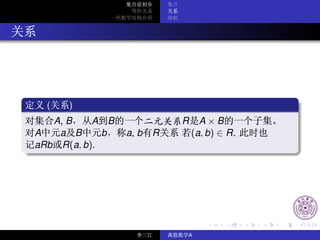
   A, B    A B              R     A×B
A   a B      b   a, b   R       (a, b) ∈ R.
aRb R(a, b).


                            A
A=B                                        A × A,
∅,        idA = {(a, a) : a ∈ A}.
A B           R        R

      dom(R) = {x|         y        (x, y ) ∈ R};
      ran(R) = {y |        x        (x, y ) ∈ R}.


                               A
(                       )
 A       B            R     B    C         S
     R
                             R ∼ = {(x, y )|(y , x) ∈ R}.
     R       S

                     R ◦ S = {(x, z)|      y       (xRy ) (ySz)}.

R∼           B   A                   R◦S       A       C


                                                   A
n-


     A
Example (Russell & Novig: AIMA, Chapter 5)
Consider the following binary constraint problem P
    V = {WA, SA, NT , Q, NSW , V , T }
    U = {red, green, blue}
    C: no neighboring regions have the same color
                                      A
Outline


  1


  2


  3


          A
(      )
A           B      R         A B                      x ∈A
           y ∈B    (x, y ) ∈ R          R
dom(R) = A,
            x ∈ dom(R)                  y ∈ ran(R)
    (x, y ) ∈ R

                  f , g, h                      A B     f,
    f : A → B,          (x, y ) ∈ f ,   f (x) = y .


                                        A
(         )
       f :A→B         b∈B        a∈A
b = f (a); f    a, a ∈ A, f (a) = f (a )
a=a; f            f


                     A
f :A→B        ran(f )                       f
         ran(f ) = {b} ⊆ B           f   cb .

A=∅         A         B                                 ∅;


f   A A                          a   f (a) = a,     f
          idA .


                             A
n


    (n     )
      n ≥ 1,   A   n           f : An → A
    n      A   0       A


                           A
(                )
            f : A → B, g : B → C,
g ◦ f : A → C (g ◦ f )(x) = g(f (x)).a
a
        f    g
            f ◦ g,                       g ◦ f.


                                     A
f,g               g◦f
g◦f   g
g◦f   f
g◦f   f   g


              A
U          R              (reflexive)               x ∈U
    (x, x) ∈ R              R                       idU ⊆ R.
U           R                          x, y ∈ U
    (x, y ) ∈ R          (y , x) ∈ R         R = R∼.
U           R                              x, y ∈ U,
    (x, y ) ∈ R   (y , x) ∈ R   x =y            R ∩ R ∼ ⊆ idU .
U           R                          x, y , z ∈ U,
    (x, y ) ∈ R   (y , z) ∈ R   (x, z) ∈ R,       R ◦ R ⊆ R.


                                       A
(           )
        U       R   R
R   U


                        A
R                U                     x ∈U    [x]R       x
                [x]R = {y ∈ U : xRy }.                U
R
    (   )
            U              R     U/R = {[x]R : x ∈ U}.
U               R


                                      A
(       )
π               U            π ⊆ P(U)
    π               U
    π                   U,
    π
    π   U


                               A
U          π                  U                Rπ   U
    a, b       Rπ iff a, b   π
                  U                   R, U/R    U
    πR ;       πR                     R.


                                  A
(   )


        A
( )

P                                         U, U              P

    U            R        R    P-               P           R
        U
    r (R) R                   r (R) = R ∪ idA .
    s(R) R                    s(R) = R ∪ R ∼ .
    t(R) R
                                               ∞
              t(R) = R ∪ R 2 ∪ R 3 ∪ · · · =         Ri .
                                               i=1


                                      A
X                  X                   ,

      a a;
      if a b and b   a then a = b;
      if a b and b   c then a c.
                   X
(partially ordered set, or poset)


                                     A
An example of poset

         The Hasse diagram of (℘({x, y , z}), ⊆)2


    2
        http://en.wikipedia.org/wiki/Hasse_diagram
                                           A
Total order and well-order


      A partial order
          is total (or linear) if for any a, b ∈ X , a b or b a
          is a well-order if every nonempty subset Y of X has a least
          element


                                          A
Tree


  A (rooted) tree is a poset (T , ) such that
       T has a unique least element, called the root
       the predecessors of every node are well ordered by
  A path on a tree T is a maximally linearly ordered subset of T .


                                         A
Group


 A group is a nonempty set G with a binary operation
 ◦ : G × G → G such that (a ◦ b) ◦ c = a ◦ (b ◦ c) for all
 a, b, c ∈ G. An element e in G is called an identity if e ◦ x = x ◦ e
 for any x. A semi-group that has an identity is called a monoid.
 A semi-group with an identity e is a group if each element x has
 a unique inverse y such that x ◦ y = y ◦ x = e.


                                          A

Lect1 No 873503264

  • 1.
  • 2.
    Georg Cantor: 1845-1918 A
  • 3.
  • 4.
    a∈A a A A, B A = B iff (∀x)(x ∈ A ↔ x ∈ B).1 (1) ∅. 1 iff: if and only if A
  • 5.
    {1, 2} 1 2 {1, 2} = {2, 1}. {1, 2, 2} = {1, 1, 1, 2} = {1, 2}. {dogs} {} A
  • 6.
    ( ) {x : P(x)} ( {x|P(x)}) P {x : x } {x ∈ A : P(x)} A P x. {F (x) : x ∈ A} A F {2x : x ∈ Z} {F (x) : P(x)} P F {x 2 : x } A
  • 7.
    ( ) A, B A B (subset) A B A B B A. A⊆B B ⊇ A. B B B A B A ⊂ B. A
  • 8.
    A A ⊆ A, ∅ ⊆ A. R, Q, Z, N N⊂Z⊂Q⊂R A
  • 9.
    U U U U A A( U ) A A = {x ∈ U : x ∈ A}, U A U {A : A ⊆ U}, U P(U) 2U . A
  • 10.
    A, B A, B A B A ∪ B; A B A ∩ B; A B A − B. A ∪ B = {x : (x ∈ A) or (x ∈ B)}; A ∩ B = {x : (x ∈ A) and (x ∈ B)} = {x ∈ A : x ∈ B}; A − B = {x : (x ∈ A) and (x ∈ B)} = {x ∈ A : x ∈ B}. A
  • 11.
    A∪∅=A A∩U =A A∪U =U A∩∅=∅ A∪A=A A∩A=A A∪B =B∪A A∩B =B∩A A∪A=U A∩A=∅ A
  • 12.
    (A) = A A ∪ (A ∩ B) = A A ∩ (A ∪ B) = A A ∪ (B ∪ C) = (A ∪ B) ∪ C A ∩ (B ∩ C) = (A ∩ B) ∩ C A ∩ (B ∪ C) = (A ∩ B) ∪ (A ∩ C) A ∪ (B ∩ C) = (A ∪ B) ∩ (A ∪ C) A∪B =A∩B A∩B =A∪B A
  • 13.
    ( ) P(U) F (U ) F U A, B ∈ F A ∪ B, A ∈ F F0 = {∅, U} A
  • 14.
  • 15.
    a, b (a, b). (a, b), (c, d) iff a = c, b = d A,B A × B = {(a, b) : (a ∈ A) and (b ∈ B)}. n A1 · · · An A1 × A2 × · · · × An n i=1 Ai . A
  • 16.
    A, B, C A× ∅ = ∅ × A = ∅, A = ∅, B = ∅ A=B A × B = B × A. A × (B × C) = (A × B) × C; A × (B ∪ C) = (A × B) ∪ (A × C); A × (B ∩ C) = (A × B) ∩ (A × C); (B ∪ C) × A = (B × A) ∪ (C × A); (B ∩ C) × A = (B × A) ∩ (C × A). A
  • 17.
    ( ) A, B A B R A×B A a B b a, b R (a, b) ∈ R. aRb R(a, b). A
  • 18.
    A=B A × A, ∅, idA = {(a, a) : a ∈ A}. A B R R dom(R) = {x| y (x, y ) ∈ R}; ran(R) = {y | x (x, y ) ∈ R}. A
  • 19.
    ( ) A B R B C S R R ∼ = {(x, y )|(y , x) ∈ R}. R S R ◦ S = {(x, z)| y (xRy ) (ySz)}. R∼ B A R◦S A C A
  • 20.
    n- A
  • 21.
    Example (Russell &Novig: AIMA, Chapter 5) Consider the following binary constraint problem P V = {WA, SA, NT , Q, NSW , V , T } U = {red, green, blue} C: no neighboring regions have the same color A
  • 22.
  • 23.
    ( ) A B R A B x ∈A y ∈B (x, y ) ∈ R R dom(R) = A, x ∈ dom(R) y ∈ ran(R) (x, y ) ∈ R f , g, h A B f, f : A → B, (x, y ) ∈ f , f (x) = y . A
  • 24.
    ( ) f :A→B b∈B a∈A b = f (a); f a, a ∈ A, f (a) = f (a ) a=a; f f A
  • 25.
    f :A→B ran(f ) f ran(f ) = {b} ⊆ B f cb . A=∅ A B ∅; f A A a f (a) = a, f idA . A
  • 26.
    n (n ) n ≥ 1, A n f : An → A n A 0 A A
  • 27.
    ( ) f : A → B, g : B → C, g ◦ f : A → C (g ◦ f )(x) = g(f (x)).a a f g f ◦ g, g ◦ f. A
  • 28.
    f,g g◦f g◦f g g◦f f g◦f f g A
  • 29.
    U R (reflexive) x ∈U (x, x) ∈ R R idU ⊆ R. U R x, y ∈ U (x, y ) ∈ R (y , x) ∈ R R = R∼. U R x, y ∈ U, (x, y ) ∈ R (y , x) ∈ R x =y R ∩ R ∼ ⊆ idU . U R x, y , z ∈ U, (x, y ) ∈ R (y , z) ∈ R (x, z) ∈ R, R ◦ R ⊆ R. A
  • 30.
    ( ) U R R R U A
  • 31.
    R U x ∈U [x]R x [x]R = {y ∈ U : xRy }. U R ( ) U R U/R = {[x]R : x ∈ U}. U R A
  • 32.
    ( ) π U π ⊆ P(U) π U π U, π π U A
  • 33.
    U π U Rπ U a, b Rπ iff a, b π U R, U/R U πR ; πR R. A
  • 34.
    ( ) A
  • 35.
    ( ) P U, U P U R R P- P R U r (R) R r (R) = R ∪ idA . s(R) R s(R) = R ∪ R ∼ . t(R) R ∞ t(R) = R ∪ R 2 ∪ R 3 ∪ · · · = Ri . i=1 A
  • 36.
    X X , a a; if a b and b a then a = b; if a b and b c then a c. X (partially ordered set, or poset) A
  • 37.
    An example ofposet The Hasse diagram of (℘({x, y , z}), ⊆)2 2 http://en.wikipedia.org/wiki/Hasse_diagram A
  • 38.
    Total order andwell-order A partial order is total (or linear) if for any a, b ∈ X , a b or b a is a well-order if every nonempty subset Y of X has a least element A
  • 39.
    Tree A(rooted) tree is a poset (T , ) such that T has a unique least element, called the root the predecessors of every node are well ordered by A path on a tree T is a maximally linearly ordered subset of T . A
  • 40.
    Group A groupis a nonempty set G with a binary operation ◦ : G × G → G such that (a ◦ b) ◦ c = a ◦ (b ◦ c) for all a, b, c ∈ G. An element e in G is called an identity if e ◦ x = x ◦ e for any x. A semi-group that has an identity is called a monoid. A semi-group with an identity e is a group if each element x has a unique inverse y such that x ◦ y = y ◦ x = e. A