prepaid by:prepaid by:
Hina murdhaniHina murdhani
vibhutivibhuti
savita rathodsavita rathod
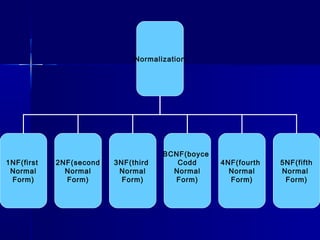
Normalization
1NF(first
Normal
Form)
2NF(second
Normal
Form)
3NF(third
Normal
Form)
5NF(fifth
Normal
Form)
4NF(fourth
Normal
Form)
BCNF(boyce
Codd
Normal
Form)
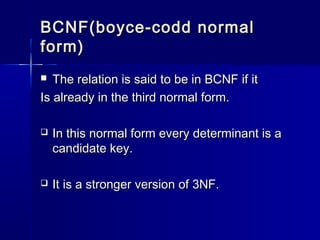
BCNF(boyce-codd normalBCNF(boyce-codd normal
form)form)
 The relation is said to be in BCNF if itThe relation is said to be in BCNF if it
Is already in the third normal form.Is already in the third normal form.
 In this normal form every determinant is aIn this normal form every determinant is a
candidate key.candidate key.
 It is a stronger version of 3NF.It is a stronger version of 3NF.
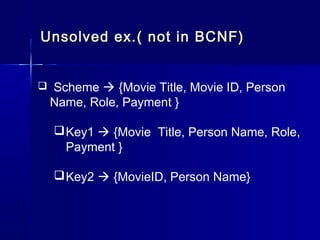
 Scheme  {Movie Title, Movie ID, Person
Name, Role, Payment }
Key1  {Movie Title, Person Name, Role,
Payment }
Key2  {MovieID, Person Name}
Unsolved ex.( not in BCNF)Unsolved ex.( not in BCNF)
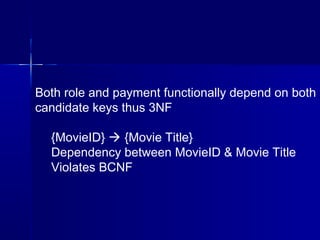
Both role and payment functionally depend on both
candidate keys thus 3NF
{MovieID}  {Movie Title}
Dependency between MovieID & Movie Title
Violates BCNF
BCNF - DecompositionBCNF - Decomposition
1.1. Place the two candidate primary keys inPlace the two candidate primary keys in
separate entitiesseparate entities
2.2. Place each of the remaining data items inPlace each of the remaining data items in
one of the resulting entities according toone of the resulting entities according to
its dependency on the primary key.its dependency on the primary key.
Example (Convert to BCNF)Example (Convert to BCNF)
Old SchemeOld Scheme  {M{Movie Title, MovieID,ovie Title, MovieID,
Person Name, Role, PaymentPerson Name, Role, Payment }}
New SchemeNew Scheme  {{MMovieID, PersonovieID, Person
NameName, Role, Payment, Role, Payment}}
New SchemeNew Scheme  {{Movie Title, PersonMovie Title, Person
NameName}}
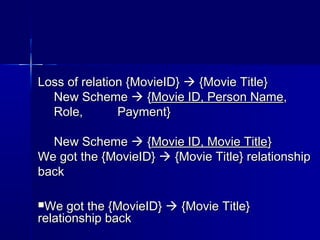
Loss of relation {MovieID}Loss of relation {MovieID}  {Movie Title}{Movie Title}
New SchemeNew Scheme  {{Movie ID, Person NameMovie ID, Person Name,,
Role, Payment}Role, Payment}
New SchemeNew Scheme  {{Movie ID, Movie TitleMovie ID, Movie Title}}
We got the {MovieID}We got the {MovieID}  {Movie Title} relationship{Movie Title} relationship
backback
We got the {MovieID}We got the {MovieID}  {Movie Title}{Movie Title}
relationship backrelationship back
Fourth Form (4NF) NormalFourth Form (4NF) Normal
 To be in Fourth Normal Form,To be in Fourth Normal Form,
– a relation must first be in Boyce-Codda relation must first be in Boyce-Codd
Normal Form. Normal Form. 
– a given relation may not contain morea given relation may not contain more
than one multi-valued attribute.than one multi-valued attribute.
 Mutli value dependency is a dependency inMutli value dependency is a dependency in
which determinate can determine more thanwhich determinate can determine more than
one value.one value.
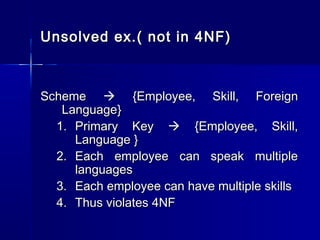
Unsolved ex.( not in 4NF)Unsolved ex.( not in 4NF)
SchemeScheme  {{Employee, Skill, ForeignEmployee, Skill, Foreign
LanguageLanguage}}
1.1. Primary KeyPrimary Key  {Employee, Skill,{Employee, Skill,
Language }Language }
2.2. Each employee can speak multipleEach employee can speak multiple
languageslanguages
3.3. Each employee can have multiple skillsEach employee can have multiple skills
4.4. Thus violates 4NFThus violates 4NF
Employee Skill Language
1234 cooking French
1234 Cooking German
1453 Carpentry Spanish
1453 Cooking Spanish
2345 Cooking Spanish
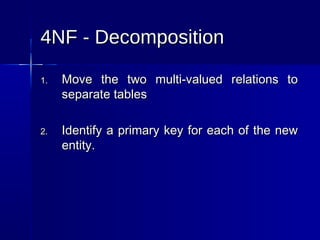
4NF - Decomposition4NF - Decomposition
1.1. Move the two multi-valued relations toMove the two multi-valued relations to
separate tablesseparate tables
2.2. Identify a primary key for each of the newIdentify a primary key for each of the new
entity.entity.
Old Scheme  {Employee, Skill, Foreign
Language}
New Scheme  {Employee, Skill}
New Scheme  {Employee, Foreign
Language}
Example( convert to 4NF)Example( convert to 4NF)
Employee Skill
1234 Cooking
1453 Carpentry
1453 Cooking
2345 Cooking
Employee Language
1234 French
1234 German
1453 Spanish
2345 Spanish
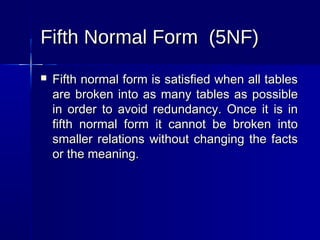
Fifth Normal Form (5NF)Fifth Normal Form (5NF)
 Fifth normal form is satisfied when all tablesFifth normal form is satisfied when all tables
are broken into as many tables as possibleare broken into as many tables as possible
in order to avoid redundancy. Once it is inin order to avoid redundancy. Once it is in
fifth normal form it cannot be broken intofifth normal form it cannot be broken into
smaller relations without changing the factssmaller relations without changing the facts
or the meaning.or the meaning.  
Normalization

Normalization

  • 2.
    prepaid by:prepaid by: HinamurdhaniHina murdhani vibhutivibhuti savita rathodsavita rathod
  • 3.
  • 4.
    BCNF(boyce-codd normalBCNF(boyce-codd normal form)form) The relation is said to be in BCNF if itThe relation is said to be in BCNF if it Is already in the third normal form.Is already in the third normal form.  In this normal form every determinant is aIn this normal form every determinant is a candidate key.candidate key.  It is a stronger version of 3NF.It is a stronger version of 3NF.
  • 5.
     Scheme {Movie Title, Movie ID, Person Name, Role, Payment } Key1  {Movie Title, Person Name, Role, Payment } Key2  {MovieID, Person Name} Unsolved ex.( not in BCNF)Unsolved ex.( not in BCNF)
  • 6.
    Both role andpayment functionally depend on both candidate keys thus 3NF {MovieID}  {Movie Title} Dependency between MovieID & Movie Title Violates BCNF
  • 7.
    BCNF - DecompositionBCNF- Decomposition 1.1. Place the two candidate primary keys inPlace the two candidate primary keys in separate entitiesseparate entities 2.2. Place each of the remaining data items inPlace each of the remaining data items in one of the resulting entities according toone of the resulting entities according to its dependency on the primary key.its dependency on the primary key.
  • 8.
    Example (Convert toBCNF)Example (Convert to BCNF) Old SchemeOld Scheme  {M{Movie Title, MovieID,ovie Title, MovieID, Person Name, Role, PaymentPerson Name, Role, Payment }} New SchemeNew Scheme  {{MMovieID, PersonovieID, Person NameName, Role, Payment, Role, Payment}} New SchemeNew Scheme  {{Movie Title, PersonMovie Title, Person NameName}}
  • 9.
    Loss of relation{MovieID}Loss of relation {MovieID}  {Movie Title}{Movie Title} New SchemeNew Scheme  {{Movie ID, Person NameMovie ID, Person Name,, Role, Payment}Role, Payment} New SchemeNew Scheme  {{Movie ID, Movie TitleMovie ID, Movie Title}} We got the {MovieID}We got the {MovieID}  {Movie Title} relationship{Movie Title} relationship backback We got the {MovieID}We got the {MovieID}  {Movie Title}{Movie Title} relationship backrelationship back
  • 10.
    Fourth Form (4NF)NormalFourth Form (4NF) Normal  To be in Fourth Normal Form,To be in Fourth Normal Form, – a relation must first be in Boyce-Codda relation must first be in Boyce-Codd Normal Form. Normal Form.  – a given relation may not contain morea given relation may not contain more than one multi-valued attribute.than one multi-valued attribute.  Mutli value dependency is a dependency inMutli value dependency is a dependency in which determinate can determine more thanwhich determinate can determine more than one value.one value.
  • 11.
    Unsolved ex.( notin 4NF)Unsolved ex.( not in 4NF) SchemeScheme  {{Employee, Skill, ForeignEmployee, Skill, Foreign LanguageLanguage}} 1.1. Primary KeyPrimary Key  {Employee, Skill,{Employee, Skill, Language }Language } 2.2. Each employee can speak multipleEach employee can speak multiple languageslanguages 3.3. Each employee can have multiple skillsEach employee can have multiple skills 4.4. Thus violates 4NFThus violates 4NF
  • 12.
    Employee Skill Language 1234cooking French 1234 Cooking German 1453 Carpentry Spanish 1453 Cooking Spanish 2345 Cooking Spanish
  • 13.
    4NF - Decomposition4NF- Decomposition 1.1. Move the two multi-valued relations toMove the two multi-valued relations to separate tablesseparate tables 2.2. Identify a primary key for each of the newIdentify a primary key for each of the new entity.entity.
  • 14.
    Old Scheme {Employee, Skill, Foreign Language} New Scheme  {Employee, Skill} New Scheme  {Employee, Foreign Language} Example( convert to 4NF)Example( convert to 4NF) Employee Skill 1234 Cooking 1453 Carpentry 1453 Cooking 2345 Cooking Employee Language 1234 French 1234 German 1453 Spanish 2345 Spanish
  • 15.
    Fifth Normal Form(5NF)Fifth Normal Form (5NF)  Fifth normal form is satisfied when all tablesFifth normal form is satisfied when all tables are broken into as many tables as possibleare broken into as many tables as possible in order to avoid redundancy. Once it is inin order to avoid redundancy. Once it is in fifth normal form it cannot be broken intofifth normal form it cannot be broken into smaller relations without changing the factssmaller relations without changing the facts or the meaning.or the meaning.