INTODUCTION OF SUPPLY CHAIN
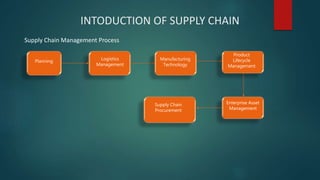
Supply Chain Management Process
Planning Logistics
Management
Manufacturing
Technology
Product
Lifecycle
Management
Enterprise Asset
Management
Supply Chain
Procurement
SUPPLY CHAIN
• A Supply Chain Is A Network Between A Company And Its Suppliers To Produce And Distribute A Specific Product
Or Service. The Entities In The Supply Chain Include Producers, Vendors, Warehouses, Transportation
Companies, Distribution Centers, And Retailers.
• Supply Chain Management (Scm) Is The Oversight Of Materials, Information And Finances As They Move In A
Process From Supplier To Manufacturer To Wholesaler To Retailer And Then To The Consumer. The Three Main
Flows Of The Supply Chain Are The Product Flow, The Information Flow And The Finances Flow. These Occur
Across Three Main Stages: Strategy, Planning And Operation. SCM Involves Coordinating And Integrating These
Flows Both Within And Among Companies.
STAGES IN SUPPLY
CHAIN
 Customers
 Retailer
 Wholesalers
 Manufacturers
 Raw Material Suppliers
INTRODUCTION OF PROCUREMENT
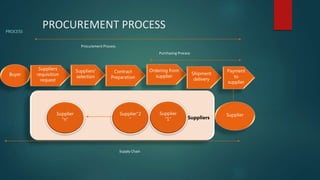
PROCUREMENT PROCESS
PROCESS
Buyer
Suppliers
requisition
request
Suppliers'
selection
Contract
Preparation
Ordering from
supplier
Shipment
delivery
Payment
to
supplier
Supplier
Suppliers
Supplier
“1”
Supplier”2
”
Supplier
“n”
Purchasing Process
Procurement Process
Supply Chain
Procurement
Management
 Procurement includes sourcing, obtaining
and paying for goods and services. Supply
chain management also covers the
logistics involved in obtaining goods,
such as shipping and warehouse
management, as well as transforming the
procured goods into products and
distributing them to customers.
ROLE OF
PROCUREMENT IN
SUPPLY CHAIN
 Procurement managers, also known as purchasing
managers, manage a company's sourcing capabilities
and supply chain. They are responsible for strategizing
and negotiating with suppliers and vendors in order to
acquire the most cost-effective deals and to reduce
procurement expenses.
 The task of buying products or services and ensuring
that suppliers comply with legal and company policies.
Procurement may involve the management of internal
processes such as adding new suppliers and ensuring
they are compliant. A key aspect of a role within supply
chain and procurement is supplier relations.
Procurement Management In Supply Chain
Procurement management is responsible for
overseeing all the processes involved in acquiring
the products, materials, goods and services
needed for efficient business operations.
Depending on the business and industry, the
terms “sourcing,” “purchasing” and
“procurement” may be used interchangeably to
describe the function of procuring supplies and
managing the process, with sourcing
considered more strategic, and purchasing and
procurement used to refer to the actual
operational function.
Organizations across all industries depend on the
expertise of procurement management in
seeking out and managing external supplier
relationships to ensure these needed items are
acquired at the best possible cost. For these
reasons, procurement management has a direct
impact on an organization’s bottom line and
strategic business operations.
BENEFITS OF PROCUREMENT IN SUPPLY
CHAIN
Supply Chain Risk Reduction
Improved customer satisfaction
Cost reduction
Improved flexibility
Improved supplier relationships
Example of
Procurement in
Supply Chain
 If a company needs a new supplier to provide an
ongoing service for an indefinite period of time — such
as an email security solution — the procurement process
helps the company choose the supplier that best meets
all of the business’s requirements at a reasonable price.
It enables the business to avoid wasting time, money
and valuable resources dealing with an inadequate
supplier.
PROCUREMENT KEY ISSUES
Pandemic initiatives
Risk management
Sustainability
Diversity
Working capital
Innovation
Digitalisation projects
PANDEMIC
INITIATIVES
 Procurement has gained significant chigh-speny it has
managed sourcing, supply chains, stakeholders, and
suppliers during the pandemic. It is now time to revisit
all category strategies and update them to reflect the
changes that have taken place.
RISK
MANAGEMENT
The pandemic has highlighted the inadequacies of previous
risk management activities. The focus now needs to be on a
broader scope of risks. The top five concerns are:
 Financial stability of critical and high-spend suppliers
 Issues that may cause reputational damage concerns
 Breaches of GDPR and other data protection/security
regulations
 Supply chain certainty
 Bribery and corruption
SUSTAINABILITY
Sustainability concerns have evolved into an increasing
global interest in issues of economic, social and corporate
governance (ESG). The top five issues are
 Ethical and sustainable sourcing
 Prevention of bribery and corruption
 Human capital practices including modern day slavery
 Reduction of energy and water use
 Reduction of CO2 emissions.
INNOVATION
 By building relationships with suppliers, procurement has a unique
external perspective to tease out and encourage innovation. Some
organisations have begun to implement a reduced or ‘lite’ version of
their terms and conditions, which is more suitable for encouraging
start-up suppliers in the market.
 To embed innovation in the procurement process, action can be taken
in the following four areas:
1. Organisational alignment throughout the procurement process
2. Early market engagement, with action that is transparent, honest and
fair, as well as clear instructions on how to manage information,
communication and intellectual property
3. Early supplier engagement at the sourcing stage, building on
information gained from the early market engagement activity
4. Innovation support activities: pilot projects, inducements and rewards,
risk sharing, briefings/seminars/workshops, and unsolicited proposals.
DIVERSITY
Diversity has been a hot topic in the US for some time, but
more recently it is finding its way onto the agenda in the
Europe and APAC regions. Procurement is supporting the
business by establishing a level playing field for diverse
suppliers to compete with other suppliers. This encourages
innovation into the business. The current challenge is
identifying those suppliers who meet the diversity criteria,
particularly when there is no mandatory policy for suppliers
to identify their diverse status within company reports and
accounts, or other publicly-available business documents.
WORKING CAPITAL
 Many organization's are adapting their
policies for payment terms so agreements
are optimized with suppliers. Rather than
lengthening payment terms, options for
supply chain financing and implementing
an invoice discounting process are being
negotiated. It is important to protect the
supply base to ensure continuous trading.
Resolving and agreeing terms through
careful relationship management remains
the most effective approach when seeking
to maintain working capital.
DIGITISATION
PROJECTS
 After building credibility during the pandemic, now is a
good time to justify investment in systems and tools to
improve efficiency. Organisations are investing in:
1. Cloud-based applications
2. Systems that sit on top of company ERP platforms to
cover risk, supplier relationship management and other
procurement-specific requirements
3. Robotic process automation
4. Data visualisation tools
5. Catalogues to manage tail spend.
IMPORTANCE OF
PROCUREMENT
MANAGEMENT
 Without procurement, it would be impossible for most
business operations to function. Procurement
management ensures that all items and services are
properly acquired so that projects and processes can
proceed efficiently and successfully.
 More than a business necessity, procurement can be
leveraged as a competitive advantage when optimized to
save money, time and resources. But driving down costs
by avoiding delays and errors and maximizing resources
is just part of the reason procurement management
plays an important role in a company’s bottom line.
CONCLUSION
• It Should Be Kept In Mind, However, That This Procurement Management System Must Run Efficiently And
Smoothly For All Benefits To Be Reaped. The Key To This Would Therefore Be An Efficient System As Well As
The Right Supplier And Resources.
• For The Purpose Of Procurement Management, There Should Be A Team Of Highly Trained Individuals, If
Procurement Management Plays A Key Role.
• As An Example, A Hospital Should Have A Dedicated Procurement Team And Should Employ Strong
Procurement Management Techniques And Tools.

procurement supply chain.pptx

  • 1.
    INTODUCTION OF SUPPLYCHAIN Supply Chain Management Process Planning Logistics Management Manufacturing Technology Product Lifecycle Management Enterprise Asset Management Supply Chain Procurement
  • 2.
    SUPPLY CHAIN • ASupply Chain Is A Network Between A Company And Its Suppliers To Produce And Distribute A Specific Product Or Service. The Entities In The Supply Chain Include Producers, Vendors, Warehouses, Transportation Companies, Distribution Centers, And Retailers. • Supply Chain Management (Scm) Is The Oversight Of Materials, Information And Finances As They Move In A Process From Supplier To Manufacturer To Wholesaler To Retailer And Then To The Consumer. The Three Main Flows Of The Supply Chain Are The Product Flow, The Information Flow And The Finances Flow. These Occur Across Three Main Stages: Strategy, Planning And Operation. SCM Involves Coordinating And Integrating These Flows Both Within And Among Companies.
  • 3.
    STAGES IN SUPPLY CHAIN Customers  Retailer  Wholesalers  Manufacturers  Raw Material Suppliers
  • 4.
  • 5.
  • 6.
    Procurement Management  Procurement includessourcing, obtaining and paying for goods and services. Supply chain management also covers the logistics involved in obtaining goods, such as shipping and warehouse management, as well as transforming the procured goods into products and distributing them to customers.
  • 7.
    ROLE OF PROCUREMENT IN SUPPLYCHAIN  Procurement managers, also known as purchasing managers, manage a company's sourcing capabilities and supply chain. They are responsible for strategizing and negotiating with suppliers and vendors in order to acquire the most cost-effective deals and to reduce procurement expenses.  The task of buying products or services and ensuring that suppliers comply with legal and company policies. Procurement may involve the management of internal processes such as adding new suppliers and ensuring they are compliant. A key aspect of a role within supply chain and procurement is supplier relations.
  • 8.
    Procurement Management InSupply Chain Procurement management is responsible for overseeing all the processes involved in acquiring the products, materials, goods and services needed for efficient business operations. Depending on the business and industry, the terms “sourcing,” “purchasing” and “procurement” may be used interchangeably to describe the function of procuring supplies and managing the process, with sourcing considered more strategic, and purchasing and procurement used to refer to the actual operational function. Organizations across all industries depend on the expertise of procurement management in seeking out and managing external supplier relationships to ensure these needed items are acquired at the best possible cost. For these reasons, procurement management has a direct impact on an organization’s bottom line and strategic business operations.
  • 9.
    BENEFITS OF PROCUREMENTIN SUPPLY CHAIN Supply Chain Risk Reduction Improved customer satisfaction Cost reduction Improved flexibility Improved supplier relationships
  • 10.
    Example of Procurement in SupplyChain  If a company needs a new supplier to provide an ongoing service for an indefinite period of time — such as an email security solution — the procurement process helps the company choose the supplier that best meets all of the business’s requirements at a reasonable price. It enables the business to avoid wasting time, money and valuable resources dealing with an inadequate supplier.
  • 11.
    PROCUREMENT KEY ISSUES Pandemicinitiatives Risk management Sustainability Diversity Working capital Innovation Digitalisation projects
  • 12.
    PANDEMIC INITIATIVES  Procurement hasgained significant chigh-speny it has managed sourcing, supply chains, stakeholders, and suppliers during the pandemic. It is now time to revisit all category strategies and update them to reflect the changes that have taken place.
  • 13.
    RISK MANAGEMENT The pandemic hashighlighted the inadequacies of previous risk management activities. The focus now needs to be on a broader scope of risks. The top five concerns are:  Financial stability of critical and high-spend suppliers  Issues that may cause reputational damage concerns  Breaches of GDPR and other data protection/security regulations  Supply chain certainty  Bribery and corruption
  • 14.
    SUSTAINABILITY Sustainability concerns haveevolved into an increasing global interest in issues of economic, social and corporate governance (ESG). The top five issues are  Ethical and sustainable sourcing  Prevention of bribery and corruption  Human capital practices including modern day slavery  Reduction of energy and water use  Reduction of CO2 emissions.
  • 15.
    INNOVATION  By buildingrelationships with suppliers, procurement has a unique external perspective to tease out and encourage innovation. Some organisations have begun to implement a reduced or ‘lite’ version of their terms and conditions, which is more suitable for encouraging start-up suppliers in the market.  To embed innovation in the procurement process, action can be taken in the following four areas: 1. Organisational alignment throughout the procurement process 2. Early market engagement, with action that is transparent, honest and fair, as well as clear instructions on how to manage information, communication and intellectual property 3. Early supplier engagement at the sourcing stage, building on information gained from the early market engagement activity 4. Innovation support activities: pilot projects, inducements and rewards, risk sharing, briefings/seminars/workshops, and unsolicited proposals.
  • 16.
    DIVERSITY Diversity has beena hot topic in the US for some time, but more recently it is finding its way onto the agenda in the Europe and APAC regions. Procurement is supporting the business by establishing a level playing field for diverse suppliers to compete with other suppliers. This encourages innovation into the business. The current challenge is identifying those suppliers who meet the diversity criteria, particularly when there is no mandatory policy for suppliers to identify their diverse status within company reports and accounts, or other publicly-available business documents.
  • 17.
    WORKING CAPITAL  Manyorganization's are adapting their policies for payment terms so agreements are optimized with suppliers. Rather than lengthening payment terms, options for supply chain financing and implementing an invoice discounting process are being negotiated. It is important to protect the supply base to ensure continuous trading. Resolving and agreeing terms through careful relationship management remains the most effective approach when seeking to maintain working capital.
  • 18.
    DIGITISATION PROJECTS  After buildingcredibility during the pandemic, now is a good time to justify investment in systems and tools to improve efficiency. Organisations are investing in: 1. Cloud-based applications 2. Systems that sit on top of company ERP platforms to cover risk, supplier relationship management and other procurement-specific requirements 3. Robotic process automation 4. Data visualisation tools 5. Catalogues to manage tail spend.
  • 19.
    IMPORTANCE OF PROCUREMENT MANAGEMENT  Withoutprocurement, it would be impossible for most business operations to function. Procurement management ensures that all items and services are properly acquired so that projects and processes can proceed efficiently and successfully.  More than a business necessity, procurement can be leveraged as a competitive advantage when optimized to save money, time and resources. But driving down costs by avoiding delays and errors and maximizing resources is just part of the reason procurement management plays an important role in a company’s bottom line.
  • 20.
    CONCLUSION • It ShouldBe Kept In Mind, However, That This Procurement Management System Must Run Efficiently And Smoothly For All Benefits To Be Reaped. The Key To This Would Therefore Be An Efficient System As Well As The Right Supplier And Resources. • For The Purpose Of Procurement Management, There Should Be A Team Of Highly Trained Individuals, If Procurement Management Plays A Key Role. • As An Example, A Hospital Should Have A Dedicated Procurement Team And Should Employ Strong Procurement Management Techniques And Tools.