Glaucoma 
Prof. Dr. Tehseen Sahi 
Chairman Department of 
Ophhalmology: KEMU
Aqueous flow 
Ciliary epithelium 
Posterior chamber 
through pupil 
Anterior chamber 
Trabecular meshwork 
Canal of schlemn 
Aqueous veins venous circulation
Aqueous flow
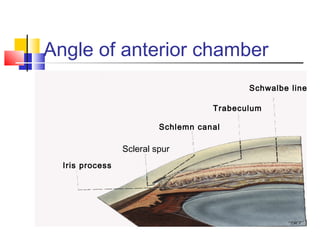
Angle of anterior chamber 
Iris process 
Schlemn canal 
Scleral spur 
Schwalbe line 
Trabeculum
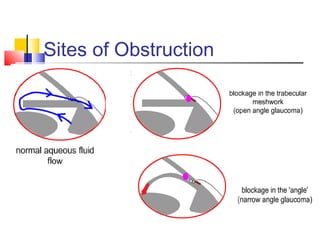
Sites of Obstruction
Primary glaucoma 
 Pupil block (angle closure) 
 Open angle
Primary glaucomas 
 Pupil block 
 Person 
 Young 
 Female 
 Idealistic 
 High strung 
 Open angle 
 Person 
 ordinary
Primary glaucomas 
 Pupil block 
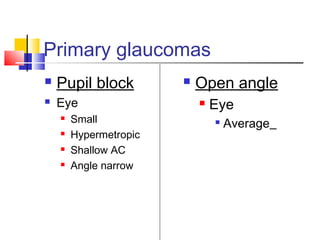
 Eye 
 Small 
 Hypermetropic 
 Shallow AC 
 Angle narrow 
 Open angle 
 Eye 
 Average
Presentation 
 Pupil block 
 ACUTE 
 SUDDEN, MARKED 
 PAIN 
 LOSS OF VISION 
 CONGESTION 
 GENERAL EFFECTS 
 Open angle 
 SLOW 
 GRADUAL
TREATMENT 
 Pupil block 
 SURGICAL 
 Open angle 
 MEDICAL
PROGNOSIS 
 Pupil block 
 VERY GOOD 
 Open angle 
 RELATIVELY 
POOR
Pupil Block Glaucoma 
MECHANISM OF ATTACK 
(Mid-Dilated Pupil) 
Increase Increas ien i np hpyhsyisoiloolgoigciacla pl puuppili lb blolocckk
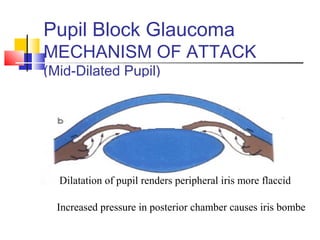
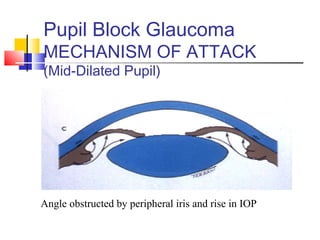
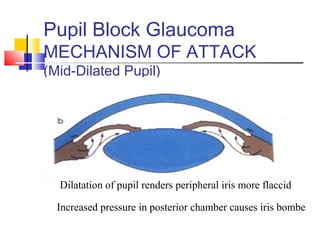
Pupil Block Glaucoma 
MECHANISM OF ATTACK 
(Mid-Dilated Pupil) 
Dilatation of pupil renders peripheral iris more flaccid 
Increased pressure in posterior chamber causes iris bombe
Pupil Block Glaucoma 
MECHANISM OF ATTACK 
(Mid-Dilated Pupil) 
Angle obstructed by peripheral iris and rise in IOP
Pupil block glaucoma
Pupil block glaucoma 
 Stages 
 Prodromal stage 
 Stage of constant instability 
 Acute congestive glaucoma 
 Ch. Congestive glaucoma 
 Absolute glaucoma
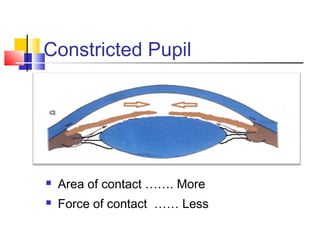
Constricted Pupil 
 Area of contact ……. More 
 Force of contact …… Less
Dilated 
 No Contact 
 No Force
Mid Dilated Pupil 
 Area of Contact …….. Less 
 Force of Contact …….. More
Pupil block glaucoma 
(Mid Dilated Pupil) 
 Prodromal stage (mechanism) 
Tense person sitting in dark area 
Pupil mid-dilated 
Firm Contact between Loose Iris 
iris and lens. 
Pupil Block 
Iris bombe 
Angle closure 
Increased I.O.P
Mid Dilated Pupil 
 Area of Contact …….. Less 
 Force of Contact …….. More
Pupil Block Glaucoma 
MECHANISM OF ATTACK 
(Mid-Dilated Pupil) 
Increase in physiological pupil block 
Increase in physiological pupil block
Pupil Block Glaucoma 
MECHANISM OF ATTACK 
(Mid-Dilated Pupil) 
Dilatation of pupil renders peripheral iris more flaccid 
Increased pressure in posterior chamber causes iris bombe
Pupil Block Glaucoma 
MECHANISM OF ATTACK 
(Mid-Dilated Pupil) 
Angle obstructed by peripheral iris and rise in IOP
Pupil block glaucoma 
 Prodromal stage 
 Features 
 Mild headache 
 Colored haloes
Pupil block glaucoma 
 Prodromal stage 
 Patient comes to bright light or goes to 
sleep 
 Pupil constricts 
 Attack finished
Pupil block glaucoma 
 Stage of constant Instability 
Prodromal attacks 
More frequent More prolonged 
 Mechanism same.
Mid Dilated Pupil 
 Area of Contact …….. Less 
 Force of Contact …….. More
Pupil Block Glaucoma 
MECHANISM OF ATTACK 
(Mid-Dilated Pupil) 
Increase in physiological pupil block 
Increase in physiological pupil block
Pupil Block Glaucoma 
MECHANISM OF ATTACK 
(Mid-Dilated Pupil) 
Dilatation of pupil renders peripheral iris more flaccid 
Increased pressure in posterior chamber causes iris bombe
Pupil Block Glaucoma 
MECHANISM OF ATTACK 
(Mid-Dilated Pupil) 
Angle obstructed by peripheral iris and rise in IOP
Pupil block glaucoma 
 Acute congestive glaucoma 
 Mechanism same 
 Attack cannot be abolished spontaneously 
 Features 
 Acute ,marked pain 
 Redness 
 Loss of vision
Mid Dilated Pupil 
 Area of Contact …….. Less 
 Force of Contact …….. More
Pupil Block Glaucoma 
MECHANISM OF ATTACK 
(Mid-Dilated Pupil) 
Increase in physiological pupil block 
Increase in physiological pupil block
Pupil Block Glaucoma 
MECHANISM OF ATTACK 
(Mid-Dilated Pupil) 
Dilatation of pupil renders peripheral iris more flaccid 
Increased pressure in posterior chamber causes iris bombe
Pupil Block Glaucoma 
MECHANISM OF ATTACK 
(Mid-Dilated Pupil) 
Angle obstructed by peripheral iris and rise in IOP
Pupil block glaucoma 
 Acute congestive glaucoma 
 Signs 
 Lid swelling 
 Ciliary congestion 
 Corneal edema 
 Shallow AC 
 Angle closed 
 Very high I.O.P 
 Pupil dilated and oval
Pupil block glaucoma 
Severe corneal edema 
Dilated, un-reactive, 
vertically oval pupil
Pupil block glaucoma 
 Ch. Congestive glaucoma 
 Angle …peripheral anterior Synechiae 
 Symptoms and signs 
 Dec. severity
Pupil block glaucoma 
 Absolute glaucoma
Management 
 Stage I (prodromal attacks) 
 Surgical 
 Iridotomy (laser) 
 Iridectomy
laser iridotomy
Management prodromal attack 
 Medical 
 PILOCARPINE eyedrops
Mangement 
 Stage of constant Instability 
 Same as prodromal attack
Managemant 
 Acute congestive stage 
 (a) Early 
 Control of I.O.P by medical means 
 Then perform iridectomy/iridotomy 
 (b) similar to stage 4
Management 
Acute congestive glaucoma 
 Medical control of I.O.P 
1. pilocarpine 
constrict pupil 
mid-dilated position changes 
Force of contact b/w iris tights 
Pupil and lens decrease 
pupil block finished 
control of I.O.P
Management 
Acute congestive glaucoma 
 2)Carbonic anhydrase inhibitors 
(acetazolamide) 
 CO2 + H2O H2CO3 
H + HCO3 
Inhibition HCO3 ions Aq.production
Management 
Acute congestive glaucoma 
 3) Osmotic Agents 
I.S Intravascular H2O I.S 
Osmotic pressure Hydrostatic pressure Osmotic pressure 
I.S pressure osmotic Pressure I.S pressure
Management 
Acute congestive glaucoma 
 Agents 
 Oral 
 Pure glycerine 
 Alcohol 
 Intravenous 
 Mannitol 20% 
 urea
Management 
 Ch. Congestive glaucoma 
 Control of I.O.P by medical means 
 Perform filtration operations

Pupil block glaucoma

  • 1.
    Glaucoma Prof. Dr.Tehseen Sahi Chairman Department of Ophhalmology: KEMU
  • 2.
    Aqueous flow Ciliaryepithelium Posterior chamber through pupil Anterior chamber Trabecular meshwork Canal of schlemn Aqueous veins venous circulation
  • 3.
  • 5.
    Angle of anteriorchamber Iris process Schlemn canal Scleral spur Schwalbe line Trabeculum
  • 6.
  • 7.
    Primary glaucoma Pupil block (angle closure)  Open angle
  • 8.
    Primary glaucomas Pupil block  Person  Young  Female  Idealistic  High strung  Open angle  Person  ordinary
  • 9.
    Primary glaucomas Pupil block  Eye  Small  Hypermetropic  Shallow AC  Angle narrow  Open angle  Eye  Average
  • 10.
    Presentation  Pupilblock  ACUTE  SUDDEN, MARKED  PAIN  LOSS OF VISION  CONGESTION  GENERAL EFFECTS  Open angle  SLOW  GRADUAL
  • 11.
    TREATMENT  Pupilblock  SURGICAL  Open angle  MEDICAL
  • 12.
    PROGNOSIS  Pupilblock  VERY GOOD  Open angle  RELATIVELY POOR
  • 13.
    Pupil Block Glaucoma MECHANISM OF ATTACK (Mid-Dilated Pupil) Increase Increas ien i np hpyhsyisoiloolgoigciacla pl puuppili lb blolocckk
  • 14.
    Pupil Block Glaucoma MECHANISM OF ATTACK (Mid-Dilated Pupil) Dilatation of pupil renders peripheral iris more flaccid Increased pressure in posterior chamber causes iris bombe
  • 15.
    Pupil Block Glaucoma MECHANISM OF ATTACK (Mid-Dilated Pupil) Angle obstructed by peripheral iris and rise in IOP
  • 16.
  • 17.
    Pupil block glaucoma  Stages  Prodromal stage  Stage of constant instability  Acute congestive glaucoma  Ch. Congestive glaucoma  Absolute glaucoma
  • 18.
    Constricted Pupil Area of contact ……. More  Force of contact …… Less
  • 19.
    Dilated  NoContact  No Force
  • 20.
    Mid Dilated Pupil  Area of Contact …….. Less  Force of Contact …….. More
  • 21.
    Pupil block glaucoma (Mid Dilated Pupil)  Prodromal stage (mechanism) Tense person sitting in dark area Pupil mid-dilated Firm Contact between Loose Iris iris and lens. Pupil Block Iris bombe Angle closure Increased I.O.P
  • 22.
    Mid Dilated Pupil  Area of Contact …….. Less  Force of Contact …….. More
  • 23.
    Pupil Block Glaucoma MECHANISM OF ATTACK (Mid-Dilated Pupil) Increase in physiological pupil block Increase in physiological pupil block
  • 24.
    Pupil Block Glaucoma MECHANISM OF ATTACK (Mid-Dilated Pupil) Dilatation of pupil renders peripheral iris more flaccid Increased pressure in posterior chamber causes iris bombe
  • 25.
    Pupil Block Glaucoma MECHANISM OF ATTACK (Mid-Dilated Pupil) Angle obstructed by peripheral iris and rise in IOP
  • 26.
    Pupil block glaucoma  Prodromal stage  Features  Mild headache  Colored haloes
  • 27.
    Pupil block glaucoma  Prodromal stage  Patient comes to bright light or goes to sleep  Pupil constricts  Attack finished
  • 28.
    Pupil block glaucoma  Stage of constant Instability Prodromal attacks More frequent More prolonged  Mechanism same.
  • 29.
    Mid Dilated Pupil  Area of Contact …….. Less  Force of Contact …….. More
  • 30.
    Pupil Block Glaucoma MECHANISM OF ATTACK (Mid-Dilated Pupil) Increase in physiological pupil block Increase in physiological pupil block
  • 31.
    Pupil Block Glaucoma MECHANISM OF ATTACK (Mid-Dilated Pupil) Dilatation of pupil renders peripheral iris more flaccid Increased pressure in posterior chamber causes iris bombe
  • 32.
    Pupil Block Glaucoma MECHANISM OF ATTACK (Mid-Dilated Pupil) Angle obstructed by peripheral iris and rise in IOP
  • 33.
    Pupil block glaucoma  Acute congestive glaucoma  Mechanism same  Attack cannot be abolished spontaneously  Features  Acute ,marked pain  Redness  Loss of vision
  • 34.
    Mid Dilated Pupil  Area of Contact …….. Less  Force of Contact …….. More
  • 35.
    Pupil Block Glaucoma MECHANISM OF ATTACK (Mid-Dilated Pupil) Increase in physiological pupil block Increase in physiological pupil block
  • 36.
    Pupil Block Glaucoma MECHANISM OF ATTACK (Mid-Dilated Pupil) Dilatation of pupil renders peripheral iris more flaccid Increased pressure in posterior chamber causes iris bombe
  • 37.
    Pupil Block Glaucoma MECHANISM OF ATTACK (Mid-Dilated Pupil) Angle obstructed by peripheral iris and rise in IOP
  • 38.
    Pupil block glaucoma  Acute congestive glaucoma  Signs  Lid swelling  Ciliary congestion  Corneal edema  Shallow AC  Angle closed  Very high I.O.P  Pupil dilated and oval
  • 39.
    Pupil block glaucoma Severe corneal edema Dilated, un-reactive, vertically oval pupil
  • 40.
    Pupil block glaucoma  Ch. Congestive glaucoma  Angle …peripheral anterior Synechiae  Symptoms and signs  Dec. severity
  • 41.
    Pupil block glaucoma  Absolute glaucoma
  • 42.
    Management  StageI (prodromal attacks)  Surgical  Iridotomy (laser)  Iridectomy
  • 43.
  • 44.
    Management prodromal attack  Medical  PILOCARPINE eyedrops
  • 45.
    Mangement  Stageof constant Instability  Same as prodromal attack
  • 46.
    Managemant  Acutecongestive stage  (a) Early  Control of I.O.P by medical means  Then perform iridectomy/iridotomy  (b) similar to stage 4
  • 47.
    Management Acute congestiveglaucoma  Medical control of I.O.P 1. pilocarpine constrict pupil mid-dilated position changes Force of contact b/w iris tights Pupil and lens decrease pupil block finished control of I.O.P
  • 48.
    Management Acute congestiveglaucoma  2)Carbonic anhydrase inhibitors (acetazolamide)  CO2 + H2O H2CO3 H + HCO3 Inhibition HCO3 ions Aq.production
  • 49.
    Management Acute congestiveglaucoma  3) Osmotic Agents I.S Intravascular H2O I.S Osmotic pressure Hydrostatic pressure Osmotic pressure I.S pressure osmotic Pressure I.S pressure
  • 50.
    Management Acute congestiveglaucoma  Agents  Oral  Pure glycerine  Alcohol  Intravenous  Mannitol 20%  urea
  • 51.
    Management  Ch.Congestive glaucoma  Control of I.O.P by medical means  Perform filtration operations