GLAUCOMA IN APHAKIA
& PSEUDOPHAKIA
BY
Dr.Aditya Mahadevan
Moderators
Prof.Dr.K.Srikanth
Dr.N.Swathi (Assoc)
Terminology & Incidence
• Many mechanisms by which cataract extraction, with or without
intra-ocular lens (IOL) implantation can lead to glaucoma
• Usage of the term aphakic or pseudophakic glaucoma is therefore
discouraged.
Incidence - Aphakia
• Incidence varies widely.
• In aphakics, chronic glaucoma post cataract surgery had an incidence
of around 3%.
• Incidence went down with the advent of the extracapsular cataract
extraction (ECCE) and posterior chamber intraocular lens (PCIOL)
implantation.
Incidence – Pseudophakia
• Generally associated with a decrease in IOP following PCIOL implantation.
• ECCE – drop of around 0.5mm of Hg.
• Phacoemulsifiction- drop of around 1 to 2mm of Hg.
• Transient increases occurs in 29-50% on the POD#1 in eyes without pre-
existing glaucoma.
• Chronic glaucoma was noted between 2- 4% after standard ECCE.
• Incidence of 11.3% following a secondary anterior chamber implants.
Mechanisms
• Various mechanisms have been described.
• Glaucoma in aphakia, in the present day, occurs mostly in paediatric
cataracts.
• Causative mechanisms can be divided into
a. Based on angle status: open angle and angle closure(with or
without pupillary block).
b. Based on duration: acute and chronic.
I. Viscoelastic substances
• The IOP elevation is by a reduction of aqueous outflow, due to
blockage of the trabecular meshwork.
• Usually transient, peaking at 4 to 7 hours postoperatively and
returning to baseline within several days, but the maximum IOP may
exceed 30 mmHg.
• Sodium hyaluronate (Healon) caused greater IOP rise than
hydroxypropyl methylcellulose (HPMC) in a study in 2007.
• Healon removal: Rock n’ roll technique needed more time and caused
greater IOP rise as compared to the two compartment technique.
II. Inflammation and hemorrhage
• IOP elevation due to obstruction by inflammatory cells, fibrin, blood
cells.
• Chronic uveitis may lead to PAS or pupillary block too.
• Risk factors: excess manipulation, retained lens matter, anterior
chamber IOLs (even more in iris supported IOLS).
• Triad of uveitis, glaucoma and hyphaema known as UGH syndrome.
• PCOILs with intact posterior lens capsules have minimal alteration in
the blood-aqueous barrier.
• Late haemorrhage (Swan syndrome) may be due to vascularized
wound.
III) Pigment dispersion
• Excess pigment dispersion leads to transient rise in IOP (open angle).
• More so when the PCIOL has dislocated into the sulcus or AC and in
ACIOLS.
• Gonioscopy in such cases will reveal heavy pigmentation of the
trabeculum.
IV)Distortion/damage to the Angle
• Kirsch et al described an internal white ridge in a corneo-scleral
incision.
• It is postulated that such limbal incisions cause distortion or damage
to the trabecular meshwork leading to open angle glaucoma.
V)Vitreous in AC
• Can cause both open and angle closure glaucomas.
• When vitreous fills the AC it can either cause pupillary block or block
the angle and prevent drainage.
• VI) Steroid responders:
If IOP starts rising only a few weeks after surgery, then a positive
steroid response has to be kept in mind
Usually this can be verified rather easily by stopping the steroid
treatment.
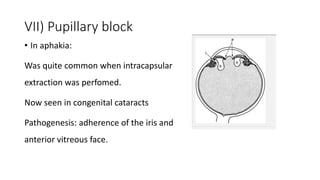
VII) Pupillary block
• In aphakia:
Was quite common when intracapsular
extraction was perfomed.
Now seen in congenital cataracts
Pathogenesis: adherence of the iris and
anterior vitreous face.
• In pseudophakia:
Most common with ACIOLS and iris fixated lens, where IOL contact with
iris leads to pupillary block.
PCIOLS can also cause pupillary block. The mechanism is usually
excessive inflammation leading to 360 degree posterior synechiae.
Sometimes a large air bubble can cause a pupillary block.
VIII) Peripheral anterior synechiae
• Formation of peripheral anterior synechiae can lead to chronic angle
closure glaucoma.
• Risk factors include flat AC due to wound leak, inflammation.
VIII) Influence of alpha chymotrypsin
Not seen anymore. Enzymatic zonulolysis done in ICCE led to increased
IOP.
Precautions & Management
• Preoperative considerations:
1) Reduction of IOP
- Massage digitally, with a rubber ball or a pneumatic rubber balloon
(Honan IOP reducer).
- I.V.Mannitol: mostly 100ml of 20% solution (2g)
over 20 mins. Onset of action in 20-60 mins.
2) Selection of IOL
PCIOLs are generally well tolerated.
ACIOLs are more problematic, and are preferably avoided in pre-
existing glaucoma or angle abnormalities.
Intra-operative considerations
• Minimal manipulation, hemostasis.
• Limbal incisions are now used infrequently.
• Judicious use of OVDS and thorough irrigation and removal at the end
of surgery.
• Use of carbachol at the end of surgery was associated with lower IOPs
in the immediate post-op period in one study.
• If severe inflammation is expected, supplementary steroid
administration (intracameral or subconjunctival) is helpful.
• The risk of steroid induced glaucoma must be borne in mind.
• In case of vitreous loss, meticulous vitrectomy must be done.
• In aphakia, iridectomy is a must, especially in pediatric cataracts.
Post-op management- Early
• A modest, transient rise in IOP with a well formed AC is usually of no
consequence and settles in 1-3 days even without therapy.
• In any open angle cause, the primary line of action would be medical.
• Carbonic anhydrase inhibitors (oral or topical), beta blockers, alpha
agonists are usually indicted. Prostaglandins are used with caution in
view of their inflammatory potential.
• UGH syndrome is managed by mydiatrics and steroids along with
antiglaucoma medications.
• Surgery in the immediate postop is only required if associated with
retained lens fragments in the vitreous or significantly in the AC.
• In such cases vitrectomy or immediate AC wash maybe necessary.
• In pupillary blocks, mydriatics may initially relieve the block but an
iridotomy is invariably necessary.
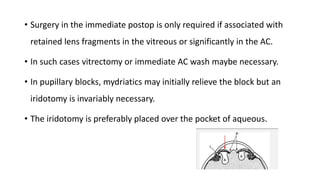
• The iridotomy is preferably placed over the pocket of aqueous.
Late post-op
• Chronic glaucoma in aphakia and pseudophakia should be medically
managed.
• Surgical intervention is indicated only when maximum medical
therapy has failed.
• Trabeculectomy with mitomycin-C is the preferred surgery of choice
although drainage devices are gaining more popularity of late.
• Trabeculectomy has a high failure rate, in view of conjunctival scarring,
inflammation, vitreous in AC.
• Failure rate is more in paediatric cases with almost 50% needing resurgery.
• Glaucoma drainage devices maybe preferable in such cases although
vitreous blocking the tube remains a major cause of failure in such cases.
• Cyclodestructive procedures like cylcocryotherapy or laser
cyclophotocoagulation are reserved for refractory cases.
Thank you

Glaucoma in Aphakia and Pesudophakia

  • 1.
    GLAUCOMA IN APHAKIA &PSEUDOPHAKIA BY Dr.Aditya Mahadevan Moderators Prof.Dr.K.Srikanth Dr.N.Swathi (Assoc)
  • 2.
    Terminology & Incidence •Many mechanisms by which cataract extraction, with or without intra-ocular lens (IOL) implantation can lead to glaucoma • Usage of the term aphakic or pseudophakic glaucoma is therefore discouraged.
  • 3.
    Incidence - Aphakia •Incidence varies widely. • In aphakics, chronic glaucoma post cataract surgery had an incidence of around 3%. • Incidence went down with the advent of the extracapsular cataract extraction (ECCE) and posterior chamber intraocular lens (PCIOL) implantation.
  • 4.
    Incidence – Pseudophakia •Generally associated with a decrease in IOP following PCIOL implantation. • ECCE – drop of around 0.5mm of Hg. • Phacoemulsifiction- drop of around 1 to 2mm of Hg. • Transient increases occurs in 29-50% on the POD#1 in eyes without pre- existing glaucoma. • Chronic glaucoma was noted between 2- 4% after standard ECCE. • Incidence of 11.3% following a secondary anterior chamber implants.
  • 5.
    Mechanisms • Various mechanismshave been described. • Glaucoma in aphakia, in the present day, occurs mostly in paediatric cataracts. • Causative mechanisms can be divided into a. Based on angle status: open angle and angle closure(with or without pupillary block). b. Based on duration: acute and chronic.
  • 6.
    I. Viscoelastic substances •The IOP elevation is by a reduction of aqueous outflow, due to blockage of the trabecular meshwork. • Usually transient, peaking at 4 to 7 hours postoperatively and returning to baseline within several days, but the maximum IOP may exceed 30 mmHg. • Sodium hyaluronate (Healon) caused greater IOP rise than hydroxypropyl methylcellulose (HPMC) in a study in 2007. • Healon removal: Rock n’ roll technique needed more time and caused greater IOP rise as compared to the two compartment technique.
  • 7.
    II. Inflammation andhemorrhage • IOP elevation due to obstruction by inflammatory cells, fibrin, blood cells. • Chronic uveitis may lead to PAS or pupillary block too. • Risk factors: excess manipulation, retained lens matter, anterior chamber IOLs (even more in iris supported IOLS). • Triad of uveitis, glaucoma and hyphaema known as UGH syndrome. • PCOILs with intact posterior lens capsules have minimal alteration in the blood-aqueous barrier. • Late haemorrhage (Swan syndrome) may be due to vascularized wound.
  • 8.
    III) Pigment dispersion •Excess pigment dispersion leads to transient rise in IOP (open angle). • More so when the PCIOL has dislocated into the sulcus or AC and in ACIOLS. • Gonioscopy in such cases will reveal heavy pigmentation of the trabeculum.
  • 9.
    IV)Distortion/damage to theAngle • Kirsch et al described an internal white ridge in a corneo-scleral incision. • It is postulated that such limbal incisions cause distortion or damage to the trabecular meshwork leading to open angle glaucoma.
  • 10.
    V)Vitreous in AC •Can cause both open and angle closure glaucomas. • When vitreous fills the AC it can either cause pupillary block or block the angle and prevent drainage. • VI) Steroid responders: If IOP starts rising only a few weeks after surgery, then a positive steroid response has to be kept in mind Usually this can be verified rather easily by stopping the steroid treatment.
  • 11.
    VII) Pupillary block •In aphakia: Was quite common when intracapsular extraction was perfomed. Now seen in congenital cataracts Pathogenesis: adherence of the iris and anterior vitreous face.
  • 12.
    • In pseudophakia: Mostcommon with ACIOLS and iris fixated lens, where IOL contact with iris leads to pupillary block. PCIOLS can also cause pupillary block. The mechanism is usually excessive inflammation leading to 360 degree posterior synechiae. Sometimes a large air bubble can cause a pupillary block.
  • 13.
    VIII) Peripheral anteriorsynechiae • Formation of peripheral anterior synechiae can lead to chronic angle closure glaucoma. • Risk factors include flat AC due to wound leak, inflammation. VIII) Influence of alpha chymotrypsin Not seen anymore. Enzymatic zonulolysis done in ICCE led to increased IOP.
  • 14.
    Precautions & Management •Preoperative considerations: 1) Reduction of IOP - Massage digitally, with a rubber ball or a pneumatic rubber balloon (Honan IOP reducer). - I.V.Mannitol: mostly 100ml of 20% solution (2g) over 20 mins. Onset of action in 20-60 mins.
  • 15.
    2) Selection ofIOL PCIOLs are generally well tolerated. ACIOLs are more problematic, and are preferably avoided in pre- existing glaucoma or angle abnormalities.
  • 16.
    Intra-operative considerations • Minimalmanipulation, hemostasis. • Limbal incisions are now used infrequently. • Judicious use of OVDS and thorough irrigation and removal at the end of surgery. • Use of carbachol at the end of surgery was associated with lower IOPs in the immediate post-op period in one study.
  • 17.
    • If severeinflammation is expected, supplementary steroid administration (intracameral or subconjunctival) is helpful. • The risk of steroid induced glaucoma must be borne in mind. • In case of vitreous loss, meticulous vitrectomy must be done. • In aphakia, iridectomy is a must, especially in pediatric cataracts.
  • 18.
    Post-op management- Early •A modest, transient rise in IOP with a well formed AC is usually of no consequence and settles in 1-3 days even without therapy. • In any open angle cause, the primary line of action would be medical. • Carbonic anhydrase inhibitors (oral or topical), beta blockers, alpha agonists are usually indicted. Prostaglandins are used with caution in view of their inflammatory potential. • UGH syndrome is managed by mydiatrics and steroids along with antiglaucoma medications.
  • 19.
    • Surgery inthe immediate postop is only required if associated with retained lens fragments in the vitreous or significantly in the AC. • In such cases vitrectomy or immediate AC wash maybe necessary. • In pupillary blocks, mydriatics may initially relieve the block but an iridotomy is invariably necessary. • The iridotomy is preferably placed over the pocket of aqueous.
  • 20.
    Late post-op • Chronicglaucoma in aphakia and pseudophakia should be medically managed. • Surgical intervention is indicated only when maximum medical therapy has failed. • Trabeculectomy with mitomycin-C is the preferred surgery of choice although drainage devices are gaining more popularity of late.
  • 21.
    • Trabeculectomy hasa high failure rate, in view of conjunctival scarring, inflammation, vitreous in AC. • Failure rate is more in paediatric cases with almost 50% needing resurgery. • Glaucoma drainage devices maybe preferable in such cases although vitreous blocking the tube remains a major cause of failure in such cases. • Cyclodestructive procedures like cylcocryotherapy or laser cyclophotocoagulation are reserved for refractory cases.
  • 22.