Downloaded 56 times


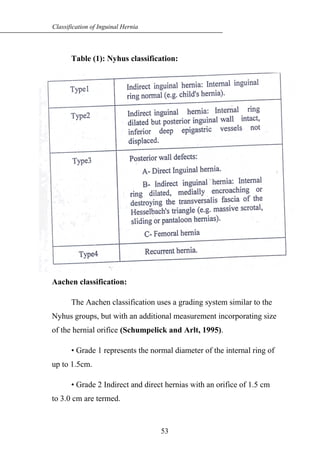


Classification schemes for inguinal hernias aim to provide an anatomical blueprint to guide surgical treatment and allow for standardized reporting of postoperative outcomes. Several classification systems are described in the document, including the Gilbert, Nyhus, Aachen, Bendavid, and Stoppa systems. These systems differentiate between direct and indirect hernias based on their location relative to the inferior epigastric vessels. They also classify hernias by characteristics like size, recurrence, and presence of complicating factors to determine the appropriate surgical approach. A standardized classification approach facilitates understanding, treatment planning, and comparison of results for inguinal hernia repairs.


