1
2
Introduction
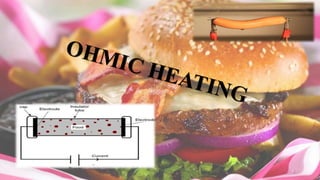
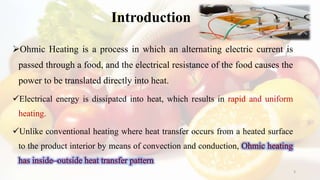
Ohmic Heating is a process in which an alternating electric current is
passed through a food, and the electrical resistance of the food causes the
power to be translated directly into heat.
Electrical energy is dissipated into heat, which results in rapid and uniform
heating.
Unlike conventional heating where heat transfer occurs from a heated surface
to the product interior by means of convection and conduction,
3
History Ohmic Heating
Its not a new technology , used as a commercial process in the early 20th century for
the “Pasteurization of Milk”.
The “Electro pure process” was discontinued between the late 1930s and 1960s,
because of the high cost of electricity and a lack of suitable electrode materials.
Interest in ohmic heating was rekindled in the 1980s, when investigators were
searching for viable methods for effective sterilization of large liquid particle.
In Conventional heating heat transfer occurs from a heated surface to the product
interior (means of convection and conduction) and is time consuming.
 Electro resistive or ohmic heating is volumetric in nature and thus has the
potential to reduce over processing by virtue of its inside–outside heat transfer
pattern.
4
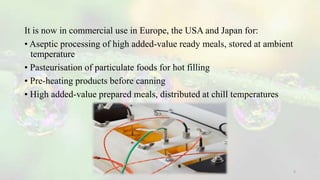
It is now in commercial use in Europe, the USA and Japan for:
• Aseptic processing of high added-value ready meals, stored at ambient
temperature
• Pasteurisation of particulate foods for hot filling
• Pre-heating products before canning
• High added-value prepared meals, distributed at chill temperatures
5
How is Ohmic heating different from
conventional thermal processing..?
During conventional thermal processing, either in cans or aseptic
processing systems, significant quality damage may occur due to slow
conduction and convection heat transfer
Ohmic heating volumetrically heats the entire mass of the food
material, thus the resulting product is of far greater quality.
It is possible to process large particulate foods (up to 1 inch) that
would be difficult to process using conventional heat exchangers.
Ohmic heater cleaning requirements are comparatively less than
those of traditional heat exchangers due to reduced product fouling on
the food contact surface.
6
Principle of Working
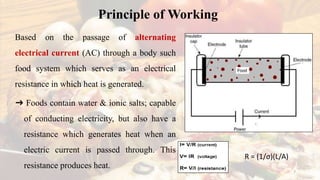
Based on the passage of alternating
electrical current (AC) through a body such
food system which serves as an electrical
resistance in which heat is generated.
➜ Foods contain water & ionic salts; capable
of conducting electricity, but also have a
resistance which generates heat when an
electric current is passed through. This
resistance produces heat.
7
R = (1/σ)(L/A)
Working
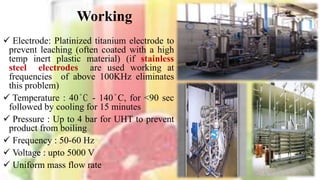
 Electrode: Platinized titanium electrode to
prevent leaching (often coated with a high
temp inert plastic material) (if stainless
steel electrodes are used working at
frequencies of above 100KHz eliminates
this problem)
 Temperature : 40°C - 140°C, for <90 sec
followed by cooling for 15 minutes
 Pressure : Up to 4 bar for UHT to prevent
product from boiling
 Frequency : 50-60 Hz
 Voltage : upto 5000 V
 Uniform mass flow rate
8
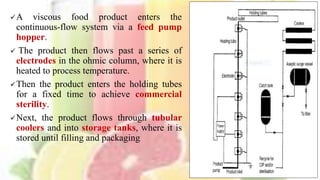
A viscous food product enters the
continuous-flow system via a feed pump
hopper.
 The product then flows past a series of
electrodes in the ohmic column, where it is
heated to process temperature.
Then the product enters the holding tubes
for a fixed time to achieve commercial
sterility.
Next, the product flows through tubular
coolers and into storage tanks, where it is
stored until filling and packaging
9
Control Parameters
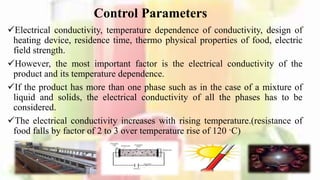
Electrical conductivity, temperature dependence of conductivity, design of
heating device, residence time, thermo physical properties of food, electric
field strength.
However, the most important factor is the electrical conductivity of the
product and its temperature dependence.
If the product has more than one phase such as in the case of a mixture of
liquid and solids, the electrical conductivity of all the phases has to be
considered.
The electrical conductivity increases with rising temperature.(resistance of
food falls by factor of 2 to 3 over temperature rise of 120 ·C)
10
Factors affecting ohmic heating
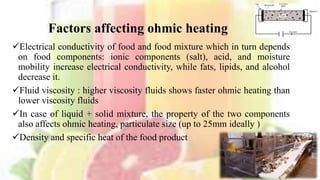
Electrical conductivity of food and food mixture which in turn depends
on food components: ionic components (salt), acid, and moisture
mobility increase electrical conductivity, while fats, lipids, and alcohol
decrease it.
Fluid viscosity : higher viscosity fluids shows faster ohmic heating than
lower viscosity fluids
In case of liquid + solid mixture, the property of the two components
also affects ohmic heating, particulate size (up to 25mm ideally )
Density and specific heat of the food product
11
Microorganisms inactivation by
ohmic heating
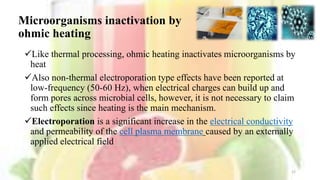
Like thermal processing, ohmic heating inactivates microorganisms by
heat
Also non-thermal electroporation type effects have been reported at
low-frequency (50-60 Hz), when electrical charges can build up and
form pores across microbial cells, however, it is not necessary to claim
such effects since heating is the main mechanism.
Electroporation is a significant increase in the electrical conductivity
and permeability of the cell plasma membrane caused by an externally
applied electrical field
12
Ohmically Processed Commercial Products
Available on the Market
A number of processing plants
currently produce sliced, diced, and
whole fruit within sauces in various
countries
In the United States, ohmic heating
has been used to produce a low-
acid products and pasteurized liquid
egg
13
Application of ohmic heating
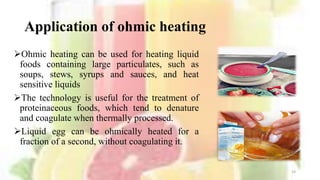
Ohmic heating can be used for heating liquid
foods containing large particulates, such as
soups, stews, syrups and sauces, and heat
sensitive liquids
The technology is useful for the treatment of
proteinaceous foods, which tend to denature
and coagulate when thermally processed.
Liquid egg can be ohmically heated for a
fraction of a second, without coagulating it.
14
Cont…
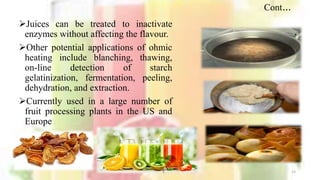
Juices can be treated to inactivate
enzymes without affecting the flavour.
Other potential applications of ohmic
heating include blanching, thawing,
on-line detection of starch
gelatinization, fermentation, peeling,
dehydration, and extraction.
Currently used in a large number of
fruit processing plants in the US and
Europe
15
Advantages
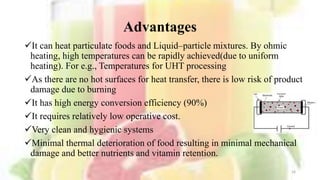
It can heat particulate foods and Liquid–particle mixtures. By ohmic
heating, high temperatures can be rapidly achieved(due to uniform
heating). For e.g., Temperatures for UHT processing
As there are no hot surfaces for heat transfer, there is low risk of product
damage due to burning
It has high energy conversion efficiency (90%)
It requires relatively low operative cost.
Very clean and hygienic systems
Minimal thermal deterioration of food resulting in minimal mechanical
damage and better nutrients and vitamin retention.
16
Disadvantages
Complex relationship between conductivity and temperature
Leaching of electrode material into the food systems
Ohmically processed multi-phase food product is not yet approved by the
FDA (as of 2001)
Expensive in terms of installation and equipment manufacture
Low conductivity foods cannot be processed eg. foods having fat globules
Rapid increase of conductivity with temperature may lead to “runaway
heating”
17
Shelf Life of an Ohmically Processed Product
The shelf life of ohmically processed foods is comparable to that of
canned and sterile, aseptically processed products
This process uses ordinary electricity. No emissions are produced at
the point of use
One emerging application of ohmic heating is fruit peeling, which
may greatly reduce the use of lye that is common to such operations,
and results in environmental benefits
18
Reference
• (De Alwis and Fryer 1990)
De Alwis, A. and P. Fryer (1990). "The use of direct resistance heating in the food
industry." Journal of Food Engineering 11(1): 3-27.
• (Halden, De Alwis et al. 1990, Icier and Ilicali 2005)
Halden, K., et al. (1990). "Changes in the electrical conductivity of foods during ohmic
heating." International Journal of Food Science & Technology 25(1): 9-25.
• (Icier and Ilicali 2005)
Icier, F. and C. Ilicali (2005). "Temperature dependent electrical conductivities of fruit
purees during ohmic heating." Food Research International 38(10): 1135-1142.
• Gopu Raveendran Nair, V.R Divya, Liji Prasannan, V. Habeeba, M.V. Prince, G.S.V.
Raghavan, Ohmic heating as a pre treatment in solvent extraction of rice bran, June
2012
19
20

Ohmic heating

  • 1.
  • 2.
  • 3.
    Introduction Ohmic Heating isa process in which an alternating electric current is passed through a food, and the electrical resistance of the food causes the power to be translated directly into heat. Electrical energy is dissipated into heat, which results in rapid and uniform heating. Unlike conventional heating where heat transfer occurs from a heated surface to the product interior by means of convection and conduction, 3
  • 4.
    History Ohmic Heating Itsnot a new technology , used as a commercial process in the early 20th century for the “Pasteurization of Milk”. The “Electro pure process” was discontinued between the late 1930s and 1960s, because of the high cost of electricity and a lack of suitable electrode materials. Interest in ohmic heating was rekindled in the 1980s, when investigators were searching for viable methods for effective sterilization of large liquid particle. In Conventional heating heat transfer occurs from a heated surface to the product interior (means of convection and conduction) and is time consuming.  Electro resistive or ohmic heating is volumetric in nature and thus has the potential to reduce over processing by virtue of its inside–outside heat transfer pattern. 4
  • 5.
    It is nowin commercial use in Europe, the USA and Japan for: • Aseptic processing of high added-value ready meals, stored at ambient temperature • Pasteurisation of particulate foods for hot filling • Pre-heating products before canning • High added-value prepared meals, distributed at chill temperatures 5
  • 6.
    How is Ohmicheating different from conventional thermal processing..? During conventional thermal processing, either in cans or aseptic processing systems, significant quality damage may occur due to slow conduction and convection heat transfer Ohmic heating volumetrically heats the entire mass of the food material, thus the resulting product is of far greater quality. It is possible to process large particulate foods (up to 1 inch) that would be difficult to process using conventional heat exchangers. Ohmic heater cleaning requirements are comparatively less than those of traditional heat exchangers due to reduced product fouling on the food contact surface. 6
  • 7.
    Principle of Working Basedon the passage of alternating electrical current (AC) through a body such food system which serves as an electrical resistance in which heat is generated. ➜ Foods contain water & ionic salts; capable of conducting electricity, but also have a resistance which generates heat when an electric current is passed through. This resistance produces heat. 7 R = (1/σ)(L/A)
  • 8.
    Working  Electrode: Platinizedtitanium electrode to prevent leaching (often coated with a high temp inert plastic material) (if stainless steel electrodes are used working at frequencies of above 100KHz eliminates this problem)  Temperature : 40°C - 140°C, for <90 sec followed by cooling for 15 minutes  Pressure : Up to 4 bar for UHT to prevent product from boiling  Frequency : 50-60 Hz  Voltage : upto 5000 V  Uniform mass flow rate 8
  • 9.
    A viscous foodproduct enters the continuous-flow system via a feed pump hopper.  The product then flows past a series of electrodes in the ohmic column, where it is heated to process temperature. Then the product enters the holding tubes for a fixed time to achieve commercial sterility. Next, the product flows through tubular coolers and into storage tanks, where it is stored until filling and packaging 9
  • 10.
    Control Parameters Electrical conductivity,temperature dependence of conductivity, design of heating device, residence time, thermo physical properties of food, electric field strength. However, the most important factor is the electrical conductivity of the product and its temperature dependence. If the product has more than one phase such as in the case of a mixture of liquid and solids, the electrical conductivity of all the phases has to be considered. The electrical conductivity increases with rising temperature.(resistance of food falls by factor of 2 to 3 over temperature rise of 120 ·C) 10
  • 11.
    Factors affecting ohmicheating Electrical conductivity of food and food mixture which in turn depends on food components: ionic components (salt), acid, and moisture mobility increase electrical conductivity, while fats, lipids, and alcohol decrease it. Fluid viscosity : higher viscosity fluids shows faster ohmic heating than lower viscosity fluids In case of liquid + solid mixture, the property of the two components also affects ohmic heating, particulate size (up to 25mm ideally ) Density and specific heat of the food product 11
  • 12.
    Microorganisms inactivation by ohmicheating Like thermal processing, ohmic heating inactivates microorganisms by heat Also non-thermal electroporation type effects have been reported at low-frequency (50-60 Hz), when electrical charges can build up and form pores across microbial cells, however, it is not necessary to claim such effects since heating is the main mechanism. Electroporation is a significant increase in the electrical conductivity and permeability of the cell plasma membrane caused by an externally applied electrical field 12
  • 13.
    Ohmically Processed CommercialProducts Available on the Market A number of processing plants currently produce sliced, diced, and whole fruit within sauces in various countries In the United States, ohmic heating has been used to produce a low- acid products and pasteurized liquid egg 13
  • 14.
    Application of ohmicheating Ohmic heating can be used for heating liquid foods containing large particulates, such as soups, stews, syrups and sauces, and heat sensitive liquids The technology is useful for the treatment of proteinaceous foods, which tend to denature and coagulate when thermally processed. Liquid egg can be ohmically heated for a fraction of a second, without coagulating it. 14
  • 15.
    Cont… Juices can betreated to inactivate enzymes without affecting the flavour. Other potential applications of ohmic heating include blanching, thawing, on-line detection of starch gelatinization, fermentation, peeling, dehydration, and extraction. Currently used in a large number of fruit processing plants in the US and Europe 15
  • 16.
    Advantages It can heatparticulate foods and Liquid–particle mixtures. By ohmic heating, high temperatures can be rapidly achieved(due to uniform heating). For e.g., Temperatures for UHT processing As there are no hot surfaces for heat transfer, there is low risk of product damage due to burning It has high energy conversion efficiency (90%) It requires relatively low operative cost. Very clean and hygienic systems Minimal thermal deterioration of food resulting in minimal mechanical damage and better nutrients and vitamin retention. 16
  • 17.
    Disadvantages Complex relationship betweenconductivity and temperature Leaching of electrode material into the food systems Ohmically processed multi-phase food product is not yet approved by the FDA (as of 2001) Expensive in terms of installation and equipment manufacture Low conductivity foods cannot be processed eg. foods having fat globules Rapid increase of conductivity with temperature may lead to “runaway heating” 17
  • 18.
    Shelf Life ofan Ohmically Processed Product The shelf life of ohmically processed foods is comparable to that of canned and sterile, aseptically processed products This process uses ordinary electricity. No emissions are produced at the point of use One emerging application of ohmic heating is fruit peeling, which may greatly reduce the use of lye that is common to such operations, and results in environmental benefits 18
  • 19.
    Reference • (De Alwisand Fryer 1990) De Alwis, A. and P. Fryer (1990). "The use of direct resistance heating in the food industry." Journal of Food Engineering 11(1): 3-27. • (Halden, De Alwis et al. 1990, Icier and Ilicali 2005) Halden, K., et al. (1990). "Changes in the electrical conductivity of foods during ohmic heating." International Journal of Food Science & Technology 25(1): 9-25. • (Icier and Ilicali 2005) Icier, F. and C. Ilicali (2005). "Temperature dependent electrical conductivities of fruit purees during ohmic heating." Food Research International 38(10): 1135-1142. • Gopu Raveendran Nair, V.R Divya, Liji Prasannan, V. Habeeba, M.V. Prince, G.S.V. Raghavan, Ohmic heating as a pre treatment in solvent extraction of rice bran, June 2012 19
  • 20.