Emerging Food Technologies Presentation Series - 2016
University of Sri Jayewardanepura
Pulsed Electric Fields for
Food Processing
Technology
Emerging Food Technologies Presentation Series - 2016
University of Sri Jayewardanepura
Name: M.M. Aaysha Shakoora
School attended: KM/ Mahmud Ladies College
Hobbies: Reading, handicraft & travelling
Interested in: Archery, Horseback riding & Swimming
Believes ,
“THE BEST AMONG YOU ARE THOSE WHO HAVE THE BEST MANNERS &
CHARACTER”
Emerging Food Technologies Presentation Series - 2016
University of Sri Jayewardanepura
OVERVIEW
 INTRODUCTION
 SYSTEM COMPONENTS
 PRINCIPLES OF PEF
 FACTORS AFFECTING THE OUTCOME OF PEF
 ADVANTAGES & DISADVANTAGES OF PEF
 REFERENCES
Emerging Food Technologies Presentation Series - 2016
University of Sri Jayewardanepura
PEF is a non-thermal method of physical food preservation that
uses short pulses of electricity for microbial inactivation.
Pulse-burst of current/ voltage/ electromagnetic field energy. A pulse may last from a
nanoseconds to several seconds.
 Offer High-quality foods.
 For food quality attributes, PEF technology is considered superior to traditional
thermal processing methods because it avoids or greatly reduces detrimental
changes in the sensory and physical properties of foods.
INTRODUCTION
Emerging Food Technologies Presentation Series - 2016
University of Sri Jayewardanepura
Use of electricity in food preservation already has more than a 100 year history, since
investigations in to bactericidal effect of current carried out by Prochowchik & Spaeth.
In the 1940s, treatment of apple mash by DC & AC current was used for increasing juice
yield.
In the beginning of 1960s, application of pulsed electric fields (PEF) for disruption of
cells in food material was patented by Doevenspeck.
He also reported achievement of up to 96% inactivation of Salmonella bacteria
suspended in marination brine.
HISTORY………..
Emerging Food Technologies Presentation Series - 2016
University of Sri Jayewardanepura
.
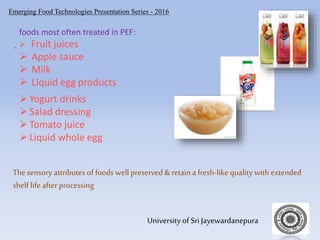
foods most often treated in PEF:
 Fruit juices
 Apple sauce
 Milk
 Liquid egg products
Yogurt drinks
Salad dressing
Tomato juice
Liquid whole egg
Thesensory attributes of foods well preserved & retain a fresh-like quality with extended
shelf life after processing
Emerging Food Technologies Presentation Series - 2016
University of Sri Jayewardanepura
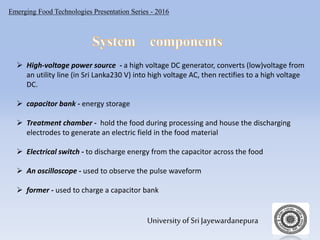
 High-voltage power source - a high voltage DC generator, converts (low)voltage from
an utility line (in Sri Lanka230 V) into high voltage AC, then rectifies to a high voltage
DC.
 capacitor bank - energy storage
 Treatment chamber - hold the food during processing and house the discharging
electrodes to generate an electric field in the food material
 Electrical switch - to discharge energy from the capacitor across the food
 An oscilloscope - used to observe the pulse waveform
 former - used to charge a capacitor bank
Emerging Food Technologies Presentation Series - 2016
University of Sri Jayewardanepura
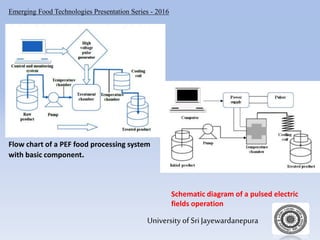
Flow chart of a PEF food processing system
with basic component.
Schematic diagram of a pulsed electric
fields operation
Emerging Food Technologies Presentation Series - 2016
University of Sri Jayewardanepura
Emerging Food Technologies Presentation Series - 2016
University of Sri Jayewardanepura
 Two electrodes are connected together with a nonconductive material to avoid electrical
flow from one to the other.
Apart from those major components, some adjunct parts are also necessary. In
case of continuous systems,
 Pump - to convey the food through the treatment chamber
 Chamber cooling system - diminish the ohmic heating effect & control food
temperature during treatment.
 High-voltage & high-current probes - measure the voltage & current delivered
to the chamber
Emerging Food Technologies Presentation Series - 2016
University of Sri Jayewardanepura
The Principles of Pulsed
Electric Field
 The process is based on pulsed electrical currents delivered to a product placed between a
set of electrodes.
 Food is capable of transferring electricity because of the presence of several ions. So, when
an electrical field is applied, electrical current flows into the liquid food and is transferred
to each point in the liquid because of the charged molecules present.
 The food product experiences a force per unit charge, the so-called electric field, which is
responsible for the dielectric cell membrane breakdown in MOs & interaction with the
charged molecules of food
 Application of pulsed electric fields of high intensity and duration from microseconds to
milliseconds may cause temporary or permanent permeabilization of cell membranes
enables inactivation of vegetative cells of bacteria and yeasts in various foods.
Emerging Food Technologies Presentation Series - 2016
University of Sri Jayewardanepura
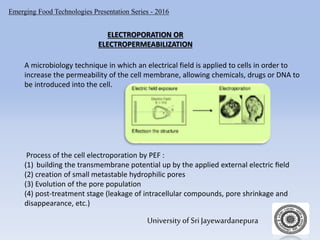
A microbiology technique in which an electrical field is applied to cells in order to
increase the permeability of the cell membrane, allowing chemicals, drugs or DNA to
be introduced into the cell.
ELECTROPORATION OR
ELECTROPERMEABILIZATION
Process of the cell electroporation by PEF :
(1) building the transmembrane potential up by the applied external electric field
(2) creation of small metastable hydrophilic pores
(3) Evolution of the pore population
(4) post-treatment stage (leakage of intracellular compounds, pore shrinkage and
disappearance, etc.)
Emerging Food Technologies Presentation Series - 2016
University of Sri Jayewardanepura
Emerging Food Technologies Presentation Series - 2016
University of Sri Jayewardanepura
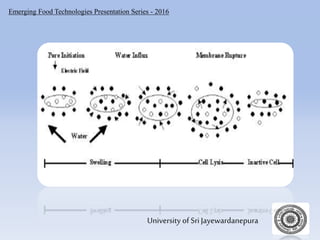
Electroporation can be either: reversible (cell membrane discharge) or
irreversible (cell membrane breakdown or lysis)
but this effect can be controlled depending on the application.
.
Treatment packaged aseptically stored under
refrigeration.
Emerging Food Technologies Presentation Series - 2016
University of Sri Jayewardanepura
Factors affecting the outcome of pulsed
electric fields treatments
The lethality factors contributing to the effectiveness of PEF
technological biological media factors
Emerging Food Technologies Presentation Series - 2016
University of Sri Jayewardanepura
TECHNOLOGICAL FACTORS
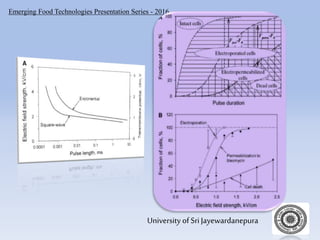
• FIELD STRENGTH - Microbial inactivation increases with an increase in the electric field
intensity, above a critical trans membrane potential.
Evenly distributed electric field intensity efficient treatment.
Electric field intensities of smaller than 4-8 kV/cm usually do not affect microbial
inactivation. In general, the electric field intensity required to inactivate MOs in foods, in the
range of 12-45 kV/cm.
• TREATMENT TIME
• TREATMENT TEMPERATURE
• PULSE SHAPE & SIZE - square waveforms may be more lethal, energy efficient than
exponentially decaying pulses. square pulses have longer peak voltage duration compared to
exponential pulses.
short pulses - avoid excessive heating or undesirable electrolytic reactions.
Emerging Food Technologies Presentation Series - 2016
University of Sri Jayewardanepura
Emerging Food Technologies Presentation Series - 2016
University of Sri Jayewardanepura
BIOLOGICAL FACTORS
● Individual characteristics of target MOs
● Physiological characteristics
● Growth states
Gram (+) cells more resistant to PEF than Gram(-)negative bacteria
Yeasts - higher sensitivity than bacteria
Larger cells - Induction of electric fields into cell membranes is greater
Emerging Food Technologies Presentation Series - 2016
University of Sri Jayewardanepura
MEDIA FACTORS
The effects of PEF on the food system :
PEF system - conductivity, resistivity, dielectric properties, ionic
strength, pH & composition
Properties of the food - physical and chemical
 These factors most likely influence the recovery of injured microbial cells and their
subsequent growth following PEF exposure, since the presence of food components,
such as fats and proteins , has reportedly had a preventive effect on MOs against PEF
treatment
 Each of these parameter influences the PEF treatment either alone or in combination.
● But enzymes and proteins are generally more resistant to electric field intensity & pulses than
microorganisms. This requires further investigation, especially on the effects of pH, temperature,
resistivity and composition of the enzyme or protein-containing medium or food system. As
bacterial spores are resistant to pulsed electric fields, applications of this technology mainly
focus on food-borne pathogens and spoilage microorganisms, especially for acidic food products
Emerging Food Technologies Presentation Series - 2016
University of Sri Jayewardanepura
Advantages of Pulsed Electric Fields
Technology
 Preservation of solid, semisolid & liquid food
pasteurization - temperatures below 30-40°C
(juices, milk, yogurt, soups, and liquid eggs)
 Economically & efficiently improve energy usage
 Providing microbiologically safe and minimally processed foods.
 Causes minimal detrimental effect on food quality attributes
 Enhance extraction of sugars (sugar beet) and other cellular content from plant cells
(Improvement of metabolite extraction)
 Enhance mass & heat transfer to assist drying of plant tissues
Emerging Food Technologies Presentation Series - 2016
University of Sri Jayewardanepura
 Enzyme activity modification
 Reducing the solid volume of wastewater
 Biotechnology and genetic engineering (electroporation in cell hybridization)
Emerging Food Technologies Presentation Series - 2016
University of Sri Jayewardanepura
● Restricted to food products with air bubbles & low electrical conductivity.
presence of bubbles lead to non-uniform treatment, operational & safety
problems. When the applied electric field > dielectric strength of the gas
bubbles, partial discharges take place inside the bubbles that can volatize the
liquid and therefore increase the volume of the bubbles. The bubbles may
become big enough to bridge the gap between the 2 electrodes and may produce
a spark. Therefore, air bubbles in the food must be removed, particularly with
batch systems. Vacuum degassing or pressurizing the treatment media during
processing, using positive back pressure, can minimize the presence of gas.
● Continuous processing – so not suitable for solid food products that are not
pumpable.
● The systems need to be scaled up to commercial systems.
● The lack of methods to accurately measure treatment delivery
● Costly
Emerging Food Technologies Presentation Series - 2016
University of Sri Jayewardanepura
 https://www.researchgate.net/publication/226595907_Electroporation_of_
Cell_Membranes_The_Fundamental_Effects_of_Pulsed_Electric_Fields_in _
Food_Processing
 Pulsed Electric Fields for Food Processing Technology
http://dx.doi.org/10.5772/48678
 https://www.researchgate.net/publication/226595907_Electroporation_of_
Cell_Membranes_The_Fundamental_Effects_of_Pulsed_Electric_Fields_in_
Food_Processing
REFERENCES

Pulsed Electric Field For Food Processing Technology

  • 1.
    Emerging Food TechnologiesPresentation Series - 2016 University of Sri Jayewardanepura Pulsed Electric Fields for Food Processing Technology
  • 2.
    Emerging Food TechnologiesPresentation Series - 2016 University of Sri Jayewardanepura Name: M.M. Aaysha Shakoora School attended: KM/ Mahmud Ladies College Hobbies: Reading, handicraft & travelling Interested in: Archery, Horseback riding & Swimming Believes , “THE BEST AMONG YOU ARE THOSE WHO HAVE THE BEST MANNERS & CHARACTER”
  • 3.
    Emerging Food TechnologiesPresentation Series - 2016 University of Sri Jayewardanepura OVERVIEW  INTRODUCTION  SYSTEM COMPONENTS  PRINCIPLES OF PEF  FACTORS AFFECTING THE OUTCOME OF PEF  ADVANTAGES & DISADVANTAGES OF PEF  REFERENCES
  • 4.
    Emerging Food TechnologiesPresentation Series - 2016 University of Sri Jayewardanepura PEF is a non-thermal method of physical food preservation that uses short pulses of electricity for microbial inactivation. Pulse-burst of current/ voltage/ electromagnetic field energy. A pulse may last from a nanoseconds to several seconds.  Offer High-quality foods.  For food quality attributes, PEF technology is considered superior to traditional thermal processing methods because it avoids or greatly reduces detrimental changes in the sensory and physical properties of foods. INTRODUCTION
  • 5.
    Emerging Food TechnologiesPresentation Series - 2016 University of Sri Jayewardanepura Use of electricity in food preservation already has more than a 100 year history, since investigations in to bactericidal effect of current carried out by Prochowchik & Spaeth. In the 1940s, treatment of apple mash by DC & AC current was used for increasing juice yield. In the beginning of 1960s, application of pulsed electric fields (PEF) for disruption of cells in food material was patented by Doevenspeck. He also reported achievement of up to 96% inactivation of Salmonella bacteria suspended in marination brine. HISTORY………..
  • 6.
    Emerging Food TechnologiesPresentation Series - 2016 University of Sri Jayewardanepura . foods most often treated in PEF:  Fruit juices  Apple sauce  Milk  Liquid egg products Yogurt drinks Salad dressing Tomato juice Liquid whole egg Thesensory attributes of foods well preserved & retain a fresh-like quality with extended shelf life after processing
  • 7.
    Emerging Food TechnologiesPresentation Series - 2016 University of Sri Jayewardanepura  High-voltage power source - a high voltage DC generator, converts (low)voltage from an utility line (in Sri Lanka230 V) into high voltage AC, then rectifies to a high voltage DC.  capacitor bank - energy storage  Treatment chamber - hold the food during processing and house the discharging electrodes to generate an electric field in the food material  Electrical switch - to discharge energy from the capacitor across the food  An oscilloscope - used to observe the pulse waveform  former - used to charge a capacitor bank
  • 8.
    Emerging Food TechnologiesPresentation Series - 2016 University of Sri Jayewardanepura Flow chart of a PEF food processing system with basic component. Schematic diagram of a pulsed electric fields operation
  • 9.
    Emerging Food TechnologiesPresentation Series - 2016 University of Sri Jayewardanepura
  • 10.
    Emerging Food TechnologiesPresentation Series - 2016 University of Sri Jayewardanepura  Two electrodes are connected together with a nonconductive material to avoid electrical flow from one to the other. Apart from those major components, some adjunct parts are also necessary. In case of continuous systems,  Pump - to convey the food through the treatment chamber  Chamber cooling system - diminish the ohmic heating effect & control food temperature during treatment.  High-voltage & high-current probes - measure the voltage & current delivered to the chamber
  • 11.
    Emerging Food TechnologiesPresentation Series - 2016 University of Sri Jayewardanepura The Principles of Pulsed Electric Field  The process is based on pulsed electrical currents delivered to a product placed between a set of electrodes.  Food is capable of transferring electricity because of the presence of several ions. So, when an electrical field is applied, electrical current flows into the liquid food and is transferred to each point in the liquid because of the charged molecules present.  The food product experiences a force per unit charge, the so-called electric field, which is responsible for the dielectric cell membrane breakdown in MOs & interaction with the charged molecules of food  Application of pulsed electric fields of high intensity and duration from microseconds to milliseconds may cause temporary or permanent permeabilization of cell membranes enables inactivation of vegetative cells of bacteria and yeasts in various foods.
  • 12.
    Emerging Food TechnologiesPresentation Series - 2016 University of Sri Jayewardanepura A microbiology technique in which an electrical field is applied to cells in order to increase the permeability of the cell membrane, allowing chemicals, drugs or DNA to be introduced into the cell. ELECTROPORATION OR ELECTROPERMEABILIZATION Process of the cell electroporation by PEF : (1) building the transmembrane potential up by the applied external electric field (2) creation of small metastable hydrophilic pores (3) Evolution of the pore population (4) post-treatment stage (leakage of intracellular compounds, pore shrinkage and disappearance, etc.)
  • 13.
    Emerging Food TechnologiesPresentation Series - 2016 University of Sri Jayewardanepura
  • 14.
    Emerging Food TechnologiesPresentation Series - 2016 University of Sri Jayewardanepura Electroporation can be either: reversible (cell membrane discharge) or irreversible (cell membrane breakdown or lysis) but this effect can be controlled depending on the application. . Treatment packaged aseptically stored under refrigeration.
  • 15.
    Emerging Food TechnologiesPresentation Series - 2016 University of Sri Jayewardanepura Factors affecting the outcome of pulsed electric fields treatments The lethality factors contributing to the effectiveness of PEF technological biological media factors
  • 16.
    Emerging Food TechnologiesPresentation Series - 2016 University of Sri Jayewardanepura TECHNOLOGICAL FACTORS • FIELD STRENGTH - Microbial inactivation increases with an increase in the electric field intensity, above a critical trans membrane potential. Evenly distributed electric field intensity efficient treatment. Electric field intensities of smaller than 4-8 kV/cm usually do not affect microbial inactivation. In general, the electric field intensity required to inactivate MOs in foods, in the range of 12-45 kV/cm. • TREATMENT TIME • TREATMENT TEMPERATURE • PULSE SHAPE & SIZE - square waveforms may be more lethal, energy efficient than exponentially decaying pulses. square pulses have longer peak voltage duration compared to exponential pulses. short pulses - avoid excessive heating or undesirable electrolytic reactions.
  • 17.
    Emerging Food TechnologiesPresentation Series - 2016 University of Sri Jayewardanepura
  • 18.
    Emerging Food TechnologiesPresentation Series - 2016 University of Sri Jayewardanepura BIOLOGICAL FACTORS ● Individual characteristics of target MOs ● Physiological characteristics ● Growth states Gram (+) cells more resistant to PEF than Gram(-)negative bacteria Yeasts - higher sensitivity than bacteria Larger cells - Induction of electric fields into cell membranes is greater
  • 19.
    Emerging Food TechnologiesPresentation Series - 2016 University of Sri Jayewardanepura MEDIA FACTORS The effects of PEF on the food system : PEF system - conductivity, resistivity, dielectric properties, ionic strength, pH & composition Properties of the food - physical and chemical  These factors most likely influence the recovery of injured microbial cells and their subsequent growth following PEF exposure, since the presence of food components, such as fats and proteins , has reportedly had a preventive effect on MOs against PEF treatment  Each of these parameter influences the PEF treatment either alone or in combination. ● But enzymes and proteins are generally more resistant to electric field intensity & pulses than microorganisms. This requires further investigation, especially on the effects of pH, temperature, resistivity and composition of the enzyme or protein-containing medium or food system. As bacterial spores are resistant to pulsed electric fields, applications of this technology mainly focus on food-borne pathogens and spoilage microorganisms, especially for acidic food products
  • 20.
    Emerging Food TechnologiesPresentation Series - 2016 University of Sri Jayewardanepura Advantages of Pulsed Electric Fields Technology  Preservation of solid, semisolid & liquid food pasteurization - temperatures below 30-40°C (juices, milk, yogurt, soups, and liquid eggs)  Economically & efficiently improve energy usage  Providing microbiologically safe and minimally processed foods.  Causes minimal detrimental effect on food quality attributes  Enhance extraction of sugars (sugar beet) and other cellular content from plant cells (Improvement of metabolite extraction)  Enhance mass & heat transfer to assist drying of plant tissues
  • 21.
    Emerging Food TechnologiesPresentation Series - 2016 University of Sri Jayewardanepura  Enzyme activity modification  Reducing the solid volume of wastewater  Biotechnology and genetic engineering (electroporation in cell hybridization)
  • 22.
    Emerging Food TechnologiesPresentation Series - 2016 University of Sri Jayewardanepura ● Restricted to food products with air bubbles & low electrical conductivity. presence of bubbles lead to non-uniform treatment, operational & safety problems. When the applied electric field > dielectric strength of the gas bubbles, partial discharges take place inside the bubbles that can volatize the liquid and therefore increase the volume of the bubbles. The bubbles may become big enough to bridge the gap between the 2 electrodes and may produce a spark. Therefore, air bubbles in the food must be removed, particularly with batch systems. Vacuum degassing or pressurizing the treatment media during processing, using positive back pressure, can minimize the presence of gas. ● Continuous processing – so not suitable for solid food products that are not pumpable. ● The systems need to be scaled up to commercial systems. ● The lack of methods to accurately measure treatment delivery ● Costly
  • 23.
    Emerging Food TechnologiesPresentation Series - 2016 University of Sri Jayewardanepura  https://www.researchgate.net/publication/226595907_Electroporation_of_ Cell_Membranes_The_Fundamental_Effects_of_Pulsed_Electric_Fields_in _ Food_Processing  Pulsed Electric Fields for Food Processing Technology http://dx.doi.org/10.5772/48678  https://www.researchgate.net/publication/226595907_Electroporation_of_ Cell_Membranes_The_Fundamental_Effects_of_Pulsed_Electric_Fields_in_ Food_Processing REFERENCES

Editor's Notes

  • #15 The processing time is calculated by multiplying the number of pulses times with effective pulse duration.
  • #18 Plotting logs of the numbers of survivors against log or treatment time, or number of pulses, have been used to explain inactivation kinetics neglecting the deviations from linearity for these plots