TEXTILE EFFLUENT TREATMENT
CHAPTER THREE
Granch Berhe
EFFLUENTS DISCHARGED BY TEXTILE
PROCESSING INDUSTRY
3.1
Total Textile Process at a Glance
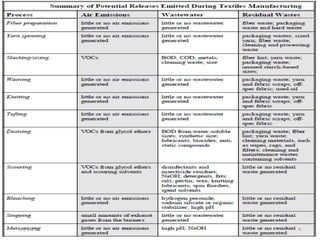
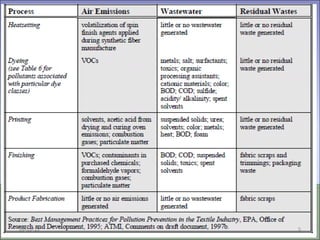
Two types of waste are generated: process chemicals and fiber wastes
The nature of the waste generated depends on
 Type of textile facility
Processes and technologies
 Types of fibers and chemicals
09/03/15 4
09/03/15 5
Dispersible wastes
Highly dispersed or mixed with other wastes: Waste water
Hard-To-Treat Wastes
Resist treatment
Contain non biodegradable or inorganic
Cannot be removed by biological processes
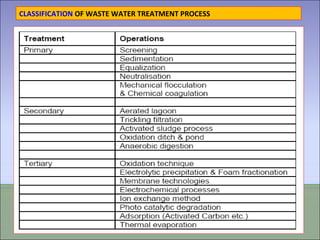
High- Volume Wastes
High-volume wastes in textiles include wash water, alkaline
wastes, warp sizes
Hazardous or Toxic Wastes
Subgroup of hard-to-treat wastes.
Metals, chlorinated solvents, non degradable surfactants
Dispersible wastes
Highly dispersed or mixed with other wastes: Waste water
Hard-To-Treat Wastes
Resist treatment
Contain non biodegradable or inorganic
Cannot be removed by biological processes
High- Volume Wastes
High-volume wastes in textiles include wash water, alkaline
wastes, warp sizes
Hazardous or Toxic Wastes
Subgroup of hard-to-treat wastes.
Metals, chlorinated solvents, non degradable surfactants
6
General Waste Categorization
Acute ToxicityAcute Toxicity
Single or multiple exposures in a short space of time (usually less than 24
hours).
Acute Toxicity of Textile Dyes
Skin Irritation
Vomit
Diarrhea
Reactive dyes can cause respiratory or skin sensitisation problems in
plant workers who manufacture the dyes and textile workers
Reactive Dyes + Human Serum Albumin [HSA]
Dye-HSA conjugate, which acts as an antigen. The antigen produces
specific immunoglobulin E (IgE) and, through the release of chemicals
such as histamine, causes allergic reactions
Single or multiple exposures in a short space of time (usually less than 24
hours).
Acute Toxicity of Textile Dyes
Skin Irritation
Vomit
Diarrhea
Reactive dyes can cause respiratory or skin sensitisation problems in
plant workers who manufacture the dyes and textile workers
Reactive Dyes + Human Serum Albumin [HSA]
Dye-HSA conjugate, which acts as an antigen. The antigen produces
specific immunoglobulin E (IgE) and, through the release of chemicals
such as histamine, causes allergic reactions
7
ToxicityToxicity
Chronic Toxicity
Non Genotoxicity
1.Water solubility
Water-soluble molecules are generally excreted rapidly by
a living organism
2.Water Insolubility
Due to the insolubility, toxicants gets large size particles
[0.1 to 3 mm] in the body which are not transported across
cell membranes.[e.g.] Pigments
Genotoxicity
 Mutagens
 Carcinogens
 Teratogens
 Toxicants reach the DNA (which resides in the nucleus of the
cell) in order for the chemical to interact with the DNA.
 So the toxicants will be able to transport across the protective
cell membranes
 Active species of most carcinogens, known as the ultimate
carcinogen, is an electrophile,
 E.Nitrenium ion [R2N+]
 Carbonium ion [R3C+]
 Carcinogens attack a nucleophilic site in DNA, which may
be a carbon, nitrogen or oxygen atom, to form a covalent
chemical bond E + [DNA] or E–[DNA]
Genotoxicity
 Mutagens
 Carcinogens
 Teratogens
 Toxicants reach the DNA (which resides in the nucleus of the
cell) in order for the chemical to interact with the DNA.
 So the toxicants will be able to transport across the protective
cell membranes
 Active species of most carcinogens, known as the ultimate
carcinogen, is an electrophile,
 E.Nitrenium ion [R2N+]
 Carbonium ion [R3C+]
 Carcinogens attack a nucleophilic site in DNA, which may
be a carbon, nitrogen or oxygen atom, to form a covalent
chemical bond E + [DNA] or E–[DNA] 9
 The toxic effects of the azo dyes may result from the
direct action of the agent itself or of the aryl amine
derivatives generated during reductive biotransformation
of the azo bond.
 The azo dyes entering the body by ingestion can be
metabolized to aromatic amines by the azoreductases of
intestinal microorganisms.
 If the dyes are nitro, they can be metabolized by the
nitroredutases produced by the same microorganisms.
 Mammalian liver enzymes and other organizations may
also catalyze the reductive cleavage of the azo bond and
the nitro reduction of the nitro group.
 In both cases, if N-hydroxylamines are formed, these
compounds are capable of causing DNA damage.
 The toxic effects of the azo dyes may result from the
direct action of the agent itself or of the aryl amine
derivatives generated during reductive biotransformation
of the azo bond.
 The azo dyes entering the body by ingestion can be
metabolized to aromatic amines by the azoreductases of
intestinal microorganisms.
 If the dyes are nitro, they can be metabolized by the
nitroredutases produced by the same microorganisms.
 Mammalian liver enzymes and other organizations may
also catalyze the reductive cleavage of the azo bond and
the nitro reduction of the nitro group.
 In both cases, if N-hydroxylamines are formed, these
compounds are capable of causing DNA damage.
 Moreover, the reduction of azo dyes by sodium
hydrosulfite and the successive chlorination steps with
hypochlorous acid, can form 2-benzotriazoles
phenilbenzotriazol (PBTA) derivatives and highly
mutagenic aromatic amines, often more mutagenic than
the original dye.
 Effects caused by other pollutants in textile wastewater,
and the presence of very small amounts of dyes (<1
mg/L for some dyes) in the water, which are
nevertheless highly visible, seriously affects the
aesthetic quality and transparency of water bodies
 Moreover, the reduction of azo dyes by sodium
hydrosulfite and the successive chlorination steps with
hypochlorous acid, can form 2-benzotriazoles
phenilbenzotriazol (PBTA) derivatives and highly
mutagenic aromatic amines, often more mutagenic than
the original dye.
 Effects caused by other pollutants in textile wastewater,
and the presence of very small amounts of dyes (<1
mg/L for some dyes) in the water, which are
nevertheless highly visible, seriously affects the
aesthetic quality and transparency of water bodies
11
 Anthraquinone dyes of the solvent or disperse class
containing one or more primary amino- or methyl amino-
groups tend to be mutagenic or carcinogenic.
 Cations bind to sulfhydryl (-SH) group (cysteine amino
acid) in enzymes disrupting the vital metabolic reaction
catalyzed by the enzyme.
 The high alkalinity and traces of chromium (employed in
dyes) adversely affect the aquatic life.
 Imidazole is corrosive to skin and irritating to eyes in
rabbits--may cause permanent eye injury, teratogenicity and
developmental toxicity observed at doses maternally toxic
in rats.
 Chloroflorocarbon based chemicals like FR causes ozone
layer depletion
 Anthraquinone dyes of the solvent or disperse class
containing one or more primary amino- or methyl amino-
groups tend to be mutagenic or carcinogenic.
 Cations bind to sulfhydryl (-SH) group (cysteine amino
acid) in enzymes disrupting the vital metabolic reaction
catalyzed by the enzyme.
 The high alkalinity and traces of chromium (employed in
dyes) adversely affect the aquatic life.
 Imidazole is corrosive to skin and irritating to eyes in
rabbits--may cause permanent eye injury, teratogenicity and
developmental toxicity observed at doses maternally toxic
in rats.
 Chloroflorocarbon based chemicals like FR causes ozone
layer depletion 12
 Formaldehyde, a highly toxic, colourless gas, has been linked to
skin irritation and allergic reactions. Even more worryingly, the
chemical is classified as a human carcinogen
 Sulphur dye cause even acid rain
Other worse Effects
Brain function, decreased attention, retardation
Reproduction including miscarriage, until births
Most sensitive are children <7; immature blood-brain barrier;
effects mental development etc……
 Formaldehyde, a highly toxic, colourless gas, has been linked to
skin irritation and allergic reactions. Even more worryingly, the
chemical is classified as a human carcinogen
 Sulphur dye cause even acid rain
Other worse Effects
Brain function, decreased attention, retardation
Reproduction including miscarriage, until births
Most sensitive are children <7; immature blood-brain barrier;
effects mental development etc……
 Carcinogenic substances: 59 substances.
 Mutagenic substances: 9 substances .
 Substances toxic to reproduction: 39 substances.
 Allergenic substances:14 substances with respiratory sensitization 56
substances with skin sensitization properties.
 Substances with environmentally hazardous, long-term effects:
approximately 57 substances.
 Carcinogenic substances: 59 substances.
 Mutagenic substances: 9 substances .
 Substances toxic to reproduction: 39 substances.
 Allergenic substances:14 substances with respiratory sensitization 56
substances with skin sensitization properties.
 Substances with environmentally hazardous, long-term effects:
approximately 57 substances.
14
Carcinogenic aromatic amidesCarcinogenic aromatic amides
1. Organic chlorine carriers (dyed acceleration)
2. Separation of chlorine bleach materials, except the sodium
chlorite from the bleached synthetic fibers
3. The free chlorine after using sodium chlorite
4. Arsenic, mercury and their mixtures
5. Alkyl phenol as a bleaching agent
6. Cr6 + compounds in the oxidizing of sulfur dyes and vat dyes
7. EDTA, DTPA, and phosphate in the water treatment softeners
8. Formadehyde based chemicals and gases
9. Chloroflorocarbon based chemicals and gases
10. Aryl and aromatic amide components
11. Accumulation of chemicals dyes and textile auxiliaries
1. Organic chlorine carriers (dyed acceleration)
2. Separation of chlorine bleach materials, except the sodium
chlorite from the bleached synthetic fibers
3. The free chlorine after using sodium chlorite
4. Arsenic, mercury and their mixtures
5. Alkyl phenol as a bleaching agent
6. Cr6 + compounds in the oxidizing of sulfur dyes and vat dyes
7. EDTA, DTPA, and phosphate in the water treatment softeners
8. Formadehyde based chemicals and gases
9. Chloroflorocarbon based chemicals and gases
10. Aryl and aromatic amide components
11. Accumulation of chemicals dyes and textile auxiliaries
15
The following must not be in the wastewaterThe following must not be in the wastewater
TREATMENT PROCEDURE PARAMETERS
OF WET PROCESSING OPERATIONS
3.2
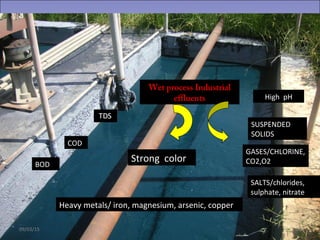
WASTE WATER FROM DIFFERENT PROCESS
COD
BOD
High pH
Wet process Industrial
effluents
SUSPENDED
SOLIDS
GASES/CHLORINE,
CO2,O2Strong color
Heavy metals/ iron, magnesium, arsenic, copper
SALTS/chlorides,
sulphate, nitrate
09/03/15 18
In most cases BOD/COD ratio of the composite textile
wastewater is around 0.25 .This implies that the wastewater
contains large amount of nonbiodegradable organic matter.
CLASSIFICATION OF WASTE WATER TREATMENT PROCESS
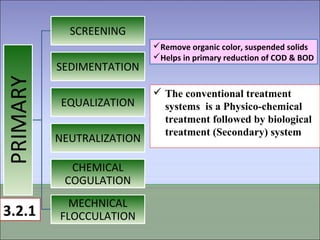
Remove organic color, suspended solids
Helps in primary reduction of COD & BOD
PRIMARY SCREENING
SEDIMENTATION
EQUALIZATION
NEUTRALIZATION
CHEMICAL
COGULATION
MECHNICAL
FLOCCULATION
 The conventional treatment
systems is a Physico-chemical
treatment followed by biological
treatment (Secondary) system
3.2.1
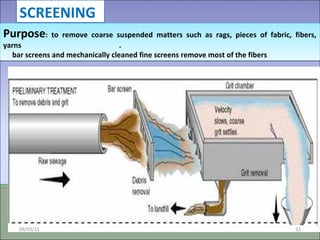
Purpose: to remove coarse suspended matters such as rags, pieces of fabric, fibers,
yarns .
bar screens and mechanically cleaned fine screens remove most of the fibers
Purpose: to remove coarse suspended matters such as rags, pieces of fabric, fibers,
yarns .
bar screens and mechanically cleaned fine screens remove most of the fibers
09/03/15 22
SCREENING
SEDIMENTATION
 The fine suspended matter passed through the screens
can be removed efficiently and economically by
sedimentation.
 This process is particularly useful for treatment of wastes
containing high percentage of settable solids
 The sedimentation tanks are designed to enable smaller
particles to settle under gravity.
 The settled sludge is removed from the sedimentation
tanks by mechanical scrapping into hoppers and
pumping it out subsequently.
 Sedimentation is sometimes combined with equalization
operation.
 The fine suspended matter passed through the screens
can be removed efficiently and economically by
sedimentation.
 This process is particularly useful for treatment of wastes
containing high percentage of settable solids
 The sedimentation tanks are designed to enable smaller
particles to settle under gravity.
 The settled sludge is removed from the sedimentation
tanks by mechanical scrapping into hoppers and
pumping it out subsequently.
 Sedimentation is sometimes combined with equalization
operation.
09/03/15 23
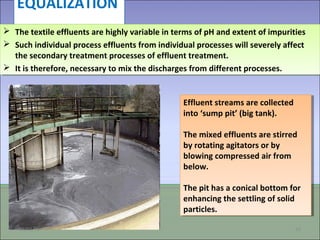
EQUALIZATION
Effluent streams are collected
into ‘sump pit’ (big tank).
The mixed effluents are stirred
by rotating agitators or by
blowing compressed air from
below.
The pit has a conical bottom for
enhancing the settling of solid
particles.
Effluent streams are collected
into ‘sump pit’ (big tank).
The mixed effluents are stirred
by rotating agitators or by
blowing compressed air from
below.
The pit has a conical bottom for
enhancing the settling of solid
particles.
09/03/15 24
 The textile effluents are highly variable in terms of pH and extent of impurities
 Such individual process effluents from individual processes will severely affect
the secondary treatment processes of effluent treatment.
 It is therefore, necessary to mix the discharges from different processes.
 The textile effluents are highly variable in terms of pH and extent of impurities
 Such individual process effluents from individual processes will severely affect
the secondary treatment processes of effluent treatment.
 It is therefore, necessary to mix the discharges from different processes.
NEUTRALISATION
 Normally, ph values of cotton
finishing effluents are on the
alkaline side.
 Hence, ph value of equalized
effluent should be adjusted.
 Use of dilute sulphuric acid
and boiler flue gas rich in
carbon dioxide are commonly
used .
 Since most of the secondary
biological treatments are
effective in the ph 5 to 9,
neutralization step is an
important process to facilitate
these processes
 Normally, ph values of cotton
finishing effluents are on the
alkaline side.
 Hence, ph value of equalized
effluent should be adjusted.
 Use of dilute sulphuric acid
and boiler flue gas rich in
carbon dioxide are commonly
used .
 Since most of the secondary
biological treatments are
effective in the ph 5 to 9,
neutralization step is an
important process to facilitate
these processes
USUALLY H₂SO₄ 1 gm/m³ TO BRING
PH 8.5.09/03/15 25
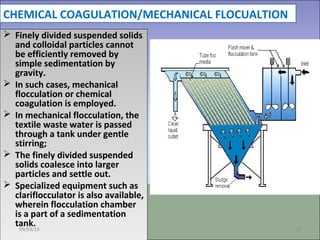
CHEMICAL COAGULATION/MECHANICAL FLOCUALTION
 Finely divided suspended solids
and colloidal particles cannot
be efficiently removed by
simple sedimentation by
gravity.
 In such cases, mechanical
flocculation or chemical
coagulation is employed.
 In mechanical flocculation, the
textile waste water is passed
through a tank under gentle
stirring;
 The finely divided suspended
solids coalesce into larger
particles and settle out.
 Specialized equipment such as
clariflocculator is also available,
wherein flocculation chamber
is a part of a sedimentation
tank.
 Finely divided suspended solids
and colloidal particles cannot
be efficiently removed by
simple sedimentation by
gravity.
 In such cases, mechanical
flocculation or chemical
coagulation is employed.
 In mechanical flocculation, the
textile waste water is passed
through a tank under gentle
stirring;
 The finely divided suspended
solids coalesce into larger
particles and settle out.
 Specialized equipment such as
clariflocculator is also available,
wherein flocculation chamber
is a part of a sedimentation
tank.09/03/15 26
SECONDARY
AERATED LAGOON
TRICKLING FILTRATION
ACTIVATED SLUDGE
PROCESS
OXIDATION DITCH /POND
The main purpose of secondary treatment is to provide BOD removal beyond what is
achievable by simple sedimentation.
Remove dissolved and
residual organic matter
aerobic mode (with air
CO2 &CH4) or with
anaerobic mode.
Achieved by digestive
action of bacteria under
suitable conditions (PH 6-
9,nuetrents,air/oxygen and
temperature
Reduce COD, BOD
and toxicity.
In such cases, the recent
trend is to set up an
activated adsorption
system or and ozonation
unit instead of biological
treatment process.3.2.2
AERATED LAGOON
09/03/15 28
 The effluents from primary treatment processes are collected in tanks and are aerated
 Air is blown in the form of stream of bubbles at the bottom with mechanical devices, for
about 2 to 6 days.
 During this time, a healthy flocculent sludge is formed which brings about oxidation of the
dissolved organic matter.
 BOD removal to the extent of 99% could be achieved with efficient operation.
 The effluents from primary treatment processes are collected in tanks and are aerated
 Air is blown in the form of stream of bubbles at the bottom with mechanical devices, for
about 2 to 6 days.
 During this time, a healthy flocculent sludge is formed which brings about oxidation of the
dissolved organic matter.
 BOD removal to the extent of 99% could be achieved with efficient operation.
TRICKLING FILTERS
09/03/15 29
 Usually consists of circular or
rectangular beds made of well-graded
gravels media where micro-organisms
deposited on i.e small stone, PVC, coal,
synthetic resins of size 40 mm to 150 mm,
over which wastewater is sprinkled
uniformly on the entire bed with the help
of a slowly rotating distributor (such as
rotary sprinkler).
 Thus, the waste water trickles through
the media.
 The filter is arranged in such a fashion
that air can enter at the bottom; counter
current to the effluent flow and a
natural draft is produced.
 Gelatinous film, comprising of bacteria
and aerobic microorganisms known as
“zooglea”, is formed on the surface of the
filter medium, which thrive on the
nutrients supplied by the wastewater.
 Usually consists of circular or
rectangular beds made of well-graded
gravels media where micro-organisms
deposited on i.e small stone, PVC, coal,
synthetic resins of size 40 mm to 150 mm,
over which wastewater is sprinkled
uniformly on the entire bed with the help
of a slowly rotating distributor (such as
rotary sprinkler).
 Thus, the waste water trickles through
the media.
 The filter is arranged in such a fashion
that air can enter at the bottom; counter
current to the effluent flow and a
natural draft is produced.
 Gelatinous film, comprising of bacteria
and aerobic microorganisms known as
“zooglea”, is formed on the surface of the
filter medium, which thrive on the
nutrients supplied by the wastewater.
ACTIVATED SLUDGE PROCESS
09/03/15 30
 This is the most versatile biological
oxidation method employed for
the treatment of waste water
 In this process, the waste water is
aerated in a reaction tank in which
some microbial floc is suspended.
 The aerobic bacterial flora bring
about biological degradation of the
waste into carbon dioxide and
water molecule,
 While consuming some organic
matter bacteria grow
 The bacteria flora grows and
remains suspended in the form of a
floc, which is called “activated
sludge”.
 The effluent from the reaction tank
is separated from the sludge by
settling and discharged.
 A part of the sludge is recycled to the same tank to provide an
effective microbial population for a fresh treatment cycle.
 The surplus sludge is digested in a sludge digester, along with
the primary sludge obtained from primary sedimentation.
 An efficient aeration for 5 to 24 hours is required for industrial
wastes.
 BOD removal to the extent of 90-95% can be achieved in this
process.
 Biological effluent treatment processes meets the standards of
BOD,COD, and are suitable for discharge into river, lake or sea.
 However, these treatments are not suitable for removal of
inorganic impurities like salt which are present in the form of
tds.
 Biologically treated water is also not suitable for recycling.
 A part of the sludge is recycled to the same tank to provide an
effective microbial population for a fresh treatment cycle.
 The surplus sludge is digested in a sludge digester, along with
the primary sludge obtained from primary sedimentation.
 An efficient aeration for 5 to 24 hours is required for industrial
wastes.
 BOD removal to the extent of 90-95% can be achieved in this
process.
 Biological effluent treatment processes meets the standards of
BOD,COD, and are suitable for discharge into river, lake or sea.
 However, these treatments are not suitable for removal of
inorganic impurities like salt which are present in the form of
tds.
 Biologically treated water is also not suitable for recycling.
09/03/15 31
OXIDATION DITCH /OXIDATION
POND
09/03/15 32
Pond aeration or lake aeration Increase in the oxygen saturation of the water.
Dissolved oxygen (DO) Fish and other aquatic animals and Aerobic bacteria
Pond bottoms of organic soils demand larger amounts of oxygen.
TERTIARY OXIDATION TECHNIQUE
ELECTROLYTIC
PRECIPITATION & FOAM
FRACTIONATION
MEMBRANE
TECHNOLOGIES
ELECTROCHEMICAL
PROCESSES
ION EXCHANGE
PHOTO CATALYTIC
DEGRADATION
ADSORPTION
THERMAL EVAPORATION
Remove dissolved solids (mineral salts) and
residual color and odor
After the treatment water can be safely
discharged or reused for processing
In order to reduce TDS further purification of
effluent is carried out using tertiary
treatments
Membrane filtration techniques particularly
RO has become popular due possibility of
recycling treated water
Membrane filtration techniques particularly
RO has become popular due possibility of
recycling treated water
3.2.3
ADSORPTION
 The most commonly used method of dye removal by adsorption.
 The process also removes toxic chemicals such as pesticides,
phenols, cyanides and organic dyes.
 Adsorbent for treatment is activated carbon.
 It is manufactured from carbonaceous material such as wood, coal,
petroleum products etc.
 Others: activated clay, silica, fly ash, (inorganic) and bio-
adsorbents-reactive dyes
• Effective for adsorbing cationic, mordant and acid dyes, and to a
slightly lesser extent, dispersed, direct, vat, pigment and reactive
dyes
• Disadvantage: activated carbon is expensive; it has to be
reactivated, which can result in 10-15% loss of sorbent.
Ion exchange process is normally
used for the removal of inorganic
salts and some specific organic
anionic components such as phenol.
All salts are composed of a positive
ion of a base and a negative ion of
an acid.
 Ion exchange materials are capable
of exchanging soluble ions and
cations with electrolyte solutions.
ION EXCHANGE
 Removal of bacteria,
salts, sugars, proteins,
particles, dyes, and other
constituents
 The separation of ions
with reverse osmosis is
aided by charged particles.
 Dissolved ions that carry a
charge, such as salts, are
more likely to be removed
by the membrane than
those that are not charged,
such as organics.
MEMBRANE FILTRATION
1.REVERSE OSMOSIS
to pass pure water at fairly high rates and to
reject salts at high pressures through the cellulose
acetate or nylon membrane.
Reverse osmosis can be used as end-of-pipe
treatment and recycling system for effluent.
2.ULTRAFILTRATION
The difference between reverse osmosis and
ultrafiltration is primarily the retention
properties of the membranes.
Reverse osmosis membranes retain all solutes
including salts.
 Ultrafiltration membranes retain only macro
molecules and suspended solids.
• They are pressure driven membrane operations that
use porous membranes for the removal of heavy
metals. The main disadvantage of this process is the
generation of sludge.
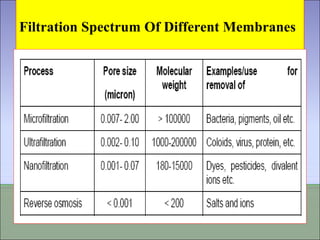
3.NANOFILTATION
 Nanofiltartion can be positioned between reverse osmosis and
ultrafiltration.
 This process is used where the high salt rejection of reverse
osmosis is not necessary.
 It is capable of removing hardness elements such as calcium or
magnesium together with bacteria, viruses, and colour.
 It operated on lower pressure than reverse osmosis and
treatment cost is lower than RO.
 Preferred when permeate with TDS but without colour, COD
and hardness is acceptable.
 Nanofiltration membranes are similar to reverse
osmosis membranes in several respects except the
degree of removal of monovalent ions such as chlorides
etc.
Filtration Spectrum Of Different Membranes
Passing water between two plates with opposite
electrical charges.
The metals attracted to negative charge
Non-metals are attracted to positive charge.
Both types of ions can be removed
Electrodialysis is used on very hard water,
more than 500 mg/L as calcium carbonate.
involves the evaporation of water.
The evaporated water leaves behind all hardness
compounds,
ELECTRODIALYSIS
DISTILLATION
ADAVNCED OXIDATION PROCESSES (AOP)
Conventional oxidation treatment have found difficulty to oxidize
dyestuffs and complex structure of organic compounds:
 At low concentration or
 If they are especially refractory to the oxidants.
AOP processes are combination of :
- Ozone (O3),
- Hydrogen peroxide (H2O2) and
- UV radiation, which showed the greatest promise
These oxidants effectively decolorized dyes, however did not remove
COD completely.
The goal of any AOPs design is to generate and use hydroxyl free
radical (HO·) as strong oxidant to destroy compound that can not be
oxidized by conventional oxidant.
OZONATION
 Ozone is a powerful oxidant agent for water and wastewater.
 Once dissolved in water, ozone reacts with a great number of
organic compounds in two different ways:
By direct oxidation as molecular ozone or
By indirect reaction through formation of secondary
oxidants like hydroxyl radical.
 The conventional fine bubble contactor is the most widely
ozone generator used because of the high ozone transfer
efficiency (90%) and high performance.
 Results presented by a few researchers revealed that ozone
decolorize all dyes, except nonsoluble disperse and vat dyes
which react slowly and take longer time.
 Colour removal using ozonation from textile wastewater is
depended on dye concentration.
 According to Rein (2001), conventional ozonation of organic
compounds does not completely oxidize organics to CO2 and
H2O in many cases.
 Remaining intermediate products in some solution after
oxidation may be as toxic as or even more toxic than initial
compound and UV radiation could complete the oxidation
reaction by supplement the reaction with it.
 O3/UV is the most effective method for decolorizing of dyes
comparing with UV oxidation by UV or ozonation alone.
(Hung-Yee and Ching-Rong (1995))
 O3/UV treatment is recorded to be more effective compared to
ozone alone, in terms of COD removal.
O3/UV
H2O2/UV
 Oxidization of the textile wastewater with H2O2 alone has been
found ineffective at both acid and alkali values (Olcay et al.,
1996),
 Under UV radiation, H2O2 are photolyzed to form two hydroxyl
radicals (2OH•) that react with organic contaminants (Crittenden
et al., 1999).
 Nonefficient colour removal at alkaline pH
 Therefore the instantaneous concentration in HO* is lower than
expected.
 Furthermore, the H2O2/UV process is more sensitive to the
scavenging effect of carbonate at higher pH values.
O3/H2O2
 The addition of both hydrogen peroxide and ozone to wastewater
accelerates the decomposition of ozone and enhancing production
of the hydroxyl radical.
 At higher pH, even very small concentration of H2O2 will be
dissociated into HO2¯ ions that can initiate the ozone
decomposition more effectively than OH ¯ ion.
 H2O2/O3 treatment of synthetic dye house highly depended on
the pH of the effluent.
 It is documented that it was 74% ozone absorption at pH 11.5
(and 10 mM H2O2) whereas at the same concentration of H2O2
and pH 2.5, ozone absorption was only 1
 Complete decolourization of C.I. Reactive Blue 220 and C.I.
Reactive Yellow 15 using H2O2 /O3 process is achieved in 90 min
(Tanja et al., 2003).
O3/H2O2/UV
The addition of H2O2 to the O3/UV process accelerates the
decomposition of ozone, which results in an increased rate of OH•
generation.
Among all AOPs, for dye house wastewater and acetate, polyester
fiber dyeing process effluent; combination of H2O2/O3/UV appeared to
be the most efficient in terms of decolouration.
COD removal efficiency of raw textile wastewater increased from
18% to 27% by using sequential ozonation and H2O2/UV.
In the case of bio-treated textile effluent, a preliminary ozonation step
increased COD removal of the H2O2/UV-C treatment system from 15%
to 62%.
99% COD removal from acetate and polyester fiber dyeing process
effluent in batch mode operation(O3/H2O2/UV in 90 min) was achieved.
In raw textile effluent, TOC removal rate was accelerated from 14%
(H2O2/UV-C) and 17% (O3) to 50%.
BENEFITS OF ADVANCE TREATMENT METHODS
 Recover water and salt.
 Low TDS water when used in textile processing minimizes
consumption of sequestering agents.
 Corrosion and scale formation can be minimized
 Efficiency of boiler can be improved
 Reusing Brine in dyeing requires less additional salt.
 Reduce problems relating to disposal of high TDS effluents
IS THERE ANY DISADVANTAGE??
 Unknown oxidation products & Expensive
MODEL WASTEWATER
TREATMENT PLANT FOR TEXTILE
MILLS
3.3
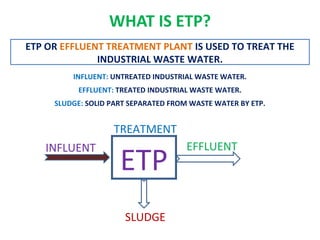
WHAT IS ETP?
ETP
INFLUENT
TREATMENT
EFFLUENT
SLUDGE
ETP OR EFFLUENT TREATMENT PLANT IS USED TO TREAT THE
INDUSTRIAL WASTE WATER.
INFLUENT: UNTREATED INDUSTRIAL WASTE WATER.
EFFLUENT: TREATED INDUSTRIAL WASTE WATER.
SLUDGE: SOLID PART SEPARATED FROM WASTE WATER BY ETP.
EFFLUENT TREATMENT PLANT OF DELTA KNIT COMPOSITE LTD
DELTA KNIT COMPOSITE LTD
3.3.1
SCREENING
DRUM SCREENER
 SCREENING IS THE
FILTRATION PROCESS FOR THE
SEPARATION OF COARSE
PARTICLES FROM INFLUENT.
 STAINLESS STEEL NET IS USED
FOR SCREENING.
 HARD PLASTIC BRUSHES ARE
USED TO CLEAN THE NET, WHICH
ARE DRIVEN MECHANICALLY.
(DRUM SCREENER IS USED IN THIS ETP)
SCHEMTIC DIAGRAM OF DRUM SCREENER
EQUALIZATION
EQUALIZATION IS THE PROCESS TO MAKE
THE WASTE WATER-
-HOMOGENOUS &
-COOL
EQUALIZATION TANK IS ALSO CALLED
HOMOGENOUS TANK.
EQUALIZATION TANK
INFLUENT FROM
SCREENING
SPRAY OF WATER COMING
FROM DYEING UNIT
AIR FOR DIFFUSION
COOL & HOMOGENOUS
INFLUENT TO PH
CORRECTION TANK
PH
CORRECTION
 IN THIS TANK PH
OF THE INFLUENT IS
CORRECTED TO MEET THE STANDARD.
 ACID OR ALKALI IS ADDED TO THE
EFFLUENT BY DOZZING TO INCREASE OR
DECREASE THE PH
OF INFLUENT
RESPECTIVELY.
 MULTI-METER TYPE PH
METER IS USED.
PH
CORRECTION
ACID OR ALKALI
INFLUENT FROM
EQUALIZATION TANK
INFLUENT OF
DESIRED PH
TO
DISPERSE UNIT
DISPERSE UNIT
 FUNCTION OF DISPERSE
TANK IS TO MIX THE SLUDGE
COMING FROM RECYCLE
TANK WITH WASTE WATER.
 IT HELPS FOR PROPER
AERATION.
DISPERSE UNIT
( MIXING OF SLUDGE & WASTE)
SLUDGE FROM
RECYCLE TANK
INFLUENT FROM PH
CORRECTION
TANK
MIXED INFLUENT &
SLUDGE TO
AERATION
AERATION
 FUNCTION OF AERATION IS OXIDATION BY
BLOWING AIR.
 AEROBIC BACTERIA IS USED TO
STABILIZE AND REMOVE ORGANIC
MATERIAL PRESENTS IN WASTE.
 ABOUT 200 KG AEROBIC BACTERIA IS
GIVEN TO THE PLAN FOR 5 YEARS.
AERATION TANK
MIXTURE OF
WASTE
WATER &
SLUDGE
AEROBIC BACTERIA
AIR
DISCHARGE TO
SEDIMENTATION
TANK
O2
ORGANIC MATTER + O2
BACTERIA
NUTRIENT
CO2+ H2O + HEAT
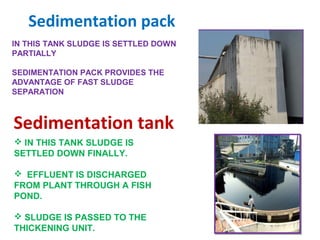
Sedimentation pack
IN THIS TANK SLUDGE IS SETTLED DOWN
PARTIALLY
SEDIMENTATION PACK PROVIDES THE
ADVANTAGE OF FAST SLUDGE
SEPARATION
Sedimentation tank
 IN THIS TANK SLUDGE IS
SETTLED DOWN FINALLY.
 EFFLUENT IS DISCHARGED
FROM PLANT THROUGH A FISH
POND.
 SLUDGE IS PASSED TO THE
THICKENING UNIT.
SCHEMTIC DIAGRAM OF Sedimentation tank
SEDIMENTATION
TANK
WASTE WATER
FROM
SEDIMENTATION
PACK
SLUDGE TO
THICKENING UNIT
EFFLUENT
EFFLUENT
DISCHARGE
FISH POND
FISH POND INDICATES THE HIGHER DEGREE OF TREATMENT IN THIS ETP
SLUDGE THICKENING UNIT
IN THIS UNIT SLUDGE IS DRIED AND
DISCHARGED.
A PARTIAL AMOUNT OF SLUDGE IS
RETURNED BACK TO THE AERATION TANK
FROM THICKENING UNIT THROUGH
RECYCLE TANK CALLED RETURN SLUDGE
TANK AND DISPERSE TANK.
SLUDGFE
THICKENING UNIT
SLUDGE FROM
SEDIMENTATION UNIT
SLUDGE DISCHARGE
SLUDGE TO RECYCLE
TANK
RETURN SLUDGE TANK
FUNCTION OF RETURN TANK OR RECYCLE
TANK IS TO MIX WATER WITH SLUDGE
THIS MIXTURE IS THEN PASSED TO
AERATION TANK THROUGH DISPERSE TANK.
 SLUDGE AGAIN OXIDIZED TO MINIMIZE
THE POLLUTION FROM SLUDGE.
 ALIVE BACTERIA OF SLUDGE IS AGAIN
USED IN AERATION TO UTILIZE THIS
BACTERIA.
SLUDGE RECYCLE TANK
SLUDGE FROM
THICKENING UNIT
MIXING OF SLUDGE
& WATER
SLUDGE TO AERATION TANK
THROUGH DISPERSE UNIT
800 KLD ELECTRO-CHEMICALS TREATMENT PLANT FOR TEXTILE
PROCESSING EFFLUENT
ENVIROS INDIA PRIVATE LIMITED
3.3.2

Textile effluent treatment

  • 1.
  • 2.
    EFFLUENTS DISCHARGED BYTEXTILE PROCESSING INDUSTRY 3.1
  • 3.
    Total Textile Processat a Glance Two types of waste are generated: process chemicals and fiber wastes The nature of the waste generated depends on  Type of textile facility Processes and technologies  Types of fibers and chemicals
  • 4.
  • 5.
  • 6.
    Dispersible wastes Highly dispersedor mixed with other wastes: Waste water Hard-To-Treat Wastes Resist treatment Contain non biodegradable or inorganic Cannot be removed by biological processes High- Volume Wastes High-volume wastes in textiles include wash water, alkaline wastes, warp sizes Hazardous or Toxic Wastes Subgroup of hard-to-treat wastes. Metals, chlorinated solvents, non degradable surfactants Dispersible wastes Highly dispersed or mixed with other wastes: Waste water Hard-To-Treat Wastes Resist treatment Contain non biodegradable or inorganic Cannot be removed by biological processes High- Volume Wastes High-volume wastes in textiles include wash water, alkaline wastes, warp sizes Hazardous or Toxic Wastes Subgroup of hard-to-treat wastes. Metals, chlorinated solvents, non degradable surfactants 6 General Waste Categorization
  • 7.
    Acute ToxicityAcute Toxicity Singleor multiple exposures in a short space of time (usually less than 24 hours). Acute Toxicity of Textile Dyes Skin Irritation Vomit Diarrhea Reactive dyes can cause respiratory or skin sensitisation problems in plant workers who manufacture the dyes and textile workers Reactive Dyes + Human Serum Albumin [HSA] Dye-HSA conjugate, which acts as an antigen. The antigen produces specific immunoglobulin E (IgE) and, through the release of chemicals such as histamine, causes allergic reactions Single or multiple exposures in a short space of time (usually less than 24 hours). Acute Toxicity of Textile Dyes Skin Irritation Vomit Diarrhea Reactive dyes can cause respiratory or skin sensitisation problems in plant workers who manufacture the dyes and textile workers Reactive Dyes + Human Serum Albumin [HSA] Dye-HSA conjugate, which acts as an antigen. The antigen produces specific immunoglobulin E (IgE) and, through the release of chemicals such as histamine, causes allergic reactions 7 ToxicityToxicity
  • 8.
    Chronic Toxicity Non Genotoxicity 1.Watersolubility Water-soluble molecules are generally excreted rapidly by a living organism 2.Water Insolubility Due to the insolubility, toxicants gets large size particles [0.1 to 3 mm] in the body which are not transported across cell membranes.[e.g.] Pigments
  • 9.
    Genotoxicity  Mutagens  Carcinogens Teratogens  Toxicants reach the DNA (which resides in the nucleus of the cell) in order for the chemical to interact with the DNA.  So the toxicants will be able to transport across the protective cell membranes  Active species of most carcinogens, known as the ultimate carcinogen, is an electrophile,  E.Nitrenium ion [R2N+]  Carbonium ion [R3C+]  Carcinogens attack a nucleophilic site in DNA, which may be a carbon, nitrogen or oxygen atom, to form a covalent chemical bond E + [DNA] or E–[DNA] Genotoxicity  Mutagens  Carcinogens  Teratogens  Toxicants reach the DNA (which resides in the nucleus of the cell) in order for the chemical to interact with the DNA.  So the toxicants will be able to transport across the protective cell membranes  Active species of most carcinogens, known as the ultimate carcinogen, is an electrophile,  E.Nitrenium ion [R2N+]  Carbonium ion [R3C+]  Carcinogens attack a nucleophilic site in DNA, which may be a carbon, nitrogen or oxygen atom, to form a covalent chemical bond E + [DNA] or E–[DNA] 9
  • 10.
     The toxiceffects of the azo dyes may result from the direct action of the agent itself or of the aryl amine derivatives generated during reductive biotransformation of the azo bond.  The azo dyes entering the body by ingestion can be metabolized to aromatic amines by the azoreductases of intestinal microorganisms.  If the dyes are nitro, they can be metabolized by the nitroredutases produced by the same microorganisms.  Mammalian liver enzymes and other organizations may also catalyze the reductive cleavage of the azo bond and the nitro reduction of the nitro group.  In both cases, if N-hydroxylamines are formed, these compounds are capable of causing DNA damage.  The toxic effects of the azo dyes may result from the direct action of the agent itself or of the aryl amine derivatives generated during reductive biotransformation of the azo bond.  The azo dyes entering the body by ingestion can be metabolized to aromatic amines by the azoreductases of intestinal microorganisms.  If the dyes are nitro, they can be metabolized by the nitroredutases produced by the same microorganisms.  Mammalian liver enzymes and other organizations may also catalyze the reductive cleavage of the azo bond and the nitro reduction of the nitro group.  In both cases, if N-hydroxylamines are formed, these compounds are capable of causing DNA damage.
  • 11.
     Moreover, thereduction of azo dyes by sodium hydrosulfite and the successive chlorination steps with hypochlorous acid, can form 2-benzotriazoles phenilbenzotriazol (PBTA) derivatives and highly mutagenic aromatic amines, often more mutagenic than the original dye.  Effects caused by other pollutants in textile wastewater, and the presence of very small amounts of dyes (<1 mg/L for some dyes) in the water, which are nevertheless highly visible, seriously affects the aesthetic quality and transparency of water bodies  Moreover, the reduction of azo dyes by sodium hydrosulfite and the successive chlorination steps with hypochlorous acid, can form 2-benzotriazoles phenilbenzotriazol (PBTA) derivatives and highly mutagenic aromatic amines, often more mutagenic than the original dye.  Effects caused by other pollutants in textile wastewater, and the presence of very small amounts of dyes (<1 mg/L for some dyes) in the water, which are nevertheless highly visible, seriously affects the aesthetic quality and transparency of water bodies 11
  • 12.
     Anthraquinone dyesof the solvent or disperse class containing one or more primary amino- or methyl amino- groups tend to be mutagenic or carcinogenic.  Cations bind to sulfhydryl (-SH) group (cysteine amino acid) in enzymes disrupting the vital metabolic reaction catalyzed by the enzyme.  The high alkalinity and traces of chromium (employed in dyes) adversely affect the aquatic life.  Imidazole is corrosive to skin and irritating to eyes in rabbits--may cause permanent eye injury, teratogenicity and developmental toxicity observed at doses maternally toxic in rats.  Chloroflorocarbon based chemicals like FR causes ozone layer depletion  Anthraquinone dyes of the solvent or disperse class containing one or more primary amino- or methyl amino- groups tend to be mutagenic or carcinogenic.  Cations bind to sulfhydryl (-SH) group (cysteine amino acid) in enzymes disrupting the vital metabolic reaction catalyzed by the enzyme.  The high alkalinity and traces of chromium (employed in dyes) adversely affect the aquatic life.  Imidazole is corrosive to skin and irritating to eyes in rabbits--may cause permanent eye injury, teratogenicity and developmental toxicity observed at doses maternally toxic in rats.  Chloroflorocarbon based chemicals like FR causes ozone layer depletion 12
  • 13.
     Formaldehyde, ahighly toxic, colourless gas, has been linked to skin irritation and allergic reactions. Even more worryingly, the chemical is classified as a human carcinogen  Sulphur dye cause even acid rain Other worse Effects Brain function, decreased attention, retardation Reproduction including miscarriage, until births Most sensitive are children <7; immature blood-brain barrier; effects mental development etc……  Formaldehyde, a highly toxic, colourless gas, has been linked to skin irritation and allergic reactions. Even more worryingly, the chemical is classified as a human carcinogen  Sulphur dye cause even acid rain Other worse Effects Brain function, decreased attention, retardation Reproduction including miscarriage, until births Most sensitive are children <7; immature blood-brain barrier; effects mental development etc……  Carcinogenic substances: 59 substances.  Mutagenic substances: 9 substances .  Substances toxic to reproduction: 39 substances.  Allergenic substances:14 substances with respiratory sensitization 56 substances with skin sensitization properties.  Substances with environmentally hazardous, long-term effects: approximately 57 substances.  Carcinogenic substances: 59 substances.  Mutagenic substances: 9 substances .  Substances toxic to reproduction: 39 substances.  Allergenic substances:14 substances with respiratory sensitization 56 substances with skin sensitization properties.  Substances with environmentally hazardous, long-term effects: approximately 57 substances.
  • 14.
  • 15.
    1. Organic chlorinecarriers (dyed acceleration) 2. Separation of chlorine bleach materials, except the sodium chlorite from the bleached synthetic fibers 3. The free chlorine after using sodium chlorite 4. Arsenic, mercury and their mixtures 5. Alkyl phenol as a bleaching agent 6. Cr6 + compounds in the oxidizing of sulfur dyes and vat dyes 7. EDTA, DTPA, and phosphate in the water treatment softeners 8. Formadehyde based chemicals and gases 9. Chloroflorocarbon based chemicals and gases 10. Aryl and aromatic amide components 11. Accumulation of chemicals dyes and textile auxiliaries 1. Organic chlorine carriers (dyed acceleration) 2. Separation of chlorine bleach materials, except the sodium chlorite from the bleached synthetic fibers 3. The free chlorine after using sodium chlorite 4. Arsenic, mercury and their mixtures 5. Alkyl phenol as a bleaching agent 6. Cr6 + compounds in the oxidizing of sulfur dyes and vat dyes 7. EDTA, DTPA, and phosphate in the water treatment softeners 8. Formadehyde based chemicals and gases 9. Chloroflorocarbon based chemicals and gases 10. Aryl and aromatic amide components 11. Accumulation of chemicals dyes and textile auxiliaries 15 The following must not be in the wastewaterThe following must not be in the wastewater
  • 16.
    TREATMENT PROCEDURE PARAMETERS OFWET PROCESSING OPERATIONS 3.2
  • 17.
    WASTE WATER FROMDIFFERENT PROCESS
  • 18.
    COD BOD High pH Wet processIndustrial effluents SUSPENDED SOLIDS GASES/CHLORINE, CO2,O2Strong color Heavy metals/ iron, magnesium, arsenic, copper SALTS/chlorides, sulphate, nitrate 09/03/15 18
  • 19.
    In most casesBOD/COD ratio of the composite textile wastewater is around 0.25 .This implies that the wastewater contains large amount of nonbiodegradable organic matter.
  • 20.
    CLASSIFICATION OF WASTEWATER TREATMENT PROCESS
  • 21.
    Remove organic color,suspended solids Helps in primary reduction of COD & BOD PRIMARY SCREENING SEDIMENTATION EQUALIZATION NEUTRALIZATION CHEMICAL COGULATION MECHNICAL FLOCCULATION  The conventional treatment systems is a Physico-chemical treatment followed by biological treatment (Secondary) system 3.2.1
  • 22.
    Purpose: to removecoarse suspended matters such as rags, pieces of fabric, fibers, yarns . bar screens and mechanically cleaned fine screens remove most of the fibers Purpose: to remove coarse suspended matters such as rags, pieces of fabric, fibers, yarns . bar screens and mechanically cleaned fine screens remove most of the fibers 09/03/15 22 SCREENING
  • 23.
    SEDIMENTATION  The finesuspended matter passed through the screens can be removed efficiently and economically by sedimentation.  This process is particularly useful for treatment of wastes containing high percentage of settable solids  The sedimentation tanks are designed to enable smaller particles to settle under gravity.  The settled sludge is removed from the sedimentation tanks by mechanical scrapping into hoppers and pumping it out subsequently.  Sedimentation is sometimes combined with equalization operation.  The fine suspended matter passed through the screens can be removed efficiently and economically by sedimentation.  This process is particularly useful for treatment of wastes containing high percentage of settable solids  The sedimentation tanks are designed to enable smaller particles to settle under gravity.  The settled sludge is removed from the sedimentation tanks by mechanical scrapping into hoppers and pumping it out subsequently.  Sedimentation is sometimes combined with equalization operation. 09/03/15 23
  • 24.
    EQUALIZATION Effluent streams arecollected into ‘sump pit’ (big tank). The mixed effluents are stirred by rotating agitators or by blowing compressed air from below. The pit has a conical bottom for enhancing the settling of solid particles. Effluent streams are collected into ‘sump pit’ (big tank). The mixed effluents are stirred by rotating agitators or by blowing compressed air from below. The pit has a conical bottom for enhancing the settling of solid particles. 09/03/15 24  The textile effluents are highly variable in terms of pH and extent of impurities  Such individual process effluents from individual processes will severely affect the secondary treatment processes of effluent treatment.  It is therefore, necessary to mix the discharges from different processes.  The textile effluents are highly variable in terms of pH and extent of impurities  Such individual process effluents from individual processes will severely affect the secondary treatment processes of effluent treatment.  It is therefore, necessary to mix the discharges from different processes.
  • 25.
    NEUTRALISATION  Normally, phvalues of cotton finishing effluents are on the alkaline side.  Hence, ph value of equalized effluent should be adjusted.  Use of dilute sulphuric acid and boiler flue gas rich in carbon dioxide are commonly used .  Since most of the secondary biological treatments are effective in the ph 5 to 9, neutralization step is an important process to facilitate these processes  Normally, ph values of cotton finishing effluents are on the alkaline side.  Hence, ph value of equalized effluent should be adjusted.  Use of dilute sulphuric acid and boiler flue gas rich in carbon dioxide are commonly used .  Since most of the secondary biological treatments are effective in the ph 5 to 9, neutralization step is an important process to facilitate these processes USUALLY H₂SO₄ 1 gm/m³ TO BRING PH 8.5.09/03/15 25
  • 26.
    CHEMICAL COAGULATION/MECHANICAL FLOCUALTION Finely divided suspended solids and colloidal particles cannot be efficiently removed by simple sedimentation by gravity.  In such cases, mechanical flocculation or chemical coagulation is employed.  In mechanical flocculation, the textile waste water is passed through a tank under gentle stirring;  The finely divided suspended solids coalesce into larger particles and settle out.  Specialized equipment such as clariflocculator is also available, wherein flocculation chamber is a part of a sedimentation tank.  Finely divided suspended solids and colloidal particles cannot be efficiently removed by simple sedimentation by gravity.  In such cases, mechanical flocculation or chemical coagulation is employed.  In mechanical flocculation, the textile waste water is passed through a tank under gentle stirring;  The finely divided suspended solids coalesce into larger particles and settle out.  Specialized equipment such as clariflocculator is also available, wherein flocculation chamber is a part of a sedimentation tank.09/03/15 26
  • 27.
    SECONDARY AERATED LAGOON TRICKLING FILTRATION ACTIVATEDSLUDGE PROCESS OXIDATION DITCH /POND The main purpose of secondary treatment is to provide BOD removal beyond what is achievable by simple sedimentation. Remove dissolved and residual organic matter aerobic mode (with air CO2 &CH4) or with anaerobic mode. Achieved by digestive action of bacteria under suitable conditions (PH 6- 9,nuetrents,air/oxygen and temperature Reduce COD, BOD and toxicity. In such cases, the recent trend is to set up an activated adsorption system or and ozonation unit instead of biological treatment process.3.2.2
  • 28.
    AERATED LAGOON 09/03/15 28 The effluents from primary treatment processes are collected in tanks and are aerated  Air is blown in the form of stream of bubbles at the bottom with mechanical devices, for about 2 to 6 days.  During this time, a healthy flocculent sludge is formed which brings about oxidation of the dissolved organic matter.  BOD removal to the extent of 99% could be achieved with efficient operation.  The effluents from primary treatment processes are collected in tanks and are aerated  Air is blown in the form of stream of bubbles at the bottom with mechanical devices, for about 2 to 6 days.  During this time, a healthy flocculent sludge is formed which brings about oxidation of the dissolved organic matter.  BOD removal to the extent of 99% could be achieved with efficient operation.
  • 29.
    TRICKLING FILTERS 09/03/15 29 Usually consists of circular or rectangular beds made of well-graded gravels media where micro-organisms deposited on i.e small stone, PVC, coal, synthetic resins of size 40 mm to 150 mm, over which wastewater is sprinkled uniformly on the entire bed with the help of a slowly rotating distributor (such as rotary sprinkler).  Thus, the waste water trickles through the media.  The filter is arranged in such a fashion that air can enter at the bottom; counter current to the effluent flow and a natural draft is produced.  Gelatinous film, comprising of bacteria and aerobic microorganisms known as “zooglea”, is formed on the surface of the filter medium, which thrive on the nutrients supplied by the wastewater.  Usually consists of circular or rectangular beds made of well-graded gravels media where micro-organisms deposited on i.e small stone, PVC, coal, synthetic resins of size 40 mm to 150 mm, over which wastewater is sprinkled uniformly on the entire bed with the help of a slowly rotating distributor (such as rotary sprinkler).  Thus, the waste water trickles through the media.  The filter is arranged in such a fashion that air can enter at the bottom; counter current to the effluent flow and a natural draft is produced.  Gelatinous film, comprising of bacteria and aerobic microorganisms known as “zooglea”, is formed on the surface of the filter medium, which thrive on the nutrients supplied by the wastewater.
  • 30.
    ACTIVATED SLUDGE PROCESS 09/03/1530  This is the most versatile biological oxidation method employed for the treatment of waste water  In this process, the waste water is aerated in a reaction tank in which some microbial floc is suspended.  The aerobic bacterial flora bring about biological degradation of the waste into carbon dioxide and water molecule,  While consuming some organic matter bacteria grow  The bacteria flora grows and remains suspended in the form of a floc, which is called “activated sludge”.  The effluent from the reaction tank is separated from the sludge by settling and discharged.
  • 31.
     A partof the sludge is recycled to the same tank to provide an effective microbial population for a fresh treatment cycle.  The surplus sludge is digested in a sludge digester, along with the primary sludge obtained from primary sedimentation.  An efficient aeration for 5 to 24 hours is required for industrial wastes.  BOD removal to the extent of 90-95% can be achieved in this process.  Biological effluent treatment processes meets the standards of BOD,COD, and are suitable for discharge into river, lake or sea.  However, these treatments are not suitable for removal of inorganic impurities like salt which are present in the form of tds.  Biologically treated water is also not suitable for recycling.  A part of the sludge is recycled to the same tank to provide an effective microbial population for a fresh treatment cycle.  The surplus sludge is digested in a sludge digester, along with the primary sludge obtained from primary sedimentation.  An efficient aeration for 5 to 24 hours is required for industrial wastes.  BOD removal to the extent of 90-95% can be achieved in this process.  Biological effluent treatment processes meets the standards of BOD,COD, and are suitable for discharge into river, lake or sea.  However, these treatments are not suitable for removal of inorganic impurities like salt which are present in the form of tds.  Biologically treated water is also not suitable for recycling. 09/03/15 31
  • 32.
    OXIDATION DITCH /OXIDATION POND 09/03/1532 Pond aeration or lake aeration Increase in the oxygen saturation of the water. Dissolved oxygen (DO) Fish and other aquatic animals and Aerobic bacteria Pond bottoms of organic soils demand larger amounts of oxygen.
  • 33.
    TERTIARY OXIDATION TECHNIQUE ELECTROLYTIC PRECIPITATION& FOAM FRACTIONATION MEMBRANE TECHNOLOGIES ELECTROCHEMICAL PROCESSES ION EXCHANGE PHOTO CATALYTIC DEGRADATION ADSORPTION THERMAL EVAPORATION Remove dissolved solids (mineral salts) and residual color and odor After the treatment water can be safely discharged or reused for processing In order to reduce TDS further purification of effluent is carried out using tertiary treatments Membrane filtration techniques particularly RO has become popular due possibility of recycling treated water Membrane filtration techniques particularly RO has become popular due possibility of recycling treated water 3.2.3
  • 34.
    ADSORPTION  The mostcommonly used method of dye removal by adsorption.  The process also removes toxic chemicals such as pesticides, phenols, cyanides and organic dyes.  Adsorbent for treatment is activated carbon.  It is manufactured from carbonaceous material such as wood, coal, petroleum products etc.  Others: activated clay, silica, fly ash, (inorganic) and bio- adsorbents-reactive dyes • Effective for adsorbing cationic, mordant and acid dyes, and to a slightly lesser extent, dispersed, direct, vat, pigment and reactive dyes • Disadvantage: activated carbon is expensive; it has to be reactivated, which can result in 10-15% loss of sorbent.
  • 35.
    Ion exchange processis normally used for the removal of inorganic salts and some specific organic anionic components such as phenol. All salts are composed of a positive ion of a base and a negative ion of an acid.  Ion exchange materials are capable of exchanging soluble ions and cations with electrolyte solutions. ION EXCHANGE
  • 36.
     Removal ofbacteria, salts, sugars, proteins, particles, dyes, and other constituents  The separation of ions with reverse osmosis is aided by charged particles.  Dissolved ions that carry a charge, such as salts, are more likely to be removed by the membrane than those that are not charged, such as organics. MEMBRANE FILTRATION
  • 37.
    1.REVERSE OSMOSIS to passpure water at fairly high rates and to reject salts at high pressures through the cellulose acetate or nylon membrane. Reverse osmosis can be used as end-of-pipe treatment and recycling system for effluent.
  • 38.
    2.ULTRAFILTRATION The difference betweenreverse osmosis and ultrafiltration is primarily the retention properties of the membranes. Reverse osmosis membranes retain all solutes including salts.  Ultrafiltration membranes retain only macro molecules and suspended solids. • They are pressure driven membrane operations that use porous membranes for the removal of heavy metals. The main disadvantage of this process is the generation of sludge.
  • 39.
    3.NANOFILTATION  Nanofiltartion canbe positioned between reverse osmosis and ultrafiltration.  This process is used where the high salt rejection of reverse osmosis is not necessary.  It is capable of removing hardness elements such as calcium or magnesium together with bacteria, viruses, and colour.  It operated on lower pressure than reverse osmosis and treatment cost is lower than RO.  Preferred when permeate with TDS but without colour, COD and hardness is acceptable.  Nanofiltration membranes are similar to reverse osmosis membranes in several respects except the degree of removal of monovalent ions such as chlorides etc.
  • 40.
    Filtration Spectrum OfDifferent Membranes
  • 41.
    Passing water betweentwo plates with opposite electrical charges. The metals attracted to negative charge Non-metals are attracted to positive charge. Both types of ions can be removed Electrodialysis is used on very hard water, more than 500 mg/L as calcium carbonate. involves the evaporation of water. The evaporated water leaves behind all hardness compounds, ELECTRODIALYSIS DISTILLATION
  • 42.
    ADAVNCED OXIDATION PROCESSES(AOP) Conventional oxidation treatment have found difficulty to oxidize dyestuffs and complex structure of organic compounds:  At low concentration or  If they are especially refractory to the oxidants. AOP processes are combination of : - Ozone (O3), - Hydrogen peroxide (H2O2) and - UV radiation, which showed the greatest promise These oxidants effectively decolorized dyes, however did not remove COD completely. The goal of any AOPs design is to generate and use hydroxyl free radical (HO·) as strong oxidant to destroy compound that can not be oxidized by conventional oxidant.
  • 43.
    OZONATION  Ozone isa powerful oxidant agent for water and wastewater.  Once dissolved in water, ozone reacts with a great number of organic compounds in two different ways: By direct oxidation as molecular ozone or By indirect reaction through formation of secondary oxidants like hydroxyl radical.  The conventional fine bubble contactor is the most widely ozone generator used because of the high ozone transfer efficiency (90%) and high performance.  Results presented by a few researchers revealed that ozone decolorize all dyes, except nonsoluble disperse and vat dyes which react slowly and take longer time.  Colour removal using ozonation from textile wastewater is depended on dye concentration.
  • 44.
     According toRein (2001), conventional ozonation of organic compounds does not completely oxidize organics to CO2 and H2O in many cases.  Remaining intermediate products in some solution after oxidation may be as toxic as or even more toxic than initial compound and UV radiation could complete the oxidation reaction by supplement the reaction with it.  O3/UV is the most effective method for decolorizing of dyes comparing with UV oxidation by UV or ozonation alone. (Hung-Yee and Ching-Rong (1995))  O3/UV treatment is recorded to be more effective compared to ozone alone, in terms of COD removal. O3/UV
  • 45.
    H2O2/UV  Oxidization ofthe textile wastewater with H2O2 alone has been found ineffective at both acid and alkali values (Olcay et al., 1996),  Under UV radiation, H2O2 are photolyzed to form two hydroxyl radicals (2OH•) that react with organic contaminants (Crittenden et al., 1999).  Nonefficient colour removal at alkaline pH  Therefore the instantaneous concentration in HO* is lower than expected.  Furthermore, the H2O2/UV process is more sensitive to the scavenging effect of carbonate at higher pH values.
  • 46.
    O3/H2O2  The additionof both hydrogen peroxide and ozone to wastewater accelerates the decomposition of ozone and enhancing production of the hydroxyl radical.  At higher pH, even very small concentration of H2O2 will be dissociated into HO2¯ ions that can initiate the ozone decomposition more effectively than OH ¯ ion.  H2O2/O3 treatment of synthetic dye house highly depended on the pH of the effluent.  It is documented that it was 74% ozone absorption at pH 11.5 (and 10 mM H2O2) whereas at the same concentration of H2O2 and pH 2.5, ozone absorption was only 1  Complete decolourization of C.I. Reactive Blue 220 and C.I. Reactive Yellow 15 using H2O2 /O3 process is achieved in 90 min (Tanja et al., 2003).
  • 47.
    O3/H2O2/UV The addition ofH2O2 to the O3/UV process accelerates the decomposition of ozone, which results in an increased rate of OH• generation. Among all AOPs, for dye house wastewater and acetate, polyester fiber dyeing process effluent; combination of H2O2/O3/UV appeared to be the most efficient in terms of decolouration. COD removal efficiency of raw textile wastewater increased from 18% to 27% by using sequential ozonation and H2O2/UV. In the case of bio-treated textile effluent, a preliminary ozonation step increased COD removal of the H2O2/UV-C treatment system from 15% to 62%. 99% COD removal from acetate and polyester fiber dyeing process effluent in batch mode operation(O3/H2O2/UV in 90 min) was achieved. In raw textile effluent, TOC removal rate was accelerated from 14% (H2O2/UV-C) and 17% (O3) to 50%.
  • 48.
    BENEFITS OF ADVANCETREATMENT METHODS  Recover water and salt.  Low TDS water when used in textile processing minimizes consumption of sequestering agents.  Corrosion and scale formation can be minimized  Efficiency of boiler can be improved  Reusing Brine in dyeing requires less additional salt.  Reduce problems relating to disposal of high TDS effluents IS THERE ANY DISADVANTAGE??  Unknown oxidation products & Expensive
  • 49.
    MODEL WASTEWATER TREATMENT PLANTFOR TEXTILE MILLS 3.3
  • 50.
    WHAT IS ETP? ETP INFLUENT TREATMENT EFFLUENT SLUDGE ETPOR EFFLUENT TREATMENT PLANT IS USED TO TREAT THE INDUSTRIAL WASTE WATER. INFLUENT: UNTREATED INDUSTRIAL WASTE WATER. EFFLUENT: TREATED INDUSTRIAL WASTE WATER. SLUDGE: SOLID PART SEPARATED FROM WASTE WATER BY ETP.
  • 51.
    EFFLUENT TREATMENT PLANTOF DELTA KNIT COMPOSITE LTD DELTA KNIT COMPOSITE LTD 3.3.1
  • 53.
    SCREENING DRUM SCREENER  SCREENINGIS THE FILTRATION PROCESS FOR THE SEPARATION OF COARSE PARTICLES FROM INFLUENT.  STAINLESS STEEL NET IS USED FOR SCREENING.  HARD PLASTIC BRUSHES ARE USED TO CLEAN THE NET, WHICH ARE DRIVEN MECHANICALLY. (DRUM SCREENER IS USED IN THIS ETP)
  • 54.
    SCHEMTIC DIAGRAM OFDRUM SCREENER
  • 55.
    EQUALIZATION EQUALIZATION IS THEPROCESS TO MAKE THE WASTE WATER- -HOMOGENOUS & -COOL EQUALIZATION TANK IS ALSO CALLED HOMOGENOUS TANK. EQUALIZATION TANK INFLUENT FROM SCREENING SPRAY OF WATER COMING FROM DYEING UNIT AIR FOR DIFFUSION COOL & HOMOGENOUS INFLUENT TO PH CORRECTION TANK
  • 56.
    PH CORRECTION  IN THISTANK PH OF THE INFLUENT IS CORRECTED TO MEET THE STANDARD.  ACID OR ALKALI IS ADDED TO THE EFFLUENT BY DOZZING TO INCREASE OR DECREASE THE PH OF INFLUENT RESPECTIVELY.  MULTI-METER TYPE PH METER IS USED. PH CORRECTION ACID OR ALKALI INFLUENT FROM EQUALIZATION TANK INFLUENT OF DESIRED PH TO DISPERSE UNIT
  • 57.
    DISPERSE UNIT  FUNCTIONOF DISPERSE TANK IS TO MIX THE SLUDGE COMING FROM RECYCLE TANK WITH WASTE WATER.  IT HELPS FOR PROPER AERATION. DISPERSE UNIT ( MIXING OF SLUDGE & WASTE) SLUDGE FROM RECYCLE TANK INFLUENT FROM PH CORRECTION TANK MIXED INFLUENT & SLUDGE TO AERATION
  • 58.
    AERATION  FUNCTION OFAERATION IS OXIDATION BY BLOWING AIR.  AEROBIC BACTERIA IS USED TO STABILIZE AND REMOVE ORGANIC MATERIAL PRESENTS IN WASTE.  ABOUT 200 KG AEROBIC BACTERIA IS GIVEN TO THE PLAN FOR 5 YEARS. AERATION TANK MIXTURE OF WASTE WATER & SLUDGE AEROBIC BACTERIA AIR DISCHARGE TO SEDIMENTATION TANK O2 ORGANIC MATTER + O2 BACTERIA NUTRIENT CO2+ H2O + HEAT
  • 59.
    Sedimentation pack IN THISTANK SLUDGE IS SETTLED DOWN PARTIALLY SEDIMENTATION PACK PROVIDES THE ADVANTAGE OF FAST SLUDGE SEPARATION Sedimentation tank  IN THIS TANK SLUDGE IS SETTLED DOWN FINALLY.  EFFLUENT IS DISCHARGED FROM PLANT THROUGH A FISH POND.  SLUDGE IS PASSED TO THE THICKENING UNIT.
  • 60.
    SCHEMTIC DIAGRAM OFSedimentation tank SEDIMENTATION TANK WASTE WATER FROM SEDIMENTATION PACK SLUDGE TO THICKENING UNIT EFFLUENT EFFLUENT DISCHARGE FISH POND FISH POND INDICATES THE HIGHER DEGREE OF TREATMENT IN THIS ETP
  • 61.
    SLUDGE THICKENING UNIT INTHIS UNIT SLUDGE IS DRIED AND DISCHARGED. A PARTIAL AMOUNT OF SLUDGE IS RETURNED BACK TO THE AERATION TANK FROM THICKENING UNIT THROUGH RECYCLE TANK CALLED RETURN SLUDGE TANK AND DISPERSE TANK. SLUDGFE THICKENING UNIT SLUDGE FROM SEDIMENTATION UNIT SLUDGE DISCHARGE SLUDGE TO RECYCLE TANK
  • 62.
    RETURN SLUDGE TANK FUNCTIONOF RETURN TANK OR RECYCLE TANK IS TO MIX WATER WITH SLUDGE THIS MIXTURE IS THEN PASSED TO AERATION TANK THROUGH DISPERSE TANK.  SLUDGE AGAIN OXIDIZED TO MINIMIZE THE POLLUTION FROM SLUDGE.  ALIVE BACTERIA OF SLUDGE IS AGAIN USED IN AERATION TO UTILIZE THIS BACTERIA. SLUDGE RECYCLE TANK SLUDGE FROM THICKENING UNIT MIXING OF SLUDGE & WATER SLUDGE TO AERATION TANK THROUGH DISPERSE UNIT
  • 63.
    800 KLD ELECTRO-CHEMICALSTREATMENT PLANT FOR TEXTILE PROCESSING EFFLUENT ENVIROS INDIA PRIVATE LIMITED 3.3.2

Editor's Notes

  • #37 Removal of bacteria, salts, sugars, proteins, particles, dyes, and other constituents that have a molecular weight of greater than 150-250 Daltons. The separation of ions with reverse osmosis is aided by charged particles. This means that dissolved ions that carry a charge, such as salts, are more likely to be rejected by the membrane than those that are not charged, such as organics.
  • #38 The applied pressures has to be high enough to overcome the osmotic pressure of the stream, and to provide a pressure driving force for water to flow from the reject compartment through the membrane into the clear water compartment.
  • #49 Low TDS water when used in textile processing minimizes consumption of sequestering agents. which are added to suppress effect of TDS in chemical treatment of cloth