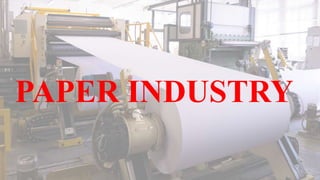
PAPER INDUSTRY
Group
Presenter
Muhammad Mustaqeem Muhammad Zubair
Muhammad Zeeshan M. Naseem Abbas
Muhammad saleem Shoaib Ahmad
Abdullah Muneer
CHOLISTAN UNIVERSITY OF
VETERINARY & ANIMAL SCIENCE
BAHAWAL PUR
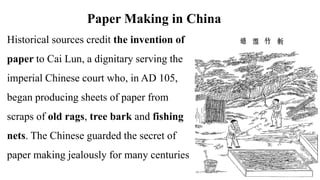
Paper Making in China
Historical sources credit the invention of
paper to Cai Lun, a dignitary serving the
imperial Chinese court who, in AD 105,
began producing sheets of paper from
scraps of old rags, tree bark and fishing
nets. The Chinese guarded the secret of
paper making jealously for many centuries
Paper Making in China
Historical sources credit the invention of
paper to Cai Lun, a dignitary serving the
imperial Chinese court who, in AD 105,
began producing sheets of paper from
scraps of old rags, tree bark and fishing
nets. The Chinese guarded the secret of
paper making jealously for many centuries
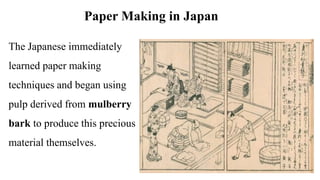
Paper Making in Japan
The Japanese immediately
learned paper making
techniques and began using
pulp derived from mulberry
bark to produce this precious
material themselves.
Paper Making in Arabs
The Arab world discovered the secrets of paper making in AD
751, when the governor-general of the Caliphate of Bagdad
captured two Chinese paper makers in Samarkand and, with their
help, founded a paper mill in the Uzbek city. From here, aided by
an abundance of hemp and linen, two high-quality raw materials
perfect for making paper, production spread to other cities in Asia,
particularly Baghdad and Damascus.
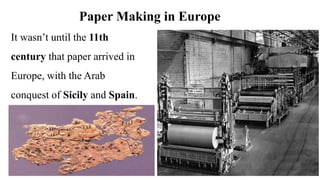
Paper Making in Europe
It wasn’t until the 11th
century that paper arrived in
Europe, with the Arab
conquest of Sicily and Spain.
Definition of Paper
It’s interesting to note that the
first definition of paper
provided by the Treccani
children’s encyclopaedia in
Italy is: “A material that is
essential for spreading ideas
in everyday life”
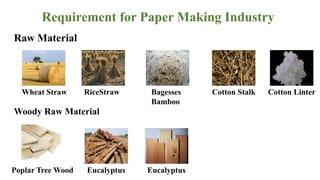
Requirement for Paper Making Industry
Raw Material
Wheat Straw RiceStraw Bagesses
Bamboo
Cotton Stalk Cotton Linter
Woody Raw Material
Poplar Tree Wood Eucalyptus Eucalyptus
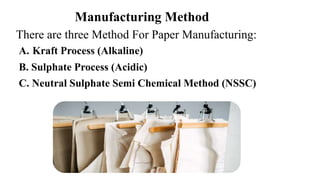
Manufacturing Method
There are three Method For Paper Manufacturing:
A. Kraft Process (Alkaline)
B. Sulphate Process (Acidic)
C. Neutral Sulphate Semi Chemical Method (NSSC)
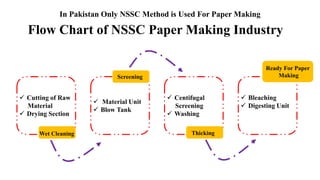
In Pakistan Only NSSC Method is Used For Paper Making
Flow Chart of NSSC Paper Making Industry
Wet Cleaning
 Cutting of Raw
Material
 Drying Section
Screening
 Material Unit
 Blow Tank
Thicking
 Centifugal
Screening
 Washing
Ready For Paper
Making
 Bleaching
 Digesting Unit
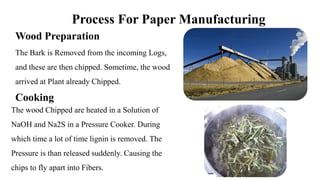
Process For Paper Manufacturing
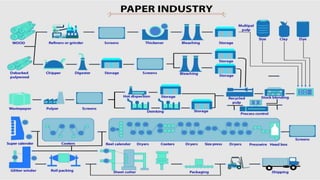
Wood Preparation
The Bark is Removed from the incoming Logs,
and these are then chipped. Sometime, the wood
arrived at Plant already Chipped.
Cooking
The wood Chipped are heated in a Solution of
NaOH and Na2S in a Pressure Cooker. During
which time a lot of time lignin is removed. The
Pressure is than released suddenly. Causing the
chips to fly apart into Fibers.
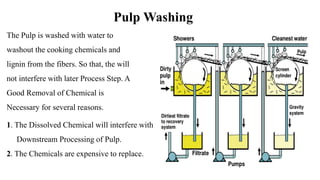
Pulp Washing
The Pulp is washed with water to
washout the cooking chemicals and
lignin from the fibers. So that, the will
not interfere with later Process Step. A
Good Removal of Chemical is
Necessary for several reasons.
1. The Dissolved Chemical will interfere with
Downstream Processing of Pulp.
2. The Chemicals are expensive to replace.
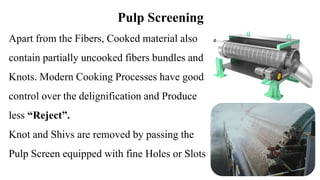
Pulp Screening
Apart from the Fibers, Cooked material also
contain partially uncooked fibers bundles and
Knots. Modern Cooking Processes have good
control over the delignification and Produce
less “Reject”.
Knot and Shivs are removed by passing the
Pulp Screen equipped with fine Holes or Slots
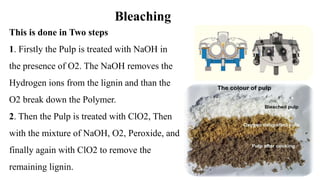
Bleaching
This is done in Two steps
1. Firstly the Pulp is treated with NaOH in
the presence of O2. The NaOH removes the
Hydrogen ions from the lignin and than the
O2 break down the Polymer.
2. Then the Pulp is treated with ClO2, Then
with the mixture of NaOH, O2, Peroxide, and
finally again with ClO2 to remove the
remaining lignin.
Paper Making
The fibers are mechanically treated to make them bond better
to each other, chemicals are added to provide special
properties, such as color or water resistance and then the water
is squeezed out and pulp is rolled smooth and dried.
Various ancillary process result in recovery of CaO, NaOH
and Na2S, the major chemicals used in the process. Various
utilities ensure that such condition as a Sufficient reaction
times and adequate mixing are met.
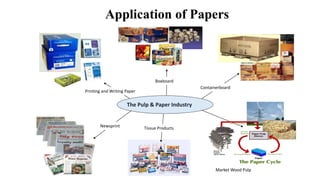
Containerboard
The Pulp & Paper Industry
Printing and Writing Paper
Newsprint Tissue Products
Boxboard
Market Wood Pulp
Application of Papers
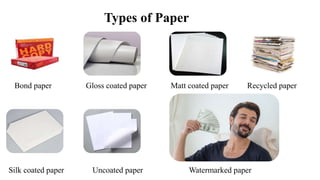
Types of Paper
Bond paper Gloss coated paper Matt coated paper Recycled paper
Silk coated paper Uncoated paper Watermarked paper
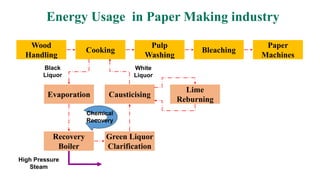
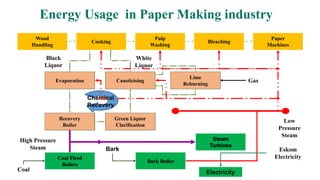
Energy Usage in Paper Making industry
Wood
Handling
Cooking
Pulp
Washing
Bleaching
Paper
Machines
Evaporation
Recovery
Boiler
Green Liquor
Clarification
Causticising
Lime
Reburning
Black
Liquor
Chemical
Recovery
White
Liquor
High Pressure
Steam
Wood
Handling
Cooking
Pulp
Washing
Bleaching
Paper
Machines
Evaporation
Recovery
Boiler
Green Liquor
Clarification
Causticising
Lime
Reburning
Black
Liquor
Chemical
Recovery
White
Liquor
Gas
Low
Pressure
Steam
Steam
Turbines
Electricity
Bark Boiler
Bark Eskom
Electricity
Causticising
Evaporation
Recovery
Boiler
Green Liquor
Clarification
Lime
Reburning
Chemical
Recovery
High Pressure
Steam
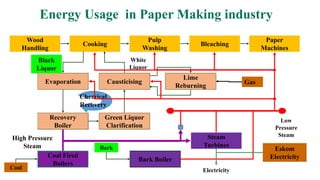
Energy Usage in Paper Making industry
Coal Fired
Boilers
Coal
Wood
Handling
Cooking
Pulp
Washing
Bleaching
Paper
Machines
Evaporation
Recovery
Boiler
Green Liquor
Clarification
Causticising
Lime
Reburning
Black
Liquor
White
Liquor
High Pressure
Steam
Gas
Low
Pressure
Steam
Steam
Turbines
Electricity
Bark Boiler
Bark Eskom
Electricity
Causticising
Evaporation
Recovery
Boiler
Green Liquor
Clarification
Lime
Reburning
Black
Liquor
Chemical
Recovery
Coal Fired
Boilers
Coal
Energy Usage in Paper Making industry
Waste Generation Points
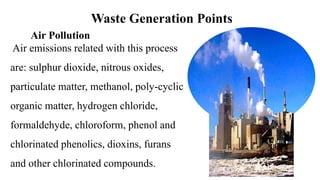
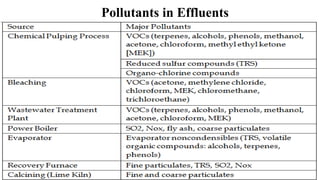
Air Pollution
Air emissions related with this process
are: sulphur dioxide, nitrous oxides,
particulate matter, methanol, poly-cyclic
organic matter, hydrogen chloride,
formaldehyde, chloroform, phenol and
chlorinated phenolics, dioxins, furans
and other chlorinated compounds.
Waste Generation Points
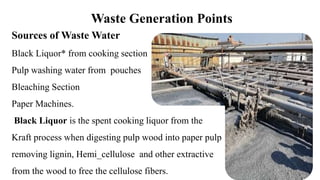
Sources of Waste Water
Black Liquor* from cooking section
Pulp washing water from pouches
Bleaching Section
Paper Machines.
Black Liquor is the spent cooking liquor from the
Kraft process when digesting pulp wood into paper pulp
removing lignin, Hemi_cellulose and other extractive
from the wood to free the cellulose fibers.
Pollutants in Effluents
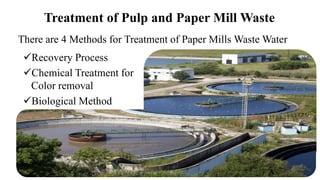
Treatment of Pulp and Paper Mill Waste
There are 4 Methods for Treatment of Paper Mills Waste Water
Recovery Process
Chemical Treatment for
Color removal
Biological Method
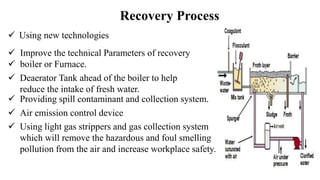
Recovery Process
 Using new technologies
 Improve the technical Parameters of recovery
 boiler or Furnace.
 Using light gas strippers and gas collection system
which will remove the hazardous and foul smelling
pollution from the air and increase workplace safety.
 Deaerator Tank ahead of the boiler to help
reduce the intake of fresh water.
 Air emission control device
 Providing spill contaminant and collection system.
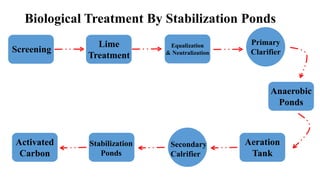
Biological Treatment By Stabilization Ponds
Screening
Lime
Treatment
Equalization
& Neutralization
Primary
Clarifier
Anaerobic
Ponds
Aeration
Tank
Secondary
Calrifier
Stabilization
Ponds
Activated
Carbon
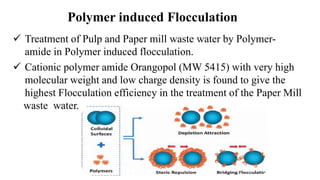
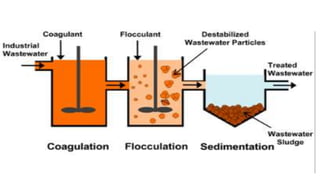
Polymer induced Flocculation
 Treatment of Pulp and Paper mill waste water by Polymer-
amide in Polymer induced flocculation.
 Cationic polymer amide Orangopol (MW 5415) with very high
molecular weight and low charge density is found to give the
highest Flocculation efficiency in the treatment of the Paper Mill
waste water.
 It can achieves 95% of turbidity reduction, 98% TSS removal, 93% COD
reduction and sludge volume index of 14 ml per gram at the optimum dosage
5 ml per gram.
Polymer induced Flocculation
 Beased on the coast evaluation, the use of polymer amide economically
feasible to treat the Pulp and paper mill waste water.
 Result suggest that single polymer system can be used alone in coagulation
flocculation process due to the efficiency of the polymer amide.
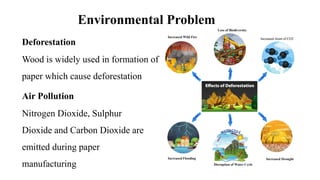
Environmental Problem
Deforestation
Wood is widely used in formation of
paper which cause deforestation
Air Pollution
Nitrogen Dioxide, Sulphur
Dioxide and Carbon Dioxide are
emitted during paper
manufacturing
The industries have developed and applied new technologies instead of conventional
pulping and bleaching processes. Some examples of these new technologies are given
below:
Organic Solvent Pulping
This process is more economical for small and medium scale plants for significant
recovery and reuse of chemicals. In this process, organic solvent like ethanol,
methanol, etc. are preferred. However, this process is more energy consumer than
conventional ones
Acid Pulping
Acetic acid under the high pressure is used for treating of wood chips. The
disadvantage of this process is to loss of acid, however recovery is
possible
How To Protect our Environment From
Hazardous of Paper industry
Biopulping
How To Protect our Environment From
Hazardous of Paper industry
Microorganism or microbial enzymes such as xylanases, pectinases, cellulases,
hemicellulases, ligninases, and their combination are used in the pulping
process to improve the properties of pulp. Biopulping is preferred because:
 To reduce the chemical and energy utilization
 To reduce the pollutants
 To increase the yield and strength properties of pulp.
Elemental Chlorine Free (ECF) Bleaching
Elemental chlorine has been used instead of chlorine dioxide and hypochlorite
and oxygen, ozone, caustic soda, and hydrogen peroxide have been applied for
TCF bleaching of Kraft pulps to reduce the chlorinated organic wastes
Management and disposal of solid wastes
How To Protect our Environment From
Hazardous of Paper industry
Anaerobic Digestion
This process type is a cost effective way due to the high-energy recovery.
Industrial wastes, which have high organic content and digestable, are suitable for
anaerobic digestion like paper sludge and wastewater treatment plant sludge
Composting
This method is suitable for the wastes and sludge, especially paper fibres and organic
materials. The wastes are stabilized via microorganisms with minimal carbon loss. The
end product of this process, humus-like material, can be used for houseplants,
greenhouse and agriculture
Steam Reforming
This technology is used for sludge treatment, however it is still considered as an
emerging technology for paper sludges. Steam reforming is a novel combustion
technology, which carries out in a steam reforming reaction system
Wet Oxidation
The principle of wet oxidation is that organic compound as solid or liquid form is firstly
transferred to water where it contacts with an oxidant under high temperature and pressure.
During wet oxidation, waste pulped with water is carbonized and its fuel value increases to
the equivalent of medium-grade coal. The waste does not cause any air emission in order
to combust without flame or smoke. This technology is also considered as an emerging
technology like steam reforming.
How To Protect our Environment From
Hazardous of Paper industry
Treatment of gas emissions
Air pollution control at pulp and paper mills has been important concern in the recent years. In
spite of these pollutants are removed from gaseous phase, they transferred another phase and
they are also different pollutants for environment. More innovative approach to solve this
problem is biofilters and bioscrubbers that have three steps to remove pollutants from gaseous
phase;
 The transfer of pollutants from air to liquid phase,
 The transfer of pollutants from liquid phase to biofilm phase where microorganisms are
located, and Mineralization of pollutants by microorganisms.
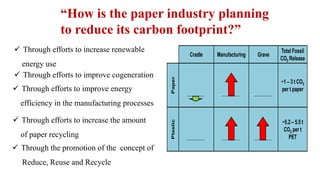
Paper
Plastic
~1 – 3 t CO2
per t paper
~5.2 – 5.5 t
CO2 per t
PET
Cradle Manufacturing Grave
Total Fossil
CO2 Release
“How is the paper industry planning
to reduce its carbon footprint?”
 Through efforts to increase renewable
energy use
 Through efforts to improve cogeneration
 Through efforts to improve energy
efficiency in the manufacturing processes
 Through efforts to increase the amount
of paper recycling
 Through the promotion of the concept of
Reduce, Reuse and Recycle
Recycling of Paper
Recycle is an essential method to minimize waste accumulation and reduce pollution. We
can recycle old newspapers, notebooks and used envelopes. Paper contaminated with food,
carbon paper and stickers cannot be recycled.
Recycling is an excellent and cost-efficient way of conserving the environment and saving
energy. One recycled bin can save enough energy to power a television for four hours. It takes
24 trees to produce one ton of paper. Recycled paper produces less pollution (approx 73%) as
compared to preparing from raw materials.
And an average newpaper can be recycled 5 times
 Save 7,000 gallons of water.
 Save 3.3 cubic yards of landfill space.
 Reduce greenhouse gas emissions by one metric ton of carbon equivalent
Thank You

Paper industry .pptx

  • 1.
  • 2.
    Group Presenter Muhammad Mustaqeem MuhammadZubair Muhammad Zeeshan M. Naseem Abbas Muhammad saleem Shoaib Ahmad Abdullah Muneer CHOLISTAN UNIVERSITY OF VETERINARY & ANIMAL SCIENCE BAHAWAL PUR
  • 3.
    Paper Making inChina Historical sources credit the invention of paper to Cai Lun, a dignitary serving the imperial Chinese court who, in AD 105, began producing sheets of paper from scraps of old rags, tree bark and fishing nets. The Chinese guarded the secret of paper making jealously for many centuries
  • 4.
    Paper Making inChina Historical sources credit the invention of paper to Cai Lun, a dignitary serving the imperial Chinese court who, in AD 105, began producing sheets of paper from scraps of old rags, tree bark and fishing nets. The Chinese guarded the secret of paper making jealously for many centuries
  • 5.
    Paper Making inJapan The Japanese immediately learned paper making techniques and began using pulp derived from mulberry bark to produce this precious material themselves.
  • 6.
    Paper Making inArabs The Arab world discovered the secrets of paper making in AD 751, when the governor-general of the Caliphate of Bagdad captured two Chinese paper makers in Samarkand and, with their help, founded a paper mill in the Uzbek city. From here, aided by an abundance of hemp and linen, two high-quality raw materials perfect for making paper, production spread to other cities in Asia, particularly Baghdad and Damascus.
  • 7.
    Paper Making inEurope It wasn’t until the 11th century that paper arrived in Europe, with the Arab conquest of Sicily and Spain.
  • 8.
    Definition of Paper It’sinteresting to note that the first definition of paper provided by the Treccani children’s encyclopaedia in Italy is: “A material that is essential for spreading ideas in everyday life”
  • 9.
    Requirement for PaperMaking Industry Raw Material Wheat Straw RiceStraw Bagesses Bamboo Cotton Stalk Cotton Linter Woody Raw Material Poplar Tree Wood Eucalyptus Eucalyptus
  • 10.
    Manufacturing Method There arethree Method For Paper Manufacturing: A. Kraft Process (Alkaline) B. Sulphate Process (Acidic) C. Neutral Sulphate Semi Chemical Method (NSSC)
  • 11.
    In Pakistan OnlyNSSC Method is Used For Paper Making Flow Chart of NSSC Paper Making Industry Wet Cleaning  Cutting of Raw Material  Drying Section Screening  Material Unit  Blow Tank Thicking  Centifugal Screening  Washing Ready For Paper Making  Bleaching  Digesting Unit
  • 12.
    Process For PaperManufacturing Wood Preparation The Bark is Removed from the incoming Logs, and these are then chipped. Sometime, the wood arrived at Plant already Chipped. Cooking The wood Chipped are heated in a Solution of NaOH and Na2S in a Pressure Cooker. During which time a lot of time lignin is removed. The Pressure is than released suddenly. Causing the chips to fly apart into Fibers.
  • 13.
    Pulp Washing The Pulpis washed with water to washout the cooking chemicals and lignin from the fibers. So that, the will not interfere with later Process Step. A Good Removal of Chemical is Necessary for several reasons. 1. The Dissolved Chemical will interfere with Downstream Processing of Pulp. 2. The Chemicals are expensive to replace.
  • 14.
    Pulp Screening Apart fromthe Fibers, Cooked material also contain partially uncooked fibers bundles and Knots. Modern Cooking Processes have good control over the delignification and Produce less “Reject”. Knot and Shivs are removed by passing the Pulp Screen equipped with fine Holes or Slots
  • 15.
    Bleaching This is donein Two steps 1. Firstly the Pulp is treated with NaOH in the presence of O2. The NaOH removes the Hydrogen ions from the lignin and than the O2 break down the Polymer. 2. Then the Pulp is treated with ClO2, Then with the mixture of NaOH, O2, Peroxide, and finally again with ClO2 to remove the remaining lignin.
  • 16.
    Paper Making The fibersare mechanically treated to make them bond better to each other, chemicals are added to provide special properties, such as color or water resistance and then the water is squeezed out and pulp is rolled smooth and dried. Various ancillary process result in recovery of CaO, NaOH and Na2S, the major chemicals used in the process. Various utilities ensure that such condition as a Sufficient reaction times and adequate mixing are met.
  • 18.
    Containerboard The Pulp &Paper Industry Printing and Writing Paper Newsprint Tissue Products Boxboard Market Wood Pulp Application of Papers
  • 19.
    Types of Paper Bondpaper Gloss coated paper Matt coated paper Recycled paper Silk coated paper Uncoated paper Watermarked paper
  • 20.
    Energy Usage inPaper Making industry Wood Handling Cooking Pulp Washing Bleaching Paper Machines Evaporation Recovery Boiler Green Liquor Clarification Causticising Lime Reburning Black Liquor Chemical Recovery White Liquor High Pressure Steam
  • 21.
    Wood Handling Cooking Pulp Washing Bleaching Paper Machines Evaporation Recovery Boiler Green Liquor Clarification Causticising Lime Reburning Black Liquor Chemical Recovery White Liquor Gas Low Pressure Steam Steam Turbines Electricity Bark Boiler BarkEskom Electricity Causticising Evaporation Recovery Boiler Green Liquor Clarification Lime Reburning Chemical Recovery High Pressure Steam Energy Usage in Paper Making industry Coal Fired Boilers Coal
  • 22.
    Wood Handling Cooking Pulp Washing Bleaching Paper Machines Evaporation Recovery Boiler Green Liquor Clarification Causticising Lime Reburning Black Liquor White Liquor High Pressure Steam Gas Low Pressure Steam Steam Turbines Electricity BarkBoiler Bark Eskom Electricity Causticising Evaporation Recovery Boiler Green Liquor Clarification Lime Reburning Black Liquor Chemical Recovery Coal Fired Boilers Coal Energy Usage in Paper Making industry
  • 23.
    Waste Generation Points AirPollution Air emissions related with this process are: sulphur dioxide, nitrous oxides, particulate matter, methanol, poly-cyclic organic matter, hydrogen chloride, formaldehyde, chloroform, phenol and chlorinated phenolics, dioxins, furans and other chlorinated compounds.
  • 24.
    Waste Generation Points Sourcesof Waste Water Black Liquor* from cooking section Pulp washing water from pouches Bleaching Section Paper Machines. Black Liquor is the spent cooking liquor from the Kraft process when digesting pulp wood into paper pulp removing lignin, Hemi_cellulose and other extractive from the wood to free the cellulose fibers.
  • 25.
  • 26.
    Treatment of Pulpand Paper Mill Waste There are 4 Methods for Treatment of Paper Mills Waste Water Recovery Process Chemical Treatment for Color removal Biological Method
  • 27.
    Recovery Process  Usingnew technologies  Improve the technical Parameters of recovery  boiler or Furnace.  Using light gas strippers and gas collection system which will remove the hazardous and foul smelling pollution from the air and increase workplace safety.  Deaerator Tank ahead of the boiler to help reduce the intake of fresh water.  Air emission control device  Providing spill contaminant and collection system.
  • 28.
    Biological Treatment ByStabilization Ponds Screening Lime Treatment Equalization & Neutralization Primary Clarifier Anaerobic Ponds Aeration Tank Secondary Calrifier Stabilization Ponds Activated Carbon
  • 29.
    Polymer induced Flocculation Treatment of Pulp and Paper mill waste water by Polymer- amide in Polymer induced flocculation.  Cationic polymer amide Orangopol (MW 5415) with very high molecular weight and low charge density is found to give the highest Flocculation efficiency in the treatment of the Paper Mill waste water.
  • 30.
     It canachieves 95% of turbidity reduction, 98% TSS removal, 93% COD reduction and sludge volume index of 14 ml per gram at the optimum dosage 5 ml per gram. Polymer induced Flocculation  Beased on the coast evaluation, the use of polymer amide economically feasible to treat the Pulp and paper mill waste water.  Result suggest that single polymer system can be used alone in coagulation flocculation process due to the efficiency of the polymer amide.
  • 32.
    Environmental Problem Deforestation Wood iswidely used in formation of paper which cause deforestation Air Pollution Nitrogen Dioxide, Sulphur Dioxide and Carbon Dioxide are emitted during paper manufacturing
  • 33.
    The industries havedeveloped and applied new technologies instead of conventional pulping and bleaching processes. Some examples of these new technologies are given below: Organic Solvent Pulping This process is more economical for small and medium scale plants for significant recovery and reuse of chemicals. In this process, organic solvent like ethanol, methanol, etc. are preferred. However, this process is more energy consumer than conventional ones Acid Pulping Acetic acid under the high pressure is used for treating of wood chips. The disadvantage of this process is to loss of acid, however recovery is possible How To Protect our Environment From Hazardous of Paper industry
  • 34.
    Biopulping How To Protectour Environment From Hazardous of Paper industry Microorganism or microbial enzymes such as xylanases, pectinases, cellulases, hemicellulases, ligninases, and their combination are used in the pulping process to improve the properties of pulp. Biopulping is preferred because:  To reduce the chemical and energy utilization  To reduce the pollutants  To increase the yield and strength properties of pulp. Elemental Chlorine Free (ECF) Bleaching Elemental chlorine has been used instead of chlorine dioxide and hypochlorite and oxygen, ozone, caustic soda, and hydrogen peroxide have been applied for TCF bleaching of Kraft pulps to reduce the chlorinated organic wastes
  • 35.
    Management and disposalof solid wastes How To Protect our Environment From Hazardous of Paper industry Anaerobic Digestion This process type is a cost effective way due to the high-energy recovery. Industrial wastes, which have high organic content and digestable, are suitable for anaerobic digestion like paper sludge and wastewater treatment plant sludge Composting This method is suitable for the wastes and sludge, especially paper fibres and organic materials. The wastes are stabilized via microorganisms with minimal carbon loss. The end product of this process, humus-like material, can be used for houseplants, greenhouse and agriculture
  • 36.
    Steam Reforming This technologyis used for sludge treatment, however it is still considered as an emerging technology for paper sludges. Steam reforming is a novel combustion technology, which carries out in a steam reforming reaction system Wet Oxidation The principle of wet oxidation is that organic compound as solid or liquid form is firstly transferred to water where it contacts with an oxidant under high temperature and pressure. During wet oxidation, waste pulped with water is carbonized and its fuel value increases to the equivalent of medium-grade coal. The waste does not cause any air emission in order to combust without flame or smoke. This technology is also considered as an emerging technology like steam reforming.
  • 37.
    How To Protectour Environment From Hazardous of Paper industry Treatment of gas emissions Air pollution control at pulp and paper mills has been important concern in the recent years. In spite of these pollutants are removed from gaseous phase, they transferred another phase and they are also different pollutants for environment. More innovative approach to solve this problem is biofilters and bioscrubbers that have three steps to remove pollutants from gaseous phase;  The transfer of pollutants from air to liquid phase,  The transfer of pollutants from liquid phase to biofilm phase where microorganisms are located, and Mineralization of pollutants by microorganisms.
  • 38.
    Paper Plastic ~1 – 3t CO2 per t paper ~5.2 – 5.5 t CO2 per t PET Cradle Manufacturing Grave Total Fossil CO2 Release “How is the paper industry planning to reduce its carbon footprint?”  Through efforts to increase renewable energy use  Through efforts to improve cogeneration  Through efforts to improve energy efficiency in the manufacturing processes  Through efforts to increase the amount of paper recycling  Through the promotion of the concept of Reduce, Reuse and Recycle
  • 39.
    Recycling of Paper Recycleis an essential method to minimize waste accumulation and reduce pollution. We can recycle old newspapers, notebooks and used envelopes. Paper contaminated with food, carbon paper and stickers cannot be recycled. Recycling is an excellent and cost-efficient way of conserving the environment and saving energy. One recycled bin can save enough energy to power a television for four hours. It takes 24 trees to produce one ton of paper. Recycled paper produces less pollution (approx 73%) as compared to preparing from raw materials. And an average newpaper can be recycled 5 times  Save 7,000 gallons of water.  Save 3.3 cubic yards of landfill space.  Reduce greenhouse gas emissions by one metric ton of carbon equivalent
  • 40.