
Pulp and Paper Making Process
Presented by,
C.Mathan
Department of EIE
Overview of Indian paper industry
• The Indian paper industry accounts for about 3% of the
world’s production of paper.
• The estimated turnover of the industry is INR 50,000 crore
approximately.
• Total number of mills 750
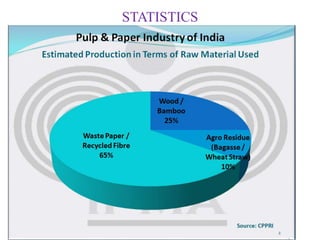
STATISTICS
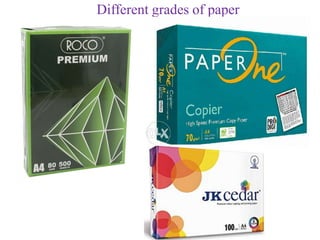
Different grades of paper
What does GSM mean?
• GSM is an acronym standing for 'Grams per Square Meter‘
• GSM of paper means the density of paper or weight of the
paper.
• Effectively, this is the thickness of the paper
• Most printing paper has a gsm between 60 and 120.
• 80gsm is standard.
Introduction
• Paper is a dried, compressed mat of plant fibers.
• Paper plays a key role in our daily life and papers have been
used for many years from now.
• Papers are made with the pulp of the woods, which is an Eco-
friendly product.
• 90% of the raw material for papermaking comes from trees.
Raw Material
• The variety of raw material used wood, bamboo, recycled
fibre, bagasse, wheat straw, rice husk, etc.
Different kinds of trees produce a different texture of paper.
• Soft woods like pine have longer fibers and give paper more
strength.
• Hardwood fibers are shorter but tend to work better in printing
and writing papers.
• Most paper pulp is made from trees (mainly fast-growing,
evergreen conifers), though it can also be made from bamboo,
cotton, hemp, jute, and a wide range of other plant materials.
• Smooth papers used for magazines or packaging often have
materials such as china clay added so they print with a more
colourful, glossy finish.
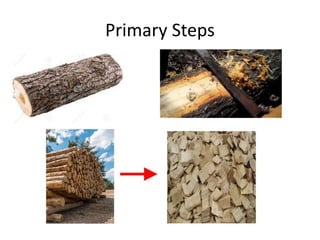
Primary Steps
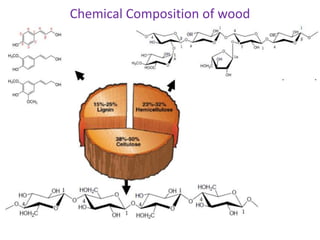
Chemical Composition of wood
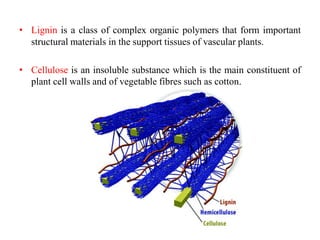
• Lignin is a class of complex organic polymers that form important
structural materials in the support tissues of vascular plants.
• Cellulose is an insoluble substance which is the main constituent of
plant cell walls and of vegetable fibres such as cotton.
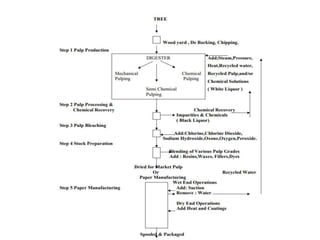
Step 1:Pulp Production
• Pulp is a commercial fibrous material obtained from bamboo,
wood, bagasse, etc.
• The primary goals of pulping are to free fibers in wood from the
lignin that binds these fibers together and then to suspend the
fibers in water into a slurry suitable for paper making.
• In the Pulp process which breaks the cellulose fibers that are
strong in tension and embedded in a matrix of lignin(complex
organic polymers) bonds.
• There are several different methods of pulp production to make
different strengths and grades of paper.
• The most common classifications are
 Chemical Pulping
 Mechanical Pulping
 Semi-chemical pulping techniques.
Chemical Pulping
• Chemical pulping uses various chemicals to separate lignin
from the cellulose fibers.
• There are two main types of chemical pulping performed:
 Kraft (sulphate) pulping
 sulfite pulping
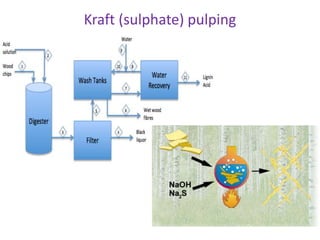
Kraft (sulphate) pulping
• The sulphate or kraft process is the world's most
common pulping process, since it yields higher pulp
strengths and can be used with all types of wood.
• In the kraft pulp process the active cooking with hot
mixture of water with chemicals (white liquor) are
sodium hydroxide (NaOH) and sodium sulphate
(Na2S) that breaks the bonds that link lignin and
cellulose.
Mechanical pulping
• Mechanical pulping utilizes steam, pressure, and
high temperatures instead of chemicals to tear the
fibers.
• As the oldest form of pulping, mechanical pulping
uses mechanical energy to weaken and separate
fibers from wood via a grinding action.
• The advantage to mechanical pulping is that it
produces much higher yields than chemical
pulping processes.
• The fiber quality is greatly reduced because
mechanical pulping creates short, weak fibers that
still contain the lignin that bonds the fibers
together.
Semi-Chemical Pulping
• Semi-chemical pulping techniques use weak chemical
solutions composed of sodium sulfite (Na2SO3) and sodium
carbonate (Na2CO3) to help digest the lignin in the pulp.
• In addition to the chemical solutions, mechanical refining is
used to separate the fibers.
Step2:Pulp Processing and Chemical
Recovery
• To further remove impurities of black liquor (black liquor is
the waste water from the kraft process).
• The removal of the black liquor takes place in washers and is
necessary to reduce the chemical costs of the liquor.
• In addition, by recycling the cooking liquor back into the
pulping process, environmental issues and costs are negated.
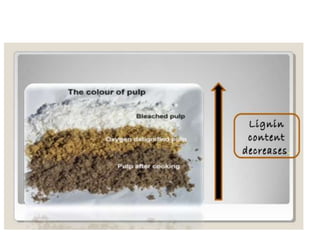
Step3:Pulp Bleaching
• Bleaching of wood pulp is the chemical
processing carried out on various types of wood pulp to
decrease the color of the pulp, so that it becomes whiter.
• chlorine dioxide, sodium hydroxide and hydrogen
peroxide.
• Chlorine dioxide bleaching is used in single or multi-
stages process. Unlike chlorine, it does not react with
water.
• It remains as a dissolved gas in water. It selectively
attacks the phenolic groups of lignin without degrading
cellulose fiber, allowing for increased yield and higher
strength bleached pulp.
Step 4:Stock Preparation
• Cellulose fiber must be subjected to
mechanical treatment before they can be made
in to paper and board.
• Beating and refining is done to develop good
fiber bonding and high paper strength.
• Papermills do not always make their own pulp
they are so called “non integrated mills”
• those who produce their own pulp are
integrated mills
Step 5:Paper Making
• The pulp from stock preparation section after beating/
refing enters the to manifold and then to head box of
Fourdrinier Machine and distribute it uniformly
across the width of wire at constant head.
.
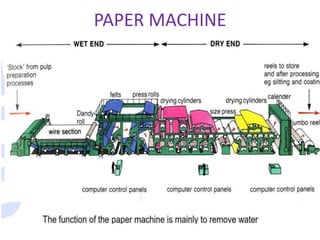
PAPER MACHINE
Wet End Process
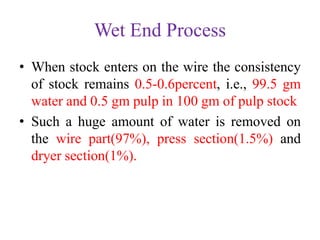
• When stock enters on the wire the consistency
of stock remains 0.5-0.6percent, i.e., 99.5 gm
water and 0.5 gm pulp in 100 gm of pulp stock
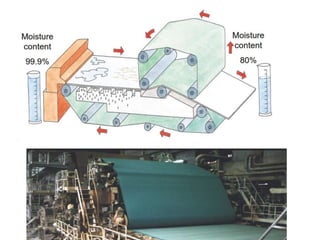
• Such a huge amount of water is removed on
the wire part(97%), press section(1.5%) and
dryer section(1%).
WIRE SECTION
Dry-End Operations
• Following the pressing of the wet-end
operations, the continuous sheet is compressed
by steam-heated rollers to allow the fibers to
begin bonding together
Calendering
• After the sheet is dried, it is passed through a
stack of heavy metal rolls, where it is
calenderised under high pressure.
• The purpose of calendaring is to smooth down
the felt and wire marks, to remove cockle and
to level off lumpy formation and to make sheet
of uniform caliper.
Thank You

Pulp and Paper making (2).pptx

  • 1.
    Pulp and PaperMaking Process Presented by, C.Mathan Department of EIE
  • 2.
    Overview of Indianpaper industry • The Indian paper industry accounts for about 3% of the world’s production of paper. • The estimated turnover of the industry is INR 50,000 crore approximately. • Total number of mills 750
  • 3.
  • 5.
  • 6.
    What does GSMmean? • GSM is an acronym standing for 'Grams per Square Meter‘ • GSM of paper means the density of paper or weight of the paper. • Effectively, this is the thickness of the paper • Most printing paper has a gsm between 60 and 120. • 80gsm is standard.
  • 7.
    Introduction • Paper isa dried, compressed mat of plant fibers. • Paper plays a key role in our daily life and papers have been used for many years from now. • Papers are made with the pulp of the woods, which is an Eco- friendly product. • 90% of the raw material for papermaking comes from trees.
  • 8.
    Raw Material • Thevariety of raw material used wood, bamboo, recycled fibre, bagasse, wheat straw, rice husk, etc. Different kinds of trees produce a different texture of paper. • Soft woods like pine have longer fibers and give paper more strength. • Hardwood fibers are shorter but tend to work better in printing and writing papers. • Most paper pulp is made from trees (mainly fast-growing, evergreen conifers), though it can also be made from bamboo, cotton, hemp, jute, and a wide range of other plant materials. • Smooth papers used for magazines or packaging often have materials such as china clay added so they print with a more colourful, glossy finish.
  • 10.
  • 11.
  • 12.
    • Lignin isa class of complex organic polymers that form important structural materials in the support tissues of vascular plants. • Cellulose is an insoluble substance which is the main constituent of plant cell walls and of vegetable fibres such as cotton.
  • 13.
    Step 1:Pulp Production •Pulp is a commercial fibrous material obtained from bamboo, wood, bagasse, etc. • The primary goals of pulping are to free fibers in wood from the lignin that binds these fibers together and then to suspend the fibers in water into a slurry suitable for paper making. • In the Pulp process which breaks the cellulose fibers that are strong in tension and embedded in a matrix of lignin(complex organic polymers) bonds.
  • 14.
    • There areseveral different methods of pulp production to make different strengths and grades of paper. • The most common classifications are  Chemical Pulping  Mechanical Pulping  Semi-chemical pulping techniques.
  • 15.
    Chemical Pulping • Chemicalpulping uses various chemicals to separate lignin from the cellulose fibers. • There are two main types of chemical pulping performed:  Kraft (sulphate) pulping  sulfite pulping
  • 16.
  • 17.
    • The sulphateor kraft process is the world's most common pulping process, since it yields higher pulp strengths and can be used with all types of wood. • In the kraft pulp process the active cooking with hot mixture of water with chemicals (white liquor) are sodium hydroxide (NaOH) and sodium sulphate (Na2S) that breaks the bonds that link lignin and cellulose.
  • 18.
  • 19.
    • Mechanical pulpingutilizes steam, pressure, and high temperatures instead of chemicals to tear the fibers. • As the oldest form of pulping, mechanical pulping uses mechanical energy to weaken and separate fibers from wood via a grinding action. • The advantage to mechanical pulping is that it produces much higher yields than chemical pulping processes. • The fiber quality is greatly reduced because mechanical pulping creates short, weak fibers that still contain the lignin that bonds the fibers together.
  • 20.
    Semi-Chemical Pulping • Semi-chemicalpulping techniques use weak chemical solutions composed of sodium sulfite (Na2SO3) and sodium carbonate (Na2CO3) to help digest the lignin in the pulp. • In addition to the chemical solutions, mechanical refining is used to separate the fibers.
  • 21.
    Step2:Pulp Processing andChemical Recovery • To further remove impurities of black liquor (black liquor is the waste water from the kraft process). • The removal of the black liquor takes place in washers and is necessary to reduce the chemical costs of the liquor. • In addition, by recycling the cooking liquor back into the pulping process, environmental issues and costs are negated.
  • 22.
    Step3:Pulp Bleaching • Bleachingof wood pulp is the chemical processing carried out on various types of wood pulp to decrease the color of the pulp, so that it becomes whiter. • chlorine dioxide, sodium hydroxide and hydrogen peroxide. • Chlorine dioxide bleaching is used in single or multi- stages process. Unlike chlorine, it does not react with water. • It remains as a dissolved gas in water. It selectively attacks the phenolic groups of lignin without degrading cellulose fiber, allowing for increased yield and higher strength bleached pulp.
  • 24.
    Step 4:Stock Preparation •Cellulose fiber must be subjected to mechanical treatment before they can be made in to paper and board. • Beating and refining is done to develop good fiber bonding and high paper strength.
  • 25.
    • Papermills donot always make their own pulp they are so called “non integrated mills” • those who produce their own pulp are integrated mills
  • 26.
    Step 5:Paper Making •The pulp from stock preparation section after beating/ refing enters the to manifold and then to head box of Fourdrinier Machine and distribute it uniformly across the width of wire at constant head. .
  • 27.
  • 28.
    Wet End Process •When stock enters on the wire the consistency of stock remains 0.5-0.6percent, i.e., 99.5 gm water and 0.5 gm pulp in 100 gm of pulp stock • Such a huge amount of water is removed on the wire part(97%), press section(1.5%) and dryer section(1%).
  • 29.
  • 30.
    Dry-End Operations • Followingthe pressing of the wet-end operations, the continuous sheet is compressed by steam-heated rollers to allow the fibers to begin bonding together
  • 31.
    Calendering • After thesheet is dried, it is passed through a stack of heavy metal rolls, where it is calenderised under high pressure. • The purpose of calendaring is to smooth down the felt and wire marks, to remove cockle and to level off lumpy formation and to make sheet of uniform caliper.
  • 32.