DEPARTMENT OF ELECTRONICS AND INSTRUMENTATION
ENGINEERING
IOT BASED HEALTH MONITORING SYSTEM
USING NODE MCU -ESP8266
INTRODUCTION
• Health is always a major concern in every growth the human race is advancing in terms of
technology.
• It is always a better idea to monitor these patients using remote health monitoring technology.
• So [IOT] Internet Of Things based health monitoring system is the current solution.
• The core objective of this project is the design and implementation of a smart project is the design
and implementation of the smart patient health tracking system that use sensors to track patient
health and use internet to inform there loved ones, incase of any issue the objective of developing
monitoring system is to reduced health care cost by reducing SMS based patient flourishing
viewing and IOT based patient checking framework.
COMPONENTS REQUIRED
• Node Mcu-ESP8266.
• Electrobot Heart Rate Pulse Sensor Module-280.
• Berg strip.
• Connecting wires.
• Dot board.
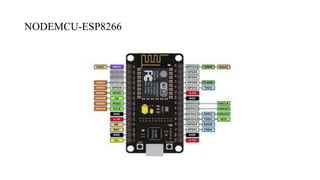
SPECIFICATIONS OF NODEMCU-ESP8266
NodeMCU is an open-source based firmware and development board specially targeted for IOT
based Applications. It includes firmware that runs on the ESP8266 Wi-Fi SOC from Espress if
Systems, and hardware which is based on the ESP-12 module.
 However, as a chip, the ESP8266 is also hard to access and use. You must solder wires, with the
appropriate analog voltage, to its pins for the simplest tasks such as powering it on or sending a
keystroke to the “computer” on the chip. You also have to program it in low-level machine
instructions that can be interpreted by the chip hardware.
 This level of integration is not a problem using the ESP8266 as an embedded controller chip in
mass-produced electronics. It is a huge burden for hobbyists, hackers, or students who want to
experiment with it in their own IoT projects. The NodeMCU is available in various package styles.
Common to all the designs is the base ESP8266 core. Designs based on the architecture have
maintained the standard 30-pin layout.
NODEMCU-ESP8266
EXISTING SYSTEM
 In IOT Based Patient Health Monitoring System Using NODEMCU-ESP8266 has two methods then
one is existing system and other one is proposed system.
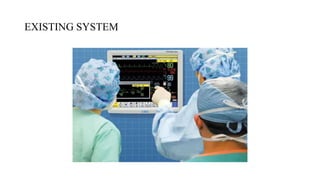
 In a hospital, either the doctor or nurse has to move physically from one person to another for
checking health condition, which may not be possible to monitor their health conditions continuously.
 Thus, any critical situations are not found easily unless the doctor or nurse checks the person’s health
at that moment. This may be a strain for the doctors who have to take care of many numbers of people
in the hospital.
 Also, when medical emergencies happen to the patient, they are often unconscious and unable to
indicate or press an Emergency Alert Button. More than 50% of hospital deaths occur in patients who
are not continuously monitored.
EXISTING SYSTEM
PROPOSED SYSTEM
 In this proposed Patient monitoring system we use NodeMCU, and the respective sensors. These sensors
used to monitor the different parameters of an ICU patient remotely and also control over medicine dosage is
provided.
 This system enables doctors to monitor vital parameters like body temperature, heart rate, acceleration and
saline level of patients in remote areas of hospital as well as he can monitor the patient when he is out of the
premises. If the parameters goes to abnormal these system sends alert Popup message to the doctors or it
makes a buzzer sound. All these information and communication between doctor and patient is possible only
through the website.
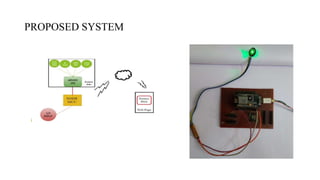
 NodeMCU is worked as server which takes the information gathered by Arduino’s from sensors and puts
complete information on the website created. This system gives the minute to minute update to the doctor.
Thus, we can reduce the deaths and can save people more easily.
PROPOSED SYSTEM
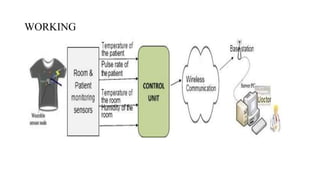
WORKING
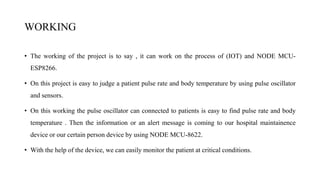
• The working of the project is to say , it can work on the process of (IOT) and NODE MCU-
ESP8266.
• On this project is easy to judge a patient pulse rate and body temperature by using pulse oscillator
and sensors.
• On this working the pulse oscillator can connected to patients is easy to find pulse rate and body
temperature . Then the information or an alert message is coming to our hospital maintainence
device or our certain person device by using NODE MCU-8622.
• With the help of the device, we can easily monitor the patient at critical conditions.
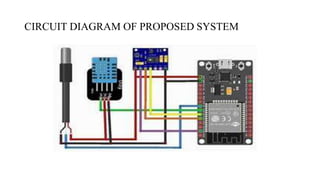
CIRCUIT DIAGRAM OF PROPOSED SYSTEM
WORKING
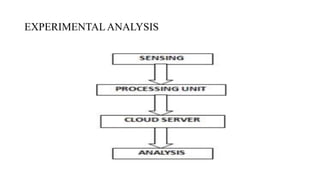
EXPERIMENTALANALYSIS
ADVANTAGES
1.This is because these “smart” health systems are providing numerous benefits to patients around
the globe.
2.Two of the primary ways IoT-based patient health monitoring systems help improve patient
outcomes is by giving healthcare providers the ability to collect and wirelessly transmit real time
data and analyze the data to uncover patterns.
3.In health monitoring system based on IoT projects, the real time factors of the patient are sent to
the cloud by using internet connection. These data can be sent to anywhere in the world, so that the
user will view the details anytime. This is the major advantage over
SMS based health monitoring system.
APPLICATION
1.Remote health monitoring is an important application of Internet Of Things.
Through monitoring, you can give adequate healthcare to people who are in dire
need of help.
2. Every day, lots of people die because they do not get timely and prompt medical
attention.
3. With IoT, devices fitted with sensors notify the concerned healthcare providers
when there is any change in the vital functions of a person.
RESULT AND DISCUSSION
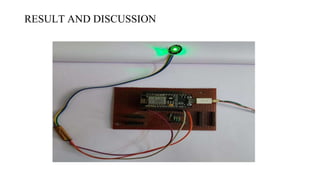
• On the working of this project, The proposed system of patient health monitoring using IOT can be
highly used in any emergency situations as it can be daily monitored, recorded and stored as a database.
This system also enables doctor to monitor useful parameters like body temperature, heart rate,
acceleration and saline level of patients in remote areas of hospital and also he can monitor patient when
he is out of the premises. If any parameter goes to abnormal this system sends alert (Popup message) to
the doctor so in future this IOT device can also be combined with the cloud computing so that the
database can be shared in all hospitals for intensive care and treatment. Similarly, you can monitor your
patient’s health from any device that features a browser. The below image is the view of the Patient
Health Status on Android SmartPhone. Simply copy the ESP IP Address and paste on the browser of
any device.
RESULT AND DISCUSSION
REFERENCES
•
[1] Vandana Milind Rohokale, Neeli Rashmi Prasad, Ramjee Prasad, “A Cooperative Internet of
Things (IoT) for Rural Healthcare Monitoring and Control”, 2011 Center for TeleIn Frastuktur,
Aalborg University, Denmark, P.P 978-1-4577-0787-2/11.
[2] Charalampos Doukas, Ilias Maglogiannis, “Bringing IoT and Cloud Computing towards
Pervasive Healthcare”, 2012 Sixth International Conference on Innovative Mobile and Internet
Services in Ubiquitous Computing, P.P 978-0-7695-4684-1/12.
[3] Junaid Mohammed, Abhinav Thakral, Adrian Filip Ocneanu, Colin Jones, Chung-Horng Lung,
Andy Adler, “Internet of Things: Remote Patient Monitoring Using Web Services and Cloud
Computing”, 2014 IEEE International Conference on Internet of Things (iThings 2014), Green
Computing and Communications (GreenCom2014), and Cyber-Physical-Social Computing
(CPSCom 2014), P.P 978-1-4799-5967-9/14.
CONCLUSION
• The Internet of Things is considered now as one of the feasible solutions for any remote
value tracking especially in the field of health monitoring. It facilitates that the individual
prosperity parameter data is secured inside the cloud, stays in the hospital are reduced for
conventional routine examinations and most important that the health can be monitored and
disease diagnosed by any doctor at any distance.
• In this paper, an IoT based health monitoring system was developed. The system
monitored body temperature, pulse rate and room humidity and temperature using sensors,
which are also displayed on a LCD. These sensor values are then sent to a medical server
using wireless communication. These data are then received in an authorized personals
smart phone with IoT platform. With the values received the doctor then diagnose the
disease and the state of health of the patient.
SANJAY.K MINOR PROJECT 2-3.pptx

SANJAY.K MINOR PROJECT 2-3.pptx

  • 1.
    DEPARTMENT OF ELECTRONICSAND INSTRUMENTATION ENGINEERING
  • 2.
    IOT BASED HEALTHMONITORING SYSTEM USING NODE MCU -ESP8266
  • 3.
    INTRODUCTION • Health isalways a major concern in every growth the human race is advancing in terms of technology. • It is always a better idea to monitor these patients using remote health monitoring technology. • So [IOT] Internet Of Things based health monitoring system is the current solution. • The core objective of this project is the design and implementation of a smart project is the design and implementation of the smart patient health tracking system that use sensors to track patient health and use internet to inform there loved ones, incase of any issue the objective of developing monitoring system is to reduced health care cost by reducing SMS based patient flourishing viewing and IOT based patient checking framework.
  • 4.
    COMPONENTS REQUIRED • NodeMcu-ESP8266. • Electrobot Heart Rate Pulse Sensor Module-280. • Berg strip. • Connecting wires. • Dot board.
  • 5.
    SPECIFICATIONS OF NODEMCU-ESP8266 NodeMCUis an open-source based firmware and development board specially targeted for IOT based Applications. It includes firmware that runs on the ESP8266 Wi-Fi SOC from Espress if Systems, and hardware which is based on the ESP-12 module.  However, as a chip, the ESP8266 is also hard to access and use. You must solder wires, with the appropriate analog voltage, to its pins for the simplest tasks such as powering it on or sending a keystroke to the “computer” on the chip. You also have to program it in low-level machine instructions that can be interpreted by the chip hardware.  This level of integration is not a problem using the ESP8266 as an embedded controller chip in mass-produced electronics. It is a huge burden for hobbyists, hackers, or students who want to experiment with it in their own IoT projects. The NodeMCU is available in various package styles. Common to all the designs is the base ESP8266 core. Designs based on the architecture have maintained the standard 30-pin layout.
  • 6.
  • 7.
    EXISTING SYSTEM  InIOT Based Patient Health Monitoring System Using NODEMCU-ESP8266 has two methods then one is existing system and other one is proposed system.  In a hospital, either the doctor or nurse has to move physically from one person to another for checking health condition, which may not be possible to monitor their health conditions continuously.  Thus, any critical situations are not found easily unless the doctor or nurse checks the person’s health at that moment. This may be a strain for the doctors who have to take care of many numbers of people in the hospital.  Also, when medical emergencies happen to the patient, they are often unconscious and unable to indicate or press an Emergency Alert Button. More than 50% of hospital deaths occur in patients who are not continuously monitored.
  • 8.
  • 9.
    PROPOSED SYSTEM  Inthis proposed Patient monitoring system we use NodeMCU, and the respective sensors. These sensors used to monitor the different parameters of an ICU patient remotely and also control over medicine dosage is provided.  This system enables doctors to monitor vital parameters like body temperature, heart rate, acceleration and saline level of patients in remote areas of hospital as well as he can monitor the patient when he is out of the premises. If the parameters goes to abnormal these system sends alert Popup message to the doctors or it makes a buzzer sound. All these information and communication between doctor and patient is possible only through the website.  NodeMCU is worked as server which takes the information gathered by Arduino’s from sensors and puts complete information on the website created. This system gives the minute to minute update to the doctor. Thus, we can reduce the deaths and can save people more easily.
  • 10.
  • 11.
    WORKING • The workingof the project is to say , it can work on the process of (IOT) and NODE MCU- ESP8266. • On this project is easy to judge a patient pulse rate and body temperature by using pulse oscillator and sensors. • On this working the pulse oscillator can connected to patients is easy to find pulse rate and body temperature . Then the information or an alert message is coming to our hospital maintainence device or our certain person device by using NODE MCU-8622. • With the help of the device, we can easily monitor the patient at critical conditions.
  • 12.
    CIRCUIT DIAGRAM OFPROPOSED SYSTEM
  • 13.
  • 14.
  • 15.
    ADVANTAGES 1.This is becausethese “smart” health systems are providing numerous benefits to patients around the globe. 2.Two of the primary ways IoT-based patient health monitoring systems help improve patient outcomes is by giving healthcare providers the ability to collect and wirelessly transmit real time data and analyze the data to uncover patterns. 3.In health monitoring system based on IoT projects, the real time factors of the patient are sent to the cloud by using internet connection. These data can be sent to anywhere in the world, so that the user will view the details anytime. This is the major advantage over SMS based health monitoring system.
  • 16.
    APPLICATION 1.Remote health monitoringis an important application of Internet Of Things. Through monitoring, you can give adequate healthcare to people who are in dire need of help. 2. Every day, lots of people die because they do not get timely and prompt medical attention. 3. With IoT, devices fitted with sensors notify the concerned healthcare providers when there is any change in the vital functions of a person.
  • 17.
    RESULT AND DISCUSSION •On the working of this project, The proposed system of patient health monitoring using IOT can be highly used in any emergency situations as it can be daily monitored, recorded and stored as a database. This system also enables doctor to monitor useful parameters like body temperature, heart rate, acceleration and saline level of patients in remote areas of hospital and also he can monitor patient when he is out of the premises. If any parameter goes to abnormal this system sends alert (Popup message) to the doctor so in future this IOT device can also be combined with the cloud computing so that the database can be shared in all hospitals for intensive care and treatment. Similarly, you can monitor your patient’s health from any device that features a browser. The below image is the view of the Patient Health Status on Android SmartPhone. Simply copy the ESP IP Address and paste on the browser of any device.
  • 18.
  • 20.
    REFERENCES • [1] Vandana MilindRohokale, Neeli Rashmi Prasad, Ramjee Prasad, “A Cooperative Internet of Things (IoT) for Rural Healthcare Monitoring and Control”, 2011 Center for TeleIn Frastuktur, Aalborg University, Denmark, P.P 978-1-4577-0787-2/11. [2] Charalampos Doukas, Ilias Maglogiannis, “Bringing IoT and Cloud Computing towards Pervasive Healthcare”, 2012 Sixth International Conference on Innovative Mobile and Internet Services in Ubiquitous Computing, P.P 978-0-7695-4684-1/12. [3] Junaid Mohammed, Abhinav Thakral, Adrian Filip Ocneanu, Colin Jones, Chung-Horng Lung, Andy Adler, “Internet of Things: Remote Patient Monitoring Using Web Services and Cloud Computing”, 2014 IEEE International Conference on Internet of Things (iThings 2014), Green Computing and Communications (GreenCom2014), and Cyber-Physical-Social Computing (CPSCom 2014), P.P 978-1-4799-5967-9/14.
  • 21.
    CONCLUSION • The Internetof Things is considered now as one of the feasible solutions for any remote value tracking especially in the field of health monitoring. It facilitates that the individual prosperity parameter data is secured inside the cloud, stays in the hospital are reduced for conventional routine examinations and most important that the health can be monitored and disease diagnosed by any doctor at any distance. • In this paper, an IoT based health monitoring system was developed. The system monitored body temperature, pulse rate and room humidity and temperature using sensors, which are also displayed on a LCD. These sensor values are then sent to a medical server using wireless communication. These data are then received in an authorized personals smart phone with IoT platform. With the values received the doctor then diagnose the disease and the state of health of the patient.