FlaxFlax
Textile classification-Textile classification-
The flax fiber is classified, as a natural, cellulose,
bast, multi-cellular fiber. it is considered to be a
heavy fiber, for this reason that most linen textile
materials are of light construction. Thick linen
textile materials would be uncomfortably heavy to
wear.
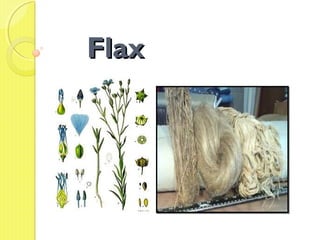
 Flax fiber comes from the stem of plant Linum
usitatissimum. From the inner bark of this plant there
are long, slender, thick-walled cells of which the
fiber strands are composed.
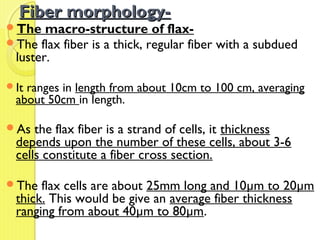
Chemical compositionChemical composition
 Cellulose                                          92%
 Hemicellulose                                   2%
 Lignin                                               4%
 Others ( pectin, fats, wax)                                           
2%
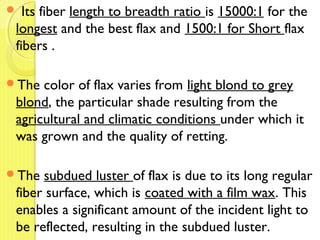
Fiber morphology-Fiber morphology-
The macro-structure of flax-
The flax fiber is a thick, regular fiber with a subdued
luster.
It ranges in length from about 10cm to 100 cm, averaging
about 50cm in length.
As the flax fiber is a strand of cells, it thickness
depends upon the number of these cells, about 3-6
cells constitute a fiber cross section.
The flax cells are about 25mm long and 10µm to 20µm
thick. This would be give an average fiber thickness
ranging from about 40µm to 80µm.
 Its fiber length to breadth ratio is 15000:1 for the
longest and the best flax and 1500:1 for Short flax
fibers .
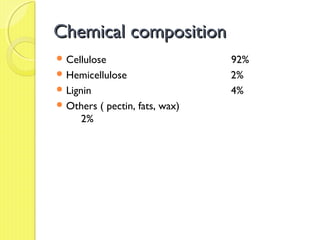
The color of flax varies from light blond to grey
blond, the particular shade resulting from the
agricultural and climatic conditions under which it
was grown and the quality of retting.
The subdued luster of flax is due to its long regular
fiber surface, which is coated with a film wax. This
enables a significant amount of the incident light to
be reflected, resulting in the subdued luster.
There may be up to 80 nodes in a single flax
fiber cell. The length of the node indicates the
width or thickness of the fiber cell.
Where ever a node occurs, it indicates a change
in the spiral direction of the fibrils which
constitute the cell walls.
Such spiraling imparts strength to the cell and,
hence, to the flax fiber
Microscopic appearance of flax-Microscopic appearance of flax-
The cross markings, known as nodes, on flax fibers
give them their characteristic microscopic
appearance.
n
o
d
e
s
The micro-structure of flax-The micro-structure of flax-
The flax fiber cell is covered with a wax film.
The cell walls of flax are constructed of spiraling
fibrils composed of cellulose polymers.
On the whole, the flax cell is more sturdily
constructed then the cotton cell, as indicated by
the former’s thicker cell walls.
This explains, in part, the greater tenacity of flax
compared with cotton.
The polymer system-The polymer system-
The flax polymer and its polymer system-
it has a degree of polymerization of about 18000.
This means the flax polymer is about 18000nm long, and about
0.8nm thick.
The polymer system of flax is more crystalline , because of its
longer polymers, spirals about each other at approximately 6°
to the fiber axis, thereby contributing towards the tenacity and
durability of fiber.
The greater crystallinity of flax fibers is demonstrate by the fact
that they are stronger, crisper and stiffer to handle, and textile
materials wrinkle more readily than those of cotton fibers.
Physical properties-Physical properties-
Tenacity-
Flax is a very strong fiber because it’s very crystalline
polymer system permits its extremely long polymers to form
more hydrogen bonds than cotton polymers.
Elastic-plastic nature-
The very inelastic nature is due to very crystalline polymer
system.
It tends to lock its polymers into position with the aid of the
countless hydrogen bonds which form between the
polymers.
 Flax will resist being flexed or bent,. When these are bent
or flexed, their polymers are liable to break leading to
fractures in the polymer system.
Hygroscopic nature-
Flax fiber is very absorbent,
 Owing to the countless polar –OH groups in its
polymers, these attract water molecules, which are
also polar.
 Aqueous swelling of the flax fiber is due to a
separation or forcing apart of polymers by the water
molecules in the amorphous regions only.
 The polarity of the water molecules, attracted to the
hydroxyl groups on the polymers, dissipates any static
charge which might develop.
Thermal properties-
Flax has the best heat resistance and conductivity
of all the commonly used textile fibers. No
satisfactory explanation can be offered for this.
Excessive application of heat energy causes the flax
fiber to scouch, char and burn, This is an indication
that flax is not thermoplastic,
which may be attributed to the extremely long
fiber polymers and the countless hydrogen bonds
they form.
Chemical properties-Chemical properties-
Effect of acids
flax fibers are weakened and destroyed by acids.
Acidic conditions hydrolyze the flax polymer at the
glycoside oxygen atom, which links the two glucose
units to form the cellobiose unit.
 Mineral or inorganic acids, being stronger that
organic acids, will hydrolyze the flax polymer more
rapidly.
linen textile materials are not mercerized .
Normal laundering will result in alkaline
hydrolysis of the waxes and gums bonding the
cells forming the flax fiber together. This
results in cell ends projecting above the surface
of linen textile materials, and is referred to as
cottonising of linen.
Several cottonising will cause a noticeable
weakening of the linen textile material.
Effect of bleaches-Effect of bleaches-
The most common bleaches used on flax textile
materials are sodium hypochlorite and sodium per
borate.
These two bleaches are examples of oxidizing
bleaches, which is mostly used for flax textile
materials. Oxidizing bleaches are so called because
they liberate oxygen which does the actual
bleaching.
Manufacture of LinenManufacture of Linen
1. Collection of plants- when the
stems of the plant turns yellow at the
seeds turn green to pale brown. The
plants are pulled out by the roots.
These are tied into bunches.
2. Drying and rippling- after pulling the
Flax, plant is tied in bundles and left to dry for few
days. The leaves and seeds are removed from
the stems by a process called Rippling. For
this, the head of the stem is passed through
coarse comb. After the removal of leaves and
seeds, the stems are again tied up in bundles.
Seeds are used for the production of Linseed
oil.
3.Retting- this is an important process. The fleshy
part of the stem is rotted by contact with water.
Retting is a ferment process where the Pectin
Ovurum(Pectin eater) bacteria eat the gum(pectin)
which bind the fiber to the stem. There are 5
method of retting-
A. Dew retting-
stems are spread out in fields and are exposed to
rain, sun and dew for several weeks, until, the stalk
begins to separate from the fiber. It takes around
15-30 days. Because of long exposure to the sun
and other natural conditions, causes to
discoloration of the fiber.
B. Water retting- the bundle of
the stems are kept in running or
segmented water for about 2
weeks . Swift running of water
carries away the bacteria and
thus slow down the fermentation. The stem bundles
are covered with straw and stones are put on the
straw to give extra weight. After 2 weeks the stalks
(upper portion of stem) separates out from the fiber
and the bundles are taken out of the water and left
to
dry.
C. Wooden vat retting- the stems are steeped
in water at the controlled temperatur75°-90° in a
Vat or in a container until the stems get soft. This is
a fast process and the easiest method of retting and
the quality of the fibers are good from this process.
D.Chemical retting- in this process the stems
are treated with mild/dilute conc. Acid and alkalis
then the fibers are easily removed from the stems.
E.Enzyme retting- enzyme retting is the safest
and fastest process of retting, in this process the
fibers can be taken out from the stems within few
houres.
4.Breaking and scutching- when
the stems are completely dry linen fiber
are separated from these stems when
the decomposed woody tissue is dry.
It is crushable by passing through iron
Rollers. The breaking operation break
the outer stalk. It reduces the stalk
to small pieces of bark called slivers. Scutching is
done with the help of scutching machine which
removes the broken slivers by means of rotating
wooden peddles, thus releasing the flax fiber from
the stem or it separates the fibers from woody
stalk
5. Hackling or combing and spinning- during this
process series of iron combs are used, ranging from coarse to fine.
Fibers are pulled through the teeth of combs, beginning with the
coarse one. The short fibers break off used for inferior quality Lenin
called Tow linen. Then the spinning process is carried out-
Tow-lines Long staple or line
Carding Carding
Card Card
Slivering Slivering
Sliver Sliver
Spinning Drawints Raning
Coarse yarn(linen) Rove
Spinning
fine yarn (linen)
6.weaving, finishing & dyeing- bleaching is
given to the yarn and later on dyeing is done.
The reason being the Linen yarn is in natural
color i.e. grey or yellowish grey. Dyeing can
not be done directly because it is not white in
color. That is why bleaching is done before
dyeing.
UsefulnessUsefulness
Moisture absorption.
Thermal insulation.
Strength.
Low static charge.
Resistance to soil.
Harvesting
Direct Combine Harvesting 
Thank
you

Flax fiber ppt

  • 1.
  • 2.
    Textile classification-Textile classification- Theflax fiber is classified, as a natural, cellulose, bast, multi-cellular fiber. it is considered to be a heavy fiber, for this reason that most linen textile materials are of light construction. Thick linen textile materials would be uncomfortably heavy to wear.  Flax fiber comes from the stem of plant Linum usitatissimum. From the inner bark of this plant there are long, slender, thick-walled cells of which the fiber strands are composed.
  • 4.
    Chemical compositionChemical composition Cellulose                                          92%  Hemicellulose                                   2%  Lignin                                               4%  Others ( pectin, fats, wax)                                            2%
  • 5.
    Fiber morphology-Fiber morphology- Themacro-structure of flax- The flax fiber is a thick, regular fiber with a subdued luster. It ranges in length from about 10cm to 100 cm, averaging about 50cm in length. As the flax fiber is a strand of cells, it thickness depends upon the number of these cells, about 3-6 cells constitute a fiber cross section. The flax cells are about 25mm long and 10µm to 20µm thick. This would be give an average fiber thickness ranging from about 40µm to 80µm.
  • 6.
     Its fiberlength to breadth ratio is 15000:1 for the longest and the best flax and 1500:1 for Short flax fibers . The color of flax varies from light blond to grey blond, the particular shade resulting from the agricultural and climatic conditions under which it was grown and the quality of retting. The subdued luster of flax is due to its long regular fiber surface, which is coated with a film wax. This enables a significant amount of the incident light to be reflected, resulting in the subdued luster.
  • 7.
    There may beup to 80 nodes in a single flax fiber cell. The length of the node indicates the width or thickness of the fiber cell. Where ever a node occurs, it indicates a change in the spiral direction of the fibrils which constitute the cell walls. Such spiraling imparts strength to the cell and, hence, to the flax fiber
  • 8.
    Microscopic appearance offlax-Microscopic appearance of flax- The cross markings, known as nodes, on flax fibers give them their characteristic microscopic appearance. n o d e s
  • 9.
    The micro-structure offlax-The micro-structure of flax- The flax fiber cell is covered with a wax film. The cell walls of flax are constructed of spiraling fibrils composed of cellulose polymers. On the whole, the flax cell is more sturdily constructed then the cotton cell, as indicated by the former’s thicker cell walls. This explains, in part, the greater tenacity of flax compared with cotton.
  • 10.
    The polymer system-Thepolymer system- The flax polymer and its polymer system- it has a degree of polymerization of about 18000. This means the flax polymer is about 18000nm long, and about 0.8nm thick. The polymer system of flax is more crystalline , because of its longer polymers, spirals about each other at approximately 6° to the fiber axis, thereby contributing towards the tenacity and durability of fiber. The greater crystallinity of flax fibers is demonstrate by the fact that they are stronger, crisper and stiffer to handle, and textile materials wrinkle more readily than those of cotton fibers.
  • 11.
    Physical properties-Physical properties- Tenacity- Flaxis a very strong fiber because it’s very crystalline polymer system permits its extremely long polymers to form more hydrogen bonds than cotton polymers. Elastic-plastic nature- The very inelastic nature is due to very crystalline polymer system. It tends to lock its polymers into position with the aid of the countless hydrogen bonds which form between the polymers.  Flax will resist being flexed or bent,. When these are bent or flexed, their polymers are liable to break leading to fractures in the polymer system.
  • 12.
    Hygroscopic nature- Flax fiberis very absorbent,  Owing to the countless polar –OH groups in its polymers, these attract water molecules, which are also polar.  Aqueous swelling of the flax fiber is due to a separation or forcing apart of polymers by the water molecules in the amorphous regions only.  The polarity of the water molecules, attracted to the hydroxyl groups on the polymers, dissipates any static charge which might develop.
  • 13.
    Thermal properties- Flax hasthe best heat resistance and conductivity of all the commonly used textile fibers. No satisfactory explanation can be offered for this. Excessive application of heat energy causes the flax fiber to scouch, char and burn, This is an indication that flax is not thermoplastic, which may be attributed to the extremely long fiber polymers and the countless hydrogen bonds they form.
  • 14.
    Chemical properties-Chemical properties- Effectof acids flax fibers are weakened and destroyed by acids. Acidic conditions hydrolyze the flax polymer at the glycoside oxygen atom, which links the two glucose units to form the cellobiose unit.  Mineral or inorganic acids, being stronger that organic acids, will hydrolyze the flax polymer more rapidly.
  • 15.
    linen textile materialsare not mercerized . Normal laundering will result in alkaline hydrolysis of the waxes and gums bonding the cells forming the flax fiber together. This results in cell ends projecting above the surface of linen textile materials, and is referred to as cottonising of linen. Several cottonising will cause a noticeable weakening of the linen textile material.
  • 16.
    Effect of bleaches-Effectof bleaches- The most common bleaches used on flax textile materials are sodium hypochlorite and sodium per borate. These two bleaches are examples of oxidizing bleaches, which is mostly used for flax textile materials. Oxidizing bleaches are so called because they liberate oxygen which does the actual bleaching.
  • 17.
    Manufacture of LinenManufactureof Linen 1. Collection of plants- when the stems of the plant turns yellow at the seeds turn green to pale brown. The plants are pulled out by the roots. These are tied into bunches.
  • 18.
    2. Drying andrippling- after pulling the Flax, plant is tied in bundles and left to dry for few days. The leaves and seeds are removed from the stems by a process called Rippling. For this, the head of the stem is passed through coarse comb. After the removal of leaves and seeds, the stems are again tied up in bundles. Seeds are used for the production of Linseed oil.
  • 19.
    3.Retting- this isan important process. The fleshy part of the stem is rotted by contact with water. Retting is a ferment process where the Pectin Ovurum(Pectin eater) bacteria eat the gum(pectin) which bind the fiber to the stem. There are 5 method of retting- A. Dew retting- stems are spread out in fields and are exposed to rain, sun and dew for several weeks, until, the stalk begins to separate from the fiber. It takes around 15-30 days. Because of long exposure to the sun and other natural conditions, causes to discoloration of the fiber.
  • 20.
    B. Water retting-the bundle of the stems are kept in running or segmented water for about 2 weeks . Swift running of water carries away the bacteria and thus slow down the fermentation. The stem bundles are covered with straw and stones are put on the straw to give extra weight. After 2 weeks the stalks (upper portion of stem) separates out from the fiber and the bundles are taken out of the water and left to dry.
  • 21.
    C. Wooden vatretting- the stems are steeped in water at the controlled temperatur75°-90° in a Vat or in a container until the stems get soft. This is a fast process and the easiest method of retting and the quality of the fibers are good from this process. D.Chemical retting- in this process the stems are treated with mild/dilute conc. Acid and alkalis then the fibers are easily removed from the stems. E.Enzyme retting- enzyme retting is the safest and fastest process of retting, in this process the fibers can be taken out from the stems within few houres.
  • 22.
    4.Breaking and scutching-when the stems are completely dry linen fiber are separated from these stems when the decomposed woody tissue is dry. It is crushable by passing through iron Rollers. The breaking operation break the outer stalk. It reduces the stalk to small pieces of bark called slivers. Scutching is done with the help of scutching machine which removes the broken slivers by means of rotating wooden peddles, thus releasing the flax fiber from the stem or it separates the fibers from woody stalk
  • 23.
    5. Hackling orcombing and spinning- during this process series of iron combs are used, ranging from coarse to fine. Fibers are pulled through the teeth of combs, beginning with the coarse one. The short fibers break off used for inferior quality Lenin called Tow linen. Then the spinning process is carried out- Tow-lines Long staple or line Carding Carding Card Card Slivering Slivering Sliver Sliver Spinning Drawints Raning Coarse yarn(linen) Rove Spinning fine yarn (linen)
  • 24.
    6.weaving, finishing &dyeing- bleaching is given to the yarn and later on dyeing is done. The reason being the Linen yarn is in natural color i.e. grey or yellowish grey. Dyeing can not be done directly because it is not white in color. That is why bleaching is done before dyeing.
  • 25.
  • 29.
  • 31.
  • 34.

Editor's Notes

  • #4 Flax fibers are amongst the oldest fiber crops in the world. The use of flax for the production of linen goes back 5000 years. Linen was also used in Ancient Egypt to wrap their dead!
  • #27 Flax fibres are easily ignitable and burn quickly due to the cellulose( a complex carbohydrate (c6h10o5)n ) content. Heat resistant properties will deteriorate the natural oils which hold the cells together when exposed to steam and hot water over time - Consider this point when washing & cleaning linen.
  • #28 Crops of flax require up to 5 times less use of fertilisers and pesticides when compared with cotton crops. The entire flax crop is used - no waste is created during harvesting. Flax farming does not damage the earth beneath and is not hazardous to eco systems. Processing does not use as much energy or chemicals compared with artificial textile fibre processing. Look for natural, chemical free, untreated and uncoloured linen for the truest eco credentials – check with the manufacturer for details. In untreated state, holds no associated health risks.
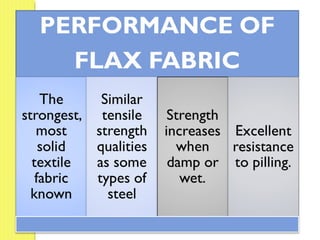
  • #29 Performance {this is very important because the end use of the fabric depends on its performance) . The strongest & most solid textile fibre known. Similar tensile strength qualities as some types of steel. Strength increases when damp or wet. Excellent resistance to pilling ( formation of little fabric balls on the surface of the fabric caused by rubbing )
  • #30 Flax may be harvested with a swather (windrower) or by direct combining.
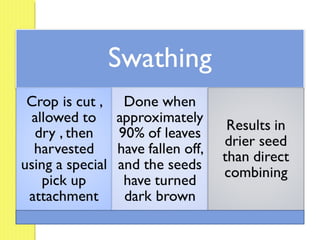
  • #31 Swathing should be done when approximately 90% of leaves have fallen off, and the seeds have turned dark brown. Swathing, then combining, results in drier seed than direct combining. results in drier seed than direct combining.
  • #32 a method of machine harvesting of agricultural crops with a single harvesting operation Should not be attempteed unless flax is free of weeds and has ripened uniformmly In these conditions , this is d cheapest method
  • #33 /flax fabric is used around the home in curtains, bed linen, upholstery(COVERING ON FURNITURE ) , table dressings and soft furnishings(RUGS , MATS ).
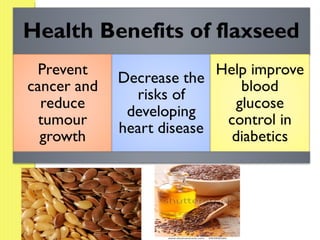
  • #34 Health BenefitsResearch shows that flaxseed may have the ability to:Prevent cancer and reduce tumor growth in the breasts, prostate and colon Decrease the risks of developing heart disease, blood clots, strokes, and cardiac arrhythmia by lowering total cholesterol, LDL (bad) cholesterol, triglycerides, and blood pressure Regulate bowel functions and prevent constipation Relieve breast pain related to a woman’s hormonal cycle Help improve blood glucose control in diabetics Help reduce inflammation associated with arthritis, Parkinson’s disease and asthma Thus we see that the whole plant is very beneficial to us.