Department of Electronics and Instrumentation
Engineering
INTELLIGENT FACE MASK DETECTION
AND AUTOMATIC DOOR OPENING SYSTEM
16EI811 - Project Work II
* 1
TEAM MEMBERS:
Porselvi S
Pugazhenthi C
Ramya P
(17BEI3026)
(17BEI3030)
(17BEI3036)
GUIDED BY:
Mr.Aravindaguru. I (AP/EIE)
It is suggested to wear a face mask and maintain social distancing
to avoid coming in contact with novel corona-virus.
Therefore, we are going to build a computer vision based face
mask detector which detects whether the person is wearing a mask
or not.
OBJECTIVE
ABSTRACT
 Wearing face masks and following safe social distancing are two of the
enhanced safety protocols need to be followed in public places in order to
prevent the spread of the virus.
 To create safe environment that contributes to public safety, we propose an
efficient computer vision based approach focused on the real-time automated
monitoring of people to detect both safe social distancing and face masks in
public places by implementing the model on Computer to monitor activity
and detect violations through camera.
 Automated inspection reduces manpower to inspect the public and also can
be used in any place.
INTRODUCTION
 Recently India along with almost all big and small countries stated emergency
conditions for the novel corona virus (COVID-19).
 Practically, the whole population of the world is under lockdown and people
are maintaining social distances as suggested by the World Health
Organization (WHO). This deadly virus has infected tens of lakhs individuals
and continues to spread globally.
 Hospitals are experiencing higher than normal patient loads and treating all
patients quickly and effectively now becomes a very challenging task. Due to
fear, country-wise lockdown, and suspended OPDs in Hospitals regular
patients are also not able to approach doctors.
* Project Title 7
S. No Authors Title of Paper Name of the journal
, vol., issue
Observations
1 Zhong-Qiu Zhao Object Detection
with Deep Learning
IEEE Prior to overview
on deep learning
based object
detection
approaches
2 Z. A. Memish,
A. I. Zumla,
R. F.
Al-Hakeem, A.
A. AlRabeeah,
and G.
M. Stephens
Family cluster of
middle east
respiratory syndrome
corona virus
infections
New England
Journal of
Medicine
The current COVID-
19 outbreak has
provoked social
stigma and
discriminatory
behaviours against
people of certain
ethnic backgrounds
as well as anyone
perceived to have
been in contact with
the virus
LITERATURE SURVEY
S. No Authors Title of Paper Name of
the journal
, vol., issue
Observations
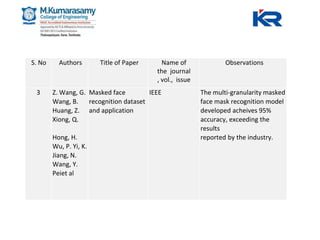
3 Z. Wang, G. Masked face IEEE The multi-granularity masked
Wang, B. recognition dataset face mask recognition model
Huang, Z. and application developed acheives 95%
Xiong, Q. accuracy, exceeding the
results
Hong, H. reported by the industry.
Wu, P. Yi, K.
Jiang, N.
Wang, Y.
Peiet al
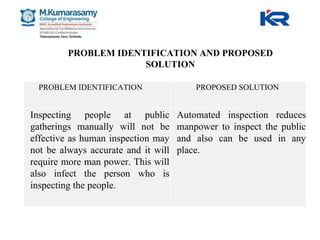
PROBLEM IDENTIFICATION AND PROPOSED
SOLUTION
PROBLEM IDENTIFICATION PROPOSED SOLUTION
Inspecting people at public
gatherings manually will not be
effective as human inspection may
not be always accurate and it will
require more man power. This will
also infect the person who is
inspecting the people.
Automated inspection reduces
manpower to inspect the public
and also can be used in any
place.
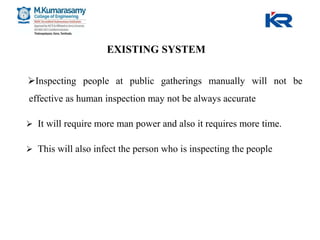
EXISTING SYSTEM
Inspecting people at public gatherings manually will not be
effective as human inspection may not be always accurate
 It will require more man power and also it requires more time.
 This will also infect the person who is inspecting the people
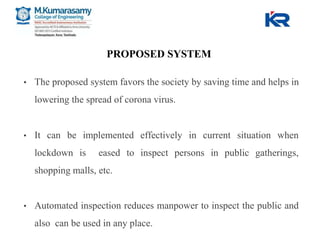
PROPOSED SYSTEM
• The proposed system favors the society by saving time and helps in
lowering the spread of corona virus.
• It can be implemented effectively in current situation when
lockdown is eased to inspect persons in public gatherings,
shopping malls, etc.
• Automated inspection reduces manpower to inspect the public and
also can be used in any place.
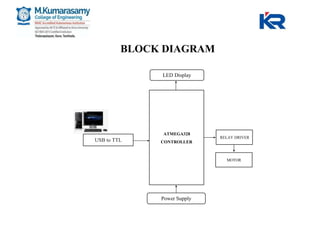
BLOCK DIAGRAM
Power Supply
LED Display
RELAY DRIVER
MOTOR
USB to TTL
ATMEGA328
CONTROLLER
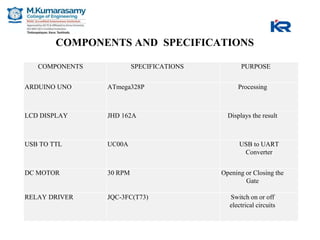
COMPONENTS SPECIFICATIONS PURPOSE
ARDUINO UNO ATmega328P Processing
LCD DISPLAY JHD 162A Displays the result
USB TO TTL UC00A USB to UART
Converter
DC MOTOR 30 RPM Opening or Closing the
Gate
RELAY DRIVER JQC-3FC(T73) Switch on or off
electrical circuits
COMPONENTS AND SPECIFICATIONS
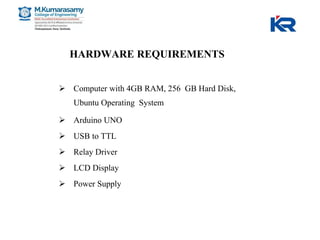
HARDWARE REQUIREMENTS
 Computer with 4GB RAM, 256 GB Hard Disk,
Ubuntu Operating System
 Arduino UNO
 USB to TTL
 Relay Driver
 LCD Display
 Power Supply
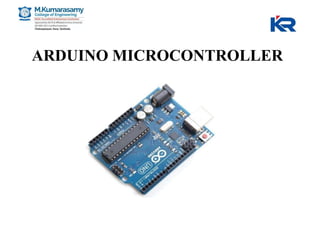
ARDUINO MICROCONTROLLER
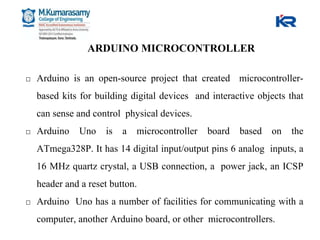
□ Arduino is an open-source project that created microcontroller-
based kits for building digital devices and interactive objects that
can sense and control physical devices.
□ Arduino Uno is a microcontroller board based on the
ATmega328P. It has 14 digital input/output pins 6 analog inputs, a
16 MHz quartz crystal, a USB connection, a power jack, an ICSP
header and a reset button.
□ Arduino Uno has a number of facilities for communicating with a
computer, another Arduino board, or other microcontrollers.
USB to TTL
 A USB adapter is a type of protocol converter that is used for
converting USB data signals to and from other communications
standards. Commonly, USB adapters are used to convert USB data to
standard serial port data and vice versa. Most commonly the USB
data signals are converted to either RS232, RS485, RS422, or TTL-
level UART serial data.
 The PL-2303 chip provides a convenient solution for connecting a
UART-like full-duplex asynchronous serial device to any Universal
Serial Bus (USB) capable host.
 This is an LCD Display designed for E-blocks. It is a 16 character,
2-line alphanumeric LCD display connected to a single 9-way D-
type connector.
 This allows the device to be connected to most E-Block I/O ports.
The display also requires a 5V power supply.
 The 5V is best generated from the E-blocks multi programmer or a
5V fixed regulated power supply
LCD DISPLAY
RELAY DRIVER
□ Relays are simple switches which are operated both
electrically and mechanically. Relays consist of a n
electromagnet and also a set of contacts. The switching
mechanism is carried out with the help of the
electromagnet.
□ It is also used in places where only one signal can be used
to control a lot of circuits. They were used to switch the
signal coming from one source to another destination. The
high end applications of relays require high power to be
driven by electric motors and so on. Such relays are called
contactors.
POWER SUPPLY
 An AC powered linear power supply usually uses a transformer
to convert the voltage from the wall outlet (mains) to a different,
usually a lower voltage. If it is used to produce DC, a rectifier is
used. These pulsations occur at a frequency related to the AC
power frequency (for example, a multiple of 50 or 60 Hz)
 The voltage produced by an unregulated power supply will vary
depending on the load and on variations in the AC supply. For
critical electronics applications a linear regulator will be used to
stabilize and adjust the voltage
SOFTWARE REQUIREMENTS
 PROTEUS SIMULATION
 OPEN CV
 TENSORFLOW
 EMBEDDED C
 ARDUINO IDE
SOFTWARE TOOLS
1. Arduino IDE
The Arduino Integrated Development Environment (IDE) is a
cross platform application (for Windows, macOS, Linux) that is
written in the programming language Java.
It is used to write and upload programs to Arduino compatible
boards, but also, with the help of 3rd party cores, other vendor
development boards.
2. Proteus Simulation
The Proteus Design Suite is a Windows application for schematic
capture, simulation, and PCB (Printed Circuit Board) layout design.
It can be purchased in many configurations, depending on the size of
designs being produced and the requirements for microcontroller
simulation.
ISIS is the software used to draw schematics and simulate the circuits
in real time. The simulation allows human access during run time, thus
providing real time simulation.
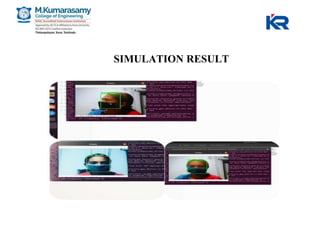
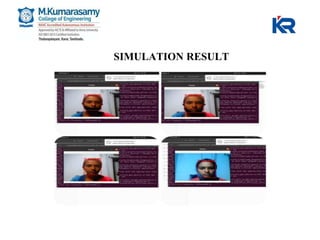
SIMULATION RESULT
SIMULATION RESULT
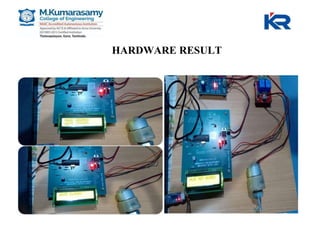
HARDWARE RESULT
CONCLUSION
 Thus, this proposed system will operate in an efficient manner in the
current situation when the lockout is eased and helps to track public
places easily in an automated manner.
 The solution has the potential to significantly reduce violations by
real-time interventions, so the proposed system would improve public
safety through saving time and helping to reduce the spread of
coronavirus. This solution can be used in places like temples,
shopping complex, metro stations, airports, etc
REFERENCES
1. Vikram Kulkarni & Viswaprakash Babu, embedded smart car security
system on face detection, special issue of IJCCT, ISSN
(Online) : 22310371, ISSN (Print) : 0975-7449, volume-3, issue-1
2. N. M. Z. Hashim, M. H. A. Halim, H. Bakri, S. H. Husin & M. M.
Said, Vehicle Security System Using Zigbee , International Journal of
Scientific and Research Publications, Volume 3, Issue 9, September
2013,ISSN 2250-3153
3. Jaypal Baviskar , Afshan Mulla , Manish Upadhye , Jeet Desai and
Aniket Bhovad, “Performance analysis of ZigBee based real time
Home Automation system”, International Conference on
Communication, Information & Computing Technology
(ICCICT), Mumbai, India, Jan. 16-17, 2015
5. Pengfei Zhou; Yuanqing Zheng; Mo Li, "How Long to Wait?
Predicting Bus Arrival Time with Mobile Phone Based
Participatory Sensing," Mobile Computing, IEEE Transactions on,
vol.13, no.6, pp.1228, 1241, June 2014.
THANK YOU

BATCH 1.pptx

  • 1.
    Department of Electronicsand Instrumentation Engineering INTELLIGENT FACE MASK DETECTION AND AUTOMATIC DOOR OPENING SYSTEM 16EI811 - Project Work II * 1
  • 2.
    TEAM MEMBERS: Porselvi S PugazhenthiC Ramya P (17BEI3026) (17BEI3030) (17BEI3036) GUIDED BY: Mr.Aravindaguru. I (AP/EIE)
  • 3.
    It is suggestedto wear a face mask and maintain social distancing to avoid coming in contact with novel corona-virus. Therefore, we are going to build a computer vision based face mask detector which detects whether the person is wearing a mask or not. OBJECTIVE
  • 4.
    ABSTRACT  Wearing facemasks and following safe social distancing are two of the enhanced safety protocols need to be followed in public places in order to prevent the spread of the virus.  To create safe environment that contributes to public safety, we propose an efficient computer vision based approach focused on the real-time automated monitoring of people to detect both safe social distancing and face masks in public places by implementing the model on Computer to monitor activity and detect violations through camera.  Automated inspection reduces manpower to inspect the public and also can be used in any place.
  • 5.
    INTRODUCTION  Recently Indiaalong with almost all big and small countries stated emergency conditions for the novel corona virus (COVID-19).  Practically, the whole population of the world is under lockdown and people are maintaining social distances as suggested by the World Health Organization (WHO). This deadly virus has infected tens of lakhs individuals and continues to spread globally.  Hospitals are experiencing higher than normal patient loads and treating all patients quickly and effectively now becomes a very challenging task. Due to fear, country-wise lockdown, and suspended OPDs in Hospitals regular patients are also not able to approach doctors.
  • 6.
    * Project Title7 S. No Authors Title of Paper Name of the journal , vol., issue Observations 1 Zhong-Qiu Zhao Object Detection with Deep Learning IEEE Prior to overview on deep learning based object detection approaches 2 Z. A. Memish, A. I. Zumla, R. F. Al-Hakeem, A. A. AlRabeeah, and G. M. Stephens Family cluster of middle east respiratory syndrome corona virus infections New England Journal of Medicine The current COVID- 19 outbreak has provoked social stigma and discriminatory behaviours against people of certain ethnic backgrounds as well as anyone perceived to have been in contact with the virus LITERATURE SURVEY
  • 7.
    S. No AuthorsTitle of Paper Name of the journal , vol., issue Observations 3 Z. Wang, G. Masked face IEEE The multi-granularity masked Wang, B. recognition dataset face mask recognition model Huang, Z. and application developed acheives 95% Xiong, Q. accuracy, exceeding the results Hong, H. reported by the industry. Wu, P. Yi, K. Jiang, N. Wang, Y. Peiet al
  • 8.
    PROBLEM IDENTIFICATION ANDPROPOSED SOLUTION PROBLEM IDENTIFICATION PROPOSED SOLUTION Inspecting people at public gatherings manually will not be effective as human inspection may not be always accurate and it will require more man power. This will also infect the person who is inspecting the people. Automated inspection reduces manpower to inspect the public and also can be used in any place.
  • 9.
    EXISTING SYSTEM Inspecting peopleat public gatherings manually will not be effective as human inspection may not be always accurate  It will require more man power and also it requires more time.  This will also infect the person who is inspecting the people
  • 10.
    PROPOSED SYSTEM • Theproposed system favors the society by saving time and helps in lowering the spread of corona virus. • It can be implemented effectively in current situation when lockdown is eased to inspect persons in public gatherings, shopping malls, etc. • Automated inspection reduces manpower to inspect the public and also can be used in any place.
  • 11.
    BLOCK DIAGRAM Power Supply LEDDisplay RELAY DRIVER MOTOR USB to TTL ATMEGA328 CONTROLLER
  • 12.
    COMPONENTS SPECIFICATIONS PURPOSE ARDUINOUNO ATmega328P Processing LCD DISPLAY JHD 162A Displays the result USB TO TTL UC00A USB to UART Converter DC MOTOR 30 RPM Opening or Closing the Gate RELAY DRIVER JQC-3FC(T73) Switch on or off electrical circuits COMPONENTS AND SPECIFICATIONS
  • 13.
    HARDWARE REQUIREMENTS  Computerwith 4GB RAM, 256 GB Hard Disk, Ubuntu Operating System  Arduino UNO  USB to TTL  Relay Driver  LCD Display  Power Supply
  • 14.
  • 15.
    ARDUINO MICROCONTROLLER □ Arduinois an open-source project that created microcontroller- based kits for building digital devices and interactive objects that can sense and control physical devices. □ Arduino Uno is a microcontroller board based on the ATmega328P. It has 14 digital input/output pins 6 analog inputs, a 16 MHz quartz crystal, a USB connection, a power jack, an ICSP header and a reset button. □ Arduino Uno has a number of facilities for communicating with a computer, another Arduino board, or other microcontrollers.
  • 16.
    USB to TTL A USB adapter is a type of protocol converter that is used for converting USB data signals to and from other communications standards. Commonly, USB adapters are used to convert USB data to standard serial port data and vice versa. Most commonly the USB data signals are converted to either RS232, RS485, RS422, or TTL- level UART serial data.  The PL-2303 chip provides a convenient solution for connecting a UART-like full-duplex asynchronous serial device to any Universal Serial Bus (USB) capable host.
  • 17.
     This isan LCD Display designed for E-blocks. It is a 16 character, 2-line alphanumeric LCD display connected to a single 9-way D- type connector.  This allows the device to be connected to most E-Block I/O ports. The display also requires a 5V power supply.  The 5V is best generated from the E-blocks multi programmer or a 5V fixed regulated power supply LCD DISPLAY
  • 18.
    RELAY DRIVER □ Relaysare simple switches which are operated both electrically and mechanically. Relays consist of a n electromagnet and also a set of contacts. The switching mechanism is carried out with the help of the electromagnet. □ It is also used in places where only one signal can be used to control a lot of circuits. They were used to switch the signal coming from one source to another destination. The high end applications of relays require high power to be driven by electric motors and so on. Such relays are called contactors.
  • 19.
    POWER SUPPLY  AnAC powered linear power supply usually uses a transformer to convert the voltage from the wall outlet (mains) to a different, usually a lower voltage. If it is used to produce DC, a rectifier is used. These pulsations occur at a frequency related to the AC power frequency (for example, a multiple of 50 or 60 Hz)  The voltage produced by an unregulated power supply will vary depending on the load and on variations in the AC supply. For critical electronics applications a linear regulator will be used to stabilize and adjust the voltage
  • 20.
    SOFTWARE REQUIREMENTS  PROTEUSSIMULATION  OPEN CV  TENSORFLOW  EMBEDDED C  ARDUINO IDE
  • 21.
    SOFTWARE TOOLS 1. ArduinoIDE The Arduino Integrated Development Environment (IDE) is a cross platform application (for Windows, macOS, Linux) that is written in the programming language Java. It is used to write and upload programs to Arduino compatible boards, but also, with the help of 3rd party cores, other vendor development boards.
  • 22.
    2. Proteus Simulation TheProteus Design Suite is a Windows application for schematic capture, simulation, and PCB (Printed Circuit Board) layout design. It can be purchased in many configurations, depending on the size of designs being produced and the requirements for microcontroller simulation. ISIS is the software used to draw schematics and simulate the circuits in real time. The simulation allows human access during run time, thus providing real time simulation.
  • 23.
  • 24.
  • 25.
  • 26.
    CONCLUSION  Thus, thisproposed system will operate in an efficient manner in the current situation when the lockout is eased and helps to track public places easily in an automated manner.  The solution has the potential to significantly reduce violations by real-time interventions, so the proposed system would improve public safety through saving time and helping to reduce the spread of coronavirus. This solution can be used in places like temples, shopping complex, metro stations, airports, etc
  • 27.
    REFERENCES 1. Vikram Kulkarni& Viswaprakash Babu, embedded smart car security system on face detection, special issue of IJCCT, ISSN (Online) : 22310371, ISSN (Print) : 0975-7449, volume-3, issue-1 2. N. M. Z. Hashim, M. H. A. Halim, H. Bakri, S. H. Husin & M. M. Said, Vehicle Security System Using Zigbee , International Journal of Scientific and Research Publications, Volume 3, Issue 9, September 2013,ISSN 2250-3153
  • 28.
    3. Jaypal Baviskar, Afshan Mulla , Manish Upadhye , Jeet Desai and Aniket Bhovad, “Performance analysis of ZigBee based real time Home Automation system”, International Conference on Communication, Information & Computing Technology (ICCICT), Mumbai, India, Jan. 16-17, 2015 5. Pengfei Zhou; Yuanqing Zheng; Mo Li, "How Long to Wait? Predicting Bus Arrival Time with Mobile Phone Based Participatory Sensing," Mobile Computing, IEEE Transactions on, vol.13, no.6, pp.1228, 1241, June 2014.
  • 29.