Project Management:
a Best Practice
Monica M. Keith
Director of Advancement Operations
Learning Outcomes
• Define project management
• Breaking down the process
• Case studies: small and large-scale
• Review of tools for project management
• Applying project management to your work
Defined…
Project management is the application of
processes, methods, knowledge, skills and
experience to achieve the project objectives.
-The Association of Project Management
Project management typically involves:
• A short-term project
• A specific outcome
• Resources – human and capital
The Process
1. Define
goal/outcome
2. Plan
– Time
– Cost
– Scope
3. Implement
4. Evaluate
1. Define
The outcome/goal(s)
typically predetermined, and initiates and
drives the project.
2. Plan
Planning is the most important step in the
process – and most complicated.
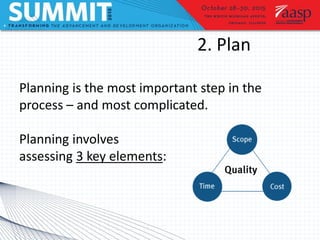
Planning involves
assessing 3 key elements:
• Time – deadline, milestones,
allocation of work between team
members and business as usual.
• Cost – the project budget,
additional/unexpected costs, staff
time, comparable value.
• Scope – directly effected by time
and cost, and vice versa.
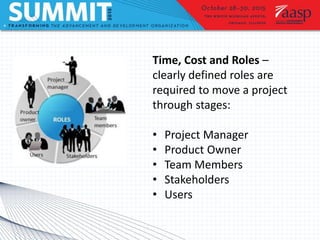
Time, Cost and Roles –
clearly defined roles are
required to move a project
through stages:
• Project Manager
• Product Owner
• Team Members
• Stakeholders
• Users
Implementation
• Strategy
• Milestones
• Resource allocation
• Adjustments
• Documentation
• Communication
Evaluation
• Result
• Process
• Budget
• Lessons learned
• Documentation
Project management as a [best]
practice is a method of planning and
guiding a project from start to finish.
Small Scale Case Study
• New president
• Interim vice president for Advancement
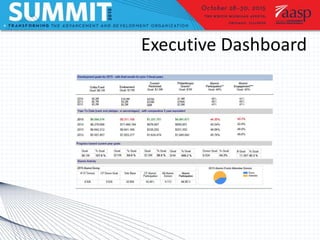
• Request for Executive dashboard
– Educational and actionable
– Current year and comparative historical data
– Data visualization
– Representative of broad division goals
Executive Dashboard
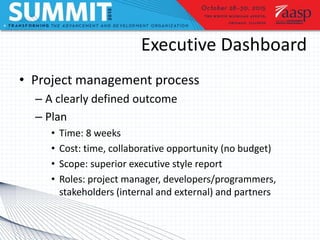
• Project management process
– A clearly defined outcome
– Plan
• Time: 8 weeks
• Cost: time, collaborative opportunity (no budget)
• Scope: superior executive style report
• Roles: project manager, developers/programmers,
stakeholders (internal and external) and partners
Executive Dashboard
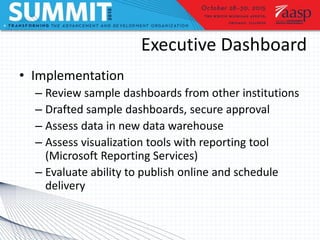
• Implementation
– Review sample dashboards from other institutions
– Drafted sample dashboards, secure approval
– Assess data in new data warehouse
– Assess visualization tools with reporting tool
(Microsoft Reporting Services)
– Evaluate ability to publish online and schedule
delivery
Executive Dashboard
Executive Dashboard
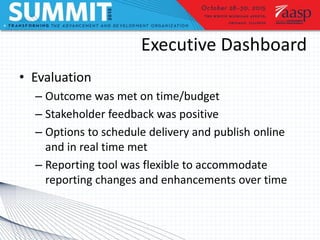
• Evaluation
– Outcome was met on time/budget
– Stakeholder feedback was positive
– Options to schedule delivery and publish online
and in real time met
– Reporting tool was flexible to accommodate
reporting changes and enhancements over time
Large scale Case Study
• Disastrous database conversion
• Many applications tied to old db in shambles
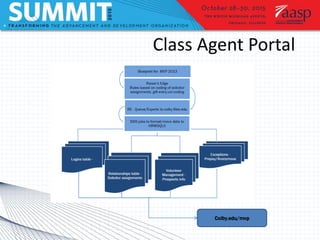
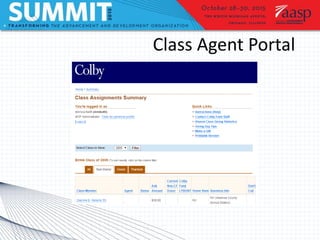
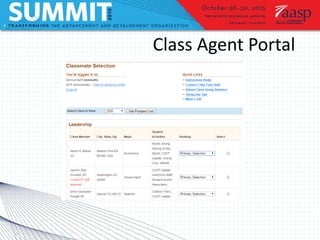
• Rebuild Class Agent Portal
– Re-engineer back end data with new database
– Evaluate volunteer and login structure
– Enhance front end user interface
Class Agent Portal
• Project management process
– Clearly defined goal
– Scope: rebuild to function in time for vol training
– Time: 5-6 months
– Cost: time/labor intensive
– Roles: assigned a project manager, multiple staff
member roles, stakeholders (Annual Giving staff
and volunteers) and partners (ITS)
Class Agent Portal
• Process steps
– Review former class agent portal
– Evaluate all tables, rules, logic for logins
– Assess best way to rebuild tables and add
enhancements
– Carefully stage the tasks and timelines
– Assign project milestones and regular
communication
Class Agent Portal
Colby.edu/mvp
Class Agent Portal
Class Agent Portal
Class Agent Portal
Class Statistics
Class Agent Portal
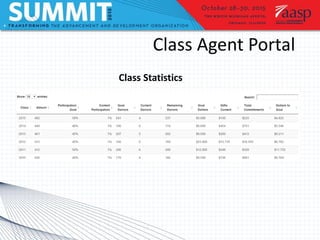
• Evaluation
– Project completed on time/budget
– Stakeholder feedback was positive
– Better team approach and cross training
– Increased usage each year
– Flexibility for enhancements in data or design
added each year since
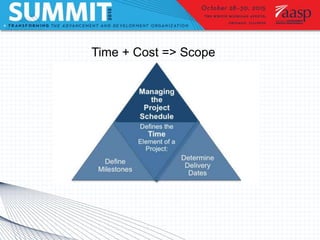
Time + Cost => Scope
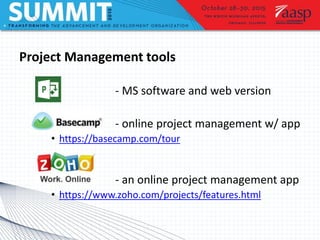
Project Management tools
- MS software and web version
- online project management w/ app
• https://basecamp.com/tour
- an online project management app
• https://www.zoho.com/projects/features.html
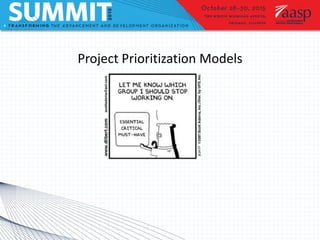
Project Prioritization Models
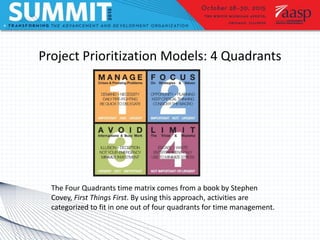
Project Prioritization Models: 4 Quadrants
The Four Quadrants time matrix comes from a book by Stephen
Covey, First Things First. By using this approach, activities are
categorized to fit in one out of four quadrants for time management.
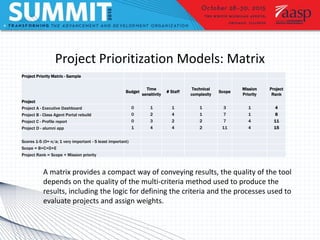
Project Prioritization Models: Matrix
A matrix provides a compact way of conveying results, the quality of the tool
depends on the quality of the multi-criteria method used to produce the
results, including the logic for defining the criteria and the processes used to
evaluate projects and assign weights.
Project Priority Matrix - Sample
Project
Budget
Time
sensitivtiy
# Staff
Technical
complexity
Scope
Mission
Priority
Project
Rank
Project A - Executive Dashboard 0 1 1 1 3 1 4
Project B - Class Agent Portal rebuild 0 2 4 1 7 1 8
Project C - Profile report 0 3 2 2 7 4 11
Project D - alumni app 1 4 4 2 11 4 15
Scores 1-5 (0= n/a; 1 very important - 5 least important)
Scope = B+C+D+E
Project Rank = Scope + Mission priority
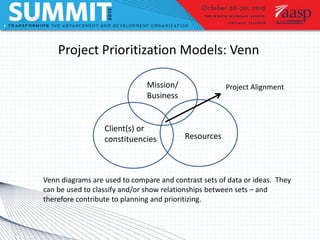
Project Prioritization Models: Venn
Venn diagrams are used to compare and contrast sets of data or ideas. They
can be used to classify and/or show relationships between sets – and
therefore contribute to planning and prioritizing.
Project Alignment
Resources
Client(s) or
constituencies
Mission/
Business
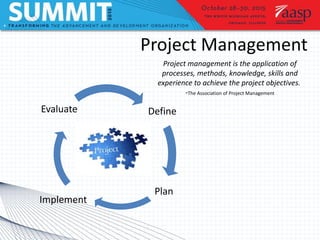
Project Management
Define
Plan
Implement
Evaluate
Project management is the application of
processes, methods, knowledge, skills and
experience to achieve the project objectives.
-The Association of Project Management
Questions?
Project Management

AASP_SUMMIT2015_Project_Mgt.pptx

  • 1.
    Project Management: a BestPractice Monica M. Keith Director of Advancement Operations
  • 2.
    Learning Outcomes • Defineproject management • Breaking down the process • Case studies: small and large-scale • Review of tools for project management • Applying project management to your work
  • 3.
    Defined… Project management isthe application of processes, methods, knowledge, skills and experience to achieve the project objectives. -The Association of Project Management
  • 4.
    Project management typicallyinvolves: • A short-term project • A specific outcome • Resources – human and capital
  • 5.
    The Process 1. Define goal/outcome 2.Plan – Time – Cost – Scope 3. Implement 4. Evaluate
  • 6.
    1. Define The outcome/goal(s) typicallypredetermined, and initiates and drives the project.
  • 7.
    2. Plan Planning isthe most important step in the process – and most complicated. Planning involves assessing 3 key elements:
  • 8.
    • Time –deadline, milestones, allocation of work between team members and business as usual. • Cost – the project budget, additional/unexpected costs, staff time, comparable value. • Scope – directly effected by time and cost, and vice versa.
  • 9.
    Time, Cost andRoles – clearly defined roles are required to move a project through stages: • Project Manager • Product Owner • Team Members • Stakeholders • Users
  • 10.
    Implementation • Strategy • Milestones •Resource allocation • Adjustments • Documentation • Communication
  • 11.
    Evaluation • Result • Process •Budget • Lessons learned • Documentation
  • 12.
    Project management asa [best] practice is a method of planning and guiding a project from start to finish.
  • 13.
    Small Scale CaseStudy • New president • Interim vice president for Advancement • Request for Executive dashboard – Educational and actionable – Current year and comparative historical data – Data visualization – Representative of broad division goals
  • 14.
    Executive Dashboard • Projectmanagement process – A clearly defined outcome – Plan • Time: 8 weeks • Cost: time, collaborative opportunity (no budget) • Scope: superior executive style report • Roles: project manager, developers/programmers, stakeholders (internal and external) and partners
  • 15.
    Executive Dashboard • Implementation –Review sample dashboards from other institutions – Drafted sample dashboards, secure approval – Assess data in new data warehouse – Assess visualization tools with reporting tool (Microsoft Reporting Services) – Evaluate ability to publish online and schedule delivery
  • 16.
  • 17.
    Executive Dashboard • Evaluation –Outcome was met on time/budget – Stakeholder feedback was positive – Options to schedule delivery and publish online and in real time met – Reporting tool was flexible to accommodate reporting changes and enhancements over time
  • 19.
    Large scale CaseStudy • Disastrous database conversion • Many applications tied to old db in shambles • Rebuild Class Agent Portal – Re-engineer back end data with new database – Evaluate volunteer and login structure – Enhance front end user interface
  • 20.
    Class Agent Portal •Project management process – Clearly defined goal – Scope: rebuild to function in time for vol training – Time: 5-6 months – Cost: time/labor intensive – Roles: assigned a project manager, multiple staff member roles, stakeholders (Annual Giving staff and volunteers) and partners (ITS)
  • 21.
    Class Agent Portal •Process steps – Review former class agent portal – Evaluate all tables, rules, logic for logins – Assess best way to rebuild tables and add enhancements – Carefully stage the tasks and timelines – Assign project milestones and regular communication
  • 22.
  • 23.
  • 24.
  • 25.
  • 26.
    Class Agent Portal •Evaluation – Project completed on time/budget – Stakeholder feedback was positive – Better team approach and cross training – Increased usage each year – Flexibility for enhancements in data or design added each year since
  • 27.
    Time + Cost=> Scope
  • 29.
    Project Management tools -MS software and web version - online project management w/ app • https://basecamp.com/tour - an online project management app • https://www.zoho.com/projects/features.html
  • 30.
  • 31.
    Project Prioritization Models:4 Quadrants The Four Quadrants time matrix comes from a book by Stephen Covey, First Things First. By using this approach, activities are categorized to fit in one out of four quadrants for time management.
  • 32.
    Project Prioritization Models:Matrix A matrix provides a compact way of conveying results, the quality of the tool depends on the quality of the multi-criteria method used to produce the results, including the logic for defining the criteria and the processes used to evaluate projects and assign weights. Project Priority Matrix - Sample Project Budget Time sensitivtiy # Staff Technical complexity Scope Mission Priority Project Rank Project A - Executive Dashboard 0 1 1 1 3 1 4 Project B - Class Agent Portal rebuild 0 2 4 1 7 1 8 Project C - Profile report 0 3 2 2 7 4 11 Project D - alumni app 1 4 4 2 11 4 15 Scores 1-5 (0= n/a; 1 very important - 5 least important) Scope = B+C+D+E Project Rank = Scope + Mission priority
  • 33.
    Project Prioritization Models:Venn Venn diagrams are used to compare and contrast sets of data or ideas. They can be used to classify and/or show relationships between sets – and therefore contribute to planning and prioritizing. Project Alignment Resources Client(s) or constituencies Mission/ Business
  • 34.
    Project Management Define Plan Implement Evaluate Project managementis the application of processes, methods, knowledge, skills and experience to achieve the project objectives. -The Association of Project Management
  • 35.

Editor's Notes

  • #6 Planning =uses goal to define, design, build process to implement
  • #8 Typical conversion 8-12 months
  • #14 Executive dashboard